




Abstract
Coalitions of formal housing, civil rights and anti-poverty organisations play an important role in urban housing movements. However, the extent and dynamics of these ‘housing movement coalitions’ are not well understood. In this article, I document the geography of housing movement coalitions across 148 US cities using leadership networks among 11.8 million civic leaders. I show that cohesive coalitions of formal housing, civil rights and anti-poverty leaders exist in a wide range of US cities, including in conservative states. In terms of change, housing coalitions have only grown in a handful of politically liberal cities since the global financial crisis, and most housing coalitions have stagnated and some have declined. Finally, change score regression models indicate that economic insecurity is associated with housing coalition emergence, but municipal austerity and hostile political environments may weaken the opportunities for coalitions to expand. These findings suggest movement scholars should widen their focus to include housing coalitions in more diverse contexts, and more closely examine how municipal funding shapes housing coalitions and their relationship to grassroots activism.
Introduction
This article undertakes a comparative and longitudinal analysis of ‘housing movement coalitions’ in the United States. Coalitions of formal housing, civil rights and anti-poverty organisations increasingly comprise a housing movement coalition that supports activism among low-income renters, particularly in large, cosmopolitan cities where movements are most influential (Card, 2022; Huron, 2018; Iveson and Tattersall, 2020; Lichterman, 2020; Martínez and Gil, 2022). Recent work suggests that such housing movement coalitions also exist in conservative and smaller cities though (Michener and SoRelle, 2022; also Pixová, 2018), and there is no documentation of the scope of coalitions 1 outside of familiar movement contexts like Los Angeles and New York. Similarly, some scholars suggest housing coalitions are growing (Desmond, 2020; Lichterman, 2020), while others note that many housing coalitions fail (Martinez, 2019; Wilde, 2019), and there are no systematic analyses of trends in housing movement coalitions, or the factors associated with their growth. Scholars thus note the importance of coalitions for housing movements (Iveson and Tattersall, 2020), and recently debate the co-opting or empowering role of housing coalitions (Card, 2022; Lima, 2021b), but the actual extent, dynamics and true significance of housing movement coalitions are not known.
In response, I propose to examine leadership structures that could constitute housing movement coalitions, and demonstrate a strategy for tracking evolving relationships among formal housing, civil rights, and anti-poverty leaders in US cities. I begin by developing a longitudinal database of 11.8 million leaders of civil society organisations in the 148 largest US cities. I then employ interlocking directorate networks to study shifting relationships among urban civil society leaders, where I examine how housing leaders have formed relationships with the leaders of civil rights and anti-poverty organisations from 1998 to 2017. Analysis shows that cohesive networks of housing, civil rights and anti-poverty leaders do exist in a diverse range of US cities, including in conservative states. In terms of change, housing coalitions have only grown in a handful of politically liberal cities since the global financial crisis, while most housing coalitions have stagnated, and some have declined. Finally, change score regression models suggest that economic insecurity is associated with housing coalition emergence, but municipal austerity and hostile political environments may weaken the opportunities for coalitions to expand.
These findings both support and qualify recent qualitative studies of housing movements.
Evidence for widespread housing coalitions suggests that future research should widen its focus to include more diverse contexts (e.g. Michener and SoRelle, 2022; Pixová, 2018), as scholars may have unduly focussed on the dynamics of successful, visible housing coalitions in coastal cities. This article also suggests that scholars should re-evaluate the relationship between municipal governance and housing movement coalitions. Scholars have recently focussed on the role of private foundations in shaping formal housing activism (Card, 2022; also Levine, 2016), for example, but public investment is found to facilitate coalition emergence (Pacewicz, 2016), suggesting tensions between grassroots activism and municipally supported coalitions (Lima, 2021b). Finally, this article demonstrates a scalable approach for understanding coalition evolution over time. This article thus responds to recent calls to specify the dynamic evolution of coalitions in civil society (Diani, 2015; Van Dyke and Amos, 2017), enabling future research on the relationships between coalitions, mobilisation and movement outcomes.
Urban housing movements and housing movement coalitions in the United States
The global financial crisis of 2007–2009 catalysed a wave of renter and housing activism (Card, 2022; Desmond, 2020; Lima, 2021a). Millions lost their homes in the years between 2007 and 2011, forcibly increasing the population of renters and generating widespread anger with the predatory practices that precipitated the crisis (Christophers, 2023; Fields, 2018). Housing costs and conditions then worsened until the onset of the COVID-19 epidemic, spurring the emergence of urban housing movements that use ‘direct action and confrontational non-violent strategies to protest against housing oppression and fight for housing justice’ (Lima, 2021a: 3284). Urban housing movements promote renters’‘collective consumption demands’ and the ‘autonomy of local communities’ through confrontations with residential landlords and advocacy for the equitable regulation of housing use and development (Castells, 1983: 305). Urban housing movements thus fight for a ‘right to the city’ for renters and poor urban communities (Domaradzka, 2018: 615), who are threatened by declining standards of living and transformations that heighten their insecurity.
Novel strategies have enabled the growth of housing movements, where grassroots activists have cultivated collective identities based on ‘renter subjectivity’ (Vollmer, 2020; Wilde, 2019), employed a diverse variety of militant tactics (Lima, 2021a) and actively worked to empower race–class subjugated communities (Michener and SoRelle, 2022). Coalitions of civil society organisations have begun to play an increasing role in housing movements as they have grown (Iveson and Tattersall, 2020), however, both creating new tensions in movements (Lima, 2021b), and expanding the influence of movements in urban conflicts over growth and housing insecurity (Card, 2022). In the United States in particular, recent ethnographic scholarship suggests that coalitions of formal housing, civil rights and anti-poverty organisations now comprise a housing movement coalition that supports renter activism (Card, 2022; Desmond, 2020; Huron, 2018; Michener and SoRelle, 2022).
More than a decade after the global financial crisis, for example, many nonprofit housing organisations now employ professional staff to organise tenants and conduct advocacy campaigns. These housing nonprofits adopt models of organising from workers centers in the labour movement, including: canvassing apartment buildings with high rates of evictions or property violations; leading tenant meetings in apartment buildings; hosting ‘Know Your Rights’ workshops; encouraging the development of tenant associations; and leading policy campaigns in municipal government (Card, 2022; Lichterman, 2020). The leaders of housing organisations, meanwhile, provide a link between these organising activities and a broader network of nonprofit financial and housing institutions (e.g. Lamb et al., 2023), including nonprofit housing providers, limited-equity cooperatives, and community land trusts who support alternatives to market-based housing.
Networks of housing organisations are also complimented by close relationships with civil rights and anti-poverty organisations. Attorneys employed by nonprofit civil rights organisations are active in renter organising, since renters can face retaliation or eviction for organising against a landlord (Desmond, 2020). Golio et al. (2023) and Michener (2020) also note the importance of civil rights attorneys in recent activism over the ‘right to counsel’ for tenants, which mandates attorney representation for tenants facing eviction and substantially reduces the likelihood that tenants are evicted. Huron (2018), meanwhile, shows how civil rights attorneys advise activists on the technical aspects of housing activism, such as efforts to turn apartments into limited equity cooperatives where local law allows. Finally, Michener and SoRelle (2022) note alternating moments of collaboration and cohesion in the relationship between anti-poverty organisations and housing movements. Renter organisers attempt to develop more holistic, egalitarian and ‘autonomous’ alternatives to professionalised anti-poverty groups, but renter organisations often receive financing and resources from anti-poverty organisations (Michener and SoRelle, 2022: 221–224). Anti-poverty organisations have the greatest resources for helping extremely deprived families, particularly in helping poor families navigate bureaucratic welfare systems to obtain healthcare, cash assistance, help with children or elder care, or housing after eviction (Small et al., 2008). As such, housing activists often refer renter families to anti-poverty organisations as a resource of last resort.
In sum, a body of ethnographic research suggests that coalitions among formal housing, civil rights, and anti-poverty organisations constitute a housing movement coalition within urban housing movements. These coalitions may create new fissures within housing movements (Van Dyke and Amos, 2017; Youssef, 2023), particularly as grassroots organising comes into conflict with the procedures of formalised advocacy organisations (Lima, 2021b), and as the growth of the coalitions creates unwieldy alliances and new internal conflicts (Card, 2022). However, like other social movement coalitions, these ‘organisational collaborations’ also allow organisations to ‘pool resources to pursue shared goals’ (Van Dyke and Amos, 2017: 1) through overlapping memberships (Heaney and Rojas, 2008), joint event participation (Diani, 2015), and shared political endorsements and campaigns (Youssef, 2023). As such, these coalitions provide a movement infrastructure for housing movements, which Andrews (2001: 76) classically defined as ‘diverse leaders and a complex leadership structure, multiple organisations, informal ties that cross geographic and social boundaries, and a resource base that draws substantially on contributions from their members for both labour and money’.
The true extent of housing coalitions is difficult to assess, though. Ethnographies of housing movements largely focus on housing coalitions in liberal metropolises (Card, 2022; Iveson and Tattersall, 2020; Lichterman, 2020; Vollmer, 2020), but coalitions may be active in many cities. Identifying coalitions is not straightforward, as the presence of isolated housing, civil rights and anti-poverty organisations in cities does not signify a coalition. Lichterman (2020: 60–63; see also Iveson and Tattersall, 2020), for example, emphasises that housing coalitions emerge when dispersed housing activists develop a true ‘community of interest’ which ‘defines itself as a collective that shares social and cultural similarities, and faces problems that threaten the collectivity’s well-being’. Like all coalitions, housing coalitions likely vary across cities from short-term or event coalitions (Meyer and Corrigall-Brown, 2005), to more permanent and enduring alliances (Diani, 2015).
Trends in coalition cohesion across the broader US are also not known. On the one hand, Martinez (2019: 1605) notes that scholars tend to focus on successful cases, and that many of the housing coalitions that emerged after the financial crisis had declined by 2014. On the other hand, Michener and SoRelle (2022: 215) document the existence of 134 tenant organisations across the United States and interview 38 organisations across 21 states. These new tenant organisations suggest a broadening coalition infrastructure for housing movements, and Michener and SoRelle (2022: 218–219) find that experiences of economic insecurity have frequently motivated new housing activism. In journalistic accounts, Dougherty (2022) describes the emergence of a robust housing movement in politically conservative Kansas City, MO, implying that coalitions have emerged even in states where local institutions are hostile to housing advocacy (for similar discussions of Europe, see Pixová, 2018). Finally, Card (2022) suggests that ‘money power’ from private foundations has been important in encouraging coalitions, while other urban scholars argue for the importance of public resources in encouraging civic coalitions (e.g. Pacewicz, 2016).
Researchers could benefit from a comprehensive analysis that identifies housing coalitions and tracks trends in housing coalition cohesion, ultimately allowing their impact and relationship to urban housing movements to be assessed. In what follows, I focus on the potential leadership structure of housing coalitions, and track leadership networks between housing, civil rights, and anti-poverty organisations in US cities. I propose that interlocking directorates can be used to identify coalition cohesion through the executive officers of urban civil society organisations, and briefly describe how scholars have used interlocking directorate networks to understand organisational dynamics (Laumann and Pappi, 1976; Pacewicz, 2016). Finally, I outline a strategy for assessing how organisational, ecological and structural explanations are associated with the emergence of housing movement coalitions.
Identifying housing coalitions through leadership networks
There are multiple ways to assess the presence of a coalition, but one of the most common markers of coalition emergence is close relationships among organisational leaders. The leaders of social movement organisations tend to have the largest and most diverse social networks (Andrews, 2001), and the way in which leaders mobilise their social networks is critical for movement success (Andrews et al., 2010). In studies of interorganisational networks, meanwhile, leader relationships have frequently been operationalised through board interlocks. A board interlock is a relationship that occurs when one board leader or officer of an organisation is also a leader or executive officer of another organisation. Urban researchers have studied board interlocks in community organisations ever since the elitist–pluralist debate (Bachrach and Baratz, 1979; Dahl, 2005; Hunter, 2017), including more recently to understand how coalitions emerge in urban civil society (Laumann and Pappi, 1976; Pacewicz, 2016).
Interlocking directorates are attractive for studying coalitions, as boards of directors integrate organisational leaders into cohesive groups with collective identities (Westphal and Zajac, 2013), enabling ‘attempts at purposive action’ that are ‘embedded in concrete, on-going systems of social action’ (Granovetter, 1985: 487). Interlocking directorate networks thus provide an ‘opportunity structure that nobody actively seeks, but that nevertheless emerges’ (Heemskerk, 2013: 95) among organisations, consistent with Lichterman’s (2020) definition of a housing coalition as an emergent ‘community of interest’. In social networks terminology, meanwhile, the emergence of dense bundles of such relationships is typically described as providing social ‘cohesion’ (Moody and White, 2003:107), where cohesion constitutes a group that exists ‘to the extent that multiple independent relational paths among all pairs of members hold it together’.
Most importantly, an interorganisational network perspective offers a scalable approach for tracking longitudinal trends in housing coalition cohesion. Social movement scholars have extensively studied causes of coalition formation (Van Dyke and Amos, 2017; Youssef, 2023), and find that coalitions are associated with social movement success (Iveson and Tattersall, 2020). Outside of historiographic methods, though, the exact structure of coalitions is difficult to operationalise and follow over time, as it implies many relational data points among a potentially large group of actors. Diani (2015: 205), for example, concludes a recent volume on urban civil society by calling for more and better treatments of dynamic evolution in civic networks, which tend to be described in static terms. The most systematic attempts to longitudinally study movement coalitions have been through protest survey sampling methods (e.g. Heaney and Rojas, 2008), but the difficulty of repeatedly conducting such surveys means survey sampling methods produce only periodic snapshots and are intractable for large-scale analysis.
Interlocking directorate networks consequentially offer a scalable measure of coalition evolution around housing activism, as leadership records can be determined yearly from administrative data across cities, states, and even national polities. In the context of this study, then, interlocking directorates offer an extensible approach for understanding not only the structure of civic coalitions in cities, but also how cohesion between housing, anti-poverty, and civil rights leaders evolves over time and is associated with other political, socio-economic and organisational factors.
Why housing coalitions form
In addition to documenting housing coalitions, scholars have proposed several reasons why housing coalitions might cohere in different cities. Grievances about economic insecurity and housing costs are usually seen as the most important reasons that housing coalitions form, echoing a long tradition of social movement scholarship (Klandermans, 1997). Desmond (2020) dates the shocks of the financial crisis of 2007–2009 as the starting point for grassroots tenant activism (see Martinez, 2019 in Spain), and Michener and SoRelle (2022) emphasise the motivating importance of rising eviction rates and urban poverty for tenant activists. Rising housing costs have also been seen as an impetus for housing activism, especially in constrained housing markets like California and New York where movements have fought for rent controls (Card, 2022). In cities where economic insecurity and housing costs are rising, then, housing coalitions may emerge in response to deepening dislocations.
Social movement scholars also identify several other factors associated with coalition formation, however, particularly resources for coalition building and conducive political and institutional environments (Meyer and Corrigall-Brown, 2005; Van Dyke and Amos, 2017). ‘Groups weigh the costs and benefits of participation when deciding to join a coalition’ (Van Dyke and Amos, 2017: 7), and Card (2022) argues that ‘money power’ from private foundations was an impetus for housing groups joining together to support housing propositions in California. Public funding for civic organisations may be important as well, however, since direct services provided by US nonprofits are primarily government funded (Salamon, 1987). The American federal government prioritised the devolution of housing policies to cities in the 1980s (Pacewicz, 2016), and nonprofit housing networks have grown in response to rising municipal–nonprofit partnerships in housing programmes (Levine, 2016). Housing coalitions may thus grow when city spending on public services rises, since housing organisations will become more attractive coalition partners when they are relatively larger and better funded (Van Dyke and Amos, 2017).
In terms of local ecology and political structure, finally, Rinn et al. (2022) and Wilde (2019) suggest the importance of a rooted renter population for housing activism and suggest that coalitions of housing activists will be more difficult to organise in cities with transient populations. Political contexts and regulatory structure have also been identified as important for housing mobilisation, both recently (Card, 2022; Martinez, 2019), and in classic accounts of tenant mobilisations (Castells, 1983; Dreier, 1984). Dreier (1984) argued, for example, that tenant activism in the 1970s was possible in part because the War on Poverty of the 1960s signalled federal support for local anti-poverty movements. More recently, Card (2022) suggests housing coalitions will emerge in states where tenant–landlord law allows housing activists to have a degree of local power and influence, underscoring the importance of political opportunities (McAdam et al., 1996).
Analytic strategy
The twin goals of this study are to identify housing movement coalitions in the United States and understand the factors associated with housing coalition emergence. To do this, I develop an original longitudinal database of urban civil society leaders in the 148 largest US cities. I develop an index of housing coalition cohesion, which identifies whether the leaders of housing, civil rights and anti-poverty organisations tend to have close relationships, and use interlocking directorates to document leader relationships over time. I then link my database of civic leader relationships to multiple databases that describe changing economic insecurity, resource environments, and ecological sources of growth in cities, as well as state tenant–landlord law policy contexts. Finally, I employ change score models to describe the factors associated with housing coalition cohesion.
Indexing housing coalitions
I develop an original database of relationships among urban civic leaders to define and track housing coalitions in the United States (Messamore, 2021). I begin by using Forms 990 filed with the US Internal Revenue Service (IRS) to reconstruct relationships among US civic leaders between the years 1998 and 2017 in the 148 largest US cities. Forms 990 are documents filed by US charitable organisations annually to obtain tax exempt status and contain detailed records of staff and leadership. Data comes from two sources that cover intervals within 1998–2017. Data for the first interval, 1998–2003, comes from a historic dataset (the ‘Digitised Data’ file) of all nonprofits that filed Forms 990 and Forms 990-EZ maintained by the National Center for Charitable Statistics (NCCS). Data for the second interval, 2010–2017, is obtained from the IRS e-filer dataset previously posted at Amazon Web Services (AWS). The IRS e-filer data release provided 2 complete financial information for all e-filing nonprofits from 2010 to roughly 2019. The IRS e-filer dataset is the largest and most detailed source of information on US civic organisations available excepting individual paper filings with the IRS. Neither database is comprehensive of all US civic organizations, 3 though, and they exclude civic organisations not required to file Forms 990 or Forms 990-EZ with the IRS, such as churches and organisations with net assets below $25,000.
These data allow trends in relationships among civic organisations, and their leaders, to be followed in intervals from the late 1990s to the late 2010s. Between 1998 and 2003, my analytic sample includes all organisations and civic leaders that appeared in Forms 990 and Forms 990-EZ filings in the 148 largest US cities. Between 2010 and 2017, my analytic sample includes all organisations and leaders that appeared in e-filed Forms 990 and Forms 990-EZ in these cities. The database contains 11.8 million individual records of staff and board members of nonprofit organisations. I exclude cities below the 148th because, below this size, cities do not consistently have locally based organisations where trends can be analysed. The total number of unique organisations varies greatly between cities because of the span of the analytic sample. 4 The largest US city in the sample, New York City, NY with a population of 8.4 million in 2017, had over 8000 active civic organisations in the 2010s. The smallest US city in the sample, Camden, NJ with a population of 73,780, had 168 active civic organisations in the 2010s.
I examine relationships between urban civil society leaders using organisation-by-organisation interlocking directorate networks. Interlocking directorates are relationships created between organisations when the leader of one civic organisation is also affiliated with another civic organisation. I construct undirected one-mode networks of the civic organisations in each city in each year from 1998 to 2003, and from 2010 to 2017 using Part VII of the Forms 990 (Part V in pre-2008 Forms 990) and Part IV of the Forms 990-EZ. Part VII requires nonprofits to report all directors and executive officers. In analysis no distinction is made between board members and other executive officers listed when locating civic leaders. The identity of each civic leader is constructed by parsing the first and last names of directors and executive officers from Part VII, removing middle names, initials, and honorific titles and converting to lower case. 5 The organisation-by-organisation adjacency matrices then enter 1 in a cell (i, j) if organisation i and j share a civic leader, and a 0 otherwise.
I then rely on the National Taxonomy of Exempt Entities Core Code (NTEE-CC) system to identify housing, civil rights and anti-poverty organisations. The NTEE-CC is a system used by the IRS to indicate the subsector and activity area of an organization. 6 I use the NTEE-CC major group classifications of ‘Housing’ (L) and ‘Civil Rights, Social Action, Advocacy ’ (R) to respectively identify housing and civil rights organisations and their leaders. To identify community anti-poverty organisations, meanwhile, I use NTEE-CC minor codes to capture a broad swath of organisations focussed broadly on neighbourhood improvement, encompassing: organisations focussed on crime prevention, organisations working broadly on neighbourhood development as well as with housing assistance, organisations running substance abuse prevention programmes, organisations that provide job training and workforce development, and organisations that provide recreational and social activities for youth. These classifications of community anti-poverty organisations have previously been used in studies of crime (Sharkey et al., 2017: 1220), and in research on eviction (Messamore, 2023).
Finally, I defined housing coalitions as emergent when the leaders of housing organisations create cohesive relationships with the leaders of civil rights and anti-poverty organisations. To identify these emergent housing coalitions, I use a two-step approach that combines inductive community detection techniques and theoretically driven measures of concentration. My measure of housing coalition cohesion thus indexes the degree to which housing, civil rights and anti-poverty leaders belong to the same affiliation groups in a given city each year.
In the first step, I identify the leadership groups that exist among all urban civic organisations. Civic leader networks in the US tend to be dominated by large components that connect roughly half of all organisations in any given city (Messamore, 2021: 152), and I locate the largest connected components in each city in each year. Within these components, I then employ the Louvain network community detection algorithm (Ma and DeDeo, 2018) to identify the groups of organisations where leaders tend to sit on each other’s boards. Broadly speaking, in each city and year, Louvain places organisations into groups (or ‘communities’) which maximise their modularity, Q, the fraction of edges within a group minus the fraction of edges expected to occur in that group expected at random in a degree preserving model. As modularity approaches one, Q indicates that a group is highly interconnected. 7
I then construct my focal measure of housing coalition cohesion by indexing the Gini coefficient for the distribution of housing, civil rights, and anti-poverty organisations across the groups detected by Louvain. Networks researchers have typically operationalised cohesiveness through hierarchical k-plex techniques following Moody and White (2003: 107). Such k-plex techniques are a strict operationalisation of cohesion, though, as groups will be only defined as cohesive to the extent that group members are directly tied to one another. Instead, I opt to use Gini coefficients to provide a more general measure of the extent to which housing coalition leaders tend to be connected to one another through both direct and indirect affiliations in groups. In each city in each year this takes the form of:

where
Traditionally used in studies of economic inequality, Gini coefficients can be broadly conceptualised as measures of concentration that index the extent to which a value is distributed evenly across a categorical distinction. Given the organisational groupings detected by Louvain, then, Gini coefficients detect the extent to which housing, civil rights and anti-poverty organisations appear in the same groups, or in different groups, in each city. Housing coalition cohesion then indexes cohesion as a percentage, where a hypothetical score of 0 indexes a city where all eligible organisations exist in different groups, and a score of 100 indicates that all eligible organisations exist in the same group.
Explanations of housing coalition emergence
I link my original database of civic networks to several databases that describe changing conditions within cities. When applicable, US cities are defined through amalgamations of census tracts to census places, where census tracts are linked to census places via the Geographic Correspondence Engine of the Missouri Census Data Center. If census tract geolocators are not available, cities are otherwise defined via the harmonisation of city names (‘St. Louis’ or ‘Saint Louis’, etc., to identify St. Louis, MO).
I use data from the 2000 and 2010 Census, and the 2011–2016 American Community Survey (five-year estimates) to track the responsiveness of housing movements to rising economic disadvantage. Census tract boundaries shift between each decennial census, so I employ geographic crosswalks available at IPUMS to interpolate data from 2000 block group ‘parts’ to 2010 block groups and aggregate these data to 2010 census tract boundaries. Linear interpolation is used to generate these covariates for years between 2000, 2010, and 2016. Afterwards, I aggregate these census tract level boundaries to the city ‘census place’ level to construct municipal measures, and conduct factor analysis 8 to determine whether a linear combination of municipal characteristics could describe economic disadvantage using census data (Sampson et al., 1997). This allows me to generate factor regression scores for underlying concentrated disadvantage in cities, a standardised score with a zero mean and a unit standard deviation, ranging from −2.27 to 3.85. Furthermore, I directly measure changing housing cost pressures on city residents by linking cities to the Federal Housing Finance Agency’s developmental Annual Housing Price Indexes for Core-Based Statistical Areas, allowing me to generate housing price index (baseline year 2000). The housing price index is indexed at 100 in year 2000 and increases relative to 2000 in every subsequent year, to a maximum of 249.09, capturing how movement cohesion is related to relative housing costs growth in cities.
I generate two measures to track the availability of resources for housing coalitions. To test the theory that ‘money power’ (Card, 2022) from private foundations encourages housing coalition cohesion, I use Forms 990 to generate private foundations, a count of the cumulative number of nonprofits per 100,000 residents in a city classified as private foundations by the IRS. To track the relationship between municipal devolution and housing coalitions, I use the Lincoln Institute of Land Policy’s Fiscally Standardized Cities (FiSCs) database. FiSC is a harmonised, longitudinal database that provides systematic accounting of fiscal data for all major areas of government for medium and large US cities between the years 1977 and 2017 (Chernick et al., 2015). I specifically use the FisC variable for real per capita (in units of $100) Municipal Services spending, which encapsulates per capita spending on multiple dimensions of public services, including housing and community development, but also discretionary spending on education, social services, public safety, and other public utilities.
I also generate multiple measures to test the role of community ecology and policy contexts in shaping housing coalitions. To capture Rinn et al. (2022) and Wilde’s (2019) suggestion that cities with transient populations are less likely to have housing movements, I use residential stability, a factor regression score generated in the factor analysis described above, to also capture the percentage of homeowners and long-time residents of a city. Residential stability is a similarly standardised score with a zero mean and a unit standard deviation, ranging from −2.72 to 2.88. I also use Forms 990 to condition my analysis on the count of nonprofits per 100,000 residents, since civic leaders can only create cohesive relationships to the extent that civic organisations exist in a city, and include city population per 100,000 residents to assess whether cities with growing populations are more likely to have housing coalitions. Finally, I use cluster-based classifications of state friendliness to tenants from Hatch (2017) – who defines state orientations to tenants as either ‘Probusiness’, ‘Contradictory’ or ‘Protectionist’ based on their tenant-landlord laws – to generate a categorical measure of the state policy context facing housing coalitions. No variables are logged or otherwise transformed. Variables, and data sources, are further described in Table 1.
Variable descriptions.
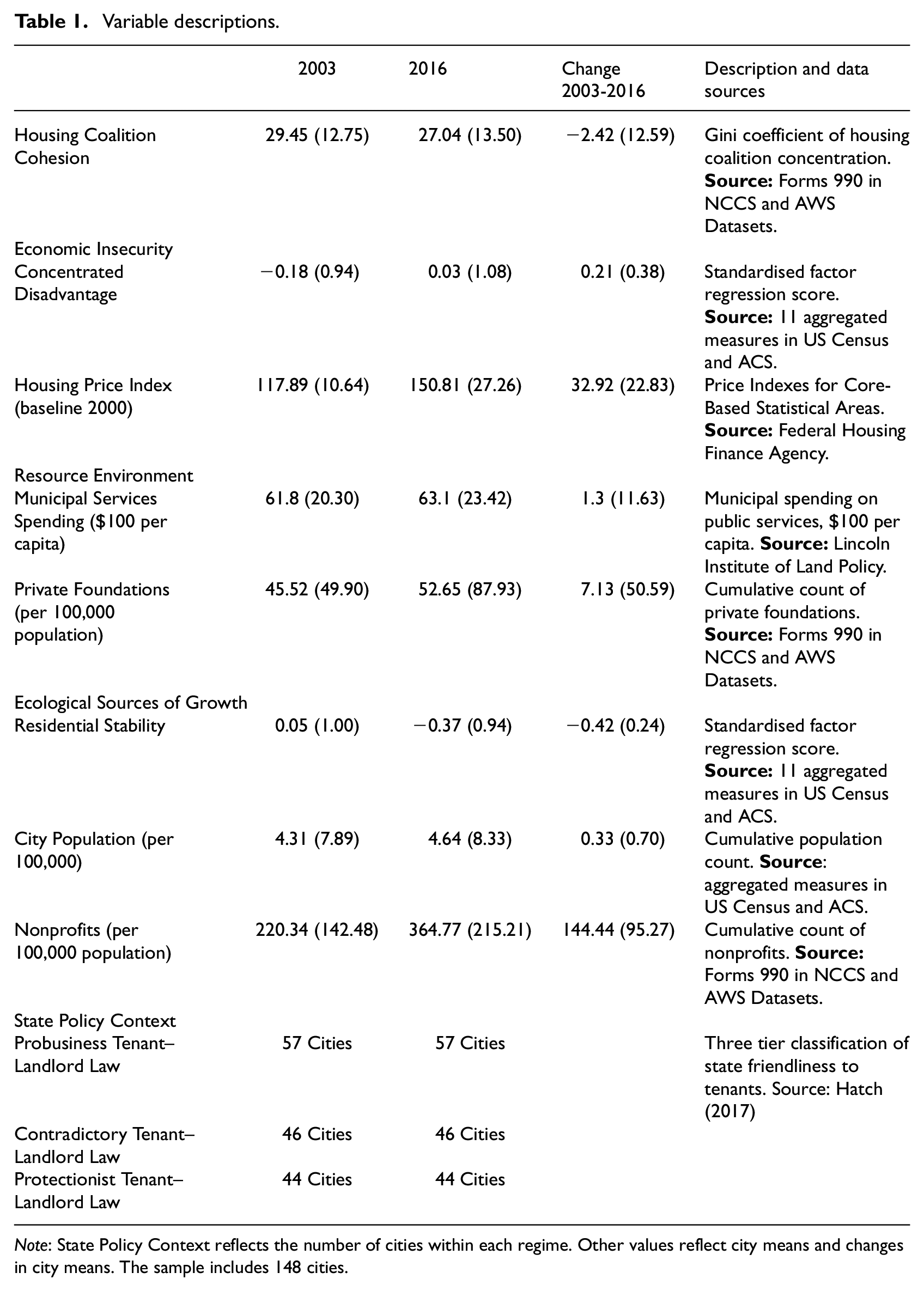
Note: State Policy Context reflects the number of cities within each regime. Other values reflect city means and changes in city means. The sample includes 148 cities.
Methodology
The analysis proceeds in two parts. In the first part, I map housing movement coalitions across the United States and describe which cities had cohesive housing coalitions and which cities did not. I also describe change in housing coalition cohesion, identifying which cities have the fastest growing housing coalitions and which cities have potentially stagnant or declining housing coalitions.
In the second component, I build upon the descriptive analysis and employ change score regression models to understand the factors associated with the growth of housing coalitions. Change score models regress temporal change in cohesion scores onto temporal change in covariates, meaning coefficients rise to the level of significance in the event of simultaneous change, and that the influence of unobserved time invariant heterogeneity is diminished. I model change in housing coalition cohesion in the 10-year interval between 2003 and 2013, the period usually identified as the starting point for contemporary housing mobilisations (Card, 2022; Desmond, 2020; Martinez, 2019). I use three-year averages (2000–2003, and 2013–2016) to smooth estimates and produce consistent estimates of relationships, since housing coalition cohesion indices fluctuate between years. In a simplified form, these decisions specify the following change score regression model:
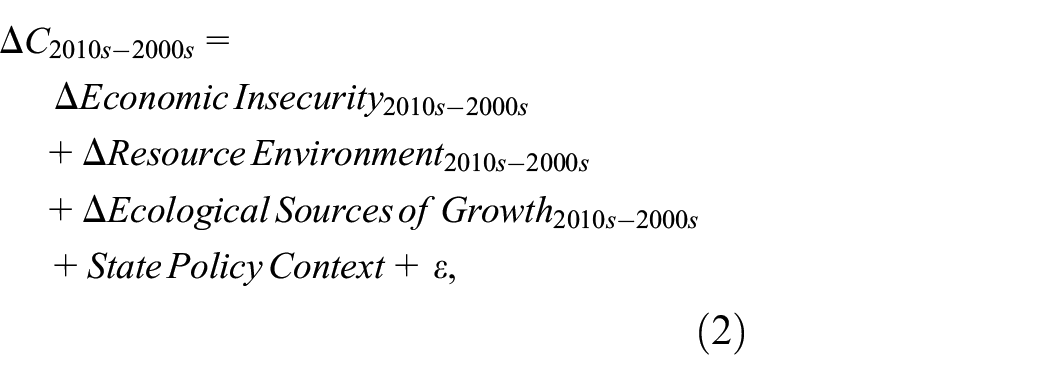
where
Results
Where are housing movement coalitions?
Figure 1 maps housing movement coalitions across the United States. In Figure 1, nodes representing each city are sized by the value of their housing coalition cohesion index, and colour coded by whether a city had low coalition cohesion (<20%), moderate cohesion (20–39%) or relatively high coalition cohesion (>40%). Figure 1 averages cohesion indices between 2010 and 2017 to diminish the influence of year-to-year fluctuations. All large cities with highly cohesive coalitions are labelled.
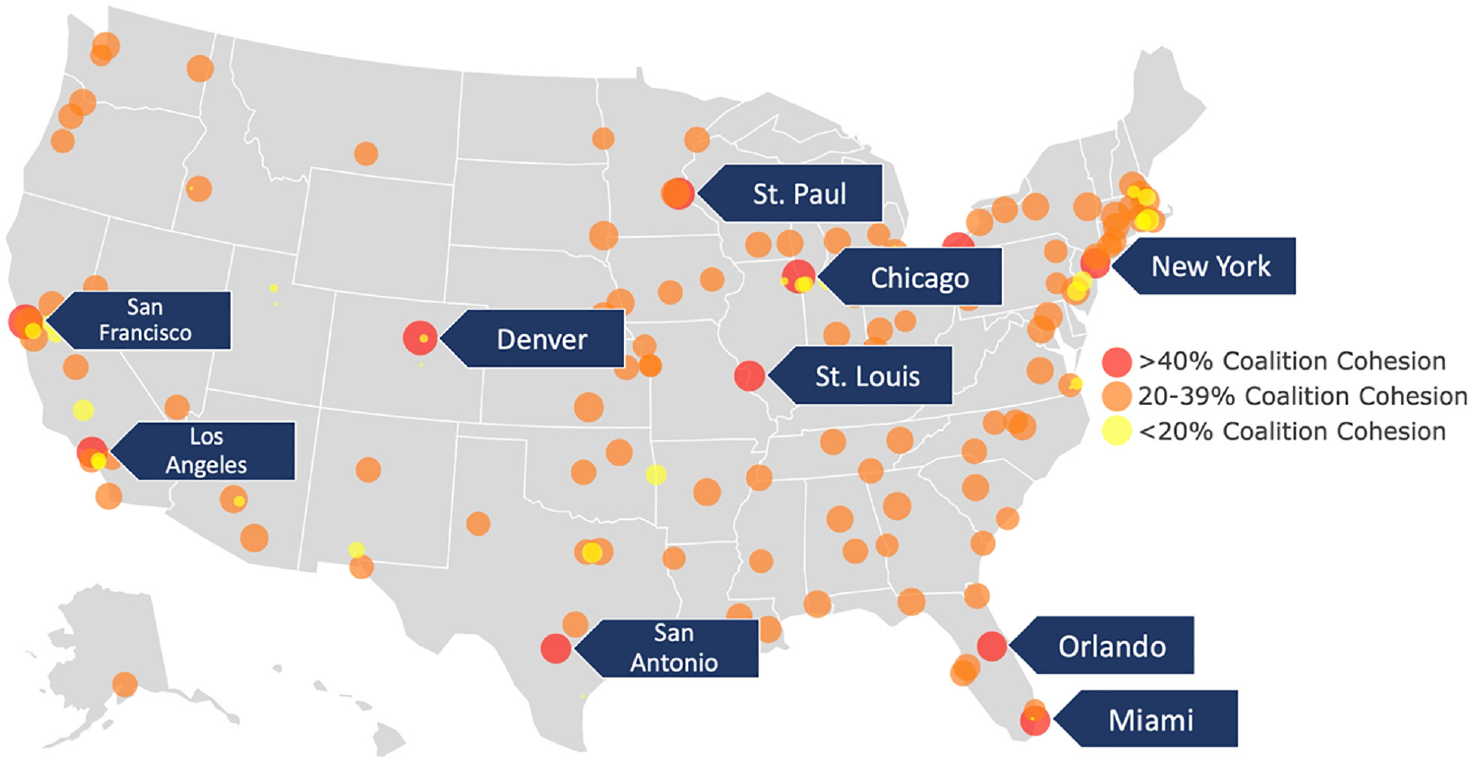
Housing movement coalitions in the 148 largest US cities, 2010–2017.
Figure 1 shows that moderate to highly cohesive housing movement coalitions are more widely distributed across the United States than commonly thought. Projected onto US topography, Figure 1 shows that housing, civil rights and anti-poverty leaders tend to be disconnected in suburbs of large metropolises (cities coloured yellow/light grey), as well as in a small number of cities. More generally, however, moderately cohesive (orange/grey) housing coalitions exist in nearly every state in the continental United States as well as in Anchorage, Alaska, with the average medium or large-sized US city having a cohesion index of 22.9% (SD = 14.74). Figure 1 thus indicates that, in the average US city, housing, civil rights and anti-poverty civic leaders tend to be about as concentrated in a single group as income is concentrated in famously egalitarian Sweden (Gini coefficient of 29.3 in 2019). However, Figure 1 also shows that highly cohesive (red/dark grey) housing coalitions exist in California, New York, across the Midwest, and in several large Southern cities. In other words, most US cities have groups of somewhat interconnected housing, civil rights and anti-poverty civic leaders, but a meaningfully sized group of cities across the US have strongly cohesive housing coalitions.
Table 2 describes the cities that have the most and least cohesive housing movement coalitions. Notably, the cities flagged as having high coalition cohesion have been identified by previous ethnographic research on tenant and housing activism. The cohesion index identifies San Francisco and Oakland in the Bay Area of California, as well as New York City, NY, Chicago, IL, St. Paul, MN and Los Angeles, CA as the cities with the most cohesive networks of civil rights, housing and anti-poverty leaders. These cities are the origin of nationally recognised housing organisations such as the Chicago Anti-Eviction Campaign, California’s Tenants Together, and the national Right to the City Alliance. However, the index also identifies several cohesive coalitions in cities that are less noted, such as Denver, CO and St. Louis, MO, as well as several large cities in the South US including Orlando, FL, San Antonio, TX and Miami, FL. These findings support Michener and SoRelle’s (2022) contention that housing coalitions are now widely dispersed across the US, including in contexts relatively hostile to tenant organising. The identification of Orlando and Miami is particularly noteworthy, as Florida has a deep housing cost crisis but is usually seen as a state with little housing activism. Here, Table 2 suggests that research on housing movements has been selective, focussing on a small number of progressive, metropolitan cities at the expense of attention to coalitions in conservative contexts.
Cities with most and least cohesive housing coalitions, 2010–2017.
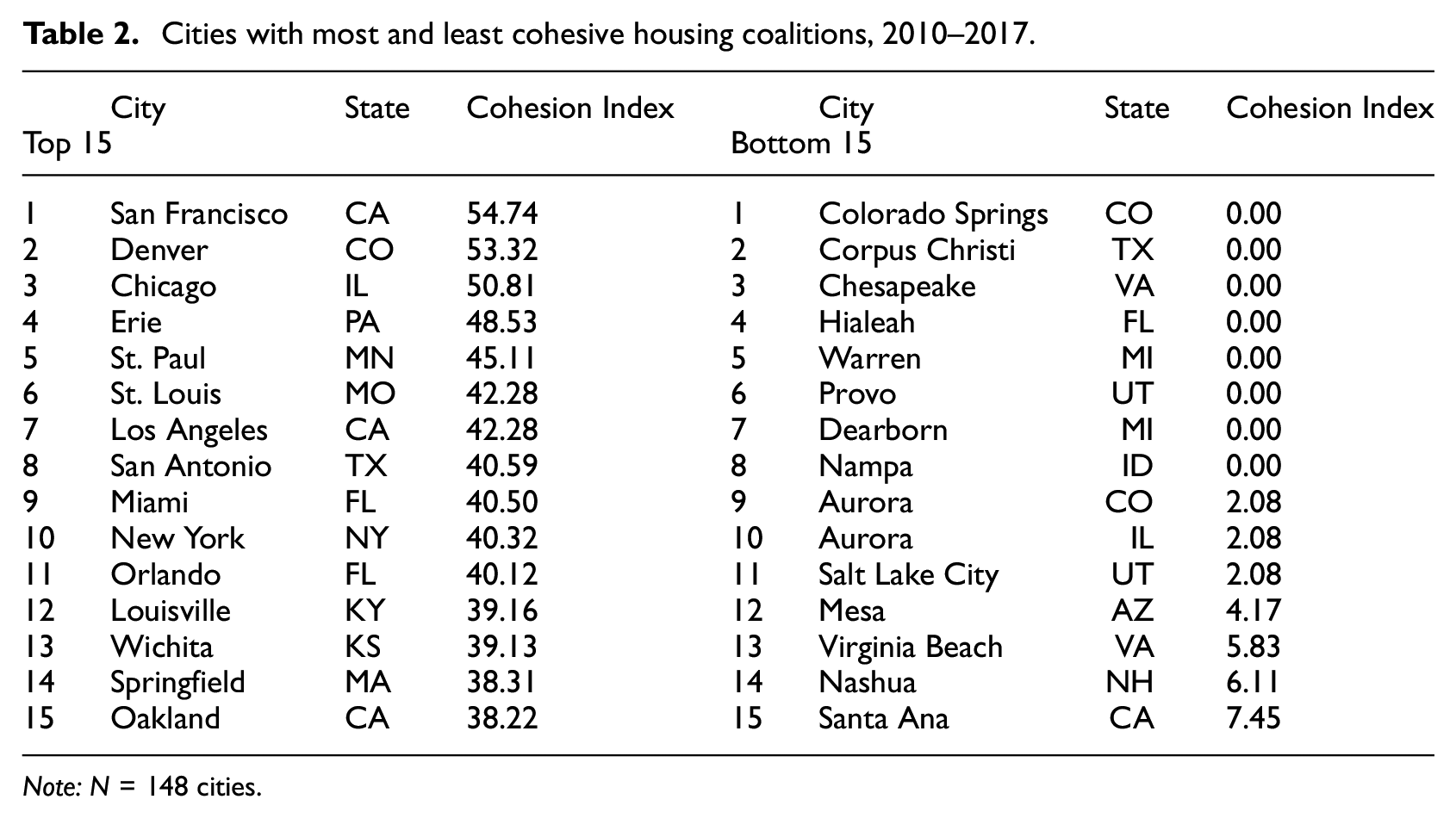
Note: N = 148 cities.
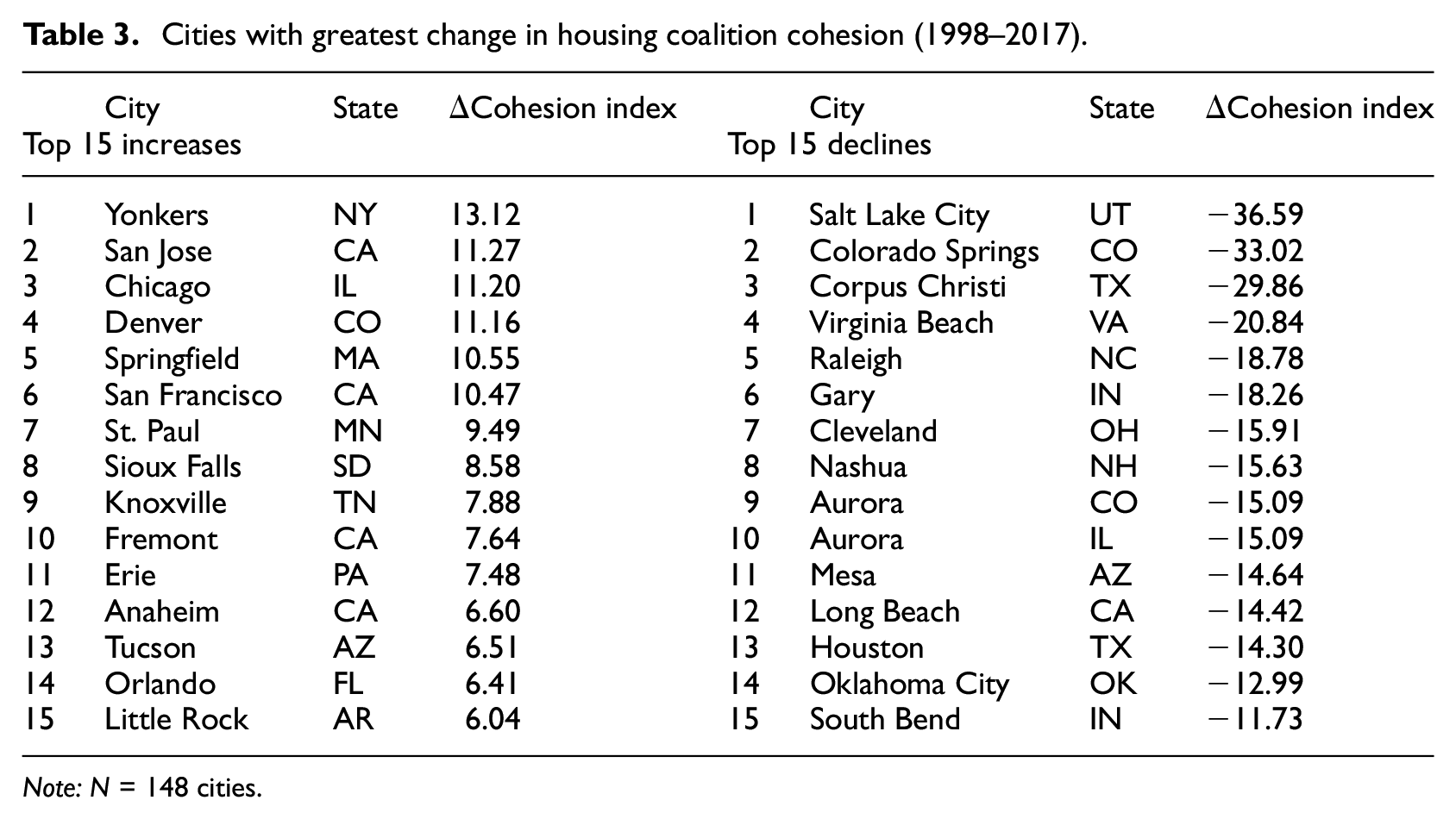
Table 3 further explores variation across the United States and evaluates change in average cohesion between the periods of 1998–2003 and 2010–2017. Critically, Table 3 indicates that the most cohesive housing coalitions in US cities are longstanding, and that outside of these cities, housing coalitions have often stagnated over the last decades. Table 3 shows that modest increases in housing coalition cohesion did occur over the last 20 years and tended to be concentrated in metropolitan areas in liberal US states, such as New York, California, and Illinois. However, stagnation or declines in coalition cohesion were more common across the US than moments of growth. The average US city’s coalition cohesion index changed by −2.4% over the past 20 years, and only six cities experienced a growth index of 10% or more, while 18 cities experienced declines in coalition cohesion by indices of −10%. Table 3 shows that the deepest declines in coalition cohesion occurred in medium sized cities and suburbs in states typically governed by the US Republican Party (11 of 15). Of these cities, three (South Bend, IN, Cleveland, OH and Gary, IN) are rustbelt cities with previous histories of extensive civic communities. Also noteworthy is the collapse of housing coalitions in Salt Lake City, UT, as well as the strong decline in Houston, TX, the fourth largest city in the United States.
Cities with greatest change in housing coalition cohesion (1998–2017).
Note: N = 148 cities.
These findings suggest a disjointed state of housing coalitions in the United States. Networks of housing, civil rights and anti-poverty leaders are apparently common in large and medium-sized US cities, and the housing coalition index shows that longstanding housing coalitions exist in a significant number of large metropolises – like San Antonio, Miami and Orlando – that are not typically associated with housing mobilisations. On the other hand, outside of these cities, Table 3 suggests that relationships among housing, civil rights and anti-poverty leaders have often stagnated or become less cohesive over the past 20 years when the United States is considered as a whole. Furthermore, Table 3 suggests that political contexts and municipal resources are linked to movement consolidation, as rustbelt cities and cities in conservative states have experienced the greatest declines in housing movement cohesion. In the next section, I employ change score models of housing coalition cohesion to understand the factors associated with coalition cohesion.
Why do housing coalitions emerge?
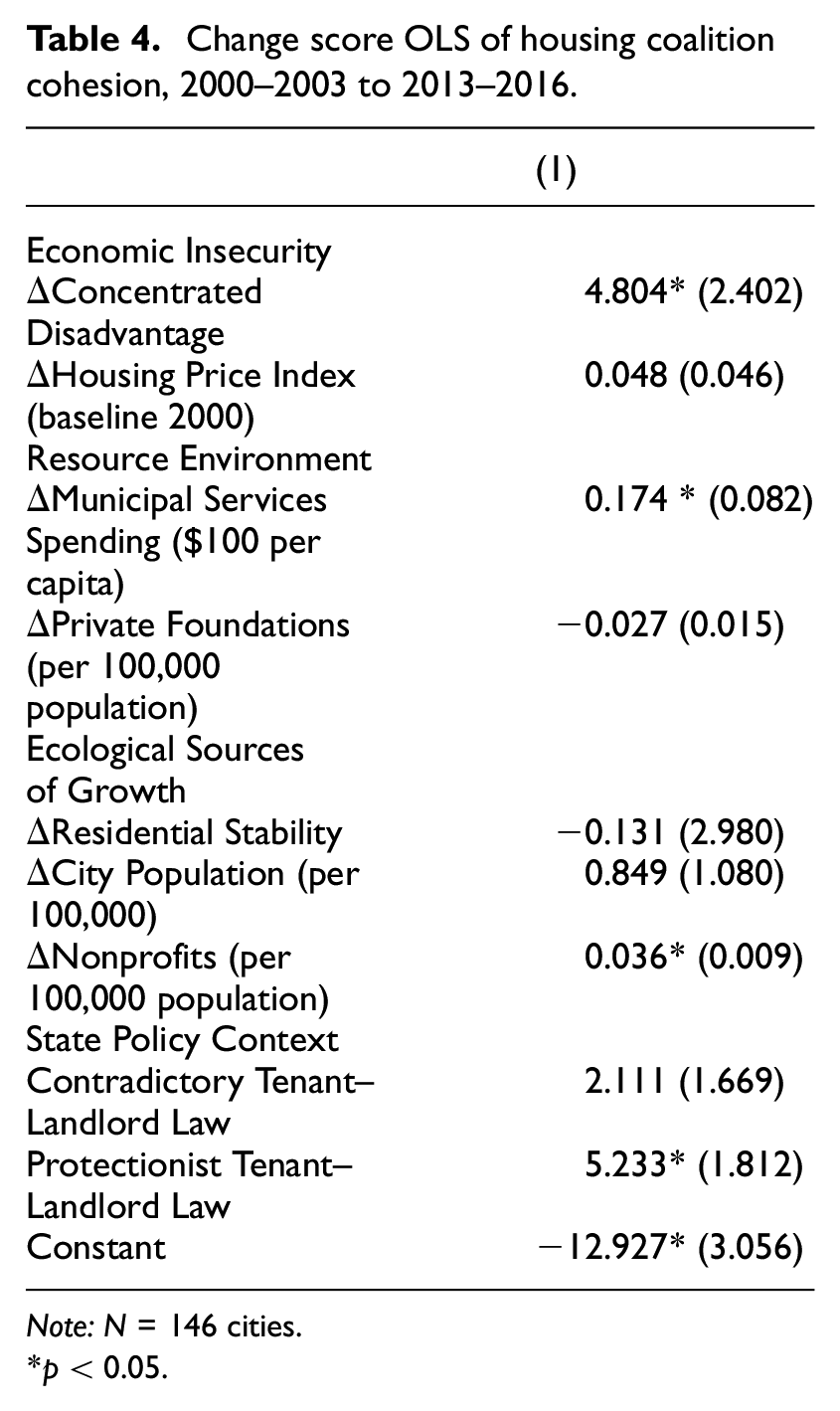
In Table 4, change in housing coalition cohesion is regressed on city level changes in economic insecurity, resource environments, and organisational ecology. Change in housing coalition cohesion is also conditioned on state tenant–landlord policy since regulatory ‘friendliness to tenants’ creates different political opportunities for housing coalitions. Coefficients are directly interpretable as percentages, where a 1-unit coefficient refers to an expected change in housing movement cohesion by 1%.
Change score OLS of housing coalition cohesion, 2000–2003 to 2013–2016.
Note: N = 146 cities.
p < 0.05.
Table 4 shows that the cohesion of housing coalitions is associated with multiple dimensions of changing socio-economic conditions in cities. Consistent with Table 3, the Constant term from the change score model indicates that housing coalition cohesion declined by an average of 12% in US cities located in states with ‘Probusiness’ tenant–landlord law regulations between 2003 and 2013, conditional on no other factor changing in such a city. In relatively conservative contexts, then, Table 4 suggests that housing coalition stagnation or decline was the norm over the last 20 years.
However, Table 4 also identifies several factors associated with coalition cohesion and growth. Increases in concentrated disadvantage predict higher housing coalition cohesion, with cities experiencing a 4.8% increase of housing coalition cohesion if they experienced a 1-unit increase in municipal concentrated disadvantage scores between 2003 and 2013. Increases in housing costs, meanwhile, do not predict housing coalition cohesion. These results suggest that housing coalitions have consolidated in cities with rising poverty and economic insecurity, but not necessarily in response to worsening housing markets. These findings are consistent with previous ethnographic accounts of how housing movements emerged in response to economic dislocations during the Great Recession (Desmond, 2020).
Results for local resource environments and organisational ecology, meanwhile, appear to qualify accounts of housing coalition emergence. As expected, increases in the number of nonprofits in cities is predictive of the growth of housing coalitions, since civic leader cohesion is conditional on the presence of civic organisations. Contrary to Card (2022) and Wilde (2019), though, increases in private foundations per 100,000 residents are not predictive of housing coalition cohesion, nor are changes in the ‘transientness’ of residents as indexed by residential stability scores. At the same time, a $100 increase in per capita municipal services spending does predict a 0.17% percent increase in movement cohesion. Table 4 suggests that municipal devolution, through public spending and support of civic organisations, has a closer association to the growth of housing coalitions than support from private foundations or changes in renter populations. As such, Table 4 suggests that scholars should more closely consider the relationship between support from municipal government and the formalisation of housing coalitions (Pacewicz, 2016).
Finally, Table 4 highlights the importance of state policy contexts for the growth of housing coalitions. Change in housing coalition cohesion was 5% higher in cities covered by ‘Protectionist’ state-level tenant–landlord laws vis-à-vis cities in ‘Probusiness’ states. States with ‘Contradictory’ tenant–landlord laws, meanwhile, do not appear to have change rates significantly different from ‘Probusiness’ states. Housing coalitions thus appear to consolidate when states are more friendly to renters in general, potentially because states with more protectionist housing policies provide more opportunities for housing coalitions to shape local regulations (Dreier, 1984), or because protectionist housing regimes signal a local population supportive of organising around housing insecurity (Card, 2022).
Discussion and conclusion
This article provides a comparative and longitudinal analysis of housing movement coalitions in the United States. Analysing leadership networks in urban civil society, I find that networks of housing, civil rights and anti-poverty leaders do exist in most medium and large US cities. Longstanding and highly cohesive housing coalitions also exist in California, New York City, across the Midwest, and in several large Southern cities, indicating a broader range of robust housing coalitions than often noted. However, housing coalitions have only grown in a few relatively liberal and wealthy cities since the global financial crisis, and in some sunbelt and conservative states coalitions have meaningfully declined. Employing change score regression models, this analysis also suggests that rising concentrated disadvantage is associated with coalition growth, while municipal austerity and hostile state-level tenant–landlord laws are associated with coalition decline.
These findings suggest that scholars of urban housing movements should widen their focus to include conservative states, small cities, and more diverse contexts in general. Complementing Michener and SoRelle’s (2022) documentation of grassroots tenant activism across the US, this study finds that formal housing movement coalitions exist in a variety of US cities where grievances about economic insecurity encourage coalitions, ranging from Denver to San Antonio and Orlando. The activities, goals, and consequences of these housing coalitions are not well understood. Formal housing organisations may choose to devote more resources to helping homeowners facing foreclosure in homeowner-centric cities, for example, particularly where the socio-economic differences between renters and homeowners are less stark (Michener and SoRelle, 2022: 219). Housing coalitions in the Midwest and South may also adopt different organising goals, focussing on poverty or urban social services, as opposed to the politics of rent control and public housing found in cities like New York and Los Angeles (Lichterman, 2020). Finally, this analysis shows that robust housing coalitions do exist in conservative states, but that they also have not grown in such states since the financial crisis. As such, coalitions in hostile political environments may be more incrementalistic (Pixová, 2018), have less relationships with grassroots movements, or be less able to influence policy, but may still have an important role in helping tenants avoid poverty or displacement (Messamore, 2023). Future ethnographies of housing movements should examine these heterogeneous coalitions and understand their dynamics.
This article also suggests that scholars should reconsider the institutional configurations that support housing coalitions, and how those configurations shape relationships between professionalised civil society and grassroots housing activists. Scholars debate the empowering or co-opting role of housing coalitions in housing movements (Card, 2022; Lima, 2021b), and focus on the role of private foundations in shaping relationships between grassroots activists and formal housing leaders (Levine, 2016). This analysis, however, finds no relationship between coalition formation and private foundation presence, and instead finds that housing coalition growth is associated with how much cities invest in public services, including nonprofits (Pacewicz, 2016). It is plausible that cities are key actors in mobilising the resources that sustain housing movement coalitions (Van Dyke and Amos, 2017), potentially creating tensions between grassroots housing advocacy and municipally funded housing coalitions. Consequently, this article suggests that scholars of housing movements should pay greater attention to the role of municipal governments in shaping housing coalitions, as well as how municipally supported coalitions influence grassroots strategies and movement outcomes.
This article suffers from some limitations. First, it does not examine grassroots organising and only examines dynamics among formalised housing, civil rights and anti-poverty nonprofits who file Forms 990. This analysis will include many tenant organisations who operate as 501(c)3s, but should only be viewed as an analysis of formal coalitions, and not as a complete analysis of all aspects of urban housing movements. A second limitation, meanwhile, is that this analysis is descriptive and does not claim to provide a complete or causal explanation for why housing coalitions evolve. For example, this analysis finds that Houston and Salt Lake City experienced significant declines in coalition cohesion after the financial crisis, and regression analyses suggest that municipal austerity and conservative political climates may have weakened housing coalitions in these cities. This analysis cannot state whether these factors broke housing coalitions in these cities, though, and points to new case studies and questions to be explored.
Nonetheless, this study’s limitations point to future research. By providing a way to index housing coalitions, this analysis allows researchers to directly assess the relationship between housing coalitions, grassroots housing activism, and housing movement outcomes. Movement researchers concerned about the co-optation of housing movements by formal organisations can evaluate relationships between housing coalitions and movement strategies (Lima, 2021b), for example, while researchers interested in movement outcomes can assess the role of coalitions in enabling policy change (Card, 2022). More broadly, this study suggests a strategy for dynamically tracking any civil society coalition of interest to researchers (Diani, 2015). As such, researchers may use the methods described in this study widely, whether to evaluate federations of environmentalists (Savini, 2023), coalitions of LGBT+ urban activists (Ghaziani, 2021), or even the overall structure of coalitions in urban civil society as they evolve in different cities.
Footnotes
Acknowledgements
I would like to thank Pamela Paxton, Jeremy Levine, Kenton Card, the three anonymous reviewers and the editors of Urban Studies for their valuable feedback on this paper.
Declaration of conflicting interests
The author declared no potential conflicts of interest with respect to the research, authorship, and/or publication of this article.
Funding
The author disclosed receipt of the following financial support for the research, authorship, and/or publication of this article: Research reported in this publication was supported by the ASA/NSF Doctoral Dissertation Research Improvement Grant. The content is solely the responsibility of the author.
