




Abstract
The use of contracts to achieve public goals has been gaining traction since the 1980s. In this article, I investigate the implications of the increased use of private law instruments for participatory democracy. This study starts with problematising the notion of contracts and proposes a conceptual model to study contractual relations in participatory processes. Next, through a detailed description of two case studies in Amsterdam and Hamburg, I show the consequences of contractual governance for participatory democracy in urban development. Namely, the interests of commercial parties and government agencies are incorporated in contracts, whereas the interests of residents are incorporated in non-legal agreements.
This has four implications for our understanding of participatory democracy and urban politics. First, the arena of public decision making has shifted from public meetings to contractual negotiations. Second, contracts are not set in stone. Mobilisation by residents can influence, adjust and politicise agreements. However, third, residents need to be able to mobilise and negotiate. This creates new boundaries between residents who are able to make deals and those who are excluded. Lastly, investigating how contracts transform urban politics should take a broad view on how contractual relations are formed and focus on both non-legal and contractual agreements.
Introduction
Contracts are mostly studied as economic instruments, meant to regulate business relations. However, government agencies have increasingly been using contracts to achieve public goals (Vincent-Jones, 2007). Although contracts have always played an important role in the field of urban development, their importance has gained traction at the cost of public law since the 1980s. For instance, urban development projects are realised in partnerships regulated through contracts (Raco, 2013; van den Hurk and Tasan-Kok, 2020; van der Veen and Korthals Altes, 2012). Consequently, participatory processes have become an integral part of urban development and urban politics (Levine, 2017; Walker et al., 2015). This presents an empirical puzzle: what is the role of private law instruments, that is, contracts, in public processes, that is, participation? Addressing this question will provide a new understanding of the influence of residents over development projects.
The empirical puzzle is relatively understudied in the literature on participatory governance and urban politics (Janssen-Jansen and van der Veen, 2017). Most research on this topic focuses on Anglo-Saxon cases (Camacho, 2013; Raco, 2013), and in particular on community benefit agreements (CBAs), which are development agreements negotiated by residents and developers (Baxamusa, 2008; Been, 2010; Janssen-Jansen and van der Veen, 2017). However, CBAs are not widely employed, and their results do not always benefit residents (Been, 2010; Camacho, 2013). Camacho (2013) notes that except for CBAs, development agreements are predominantly negotiated by government agencies and developers, excluding residents. Thus, in most urban development processes, residents are not immediately recognised as contractual negotiators. Research from Raco (2013) and Savini (2016) underlines that contracts limit the ability of residents to influence decisions. Therefore, this study concentrates on how contracts manifest during participation efforts in large-scale urban development processes in Amsterdam and Hamburg. The purpose of this research is twofold: (1) to problematise the meaning of contracts and agreements in participatory processes, and (2) to show through a detailed description the consequences of contractual governance for resident participation. The research puzzle is addressed by fieldwork conducted in Amsterdam and Hamburg. This study finds that the increased importance of contracts in urban development has shifted the arena of public decision making from public meetings to contractual negotiations. This does not necessarily imply that contracts circumvent public debate. Contracts can be adjusted. However, it does shed light on new hierarchies between actors.
The goal of participation is to give residents influence over development projects. However, broader literature on participatory governance shows that there exist barriers in the ability of government agencies to implement the outcomes of participatory processes, and social inequalities tend to be reproduced (Levine, 2017; Stapper and Duyvendak, 2020; Walker et al., 2015). Furthermore, participatory processes are criticised by several authors as being ‘post-political’ (McAuliffe and Rogers, 2018; Metzger et al., 2015; Swyngedouw, 2005). According to post-political theory, ‘politics is concerned with the set of practices and institutions through which an order is created, organising human coexistence’ (Mouffe, 2011: 9), while the political is the dimension of conflict and antagonism (Mouffe, 2011: 9). Post-politics is the condition in which conflict is replaced by consensus. Participation functions as window dressing, while real decision-making power is transferred to municipal experts and commercial parties.
Instead of a priori assuming that urban elites use contracts and participation to cement their power, I explore empirically how contracts manifest during participatory processes of development projects. This study introduces a conceptual framework to study the role of contracts in participatory governance, based on relational contract theory (Macaulay, 1963; Macneil, 1980). I use the distinction between non-legal agreements, which are less enforceable agreements, and contracts, which are more enforceable agreements. Non-legal agreements bind parties based on trust and reputation rather than legal obligations (e.g. Macaulay, 1963). This will provide a novel perspective on the influence of citizens in development processes. What is the impact of participation on contracts? What is the role of contracts in citizens’ involvement? Hence, the main question of this article is: what is the relationship between contracts and non-legal agreements with residents during participatory processes?
Contractual relations in participatory processes
The most prevalent way of studying contracts in urban development projects is the transaction cost approach. Transaction cost economics assumes that contracts are tools designed to minimise transaction costs (Williamson, 1979, 1981). Since this research inquires how contracts are used to achieve public goals, I focus on citizens’ interests rather than costs. Citizens’ interests are a set of goals and needs that are the outcome of participatory processes (see Stapper and Duyvendak, 2020). Therefore, I have chosen to develop a conceptual framework based on relational contract theory (Macaulay, 1963; Macneil, 1980). According to relational contract theory, agreements are embedded in relations, which implies that when relations change, agreements between actors also change (Granovetter, 1985; Macneil, 1980). This has three major implications for studying contracts. First, both contractual and non-contractual relations need to be studied. The main goal of agreements is to coordinate the actions of actors, not to reduce costs or enforce promises. The precise contractual terms are important to study, but not the whole picture. Second, contracts evolve when the specific environment of a contract changes. When an actor cannot perform its obligations, litigation is prevented by renegotiating the deal between actors (Granovetter, 1985; Macaulay, 1963). These adjustments do not necessarily lead to new contracts. Oral commitments, non-binding agreements or implied understandings can all function as agreements to complement or supplement contracts. Third, agreements exist on a continuum of enforceability. Not all agreements are designed with the intention to be legally binding. Non-legal agreements are designed to be assurances that a certain promise will be fulfilled. However, actors do not have the intention to be legally bound to non-legal agreements. Contracts are agreements that are legally binding (Eisenberg, 2018). Non-legal agreements and contracts work in tandem to provide a framework in which actors can achieve their shared goals. It is important to note that not all understandings between actors can be considered agreements or contracts. In order to qualify as an agreement, there should be mutual understanding about the content of the agreement. There can be a certain fuzziness about the agreement, but there cannot be contradictory assumptions.
Relational contract theory is a fitting approach to studying participatory processes. In most participatory processes, residents are inclined to come to an agreement, but refrain from having the intention to be legally bound. Explicit commitments with enforceable obligations carry the risk of litigation. An assurance gives actors enough confidence that promises to the neighbourhood will be fulfilled. Therefore, analysing agreements based on a continuum of enforceability helps to understand how contracts affect relations in participatory processes. On one side of the continuum are non-legal agreements. These agreements articulate a specific course of action in order to give actors the assurance that promises will be fulfilled. Non-legal agreements are not intended to be legally binding. However, a court can retrospectively judge that non-legal agreements have legal consequences (Posner, 2003). Moreover, breaking the promises in non-legal agreements can hurt the reputation of actors. Breaking non-legal agreements in participatory processes can lead to political conflict. Non-legal agreements can be minutes from participation sessions, oral assurances, neighbourhood codes or letters of intent.
On the other side of the continuum are contracts. Contracts stipulate a careful planning to reach a specific goal. The actors have the intention to be bound by the agreement, expressed in provisions concerning defective performances and legal sanctions. Defective performances are situations where parties cannot reasonably fulfil obligations, but there is not a breach of contract. For instance, the actors have agreed to designated housing for low-income families. There is a possibility that no low-income family implies for a house and therefore the obligations of the contract cannot be met. Contracts may contain terms that regulate what the parties need to do in such cases. Legal sanctions can include fines and other penalties as compensation for non-performance. Examples of contracts are development contracts, community benefits agreements or leases.
For the purpose of this study, the term ‘development contract’ will refer to the agreements between parties that outline the conditions under which they will work together in the development process (Janssen-Jansen and van der Veen, 2017). Since this study focuses on participatory processes, I analyse how the outcomes of participatory processes are translated into non-legal agreements and contracts (see Figure 1). I refer to the outcomes of participatory processes as citizens’ interests.
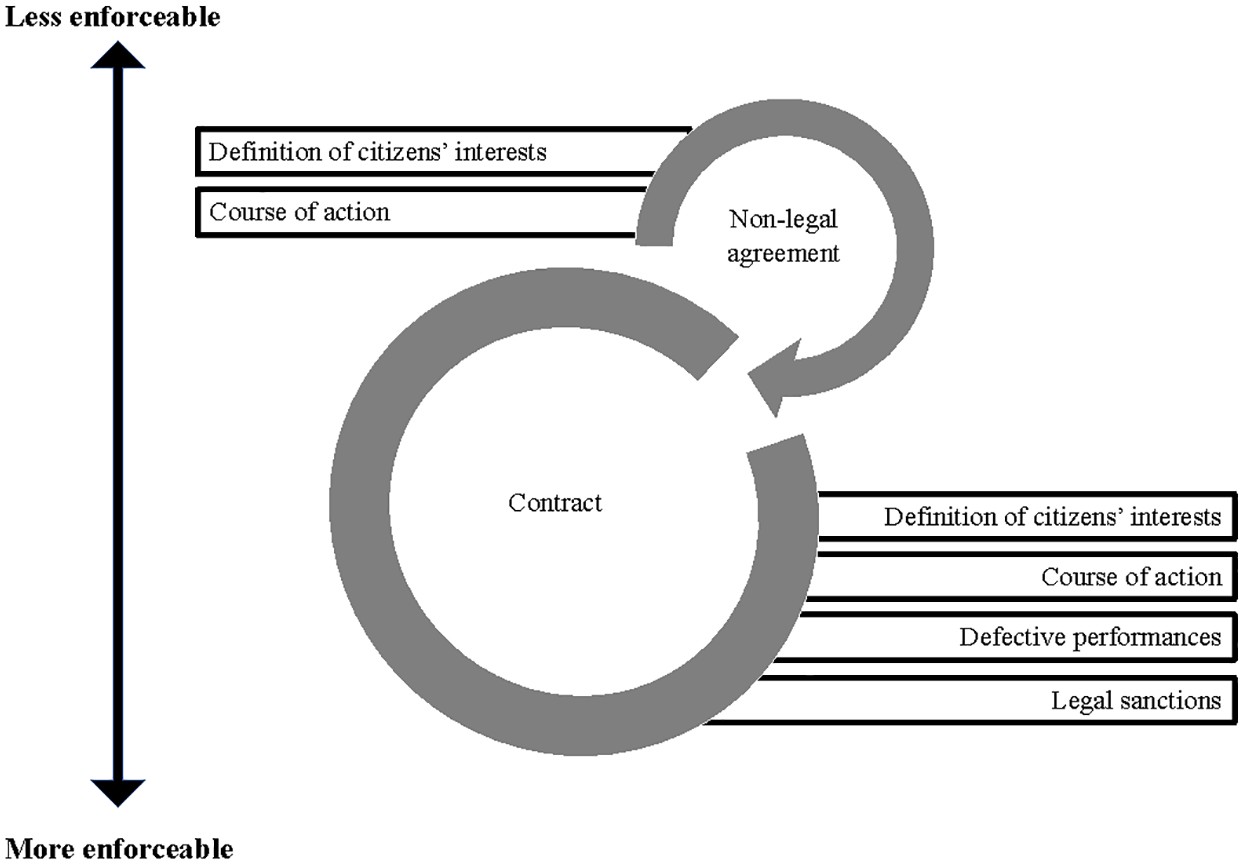
Contractual relations in participatory processes.
Methods and comparative strategy
There are three reasons for comparing development projects in Amsterdam and Hamburg for this study. First, the planning systems have moved towards more regulatory flexibility and embracing contractual governance. In Amsterdam this occurred through the (national) introduction of flexible land use plans and development contracts (anterieure overeenkomsten) (Buitelaar et al., 2011); in Hamburg this happened through the use of urban development measures (Städtebauliche Entwicklungsmaßnahmen) and the introduction of statutory urban development contracts (Städtebaulicher Vertrag) (Schmidt, 2009). Second, the response to the new policies is different. In Hamburg the introduction of market-oriented policies was met with large-scale demonstrations in 2013–2014 (Novy and Colomb, 2013; Vogelpohl and Buchholz, 2017), whereas in Amsterdam new civil society actors embraced a more liberal discourse of entrepreneurialism (Savini et al., 2016). This raises the question whether the more compromise-seeking civil society actors in Amsterdam work better in a context of negotiation-based planning, or if the more activist actors of Hamburg gather more political leverage and are therefore better positioned to make use of contractual negotiations. Third, most literature about contractual governance and participatory processes focuses on Anglo-Saxon cases (Been, 2010; Camacho, 2013; Janssen-Jansen and van der Veen, 2017).
In the city of Amsterdam I interviewed 40 actors active in urban development, and in the city of Hamburg I interviewed 27 actors active in urban development. The actors were developers, were neighbourhood residents active in the participatory process or were working for government agencies. During the interviews, I asked open questions such as: ‘What were the critical moments during the project?’‘Who were the key actors in the project?’‘How were the citizens’ interests defined in the project?’‘What was the role of agreements and contracts in the project?’ and ‘What were the core contractual obligations?’
Based on those interviews, I decided to zoom in on two cases. For the analysis of the Amsterdam case, I studied 13 documents (policy documents and contracts) and used 13 interviews with actors. For the Hamburg case, I investigated 11 documents (policy documents and contracts) and used 13 interviews.
Participation and planning in Amsterdam
Amsterdam is the economic centre of the Netherlands and its largest city, with almost 2.5 million inhabitants in the metropolitan area. The city is divided into eight administrative boroughs, called stadsdelen. Until 2016, the administrative boroughs were responsible for preparing land use plans and coordinating development projects. Every administrative borough, expect for the harbour, had its own council and executive branch. Since 2016, those responsibilities have been transferred to the central city. Before the 1990s, the majority of the housing in Amsterdam was owned by housing associations, but since then private homeownership has been promoted. This brought down the housing stock of housing associations to 45.6% in 2015 (Hochstenbach, 2017).
In Amsterdam, residents can comment on changes in land use plans (Needham, 2007). Next to this statutory obligation, the municipality organises participatory processes to build support for development plans. The participation meetings vary from consultation rounds to projects with more substantial influence of residents. In the last decade, there has been an effort to include residents as developers in development projects. Although this happens frequently around the world, for the Netherlands it is a new trend. This is part of a strategy to incrementally develop areas, in order to grow development projects ‘organically’ (organische gebiedsontwikkeling) (Buitelaar et al., 2018).
Participation and planning in Hamburg
Hamburg is Germany’s second-largest city, with almost 4 million residents in its metropolitan area. In Germany’s federal system, Hamburg is both a state and a municipality, which means that it is more autonomous than most other German cities. Spatial plans are made by the executive branch, called the Senate, and adopted by the legislative branch, called the Bürgerschaft. The city is divided into seven boroughs that have their own councils and administrative leaders. However, large-scale urban development projects are often the responsibility of the Senate. Hamburg is predominantly a city of tenants, with 76% of the apartments rented (Vogelpohl and Buchholz, 2017).
The Christian Democrats led the Hamburg government between 2002 and 2011. In this period, market-oriented and pro-growth urban policies were adopted, resulting in state-led gentrification processes (Novy and Colomb, 2013). Moreover, for development deals the highest-bidder principle was introduced and the lock-in period for rent-controlled social housing was reduced from 30 to 15 years (Vogelpohl and Buchholz, 2017).
Planning law in Germany stimulates discussion concerning potential changes in land use among stakeholders (Schmidt, 2009). Social movements, especially the Recht auf Stadt (Right to the City) movement, launched protests against the market-oriented housing policies of the city (Novy and Colomb, 2013; Vogelpohl and Buchholz, 2017). The influence of the movement on the politics of Hamburg was strong. For example, the squatting of the Gängeviertel complex did not lead to eviction by the police; instead, the municipality decided to buy back the complex from an investor (Novy and Colomb, 2013). Partly in response to the movement, the city of Hamburg created an institute in 2012 called Stadwerkstatt to stimulate participation. Moreover, the municipality introduced the transparenzportal (‘transparency register’), in which all the contracts and documents that the municipality produces are published.
Oostenburg-Noord
Oostenburg-Noord is a former industrial area, close to the old eastern harbour of Amsterdam, which deindustrialised in the 1970s. The neighbourhood is known for its working-class history, with a network of well-organised, active citizens. Governmental strategies of liberalising the housing market and countering segregation have led to a decrease in lower-income inhabitants and a rise in house values in the area (Uitermark and Bosker, 2014). The land of Oostenburg-Noord is owned by two landowners: a housing association called Stadgenoot, and the development agency of the national government, called Rijksvastgoedbedrijf.
Due to the financial crisis, Stadgenoot needed to experiment with its development strategy in order to attract investors. The architectural firm Urhahn was hired by Stadgenoot to create a vision for the project. Urhahn is known for its strategy of cooperating with residents (Uitermark and Bosker, 2014); through meetings and focus groups with residents, they created the document ‘City Wharf Oostenburg’ (Urhahn, 2012). They proposed to develop the area incrementally, using bottom-up initiatives and participatory tools to steer development. Due to the bad housing market, Stadgenoot decided to divide the area into smaller lots. Small investors or private entrepreneurs could buy the lots and realise their own projects within the larger urban development project.
The Eilandenoverleg (EO) is a neighbourhood organisation that represents the residents of Oostenburg-Noord. Initially, EO was content with the development strategy of the housing association. As a neighbourhood organisation, it attempted to define the citizens’ interests for the residents of Oostenburg-Noord. Through a letter to Stadgenoot, it stressed the importance of high green ambitions for the area, the need for social housing and its desire for space for small- and medium-sized businesses, creative entrepreneurs and cultural activities (Eilandenoverleg, 2013). Moreover, EO proposed to Stadgenoot to organise public meetings to create guidelines for the development with the neighbourhood. These public meetings could lead towards the terms for further cooperation. Stadgenoot agreed to the proposal of EO and organised four meetings in a nearby public venue. Thus, eventually the parties attempted to create a definition of the citizens’ interests together. They agreed on a specific course of action – the organisation of four public meetings in a nearby venue. However, there were contradictory assumptions about how the meetings would be organised and what the role of EO was. One civil servant was very positive about the workshops: Look, they [notorious nay-sayers] could share their opinion, which is important, because you need to know what is going on in the neighbourhood. But hearing the other stories, and we could do that through the meetings, went really, really well. (Civil servant 1, Oostenburg-Noord, 12 December 2017)
Meanwhile, a member of EO was more critical: ‘The themes were discussed in small groups. In those groups, professionals [architects and developers] were quite dominant. The residents were underrepresented’ (Resident 1, Oostenburg-Noord, 23 November 2017).
The principles that were formulated included making the areas near the water publicly accessible, limiting access for cars, creating green spaces and developing a square for the neighbourhood. During the last public meeting, Stadgenoot asked EO to respond to the principles. In its response, EO criticised the organisation of the meetings. The members of EO argued that the meetings were attended by many civil servants, architects and designers, but not necessarily residents of the neighbourhood. Moreover, the residents had no influence on the topics that were discussed. They also criticised that by dividing the meetings up in themes, structural issues were ignored. EO pushed for the following issues: locating the high-rise buildings near the rail track, increasing the amount of social housing, building a noise barrier to limit the noise of the trains and limiting the access for cars in the area as much as possible. But there was also praise from EO – it thought the plans were promising and offered to cooperate with Stadgenoot (Eilandenoverleg, 2013). Although EO and Stadgenoot had the same goal, they had contradictory assumptions about how the public meetings would be organised. Therefore, there was no clear non-legal agreement between the resident organisation and the developer. The EO claimed to be the representative of the neighbourhood, but the public meetings showed different opinions about how the citizens’ interests should be defined. The assertation of EO that the public meetings were dominated by professionals could be easily dismissed as arguments of ‘nay-sayers’. Hence, EO could only influence the definition of the citizens’ interests in a limited way and did not achieve a strong position to negotiate with the developers or the municipality.
Both Stadgenoot and Rijksvastgoedbedrijf agreed that realising social housing in Oostenburg-Noord was not a priority for them. ‘We concluded with each other that 20% social housing and 80% market rate housing would balance the housing stock in the neighbourhood’ (Civil servant 1, Oostenburg-Noord, 12 December 2017). Together, Stadgenoot and Rijksvastgoed-bedrijf negotiated a development contract with the municipality. The development contract specified the responsibilities of the parties for the project, including the amount of social housing and who was accountable for the public space. The contract was not available to the public and EO did not take part in the negotiations.
After the development contract was signed, the land use plan was created. Some of the citizens’ interests as formulated by EO and the residents were incorporated into this plan. The waterfront remained 70% publicly accessible, high-rise buildings were located near the rail track and car parking facilities were limited. Moreover, the plan stressed the importance of high green ambitions and stimulated the development of a renewable energy cooperative for the neighbourhood. Although these provisions are encouraged, they are not obligatory (Gemeente Amsterdam, 2016). Though some of the demands of EO were incorporated in the flexible land use plan, both EO and the developers still had conflicting assumptions about the amount of social housing needed for Oostenburg-Noord.
The lack of clarity about social housing became a conflict between the municipality, Stadgenoot and EO. The municipality and Stadgenoot intended to develop 16% of the total land area into social housing (20% of the total amount of housing units was reserved for social housing): ‘We ended up with 20% social housing and 80% market rate housing, to balance out the neighbourhood’ (the neighbourhood has predominantly social housing; Civil servant 1, Oostenburg-Noord, 12 December 2017). A member of EO published an opinion piece in the local newspaper to criticise the low amount of land that was designated for social housing. EO argued that at least 35% of the total land area should be reserved for social housing. EO also reached out to politicians: ‘We had talks with them. Before every council meeting we sent them our written responses to new developments’ (Resident 1, Oostenburg-Noord, 23 November 2017). Thus, EO argued that more social housing needed to be part of the citizens’ interests, while the housing association and the municipality argued that less social housing was needed. The reason for this position was that there were already many social housing units in the neighbourhood.
When the flexible land use plan came to a vote in the municipal council, a majority of the politicians sided with the definition of citizens’ interests of EO. This meant that the land use plan demanded that at least 20% of the land would be reserved for social housing, while the commissioner had already signed a development contract that designated 16% of the total land for social housing. The disparity between the flexible land use plan and the development contract was solved through an amendment to the development contract: ‘We left the development contract for what it was, we made an amendment, and that took into account the demands of the council. This was signed by the parties [developers and municipality] and approved by the council’ (Civil Servant 1, Oostenburg-Noord, 12 December 2017). The initial agreement for 16% of the total land to be used for social housing was raised to 20%. The amendment fixed one of the contradictory assumptions between EO and the developers, although EO would still have preferred more social housing.
After the flexible land use plan was adopted by the municipal council, and the amendment was signed by the parties, the Rijksvastgoedbedrijf decided to sell its land. The buyer of the land was a joint venture between the investor Stonewell and the developer VORM. VORM took the lead in negotiating and managing the purchase. The tender process was not directed to deliver the interests of residents but was primarily focused on the highest price: ‘Only the price mattered; you didn’t need to hand in a design, and there were no extra points for sustainability’ (Consultant 1, Oostenburg-Noord, 20 February 2018).
The relationship between EO and the developers was damaged by the conflict over social housing. To prevent future conflict, Stadgenoot proposed to organise meetings between EO, the developers and the municipality. In exchange for their consent, EO gained access to the decision-making process of Stadgenoot, VORM and the municipality. The meetings were used by the EO to pressure the developers to align with their definition of citizens’ interests, such as by using renewable energy sources, increasing the size of the housing units and building community facilities. By attending the meetings, EO and the developers started to form non-legal agreements about the performances of the parties. First of all, there was a non-legal agreement about the course of action. Stadgenoot organised the meetings, and EO and the other parties could set the agenda. EO was especially concerned about the size of the apartments, the sustainability of the project and the community facilities. Secondly, a non-legal agreement about citizens’ interests such as the size of the apartments was formed by putting the topic on the meeting agenda. The developers were therefore encouraged to include a minimum size of the apartments in the sub-contracts to prevent the development of micro-apartments: We are going to look whether we can formulate rules for the land area designated for social housing, the division of the typology of the units and the size of the units. I won’t say that we will regulate it very narrowly, but we will look into it. (Housing Association Manager 1, Oostenburg-Noord, 19 December 2017)
Thirdly, a non-legal agreement about the citizens’ interests concerning high green ambitions was formed. The developers announced that the project would use renewable energy sources. Stadgenoot already wanted high green ambitions for the project, so when EO pressed for renewable energy sources it agreed. The influence of EO on this non-legal agreement was mostly indirect, through agenda-setting: No, we did not listen very directly to them, but the fact that the residents were involved of course made the municipality and the housing association promise that we must do something about sustainability. And we must do something about social housing, or we would get in trouble. So only that is already influential. (Consultant 1, Oostenburg-Noord, 20 February 2018)
Finally, a letter of intent, including a shared definition of citizens’ interests, a course of action and regulations on defective performances, was made about community facilities, with residents. The plan for the community facilities was proposed by three members of EO, but it was eventually declined. Stadgenoot could assist the community centre, but could not cover all the costs, so the initiative takers needed to create a plan that would be financially sound. Because they lacked the expertise to design a professional plan, they applied for a subsidy to get professional help. With the subsidy they obtained funding to hire a consultant, who helped formulate a plan that was more in line with the standards of the developers. With the improved plan, Stadgenoot agreed to sign a letter of intent to create the community centre. In the letter of intent there is a condition on defective performances that states that Stadgenoot will only support the community facility when other parties support it financially.
In the first phase of the interactions between the neighbourhood organisation and the developers, there were contradictory assumptions about the development process. The neighbourhood organisation assumed that it would be the negotiating party. However, they could not claim to be the representatives of the neighbourhood; therefore, their position could be dismissed as that of nay-sayers. Hence, the municipality and the developers signed a development contract together without the involvement of residents. The relations between the actors remained at the level of contradictory assumptions until the conflict over social housing emerged. Because of the conflict, the developers and the municipality changed their contract and added some of the terms of the residents into an amendment. Hereafter, the relations changed; through a couple of meetings, four non-legal agreements between the developers and the municipality were made. The meetings show that relations can substitute written agreements and that when the relations change the agreement can change as well. However, residents need to claim their position in order to be accepted as a negotiation party. Notably, agreements about the design of the project, such as the public space, were made more easily than agreements on social housing.
Neue Mitte Altona
Neue Mitte Altona is located in Altona, a popular borough of Hamburg. Altona was founded as an independent city and absorbed by Hamburg in 1937. The southwest part of Altona, in which Neue Mitte Altona is located, is gentrifying and is known for having a strong activist culture (Franzén, 2005). The project of Neue Mitte Altona was made possible by the decision of Deutsche Bahn (the German rail operator) to move the train station from Altona to Diebsteich, which opened up the area for housing development. The land was owned by Deutsche Bahn, two large landowners and some smaller landowners.
In order to designate the area for housing development, the municipality decided to make use of section 165 of the German building code. This section allows governmental agencies to start making plans for development via the so-called urban development measure. This allows a municipality to either force landowners into negotiation about future developments or to buy the property from the landowners. This measure can only be used when there is a proven need for the public (Schmidt, 2009). Simply arguing that there is a lack of housing is not enough; there should be precise probability calculations about the development of housing and the population in the (metropolitan) area (Beck Online, 2019). Moreover, the municipality needs to measure precisely what the value of the land is, with and without the development (Beck Online, 2019): So it is a very strict law, so we cannot do it all the time and everywhere of course; only if you have special interests of the city, and if you have an area that will be transformed in its land usage in the next years. (Consultant 1, Neue Mitte Altona, 15 March 2018)
The proposed land use plan allowed for housing, which was very profitable as the negotiations started before the financial crisis. Thus, the landowners agreed to negotiate a development contract. Next to the three landowners, three real estate investors were included in the negotiations of the development contract.
The first step towards the development contract was made in 2007. The Senate of Hamburg approved the start of the ‘Vorbereitende Untersuchungen’, or preliminary investigations that are a requirement of the urban development measure. The negotiations between the municipality and the landowners led to an agreement about the financial obligations of the parties in 2010. Residents were excluded from these talks. After the draft financial obligations had been outlined, the preparation of the preliminary investigations continued. The preliminary investigations substantiated the claim that there was a public need for the development, and led to contracts between the negotiating parties on the programme, and the financing and planning of the project. The negotiations about the preliminary investigations centred around topics such as housing, green spaces and the financial commitments of the parties.
Residents were not directly involved in the negotiation process, but the municipality organised an extensive participatory process to define their interests. Workshops, seminars and walks were organised to gather input from residents. In total, more than 600 recommendations by residents were made (Freien und Hansestadt Hamburg, 2013). The masterplan of Neue Mitte Altona was created with input from residents who were part of the tender jury (without voting rights) and through the organisation of workshops (Freie und Hansestadt Hamburg, 2013). The participatory process resulted in the definition of the following citizens’ interests: the preservation of historical buildings, having at least 20% of the housing units designated for self-build cooperatives, the realisation of a public park, encouraging cycling instead of car use, a high degree of accessibility for people with disabilities, only small-scale commercial spaces and enough participation opportunities for residents (Freie und Hansestadt Hamburg, 2013). The participatory process conveyed citizens’ interests but lacked a clear course of action. From the side of the municipality, there was an intention to incorporate the outcomes of the participatory process in the plans but there was no explicit commitment.
Two citizens’ groups started to play a major role in the development process. The first group was the Koordinierungsgremium (KG), which was installed by the municipality in light of the public sentiment concerning citizen participation. The municipality saw KG as an advisory board. KG organised itself according to the principles of the Recht auf Stadt movement. During assemblies, it formulated statements about the development project, and those statements were then discussed and voted on. The topics that were mostly voted on concerned the role of citizens in decision-making processes, housing cooperatives and social housing, space for small-scale entrepreneurs, noise control, green ambitions and a preference for mobility focused on the bike. For KG, it was also important that the new neighbourhood included the Altonaer Mischung (Altona mixing) of housing units, small shops and workplaces. All meetings were transcribed live, in order to increase transparency. In total, 12 meetings were organised and 389 statements were voted on (Birzer et al., 2011). The municipality and KG had conflicting assumptions about the course of action after their recommendations were formulated. The municipality saw the recommendations as advice, while KG had assumed that its definitions of citizens’ interests would be fully implemented into the agreements that managed the development project.
The second group was Eine Mitte für Alle (EMfA). The main goal of this group was to make Neue Mitte Altona fully accessible for people with disabilities. The non-profit organisation Q8 supported the group in organising several meetings. The meetings were well attended and resulted in a list of recommendations: ‘They initiated a forum, Eine Mitte für Alle. Around 30 people came together to continuously work on the topic of inclusion and urban development especially for Mitte Altona’ (Project Coordinator, EMfA 1, Neue Mitte Altona, 13 March 2018). The recommendations included citizens’ interests such as the creation of fully accessible housing, job counselling for people with disabilities, professional neighbourhood management that is sensitive to the issues of people with disabilities, high green ambitions and the need for places of worship. Those recommendations were written in contractual terms, so that they could easily be implemented in contracts. EMfA lobbied politicians and developers in order to get their recommendations adopted.
Between April and September 2012, the preliminary investigations and the masterplan for Neue Mitte Altona were published. The KG group criticised the preliminary outcomes: ‘From my point of view it was camouflage’ (Activist 1, Neue Mitte Altona, 22 March 2018). In a pamphlet called ‘A Moratorium for Neue Mitte Altona’, KG declared itself – and the legitimacy of Neue Mitte Altona – dead. The members of KG argued that the participatory process lacked transparency, that the proposed realisation of 33% social housing and 33% rent-controlled housing was too low, that previous users of the area could not come back, that the plan for the preservation of historical buildings was unclear, that the development did not reflect the Altonaer Mischung, that the mobility concept was not green enough and that developers were making too much profit (Koordinierungsgremium Mitte Altona, 2012, 2015). Some of the citizens’ interests as formulated by KG were eventually included in the development contract that was signed in May 2014. For example, the contract controls the rents of shops, preserves historical buildings, supports self-build cooperatives, fosters the development of small-scale businesses and outlines a mobility strategy focused on bikes. However, KG argued that its recommendations were watered down. For example, they wanted more than 33% social housing in the area. Moreover, the development contract underlined the importance of accessibility for people with disabilities. The formulation in the contract did not have any clarity on a course of action for how this would be achieved. The senate of Hamburg adopted a strategy on how to realise the recommendations of EMfA, but that did not include the landowners of Neue Mitte Altona. However, there was a non-legal agreement between the parties to make Neue Mitte Altona accessible for people with disabilities.
Comparing Oostenburg-Noord and Neue Mitte Altona
The cases of Oostenburg-Noord and Neue Mitte Altona show the importance of the development contract. The negotiations of the financial obligations of the parties preceded the possibilities for residents to get involved in the decision-making process. In the case of Oostenburg-Noord, the participatory process as organised by the municipality was criticised by a group of residents. The ability of residents to get involved in Neue Mitte Altona was limited because of the strict legal requirements needed to make use of an urban development measure. The involvement of different organisations representing the interests of residents was more fragmented in Neue Mitte Altona than in Oostenburg-Noord. While the inputs of the participatory process of the municipality and EMfA led to non-legal or contractual agreements, KG and the municipality did not come to an agreement. However, it should be noted that their recommendations concerning rent control for shop owners and mobility focused on bikes were incorporated – including legal sanctions – in the development contracts. Thus, compared with the case of Oostenburg-Noord, the efforts of KG resulted in more contractual agreements.
Like the issue of social housing in Oostenburg-Noord, KG criticised issues that had already been accepted in a contract between developers and the municipality. Unlike the residents of Oostenburg-Noord, KG was not able to force the municipality into making adjustments to the contracts, leading to the dissolution of KG, which undermined the legitimacy of the project. EMfA was able to use non-legal agreements, like EO in Oostenburg-Noord, to enforce its goals for Neue Mitte Altona. While KG criticised issues such as the profit rates of the developers, EMfA’s issues were focused on accessibility, making them more compatible with the goals of the developers. The cases show that non-legal agreements can function as substitutes for contracts (see Table 1). Moreover, they highlight the precarious position of residents in participatory processes. Residents can be invited to participate, but there is often a lack of clarity on how their input will be used.
Agreements in Oostenburg-Noord and Neue Mitte Altona.
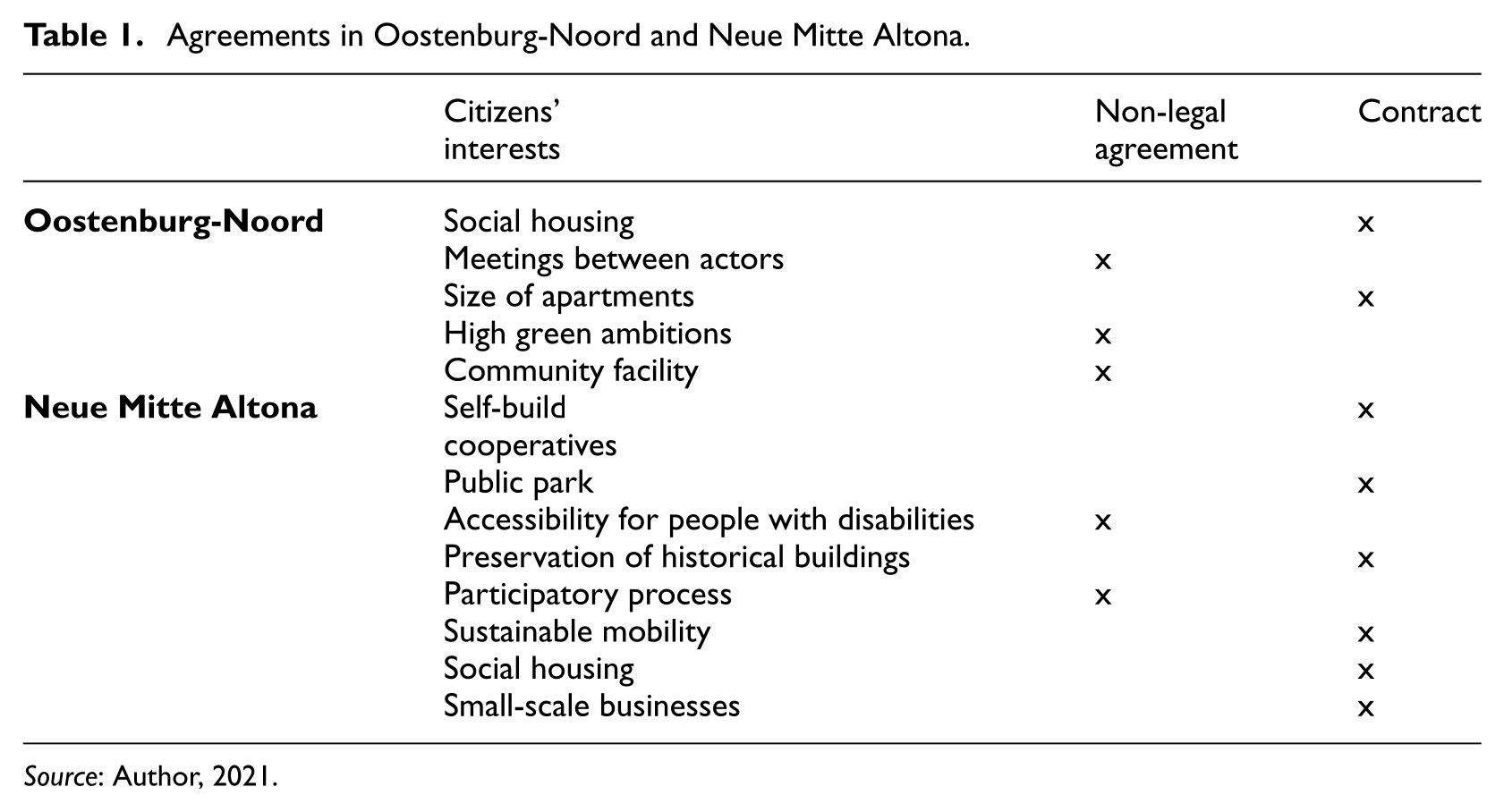
Source: Author, 2021.
Discussion and conclusion
Contracts are increasingly used to achieve public goals. The aim of this article has been to scrutinise how contracts manifest during participatory processes over development projects. The appeal of using contracts to deliver public goals is that they can provide context-specific solutions for local problems. This could potentially work to the benefit of residents. However, this study found that contractual governance complicates the position of residents in urban development.
This study has four main contributions. First, contracts between developers and governmental agencies constrain the ability of residents to be involved in the project. Agreements have the capacity to present a unifying set of citizens’ interests, which will be replicated in other policy documents. This shifts the arena of public decision making from the public meeting to contractual negotiations. Whereas participatory processes promise that residents can be involved, consequential decisions – especially concerning land prices – are already regulated through contracts. The political and legal environment of cities influences to what extend this occurs. In Amsterdam there is less pressure from social movements to open up contractual negotiations to the public; therefore, developers are less inclined to make (contractual) agreements with residents. The pressure from social movements in Hamburg creates an environment where promises to residents are more often safeguarded through legal sanctions. However, when developers make (contractual) agreements with residents in Hamburg, they prefer to work with compromise-seeking groups. This finding seems to affirm the arguments of post-political scholars.
Nevertheless, secondly, this study has shown that agreements can be adjusted. As van den Hurk and Tasan-Kok (2020) showed in their research on contracts between municipalities and developers, contracts are flexible tools. Non-legal agreements in Oostenburg-Noord and Neue Mitte Altona helped to deliver outcomes of participatory processes. When residents mobilise support from the media and from politicians, they can bend agreements towards their goals. Again, the strength of social movements in Hamburg gave residents a better position to negotiate with developers. This nuances the stance of post-political theory that participation and contracts are tools of the urban elites to cement their power. Residents can politicise contracts and use participatory processes to bend the definition of citizens’ interests to their goals.
However, thirdly, contrary to the research of van den Hurk and Tasan-Kok (2020) which focused on contracts between developers and municipalities, this research examined participatory processes. The flexibility of contracts provided opportunities for residents to adjust agreements, but also made the position of residents precarious. The residents active in the Koordinierungsgremium believed they had an agreement with the municipality, but it turned out to be a misconception. Contractual governance has different consequences for developers and municipalities than for residents. While developers and municipalities hire legal experts and have know-how of agreements, residents need to navigate these contractual negotiations voluntarily. Residents have to earn their position and this position remains precarious. Their recommendations can be dismissed as nay-saying or advice. Moreover, the ease of forming contractual relations is related to the profitability of developers. Agreements that relate to public space are more easily made than agreements that relate to housing. Residents that criticise how projects are financed are more likely to be excluded from the negotiation process. This occurred in Neue Mitte Altona, where the more compromise-seeking Eine Mitte für Alle was able to negotiate agreements with the developers; and the relation with the more activist Koordinierungsgremium remained contentious. Furthermore, residents who have access to the media and to politicians have more opportunity to influence decisions. This creates new boundaries between residents who are able to make deals and those who are excluded.
Lastly, this research suggests that non-legal agreements are substitutes for contracts in participatory processes. This implies that studying contracts in order to scrutinise relations between developers and residents would not be sufficient. Transaction costs economics, which is the most prevalent way of studying contracts in the public sector (Schepker et al., 2014), would limit the focus of the research on transactions. The conceptual model proposed in this study proved to be useful to give a more detailed understanding of contractual governance and urban politics. Developers can circumvent public processes by negotiating contracts with government agencies. However, through political action, residents can harness non-legal agreements and contracts to bend development processes towards their goals.
Footnotes
Acknowledgements
We want to acknowledge all the interviewees for taking the time to tell their stories to us. I would like to thank Nanke Verloo, Jan Willem Duyvendak, Martijn van den Hurk, Merlijn van Hulst and Menno van der Veen for their helpful comments and supervision.
Declaration of conflicting interests
The author declared no potential conflicts of interest with respect to the research, authorship, and/or publication of this article.
Funding
The author disclosed receipt of the following financial support for the research, authorship, and/or publication of this article: This work was supported by the Dutch Organisation for Scientific Research [438-15-159] as part of the Smart Urban regions for the Future (SURF) call.
