




Abstract
The relationship between industrialisation and urban development is subject to assumptions based on experiences in the global North, with little research on how it plays out in countries undergoing urbanisation and industrialisation today. In the context of recent excitement about China’s role in stimulating an ‘industrial revolution’ in Africa, we examine how Chinese zones in Ethiopia and Uganda are influencing the urban–industrial nexus. We argue that Chinese zones are key sites of urban–industrial encounter, but these dynamics are not primarily driven by the government officials that dominate the ‘policy mobilities’ literature, nor by the State-Owned Enterprises usually associated with Chinese activity overseas. Rather, they are emerging through the activities of inexperienced private Chinese actors who do not even operate in the worlds of urban policy. Faced with government histories and capacities that vastly differ from China’s, directly replicating the Chinese experience is virtually impossible; yet the tentative and improvisational relationships between Chinese firms, African government authorities and other local actors are gradually moulding new urbanisms into shape. The piecemeal bargaining and negotiation that unfolds through these relationships bridges some of the gaps between industrialisation and planning, but this cannot compensate for the governance of the urban–industrial nexus at higher scales.
Introduction
Urbanisation and industrialisation have been so closely coupled in the European and North American experience – and more recently in parts of East Asia – that the relationship between them rarely comes under scrutiny. Whether viewed through classical social science lenses, which suggest that industrialisation drives urbanisation, or through more recent suggestions (rooted in sources as diverse as Jacobs (1969) and Lefebvre (1970)), that urbanism itself ultimately produces industrialisation, the association between the two is treated as automatic. Yet the situation in much of contemporary sub-Saharan Africa, where urbanisation has been proceeding apace without significant industrialisation (Gollin et al., 2016; UNECA, 2017), impels us to think about this relationship differently. In the context of a recent surge in manufacturing investment from China, the African continent is the site of new encounters between urbanisation and industrialisation in spaces where there is barely any previous urban–industrial nexus to build upon. If Africa is indeed set to become the ‘next factory of the world’ (Sun, 2017), what kind of urbanisms are being manufactured in the process – and how?
Increased offshoring by Chinese manufacturers in Africa over the past decade has prompted a wave of cautious optimism about Africa’s manufacturing potential (Geda et al., 2018; Lin et al., 2019; Sun, 2017). Between 2003 and 2014, China’s foreign direct investment (FDI) stock in Africa increased from US$491 million to US$32.4 billion, and by far the largest number of investments were in manufacturing (UN-HABITAT, 2018: 109). Much of the excitement about China’s role in Africa’s industrial transformation has focused on job creation, knowledge spillovers and economic linkages (Oqubay and Lin, 2019a). Although the importance of infrastructure (and its absence) is often emphasised, the broader urban implications of these industrial investments are underexplored, reflecting a general deficit in research on the processes underpinning the urban–industrial nexus around the world.
One strategy for overcoming Africa’s infrastructure deficits has been through Special Economic Zones (SEZs) and Industrial Parks (IPs), which are increasingly central to Chinese industrial investments in Africa (Bräutigam and Tang, 2011, 2014; Oqubay and Lin, 2019a, 2019b). Yet the creation of zones does not resolve the spatial challenges of industrialisation; rather, it opens a new set of questions. IPs and SEZs are generally sited close to or within existing urban areas, and the relationship is not automatically synergistic. The concepts of SEZs, IPs and other forms of economic zone can also imply very different kinds of relationships with urban space and planning processes. 1 The risk of industrial zones becoming islands that fail to integrate both spatially and economically, despite contributing to short-run economic growth, has proved historically to be very real (Easterling, 2014; Farole, 2011; UNECA, 2017).
Early SEZs in Africa since the 1970s largely failed to achieve basic objectives (Bräutigam and Tang, 2011; Farole, 2011). There are, however, reasons to believe that Chinese-led SEZs hold greater potential, especially given China’s own extensive experience with them and with associated urban development. In 2006, the Chinese government decided to support overseas SEZs, including six in Africa. Progress has been highly uneven but with pockets of relative success (Bräutigam and Tang, 2014; Sun, 2017). These zones have been followed by a wave of private IPs developed without government support, which are barely researched despite bringing substantial change to urban areas across Africa.
In this article, we examine how Chinese industrial zones in Africa are influencing the urban–industrial nexus. The intertwined trajectories of industrial development and urbanisation in China’s experience have been well documented (Chen, 1995; Friedmann, 2005; Gu et al., 2017; Walder, 1992; Wu, 2015), but whether and how this experience is being translated into African contexts remains uncertain. This is an important issue given the lack of alignment between industrial policy and urban planning across much of Africa (UNECA, 2017). As ‘potential test beds for urban software’ (Easterling, 2014: 28), Chinese zones in Africa are vital sites in which to examine the making of industrial urbanism in contemporary Africa.
While most attention paid to large-scale Chinese activity in Africa is on State-Owned Enterprises (SOEs), private Chinese investors dominate manufacturing investment and industrial zone development. In this article, we highlight some specific ways in which private investors are starting to build infrastructural and spatial connections between industrial zones and the urban fabric, drawing partly on China’s experience, but also in response to the everyday challenges they face. By paying closer attention to the businesspeople involved in these ventures – who often have no previous experience in developing industrial zones and are simply experimenting on the ground – we can observe dynamics in the urban–industrial nexus that are obscured by the dominant focus on SOEs and Chinese ‘state capital’ (Gu et al., 2016; Lee, 2018). 2
We begin by rooting the article conceptually in the ‘policy mobilities’ literature, and specifying our methodology. Following this, we discuss the very different contexts for urban–industrial connections in sub-Saharan Africa and China, before turning to Ethiopia and Uganda specifically, outlining the national IP strategy in each country and then exploring the varying roles of Chinese actors. This brings us to our core focus, which is the practices of specific Chinese private investors and their local interactions. Instead of the consultants and officials that dominate the policy mobilities literature, we argue that these inexperienced private investors are central to shaping new forms of improvised linkages between industrial zones and urban development in Ethiopia and Uganda. The struggles of these investors to succeed and to negotiate with a range of local and national actors have drawn together some of the threads of urbanisation and industrialisation in new ways, with important implications for African urban futures.
Conceptual framing and methodology
There is a curious fissure between the literatures on industrial policy learning and urban policy ‘mobilities’. Urban–industrial policy coherence and the importance of urban planning are largely absent from the transnational industrial policy learning literature, including where it discusses SEZs (Farole, 2011; Kim and Nelson, 2000; Oqubay and Ohno, 2019). Meanwhile, there has been extensive attention to urban policy in the ‘policy mobilities’ literature (McCann and Ward, 2011; Peck, 2011; Robinson, 2015), but with relatively little attention paid to industrialisation. These two literatures thus ironically lack the very integration that was central to the successful urban–industrial nexus in China.
This disconnect reflects the fact that much of the work of actively integrating manufacturing industry with urban space and infrastructure happens not at the level of official government policy, but elsewhere. When considering how policies might be ‘arrived at’ in a given location (Robinson, 2015), the policy mobilities literature largely focuses on international consultants and other ‘policy entrepreneurs’, as well as government officials. However, in the relatively rare examples of this literature engaging with East Asia, the role of private enterprises has been emphasised (Bok and Coe, 2017; Song et al., 2018). Thus, despite East Asia being associated with state-driven development, it is often private entrepreneurs and firms that do much of the work of translating policy ideas into new contexts. These individuals and firms might have no intention of being agents of policy mobility; any policy mobilisation that they enact is merely ‘a value-added activity that provides possibilities of profit generation’ (Bok and Coe, 2017: 56).
This prompts us to consider who the most important agents of mobile international knowledge actually are when it comes to Chinese influence on African industrialisation. Although numerous initiatives now exist for African government officials to travel to China and learn about its experiences, this policy learning is only part of the picture, and there are many aspects of the Chinese experience that African governments may ignore, consciously or unconsciously. Learning by policy actors unfolds in the context of powerful pre-existing ideological and sociopolitical frames that filter policy-making imaginaries (Peck, 2011; Zhang, 2012: 2855). Yet private sector actors operating in Africa generally have no such political preferences. Consequently, they often develop forms of local engagement and policy mutation beyond the scope of national governments’ industrialisation agendas.
In what follows, we examine these processes of learning, translation and mutation as they are unfolding through Chinese private industrial parks in two very different African contexts. Ethiopia and Uganda were selected because they both host major Chinese IPs, but substantially differ both in terms of governmental commitment to industrialisation and state control over land. They also enable us to examine urban–industrial integration at very different scales, with Ethiopian IPs being much larger. The article draws on research conducted between November 2017 and June 2019 in China, Ethiopia and Uganda. In China, we interviewed policymakers and international agencies concerned with investment in African countries. In Ethiopia and Uganda, we interviewed Chinese investors and contractors, national and local government representatives, Chinese government agency representatives and international donors. Overall, we conducted over 80 semi-structured interviews, supplemented by a small-scale questionnaire survey of 50 workers in Huajian Light Industry City (HLIC) in Addis Ababa, stakeholder workshops with UN-HABITAT in Nairobi in 2018 and in Ethiopia in 2019, analysis of key government and international agency documents and observation of IPs in Uganda and Ethiopia periodically across the course of a year.
This material was analysed thematically, during which three particular lines of comparison were drawn out: between the conditions of China’s own zone-based urban development and conditions in our African cases; between Ethiopian and Ugandan contexts and experiences; and between Chinese private IP investments and the national, public IP programmes in Ethiopia and Uganda. Through this multifaceted comparative analysis, we were able to inductively develop our arguments about the significance and implications of Chinese IPs for the urban–industrial nexus in Africa.
The urban–industrial nexus: Africa and China compared
By ‘urban–industrial nexus’, we refer to the relationship that industrial developments such as factories and industrial zones have with the surrounding urban fabric, for example through infrastructures of energy, water, waste and transport, and the accessibility and quality of housing for workers. Access to land and appropriate land use regulations, enabling industries to thrive while complementing surrounding land uses and limiting negative externalities, are important as well – as is the location of industry vis-a-vis appropriate labour markets. The extent to which these connections are governed in a coherent way, and through integrated policies, varies widely. The mechanics of this nexus have been subject to surprisingly little research in the global South, though some recent studies exist on China (Li and Chen, 2012; Liu et al., 2020) and Africa (Murphy and Carmody, 2019; Turok, 2014).
There has also been limited attention to the relationship between urbanisation and industrialisation as processes, in sub-Saharan Africa, partly due to assumptions rooted in historically specific experiences of the global North. Historically, industrialisation has often been viewed as the primary driver of urbanisation, with rural–urban wage differentials generated through industrial development stimulating migration into cities (Lewis, 1954). This led late 20th-century economists to puzzle over what they termed ‘over-urbanisation’ in Africa: that is, urbanisation unmatched by industrial job opportunities (Davis, 2016). However, closer attention to the fundamental drivers of urbanisation globally shows that the link between urbanisation and industrialisation is not natural or inevitable (Fox, 2012).
The disjuncture between urban development and the extent of industrialisation in much of the South has become a subject of significant concern (Gollin et al., 2016; UNECA, 2017). Limited industrial investment during the colonial era, followed by structural adjustment in the 1980s–1990s alongside the surge in cheap manufacturing from Asia, caused many African countries to de-industrialise (Mkandawire and Soludo, 1999). From 2000 to 2015, the average decline in manufacturing in Africa as a share of GDP was 2.3 percentage points (UNECA, 2017), while in the same period the level of urbanisation increased from 30% to 40%. Today, many African cities pose significant obstacles to industrial success due to infrastructure deficiencies, legacies of unplanned urban form, complex land markets and inadequate housing and transport (UNECA, 2017: 122–126).
Economists increasingly argue that structural transformation towards manufacturing is essential for sustained growth and poverty alleviation in Africa, with SEZs and IPs seen as important tools for achieving this (Ajakaiye and Page, 2012; Geda et al., 2018). Part of the reason for previous SEZ failures was their lack of strong connections to existing urban economies (UNECA, 2017). This was linked to a broader neglect of urban policy for which Western donors – gripped from the 1980s by ideas of ‘urban bias’ (Bates, 1981; Lipton, 1977) and a hostility towards public sector planning – were partly culpable. Around half of African countries have no national urban strategy (UCLG Africa and Cities Alliance, 2018), and those that do exist are often divorced from economic development strategy (Turok, 2015). Over the past decade, many African countries have returned to industrial policy (Ajakaiye and Page, 2012; Whitfield et al., 2015). Yet the dual legacy of structural adjustment and diminished planning capacity creates formidable obstacles to effectively integrating manufacturing industry with surrounding infrastructure, housing and land use.
China offers a contrasting experience over the same period. While it has experienced varying urban–industrial relationships since the early rural-based industrialisation under Mao (Gu et al., 2017), the creation of SEZs since the late 1970s played an integral catalytic role in both industrialisation and urban development (Bräutigam and Tang, 2011; Easterling, 2014; Ren, 2013). The earliest SEZs in Guangdong and Fujian Provinces, including Shenzhen, charted a remarkable learning journey, deploying institutional experiments to maximise the benefits of foreign investment. By 1981, these SEZs accounted for 60% of all FDI in China (Zeng, 2010).
In the late 1980s, the Shenzhen ‘flagship’ development story gave way to other forms, including Economic and Technological Development Zones and High and New Technology Industrial Development Zones (Chen, 1995). The later economic zones did not follow the exact model of Shenzhen, and some cases such as the Tianjin Economic and Development Area have been associated with urban fragmentation (Wang et al., 2020). However, while levels of urban–industrial integration vary, the overriding story is one of relative coherence between the urban and industrial policies, reflected in at least two aspects which are missing from many African contexts and from formal efforts at ‘policy transfer’.
First, despite a one-party state, there has been significant decentralisation in the administration of both urban areas and SEZs. Although SEZs in China are regulated by the national government, they enjoy strong governance autonomy. Early SEZs were granted municipal/sub-provincial status, and more recent economic zones are usually governed by a special commission directly under local government or a parastatal company in which local government holds a large share (Chen, 1995). These developments substantially increased local autonomy (Eng, 1997). By the late 1980s, urban governments enjoyed widespread freedom in revenue-raising and engaging flexibly with FDI. The consequent local autonomy facilitated capacity transfer between FDI and the local economy (Walder, 1992). Much SEZ revenue remains local (up to a threshold when a proportion may have to be shared with the provincial government), but the national government largely refrains from interfering. SEZs and local governments have thus grown together symbiotically (Eng, 1997).
Second, planning plays a significant role throughout (Eng, 1997; Ng and Tang, 2004). Both industrial and urban land use increased significantly in the post-1978 era and there are many territorial tensions to be resolved, but land-use planning and urban planning generally are afforded significant authority in this arena (Kuang et al., 2016). It has thus been said that in the post-1978 era the government realigned administration to shift from a ‘planned economy’ to a ‘planned cities’ approach (Abramson, 2007).
The above features contrast with many African contexts, where recent efforts towards decentralisation have been primarily administrative rather than fiscal, and planning started to be undermined just as it was simultaneously being strengthened in China. Against this diverging background, many official efforts by Chinese policy actors to advise African governments on industrialisation involve assumptions or oversights that render their efforts ineffective or irrelevant, as we discuss further below.
Industrial park development in Ethiopia and Uganda
The recent emphasis in the industrialisation push in both Ethiopia and Uganda has been on IPs, rather than other more expansive forms of SEZ. In terms of functional development, IPs in both countries resemble the earlier stages of China’s Free Manufacturing Zones and Export Processing Zones (Chen, 2019), which focus on labour-intensive industries and primarily target job creation and export-oriented production. Because some of the IPs in Ethiopia and Uganda (particularly private Chinese ones) have ‘zone’ in the title, and in practice the terms are flexible, we here use the generic ‘Chinese zones’ interchangeably with Chinese IPs.
In contrast to economic zones within China, which are all administered by local public agencies, in both Ethiopia and Uganda we need to distinguish between national (public) IPs managed by a national authority, and private zones managed by private (usually foreign) companies. There are interesting dynamics between public and private zones, involving competition but also an interest in learning from each other –especially in Ethiopia. In the remainder of this section, we briefly review the national IP programmes in each country, before turning to the role of different kinds of Chinese actors.
National IP development programmes
Ethiopia provides Africa’s clearest example of a government that has been committed to promoting light manufacturing in recent years, including through IPs. In 2014, the Industrial Parks Development Corporation (IPDC) was established to drive forward national IP development (Oqubay, 2015; Staritz and Whitfield, 2017; Sun, 2017). Yet even in the accounts offered by Arkebe Oqubay – a senior Ethiopian policymaker since the 1990s – the relationship between industrial zones, existing urban areas and urban planning has been a weak link. Instead of concerted efforts towards policy integration, cities adjoining the 12 national IPs are merely ‘expected to prepare master plans’ to accommodate IPs’ effects (Gebre-Egziahber and Yemeru, 2019: 798). Research on Ethiopian IPs has also largely neglected this issue, focusing mostly on labour relations and economic linkages (Fei and Liao, 2020; Giannecchini and Taylor, 2018; Lin et al., 2019; Oqubay and Lin, 2019b; Oya, 2019).
The difficulties in integrating IPs with urban areas are vividly illustrated by the case of Hawassa, Ethiopia’s flagship (and Africa’s largest) IP. The park employed 31,500 workers by December 2019, 3 and when full has the potential to increase the city population by over 50%, from around 500,000 today to a projected 750,000 by 2035. The lack of a coherent framework for integrating spatial planning with IP development, alongside protracted disputes between the municipality and the IPDC on how to deal with the massive shortfall in workers’ housing, pose huge challenges. 4
In Uganda, attention to manufacturing has been much more fragmented (Whitfield et al., 2015). A dual track strategy has emerged where national IP development is led by the Ugandan Investment Authority (UIA), while a programme to facilitate ‘free zones’ is led by the Uganda Free Zones Authority (UFZA). However, there is no central agency with the remit and resources to promote IPs like Ethiopia’s IPDC. UIA oversees nine parks at various stages of development – though the only operational one is Namanve near Kampala, which is still severely lacking in infrastructure finance. UFZA aims to help private investors develop their own export-oriented zones, but does not actively invest in IPs or source land. Representatives concede that despite attempts to learn from China, it is very difficult to establish large zones due to Uganda’s widespread private land ownership, and the agency has little engagement with processes of planning or urban policy formation. 5
Disaggregating Chinese actors in industrial park development
Before turning specifically to private investors, it is important to disaggregate the multiple types of Chinese actors involved in IP development in the two countries, in varied roles. Tables 1 and 2 outline the main IPs of any kind in Ethiopia and Uganda respectively, showing that Chinese actors are engaged in a range of ways. Overall, we identify four sets of Chinese actors engaged in IP development.
Industrial parks in Ethiopia and key actors.
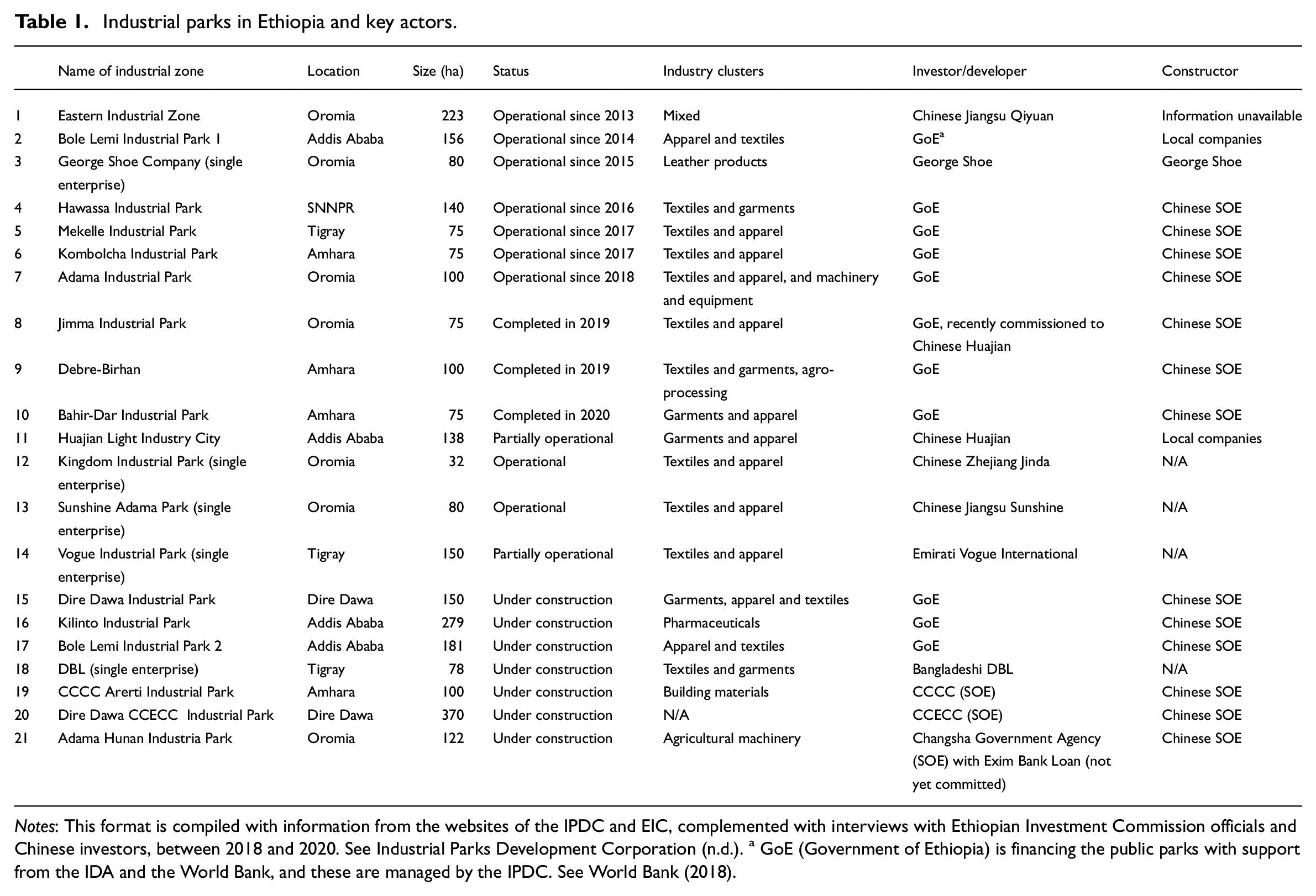
Notes: This format is compiled with information from the websites of the IPDC and EIC, complemented with interviews with Ethiopian Investment Commission officials and Chinese investors, between 2018 and 2020. See Industrial Parks Development Corporation (n.d.). a GoE (Government of Ethiopia) is financing the public parks with support from the IDA and the World Bank, and these are managed by the IPDC. See World Bank (2018).
Industrial parks in Uganda and key actors.
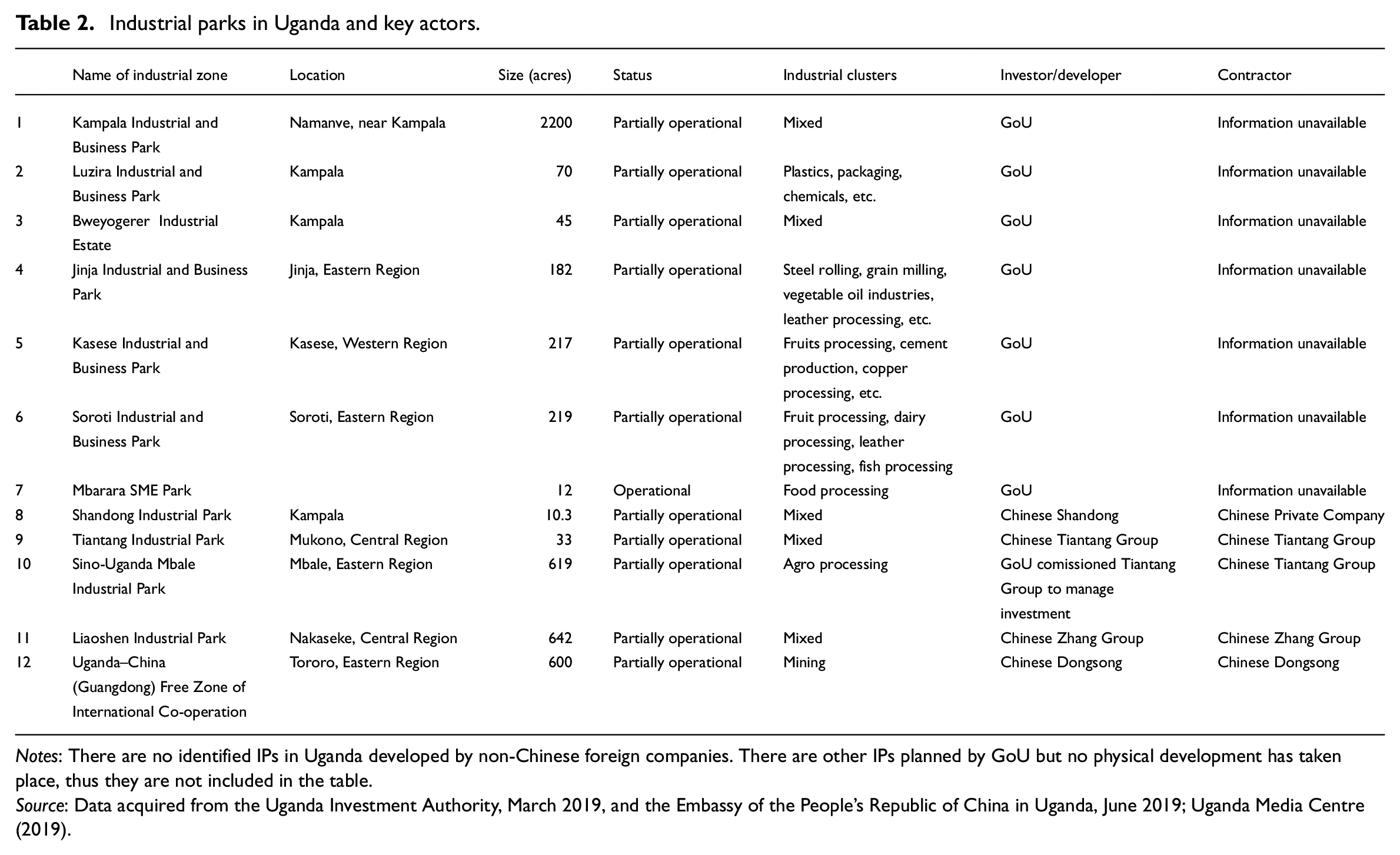
Notes: There are no identified IPs in Uganda developed by non-Chinese foreign companies. There are other IPs planned by GoU but no physical development has taken place, thus they are not included in the table.
Source: Data acquired from the Uganda Investment Authority, March 2019, and the Embassy of the People’s Republic of China in Uganda, June 2019; Uganda Media Centre (2019).
First are those that embody China’s ‘state capital’, that is, SOEs investing in IPs. These are actually very few. In our cases there are two SOEs (CCCC and CCECC) actively investing, both in Ethiopia, and one further proposed venture involving the Changsha Government Agency. However, their IPs remain empty at the time of writing and our interviews suggest that Chinese SOEs are reluctant to invest any further themselves. They took over these parks through specific arrangements with the Ethiopian government that would enable them to maintain their competitiveness in the construction business. 6 Beyond this, the expectation is that (as in China’s own experience) investment will be the role of other, private investors seeking to use the parks. The second category of Chinese actors is contractors – also often SOEs – acting merely in the capacity of construction firms rather than investing. These are substantial in number; Chinese contractors have been involved in all of the Ethiopian national IPs, for example.
A third category is policy advisers – the agents most typically associated with ‘policy mobility’– who on a few occasions have come to African countries specifically to share learning from Chinese experiences. These efforts have been relatively limited, and rarely influential. Of over two dozen IPs with significant Chinese involvement, only a couple involved expertise in planning beyond the production of physical layouts of the parks by Chinese designers. In Hawassa, experts from Suzhou IP were invited to share experiences through a two-year skill transfer programme. However, both Ethiopian officials and Chinese advisors suggested that the transfer was unsuccessful, with one source even claiming that the experts ‘remained in their office all the time and did not care about what’s going on in the park’. 7
Another notable attempt at policy ‘transfer’ was the strategy developed by the Chinese Association of Development Zones (CADZ) in Ethiopia from 2013 to 2015, which included proposals for 20 SEZs throughout the country. This strategy explicitly discusses the relationship between urbanisation and industrialisation, proposing to ‘shape a SEZ more like a township than a mere industrial park’ (CADZ, 2015: 25). It has not been adopted, however. In the specific case of Dire Dawa – which differs from other Ethiopian secondary cities in having ‘chartered city’ status – CADZ also developed a SEZ Master Plan that is actively being used to guide investment in and around Dire Dawa. Yet it is unclear whether the broader SEZ will materialise, beyond the existing IP; local planners themselves indicate a lack of capacity to implement these plans. 8 Aside from this one case, the Ethiopian government was concerned about the expansive spatial and governance implications of the SEZ concept, hence settling instead on an IP-based strategy (Robi, forthcoming). In Uganda, several plans for specific new SEZs have also been developed by Chinese investors and advisors, but again with little prospect for realisation given Uganda’s governance structures.
The fourth category is private investors. As we will now argue, despite an ongoing tendency to associate Chinese activities in Africa with large SOEs, it is actually private actors we must look to for the most significant IP investments and associated learning and influence regarding the urban–industrial nexus. In contrast with the hesitant steps by Chinese state capital, private Chinese investment into African IPs is thriving (note that all Chinese firms listed in Tables 1 and 2 are private unless otherwise stated). As well as being much more involved in African manufacturing generally (UN-HABITAT, 2018), Chinese private enterprises are far more active than SOEs when it comes to investing in IPs and drawing other investors into them.
A closer look at private investors across both countries reveals a surprising shared characteristic: none have had direct participation in SEZs or IPs in China. This has significant implications for their capacity to convey policies from the Chinese SEZ experience, because they have not themselves been part of it. Table 3 provides an overview of the career trajectories of some key Chinese IP developers in Ethiopia and Uganda, illustrating both their diversity and a common lack of background in Chinese zones.
Chinese private park investors/managers in Uganda and Ethiopia.
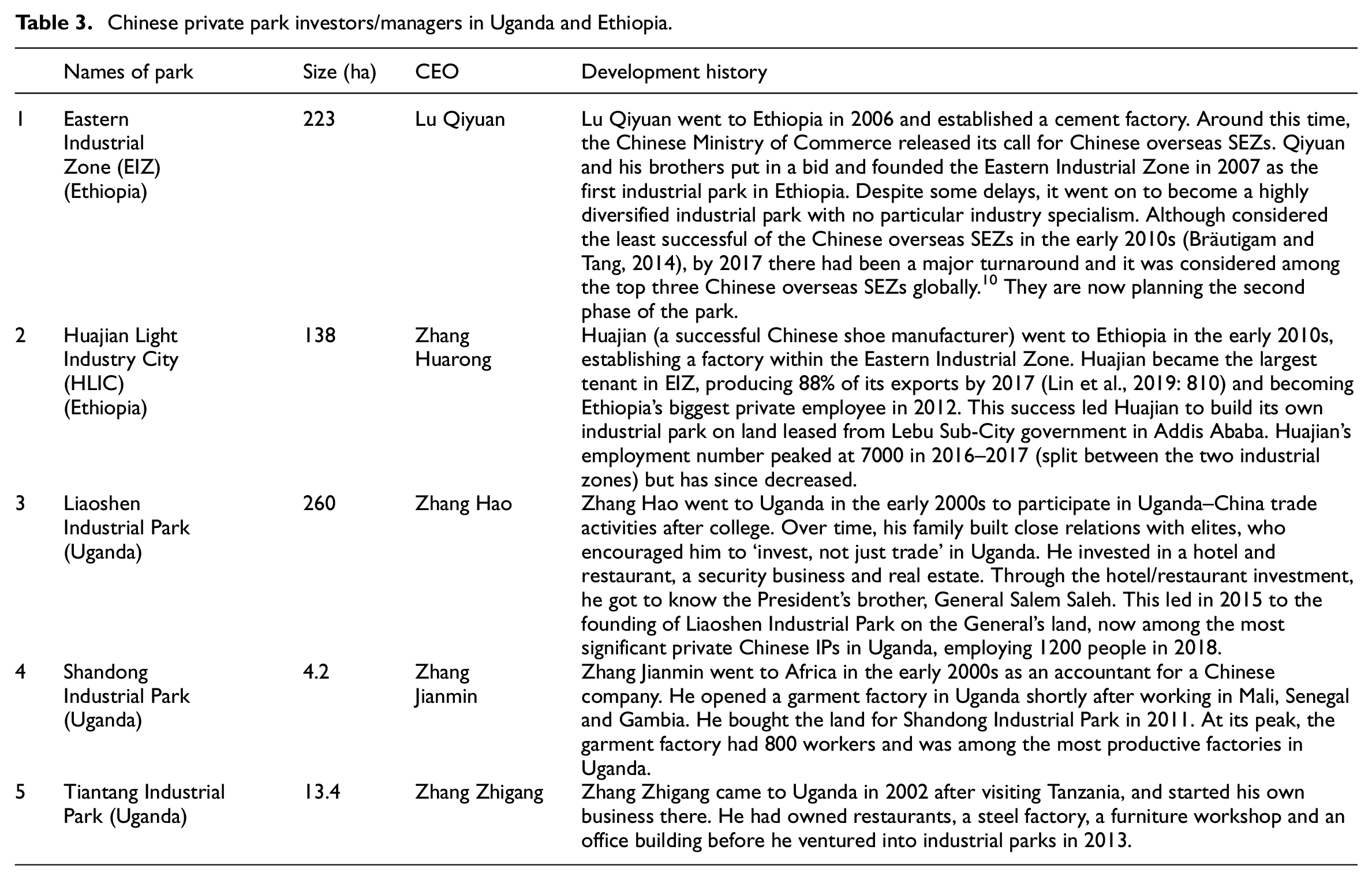
The narratives in Table 3, selected because the actors concerned have developed some of the most significant foreign-owned IPs in the two countries, demonstrate that they were private entrepreneurs who decided to invest in IPs quite spontaneously. With the exception of Eastern Industrial Zone (EIZ), none received any Chinese state support, 9 and none had prior experience of developing and managing economic zones. As they moved from other sectors into the complex position of IP management, they adopted a range of complex new roles, including acting as intermediaries between African government agencies and other foreign private businesses. This inexperience meant they had limited knowledge of the impacts that IPs can have on surrounding areas – which can be dramatic and multifaceted. As well as the intensification of development in nearby towns or neighbourhoods, the detrimental environmental effects can be severe. Evidence of contamination of rivers close to EIZ, for example, sparked particular concern. In all cases outlined in Table 3, expertise in planning and integrating IPs was deficient on both the Chinese and African sides. Most attempts at integration have been ad hoc, taking place in the absence of clear planning or government support, severely limiting the prospects for conventional ‘policy transfer’. However, private firms have drawn on experiences from China in idiosyncratic ways to innovate forms of urban integration through gradual processes of learning and negotiation.
Tentative urban policy learning: ‘Crossing the river by feeling the stones’
It is worth re-emphasising that in our African case studies, local authorities possess nothing like the level of power and resources devolved to local governments in the Chinese experience of SEZ-led urbanisation after 1978. Power in Ethiopia has always been highly centralised, despite its contemporary federal structure (Markakis, 2011). Although Uganda has undergone extensive decentralisation since the 1990s, this has fragmented administration without substantial autonomy or revenue-raising capacity (Green, 2015). Weak and under-resourced local government makes it very difficult to respond to the urban challenges accompanying the development of IPs or other economic zones. Such zones are usually built in sparsely populated areas, with relatively undeveloped infrastructure; yet when focused on labour-intensive manufacturing, IPs often generate rapid local population growth and a range of associated pressures.
Ethiopia’s EIZ houses over 90 factories and hired 14,700 people at its peak, most of whom are based in the nearby towns of Dukem and Bishoftu. HLIC – a private zone whose grand title and boot-shaped design (see Figure 1) underline the private investor’s ambition to make what is currently just an industrial park into a multifunctional urban area – employed over 3600 workers in 2018. Liaoshen IP in Uganda (Figure 2) is still under construction, but in addition to 1200 employees working in a ceramics factory, a new cement factory aims to employ 2000 workers within months of opening. If new workers move to the neighbouring urban centre of Kapeeka, currently home to just 3000 households, 11 this could produce a massive proportional increase in population.
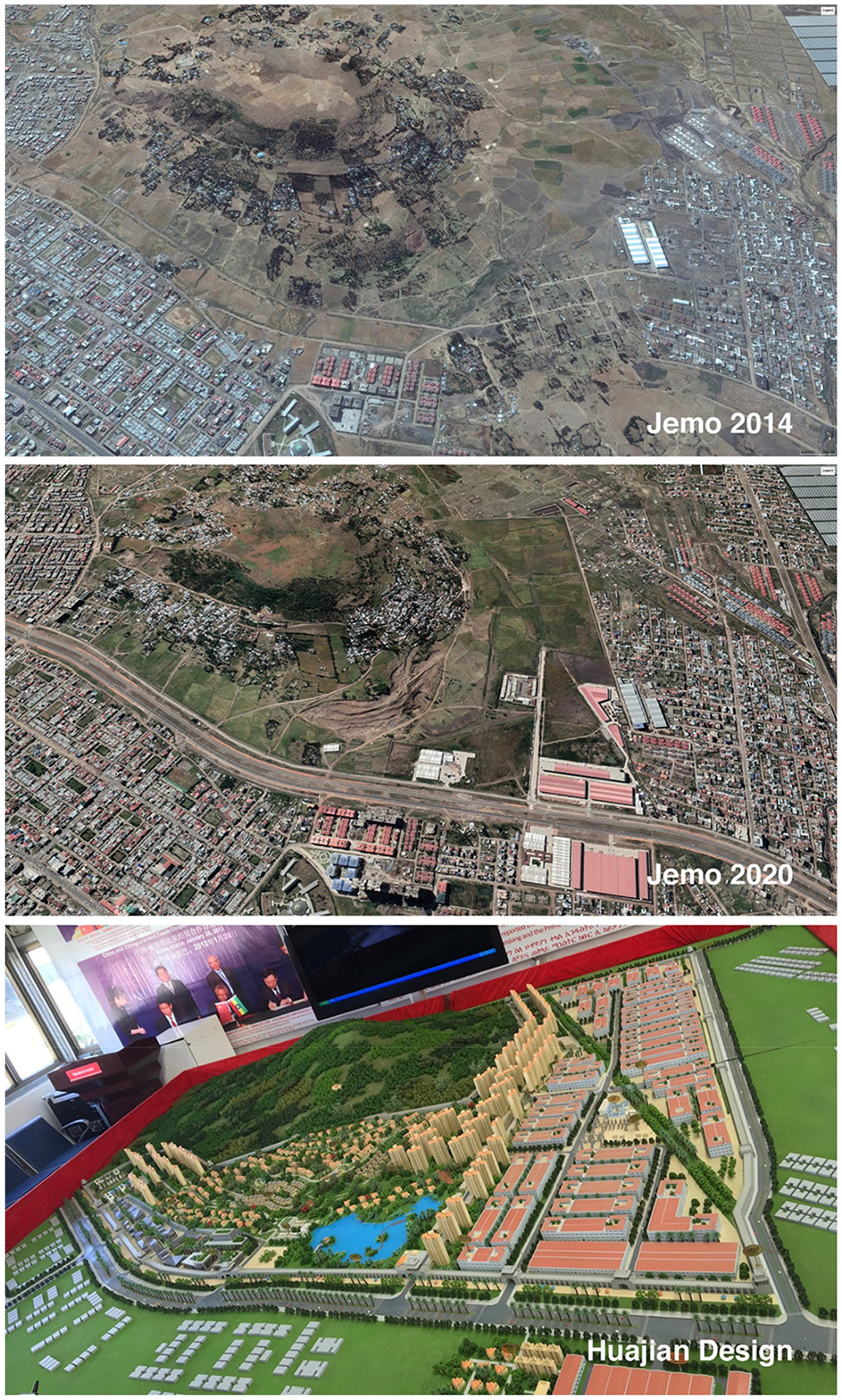
Huajian Light Industry City and Jemo area.
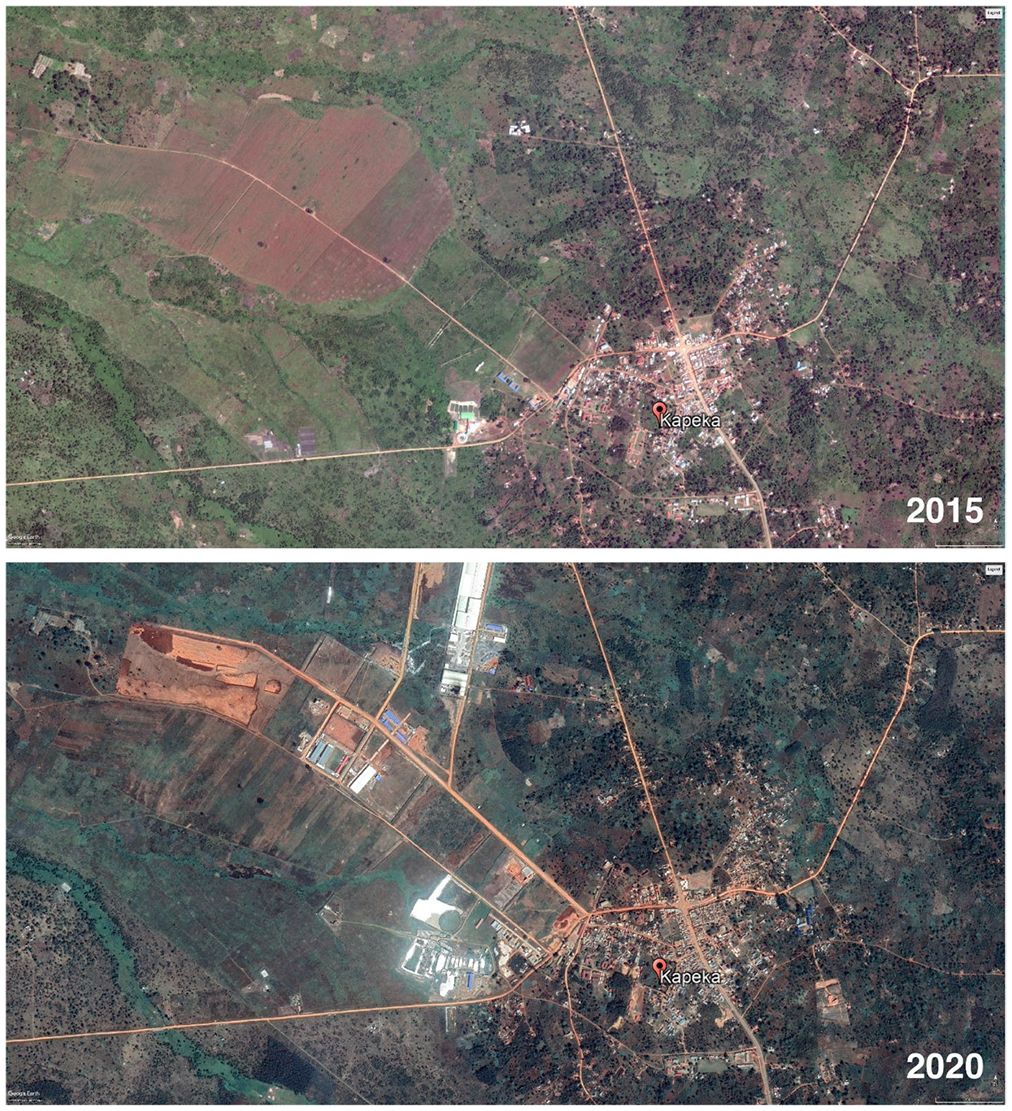
Kapeeka and Liaoshen Industrial Park.
Despite the limits of organised policy transfer programmes, individual private Chinese IPs have become sites of experimentation in their relationship with urban development. One aspect of this concerns housing – a major concern in virtually all the IPs considered here, with a significant gender dimension as the majority of factory workers are women. In Ethiopia, land use policies initially prohibited mixed use development within IPs, and consequently the first zones offered no housing. Some firms in EIZ offer shuttle buses instead from nearby towns where urban infill development and the strain on infrastructure are intensifying. 12 There has also been significant private housing construction close to HLIC, where rents are reportedly skyrocketing. 13 However, HLIC is the first IP in Ethiopia to provide workers’ accommodation within the park, drawing directly on Chinese experiences after its managers persuaded the authorities to allow mixed use inside. In early 2018, about 1400 workers lived in dormitories inside the zone. Although in some respects this contributes to the zone’s enclavic nature, the accommodation was something that factory workers appreciated more than most aspects of their low-wage jobs, rating relatively highly features such as privacy, comfort and bathing and toilet facilities in the dormitories. 14
A second important area of private investors’ influence, with more of a direct effect on policy and law, relates to land management and tenure. EIZ’s managers wanted to lease out land parcels to attract tenants, as is normal in the Chinese experience – but private sub-leasing was prohibited by existing land regulations (Fei and Liao, 2020). Ethiopian government resistance to sub-leasing in a context where land is so sensitive was substantial. To overcome this, Qiyuan Group engaged in what one senior representative termed ‘hundreds of pleas to different levels of government and millions of meetings’, as well as study visits to China, in order to acquire a letter from the Ministry of Industry to allow them to experiment with leasing land as a ‘special case’. Making sub-division a standard practice required further negotiations, through which Qiyuan also successfully lobbied for the extension of the tax exemption period for investors. The whole process of negotiation took almost three years, 15 leading to the 2015 Industrial Parks Proclamation. Sub-division is now legal, and it is widely believed that Qiyuan’s efforts to maximise the potential of EIZ played a key role in shaping Ethiopia’s policy framework for IP development (Fei and Liao, 2020).
Despite this, Chinese IP investors’ practices and ideas are not always considered as contributing to development in surrounding areas, and communication problems between investors and local authorities endure. In Uganda, district planners (who are nominally responsible for planning in Kapeeka Sub-County, where Liaoshen IP is located) complain that the IP bypasses them by negotiating development plans directly and often informally with national government. This is exacerbated by close personal relations between the IP owner and Ugandan first family. However, the owner argues that he has attempted to support local planning but faced serious challenges. Although the IP itself has detailed plans, there was no area plan for Kapeeka Sub-County for its plans to integrate into. 16 Amid growing concerns about the park’s impact – including in relation to waste – the local authority enlisted Kampala-based consultants to develop a Sub-County plan, and found that the district authorities had little knowledge of the IP and few if any staff had even visited. 17 They also reported intense land speculation in the wider area as land value increased in response to the park’s activity, amplifying the challenge of land development outrunning local planning. The sense that powerful actors are transforming the area has produced a climate of suspicion in Kapeeka, and negative local attitudes towards Chinese investment and labour practices (Wyrod, 2019). The weak and strained relations between district authorities and Chinese investors provide a striking contrast with the tight local bargaining between local officials and foreign capital that shaped industrial urbanism in China (Eng, 1997).
In the context of these difficulties, small steps towards integration are taken as the relationship between the IP and surrounding urbanisation is improvised on a day-to-day basis. The Zhang family at Liaoshen increasingly realise that local development and urban integration matter, and have developed several initiatives to build links with Kapeeka town. These include social initiatives such as the organisation of football games between Chinese factories and the local community, but also nascent urban environmental and economic initiatives including cleaning streets, planting trees and encouraging local motorcycle-taxi riders to diversify livelihoods through recycling activities. 18 These developments unconsciously replicate, albeit on a smaller scale, some of the ways in which early SEZ developers in China took on new responsibilities to support development in surrounding areas. In Shekou, Shenzhen’s first economic zone, local infrastructure weaknesses led the zone developer to invest in schools and hospitals around the zone (Lin et al., 2019: 820). Unfortunately, developments in Kapeeka are also replicating some forms of social and spatial inequality that accompanied Chinese industrial urbanism (Eng, 1997; Wyrod, 2019).
Meanwhile, efforts to inculcate urban industrial norms and labour discipline through rituals of hard work, punctuality and individual betterment are evident in all the zones – particularly those involving Huajian. Workers in HLIC assemble every morning at 7.20 am for a briefing, commencing work by 8 am and working until 5.50 pm, with a one-hour lunch break and three meals provided onsite. Each worker is given a Chinese name, with meanings that correspond to words such as ‘development’, ‘efficiency’ and ‘cooperation’, as well as the names of cities. 19
The fact that local government planning and infrastructure provision are particularly weak for private IPs often forces them to negotiate with local authorities in unexpected ways. In both countries, the main government agencies that IP owners need to deal with for licensing, regulation and taxation are national. Yet when it comes to daily concerns about energy, water, transport and waste management, neither national utilities nor local authorities are able to provide what they require. This has led EIZ to build its own electricity supply and distribution infrastructure, which necessitates dealing with local authorities to acquire land, source labour and arrange contractors. In HLIC, after losing patience with waiting for the government to pave the main road running through the zone and linking it to the ring road, Huajian decided to widen and pave this road themselves (see Figure 1). 20
Rather than these infrastructural investments taking place through a framework guided by government, investors usually have to feel their way. Interestingly, in working closely with the Oromo regional government as well as the federal government, the Chinese managers of EIZ in Ethiopia perform a role that is lacking in the government’s own national IP programme. Centralised decision-making within IPDC, as well as Ethiopia’s fraught ethno-political context, have inhibited smooth inter-governmental working regarding the national IPs.
21
However, the Chinese private IPs can (and need to) position themselves neutrally between the different stakeholders to maximise their prospects for success. In discussing his relationship with the Oromia government, a senior EIZ figure contrasted local government capacities with those in China, but also emphasised the relationship-building and sense of influence: If it were China 50 years ago and a foreign investor came here to operate an industrial park, the city government would be so thrilled, offering all kinds of policy advantages, learning actively from the practice and making plans surrounding the park. In Ethiopia, however, the progress is much slower and the impact smaller. Despite that, we have seen progress … We are actually in conversation with the government, suggesting a merger of Dukem and [Bishoftu]. We are proposing an industrial city – a satellite city. Last week we brought this idea to the table of Abdulaziz, who is the Vice President of the Oromia region … He is very interested in this idea. Ten years ago when we came to Dukem it was still a very small village. Now we are looking for design institutes in China to make a 25 km2 urban plan for the government.
22
More generally, unlike in China where local authorities provided resources and services to IPs, in our African cases the IP investors’ local engagements are more about negotiating with public authorities as brokers and gatekeepers. The complexities of local negotiation are well illustrated by the case of Shandong IP in Kampala, where securing a land title and working around land use regulations necessitated extensive negotiation, and both formal and informal payments. The outcomes of such relationship-building efforts with local authorities are generally tentative and uncertain. Yet they are to some extent producing new forms of urban–industrial integration that weakly echo – though substantially differ from – China’s own experience.
While policy ‘mobility’ may be impossible in this context, Chinese park owners and local authorities are, therefore, periodically ‘arriving at’ elements of a new urban–industrial nexus through their private, individual practices. In contrast to ideas of neocolonialism, this is partly because these Chinese zones are not strategically planted in Africa to expand Chinese state capitalism. Rather, they involve entrepreneurs practising the most important lesson from industrialisation in China: learning by doing, or – to use Deng Xiaoping’s famous metaphor about China’s own development –‘crossing the river by feeling the stones’– and in so doing improvising new forms of urban–industrial linkage.
Conclusion: Striving for a new urban–industrial nexus
This article has explored the extent to which new urban–industrial connections are unfolding through Chinese industrial zones in Africa, but primarily not through conventional forms of policy mobility. Most investors developing IPs in Africa have very limited experience in Chinese IPs, and while often exposed to ‘best practice’ stories from China find themselves faced with vastly different institutional environments. Our two case study countries vary significantly in their emphasis on industrialisation, yet in both cases the coordination between central and local government agencies, and the powerful role of the latter as drivers of urban–industrial evolution, are absent.
However, as our examples show, these challenges lead investors to search for ways to either change policies or develop their own practices in the absence of them. Rather than official policy learning processes, we find that the steepest learning curve is that of the Chinese entrepreneurs themselves. Faced with government histories and capacities that vastly differ from China’s, investors’ influence on urban–industrial integration can only unfold through the slow and incremental processes of responding to ever-changing opportunities and constraints, as the relationship between firms and local authorities gradually moulds new urbanisms into shape.
These experiences illustrate some limitations of the policy mobilities literature, which focuses primarily on the active mobilisation of policy ideas rather than how policies filter through practices – and specifically the practices of profit-seeking investors with only a distant connection to the experiences from ‘home’ that they ultimately try to reconstitute. While McCann (2011) and others discuss the banal practices of consultants, we put the spotlight on the banal practices of inexperienced zone managers who do not even operate in the worlds of urban policy and are, in general, not particularly interested in mobilising it. As one manager involved in the long negotiations leading up to the Ethiopian Industrial Parks Proclamation noted, ‘We didn’t push them to build the [Industrial Parks] law. It was all the issues and challenges we met that drove them to realise there must be a law.’ He then noted that ‘of course, the law didn’t solve all the problems at once … we are still facing new challenges every day’. 23 Through bargaining with local governments and drawing piecemeal on Chinese experiences, attempts to overcome these challenges gradually generate negotiated solutions, however limited they might be, which are producing new urban–industrial landscapes.
Moreover, while prospects for formal policy transfer appear limited, Chinese IPs are having a further impact through their role as competitors to national IP programmes. Although beyond the scope of this article to discuss in depth, Chinese IP owners have concerns about favourable taxation and infrastructure provision in national IPs (particularly in Ethiopia), leading them to strive to provide better infrastructure and services themselves in order to attract investors, and to regularly propose new ideas to the government. The Chinese zones are therefore evolving through dynamic, competitive relationships with those supported by the national government.
Through these processes, new forms of urban–industrial nexus are being improvised. As Easterling (2014: 40) notes, zones develop their own ‘peculiar forms of urbanity’. Whether through housing provision, transport links, recycling initiatives or just bargains struck by investors with local political actors to maintain goodwill, these Chinese IPs play a role in shaping African urbanisms. Some Chinese investors strive for more direct influence than this – for example in the case of Qiyuan’s proposed ‘industrial city’ merger of Dukem and Bishoftu. Although there are significant physical and administrative obstacles to realising such visions, the fact that these discussions are happening is pushing forward the conversation about urban–industrial integration. Some observers argue that Ethiopia’s publicly owned IPs are more likely to facilitate internal economic linkages than private ones (Gebre-Egziahber and Yemeru, 2019; Giannecchini and Taylor, 2018). We highlight a different dynamic, suggesting that it is through private Chinese IPs that the prospects for urban integration may be greater, both through partial emulation of China’s experience and through investors’ growing consciousness that they must foster better links with surrounding urban areas to survive.
This is not to deny deep and enduring problems relating to these zones, including the question of industrial waste. It is clear that improvising the urban–industrial nexus in this way cannot substitute for broader integration at the level of governance and policy. More generally, it remains debatable how far African countries should be basing their approach on the Chinese experience, which was replete with land disputes and environmental degradation (Fei and Liao, 2020; Lin et al., 2019). While there is much to be learned from China about the relative autonomy of both SEZs and the local governments they bargained with, these also come with their own risks in our African case studies – especially given the lack of experience of IP managers and the complex ethnic politics that was absent in China. Countries such as Ethiopia and Uganda must and will continue to plot their own paths as they seek to industrialise. But in the meantime, it is clear that new forms of urbanism indirectly influenced by China’s experience will continue being manufactured on the ground, as investors and their authorities feel their way across the river.
Footnotes
Acknowledgements
This article is co-authored with equal overall input from both authors. We would like to acknowledge the invaluable research assistance provided by Yohana Eyob and Metadel Sileshi Belihu in implementing our questionnaires. We would also like to thank Selamawit Robi for the many insights and conversations that have enriched our understanding of the Ethiopian industrial and urban policy context. All errors are our own.
Declaration of conflicting interests
The research was funded through an ESRC Future Research Leaders grant (grant no. ES/N018095/1).
Funding
The author(s) received no financial support for the research, authorship, and/or publication of this article.
