



Abstract
This paper traces the evolution of Chinese finance in infrastructure development in Kenya, transitioning from a government-to-government (G2G) to a public-private-partnership (PPP) model, as exemplified by the Kenyan Standard Gauge Railway (SGR) and the Nairobi Expressway. It demonstrates how financing models redistribute risks and control among stakeholders, producing distinct spatial outcomes. The G2G-financed SGR placed financial risks on Kenyan institutions while limiting Chinese contractors’ authority, resulting in uneven and short-lived development gains in towns such as Voi. The PPP-financed Expressway, on the other hand, transferred greater financial exposure to the Chinese concessionaire but also granted tighter technical and operational control, embedding profitability imperatives into its design and operation. The paper argues that the shift in financing not only commodifies infrastructure but also institutionalises bypassing, as projects increasingly prioritise exclusive flows, tolled access, and selective connectivity over inclusive integration. It challenges the assumption that PPPs represent a more efficient financing model, and shows instead how the redistribution of risk and control through financing models shapes the socio-spatial inequalities of large-scale connectivity infrastructure.
Introduction
On 14 May 2022, the 27-km Nairobi Expressway, connecting Jomo Kenyatta International Airport and Nairobi’s western suburbs, commenced trial operations. This tolled highway, the first of its kind in Kenya, was financed, constructed, and is operated by China Road and Bridge Corporation (CRBC), the same company that built and played a critical role in financing Kenya’s Standard Gauge Railway (SGR). Both projects were closely associated with former President Uhuru Kenyatta, who presided over the groundbreaking and launch of the SGR before later announcing the opening of the Expressway. Oversight of the Expressway’s construction fell to Transport and Infrastructure Cabinet Secretary James Macharia, who also held office during the SGR’s inauguration. As such, the two projects involved a similar constellation of political and institutional actors, though they were financed under distinct arrangements. The SGR, launched in 2013 and developed in phases, first linking Mombasa to Nairobi (2017) and then extending to Naivasha (2019), was funded through a government-to-government (G2G) loan agreement with China. By contrast, the expressway was subsequently developed through a public-private partnership (PPP) arrangement, under a 30-year concession to CRBC.
This change of financing arrangement reflects broader shifts in the governance of China’s Belt and Road Initiative (BRI). As overseas lending has become more risky and costly, Beijing has promoted infrastructure PPPs in China’s international construction market (van Wieringen and Zajontz, 2023). At a moment when Kenya was politically and financially sensitive to rising debt, CRBC’s decision to adopt a PPP model for the Expressway aligned not only with domestic concerns but also with Beijing’s broader push for market-oriented financing approaches. Notably, this shift also resonates with the global promotion of PPPs by multilateral development banks as a means of addressing infrastructure gaps, particularly in Africa. PPPs are advanced as market-based solutions that mobilise private capital, bring in technical expertise, and enhance efficiency and accountability through performance-based contracts (Osei-Kyei and Chan, 2016; Siemiatycki, 2011; World Bank, 2014). Yet the move from G2G for the SGR to PPP for the Expressway raises important questions: Does privatised infrastructure financing genuinely mitigate the structural dominance of external actors - China in these cases - and create opportunities for more inclusive and sustainable urban development? More specifically, in what ways do different financing models shape spatial inequalities and reinforce the dynamics of urban bypassing?
This paper addresses these questions by examining the cases of the SGR and the Nairobi Expressway, which, despite differences in function, scale, and financing model, are closely interlinked, not least because they share the same stakeholder structure. Both projects were conceived as flagship components of the Northern Corridor, the transport artery linking the East African coast to the hinterlands as far as eastern Democratic Republic of the Congo (DRC). While the corridor includes multiple infrastructure components, these two projects were selectively advanced by Chinese financiers in speculative ways. CRBC became the contracting company for the SGR after successfully securing financing from Exim Bank, and it assumed operational responsibility for Phase I of the SGR in 2017 (Huang and Lesutis, 2023; Wang and Wissenbach, 2019). Following intense criticism of debt-trap diplomacy and the SGR’s contract being deemed illegal for bypassing international tendering processes, CRBC, under legal and political pressure, announced the Nairobi Expressway in 2019 under a PPP model—in collaboration with the same group of Kenyan politicians and technocrats, albeit at a different time and for varied motivations. The PPP framework was widely promoted as a way to ease the burden on taxpayers, distribute risk more equitably, and enhance accountability while reducing corruption through shared responsibilities (World Bank, 2018).
The paper argues that the shift from G2G to PPP financing does redistribute risks and responsibilities, yet in practice, it often reinforces rather than reduces inequalities in infrastructure access. To analyse these dynamics, the paper employs a spatial lens, drawing on the concepts of urban enclaving and bypassing. Urban enclaving refers to how the middle class isolates itself within contemporary sub-Saharan cities (Nielsen et al., 2021). Urban bypassing, on the other hand, describes how large-scale infrastructure projects often neglect existing urban cores to connect suburban or peripheral areas, a pattern observed globally (Angotti, 2012; Goodfellow, 2020; Nielsen et al., 2021; Sawyer et al., 2021). These two phenomena are increasingly interconnected. As Sawyer et al. (2021) argue, the bypassing effects of infrastructure often lead to the creation of exclusive and exclusionary spaces that cater to middle- and upper-class lifestyles. The privatisation of infrastructure further exacerbates this dynamic by prioritising the interests of specific social groups, selectively connecting certain areas, and channelling flows of goods and people while restricting access for others, thereby intensifying spatial exclusivity and inequality.
To contextualise the discussion on an urban scale, this study employed fieldwork in two distinct urban landscapes: Voi and Nairobi. Voi was selected as the case study for the SGR because, unlike the bigger terminals in Nairobi and Mombasa, smaller towns better exemplify the uneven and limited trickle-down of infrastructure benefits. A development report explicitly notes that ‘The economic growth in towns like Voi and Mtito Andei, which will be terminals on the proposed new rail line … More tourists will also prefer rail transport’ (Africa Centre for Open Governance [AfriCOG], 2017). The analysis is based on first-hand data acquired through field visits and engagements. From May 2019 to December 2021, I conducted field visits to diverse locations, including the Kenya Port site, Suswa station, Chinese construction camps, resettlement sites in Voi, and the Kenyan Railway Corporate office. I conducted 18 semi-structured interviews with public sector employees, Chinese managers, and engaged with international and local NGOs, including UN-Habitat, Naipolitan, and the Kenya Transport Research Networks. These interviews focused on the distribution of responsibilities and risks among stakeholders in both projects. Findings from the interviews, complemented by policy documents and planning reports, informed the empirical analysis of how the redistribution of risks and control unfolded in the shift from G2G to PPP. For the Voi case, field visits and interviews with local residents provided additional insights into the localised impacts of the SGR. Between December 2021 and October 2022, further research was conducted in Nairobi, including participation in transport workshops, three follow-up interviews with Chinese Expressway operators, observations of Expressway use, and site visits along the route and its surrounding areas. These activities informed the analysis of the Expressway case study.
The next section reviews the existing literature and explores the relationship between infrastructure finance, commodification, and bypassing through the lens of how shifting financing agreements redistribute risks and control in ways that produce both institutional and spatial forms of bypassing. Building on this framework, the following section examines how such redistributions of risks and control materialised in the cases of the SGR and the Expressway, along with their implications for project implementation and socio-political outcomes. The subsequent sections focus on the spatial effects of the two case studies: the SGR’s impact on Voi and the Expressway’s influence on Nairobi, analysing local access to these infrastructures and the mechanisms of control shaping this access, as well as the implications for urban enclaving and bypassing. The paper concludes by arguing that the growing privatisation and commodification of infrastructure are likely to intensify the bypassing and inequalities inherent in large-scale connectivity infrastructure projects.
Infrastructure commodification and intensified bypassing
Filling the infrastructure financing gap has long been a central issue in Africa’s infrastructure development rhetoric. The recent rise of Chinese bilateral loans has generated extensive criticism, particularly regarding the highly structured financing from the Belt and Road Initiative (BRI) and other Chinese state-capital expansionist projects. These critiques highlight concerns over debt sustainability, foreign asset control, and opaque negotiation processes (Carmody et al., 2021; Taylor, 2020). The shift from a G2G financing model in the SGR to a PPP model in the Nairobi Expressway illustrates China’s broader strategy of transitioning from loans to corporate financing. This shift aims to address the criticisms and risks associated with traditional financing methods and represents a form of ‘meta-governance’ within the BRI’s spatial fix (van Wieringen and Zajontz, 2023). Chinese officials have endorsed PPPs in multilateral settings as a ‘debtless’ alternative to loan-based infrastructure financing.
The transition from G2G to PPP in Chinese infrastructure finance aligns with the global trend of privatising infrastructure financing. Multilateral organisations and Western nations have long advocated PPPs as a primary mechanism for financing public infrastructure, especially in developing nations with constrained government budgets (Osei-Kyei and Chan, 2016; Siemiatycki, 2011). Earlier PPPs emerged from the neoliberal imperative to curtail public expenditures and improve economic efficiency during the late 20th century (Mitchell-Weaver and Manning, 1991). By the turn of the century, these efforts converged with heightened attention to Africa’s infrastructure gap in development agendas (Goodfellow, 2020). Various PPP models exist, typically involving the lease or concession of public assets to private enterprises. Proponents argue that PPPs are an essential way of entrepreneurial governance in delivering infrastructure, particularly in regions that have historically struggled with underdeveloped transport networks (Calderón and Servén, 2010; Koppenjan and Enserink, 2009).
One major critique of PPP warns that the privatisation of public assets transforms infrastructure into a lucrative domain of accumulation, subordinating public interests to the economic priorities of private partners. This transformation takes at least three forms. First, infrastructure can be assetised and financialised, turned into tradable instruments that expose states to financial markets, producing new liabilities to bondholders and investors (Ashton et al., 2016; O’Neill, 2019). Second, infrastructure projects often drive speculative increases in land value, generating opportunities for accumulation that primarily benefit elites (Bon, 2021; Goodfellow, 2020). Third, even when infrastructure is not financialised or explicitly tied to land speculation, it is increasingly treated as a rent-generating asset through concession rights, tolling regimes, or integration into commercial projects (Appel, 2012; Enns and Bersaglio, 2020). For example, in Nigeria, the Lekki–Epe Expressway commodified access to mobility by converting a public road into a pay-per-use facility, triggering protests and legal challenges, especially from residents and informal transport users, who were priced out (Osei-Kyei and Chan, 2016). Appel (2012) also shows how in Equatorial Guinea oil companies and the state used infrastructure as a terrain of negotiation, producing infrastructural violence as both actor sought to shift or evade responsibility.
As these cases exemplify, a central feature of commodified PPP arrangements is the redistribution of risks and control across public and private actors. In theory, PPPs are promoted as mechanisms to shift financial and operational risks away from governments to private partners. In practice, however, risk allocation motivates private investors to focus on specific interests and assert varying levels of control, as they prioritise protecting their business from potential investment failure (Lomoro et al., 2020). This redistribution of responsibilities reconfigures power relations in infrastructure governance and leads to institutional bypassing. Under PPP arrangements, contractors become long-term operators and managers with authority to set tariffs, determine service levels, and prioritise cost recovery and profit generation. Projects deliberately circumvent existing governance structures, such as participatory planning processes, municipal regulations, or environmental safeguards, to avoid delays or additional costs (Enns and Bersaglio, 2020; Follmann et al., 2023; Sawyer et al., 2021). As contractors move from being mere builders to de facto operators and decision-makers, governments lose leverage over the integration of projects into broader development agendas.
Spatially, commodified PPP infrastructures exemplify ‘plug-in’ urbanism, in which investors insert projects that connect selectively to global or elite circuits of value while intentionally bypassing other groups. This is evident in the Nairobi Expressway’s elevated, fenced, and tolled design, which creates enclaves above the city that link specific nodes while leaving others disconnected. Unlike earlier loan-financed projects, where bypassing often emerged inadvertently from weak planning coordination, commodified PPP infrastructures institutionalise spatial bypassing into their operational models. The outcome is a more deliberate and intensified form of urban exclusivity, in which commodification and bypassing reinforce one another (Ashton et al., 2016; Bon, 2021; Nielsen et al., 2021; Wiig and Silver, 2019).
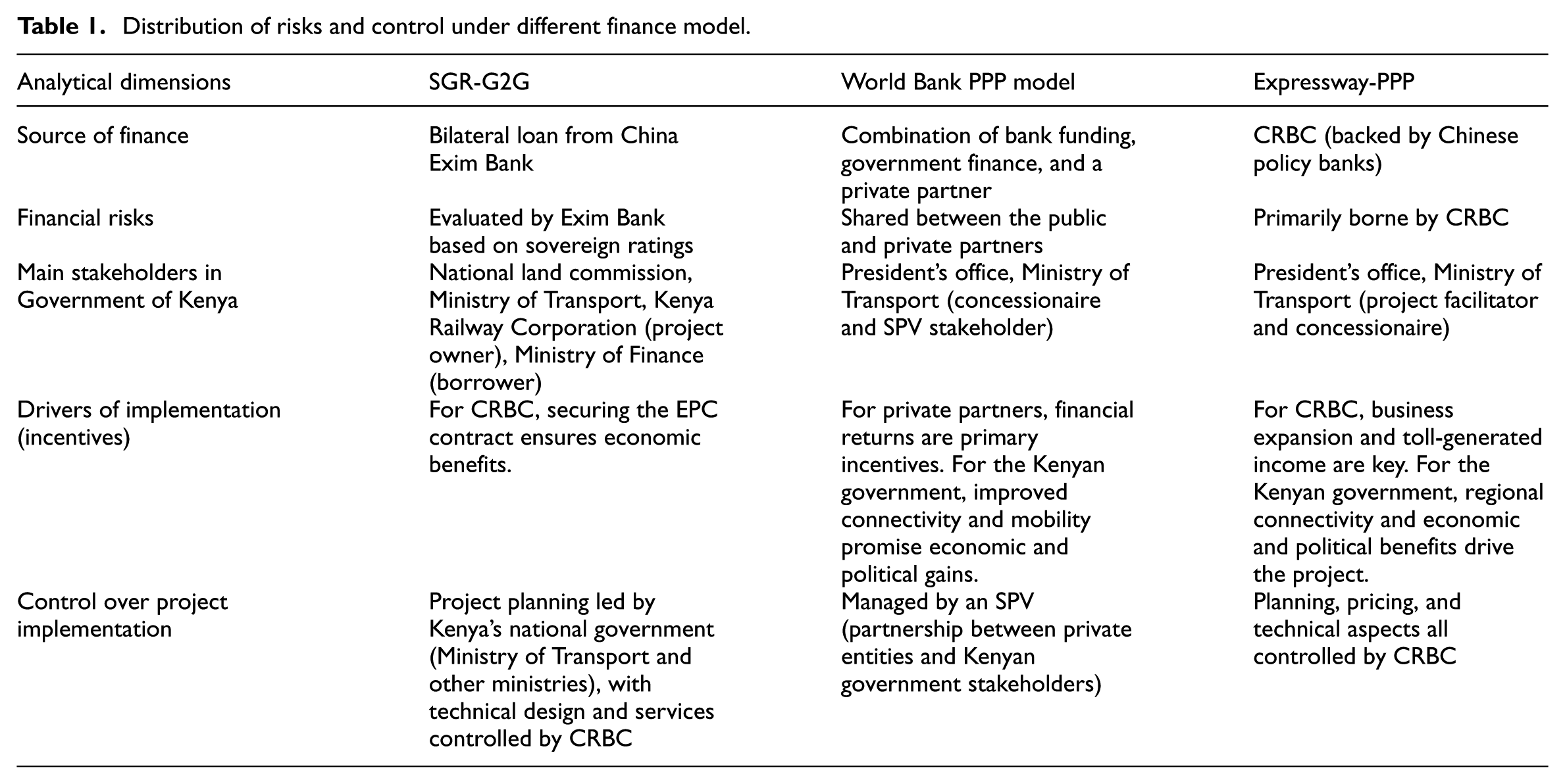
The ways in which the Chinese PPP commodifies the infrastructure and shapes spatial outcomes differ in important respects from PPP models used in other contexts. The first key difference lies in the identity of the ‘private partner’. In most Chinese PPP engagements in Africa, the ‘private’ partners are in fact state-owned enterprises (SOEs), which function as ‘state-capital hybrids’ (Alami and Dixon, 2022) both domestically and globally. A second difference in the Chinese PPP model is the absence of financialisation. In the Expressway project, value generation for the ‘private partner’ is tied directly to activities to produce, operate, and ‘sell’ the infrastructure. Table 1 provides a detailed comparison of the G2G model, the typical World Bank PPP model, 1 and the Chinese PPP model, highlighting differences in financing structures, economic incentives, and control and risk allocations. In the SGR project, Kenyan national institutions like Kenya Railways Corporation (KRC) retain project control and ownership, while CRBC acted as the Engineering, Procurement, and Construction (EPC) contractor, bearing mainly the technical responsibilities. In the Expressway PPP model, the Chinese SOE obtained much stronger control over project management because it lacked an equivalent government counterpart that holds ownership. In the World Bank PPP model, a Special Purpose Vehicle (SPV) is typically formed between the host government and the private contractor, facilitating shared responsibilities and risks. However, in the Expressway project, CRBC maintains direct control over the design, construction, and operation of the Expressway, maximising profit regardless of political risks and public interest concerns. As the table illustrates, the Expressway PPP model consolidates control in the hands of a few key stakeholders, effectively turning the project into a product of profit-driven business venture. These dynamics are explored in detail in the following empirical section.
Distribution of risks and control under different finance model.
From G2G to PPP: Risk and control redistribution
Both the idea of an SGR and a plan for the ‘Uhuru Highway Overpass’ 2 took shape in the early 2000s as part of the Northern Corridor Transport (NCT) development. In 2001, the Government of Kenya sought assistance from the World Bank to assess financing options for the road sector. The initial proposal, known as the Nairobi Urban Toll Road (NUTR) project, envisioned a 77.1 km tolled section along Uhuru Highway traversing the city centre and a 29 km bypass along the southern border of the city (World Bank, 2007). The World Bank’s involvement played a pivotal role in introducing PPP practices in Kenya’s road sector. The Bank provided support to the Government of Kenya (GoK) through its Public-Private Infrastructure Advisory Facility (PPIAF), leading to the formulation of PPP regulations in Kenya (Ministry of Roads, 2009). The World Bank stated in its NUTR project document, ‘By competitively procuring PPPs, the GoK is turning away from previous operations which often lacked transparency and accountability’. In 2006, the GoK awarded the road development project, encompassing both the southern bypass and the Uhuru Highway overpass, to the Austrian company Strabag (NCC, 2014). However, the World Bank withdrew from the financing plan because Strabag failed to comply with its social and environmental safeguards. This was followed by GOK’s decision to halt the project because it was no longer deemed ‘feasible’ (Ndegwa, 2011). The vision of the ‘overpass’ lay dormant until CRBC re-initiated its planning in 2019. 3
The idea of reutilising the nearly dysfunctional narrow-gauge Kenya-Uganda railway emerged in the 1990s, but only materialised in the NCT plan (Taylor, 2020). In 2006, the governments of Kenya and Uganda, along with Rift Valley Railways (RVR), entered into a concession agreement in which RVR assumed responsibility for revitalising the colonial railway. Meanwhile, a Kenyan politician proposed a PPP model to engage CRBC in upgrading the railway to standard gauge. Under this model, the government would lease the land to the operator, while the Chinese company would build, operate, and transfer (BOT) the railway (Omondi, 2021; Wafula, 2018). To secure the construction contract for the proposed SGR, however, the CRBC undertook two strategic actions. First, the company offered a feasibility study for the SGR to the GoK at no cost. Second, it engaged the China Exim Bank to provide financial backing, enhancing CRBC’s economic competitiveness and mitigating financial risk for the Chinese SOE by ensuring direct payment from the bank. As a condition of the Chinese loan, the SOE was awarded the contract as the sole contractor without a competitive bidding process. To secure loan repayment, the G2G agreement included a Take-Or-Pay Agreement (TOPA), requiring the Kenya Ports Authority (KPA) to prioritise freight transportation via the SGR from the port (Brautigam et al., 2022). This arrangement redistributed risk in highly uneven ways: the Kenyan government assumed sovereign debt obligations and guaranteed freight flows through TOPA, Exim Bank secured repayment through state guarantees, while CRBC bore minimal financial risk but retained technical control over design and construction. In this way, the G2G model shifted financial exposure onto the Kenyan state and its agencies, while granting CRBC privileged access to contracts and operational leverage with little long-term accountability.
Two subsequent developments reshaped CRBC’s perspective on its role in financing infrastructure in Kenya, the first being its transition to operating the SGR. In 2017, just before the completion of SGR Phase I, the CRBC entered into an operational contract for the SGR. This decision was driven by concerns about the reputational damage that could arise if a foreign company assumed control of the Chinese-built SGR and by pressure from the Exim Bank to oversee project management. 4 CRBC thus established the local brand Africa Star, to operate the SGR and receive service payments from the KRC. In the same year, the RVR concession was terminated to prioritise the SGR’s use. Although this safeguarded repayment for Exim Bank, it left CRBC with unexpected responsibilities: as a state-owned enterprise, it had to absorb significant operational costs and reputational risks associated with the line’s performance, despite its limited ability to influence broader policy and planning decisions as an EPC contractor and service provider. 5
A second incident that changed CRBC’s perspective was reputational risk. The political risks associated with the G2G model, including concerns about debt sustainability and contract opacity, became increasingly hefty. A court ruling that deemed the EPC contract illegal placed CRBC at the centre of Kenya’s debt politics, exposing the SOE to reputational costs well beyond its role as contractor (Cuenca, 2020). The experience of managing the SGR controversies shaped CRBC’s subsequent approach to the Expressway. Additionally, although securing the SGR contract brought economic benefits, CRBC faced a pressing need to pursue commercial practices and identify new business opportunities in emerging markets. As a result, the SOE shifted from acting as an intermediary between Chinese state capital and the host country to an investment model driven primarily by economic incentives. When presented with the opportunity to develop the Nairobi Expressway, CRBC successfully transitioned into the role of a ‘private’ partner for the GoK. Access to Chinese state capital facilitated the viability of the toll road project. A significant change was that CRBC retained tight control over the project through a 30-year concession, ensuring that technical decisions prioritised cost-efficiency. To manage the Expressway’s operation, CRBC established Moja Expressway Company, which will remain under its ownership, without plans to transfer it to Kenya.
For the Kenyan government, the PPP model offered immediate relief from sovereign borrowing at a moment of acute sensitivity to debt exposure, while also enabling the central government to consolidate political control. By structuring the Expressway as a national concession project tied to the President’s Office, the government bypassed county-level institutions and used the project to signal delivery capacity ahead of the 2022 elections (Ouma, 2021). Furthermore, the construction coincided with the transfer of functions from the Nairobi City County to the Nairobi Metropolitan Services (NMS), an entity under the direct control of the President’s office. As highlighted in other studies (Maina and Cirolia, 2023; Ouma, 2023), the replacement of local government authority by the NMS facilitated the central government’s consolidation of power and accelerated the delivery of national infrastructure projects, underscoring the political importance of the Expressway.
Unlike the G2G model, the Expressway PPP redistributed risks and control in new ways: CRBC assumed greater financial exposure but secured near-total operational authority through the concession; the Kenyan state minimised direct debt obligations while enhancing centralised political oversight; and the absence of an empowered local counterpart meant that public accountability was further eroded. In short, the PPP structure concentrated financial and technical control in CRBC’s hands, while enabling the national government to use the project for political ends without assuming the same fiscal risks as under the SGR.
SGR in Voi: Temporary growth and sustained inequality
This section examines the local impacts of the SGR in Voi, a town situated between Nairobi and Mombasa and adjacent to Tsavo National Park, one of Kenya’s largest conservation areas and a major international tourist destination. The case of Voi highlights the differentiated effects of infrastructure at the urban scale. Before the SGR, Voi received little tourist traffic, as most visitors entered the national parks directly from Mombasa and Nairobi by road. At the time of its conception, the SGR was regarded as a catalyst for local economic development as it promised enhanced connectivity. This section assesses how these promises translated into practice, focusing on three dimensions: the disconnect between railway facilities and the existing urban fabric, the temporary nature of employment generation, and fluctuations in land values. Together, these illustrate how the distribution of risks and responsibilities among implementing actors, and their misalignment with developmental objectives, produced only temporary gains and uneven accessibility to development.
The introduction of the SGR increased Voi’s accessibility to international tourists, who could now stop in the town before entering the parks. This has fostered the growth of tourism-related businesses in Voi, evidenced by the increase in the number of hotels from just one prior to the SGR’s construction to five at the time of writing. Yet, when railway passengers arrive at Voi, they do not disembark in the town centre but at a station several kilometres away, with inadequate connections to local services (see Figure 1). The result is a striking disconnect between the railway facilities and local economic life, limiting the town’s ability to capture sustained benefits.
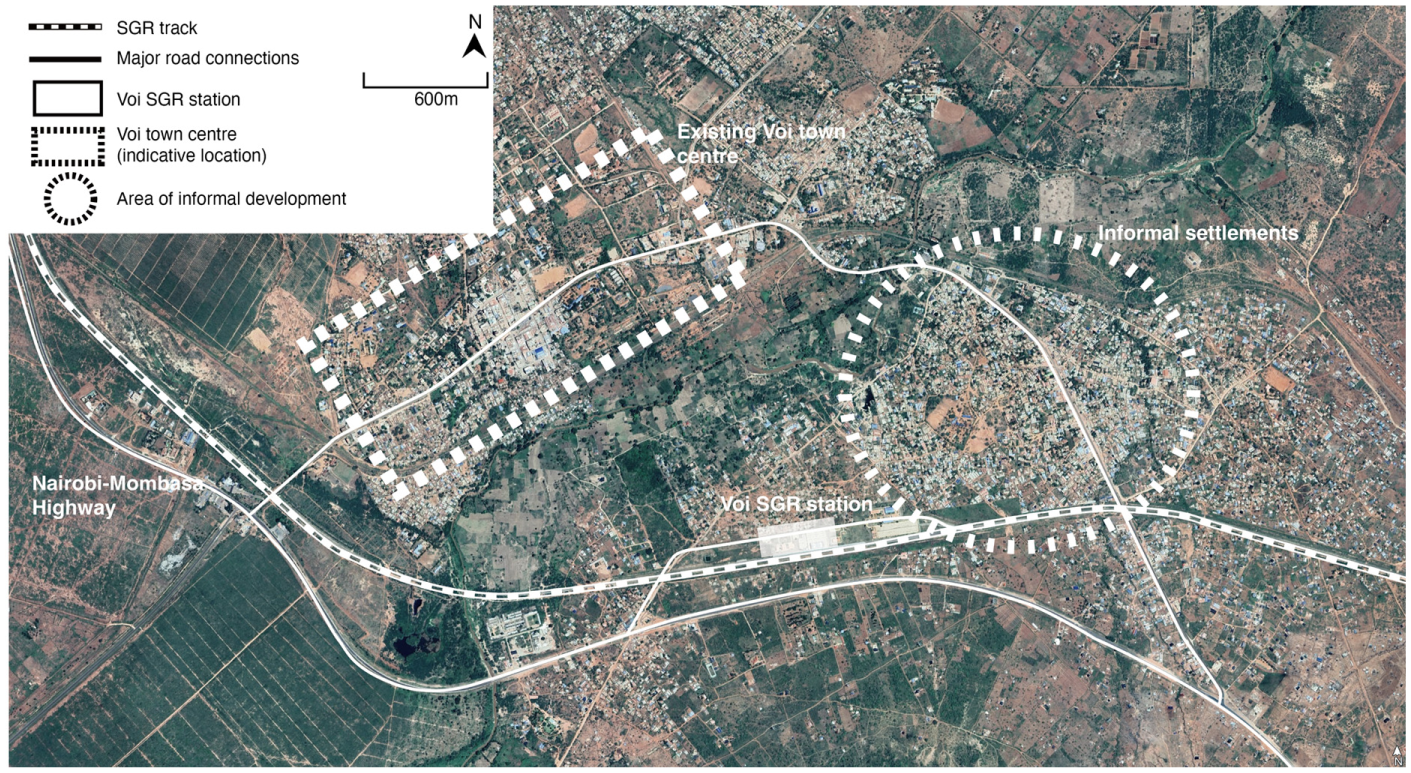
The spatial relations between the SGR, the town centre of Voi, and the informal settlements.
This evident disconnection between new infrastructure and the existing urban fabric raises a critical question: who gets to decide the location of the station? Interviews indicate that no public participation took place in the siting practice. Instead, the national government of Kenya determined the route and station sites primarily on the basis of land availability and ease of acquisition by KRC. This explains why much of the line follows the alignment of the old colonial railway, where land appropriation was less contentious. 6 Yet, where the colonial line cuts through dense settlements, the implied costs of compensation and relocation simply do not allow the much larger SGR stations to follow through. Like in Voi, all SGR stations in Kenya have been constructed on the peripheries, detached from existing urban cores. Interviews with officials from CRBC and KRC confirm that the Chinese contractor played only a limited role in station siting, despite being central to project delivery. CRBC’s feasibility study produced a favourable economic assessment that helped secure the contract, but it was not grounded in detailed operational analysis or integration with local urban economies. In effect, the prioritisation of CRBC’s commercial interests over implementation considerations exacerbated the misalignment of goals among stakeholders. CRBC’s responsibilities remained confined to the technical delivery of railway construction, without accountability for the broader urban and economic impacts of the project. 7
Proponents often emphasise the SGR’s contributions to job creation (Taylor, 2020; Zhu et al., 2020). Indeed, construction temporarily employed approximately 25,000 Kenyans, with 6667 workers in Voi alone. 8 The number of local contractors also surged from approximately 30 before the construction to 88 at the time of the interview. 9 One local contractor experienced significant growth, expanding from just two trucks to 35 trucks and employing over 200 individuals. 10 However, these gains proved short-lived. Once construction ended, employment collapsed, and contractors were forced to scale back, leaving the majority of workers unemployed again. The same local contractor who expanded to 200 employees was forced to halve their workforce once construction ended. Most former employees returned to the riverbanks to collect stones for sale.
The job opportunities during the construction period drew thousands of migrants into the urban areas of Voi, many of whom ended up in the informal settlements on the outskirts of the town. 11 Regarding further job opportunities, local interviewees are aware of the capacity transfer project KRC is conducting in Nairobi, where an institution is established to train railway workers and managers. However, the opportunity to access these training institutions remains highly restricted, often bypassing individuals outside the public sector, particularly those in the informal sector. Without consistent employment opportunities within the local community, residents of informal settlements will lack the essential resources necessary to significantly improve their living conditions.
Another significant area of impact is the volatility in land and property values. As seen in other contexts, infrastructure projects often trigger speculative surges in land prices, creating lucrative opportunities for states and elites (Bon, 2021; Enns and Bersaglio, 2020; Goodfellow, 2020). In Voi, land values spiked in anticipation of compensation during the construction phase, rising to as much as KSh 5 million per acre, only to collapse to around KSh 1.5 million once construction ended. 12 Rather than signalling sustained growth, this fluctuation reflects how the SGR fuelled speculative investment detached from long-term development outcomes.
The repercussions were deeply uneven. Land compensation disputes persisted for years after the completion of the SGR. One case involved a corrupt deal in compensating a sisal plantation. The sisal plantation in Voi received compensation averaging 16 times more than sisal plantations elsewhere, resulting in a total price variance of tens of millions of dollars (Wafula, 2018). The same sisal plantation also entered into a long-standing dispute with local villagers, whose access to the nearby highway was cut off by the plantation after the plantation used part of its compensation to acquire cheaper land, blocking local roadways. 13 This unplanned, unregulated reconfiguration of land structures left villagers without property, enclosed and isolated from potential development opportunities—a situation mirrored by many others in the area. 14 In this process, a form of passive enclaving emerges: speculative gains for a few, displacement and isolation for many. The volatility of land values thus intensified inequality and revealed the absence of coordinated planning or accountability mechanisms in infrastructure finance, undermining the SGR’s developmental vision.
The Expressway: Planned exclusiveness and intentional bypassing
The Nairobi Expressway originated from earlier planning efforts in Kenya’s transport sector, where congestion was framed as an urgent economic problem: reducing labour productivity, lowering GDP, and worsening air pollution (World Bank, 2007). The plan detailed elevating Uhuru Highway to an ‘overpass’, and the tolling mechanism was also deemed critical because it is ‘[t]he most successful solution… to address the road investment shortfall’ (NCC, 2014). The project was initially halted following the withdrawal of World Bank financing. The sudden resumption of the expressway project, financed by Chinese interests, has been attributed to a range of speculative narratives. One account suggests that Chinese diplomats, frustrated by traffic congestion during their visit, proposed the need for a new road. Another narrative recounts a Kenyan politician’s visit to China, where they were inspired by Beijing’s multi-layered road network (Guma et al., 2023). 15 These accounts underline the speculative nature of the Expressway.
Under a PPP agreement with the GoK, CRBC secured tight control over project design and operation, transforming from a construction contractor into an investment-oriented concessionaire. This control enabled CRBC to maximise profit. They first did so by accelerating completion. The concession included a 3-year construction phase followed by a 27-year operation period. CRBC completed construction and commenced operations more than 1 year ahead of schedule, extending the period for generating profits. Cost control was another strategy. To reduce expenses, CRBC subcontracted secondary works such as landscaping and drainage to lower-priced local firms. 16 These decisions left a visible mark on the quality of the Expressway. Drainage issues emerged shortly after its opening, with hanging pipes discharging rainwater from the elevated road deck onto the lower highway, exacerbating perennial flooding along Uhuru Highway. The project’s ‘greening’ goals also fell short, as vegetation intended to adorn the highway’s pillars began wilting shortly after planting (Okubasu, 2022). These challenges appear puzzling given CRBC’s extensive experience in constructing highways and involvement in other road projects in and around Nairobi. 17
The design and operation of the Expressway reveal its exclusionary focus. While purportedly aimed at reducing congestion, the expressway primarily connects affluent suburbs and the international airport, bypassing Nairobi’s central business district (CBD)—the city’s most congested area (see Figure 2). When the expressway opened in 2022, no exits were available in the CBD, underscoring its limited accessibility for the broader urban population. Although an additional exit was constructed 4 years later, this delay highlights the project’s prioritisation of elite connectivity over equitable urban mobility. The expressway’s toll structure further entrenches its exclusivity, with high fees effectively barring access for lower-income groups. Matatus (local mini-buses), which serve as Nairobi’s primary public transport mode, were banned from the expressway following an accident shortly after its completion, and the prohibition persisted for over a year (Agutu, 2022).
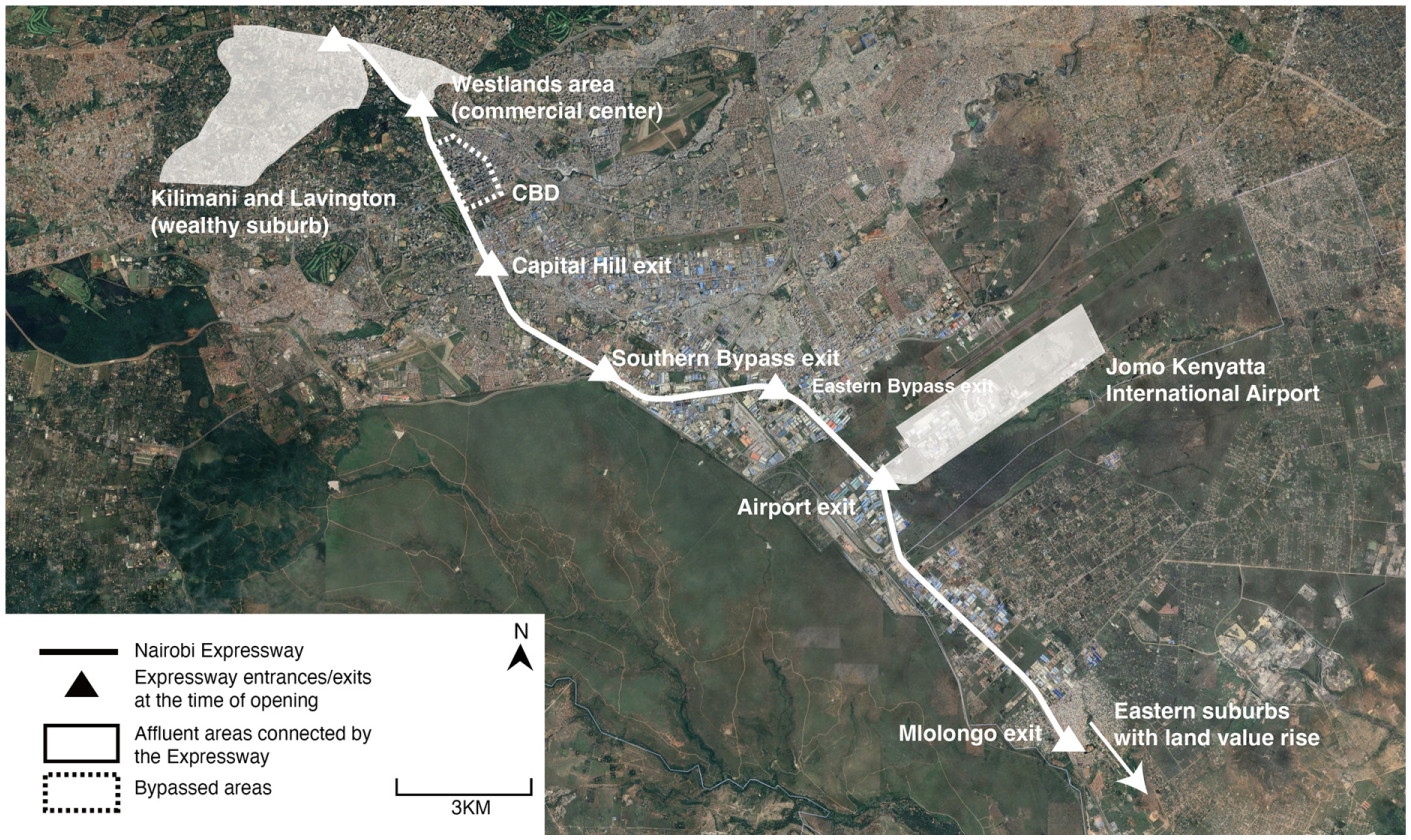
The Nairobi Expressway, its initial exits locations, and the areas it connects and bypasses.
The toll road concentrates flows of capital and mobility within a linear, vertically segregated space, intentionally bypassing less affluent areas and users. This aligns with Sawyer et al.’s (2021) concept of ‘bypass urbanism’, wherein infrastructure circumvents existing territorial regulations to pursue financial gains, political prestige, and socio-spatial exclusivity. While the Expressway has not yet led to the formation of large-scale elite communities, it has already influenced land price change, driving up property values and encouraging the construction of new malls and facilities in the eastern suburb of Nairobi that appeal to middle-class land buyers (Mwaniki, 2023). This demonstrates its role in exacerbating urban inequalities by fostering socio-economic enclaves increasingly detached from broader urban networks.
Unlike the SGR, where CRBC had little say over the siting of stations because of the loan-based model, the Expressway gave the company direct authority over crucial design decisions. CRBC controlled the placement of entrances and exits and determined toll levels, all with the goal of maximising revenue. A few exceptions to this control highlight how centralised political authority intersected with corporate power. In October 2020, plans to relocate a centennial fig tree to accommodate an Expressway entrance met with resistance from environmental activists, prompting a presidential decree that preserved the tree and required the NMS to adjust the design (Reuters, 2020). Similarly, public concern over potential encroachment into Uhuru Park led the government to issue assurances that the park would remain ‘untouched’, with revised designs presented as evidence of responsiveness (AllAfrica, 2019). Compared to the SGR, where debt repayment obligations left no room for compromise, the Expressway’s PPP model allowed selective adjustments. The contrast with the SGR is instructive. Bound by a G2G loan agreement and a Take-or-Pay clause with Exim Bank, the Kenyan government and CRBC had little room to accommodate dissent: debt repayment and delivery deadlines took precedence over environmental concerns. Yet these interventions were narrowly symbolic: while high-profile landmarks were preserved, issues of affordability, public transport, and neighbourhood disruption were ignored. The responsiveness of the Expressway thus remained limited to symbolic spaces of political visibility, while its underlying commodified logic persisted.
The exclusionary logic and lucrative nature of the expressway have not gone uncontested. Public discontent was clearly demonstrated during an anti-government protest in July 2023, for example. Sparked by frustrations over rising living costs and unemployment, the protests escalated into violent confrontations near the Mlolongo toll station, situated at the expressway’s endpoint and symbolic of the socio-economic divide it reinforces. Protesters breached the expressway wall and vandalised the toll booths, turning the expressway into a site of political contestation over issues of belonging, exclusion, and citizenship (Abdikadir, 2023; Von Schnitzler, 2019). The protests were reportedly financed by opposition figures, including former President Uhuru Kenyatta, who had originally championed the expressway project but now leveraged the protests against the project as a way to challenge the current regime. The expressway thus embodies not only infrastructural exclusion but also the contested nature of urban development in Kenya, where political and economic interests intersect with questions of control, access, and belongings.
Conclusions
This paper examines the redistribution of risk and control in the shift from G2G to PPP financing, through the cases of two Chinese-financed infrastructure projects in Kenya involving the same implementation actors. It argues that lucrative infrastructure not only reshapes power structures in infrastructure governance but also directly produces new forms of urban inequality and bypassing. While PPPs are often promoted as responses to debt sustainability concerns in China’s outward financing, they neither resolve questions of long-term sustainability nor mitigate inequalities of access. Instead, PPPs commodify infrastructure by converting it into lucrative assets operated for revenue, embedding profitability into design and operation. As a result, spatial bypassing is no longer a contingent side-effect of weak planning but becomes institutionalised within financial models that prioritise exclusive flows, tolled access, and symbolic interventions over inclusive development. The paper demonstrates empirically and theoretically how financing arrangements themselves function as instruments of spatial restructuring.
Under the SGR, sovereign borrowing and loan guarantees shifted financial risks onto Kenyan institutions, while CRBC retained limited technical authority but was ultimately drawn into costly operational responsibilities through Africa Star. The Expressway, by contrast, redistributed risks by granting CRBC the role of concessionaire: the SOE bore greater financial exposure but secured tighter technical and operational control, while the Kenyan government minimised debt obligations and recentralised political oversight through the presidency. Whereas G2G debt obligations left no room to accommodate contestation around the SGR, the Expressway’s PPP structure enabled selective design adjustments to preserve politically visible landmarks while ignoring broader concerns of access and equity. The PPP model also served to reinforce the national government’s centralised control, allowing it to direct the project toward selective economic and political objectives. In both cases, the state-finance-backed CRBC actively lobbied the Kenyan government to secure contracts, positioning itself as a key driver of these infrastructure projects. By prioritising projects that promised higher financial returns and productivity, the CRBC’s construction works produced enclosed linear spaces in both projects: the SGR, with its fencing and ticketing system, and the Expressway, with its tolling mechanisms, restricted access to a select few while excluding others.
Spatially, both projects have led to enclosure and bypassing. The G2G-financed SGR led to spatially uneven development, as seen in Voi, where the infrastructure-induced enclaving began during the land acquisition phase. It also created zones of displacement and isolation while concentrating investments in select areas, benefiting only certain groups—a process characterised as ‘passive enclaving’. The PPP-financed Expressway, on the other hand, created a vertical enclave by adding a controlled-access layer to Nairobi’s existing road network. As a private venture, the Expressway deliberately bypassed Nairobi’s more densely populated Central Business District (CBD), where congestion is most severe, underscoring its exclusivity and the privileging of affluent users able to afford the toll fees.
This research therefore problematises the viewing of infrastructure as banal ‘public goods’ in the urban frontier of Africa. By prioritising productivity and economic return over accessibility and participatory decision-making, the infrastructure and the land it occupies have both been reduced into an extractable and disposable commodity (Bon, 2021). Amid the influx of international finance to address Africa’s significant infrastructure gap, the approach taken by China in its development abroad, as argued by Anguelov (2021), does not necessarily create a new and alternative development path that would reduce global inequalities. Instead, it reflects neoliberal tendencies, with an emphasis on market-oriented policies, privatisation, and the utilisation of state-owned enterprises for economic purposes. In practice, this study calls for more inclusive approaches that integrate public support (Pellegrino, 2021), equity, participation and accessibility into the design of PPP infrastructure financing in Africa. It challenges the prevailing reliance on privatisation and calls for rethinking its role in urban infrastructure development, particularly in regions marked by high socio-spatial inequality.
Footnotes
Acknowledgements
I would like to thank Professor Tom Goodfellow for his guidance during the writing of this article. I am grateful to the anonymous reviewers for their careful reading and constructive feedback, which significantly improved the paper.

Funding
The author disclosed receipt of the following financial support for the research, authorship, and/or publication of this article: The writing up of this work was supported by funding from the Urban Studies Foundation via a Postdoctoral Research Fellowship (grant reference: USF-INT-230904.S). The author also acknowledges funding from the European Research Council (ERC) under the European Union’s Horizon 2020 research and innovation programme as part of the GlobalCORRIDOR project (grant agreement ID: 947779).
Declaration of conflicting interests
The authors declared no potential conflicts of interest with respect to the research, authorship, and/or publication of this article.