




Abstract
Regeneration is an internationally popular policy for improving distressed neighbourhoods dominated by large social housing developments. Stimulating employment is often touted as a secondary benefit, but this claim has rarely been evaluated convincingly. In 2003, Glasgow City Council transferred ownership of its entire social housing stock to the Glasgow Housing Association and over £4 billion was invested in physical repairs, social services and other regeneration activities. Using a linked census database of individuals (Scottish Longitudinal Study), we evaluate the causal effect of the Stock Transfer on employment in Glasgow through a quasi-experimental design that exploits idiosyncrasies and changes in Glasgow’s administrative boundaries. We find that the Stock Transfer had a positive effect on employment for Glasgow residents who were not living in transferred social housing stock. We establish that this effect was mainly accomplished through the local employment multiplier effect of capital spending rather than through any other programmatic elements of the Stock Transfer. Exploratory analysis shows heterogeneous effects: individuals who were over 21, female, living with dependent children and with less education were less likely to benefit from the intervention. We did not find significant subgroup effects by neighbourhood deprivation.
Introduction
For over a quarter of a century urban policymakers in Europe, Australia and the US have pursued strategies for regenerating distressed neighbourhoods dominated by large social housing developments. Though programmatic details differ across nations and cities, the strategies typically involve selectively demolishing and/or rehabilitating the estates, infilling them with new construction to facilitate ‘social mix’, and supplying a variety of ancillary support services and resources for lower-income residents. 1 Though evaluations have uncovered numerous positive outcomes from these initiatives, whether felicitous employment impacts ensued for either low-income residents of regenerated neighbourhoods or the surrounding urban populations is unclear. We believe that much of this ambiguity can be traced to methodological shortcomings of previous evaluations. Our goal is to provide a more definitive, plausibly causal answer to the question of whether a major social housing regeneration scheme generated more employment and, if so, for whom and how.
The particular scheme we analyse – the transfer of 80,000 social housing units from the Glasgow Local Authority to the private, non-profit Glasgow Housing Association (GHA) in 2003 (hereafter the Stock Transfer) – provides an ideal natural experiment for answering this question. This large-scale voluntary transfer (LSVT) was the most expensive urban regeneration project ever undertaken in Scotland –£4 billion of private and public funding – invested within spatially demarcated boundaries that occurred in a larger context of changing local jurisdictional borders, which we exploit for identification of causal effects. This regeneration scheme included repairs and improvements on transferred properties, demolitions followed by infill construction aimed at owner-occupiers, a variety of neighbourhood social and personal-support interventions and the institution of more community-based housing governance.
We estimate the employment effects of the Stock Transfer on individuals living within the current boundaries of the Glasgow Local Authority (an area hereafter referred to as Glasgow City), distinguishing those who lived in regenerated estates and other residents, using a difference-in-difference design that exploits geographic variations in the intervention. Glasgow City itself is part of a wider urban conurbation – whether defined by built-up urban area, commuting zones or political landscape (see map in the Supplemental Materials). Surrounding local authorities (LAs) in the wider urban area did not enact LSVTs and were not eligible for any special additional funding to repair their social housing stock. Nonetheless, all residents living in surroundings LAs were exposed to the same regional and national factors affecting the economy during the periods before and after the Stock Transfer. We exploit this geographic under-bounding of Glasgow’s city limits, as well as changes in the administrative boundaries of Glasgow City, to account for unobserved differences in resident and neighbourhood characteristics across councils in the wider urban area. We decompose the employment effect of the Stock Transfer into two elements: its direct effect on social renters through programmatic housing repairs, social supports and governance change and its indirect effects on all participants in the regional economy through government spending-induced local employment multipliers. Finally, we probe the degree to which impacts are heterogeneous across population groups
Potential employment impacts of social housing regeneration programmes: Theory and evidence
There are several mechanisms through which social housing regeneration efforts could boost the employment prospects of residents of both the renovated estates and the surrounding community. Although our study cannot fully unpack the effects of individual mechanisms described below, we are able to distil the net consequences of intervention-specific components for social renters versus the local employment multiplier for the general population.
In the case of residents of the renovated estates, the causal processes may work (in non-mutually exclusive ways) through improvements in the physical quality of the occupied dwelling unit and/or social-interactive processes within the housing development (Kearns and Mason, 2018). Damp, mould, vermin, poor upkeep, overcrowding – conditions that often characterised social housing affected by the Stock Transfer – have been linked to adult stress, depression, hostility and inferior health outcomes (Chambers et al., 2015; Coley et al., 2013; Jacobs et al., 2009), all of which could impede an individual’s ability to find and keep a job. If the redeveloped housing complex includes new residents of different social classes, social renters may be exposed to a variety of social processes (role models, peer effects and job networks) that could enhance their willingness and ability to find work (see the reviews of theory and evidence in van Ham and Manley, 2010).
In the case of all residents of the city in which the regeneration programme occurs, the exogenous injection of a substantial amount of central government spending will create local employment multipliers (Kearns and Mason, 2018). Funds spent on social housing repairs and new housing construction will directly affect employment in these sectors and indirectly induce employment in other sectors through business-to-business transactions. Additional personal spending by individuals employed in Stock Transfer-related businesses can further induce employment in a wide range of sectors. Finally, a change in the condition of formally distressed neighbourhoods may attract new businesses into regenerated areas, spawning further multipliers.
Virtually all economic evaluations of major social housing regeneration programmes have focused on the consequences for former or current low-income residents of the neighbourhood. Turok (1992) and Batty et al. (2010) examined unemployment trends for samples of surveyed residents of areas impacted by the Glasgow East Area Renewal (GEAR) project redevelopment in Glasgow’s East End and the UK’s New Deal for Communities (NDC) programme, respectively, and could discern no sizeable improvements. Similarly, in the case of the US HOPE VI programme, longitudinal evaluations based on surveys of low-income adult residents of redeveloped estates have found few if any employment gains for this group (Curley, 2010; Collins et al., 2005; Levy, 2007; Popkin, 2010; Popkin et al., 2010). 2 These findings cannot be considered definitive, however, because none are based on quasi-experimental research designs for estimating the counterfactual.
The rare studies employing quasi-experimental evaluation methods come to different conclusions. Gutiérrez Romero (2009) used a difference-in-difference (DiD) analysis of household survey data collected in NDC and control areas in 2002 and 2004. She found that jobless residents of NDC areas exhibited significant gains in their probability of employment (compared with residents of similarly deprived areas) if at the time of intervention they were in full time education or training, or were receiving incapacity benefits. Permentier et al. (2013) evaluated the Empowered Neighbourhoods programme in 40 deprived Dutch neighbourhoods, employing a regression discontinuity design involving as controls similarly deprived neighbourhoods that were not selected for treatment. They found no indications that the Empowered Neighbourhoods policy led to any greater improvement in incomes or social advancement in the priority neighbourhoods than in the controls.
To our knowledge, only three studies have investigated the regional job creating impacts of social housing redevelopment programmes. 3 Zielenbach et al. (2010) and Hanka et al. (2015) used economic multiplier models to analyse the employment impacts of HOPE VI investments in several cities, concluding that these effects were substantial. Their method is essentially tautological, however. By assuming the validity of their multiplier models their approach guarantees that any exogenous source of central government spending will appear to generate a positive local employment impact. It cannot demonstrate whose employment rates were affected or what these rates would have been in the absence of the intervention. Marlet and van Woerkens (2010) evaluated the Dutch Big Cities phase II and III programmes by conducting a regression-based comparison of city-wide changes in aggregate employment and unemployment indicators across participating and non-participating cities. They could identify no impacts from the programme, with the possible exception of young workers’ employment. 4 Once more, however, the lack of a clear and persuasive counterfactual renders the conclusions of these studies less convincing.
Of most relevance to our paper, the Glasgow Stock Transfer has been evaluated in several domains as part of the GoWell study, which used data collected from three waves of surveys and interviews of residents in 15 regeneration sites between 2003 and 2011. One analysis found that the employment rate of tenants living in regeneration areas increased modestly, especially if the local programme yielded more housing improvements and community empowerment, though there was no connection with residents’ social networks or participation in training programmes (Kearns and Mason, 2018). As provocative as this finding is, without any control groups it is impossible to discern whether this employment increase is causally related to the Stock Transfer or confounding regional or national forces impinging during the same period.
It is on this point that our paper aims to make a more definitive contribution by leveraging the geographic idiosyncrasies of the Stock Transfer to obtain plausibly causal estimates of its impact. Our main research questions are:
R1: Did the Stock Transfer have an effect on employment rates for social renters living in local authority-owned housing (hereafter referred to as ‘LA Renters’) and for other Glasgow residents (hereafter ‘Other Residents’)?
R2: Did the Stock Transfer have differing employment effects across subgroups of LA Renters and Other Residents?
As previously noted, the Stock Transfer likely created two sorts of programme treatment effects on employment. One was composed of the bundle of intervention-specific components: asset transfers from public sector ownership to ‘community driven’ management; social supports; housing repairs, improvements and demolitions; and tenure mixing that might alter neighbourhood social interactions. The other was general local economic multiplier effects arising from the substantial injections of capital spending. We posit that the Stock Transfer had a larger intended effect on LA Renters than Other Residents since the former were potentially affected by both intervention-specific and general components (most of which were supposedly beneficial). We will endeavour to decompose net effects by distilling the relative impacts of the bundle of intervention-specific components and the multiplier. The aforementioned findings from prior studies suggesting heterogeneous impacts motivates our exploratory analysis of subgroup effects in research question two.
Methods
Overview
We gather information on individuals from linked 1991, 2001 and 2011 versions of the Scottish Longitudinal Study (SLS). We identify working-age adults in these datasets who during 2001 (just before the Stock Transfer) were: (1) LA Renters in Glasgow City; (2) Other Residents of Glasgow City; and (3) residents of LAs surrounding Glasgow City. The Stock Transfers occurred only within Glasgow City, though the functional economic area over which multiplier effects likely emanate extends beyond the city limits to encompass surrounding LAs. As a control group we use a matched sample of residents living in surrounding LAs, but outside Glasgow City, then employ a standard difference-in-difference technique for estimating the intent-to-treat effects of the Stock Transfer on employment rates in 2011 compared with 2001 for both LA Renters and Other Residents of Glasgow City. We conduct a variety of robustness tests. Finally, we replicate the analysis for subgroups to test for heterogeneity of effects.
Data
Geographic delineations
The LAs surrounding Glasgow (henceforth Surrounding LAs) are: West Dunbartonshire; East Dunbartonshire; East Renfrewshire; Renfrewshire; North Lanarkshire; and South Lanarkshire (see the map in the Supplemental Materials). We based our specification on adjacency to Glasgow City in order to control for shared regional economic trends. Coincidentally our specification of Glasgow plus Surroun-ding LAs roughly matches the Organisation for Economic Co-operation and Development's (OECD) definition of Glasgow Functional Urban Area (minus Inverclyde). We tested alternative specifications for the wider urban area – including travel-to-work areas – and found the same results.
The Scottish Longitudinal Study
The Scottish Longitudinal Study is a representative 5.3% sample of the Scottish population linked through time by matched census records, selected if they have one of twenty pseudo-randomly selected birthdates. The original 1991 census sample SLS members who were individuals in the 1991 census with one of twenty randomly selected birthdates numbered around 270,000 members. SLS members can only leave the cohort due to deaths or migration out of Scotland, meaning that around 70% of study members are present in one census and the next (e.g. both 1991 and 2001; 2001 and 2011). 5 Entry is similarly controlled and any individual either born in Scotland or who immigrated to Scotland, on any of the SLS birthdates are added to the study. The original 1991 sample has around 270,000 members. Further SLS members entered at the 2001 and 2011 censuses. Roughly equal numbers of SLS members are present in 2001 and 2011, as immigrants and new births replace lost members (Boyle et al., 2009). We use data from the 2001 and 2011, censuses on members living in Glasgow plus Surrounding LAs to estimate the effects of the Glasgow Stock Transfer, which occurred during the intervening years. Additional data on SLS members from 1991 to 2001 are used to test the robustness of our estimates. For our purposes, the SLS offers several advantages: the individual data are geocoded; using the census as a basis means there is low sample attrition and it has the potential to track individuals who have left their original neighbourhoods in 2001. Geocoding is at postcode level (accessible to SLS staff only) and records a person’s residence on the census date.
Sample and measures
We restrict the analysis sample to those expected to participate in the labour force during our study period: men aged between 16 and 55 years and women aged between 16 and 50 in 2001. The treatment group for our main analysis is composed of SLS members who were residing in Glasgow City in 2001 (distinguished by LA Renters 6 and Other Residents) and who also appeared in the 2011 census (eight years after the start of Stock Transfer). Our control group is a similar set of SLS members who were living in Surrounding LAs in 2001 and who also appeared in the 2011 census. Aside from the main Stock Transfer effects, we also explore subgroup effects by gender, presence of dependent children, highest qualifications, age group (>21 years) and neighbourhood deprivation.
Our outcome of interest is employment probability in 2011. We classify an individual as employed if they worked full- or part-time, or were self-employed and were not a full-time student. We also use other census information on gender, age, highest qualification, family status and number of dependent children of SLS members as bases for matching treatment and control groups in various estimators. Finally, the census includes self-reported information on housing tenure and landlord, which we used to identify social renters in LA-owned housing. Additional information on the proportion of social renters in each neighbourhood (defined by Scottish Datazones, areas of around 750 people, on average; see Flowerdew et al., 2007) in 2001 and the coordinates of postcode centroids were linked to the SLS from other publicly available sources.
Descriptive statistics
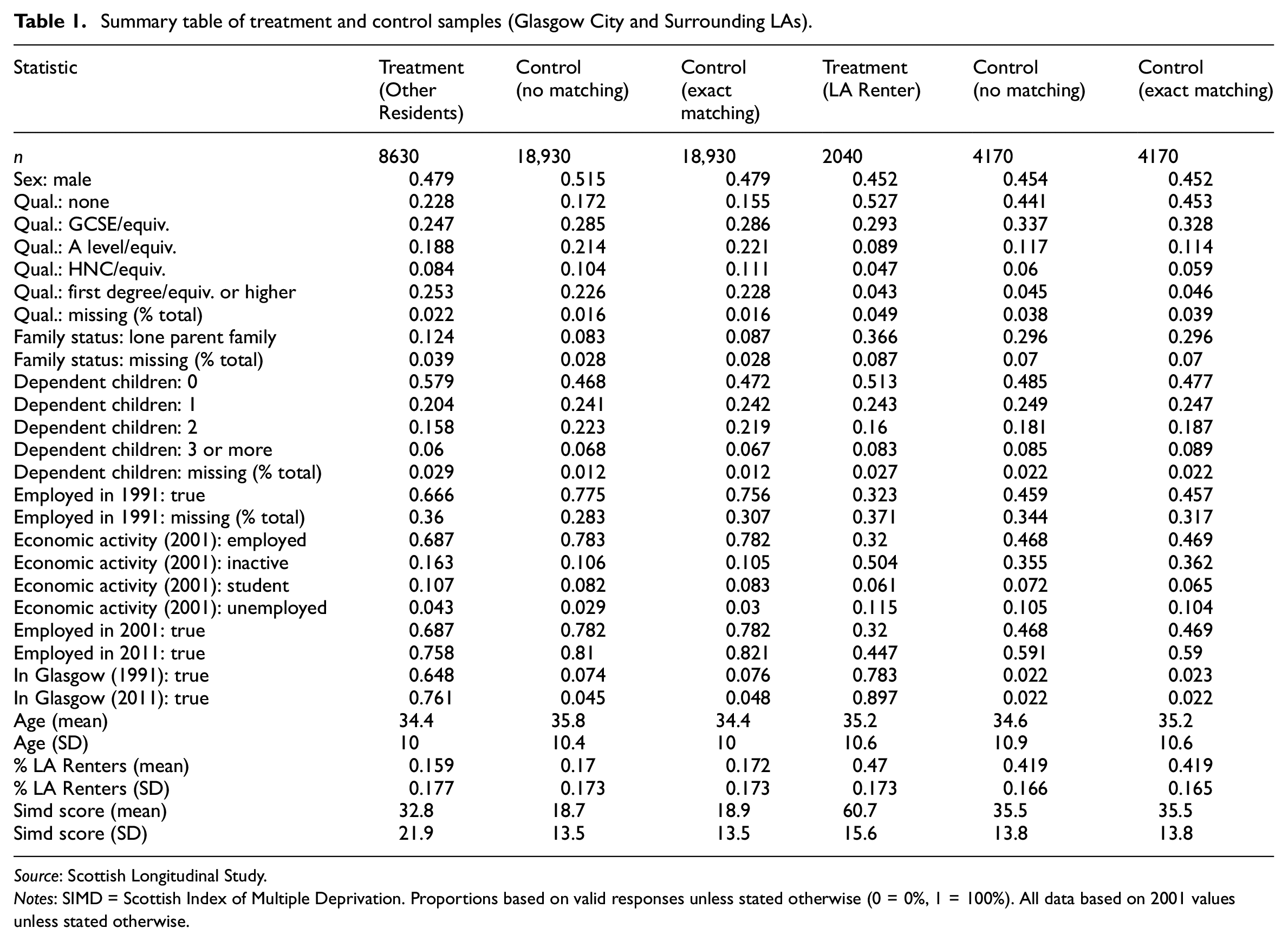
Our main sample consists of SLS members who appeared in both the 2001 and 2011 censuses. Our treatment and control samples are distinguished by whether an individual was a resident of Glasgow City (treatment) or Surrounding LAs (control area) in 2001. Table 1 describes the distribution of key characteristics across the treatment and control groups. The columns are organised by tenure group and by matching procedure (see next section). In particular, the control group columns reflect summaries prior to matching and after exact matching by age and sex (our preferred estimator, weighted by matching weights).
Summary table of treatment and control samples (Glasgow City and Surrounding LAs).
Source: Scottish Longitudinal Study.
Notes: SIMD = Scottish Index of Multiple Deprivation. Proportions based on valid responses unless stated otherwise (0 = 0%, 1 = 100%). All data based on 2001 values unless stated otherwise.
Prior to any other analyses, we note a number of distinct differences between treatment and control cases: treatment cases are more likely to: be female; not be in employment; have no dependent children; have lower-than-secondary qualifications; live in datazones with higher rates of social renting and higher deprivation; and be in a lone-parent family. Many of these differences reflect the larger proportion of social housing in Glasgow as well as an older population residing in suburbs outside of Glasgow (once accounting for tenure). Exact matching on age and gender does not fully eliminate these differences but – as we discuss later – we can test for the effects of this on our DiD estimator. On this point, we now explain our statistical approach, which uses longitudinal data to reduce the possibility of observed (and unobserved) confounders affecting our estimates.
Statistical analysis
We are interested in measuring the causal effect of the Stock Transfer; in other words, what would employment rates have been like in 2011 for the treatment group had the Stock Transfer not taken place. This is the Intent-to-Treat effect of the Stock Transfer (henceforth ITT or

where

More generally, a linear regression model is used to estimate

where
To test the DiD assumption of common pre-treatment trends and absence of confounders, we conduct robustness checks using 1991–2001 data (see next section). Our standard errors do not significantly differ if we use robust standard errors to correct for heteroscedasticity.
In order to explore the potential subgroup effects for research question two, we create a dummy variable

Here the term
Key methodological assumptions and other considerations
A key assumption of our DiD estimator is that changes in the employment rate for the control group between 2001 and 2011 is an unbiased estimate for changes in the treatment group if the Stock Transfer had never taken place. There is no direct way to prove this assumption but we argue for its plausibility for two reasons. First, a variety of non-Stock Transfer external shocks would likely affect those in both control and treatment areas in a similar fashion. As residents sharing the functionally interconnected urban area, similar individuals should be similarly affected by (perhaps unobserved) coincident macroeconomic forces, regardless of where they resided in the region. Illustrations of such forces potentially affecting employment rates include new national and regional welfare policies, changes in Scottish economic health and the effects of an ageing population. Second, we in fact observe common employment trends prior to the Stock Transfer for similar residents of both treatment and control areas inside and outside of Glasgow City, respectively. Specifically, for those 16 years or older in 1991 we find no difference in employment changes between the two groups between 1991 and 2001 (i.e. when no intervention took place), once we match by age. This important finding buttressing our DiD approach proves robust to alternative delineations of treatment and control groups; see details in the Supplemental Materials.
Bias in measuring impact may arise, however, if the Stock Transfer had a causal effect on employment for control area residents due to contagion and contamination effects. Businesses and residents living outside Glasgow City were eligible to compete for work directly related to the Stock Transfer. This is an example of contamination as control cases could have benefited from one component of the treatment. This can also occur if any control cases get treated as a result of moving into Glasgow City. Furthermore, the employment effects due to indirect business-to-business and induced personal spending will likely be spread well beyond city borders. This results in a contagion effect. In this scenario, we interpret our results as the lower bounds of the true effect size under two mild assumptions: (1) the contagion effect of employment is not negative (i.e. employment in Glasgow did not reduce employment elsewhere), and (2) the extent of contamination is not so extreme that more control cases received more treatment interventions than treatment group cases.
The first assumption is standard economic convention. Regarding contamination, we first can check the proportion of control cases that moved into Glasgow City. Regardless of tenure group, less than 5% of people residing in Surrounding LAs in 2001 had moved to Glasgow City by 2011 whilst 10% to 24% of Glasgow City residents had moved elsewhere by 2011 (Table 1). Therefore it is unlikely that the extent of contamination through residential mobility is extreme enough to overturn prior assumptions. In addition, it is unlikely that control cases had more access to employment (directly, indirectly or induced) generated by the Stock Transfer. The vast majority of new, non-construction-related (primarily administrative and service delivery) jobs directly linked to the creation and expansion of local housing organisations should be located in Glasgow City. 9 The majority of economic activity in the region is in Glasgow’s central business district, which itself is a major shopping area. Therefore, it is at least plausible that Glasgow City would attract at least its equal share of indirect or induced employment caused by induced business-to-business or personal spending. Commuter flow information and working-age population density strongly support the argument that Glasgow residents have better access to jobs located in Glasgow City (see Supplemental Materials).
A final consideration relates to our method’s assumption that Other Residents of Glasgow City do not receive the programmatic treatments associated with the Stock Transfer. This assumption might be violated by Other Residents residing in multifamily buildings undergoing fabric works being undertaken under the auspices of the Stock Transfer (Curl and Kearns, 2015). These individuals are likely to have been occupants of former social rental dwellings that they bought under the Right-to-Buy scheme. The proportion of such Other Renters affected by Stock Transfer fabric works is likely to be tiny. If fabric works had anything less than an implausibly high effect on employment rates then we can safely assume that its effects on our analysis are virtually nil.
Results
Main results and robustness checks
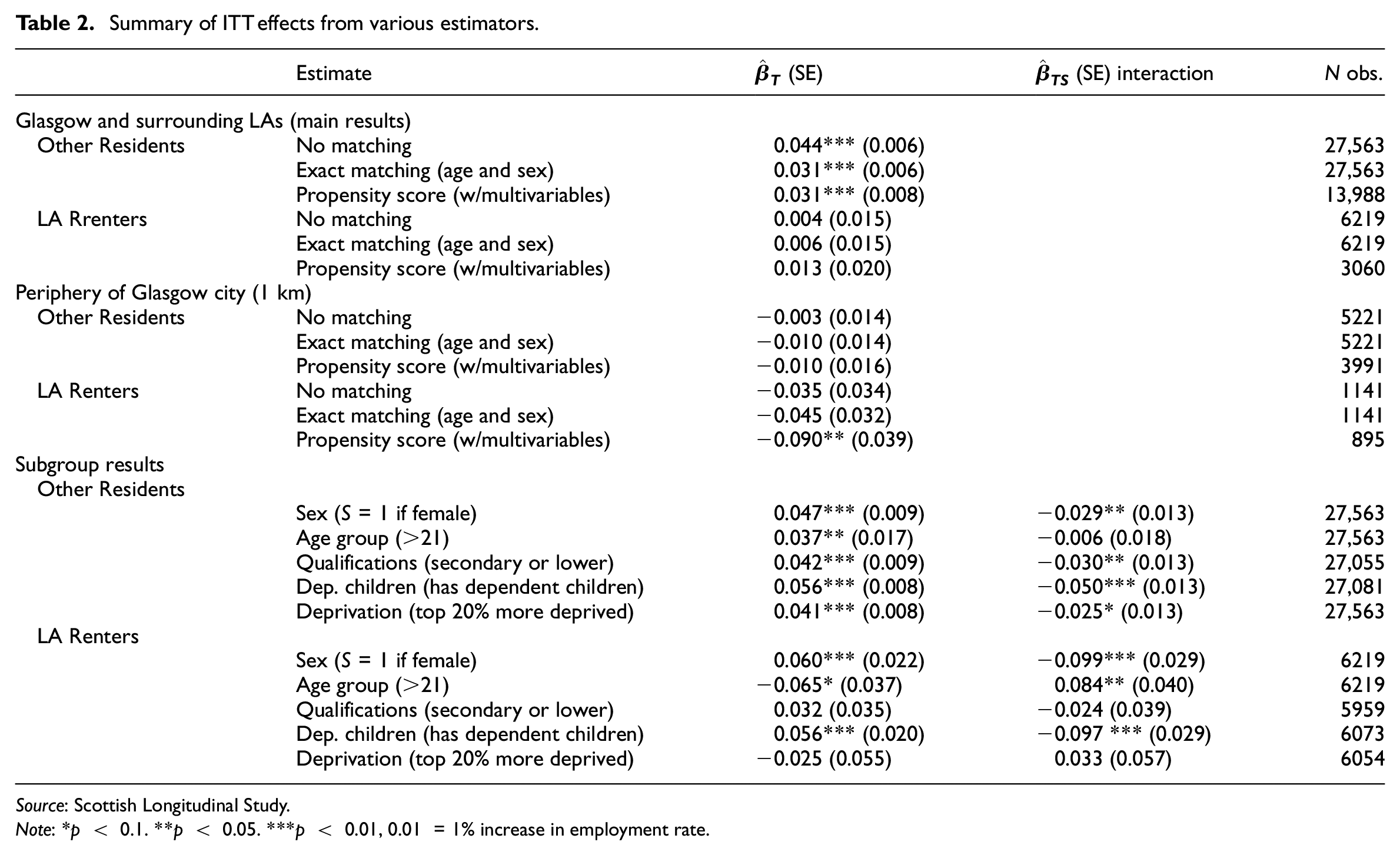
Results of our DiD estimators for answering research questions one and two are presented in Table 2. We do not find a statistically significant effect of the Stock Transfer on LA Renters’ overall employment, consistent with most prior research. Contrary to our expectations that LA Renters should be more strongly affected than other Glaswegians, however, we find a statistically significant positive effect (3.1% higher employment rate) overall on Other Residents of Glasgow City.
Summary of ITT effects from various estimators.
Source: Scottish Longitudinal Study.
Note: *p < 0.1. **p < 0.05. ***p < 0.01, 0.01 = 1% increase in employment rate.
We check these results in several ways; all suggest that our main findings are robust. Full details on each of our analyses are in the Supplemental Materials. First, we specify a different control group, switching from age-matched working-age adults living in Surrounding LAs to such adults living in former Glasgow City areas prior to 1996. In 1996, a number of changes occurred to local government across Scotland due to the Local Government etc. (Scotland) Act 1994. As a result, Glasgow City’s administrative borders shrank to exclude the towns of Rutherglen and Cambuslang, which were both reassigned to the newly formed South Lanarkshire Council (see map in Supplemental Materials). These boundary changes were motivated by factors unrelated to the Stock Transfer and employment rates. As such, residents in pre-1996 Glasgow City areas provide a compelling (although relatively small in number) control group because they would have been eligible for the Stock Transfer had the boundary change not taken place seven years earlier. Our estimates do not prove substantively different when we use residents of former Glasgow City areas as controls.
Our second robustness test augments the pre-treatment (i.e. 2001) characteristics used for matching treatment and control individuals besides age. Our experiments, using a variety of additional characteristics (highest qualification, lone parent family status and number of dependent children), produce estimates statistically equivalent to the main results.
Our final robustness test addresses the issue of whether the Glasgow City results might have been biased by two exogenous sources of population change potentially shaping employment rates. These are the growing numbers of students due to the expansion of higher education during the 1990s and the influx of asylum seekers during the later 1990s. We re-estimate the DiD excluding those under the age of 25 and non-white British residents, but it does not change our main estimates.
Unpacking intervention-specific impacts and multiplier effects
To contextualise ITT, we also estimate the effects of the Stock Transfer on some treatment components. We cannot directly estimate what proportion of our SLS sample received treatment components such as housing improvements. However, we can ascertain the degree to which the Stock Transfer successfully induced changes in housing. In particular, other LAs during this time may have also undertaken significant (but less well-funded) regeneration efforts. Using the Scottish Housing Conditions Survey (SHCS), we find that social housing in Glasgow City had improved between 2003/2005 and 2011/2013. Rates of failure on the Scottish Housing Quality Standard dropped considerably from 76% to 45%. Glasgow had a minor drop in the rate of housing with any disrepair (−3.9%) and greater reductions in the rate of housing with urgent disrepair (−16.5%). However, surrounding LAs also experienced similar drops in the rate of poor housing. Only Glasgow’s reduction in the rate of urgent disrepair was substantially larger than those in surrounding areas (DiD estimate: −7.4%). Surprisingly we find, using the 2002 SHCS, that prior to the intervention Glasgow’s social housing was not particularly worse than other social housing in the Surrounding LAs (although Glasgow City had a proportionally larger social housing stock). In terms of social mixing, we find from census data that segregation by household tenure was relatively stable in both Glasgow and its Surrounding LAs. Glasgow actually evinced a relative increase in segregation compared with other areas during this time. We find the same pattern of results for areas close to Glasgow City’s borders, which is relevant to the next section. Due to lack of records on Housing Association spending and the peculiarities of local government housing budgets, it is difficult to ascertain the extra expenditure on social housing resulting from the Stock Transfer. Once again, full results of all these analyses are in the Supplemental Materials.
Our robust finding of no impact upon LA Renters might have been produced because the intervention created such disruptive effects on the social housing estates’ residents that it negated any positive employment effects produced by the local employment multiplier. We investigate this by unpacking the relative influences of the Stock Transfer’s programmatic and multiplier components through the aforementioned DiD analysis of treatment and control individuals living in close proximity but on opposite sides of Glasgow City’s borders.
The intuition behind our approach is that residents living in these border areas have similar transport access to any new employment opportunities that resulted from the Stock Transfer. Similarly, since many large areas of social housing overspill Glasgow City borders, LA Renters on either side of the border tended to live in contiguous areas of high deprivation before the Stock Transfer. Since any economic multiplier effects should affect both treatment and control groups (i.e., in this case, living within 1 km of either side of the Glasgow City border) of LA Renters equally, any observed differences in their employment rates must be due to the intervention-specific Stock Transfer elements. Analogously, we can compare outcomes for Other Residents of these areas bordering Glasgow City. If our assumptions are correct, we expect there to be no differences in employment effects between these groups after the Stock Transfer since they were: (a) in similar neighbourhoods with similar transport access to new employment activities generated by economic multiplier effects, and (b) unaffected by intervention-specific elements of the Stock Transfer experienced by LA Renters. Furthermore, the overwhelming majority of border areas were not sites of demolition, which effectively limits the influence of Stock Transfer-induced tenure-mix change. 10 As previously mentioned, we found little additional tenure mixing occurring in these areas.
Results of this investigation are presented in Table 2 (see periphery subsection). As expected, we do not find any differential effect of the Stock Transfer for Other Residents living in the same border areas around Glasgow City. This suggests that the local multiplier effects spilt over jurisdictional lines with roughly comparable impacts on generic residents proximate to Glasgow City. We also find no statistically significant different effects, however, among LA renters living within 1 km of Glasgow City boundaries, though the point estimate for LA Renters in the treatment group was negative and statistically significant if we used propensity score matching (−9.0%). It is possible that the programme-specific areal regeneration mechanisms of the Stock Transfer had a negative effect on employment of LA Renters, offsetting the (presumably) positive impacts of the local employment multiplier to yield the nil net effect observed in the main sample. However, we advise caution due to repeated statistical testing and its effect on finding statistical significance.
Subgroup results
Even though our main findings show no positive employment impacts of the Stock Transfer on LA Renters as a group, this may not hold uniformly across all groups of tenants. Similarly, the Stock Transfer’s apparent positive impact on Other Residents of Glasgow City need not necessarily appertain equally to all types of individuals. We explore these features related to answering research question two by replicating our core DiD analysis dichotomously stratified by characteristics that are commonly believed to influence labour force participation and employment prospects: gender, age, post-secondary educational qualifications, dependent children in the household and neighbourhood deprivation.
Across both LA Renters and Other Resident groups, we find lower employment effect sizes for women and individuals in households with dependent children. We find mixed results for age and education: LA Renters over age 21 and Other Residents with more than secondary qualification had higher effect sizes. No differences were found based on neighbourhood deprivation. Contrary to the tenure group as a whole, our subgroup results do suggest that LA Renters who are men and without dependent children may have been positively affected by the Stock Transfer. Due to the exploratory nature of any post-hoc subgroup analyses, there is always an inflated chance of observing heterogeneous treatment effects. However, judging by the general trend of results, it seems that traditionally disadvantaged groups in the labour market – women, youth, poorly educated, parents – benefited less – or in some case not at all – from the Stock Transfer. Though it is beyond the scope of this study to delve into the reasons for these differential outcomes, it appears that the social and personal-support interventions were severely inadequate to overcome the numerous personal and institutional barriers to employment faced by the most disadvantaged residents of Glasgow City.
Discussion
We find no evidence that the Glasgow Stock Transfer had a positive impact on employment for LA Renters as a whole. This finding contrasts with that from Kearns and Mason’s (2018) analysis using GoWell data, though their goal was to explore associations between changes in employment and other characteristics (e.g. health and education), rather than to infer causality.
We find evidence, however, that the Stock Transfer had a positive impact on employment for residents in Glasgow who were not LA Renters. Specifically, our estimates suggest that the Stock Transfer reduced the number of unemployed in the 2011 census by around 7400 people, equivalent to a saving of (up to) £541,000 a week for the Department of Work and Pensions in unclaimed unemployment benefits. 11 Although this – admittedly crude – estimate is relatively small compared with the total expenditure of the Stock Transfer, we note that economic growth per se was not a primary object of the scheme and thus any such budgetary benefits would constitute extra value-added due to the intervention. Our estimates of employment multiplier effects are comparable to those in a recent report commissioned by GHA (Fraser of Allander, 2019).
From the perspective of employment inequality, for both tenure groups the Stock Transfer benefited the employment of men and individuals without dependent children – in short, those who are under-represented in Glasgow’s social housing sector. We expected the male-dominated construction and maintenance industry to disproportionately benefit from the intervention’s capital spending. However, a significant proportion of spending 12 by GHA involved operating expenditures including administration and management (Fraser of Allander, 2019). We suspect that it was this, non-construction-related spending that promoted the employment of individuals without dependent children.
Finally, an analysis of the SHCS shows that social housing conditions in Glasgow may not have improved in most categories relative to other LAs. As noted in the supplement, we could not ascertain with exact confidence intervals for these estimates. However, this suggests that this quasi-experiment is an underpowered test of the causal impact of housing improvements on employment since the induced improvement in housing is low. Unfortunately, lack of control over the intervention is an unavoidable flaw of all quasi-experimental methods.
Conclusions, implications and suggestions for future research
Our analysis shows that the Glasgow Stock Transfer affected general employment levels through the direct and indirect effects of spending. We do not find any evidence that other aspects of the intervention – such as dwelling improvements, tenure mixing or changes to housing governance – had a measureable impact on employment of social housing residents. There is evidence from other studies showing that the intervention achieved many of its primary objectives, including improving residents’ health (Curl et al., 2015) and housing conditions (Kearns and Mason, 2018), yet it is nonetheless disappointing that the intervention did not generate benefits in the form of enhanced resident employment in general.
Our findings show that the beneficiaries of social housing regeneration are primarily groups who are under-represented in social housing. More inclusive approaches to social housing regeneration that achieve the primary objectives of regeneration whilst also providing additional employment to the local community would provide additional value for money. We do not doubt that implementing a successful approach that meets these goals is difficult and detailing the specific policy strategies needed is beyond the scope of the current paper. It is sufficient to note, however, that the nature of the Stock Transfer involved large amounts of community decision-making and ownership of regenerated housing stock – yet it still failed to yield any employment benefits for most social housing residents. One potential explanation is that unemployment amongst former Glasgow LA housing residents is mainly a supply-side issue: residents may lack the appropriate skills or are otherwise constrained by other factors that affect their participation in the labour market.
Our findings have direct relevance for Scotland’s ongoing programme of new home building. Between 2011 and 2016, the Scottish Government launched a programme that built 30,000 units of housing to meet growing demands for affordable homes and new social housing. The subsequent success of the scheme and a 2015 assessment on affordable homes led the Scottish Government to commit to an even more ambitious initiative to provide 50,000 affordable homes by 2020 (Serin et al., 2018). The so-called Affordable Housing Supply Programme represents £3 billion of funding and 70% of new units will be social housing. Our evaluation of the Glasgow Stock Transfer – an intervention with a similar capital expenditure – would imply that the Affordable Housing Supply Programme will cause higher employment in Scotland but is unlikely to do so for traditionally less-advantaged social groups.
We believe that our research design facilitates additional analyses evaluating other outcomes of the Stock Transfer beyond those already investigated by the GoWell evaluation. For example, it would be possible using geocoded crime rate data to evaluate whether the Stock Transfer affected crime in Glasgow, using the same difference-in-difference estimator. In particular, we believe that future analyses will likely continue to rely on the SLS for a number of reasons. As already highlighted, the census extracts from the SLS have a number of desirable characteristics regarding coverage, attrition, size and cost. Furthermore, the SLS database potentially allows linkages not only among the censuses, but also with information from NHS records, educational data and crime data. Finally, this paper only considers the first decade following the Stock Transfer, which is still an ongoing process. Upon the publication and linkage of the 2022 census (delayed due to COVID-19), it may still be possible to use our research design to estimate the longer-term employment effects of the Stock Transfer.
Supplemental Material
sj-docx-1-usj-10.1177_00420980211047044 – Supplemental material for The effects of social housing regeneration schemes on employment: The case of the Glasgow Stock Transfer
Supplemental material, sj-docx-1-usj-10.1177_00420980211047044 for The effects of social housing regeneration schemes on employment: The case of the Glasgow Stock Transfer by Meng Le Zhang, George Galster, David Manley and Gwilym Pryce in Urban Studies
Footnotes
Acknowledgements
The authors alone are responsible for the interpretation of the data. Census output is Crown copyright and is reproduced with the permission of the Controller of HMSO and the Queen’s Printer for Scotland.
Declaration of conflicting interests
The author(s) declared no potential conflicts of interest with respect to the research, authorship, and/or publication of this article.
Funding
The author(s) disclosed receipt of the following financial support for the research, authorship, and/or publication of this article: This research was funded by the Economic and Social Research Council as part of the Understanding Inequalities project (ESRC Grant Reference ES/P009301/1). The help provided by staff of the Longitudinal Studies Centre – Scotland (LSCS) is acknowledged. The LSCS is supported by the ESRC/JISC, the Scottish Funding Council, the Chief Scientist’s Office and the Scottish Government.

Supplemental material
Supplemental material for this article is available online.
Notes
References
Supplementary Material
Please find the following supplemental material available below.
For Open Access articles published under a Creative Commons License, all supplemental material carries the same license as the article it is associated with.
For non-Open Access articles published, all supplemental material carries a non-exclusive license, and permission requests for re-use of supplemental material or any part of supplemental material shall be sent directly to the copyright owner as specified in the copyright notice associated with the article.
