




Abstract
Smart urbanism is a currently popular and widespread way of conceptualising the future city. At the same time, the smart city is critiqued by several scholars as difficult to define, and as being almost invisible to the naked eye. The article explores two urban spaces through which the smart city is rendered visible, in two UK cities that are prominent sites for smart urban experimentation and development. Bristol’s Data Dome and Glasgow’s Operations Centre are analysed in light of their iconic nature. The article develops a conceptual understanding of these flagship spaces of the actually existing smart cities through three interrelated conceptual lenses. Firstly, they are understood as a videological type of Leibniz’s concept of the windowless monad. Secondly, they are conceptualised as examples of banal and serialised architecture. Thirdly, these spaces and their attendant buildings are understood as totemic assemblages that point to newly emergent forms of elite urban power.
Introduction
Smart urbanism has emerged as an important theme in debates around urban futures and sustainable urban development. At the international scale, networks of knowledge (around standards, evaluation frameworks and governance ‘platforms’) perform the smart city as a vast project based on visions of the future city as digitally integrated and rooted in frictionless forms of exchange and consumption (Kitchin, 2015a). At the national scale, city governments worldwide have instituted strategies aimed at transitioning cities towards ‘smart’ futures. For example, in 2012 the Chinese Ministry of Housing, Rural and Urban Development announced 90 smart city pilot projects countrywide: by 2013, this had increased to 193 (Li et al., 2015). In the UK, a 2012 government-sponsored future cities competition funded the development of 30 smart city ideas, with a single winning project in Glasgow awarded £24m (Taylor Buck and While, 2015). At the corporate level, smart urbanism is a burgeoning market within the digital economy, with several large multinationals – IBM, Siemens, Cisco and Samsung first and foremost – manoeuvring for primacy in selling digital technologies to urban stakeholders.
Utopian urban projects throughout the 20th and early 21st century were characterised, at least in part, by their visibility (Brighenti, 2007): in blueprints, plans, architects’ designs, websites and PowerPoint presentations (Rose et al., 2014). New forms of urbanism, from New Towns to eco-cities, were visually imagined as spaces and places for specific forms of urban activity. The smart city is a further iteration of a highly modern impetus to imagine and shape the future of the city and of urban society. However, smart urbanism is at once a grander and more diffuse project than previous forms of utopian urban planning. First and foremost, smart urbanism is not seen as confined to planning per se, but as a way of rethinking cities’ economic and cultural ways of working (Cowley and Caprotti, 2019): the digital, sharing and creative economy, and the increasing rapidity of innovation and industrial change, to name but a few economic concepts, are all enabled (in part at least) through smart technologies. In terms of being diffuse, however, the smart city presents definitional challenges which render the concept of smart urbanism slippery at best. It is also difficult to visualise. There are few places and spaces in the contemporary city that can be visualised and made legible as clearly belonging to the smart city. This article focuses on two existing spaces of the smart city, in Bristol and Glasgow, to argue that buildings and spaces constructed as key nodes within smart city strategies function to render the smart city visible on the one hand, and that they exist as symptoms of monadic, banal, serialised and totemic approaches to contemporary urbanisation on the other.
From utopian urbanism to material spaces of the smart city
The article is contextualised in recent work on the emergence of smart urbanism. Firstly, it draws on approaches to the smart city that excavate its discursive and material origins (Kitchin, 2015b; Picon, 2015). Secondly, the article is informed by studies of the discursive construction of contemporary smart cities and of the limits of such constructions (Tironi and Valderrama, 2018), such as research highlighting tensions inherent in the portrayal and subsequent potential materialisation of smart urbanism between the national and city scales (Taylor Buck and While, 2015). More broadly, the discursive research emphasis includes recent studies of the role of smart urbanism as the latest in the evolution of concepts associated with (re)interpretations of sustainable urban development (De Jong et al., 2015; Fu and Zhang, 2017; Haarstad, 2017). Thirdly, the article’s focus on understanding the role of specific buildings and spaces as anchor points for smart city strategies builds on studies that critically analyse the city–market relationship (Hollands, 2015) by investigating the role of ‘corporate storytelling’ (Söderström et al., 2014: 307), and anticipatory discourses of crisis requiring ‘smart’ urban ‘solutions’ (McNeill, 2015; White, 2016). Much of this literature has excavated how the shaping of the smart city also involves the shaping of specific notions of urban citizenship through forms of governmentality inflected by neoliberalism (Klauser et al., 2014; Vanolo, 2013, 2017; White, 2016).
Understanding the smart city as genealogically-rooted, discursively constructed and justified, place- and historically contingent and existing in a state of tension between the urban, national and international scales necessitates an acknowledgement of the broader, utopian role of smart urbanism in contemporary urban development. Genealogically, smart urbanism’s utopian DNA is not surprising when considering the fact that previous paradigms in sustainable urban development (such as the 1990s and 2000s’ focus on eco-urbanism, eco-cities and low-carbon cities) carried the seeds of utopianism in themselves (Datta, 2015; Joss, 2015). The smart city exemplifies a type of techno-utopianism (Wiig, 2015) based on the premise that the ever-closer integration of digital technologies into urban life will bring about economic, environmental and social benefits in future-focused scenarios. In this sense, the smart city as utopian project can be described as deeply modern in the underlying impetus to centrally know, organise, build (or retrofit) and control (or manage) the city for aims represented as progressive. Drawing on Barns (2012: 163), there exists a ‘resurgent utopian formalism’ in today’s smart city, which ‘projects the spatiality of networked systems as enhancing the legibility of complex material, informational and cultural processes’. This brings into focus, then, the role of iconic built spaces that are central to the ‘urban fantasies’ of utopian smart cities as rooted in the exercise of symbolic power (Watson, 2014, 2015). While much of the literature on smart urbanism is focused on networks, governance arrangements, flows of data and knowledge, and on the circulation of urban imaginaries, less has been said about the role of specific material spaces of the smart city. And yet, several scholars have critically examined the key role of those spaces in which networks and flows become visualised and subject to notions of control. This is the case, for example, with studies of smart city dashboards (Kitchin et al., 2015, 2016) and urban control rooms (Mattern, 2015), including such iconic examples as the Rio Operations Centre (Goodspeed, 2015). Others have focused on the role of future city exhibition centres, such as Siemens’ The Crystal, in London (Rose, 2017), or the production of urban planning exhibition halls in several large Chinese cities (Fan, 2015). These spaces are part and parcel of techno-cultural processes that promise to render the smart visible, legible and controllable. They are at the same time built spaces of concrete, steel and computer hardware, and cultural spaces that represent a videological view on the city. In their ludic elements (Nijholt, 2015; Wolff et al., 2017), these systems often represent a videogame-like approach to the city.
The article examines two specific spaces in the UK smart city, understanding these both as iconic (because of these spaces’ representation of smart urbanism), and as flagship (because the buildings that are the focus of the article function as built statements of their respective cities’ smart city ambitions). The article builds on previous work that has critically examined the role of iconic, flagship architectures and projects. These studies have included work on high-rise urbanism (Acuto, 2010; Jencks, 2012; Kaika, 2010), including analyses of the branding, symbolic import and internationalisation of flagship urban projects (Ponzini and Arosio, 2017). Much of this interdisciplinary literature acknowledges the built and design elements of flagship urban projects, while also engaging at depth with their iconic status as ‘urban shrines’ (Kaika and Thielen, 2006) to elite and other forms of power (Sklair and Gherardi, 2012). Studies examined ‘globally branded shopping malls, theme parks, waterfront developments and transportation centres’ (Sklair, 2010: 139) as well as skyscrapers and urban mega-projects such as eco-cities (Caprotti, 2015; Chang et al., 2016; Cugurullo, 2016; Joss, 2015). In this article, the focus is less on striking architecture and grand buildings, and more on urban spaces central to imaginations of the high-tech smart city. The spaces considered – the Bristol Data Dome and the Glasgow Operations Centre (GOC) – are striking in many ways, but their architectural presence is less than iconic. What is iconic, and what is investigated in more detail below, is their role as spaces where the smart city emerges in visibility and is controlled or managed, and where mechanisms of governance, governmentality and logics around a monadic and videological approach to the city are realised.
The focus on the GOC and Data Dome is not intended to construct a direct comparison between the two buildings, which are different in function as well as in architectural design and treatment of flows of data and information. The comparative work presented here aims to show that ‘it is precisely the variation across’ cases like the GOC and Data Dome that means that ‘a much broader array of conceptualizations can be put into play for comparative exploration’ (Robinson, 2016: 194). It is for this reason that the article presents several conceptual angles through which the smart city can be explored via its flagship spaces: as a way of ‘launching analyses’ (Robinson, 2016: 195) into the wider significance of smart urbanism. The two buildings are analysed not only as spatial nodes within flows of data, but also because of their symbolic role as signifiers of smart city imaginaries. In this sense, they function as materialisations of smart city visions produced by city authorities as well as corporate and other actors. Although flagship urban spaces of the smart city are in many ways banal and linked to globalised imaginaries and practices around smart urbanism, they nonetheless do part of the work of constructing the smart city in specific ways. Further, the article is based on analysis of both spaces, rather than focusing on one, so as to move past the potential for fetishising one space as somehow being the representation of the UK smart city.
Iconic spaces of the smart city
The Bristol Data Dome
Bristol’s planetarium, located in the city’s Millennium Square, has recently been repurposed as the Bristol Data Dome (Figure 1). It is part of, and physically linked to, theAt-Bristol Science Centre (hereafter At-Bristol). Costing £97m, At-Bristol opened in 2000 (At-Bristol Science Centre, 2017). Interestingly for a facility that now houses a key visual node for high-tech smart city projects, the development of At-Bristol in the late 1990s sparked controversy due to a perceived move from science to high-tech sensationalism in the centre’s design. At-Bristol replaced the Exploratory, the previous science centre. When At-Bristol was designed, critics alleged that the focus of the new centre had shifted from Exploratory’s focus on ‘hands on’ science, to a facility where ‘the building and setting are wonderful’ but the overall internal design resulted in ‘an intellectually tatty vision of the Exploratory’, as reported in the journal Nature (McCabe, 1999: 804) which featured a debate on the controversy, which it billed as a ‘scandal’ (Nature, 1999: 801).
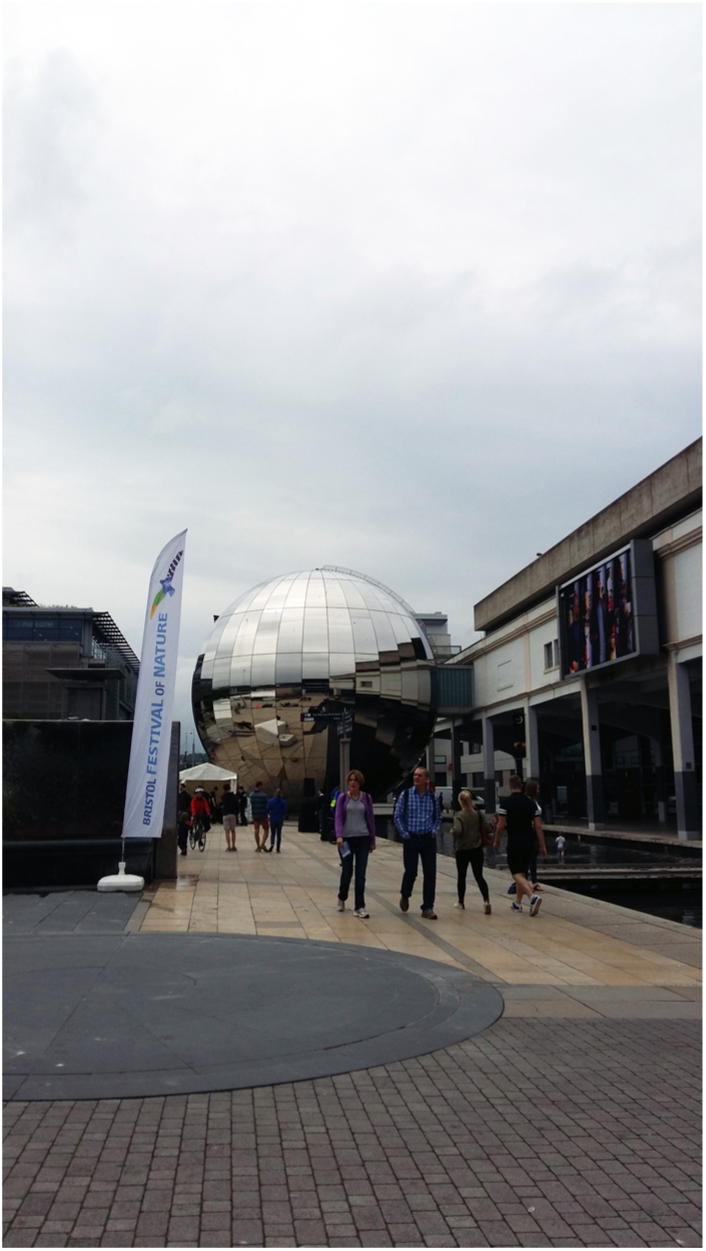
The Data Dome, Bristol.
The planetarium (originally Britain’s first 3D planetarium facility) was partially repurposed as a flagship symbolic location for showcasing Bristol’s smart city ambitions. This was funded through a grant from Bristol City Council after a project to turn the planetarium into what is now known as the Bristol Data Dome was included as part of the Bristol is Open and Gigabit Bristol programmes, two key planks in Bristol’s smart city strategy. The project itself was run and managed by Ridge LLC, a UK property consultancy. The planetarium was refitted from February 2015 as part of its integration into Bristol’s smart city projects, headed by a joint venture between the University of Bristol and Bristol City Council (Burton et al., 2018). After opening in November 2015, it was called the Bristol Data Dome. The repurposing involved connection of the Data Dome to a high-performance computer at the University of Bristol, and the ability to display data visualisations in 4K resolution (Bristol is Open, 2015) using two 360-degree digital projectors (BBC, 2015).
The Data Dome is a spherical, stainless steel structure with a polished finish, making it reflective and windowless. It is set apart from the main At-Bristol building, thus lending it physical prominence in Millennium Square. It is partially surrounded by water and is connected to At-Bristol via a first-floor bridge. After the 2015 refurbishment, a walkway was also opened from Millennium Square into the Data Dome. Unsurprisingly, the walkway resembles boarding stairs of the types found on aircraft or in science fiction settings. The original planetarium was designed by London-based architectural firm WilkinsonEyre. Structural engineering work was carried out by Arup, a multinational professional services corporation. When not used for space-focused exhibitions for the public, the Data Dome is used to display data, infographics and geomapped information, using digital projection ranging from movie projection to the utilisation of a games engine to render urban environments in 3D. As a social space, therefore, the Data Dome involves the working lives of museum workers as well as corporate employees (paying for use of the Dome for the purposes detailed above), and the general public who use the Data Dome in both its functions as planetarium and data display facility.
The Glasgow Operations Centre
The GOC was funded through the award of a 2013 £24m UK government grant, the result of Glasgow submitting a successful bid for a smart city demonstrator project. The national competition was run by the Future Cities Catapult, part of the then Technology Strategy Board (now Innovate UK).
The GOC is housed within the headquarters of Community Safety Glasgow (CSG), located in an otherwise largely nondescript office building. It is clearly aimed at the twin purposes of managing security and traffic based on data feeds. The GOC is located in close proximity to the Glasgow Emergency Control Room, used to manage and monitor ‘major incidents in the city’ (CSG, 2017: 6). It is the central node within a large amount of data networks, feeds and flows of various types of information. As of June 2015, it was reported that the GOC received a total of 582 different live data feeds, and data from a network of 1430 non-image based traffic sensors. Of the 582 live feeds, 550 were fixed CCTV feeds (including 141 traffic CCTV cameras), 11 were feeds from mobile CCTV cameras and 21 were from redeployable CCTV cameras (CSG and King, 2015). Those working within the GOC are mostly employees of CSG, while several public services (from the police to the ambulance and fire services) are connected to the GOC as part of the facility’s response function. A Foucauldian understanding of its role in the city reflects ‘a spatial dynamics that responds to the need to manage and optimise circulations, rather than fixing and enclosing particular places, people, functions, and/or objects’ (Klauser et al., 2014: 881). As such, the GOC is a physically enclosed space that also serves a panoptic function.
The actual space of the GOC is that of an irregularly-shaped room, with a single entrance doorway and no windows. The layout is composed of banks of desks with computer workstations, facing banks of screens displaying some of the live data feeds: it is represented in much the same way as other smart city control rooms. The space of the control room, and the internal design and furniture, were designed by Thinking Space Systems, a Romsey, UK-based control room furniture corporation. IBI Group, a global architecture, engineering, planning and design firm, provided architectural and design services for the GOC. The banks of screens were supplied by eyevis, a visualisation systems corporation based in Reutlingen, Germany. The functioning of the screens themselves is made possible through the server room adjoining the GOC. This room contains, as well as servers, 11 Netpix video wall controllers and 65 rack-mounted decoders: this allows for the display of up to 2100 simultaneous data feeds on the banks of screens mounted in the GOC (eyevis, 2014). Thus, the GOC is made possible through international networks of technology actors as well as a broader, national and city-specific set of policy actors and agendas.
Analysing flagship smart urban spaces
The architecture of the windowless monad
As seen above, flagship urban spaces are used to represent and signify the smart city. This visibility is as much physically and materially present in the fabric of the city as it is visible through the symbolic presence of these structures and spaces in media, and predominantly online media. Indeed, while there is little to no printed documentation on either the Data Dome or the GOC, both have significant presence online. The Data Dome is featured on the At-Bristol website, and the GOC has its own site hosted by CSG (CSG, 2017) as well as a site hosted on the Future City Glasgow web platform (Future City Glasgow, 2017). At the same time, the broader smart city is essentially invisible and subtly integrated within the urban fabric, and is defined more by its practical invisibility than by its architectural, infrastructural, built or other form of visibility (Caprotti, 2017). Rather, it is conceptualised as an intermeshing of data, code, infrastructures and flows, which are not necessarily visible (Gabrys, 2014). Indeed, representations of spaces of the smart city are often characterised by ‘plenty of hi-tech symbols, but without any visible human presence’ (Vanolo, 2013: 892).
This leads to the question of how to understand the highly visible, built excrescences that are the Data Dome and the GOC. Although they are visible in different ways – the Data Dome can be visited and is a firmly planted material presence in one of Bristol’s central squares, while the GOC is not architecturally prominent but has a well-developed web presence – both function as spaces and places that render the smart city visible. Therefore, both the Data Dome and the GOC are characterised by visibility, albeit in different forms. At the same time, they are also characterised by a certain hermetic quality: the Data Dome is windowless and thus visually isolated from central Bristol; the GOC is a self-contained control room where the visual reference points are videological rather than windows, and where rendering data flows visible enables the GOC to lend itself to strategic forms of visibility focused on urban control (Brighenti, 2007). Additionally, in the case of the GOC, the centre itself is dislocated from the city centre, while functioning as a central recipient of urban data: the GOC is housed in Eastgate, south-east of the city centre. Therefore, a highly visible web presence for the GOC is belied by a non-central, largely inaccessible (to the public) physical location and by a nondescript building.
The notion of the ‘windowless monad’ (Sandywell, 2016) is useful here, to denote the particular character of specific flagship architectures (especially control rooms and urban dashboards) associated with the smart city. This concept is based on an elaboration of the monad concept introduced by philosopher Gottfried Wilhelm Leibniz. In his Monadology, Leibniz theorised monads as single, simple, self-enclosed constituent parts of the real. The ‘windowless’ monad is constituted by a reality that is virtual in that it is constructed through the flows of representations and data perceived by monadic entities in their windowless existence. As Ankersmit (2005) argues in his work linking the concept of the windowless monad to the urban, the reality of the city becomes the reality of the windowless monad. An elaboration of the monad as windowless, then, renders it as an entity that engages in ‘specular mirroring’ of the real, in a ‘videological framework’ that is ‘free from outside determination’ (Sandywell, 2016: 600). At the same time, Leibniz’s conceptualisation of the monad allows for spatiality in that space (such as the space of the city, or representations of that space) that ‘is within the context of its consciousness rather than an absolute independent substance’, and thus it can only be identified ‘with the relatedness of the items of one’s immediate consciousness’ (Northrop, 1947: 433). The smart city control room can be seen as an example of a videological, windowless monad. It is monadic in its self-representation of the city’s reality through flows of data, sound and video images, while at the same time being physically as well as symbolically windowless. The spaces of the urban control room are, in fact, usually physically windowless, and at the same time they are normally housed in buildings owned by public authorities, but which cannot be freely accessed by the public. This is because of the strong associations between the control room and the police and urban security sphere, which automatically preclude a window onto the public realm that does not fall under the power of the urban police realm. Therefore, the smart control room as windowless monad is necessarily videological, in that it relies on visual representations of data and urban life to render the specular view of the city that is at the heart of notions of smart urban control. These notions have their roots in deeply modern urban imaginaries (Gottschalk, 1995; Picon, 2015) influenced by visual culture, modern urbanism, dystopian postmodern visions of the city and cultural practices from videogaming to science fiction. Indeed, the Data Dome has been used to host immersive gaming experiences, as seen by a 2016 event in which Swindon, UK-based Fayju Games showcased its new Cascade videogame (We The Curious, 2016). The Data Dome and GOC can be seen as monadic in part because of the fact that there is effectively no communicative engagement with the city: the buildings receive data flows (and analysis may or may not be made of these flows), but there is little to no communication back to the city itself (citizens, communities, etc.). In the case of the Data Dome, for example, visualisations of data may be made available to citizens in situ through events that can be booked, but these are not frequent and little actual two-way engagement with audiences (the public, individual citizens, etc.) is included within the Data Dome’s remit. With regards to the GOC, the Future City Glasgow site (Future City Glasgow, 2017) explains how the control room will receive flows of ‘intelligence’ that will be ‘mapped’ to ‘monitor and measure’ various ‘indicators’ which in turn are represented as forming the GOC’s ‘impact and value’ for Glasgow’s residents.
The notion of the windowless monad in the smart city leads to observations about the link between windowless, videological views ‘on’ the city, and architectures and practices of control. Firstly, the GOC and Data Dome can be linked to visions and imaginations (fantasies?) rooted in imaginaries around videogames, science fiction, the space programme and other phenomena that have had significant cultural impacts. In this sense, these buildings are monadic because they become, in their embodiment of these visions, ‘a fragment of the past blasted out of the continuum of history and charged with the presence of the now’ (Weigel, 2002: 24). Second, as seen above, buildings such as the Data Dome or the GOC effectively render the smart city visible, but also represent an architecture of control. Indeed, Lemos (2017: 87) describes the GOC as a ‘huge surveillance project for monitoring public space’. This control may be interdictory (as when a data feed enables a rapid police response), surveillance-focused (as in networks of CCTV cameras), and based in legally-defined decisions as to who and what are ‘allowed’ in public space. Nonetheless, it remains part and parcel of the generation of a type of urban interdictory space that has ‘undergone a process of continual evolution, becoming subtler and more systematically pervasive’ (Flusty, 2001: 659). Although scholarship has excavated the performed and social character of urban surveillance and its imbrication with cyberspace (Koskela, 2002), buildings such as the GOC can be seen as part of a process of ‘tactically engineering spaces from whence the bulk of the city’s populations can be kept out of mind or, at the very least, kept well in line’ (Flusty, 2001: 663).
When considering flagship smart city architectures, then, it becomes clear that spaces such as the GOC and the Data Dome are imbued with a videological approach to the city that is, at heart, also a ludic approach rooted in the aesthetics of videogaming. This is because the screens and consoles, and the potential for visualisations of both data and physical spaces of the city, render the smart city operative as a ‘gamer’ who can direct, control (play) the city much as a videogamer can be absorbed in an urban simulation like the popular SimCity videogame (Bereitschaft, 2016).
In turn, the ludic angle connects these spaces of centralised (illusions of) control to the early development of smart city control rooms as a way of managing not whole cities, but sporting events. The link between these events and urban control has been explored with a focus on the development and use of security and surveillance practices to gain an overview, and an arm’s length control over, crowded and dynamic spaces associated with sporting and other events (Coaffee, 2015; Klauser, 2013). The GOC, in turn, was funded and developed with the aim of providing initial control and city management during the 2014 Commonwealth Games. Likewise, the Rio de Janeiro Operations Centre was seen as the initial stage of urban planning for the Olympic Games, held in the city in 2016: security and surveillance were widely perceived as crucial to the success of the Olympics, and for improving Rio’s global image (Azzi, 2017). Indeed, ‘the imaginary of the smart city is often linked to fears concerning privacy, security and control’ (Vanolo, 2016: 26). At the same time, the smart city control room’s game-like view of the city can be seen as part and parcel of a more playful approach to urban surveillance (Koskela and Mäkinen, 2016), which turns the control room into a set of consoles with which the city can be viewed and manipulated, much as in a videogame. Acknowledging the videogame-like qualities of smart city control rooms does not, however, entail forgetting that the videogame is a cultural artefact that is not value-free, and that it exists in varieties from the psychedelic to the deeply dystopian. Indeed, Vanolo (2016) uses the Watch Dogs videogame (set in a dystopian smart city) to illustrate how, while the control room is partly based in imaginaries informed by videogaming, games themselves, as cultural products, can end up referring back to the smart city as a landscape in which dystopian games can be set and played.
Banalisation and the serial smart object
New and highly visible and marketed spaces of the smart city can be seen as examples of a twin process of banalisation and international standardisation based on discursive, policy and governance-based policy mobilities and circulation (González, 2011; Ponzini and Arosio, 2017). In many ways, the Data Dome and the GOC represent serial banality. While the Data Dome may be striking in terms of its spherical shape and metallic exterior, it is nonetheless a repurposing of a planetarium. Furthermore, the spherical shape is by no means novel, but is a referent to high-modern (and much grander) geodesic buildings such as the 1967 Montréal Biosphère, the 1982 Spaceship Earth (Epcot) structure (at the Walt Disney World resort in Florida) and the 1985 Géode IMAX theatre, Paris. The GOC, likewise, is serialised in two ways: first, it is housed in an office building whose architecture replicates that found in many cities and office parks. Secondly, as a room, the GOC belongs to a long history of modernist command-and-control utopian visions (Mattern, 2015; Picon, 2015) based on the idea of the ‘control room’, whether it is a NASA facility, the high-tech control rooms found in nuclear power plants and complex industrial facilities, air traffic control centres or the videogaming suite. The serial nature of these architectures lies not so much in their aesthetic characteristics, but in the fact that they are yet another expression of a series of high-modernist utopian imaginaries (Picon, 2015) elaborated and replicated as part and parcel of the development of the genealogies of the smart city (Kitchin, 2015b).
The Data Dome and GOC are part of a process of banalisation and standardisation of smart city imaginaries, at the same time as these imaginaries are presented as novel, high-tech and futuristic. This process is both banal and globalised (Kaika, 2011): banalistically linked to past urban form, while connected to a proliferation of contemporary, corporate, international imaginaries of the smart city. It also consists of urban spaces and visions that are linked to a globalised and circulating version of smart and sustainable visualisations of the future city (McCann, 2011; Rapoport and Hult, 2017).
Flagship smart city architecture: Urban totems
The final point of analysis proposed on the role and significance of flagship spaces of the smart city is that these spaces can be interpreted as mediators and interfaces for elite power. This argument is based on recent work on iconic and totemic architecture. As Kaika (2011: 970–971) has argued, urban totems not only ‘signify’ power, but also help to ‘institute’ new forms of power. The Data Dome and the GOC both clearly signify power, largely through a videological approach to data that renders the smart city visible and therefore enables imaginations of monadic knowledge on the one hand, and Panopticon-like control on the other. In contrast with Bentham’s Panopticon, however, spaces such as the GOC enable the institution of what could be termed a ‘reactive Panopticon’. This is because the GOC’s operators are not simply silent witnesses of the city’s activities, but have the possibility of occasioning real-time or at least rapid responses to activities and people or groups deemed to be unsafe, antisocial or otherwise undesirable. These responses may vary, from those involving the emergency (ambulance, fire), security (police, military) or other (environmental, traffic) services, to the highlighting of a specific urban area for potential imminent intervention (by, for example, the police). As the GOC’s web presence on the Future City Glasgow website states (Future City Glasgow, 2017), the GOC aims to provide ‘a co-ordinated, real-time, intelligence-led, response to incidents large and small across the city’.
At the same time, as seen in the case of the Data Dome, these urban totems are partly characterised by their instability. Just as the Data Dome is a repurposed planetarium (and is still largely used as a planetarium), urban totems themselves have little reason for being if not to render data legible, and the smart city visible in the material sphere. In light of their role as interfaces that make the smart city legible, smart urban totems are nonetheless deeply tied to their local settings: there is ‘a story seemingly bursting from every surface and fixture’ (Simpson, 2014: 834) of iconic spaces of the smart city. These range from the Data Dome’s antecedents in the development of the At-Bristol centre, to the planning of a high-tech operations centre in Glasgow that has brought together functions as different as traffic control and security camera monitoring.
Finally, it can be argued that the totemic nature of flagship spaces in the smart city means they function not simply as spaces of the legitimation of corporate power, but as spaces that are designed for city authorities to legitimise and justify their own power (Patterson, 2012; Sklair, 2017; Yaneva, 2017). In a visual and symbolic sense, they justify investing taxpayers’ money in highly technological enterprises associated with the smart city. Fibre networks, high-performance computing, flows of data, networks of urban sensors and wireless communication standards all come together in flagship spaces such as the Data Dome and the GOC. These buildings, then, effectively function as interfaces through which digital technologies and highly technocratic forms of urban governance are fetishised into glittering and easy-to-understand visions of the urban future. The Data Dome and GOC effectively function to ‘bridge the middle ground between the monumental and the evidently personal’ (Malone, 2017: 106). These spaces and buildings have a role in constructing new forms of (digital) urban power on behalf of municipalities and national governments.
Discussion and conclusion
The article’s analysis of iconic, flagship spaces of the smart city opens up questions around their function and role(s) in constructing and mediating smart urbanism in the contemporary city. The following points of reflection are aimed at sparking debate on this issue: as digital infrastructures become ever more enmeshed with and within the urban sphere, examining the significance of the visible excrescences of smart urbanism becomes a key project for understanding the turn towards specific iterations of the digitally-inflected city. A first point for reflection concerns the twin nature of smart urban spaces as both windowless and as spaces of visualisation of data flows. As seen above, monads are entities that reflect a specific view of urban reality, while not engaging in communication with it. This is the case with the smart city control room, with its hundreds of screens and aseptic consoles through which the city can, we are told, be known, measured and potentially regulated. The question that is raised, here, is around the potential for a move from governance to control, from democracy to autocracy (Krivý, 2018), and in less than progressive directions in the smart city:
The world of the windowless monad begins to look like a nightmare (generated by the thought of inhabiting an asocial world of self-contained and self-sufficient egos) or, more positively, as a forerunner of the idea of a hologram universe. The Leibnizian cosmos of non-communicating monads is perhaps also a prefiguration of the alienation experienced by many individuals subjected to the material imperatives of modern life. (Sandywell, 2016: 600)
A second point of reflection is centred around the roles of flagship spaces of the smart city. In part, the spaces of the Data Dome and the GOC perform the smart city in specific ways and render it visible. At the same time, however, these spaces are nodes in a network (of data and code, yes, but also knowledge, policy, governance and other practices of power) that play a part in producing urban space. Whilst buildings and spaces associated with the smart city may appear fixed, they are in fact part of ‘processes, tensions and struggles’ (Dikec, 2015: 85) integral to the production of the (smart) city. As seen with the Data Dome, which is presented as an example of futuristic smart city technology, but which is in fact a repurposed planetarium, the smart city represents a reworking of the current urban condition rather than a wholly new type of urban reality. This reworking is often more banal and anodyne than what the imaginaries associated with smart city marketing present to wider audiences. Thus, flagship spaces do the work of mediating power in the (smart) city (Dovey, 1999) both symbolically and through material impacts such as the occasioning of rapid responses by security and emergency services in the city.
Thirdly, there exists an opportunity for rendering visible the complex and dynamic networks of emergent elite power both signified by, and continuously constituted in, these spaces. The GOC and Data Dome show how networks of global corporations, policymakers, municipal authorities and other actors perform an elite role in the contemporary smart city: from the manufacturers of smart city control room furniture, to architecture and urban design firms, to technology corporations providing sensors, screens, servers and software, to city authorities and national governments, to international standards organisations and actors in smart city finance. These actors, and their respective corporate, group and individual biographies, are assembled, at times temporarily and in less than stable ways, in configurations that help to produce and perform not just specific notions of the smart city, but smart city elites themselves.
Finally, any discussion of iconic architecture and mediations of power through built form (Dovey, 1999) raises the issue of how resistance to that power is materialised. This was not a key focus for this article. Nonetheless, if iconic and flagship spaces of the smart city are constitutive of elite power, then a key question is what forms of resistance exist or are emerging that move against the grain of visions of future digital urban smartness. Resistance is in some ways widespread and generally focused on specific aspects of smart urbanism: such as public and regulatory practices against Uber’s ride-hailing services in several cities (Walravens, 2015). At the same time, and heeding the call, mentioned above, to avoid stereotyping all smart urbanism as corporate, post-political and non-local, it is key to remain aware of the potentially progressive, post-capitalist politics and economics rendered possible, as Rossi (2016) has argued, through a consideration of smart urbanism that is not limited to corporate visions, and that does not solely focus on smart urbanism as a monolithic construct. Resistance to, and re-interpretation of, the smart city and its flagship spaces will likely involve digital as well as other forms of resistance (Brighenti, 2010). This leaves scholars with the open question of where can the non-corporate, non-governmental smart city be found in the ordinary cities of today?
Footnotes
Declaration of conflicting interests
The author(s) declared no potential conflicts of interest with respect to the research, authorship, and/or publication of this article.
Funding
The author(s) disclosed receipt of the following financial support for the research, authorship, and/or publication of this article: This work was supported by the Economic and Social Research Council (grant number ES/L015978/2), ‘Smart eco-cities for a green economy: A comparative study of Europe and China (SMART-ECO)’.
