




Abstract
This article aims to contribute to recent debates on the politics of smart grids by exploring their installation in low-income areas in Kingston (Jamaica) and Rio de Janeiro (Brazil). To date, much of this debate has focused on forms of smart city experiments, mostly in the Global North, while less attention has been given to the implementation of smart grids in cities characterised by high levels of urban insecurity and socio-spatial inequality. This article illustrates how, in both contexts, the installation of smart metering is used as a security device that embeds the promise of protecting infrastructure and revenue and navigating complex relations framed along lines of socio-economic inequalities and urban sovereignty – here linked to configurations of state and non-state (criminal) territorial control and power. By unpacking the political workings of the smart grid within changing urban security contexts, including not only the rationalities that support its use but also the forms of resistance, contestation and socio-technical failure that emerge, the article argues for the importance of examining the conjunction between urban and infrastructural governance, including the reshaping of local power relations and spatial inequalities, through globally circulating devices.
Introduction
Smart energy grids are increasingly being deployed in cities of the Global South. Although their use in these cities remains uneven, current trends suggest that aging electricity networks are gradually being replaced with smart grids worldwide (Nhede, 2019). Whereas urban studies literature has provided insights into other electricity technologies in these cities, particularly in Africa (e.g. Baptista, 2015), smart grids are still a relatively neglected empirical object of study. This is despite the fact that they are increasingly changing electricity infrastructure management, embedding the promise of an improved evolution of the traditional electricity grid to the benefit of all parties involved. For electricity providers, automated systems and digital data should enable better planning and management of electricity demand. Consumers should also benefit from this technological change as they are given greater control over their own electricity consumption through real-time information feedback. More broadly, it is presented as a win-win technology able to help address different challenges, including energy and climate change, economic growth, energy security and reliability. This discourse has already been questioned by some critics who highlight how these technologies often embed specific political projects including forms of anti-politics linked to neoliberal governance (Sadowski and Levenda, 2020). With a focus on cities, research has revealed how smart grids are ‘governmental programmes’ (Bulkeley et al., 2016a) within smart experimentations (e.g. McLean et al., 2016), urban climate governance and energy transition policies (e.g. Bhardwaj et al., 2019), and embed logics of security linked to forms of governing through codes (Klauser et al., 2014). Yet, much of this work has focused on forms of smart city experiments, mostly in the Global North, while less attention has been given to the implementation of smart grids in cities characterised by high levels of urban insecurity, socio-spatial inequality and contested state sovereignty at the local level (e.g. gangs and militias, see Arias, 2017).
This article contributes to these current debates on the politics of smart grids through a focus on the deployment of a smart metering system 1 in low-income communities in two cities of the Global South – Kingston (Jamaica) and Rio de Janeiro (Brazil) – the so-called ‘inner-city’ communities in Kingston and favelas in Rio de Janeiro. It illustrates how, in these contexts, the deployment and use of smart metering is closely linked to reconfigurations of urban security policies that supposedly aim to reduce ‘urban violence’ within a discourse of the state ‘claiming’ back these areas. The examples of Kingston and Rio de Janeiro help to expand current understanding of smart grids as a governance tool by revealing how electricity providers use these systems to navigate different risks associated with uncertain urban security conditions, and the poor socio-economic status of these consumers. Although these systems are not only installed in these communities, it is in these areas that we see the spatially differentiated potential of these systems as an urban governance tool to navigate different risks. In order to explain this spatial performance of smart grids, I use the notion of affordances to consider their functional significance and use in relation to the needs and vision of the electricity provider. Looking at the affordances of the smart grid within these urban contexts provides a way of understanding the smart grid as a security device 2 used to protect infrastructures and revenues against losses and fraudulent behaviours, and to navigate complex relationships framed along the lines of socio-economic inequalities and forms of territorial control.
Through this analysis, the article’s contributions are threefold. First, it helps build an understanding of smart grids as a governance tool closely associated with urban sovereignty – here linked to configurations of state and non-state (criminal) territorial control and power. Second, it reinforces the idea, already present in the literature, that not only governments but also corporations enact politics, and here, more specifically, use the smart grid to manage populations (consumers) in territories that represent different risks. Third, it seeks to expand the still limited understanding of uses of smart grids in cities of the Global South.
This article is based on qualitative research on the governance of electricity access carried out over the past decade in Rio de Janeiro and during the last three years in Kingston, with a focus, in both cases, on the link between the management of electricity infrastructure and urban security policies. 3 The article begins by providing an understanding of smart metering within complex urban governance structures, connecting conceptual debates on the politics of smart grids, Science and Technology Studies (STS) and security studies. It continues with an exploration of the contexts of Kingston and Rio de Janeiro, setting out how urban security governance is important for understanding high non-technical losses in these areas and the installation of a smart metering system, often linked to urban security policies. It then describes how these systems operate as a security device to manage (spatial) risk, which is also contested through forms of disruption, socio-technical failure and bypassing, within changing urban security contexts. The article concludes by outlining the importance of analysing the global circulation of these technologies in association with local urban inequalities, not only within the political rationalities that support their implementation, but also with regard to forms of active and passive resistance.
Smart grids within contested urban (security) governance structures
Smart grids 4 are increasingly deployed in cities and are presented as instruments capable of improving how different societal and environmental challenges are governed, including: (1) energy transition and climate change; (2) the interface with and integration of a variety of networked infrastructures; (3) economic growth; and (4) energy security and reliability (Luque, 2014). The conjunction between smart grids and these different challenges has been the object of various studies, which have developed a critical understanding of these systems. As a common point, this research reveals how smart grid deployment and management involve power relations that have political implications. Smart grids have been considered as systems that convey techno-politics: the ‘embedding of political rationalities in technological systems’ (Sadowski and Levenda, 2020). The urban dimension of the politics of smart grids has been particularly emphasised. For example, within the Australian urban context, Bulkeley et al. (2016a) show how the smart grid is a deeply urban political project because it constitutes new forms of (smart) urbanism. Building on understandings of technology as eminently political (Barry, 2001), they demonstrate how the urban in this political project of the smart grid is materialised within place-based aspirations, and within a specific urban order adapted to the logics of the smart grid (Bulkeley et al., 2016a). The political logics of interaction between the smart grid and the urban stem from ideas of the electricity grid as a tool to regulate, re-order and more generally to govern within modernist ideals (see Scott, 1999). The famous quote of Lenin (1920) ‘Communism is Soviet government plus the electrification of the whole country’ perfectly illustrates this approach of considering electrification as a deeply political project. Digital technologies, however, have considerably changed the logics of governing through infrastructures.
Within this literature, the use of the Foucauldian notion of ‘governmentality’ has particularly guided political interpretations and conceptualisations of smart grids. Following this theoretical framework Bulkeley et al. (2016b), for example, reveal how smart grids change the logics of governing the electricity grid, reconfigure the relationship between the providers and the consumers, and seek to align energy practices to new governmental rationales. They see the smart grid as a ‘new set of governmental programmes that seek to deploy a logic of managing demand in relation to supply in order to respond to challenges of decarbonisation, decentralisation and the financing of infrastructure provision’ (p. 20). This interpretation is particularly useful because it enables us to understand not only how forms of governing are implemented through smart grids but also how social practices conform with or contest such framings, escaping the dominant trend of over-determination of political rationality (see also Danieli, 2018). Within a similar theoretical framework, Klauser et al. (2014) also offer a compelling understanding of the smart grid as an instrument used to govern everyday life through codes, including governing consumption behaviours and spatial practices of (traffic) circulation within smart city experiments. In their work, the Foucauldian conceptualisation of ‘security’ is used to study the performance of smart grids, analysed as a mediating technique through which to understand ‘the power dynamics inherent in contemporary governing through code’ (Klauser et al., 2014: 872).
These studies are particularly useful for understanding the development of smart grids in Kingston and Rio de Janeiro because of their focus on the relationship between rationalities and governmental technologies, which are actually not only limited to the state but also to corporations (e.g. Lovell and Powells, 2020). However, although it is recognised that the urban conditions in which smart grids are implemented are important for understanding such politics, limited attention has been paid to the urban governance structures in which these systems are also enrolled. Research has generally focused on smart grids as a mediator of the relationship between the state, private providers/corporations and households. This is probably due to the context and programmes studied. Most of the literature on the interaction between smart grids and cities has particularly explored these logics within complex energy-related governance challenges, including climate change, energy transition and broader smart city projects (e.g. Bhardwaj et al., 2019; Bulkeley et al., 2016a; McLean et al., 2016). In this context, we still know relatively little about these developments in poor neighbourhoods, particularly in cities of the Global South, where local governance structures often reflect a complex relationship with the state.
A few exceptions illustrate how smart grids are used to reshape norms and rights in informal neighbourhoods (Pilo’, 2017) and maximise returns on investment, which also reshape micro-politics at the neighbourhood level (Guma, 2019). In fact, in various cities of the Global South, power is often much more widely distributed between various state and non-state actors, including criminal actors such as gangs and militias, who can assume an important governance role and affect the delivery of urban basic services (Rufín et al., 2020). Their presence can entail resistance to infrastructural change (e.g. de Bercegol and Monstadt, 2018; Guma, 2019) or even competition, through water racketeering for example (Ranganathan, 2014). The role of infrastructure and its technology in shaping these complex governance relationships remain under-conceptualised.
Critical security studies building on STS and materialist perspectives provide an insight into the relationship between technology, security and governance. Some scholars suggest the importance of things and devices in reconfiguring security governance action (Amicelle et al., 2015), helping to position state sovereignty and urban security politics as a disputed material process (Müller, 2019). The increased technicisation of security leads to the development of a ‘technopolitics of security’, particularly in contexts where different sovereignties are contested (Müller and Richmond, forthcoming). Most of these studies focus on security technologies (e.g. cameras) while, with the exception of Foucauldian interpretations of smart grids, 5 smart grids are not generally considered an explicit security technology. However, the linkage between urban security dynamics and the installation and use of smart grids in Kingston and Rio de Janeiro opens up new interpretations of the smart grid as a security device. Smart grids are supposed to protect infrastructure and revenue by governing fraudulent behaviours and enabling the providers to navigate risks associated with socio-economic inequalities and uncertain state and non-state attempts at asserting territorial control. The notion of affordances helps to make sense of these contextual uses within urban security governance structures.
The idea of affordances was introduced by the psychologist Gibson to convey possibilities for action in a specific environment and it has been used in STS to understand the functional significance of technology for specific actors, generally the users (Hutchby, 2001). Hutchby defines affordances as ‘functional and relational aspects which frame, while not determining, the possibilities for agentic action in relation to an object’ (Hutchby, 2001: 444). In short, ‘an affordance is not a property or quality residing in either the object or subject but relates to how objects are perceived with regard to their possibilities for use’ (Harwood and Hafezieh, 2017). Using the notion of affordances for the study of smart grids is not new. The affordances of smart grids have been explored to examine how smart meters create new potential engagements for households (e.g. Lovell et al., 2017), or how technological choices and socio-political organisation mutually change (e.g. Rumpala, 2013), for example. Compared with other STS notions, the notion of affordances is unique in that it provides for the consideration of possibilities and constraints for action and uses of an object that were not anticipated in advance. While the smart grid was not originally conceptualised to navigate risk but to better manage electricity demand and the commercial relationship, de facto it affords that form of management. This conceptualisation highlights one side of the story – the providers’ perspective – yet, it is important to consider the structural and relational dimension of affordances in order to understand how affordances ‘operate at the intersection of artifacts, actors, and situations’: ‘for whom [affordances work] and under what circumstances?’ (Davis and Chouinard, 2016). Thus, I use this notion to consider the possible actions, uses and contestations of smart grids that emerge from the relationships between the providers, these users and the urban governance (security) environment in which they operate. In what follows, I set out how a specific component of the smart grid, smart metering, is used as a governance tool within moving security governance policies, as well as how these uses are reverted or contested through socio-technical failure and protests.
Criminal governance, space and electricity losses in Kingston and Rio de Janeiro
From an electricity infrastructure development perspective, there are several similarities between Kingston and Rio de Janeiro, despite large differences such as the size of the two cities, for example. 6 In both cities, near universal extension of the grid 7 coexists with significant spatial inequalities, in terms of quality of electricity provision, between low-income and partially informal neighbourhoods and upper-middle-class neighbourhoods (see Pilo’, 2019, for the case of Rio de Janeiro). Moreover, in both cities, electricity is distributed by private providers – the Jamaica Public Service (JPS) in Kingston, and Light in Rio de Janeiro – who experience similar electricity service management challenges. Despite technical and non-technical 8 loss reduction being one of the promises of the privatisation reforms largely imposed by international donors on a number of developing countries, these losses have generally increased. This is the case in both cities, where non-technical losses correspond to 18.03% (interview 7) and 23.95% (Light, 2019) in Kingston and Rio de Janeiro, respectively.
In both cities, non-technical losses stem from the practices employed by the different types of customer (residential, commercial and even public power customers), across heterogeneous socio-economic conditions and types of neighbourhood (Jamaica Public Service Company Limited (JPS), 2018; Light, 2019), which dispels the stigmatising myth that ‘non-payment culture’ is linked to poverty. However, from the companies’ perspective, this heterogeneity means adapted loss-reduction strategies are required that take the socio-economic characteristics of the customers, the material and technological complexity of irregular connections, as well as the type of urban environment into account. In both cities, the reduction of losses in low-income communities presents similar challenges, despite there also being differences in local politics, policies and public interventions that affect electricity service provision and access. In particular, we see the presence of complex governance systems in which criminal actors and politicians play a central role in shaping the security environment of these communities. The fact that both cities have long been emblematic of the pervasive gang and police violence that has plagued many cities in the region over recent decades is central to understanding the persistent categorisation of low-income communities as high-crime areas, which also affects the context in which the companies operate.
Irregular electricity access in many communities in downtown Kingston is embedded in larger political structures in which a laissez-faire policy is coupled with a system of patronage that more generally influences access to resources (Campbell, 2020). These impoverished areas are generally known as ‘garrison communities’. This term was originally coined to designate the local organisation of a political culture in which opposition to the locally dominant political party could lead to physical danger and violence. Since the 1980s, the development of these patronage-based political relations, first established in the post-independence period during the 1960s, has increasingly been mediated by local gang leaders – called ‘dons’– leading to an emergent form of ‘hybrid state’ (Jaffe, 2013), in which bureaucrats, politicians and ‘dons’ co-govern these areas. Access to services and infrastructure, as well as the redistribution of jobs and other resources, has been crucial for maintaining the so-called ‘garrison politics’ system, and for understanding the social embeddedness of these criminal leaders (Harriott, 1996). In these communities, often characterised by the presence of both large housing schemes and informal self-built urbanisation, efforts to improve electricity infrastructure not only entail both grid extension and the regularisation of existing connections but also must contend with these complex governance structures that involve security aspects (interview 7).
In Rio de Janeiro, a specific electrification policy implemented in the 1980s officially recognised the right to this infrastructure in favelas, overcoming one of the main obstacles to their electrification up to this point: the precarious land tenure (Vasconcellos, 1987). Since then, multiple electricity regularisation projects have been carried out. The electricity-sector privatisation reform in the 1990s, and the subsequent introduction of a private provider to manage the distribution system, undoubtedly contributed to the emergence of electricity regularisation projects that sought to reduce financial losses, which progressively increased after implementation of the electrification programme (interview 1). As in Kingston, the consolidated local embedding of armed drug-trafficking groups in many favelas since the 1990s has complicated interventions in these areas, including the implementation of electricity regularisation projects (see Pilo’, 2015).
Owing to these security concerns, both companies categorise these areas based on the level of losses and of security risk. JPS uses the category of ‘red zones’ to define ‘communities that exhibit energy loss in excess of 70%, have a high propensity of throw-ups and are uninviting of normal commercial operations (…). These communities cannot benefit from our normal commercial operations because of high crime rates’ (JPS, 2018: 101). In these communities, JPS states that when its agents attempt to cut off the so-called ‘throw-ups’– illegal connections – they can face significant aggression, with some of these incidents also receiving media attention (Jamaica Observer, 2013). Thus, the company’s disconnection teams are often accompanied by the police: ‘they [the disconnection teams] go around with the police on a daily basis … always with the police to tough inner-city areas to remove illegal connections because there is a risk of aggression’ (interview 5). In Rio de Janeiro, Light uses the ‘risk area’ (área de risco) categorisation to identify those favelas considered to pose a physical danger for their agents during operations because of the presence of criminal powers, particularly during operations to disconnect irregular connections (interview 3). According to the former communities’ relationship manager at Light, in these areas ‘it was not possible to disconnect for defaults on payment or irregular connections. They [the gangs] would not allow us to do that. All the efforts in this direction [to reduce losses] were without results. So, we shifted our efforts toward increasing energy efficiency measures’ (interview 2).
Whereas, according to JPS (2018), the number of customers in these areas is very low, 9 in Rio de Janeiro the company affirms that 883,000 customers lived in ‘risk areas’, which equates to 20.5% of all Light customers (Polito, 2018). The infrastructural conditions in these communities are also slightly different, however: ‘red zones’ in Kingston are generally communities defined as high crime areas and where the entire infrastructure is precarious or absent and needs to be completely replaced. Meanwhile, the definition of ‘risk areas’ in Rio de Janeiro is used to more strongly highlight the difficulties in executing operations and sustainably eradicate illegal connections because of unpredictable violence. Despite non-technical losses not being specific to areas that pose security concerns, 10 electricity management practices are shaped by the uncertainties and unpredictability of potential conflicts. The installation of the smart metering system is part of changing security dynamics moulded by the political context.
State, police and the installation of smart meters
Since the beginning of 2000, both providers have invested in progressively installing smart metering systems that target different neighbourhoods and types of customer; a process in line with the wider regional trend of investing in smart metering (corresponding to 50% of the investment in smart grids (Nhede, 2018). In Rio, around 900,000 customers had digital meters in 2018, which corresponds to 64% of all of Light’s customers (Light, 2019). This system has been expanded through a partnership with the company Landis+Gyr, one of the world’s industry leaders in energy management solutions. Described on the Landis+Gyr website as the ‘largest smart grid partnership in South America’, a 5-year contract worth 750 million reais (around 160 million euros) has been signed between the two companies, which covers supply, implementation, operation and maintenance of the smart grid solutions. Similarly, in Kingston, JPS has selected Trilliant Incorporated, and Itron Meters to deploy their smart metering system. As of 2019, JPS had deployed over 156,000 smart meters across the entire island, which corresponds to 23% of its customers, and it is planning to invest over US$80 million by 2024 on installing smart meters to all its customers (JPS News, 2019).
The functionality of these systems is very similar with just a few minor differences. In Kingston, JPS introduced Advanced Metering Infrastructure (AMI) for large commercial and industrial customers in 2009. A year later, a similar system, Residential Advanced Metering Infrastructure (RAMI), was developed for residential customers (Office of Utilities Regulation, 2011: 1). In Rio de Janeiro, Light installed the ‘centralised measurement system’ (SMC) and the ‘individual measurement system’ (SMI). These systems, the characteristics of which are presented in detail below, introduced two main changes to the electricity distribution system: they automated a certain number of electricity management and commercial relationship-related operations and protected the system against fraud. These systems have not only been installed in low-income areas, as their deployment forms part of larger electricity system modernisation and optimisation ambitions. In Rio de Janeiro, for example, only 229,000 of the 898,000 digital meters installed in Light’s concession areas in December 2018 had been installed in communities– according to Light’s terminology (Light, 2018). However, as explained above, it is in these contexts that we see the contextualised affordances of smart metering.
In low-income communities, the first installation campaigns of the RAMI in Kingston and the SMC in Rio de Janeiro are directly linked to the changing urban security policy in these areas. In Rio de Janeiro, smart metering implementation started with the introduction of Pacifying Police Units (UPPs) in 2008, a security policy to install a permanent police presence to reduce the visibility of drug trafficking and supposedly develop a holistic approach to favelas’ urban integration. Thus, the installation of smart meters in these areas was enabled by the broader context of the city’s hosting of mega-events in which security governance became a major government concern (Giulianotti and Klauser, 2011). As stated by Machado da Silva and Menezes, ‘the installation of the UPP did not mean the beginning of the presence of agents of the State, nor the departure of all traffickers from the “pacified” favelas, but a transformation in the modalities of presence of these actors in favelas’ (Machado da Silva and Menezes, 2019). This configuration, however, particularly benefited companies who saw the opportunity to formalise a ‘lost’ market facilitated by a context in which new territorial regimes and governmentality instruments were applied (Pereira Leite, 2015). At that time, UPPs created a specific ‘window of opportunity’ for electricity infrastructure interventions as the police presence provided a secure environment. At the time, and over the following few years, the roll-out of the smart metering system thus mirrored the UPP implementation plan. During the 2008 to 2014 period, the company de-classified favelas with UPP so they were no longer ‘risk areas’ (interview 2). SMC has been mostly used in favelas with UPPs (interview 2).
Similarly, in Kingston, the RAMI system was first installed in 2010 in a community in West Kingston called Tivoli Gardens following the well-known ‘Tivoli incursion’, an armed conflict between the Shower Posse drug cartel and the military and police forces, which led to the arrest and extradition to the USA of its leader, Christopher ‘Dudus’ Coke. The arrest of Dudus, during violent clashes that included several extra-judicial killings, opened possibilities for state and non-state interventions in Tivoli Gardens, which had previously been under Dudus’s strict control. While residents mainly had free access to electricity (Jamaica Observer, 2013), the arrest of Dudus also implied the end of a protection system in which sanctions were not imposed on illegal connections. After this intervention, and with a renewed police presence that sought to assume a similar role to that of the dons in regulating everyday life in the community (Meikle and Jaffe, 2015), JPS installed the first RAMI in Tivoli (RJR News, 2011). Over the years that followed, RAMI was rolled out in other communities across the entire island.
In both contexts, the installation of smart metering systems in low-income and designated high-crime areas occurred during a reconfiguration of state interventions in public security, revealing how infrastructural change is also linked to state sovereignty. In this context, smart metering embeds the promise of differently managed electricity infrastructures in environments in which conventional management practices have generally failed. In particular, as detailed below, the characteristics of smart metering hold the promise of better managing potential irregular behaviours within an uncertain environment in which both socio-economic and (security) governance conditions limit the effectiveness of conventional management practices.
Smart metering: Governing risks and uncertainties
The installation of the RAMI in Kingston and the SMC in Rio de Janeiro is part of a differentiated electricity management approach in these areas, which is generally combined with other spatialised interventions, such as ‘social interventions’ and energy-efficiency measures, for example. Smart metering, in particular, is the technical aspect that is intended to minimise non-technical losses by maximising protection of the electricity system against potential fraud. Although RAMI and SMC are also installed in other areas, most of these systems are installed in ‘red zones’ and ‘risk areas’. The SMC is installed in areas that, according to the terms used by Light, have a ‘high level of aggressiveness’ to the network (Light, 2009: 9). Under the Light definition, this includes low-income areas, areas with a high proportion of social housing and areas with precarious urbanisation. In contrast, the SMI is installed in areas with ‘low aggressiveness to the network’ (Light, 2009: 7), mainly in upper-middle-class neighbourhoods. In Jamaica, when their installation was launched, JPS referred to the RAMI as ‘the new weapon to fight against losses’ (Obiglio, 2010) in its #WarOnPowerTheft. 11 In fact, the technical characteristics of the RAMI and the location of the meters are oriented to preventatively manage the risk of the system being violated; they also change how JPS manages its relationship with these customers. As Amicelle et al. (2015) argue, socio-technical devices contribute to (re)organising relations between the governors and the governed, generally the ‘state’ and the ultimate ‘targets’ of security policies but also with other, often private, actors in charge of implementing those policies.
The RAMI’s features allow JPS to remotely manage and execute crucial operations previously carried out manually by the company’s agents. Meter readings, disconnections for non-payment and reconnections are now automated. The aim of this automation is not only to collect more accurate consumption data and consequently better identify fraud and plan inspections, 12 but also to minimise human interaction between the customer and the often-subcontracted agents. This potentially implies fewer conflicts and less corruption, particularly during disconnection operations. These conflicts can emerge not only with residents but also with criminal actors who can decide if and under which conditions agents can enter and operate in the area (interviews 8 and 3), which is less the case in Kingston than in Rio. At the same time, these systems minimise the interaction between customers and disconnection agents – often subcontractors – notorious for enabling corruption of the meters in exchange for payment.
These systems also have an anti-theft design to discourage attempts to violate the systems. Design features include installing the meters in closed cabinets located 9 m above ground on electricity poles and no longer on the customers’ premises, 13 and replacing low-voltage (secondary lines) with medium-voltage distribution lines (Figure 1).
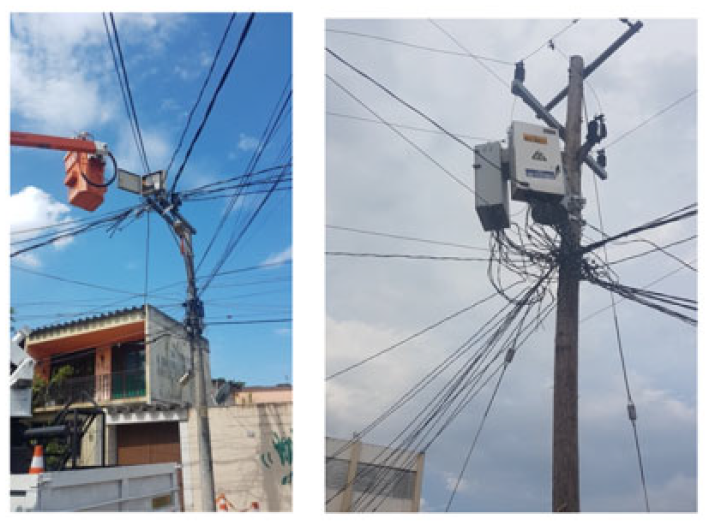
The SMC (Rio de Janeiro) and the RAMI (Kingston).
The securitisation of these areas and of favelas in particular has provided an opportunity to turn the electricity grid into an object to be protected. Moreover, the technical characteristics of these systems also prompt us to consider the temporalities of perceived risks in a context of moving security policies. Smart metering should not only help to better govern the present situation but also to mitigate future harm. By reducing the possibility of not being able to carry out commercial operations, this system should both help produce a spatial and socio-material order that is aligned with commercial logics and prevent potential violations of the infrastructure or conflicts. This less visible affordance of smart metering can be linked to broader politics of security and governments of risk in cities (Zeiderman, 2016) while revealing the ways in which electricity providers also use strategies and techniques to protect infrastructure and their business from potential threats, which are linked to uncertain security governance; however, these new orders are also reconfigured by contestation and socio-technical failure.
Disrupting smart metering within changing security contexts
Amicelle et al. (2015) suggest that security devices are ‘inseparably related to situated modes of agency and resistance’. Collective resistance is undoubtedly what characterised the modes of appropriation of this system in Rio de Janeiro, in a context of shifting security governance. In Kingston, socio-technical failure partially destabilised the working of the smart metering system. Thus, political protests and socio-technical failures prevented the smart grid from fully living up to its promise of infrastructure protection, control and non-technical loss management.
In Rio de Janeiro, after a few years of considerably reduced non-technical losses, not only did these losses once again start to rise but the system was also increasingly at the centre of multiple contestations after unexpected and surprisingly high electricity bills were issued following its installation. Just to give a sense of proportion, some residents received bills of 1000 reais, which correspond to a monthly minimum wage. Opposition to this system was particularly strong in a number of favelas, where protests have been held (Altino, 2018). Since 2012, this system has been denounced as weakening consumers’ rights (Haidar, 2012) and, more recently, this political concern has increased. Following street protests and legal action taken against the company to contest the technical reliability of this system, both in Rio de Janeiro and in other neighbouring municipalities, further installation campaigns have been prohibited. Interviews with residents in a favela in which the system has been installed indicated that these forms of resistance first found their origins in the mistrust generated by the protection system, which was perceived as creating a distance between the users and the meters (Pilo’, 2017), and generated multiple conflicts (Loretti, 2016). This mistrust was then amplified by suspected technical and functionality problems, which were thought to partially explain the high electricity bills. The security governance conditions that facilitated the installation of these systems also dramatically declined. In 2016, the government of the State of Rio de Janeiro declared a state of emergency and a financial crisis that led to measures that included reducing the number of UPPs. In 2018, the national government, under the illegitimate President Michel Temer, signed a decree that put the military in charge of security in Rio de Janeiro. With the army on the streets and the crime rate rising as part of a more general crisis, in the favelas the ‘promise’ of the UPPs unsurprisingly faded and was replaced by a ‘dual security assemblage’ where police and gangs co-produce (in)security through arrangements (Richmond, 2019) and violent police interventions. This context dramatically changed the environment in which Light operates. The provider states they only ‘enter’ favelas when possible (in defined ‘possible areas’) depending on the presence and agreement of criminal actors and ongoing confrontations with the police (interview 3). Smart metering reached its limit in this context, especially in relation to the promise of remote management of the commercial relationship. In practice, while disconnection for non-payment can be performed remotely, it is impossible to maintain this disconnection if consumers reconnect themselves to the grid. An agent needs to be sent. Moreover, residents have developed strategies to counter the smart metering technology and losses have started to increase once again.
In Kingston, technical problems have actually been detected in the communication system but discussions in the political arena have been less widespread than in Rio de Janeiro. One of the main problems leading to system faults in 2018 and 2019 concerned the communication network used to connect the provider and the customers. This problem is not recent since it has been under examination by the electricity regulator for at least the past decade (interview 6). This communication problem implied that the company was not able to properly measure the monthly consumption of these customers and also that connection and reconnection operations were not carried out at that time (interview 10). In 2018, most of the customers with whom I conducted semi-structured interviews in a community downtown were receiving estimated bills. Compared with Rio de Janeiro, these local stories have received limited public attention. The performance of the RAMI was briefly raised in the political arena in 2011 when a member of Parliament asked the House to ‘direct an investigation into the manner and method of the implementation of the Residential Automated Metering Infrastructure (RAMI) programme, and examine alternative approaches to ensure access to reliable, safe and affordable electricity for the working poor (…)’ (Jamaica Gleaner, 2011).
Although this emerged as a technical problem, the reasons for this communication failure were multiple. A JPS engineer, for example, explained that the technology adopted at that time, the power line carrier (PLC) communication system, was not working correctly because of conflicting radio frequencies (interview 10). Consequently, the company then switched from a PLC to a Quadlogic system, which is considered to have a more solid communication platform. However, another JPS manager explained that its poor performance was predominantly due to its inability to deal with the complexity of urban environments that contain sounds and materialities that can interfere with the communication system, as well as to human corruption: So, with the removal of the secondary wire, it was hoped that the system will eliminate theft. However, we found that people found a million ways to breach the system. And in breaching the system, sometimes the communication module is destroyed. They burn the modules. (Interview 9)
The reasons for these failures emerge through the interaction between these technologies and both the urban environment and human actions, which have destabilised the expected function of protecting the grid against fraud. It reminds us that getting technology to work still requires the assembled work of humans and non-humans. In both cases, providers still must send agents to check the meters or to cut off new illegal connections. In both contexts, the state security measures reshape possibilities and expectations. While in Rio de Janeiro Light devises new strategies based on the security environment, in Kingston the new installation campaigns target Zones of Special Operations (ZOSOs) (interview 8), which are considered high-crime areas where the government is allowed to deploy special security and ‘community development’ measures. In both contexts, infrastructural change follows the unstable and shifting state security measures.
Conclusion
Smart metering is a technology that is in circulation around the world, and it is increasingly changing not only how electricity infrastructures are managed but also how global and local problems are governed. The analysis of Kingston’s and Rio de Janeiro’s installation of smart metering reveals that the global circulation of these systems is linked to local urban inequalities and shifting urban governance security contexts. In both cities, smart metering provided the opportunity to protect infrastructure, embedding the promise of changing the way different risks are governed. By unpacking the role played by smart metering in private providers’ navigation of uncertain sovereignty and commercial risk, this article has looked at smart metering as a security device. Through the interaction between the uses of these systems and urban environments, smart grids emerge as a governance tool to protect infrastructure and revenues, to reduce losses and manage fraudulent behaviours, and to navigate complex relations marked by socio-economic inequalities and changing attempts to gain territorial control. These affordances are consequently mediated by the urban space, which highlights the importance of exploring technological change in cities through the perspective of the power relations at play between heterogeneous local governance actors.
The use of digital technology to navigate governance uncertainties and socio-economic inequalities testifies to a belief in a sort of technological fix, which is not surprising considering that providers have regulatory obligations to reduce losses, an interest in cost recovery but also a peripheral role in such complex governance structures. The contestation and socio-technical failure of these systems, however, reveal the multiple limitations of their uses, including the effective power assigned to this technology. While it is important to reveal the political rationalities associated with these systems, it is also essential to document the forms of active and passive resistance observed, including boycotts and socio-technical failure, in order to grasp the political workings of these systems. This is the most complicated association because of all the potential heterogeneous outcomes. While some customers responded to initial high bills and disconnections by installing new illegal connections or taking legal action, especially in Rio, others are racking up increasing debt with the providers, which contributes to a rise in socio-economic inequalities. Despite such diversity, it highlights the importance of looking at the temporalities of infrastructural change in their interaction with changing contexts and practices, including the co-evolution of technology, infrastructure and urban governance. With the renewed reinforcement of criminal actors in the governance of favelas in Rio de Janeiro, in particular, it remains to be seen how their territorial control will shape both electricity management practices and technological change. These questions place the political workings of these technological systems – including their technical failure, contestation and bypassing – at the centre of understanding the conjunction between urban and infrastructural governance, including the reshaping of local power relations and spatial inequalities through globally circulating devices.
Footnotes
Acknowledgements
I am grateful to all the staff from both electricity providers for their availability in responding to my questions, and to residents in different communities for sharing their experiences and thoughts about these systems. I am also immensely grateful to Professor Anthony Harriot and the amazing members of the Institute of Criminal Justice and Security at the University of the West Indies for hosting me during my fieldwork in Kingston. This article greatly benefited from the comments of anonymous reviewers in Urban Studies, as well as other colleagues. A special thank you to Rivke Jaffe for our discussions in and beyond this paper and to Frank Müller for his multiple feedback.
Funding
The author disclosed receipt of the following financial support for the research, authorship, and/or publication of this article: Funding for this article has been provided by the Belgian National Fund for Scientific Research (NFSR – F.N.R.S), under the FNRS 3-years post-doctoral scheme.

Notes
Interviews cited
1. Manager of the relationship with communities from 1998 to 2008, Light, 7 April 2010.
2. Manager of the relationship with communities from 2009 to 2016, Light, 24 October 2016.
3. Superintendent of Energy Recovery, Billing and Collection, Light, 10 March 2020.
4. Manager of the relationship with communities from 2009 to 2016, Light, 10 November 2011.
5. Director of Revenue Security, JPS, 2 August 2018.
6. Engineer, Office of Utility Regulation (OUR), Kingston, 20 May 2019.
7. Program Manager of Community Renewal, JPS, 31 July 2018.
8. Program Manager of Community Renewal, JPS, 3 June 2019.
9. Special Project and logistic manager – PAYG, JPS, 15 August 2018.
10. JPS engineer at the Revenue Security Department, 7 August 2018.