




Abstract
Extant studies on land dispossession often focus on its economic and extra-economic aspects, with respective emphasis on the operation of market mechanisms and the deployment of state-led coercion in bringing about the separation of households from their land. This article draws attention to the under-examined role of informal institutions in the politics of dispossession. Social organisations such as lineages and clans pervade grassroots societies and are central to land control and configurations of property rights. In China, the reconsolidation of lineages as shareholding corporations that develop real estate and operate land transfers has rendered them prominent actors in the politics of land and urbanisation. Drawing on an empirical case study, this article argues that informal institutions play a crucial role in mediating both the economic and extra-economic processes of dispossession. It further shows how, by providing the networks necessary for collective mobilisation and supplying the normative framework through which rightful shares in land are claimed, social organisations are at the same time instrumental in the organisation of anti-dispossession struggles. By unravelling the social dynamics that underlie land expropriation, this article offers a nuanced perspective to the politics of dispossession that goes beyond narratives of state-led coercion and market compulsion.
Introduction
The proliferation of varieties of interests in land for purposes such as industrialisation and urbanisation has resulted in widespread processes of dispossession where residents and entire communities have been displaced from their land (Pain, 2019; Shin, 2016). In analysing the politics of dispossession, extant studies have often focused on the role of the state and capital as agents of dispossessory practices. Conflict over land is theorised as an issue of competing class interests that pits households who rely on the land for livelihood against private capital that seeks to enclose it for profit-making. The state is involved in facilitating the appropriation of value from land either by assisting its transfer to private capital through property rights reassignment, or by participating directly in the physical expropriation of land through the deployment of force (Levien, 2013). Together, state-led coercion and market compulsion form the twin narratives that have informed most research on land dispossession.
Less attention, meanwhile, has been given to the role of informal institutions and social forces in the dynamics of dispossession. Social structures such as clans, families and religious associations constitute a key part of grassroots organisational life and are prominent players that control access to resources. In the politics of land, particularly in the Global South, the extension of processes of accumulation by dispossession to peri-urban areas and the countryside has highlighted the role of informal institutions and their territorial authority (He and Xue, 2014). An analytical focus on these local forces sheds light on the social basis of land politics and draws attention to what can be called the ‘social politics’ of dispossession.
By introducing the social as an additional dimension of analysis, this article makes two main arguments. First, it is shown that social forces mediate both economic and extra-economic forms of dispossession. By virtue of their role in defining grassroots property relations and structuring ownership regimes, informal institutions are central actors in the politics of land where they often join forces with or are co-opted and recruited by the state and private capital as middlemen and intermediaries of rural land development. Not only do social elites assist the state in the deployment of informal coercion in residential evictions, but social ties and kinship loyalties are also often mobilised by community leaders in persuading and obliging villagers to give up their land in market-based transfers. While conceptually distinct, therefore, the extra-economic, economic and social aspects of dispossession are by no means mutually exclusive and often operate in tandem.
Second, it is argued that understanding the social dimension of land politics is crucial to the study of collective resistance surrounding land expropriation. Conventional approaches to anti-dispossession politics have focused on class-based and rights-based activism. Class-based accounts emphasise competing class interests between capital owners and those losing their land, while rights-based approaches highlight the role of the law and conceptualise bottom-up legal contestation by residents as ‘rightful resistance’ (O’Brien and Li, 2006). The emphasis on the social draws attention instead to the moral underpinnings of grassroots resistance. As members of lineage organisations, villagers felt betrayed by their kinsmen when their rights in corporate property were encroached upon. Kinship thus provides a principal framework through which distributive claims in common property are articulated, which in turn constitutes the rationale for collective action.
This article draws on the case study of a peri-urban village in Guangzhou, China. In a community with two dominant surname groups, the local elites have reinvented grassroots structures of power through corporate reforms to reassert territorial control. Acting as self-appointed representatives of their kin, the elites allied with state and capital to jointly appropriate value from village land. The very social relations that aided the empowerment and enrichment of these families led to the dispossession and marginalisation of other villagers in the collective. The eventual outbreak of protests reveals the fractures within the community, and demonstrates the role of social forces both in facilitating dispossession and in resisting it.
Informal institutions and land control
From religious associations to clans and kinship groups, social organisations act as ‘repositories of authority’ and often ‘vie for the power to set rules’ (Migdal, 2001: 229, 50). Rather than being relics of pre-modern societies, informal institutions have remained resilient and pervade contemporary political and economic institutions (North, 1994). Their relationship with formal institutions may be complementary, accommodating, substitutive or competitive (Helmke and Levitsky, 2004; Lauth, 2000). Some researchers maintain that informal organisations undermine formal institutionalisation. The endemic nature of informal rules and clan politics has negatively affected political consolidation in both democratic and authoritarian regimes (Collins, 2004; O’Donnell, 1996). Others view informal organisations as instrumental in complementing or substituting formal ones, by providing public goods and undertaking governance functions where states are weak or failing (Tsai, 2007).
In land politics, grassroots social organisations are key actors because their claims to authority often invoke a territorial logic (Sikor and Lund, 2009). By delineating boundaries, appropriating resources and occupying land – legitimated by customary rights and ancestral claims to ownership – socio-political groups exercise authority through territorial strategies. In theorising the nexus between informal institutions and property rights, some argue that social organisations serve to protect and consolidate group property rights by maintaining powerful norms of trust and accountability (Ostrom, 1990). The presence of religious and lineage organisations is found to bolster accountability amongst grassroots officials (Tsai, 2007). Nonetheless, social organisations could also work to undermine property rights. It is argued that, ‘strong informal institutions also empower local elites who can use their influence to capture rents and confiscate property’ (Mattingly, 2016: 384). These studies demonstrate that social organisations are central to the way property rights are claimed and exercised.
In the extant literature on land dispossession, attention has often focused on political and economic forces while the role of social forces is muted. On the one hand, studies of dispossession by economic means emphasise the role of market forces in causing inhabitants to give up their land. Whether for financial viability or economic enticement, residents are compelled to enter into seem-ingly voluntary market arrangements to exchange their land for a price. There is no apparent coercion involved that obliges households to sell; the transfer of land takes place rather ‘through the normal, everyday workings of imperfect markets’ (Akram-Lodhi, 2012: 130). On the other hand, studies of extra-economic dispossession highlight the role of the state and parastatal organisations as coercive agents in land grabs. Dispossession by extra-economic means involves ‘the use of legal or political power and/or (the threat of) force’ in seizing land (Hall, 2013: 1592), and spotlights ‘the direct and transparent intervention of the state into the process of accumulation’ (Levien, 2013: 360).
Going beyond the dual emphases on state and market forces, this article proposes that social forces should constitute a third axis in the study of dispossession politics. Applying an analytical framework that encompasses the three axes of the political-legal, economic and social draws attention to the way social forces interact with state and market forces in the politics of dispossession and anti-dispossession. The argument is not so much that social forces have a direct causative effect, but that they play a crucial mediating role in both facilitating and countering dispossession. In terms of facilitating dispossession, kinship loyalties and relations of trust have enabled lineage leaders to extend significant control over rural collective property and to elicit compliance from villagers during land takings. Exploiting their social standing and privileged access, lineage leaders assisted the transfer of land to state and capital via both market-based negotiations and coercive expropriations while making lucrative gains in the process. In terms of countering dispossession, the activation of kinship could supply villagers with the moral rationale and mobilisational network for organising resistance. The rallying force of social ties provides support to extant research on the role of informal institutions in anti-dispossession struggles (He and Xue, 2014). By unravelling the social dynamics that underlie land expropriation and resistance to it, this article seeks to offer a more nuanced perspective on the politics of dispossession that goes beyond narratives of state-led coercion and market compulsion.
Case study and methodology
To examine the role of informal institutions in land dispossession in China, this article focuses on lineage groups, one of the most important organisational vehicles in grassroots associational life. Chinese lineages are defined by their large, corporate holdings of land (Faure and Siu, 1995). Landholding enables lineage groups to confer settlement rights to villagers, including the right to build houses and use common land and resources (Faure, 1989). As a social organisation that structures access to property, lineages provide a framework through which local elites derive power. Rather than declining in relevance under China’s economic reform, the post-socialist era has seen the revitalisation of social organisations where family and kin relations served as key coordinating forces in spearheading rural industrialisation (Lin, 1995).
The revival of kinship demonstrates the ability of informal institutions to reconfigure and adapt to changing circumstances to preserve power. This can be observed in Temple village, the case study of this article, a community situated at what was in the 1980s the rural–urban fringe of Guangzhou. Temple village has a settlement history that dates back to China’s Yuan dynasty (1279–1368). The village has two dominant surname groups, the Luos and the Zhengs, which together controlled 1893 mu (approximately 1.26 km2) of ancestral land prior to the Communist Revolution. The village had a population of 4800 local villagers as of 2018, with each surname group accounting for approximately two-fifths of the total village population.
Formerly an agrarian collective, Temple village underwent rapid industrial and urban transformation in the reform era and is now an economy primarily dependent on land rent. This article follows developments from the late 1990s onwards, when the village underwent extensive land expropriations for the construction of a new financial district. As part of Guangzhou’s city-building efforts, the municipal government announced plans to construct a new central business district by requisitioning land from villages in the peri-urban areas. Temple was one of the communities designated for wholesale demolition and redevelopment. The reinvention of lineages there as a modern landholding corporation enabled the social elites to regain control over land and become prominent players in land development. This article investigates the social politics underlying these territorial processes.
Empirical data was collected through archival research, fieldwork and interviews. Archival materials consulted include government policies, the Temple village gazetteer and documents published by the villagers’ committee and village shareholding company. Fieldwork was conducted between 2011 and 2013, with follow-up data collection in 2016 and 2018. The author visited the village on multiple occasions during the redevelopment process and conducted interviews with the villagers, who were mostly holdouts who did not follow eviction orders. Additional interviews were conducted with officials, urban planners, activists, as well as local journalists who reported on village redevelopments in Guangzhou.
Informal institutions and the capture of property rights regimes
In Temple village, social forces played a prominent role in the politics of land by virtue of their control over collective property. Specifically, kinship elites were able to co-opt the key economic institution through which land rights are exercised – the village shareholding company – and use it as a platform to advance parochial family interests.
Rural land in China is held in collective ownership by the village community. Under state socialism, the production brigade and team were the designated owners of rural land (Lin and Ho, 2005). The 1980s saw the dismantlement of the commune system, but the institution of collective ownership was preserved. As China transitioned towards a market economy, rural land became a prime resource for furthering capital accumulation, especially in the coastal regions. Converting farmland to non-agricultural use, villages leased land to external investors for the setting up of factories and developed their own industrial property to capitalise on the wave of rural industrialisation (Tao et al., 2010). Into the 1990s and 2000s, growing real estate interests further presented opportunities for villages to appropriate land rent through commercial and residential developments (Hsing, 2010; Zhao and Webster, 2011).
The chance to engage in capital accumulation through property development provided the context for the establishment of shareholding companies at the village level (Chung and Unger, 2013; Po, 2008; Wong, 2015). Communal resources were supposedly divided out to rural households following de-collectivisation, but large-scale real estate projects favoured the centralised management of land. Village shareholding companies were set up as corporate entities through which rural collective assets were held and managed. Adopting the features of a limited liability company, the village shareholding company consists of two main decision-making organs. The board of directors, comprised of the core managerial elites, is the executive organ responsible for preparing budgets, making investment plans, negotiating land contracts and allocating revenues. The shareholders’ assembly, made up of all eligible villager-shareholders, is the supreme organ where major matters are deliberated and voted on. In principle, the assembly provides a platform for villagers to exercise their rights as joint owners of collective property: not only are they empowered to elect their own leaders and vote on major decisions, but they are also entitled to share in the company’s profits through dividend pay-outs (Kan, 2019).
Despite their modern corporate features and democratic provisions, many village shareholding companies operate in reality as highly clientelistic social organisations. In Temple village, the shareholding company was controlled by a core network of elites who were all members of the most powerful lineages in the village, the Luos and the Zhengs. The director of the group, Secretary Luo, ascended to power in 1980 when he was made Party secretary of Temple village. According to villagers interviewed, Luo’s rise had to do with his family and clientelistic ties with two individuals. Luo was the son-in-law of the former village Party secretary; he also developed close connections with the mayor and Party secretary of the township, Secretary Chu, who later became the district deputy mayor and Party secretary in the 1990s and was further promoted to the post of deputy mayor of Guangzhou in the 2000s. Ties with these powerful patrons enabled Luo to consolidate his family empire in Temple village with little scrutiny.
The establishment of the shareholding company in 1999 presented Luo with the lucrative opportunity to secure his family’s private control over public village property. First, all collective assets – including 460 mu (approximately 0.31 km2) of land, fixed assets totalling 380 million yuan, as well as 13 village enterprises such as hotels, factories, retail markets and petrol stations – were placed under the centralised management of the village shareholding company. Luo then concentrated decision-making power by taking up the position of chair of the board of directors and staffing key posts with his family members, in-laws, relatives and childhood friends (fieldwork and interviews, 2013). The two deputy directors were respectively his brother-in-law and nephew, and the heads of the administrative office, the economic management team and the company party branch were all his nephews. Other leadership positions in the company were taken up by immediate relatives of the two deputy directors. The company thus essentially operated as a clientelistic organisation with nominal corporate characteristics.
Jean-Louis Rocca (2004: 182) observed that in post-socialist China, ‘capital has become social (controlled by socio-political groups) even before the question of private ownership has been really posed’. Temple village provides a case in point for the ‘societalization of capital’, where the central questions in village governance revolved around the concerns of family heads about how to increase family wealth and satisfy parochial interests (Rocca, 2004: 181). By co-opting the institution of the shareholding company, Temple’s social elites were able to renew not only their formal power as company bosses but also their informal authority as patrons of their fellow kin. Unlike conventional corporations whose primary motive is to maximise profits, the village shareholding company plays a dominant social role in community governance and welfare provision (Xue and Wu, 2015). By sponsoring cultural activities and financing public goods, the centralised management of collective resources enables local leaders to distribute patronage in ways that help perpetuate their power (Kan, 2016). Far from being vestiges of traditional societies, therefore, the reinvention of lineages in China as modern corporations reasserted their role as powerful actors in grassroots politics.
Social forces and expropriation by economic means
The ability to command land use and dispose of collective revenues renewed the authority of Temple village’s lineage elites. This section and the next demonstrate how, acting through the shareholding company as brokers of land, Secretary Luo and his aides were directly involved in both economic and extra-economic processes of land dispossession, to their own enrichment but at the expense of other villagers.
According to village records, under the rapid industrialisation and urbanisation unleashed by market reform, Temple village lost over 839,000 m2 of land to construction between 1979 and 1992. In the mid-1990s, the government further expropriated over 652,000 m2 of land from Temple village for the development of Guangzhou’s new central business district. Following the expropriations, the village retained rights over only 169,185 m2 of land, which was divided into 15 land parcels. All of them were situated at prime sites neighbouring the proposed CBD development. Beginning in the 2000s, the use rights of these land plots were progressively sold off to real estate companies for property development. Five of the land parcels were used for the construction of office buildings and retail space, while nine were developed into high-value residential estates. Notably, the land rights were sold to developers at rates far below the market level and with terms that were highly unfavourable to the village. For one site with a gross floor area of 165,000 m2, 40% of rights were sold to a developer for 47.2 million yuan – which translates to the low price of 730 yuan per square metre – when commercial property in the neighbourhood was at the time worth over 10,000 yuan per square metre (Tao, 2014). Another site with a gross floor area of 68,000 m2 was sold to a second developer at the price of about 880 yuan per square metre. Village-owned property and retail space were also leased out cheaply to tenants. It was estimated that of the 470,000 m2 of rentable space owned by the shareholding company, 350,000 m2 were rented out at below-market prices. Many of the stores were rented out at the low rate of 15–18 yuan per square metre, when the average market price was estimated to be at least 400–1000 yuan per square metre (Wang, 2014).
On paper, these transactions appeared to be voluntary exchanges achieved through market-led processes: agreements were negotiated and signed through the shareholding company with developers and tenants. An exclusive focus on market forces alone, however, is inadequate in explaining why leaders and villagers at Temple would consent to the transfer of their land rights at such low rates. When social politics is taken into account, it can be seen that the intervention and mediation of social forces were crucial in consummating what appeared on the surface to be voluntarist market exchange.
When asked why the unfavourable deals were concluded without opposition from below, interviewed villagers who later protested against such developments either said that they were not informed (bu zhiqing), or that at the time they simply did not pay attention to or ask about these matters (meiyou guowen). They did not know how much land the shareholding company had in its possession until they later realised how much less they had received in dividends when compared with villagers in surrounding neighbourhoods. The issue of trust is of central relevance here. The kinship elites were seen as custodians of the collective interests of the ‘big family’ (da jiating). They were viewed as leaders who would negotiate the best deals for the community and were expected to maximise the material benefits of all villagers.
In land requisitions, uncertainty surrounding the actual worth of specific land parcels creates steep information asymmetry between leaders and ordinary villagers. There are few ways for villagers to estimate what a fair or favourable deal would look like except through comparison, but the lack of transparency surrounding land transfers precludes convenient access to information. Under such conditions, trust in lineage leaders plays a key role in eliciting compliance. As Daniel Mattingly (2016: 394) found, villagers in China exhibit a high degree of confidence in information about land-taking supplied by lineage leaders: ‘when these leaders endorse a land expropriation plan, villagers receive a signal that the offer may in fact be the best available’.
Deference to lineage elites and lack of information created room for kinship leaders to exploit their social power in persuading or pressuring villagers to consent to the terms of the deals put before them (Mattingly, 2016). The use of affective ties and familial relations to elicit compliance from community members has been observed in various redevelopment projects in China (Schoon and Altrock, 2013; Kan, 2016; Shin, 2016). The weakness of accountability mechanisms further provided an enabling environment for rent-seeking and collusive behaviour. In Temple village, the managerial elites gave highly favourable terms to developers and received lucrative kickbacks in return. Later court proceedings revealed that leaders of the shareholding company had each taken up to 1.83 million yuan in bribes from real estate developers. The family had in addition embezzled public property amounting to 7.24 million yuan (Guangzhou Daily, 2014).
The transfer of interests to developers vastly reduced the collective revenues available for dividend pay-out to villager-shareholders. Reported growth in the collective economy did not translate into concrete benefits for the villagers. Between 1995 and 2009, the worth of village fixed assets increased from 237 to 580 million yuan, but the amount of annual dividend pay-out remained about the same, at 300 yuan per share, throughout this period (Yang, 2010). On average, villagers received only about 400 yuan each month from the company (fieldwork, 2013). For those without a job or alternative sources of income, this was hardly sufficient to cover the rising costs of living. One villager interviewed complained that, ‘we have the best land, but our [land-derived] income is the worst amongst Guangzhou’s urban villages’ (interview, September 2013).
Attention to the operation of social forces in dispossession demonstrates that the ‘voluntary’ nature of market exchange cannot be taken for granted, even when expropriation takes place through economic rather than extra-economic means. It also highlights the mediating role played by community authorities in facilitating land acquisitions. In Temple village, Secretary Luo and his associates exploited villagers’ trust and their delegated authority as representatives of the collective to make deals with real estate companies and sell off villagers’ land rights. The seemingly market-led transactions are belied by the villagers’ allegation that they were neither informed of nor given a say in the exchange process. In co-opting the village shareholding company as a conduit to extend familial control over land, the social elites also undermined its democratic institutions by bypassing the shareholders’ assembly and deliberative processes. The reality of political capture by local elites thus points to the importance of examining the role of social forces in facilitating the transfer of land rights to private capital.
Social forces and extra-economic dispossession
In contrast to expropriation by economic means, extra-economic dispossession involves the deployment of political-legal and coercive force in physically seizing land and property. This took place in Temple village when villagers refused to obey eviction orders after discovering how their land rights were sold to developers at unreasonable prices. In 2009, the municipal government announced plans for the wholesale demolition and redevelopment of Temple village. Villagers were to sign eviction agreements to give up their property, after which they would be temporarily re-housed until new resettlement housing was completed. The signing process became a platform for the mobilisation of collective resistance. It was estimated that only the owners of 100 out of 1917 buildings signed the agreement within the first weeks. Despite opposition, the leadership concluded deals with developers and pressed ahead with evictions.
Studies of extra-economic dispossession often highlight the role of the state in the deployment of force. In Temple village, state-sanctioned violence was indeed used at the beginning in an attempt to seize collective property. In August 2010, police and security forces were deployed to demolish the village’s agricultural products wholesale market. According to the official press, the district government had already reached an agreement with the village shareholding company that the wholesale market would be torn down. The district land bureau also claimed that compensation had already been disbursed to the company. However, villagers contested these accounts and stated that they had not been informed of the agreement (interviews, September and October 2013). Knowing of the imminent demolition, they occupied the market and staged a sit-in protest. According to interviewees, security forces charged towards the market in the early hours one morning but were twice repelled by villagers who threw rocks and other objects to prevent their advance. Protestors were then physically removed as bulldozers made their way to demolish the market. The confrontation was extensively reported by both the national and foreign media, creating much negative press for the government just before the Asian Games were due to take place in Guangzhou (Pomfret, 2010; Yang, 2010).
Following the violent clash, there was a distinct shift towards more discreet forms of informal coercion where social forces were involved. Local governments often have good reasons to outsource coercion to third parties such as non-state or semi-official actors: the delegation of coercion enables officials to avoid direct scrutiny from higher authorities while still allowing for the effective deployment of intimidation. Because informal coercion is typically ‘local, low intensity, and low risk’, ‘local officials and their allies have often worked together to combine formal and informal coercion effectively to overcome popular resistance’ (Chen, 2017: 82). In Temple village, local authorities began working with community leaders to evict holdouts, seize property and overcome opposition to redevelopment. Village leaders were instrumental in the targeted use of coercive tactics, as they were equipped with intimate knowledge of the community and were familiar with the social relations between villagers.
The notion of ‘relational repression’ has been used to describe how social ties are used to demobilise protestors. Relational repression operates through ‘persuasion, pressure and the impact of influential people’, and relies on ‘relatives, friends, and native-place connections to defuse popular action’ (Deng and O’Brien, 2013: 534). Villagers facing land dispossession and home demolition have been identified as prime targets of such tactics. Because the deployment of relational repression requires familiarity with pre-existing social relationships, the recruitment of local social forces is commonly observed.
In Temple village, the use of coercion was effected through social relations and family networks. One example was the targeting of relatives of holdout households (fieldwork, October 2013). Villagers reported that repressive tactics were often deployed through familial relations to pressure holdouts to sign eviction agreements. In one instance, four villagers were arrested on the charge of disturbing public order and were detained for 15 days. Family members were brought in and made to sign eviction agreements in order to secure the detainees’ release. Upon the relatives’ refusal, the charges were reportedly escalated to criminal charges. Another example is the use of local knowledge to target influential members of the community. One protest leader was Mr Zheng, a middle-aged man with a wife and a son who was then nine years old. One of the most outspoken activists in the village, Mr Zheng was well-versed in the language of the law and knowledgeable about the details of land expropriation. In December 2011, he was arrested and sentenced to 13 months in prison for engaging in prostitution, a charge he denied and his fellow villagers called ridiculous. Zheng believed he was arrested because ‘[the leadership] knew [he] had the power to influence other villagers’ (interview, September 2013).
The use of informal coercion also extended to tenants living in Temple village. The main source of income for many village households was rental income, either from leasing storefront space to tenants operating eateries, tuck shops, salons and other small trades, or from renting apartments to migrants for accommodation (Liu et al., 2010). The eviction of tenants directly threatened villagers’ means and was described by interviewees as an ‘economic sanction’ imposed by the leadership. Similar to the intimidation of holdouts, local knowledge of community relations enabled the leadership to target tenants. Interviewees recalled how security personnel would arrive at their door to take down the identity and employment details of tenants (fieldwork, June 2013). Migrant workers who registered their address as Temple village reportedly experienced difficulty in processing their temporary residence permit, which is required for them to be eligible for social security insurance while working in Guangzhou.
Between 2010 and 2013, the holdout households faced deteriorating conditions. A wall enclosure was built around the neighbourhood and access to the village became strictly regulated. The village primary school, nursery and childcare facilities were shut down, prompting parents to hunt for schools elsewhere, which usually require the payment of hefty fees. On the streets, rubble from torn down buildings was left unattended to and posed safety hazards to those remaining in the village (Figure 1). This was a direct result of the leadership’s policy of demolishing evacuated buildings immediately, even if neighbouring houses were still occupied. It was not uncommon for residents to find their own homes damaged by demolition works next door. Deserted homes and rubble caused significant deterioration in hygiene; villagers also reported the cutting off of electricity and water supplies. It was under such circumstances that the campaign against expropriation was organised.
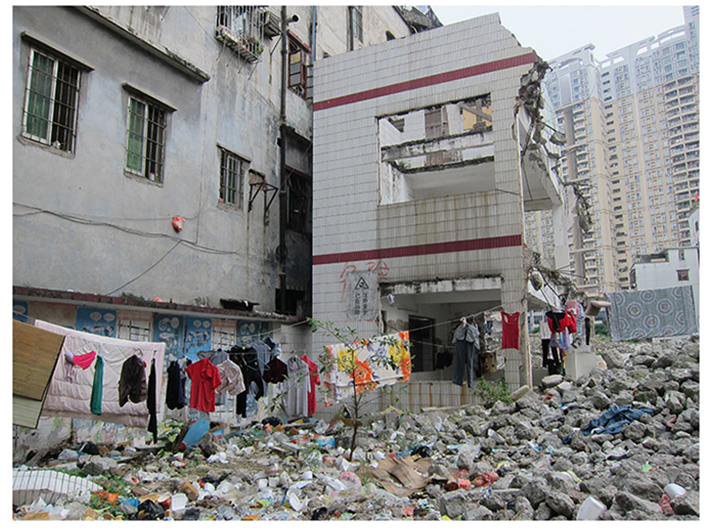
Holdouts living in Temple village during demolition, 2013.
The social politics of anti-dispossession
The previous sections have examined the role of social forces in facilitating economic and extra-economic forms of dispossession. This final section demonstrates the centrality of these same forces in mobilising the community against land grabs. The involvement of village leaders in non-transparent deals that dispossessed villagers of their land rights and in the deployment of coercion caused deep resentment towards the leadership. The very same social norms that at the beginning facilitated the transfer of resources to elite hands – affective bonds of trust, reciprocity and mutual support – were also activated in anti-dispossession struggles. Specifically, kinship served two important functions: first, it supplied the normative ground and moral rationale for resistance against land dispossession; and second, it provided the social ties and networks necessary for organising collective action.
The significance of sociocultural factors is often underplayed in conventional app-roaches to the politics of anti-dispossession. Class-based accounts emphasise how competing class interests precipitate contention over land resources: private capital and the state seek to enclose land exclusively in their circuits of capital accumulation, but local residents still depend on it for livelihood and subsistence. In the case of China, the speeding up of urbanisation has been seen as a trigger for the organisation of the Chinese peasantry as a class. Since ‘land seizures had destroyed peasants’ livelihoods and basis for survival’, this might ‘trigger more acute class contradiction in the countryside’ (So, 2013: 152). An alternative framework in theorising bottom-up contentious politics is that of ‘rightful resistance’ (O’Brien and Li, 2006). This rights-focused approach emphasises how the introduction of laws and growing rights consciousness provide the basis for legal mobilisation and rights-based activism (Erie, 2012
While they respectively highlight how the threat to economic livelihoods and the violation of land rights may give rise to political contention, class-based and rights-based accounts fail to adequately capture the social and moral dimension that underlies villagers’ claims to land. Villagers in Temple mobilised not only, and not primarily, because their subsistence was at stake or because certain laws were broken, but because they felt betrayed and deprived of what was rightfully theirs by their fellow kinsmen. Their main grievance had to do with how the elites, as family heads and supposed patrons of the lineages, did not care for the well-being of other members of the collective. Secretary Luo and his associates were seen as enriching themselves at the expense of the collective good of their fellow kin.
In interviews with villagers, this sense of betrayal of the ‘big family’ was clearly expressed. One villager remarked: Director Zheng [deputy director of the shareholding company] and I are from the same lineage; we see each other at every wedding and funeral . . . The villagers have given their trust to him and allowed him to manage the affairs of the big family, but now he has engaged in corruption. Is it not right that something should be done? (Interview, September 2013)
Notably, villagers appeared tolerant of leaders taking more of the collective profits earned, even of some forms of corruption. Their concern was not so much about what is legal or lawful than what is morally justifiable. When asked why villagers mobilised collectively in Temple but not in a neighbouring village where the leadership was also found to have engaged in corruption, one villager remarked: Both leaderships are corrupt. But at least over there, the lineage leaders took a big bite and left some for the villagers. Here they took everything; they even took the trouble to break our rice bowls. They did not even let us have the leftovers. (Interview, September 2013)
The distinction between rights and rightfulness is important here. In discussing the emergence of a ‘politics of the rightful share’, James Ferguson (2015: 183) differentiates between the liberal conception of ‘rights’ as held by individuals, and the sense of ‘righteousness’ which is based on moral rather than legal principles. The politics of the rightful share is about the making of ‘a righteous claim for a due and proper share’ in material distributions, a demand for ‘a rightful allocation due to a rightful owner’ (Ferguson, 2015: 178, 184). In protesting against dispossession, villagers in Temple were not only contesting the violation of land rights but also making a distributive claim on common wealth that is grounded in membership in a village corporate reinforced by notions of kinship and collectivism. The resistance put up was ‘rightful’ not so much because it draws on legal notions of land and property rights, but more importantly because it appeals to a sense of ‘rightfulness’ regarding the moral legitimacy of how collectively-held resources should be governed and shared amongst members of the village kin.
Aside from supplying villagers with the moral basis for mobilisation, kinship ties were also activated in uniting aggrieved households. Pre-existing social networks were crucial in the organisation of collective action, such as a village-wide signature collection campaign to counter the government’s stated claim of majority support for redevelopment, and a petition visit to Beijing in 2011. The impact of such ties extended beyond the geographical confines of the village. Temple villagers were supported by a cross-neighbourhood network of disaffected villagers and residents, some of whom were also confronted with the prospect of demolition and eviction in their home communities. They referred to each other colloquially as ‘cousins’– historical patterns of settlement meant that villagers with common ancestry and surnames were now residents of neighbouring villages and communities. This network was held together by a core group of activists who acted as information nodes and contact points, made up mainly of middle-aged villagers who were technology-savvy and outspoken. Despite the restrictive media environment, news concerning Temple village was effectively disseminated through online platforms such as Weibo. When collective action was organised, appeals for support would be posted online and spread through word of mouth. In the Temple village mobilisation, residents from other neighbourhoods came to give support while others joined, in their own words, to ‘observe and learn’. Still others came to publicise their own grievances and appeal for help, distributing information leaflets with details of the injustices in their villages. Sometimes it was a matter of showing up to ‘give face’ (gei mianzi), with the anticipation that support would one day be reciprocated (fieldwork, 2013).
The networked mobilisation was crucial in garnering external support for Temple villagers, including students, journalists, lawyers and activists, which ultimately succeeded in eliciting a state response. In August 2013, the municipal government announced the launch of investigations into the conduct of the village leadership. The head of the family empire, Secretary Luo, had by then escaped overseas, but seven of the 12 core leaders of the shareholding company were brought before the court in 2014. The prosecution led to the unravelling of a powerful nexus that spanned across multiple bureaus and administrative levels in Guangzhou, bringing down the deputy mayor, Secretary Chu, as well as top officials at the Municipal Land Resources and Housing Administrative Bureau (Oriental Daily, 2014). Following the leadership’s fall from grace, the redevelopment of Temple village stalled. As of the end of 2018, the first two phases of resettlement housing construction have been completed but demolition works for the third phase have yet to be performed (Figure 2).
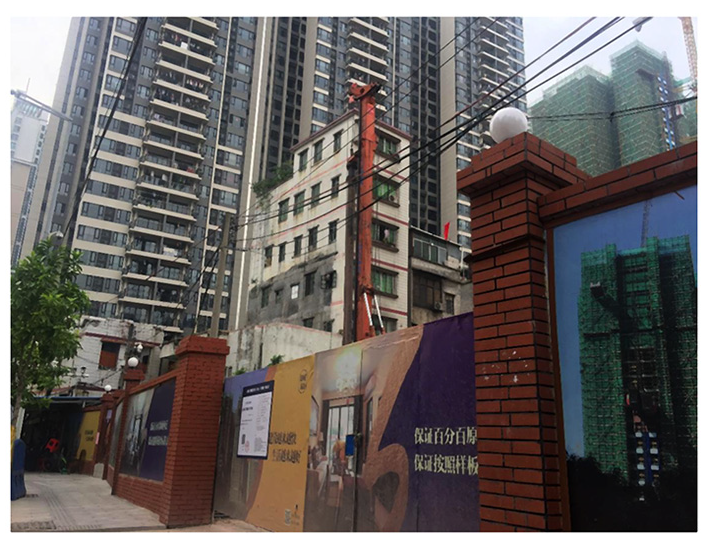
New resettlement housing in Temple village, behind low-rise buildings occupied by holdouts, 2018.
Conclusion
This article makes the case that attention to social forces is imperative for an in-depth study of the politics of dispossession and anti-dispossession. Going beyond the conventional emphasis on state-led coercion and market-led transactions, it demonstrates that the operation of informal institutions is central to the micro-political processes of how land dispossession unfolds at the grassroots. Far from being relics of pre-modern societies, grassroots solidary organisations such as clans and lineages are central forces in structuring property regimes and controlling land resources in contemporary societies. Property rights over land continue to be exercised through local patterns of family domination and alliance, supplying a platform for social elites to preserve and renew their power despite changes in macro-political and economic arrangements. A nuanced understanding of the territorial dynamics of urbanisation should hence go beyond an exclusive focus on political economy, and give attention to the agential and mediating role of social forces.
In theorising the nexus between informal institutions and property rights in China’s village governance, the extant literature has debated whether the presence of grassroots solidary groups protects or weakens land rights. This article has shown that lineage loyalties and kinship networks can be activated both in facilitating land dispossession and in mobilising against it. On the one hand, in land expropriations lineage elites were able to exploit their positional authority and social ties in eliciting compliance for market land transfers. The role of social forces in assisting the state and private capital in dispossessory practices is further demonstrated through the use of informal coercion and relational repression in land takings.
On the other hand, an emphasis on informal institutions also reveals their centrality in mobilising resistance against land grabs. By providing a framework through which shares in collective property were rightfully claimed, kinship supplied the moral rationale for anti-dispossession struggles. The organisation of collective action was supported by the dense social networks pervading grassroots society that drew on notions of ancestry and common descent. Temple village is by no means an isolated example of the role of informal institutions in collective mobilisation. In the well-known case of Wukan village in Guangdong where residents mobilised successfully against land grabs, it was found that ‘the revitalised and reinvented clan system’ was ‘of great significance in forming a collective identity and bringing about communal resistance’ (He and Xue, 2014: 132). Aside from lineages, comparable forms of solidary groups such as religious associations have also been identified as important rallying forces in mobilisations against land expropriation (Luo and Andreas, 2016).
It remains to be seen whether the kind of collective politics built on such social ties and affective bonds would be effective in the face of state co-optation and bureaucratic absorption. The recent literature on anti-dispossession resistance has observed how the commodification of land politics has had the effect of demobilising the peasantry. The offer of material concessions in exchange for land rights is found to negatively impact the potential for collective action, as the introduction of money and bargaining erodes the basis of solidarity necessary for bottom-up mobilisation (Chuang, 2014). The pre-emption of contention through material means is reflective of broader shifts in the Chinese state’s strategy of protest management, where ‘dishing out cash payments or other material benefits in exchange for compliance has become a patterned and routinised response to popular unrest’ (Lee and Zhang, 2013: 1486).
This article has shown how kinship ties could supply the basis of solidarity needed for collective resistance despite the commodification of land politics. Nonetheless, while robbed of their rightful shares in collective property, villagers in the extant case study did not depend on the land for subsistence. Unlike residents in more impoverished circumstances, villagers in Temple had the resources to stage a protracted campaign against the leadership. For communities without such resources, however, strategies of material co-optation may prove effective in demobilisation. The variegated response to market mechanisms by households confronting dispossession thus supports observations regarding the differentiated absorption of residents by capitalist relations. Further comparative research could reveal how informal institutions operate in communities with different levels of economic development facing the prospect of land dispossession.
Footnotes
Acknowledgements
The author is grateful to the reviewers for their constructive comments. Earlier versions of this paper were presented at a research symposium at Hong Kong Polytechnic University in August 2018 and at the 20th Annual Conference of Hong Kong Sociological Association in December 2018. The author would like to thank Rachel Murphy and other participants for their helpful comments. She also thanks Vivien Chan for her research assistance.
Declaration of conflicting interests
The author declared no potential conflicts of interest with respect to the research, authorship, and/or publication of this article.
Funding
The author disclosed receipt of the following financial support for the research, authorship, and/or publication of this article: The work described in this article was partially supported by a grant from the Research Grants Council of the Hong Kong Special Administrative Region, China (Project No. PolyU 25604917).
