




Abstract
In a bid to actualise the vision of transforming Lagos into Africa’s model megacity and global economic and financial hub, the state government has embarked on and/or supported various urban development projects. Drawing on the theoretical underpinnings of neoliberalism, we argue that governance practices in Lagos are transforming the city in a manner that is paradoxical to the intents of the city’s development plan. This paper, therefore, explores how government practices have shaped the city, and the socio-spatial consequences of the recent Lagos state government-supported developments. Of interest are projects from the Lagos State Development plan (2012–2025) which have resulted in significant spatial displacements – hence the selected case studies of Lekki Free Trade Zone and Badia-East Housing Estate. The study reveals that the Lagos state development policy results in creative destruction largely due to the uncritical embrace of market logic over social logic, thereby entrenching urban discontent and socio-spatial fragmentation across the city.
Introduction
A major challenge facing cities today is the articulation of the globally oriented economic functions of the city with locally rooted society and culture (Castells, 1993; Parnell and Robinson, 2012), given the hegemony of neoliberalism in contemporary governance practices (Harvey, 2007). Neoliberalism promotes policy agendas that give increased openness to market mechanisms and supremacy to the interests of capital (Thompson and Coghlan, 2015), while not necessarily reducing the state’s influence in the development process, contrary to its conventional theorisation (Davies, 2014). In this context, governance ideology has increasingly shifted from managerialism to entrepreneurial, in which urban development now largely centres on partnerships between the public and private sectors and urban commodification for capital accumulation with damaging consequences to the livelihoods of the local residents (Harvey, 1989).
This development ideology has been implemented globally by policymakers, particularly in the urban context, with redevelopment projects being a major symbolic representation (Mosciaro and Pereira, 2019). Despite its many paradoxes, urban neoliberalism is also largely embraced by African governments as a development approach, and its putative benefits are continually being used to promote and implement new waves of urban development projects. Such projects ostensibly aim to address socio-economic challenges in multiple dimensions. The main idea is the claim that the associated projects are necessary for urban prosperity and bring several benefits to urban residents, albeit via trickle-down. 1 Interestingly, in many cities where this has been implemented, prosperity and wellbeing of urban residents (especially the poor) hardly correlate, hence the urban paradox.
The urban paradox in Africa is implicit in the work of many scholars, who have termed the megaprojects sprouting in many African cities as urban fantasies and over-ambitious (Gellert and Lynch, 2003; Obeng-Odoom, 2015; Watson, 2014), capable of worsening the existing poor condition and serving as ‘ideological foils to obscure the inconsistencies and inequalities within society’ (Gunder, 2014: 10). This position aligns with that of Harvey (2003), who noted that market liberalisation – the credo of the liberals and the neoliberals – will not produce a harmonious state in which everyone is better off. He argues that it will instead produce ever greater levels of social inequalities.
Despite the urban neoliberal transformations going on in Africa, relevant studies have been mostly speculative. For example, some recent studies (Ballard and Harrison, 2019; Brill and Reboredo, 2019; Van Noorloos and Kloosterboer, 2018), in responding to Watson’s (2014) predictions, speculate about the probable potential negative externalities of urban neoliberal development projects in Africa. In contributing to this discourse, we advance that the case of Lagos – Nigeria’s most populous city and economic-industrial hub – presents an opportunity not only to interrogate these positionalities but also to demonstrate empirically the reality of paradoxes in the implementation of African neoliberalist urban development agendas.
Lagos has been described as a symbol of urban disorder (De Gramont, 2015; Gandy, 2005, 2006; Kaplan, 1994) and as a stationary crisis by Lewis (2009: 652), who observed that: The fundamental conundrum of Lagos, considered as both paradigm and pathological extreme of the West Africa city, is its continued existence and productivity in spite of a near-complete absence of those infrastructure, systems, organisations, and amenities that define the word city in terms of Western planning methodology. Lagos, as an icon of West African urbanity, inverts every essential characteristic of the so-called modern city. Yet, it is still – for lack of a better word – a city.
Since 1999, Lagos has been faced with the herculean task of addressing these endemic challenges (Agunbiade and Olajide, 2016) and the state government has embarked on and/or supported various (re)development projects, drawn largely from the Lagos State Development Plan (2012–2025) (LSDP). LSDP promotes strong private-sector investments and modernist thinking, hence projects include Eko Atlantic City (ostensibly to prevent flooding and ocean surge), Lekki Free Trade Zone (economic development), Lagos Home Ownership project (housing) and extensive market redevelopments (urban revitalisation).
Indeed, much has been said regarding the positive externalities and economic prospects of these urban reforms and redevelopment projects in Lagos. For instance, De Gramont (2015: 1) described how Lagos has transformed ‘from being a symbol of urban disorder to a widely cited example of effective African governance’. The author further highlighted how the government increased the state’s revenue base with the resources deployed for urban development and a prosperous megacity. However, what is often neglected are the unwitting consequences of the putative benefits of these urban development projects on everyday citizens, especially the poor.
Therefore, this paper probes the paradoxes of the Lagos urban development agenda since 1999, focusing on the role of the state government in operationalising the LSDP, as well as the attendant consequences of selected projects on local residents.
The paper is based on literature review, personal observation and a series of in-depth interviews with impacted low-income communities as well as urban rights advocacy groups, policy actors and urban development experts. The paper is theoretically situated within the governance and neoliberal development discourse. Our key theoretical contribution challenges the conventional understanding and often oversimplified notion of the hollowing-out of the state in the neoliberal development trajectory. Contrary to this popular theoretical understanding, we implicate the Lagos state government as an agent of urban neoliberalism whose activities result in urban transformation as ‘creative destruction’ (Harvey, 2007) – an urban paradox. Creative destruction in this sense implies that urban transformation destroys the social and economic structures of everyday people while creating urban modernity. Another paradox that our study uncovers is the gap between the essence of development, development aspirations of the state and how these development outcomes impact the urban poor.
We begin by reviewing literature within the broader discourse of governance, development and neoliberalism, highlighting the role of the state in the urban neoliberal development agenda and how the putative benefits of neoliberal urban development projects that result can render ostensible beneficiaries to become victims. Taken together, our theoretical contribution in this paper is that, contrary to the popular notion of hollowing-out the role of the state in a city’s neoliberal development agenda, the state is indeed an active agent of creative destruction. This demonstrates an urban development paradox in which government takes a neoliberal development approach ostensibly for socioeconomic development but the processes and outcomes become damaging for the livelihoods of the urban poor majority. The literature review is followed by a broad overview of Lagos’ development trajectory over the last 20 years and an in-depth look at two projects – Badia-East redevelopment project and Lekki Free Trade Zone – which exemplify the new wave of urban development. We then follow with a section discussing the inherent paradoxes in the governance–development nexus and attendant consequences for residents, especially the urban poor. The final section summarises the main findings.
Urban governance and the neoliberal development in Africa
Reviews of both empirical and theoretical work generally conclude that development is a contested concept (Cowen and Shenton, 1996; Thomas, 2000). For example, the definition of Sen (1999) which describes development as freedom contrasts with the conservative definition which sees development as socioeconomic change (Thomas, 2000). Whatever definition one adopts, there is a baseline agreement that the objective of development is to improve quality of life. However, for many African governments who embrace neoliberalism, urban development outcomes contradict this primary objective and contrast with the livelihood realities of citizens who usually have to cope with multiple deprivations and precarious living conditions (Olajide, 2015; Smit, 2018).
Across African cities, the neoliberal development ideology has gained significant ground since 2000, largely manifesting as the entrepreneurial city (Eduful, 2019; Thorsen and Lie, 2006). It is a contested concept (Gainsborough, 2010), which is neither monolithic in form nor universal in effects (Brenner and Theodore 2002: 6; Parnell and Robinson, 2012). Parnell and Robinson (2012: 593) advance that urban neoliberalism involves complex processes of ‘hybridisation, localisation and transformation’. This paper seeks to highlight, with an empirical focus on Lagos, the complexities of urban neoliberalism when localised in an African city.
One of the earliest definitions of neoliberalism came from Cros (1950), who described the term as a political ideology which revived liberalism. Drawing on the notion that neoliberalism is a revival of liberal ideas, an important question surrounding the discourse is: which type – classical or modern? While classical liberalism promotes deregulation, privatisation, free market, commodification of basic needs and withdrawal of state from the market, the modern liberalism provides platforms for the state, as one of the key actors, to perform oversight and regulatory functions over the market and even distribution of resources in a way that aids private-sector, elite groups and the hegemony of the market (Brown, 2009). Following Polanyi (1957), we argue that contrary to the notion that the market is autonomous of the state, the market is indeed embedded in the society in which the state is a major actor. We argue further that neoliberalism as currently practiced shows the state is not autonomous and is in fact strategically positioned as a promoter, enabler and even sometimes as partner/shareholder in urban development projects that draw on private investments (Fincher et al., 2016).
Arguing from both economic and political perspectives, Brown (2003) notes that neoliberalism is not just a bundle of economic policies but encompasses a set of interconnected ideologies, logics, values and policies that seek to achieve the hegemonic power of the state and market. Brown (2003) further states that under the hegemony of urban neoliberalism, governance decisions regarding social practices, institutional functioning, public policies and the overall development agenda affecting the everyday life of citizens are defined by market logic. Under neoliberalism, any activity that seems to compete with the profitability and hegemonic power of corporate institutions is automatically under threat because it is assumed it will hinder the functioning of the market, which is promoted as the only logical way of allocating resources (Chomsky, 1999). In essence, beyond just being a set of policies to promote market-based solutions to a range of urban development challenges (Geddes, 2014), urban neoliberalism encompasses economic, cultural and political agendas essentially to empower the state over its subjects (Jessop, 2013; Wacquant, 2014) and to restore the conditions for capital accumulation and the power of economic elites (Harvey, 2007).
Scholars such as Carmody and Owusu (2016) posit that urban neoliberalism has significantly curtailed the role of the state in Africa’s urban development. Others counter this position with studies showing that as aspirations for development, modernity and access to global capital increase in many African cities, states assume a central position in the urban development process (Lawanson and Agunbiade, 2018; Mattes et al., 2002). While the state may be retreating from direct ownership and administration of urban development projects, at the same time the state is becoming increasingly involved in regulatory and managerial activities of urban (re)development processes (Negussie, 2006).
Across Africa, the rise of urban entrepreneurialism has seen governments seeking means of attracting global investment opportunities. The outcomes of this approach have turned states into agents of creative destruction (Harvey, 1989, 2007), characterised by accumulation by dispossession and the commodification of urban development projects and benefits (Shin and Kim, 2016), as has been seen in cities such as Addis Ababa, Kigali, Nairobi and Lagos.
It is assumed that urban neoliberalism represents the ideal mechanism for optimal allocation of resources for investments, employment opportunities and more equitable, liveable and sustainable development (Dollar and Kraay, 2002), with promoters claiming that it brings multiple economic and local development benefits (Harvey, 1989). It is also assumed that it is an innovative pathway to liberate Africa from poverty and set the continent on the path of economic recovery and job creation through presumed trickle-down effects (Harvey, 2007). However, there is overwhelming evidence that the implementation of urban neoliberalism has moved capital, wealth and resources in the direction of the already wealthy (Bowles, 2005; Brenner and Theodore, 2002; Parnell and Pieterse, 2010; Thorsen and Lie, 2006), creating intense socio-economic and livelihood insecurities for the citizenry (Duckett, 2020; Harvey, 2007), inadvertently instituting the creative destruction of the city’s social and economic fabric while unwittingly implementing the ‘destructive transformation’ of the city’s urban infrastructure.
Ideally, the objectives of development are to promote transformation, progress and social equity and improve people’s living conditions (Cowen and Shenton, 1996; Sen, 1999; Thomas, 2000). However, with urban neoliberal development, ‘the promise of social equity is unendingly deferred’ (Fincher et al., 2016: 518) as the ‘trickle down’ effect has proven in many cases to be unachievable. It has been argued that neoliberal development ideology is arrogant in its assumptions (Ferguson, 2010) and is in fact an ideological fantasy and illusion that masks individual social realities (Žižek, 1989) and, at the same time, a foil to obscure the inconsistencies and inequalities within society (Gunder, 2014).
Methodology
This study focuses on two case studies (Lekki Free trade Zone and Badia-East Housing project) in which the Lagos state government’s neoliberal approach to development has resulted in an urban paradox. The study relied on qualitative data drawn from fieldwork in the two communities in 2015, complemented with further field visits in 20172 when additional interviews were conducted with local residents. Data for the Lekki Free Trade Zone were obtained from a focus-group discussion with residents of nine impacted communities and nine in-depth interviews with community leaders and urban development experts, while the Badia-East Housing project relied on data collected from ten in-depth interviews with representatives of the impacted community, civil society actors and government officials. In addition, we rely upon extensive documentary research (media coverage, policy documents, research reports and academic literature). Therefore, data analysis was based on triangulation of relevant data from literature, personal observations, focus-group discussion and interviews.
In the next section, we will discuss how neoliberal logic plays out in the development trajectory of Lagos.
Urban paradox: Implementing the neoliberal agenda in Lagos
Lagos is Nigeria’s commercial and industrial hub, accommodating about 65% of the country’s economic activities (Lagos State Government (LASG), 2013; Nigerian Investments Promotion Council, 2018; Pilling, 2018). Despite this, socio-economic inequalities are prevalent as over two-thirds of the population live in precarious conditions and are employed in the informal economy. Lagos has a Gini coefficient of 0.643 (UN-Habitat, 2010, 2016).
Prior to the 1986 adoption of the neoliberal economic reforms (Structural Adjustment Programme (SAP)) by the military government, the Nigerian development approach was reminiscent of the African socialism of the 1960s, in which the state determined the direction of production, 4 distribution and allocation of resources (Lonsdale, 1981). The introduction of SAP was accompanied by a reduction in government spending on development, as well as international and national disinvestment in public infrastructure. The result was an urban infrastructure crisis, with large cities such as Lagos experiencing intense consequences. This continued until 1999 when Nigeria returned to democratic governance.
The process of governance and policy reform that began in 1999 provided an opportunity for the state government to focus on addressing urban challenges in a strategic manner, as articulated in its development policy documents, notably the Lagos State Ten-Point Agenda and subsequently the Lagos State Development Plan (LSDP) 2012–2025.
The Lagos State Ten-Point Agenda – a sector-wide development policy framework to guide Lagos towards the path of poverty alleviation and sustainable economic development – articulated the need to position Lagos for global relevance and economic development. The formulation and implementation of the Ten-Point Agenda enjoyed strong political will and financial commitment (through budgetary allocation) from the Lagos State government between 2003 and 2007. The Ten-Point Agenda gave way to the Lagos State Development Plan 2012–2025 (LSDP) which was launched in 2012, as a longer-term strategic development policy framework (Lagos State Government (LASG), 2013). It is anchored on four development pillars – economic, infrastructure, social and security, and sustainable environment.
Similar to the central aspiration of the Ten-Point Agenda, the LSDP also emphasised strengthening the strategic positioning and global competitiveness of Lagos, acknowledging that financial resources far in excess of the state’s capacity were required, hence it recommended collaboration with the private sector and international investors in critical infrastructure development (Lagos State Government (LASG), 2013). The Lagos state government thus adopted a business-like and private-sector-led approach to governance and development, which it termed ‘Transformation Urban Development Agenda’ (Agunbiade and Olajide, 2016; Olajide et al., 2018). This development approach exemplified what Harvey (1989) referred to as ‘urban entrepreneurialism’.
The LSDP was operationalised through a series of projects and policy reforms (see Table 1), many through international funding as the city increasingly became a major destination for foreign capital flows (Ali et al., 2015) and a major spatial unit for capital accumulation in Africa (UN-Habitat and IHS-Erasmus University Rotterdam, 2018). 5 The state government set up the Office for Overseas Affairs and Investments – Lagos Global – in 2015, in order to deliberately advance this approach. 6 It has been renamed Office of SDGs and Investment by the current government. 7
Major urban development projects in Lagos.
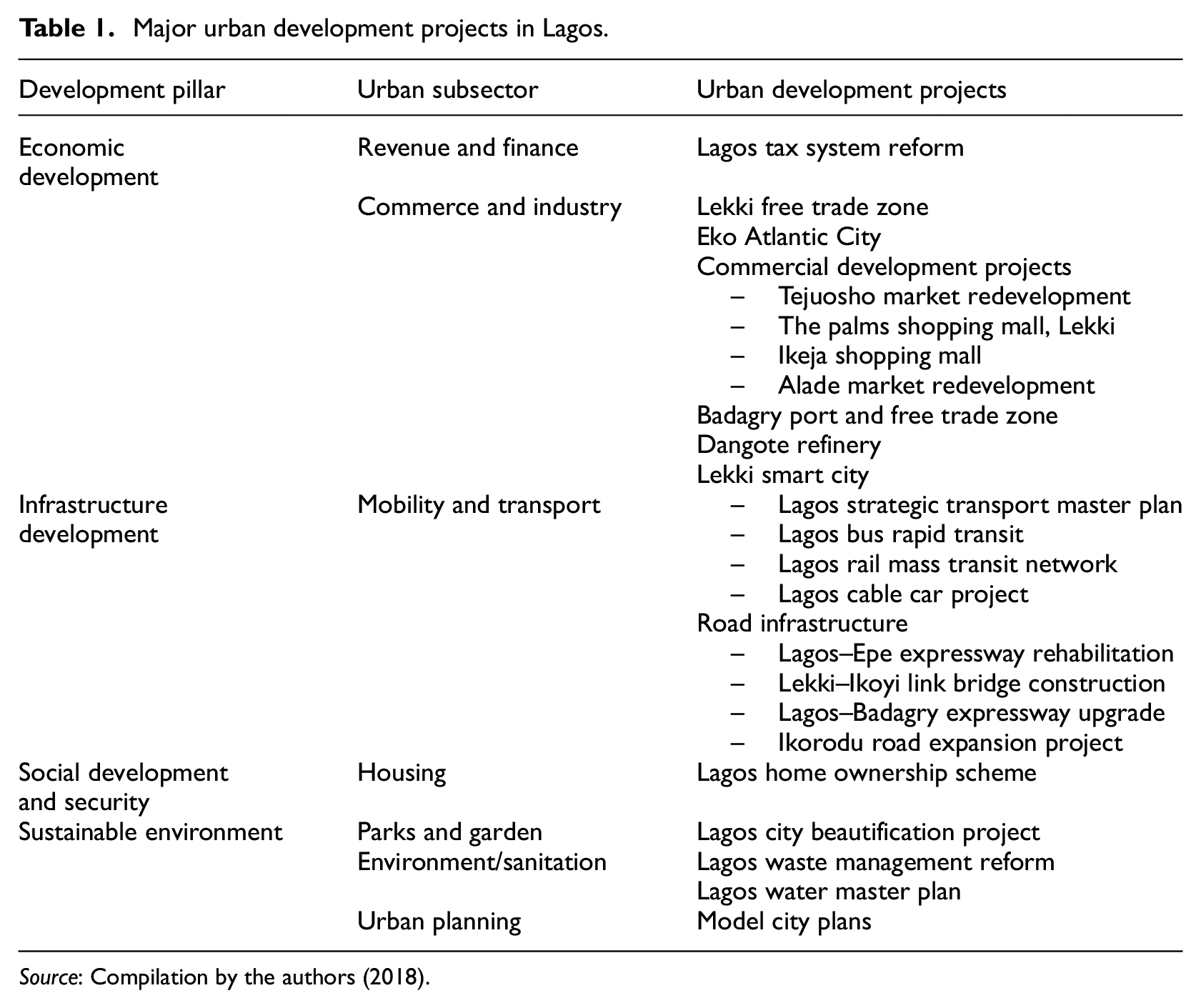
Source: Compilation by the authors (2018).
These projects and policy reforms resulted in significant changes in the spatial configuration of Lagos, such that while the city continues on the trajectory of existing urban densification and gentrification in its inner areas it is also developing new enclaves in the peri-urban areas, both resulting in large-scale shifts in land ownership and social dynamics (Lawanson and Agunbiade, 2018). The development processes and the outcomes are resulting in paradoxical spaces of extreme poverty and wealth, and of inclusion and exclusion driven by accumulation by dispossession. To empirically interrogate the various theoretical arguments presented in the previous sections, this article draws on two urban development projects – Lekki Free Trade Zone (LFTZ) and Badia-East Housing project, which were proposed under the economic and social security pillars of LSDP. While the Badia-East Housing redevelopment project falls within the city core area, LFTZ is in the peri-urban interface.
Lekki Free Trade Zone land acquisition
A common derivative of neoliberalism, in its recent waves across Africa, has been the complexity of large-scale land transactions for megaprojects buoyed by global capital flows (Steel et al., 2017, 2019). LFTZ is one such megaproject, designed to attract foreign direct investment, promote Nigeria’s industrial sector, establish a new economic hub and increase the economic potential of Lagos and Nigeria with a view to creating economic opportunities for local people (Lagos State Government (LASG), 2012).
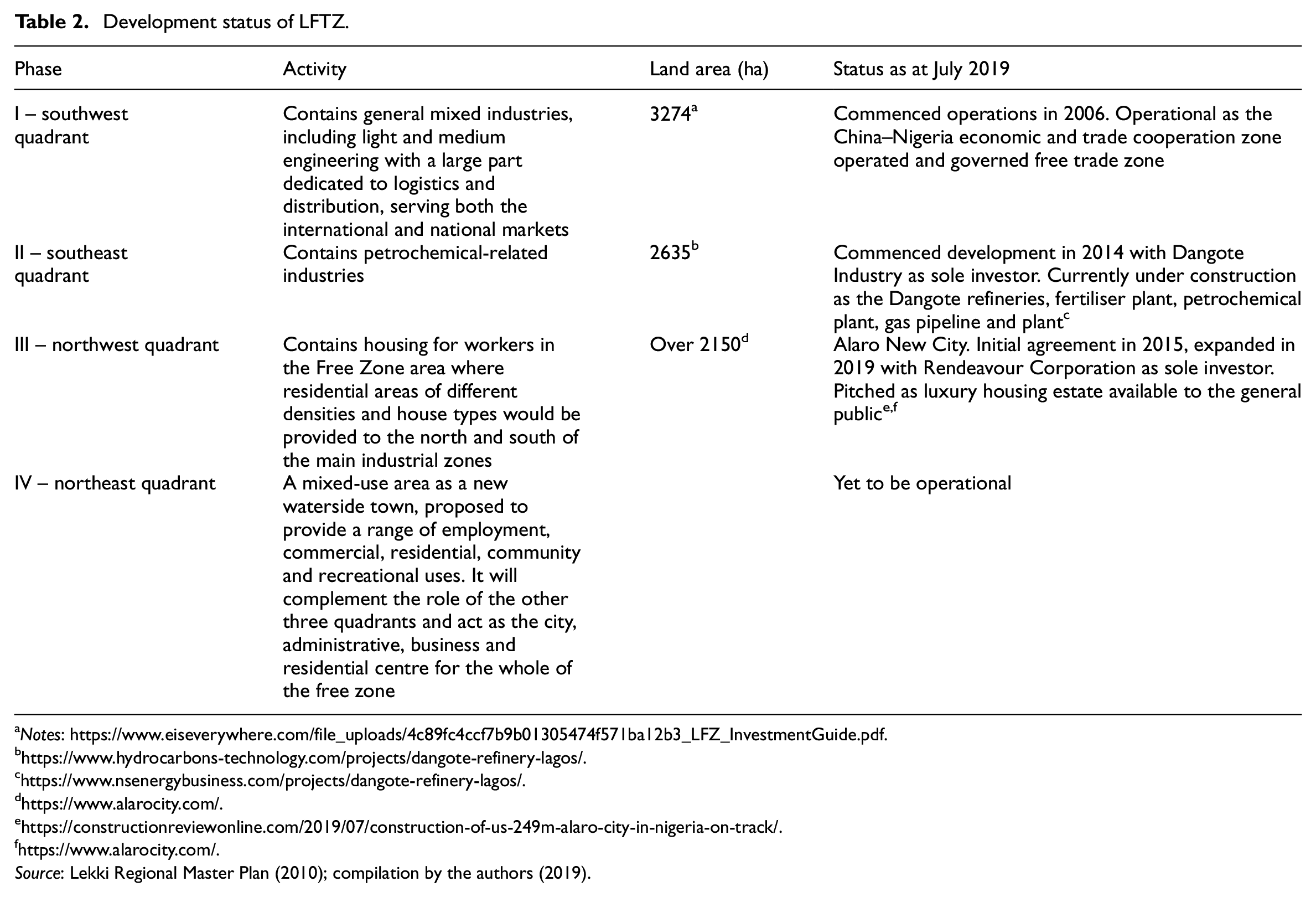
It was conceived in 2004 and was formally launched in 2006 on a land area of 16,500 ha, along the southeastern stretch of the Lagos Atlantic coastline in Lekki peninsula (see Table 2).
Development status of LFTZ.
Notes: https://www.eiseverywhere.com/file_uploads/4c89fc4ccf7b9b01305474f571ba12b3_LFZ_InvestmentGuide.pdf.
https://constructionreviewonline.com/2019/07/construction-of-us-249m-alaro-city-in-nigeria-on-track/.
Source: Lekki Regional Master Plan (2010); compilation by the authors (2019).
While Phase 1 – Chinese Economic Zone–is fully operational, Phase 2–Dangote Refinery–is under construction and is expected to begin operation in 2021. Phase 3 – Alaro New City – is already marketing plots.
Phase 1 (Chinese Economic Zone) is administered through a joint venture between the Lagos State Government and Lekki Worldwide Investments (LWI), a private company established by the Lagos State government, and China-Africa Lekki Investment Limited, a consortium of four Chinese enterprises. The government provided land through acquisition mechanisms while conceding operational privileges and fiscal incentives, as is common in neoliberal development projects, to the foreign investors.
In the course of commencing activities for the LFTZ Phase 1, nine coastal communities were affected: Tiye, Ilege, Imagbon Segun, Imobido, Itoke, Okunraiye, Idotun, Ilekuru and Idasho. An analysis of the livelihoods and socioeconomic conditions of the residents of the communities shows that the majority live in absolute poverty and the predominant occupations were farming, fishing, home-based enterprises and petty trading. The livelihood conditions were made worse through acquisition of their land.
Drawing on the provisions of the Land Use Act of 1978, the community farmlands and homes were compulsorily acquired by Lagos State Government in 2005 for undisclosed ‘overriding public interests’ (Lawanson and Agunbiade, 2018). After intense negotiations, a Memorandum of Understanding (MoU) was signed in March 2007 between the Lagos State Government, Ibeju Lekki Local Government, Lekki Worldwide Investment Limited and the representatives of the affected communities. The MoU, as a binding agreement among all parties, made provisions for resettlement of and compensation for the affected communities. This included the allocation of 2.5% of shareholdings in the Lekki Worldwide Investment Company to the affected communities and a directorship position for a nominee of the communities in the holding company of the LFTZ. Also included in the MoU is the provision of alternative housing, social development projects and capacity-building opportunities for local communities.
The MoU was considered to be relatively successful in protecting the heritage rights of the communities, however, their economic rights suffered. Even though the communities were able to keep their ancestral homes and shrines within the extent of their current settlement expansion, they lost their farmlands and livelihoods and were not adequately compensated.
The state government acquired the farmlands, with the compensation process based on the provisions of the Land Use Act – hence one-time payments were made based on the state-assigned value of crops that were on the farmlands, rather than on both the rental value of the land and the market value of the crops as provided for in the Land Use Act. Economic crops such as oil palm trees were valued at 50 US cents ( What can I do with 75,000naira (US$250)? This is 2015? I cannot afford to buy another land with that amount. If they allowed me to sell the crops on the farm, I would have made more than twice that amount.
The compensation template adopted undervalued the farmlands, while all the affected individuals are yet to be fully resettled or compensated because of delays by the Lagos state government in actualising some provisions of the MoU (Heinrich Boell Stiftung, 2018). As at January 2021, little has changed.
Despite lingering tensions arising from these delays and injustices, Phases II and III have commenced, with the Lagos state government playing an active role, and the private investors receiving state-enabled endorsements, concessions and waivers, and even partnership. As was the case in other megaprojects of the Lagos State Government, there is no evidence of public presentation of the Environmental Impact Assessment or mitigation plan for the Dangote Refinery and related projects, despite the potential environmental hazards such projects present.8,9 Even communities far distant have begun to suffer the negative consequences of the refinery, with fishing and other livelihood activities seriously impeded. Unfortunately, this and other concerns of impacted local stakeholders have been ignored.
The case of the LFTZ project demonstrates unequivocally an urban development paradox in which there is a disconnect between the developmental priorities of the state government and the livelihood aspirations and needs of local communities. The reality is that while the majority of the local communities mostly rely on agriculture for survival, the developmental agenda of the state government deprived them of their sources of livelihood and economic development aspirations. This case study shows the Lagos state government as an agent of neoliberalism, promoting accumulation by dispossession (Harvey, 2003) and speculative urbanism (Goldman, 2011), both features of creative destruction (Harvey, 2007; Schumpeter, 2003).
Badia-East redevelopment project
Successive Lagos state governments have prioritised environmental orderliness and urban renewal, attracting international development funding and implementing public–private partnerships for housing and upgrading projects, especially in the city core. In many instances, these urban renewal efforts have resulted in large-scale spatial displacements, exacerbating existing socio-spatial inequalities (Lawanson and Omoegun, 2017).
The situation in Badia-East is particularly poignant given that over 3000 households have been displaced from this low-income community since 2013 and the community is being transformed into luxury residential enclaves for middle- and high-income earners.
Badia-East is part of the larger Badia community, one of the nine beneficiary communities for slum upgrading under the World Bank-funded Lagos Metropolitan Development and Governance Project (LMDGP). The project aimed at increasing sustainable access to basic urban services through investments in critical infrastructure and settlement regeneration.
Without adequate notice or engagement with residents, many of whom had legal claims to the land, the community has suffered multiple forced evictions, with demolition of structures carried out by the Lagos State government (affecting 2252 households in 2013) and the Ojora Chieftaincy Family, which exercises customary claims to the land (affecting 10,000 persons in 2015 and 300 households in 2017). The area demolished by the Ojora Chieftaincy Family was earmarked for Jubilee Housing Estate – a private gated community, while the area demolished by the state government is the current site of the yet to be completed Badia-East Redevelopment project – a housing estate under the Lagos Home Ownership Mortgage Scheme (Lagos HOMS) targeting medium-income earners. The project is at clear variance from the in situ upgrading provisions (for low-income communities) through which the LMDGP loan was secured (Spaces for Change, 2018).
Many Badia-East residents had lived in the community since the 1970s under the Federal Government’s compensatory land exchange that attended the acquisition of the current site of the National Theatre Iganmu in 1973. The 2013 demolitions resulted in spatial displacement, loss of properties and livelihoods and injury to residents, vulnerability to severe weather conditions and environmental health risks. Some households are still to be fully resettled, although they had legal claims to the land and were entitled to adequate compensation based on the provisions of the Land Use Act.
According to Spaces for Change (2018), the Lagos state government used some of the World Bank funds allocated for the LMDGP slum upgrading to compensate affected residents. Under the compensation structure designed to benefit 2252 households, displaced tenants were given the sum of
The Badia-East Redevelopment Project, under the Lagos HOMS, sponsored by the Ministry of Housing was designed as a modern housing estate, comprising a shopping and office complex, and 29 blocks of multi-tenement apartments. The state government offered Badia-East evictees allocations in the new housing estate, provided they were able to meet the stringent eligibility criteria 10 which included evidence of proof of residence, tax payment and proof of ability to make the 30% down-payment (equity contribution) and meet their monthly repayments. These criteria effectively disqualified residents of Badia-East, many of whom were informal workers earning below the national minimum wage and lacking official documentation such as tax and banking records. Moreover, their homes had been demolished – hence they would have been unable to provide proof of residence.
The Lagos state government sponsored a forced eviction exercise in 2013 and tacit support for subsequent actions are consistent with the state acting as an agent of accumulation by dispossession and destructive transformation, as posited by Harvey (2007). Also worth noting is the complicity of the Ojora land holding family in displacing legal land title holders – albeit poor. This buttresses the point of institutions (both constitutional and traditional) prioritising market logic over social logic in the (re)allocation of urban resources. Across the city, we see the consolidation of political influence by Lagos traditional land-holding families and how this is being used to perpetuate spatial displacement and/or gentrification of the urban poor.
Urban neoliberal paradox in Lagos: The state as agent of creative destruction
The situation where the Lagos state government-led urban transformation projects correlate significantly with the destruction of urban livelihoods presents a grave paradox. The state government advances a neoliberal development agenda that centres on the attraction of private and/or foreign capital and investments, prioritising entrepreneurial approaches and market logic over social logic, with unprecedented socio-economic consequences. The two case studies presented in this paper reveal significant socio-spatial consequences of urban development projects, thus demonstrating the creative destruction tendency of the state.
While the implementation of the Lagos state’s strategic development plan is resulting in modernist urban growth and economic development, state decisions are also inadvertently destroying the social fabric and economic livelihoods of the city’s poor and vulnerable. This contradicts the popular notion of the hollowing-out of the state in the neoliberal development discourse, and instead demonstrates the hegemonic power of the neoliberal state where governance decisions, regarding social practices, institutional functioning, public policies and the overall urban development agenda, which affect the everyday life of citizens, are defined by market logic (Brown, 2003). In the case of Lagos, the government plays an active role in advancing the interests of the private sector.
Land acquisition for the LFTZ project resulted in forced eviction and displacement of local communities and transfer of ownership to the promoters of the project. This corroborates what Shatkin (2016) describes as a real estate turn in urban development, in which the state directly or indirectly facilitates the financialisation and materialisation of land into real estate. Through the mechanism of land acquisition, which serves as 20% investment equity for the state, the Lagos State government facilitated the development of the LFTZ. So, as global capital finds a spatial fix (Harvey, 1985) in the LFTZ project, large-scale land acquisitions became conduits of urban speculation and capital accumulation that serve the interest of the private investors, with local communities being adversely impacted. In this regard, the private investors mobilise government power for investment opportunities that prioritise market and capital logics over social logics.
Even though the current Lagos development plan is aimed at recovering from the many years of public infrastructure neglect, the decisions being made to position the city as an investment-friendly global city are entrenching neoliberal practices and poverty for many local residents. The paradox is that while the Lagos state government claims to take a ‘business-like’ (i.e neoliberal) approach to governance to enhance socioeconomic benefits and reduce poverty, the development outcomes are, rather, worsening the already precarious condition of the urban poor. Furthermore, while the physical manifestation of many of these urban development projects is resulting in a more orderly and aesthetically pleasing city, it is accompanied with socioeconomic consequences in the forms of spatial displacement, social exclusion and loss of livelihoods for the urban poor. For example, over 3000 families were rendered homeless through the Badia-East redevelopment project – a clear manifestation of creative destruction. Also, while the land areas for the LFTZ project have been completely acquired and the local communities could no longer farm or use the land for any productive activities, the new landowners are enjoying improved land value. The promises of job creation and local infrastructure development are also as speculative as the project.
The megacity aspiration and the need for urban modernity were invoked to rationalise the forced eviction of the Badia-East community. This decision to undertake the construction of luxury housing estates in Badia-East rather than carry out slum upgrading for which a World Bank loan was obtained is a clear case of urban neoliberalism and what Goldman (2011) articulated as speculative urbanism. In fact, Shin and Kim (2016), drawing on Lefebvre (2003), highlight the place of real estate as a pre-emptive means to generate economic development and as a factor of accumulation to address the inherent risks of declining rates of profits and increased contestation against urban neoliberal development.
The fact that slums are considered a threat to the Lagos megacity aspiration further buttresses Chomsky’s (1999) position that under the neoliberal agenda, any activity that seems to compete with the profitability and hegemonic power of corporate institutions is automatically under threat. The Lagos state government considers slums to be an economic misuse of prime land (Olajide, 2015; Olajide et al., 2018) as was articulated in the widely reported statement of the head of the Lagos State Task Force on Environmental and Special Offences (Enforcement) Unit, during the 2013 Badia-East demolitions (Akoni and Olowoopejo, 2013). According to him: Government can no longer allow continuous existence of slums. Slums cannot flourish in the centre of a state with a megacity plan. We cannot achieve megacity status with these slums.
Shrestha and Aranya (2015) note that the advocates of urban neoliberalism often argued that it holds inclusivity at its core through invited spaces in participatory planning processes and public consultation. However, the notion of formal inclusion does not in any way assure substantive inclusion (Sandercock, 1998), as the MoU signed between the state government and nine villages impacted by the LFTZ was not respected. Neoliberalism allows for the overpowering of economic aspects of urban development and disregards the social and cultural aspects of citizenship in this situation as Phase II and III proceeded in spite of the Lagos state government’s failure to fully resettle affected communities in Phase 1 or to implement its obligations in the MoU.
While the Lagos state government is aggressively pursuing investment opportunities for urban transformation, the city is increasingly becoming a place of selective socio-spatial inclusion and exclusion in a manner similar to what Miraftab and Wills (2005) term contradicting development policies. In the case of LFTZ, displaced communities were issued certificates of occupancy for alternative lands outside the Zone. The alternative lands, however, originally belonged to other communities (Okesegun, Elekuru-Lasia and Olomowewe), leading to tensions with hitherto peaceful neighbours (Lawanson and Agunbiade, 2018). Sadly, the World Bank loan taken for slum upgrading in Badia-East was used to facilitate the removal of Badia residents from their community to give way for upscale real estate projects. A recommendation to convert the redevelopment project to social housing for the displaced residents was rejected by the Lagos state government (Spaces for Change, 2018), as the area had already been earmarked for the development of luxury enclaves for more affluent citizens. The urban paradox is that the urban development decisions by the Lagos state government to provide housing for citizens ultimately resulted in rendering them homeless.
An emerging phenomenon resulting from the entrepreneurial urbanism and the urban paradox in Lagos is the rise of social movements. They seem to be the push-back by local communities, stakeholder groups and civil society organisations to the increasing neoliberal paradigm of governance and development in the city. For example, the Nigerian chapter of the Slum Dwellers International – the Federation of Slum/Informal Settlement Dwellers of Nigeria – was birthed following the Badia-East evictions. In the case of the LFTZ, the MoU was negotiated and agreed to only after the affected communities invited the human rights law firm – (Social and Economic Rights Action Centre) to intervene. Other groups have also emerged, such as Communities against Forced Displacement, Enough is Enough and the ‘Do Not Evict Us Campaign’. However, the extent to which these social mobilisation efforts are affecting neoliberal aspirations and yielding inclusive urban outcomes is yet to be documented and/or fully understood. These are areas we hope to further interrogate in the future.
Conclusion
The theoretical argument regarding the dynamics and interplay of governance and urban neoliberalism has generally assumed that neoliberal development ideology has significantly curtailed the role of the state in Africa’s urban development. In this paper, we provided grounded empirical evidence as against earlier studies, which have been merely speculative about the dynamics and interplay of urban neoliberalism and the state in African cities. Our study revealed that the state government acted as both an enabler and a promoter of accumulation by dispossession and speculative urbanism in its various urban redevelopment projects. While it is clear that the state government adopted a neoliberal approach in the implementation of its urban transformation agenda, and that the well-intended development efforts have become tools of speculative practices, social exclusion and spatial displacement of the poor – essentially agents of creative destruction. The case of Lagos’ urban and economic development therefore exemplifies the paradox of neoliberal urbanism.
One of the paradoxes our findings reveal is the gap between the essence of development, development aspirations of the state and the reality of urban development outcomes on the majority of the urban poor. The Lagos state government played a major role in accumulation by dispossession of community assets and the spatial displacement of communities impacted by the LFTZ and Badia-East redevelopment projects – projects initiated to achieve model megacity aspirations. In this sense, we found that development projects that are meant to cause economic growth and mitigate existing poverty have rather contributed to significantly increasing the precarity of the urban poor.
The uncritical embrace of neoliberal economic policies has resulted in a city where the poor, in addition to suffering social exclusion, are also victims of the city’s development. Social exclusion in the forms of structural, institutional and agentive processes of repulsion or obstruction in which individuals and entire communities of people, as demonstrated in our case studies, are systematically denied their rights, opportunities and resources (Fischer, 2008). In Lagos, this is worsening the existing widespread socio-spatial inequality, deprivation and discontent across the city, thereby exacerbating the already precarious living conditions of the urban poor.
While urban modernity aspirations of the state are desired, it is essential to pay close attention to the processes and unintended consequences and not simply assume an automatic trickle-down effect. Paying attention to the many paradoxes of neoliberalism discussed in this paper can provide a better opportunity to foster pathways to deliver urban transformation in a manner that does not further impoverish already marginalised low-income communities, who should ordinarily be the beneficiaries of development. This can also help to reduce the many contradictions between government’s aspirations for economic growth and urban modernity on the one hand, and the socioeconomic aspirations of the communities on the other hand. In the case of Lagos, it is important to understand that social aspects of development are as critical as economic considerations, hence it is imperative that the interest of citizens are at the heart of the urban development process.
Footnotes
Declaration of conflicting interests
The authors declared no potential conflicts of interest with respect to the research, authorship, and/or publication of this article.
Funding
The authors received no financial support for the research, authorship, and/or publication of this article.
