




Abstract
The technological vision of smart urbanism has been promoted as a silver bullet for urban problems and a major market opportunity. The search is on for firms and governments to find effective and transferable demonstrations of advanced urban technology. This paper examines initiatives by the UK national government to facilitate urban technological innovation through a range of strategies, particularly the TSB Future Cities Demonstrator Competition. This case study is used to explore opportunities and tensions in the practical realisation of the smart city imaginary. Tensions are shown to be partly about the conjectural nature of the smart city debate. Attention is also drawn to weakened capacity of urban governments to control their infrastructural destiny and also constraints on the ability of the public and private sectors to innovate. The paper contributes to smart city debates by providing further evidence of the difficulties in substantiating the smart city imaginary.
Introduction
In 2012, the UK government’s national innovation agency, the Technology Strategy Board (TSB), launched a competition to stimulate technological innovation in UK urban management. The Future Cities Demonstrator Competition (FCDC) gave 30 municipal authorities £50,000 each to develop feasibility studies, with a further £24m available for implementation of the winning idea (TSB, 2012a). This competition can be seen as part of the quest to unlock the promise of a technologically enhanced ‘smart city’, and for UK government this brought benefits at ‘home’ (urban service delivery improvements) and ‘abroad’ (competitive advantage in smart city goods and services). In this paper, we use insights from the FCDC to advance debate about the drivers, challenges and opportunities of cutting edge urban innovation.
There is a growing literature on the tensions underpinning ‘techno-utopian’ (Luque et al., 2014) visions of smart urbanism. Our particular focus in this paper is the challenge for policy-makers of moving from the attractive but elusive imaginaries of smart city discourse to tangible intervention. The starting point is that there are significant state interests in exploiting smart city technology, whether to enhance citizen engagement and local democracy, improve local service delivery efficiency, build infrastructural resilience, or increase the possibilities for remote surveillance and control. However, evidence points to important challenges in realising this potential, including: having to work through technology providers with different priorities; potential knowledge deficits about what is possible and how it might be steered; and limited resources to fund the required infrastructure. These are issues about the capacity to intervene and the quality of knowledge and knowing within the state.
It is this context that frames our interest in the FCDC. The FCDC was part of a wider set of initiatives to develop national innovation policy around the smart city agenda. This reflects a move to supplement the TSB’s focus on relatively well-defined science and technology innovation sectors (e.g. ICT (Information & Communication Technologies), construction, pharmaceuticals, energy) with a more cross-cutting theme on cities and ‘urban’ intervention. The FCDC’s aim was not so much to fund experiments (cf. Evans, 2011; Schmeink, 2013), as to stimulate creative thinking both within local government and between local governments and relevant private-sector partners about potential smart city intervention and especially smart city product development.
As we demonstrate, the FCDC is therefore of wider interest to urban and regional scholars for a number of reasons. First, it highlights some of the practical and conceptual challenges of translating smart urbanism into a tangible object of governance. Here issues are raised about the disconnections between ‘home’ and ‘overseas’ intervention and the tensions between collaboration and competition amongst different public and private interests. Second, the FCDC provides a distinctive view on the issues at stake for governments in positioning cities as laboratories for wider public or commercial projects. What we describe empirically is the process of trying to ‘fill-in’ the concept of urban technological innovation known as the smart city.
The empirical work is based on interviews with local authorities and consultants involved in the FCDC. The paper draws out a series of conflicts in mobilising public and private interests around urban technological innovation, some of which reflect the curious ways in which cities were positioned, but also the broader difficulties in grasping the smart city as systemic transformation. We begin by examining the potential difficulties for governments in facilitating smart city experimentation within the context of prevailing norms of urban governance. The paper then examines the context, process and outcomes of the FCDC case study in relation to the meaning of smart urbanism and the capacities and capabilities it requires of public and private interests. The conclusions look beyond the specific circumstances of the Future Cities Demonstrator Competition to consider the broader implications for research on the rolling out of smart city innovation.
Competing interests, empty discourse and the struggle to ‘fill-in’ the smart city
The quest for technologically enhanced urban management – often termed the ‘smart city’ or ‘smart urbanism’ – is generating significant attention amongst governments, technology providers and academia. The term ‘smart’ has frequently been used interchangeably with ‘wired’, ‘digital’, ‘telecommunications’, ‘informational’ and ‘intelligent’ (Hollands, 2008). Dirks and Keeling (2009) define a smart city as one that deploys technology to transform core systems (people, business, transport, communication, water and energy) and optimise returns from finite resources. In the context of climate change, democratic deficits and rising urban welfare costs, smart city restructuring has emerged as a significant source of hope for urban futures. It promises a new era of optimised ‘smart’ infrastructural management that connects the supplies and demands of people, organisations and objects in new and exciting ways. The smart city formulation is integral to enhancing economic competitiveness, quality of life and a dynamic image – a key urban imaginary for the emergent 21st century city (Luque et al., 2014).
Although the smart city ‘can mean different things to different cities’ (Hollands, 2008: 310), the concept is underpinned by the promise of addressing meta-issues of climate change, urbanisation, citizen engagement and resource efficiency. As Viitanen and Kingston (2013: 1) suggest, ‘the smart city can be understood as an urban strategy that seeks advanced technological solutions to the pressing issues facing policy makers’. Or, as Gabrys puts it (2014: 31), smart city proposals ‘have focused on how networked mechanisms and participatory media might achieve “greener” or more efficient cities that are simultaneously engines for growth’. The smart city is a ‘technical solution to political and environmental issues’ (Gabrys, 2014: 44), a potential ‘technological fix’ (Viitanen and Kingston, 2013).
Particular emphasis is placed on the role of ICT – wireless broadband, analytical software, real-time sensing and feedback, and the ‘Internet of Things’ (Srivastava and Vakali, 2012) in enabling urban innovation through citizen interaction and greater connectivity between services (Hooper, 2010). Washburn et al. (2010) define a smart city as one which uses ‘real-time awareness […] and advanced analytics to help people make more intelligent decisions’; the aim is ‘to deploy ubiquitous computing across urban infrastructures and mobile devices’ (Gabrys, 2014: 30). As Gabrys (2014: 31) emphasises, ‘cities infused by digital technologies and imaginaries are not a new development’, but it is the intersection of ‘smart’ and ‘sustainable’ urbanisms that underpins the enthusiasm for smart cities. The smart city quest is being driven by the overlapping interests of academia, government and industry. It is being worked through multi-scaled and multi-sectoral experimentation, innovation and searching, often focusing significant R&D efforts in ‘urban laboratory’ trials.
However, the smart city concept has attracted growing scepticism. It is argued, for example, that smart city technologies may encourage increased surveillance, technical lock-ins, the outsourcing of power and control to private-sector providers, and reinforced marginalisation of excluded citizens (Hollands, 2008; Vanolo, 2013). As Viitanen and Kingston (2013: 13) argue, ‘the smart city political economy constructed around “green growth” provides powerful levers of control for the technology elites that regulators appear ill prepared to reign in’. There is also disquiet about the power and investment choices of technology providers and disregard for the ‘unknown or hidden consequences’ (Viitanen and Kingston, 2013: 1) of the smart city. Concerns persist that the smart city is little more than a marketing label (Hollands, 2008) or a hollow urban imaginary in search of meaning. Many commentators simply question the substance of the technological vision and the capacity to deliver significant change within the materially and institutionally messy reality of cities.
In this context, Luque et al. (2014) highlight that smart urbanism was preceded by earlier attempts to promote ‘so-called transformative urban technology’, where the promised benefits were not realised or only realised after extended trial and error experimentation (cf. Graham and Marvin, 1996, 2001). The problem is partly that technological benefits tend to be overstated, but even where the technology has potential, innovation is compromised by the ‘messy practice of their selective application’, in particular social and political contexts (Luque et al., 2014: 75). The interests of those promoting smart urbanism do not necessarily overlap neatly given the mix of private (provider) and public (consumer) interests.
Whilst critiques of the smart city as discourse are well-founded, there is a danger that they overlook the necessarily experimental and emergent nature of smart city restructuring. Indeed, cities have and continue to be reworked around ICTs in myriad ways, both through the infrastructural hardware of the city and the integration of ICTs into the daily lives of firms and citizens. One issue is that the smart city discourse (including its critiques) is often rooted in the expectation of transformational systemic change that overlooks the roll out of the smart city through multiple incremental and smaller scale changes. Indeed, evidence suggests that smart city innovation is most evident through well-funded niche experiments in a limited range of urban contexts (Evans and Karvonen, 2014; Vanolo, 2013).
Tensions in the rolling out and filling-in of smart city imaginaries
One dimension of smart cities requiring further work is therefore the practical realisation of innovation and its contribution to urban restructuring: What are the geographies of smart city innovation? What innovation is happening and where? Addressing these questions focuses attention on definitions of innovation and also potential tensions between the normative goals of smart city innovation and the context in which urban innovation unfolds. It is understandable that national and local governments might be interested in stimulating potentially transformative smart city investment. Benefits include increased infrastructure and services efficiency, enhanced citizen engagement via tailored service provision and democracy, and improved image and economic development, with ‘smart’ joining ‘sustainability’ as a key trope in the promotion of a dynamic modern city (Chin et al., 2010; Hollands, 2008). As we show below, some national governments will also have interests in exploiting potential competitive advantages in smart city technology as part of national innovation and export strategies. The quest for smart city restructuring resonates with the broader competitive urban politics of infrastructural renewal (Hodson and Marvin, 2010). This is a matter of intertwined social and economic securitisation of local territory. As Hodson and Marvin (2010) demonstrate, concerns about energy and ecological security have encouraged cities such as London, New York and San Francisco to promote low-carbon transitions as a means of reinforcing their competitive economic advantages, recasting neoliberal inter-urban competition as an ‘eco-competitive race’ (Hodson and Marvin, 2010: 98). The rationale behind this, they argue, is to protect cities against the vulnerabilities of resource scarcity and climate change, but also to ‘remain competitive, predicated in the first instance on the ideological pursuit of mobile capital rather than specific local priorities’ (Hodson and Marvin, 2010: 9). Smart city technologies are deeply implicated in any attempts to secure infrastructural resilience.
Yet as with other aspects of urban infrastructure, state orchestrators are faced with significant challenges in translating aspiration into reality. In principle, the interest of governments in supporting smart city innovation should overlap with the burgeoning supply-side of smart city innovations. Smart city literature has a keen interest in the role of technology and service providers in creating markets for smart city products and determining pathways for smart city transition (Batty et al., 2012; Chin et al., 2010). As the private sector is assumed to be at ICTs’ cutting edge, it has an unrivalled position in influencing urban experiments (Viitanen and Kingston, 2013), which are often enacted globally via futuristic ‘city labs’. This is certainly demonstrated by initiatives such as Arup’s Cities & Climate Change programme (Arup, 2014), Microsoft’s CityNext (Microsoft, 2014) or IBM’s global ‘Smarter Cities Challenge’ (IBM, 2010).
However, smart technology supply and demand does not necessarily translate unproblematically into improved urban management. A number of potential tensions can be identified. First, the smart city vision relies partly on connections across different spheres of urban management and service provision. This coalescence sits uneasily with the tendency for urban infrastructural and service management to become ever more splintered because of the neoliberal disaggregation, outsourcing and privatisation of urban service provision (Graham and Marvin, 2001; McFarlane and Rutherford, 2008). In many contexts, smart city innovation has to contend with complex organisational and investment arrangements and ownership patterns. Indeed, smart city strategies are often an attempt to establish an integrated perspective as the first stage in overcoming fragmented and splintered service provision (Luque et al., 2014).
Second, there are potential asymmetries in the interests on the supply-and-demand side of smart city technologies. Smart city innovators often seek profits, meaning that some places are priced out of the market or do not have the profile to attract investment by acting as ‘halo models’. As highlighted by Hodson and Marvin (2010), it is to be expected that the most innovative private-sector firms to gravitate towards wealthier places with the public or private resources to pay for enhanced urban services. Arguably, this is currently demonstrated in the UK by the repeated focus on London as the innovation hub, with many other cities left behind (Aziz et al., 2011; HM Treasury, 2006). Moreover, whilst the private sector aims to produce universal solutions that can be applied globally with minimal adaptation to maximise profit, cities require co-produced and place-specific smart city solutions. For example, smart city theory might suggest that an innovation is trialed in one city and then rolled out more generally. However, the ‘open sourcing’ of innovation can conflict with commercial/competitive interests, such as the time and intermediaries required to develop a thorough understanding of place and its specific requirements (Viitanen and Kingston, 2013). The potential tensions between system control and open sourcing is demonstrated in literature on urban laboratories (Evans and Karvonen, 2014). Urban laboratories are at the forefront of city reconfiguration (Karvonen and van Heur, 2014), facilitating experimentation around design, implementation, measurement and up-scaling. Indeed, it is the supposed placelessness of laboratories that lends a universal quality to the knowledge gained (Karvonen and van Heur, 2014). However, through property ownership and political influence, powerful urban actors can exert enormous pressure on city projects that belies the impression of clinical scientific detachment given by the term ‘laboratory’.
Third, alongside potential conflicts between supply and demand actors, effective smart city initiatives require leadership, stakeholder buy-in, and ownership or coordination of key platforms. Nam and Pardo (2011) stress the importance of cross-organisational and cross-system interoperability as well as strong leadership with a commitment to change. However, a wide range of literature has highlighted the technical and financial knowledge, skills and expertise required of the public sector in enabling urban infrastructural and technological transitions (Monstadt, 2007). As Monstadt (2007: 336) demonstrates, ‘the delegation of public tasks to the private sector is partially misunderstood as a discharge of public duties’, and the enabling of private-sector intervention requires new regulatory tasks for professional contractual management, performance evaluation and supervision by public authorities. There are questions about whether governments have sufficient knowledge, expertise and resources to engage in negotiations with smart city providers. Local government’s capacity to commission effectively and the extent to which there is platform integration have been weakened by the privatisation, outsourcing and state fiscal retrenchment (Monstadt, 2007, 2009). National and local governments often lack sufficient expertise to effectively bid, let and negotiate contracts, and the legal means to enforce these contracts (Brown and Potoski, 2003).
There are therefore likely to be significant capacity constraints for cities in developing and implementing meaningful interventions in the context of an emerging and challenging market for smart city goods and services (Hodson and Marvin, 2010). The city is not necessarily a supine patient waiting to be experimented on and rewired, but brings its own material challenges in terms of institutional and infrastructural lock-ins and social, economic and environmental pressures and demands. In the following sections, these issues about the capacity and capability of cities to engage in smart city restructuring are examined through the lens of the Future Cities Demonstrator Competition. The empirical analysis draws on a mixture of primary and secondary data, including semi-structured interviews with representatives of nine of the bidders: Bristol, Cambridge, Coventry, Greater London Authority (GLA), Glasgow, Manchester, Sheffield, Stoke-on-Trent and Swindon, regarding the preparation of FCDC feasibility studies (referred to here as ‘bids’). We also review secondary data from all 29 of the bids publicly available on the TSB website and related reports including an evaluation of proposals by Arup consulting (Arup, 2013).
Imaginary meets reality: The TSB Future Cities Demonstrator Competition
Established in 2004 as a national government advisory board, in 2007 the TSB became an ‘arms length’ publicly funded agency of UK central government. Its remit is to accelerate national economic growth by helping UK firms and researchers respond to global market opportunities (Dickins et al., 2013), with a view that ‘the countries most likely to benefit from these opportunities will be those which can innovate most rapidly’ (TSB, 2014a). It invests ‘in commercialising new ideas with business … targeting technologies and areas with the greatest scope to improve business, the economy and society’ (TSB, 2013a). The TSB’s role is therefore twofold: to identify innovation opportunities and to tackle barriers to realising those opportunities by working across business, academia and government. To reflect this remit, in 2014 the TSB was re-branded as ‘Innovate UK’, though it is referred to as the TSB throughout this paper. The TSB uses a range of mechanisms to stimulate innovation, including: a network of field-specific innovation centres; collaborative R&D for new products, processes and services; demonstrators that enable testing and validation of innovation to accelerate market readiness; engagement events that foster business collaboration (TSB, 2013b); and, in line with the UK’s market-led governance model, competitions. The TSB’s strong emphasis on ‘encouraging challenge-led innovation’ (TSB, 2013c: 6) means it has developed a modus operandi of inviting competitive bids from business and academics in response to calls for proposals. During 2012–2013, the TSB ‘ran more than 70 thematic competitions for R&D and innovation funding’ (TSB, 2013b: 29). These competitions vary in scale and scope, may be single or multi-sector, and can involve the development of practical place-specific demonstrator projects. The competition calls fall under specific identified priority areas which the TSB defines by determining market need and perception of globally significant problems. The ethos is that government action to address these issues can profoundly change the focus or speed of market development. Close collaboration with UK government departments to understand their intentions and actions allows the TSB to assist relevant communities to address evolving market needs (TSB, 2013c) and promote sustainable UK business growth. The TSB’s total budget for 2013–2014 was approximately £440m (TSB, 2012b).
The TSB’s strategy for 2011–2015 focused on five societal challenge areas: energy, healthcare, built environment, food and transport; underpinned by two general competencies – high value manufacturing and digital services (TSB, 2013c). The urban remit was clearly implicated within energy, built environment and transport, but there was no overarching cities theme. From 2012 onwards, however, Future Cities was a priority theme, with plans for a Future Cities Catapult to stimulate innovation (TSB, 2013c). The TSB’s move into cities is perhaps a logical extension of its national innovation systems remit, given the UK’s international urban consultancy strengths and emerging smart city market opportunities. The UK, and London in particular, has long been the base for international built environment/cities consultancy firms, and the UK has a large research community working on these issues. Moreover, the TSB identified cities as a significant international market opportunity for the UK: ‘the accessible market for integrated city systems is estimated to be £200bn a year by 2030’ (TSB, 2014b). The influence of international exemplars on this shifting focus is not explicit within TSB documentation, but its implementation was contemporaneous with various initiatives such as ‘Amsterdam Smart City’ (Amsterdam Smart City, 2014), ‘Yokohama Smart City Project’ (City of Yokohama, 2014) and ‘Model City Mannheim Project’ (MOMA) (Siemens, 2012).
The TSB’s cities work was preceded by two initiatives. Its Low Impact Buildings Innovation Platform, set up in 2008, recognised the need to expand the focus from individual buildings to groups of buildings and ultimately cities (TSB, 2012b). Is also established an ‘Internet of Things’ Knowledge Transfer Network in January 2011 (TSB, 2011a), which originally stated that ‘a widespread Internet of Things has the potential to transform how we live in our cities’ (Young, 2011). Later the same year, the TSB recruited a project manager for the nascent ‘Future Cities Catapult’ (TSB, 2011b).
However, the ‘built environment’ theme was more closely tied to building technologies and therefore more easily defined than the rather amorphous topic of ‘cities’. In some respects, ‘urbanisation’ raises significant challenges for the TSB in terms of carving out a distinctive ‘urban’ niche vis-à-vis other priority areas. It was recognised that considerable development was required to stimulate and support product development in the context of (a) the UK consultancy sector having few discrete urban products to export; (b) the lack of a coherent urban consulting firm innovation system, causing tensions between collaboration and competition; (c) the emergent nature of the smart city; and (d) city problems rarely being solely technological challenges and often centering on ‘soft’ human infrastructures of trust, reciprocity and attachment (Interviews; Gibbs et al., 2013; Paquet, 2001). It could be argued therefore that the multi-sectoral and often societally rooted challenges of urban environments are a poor fit for an economic development body such as the TSB:
[The TSB] approach cities very much from a business perspective … what industry can do for cities … I don’t necessarily agree that that’s the right approach. (Interview #7)
There were also concerns about whether UK cities could provide appropriate environments for internationally transferable urban innovation laboratories. Therefore, while there is a rationale for urban innovation support through bodies such as the TSB, the question is how did the TSB seek to fill-in the smart city imaginary?
One central issue was the need to demonstrate practical application. As outlined above, the potential economic, social and governance benefits of urban innovation have stimulated a significant wave of city experiments, mainly initiated by national governments seeking to promote innovation or private-sector companies seeking to demonstrate their goods and services (Batty et al., 2012; Evans and Karvonen, 2014; Gabrys, 2014; Karvonen and van Heur, 2014). However, public- and private-sector interests do not necessarily overlap neatly in these urban experiments, nor do economic, social and environmental goals (Viitanen and Kingston, 2013).
In 2012, the TSB decided to fund local authorities to develop innovative ‘Future Cities’ bids. The FCDC challenge was for UK cities to demonstrate city system integration to create better places to live and work whilst increasing resilience. The intention was to ‘demonstrate at scale, and in use, the additional value … created by integrating city systems, [enabling] businesses to test … new solutions … [and allowing] UK cities to explore new approaches to delivering a good local economy and excellent quality of life, whilst reducing the environmental footprint and increasing resilience to environmental change’ (TSB, 2012a: 2).
The competition was a two-stage process. First, urban areas with a minimum population of 125,000 were invited to bid for £50,000 to carry out a feasibility study for ‘Future City’ Integration. Second, on completing the feasibility study, entrants could submit a proposal for the £24m large-scale demonstrator funding. Stage 1 opened on June 2012, with three weeks for Stage 1 applications, and if successful, a further 19 weeks for feasibility study reports and full applications. Of the 50 municipalities that applied for Stage 1 funding, 30 were awarded feasibility study grants. These 30 cities represented a broad geographical and population range, although the vast majority were in England, with two in Scotland, one in Wales and one in Northern Ireland. Key selection criteria included: the ability to host a large-scale demonstrator, population size; potential service delivery innovation; and crucially, evidence of existing or current investment in city systems (TSB, 2012a). At Stage 2, of the 29 cities that completed bids, 26 submitted full demonstrator proposals. The following two subsections look in more detail at the process and outcomes of the FCDC in terms of two principle challenges in the rolling out of smart urbanism: (a) the definition of smart urbanism; and (b) the capacity to move from techno-utopian vision to tangible reality.
Prospecting for the smart city: Definitions and outcomes
The FCDC’s explicit requirement for tangible intervention provides a rare opportunity to examine the practical realisation of the normative imaginary of smart urban innovation. The question of whether this was possible, and over what timescales, was something of a fault line in the framing of the competition, reflecting tensions in national innovation policy between open-ended experimentation and shorter-term product development. For example, the TSB states that that ‘future cities’ must ‘deliver economic activity, quality of life and a lower environmental footprint’ (TSB, 2012b: 29) with ‘the citizen at the heart of the city’ (TSB, 2014b). Yet reflecting the TSB’s remit, the FCDC focus was strongly technologically biased, with twin goals of supporting transferable product development and benefiting city management in particular places. Whilst these goals are not mutually exclusive, they might lead to differing responses. Participants reported a degree of confusion about the underlying intentions:
I think TSB have confused the language a lot here … my take … is that the smart bit enables you to create a future city, and the smart bit is essentially technology. (Interview #7) there was confusion over the requirements … how scale related … what the criteria were. (Interview #2)
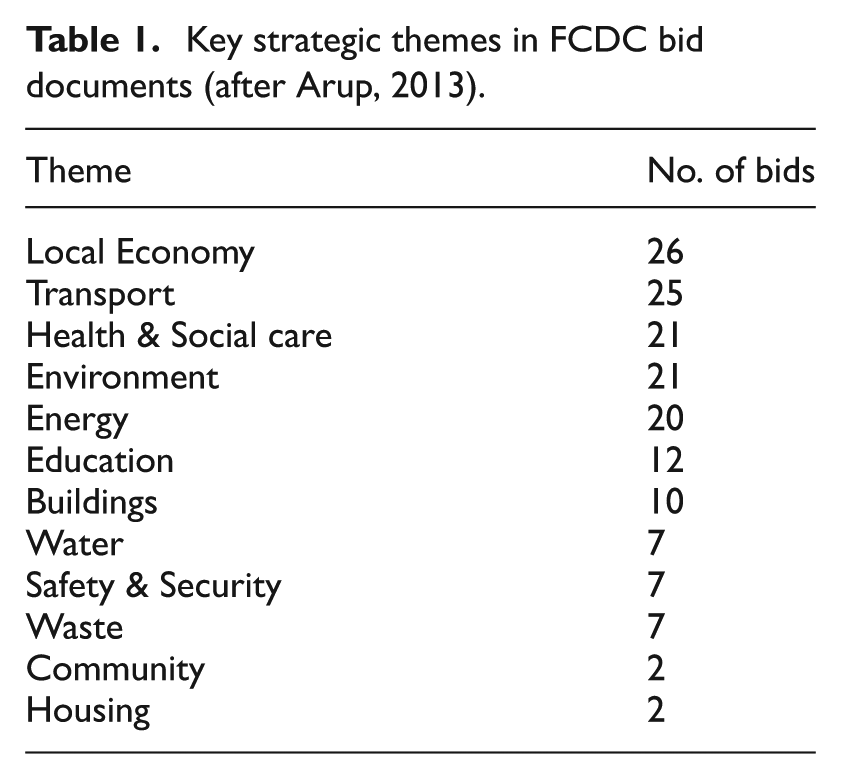
Despite the confusion regarding the FCDC’s overarching goals, city bids showed marked similarities in the challenges identified, cutting across socio-economic, political and environmental issues. There was an overwhelming focus on improving energy use, environmental footprint, quality of life, transport and local economic opportunity (Table 1). Education, buildings, water and safety were much less common, while despite the apparent importance of the citizen, only a very small proportion of bids considered either housing or community. Notably some core dimensions of the smart city imaginary – such as the emphasis on green growth or community benefits – received less emphasis in the bids. It is perhaps not surprising, given the TSB’s mission and government emphasis on economic growth, that almost all bids emphasised local economic development benefits, but this also reflects the limited capacity and influence of UK local government to engage more creatively across urban service provision.
Key strategic themes in FCDC bid documents (after Arup, 2013).
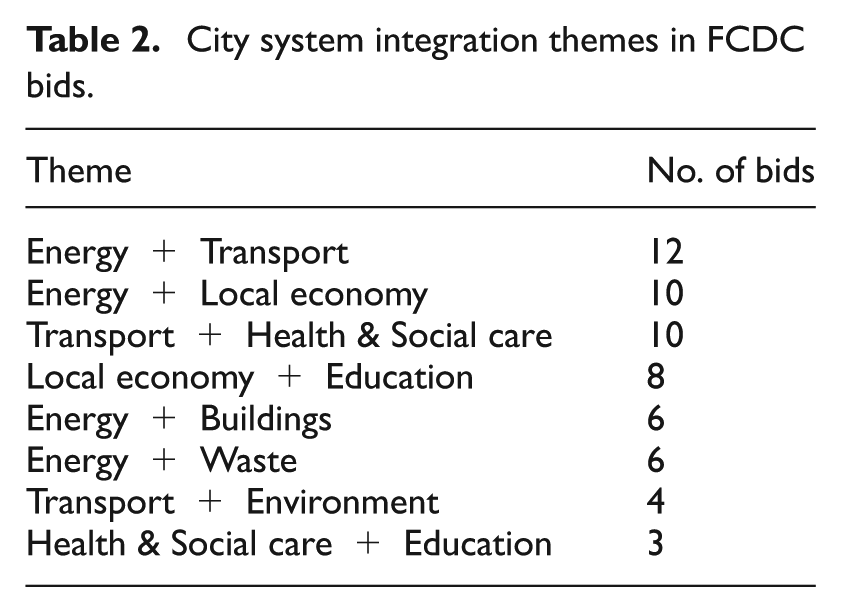
In terms of the key FCDC requirement of integrating city systems, eight bids involved the integration of just two systems, generally a mix of energy, transport, and health & social care (Table 2). For example, integration of transport with health & social care was central to Birmingham’s bid, based on the calculation that NHS transport represents 30% of city traffic (Birmingham City Council, 2012: 26). A further five bids sought to create two ‘parallel’ integrations, each involving two systems. For example, Ipswich proposed integrations of: ‘transport & health & social care’ and ‘local economy & education’, but there were no interconnections between these parallel themes. Ten other bids proposed more ‘multipoint’ integrations that encompassed three or more systems. For example, Milton Keynes proposed integrating energy systems with waste and local economy, which was in turn integrated with education. None of the bids proposed what might be considered ‘holistic’ multipoint integration that involved more than four city systems.
City system integration themes in FCDC bids.
Perhaps the ultimate test of the FCDC is whether it was able to facilitate distinctive technological or advances in relation to smart urbanism. Some of the more notable project ideas included Manchester’s proposal for a ‘super trench’, combining heat-network piping, DC cabling and a ‘last mile’ rail trolley freight and waste system. Last-mile transport solutions attempt to tackle the issue that the last mile of a supply chain is often the least efficient, owing to the fact that freight must move from high capacity efficient modes of transport (e.g. trains) to lower capacity, less efficient modes of transport (e.g. vans or lorries). Similarly, London’s ‘last-mile’ freight system proposed using electric vans to exploit alternative energy sources and storage, as well as feeding new district heating networks with waste heat extracted from the London Underground system, electrical substations and data centres. Glasgow proposed Smart Building Management System (BMS) and an Intelligent Operations Platform, allowing real-time information feeds to building managers regarding actual versus optimal building performance for that particular building design, energy conservation measures and deep retrofit options. The ‘last-mile’ freight system of these proposals is a much discussed concept within the future cities literature (e.g. Edwards et al., 2010). Similarly, the underground heat recovery project had already been piloted in Paris (Reuters, 2010), and real-time advanced BMS proposals are not uncommon in discussions about smart cities (Moreno et al., 2014). The question is whether it was innovative application or innovation technology development that mattered for the competitive urbanism of the FCDC. Bristol’s proposed Community Communications Canopy is a network based on radio frequency-enabled photocells retrofitted to the existing street lighting system to facilitate access to broadband and introduce a network to transmit information collected by sensors. Bristol’s bid also presented a detailed analysis of city systems (e.g. water, mobility, energy, community, waste, etc.) and their interactions, and planned to combine technical innovation with an overhaul of governance structures. The focus on governance was to ensure that: the Bristol City Operating Platform would be used in ways that benefited the city; data security concerns were allayed; the correct skills and expertise were involved in steering the programme; and that culture change within the public sector was effectively supported (Bristol City Council, 2012). This approach included an ethics committee to ensure that citizens’ interests remained central to the way information is gathered and shared, with the aim of building trust around issues of data privacy. Crucially, given the constrained timescales for the competition, the most developed submissions were based on ideas previously proposed or already under development.
The capacity for smart city innovation
The FCDC decision to work through local government might seem surprising and somewhat curious given the relatively limited powers and resources and diminished capacities of UK local government in key areas of infrastructure and service provision. The difficulties facing UK cities in assembling the resources and governance powers to reshape urban hardware is well documented, and reflects the limited autonomy of municipal government and the effects of successive rounds of neoliberal hollowing out of the local state (Bulkeley and Kern, 2006; Graham and Marvin, 2001). The exception is Greater London, 1 which has greater powers and autonomy than other UK municipal authorities, especially in areas such as transport (Hodson and Marvin, 2012). One key issue for UK cities, including London, is that infrastructure regimes are not organised at an urban or city-regional scale. Although water management and energy generation and supply originated as a local government function, decisions were regionalised and centralised as part of 20th-century welfare state policies (Bulkeley and Kern, 2006). Compared with many other countries, UK multilevel government is strongly centralised in terms of policy direction, funding and infrastructure investment. Local government capacities and capabilities have been further eroded by aggressive national requirements for the outsourcing and privatisation of urban utility provision, most recently by post-2008 austerity cuts, leaving most critical infrastructure systems in private and often foreign ownership. Consequently, beyond the larger cities of London, Manchester, Birmingham, Bristol and Glasgow, there was a weak recent track-record of local authority-led smart city innovation.
The FCDC was therefore about stimulating new forms of public–private engagement, and was designed to facilitate innovative thinking. The agenda was deliberately broad and flexible: ‘We are not specifying the challenges that should be tackled, the particular systems that should be integrated, or the approach that should be taken’ (TSB, 2012a: 3). However, the process exposes tensions related to the FCDC’s aims and the context for urban innovation in the UK. As indicated above, asking local governments to innovate was always likely to be a significant challenge, particularly as the FCDC coincided with significant post-2008 austerity local government contraction. These cuts were felt to particularly strongly affect the capacity for thinking and innovation. As one respondent pointed out:
this comes at a time when all thinkers [in the local authority] are leaving. (Interview #8)
Knowledge and ideas originate from many sources however (Hodson and Marvin, 2007), and the intention was for local authorities to link to the private sector to deliver their visions. Accordingly, many cities used the seed-corn money to commission consultants such as Arup and WSP Group to draft their bids, and indeed, Arup worked on six of the final 29 bids – Bristol, Leeds, Leicester, Manchester, Newcastle and Sheffield. Most cities gleaned advice from a variety of stakeholders. These included technology advice from technical consultancy firms including: Siemens, IBM, Microsoft, Intel, Cisco, Serco; and utility companies such as: BT, Telefonica, Scottish Power, British Gas, E.On and various water companies.
Overall, however, whether expertise was commissioned or not, evidence suggests that cities and their partners struggled to come up with the innovation required. There was a tendency for the same international exemplars to recur (Arup, 2013), such as Hammarby Sjöstad in Sweden or the Vauban district of Freiburg in Germany. The external evaluation of feasibility studies suggests that the lack of consultant diversity was a particular issue (Arup, 2013). Our interviews indicate that most of the cities were using a similar language, identifying the same problems and barriers, and gravitating towards similar solutions and projects. Even the best entries were felt to be limited in scope:
you didn’t get enough different ideas I don’t think … I don’t think there was anything in any of the other bids that struck us as mind-blowingly innovative or different to be honest. (Interview #7)
The competition structure also meant that rather than city coalitions developing shared ideas, each city was working individually, developing numerous parallel approaches to how integration between city systems might be achieved, despite the obvious advantages of collaborating on non-proprietary open protocols and standards:
[the competition structure] probably restrained or dampened collaboration between cities. (Interview #5) [one city said] ‘does anybody want to work together on this?’… but no-one really followed up on that, and I think everybody went into competition mode. (Interview #10) [the competition] made it very difficult for all of the cities to have a meaningful conversation … and that was very frustrating … that was one of the key feedbacks that came from cities – this doesn’t work. (Interview #7)
The city of Cambridge identified several integration projects that were important for the medium- to long-term aspirations of the city, but which were excluded by the city from the bid as they did not meet the TSB’s eligibility criteria. For example, the Science Park Railway Station information systems that planned to extend the integration of bus, rail, cycle and ticketing were said to be ‘superb integration examples’ but were not due to go live until 2015 and were therefore outside of the scope of the competition’s 2014 delivery deadline (Duff, 2012). It could be argued that it is precisely this medium- to long-term investment, which currently falls outside the scope of common finance models, that ought to be encouraged through government-sponsored innovation. The governmental imperative to spend money within fiscal timeframes often cuts across the need for longer technical innovation timescales. Another shortfall of the FCDC process was that funds could not be used to bridge gaps in existing project funding (Duff, 2012), even where catalytic funding of this sort could provide good value for public money. This stipulation may be an example of the stated goal of maximising impact being overridden by the need to delineate direct FCDC impacts in order to justify future government funding. Overall, this meant that in terms of innovation, the competition entries were weak in terms of pushing forward significantly on innovation or product development.
Many cities identified significant internal barriers to achieving their vision. Generally, these were associated with a lack of appropriate skills, the need for behaviour change within the authority, and limited opportunities to consult experts within the time available. Strong leadership was also seen as a central requirement to drive a city vision, coordinate between stakeholders and partners, and challenge organisational silos. The most significant barrier identified by our interviewees was the challenging timescale:
The machine that the TSB wanted to work with wasn’t fit for the purpose that they had … we just didn’t have the time to engage internally. (Interview #8)
This meant that direct engagement with citizens in the development of the bids was rare, and wide stakeholder engagement was difficult. Such constraints are likely to have inhibited creativity and the development of the novel partnerships required to tackle the complex and multi-sectoral problems posed by city challenges.
It was also apparent that ongoing city engagement and collaboration was not paramount for the TSB, which seemed unprepared for the willingness of cities to continue dialogue with each other after the FCDC had finished:
The TSB are quite good at … running competitions, but then actually learning from that and [continuing] working relationships with cities … I’m not sure how much capacity they have … (Interview #1) I don’t think they seemed that interested in coming to talk to us … there wasn’t a lot of depth to that feedback … (Interview #5)
Yet in some cases the competition did serve to accelerate urban strategies by providing extra resources and momentum to allow them to evolve their thinking. In the city of Sheffield, for example, the proposal to install community-scale Wi-Fi alongside smart meter installation stemmed from longstanding attempts to drive local energy policy given the financial barriers to extending its district heating system (Sheffield City Council, 2012). In some respects, the proposal was stronger on institutional innovation around existing technologies than on innovative smart city initiatives. In general, the freedom to use £50,000 for exploratory work was particularly important for local authorities, and some pointed to the advantages of being more equitable in the distribution of the FCDC prize fund to enable more of this work.
The winning formula: Innovation and implementation capacity
In January 2013, the city of Glasgow was announced as the winner of the competition and recipient of the £24m. Three of the runner-up proposals were also given partial funding to develop their proposals further, and in April 2013, it was announced that Peterborough, London and Bristol would also receive grants of £3m each (Arup, 2013). So why was Glasgow successful? Glasgow’s proposal was distinctive in its ambition and its framing of intervention around the city’s social and health priorities. It centred on a smart city management system, incorporating an intelligent operations platform, a data repository, a series of city dashboards and a citizen engagement app: ‘Glasgow will create a technology infrastructure to enable the integration of city systems and data across multiple agencies for the delivery of improved and responsive city services […] a structure easily replicated by other urban areas’ (Glasgow City Council, 2012: 3). When compared with many of the other proposals (see Table 3), it can be seen that Glasgow’s proposal sat more comfortably in the realms of the smart city imaginary. In contrast, although Peterborough’s proposed integration platform was in some respects similar to Glasgow’s, it was underpinned by a slightly different ethos of prioritising community development by building on its established Sustainable Community Strategy, with stated priorities of regenerating neigbourhoods; empowering local communities; and building community cohesion (Peterborough City Council, 2012).
Content of the winning proposals.
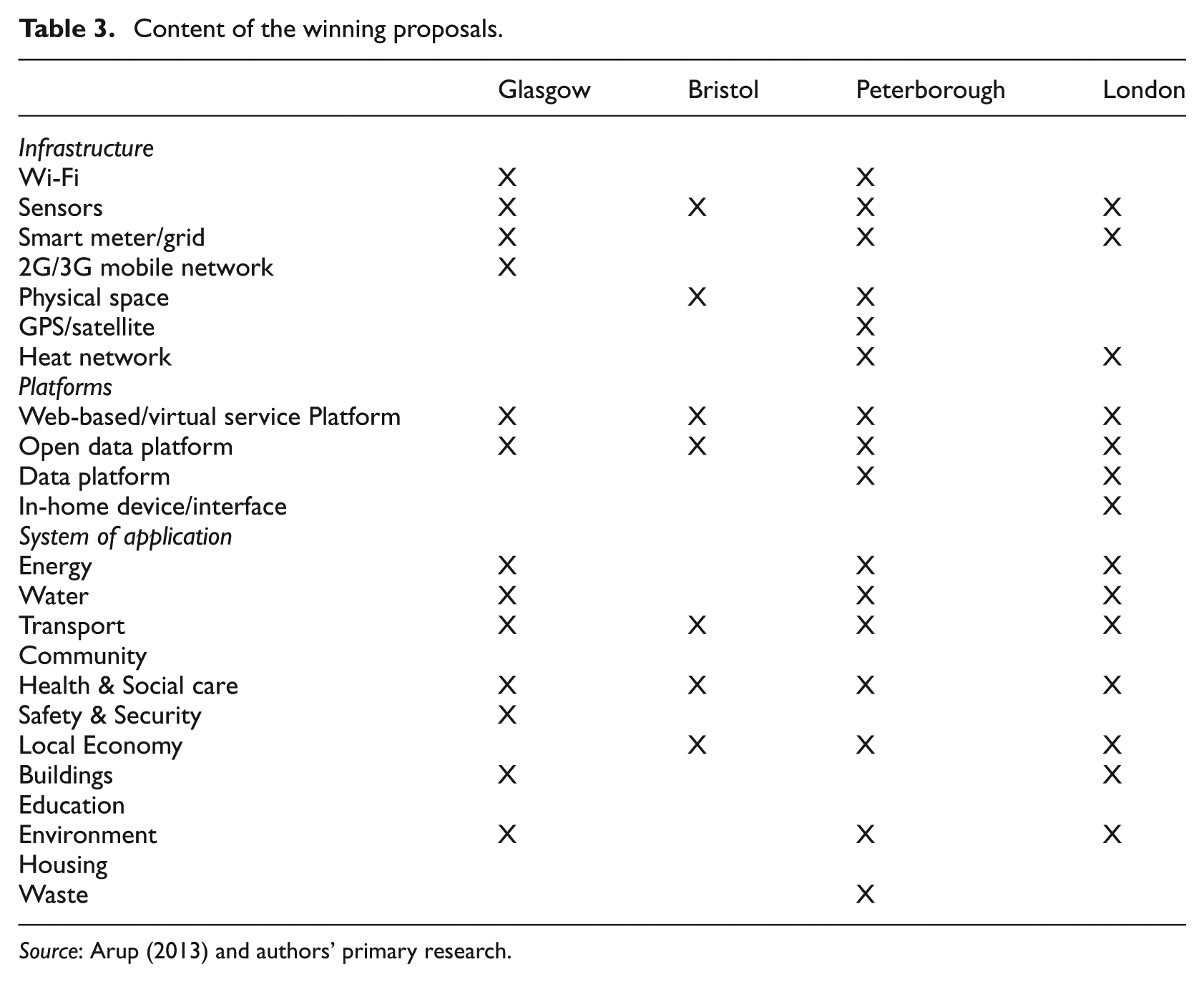
Source: Arup (2013) and authors’ primary research.
Glasgow had the wider infrastructural and institutional support needed to respond to the FCDC’s ambition and co-authored its bid with University of Strathclyde, IBI and ACCESS Group (Glasgow City Council, 2012: 58). ACCESS LLP was established in 2008 with a 10-year, £265m contract to transform the Council’s ICT and Property Services. It is jointly owned by Serco Ltd and Glasgow City Council. IBI Group is a multidisciplinary built environment consultant. Similarly, Bristol already had relevant initiatives in place. It was an early signatory of the Green Digital Charter, the only UK city ever to have been shortlisted for the European Green Capital Award, and launched Smart City Bristol in 2011 (Bristol City Council, 2012). London’s proposals also built upon numerous existing initiatives, including: a National Underground Asset Group (NUAG) and Crossrail collaboration; the EU funded CELCIUS Smart Cities project; UK-leading activity by the GLA on decentralised energy; the Low Carbon London programme; the Mayor’s RE:NEW programme; TSB’s Retrofit for the Future; and the NHS Whole System Demonstrator (Greater London Authority, 2012). Significantly, Glasgow was also able to leverage the FCDC funding with £500m of Commonwealth Games investment. This consisted of 20 major infrastructure and venue projects, including a district heating network, a new Games Route Network, and £40m of Fastlink bus rapid transit system infrastructure, building on the city’s extensive urban transport corridors.
Conclusions
Our aim in this paper has been to examine the issues and challenges related to state intervention in support of smart city innovation. In particular, we have highlighted the governmental and governance challenges in turning the spatial imaginary of a technologically enhanced smart city into meaningful urban projects, the politics of ‘filling-in’ the smart city imaginary. Our starting point was that local and national governments are likely to have significant economic, social and environmental interests in enabling smart city restructuring, which in principle ought to align with the burgeoning industry of smart city businesses waiting for the opportunity to transform urban infrastructures, if governments can create the right market opportunities (cf. Viitanen and Kingston, 2013).
However, the FCDC explored in the empirical sections of this paper represents some of the conflicts and difficulties for governments in orchestrating smart city innovation. These tensions stem partly from the conflicting objectives of the FCDC and the mismatch between national innovation policy and local political priorities. There were certainly potential tensions between the goals of delivering benefits to cities and enhancing the UK’s capability in the lucrative international smart city products and services market. That the FCDC entries were generally limited in scale and scope is perhaps not surprising. Despite the pump-priming resource, cities were expected to innovate within short timescales in the context of severe local authority budget cuts, and the longer-term hollowing out of local government power and influence. Competing rationales in national policy were perhaps reflected in a lack of clarity about what bids should contain. Significantly, under the competitive localism of UK national innovation policy, cities were also corralled into further inter-urban competition, rather than being encouraged to collaborate within a national cities framework. Along with the lack of feedback and follow-up, this indicates that the FCDC was less concerned with improving the functioning of UK cities and more interested in external export opportunities. Developing innovative smart city strategies was always likely to be challenging, and it is difficult to avoid the conclusion that municipal governments were being asked to prospect for private-sector investment on behalf of central government but with limited generative power. There was also limited awareness of local government and private-sector capacity to respond effectively, given the limited timescales and resourcing of the initiative. The FCDC’s technical bias also proved problematic. Many commentators believe that urban problems do not pivot on technical challenges (Gibbs et al., 2013), that solutions must necessarily involve a proportion of social innovation to succeed (e.g. Paquet, 2001), and that local scale is key so actors can meet face to face, exchange tacit knowledge and undertake collective action (Karvonen and van Heur, 2014). In its attempt to work through cities in the pursuit of patentable and exportable products and services, the TSB therefore started with a poor understanding of the context for urban governance and smart city innovation in the UK. Arguably, this is why it was unsuccessful in its remit to stimulate real technical innovation and holistic systems integration. In general, the FCDC parameters meant the bids overestimated the transformative power of technology and underestimated the importance of the ‘soft’ human infrastructures that underpin urban decision-making and governance.
Looking beyond the specific circumstances of the FCDC, the paper has relevance to the broader and burgeoning literature on smart city markets and initiatives. For instance, the FCDC’s curious set up perhaps reflects wider difficulties in mobilising around the ‘urban’ as a national technical innovation sector, when in reality the ‘urban’ is a human ecosystem comprising protean relationships. The smart cities literature has focused strongly on the problems of ‘parachuting’ in urban consulting firms offering solutions (Hodson et al., 2008; Pincetl, 2010), but the FCDC reflected a different logic around empowering local government to orchestrate innovation. Whilst local government was not necessarily equipped for that task, our analysis points to the difficulties in engaging innovative private-sector firms. The most transformative ideas came from existing public–private vehicles rather than new partnerships capable of rapid innovation, meaning the FCDC was less about innovation and more about maturity of personal public–private relationships. In short, prospecting for private-sector innovation through the FCDC proved problematic. Short timescales, the need for projects to start quickly, the limited capacity of local government to forge appropriate links and, crucially, the friction between open source ‘city gains’ and closed source intellectual property-based profits were all factors that inhibited effective public–private collaboration. This latter point is significant given the differential capacity of cities to finance projects and attract investment.
The scope of the bids is also a related but critical issue. There is a crucial distinction between ‘whole-city’ smart urban strategies and the more focused project-based interventions typical of the bids (Luque et al., 2014). Ultimately, the paper demonstrates the translational difficulties in asking the real smart city to ‘stand up’ (Hollands, 2008), at least as some type of transformative whole-city practical intervention. Some of this is down to the mix of rationales and logics within the UK national innovation policy that sits behind the FCDC and also the limited capacity of local government to respond to the FCDC’s ambitious brief and timescales. There was also a tension between the aspiration for city systems to coalesce and the realities of splintered service provision. Whether or not there is substance in smart urbanism, the benefits are unlikely to be identified through short-term responsive bidding. A longer-term strategic perspective is required to build relationships and identify meaningful synergies. In this respect, it may be that the FCDC came too early in the development phase of smart city technologies to generate meaningful applied research and marketable solutions from the public or private sector. Smart city restructuring may be less about wholesale transformation and more about the incremental enactment of numerous initiatives and interventions by governments, firms and citizens – a city restructured through apps rather than operating systems (Desouza and Bhagwatwar, 2012). It remains to be seen whether the open-ended experimentation required to build infrastructural resilience is compatible with neoliberalised and market-led approaches to governance at the national and urban scale.
Footnotes
Funding
This research received no specific grant from any funding agency in the public, commercial, or not-for-profit sectors.