




Abstract
What happens to firm-level research and development (R&D) when urban locations have more knowledge spillovers and are more entrepreneurial? This article explores the potential tension between knowledge spillovers, start-ups and innovation effort in existing firms. The relationship is empirically tested using Swedish firm-level data and municipality-level data on start-ups. The results indicate that having more start-ups in urban municipalities is associated with lower firm-level R&D expenditure. However, this relationship is not linear, where the negative association between the level of new firm formation and firm-level R&D expenditure decreases with scale. This suggests that the relationship between local entrepreneurship and a business’ R&D decisions is conditioned by the extent of that entrepreneurship.
Introduction
It is widely accepted that entrepreneurship is an important driver of economic development (Acs et al., 2012; Fritsch and Mueller, 2004; Stuetzer et al., 2018; Urbano et al., 2019). There is substantial evidence that entrepreneurship and innovation are concentrated spatially in urban locations (Adler et al., 2019; Eriksson and Rataj, 2019; Florida et al., 2017).
A strong entrepreneurial ecosystem incorporating, among other things, institutional, legal, knowledge and labour market elements is beneficial for city growth and development. However, there is a lack of evidence on the relationship between entrepreneurial localities and the innovation activities of incumbent firms at the level of the firm. This article contributes to reducing this gap in the literature using Swedish data.
The extent and composition of firm-level research and development (R&D) investment are a strategic decision, which is conditioned by a firm’s ability to capture the returns from R&D and the ability to access and exploit knowledge generated externally, including that generated by other businesses. This suggests that the decision on the degree of innovation effort must balance the extent to which a firm perceives a risk to the appropriability of returns from R&D (Hurmelinna-Laukkanen and Puumalainen, 2007) with the need for firms to develop internal absorptive capacity to exploit external knowledge (Cohen and Levinthal, 1990).
There are spatial aspects to this strategic innovation decision, since geographic proximity may enhance the ability of businesses to learn from each other and benefit from others’ knowledge creation (Glaeser et al., 1992). However, proximity may be a double-edged sword, where businesses benefit from absorbing the knowledge generated by others, but risk leakage of their own knowledge creation to others. Colombo and Dawid (2016: 170), modelling incumbent firms’ strategic decisions in response to start-ups, argue that ‘the incentives of incumbents to invest in R&D may be reduced because of the increased danger of knowledge loss occurring through start-up formation’.
This presents potentially important policy implications for urban development. It is generally accepted that the policy informed by and focused on the entrepreneurial cities framework (Hall and Hubbard, 1996; Harvey, 1989; McNeill, 2017) will bring only positive economic effects for cities. However, Carree et al. (2002: 285) suggest that there is an economic ‘growth penalty’ associated with too many new firms as well as too few. Further, Greene et al. (2004) argue that an increase in the quantity of new firms will eventually be associated with a decline in the quality of firms. We suggest that it is important for city managers to understand the dynamics of the relationship between firm R&D effort, knowledge spillovers and start-ups within the entrepreneurial eco-system (and also discussed in (Spigel and Harrison, 2018)).
This relationship is explored in this article, using incumbent firm-level data and entrepreneurial start-up data for Swedish metropolitan areas. Investment in R&D activity in co-located firms is used to indicate local knowledge spillovers. While used extensively in the literature, it is more accurate to describe local R&D activity as potential knowledge spillovers, since the scope for firms to learn from the knowledge-generating activities of others is enhanced by the scale of the knowledge-generating activities. The analysis here estimates whether business innovation effort is related to potential knowledge spillovers and the general level of entrepreneurial new business start-ups in the municipality in which it is located.
R&D investment, knowledge spillovers and local entrepreneurship
This section outlines the conceptual frameworks and hypotheses to be tested relating to knowledge spillovers, local entrepreneurial activity and R&D spend. It further outlines the potential outcomes between these concepts at a sectoral level.
Localised knowledge spillovers and R&D spend
While businesses are generally considered to engage in R&D to enhance productivity or profitability (Nelson, 1991), firms also engage in new knowledge creation even where the commercial returns are not easily assessed. Cohen and Levinthal (1989, 1990) argue that firms engage in R&D activity not only for the direct benefits, but also to enhance their ability to identify, evaluate and exploit new external knowledge.
This means that firms may increase investment in R&D to enable them to access and use knowledge created outside of their businesses. Indeed, a long-standing and key motivation and explanation for the spatial concentration of economic activity is the potential for knowledge spillovers (Fujita et al., 1999; Jacobs, 1969; Marshall, 1890; Porter, 1990; Saxenian, 1996).
There is also substantial empirical support for geographically bounded knowledge spillovers within the innovation and regional economics literatures (e.g. Broekel and Mueller, 2018; Cardamone, 2018; Crowley and Jordan, 2017; Doran et al., 2012; Grillitsch et al., 2017; Johnston and Huggins, 2017; Neves and Sequeira, 2018). While the opportunities and effects may vary by business, there is substantial evidence from the literature that businesses gain knowledge advantages from spatial concentration (Duvivier and Polèse, 2018; Fitjar et al., 2016; Kloosterman and Lambregts, 2001; Rammer et al., 2019; Verdú and Tierno, 2019). This means that co-location may increase the value of internal R&D, since the more firms that are located within an area, the more knowledge is available to spill over.
While earlier literature tended to use the concept of ‘knowledge in the air’ (Marshall, 1890: 271) as shorthand for localised knowledge spillovers, more recent papers emphasise that co-location is not a sufficient condition for benefitting from knowledge spillovers (Fitjar and Rodríguez-Pose, 2017), as other mechanisms such as labour mobility, networks and joint ventures are also required. Businesses may also not be able to exploit localised knowledge to the same extent as others, given their resources and location within a network (Grillitsch and Rekers, 2015). They may overcome a lack of access to local knowledge by collaborating at other geographical scales (Grillitsch and Nilsson, 2015; Grillitsch et al., 2017). Co-location alone will not guarantee efficient and effective learning between firms (Grillitsch and Rekers, 2015).
The concept of open innovation highlights purposeful interaction with external knowledge sources to enhance the effectiveness of previously closed internal R&D (Chesbrough, 2003, 2017; Enkel et al., 2020; Masucci et al., 2020). There is evidence that open innovation opportunities and effectiveness are enhanced by spatial proximity, particularly for small and medium-sized enterprises (Della Peruta et al., 2018; Huang and Rice, 2013; Kapetaniou and Lee, 2019). This suggests that co-located R&D active businesses may positively reinforce an innovation eco-system.
In a nuanced study, Crescenzi and Gagliardi (2018) explore the complementarity between internal and external sources of knowledge for a firm. They find that firms that are located where there are clusters of more knowledgeable individuals (measured by the location of patent holders) are not necessarily more innovative. Innovations will only be realised if firms make external knowledge exploitation an essential part of their strategy by actively combining potential and realised absorptive capacity. At the same time, expanding a firm’s absorptive capacity through R&D investment provides it with greater opportunity to connect with global pipelines of new technologies, moving beyond a reliance on local networks (Bathelt et al., 2004; Trippl et al., 2018). However, there is also evidence that R&D investment enhances a firm’s ability to capture and exploit knowledge generated locally (López-Bazo and Motellón, 2018; Prenzel et al., 2018).
Consequently, the first hypothesis (H1) to be tested in this article is based on the well-established conceptual framework of expected positive relationships between localised knowledge spillovers and R&D.
H1: Firm-level R&D is positively associated with R&D in co-located firms.
Firm-level R&D and local entrepreneurship
While firms’ innovative efforts are potentially helped by the efforts of other firms, and this may have spatial aspects, there is also a potentially negative relationship between a more entrepreneurial location and firm R&D effort.
Columbo and Dawid (2016) argue that businesses in entrepreneurial locations, measured by new firm formation, will invest less in R&D, due to the risk of knowledge loss. This may particularly be a concern where incumbent firms are a major source of new start-ups (Agarwal et al., 2007).
This is also asserted by Klepper (2001), who, in discussing employee start-ups in high-tech industries, refers to the potential adverse effect of such spin-offs on the incentives and capacity for incumbent firms to innovate. In addition, Babina and Howell (2018) find that firms’ R&D investment leads to new start-ups via employees departing to launch their own firms. Since this may appear to have no observable cost to the firm the entrepreneurs left, this spawning is a conduit for knowledge spillovers. Further, these spillovers also tend to be geographically bounded and are another source of agglomeration of economic activity.
The spillover of knowledge through entrepreneurial spawning has implications for innovation outcomes in the firms that new business owners leave. Kim and Marschke (2005) analyse the relationship between a firm’s propensity to patent and the likelihood of highly skilled employees to join or start a rival firm. Their finding that employee mobility ‘within geographical regions has a pronounced effect on patenting is consistent with evidence elsewhere of localized technological spill-over effects’ (Kim and Marschke, 2005: 313). Using data from the Italian Community Innovation Survey, Colombo et al. (2017) find that firms spend less on R&D where there are better complementary assets for new venture start-ups. These assets are proxied by the extent to which financial resources are available for new start-ups.
The mobility of highly skilled employees in a region and/or new firms has been well established in the literature as a means of the appropriability of knowledge being lost to its creator (Agarwal et al., 2016; Castillo et al., 2020; Grillitsch and Nilsson, 2015; Grossman and Helpman, 1993: 16).
All these effects suggest that an entrepreneurial region with an environment that favours start-ups may simultaneously result in lower R&D activity in existing regional firms. The second hypothesis to be tested in this article (H2) is:
H2: Firms will invest less in R&D in more entrepreneurial locations due to the risk of losing knowledge to other firms.
Sectoral implications for the hypotheses
An industrial economy perspective is a commonly employed framework for thinking about firm innovation, where the propensity of innovation can be explained by the structural characteristics of the sector in which the firm operates (Vega-Jurado et al., 2008). Consequently, sectoral differences have been an important empirical consideration in innovation studies since, at least, Pavitt (1984). Existing innovation studies indicate that there is significant variation in innovation activity across sectors, and it is now common to control for sectoral effects in empirical innovation studies (Bogliacino and Pianta, 2016; Doran et al., 2020; Hamidi and Zandiatashbar, 2019; Malerba, 2004; Mina et al., 2014; Roper et al., 2017).
Many innovation studies have focused on the differences between manufacturing and service firms (Abreu et al., 2010; Crowley, 2017; Miles et al., 2000; Mina et al., 2014; Morikawa, 2019; Sirilli and Evangelista, 1998). Service industries now account for over 70% of global output but have long been regarded as passive adopters of technology and as technological laggards, relative to their manufacturing counterparts (Metcalfe and Miles, 2000). The limited literature on innovation in service firms identifies the drivers of innovation to be distinctly different from those found in manufacturing studies (Crowley, 2017; Mina et al., 2014; Sirilli and Evangelista, 1998), with additional evidence of differences in the propensity of service firms to use patents (Miles et al., 2000; Morikawa, 2019).
There is evidence that regions with relatively high sectoral specialisation will tend to be more innovative due to enhanced scale economies, reduced transaction costs and knowledge spillovers between similar firms (Storper, 2013). Roper and Love (2018) argue that the knowledge base for innovation across sectors will depend on factors such as the maturity of the sector, the degree of competition and the potential for appropriating the returns to innovative effort. Sirilli and Evangelista (1998) find that appropriability conditions and the risk of being imitated are a greater barrier to innovation for manufacturing than service firms. Arvanitis (2008) find appropriability, measured by a firm’s assessment of the relevance of the property rights protection of innovation outputs, has a positive effect on innovation activities in both service and manufacturing firms, but the effect was stronger in manufacturing.
Similarly, Yacoub et al. (2020) identify that the tension between the sharing of knowledge and the protection of knowledge, referred to as the paradox of open innovation, is less of a problem for service firms compared to manufacturing firms. This is due to appropriation and openness being complementary and mutually enabling elements in service firms.
It is argued that the codified nature of knowledge in the innovation process in manufacturing firms makes it easier for their competitors to take advantage of any knowledge spillovers (McEvily and Chakravarthy, 2002; Yacoub et al., 2020). The tension in the appropriability and knowledge sharing trade-off for manufacturing and service firms is a function of knowledge complexities embedded in their respective products/services (Yacoub et al., 2020). Firms that produce innovations requiring complex knowledge combinations are more likely to seek external knowledge, which empirically has been identified to occur relatively more often in service firms (Mina et al., 2014; Tether, 2002).
Against this backdrop in the innovation literature, we expect sectoral differences to emerge in testing hypotheses H1 and H2. Consequently, this study controls for sectoral differences and further splits the analysis by services and manufacturing.
Data and methods
Data
To test our hypotheses, we use firm-level R&D expenditure to indicate a firm’s innovative effort, the average level of R&D expenditure among firms in each area to measure local R&D intensity and the number of start-ups to indicate the level of entrepreneurship. Firm-level R&D data comes from the World Bank’s (2014) Swedish Enterprise Survey (SES). The SES is a survey of business owners and top managers from 600 firms conducted between January and November 2014. The SES collects data on firm characteristics, firm performance and perceptions of the business environment.
The survey intended to cover all of Sweden, but due to budgetary constraints and following advice from Statistics Sweden (SCB), data collection ultimately included the top 10 local labour market areas in Sweden, which unfortunately constrains the potential to look at urban–rural differences. However, the sample covers two thirds of the population between the ages of 20 and 64, two thirds of working places in Sweden and all the major cities in Sweden. Thirty-five per cent of firms are in an area with a population of less than 50,000, 30% are in an area with 50,000 to 250,000 people and 18% are in an area of 250,000 to 1 million. The remaining 17% are in an area with a population over 1 million.
The SCB and World Bank grouped the geographical areas into four regions for stratification, with just under a third in the Linköping-Örebro-Karlstad-Västerås region (Centre region) and a similar number in the Borås-Gothenburg-Jönköping-Trollhättan region (West region). The Stockholm-Solna region (East region) has the fewest firms, with just under one fifth of the total, and firms in the Malmö-Lund region (South region) make up 20% of the sample. 1
According to the World Bank (2014), the SES was based on a representative sample of firms by size and sector, using a stratified random sampling technique. The proportion of the sample by region and firm-size category is reported in Supplemental Table A1 (in the supplemental material). Medium-sized firms (>20 and <99 employees) are the modal category in each region. The West region of Borås-Gothenburg-Jönköping-Trollhättan has the highest proportion of large firms (over 100 employees). Overall, there is a greater proportion of manufacturing firms relative to service firms sampled in each region.
At the lower spatial level of the municipality, the sampled firms range across 103 of the 290 municipalities in Sweden. Supplemental Figure A1a (in supplemental material) displays the location (by municipality level) of the sampled firms from the SES. 2
Table 1 contains variable definitions and descriptive statistics for relevant firm-level variables. Our indicator of innovative effort is R&D spend per worker, and the average spend for the sample of firms is SEK28,810. 3 Slightly fewer than 40% of the firms report that they perform R&D.
Variable definitions and descriptive statistics.
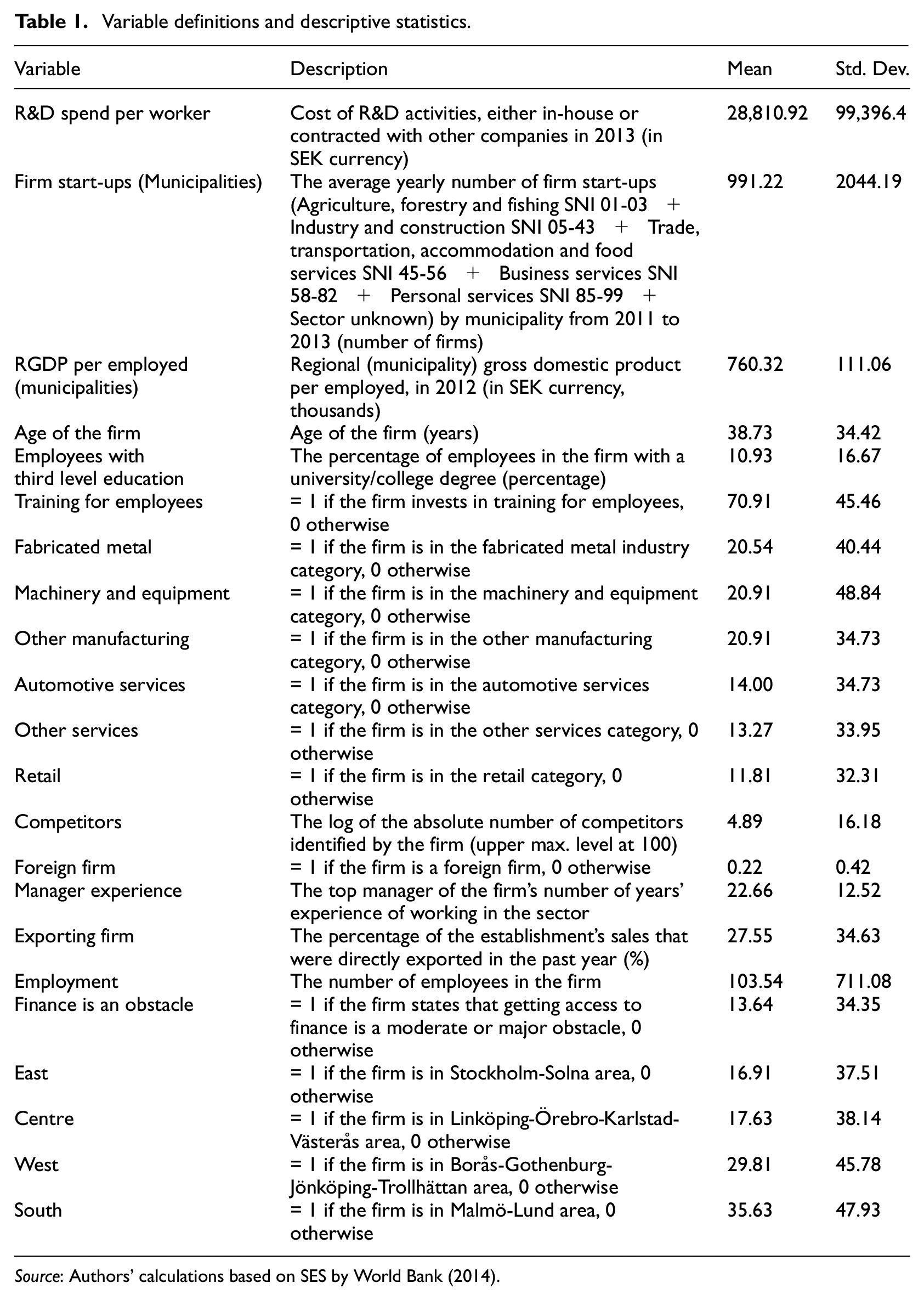
Source: Authors’ calculations based on SES by World Bank (2014).
Our indicator of entrepreneurship, the level of firm start-ups, comes from the Swedish Agency for Growth Policy Analysis (n.d.). This provides information on the number of start-ups by year for each of Sweden’s 290 municipalities. Supplemental Figure A1b (in supplemental material) shows the average yearly share of start-ups by municipality from 2011 to 2013. There was an average of 70,722 new firms created each year across all Swedish municipalities from 2011 to 2013.
There is corresponding firm start-up data for the 103 municipalities represented within the firm-level SES survey data. Hence, our focus in this article is on the municipalities where our two data sources match. Previously in the Swedish case, spatial patterns of start-ups were found to be persistent, spatially durable and sticky (Andersson and Koster, 2010). Nevertheless, for this analysis, the average yearly number of new firm start-ups by municipality over the three-year period 2011 to 2013 is used to account for a potential temporal lag between firm start-up levels and R&D spending.
In our matched sample, there was an average of 991 new firms created per municipality each year over the three-year period from 2011 to 2013. The lowest average number recorded was in Munkfors (14) and the highest number was in Stockholm (11,031).
The start-up data are only available at the Swedish Standard Industrial Classification (SNI) broad categories level. The most highly represented sector is Business Services (SNI-58-82), with 36% of start-ups, followed by Trade, Transportation, Accommodation and Food Services (SNI 45-56) and Personal Services (SNI 85-99), with 24% and 21% respectively. Just under 16% of start-ups are in Industry and Construction (SNI 05-43), and 3% are in in Agriculture, Forestry and Fishing (SNI 01-03).
The highest proportion of Industry and Construction start-ups (hereafter broadly referenced as manufacturing) was 35% in the municipality of Lilla Edet. This indicates that new start-ups are predominantly in service sectors, which largely replicates the patterns in other developed countries.
OLS estimation
For the empirical strategy we use an ordinary least squares (OLS) regression. The OLS specification is as follows:
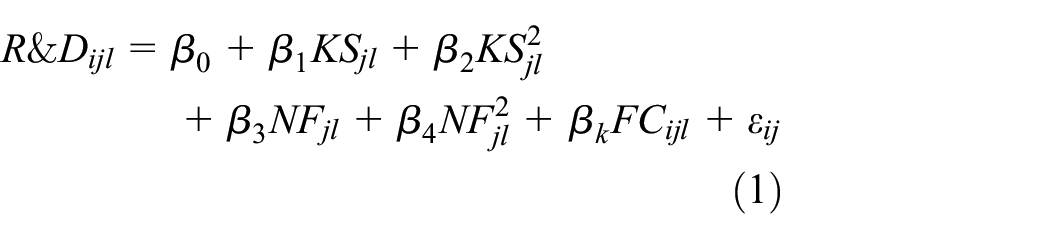
In this specification, notation
It is also possible that R&D expenditure is influenced by regional size (Eriksson and Rataj, 2019; Feldman, 1999) and regional industrial structure (Capozza et al., 2018; Guo et al., 2016). Most of the independent variables are observed in the SES dataset. To control for regional size and regional productivity, we add regional gross domestic product (GDP) per worker (at the municipality level) to our dataset sourced from Statistics Sweden (n.d.). The average GDP per worker across the 103 municipalities was SEK760,000 in 2012. 4 We also control for broad sector in our analysis to account for additional heterogeneity of industrial structure.
In all, we conduct three OLS estimations. The first estimate includes all types of firms in the SES, irrespective of sector, and the start-up data from all sectors (average of years 2011–2013) from the Swedish Agency for Growth Policy Analysis (n.d.) start-up data. Second, our analysis becomes more granular by estimating an OLS regression for manufacturing firms in the SES with the corresponding manufacturing start-up data (SNI 05-43). Third, we estimate an OLS regression for service firms in the SES and the corresponding service start-up data (SNI 45-56 and SNI 58-82). This is to account for sectoral implications, as outlined above. On each occasion, the estimations control for independent variables as specified in equation (1).
Robustness checks
The underlying spatial configuration of the data calls for some robustness checks to identify if the OLS specification in equation (1) is the best fit for the empirical estimations. A micro-geography of start-up effects has been identified previously in the Swedish case (Andersson and Koster, 2010) and in other international cases (Rammer et al., 2019), indicating that the spatial effects of start-ups are likely to be constrained within the municipality. However, as a robustness check, an OLS specification that includes both the number of new start-ups (in log form) and a spatially lagged start-up variable was estimated. The spatial lag start-up variable is the average number of start-ups in the surrounding contiguous municipalities (in log form) to the municipality
As we are dealing with spatial data, we also conducted a Moran’s I test examining the error term of the OLS model. The Moran’s I test suggests that there are no underlying spatial misspecifications with the model. 5
We further conducted a Spatial Autoregressive Regression (SAR) model, which extends the OLS regression by allowing for a spatial lag of the dependent variable and spatial lag of the error term. Here, the estimated impacts of (1) R&D spend in nearby firms, and (2) errors from nearby locations, on the dependent variable are controlled for. The inverse distance-weighting matrix used the firms’ latitude and longitude locations. The overall Wald test of spatial terms is insignificant (see supplemental material, Supplemental Table 2 column (3)), indicating that there is no additional benefit of the SAR model over the OLS specification.
We also explored the possibility that a multilevel or hierarchical model would produce different results. This modelling approach contains both fixed effects and random effects, where the latter are random deviations other than those associated with the overall error term (StataCorp, 2013). The stratified random sampling nature of the data resulted in individual firms being selected within municipalities and within regions, and consequently a hierarchical modelling approach may be more appropriate than standard OLS or SAR procedures. The hierarchical model allows for adjustments of the results by variations caused by contextual effects (at the level of the municipality/region) and separately the effects that are an artefact generated from variations in the characteristics of firms within areas. The likelihood ratio test for the multilevel versus the OLS model is insignificant, indicating that there is no additional benefit of the multilevel model over the OLS specification (see supplemental material, Supplemental Table 2 column (3)).
All robustness models show almost identical results to the OLS output. We conclude from our sensitivity tests that our OLS strategy is reliable and robust. We present and discuss the results of the OLS estimations in the next section.
Findings
The results from the estimation on the full sample are reported in the first column in Table 2. In these results there is no support for our first hypothesis, as, other things equal, the level of firm R&D expenditure is insignificantly related to potential knowledge spillovers from co-located firms. Consequently, we conclude that the potential for knowledge spillovers is not related to higher R&D expenditure. However, we do find support for our second hypothesis, as R&D expenditure is negatively associated with the number of start-ups in the same municipality. This provides support for Colombo and Dawid (2016), who suggest that the risk of leakage of new knowledge to entrepreneurial co-located start-ups acts to disincentivise R&D activity. The potential negative spillovers, in this case, outweigh the potential positive knowledge spillovers.
OLS estimation results of models.
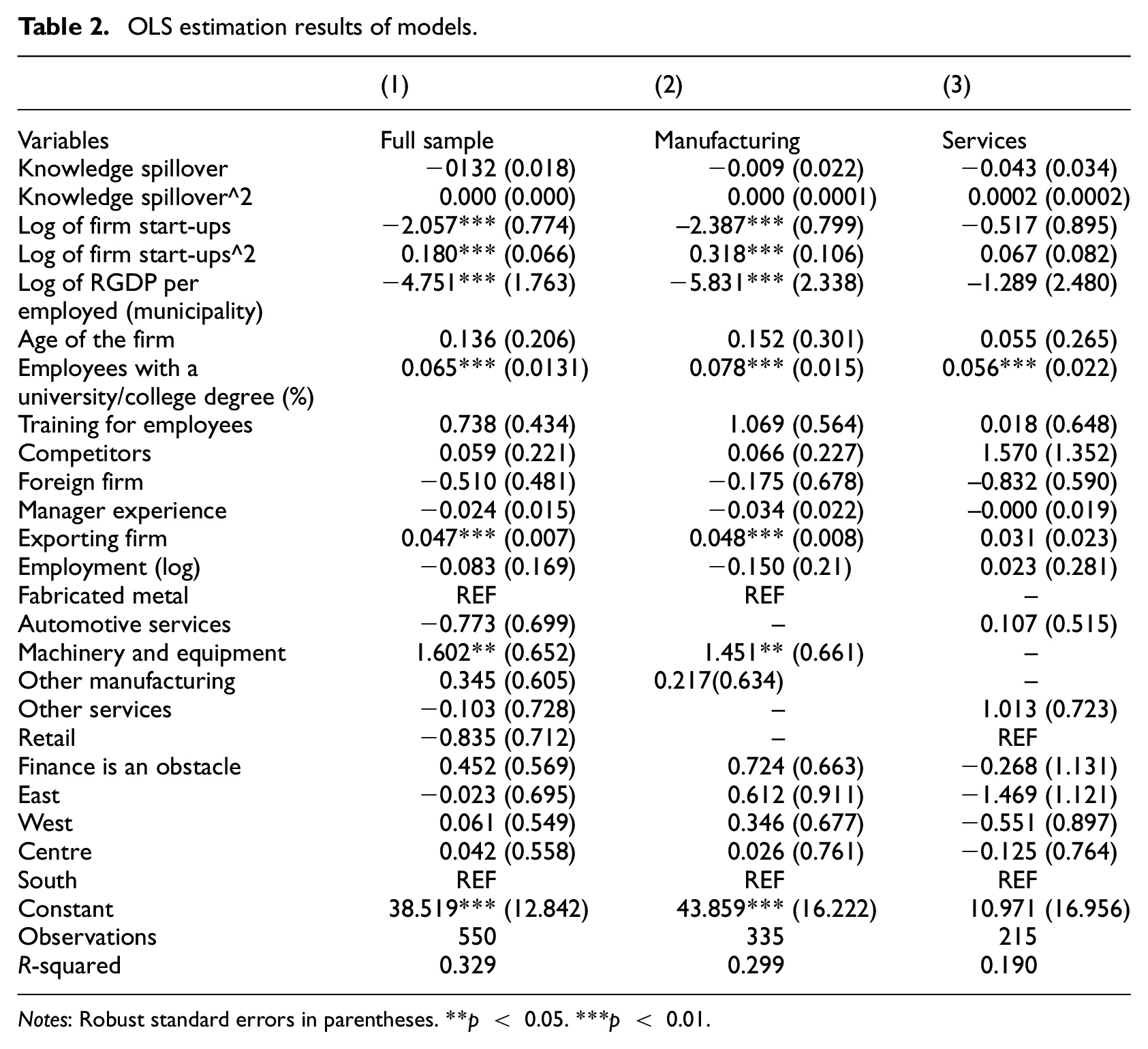
Notes: Robust standard errors in parentheses. **p < 0.05. ***p < 0.01.
However, the squared term for the number of start-ups is positively associated with firm-level R&D investment. Supplemental Figure A2a (in supplemental material) shows the marginal effects plot for this relationship and demonstrates a non-linear relationship between the level of start-ups and firm-level R&D. This means that an increase in the number of start-ups has a diminishing marginal effect and there may be a point at which more start-up intensity incentivises firm-level R&D. This scale effect may indicate that although more knowledge is ‘in the air’, many firms generate this and so there may be less focus by other firms on the knowledge activities of any single firm. It may also be that the incentive for firms to engage in R&D is increased by the presence of more other firms, including start-ups, as this makes the absorptive capacity element of R&D activity more valuable.
While spillovers associated with new start-ups in all sectors may depress R&D investments for all types of firms, it could also be argued that knowledge spillovers are more likely to occur if R&D is conducted in the same market and that new firms are actually in competition with incumbents (Marshall, 1890; Porter, 1998). As outlined in the theoretical and method sections, we also tested our hypotheses at the more disaggregated sectoral level of manufacturing and service firms. The results of these models are presented in the second and third columns of Table 2.
We identify very similar results for manufacturing firms. Again, a non-linear relationship is observed between new start-ups and R&D spend (Supplemental Figure A2b in supplemental material). From this, we conclude that the negative start-up effect associated with R&D spending decisions is an isolated phenomenon relating to manufacturing firms in our Swedish sample.
This differing pattern between manufacturing and services has support in the literature, as outlined earlier. The appropriability conditions and, particularly, the threat of imitation may act as greater R&D investment deterrent for co-located manufacturing firms (Arvanitis, 2008; Sirilli and Evangelista, 1998; Yacoub et al., 2020). This suggests that the paradox of openness is more problematic for manufacturing firms, despite the likely greater prevalence of legal appropriability methods for this type of firm (Laursen and Salter, 2014). A strategy by these firms to reject collaboration for fear of knowledge leakage and to engage in closed innovation processes could limit the opportunities to successfully benefit from absorptive capacity and develop and commercialise innovations (Baum et al., 2000).
Furthermore, education, training and exporting have a positive association with R&D spending per worker in manufacturing firms. In contrast, only education matters for R&D spending in service firms. Again, these contrasting findings by sector type provide further support to the existing literature that has found the innovation process to be different between manufacturing and service firms (Abreu et al., 2010; Crowley, 2017; Mina et al., 2014; Sirilli and Evangelista, 1998).
Returning to the control variables for the entire sample, there is a positive association between firm-level R&D investment and human capital, as expected (Cohen and Levinthal, 1990; Griliches, 1998; Romer, 1990). Human capital in this case is indicated by the proportion of employees with a qualification from a higher education institution and whether the firm provides training for employees. The positive association between exporting and firm R&D effort is also consistent with previous studies (Feldman, 1999; Roper and Love, 2002).
Interestingly, the results indicate that regional economic size (measured by the log of regional GDP per capita) has a negative association with the R&D investment activities of firms. Again, this is found to be the case only for manufacturing firms. This result may be explained by the low spatial unit of our analysis. City regions may have concentrations of relatively higher numbers of manufacturing firms in poorer municipalities. This may even reflect past planning strategies to incentivise manufacturing firms to establish (e.g. science park developments / regeneration plans) in deprived or depressed localities. Alternatively, it may also be linked to the industrial life cycle or value chain patterns, where manufacturing firms locate at the edge of city-regions where firm density and productivity are relatively lower (Campi et al., 2004; Lindelöf and Löfsten, 2003; Webber, 1982; Yang et al., 2019).
Conclusions and policy implications
The analysis presented here has implications for the entrepreneurial cities model of urban development. While greater levels of entrepreneurship, measured here as new start-ups, may drive economic growth and strengthen the innovation eco-system, there may be negative implications for R&D investment at the firm level, particularly for manufacturing firms.
To counteract a potential decrease of investment in innovation (measured here as R&D expenditures) due to a greater number of start-ups, policy mechanisms to offset this may be required. The analysis points to areas where interventions may be most impactful, including support for staff training, graduate recruitment, exporting and even more importantly identifying jointly with incumbent firms how appropriability and knowledge-sharing tensions may be overcome. This tension may be connected to the existence and use of legal appropriability mechanisms.
In addition, considering that we identify that local knowledge spillovers are insignificantly related to co-located R&D expenditure, government R&D supports, such as innovation voucher schemes and subsidies, may be very important for stimulating innovation, though such R&D support is frequently set at the national, rather than city or regional level. A useful role for city and regional policy makers therefore may be to help firms in their areas to access the full range of policy support potentially available to them. At the least, city managers must be aware of the firm-level dynamics of policies to enhance their city’s entrepreneurial eco-system and also be aware that the literature may have been overstating the importance of cities in generating positive local knowledge spillovers (Shearmur, 2012). Previous Swedish studies also identify that local knowledge spillovers play a limited role in influencing R&D efforts after controlling for firm-level effects (Andersson and Ejermo, 2005; Grillitsch and Nilsson, 2015; Johansson and Lööf, 2008). Perhaps, negative externalities such as knowledge leakage and entrepreneurial spawning are especially prevalent in knowledge-dense urban areas, where negative externalities outweigh positive externalities (Grillitsch and Nilsson, 2015).
The empirical results show a non-linear relationship, so that the negative association between firm R&D investment and start-ups is reduced by scale of entrepreneurship. This has implications for smaller or second-tier cities that will, by nature of their size, have fewer start-ups than capital or larger cities. Indeed, the relationship seen here may go some way to explain the persistence of productivity and innovation advantages of capital city regions, though more focused analysis on that issue would be required.
We also find an underlying manufacturing versus service start-up sectoral story. However, it is a limitation of the article that the SES sample size and the data on firm start-ups do not facilitate a more granular analysis of sectoral relationships. To explore this further would require a large sample and the sectoral breakdown of incumbent and start-up firms. We note that this could be an area of interest for future research. Still, the fact that municipalities with greater general start-up levels of manufacturing firms have lower firm-level R&D activity is a concern for policymakers, as it may help explain any inter-regional differences in standards of living.
The insights of the analysis presented here suggest that there are firm-level relationships that may be under-appreciated in the implementation of entrepreneurial cities frameworks. The interdependence between firms within city regions means that entrepreneurial activity may work to hinder the production of the knowledge ‘in the air’ that underpins agglomeration effects for innovation, and policy supports for R&D at the firm level may mitigate some of the adverse consequences and enhance even further the system effects of entrepreneurship. That said, what we observe here is a correlation between start-ups and R&D expenditure. Consequently, it is important to be tentative from a policy perspective on this principal finding. Future research should look to employ panel data, if available, to determine causal effects between start-ups and R&D expenditure.
Supplemental Material
sj-pdf-1-usj-10.1177_0042098021995105 – Supplemental material for Do local start-ups and knowledge spillovers matter for firm-level R&D investment?
Supplemental material, sj-pdf-1-usj-10.1177_0042098021995105 for Do local start-ups and knowledge spillovers matter for firm-level R&D investment? by Frank Crowley and Declan Jordan in Urban Studies
Footnotes
Acknowledgements
The authors are grateful to their colleague Professor Justin Doran for his comments on drafts of the article, and to three anonymous referees for their constructive and insightful reviews.
Declaration of conflicting interests
The authors declared no potential conflicts of interest with respect to the research, authorship, and/or publication of this article.
Funding
The authors received no financial support for the research, authorship, and/or publication of this article.

Supplemental material
Supplemental material for this article is available online.