




Abstract
As a prominent and performative discourse, The Smart City has the potential to shape urban futures. Yet, its mostly top-down implementation and dominantly technocratic definition of problems raises critiques of The Smart City as the latest version of a series of post-political and neoliberal visions of urban governance. However, as smart cities are implemented into ‘actually existing’ strategies locally, they are always negotiated and translated into place-specific contexts. Beyond critiquing the powerful discourse of The Smart City, the social innovation–(re)politicisation nexus (SIRN) spells out a framework for contesting and co-producing radically transformative smart city visions and politics as they take shape on the ground. Linking the empirical case study of the ‘top-down’ implementation of SmartCity Cologne, Germany, to current ‘bottom-up’ discourses on reclaiming the urban commons, we show how ‘true’ and ‘real’ social innovation must go hand-in-hand with a re-politicisation of hegemonic logics and discursive framings. In doing so, this paper makes theoretical and empirical contributions to public and academic discourse on which governance practices, methods and policies could contribute to radical transformations towards a ‘truly’ smart and sustainable urban future.
Introduction
As a powerful and influential discourse, The Smart City has become a seductive panacea for the shaping of urban futures (Herrschel, 2013; Hollands, 2015; Luque-Ayala and Marvin, 2015; McFarlane and Söderström, 2017; McLaren et al., 2015; Vanolo, 2014; Viitanen and Kingston, 2014). Yet, despite its performative impact, there remains a general ambiguity of what The Smart City exactly is, what sort of futures its vision is creating, and who has a say in shaping them (Hollands, 2008; Luque-Ayala and Marvin, 2015).
Critics point to the top-down and technocratic nature of smart policy discourse (Wiig, 2016: 4) and the low or non-existent engagement of citizen participation, even when participatory decision-making is promised (Cardullo and Kitchin, 2019; Crivello, 2015; March and Ribera-Fumaz, 2016). Yet, while The Smart City often emerges as top-down and technocratic, smart strategies are never fully top-down but are always negotiated and translated into place-specific contexts (Stollmann et al., 2016). When applied locally, the general discourse of The Smart City becomes grounded in a variegated implementation, or what Shelton et al. (2015) call the ‘actually existing’ smart city.
In Germany, we see that as a recent proliferation of primarily top-down smart city strategies are embedded locally, they encounter a growing bottom-up activism seeking to reclaim the urban commons (Baier et al., 2016; Follmann and Viehoff, 2015; Hatzelhoffer et al., 2012; Stollmann et al., 2016). Reclaiming the commons is a discourse focused on transforming governance practices, policies and infrastructure away from capitalist logics and towards a more democratic, community-based control. This discourse has manifested in Germany in a variety of bottom-up social movements in which actors from civil society are demanding more inclusion in decision-making and pursuing alternative forms of urban governance, including democratic control of municipal energy provision (Becker et al., 2017) and circular regional food economies (Thurn et al., 2018).
With the understanding that the present is a moment of unprecedented opportunity and necessity for theorising and constructing policies and practices for radical transformations to sustainability 1 (Blythe et al., 2018) we ask: is there potential in The Smart City for reconciling top-down and bottom-up approaches – in Germany and elsewhere – to co-produce ‘truly smart and sustainable urban futures’ (McLaren et al., 2015: 3–7)? To answer this question, we must first examine how smart and sustainable futures are currently defined in mainstream, top-down approaches.
In a proposed comprehensive definition of The Smart City by Dameri (2017: 137), it is noted as equally important to define smart by including ‘smart activities,’ but also excluding ‘initiatives out of scope’. Accordingly, what is smart is also defined by what is not-smart. Since the smart label is not fixed to any essential meaning but produced and constituted through discourse, the defining of ‘smart’ is a site of struggle for the creation of meaning (Gibson-Graham, 2002: 96). This understanding highlights the significance of power relations in the construction of smart as a hegemonic discourse, by which meaning is articulated and ‘fixed’ into practices of smart urban governance (cf. Mouffe, 2018). Furthermore, this view carves out possibilities for immanent critique to transform practices of smart urban governance from within by drawing on smart’s own ‘symbolic references’ (Mouffe, 2018) –for example, ‘innovation’ and ‘participation’. Here we see potential to ‘re-articulate’ the ways in which innovation and participation are translated into smart practices, with the goal of extending democratic values and carving out space for alternative innovation approaches to address urgent social and ecological problems within The Smart City discourse.
Any strategic interventions which pursue smart and sustainable futures do not emerge as inevitable or apolitical; their inherent normativity, rather, underscores the need for ethical debate, political negotiation and pluralistic inclusion of diverse (and critical) voices (Blythe et al., 2018). Given that, we will argue that smart city strategies do contain potentials for radical transformations; but with qualifiers – following the lead of Maria Kaika’s (2017: 99) ‘real smart cities’ and Duncan McLaren, Julian Agyeman and Robert Gottlieb’s (2015: 2) ‘truly sustainable and smart cities’.
The emphasis on these qualifiers (real and truly) underscores the risk of smartness and sustainability falling into the post-political trap (McLaren et al., 2015). The trap acknowledges critiques that transformations to sustainability run the risk of being co-opted into business-as-usual trajectories, or disciplined by ‘apolitical’ constraints of neoliberal and financialisation market logics (Blythe et al., 2018; Paidakaki et al., 2018; Swyngedouw, 2007; Vanolo, 2014). However, the use of these qualifiers also insists that transformations in pursuit of smart and sustainable futures do have the potential to be ‘real’ and ‘true’. Our aim in this paper, therefore, follows those of (among others) Hollands (2015) and McFarlane and Söderström (2017). These scholars have highlighted the need to move beyond a mere critique of smart urbanism, setting new parameters of debate for which governance practices, methods and policies could lead to a smart and sustainable urban future. It is to such a task of intervention in the smart urbanism discourse that we hope to contribute.
The remainder of this paper comprises two main parts: the first develops a theoretical framework and the second is an empirical case study of SmartCity Cologne (SCC). The theoretical section begins with a brief overview of critical literature on The Smart City. It discusses how smart city strategies have externalised innovation, meaning that socio-political innovation is foreclosed as existing configurations are seen as inevitable. Next, we develop a theoretical framework that deconstructs this inevitability and carves out spaces in which alternative visions could gain traction in The Smart City. Drawing on Swyngedouw’s (2018) ‘post-politicisation’ concept (which we explain below), our framework argues for a pluralistic and open stance to heterodox approaches and practices in governance, which include the possibility of innovating socio-political configurations (i.e. institutional arrangements, power asymmetries, participation processes, etc.). We call this the social innovation–(re)politicisation nexus (SIRN) as we argue that real social innovation cannot be achieved without re-politicisation and vice versa. The nexus represents the meeting point of these two concepts, resulting in a ‘bottom-linked governance’ (Eizaguirre et al., 2012) which aims to synthesise the tensions between the conceptual extremities of top-down policies and bottom-up practices (Baker and Mehmood, 2015) by internalising conflict and making space for heterodox alternatives within institutionalised democratic governance.
In the empirical section we illustrate an example of the opportunities and challenges that emerge for the unpacking of the SIRN. We do so by translating The Smart City into an actually existing smart city in Germany: SmartCity Cologne (SCC). In particular, our analysis of Cologne’s smart city politics, first, provides a particular insight into how actually existing smart city actions and policies are assembled locally (Vanolo, 2014; White, 2016). Second, we document an additional case of contrast between actually existing processes of decision/policy-making and the citizen-centric rhetoric often associated with smart cities (Cardullo and Kitchin, 2019; Hodson and Marvin, 2017; Joss et al., 2017; Wiig, 2016). Finally, we focus attention in the latter discussion in our paper on opportunities and challenges for unpacking the SIRN – in Cologne, and beyond to other smart city strategies and urban governance practices.
The Smart City: The critique
Much of the sustainability argument has evacuated the politics of the possible, the radical contestation of alternative future socio-environmental possibilities and socio-natural arrangements, and silences the radical antagonisms that are constitutive of our socio-natural orders by externalizing conflict. (Swyngedouw, 2007: 26)
For a growing body of critical literature, The Smart City is understood as ‘the technological version of a sequence of neoliberal-infused new urban visions’ (Kitchin, 2015: 132), whereby existing trajectories of capitalist growth are reinforced as the primary means for driving urban development (Cugurullo, 2018; Grossi and Pianezzi, 2017; Viitanen and Kingston, 2014). Innovation in The Smart City is, therefore, mostly limited to technological and digital advancements rooted in market-economic logics, while foreclosing more general socio-political innovation (Taylor Buck and While, 2017; White, 2016). Specifically, as smart cities have been mobilised to deliver urban sustainability, approaches and strategies have focused on the ‘promotion of efficiency and growth, the control of individual and household behaviour, and the mediation of consumer culture’ (Martin et al., 2018: 276).
Following these critiques, we see The Smart City’s innovation to be generally externalised, which here means two things. First, by considering existing politico-institutional configurations and economic trajectories as inevitable, innovation is directed towards visions of apolitical ‘techno-utopian’ solutions (Luque-Ayala and Marvin, 2015; Taylor Buck and While, 2017). Here it is assumed that smart technologies alone will lead to better urban futures. Second, smart policymakers have valued external expert knowledge over local citizen knowledge (Shelton et al., 2015; Söderström et al., 2014). In doing so, policymakers focus on the materiality of the city and its competitive position relative to other cities, rather than the materiality of the citizens and their place-specific needs and capacities (Bauriedl, 2017).
In line with these visions, The Smart City has not only internalised the ecological modernisation agenda of sustainable development, it also epitomises the link between entrepreneurialism and (a kind of) environmentalism that opens up new waves of (private) investment for city governments and new opportunities for profit-making in the private sector. We interpret the smart city, then, as an ‘urban sustainability fix’ (While et al., 2004). While et al.’s (2004) notion of the ‘urban sustainability fix’ is defined as an institutional strategy for ‘safeguard[ing] growth trajectories in the wake of industrial capitalism’s long downturn, the global “ecological crisis” and the rise of popular environmentalism’ (p. 551). The ‘fix’ of The Smart City allows cities to position themselves as green forerunners in the context of global inter-urban competition for capital investment and funding schemes, while selectively targeting environmental problems (Herrschel, 2013; Rosol, 2013; Temenos and McCann, 2012).
Insofar as many smart city strategies continue to follow these developments, The Smart City enters urban policy-making as an updated ‘technology of austerity urbanism’ (Pollio, 2016), or a re-framing of ‘neoliberal ideology’ (Cardullo and Kitchin, 2018; Grossi and Pianezzi, 2017). Therefore, The Smart City has often been integrated into already existing apolitical governance tendencies (Béal, 2012) and resonates with the ‘post-democratic’ or ‘post-political’ (MacLeod, 2011; Mouffe, 2005; Swyngedouw, 2007) debate. In particular, Mouffe (2005) has warned that consensus politics are a serious danger to (urban) democracy. This danger has been described by Béal (2012) as a process by which elite coalitions first select and prioritise what they view as urban problems; and, second, compose a decision-making network and substantive policies based on the interests of elite coalitions, rather than democratic representation. In this process a hegemonic consensus is constructed, while contestation and conflict, along with grassroots actors, are externalised (Swyngedouw, 2007: 26).
Indeed, cities are not made smart because of citizen requests (Stollmann et al., 2016: 6). Critics have, rather, seen The Smart City as a ‘top-down, technocratic policy discourse’ (Wiig, 2016: 4). Furthermore, empirical studies have shown that actually existing smart city projects are planned and implemented without public participation (Cardullo and Kitchin, 2019; Crivello, 2015; Stollmann et al., 2016). Although participatory decision-making processes are often promised as part of smart city agendas, participation is often limited to the creation of new technological advancements including digital e-governance tools (Afzalan et al., 2017), without attention to existing power asymmetries.
Yet, we argue that smart urbanism is not inherently top-down – even if ‘corporate storytelling’ suggests this (Söderström et al., 2014). Rather, local implementation is always politically contested and can even shift from strictly top-down to more bottom-linked. Although smart city platforms often do emerge as apolitical and top-down, they are always negotiated and translated into place-specific contexts (Stollmann et al., 2016). This has been seen recently in Barcelona, where Cardullo and Kitchin (2018) detail the re-politicisation of the smart city project: away from domination by state and private interests and towards the inclusion of citizen/community interests and civic society movements. Therefore, smart city politics emerge as context-specific and the smart label as dynamic.
This moment of translating The Smart City into the ‘actually existing’ smart city is a site of struggle, with potential for the creation of meaning. Smart urban futures can either be discursively constructed into existing apolitical governance tendencies, or the approaches and methods for constituting smart and sustainable development can be repurposed and re-politicised (Gibbs et al., 2013; Hollands, 2015; Kaika, 2017; McFarlane and Söderström, 2017; March and Ribera-Fumaz, 2016; Martin et al., 2018). Yet, more detailed empirical studies of actually existing smart cities are needed to carve out different variants. In particular, it is yet to be determined if and how actually existing smart city initiatives can be re-politicised. And, likewise, how counter-hegemonic voices of environmental movements, subaltern groups and ordinary citizens can be incorporated into and empowered by actually existing smart city strategies. The next section proposes a framework for beginning to unlock political potential within The Smart City.
The social innovation–(re)politicisation nexus (SIRN): Carving out political potential in smart urbanism
The Smart City embodies the potential to transform urban futures. However, as we have argued above, the inherent normativity of transformation requires a re-politicisation of The Smart City discourse. Re-politicisation necessitates a simultaneous internalisation of innovation; breaking from The Smarty City’s predominantly externalised conception and practice of innovating. Internalisation means that social relations – including governance arrangements, processes, methods and approaches – are incorporated into the scope of smart innovation, with a stance of openness to heterodoxy. As we consider re-politicisation and social innovation to be co-constitutive, we call this the social innovation–(re)politicisation nexus (SIRN).
Re-politicisation: Deconstructing post-political inevitability
For Swyngedouw (2018), post-politicisation is a particular form of de-politicisation by which hegemonic (urban) governance arrangements and principles are increasingly seen as outside of the realm of democratic politics. The post-political, in other words, is seen to equate arbitrary constraints with social objectivity (cf. Mouffe, 2000). The constraints, as such, become taken-for-granted assumptions beyond historical contingency – creating an illusory ‘end of history’. Politics is, in this way, ‘economised’, as mainstream economic logics (e.g. neoliberal-economics and financialisation) become fixtures of social reality with political agency and the ability to transcend ethical debate and political negotiation (Swyngedouw, 2018: 32). In short, the post-political economy, disembedded from the messiness of social relations, can make decisions for us.
Following these perspectives, we see the political as a space of democratic disagreement and negotiation, and a moment in the process through which ‘normal politics’ is transformed (Swyngedouw, 2018: 56). Yet, re-politicisation is not an end in itself – as the political is not ‘more important than actually existing instituted politics’ (Swyngedouw, 2018: 56). The aim of re-politicisation is, rather, to transform politics in instances where existing hegemonies limit capacities for addressing and meeting social problems and needs. We emphasise that there can be neither a blueprint normative vision of The Smart City – nor a script of intervention for its re-politicisation (cf. Gibson-Graham, 2006).
A process of politicisation, Swyngedouw (2018: 24–25) tells us, begins with an ‘inaugural event’ of staging democratic disagreement, which cannot be named in advance by social theory. This leads us to social innovation, a concept that we see as an approach through which citizens generate alternative plans when mainstream state- and market-led solutions do not meet local needs.
Social innovation: Generating alternatives
As an in-vogue concept, social innovation has generated an ‘admittedly confusing debate’, as it has been mobilised in various ways by different groups, from public and state entities to radical democratic theorists (Paidakaki et al., 2018: 12). Critics have argued that since institutional discourse on social innovations in governance have been confined within narrowly market-economic terms, the concept is doomed to fall into the post-political trap and further exclude marginalised groups (Swyngedouw, 2005). Yet, social innovation remains useful (again with the qualifier of re-politicisation) for framing transformative social change and generating context-specific alternatives to dominant urban development models and approaches (Blanco and León, 2017; Nyseth and Hamdouch, 2019), such as those assumed inevitable in The Smart City. We follow here Ulug and Horlings (2019: 14), who clearly define social innovations as being comprised of, on the one hand, a process (i.e. new rules or organisations of social relations); and on the other hand, a product or end result (i.e. satisfying unmet social needs and making social contributions, including the empowerment of communities) (Baker and Mehmood, 2015).
Blanco and León (2017), in particular, have documented how confrontational social innovation can lead to a ‘process of political empowerment’ (p. 2185), through their case study of the negotiation of a new affordable housing policy in Barcelona. This case displays the potential effectiveness of conflict for shifting power relations in urban governance among civil society (especially marginalised actors), the market and different levels of government (González et al., 2010). Besides confrontation, movements to reclaim the urban commons can offer opportunities for disruptive social innovation through reconfigurations of physical spaces and infrastructures towards community ownership and operation. We see such commons-oriented movements to include political urban gardening (Certomà and Tornaghi, 2015; Follmann and Viehoff, 2015) and food movements (Thurn et al., 2018), as well as re-municipalisation of urban service delivery and energy democracy (Becker et al., 2017; Cumbers and Becker, 2018). All of these examples display ‘painstaking efforts’ (Kaika, 2017: 99) of intervention, in which needs – for example, sustainability or social justice – are so urgent that citizens are driven to take on new ‘do-it-yourself’ (Baier et al., 2016) roles in urban governance processes. As such civil society movements in physical urban space are often supported by (trans-local) digital communities, smart technologies could be seen as a potential facilitator of disruptive, community-empowering social innovations (cf. Martin et al., 2018). If smart city strategies were open to such innovations, smart technologies could become a key driver by which ‘individuals and groups come to see themselves as shaping/governing economic processes rather than as simply subjected to them’ (Gibson-Graham and Roelvink, 2009: 35).
As with re-politicisation, however, we emphasise that social innovation cannot be understood as a ‘normative recipe for solving all human and social problems in any context’ (Nyseth and Hamdouch, 2019: 2, emphasis added). Many may argue that past attempts to reclaim the commons with public ownership have been ‘disappointing, if not disastrous’ (Cumbers, 2012: 62); or that breaking away from fixed policy paths contains too much risk and uncertainty (Nyseth and Hamdouch, 2019). We would not dispute such arguments. Yet, we argue the benefit of social innovation lies rather in its ability to keep ‘windows of democratic dialogue’ open (Nyseth and Hamdouch, 2019: 4). This includes using pluralism and heterodox thinking to break from path dependency when necessary; and reflexivity for when plans fail and need to be adjusted (cf. Cumbers, 2012). As such, social innovation is seen as a way for empowered citizens to generate and experiment with governance alternatives – if and when plans or models proposed by the state and private market limit the capacities for addressing place-specific needs and problems. This brings us to the nexus: ‘bottom-linked’ governance, which aims to synthesise the tensions between bottom-up practices and top-down policies by internalising conflict (Eizaguirre et al., 2012).
The nexus: Internalising conflict with bottom-linked governance
The concept of ‘bottom-linked governance’ forms the nexus of the SIRN as it combines the focus on institutional innovation in re-politicisation with the focus on bottom-up alternatives generated through social innovation (Eizaguirre et al., 2012). As such, bottom-linked governance is a method for incorporating ‘invented’ spaces of participation into ‘invited’ institutional channels (Miraftab, 2004). The result is a dynamic process of participation (Silver et al., 2010) in which bottom-linked governance is ‘materi- alized through constant and varied interactions between socially innovative actors and institutional structures’ (Paidakaki et al., 2018: 14, emphasis added).
Bottom-linked governance has emerged in response to a perceived paradox in contemporary multilevel governance, in which the institutional imperative of citizen participation has not necessarily coincided with citizen empowerment (Eizaguirre et al., 2012: 2009). Several authors have, thus, identified the need for invited participation in urban governance to make space for invented spaces of conflict, contestation and antagonism, which for agonistic theorists such as Mouffe (2000, 2005) define democratic politics. Eizaguirre et al. (2012) articulate a bottom-linked governance that is closely related to Mouffe’s agonistic model of democracy. While recognising the opportunity for ‘real’ participation in invited institutional policy-making, Eizaguirre et al. (2012) stress that bottom-linked practices require institutions to develop capacities and procedures for an ongoing engagement with conflict, dissent and disagreement (p. 2010). However, the strength of bottom-linked governance can be found in its emphasis on avoiding the ‘local trap’ (Purcell, 2006), that is, the attempt to solve all problems at the local level or give a priori preference to, for example, purely horizontal organisational models. Informed by these perspectives, we move next into our empirical case study of Cologne.
Data collection and methods
Empirical data on SCC were collected through various qualitative methods in 2017 and 2018. The research began with a review of publications by actors involved in SCC project management (e.g. Möhlendick, 2017), websites of SCC project management (www.smartcity-cologne.de) and funders, a study which included SCC project management interviews (Brandt et al., 2016), and a more general review of coinciding development plans for the city of Cologne (e.g. Bauwens-Adenauer and Soénius, 2009). Based on this review we identified actors in the project management team for interviews. Semi-structured interviews were then conducted with six members of the SCC project management team (see Figure 1) from private and public sectors. Questions focused on the history of the actors’ organisation, their roles in SCC, an interpretation of what ‘innovation’ meant for SCC, and encountered and anticipated difficulties. These interviews all lasted from 45 to 60 minutes.
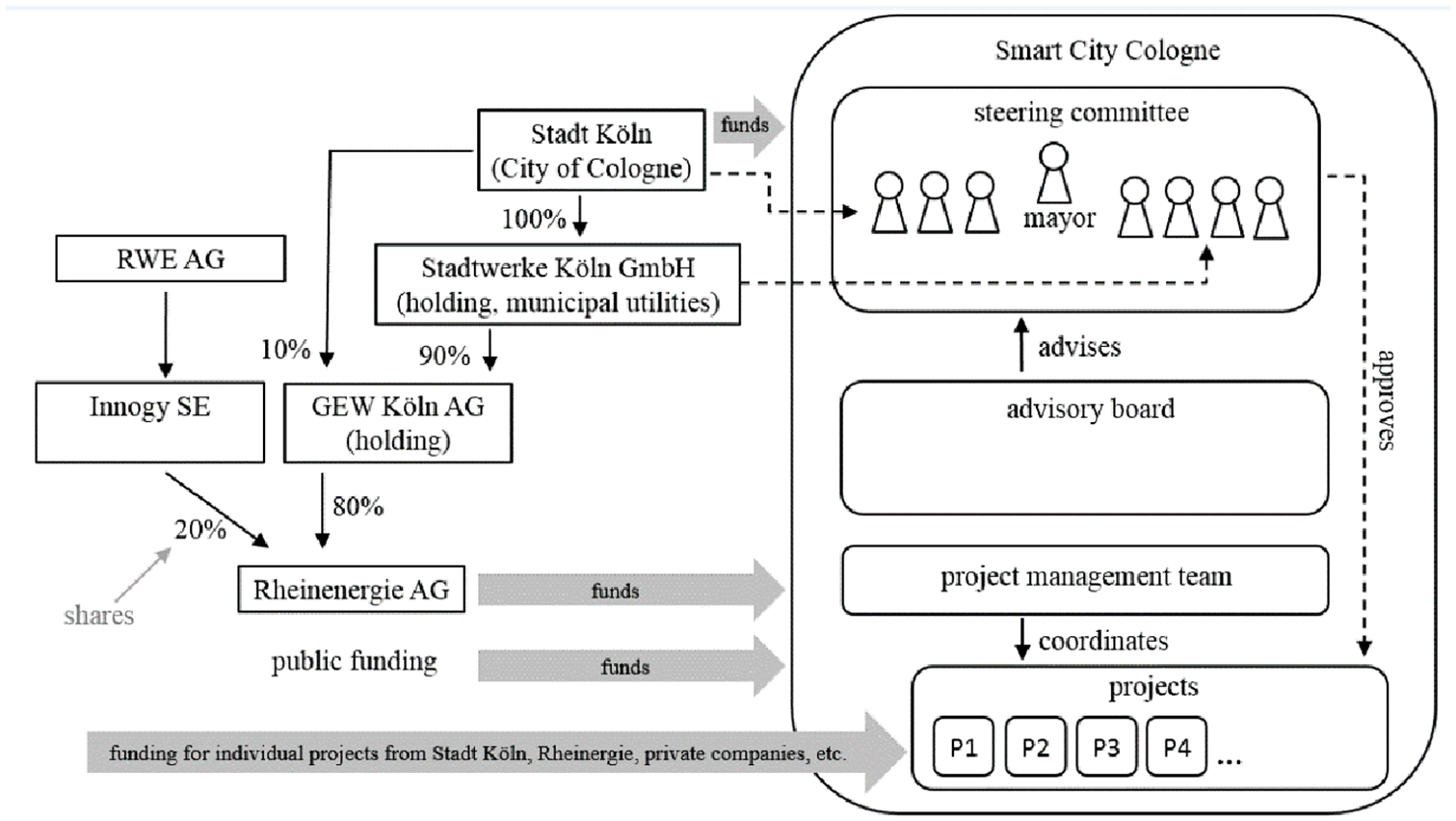
SmartCity Cologne structure.
Further interviews were conducted with five leaders of citizen initiative groups in Cologne. These groups were selected based on their activism in areas consistent with the goals of SCC, namely, climate and environmental protection and citizen participation. Semi-structured questions were developed in advance for these interviews but discussions were more open-ended and ranged from 45 to 90 minutes in length. These interviews focused on motivations underlying activism and gauged the extent to which active citizens saw SCC as open to and productive for engagement. Participants in all interviews agreed in advance to be recorded and transcripts were made in all cases. Follow-up personal communications with participants have also been included as data. Finally, participant observation, including informal interviews and detailed notes on presentations and discussion sessions, was conducted during the SmartCity Cologne Conferences in 2017 and 2018. All qualitative data were analysed using a critical discourse and narrative approach, which focused on how language was used to create meaning.
Cologne’s smart city platform
Locally framing smartness
SmartCity Cologne (SCC) was founded in 2011, in a joint partnership between the municipal energy provider, RheinEnergie (RE), and the city of Cologne. We see the implementation of SCC to have been influenced by two main trends in the German context: austerity-inclined fiscal policies at various levels of German government and the federal government’s Energiewende (Energy Transition) policy. In line with recent global trends of intensified fiscal austerity (Peck et al., 2009), German municipalities have experienced a steady increase in indebtedness and a decrease in leverage to impose taxes on trade (Gewerbesteuer) and land (Grundsteuer), because of an amplified competition among cities to attract businesses and private capital (Keller, 2014). As it began to face de-industrialisation in the 1980s, the city of Cologne became focused on facilitating economic growth and building a strong employment market, through public–private partnership and cost-efficiency considerations in planning (Mattissek, 2008).
These factors, among others, have resulted in a policy of fiscal discipline and Cologne has repeatedly been in danger of falling into insolvency. To maintain budgets under declining tax revenue, German municipalities have implemented the corporatisation of municipal utility companies, which have been traditionally tasked with providing urban services. Cross-subsidisation between the different municipal utility companies has always played an important role in financing municipal public services in Germany: for instance, the profits from energy providers have been used to offset operating losses of services such as public transport. Therefore, the municipal energy sector has always played a multifunctional role for German city governments. While corporatisation and European competition laws have restricted cross-subsidisation (cf. Bulkeley and Kern, 2006), the energy sector has continued to be a very important factor for many municipal budgets and the close connection between municipal governments and ‘their’ utility companies remains (e.g. senior members of city government sit on supervisory boards of municipal corporations).
In parallel with these developments, the German Energy Transition policy and resulting market changes have put municipalities which rely on the profits of ‘their’ energy utilities under threat of a ‘massive loss of market share, revenues, and profits’ (Richter, 2013, pp. 1226–1227). Since Cologne is, partly through city-owned subsidiaries, the majority shareholder of RE with 80% ownership (RheinEnergie, 2017: 29), the municipal energy supplier’s steady profits are a major supporter of the city budget. RE is, accordingly, an exceptionally powerful actor with regard to city financing and the implementation of the Energy Transition in Cologne. For this reason, the company has been the main driver of SCC from the beginning.
Owing to the inertia (i.e. long-term capital assets, networks and holdings) of conventional power production with fossil fuels, it is in the financial interest of RE’s profitability to resist radical transformation and operate with a business as usual approach for as long as possible, while at the same time slowly building up capabilities for renewable generation (Richter, 2013: 1228). This creates a profitability paradox for the city in the energy transition: maintain revenue streams while facing the imperative to transform power production. Based on these influences, we argue, the local framing of smartness in Cologne can only be understood based on the close connection between the city government and the energy provider RE, and the profitability paradox, which both actors face under the energy transition.
Origins, structure and goals of SCC
Smartness in Cologne is framed as a central and multi-faceted approach to transform Cologne into a sustainable/climate-friendly city. The key goal of SCC is climate protection, as this is viewed as ‘the linchpin of a sustainable and resilient city’ and defined as the major urban challenge in the coming decades (Möhlendick, 2017: 26). 2 Thus, SCC is framed as an urban environmental governance ‘platform’ by its founders; not as an urban development agenda. Consequently, SCC is managed by the coordination office for climate protection (Koordinationsstelle Klimaschutz), which is institutionalised within the city’s administration in the department responsible for social, integration and environmental affairs, rather than urban planning. It is further framed as a supplementary/complementary action for climate protection alongside other activities outlined in the Integriertes Klimaschutzkonzept Köln 2013 (Integrated Concept of Action for Climate Protection).
The organisational structure of SCC is notably top-down, which is reasoned by the city government to be necessary for the initiation phase (Möhlendick, 2017). This top-down phase is still said to be temporary, as a bottom-up approach is stated as a goal of SCC as a whole. 3 It is, however, unclear how long the top-down ‘phase’ will last, since there have been no structural changes since the strategy began in 2011. At present, SCC has three main levels of hierarchy through which goals and financing are developed and projects are implemented (see Figure 1). At the top, a steering committee is led by the mayor of Cologne, three members from the city administration and four board members of the Stadtwerke Köln GmbH (the city-owned corporation holding shares in RE). Second, is an advisory board made up of local universities, research institutes and corporations giving scientific counsel for projects and policy. Finally, at the implementation level, various projects – which are proposed and carried out by a variety of entrepreneurial actors – are then coordinated by a project management team, made up of employees from RE and the city of Cologne.
SCC began with five projects in 2011 and today about 45 projects have received the SCC label. 4 Projects are either developed specifically for SCC or existing projects are promoted and given the SCC label, providing that they conform to the SCC fields of action, which include climate protection, energy efficiency, innovation and an integrated approach to governance. 5 Much of SCC’s focus thus far has been on energy-efficient technologies and carbon emission reduction. Additionally, various economic (e.g. job creation, attraction of investment and start-ups), ecological (e.g. prevention of air pollution, climate-friendly development and mobility) and social (e.g. integrated participation, quality of life) benefits are projected as quasi by-products of SCC policies and projects (Möhlendick, 2017: 31). Yet, it remains opaque why certain initiatives are labelled smart, while others, which also deal with urban sustainability, are not.
Elite post-politics of smart city austerity
Our interviewees consistently revealed that the greatest difficulty facing SCC and the city of Cologne is that all projects and goals must be pursued on a stressed municipal budget (see also: Möhlendick, 2017: 26). For example, in an official notice of the city administration outlining the concept of the SCC to local politicians in 2012, the SCC coordination office argues that in view of the limited availability of municipal resources and the intended positive publicity, the economic viability of the measures carried out is of great importance. Projects that could only be realized through massive subsidies would miss the goal of positively motivating Cologne’s citizens and companies. However, in the sense of a role model function […] pilot and lighthouse projects must be realized which can only demonstrate indirect profitability [mittelbare Wirtschaftlichkeit].
6
Interviewed city officials further voiced concerns that ‘everyone wants to see the city […] push climate protection forward, but there is usually not enough money to do so, there are not the right laws to do so […]. Climate protection for a city in Germany is not mandatory […] only when a certain task is mandatory is the city receiving funds from the state or from the federal state […]. So basically, all [city staff] payment and activities are free, and Cologne is not a rich city.’ 7 The assumed necessity for SCC projects to generate profitability creates a structural dependency on private companies and ‘start-ups’ as the primary bearers of innovation. This necessity contradicts the stated goal of creating a ‘bottom-up’ approach for SCC. It also neglects a multiplicity of possible innovations which are not primarily directed towards (capitalist) economic objectives (cf. Jessop et al., 2013).
The understanding that, without private funding, SCC ‘would not work at all’ 8 is widespread, despite some city officials being aware of contradictions posed from reliance on private funding – even in the case of SCC co-founder RE. According to SCC staff, ‘RheinEnergie has the aim to make profit, so they have other interests than the city hall. […] This can be very challenging.’ 9 The conflict of private funding was additionally noted by RE’s project management, who stated that the difficulty of finding firms to fund projects, because of limited profitability, was perhaps SCC’s greatest challenge. 10
The reliance on outsourcing solutions to private companies causes a focus on the demand side (i.e. changing consumer/household behaviour), while the supply side is fixed (cf. Cardullo and Kitchin, 2018; Martin et al., 2018). Mediation on the consumer side can lead to economic difficulties, which was outlined by a city official as follows: If we want to implement new technologies to get our households and buildings more energy efficient, it brings costs. And where do the costs end? Usually at the tenant, or the owners.
11
For example, in the case of the SCC project, Grow Smarter – a European Union-sponsored retro-fitting of a 1950s-built low-to-middle class neighbourhood called Stegerwaldsiedlung, with new smart-climate technologies – the same official stated: It’s really a tough problem because such a topic like climate protection innovation is so far away from the daily life of these people […] they only have in mind how do they get through the next month with their money.
12
As a consequence of these economic difficulties, in interviews SCC experts expressed the need to convince citizens that smart-climate technologies are for their own good. RE officials convey this challenge in terms of the Climate Street project: We have implemented all of the possible climate protection technologies in a confined space [the Climate Street project], in order to bring [technologies] closer to the citizens so that they can also see that we can use new technologies without bringing harm to them, i.e. financially.
13
So, clearly, SCC actors are well aware of the economic challenges residents face. Yet, the involvement of residents in top-down projects such as Grow Smarter is closer to being informed about, rather than being included from the start in the decision-making about how ‘their’ houses will be made climate-friendly. One city official acknowledged a need for improvement in participation efforts, stating ‘when it comes to implementation the people are not questioned anymore’. 14
Deficits in participation are, however, viewed as unavoidable in the current setup because of the limited staff and financial resources of the city, which further underlines the dominant logics of austerity. 15 Thus, despite efforts to limit rent increases in the Grow Smart project 16 and make office hours available for resident consultation, 17 citizen engagement and participation in SCC projects is mainly conceptualised in terms of consumerism, rather than the contribution to decision- and policy-making.
Opportunities for citizen engagement beyond elite post-politics?
Public participation is a central point of SmartCity Cologne: Cologne’s residents have the opportunity to get involved and to noticeably impact the lifestyle of their city.
18
(SmartCity Cologne Website)
The SCC website invites everyone to participate and a bottom-up approach is stated as a goal. 19 However, the ‘actually existing’ extent of measurable citizen participation is limited to 15-minute brainstorming sessions during the annual SmartCity Conference, where citizens are invited to express their concerns or ideas based on predefined questions. Additionally, two contests have been held for idea generation (one at a local university and one at an elementary school). 20 Yet, so far there has been no example of a citizen idea or initiative being included under the SCC label in the first eight years. 21 Interviews with citizen activists even suggested that awareness of SCC is low, despite a lively network of grassroots initiatives and action in related fields. One citizen activist was, indeed, surprised to learn that SCC was addressing climate protection. 22 Another lamented, ‘[SCC] is public relations. It is a RheinEnergie “image thing” […] it’s not going to move on climate change.’ 23 Seemingly, SCC aims to raise ‘greater acceptance and greater commitment to the implementation of measures by improving cooperation with citizens,’ 24 rather than developing new ideas with them. Thus, the situation is not much different than in other European smart cities (Cardullo and Kitchin, 2019; Crivello, 2015; March and Ribera-Fumaz, 2016).
However, there seem to be several differences in Cologne. Not only does the SCC leadership display a clear commitment towards public participation, Cologne’s mayor has established a city-wide dialogue aiming to develop guidelines for public participation 25 and continue structural reforms within the city administration. One city official stated that, ‘a change of governance and a change of processes within the city’ are a major component of SCC. 26 As part of the emphasis on facilitating participation, the mayor of Cologne has established a paid position within the city administration that is solely dedicated to structurally reforming the city administration and generating social innovation. One example is found in meetings between citizens and the municipal government. These meetings aim to facilitate collective cross-learning, for example, a ‘Schlaumacherei’, 27 which, literally translated, means ‘making-clever workshop’ or the ‘Stadtgespräche: Kölner Perspektiven 2030’, in which Colognés mayor discusses with citizens about future perspectives for the city. Therefore, we see a structural potential for alternative framings of Cologne’s smart city discourse within the city administration.
Adding to this, local grassroots organisations want to participate and bring their ideas to make Cologne more sustainable and climate-friendly. However, so far, their ideas and actions are not labelled as being part of SCC even if they deal with very similar issues. One example of Cologne’s lively citizen groups is the umbrella initiative AGORA Köln. 28 The initiative was formed in 2013 by civil society organisations (including environmental groups), creative artists and local businesses, and today comprises more than 130 groups. AGORA is engaged in several bottom-up projects and policy initiatives, including an alternative mobility concept and an action plan for re-organising Cologne’s food system. Thus, opportunities for SCC to benefit from grassroots inclusion exist – and there are signs that such integrations are beginning to take shape. Most recently, AGORA was invited to present its activities at a stall during the Cologne Smart City Conference 2018. Therefore, we see the potential for alternative framings of Cologne’s smart discourse through the widely proclaimed willingness of the local government to facilitate citizen knowledge. As declared by one city official, ‘I always emphasize that we are in a process and everyone can have an influence on this process. We are not determined at all to go in this direction, or that direction.’ 29
Discussion: Opportunities and challenges for a re-politicisation of The Smart City
So, what potentials exist within Cologne’s platform; and where do we see opportunities and challenges for a re-politicisation of Cologne’s smart city approach towards transformative social innovations? Bringing the SIRN to the politics of SCC, here we spell out what the SIRN could look like in Cologne. Our analysis shows that in Cologne – as elsewhere – ‘no straightforward narrative about the smart city’ exists beyond RE’s and others’ ‘corporate storytelling,’ as the other actors’ motives are diverse and ‘politically variegated’ (Söderström et al., 2014: 318). Alternative visions need to deconstruct hegemonic storylines about what the smart city is in the case of Cologne. They also need to formalise bottom-linked procedures for co-producing smart and sustainable transformations. In Cologne, we see several opportunities and barriers in this context.
First, as long as SCC is narrowly viewed as an urban environmental governance approach for climate protection and is not reframed as a more holistic urban strategy, its impacts remain limited. In particular, other municipal departments – such as urban planning – are barely involved at present. The administrative changes outlined above show a potential for change. However, the broadening of SCC to become a mainstream strategy for urban transformation in Cologne would require a strategic process. This would entail a diverse range of stakeholders, from inside and outside the city administration, to participate and redefine what ‘smart’ means for urban development in Cologne. Such a participation process could be modelled after the inclusive stakeholder participation that took place at the beginning of Vienna’s smart city initiative (Exner et al., 2018; Fernandez-Anez et al., 2018). As the current organisational structure of SCC would be challenged, this would likely produce resistance from within the administration and RE. At the moment, we see only limited scope for such an opening and re-politicisation of the SCC from within as the SCC actors’ willingness to reduce power asymmetries is low. Moreover, SCC activities remain largely unchallenged, as public and political pressure for a re-visioning of the SCC is generally absent.
Beyond administrative changes, there are several examples of social innovation in Cologne that, because of de-politicisation, have been seen as irrelevant or unrealistic. In other words, many of Cologne’s civil society initiatives striving for sustainability and increased participation in the city’s urban governance have been seen as not smart. Accordingly, a re-politicisation is necessary to invite Cologne’s active grassroots scene into SCC. Following Mouffe (2018), we argue that this re-politicisation of the smart label could begin through a ‘double move’ of counter-hegemonic articulation. In the case of SCC, this ‘double move’ begins, first, with a ‘disarticulation’, or deconstruction, of the ways in which ‘innovation’ and ‘participation’ are mobilised and put into practice. This move would highlight the current contradictions of SCC. Second, a re-articulation of ‘innovation’ and ‘participation’ in the smart discourse could build a ‘chain of equivalence’ (Mouffe, 2018) with alternative (bottom-up) approaches for addressing social and ecological problems that are already being generated in Cologne’s civil society. The latter move would require a new role for citizens beyond that of mere consumers – namely, an empowerment of citizen groups to pose meaningful challenges to the ‘common sense’ of urban politics in Cologne. Moreover, it would entail a willingness of policymakers to explore alternative notions of economic health beyond neoliberal models of growth (e.g. a-growth, de-growth, or steady-state models, along with various forms of cooperative/collective ownership). Such a reframing could widen the field of possibility for smart development and begin to change activists’ perception that SCC is an impotent space for developing their social innovations. 30
In order to illustrate the internal contradictions, and weaken the rationality of the current SCC configuration, we can look at an example. Although the existing public control over RE emerges as a possible entry for more bottom-up engagement, the publicly owned firm has also suppressed critical public voices. Currently, the city of Cologne controls 80% of RE’s shares while the other 20% is controlled by Innogy SE, a subsidiary of RWE Power AG, which is Europe’s largest producer of lignite coal. Decentralisation of energy production is a central part of RE’s plan for new business models in the coming years (RheinEnergie, 2017). However, decentralisation here refers to the means of production and consumption – not decision-making. One interviewed citizen group named Tschö RheinEnergie 31 – literally meaning ‘goodbye’ RE – has called for a re-municipalisation of the energy provider RE as a part of their campaign to pursue progressive climate action in the city. The group argues that re-municipalisation could decouple RE’s energy investments from the corporate imperative of high returns and, consequently, allow for bolder transformations of Cologne’s energy production in line with trends across Germany (Becker et al., 2017; Cumbers and Becker, 2018).
However, in its efforts to develop a political dialogue about RE’s business model and practices – namely, continued reliance on lignite coal – the citizen initiative has encountered difficulties. For example, RE has filed a court injunction against the group’s leader for distributing a critical petition. 32 This left the citizen activist facing a team of corporate lawyers and 250,000 euros in legal penalties – which he perceived as an attempt to silence his confrontational activism. 33 Moreover, Tschö RheinEnergie has been portrayed as naïve (called well-intentioned but counter-productive by the city’s Green Party), 34 or difficult to deal with (‘very difficult to agree on numbers’) 35 when it challenges the de-politicised arrangements of Cologne’s energy politics. Therefore, major barriers for the realisation of SIRN remain – namely power asymmetries – despite the public–private liaison around the municipal energy supplier and an active grassroots scene.
In particular, we have shown that under austerity politics and given the fact that climate protection is a ‘not mandatory’ 36 budgetary item in German cities, urban climate protection still relies on higher-level public (e.g. EU Grow Smarter) and private funding on a project basis. 37 SCC has been successful in applying for EU Grow Smarter funding as SCC’s public–private partnership setup and actions are in line with the existing EU-funding schemes. However, Cardullo and Kitchin (2018) have outlined how EU funding schemes, underpinned by the constraint of ‘neoliberal ideals’, reinforce ‘[subservience] to the interests of state and market’, rather than ‘reflecting and serving the interests of citizens’ (p. 13). As shown for Cologne, these funding schemes delimit local possibilities and predefine relevant interlocutors. Cologne is not alone in this regard, as these issues seem to pervade many, if not most, smart cities (see e.g. Cardullo and Kitchin, 2018; Dameri, 2017; Wiig, 2016). In ‘Amsmarterdam’ – which to some extent served as inspiration for Cologne – the balancing of smart power asymmetries also turns out to be difficult. As in Cologne, although Amsterdam considers citizens as the ‘final stakeholders’ of its smart urban strategy, the platform’s structure is also (still) closed and driven by the founding core group of actors (Dameri, 2017: 126).
To summarise the challenges that remain for an unpacking of the SIRN in Cologne (and beyond): specifically in Cologne’s urban politics, we have noted a structural potential in which leaders are making efforts to engage citizens in participation. Moreover, a number of citizen groups, such as the umbrella initiative AGORA, are demanding real engagement and empowerment for co-producing a sustainable urban future. Recent developments (bottom-up initiatives and administrative reforms) open general opportunities for the SIRN being realised in Cologne. However, what is missing in Cologne is both an openness to politico-institutional re-politicisation and a public pressure to generate social innovation within SCC – which are again inseparable – to shift the process of innovating smart transformations towards the inclusion of alternative visions.
Conclusion: Unlocking political potential in the actually existing smart city
Our goal in this paper has been to intervene in The Smart City’s influential development narrative on what approaches, methods and governance processes constitute the transformations to smart and sustainable urban futures. Theoretically, we have agreed with the many critiques of The Smart City as a technocratic and top-down discourse. At the same time, however, we have also advocated for an openness to possibility – not only from the top-down ‘invited’ spaces of parti-cipation making space for dissent, but also from the bottom-up ‘invented’ spaces, by engaging with opportunities in the actually existing smart city. We have argued that this requires a simultaneous re-politicisation of politico-institutional arrangements and economic trajectories considered inevitable in mainstream urban development discourse. It also requires a willingness of policymakers to engage with heterodox approaches and solutions generated through social innovation. We have argued that the nexus formed by these two concepts could be found in an agonistic bottom-linked (Eizaguirre et al., 2012) approach to governance, that establishes an ongoing engagement with conflict and makes room for dissent (Silver et al., 2010).
Empirically, we have demonstrated how smartness takes shape locally and illustrated the difficulties and opportunities for the SIRN to emerge in Cologne. The German context is unique in the extent to which city governments have relied on municipal energy companies to play a multifunctional role with, for example, cross-subsidisation. This context sets the stage for Cologne, where SCC is thus far confined to a narrow focus on climate change and energy transition. Moreover, these foci are interpreted and tailored to the interests of the public–private liaison around the municipal energy supplier RE. As such, the smart city discourse in Cologne perpetuates ‘no alternative’ logics and consequently, the reinforcement of elite post-politics. Although SCC is distinct, its still-closed actor constellation parallels those of other smart cities (e.g. Dameri’s (2017) account of Amsterdam) and the limited scope and possibility of citizen participation draws many parallels to other cities more generally (as shown also for other cities by Cardullo and Kitchin, 2018; Späth and Knieling, 2018).
However, de-politicised logics (in the sense of dependencies and restrictions) do not derive from smart city platforms or technologies as such. Rather, as we have shown in Cologne, they are rooted in municipal financial restrictions, discursive framings and elite-consensus; namely, the existing post-political governance arrangements into which smart city labels are incorporated. Therefore, The Smart City is clearly not inherently top-down or apolitical. Rather, it is specific powerful actors who depoliticise actually existing smart city approaches, based on hegemonic discursive framings. In Cologne, we see this as the public–private liaison around the municipal energy supplier framing SCC with specific discourse in Germany – the energy transition and municipal austerity – to foreclose the inclusion of alternative possibilities and potentials for radical transformations.
Based on the outlined nexus between social innovation and re-politicisation, we conclude that there will be no re-politicisation of smart city strategies without social innovation and vice versa. Going forward, (smart) city leaders are, thus, tasked with questions of how to formalise procedures of bottom-linked governance that democratically define urban problems, co-produce social and technological innovations and transform the technologically heavy smart urbanism to a platform for knowledge, innovated jointly by empowered communities, the state and private companies. However, as a necessary precursor, it remains a policy decision by urban governments (supported by city administrations) to open up actually existing smart city platforms for a wider range of actors and ideas, and allow for a bottom-linked engagement with dissent in smart city visions.
While our empirical analysis of the politics surrounding SCC is limited to one case, it gives a detailed picture of how smartness is constructed in a distinct way locally. Further, our approach does not operationalise any measurement of the impact that smart city strategies have on sustainability (see e.g. Yigitcanlar and Kamruzzaman (2018) for carbon emissions in UK smart cities). While such impact measurement studies could be beneficial for future avenues of smart city research, we see the deconstruction of The Smart City discourse as a key method for re-politicising smart urbanism, and future research is needed on two interrelated issues: The first involves a comparative analysis of smart city discourses and the deconstruction of the depoliticising ‘no alternative’ logics of actually existing smart city initiatives. The second involves the analysis of whether the inclusion of social innovation into smart city strategies – as argued and conceptualised in the SIRN – can actually open up spaces for democratic dialogue and facilitate the making of truly smart and sustainable urban futures.
Footnotes
Acknowledgements
The authors would like to thank Ina Horlings, Alex Franklin, Andrew Karvonen and Stephen Healy for their detailed and helpful feedback on various versions of the manuscript. We thank the anonymous reviewers for their critical remarks and ideas to strengthen the initial submission as well as the editor for his support in the process. This research would not have been possible without the commitment of the interviewees. We thank them for their time, critical discussion and information. Responsibility for the paper’s flaws and limitations must of course remain with the authors.
Declaration of conflicting interests
The author(s) declared no potential conflicts of interest with respect to the research, authorship, and/or publication of this article.
Funding
The author(s) disclosed receipt of the following financial support for the research, authorship, and/or publication of this article: During the latter stages of writing the manuscript, S. Leitheiser was funded by the RECOMS project within the European Union’s Horizon 2020 Research and Innovation programme under the Marie Sklodowska-Curie grant agreement No 76538.
