




Abstract
This paper presents a study that employs a raciolinguistic language ideology lens to examine perspectives on verbal intelligence of Black elementary students and their teachers. A content analysis of qualitative interviews indicates that verbal intelligence existed within and across three communication modes (informative, performative, and associative), that students and teachers differed with respect to the characteristics associated with each mode, and that teachers did not link verbal intelligence with communication in the associative mode. Implications for educational theory, Black English perspectives, and gifted and talented education identification and assessment practices are offered with attention to an urban characteristic school setting.
Keywords
Introduction
The underrepresentation of Black students in gifted and talented education (GATE) programs is “persistent and pervasive” (Ford, 2021, p. 157). In an analysis of data from more than 10,000 elementary schools, Grissom and Reading (2015) found that Black students were assigned to GATE programs half as often as White peers with identical academic and test performance. A large volume of research has shown that teachers are much less likely to refer Black children for GATE programs (Elhoweris et al., 2005; Lamb et al., 2025; Ford, 2021; Tenenbaum & Ruck, 2007) and that the teacher's race matters: White teachers under-referred Black students for GATE programs even when they were matched with White students on test scores, grades, and family characteristics (Grisson & Redding, 2015). Grisson and Redding (2015) found that, “all else being equal, Black students are three times more likely to be assigned to gifted programs when taught by a Black teacher than a [non-Black] teacher” (p. 10).
The problematic role of language in GATE identification for culturally and linguistically diverse students has received increasing attention from scholars (Ford, 2021; Hamilton et al., 2020; Pereira, 2021). Ford et al. (2008) argued that, although language skills are a key indicator of giftedness, identification processes that rely heavily on language proficiency are often barriers to Black children's participation in GATE programs. Tests of individual intelligence and achievement that depend on familiarity and ease with mainstream American English (MAE) and school-based language practices may fail to identify the ability and potential of children who have had limited exposure to MAE and the language and culture of schooling, as well as those who do not speak MAE. Ford and Whiting note that teacher referrals may also be impacted: “if the student does not speak standard English (e.g., is Limited English Proficient, or speaks Black English Vernacular or Ebonics), the teacher may not recognize the student's strong or bilingual verbal skills” (p. 297). Given the race-based inequities in GATE identification in elementary school and the overreliance on tests of verbal intelligence (Ford et al., 2015, 2024), the current study provides definitions and characteristics of verbal intelligence from GATE elementary students and teachers who are Black.
Verbal Ability of Young Black Students
Ford and colleagues have promoted nonverbal intelligence tests as an important step toward more equitable GATE identification processes (Ford et al., 2008, 2021), as well as training and tools for teachers to help them recognize the [verbal] abilities and potential of students. One such verbal ability observed in Black students is facility with the language variety of many Black speech communities—Black English. Black English has been extensively studied across multiple disciplines and refers to the language variety in preferred ways such as African American Language (Lanehart, 2015) and Black Language (Baker-Bell, 2020) in education, African American Vernacular English (King, 2020) in sociolinguistics, African American English (AAE) in linguistics (Green, 2002), and communication sciences and disorders (Mills, 2015).
Black English's legitimacy and complexity are well attested, including by the American Speech–Language–Hearing Association (ASHA). It is the position of the ASHA that no dialectal variety of American English is a disorder or a pathological form of speech or language. Each dialect is adequate as a functional and effective variety of American English. Each serves a communicative function as well as a social-solidarity function. Each dialect maintains the communication network and the social construct of the community of speakers who use it. Furthermore, each is a symbolic representation of the geographic, historical, social, and cultural background of its speakers (https://www.asha.org/policy/tr2003-00044/).
Yet Black English and its speakers are persistently stigmatized, making necessary systematic efforts to increase awareness and appreciation of cultural and linguistic differences. Many Black students enter school communicating in ways that align with Black English, including its ways of connecting ideas in a topic-associating rather than in a topic-centered fashion (Michaels, 1981). That is, when telling stories, Black students may connect events thematically rather than temporally and linearly. In addition, Black students in urban (Champion, 1998) and rural settings (Heath, 1983) tend to tell stories for the purpose of entertaining the audience rather than informing a listener. With time in school, Black students display a repertoire of narrative structures, including moral centered—teaching the listener a lesson in virtue—as well as topic centered and topic associating (Champion, 1998; Champion et al., 1995; Hyon & Sulzby, 1994). This paper, through qualitative interviews, explores the ways in which Black students and their teachers describe how verbal intelligence is enacted in child speakers.
Defining Verbal Intelligence
In definitions of gifted and talented, verbal abilities have long figured prominently and continue to do so, even as the GATE field has shifted toward conceptualizations of gifts and talents as multidimensional, dynamic, and enacted in multiple ways (e.g., Ford et al., 2011; Gardner, 1983; Renzulli, 1986; Sternberg, 2007). Early conceptualizations were grounded in constructs of eugenics, genetic, and superior intelligence operationalized as above-average scores on IQ tests or achievement tests in which verbal skills and knowledge were a key component ( Terman, 1925). Even today, it took the American Psychological Association (APA, 2020) decades to finally acknowledge that traditional standardized tests are biased against Black and some other minoritized groups. As researchers have argued, linguistic and cultural loadings favor White groups, especially from high-income backgrounds.
Following the Marland Report (1971), attention to gifted and talented culturally and linguistically different students led to experimentation with alternative identification practices, including more inclusive language-focused practices, such as the use of high levels of Spanish–English bilingual proficiency and/or speed of English as a second language learning, to identify GATE Mexican American students (Gallagher, 2023). We have not found attention to Black English in GATE literature on English as a second language and bilingual in the context of testing instruments and policies and procedures other than arguments from Ford and colleagues (2008, 2011). That is, when verbal skills are recognized among bilingual students by educators, Black students are not included in considerations, despite Black English being a language. Also crucial to understand is that the majority of Blacks speak Black English, especially in low-income urban communities.
The persistent prominence of language skills in standardized tests and GATE identification processes makes it essential that we broaden our conceptualization of verbal intelligence such that the abilities and potential of culturally and linguistically different students can be increasingly recognized. Critical to such conceptual expansion is an understanding of language and linguistic behavior as cultural and social phenomena (Schneider & McGrew, 2012, 2022). Theoretical models that recognize cultural variation in what counts as verbal intelligence are an important and long-overdue step toward developing more inclusive GATE identification processes. Through a qualitative analysis of interviews with Black students and their teachers, we investigate cultural variation in defining verbal intelligence as an essential next step for the construction of inclusive models of verbal intelligence and their application to GATE identification.
Theoretical Framework
This study draws on the same framework as that of our previous work (see Mills et al., 2021, p. 86). As others who study Black English (Smith, 2025) and multilingualism (Phuong & Chinchilla, 2025; Sah & Uysal, 2025) in urban schools have done, we take language ideology and raciolinguistics as a theoretical framework that helps us critically examine beliefs about what counts as verbal intelligence (Rosa & Flores, 2017). Research by scholars of raciolinguistics—a relatively new field that explores how race shapes our ideas about language and how language shapes our ideas about race (Alim et al., 2016)—has brought into focus language ideologies that “produce racialized speaking subjects who are constructed as linguistically deviant” (Flores & Rosa, 2015, p. 150).
The other extreme is the deficit-oriented belief that Blacks are incapable of speaking MAE. Alim and Smitherman's (2012) book Articulate While Black: Barack Obama, Language, and Race in the U.S. focused exclusively on how people were stunned, to say the least, that former President Obama was able to speak MAE plus Black English and slang. Alim and Smitherman (2012) analyzed several racially loaded, cultural-linguistic controversies involving the President—from his use of Black Language and his “articulateness” to his “Race Speech,” the so-called “fist-bump,” and his relationship to hip-hop culture. A number of discussions address particularly how Obama adopted slang and Black English in urban, inner-city restaurants. The practice of language shifting is common among Black Americans who align with and traverse across many cultural identities. Shifts in language practice arise from language ideologies.
There are three deep-rooted language ideologies that have a profound effect on educational language policy and practice: (1) the ideology of language standardization—the idea that there is a correct way of using the national language and that all people ought to use it this way; (2) the ideology of monolingualism—the idea that a single shared language is essential to the unity and strength of a nation and that mastery of that language is required for full citizenship; and (3) the ideology of dualism, also referred to as “the great divide”—the idea that orality (speaking and listening) and literacy (reading and writing) are two separate entities, with literacy receiving a higher value (Bloome et al., 2003; Collins & Blot, 2003; Farr & Song, 2011). Orality is conceptualized as concrete and context bound and is associated with simplicity, whereas literacy is conceptualized as abstract and context free and is associated with modernity and progress. Subsequent to an ideology of dualism, educational standards require that children speak in a “literate” fashion, rendering teachers ineffective in supporting language that is aligned with orality.
Researchers’ Positionality
We bring to this study complementary expertise in cultural and linguistic diversity in educational settings. The first author is a Black woman and a language scientist and speech–language pathologist who studies the cognitive, social, and linguistic resources that school-age Black children draw upon to tell stories. She was identified as GATE in second grade and enrolled in self-contained GATE classrooms from Grades 2 through 12. She has conducted several studies that examine language produced by GATE children in formal and informal verbal tasks, providing insights into the utility of norm-referenced measures and criterion-referenced measures in identifying giftedness (Mills, 2015; Mills et al., 2017).
The second author is a White woman and an applied linguist and linguistic anthropologist who studies the social and cultural patterning of children's learning and language development in multiple languages and multiple contexts. Her children were both in GATE classrooms throughout elementary school. The third author is a Black woman and gifted and talented education scholar who studies underachievement, achievement gaps, along with racial and ethnic representation disparities in GATE programs. She focuses extensively on equitable, culturally responsive and anti-racist education and educators. She is highly regarded in GATE, having won several awards for her scholarship - quality, volume, and impact.
The first two authors each have extensive experience training K–12 professionals to better understand and serve culturally and linguistically different children. Our work is grounded in the belief that a better understanding of patterns in language behaviors and perceptions is a crucial step in the development of linguistically fair and culturally fair assessments. Moreover, we share a commitment to research that takes seriously the experiences, perspectives, and language practices of the people most directly concerned and affected (children, teachers, parents). For example, in a previous collaboration, we examined the impact of language variation on ratings of Black children's narrative language and identified participants’ ideologies related to narrative language and language variation, bringing together quantitative findings from ratings by Black and White parents and teachers with qualitative findings from interviews with participants (Mills et al., 2021).
Although trained in different research traditions, we orient to culturally situated and socially situated theories of language, testing/assessment, and learning. That is, we see language as a symbolic system for social action, including the display and definition of identities and relationships. We understand linguistic competence to be co-constructed with others in shared activity within the social contexts of daily life. Because of this, we give analytic attention to participants’ beliefs, values, goals, and expectations related to language and linguistic behavior. We are excited by efforts of GATE scholars and practitioners to make it more inclusive, and we hope to contribute to this work by identifying and comparing patterns in interested parties’ understandings of what it means to be a highly skilled user of language.
The Current Study
In this article, we explore the perspectives on verbal intelligence held by Black elementary school students and their teachers in an effort to inform equitable and inclusive identification and assessment practices for needed educational placement. We interviewed Black students because they are the ones most negatively impacted by GATE identification practice and because we stand to learn much from their perspectives on verbal intelligence, which they have developed through their experience, learning, and acculturation. We interviewed teachers because they play a major role in referral, identification, and recruitment (Grissom & Redding, 2015; Szymanski & Shaff, 2013), which means that their perspectives on verbal intelligence heavily determine Black children's opportunities to participate in GATE programs.
We investigated the following research questions:
How do Black school-age students in general education and GATE describe verbal intelligence? How do teachers of general education and GATE describe verbal intelligence? How do Black students’ descriptions of verbal intelligence compare with those of teachers?
Method
The data presented in this paper were collected as part of a larger, mixed-method study (see Mills, 2015; Mills et al., 2017). In the larger study, we recruited a convenience sample of students and teachers to examine differences in narrative language (the language of storytelling) between Black children in general versus GATE classrooms, employing ethnography, semi-structured interviews, and a quasi-experiment. For the current study, we employed a qualitative research design. Through qualitative interviews, we elicited descriptions of verbal intelligence from Black elementary school students and their teachers.
Schools were of “urban characteristic” (Milner, 2012). Urban characteristic refers to schools outside large metropolitan areas that are experiencing shifts often associated with urban settings, such as increases in English language learners, racial and ethnic diversity, or economic change. These schools may be located in rural or suburban communities. Because we sought to investigate personal perspectives and meanings, we used qualitative interviewing to hear from students and teachers themselves regarding how they think about verbal intelligence in children. This study was approved by the University of Illinois at Urbana-Champaign institutional review board (IRB) for the original study and by the University of Houston for secondary data analysis.
Participants
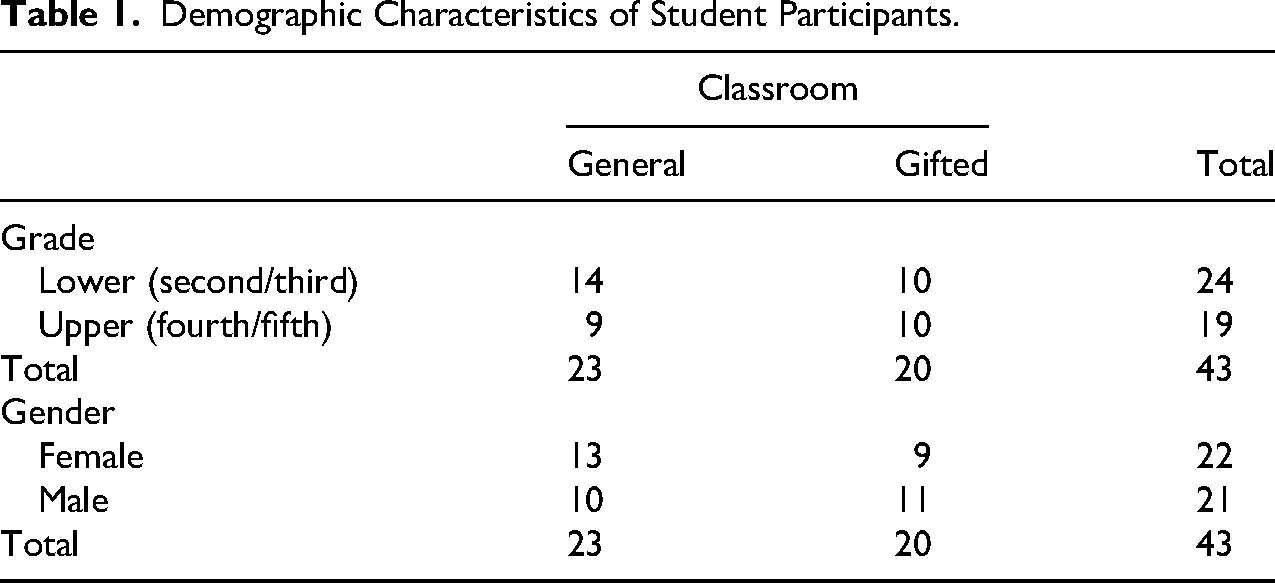
We included two groups of participants in the study: students and teachers. Students were 43 Black children in Grades 2 through 5 who were enrolled in self-contained general or GATE classrooms. Students in the study are from small urban communities that “have been undertheorized as contexts for [language] and literacy learning (as opposed to school failure)” (Dyson & Genishi, 2005, p. 30). Students were from four elementary schools in Central Illinois. In three of the four schools, there was a disproportionate number of minoritized and low-income students (per free and reduced lunch qualification). In the fourth school, only 25% of children in the school qualified for free and reduced lunch, but most were African American. Our study highlights the abilities of gifted children from low-income backgrounds. Table 1 shows the number of student participants in general and GATE classrooms by grade and gender. Again, student participants were from a larger mixed-methods study examining language ability of GATE and non-GATE school-age Black children (see Mills, 2015; Mills et al., 2017).
Demographic Characteristics of Student Participants.
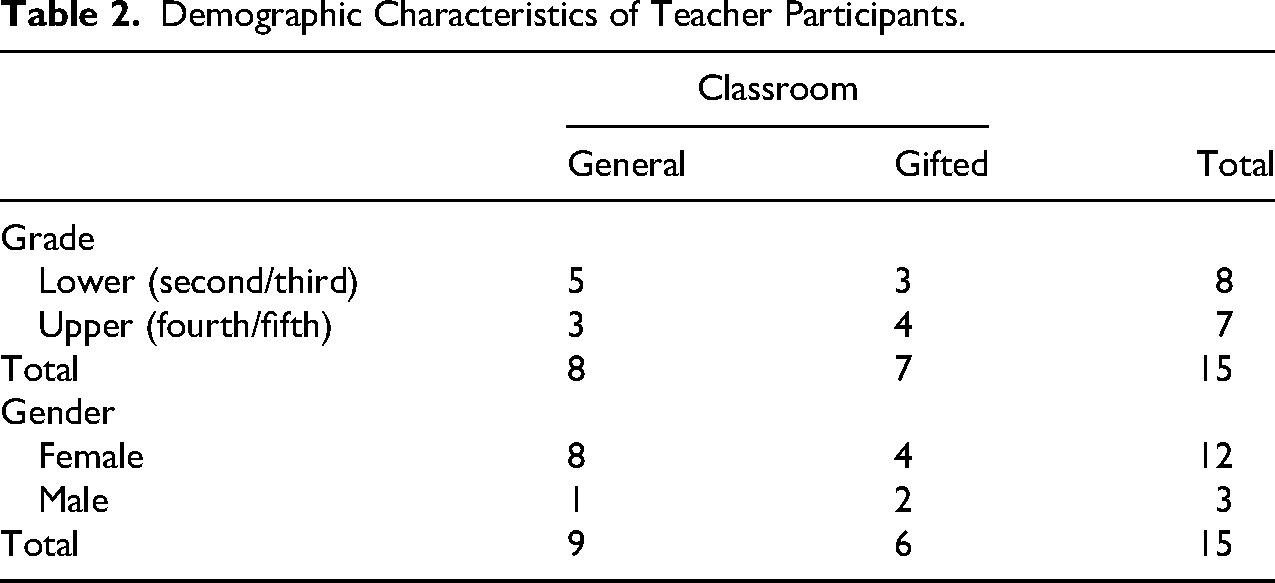
Teacher participants were recruited from the same schools and classrooms as student participants. Table 2 displays the number of teacher participants from general and GATE classrooms by grade and gender. Teacher participants comprised a fairly homogenous group by race and gender: two Black females, 10 White females, and three White men. Teachers also tended to be from the same region of the United States—11 were reared and educated in the state of Illinois; four were from Missouri, Iowa, Ohio, and New York.
Demographic Characteristics of Teacher Participants.
Data Collection
The first author conducted and audio-recorded individual interviews using a Marantz PDP 201 (Itasca, IL, USA) recorder with an external table microphone in a quiet school room during the 2006–2007 academic year. We crafted descriptive interview questions, such as grand tour and mini tour (Westby et al., 2003), to get at participant meaning. Descriptive questions are widely employed in qualitative interviews. Specifically, the first author said to each student participant: “Tell me about someone you know who is a good talker.” The term “good talker” was used as it was a more developmentally appropriate phrase than was “verbally intelligent/gifted.”
The first author said to each teacher participant: “Tell me about a student you know who is verbally gifted or verbally intelligent.” The word “verbal” was used rather than “linguistic” because verbal intelligence is evaluated in target school districts through a test of verbal cognition. Further, we were particularly interested in verbal intelligence in an oral, rather than written or signed, form. Students and teachers were asked to think of a particular case of a good talker/verbally intelligent individual they know. Student participants were told that this person could be from their school, home, or community and that this person could be a teacher, relative, or friend. Teacher participants were told that this person could be a student from their class or from a class previously taught. The goal was to arrive at descriptions of verbal intelligence in children rather than in adults.
Data Analysis
Two African American speech–language pathology undergraduate females who were bidialectal (AAE/MAE) transcribed interviews in the Systematic Analysis of Language Transcripts software program (Miller & Iglesias, 2010). The first student transcribed all interviews with students (1–9 min) and teachers (3–29 min). The second student transcribed 10% of a randomly selected group of interviews from students (40 min) and teachers (30 min). Word-level agreement between the two transcribers reached 95% for student interviews and 93% for teacher interviews. Thus, the conventions listed in Appendix A applied to transcripts were sufficient to represent what participants said and how they said it.
Interview coding
We employed reflexive thematic analysis (RTA) for this secondary qualitative analysis, following Braun et al. (2023). Thematic analysis is a widely used and flexible method for identifying, analyzing, and reporting patterns within qualitative data. Guided by a constructionist epistemology, which views meaning as socially constructed, we followed Braun and Clarke's six-phase RTA process to systematically guide our analysis and ensure thorough and reflective engagement with the data. This six-phase process includes (1) familiarization with the data, (2) generating initial codes, (3) searching for themes, (4) reviewing themes, (5) defining and naming themes, and (6) producing the final report of findings.
In the first phase of the inductive analysis, the first author read all student and teacher interview transcripts to better understand participants’ interpretation of verbal intelligence. Then, she completed selective initial, or open, coding on a small set of interview transcripts that contained ample descriptions of verbal intelligence (20% of student [n = 10] and teacher [n = four] interview transcripts). A second researcher, experienced in qualitative analysis and unfamiliar with the first author's coding decisions, also engaged with the same subset of data to generate initial codes.
Following Emerson et al. (1995), we read transcripts line by line to identify and annotate ideas, meanings, and issues suggested by the data. In the margins, we noted interpretive phrases that captured analytic insights (e.g., vocabulary; this exemplifies duality; ideology of standardization; points to a relational focus). The first author then reviewed and reflected on both sets of codes to expand interpretive possibilities and inform theme development.
In the next phase, the initial codes were revisited and refined through interpretive engagement with the full dataset. Codes were reworded, merged, or expanded to better reflect nuanced meanings across the data. For example, the initial code semantic knowledge was refined into broad semantic knowledge and deep semantic knowledge, distinguishing between knowing what words mean and understanding how words feel.
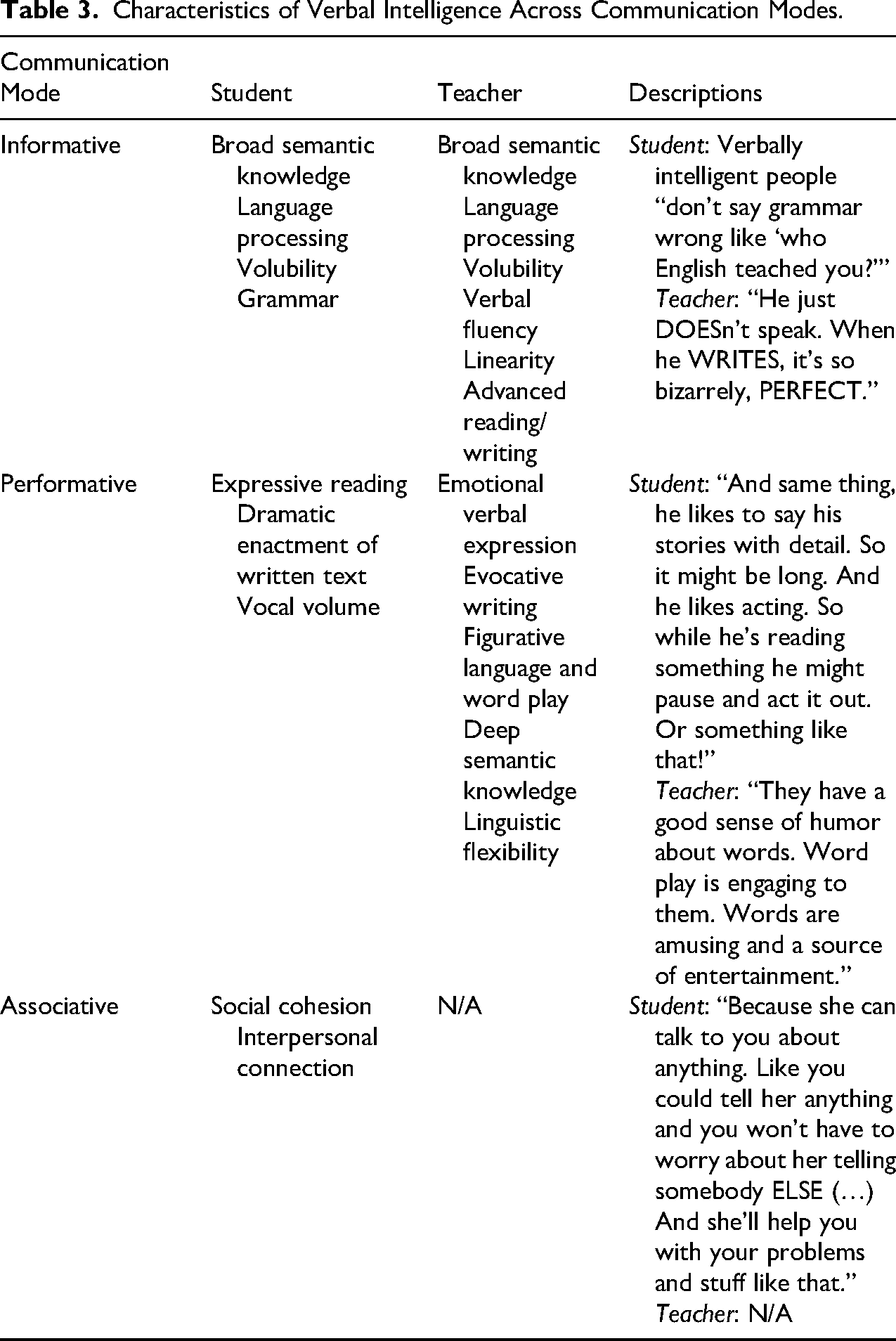
The subsequent phases—constructing, reviewing, and defining themes—were conducted iteratively. Related codes were interpreted as components of broader patterns of shared meaning and organized into candidate themes. Thematic maps were developed to visualize relationships among codes and themes (see Table 3). For instance, descriptions of “advanced vocabulary” were interpreted as part of the informative mode theme.
Characteristics of Verbal Intelligence Across Communication Modes.
In the final phase, the first author reread all transcripts to select illustrative vignettes that exemplify each theme. These vignettes are presented in the following section. Pseudonyms are used in direct quotes, which were lightly edited to improve readability while preserving meaning. Transcription conventions are detailed in Appendix A. In the Discussion section, we present themes as patterns of shared meaning supported by illustrative data excerpts.
Assuring trustworthiness
A trustworthiness check of the focused coding was conducted by two graduate students with advanced training in qualitative research. Graduate students were presented with descriptions of each communication mode and eight excerpts from interviews, as shown in Appendix B. Both students accurately identified all items. The item on Line 6 led to discussions about how to fine-tune coding to better distinguish between informative and performative modes, which is reflected in Table 3.
Results
Student and teacher descriptions of verbal intelligence were framed by three themes: informative, performative, and associative. We refer to these three themes as communication modes, using the word “mode” in the sense of way or manner in which something is experienced, expressed, or done. In the informative mode, participants described verbal intelligence as an individual's ability to share information precisely, concisely, and linearly. In the performative mode, participants described verbal intelligence as an individual's ability to use language in an entertaining and captivating manner. In the associative mode, participants described verbal intelligence as an individual's ability to use language in a way that bonded them relationally to another person.
Black school-age students in general education and GATE described verbal intelligence in all three modes. In contrast, teachers of general education and GATE described verbal intelligence within two modes (informative and performative). Moreover, descriptions of verbal intelligence within the two overlapping modes qualitatively differed between Black students and teachers, as outlined below.
Each communication mode includes distinctive subcategories or characteristics. As shown in Table 3, teachers provided a broader range of characteristics of verbal intelligence within informative and performative modes than did students. Unlike students, teachers did not describe verbal intelligence within an associative mode.
These communication modes are used as a heuristic for thinking about the participants’ descriptions of verbal intelligence. Further, they are not conceptualized as static in nature; there is some overlap among the communication modes. In fact, participants tended to provide descriptions of verbal intelligence that fit within multiple modes.
Interview data are reported separately for students and teachers. Whenever possible, student and teacher vignettes are presented in ascending order by grade level. Due to space constraints, vignettes for some, but not all, components within each communication mode follow. Appendix A details the coding conventions used in vignettes and quotes from interview data.
Student Perspectives of Verbal Intelligence
Students provided descriptions of verbal intelligence that fits within informative, performative, and associate modes of communication.
Informative mode
Student descriptions of verbal intelligence reflected criteria based on MAE production. Students also perceived verbally intelligent individuals as possessing advanced grammatical and vocabulary skill, volubility, and language processing skills.
Grammar. A third-grade student in the GATE program said that verbally intelligent people “don’t say grammar wrong like ‘who English teached you?’” The use of grammar that aligned with MAE was seen as a part of verbal intelligence in the informative mode.
Broad semantic knowledge. Vocabulary skills were characteristic of student descriptions of verbal intelligence in an informative mode. A third-grade student in the general education program said that his classmate was a good talker because “he knows lots of big words and he can talk a lot.” This student also asserted, “And then sometimes he explains them to me. And then that helps me to understand what those words mean.” This verbally intelligent student not only knows “big words” but is also able to define them for his classmates. A fifth-grade gifted student described himself as a good talker based on his semantic dexterity: S Because I use, sometimes I use big words. As my parents say, I use big words. I Mhm. S That mean instead of me using like a whole sentence just to say it, I just use one big word to cover all the sentences. I Ok give me an example! S Instead of saying “I like talking to people.” I Mhm. S I go, “I like interACTing with people.”
Language processing. A different fifth-grade student in the general education program described someone who engaged in language processing as verbally intelligent. This student was described as verbally intelligent, “someone that is great at telling directions and telling you how to do something.” In the informative mode, good talkers are seen as people who explained and provided information.
In summary, verbal intelligence in the informative mode was characterized by students as involving MAE grammar and extensive vocabularies. Additionally, the ability to explain and provide directions were also characteristic of individuals with verbal intelligence.
Performative mode
Student descriptions of verbal intelligence in the performative mode consisted of volubility, vocal volume, dramatic enactment of written text, and advanced and/or expressive reading.
Vocal volume. A second grader in the GATE program described verbally intelligent individuals as those who were “not shy to talk” and those who “scream on the phone” and “LAUGH loud.”
Dramatic enactment of written text. A fourth-grade gifted student described a student in class as a good talker who performed portions of written text for his counterparts: S He likes to write stories a lot! He said that he was writing since he was like two or something! I Wow! S And same thing, he likes to say his stories with detail. So it might be long. And he likes acting. So while he's reading something he might pause and act it out. Or something like that! I Laughs. S And he would be funny. Or to get everybody's attention, he would like stand on a chair and read it. Or he would read out loud. I Laughs. S And I think the reason why he writes a lot is because he likes fantasy and stuff. Anything that has to do with night or magic or stuff like that.
Expressive reading. A fifth-grade general education student described a fellow fifth grader as a good talker who was an “expressive” and an advanced reader: S Because he use expression when he's reading. I Mhm. S And plus OH YEAH!! He knows what he's reading. Plus he uses like a very loud voice. So if they don’t understand or like if they don’t hear it, he’ll talk real loud and stuff. I Okay. S And he's a high reader!
This individual spoke in a loud voice to facilitate comprehension, and he used expression to engage his audience. It is not clear whether “high” reader referred to the level of the reading group or the level of the text read. What is clear was the association between reading in a performative mode and verbal intelligence.
In summary, students described individuals with verbal intelligence in the performative mode as being verbose in oral and written language, as dramatically enacting written text, as expressive readers, and as loud speakers who were unafraid to talk.
Associative mode
In addition to describing individuals with verbal intelligence as communicating in informative and performative modes, students in this study described individuals as communicating in an associative mode. Descriptions of verbally intelligent individuals communicating in an associative mode were socially cohesive and interpersonally based.
Social cohesion. Verbally intelligent people in the associative mode communicated during school and after school. A second-grade gifted student described her friend as verbally intelligent in the associative mode: S Because she usually talks to me outside. We get to play with each other and swing together. And usually we get to play outside. We usually sit by each other on the carpet too! I Mhm. She's in your classroom? [S Nods] I And why do you say she's a good talker? S Because me and her talk a lot on the phone! I Yeah! And what does Lilly talk about? S Like stuff, like she wants me to come over.
A fourth-grade student in the gifted class described the different ways her older sister spoke and interacted with her and other children: S My older sister. She talks a lot, but not in a bad way. Sometimes she doesn’t use like proper grammar, but sometimes she does. And I think sometimes she can be a really good role model. Because like when she's around other kids, she doesn’t act like how she acts when she is at home. Sometimes when I’m away from her, and then when we meet back together, she will be all nice. But sometimes when I stay around here, I will get annoyed, and then she will get annoyed. But when she's around other kids, she’ll talk to them how she talks to me. She treats them respectfully. She talks to me good, but sometimes bad. But she doesn’t talk to the kids like that.
Interpersonal connection. A different fourth-grade gifted student described her mother as being verbally intelligent in an associative communication mode “because she can talk to you about anything. Like you could tell her anything and you won’t have to worry about her telling somebody ELSE (…) And she’ll help you with your problems and stuff like that.” This did not describe her mother's speech in terms of structure or content but in terms of her ability to relate and respond to another in the way they need. The verbally intelligent individual was a mother who used her talking to advise her daughter and always knew when to restrain her speech to keep information confidential.
A fifth grader in the gifted program identified himself as verbally intelligent based on his use of language to encourage others. He asserted, “I try to use good words towards people, trying to make people HAPPY about themselves.” A fifth-grade student in general education focused on helpfulness in his depiction of good talkers: S When I was sick and we was going out to eat so I could get some soup to feel better, she came to me and started talking about, “Why are you sick?” and “Are you going to feel better?”
A different fifth grader in the general education program said that a verbally intelligent individual “might tell you when you is doing something wrong and you need to work on that to get better at it. And, ‘stop doing this to be a better person in your life.’” The verbally intelligent individual attempted to help someone improve morally.
In summary, verbal intelligence in the associative mode involves the use of language as a tool to connect, encourage, advise, lead, show kindness, and help other people. Verbal intelligence in this mode centers on social relationship construction and maintenance.
Teacher Perspectives of Verbal Intelligence
Teachers provided descriptions of verbal intelligence that fit into an informative and/or a performative mode of communication. Unlike students, teachers did not define verbal intelligence within an associative mode.
Informative mode
For teachers, verbal intelligence in the informative mode consisted of vocabulary skills, verbal fluency, language processing skills, linearity of speech, and volubility and is related to such things as reading, writing, and parental involvement.
Broad semantic knowledge. Teachers across educational placement and grade levels identified students with wide vocabulary knowledge and use as verbally intelligent. One third-grade teacher in general education reported: T Some of the things that come out of her mouth absolutely floor me. I think ‘Wow, how do you even know how to
Vocabulary, as an element of verbal intelligence in the informative mode, was also associated with the ability to understand and use lexical items connected to the curriculum. Verbally intelligent students, according to a third-grade gifted teacher, “see the connectedness between all curricula across the board. And they connect what they learn in the classroom to the world around them without any difficulty at all.” Vocabulary was part of one general education fifth-grade teacher's description of being verbally intelligent in an academic setting, “IN class if they were to talk about a SUBJECT matter, it's if they can use the vocabulary.”
Verbal fluency. Verbal fluency was another characteristic of a verbally intelligent student communicating within the informative mode. Verbal fluency consisted of the ability to express a thought eloquently and articulately. According to a fifth-grade gifted teacher, verbal fluency has to do with the ability to “think on [your] feet [and] construct a good, smooth answer, very fluent.” This teacher's description differed from that of a third-grade gifted teacher on the use of cueing to facilitate verbal fluency. According to the third-grade gifted teacher: T Even if they have difficulty trying to express themselves, they’ll just push right on through it. And they’ll look to you for cues (…) and you might give them one cue and then that kind of sparks whatever it was they were trying to get through to you to finish it.
Language processing. Within the informative communication mode, verbally intelligent students were reported to be good at such language processing skills making inferences, problem-solving, arguing, debating, forming opinions, discussing in an “adult-like” manner, asking questions, commenting, and making predictions. Central to discussing in an adult-like manner was the importance of the topic itself. One third-grade general education teacher said of a verbally intelligent student: T She's really good at expressing her opinions on things. I could see her being a lawyer because she's good at arguing. [She's] really good at debating. She sort of holds the floor. I would describe her as being a leader rather than a follower.
Linearity. Linearity was also important in teacher descriptions of verbal intelligence within the informative communication mode. Teachers described students who spoke precisely as verbally intelligent. A third-grade general education teacher commented that verbally intelligent students do not just “gab on” and not “get anywhere.” She said that these students do not “talk in circles” or “talk AROUND something.” A second-grade general education teacher stated that the speech of the verbally intelligent is “not random.” Verbally intelligent students structured their discourse sequentially.
When asked to describe someone who was verbally intelligent, a second-grade general education teacher said, “I would think of someone who can express themselves and use sequence. And to really use transitions [such as] first, then, next, and finally.” This teacher said that a verbally intelligent student would not present a “tumbling story” but that they would engage in “sequencing and really processing information to be able to piece it out.” In the informative mode, verbal intelligence is described as a cognitive process.
Volubility. Volubility (talkativeness) was another theme for describing verbal intelligence within the informative mode. Teachers stated that verbally intelligent children had much to say, were specific, were loquacious, and simply enjoyed speaking. A second-grade general education teacher said, “His answers are very explicit. And in fact sometimes his answers go a little beyond what I was looking for. He loves to contribute. He loves to talk. He is very verbose.” This description reveals a hedonistic purpose for talking, because it is delightful to the speaker. So then, talking was an act the speaker engaged in not just to inform others by contributing to class discussions but also to entertain himself.
Advanced reading/writing. Like students, teachers tended to relate reading and writing with verbal intelligence in their portrayals of students communicating within the informative mode. A fifth-grade general education teacher stressed that a verbally intelligent student is one who is “able to describe or tell about things that they ARE able to do in written form.” She went on to say that students who were not verbally intelligent tended to write in a telegraphic form, including only the “most important words” and leaving off connectors such as “and.”
Interconnected with teachers’ descriptions of the verbally intelligent as having a command of oral and written language was the notion of their possessing strong vocabulary and language processing skills. The same fifth-grade teacher said, “through their writing, many times you can see the use of vocabulary words, their comprehension, [and] the inferencing.” A fourth-grade gifted teacher said the following of verbally intelligent students, “you see it VERBALLY but you see it when they WRITE. Because of their WORD choices and the SENTENCE structure.” This same teacher described another student who was not “verbal” as verbally intelligent. She asserted, “He just DOESN’T speak. When he WRITES, it's so bizarrely PERFECT.” Here, the term “verbal” also included a student who expressed himself well in written rather than oral language. A different fourth-grade gifted teacher described as verbally intelligent a student who spoke but did not write well. She said, “The written part just really frustrates him.” Yet she included him as an example of verbal intelligence.
Reading was associated with verbal intelligence in the informative mode and was linked to vocabulary. One fifth-grade general education teacher stated, “She's a reader, so her vocabulary tends to be not of a fifth grader.” Here, being “a reader” was related with the employment of above-grade-level vocabulary. A fourth-grade gifted teacher stated, “I definitely see a connection between kids who are astute READERS and good writers and speakers. Kids that READ voraciously at a higher level tend to have that ear for language because they’re always hearing it.” In contrast, a second-grade general education teacher said that a verbally intelligent student she knew was “NOT one of my HIGHER readers, but he's kind of in the middle.” Her description of verbal intelligence allowed space for students at varied reading levels. This teacher's perspective is one that may not converge with that of the school district or the academic curriculum, which stresses development in linear stages.
In summary, verbally intelligent students displayed a wide range of higher-level vocabulary, verbal fluency, an ability to discuss and comment, linearity of speech, and volubility within the informative mode. Teachers also linked verbal intelligence with reading and writing within the informative mode. Verbally intelligent students were able to read at higher levels and to write in a way that showed their comprehension of vocabulary and sentence structure.
Performative mode
Teachers perceived verbal intelligence as having a performative quality characterized by emotional verbal expression, use of figurative language, evocative writing skill, vocabulary use, and linguistic flexibility.
Emotional verbal expression. A fifth-grade general education teacher, after presenting an informative mode of enacting verbal intelligence (e.g., wide vocabulary and amazing knowledge of English vocabulary), reflected, “…You can be verbally gifted and not have a wide range sometimes, if you just have a gift for GAB.” He goes on to say that a verbally intelligent student would express their emotions well, be funny, and enjoy talking. This teacher believed that there were two types of verbal intelligence, “academic” and having a “gift for gab.” The former type could be observed in the classroom and the latter at home or during what Dyson (1993) terms the “unofficial,” student-controlled class times. The verbally intelligent student with a gift for gab spoke with “a lot of SLANG. A lot of JARgon (…) but it's still very descriptive. It's just a different way.” Linguistic flexibility is evident in this teacher's description of a verbally intelligent student who speaks “slang” or “jargon” that is inconsistent with “official” classroom expectations. Thus, teachers included volubility as a characteristic of verbal intelligence belonging within both informative and performative communication modes.
Figurative language and word play. Teachers also described verbally intelligent students as understanding and producing different types of figurative language. A third-grade gifted teacher stated, “They have a good sense of humor about words. Word play is engaging to them. Words are amusing and a source of entertainment.” This teacher went on to give an example of how verbal intelligence might play out in the classroom: T They find things funny. I Mhm. T You know we had a vocabulary word, decay. I Mhm. T And if I say “well decay it's after the j,” they’ll get it.
A fifth-grade gifted teacher reflected, “If somebody SAYS something funny or a little pun or something in class, they’ll catch it.” Verbally intelligent students tended to understand and produce metaphoric language that their same age peers did not. They used language not just as a symbolic tool (Vygotsky, 1978) in the informative mode but also as a toy in the performative mode.
Evocative writing. Children depicted as verbally intelligent deployed lots of descriptive words in their writing. A third-grade general education teacher said of her verbally intelligent student's writing, “Her writing is very detailed and you can just picture and kind of connect with the writer (…) It's not DULL.” An element of audience participation was expressed in this description. The verbally intelligent writer, much like a good storyteller, showed their audience a scene to help them enter the narrative (Bauman, 1986).
Deep semantic knowledge. A third-grade general education teacher described how her verbally intelligent student used vocabulary in rhetorical ways: T Yes because not only the words that she uses but the way she uses them. The way she uses them properly and the TONE she uses them in. You know that she has a FULL comprehension of WHAT that means.
Linguistic flexibility. Multilingualism was associated with verbal intelligence in the performative mode. A fifth-grade GATE teacher commented that her verbally intelligent student “could tell you in three languages.” Teachers described verbally intelligent students as possessing linguistic flexibility in the performative mode. A third-grade gifted teacher said that verbally intelligent students “are flexible in their use of language. They can adapt their language to suit the listener.” This description differed from that of a fourth-grade gifted teacher who stated, “This particular child has a difficult time communicating with peers. He communicates VERY WELL with adults but he does have a difficult time communicating with his peers.” This child, then, who may well be considered socially or otherwise awkward by his peers, was allowed entré into verbal intelligence by his teacher because he communicated well with adults. It appears that displaying the ability to communicate with people in power and in an “adult-like” manner informed teacher descriptions of students as verbally intelligent.
To summarize, it is important to note that general education teachers perceived children in their own classrooms as being verbally intelligent, though they were clearly not participating in a GATE program. Verbally intelligent students, according to teachers across educational placement, had expansive semantic knowledge and spoke with precision. Tensions around cueing students to facilitate verbal fluency and reading level and verbal intelligence were evident. To some extent, teachers across educational placement included notions of linguistic flexibility in their depictions of children who are verbally intelligent. Students who displayed their verbal intelligence through linguistic flexibility were multilingual and code-switched according to their classroom social world as well as according to the social position of the speaker.
Table 3 displays student and teacher characterizations of verbally intelligent individuals across communication modes and shows how Black students’ descriptions of verbal intelligence are similar to and different from those of their teachers. Like their teachers, Black students perceived verbal intelligence in informative and performative modes. These students also placed their descriptions of verbal intelligence in an associative mode, unlike their teachers.
Discussion
In this study, we set out to identify and compare patterns in how Black elementary school students and their teachers talk about what it means to be a highly skilled user of language. In our analysis of participants’ descriptions, we identified three communication modes in which verbal intelligence was said to be demonstrated by children: informative, performative, and associative.
(Mis)Alignment of Perceptions of Verbal Intelligence
Definitions of verbal intelligence within an informative mode aligned with ideologies of language standardization: Verbally intelligent individuals expressed themselves in ways that aligned with classroom MAE. Definitions of verbal intelligence across informative and performative modes reflect the ideology of dualism between orality and literacy: Definitions within the informative mode focused on clear verbal expression used to demonstrate knowledge whereas definitions within the performative mode centered on dramatic verbal expression used to entertain an audience. Finally, definitions within an associative mode did not fit within the framework of language ideologies as it captured verbal intelligence expressed within human relationships.
For both students and teachers, descriptions of verbal intelligence in the informative mode were grounded in the speaker's ability to share information clearly, using a wide range of higher-level vocabulary. Descriptions of verbal intelligence in the performative mode were based on the speaker's ability to captivate their audience, with students and teachers referring to different verbal means of doing so. Unlike teachers, students also produced descriptions of verbal intelligence in an associative mode, which were rooted in relationships and the skillful management thereof through talk in interaction.
We found that students and teachers produced descriptions that converged in some respects and diverged in others. Table 3 summarizes student and teacher characterizations of verbally intelligent individuals across communication modes and shows how Black students’ descriptions of verbal intelligence are similar to and different from those of their teachers. Like their teachers, Black students described verbal intelligence in the informative and performative modes. For both groups, verbal intelligence in the informative mode was demonstrated through volubility, language processing skills, and a wide range of higher-level vocabulary.
Students’ descriptions included references to the use of MAE grammar, whereas teachers linked verbal intelligence in the informative mode to linearity of speech and school-based literacy skills: higher-level reading ability and writing that demonstrated advanced lexical and grammatical knowledge. Verbal intelligence in the performative mode was described by students and teachers as manifested through emotionally expressive and evocative language use. Students emphasized vocal volume and expressive reading and dramatic enactment of written text, whereas teachers referred to the use of advanced vocabulary, figurative language, and word play in both speech and writing and linguistic flexibility (the ability to vary and adapt their linguistic style and/or code to the listener and the setting).
Teachers’ conceptualizations of verbal giftedness seemed circumscribed by the language and literacy practices that are taught and privileged in schools, with a strong emphasis on skillful communication of facts and explanations. Across the data, we observed that teachers’ descriptions were limited to school contexts, whereas students’ descriptions of verbally intelligent children referred to a range of contexts. This finding may seem unsurprising: Teachers were interviewed in their professional role, and the informative mode is prioritized in most classroom instruction. Nevertheless, these patterns of difference merit attention because of their possible bearing on teacher referrals of Black children for GATE testing.
If Black students conceptualize verbal intelligence in the informative mode differently than do their teachers, their efforts to perform at a high level in this mode may not be recognized or valued by their teachers. If Black children recognize and value more highly verbal intelligence in modes other than the informative mode, they may display verbal skills more frequently in these modes rather than in the mode prioritized by their teachers. If teachers attend most to verbal skills displayed in the informative mode as indicators of verbal intelligence, if they conceptualize verbal intelligence in this mode quite differently than their students do, and if they do not even consider the associative mode to be relevant for gifted identification, they may not recognize the gifts and potential of Black children whose verbal intelligence manifests in other modes more frequently and/or more noticeably.
Implications for Educational Theory
With the goal of contributing to efforts to make GATE programs more inclusive by expanding our understanding of verbal intelligence, we explored how Black children and their teachers talked about what it means to be a highly skilled user of language. We took this emic approach because it is necessary to know more about how key participants in GATE identification processes think and talk about verbal intelligence so that their perspectives may enrich theory and inform its translation into practice. Descriptions from Black elementary students and their teachers provided insights that can help us reconceptualize verbal intelligence in ways that are more culturally and verbally inclusive and more aligned with current theories of language as social and cultural practice.
Based on student and teacher descriptions, we inductively identified three communication modes (informative, performative, and associative) in which children may demonstrate verbal intelligence. For each of these modes, we identified characteristics that were regarded by participants as indicators of verbal intelligence. We found similarities and differences between students and teachers with respect to the number of modes (two for teachers and three for students) and the characteristics associated with each mode. And, finally, we found that one mode (informative) predominated in teachers’ descriptions, whereas students gave greater weight to two other modes (performative and associative). Together, these findings may help us reconceptualize verbal intelligence and develop frameworks for gifted assessment and identification that are grounded in the perspectives and experiences of Black children and their teachers and that take differences into account to address the needs and interests of a group that is under-represented in GATE programs in all settings, but especially in urban schools/communities (Mills et al., 2013).
Our findings resonate with those of prior research showing differences in how giftedness is perceived by Black families and (mostly White) teachers. Humor, an ability to improvise, the use of expressive language, and the ability to interact successfully with others were highly valued by Black families and are believed to indicate high potential (e.g., Torrance, 1978; VanTassel-Baska & Stambaugh, 2007). On the other hand, teachers emphasize academic achievement and conformity to classroom norms (Cody et al., 2022). Moon and Brighton (2008) found that primary-grade teachers believed that the gifted learner had “facility with language, including a strong vocabulary”, and they had difficulty imagining a gifted learner without strong early reading skills (p. 472). Teachers in their study did not link giftedness to social competence. Rather, they found it easy to imagine a gifted learner with “poor social skills” (p. 457), and they were less apt to consider identifying as gifted a student who “is well liked by classmates” or “makes other students laugh” (p. 462).
Not only does the associative mode help us reconceptualize verbal intelligence in a way that better represents the perspectives of Black students and their families, it also draws our attention to the fact that interpersonal communication is a major component of linguistic behavior and thus should be considered an important dimension of verbal intelligence. Furthermore, if we take seriously the research findings that Black students “may engage their problem-solving, critical thinking, concentration, and creative skills more often when engaging with others, as opposed to when working individually” (Cody et al., 2022, p. 2), then we need to reconceptualize verbal intelligence in ways that recognizes the importance of interpersonal communication in academic and intellectual endeavor and development.
We see the ideology language standardization reflected in our participants’ descriptions of verbal intelligence when students invoke criteria based on MAE, when teachers make no reference to the associative mode and instead focus on the informative mode, and ideologies of dualism when teachers emphasize so-called “literate language” (school-based literacy skills, linearity of speech, and advanced MAE vocabulary and grammatical knowledge).
The communication mode lens helps us think about language as not just verbal knowledge and skills but also as a tool for social action to serve diverse purposes, in a wide range of contexts, taking multiple forms. Viewing verbal intelligence through communication modes may help us shift from our current focus on school-based literacy skills, vocabulary, and “decontextualized” language use in tests (because testing is a context). Research has made clear that standardized tests and conventional classroom practices and norms reflect and favor the language practices and norms of mainstream culture and consequently disadvantage children growing up in minoritized communities (often urban), whose practices and norms are too often invisible or viewed as deficient in schooling contexts.
Thinking about verbal intelligence in different communication modes can help us move beyond the constructs and categories offered by school curriculum and standardized testing, which too often fail Black children. The communication mode lens makes visible a wider and more inclusive range of skills and strengths, calling our attention to skillful ways with words that may go unnoticed and unappreciated if giftedness is defined in terms of the language and literacy practices that are taught and privileged in school. When we use the three communication modes as a heuristic, we are more likely to recognize when communities vary with respect to how they conceptualize highly skilled language use in each mode and the value they place on verbal intelligence in each of the different modes.
Implications for Educational Practice
In this study, we examined the descriptions of verbal intelligence of gifted and non-gifted Black students in urban characteristic schools and their teachers to better understand their perspectives, with the larger goal of expanding and deepening our conceptualization of verbal intelligence and, thereby, contribute to the development of more equitable and inclusive gifted identification practices relying on verbal skills. We believe that our findings may be used to inform the development of tools and training for teachers in urban characteristic schools to help them recognize verbal intelligence in Black children and advocate for their access to GATE programs. Our findings may also be used to promote productive conversations among teachers, students, and parents about how, when, and where children demonstrate verbal intelligence. Dialogue of this sort is essential to build models of verbal intelligence that incorporate student and teacher perspectives to form culturally fair and equitable GATE referral tools.
Tools that are widely used in gifted identification detect and privilege particular forms of language use that too often lead to the disenfranchisement of Black children, as they tend to be overlooked and excluded from GATE programs (Ford, 2021). For example, checklists that teachers are asked to complete as part of the gifted identification process typically ignore cultural and linguistic diversity in how giftedness is manifested and consequently may fail to “accurately capture [the] strengths, abilities, and potential” of culturally and linguistically diverse students (Ford et al., 2008, p. 297). Such checklists and their use by teachers and decision-makers may also negatively impact the participation of families in the nomination process by framing verbal intelligence in solely school-based ways, emphasizing the informative mode and aspects of language use, such as use of advanced vocabulary and adherence to MAE conventions. In urban characteristic schools, such practices are especially harmful, given that teachers may be racially, linguistically, and regionally different from their students. That is, most teachers are from White middle-class suburban or urban backgrounds, whereas students in urban characteristic schools may be from non-White low-income rural backgrounds.
Ford et al. (2001) have long stressed the need for training and support for teachers to develop the awareness and skills necessary to recognize giftedness in culturally and linguistically diverse students and to recommend them for services. Such training should raise teacher awareness of their critical role in GATE program representation and of bias in GATE identification tools and practices, and language and linguistic diversity must receive critical attention. Despite decades of scholarship demonstrating the complexity of AAE and the linguistic strengths of Black children and their communities, “teachers’ language attitudes have remained remarkably consistent for many decades, particularly when it comes to the language of Black students” (Smitherman, 2017, p. 8). Exploration of multiple perspectives on verbal giftedness and reflection on one's own views would be a critically important part of teacher training in urban characteristic schools (Szymanski & Shaff, 2013), as would discussion of strategies for thinking together with students and their families about the identification of linguistic gifts and talents.
Limitations and Future Directions
Using different interview prompts for students and teachers was a limitation of the study, but something that was necessary given the age difference between the two groups of participants. The more technical language used with teachers may have led them to think only about formal schooling contexts, whereas the more colloquial language used with the child participants may have created a more open space for thinking about verbal intelligence. However, we note that children referred to language use in school and to school-based literacy skills. Teachers’ descriptions centered on school-based language use and reflected an orientation toward literate language, but most of their descriptions referred to spoken language. Future studies are needed to develop and validate measures of verbal intelligence across modes.
A second future study might include a measure of racial identity of Black GATE children. The extant literature indicates that adolescent GATE students and females tended to embrace their Black racial identities to a greater extent than did males and underachievers (Ford & Harris, 1997). A future study might investigate the relationship between modes of verbal intelligence and Black racial identity in Black students. Based on findings from the current study, we would predict that like students in the current study, students with stronger Black racial identities may embrace verbal intelligence within all three modes whereas students with weaker Black racial identities may perceive verbal intelligence only within informative and performative modes.
Finally, to gain a more complete picture, future research must examine Black parents’ perspectives on verbal intelligence. Parent voices are critically important and should feature prominently in equitable GATE identification processes (Delgado-Valencia et al., 2025).
Our work included the voices of Black children, and we believe they serve as a proxy for a parental perspective, as children are constructing identities primarily in the home, under the influence of their parents, at this stage of development. Yet it is not known whether Black adults perceive verbal intelligence within an associative mode as do Black children
Conclusion and Final Thoughts
This study examines verbal intelligence through the eyes of children from a minoritized linguacultural community and their teachers, contributing to the ongoing conversation regarding the underrepresentation of Black students in gifted programs in two ways. First, descriptions of verbal intelligence provided by Black students and their teachers are analyzed and compared to expand on current understandings of verbal intelligence with insights from interested parties. Second, the associative, informative, and performative communication modes are offered in the hope that they may serve as a useful heuristic in future efforts to develop tools and training for participants in the gifted identification process.
If we want to make gifted identification more inclusive, particularly in urban characteristic schools, we must distinguish in theory and practice between being gifted and being good at school as it is conventionally organized and enacted (usually in accordance with White middle-class values, norms, and preferences). Because language plays a large and problematic role in gifted identification, reconceptualization of verbal intelligence is a crucial part of making this distinction, enriching our understanding of giftedness and positioning the field of gifted education to help change widely held beliefs about language that negatively impact the educational experience of Black students.
Footnotes
Acknowledgements
We are thankful for the students and teachers who participated in the study. The first author is grateful to her virtual writing groups that began meeting during the Covid-19 pandemic (Underrepresented Women of Color Coalition, Joy Collective, Collaborative Writing Group) for the wonderful grounding. She is also grateful to her research assistants in the Child Language Ability Lab, especially Zaynab Yusuf for copyediting assistance. The authors appreciate the Supporting Black Children's Language, Literacy, and Joy collective for serving as an ideation factory.
Declaration of Conflicting Interests
The authors declared no potential conflicts of interest with respect to the research, authorship, and/or publication of this article.
Funding
The authors disclosed receipt of the following financial support for the research, authorship, and/or publication of this article: This research was supported by a Cross College Seed Grant from The Ohio State University, Underrepresented Women of Color Coalition Research Grant from the University of Houston (UH), UH Summer Undergraduate Research Fellowship, UH Provost Undergraduate Research Scholarship, The National Institutes of Health (grant number 5R21DC019997-02) and the American Speech-Language-Hearing Foundation. A grant (U54MD015946) from the National Institute on Minority Health and Health Disparities (NIMHD) to the University of Houston supported a Writing Accountability Group. A UH African American Studies professional development grant supported conference travel to disseminate findings from this project.
