




Abstract
We explore how a professional development program enabled educators to stretch their ideas related to (a) equitable participation in elementary mathematics classrooms, and (b) their district's policy aimed at promoting equitable participation. Our analysis revealed that participants’ views shifted as they engaged with others’ sense-making, grounded in their observation of mathematics instruction as it unfolded in real time, about equity and the distribution of opportunities to learn. Our findings highlight how collective inquiry into tensions between policy, theory, and the mechanisms of teaching and learning can create fissures- opportunities to shift educators’ views on and understandings of equity.
Keywords
Attention to equity and inequality in public schooling has animated and driven scholars and practitioners alike. Though we have made progress, it is also true that deep, systemic inequities in access and opportunity persist in the institution of public education in the United States (see, for example, Duncan & Murnane, 2011; Milner, 2010; Noguera, 2016; Weathers & Sosina, 2022). In mathematics education, scholars who consider participatory equity have elaborated the importance of disrupting opportunity gaps that produce inequitable access to knowledge (Flores, 2007; Gutiérrez, 2011; Ing et al., 2015; Reinholz & Wilhelm, 2024). Participation in mathematics class is a key resource that supports mathematics learning (Gutiérrez, 2011; Martin et al., 2017; Michaels & O’Connor, 2015). However, opportunities to participate in mathematical discourse are not distributed equitably (Esmonde, 2009; Herbel-Eisenmann et al., 2011; Reinholz & Shah, 2018; Weber et al., 2010). Students of color, girls, and students for whom English is not their first language receive fewer and less cognitively demanding opportunities to participate in the mathematical discourse of their classrooms (Langer-Osuna, 2011; Martin, 2007), uncovering how teacher biases, stereotypes, and deficit-laden frames construct racial disproportionalities in participatory equity in mathematics classrooms (Copur-Gencturk et al., 2020; Reinholz et al., 2020). Supporting teachers to promote participatory equity within their mathematics classrooms has emerged as a key focus of efforts to eliminate longstanding inequities in mathematics education.
In this paper, we consider how teachers can be supported to promote participatory equity in mathematics classrooms. We begin this paper by considering the ways that efforts to support equitable teaching and learning are complicated by the pervasiveness of under-articulated and under-resourced understandings of both what constitutes and how we might better support participatory equity. We then describe an approach to teacher professional development centered around the close examination of and engagement with a teacher's instructional practice as mathematics instruction unfolds across a week in an upper elementary mathematics classroom. Next, we describe our study that investigated the evolution of in-service teachers’ ideas about participatory equity in mathematics classrooms and practices that promote it as they participated in the professional development approach described. We conclude with a discussion of implications of this research for disrupting longstanding racialized opportunity and participatory equity gaps in urban intensive, emergent, and characteristic schools (Milner, 2012).
Literature Review
The focus of this manuscript is on supporting teachers’ understandings of participatory equity, which, we argue, is critical for the work of teachers practicing across categories of urban education typologies (Milner, 2012). It is no surprise to those intimately familiar with the connection between racism, structural oppression, and capitalism (McLaren & Torres, 2005) that urban intensive, urban emergent, and urban characteristic schools face a number of systematic challenges (Milner, 2012). Research has established that urban school systems report lower levels of academic “achievement,” changing demographics, and severe budget cuts (e.g., Turner & Spain, 2020). Darling-Hammond (2004, 2010) has found that teachers working in urban schools are more likely to be inexperienced, underqualified, and have fewer advanced degrees. Beneath the surface of these statistics is an ever-present deficit framing, often used to pathologize students of color (Ullucci & Howard, 2015), “maintain order” (Acevedo & Solorzano, 2023), and render structural conditions invisible (Gorski, 2016). These stark realities have significant implications for students who attend what Darling-Hammond calls “apartheid schools” that serve more than 90% students of color (2010, p. 38). Supporting teachers’ conceptions and practice-based enactments of these conceptions of equity in schools that have often deficit framed and pathologized students of color is critical.
We join Smith et al. in not “restrict[ing] urban education to its challenges and narratives of inequities” (2024). Instead, we center the mathematical brilliance of Black and Brown children (Leonard & Martin, 2013; Rigby & Forman, 2025; Smith et al., 2024) and the community cultural wealth of their families (Goldin et al., 2018; Khasnabis & Goldin, 2016; Yosso, 2005). Scholars who investigate equity in urban education point to the critical importance of disrupting opportunity gaps by ensuring access to knowledge and maintaining high expectations and culturally relevant pedagogy (Carter & Welner, 2013; Comstock, 2025; Hinnant-Crawford et al., 2023; Ladson-Billings, 1994; Liou & Rotheram-Fuller, 2019; Milner, 2020). Scholars who study participatory equity in mathematics classes propose a similar set of critical considerations for the enactment of anti-racist, equitable teaching in mathematics classrooms, including culturally relevant pedagogy, support of mathematical discourse, equity in access to knowledge, and development of critical mathematics (Coleman et al., 2023; Kokka, 2019; Martin, 2007; Martin et al., 2017; Pateman & Lim, 2012). We draw upon the dialogue between these literatures and, in particular, consider the importance of opportunity gaps in access to knowledge, resources, and opportunities to participate in mathematics classrooms.
Opportunities to participate in classroom discourse are central to learning (National Council of Teachers of Mathematics, 2014; National Research Council, 2000; Resnick et al., 2010; Sfard, 2008). Yet, in mathematics classrooms, we know that access to these opportunities for students of color is often limited. Teachers tend to offer these students fewer and less cognitively demanding opportunities to participate in the discourse of their mathematics classrooms than their peers (Langer-Osuna, 2011; Martin, 2007; Moschkovich, 1999). These racial disproportionalites are related, we know, to teacher bias (Copur-Gencturk et al., 2020; Reinholz et al., 2020).
Shah and Lewis (2019) define participatory equity as “a condition in which both participation and participation opportunities are distributed fairly during the learning process” (p. 438). One way to understand issues of equity in education is in terms of the fair distribution of resources needed for learning (Esmonde, 2009). Although there is wide consensus among educators that equity is a valuable goal, there are two distinct perspectives on what is understood as fair in the distribution of educational resources: educational equity and equality of education (Secada, 1989). Fairness, through the perspective of equality of education, is achieved when all students receive an equal share of the available resources. Through the perspective of educational equity, fairness is achieved when every student receives a share of the resources needed to achieve educational outcomes. Central to the equity perspective is the notion that students enter classrooms with differential needs. For example, the needs of students from groups that have been historically marginalized are mediated by the effects of longstanding institutional discrimination and structural inequality in schooling (Darling-Hammond, 1998). From this perspective, the equal distribution of educational resources is seen as an important starting point but an insufficient approach to achieving equity (Reinholz & Shah, 2018). Educators employing an equity perspective contend that ensuring fairness for students from groups that have been historically marginalized may require providing them with more and different resources than their peers from groups that schooling has historically well served (Levinson et al., 2022; Reinholz & Shah, 2018).
In our work, we have found that although many teachers express commitments to realizing equity within their classrooms, the practices they employ to achieve this goal align more closely with a focus on equality. This mismatch is understandable as the notions of equity and equality are often erroneously conflated. Many of the policies and recommendations for practice made under the banner of educational equity reflect a longstanding conservative commitment to equality in education (Allen et al., 2018; Love, 2019; Martin, 2003). This policy context shapes and constrains teachers’ ideas about the work required to promote equity in their classrooms (Soler-Martín et al., 2018).
One practice that we have seen regularly promoted as critical to supporting participatory equity in mathematics discourse is the use of “equity sticks.” Equity sticks are used to intervene on the problematic trend of students from historically marginalized groups receiving fewer opportunities to participate in discourse in mathematics classrooms. The aim is to prevent teacher bias from hindering students’ opportunities to participate in classroom discourse. In this practice, a teacher uses popsicle sticks (or other objects such as notecards) to randomize which student is given an opportunity to participate in classroom discourse when it arises. Each popsicle stick is labeled with a student's name and placed into a container. When an opportunity to participate in classroom discourse arises, the teacher pulls a popsicle stick, and the opportunity goes to the students whose name is written on the popsicle stick. Essentially, equity sticks, and other similar supports, are an effort to “neutralize” teacher bias and aid the teacher in achieving fairness through a focus on the process of resource distribution with the goal of ensuring that all students are treated the same at the moment in which an opportunity to contribute to classroom discourse arises. Since the distribution is random, each student has an equal chance of receiving any opportunity to participate in classroom discourse. In theory, this will lead to an equal distribution of these opportunities among students over time.
While the use of equity sticks does promote equality in the sense that it seeks to ensure that individuals and groups of students are not systematically excluded from opportunities to participate in classroom discourse, the practice is not inherently equitable, as the name suggests (Curren-Preis et al., 2022; Warren & Ward, 2021). Opportunities to participate in classroom discourse do not occur in a vacuum, and the distribution of these opportunities is a highly consequential and political process (Reinholz & Shah, 2018). Who a teacher calls on to contribute has important consequences for the flow of instruction as well as for who is seen as a competent knower and doer of mathematics within the classroom. As such, differences in the mathematical knowledge and dispositions toward participating in classroom discourse of individual (and groups of) students and how these differences matter for the instructional goals and access to identities as valuable contributors are important considerations when pursuing participatory equity. From this perspective, the name “equity sticks” is a misnomer as the mechanism, random selection, that it relies on belies attention to the differential ways that students may take up those opportunities and the pedagogical and political consequences that result.
The literature on equity focused professional development (EFPD) has been shown to lead to changes in teacher beliefs, bias, and practice about equity (Carter Andres & Richmond, 2019; Tam, 2015). In particular, scholars have found that EFPD can impact teacher beliefs in ways that predict changes in teaching practice (Palermo & Thomson, 2019), that teacher beliefs and biases can be “profoundly affected” by participation in EBPD (Swan & Swain, 2010, p. 165), and that these changes in beliefs, in turn, enable changes in instructional practices related to classroom equity and teachers’ instructional practice (Hošpesová et al., 2018; Maass, 2011). This literature attends to EFPD's effects on teacher bias, yielding similar results, especially related to reflection on bias and impact of that reflection on equitable teaching practice (Gershenson et al., 2016; Pollock & Matschiner, 2024).
Supporting participatory equity in mathematics classrooms involves supporting teachers to distinguish between equity in education and equality of education and to critically examine their practice in light of the distinction between the two. Professional learning communities (PLCs) have been shown to be effective at supporting deep teacher learning and enabling change in teachers’ beliefs and practices contemporaneously (Carter Andrews & Richmond, 2019; Tam, 2015) as well as historically (Cohen & Goldin, 2024). They help promote collective professionalism in teaching and provide avenues for the exploration of new ways of teaching (Harris & Jones, 2019; Hindin et al., 2007). Reflective dialogue is one of the essential characteristics of PLCs that promote teacher learning (Carter Andrews & Richmond, 2019; Kruse et al., 1995; Louis & Marks, 1998), and when this dialogue focuses on problems of practice and concerns about how to foster learning for students in groups that have been historically marginalized by schools that arise from teachers’ own questioning and theorizing, PLCs can support deep learning around issues of equity (Cochran-Smith, 2015). Despite their educative potential, deep, sustained conversations of this type remain uncommon, even in PLCs (McLaughlin & Talbert, 2001). Little and Horn (2007) note that unpacking such conversations can help us understand their power in pushing the boundaries of teaching and learning and contribute to making them a more common feature of teachers’ professional learning.
Our work here in this manuscript is in dialogue with these literatures and the sets of debate, understandings, and misunderstandings. Our aim is to unpack a conversation in which teachers who participated in a professional development context that featured communal reflection and inquiry into live teaching and learning engaged each other around issues of participatory equity, particularly the use of equity sticks. Guided by our research question: What do educators learn about supporting participatory equity in mathematics classrooms when they engage in (1) collective observation and (2) collective inquiry into the mechanisms and practices of mathematics teaching and learning? We seek to understand how this opportunity interacts with more normative understandings of equity as equality, understandings often featured in teacher education programs, in professional development, and in district and local policies. In doing so, we investigate how educators can be supported to develop more expansive notions of equity, for we know that teachers’ ideas about equity inform how they enact “equitable practice.”
Research Context
The Summer Mathematics Program (SMP) is a professional learning experience that brings teachers, teacher educators, and other education stakeholders together for 2 weeks to observe, study, and discuss mathematics teaching and learning. This PLC is organized around a summer mathematics learning opportunity for rising fifth grade students local to a large midwestern university. The SMP aims to provide students with an enriching experience characterized by collective engagement in rich mathematical tasks and robust classroom discourse practices. In addition to providing a mathematics learning opportunity for students of the community, the SMP also serves as a site for the public teaching of mathematics. Led by an experienced elementary mathematics teacher and researcher with decades of experience of making her practice public, the instruction that occurs during the SMP is observed in real time by the participants of the SMP and serves as a “common text” to ground the PLC's collective inquiry into mathematics teaching and learning. The community is referred to as a laboratory to convey that its members have the opportunity to actively engage in the study of teaching by proposing changes to the lesson plan, including teacher moves, and observing how those changes impact the teaching and learning in the classroom.
For the participants of the SMP, each day begins with a roughly 45 min pre-brief of the day's plan before the start of instruction. During the 2.5 h instructional time, participants can observe by watching from the back of the classroom or by watching a livestream of the instruction in a different room in the same building. After the instructional time is complete for the day, there is a break during which many participants review student work. Facilitators then reconvene the participants for a debrief of the day which lasts roughly 1 h.
In the before class pre-brief and after class debrief, facilitators support an ongoing dialogue between the participants and classroom teacher about the ongoing instruction and its connections to enduring problems of practice in mathematics teaching, including problems of practice related to equity issues. During the pre-brief, participants prepare for the day's observations by reviewing the detailed lesson plan and completing the math problems the students will be asked to do. Participants are invited by the facilitators to ask questions and share observations about the instructional goals, the teaching, and the children's work. They are also often encouraged to focus their observation on particular teacher moves or student responses and hypothesize what might happen with the children if particular moves are employed. Typically, a facilitator begins the debrief by inviting the SMP teacher to share her reflections and lingering considerations from the day's lesson. After the teacher shares, the facilitator sets up the whole group conversation by naming and framing possible topics for discussion, which often includes topics raised by participants during previous pre-briefs or debriefs. As they engage in the conversation, participants bring their own reflections and ask questions stemming from both their own experiences and their observations of the instruction. The SMP teacher listens and takes notes during this discussion. At the end of the debrief, the teacher steps back in to comment on topics from the discussion, and these comments often serve as discussion points in the next morning's pre-brief. After debrief, participants either leave for the day or engage in an afternoon of professional development connected to aspects of the teaching and learning from the SMP.
Methods
Data
In this study, we investigated the evolution of a group of teachers’ understanding of equity vis-a-vis their commitments to and reflections upon the use of “equity” sticks. The data for this study come from the first week of one iteration of the SMP. All of the daily pre-briefs and debriefs were video and audio recorded. Transcripts were made from the video recordings, focusing on the larger group discussions rather than small group conversations, which may have happened at different points.
Participants
There were 93 participants during this SMP, which included a mix of teachers, teacher candidates, math coaches, instructional leaders, policymakers, and teacher educators. Participants came from across the United States and around the world. An additional 12 participants attended SMP remotely, through live-streaming. A few participants had attended SMP for multiple years. All participants could attend the pre-brief, the observation of the classroom instruction, and the debrief. Participants could also register for an afternoon professional learning experience that extended conversations about teaching and learning in a smaller setting. Some attendees came by themselves, and others came as part of a group from their school, district, or higher education institution.
Data Analysis
We employed grounded theory (Glaser & Strauss, 1967) and iterative comparative analysis (Corbin & Strauss, 2015) as we analyzed participants’ reflections and questions in the conversation that unfolded in the pre-briefs and debriefs. These methods were used to create the coding framework and to interpret meaning, as we worked together systematically to reveal both themes and patterns in the data (Maier, 2017; Schreier, 2012; Weber, 1990). Moreover, these methods enabled the team to identify themes in the topics raised by participants and, ultimately, to elucidate patterns in participants’ thinking about equity and equality and opportunities to participate in mathematics instruction.
All interview data were transcribed and coded in Dedoose, a web-based qualitative analysis software program that enables synchronous coding and analysis by research teams. We began by identifying codes based on the topics raised by the participants, facilitator(s), and teacher(s). Each code included a description and an example quote. To test this initial version of the codebook, the five researchers individually attempted to use the codes on the same transcript. Working together, the research team inductively refined the codebook several times until it adequately captured all relevant themes in the data. After several iterations of additional coding resulted in only minor changes to the codebook, we continued in the following way: each transcript was blind coded by two separate research team members who met with a third research team member to align codes and to ensure consistency in coding. Pairs were alternated for each round of coding to minimize the likelihood of drift. The entire group met regularly to review and clarify coding decisions, clarify distinctions between codes, and revise code descriptions that were entered into the codebook as needed.
“Student participation” and “equity” were two of the topics of discussion that were featured regularly in the ongoing conversation at the SMP over the course of the week. Turns of talk in which the members of the SMP learning community discussed how the students in the SMP were participating, the efforts of the teacher to support and encourage student participation, or problems of practice related to increasing student participation in mathematics class were tagged with the student participation code. The equity code was applied to utterances in which the participants, facilitators, or lab class teacher raised issues related to supporting the diverse needs of individual learners or attending to the histories of marginalization experienced by students of color, girls, and non-native English speakers in the course of instruction. Discussion about participatory equity was found at the intersection of these two codes. One long excerpt was identified in which the use of “equity sticks” was the topic of discussion among the members of the SMP. This excerpt was a rich source of data because of the number and variety of speakers and the sustained, explicit talk about instructional strategies and teaching for equity. It is particularly revealing as several of the participants speaking were from a school district that had developed directives around teaching for equity and had sent a team of teachers and administrators to SMP.
Participants
Given our specific focus in this manuscript and analysis of this group of educator participants’ discourse related to equity and equality, we add here the following background pertaining to their schooling context. This group came from a small public school district in a rural district in the western United States. In this district, there are three elementary schools, one high school, a continuing education program, and a virtual K-12 school. About 3,000 students are enrolled in the in-person schools and another 1,000 in the virtual school. Racially, the students self-report as 9% Black, 71% Hispanic/Lantinx, 16% White, and 2% other races including Asian, American Indian or Alaskan Native, Filipino, Native Hawaiian or Pacific Islander, or two or more races. The percentages decrease for the Black and Hispanic/Latinx students from the elementary schools to the high school. Approximately 75% of students are considered socioeconomically disadvantaged according to the district's School Accountability Report Card data. About 10% are considered English language learners, again with a lower percentage in the high school than in the elementary schools. Eleven educators, including five administrators and six teachers from this district, which we will refer to as Grand Valley (GV), participated in this iteration of the SMP. Prior to the SMP, the GV school district enacted a policy strongly encouraging the use of equity sticks in mathematics classrooms. As is detailed in the results, this policy context informed how these participants conceived of the work of and engaged in conversations around supporting participatory equity in mathematics. The evolution of their thinking, as reflected in their participation in an extended discussion about the affordances and limitations of equity sticks as a tool for promoting participatory equity, is the focus of our analysis.
Positionality
The data in this analysis comes from a professional development that was supported, in a variety of ways, by each of the authors. The research team of five individuals worked on this analysis as part of a larger study, including two post-doctoral fellows, one graduate student, and two more senior researchers. We represent a variety of cultural and ethnic backgrounds including Black, Hispanic, and White. We all have experience working with educators to probe and develop mathematics teaching practice through the lens of equity. This experience comes from our time spent as teacher educators, professional developers, and instructional coaches. Approaching the work, and guiding it throughout, we acknowledge that our various experiences and backgrounds inevitably influenced our expectations and interpretations of the data (Creswell, 2009), informed by our collective belief that research reflexivity is a key method to support both the trustworthiness and authenticity of qualitative methodologies (Creswell & Miller, 2000). In practice, this meant that we worked individually and as a collective to interrogate and reflect on our positionalities and the ways that they shape our work. This meant, as well, that each of us engaged in reflection on our racial and ethnic positionalities relative to our discrete and collaborative roles on the project, and that we critically examined the data in terms of racial patterns (Milner, 2007), paying particular attention to deficit frames and racial stereotypes.
Guided by Milner's (2017) four components of the Framework of Researcher Racial and Cultural Positionality, we actively sought to disrupt hegemonic ideas about normality, ongoing and recurrent deficit frameworks, and color and culture blind research (Milner, 2017) as it pertains to both research on K12 schools and teacher education. We took care to honor this as we engaged in the process of collective sense-making, as we worked individually to research the self—our particular racialized selves in relation to the analytic work we engaged in—to move to researching and reflecting on our particular racialized selves in relation to others. By centering race in the analysis, we worked individually and collectively to engage in critical reflection so as to consider systems as we considered school policies and how and in what ways they can—and often fail to—support equity in instruction, especially across each of Milner's categories of urban education typologies (2012).
Findings
What we’re gonna be talking about today is opportunities for children to participate in different ways and to show what they know in different ways.
We begin the analysis of findings with the facilitator's guiding opening, meant to structure the debrief of the classroom work. Here, the facilitator establishes the value, in this setting, of “different” opportunities to participate and how these might be particular to individual children, their learning progress, and the content the class is focusing on.
The laboratory setting is one where participants study many aspects of teaching and learning. In this setting, even participants’ own engagement can be seen as text. As such, the facilitator notes that some participants are sitting in the back and invites participants to notice the following: I’d like you to take a few minutes to think about what it means to be participating. And the reason that I’m asking you that is because you’re sitting in the back. And I’m not assuming that you’re not participating because you’re sitting in the back and watching this discussion. And I’d like you to think a little bit about what are the ways in which you are participating even though you’re not a part of this particular circle because I’d like to hear a little bit about what that means for the children we’re not hearing from as well.
This is one of a few questions the facilitator poses, priming participants to open up their understanding of “what counts” as participation, to look for, in their analyses of the children's participation, more than more traditional markers of participation such as speaking publicly, sharing work at the board, and raising hands.
It is in this context, but quite a bit later in the debrief, that Querida asks: And I just want to know because it's obvious that you do everything with a purpose and that you have very good structure and plans for your day. And I was just wondering what you think of—what your thoughts are on equity sticks—equity cards and would you use them and if not, why not?” she continues: “So like the equity cards where the students can decorate or write their names on poker cards or whatever and then you pull their names to participate in class. I just want to know your thoughts: why not or if yes, why—why would you use them?
In this question, Querida invites the SMP teacher, the SMP facilitator, and other SMP participants, as well as her district's superintendent and other district leadership, to consider a key question about her own district's equity sticks policy. What follows is an analysis of how educators collectively shift in conceptions of supporting participatory equity in mathematics classrooms when they engage in (1) collective observation and (2) collective inquiry into the mechanisms and practices of mathematics teaching and learning.
Observing Teaching in Real Time: Shifting Conceptions and Understandings of Equity
First, we examine an analysis of participants’ consideration of opportunities to participate and, in particular, the ways that educators from GV wrestled with reconciling their district's equity sticks policy with the ways that opportunities to participate were being distributed and taken up in the SMP. How did Querida and her colleagues arrive at this question, a public wondering, in the presence of their superintendent and other district leadership? How and in what ways did their understandings vary and shift, and what remained consistent?
This analysis helps us to better understand how educators can be supported to develop more expansive notions of equity. In this section, we examine and analyze the ways in which the participants, and, in particular the GV participants, speak about, operationalize, and consider students’ opportunities to participate. As noted, we focus the analysis in this manuscript on the discourse in this post-brief as the participants’ engagement in this question is extended.
GV participants came from a district, as we have detailed above, in which equity sticks were used as a means to distribute “equitable opportunities.” Fundamentally, the concept of equity sticks rests upon the idea that equity is achieved when opportunities to participate are “equal” and when they are spread randomly across a group of students. As such, this view is represented in the idea that equity sticks can “neutralize” teacher bias. Here, the “random-ness” of the distribution is posited as how equity is accomplished. This has perhaps obvious and perhaps less obvious implications for understandings of how individual students’ thinking does—or does not—impact or affect other students’ thinking and for the work of the teacher. If “random-ness” is all that is needed to accomplish equity, then the teacher need not consider what individual students know and think about the content at hand. The teacher need not weigh how these different understandings are differentially useful for the development of a class’ learning. The teacher need not consider how a student's response to a question positions them relative to the mathematics or to their peers. Historic patterns of representation and lack of representation can be righted by randomly distributing new opportunities (Figure 1).
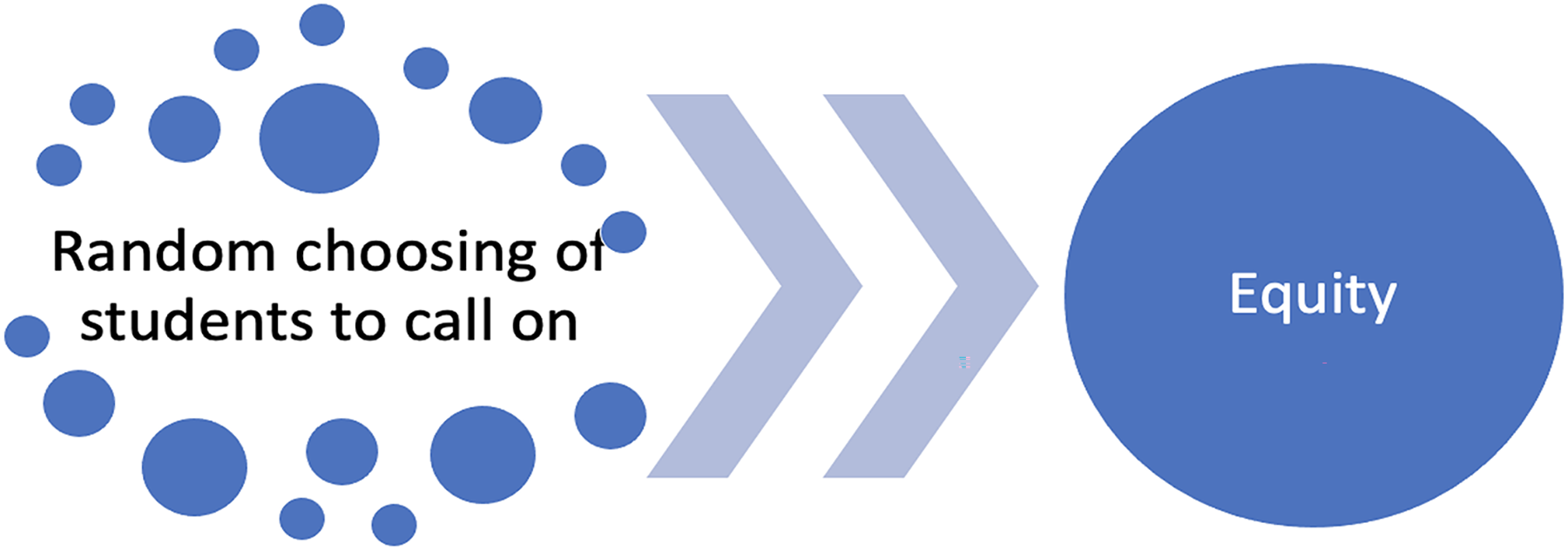
“Equity sticks:” equity as equality.
The SMP class suggested a different set of ways to understand equity: one that moves away from a focus on whether opportunities are distributed “equally,” or randomly, to one where the fundamental question was how might opportunities to participate can be distributed given historic inequalities, and systemic racism, as well as what kinds of considerations go into distribution in a classroom where those historic inequalities play out in real time, and are exacerbated and reinforced, and where what individual students do and can do with content matters for the whole class’ learning—about content, as well as about what “counts” as smart or capable (Figure 2).
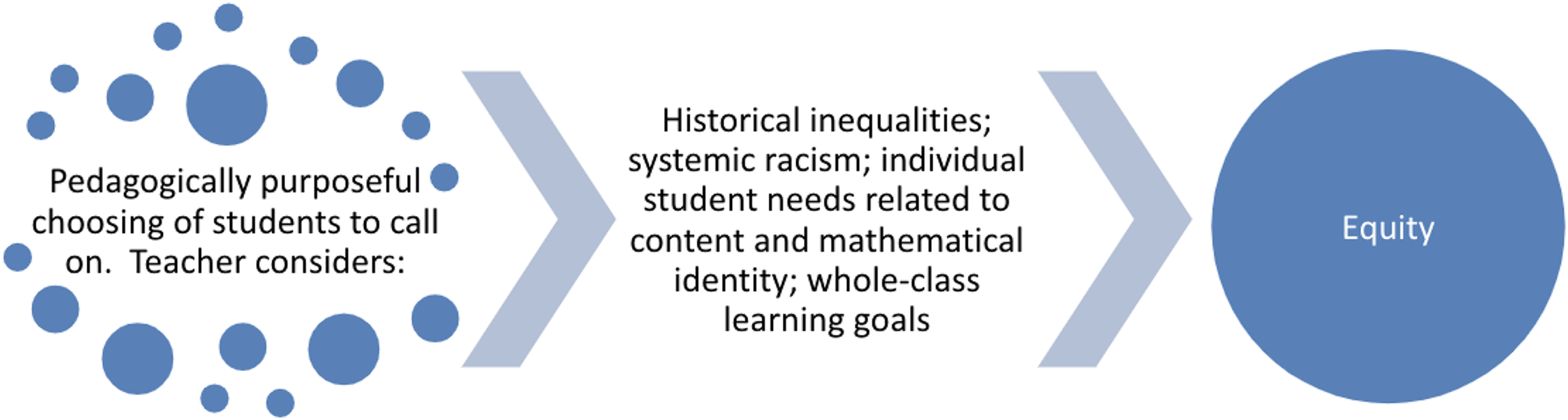
Participatory equity as pedagogically purposeful considerations of individual and collective learning needs and goals and historical inequalities choosing of students to call on.
As detailed below, participants’ views shifted as they came into evidence, in real time, of others’ sense-making about equity and opportunities to learn, all centered on the viewing of children's mathematical work with their teacher and each other. What we see are the ways that tensions between policy, theory, and the mechanisms of teaching and learning can create fissures—opportunities to shift participants’ views and understandings of equity. As participants see students, the mathematical content, and the teacher, each of these is remade and re-oriented toward more expansive views of equity.
Re-Seeing Content: The Role of Content in Creating Conditions for Equitable Opportunities to Participate
A key finding of this analysis is that focusing on the mathematical content children were learning also deepened participants’ understanding of how teachers can create equitable opportunities for participation. Here, Amanda notes: So in our group yesterday, I believe we talked about how a lot of these questions seem to have a low floor, high ceiling. So wherever the students are at, that's where they enter, and they can contribute what is appropriate for them. And they can feel confident in what they’re contributing, but it's still something that they need to reach for. They still have growth they can make. All of them can still learn something new from it.
Here, Amanda brings to the entire group her observation that subject-matter content and the structure and types of problems might be designed instructionally to create conditions that enable equitable opportunities to participate. Turning her eye to the content and the pedagogical choices around problems students are invited to solve, Amanda observes the “low floor, high ceiling” nature of the problems the students consider together. Turning her attention to this leads, as we see, Amanda to name the way this pedagogical design results in all of the students being able to enter into and participate in solving these problems, given their developing mathematical understandings. She notes that this opening of entry does not limit access to only those with a certain level of in-this-moment mastery and also does not limit the ambition of the problems and the work. Instead, as she observes, this design enables students to feel confident in their engagement while, at the same time, opening up further opportunities for the students to stretch and expand their understandings. At the same time, this instructional design serves the teacher herself, enabling the teacher to learn more about the edges and fullness of students’ understandings as they develop. This is a shift from one conception of equity and toward another. Here, the content and the instructional design of the problems around that content are levers for student participation, not only the simple calling on students with randomness.
Re-Seeing Student Contributions to Collective Understanding and Learning
In a subsequent turn, Ann, another GV participant names that individual students grow from listening to each other and that students’ mathematical thinking can stretch individual students’ understandings: With—and kind of going with Ariel's saying, the growth—I’m at Logan's desk right now, and he's the one that used the parentheses and what not. And it's interesting because he went into the equation yesterday with just subtraction problems and addition problems. That's where he went in. And then as he's doing it in class today, he's using division. However, once he listened to the students, he grew and grew and grew, and the answer he gave is not even in his book. So that tells you that he grew, and he went to that ceiling. And so I agree. He did what he could. But—
Here, Ann has been tracking one student's growth through looking at multiple data points. Paying attention to an expanded set of data points, she draws not only Logan's in-class work but also his desk work. Looking across these, she can see his growth as a result of what others in the class were modeling. Ariel notes, “Once he listened to the students,” he was able to reach “that ceiling.” Thus, in addition to expanding the sites for evidence of his growth, Ariel also expands from whom Logan and other students might learn: not just from the teacher, but from the teacher and the other students in the classroom.
Querida adds to this, noting how the structure of the problems allows for what she calls differentiation. This differentiation is not immediately apparent to the children. Instead, Querida names this differentiation as enabling children to “work at their potential” and learn from each other: Well, right off the bat, you think of having to do with small group instruction or one-on-one instruction. And although she [the teacher] does walk around and does like give one-on-one assistance, I think the differentiation in this group is that they don’t even know. They just are working at their potential, and they are listening to each other so well that they are building upon, you know, what they are listening from their peers. And I think Gale mentioned this, but as the students were sharing with each other, you could see the other side of the room writing down more examples and then when it was their turn, they were even more prepared to respond with a more sophisticated answer. And something I really appreciated is that I think it was—I don’t re—‘Cause I had two females, but it was probably Paula. She did not hesitate to share a very easy answer, and it was perfectly fine. And nobody noticed that it was not a—like the four trillion one. But it was just nice to see that she was, you know, like feeling comfort in sharing what—her thinking with the group.
Here, again, we see how participants observed that the structure of the mathematical problems and, perhaps, the norms of the classroom enable the students to participate and learn from each other. Querida notes that the instructional design results in participation that is unencumbered by fear of judgment. And yet, while the GV participants’ eyes are being drawn toward a more open or expansive conception of equity, there are still aspects of the pedagogical work that remain unnamed. Specifically, these participants do not name how the teacher has to and does call on students in purposeful ways, so as to enable this.
As such, each of these statements illustrates the same sets of things: naming individual students’ work and how it moves the whole class, but not naming the purposeful choosing of the student by the teacher in her effort to move the class’ understanding forward. There is much to see and consider in the second conception of equity in student participation. Here, what is seen is expanded in ways that illustrate a shift toward the second understanding of equity, but the teacher's work in facilitating the students’ learning from each other remains unnamed. This is significant, because it leaves an important aspect of the concept of “random” calling upon students that is central to equity sticks unchallenged.
The Conservative Grammar of Understanding: Regression to the Mean
Just as the discussion and shared understandings shift closer to understandings of equity versus equality, in the next turn of talk, we examine how GV participants work to reconcile these new understandings with those that characterized the equity stick approach. In the following quote, Alfred remarks on two key things: the teacher's “poker face” in response to a student's unexpected response, and the results of his own tabulation of who she calls on, and how many, exactly, opportunities each student has in comparison to each other: I think I would have busted up laughing and gave him a high five and a “You’re crazy,” and sent him back to—But she just kept it level. She kept it equal, and I want to emphasize on equal. There was that equality for everybody and moved on and didn’t spend time there. Didn’t act like it was a crazy answer. Everybody was equal, and it just creates that equality but—You know, that makes them all feel comfortable to share.
Here, the word “equal” is used in two ways: equal is how the teacher did not “bust up laughing,” as if restraining herself from saying “you’re crazy” as she remained neutral as students shared their solutions and equal as in the same number of opportunities. Alfred appears to be paying less attention to the pedagogical warrants of the teacher's decision-making and instead is using the rationale for equity sticks to substantiate the teacher's choices regarding the distribution of opportunities to participate in discourse. The individual students’ intersectional identities, their (mis)understandings of the content, and the learning goals and the class’ movement toward those goals fade away, and once we again participants are left with the additive approach, where the who is called on might not be random, but its equitable foundational warrants are unobserved and unremarked upon.
Here, how a teacher responds to the contributions of students is entwined with considerations of equity as how they can respond is conceived as inviting or inhibiting students’ contribution. As such, the distribution is still named as equal, but the process the teacher utilizes is seen for its preservation of that equality. Drawing more from the rationale of equity sticks, we can see how the equity stick approach seeks to disrupt teacher bias by eliminating their decision-making. Here, Alfred tries to knit together both understandings: while the teacher has opened up her aperture, and is responding in differentiated, historically, and sociologically relevant ways, these are justified by Alfred and his district's privileging and preserving the importance of equal numbers of opportunities.
“Paying Attention to the Details”: How Pedagogical Moves Entwined With Ambitious Views of Students’ Brilliance and Mathematical Content Open Up Opportunities for Participation
But the community of teacher-and-educator learners soon fills this gap, bringing the collective eye to the teacher's pedagogy, making the teaching itself more visible. Building on Alfred's statement about the teacher's keeping it “equal” in her demeanor and use of her body, Querida shifts the collective gaze to the effects of the teacher's pedagogy, noting how the pedagogical moves under investigation open up opportunities for student participation: One of the things that I really appreciated—I’m very impressed with—is the fact what Alfred mentioned that whether the response is fantastic or it's wrong or whatever she continues with her, you know, very neutral face. And today was a very good example of that. There were a couple of examples of the students did wrong or whatever, and she redirected the students and continued to ask questions and continued to allow the students to participate in the discussion to show the students what the correct answer was without having to say, “This is the correct answer.” And I was having struggles with that the first day, and so now it feels like very good to, “Oh, so this is how it's happening.” So, you have to pay attention to the details. So, I think it's really productive for the kids not to tell them “This is the correct answer so check your work,” but “Okay so, how did you get there? And what do you think so and so? And can anybody, you know, say anything to help him out?” So, I thought that was really great.
In this moment, Querida analyzes how the teacher's pedagogical responses open up opportunities for students to participate. Querida engages the SMP participants, here, in considering how the teacher's attention to the “details”—here, how students understand mathematical content, and how they are thinking about themselves vis-a-vis that content—is important for the distribution of opportunities to learn. Pedagogy matters not only in the act of calling upon and sequencing student contributions but also in the teacher's responses to “incorrect” answers.
Doing this necessitates an expanded understanding of the content itself, where math is often taught in ways that reify the view of students’ answers being only right or wrong. Querida's observations also necessitate revised views of students’ competence and of the content under study. We can see here that the teacher's pedagogical moves are founded on assumptions of competence: that students are sense-makers who can reason with mathematical content and that in that reasoning they can collectively do productive work that builds their learning opportunities. As such, these observations push at the “equity sticks” view and instead share many of the key foundational understandings of how equity is constructed in the SMP.
Interlude: Moving Forward With Our Inherited Selves and Humanizing Students
Questioning the sufficiency of random assignment for the distribution of equitable opportunities to learn necessitates a radical shift (Cohen, 1990). And, it is one of dissonance, learning, and unlearning. Given this, it is not surprising that the GV participants return again to their inherited ways of understanding equity. We see here that the idea of “counting” and of “equal” as assessments of “equity” comes up again: My buddy over here Kirsten has been tallying every time she calls on somebody. And every time– And today, I said, “Hey, you know what? Just do the teacher only. Just—Let's see what's going on there.” Because we were tallying up—‘Cause the kids would call on—You know, they got a chance to be teacher and call… And amazingly, pretty much even across the board. So, she's dispersing the amount of time that she makes contact with them and asks them to participate. So, she's giving an assessment there. And also—And I’m thinking looking at their notebooks that that's another area of assessment and of course probably homework too. (Alfred)
Here again, GV participants—Kirsten and Alfred—tally up and count the number of opportunities students have, and note that, even in the SMP way of teaching there is an “even” set of opportunities across students, which they understand as “amazing.” Even as the participants continue to learn more and more about equity, old habits accompany us forward. Counting is a habit that seems especially hard to shake off. The muscle memory remains. As the GV participants have observed and named, randomly assigning opportunities for students to participate is not a measured, pedagogically warranted decision grounded in disrupting historical inequalities and supporting the learning goal. But as the GV participants have, themselves, already seen and named, pedagogically, randomly assigning opportunities to participate is not the measured, pedagogically warranted set of decisions made based on understandings of historical inequalities, of children's sense-making as individuals and as a community, and in relation to a learning goal.
Beginning with this focus on the teacher, they keep their eye on the adults in the room and reflect on how they, themselves, have felt about participating in the SMP learning community and how the opportunity to be students themselves helps them re-see what K-12 students might experience in a classroom that uses equity sticks. On this Kirsten opines: Okay. I’m from the same district, so that's something that our district likes us to do. But as I’m talking to other colleagues, like we’re in the class like the students now. And we sometimes don’t like it (laughs) when we’re getting randomly called on. That's one thing I like that she does so they know you’re each going to have a turn. She says, “We’re gonna share.” They’re prepared. They’ve already talked to their partner. Sometimes when you use equity sticks, you’re really putting people on the spot, and we as adults, I’m personally—I got so nervous yesterday, and some of these kids, you can tell they’re very nervous even though she makes them comfortable and is giving them confidence. So, I don’t know that those equity sticks are for everyone and every child. Maybe to the teacher it's proving that you’ve done it. But she's a master like I said. All these kids are even today. It's like she did a really great job. Sure, she highlighted like Tomeka. She needed that. But she does real well about making sure she does it equally. So, I don’t know if that's a strategy that maybe more beginning teachers need or teachers that aren’t as well structured as she is. But interesting to see both ways of calling on students.
Here, Kristen names that putting herself and her colleagues in the seat or place of a student complicates her commitments to that district policy. Positioned in this new way Kristen wonders: perhaps equity sticks help teachers think that they are teaching in equitable ways while they might jeopardize students’ feelings of safety and inclusion. In this turn, what “our district likes us to do” is set alongside how students in classrooms, themselves, might be affected by this policy.
“Looking at it Differently”: Challenge and Expansion of Understandings of Equity and Equality in the Distribution of Opportunities to Participate
We conclude the findings section with Ann's final contribution, in which she names and confronts the dissonance she and other of her colleagues have felt in the SMP and the observation of live teaching, and how she finds herself, now, “looking at it differently”: I think that goes with the fact that [the teacher] really wanted to call on someone with a different fraction ‘cause she wanted to pull out some of the things. And I totally understand that. She wanted to look at some different math pieces. But Tomeka needed to be called on, and she blossomed after that. And I mean even when they came back from the break, she was answering questions (inaudible) spoken the whole time, and now she's running the show here. You know? And so, I do– And it– This is really hard for Querida and I because we do a lot with equity sticks and things like that. But this is the first time I’ve been looking at it through different eyes right now. And at that time, that needed to happen. And so that's where I’m definitely looking at it differently.
The dissonance Ann speaks of here exists between what she observed regarding opening up opportunities and her district's policy of using equity sticks. Here, Ann notes that the teacher had her eyes on two things: first, what the community of learners needed to move forward, and, second, what an individual in that community needed for her own sense of competence and engagement. Ann names this teaching problem and the work that the teacher needed to do to manage this dilemma. The results of her pedagogical choice, Ann notes, were many, resulting in a significant shift in Tomeka's understanding.
Meanwhile, if the teacher were mandated to use equity sticks, neither of these pedagogical choices would be open to her. She would not need to have her eye on the content and how to move students through their understandings or on what an opportunity might mean to Tomeka in this precise moment. Instead, the teacher would find herself choosing a popsicle stick from a cup, which her district maintained would result in equity.
Discussion: Moving Past Technical Fixes
− Undoing of low standards through careful examination of students’ mathematical brilliance
− Expanding teachers’ understandings of participatory equity to show that
David K. Cohen wrote that “all revolutions preserve large elements of the old order as they invent new ones” (1990, p. 117). Moving toward new understandings of equity is a tricky work, especially when these understandings have been constructed and reinforced in the nested environments and systems of racism, structural racism, and capitalism that mold and shape normative understandings of teaching and learning in the United States (McLaren & Torres, 2005) and in urban intensive emergent, and characteristic schools (Milner, 2012). Our analysis of the ways in which participants’ conceptions of equity shift as they observe teaching and learning in real time, in community with other teachers and educators, and with the scaffolding of the teacher and teacher educators highlights the stickiness of the “old order,” which obstructs opportunities for historically racialized youth to participate in mathematics classrooms. The participants’ ideas are stretched, both individually and collectively, with and by each other and by the opportunity for collaborative inquiry into the mechanisms of teaching and learning. And the trajectory of these changes is not linear. As participants advance toward a new way of considering equity, questioning and coming to better understand the ways that random approaches at equity in classrooms that are nested in racist and unequal systems, participants rely on “old” ways of validating equity: by counting and tallying at times, paying less attention to the childrens’ mathematical progress, and at other times coming to privilege the collaborative and mathematical thinking in the classroom. As such, this analysis helps us better understand how educators can be supported to develop more expansive notions of equity that infuse their practice and disrupt longstanding opportunity gaps in participatory equity, especially as they are enacted across urban education typologies (Milner, 2012) and racial disproportionalities in participatory equity in mathematics classrooms (Copur-Gencturk et al., 2020; Reinholz et al., 2020)
Doing so necessitates, we see, breaking away from incentives—perverse and otherwise—that reside in nested spheres of the work of teaching. Disrupting the idea of equity sticks as an effective means to achieving participatory equity necessitates, first, rethinking how educators see and know content. In this case, for example, children's work “doing” mathematics comes to be seen as a process of mathematical thinking, not, as is more common, as a process of “right”/“wrong.”
Second, this disruption necessitates rethinking how educators see and understand children in classrooms. In this case, coming to see children as sense-makers and mathematical thinkers whose individual progress and learning is and can be a resource for the learning of the collective, and for whom teachers should maintain high expectations. Given the preponderance of deficit views of racially minoritized youth across and within urban typologies, we see how centering Black and Brown youths’ brilliance as axiomatic (Leonard & Martin, 2013; Rigby & Forman, 2025; Smith et al., 2024) challenges teacher beliefs. Third, this disruption necessitates rethinking learning goals, and scaffolding and understanding individual students, and the class trajectories toward these goals for the collective. Last, this disruption necessitates rethinking a key practice of teaching: distributing opportunities to learn. As such, disrupting understandings of equitable distribution of opportunities to participate in classroom discourse can be understood as a micro-disruption: a disruption in an everyday practice of teaching that occurs innumerable times across each hour and day of classroom instruction. This is aligned with scholarship on equity in urban education that points to the necessity of disrupting opportunity gaps by ensuring students’ access to knowledge, of teachers maintaining high expectations; and of the use of culturally relevant pedagogy (Carter & Welner, 2013, Comstock, 2025; Hinnant-Crawford et al., 2023; Ladson-Billings, 1994; Liou & Rotheram-Fuller, 2019; Milner, 2020).
These findings are useful, as well, for understanding the power—and limits—of policies that rely on color-blind and inert mechanisms, such as equity sticks. Equity sticks are tools that are dependent upon teachers’ use with their students as they work on content. A limitation of this inert and color-blind tool is that it carries with it a false narrative regarding what it “takes” to practice in equitable ways. This problem removes the possibility of equity being embedded in the pedagogical practices and the content knowledge for teaching that a teacher brings to their work. Last, this color-blind and technical fix to a trenchant problem that plagues US public schooling obscures deep consideration of the historical and contemporaneous systems of White saviorism and endemic racism in our classrooms and society. All of this pertains to necessary expansions of understandings among educators related to disrupting opportunity gaps as they pertain to participatory equity in mathematics classrooms (Coleman et al., 2023; Kokka, 2019; Martin, 2007; Martin et al., 2017; Pateman & Lim, 2012) and how doing so benefits students’ opportunities to participate in mathematical inquiry in classrooms.
In the final excerpts analyzed here, Kirsten notes that equity sticks could serve, quite simply, to reassure the teacher that they are working toward equity: “Maybe to the teacher it's proving that you’ve done it” and invites other participants to note that the teacher had to (1) have her eye on what the community of learners needed in order to move forward and (2) what an individual in that community needed for her own sense of competence and engagement. Her analysis—a break from the ideas she and her colleagues brought to the professional development—uncovers how only with those focal points could the teacher practice in a way that might approach equitable distribution of opportunities to practice.
The implication, then, is that educators must focus not on the inert tool if they are to substantively stretch how they distribute opportunities in equitable ways. Instead, their eye and their attention needs to be focused on how they use the tool—how they animate it in their practice, understanding that achieving equity necessitates focusing on how tools are being brought to bear on the sets of decisions that the teacher is attending to in the practices of teaching and learning, how they understand their students as brilliant sense-makers, cultivating reflexive awareness of systems of racism in educational policymaking, especially as it relates to common pejorative, deficit laden views of urban schooling.
Footnotes
Declaration of Conflicting Interests
The authors declared no potential conflicts of interest with respect to the research, authorship, and/or publication of this article.
Funding
The authors disclosed receipt of the following financial support for the research, authorship, and/or publication of this article: The research reported here was supported by the U.S. National Science Foundation under Award No. 1621104. Any opinions, findings, and recommendations expressed are those of the authors and do not reflect the views of the U.S. National Science Foundation. We express our gratitude to the children and teachers in the mathematics classroom for inspiring us every day with their brilliance and allowing us to use their mathematics classroom as a shared context for professional learning. We also thank the teachers, professional developers, and teacher educators who engaged in learning with us. They pressed us to consider the realities of schooling and engaged with us in imagining classroom spaces that showcase the brilliance of all students.
