



Abstract
This qualitative study analyzed data from urban intensive and urban characteristic in-service teachers in a master's program using a raciolinguistics framework. Using classwork and interview data, we explored how professional development (PD) allows teachers to engage with professional discourses to process raciolinguistic experiences as they teach in secondary content-area courses. These experiences included microaggressions with other teachers, friends, and the students they taught. Teachers identified and navigated tensions in their profession from being positioned through raciolinguistic policing. Lastly, indexing and naming raciolinguistic ideologies led teachers to negotiate professional identities. Based on those findings, we share implications for in-service teacher PD and the potential to engage teachers to negotiate raciolinguistic ideologies around teaching emergent bilinguals in various urban contexts.
Keywords
Introduction
Urban school districts in Texas serve one of the nation's largest populations of multilingual students from diverse ethnic, racial, and cultural backgrounds (National Center for Education Statistics [NCES], 2021). This context is rife with both nuance and tension, as at the secondary level (grades 7–12), the teacher workforce is predominantly monolingual and reports feeling underprepared to instruct Emergent Bilinguals (EBs; Rubinstein-Avila & Lee, 2014). Teachers similarly report feeling underprepared for teaching in urban school contexts (Howard & Milner, 2021), which are in turn often characterized by large numbers of EBs. The present article focuses on those educators who not only work in urban education contexts with EB students but also identify as linguistically minoritized themselves. These teachers, in particular, grapple with additional layers of ideological clarity and identity negotiation as they are racialized and forced to navigate hegemonic listening subject positions of individuals and institutions (Fallas-Escobar & Deroo, 2023). As an example, in one of her professional development (PD) assignments, the participant Marina poignantly reflects on a comment made to her by a friend: “You have a master's degree, but you speak so ghetto,” shedding light on the raciolinguistic affronts linguistically minoritized teachers endure (all names are pseudonyms).
In conceptualizing urban schools, Milner (2012) proposed a typology distinguishing between “urban intensive” and “urban emergent” contexts. He introduced a final category, “urban characteristic,” for schools outside cities that share common characteristics with schools in large cities. In that category, he highlighted schools that experienced demographic shifts, income inequality, and increased EBs despite not having considerable enrollment numbers. Welsh and Swain (2020) built on Milner's framework, emphasizing the complexities of defining urban contexts not just by the volume of students they serve. They argued that discussions of urban education in academic literature often focus on the deficit positioning of minorities. Instead, they advocated for recognizing nuances in sociocultural factors present in urban settings, which can inform learning challenges and benefits. Our study focuses on two school districts that could be categorized as urban intensive and urban characteristic.
As a bilingual teacher in an urban intensive district, Marina illustrates the complexity of making inroads into the teaching profession for those who look and sound different from the norm. Linguistic minority teachers are likely to suffer racial and linguistic microaggressions along the way, affronts stemming from deeply entrenched monoglossic or monolingual language ideologies (Kircher & Kutlu, 2023). In the U.S., these are primarily associated with a one-nation-one-language ideology that manifests as English-only and ideologies of standardization that impose raciolinguistic borders in and on communities (Lara et al., 2025). These ideologies involve belief systems rooted in anti-immigrant notions of incorporation into the dominant culture and language through the English-only movement (Uysal & Sah, 2024) and deficit notions toward heritage languages of longstanding inhabitants of the country. Students and faculty in English as a Second Language (ESL) and Bilingual Education programs are not free from monoglossic language ideologies and, at times, reify the borders of race, language, and ethnicity via schools’ de jure and de facto policies (Chávez-Moreno, 2021). These ideologies influence how teachers perceive and address multilingual students’ academic and linguistic needs in the classroom (Athanases et al., 2019; Sah & Uysal, 2022).
Becoming and being teachers in ideologically laden contexts means learning to navigate these raciolinguistic ideologies and tensions, which may mitigate attrition and increase self-efficacy among secondary content-area teachers who work with EBs. Therefore, in this study, we analyze data from PD activities designed to support this navigation. Our analysis addresses the research question: How do secondary content-area teachers navigate raciolinguistic ideologies as they learn to teach multilingual students?
Literature Review
Raciolinguistics as a Method
Studies on raciolinguistic ideologies employ various analyses to address “critical questions about the relationships between language, race, and power across diverse ethnoracial contexts and societies” (Alim et al., 2016, p. 3). A raciolinguistics methodology critically engages and exposes instances of colonization through racialized linguistic practices (Von Esch et al., 2020). As a social construction, whiteness 1 is positioned as the standard and a standardized version of English as the norm with which individuals’ language is measured (Lippi-Green, 2012). However, even when presented with what would be considered standardized speech, listening subjects perceive speech that emerges from a person of color as accented (Rubin & Smith, 1990). In this way, raciolinguistically oriented studies expose how vestiges of colonization still serve to racialize individuals and their language practices, devaluing and positioning them as deficient or inferior to practices of idealized white speakers of standardized English (Rosa & Flores, 2017).
Languages and the Education of U.S. Latinos Through a Raciolinguistic Lens
Among Latinos in the U.S., deficit ideologies are doubly harmful. Latinos’ English competency is often questioned because their ethnicity is conflated with a monolingual Spanish speaker stereotype, even when they do not speak Spanish (Flores & Rosa, 2023). In contrast, Latinos who possess markers of assimilation are nonetheless pathologized by English listening subjects (Rosa, 2019). U.S. Latinos’ spoken Spanish often faces scrutiny and is positioned as inferior (Briceño et al., 2018; Flores & Rosa, 2015).
Tseng (2021) demonstrated this point and interviewed 22 first- and second-generation Latinos in the U.S. to examine the impact of ideologies around language, identity, and agency on participants’ linguistic identities and language use. Tseng found that pervasive ideologies such as language correctness, language purity, and native speakerism imposed deficit identities on later-generation speakers, who hence felt language insecurity and avoidance. Focusing on the predominance of such ideologies, Rosa and Flores (2017) challenged us to stop trying to “clean up” or fix language varieties in communities of color and instead deconstruct white supremacy by embracing language varieties as equally legitimate and complex.
Raciolinguistics in Teacher Education Contexts
Teacher education and PD contexts are critical sites for what Cushing (2023) referred to as raciolinguistic policy assemblages, or a collection of items such as “curricula, assessments, and pedagogical materials” (p. 46). Within those assemblages, racial hierarchies are usually sustained through the construction of race and language that assert normative identities in education and marginalize non-white, non-standard English speakers. Research examining raciolinguistic ideologies vis-a-vis teacher learning/perspectives offers important insights, such as the concept of teacher subjectivity. This concept refers to the premise that “the self is in constant flux and engaged in a power-laden dialectic with others and the world.” It is “always constructed, contingent, and negotiated” (Daniels & Varghese, 2020, p. 58).
Daniels and Varghese (2020) proposed an added layer, raciolinguicized teacher subjectivities, that shows how bilingual teachers—even those teaching within Dual Language (DL) contexts–can negatively reproduce harmful raciolinguistic ideologies in their evaluation of Latinos or EBs (Chávez-Moreno, 2022). In fact, deficit discourses of languagelessness—that is, language testing policies position students as lacking “academic” language—dominate secondary school contexts where content instruction is privileged over attention to language and literacy in disciplinary teaching (Rosa, 2016; Solís, 2017b). Moreover, deficit language ideologies in circulation among school-based discourse communities, like languagelessness, perpetuate the exclusion and racialization of student identities (Rosa, 2016).
It is essential to acknowledge raciolinguicized teacher subjectivities to understand how teacher education or teacher PD approaches are part of systems in which whiteness and standardized English reinforce who can be heard (Daniels & Varghese, 2020). These approaches may reinscribe whiteness and standardized English and often marginalize particular experiences, epistemologies, and subjectivities of teachers of color whose identities are constructed in opposition to posited neutral teacher identities attached to whiteness and standardized English. Teachers can develop ideological clarity by addressing notions of language and power (Varghese et al., 2023). In other words, raciolinguicized teacher subjectivities allow us to understand how teacher learning activity “invisibilizes, centers, and normalizes whiteness, and the subjectivities of white teacher educators, teachers, and preservice teachers” (p. 60).
This process can be readily seen with the dominance of “practice-based” teacher PD/learning that positions teaching practices as identity-neutral, especially practices intended to redress achievement outcomes for culturally and linguistically diverse students (Daniels & Varghese, 2020). Raciolinguistic ideologies may position teachers of EBs to negatively evaluate and represent bilingual Latino students’ language practices against the background of standardized language teaching within generic practice-based (albeit DL) frameworks. This indicates a need to create opportunities for teachers to develop critical racial consciousness (Chávez-Moreno, 2022) and engage in critical sociocultural pedagogical practices where raciolinguistic ideologies are made visible.
Tensions and Teacher Sense-Making
When involved in PD projects, in-service teachers’ learning may lead them to reflect on tensions undergirded by competing ideologies shaping the context. The tensions teachers encounter in their engagement with project-related discourses are meaningful sites for understanding how teacher identities, professional/teaching expectations/stances, and sociocultural knowledge are constructed, addressed, negotiated, and transformed. From a sociocultural perspective, tensions are ever-present potentialities in meaning-making that, left unidentified or unrecognized, remain unexamined, underdeveloped, and invisible. However, when named and identified, tensions can lead to breaches or ruptures in the productive reorganization or adaptation of relationships between interlocutors and/or apparent disparate bodies of knowledge (Solís et al., 2009; Solís, 2017a).
Tensions have been referred to as dilemmas in teaching as they are ubiquitous and linked to how teaching is inherently uncertain. These tensions require constant negotiation of pedagogical questions, such as changing curricular policies and asserting equity-minded practices while ensuring rigorous and inclusive content delivery (Ball, 1993, p. 392; citing Lampert, 1985; Stillman, 2011). Pushing for or instigating tensions during teacher learning addresses one of the significant pitfalls that derails engagement in equity-minded pedagogical approaches (like culturally responsive pedagogy), where tensions are often avoided, and cultural knowledge and educational inequities are simplified, essentialized, and trivialized (Sleeter, 2017).
Sociocultural research of teacher learning through productive tensions shows the possibility of designing productive spaces and conditions where teachers can examine tensions, engage in robust professional learning, and translate that learning into their teaching. From an activity theory perspective, tensions/dilemmas are not impediments or outcomes of learning but rather “catalysts for teacher change” (Caspari-Gnann & Sevian, 2022, p. 3). For example, a case study involving in-service teachers of EBs grappling with reductive accountability measures illustrates how school principals (acting like mentors) mediated teachers’ critical professional practice through their adaptive support of teacher learning and agency (Stillman, 2011).
More recent research on tensions and teaching (Caspari-Gnann & Sevian, 2022) considered tensions as dilemmas teachers face and situated these tensions/dilemmas within various perspectives as conceptual, pedagogical, cultural, and political based on Windschitl's (2002) work. However, these perspectives of tensions as dilemmas fall under pedagogical tensions. The tensions teachers face negotiating and confronting raciolinguistic ideologies are broader and more encompassing of the sense-making teachers undertake in their personal and professional lives as they take critical stances about culture, language, and education. Focusing on in-service content-area teachers’ navigation of raciolinguistic ideologies, our study contributes to the existing research literature on teachers’ tensions with a critical lens.
Methodology
Project Description and Activities
The current study describes part of Project SELFIES, a grant-funded PD project. Project SELFIES has three goals: (a) to provide 30 graduate credit hours of coursework equivalent to a Master's degree in either Teaching ESL or Bicultural-Bilingual Studies and state certification in either field; (b) to engage in-service educators in Professional Learning Communities (PLCs) and instructional coaching cycles that introduce research-supported methods for integrating content and language in the academic disciplines; and (c) to hold family literacy events for the communities served in two partner independent school districts. Participants are expected to take the ESL or Bilingual Education supplemental exam in Texas after completing the first year of graduate study (see Figure 1).
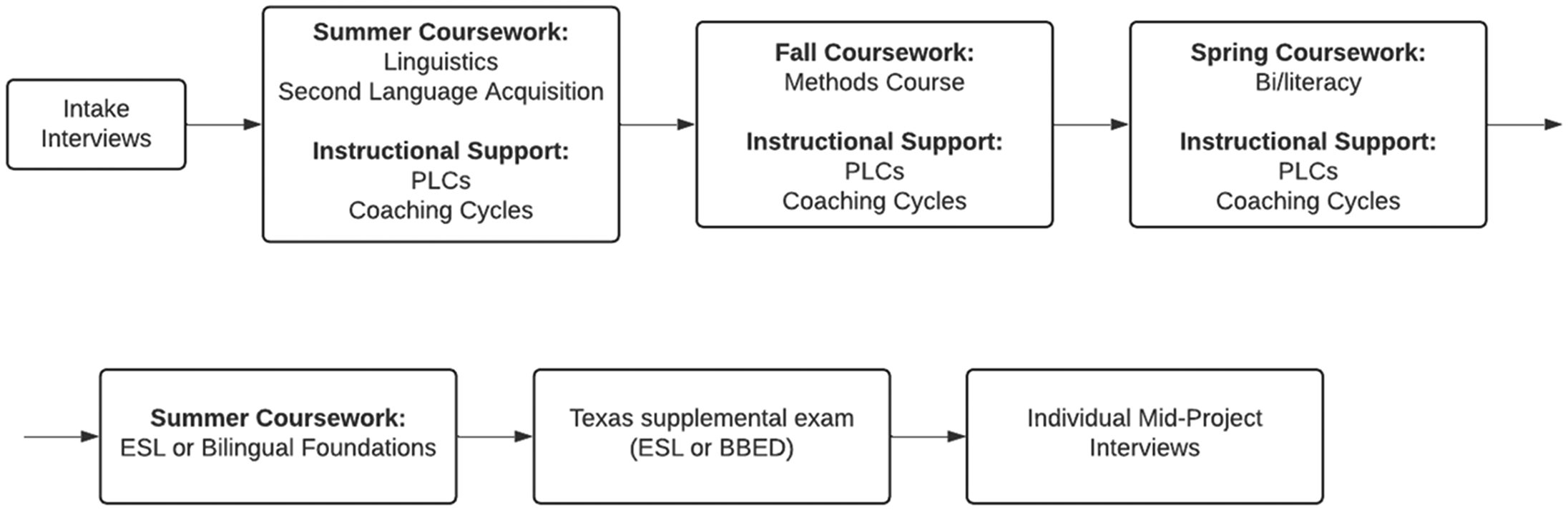
Timeline of coursework and instructional support cycles.
Study Site
This study is socio-politically and culturally situated in a south Texan region that has suffered decades of economic segregation. We are implementing Project SELFIES at a large public Hispanic Serving Institution, wherein more than half of the students identify as Hispanic (Latino) and nearly half identify as first-generation undergraduates. The larger school district is classified as Urban Intensive (located in a large metropolitan city) and the smaller one as Urban Characteristic (located away from a large city but experiencing shifts much like that of larger districts) (See Smith, 2025; Milner, 2012; Young et al., 2024).
The larger district serves approximately 47,000 students, with 25% of total students in bilingual and English language learning programs, and the smaller, roughly 11,000 students, with around 8% identified as EBs. Enrollment trends in the districts and raciolinguistic profiles of students mostly mirror the state demographics, as Texas has the most sizable number of EBs and the largest percentage of Spanish-speaking EBs (89.82%) in the country (OELA, 2020).
Participants
Since 2022, Project SELFIES has included 30 teachers (12 in Cohort 1 and 18 in Cohort 2) with varying degrees of attrition. Of the original 30, 16 teachers pursued ESL supplemental certification, and 14 sought Bilingual Education supplemental certification. The participants represent the following content-areas: English Language Arts and Reading (seven), Science (nine), Social Studies (seven), World Languages (three), and Technology/Business (two). The remaining two are instructional coaches who support content-area teachers in working with EBs and thus engaging across multiple content domains.
Most participants came from ethno-racial-linguistically minoritized and marginalized communities in the U.S. Twenty identified as Latino, two as white/Latino, two as Black, one as Asian, another as Asian/Latino, and four as white. Most participants reported bilingualism as part of their linguistic identities, with 21 indicating Spanish-English bilingualism and eight identifying as monolingual English speakers with prior formal language learning experience. One teacher reported being an English-French bilingual, and another identified as a Korean-English bilingual.
Data Collection
Data sources include course assignments (e.g., Language Learning Story, Identity Wheel), individual intake and mid-project interviews, field notes from classroom observations, and recordings of PLCs and collaborative coaching meetings. Students presented most assignments to their peers in front of the class or during online asynchronous meetings, typically video- or audio-recorded.
Collaborative Coaching Cycles
Participants engaged in praxis through three collaborative coaching cycles during year 1 of the study. These coaching cycles involved 1) planning, discussing, and redesigning a focal lesson, 2) observing/recording the adapted lesson, and 3) reflecting on the lesson afterward. The collaborative coaching cycles engaged content-area teachers in exploring, applying, and adapting pedagogical practices (i.e., humanizing instructional approaches, effective sociocultural practices) introduced during PD activities (i.e., PLC meetings, course reading, assignments). Coaching cycle activities also provided one-on-one deliberate support for teachers seeking to improve student learning outcomes; collaborations between project researchers (graduate students, education professors) and content-area teachers emphasized attention to classroom and school-based concerns, resources, and questions (see Figure 2).
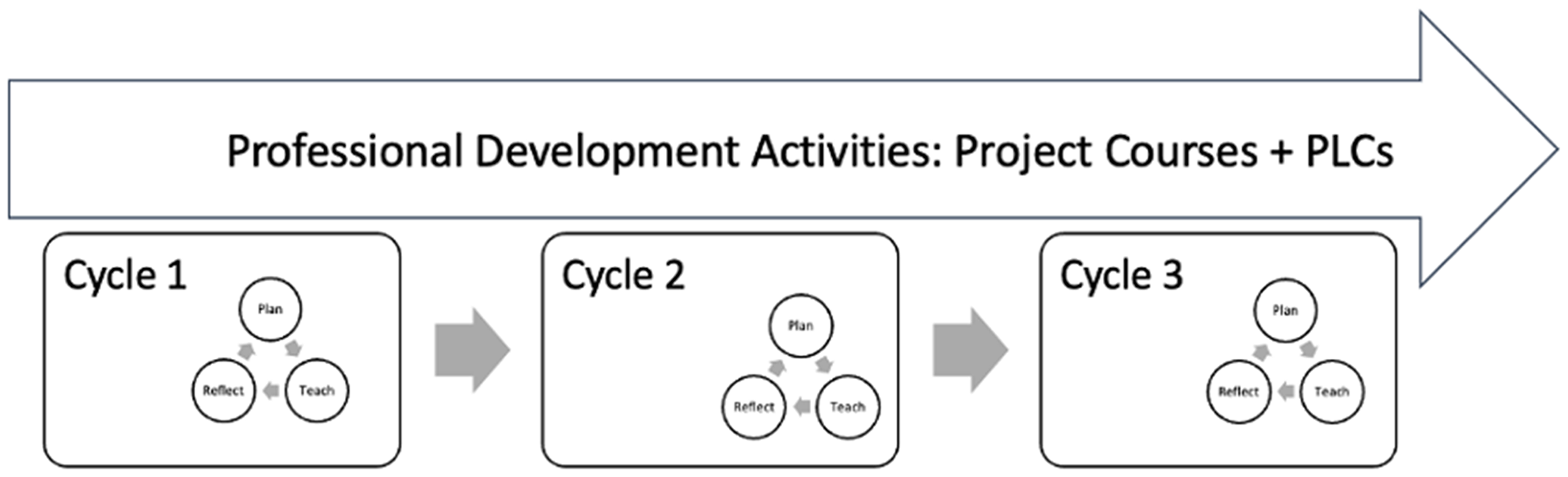
Focal PD activities. PD=professional development.
PLC activities were group meetings during or between organized course meetings where participants reflected and discussed PD themes, course materials, and pedagogical practices. Coaching cycles and PLC sessions focused on engaging critical sociocultural pedagogical practices that drew heavily from the Standards Performance Continuum Plus (SPC+) framework (Teemant et al., 2014). The SPC + framework builds from previous research on the positive effects of teachers engaging in iterative, classroom-based teaching cycles using the Five Standards of Effective Pedagogy (Joint Productive Activity, Language and Literacy Development, Contextualization, Challenging Activities, and Instructional Conversations) and Critical Stance as a sixth pedagogical practice or standard (Bravo et al., 2014; Goldenberg, 1992; Teemant, 2014; Tharp & Dalton, 2007). These six practices informed discussions on instructional approaches and lesson materials; the SPC + framework offered flexible language, facilitating shared conversations about teacher-selected lesson aspects for development and redesign.
Identity Wheel
Participants created an Identity Wheel at the beginning of the linguistics course required during their first semester (see Appendix A). Identities on the wheel included age, spiritual affiliation, race, ethnicity, socio-economic status (SES), gender, sex, sexual orientation, national origin, first language, and ability (University of Michigan, 2024). Participants listed the social identities they considered most often. Then, they reflected on those they thought most strongly impacted their teaching, using numbers to indicate the salience of their social identities. They then explained the relationship of those identities to their professional identities to their classroom peers.
Language Learning Story
As a final Linguistics course project, participants created audio- or video-recorded stories as 10 to 15-min digital narratives with multimodal components. Theorizing narrative as identity construction (Connelly & Clandinin, 1999), language learning stories are an identity-oriented storytelling activity. Narrating their stories, teachers positioned themselves as language users (inclusive of learning), teachers, and analysts by drawing on dimensions of Teacher Language Awareness (Andrews, 1999). The main goal was for teachers to re-remember their language experiences by reflecting on how those positions comprise(d) part(s) of their professional identities as EB teachers. Participants also reflected on raciolinguistic ideologies they had experienced, deepening their understanding of these discourses in their present and future professional lives as bilingual/multilingual speakers and educators.
Data Analysis
The initial analysis focused on describing teachers’ stances, narratives, and/or (re)positioning of pedagogical practices or identity orientations (the focus of the PD activity/assignment), and secondly, the analysis focused on pinpointing how teacher stances and particular tensions were constructed, and how those tensions reflected the broader language and raciolinguistic ideologies (not necessarily ordered in this way). For example, the identity wheels were coded descriptively by tallying how often each social identity was mentioned, and their responses to which identity was the most impactful to their teaching were coded using the wheel as an a priori template for thematic analysis. We also coded the multimodal data, such as language stories, based on the three orientations of linguistically responsive instruction (e.g., sociolinguistic consciousness) to see how those orientations were part of their multimodal narrative identity construction in those stories.
Moreover, we coded the audio- and video-recorded PLC and collaborative coaching sessions using the SPC + rubric and accompanying contextual information. We transcribed planning and reflection coaching sessions by noting both teacher and researcher talk; video logged recorded observations by noting classroom activities, student–teacher talk, and sample speech. We then coded video logs and transcripts by using qualitative data analysis software, Dedoose. Our primary codes included different dimensions of SPC + practices, and we added additional codes grounded in an exploratory analysis of a sub-sample of transcripts/video logs.
As many project researchers considered themselves bilingual/multilingual educators, we attempted to frame and guide discussions to include the range of bilingual/multilingual voices of teachers and students. Questions during planning sessions often focused on discussing lesson ideas and content-areas teachers wanted to pursue a lesson by using one or more of the SPC + practices and/or associated instructional strategies.
Researcher Positionalities
We acknowledge that our positionalities influence the methodological choices and presentation of the data. As university faculty and researchers, we are poised to gain access, build rapport, and earn credibility. We also acknowledge that students may share their experiences in our classes and during interviews because of our positions (De Costa et al., 2021). However, our positionalities also allow us to see the deeper nuances in our participants’ work and data.
Gilberto self-identifies as a Chicano. He attended school in the U.S. and México and is bilingual, bicultural, and biliterate. His work as an EB teacher and bilingual teacher educator spans over two decades. He began learning English at age nine, and throughout his life, he has endured raciolinguistic microaggressions from listening subjects.
Bedrettin has practiced and researched language teacher education in the U.S. by serving teachers of EBs in K-12 schools in Maryland, Alabama, and Texas. He is a Turkish-English bilingual who moved to the U.S. for his doctoral education; he views himself as a transnational teacher educator and maintains his critical pedagogy-oriented research in Türkiye and the U.S. Learning English as a foreign language in Türkiye, Bedrettin's English is marked less/other than the “standard” in the U.S. linguistic landscape.
Jorge identifies as a Chicano bilingual scholar and first-generation college graduate who has worked as a classroom teacher, whole school change consultant, and bilingual teacher educator. His research in the Southwest U.S. centers on advancing transformative ways to leverage and cultivate sociocultural resources and language/literacy practices in STEM content-areas for bilingual/multilingual communities.
Kristen identifies as a teacher educator from the U.S. who has worked as a teacher, instructional coach, and consultant for multilingual classroom spaces and pedagogical practices across the Americas. Being a heritage Spanish speaker has influenced her exploration of linguistically responsive, identity-oriented teacher education and development.
Jessica is a former high school teacher of Spanish and French who now specializes in teacher preparation. Acknowledging the heritage language loss in her family history, she recognizes the long-lasting impact of monoglossic ideologies on one's cultural and linguistic identity. Thus, her research focuses on heritage language maintenance and advocacy for multilingual learners.
María, a Chicana, immigrated to the U.S. with her family when she was three. Consequently, she developed biculturalism, biliteracy, and bilingualism in Spanish and English. She has worked in Bilingual/ESL education for over two decades as a bilingual middle and elementary school teacher and teacher educator. Her research interests include literacy practices in bilingual classrooms, family and community literacy, and bilingual teacher education.
Findings
We set out to address the following research question: How do secondary content-area teachers navigate raciolinguistic ideologies as they learn to teach multilingual students? Through our analysis of classwork and interview data, we focused on how PD allows teachers to engage with professional discourses to process raciolinguistic experiences in an educational context. Our analysis yielded the following themes: (1) engaging professional discourses to process raciolinguistic ideologies; (2) identifying and grappling with tensions related to raciolinguistic ideologies; and (3) negotiating professional identities by indexing raciolinguistic ideologies. These themes do not imply that participating teachers completely disrupted the ideologies and resolved corresponding identity tensions through participating in the PD project activities.
Engaging Professional Discourses to Process Raciolinguistic Ideologies
Our first finding demonstrates how teachers engaged in discourses provided through PD to process their past raciolinguistic experiences. Participants referenced experiences and ideologies such as mock Spanish, deficit views of literacy learning based on SES, standardized and purist notions of language, stigmatization of “accented” language, heritage language loss, linguistic racism, desirable Englishes, deficit views of bilingualism and language mixing, monolingual language policies, perceived language barriers, language as a problem, languagelessness, assimilation, and whiteness.
As participants critically examined their experiences, they drew from multiple discourses related to embracing language variation, challenging deficit views of multilingualism, confronting false language dichotomies, negotiating one's identity as a language speaker, enacting critical pedagogy and advocacy, and understanding the impact of historical and sociopolitical factors such as colonialism and language policies. Below, we provide illustrative examples of how some of these ideologies and discourses manifested in the work of three participants across several courses.
“And I'm like, ‘ghetto,” Wait a Minute, “it's not ghetto”
Marina's language learning story explained how she had learned that her bilingualism is an “over time” historical process of language development. Marina, a Latina woman, grew up in a southwest border town. She learned Spanish first and grew accustomed to mixing her two languages often. In the following excerpt, she notes that her language or bilingualism is developed rather than deficient despite criticism from her friends about how it negatively impacts her language use. With this program, with Project SELFIES, I know that I’m starting to realize a lot of things about me and my language and, you know, how it has developed over time. And I know, it's, I know it's developed. I have a lot of friends that I talk to, that, you know, they look at me and are like, ‘Marina, you have a master's degree, but you speak so ghetto.’ And I’m like, ‘Ghetto? Wait a minute, it's not ghetto. If anything, I am more intellectual because I have two languages.’ But I have to, I have to educate my, my friends about it, too. And so, now I have the education to do that. I can now explain to them why it is; I speak this way, why I have, you know, why I code-switch. (Language Learning Story, Summer, 2022)
Of note here also is Marina's reference to “ghetto” used by others to diminish her bilingualism and academic credentials and assert a kind of language standard where languages are not allowed to mix or code-switch. She uses the narrative device of reported speech to voice one such criticism where her friends sometimes diminish or cast a kind of corrective assessment about her academic preparation linked to speaking ghetto. Marina's reported speech of her friends saying, “You have a master's degree, but you speak so ghetto” uses the discourse marker “but” to typically cast contrastive statements about her education and language in reference to these opposing views she has been exposed to as a bilingual language learner. This juxtaposition also pushes to re-align academic training within a hierarchical racialized order of language where undereducated speakers use ghetto language and educated speakers use non-ghetto language or, rather, standard, white English.
Moreover, language as ghetto indexes raciolinguistic ideologies that position speakers as non-white/Black, unintelligent, and outside of mainstream culture and society, highlighting the intersection of race and social class in shaping language ideologies. Ghetto is also a reference to historical and continued ethnic and racial segregation and subjugation of multilingual and bidialectal communities in the United States (Baugh, 1999; Paperson, 2010; Wirth, 1997). More specifically, according to Woolley (2013), the term ghetto in reference to the language and behaviors of someone “stands in metonymically for black and brown people of color and poverty,” operating within an ideology of colorblind racism (p. 310).
So ghetto expresses a shared reference to using language that allows Marina to reveal a shared understanding of this raciolinguistic ideology as in her speaking so ghetto denoting the existence of degrees of this behavior. That so constructions are like other such constructions like that's so gay and that's so Asian used to marginalize, castigate, and ridicule people and behaviors (Woolley, 2013). Marina further reflected on presently being able to reject and remedy these raciolinguistic ideologies that attempt to standardize her language use and bilingualism due to her participation in the project.
Escaping the Space Between “Right” and “Wrong”
In a course on second language acquisition (SLA) theories, the goal of providing learners with a foundational understanding of numerous theories may preclude the ability to meaningfully connect with the material and its applicability to the classroom. However, teacher educators may purposefully create spaces to encourage teachers to make meaningful connections between the course material and the language learning experiences of themselves and their learners. These spaces may also help teachers develop an awareness of their raciolinguistic ideologies, as well as the impact of these ideologies on their sense of identity as language learners and teachers (Fallas-Escobar et al., 2022; Lindahl et al., 2021).
In their theories of SLA course, participants responded to a series of prompts by reflecting upon their knowledge, experiences, and beliefs related to language learning and teaching. Participants responded to the same prompts at the beginning and end of the semester to determine how their understanding of the course material and its applicability to their professional experiences had grown through engagement with the course. Jane reflected on the struggles she experienced as she navigated a dichotomous view of “right” or “wrong” language practices: It suddenly made so much sense why I struggled (and continue to!) with the various preterit tenses when temporal adverbs came so easily. I gained a better understanding of why some utterances sounded ‘right’ or ‘wrong,’ even when I could not explain the reason. I also got to experience a beautiful mix of international cultures, having professors and classmates from more countries than I could count. This greatly broadened my view of language learning and made me feel so much more at ease. I gained greater confidence in speaking, making mistakes, and negotiating for understanding in Spanish. I also felt that I had created for myself in the past and recently escaped from a false dichotomy of whether I was being a Spanish speaker ‘enough’ or ‘not enough,’ I am positive that these experiences will help me cultivate a supportive, effective learning environment for my students. Many of my students have felt caught between the worlds of their languages. I hope to encourage them to think of their bilingualism as a gift and to help them understand some of the ideas of how we learn languages the way we do. (End of Semester Reflection, Summer 2023)
In a way that resonated with the feelings of linguistic inadequacy expressed by second-generation immigrants in Tseng's (2021) work, Jane's concern for the correctness of her language skills made her feel “not enough” as a Spanish speaker. However, her confidence increased after engaging with the course content and community, demonstrating how teacher education and PD spaces can help educators confront deficit beliefs. A powerful sense of advocacy emerges as she commits to enacting an asset-based approach to bilingualism, which will help students like herself navigate similar tensions. Ultimately, she shifted from a reported sense of knowing “very little about the theories relating to second language acquisition” in her beginning-of-semester reflection to a renewed sense of understanding not only of the theories themselves but also how to apply them to embrace her bilingualism and that of her students.
Childhood Memories of Feeling Insecure with White Teachers
The following excerpt is from a course routine called Instructional Conversations Around Readings (ICAR) used in a redesigned project course taught in English and Spanish titled “Pedagogías Críticas en la Instrucción de Contenido Bilingüe/Bicultural/Critical Pedagogies in Bilingual/Bicultural Content Instruction.” This course supported the critical engagement of culturally responsive teaching of content-areas in bilingual/multilingual classrooms. Teachers examined and discussed five major units, including humanizing pedagogy, problem-posing education, sociocultural development, critical consciousness, and praxis. These units introduced related themes or critical discourses, such as deficit thinking and anti-banking education, collaborative teacher-led research through lesson study, community cultural wealth, funds of knowledge, radical love, asset-based assessments, and genuine dialogue.
During week two, teachers read about deficit thinking and banking approaches in education and discussed/reflected on how these ideas related to their classroom teaching contexts or prior schooling experiences. Through weekly ICARs, discussion leaders prepared notes to guide small group discussions. Discussion leaders created ICAR-formatted notes asking teachers to 1) identify key concepts used in the reading(s) and define these concepts in their own words, 2) summarize the key message in the reading(s) and select a quotation that resonated with them, 3) connect the readings to other knowledge, previous readings, or other learning experiences, and 4) relate and evaluate the usefulness of the reading(s) with respect to humanizing pedagogy.
In her small group discussion, Amelia prepared ICAR notes related to two authors (del Carmen Salazar, 2013; Valencia, 2010) and identified key terms she found meaningful in these readings that included “hyphenated American,” “whiteness,” “subtractive schooling,” “humanization,” and “critical consciousness.” Amelia selected a quotation from del Carmen Salazar (2013) that reminded her of formative childhood memories of feeling insecure around white teachers, highlighting how the author associated whiteness with success and her darker brown skin with failure: I am filled with endless stories of advertent and inadvertent messages of inferiority that compelled me to crave whiteness as a young child. In the third grade, I desperately wanted to be white. My teachers privileged whiteness through the English language and U.S. culture, and they excluded all that was native to me; hence, I ascertained that white children were smarter, more attractive, and affluent. As a result, I became a connoisseur of whiteness when I was eight years old. (del Carmen Salazar, 2013, p. 122)
Amelia identified with this experience and connected the passage with her memories of feeling racialized and excluded from the classroom community as a child. She shared in her ICAR notes, “Childhood memories of feeling insecure with white teachers are deep-rooted, much like Salazar describes in her intro.” In connecting key concepts that resonated with her, Amelia offered the following reflection to her ICAR colleagues: For most of our students, immigrating to America is a culture shock. Their entire world changes from one day to the next and fitting into a world that is so different from theirs can be extremely difficult. Our education system is focused on standardized testing, which is unfit for EB students. Freire states students must value their heritage and cultures and be open to learning. Teachers must humanize pedagogy and reinvent the pedagogical practices of the past. We must teach with intent and purpose. Reinventing pedagogical professionalism means creating lessons that appreciate our students’ language and culture. Lessons based on student's experiences are meaningful, encouraging students to participate and not become defiant as a means of retaliation. Forming a classroom of respect creates tremendous educational opportunities. As teachers teach, they learn. As students learn, they teach. (ICAR Notes, Amelia Week 2)
Like other teachers in the course, Amelia drew from a range of critical discourses introduced during PD experiences to reflect on how to dismantle deficit thinking and other exclusionary practices by “reinventing pedagogical professionalism,” including upending traditional teacher-centered instructional approaches. Moreover, Amelia linked raciolinguistic processes experienced by her and other educators of color to exclusionary teaching practices that require explicit action to rethink teaching and learning.
Identifying/Grappling with Tensions Related to Raciolinguistic Ideologies
Our second finding illustrates the raciolinguistic tensions teachers identified and grappled with as they engaged in metacommentary around their identities as teachers in a raciolinguicized linguistic context (Fallas-Escobar, 2024). This theme illustrates how raciolinguistic positioning is not unidirectional but rather bidirectional or, at times, multidirectional. Both colleagues and students contribute to the tensions that come about from the performative aspects of being positioned as a Latino teacher who embodies language policies of monolingualism in the content-area education of EBs.
Teaching EBs in specific settings is often dictated by language policies that equate using English with success or correctness. In a sense, teachers in this finding illustrate the complexity of their ethnic identities as they are related to contradictory positionings of them and their language. On the one side, they are sometimes positioned as possessing an essentialized innate ability to speak Spanish simply for being ethnically Latino; at other times, that very Spanish-speaking identity undergoes a process of erasure when it comes to content-area instruction and the foregrounding of English for success in that context.
“Miss, you speak Spanish?:” Raciolinguistic Ideologies of Containment
Zulema, a history teacher at the secondary level, grew up on the border and spoke Spanish and English with her family. Upon traveling up north to central Texas, a shift in speaking primarily English became the norm for her. Urciuoli (2022) described how people of color may have inner spheres where their English use is unguarded, but they are also keenly aware of English use that is: Marked in outer-sphere relations, subject to judgment by bosses, teachers, doctors, social workers, landlords, and others in authority, with class and likely to be white. Here, one needs an outer sphere register to use with English speakers who can hire or fire, rent or evict, give grades, and promote or fail: a set of pragmatic functions not found in inner sphere uses. Outer-sphere correctness norms have consequences. (p. 72)
Despite adhering to the use of English in most educational contexts, Zulema managed to evolve her professional identity. In her Mid-Project Interview, she described how, through meeting her professional goals and working with EBs, she saw her professional identity as a Latina English speaker transform into that of a Bilingual Latina who spoke Spanish. She stated that, due to her MA courses, she advises her students about maintaining their home language and culture: ‘Don't forget your first language. I know you’re; you’re learning English.’ I say that because, you know, I grew up bilingual. Right? As Spanish first and then English, and I, in school my, I mean my school was bilingual. But my reading teacher was Miss Springer, a white lady, and she's like the one, that you know, with also, with my mom reading, reading, reading, reading in English and English… I tell my students: ‘Please don’t forget, don’t, don’t forget your language, don’t forget your culture.’ … When I first started speaking Spanish to them, they’re like, ‘Miss, you speak Spanish?!’ and I go, ‘Claro que sí, of course I do.’ Right? And they were like, you know, they were kind of like shocked. Like ‘Really?!’. (02/26/2024, Mid-Project Interview)
Being keenly aware of the raciolinguistic metacommentary where folks conflate language with race, as a Latina, Zulema is in a double bind. She is expected to abide by nationalist tensions, assimilate linearly, and speak English. However, Latinos expect her to speak Spanish; when she does not, they write her off as Americanized or Pocha (Valenzuela Arce, 2004; Zentella, 2016). Upon learning that Zulema speaks Spanish, her Spanish speakers initially reacted with surprise, indicating that she had engaged in raciolinguistic ideologies of containment around Spanish (Fallas-Escobar, 2024).
“True Spanish Speakers”: The Politics of Linguistic Gatekeeping
Another instance where teachers were the object of raciolinguistic commentary and positioning by faculty and, notably, students is illustrated by Lorenzo, a high school English Language Arts teacher. Lorenzo indicated in a class discussion that the school administration often places EBs new to the U.S. in his class because he identifies ethnically as Latino. Initially, Lorenzo was surprised when tasked with teaching English Language Arts to newcomers despite not yet having an ESL certification. In this instance, Lorenzo grapples with the tension that colleagues conflate his ethnic identity with linguistic proficiency or “looking like a language” (Fallas-Escobar et al., 2022), impacting his classroom teaching responsibilities. This raciolinguistic enregisterment, wherein his ethnicity and language are simultaneously assumed and constructed by his peers, permeates to his students as well.
In his Mid-Project interview, Lorenzo shared a contrasting episode wherein he discussed with his students about hierarchies of language related to national identity: Speakers like from, let's say, Honduras, right? Who, or let's say, from Mexico… True Mexican, born over there, they’re on a visa. And then you have your kind of second language speaking, kind of still struggling with English, but they're natives to the U.S., and they're more Chicano. (03/13/2024, Mid-Project Interview)
Being curious, Lorenzo quizzed his students on their distinctions with marked ideologies between students who originate from Central America and México as being “true Spanish speakers” (03/13/2024, Mid-Project Interview). In his students’ opinion, there is a distinction as to who is imagined to be a “true” Spanish speaker, much like his project colleague Marina, who referenced degrees of linguistic judgment around her language use with “so” in “so ghetto,” (which could also be an intensifier). This assumption maintains that only one who meets idealized ethno-racial and fluency standards can be considered an authentic speaker of a language. In a space where students jockey for power and agency over their language identities, perceived Spanish proficiency is one linguistic and ethnic gatekeeping mechanism (Lindahl et al., 2021).
Lorenzo describes these hierarchical divisions in his students as “discrepancies” (03/13/2024, Mid-Project Interview). His excerpts show that he is thinking through these hierarchies and discussing them with his students, as he recounted a conversation where he asked two students from Central America about their disunion with the U.S. born Latinos: I asked, you know: ‘What do you think of them?’ Cause they’re in the same class. And he's like: ‘Oh, I don't like those,’ you know, ‘Chicanos, like they're not true Mexicans. Like, they're not. They're, they're, they're, uh. They were born here. But their parents are from Mexico, but they think that they’re—’ and then I was like, ‘Whoa! Whoa!’ I was like, ‘I'm. I'm that too.’ You know what I mean? Like I. ‘Careful,’ like, you know. ‘Don’t go too far.’ And I was like, ‘I know what I know and that too, you know, that my parents were born over there too.’ So, you know, and I was like, but I didn't know that was a thing that even amongst themselves. They're kind of creating these inequities or whatever. There's levels to that as well. (Mid-Project Interview, 3/13/2024)
Reminding his students that he is Latino and a Spanish speaker, Lorenzo encouraged them to think more deeply about how they are positioning others, who they are positioning, and why. Being aware of the metacommentary that positions U.S. Latinos as inauthentic bilinguals, Lorenzo humanized himself to encourage his students to deconstruct hierarchical conflations of language and ethnicity that position Latino individuals as linguistically deficient or ethnically inauthentic (Fallas-Escobar et al., 2022). Through coursework, reflections, and discussions, Lorenzo illustrated a change over time in how metacommentary of language correctness, language purity, and native speakerism (Tseng, 2021) had contributed to his ideas of authentic Spanish speakers. Most importantly, he worked to help his students to reconsider who is bilingual.
Negotiating Professional Identities by Indexing Raciolinguistic Ideologies
We found that participants negotiated their professional identity by indexing and navigating the dominant raciolinguistic ideologies in their context. This theme was recurrent in course activities and individual mid-project interviews. To illustrate, we will share data from Daniel's Identity Wheel activity and Laura's interview.
“I can relate to them and the issues they may face”: Raciolinguistic Adversities That Inform Professional Identities
During the first summer 2023 course, participants enrolled in a Linguistics course are asked to reflect on their multiple identities through an Identity Wheel activity. The activity invites students to reflect on their ethnicity, SES, gender, sex, sexual orientation, national origin, first language, physical, emotional, and (dis)ability, age, religious or spiritual affiliation, and race. Daniel, a second cohort SELFIES participant and social studies teacher, shared that he often thought about his ethnicity, national origin, and race. He shared that upon immigrating “to America, people have treated me differently based on my ethnicity, national origin, and race based on my physical characteristics.” He emphasized that his phenotype, which categorized him as a forever foreigner (Tuan, 1998), led to being racialized and treated “differently.” Immigrating to the U.S., Daniel grappled with a sense of belonging both in Korea and the U.S. He added, I am not accepted as being either an American or Korean. I feel that I am not completely American nor Korean. To become American, I had to give up many parts of me that made me Korean. Yet, when I was living in Korea, even though I was born in Korea and look like Korean, I was not really accepted as full Korean either. (Identity Wheel, Summer 2023)
Although Daniel has lived in the U.S. for most of his life and shares a similar birthplace, phenotype, and language with Korean citizens, he feels out of place. This resonates with the experiences of Kim (2020), a U.S. teacher educator, who was often reminded through interactions with individuals about her ability to speak standard English and asked about her country of origin. Nepantla (Anzaldúa, 1987), an in-between state, mirrors Daniel's feeling of not belonging to the country of origin or the immigrated country. Daniel also reflected on ethnicity, physical, emotional, and race as identities that were most relevant to his teaching. He began with a flashback: We landed in a rural PA, Dutch county, where my brother and I were the only non-white students from 1st grade till we were in 12th grade. Being of a different ethnicity, especially Asian, was not very conducive for our social life growing up. I remember many days of being ridiculed because we were different looking and had different cultures. We were also not English speakers, so we had to go through ESL. I grew up with lots of anger and resentment at the way we were treated at times and understood what racism was at an early age. (Identity Wheel, Summer 2023)
As Asian minorities, he and his family had to overcome many adversities due to their phenotype, language, and culture while living in a white community. These obstacles provided Daniel a lens to understand “what racism was at an early age.” As a social studies teacher, Daniel's experiences with racism and discrimination have informed his historical positionality (VanSledright, 2002): Having experienced ESL and growing up in a somewhat hostile social environment has taught me to have empathy for minority students and Emergent Learners. I can relate to them and the issues they may face trying to learn an L2 while continuing their education. Thus, I learn to have more patience and understanding for ELs. (Identity Wheel, Summer 2023)
Daniel's historical positionality affords him “empathy for minority students and Emerging Learners.” Daniel's asset-based reference to his students as “emergent learners” and “emergent bilinguals” (Intake Interview, 12/1/2023) positions them as emerging learners rather than deficit-oriented labels such as English language learners, limited English proficient, or English as a second language, as is often noted in the literature (Kanno et al., 2024).
Daniel further shared that each student brings with them their “own individual identities,” such as SES and “physical, emotional, and developmental (dis)abilities.” Coupled with the similarities in languages (country of origin and English), these individual identities will vary the pace and effort individuals will experience as they learn “American English” within school settings. As Daniel discussed his various identities, he emphasized a clear understanding that teachers’ identities impact how they teach, while students’ identities impact how they learn.
“I stopped telling them that I was part Chinese”: Raciolinguistic Policing by Students
The other illustrative example of content-area teachers’ professional identity construction concerning raciolinguistic ideologies comes from mid-project interviews. We conducted those individual interviews after participants completed two semesters of the program. In that interview, we revisited the in-take interview questions and additionally asked about their learning through the courses using the SPC + rubric as a mediating tool. Laura, a middle school science teacher born in Mexico, was schooled there and in the U.S. and moved to Texas as an adult. After that move, she experienced being raciolinguistically marginalized inside and outside the school environment. She initially shared: I went to a church, and they were very racist against me, and I would go, for example, to buy a car, and they just wanna talk to my husband [monolingual English speaker], and they don’t wanna talk to me or, you know, they refer to him mainly. (Mid-Project Interview, 2/20/2024) And even in the classroom, like, I know I had this student that was Canadian, but he, he said, ‘I look dark, so people ask me if I’m African American, but I’m not. I’m Canadian.’ And then when I spoke to him, whatever, I can’t remember what I said. But he said something like. ‘Talk to me, when you’re speaking, with an English accent.’ And so, that was offensive. I had to call somebody to come and handle that ‘cause I just couldn’t. (Mid-Project Interview, 2/20/2024)
Laura juxtaposed two instances of racialization in that excerpt strategically, which demonstrated how raciolinguistic ideologies are deployed and navigated in student–teacher conversations. First, the “Canadian” student shared how he responded to and denied others’ positioning efforts of racializing him as “African American” by explicitly bringing in his national identity. Then, the same student raciolinguistically marginalized Laura and entirely negated her professional teacher identity by denigrating or attacking her linguistic identity as an English speaker. That attack was so blatant and damaging that Laura needed outside help.
Moving forward with more examples in the conversation, Laura shared that she had a “horrible experience at this school” when she “first came in 2013.” She described that experience as follows: I thought I was gonna quit. I was in shock, culture shock. And so, I learned how to manage the kids and how to work with them. But at first, when you’re first trying to figure out what kind of teacher you want to be and what tone you need to use in order for them to listen to you, that was the toughest time. That was really, really hard. And it was constantly: ‘You, you need a. What did you say? And can you repeat yourself? And that's not right. You should say like that.’ And the corrections and making fun of me and or they asked me. ‘Are you Mexican? Because you look Chinese’ and then they’d say like, ‘dong, dong, dong,’ something like that, like imitating or mocking the Chinese. And so, I was [nervous chuckle] they just. I stopped telling them that I was part Chinese because of them. (Mid-Project Interview, 2/20/2024)
Laura's “toughest time,” which pushed her to the verge of quitting her job, included her being raciolinguistically marginalized by her students during her classroom teaching. Her students kept positioning and highlighting her racialized language identity by constantly complaining that they did not understand what she said in English, policing or correcting her English. Then, they questioned her Mexicanness due to her Chinese heritage, which is visible in her physical appearance.
Discussion and Conclusion
In this study, we explored how in-service teachers of EBs navigate various raciolinguistic ideologies during a PD project, revealing racial, ethnicity, and language tensions. Findings revealed how teachers’ personal narratives and experiences highlight the contradictions between societal expectations of language use and their own identities and demonstrated their negotiation of these complex dynamics. We focus here on examining the implications of future projects and how they can provide opportunities to interrogate the personal, professional, and political dimensions of serving EBs.
Identifying, Grappling with, and Processing Tensions
Our study provides cases of how in-service teachers of EBs engaged, processed, grappled with, and negotiated a range of raciolinguistic ideologies made visible through their participation in a PD project (Daniels & Varghese, 2020; Pratt, 1991); we draw here in part from Pratt's (1991) work that contests notions of idealized and neutral learning communities to propose that our in-service teachers similarly confronted racialized contact zones thereby making raciolinguistic ideologies visible. Tensions of teacher interactions, of their sense-making, and within personal and professional narratives, while ever-present, are made visible in similar ways across the seven exemplars.
However, these tensions also vary in noteworthy ways in how they are connected or disconnected while creating potentialities for learning and transformation of contested knowledge (Baquedano-López et al., 2005). Tensions, as the pulling between competing ideas or apparent contradictions related to race, ethnicity, and language, allow us to describe how these posited distinctions are constructed and associated. Marina's recollection shows how views of language use and advanced graduate education can be constructed in opposition to each other through race and language. These disagreements, expressed by teachers like Marina, reflect teachers’ intersubjectivity (Matusov, 1996) about language ideologies and possibilities for “cultivating epistemic disobedience” (Domínguez, 2021).
How is it that educated people must necessarily speak a standard language and not mix languages or sound so ghetto? The tensions arising from this raciolinguistic ideology position Marina as someone who not only needs to defend her language but also as someone who can now reject and inform others about fallacies surrounding language, education, and competence (Flores & Rosa, 2023). There are several overlapping tensions made visible, including the tension within the widespread narrative of how all educated people must speak standard English and the tension within the personal narrative that reflects the conflictive view of the teacher who is now implicated in addressing how to reject the re-production/re-circulation of such raciolinguistic ideologies (Rosa, 2016).
These narratives partly reflect teachers’ negotiation and creation of how “language and discourse construct identity” (Kroskrity, 2004, p. 512). These two types of tensions are also present in Zulema's example, where she describes the competing contradictory position of Latino teachers, either innately bilingual or mainly English speakers while teaching content (widespread narrative); related to this raciolinguistic ideology is another tension where she describes needing to help her students manage and negotiate this same conflation so that her students can sustain their bilingualism (personal, teacher narrative).
Jane follows a similar pattern in her recollection of tensions as she describes feeling liberated from false dichotomies about being a Spanish speaker (personal narrative) and moving forward using this new understanding of language development to be an advocate for her students in seeing “their bilingualism as a gift” (teacher narrative). Examples from Lorenzo and Amelia reflect similar paths in their grappling with tensions residing within their recollection of being essentialized and excluded due to their physical appearance and language use (personal narratives) and then also extending this sense-making to address tensions within classroom structures or teaching practices (widespread and teacher narratives).
However, there are also notable differences in how tensions play out in teachers’ identification and negotiation of raciolinguistic ideologies. Daniel's identification of tensions related to his lifelong experiences and adversities being racialized due to his phenotype, language use, and culture describe deeply entrenched raciolinguistic ideologies faced by Asian Americans across social contexts (personal, widespread narratives). Daniel's experiences are then connected to a stance where he sees himself not necessarily addressing other existing related tensions but rather someone who sees himself as a better-equipped teacher and more empathetic to language-minoritized students (teacher narrative). Daniel's example does not extend or connect the initial tension to another but instead turns inward and extinguishes the posited tension.
Like Daniel, Laura's example reveals how tensions are addressed and connected or may remain unresolved and disconnected. Laura identifies numerous tensions related to being excluded and questioned as a legitimate/suitable interlocutor in everyday interactions (e.g., going to church, buying a car) and the classroom (personal, widespread narratives). Tensions arising from being policed for her language use and questioned as being Mexican required that Laura, in one instance, withdraw/abandon the hurtful exchange and consider leaving the teaching profession.
Analyzing those cases of content-area teachers of EBs, our study findings contribute to the research on language ideologies in teaching and teacher education. First, we consider that most of the existing literature is on white, middle-class content-area teachers and teacher candidates in the U.S. (Sleeter, 2017; Souto-Manning & Emdin, 2023) but acknowledge that educators of all identity orientations will find themselves at some point in their career wrestling with harmful ideologies or showing increased awareness about their impact (Fallas-Escobar et al., 2022). Therefore, we foreground the stories of ethnoracio-linguistically marginalized and minoritized teachers’ experiences with such ideologies; for those teachers, as our study indicates, dominant ideologies around language, race, ethnicity, and nationality concern very closely issues of their own subjectivities marked in colonizing, white discursive spaces (Daly et al., 2024).
Second, our study destabilizes the traditional conceptualization of PD as teacher learning dissociated from teachers’ raciolinguicized subjectivities (Daniels & Varghese, 2020). Our findings demonstrate that transformative teacher learning can occur only when teachers’ identity work is included in the learning experience (Yazan, 2019). In the case of learning to teach EBs, teachers’ raciolinguistic identities need to be foregrounded so that they can better understand how dominant ideologies of race and language perpetuate normative structures of marginalization and make connections between their personal and professional identities (Maddamsetti, 2024). However, our study shows that transformative or identity-oriented teacher learning is always full of tensions that teachers need to make visible, navigate, and unpack as part of their learning and classroom practices.
Howard and Milner (2021) emphasized that improving the educational achievement of students in urban schools relies on preparing “highly qualified and skillfully trained teachers” who possess the “essential knowledge, skills, and dispositions” (p. 196) and are needed to work effectively in these environments. Our study demonstrates that these diverse and specific locations encounter unique challenges due to the interplay of various socio-economic factors, languages, and cultures. We have shown that different raciolinguistic tensions arise at these intersections and that teachers can learn to recognize and speak back to these tensions. However, these differences should not be viewed merely as obstacles to overcome; instead, they should be recognized as valuable experiences that schools can leverage as a foundation for growth (Welsh & Swain, 2020).
Implications for Teachers Addressing Raciolinguistic Ideologies
Our findings situate constructing teacher identities at the nexus of personal, professional, and political dimensions (Amanti, 2019; Menard-Warwick, 2013; Sah, 2022; Tseng, 2021; Yazan et al., 2023). We recommend conducting PD research that focuses on all three dimensions of their identities. By deliberately focusing on PD activities that allow secondary teachers to reflect on raciolinguistic ideologies in urban education settings, we can support how teachers negotiate racial/racialized positionings based on language. However, engaging with these tensions brings certain potentialities and consequences for teachers and teacher educators. Teacher surveillance of their body is not a neutral circumstance. As teacher educators, we need to guide these discussions in a way that acknowledges that there may not be closure or resolution as teachers return to their schools and negotiate those tensions with the tools gained in teacher education courses.
Our findings also point to the intersection of personal, professional, and political dimensions of serving EBs in the United States. Teachers of EBs construct their identities at that intersection, which includes the ongoing process of “ideological becoming” (Bakhtin, 1981). Previous studies have addressed how all three dimensions converge on teachers’ professional identity construction, agency, and emotions (Menard-Warwick, 2013; Sah, 2022; Yazan et al., 2023). Our findings exemplify how teachers’ encounters with raciolinguistic ideologies involve their identity negotiation as they make sense of their raciolinguistic experiences and sociopolitical situatedness (Motha, 2006; Park, 2015).
Two of Laura's most personal characteristics (i.e., language and race) were questioned and policed in the classroom during student conversations. Having such experiences while conducting her teaching practice, Laura's teacher identity is largely raciolinguicized (Daniels & Varghese, 2020). Lorenzo was introduced to raciolinguistic borders when he asked his students about what Zentella (2016) would refer to as the networks, territories, and languages. Such surveillance of the body in terms of language and performativity is subject to policing, not just by teachers in the form of raciolinguistic enregisterment (Flores & Rosa, 2023) but by students as a form of telegraphing their linguistic capital (Yosso, 2005). Whereas teachers have been shown to police language used by students and adversely affect their experiences (Clemons & Toribio, 2021), students have been shown to engage in identity negotiations around language with acts like appropriation, accommodations, and mocking (Paris, 2009; Reyes, 2005). In our work, students play a vital role in the socialization of teachers as imagined authentic speakers of a language.
In conclusion, our study presents a situated context that may offer insight into other contexts where teachers negotiate raciolinguistic ideologies. Teacher PD projects like SELFIES can help build community when teachers make personal connections. We acknowledge that teachers willingly engaged in PD. The activities supported the development of the personal, professional, and political dimensions versus rote memorization of quick fixes and approaches to teaching EBs. Our approach focuses on the personal; it is flexible, sharing vulnerable experiences collectively to build community. Our study illustrates the potential for teacher education programs to create and navigate spaces where awareness of raciolinguistic ideologies can be explored, and epistemic disobedience can be cultivated (Domínguez, 2021).
Funding Agency Statement
The contents of this article were developed under a grant from the U.S. Department of Education (Department). The Department does not mandate or prescribe practices, models, or other activities described or discussed in this document. The contents of this article may contain examples of, adaptations of, and links to resources created and maintained by another public or private organization. The Department does not control or guarantee the accuracy, relevance, timeliness, or completeness of this outside information. The content of this [insert type of publication] does not necessarily represent the policy of the Department. This publication is not intended to represent the views or policy of, or be an endorsement of any views expressed, or materials provided by, any Federal agency.
Footnotes
Acknowledgments
This work was financially supported by the U.S. Department of Education, Office of English Language Acquisition, National Professional Development grant program [# T365Z210131]. We are grateful to all secondary content-area teachers from partnering districts who participated in this project and all graduate research assistants. We also acknowledge the support and guidance from the partnering district administration and school leaders. Lastly, we thank the special issue editors, Dr. Pramod Sah and Dr. Hüseyin Uysal, for the invitation to contribute to this collection and for their continued support in the process.
Declaration of Conflicting Interests
The authors declared no potential conflicts of interest with respect to the research, authorship, and/or publication of this article.
Funding
The authors disclosed receipt of the following financial support for the research, authorship, and/or publication of this article: This work was supported by the Office of English Language Acquisition (grant number T365Z210131).
ORCID iDs

Notes
Appendix A: Identity Wheel
Figure A1 Note: Social Identity Wheel. Adapted with permission from LSA Inclusive Teaching Initiative. (2021). Social Identity Wheel. The College of Literature, Science and the Arts. Equitable Teaching at the University of Michigan. https://sites.lsa.umich.edu/inclusive-teaching/social-identity-wheel/