



Abstract
This study investigated how newcomer emergent bilinguals made meaning in two 9th-grade biology classrooms. Methods relevant to naturalistic inquiry were used to collect and analyze data. Findings indicate that newcomers bridged aspects of personal experiences with social competencies valued in classrooms through using heritage languages, engaging as brokers and collaborators, and attempting to realize goals of learning English and content simultaneously. Findings also show that misalignments between social competence and personal experience constrained meaning-making. This study illustrates a need for activities that reflect and expand newcomer resources and experiences, and for activities that can take shape through student participation.
Emergent bilingual (EB) students bring rich and varied resources to urban science classrooms that support their learning, including heritage languages that facilitate negotiation of new content, and academic and cultural experiences that inform participation (Espinosa, 2016; Morales-Doyle, 2017: Poza, 2018). Recent research, however, points to challenges in recruiting these resources, particularly when teachers have little training in accessing the strengths of culturally and linguistically diverse students (Besterman et al., 2018) and instruction is delivered in English-centric contexts (Lemmi et al., 2019). These challenges are compounded by the academic, linguistic and cultural heterogeneity within the EB population; while scaffolding EB learning is certainly “more than just good teaching” (de Jong & Harper, 2005, p. 102), effective instruction for a recently-arrived EB in a biology classroom might differ significantly from effective instruction for a US-born EB studying physics.
This study joins an ongoing conversation concerning EB—and particularly Latino—student participation in secondary urban science classrooms. On the one hand, this conversation recognizes that contextual features, such as pedagogical approaches (Gomez et al., 2019), program models (Buxton & Caswell, 2020), and teachers’ positioning of students (Person et al., 2021; Shepherd, 2020) inform student achievement. On the other hand, this conversation recognizes that EB features, such as language proficiency (Harman et al., 2020), academic and cultural experiences (Kirmaci et al., 2019), and peer interactions (Beltramo, 2017) also shape achievement. We contribute to this conversation by challenging dichotomies between the individual and the learning context, and offer insights into ways that EBs of differing cultural and linguistic backgrounds from their teachers can make meaning in English-centric contexts.
To do so, we use a communities of practice (CoP) perspective (Lave & Wenger, 1991) to investigate how teachers and newcomer EBs make meaning in urban 9th-grade biology classrooms. This CoP perspective helps address two pressing issues at the intersection of bilingual and science education. First, EBs represent nearly 10% of students in US schools (NCES, 2018), yet have few opportunities to participate in rigorous STEM coursework (NASEM, 2018). Latino students—the largest subgroup within the EB population nationally and the state in which this research was conducted—are not proportionally represented in post-secondary STEM majors and professions (NASEM, 2018). We investigate EB achievement in biology, a foundational course in STEM trajectories (Gomez et al., 2019) that integrates content from multiple disciplines (e.g., chemistry, mathematics) (Tsui & Treagust, 2013). However, while measures of student success—and particularly, measures in urban classrooms (see Crocco & Costigan, 2007)—are often benchmarked by achievement on standardized tests and end-of-course exams, we attend to classroom meaning-making as a marker of successful EB participation.
Second, while considerable work focuses on EBs in elementary science classrooms (e.g., Lee & Buxton, 2008), few studies address secondary instruction, and moreover, how this instruction can be implemented. Rather than assume a one-size fits all approach to “what works” in urban contexts, we focus on newcomer EBs, or recently-arrived students who learn new academic and linguistic content in a shortened period of time (Short & Boyson, 2012). We join other scholars in urban education (Borrero & Yeh, 2020; Kumi-Yeboah, 2020; Roxas, 2011; Volk, 2021) who seek to understand the educational experiences of distinct student populations, and ask:
How do newcomer EBs make meaning in biology classroom CoPs? How do these CoPs shape opportunities for EB meaning-making?
Engaging EBs in Secondary Science Classrooms
The term emergent bilingual (EB) emphasizes that students develop proficiencies in multiple languages simultaneously (Garcia, 2009). Though English language learner is regularly used within policy documents, emergent bilingual recognizes the full scope of students’ linguistic strengths, and the challenges they face when learning with only part of their linguistic toolkits. We use EB to refer to students in the process of adding English to their expanding language repertoires who have been identified to receive additional instructional scaffolds. Below, we examine different approaches that support EB achievement in secondary science. We use our CoP perspective to describe productive pedagogies that foster EB meaning-making through attention to resources and aspects of identity.
Extensive work calls for instructional approaches where EBs can use and develop specific patterns of language to participate in disciplinary practices outlined by the Next Generation Science Standards, such as engaging in argument from evidence and communicating information (Bailey, 2010; Bunch, 2013; Gomez et al., 2019). Buxton and Caswell (2020) argue that “the integration of disciplinary practices and classroom discourse must be central to the work of all secondary grades content area teachers” (p. 558). Such instruction positions EBs to develop linguistic resources at the word level (e.g., vocabulary like process or observation), sentence level (e.g., if/then statements for making hypotheses), and discourse level (e.g., summarizing observations in lab reports).
Swanson et al. (2014), for example, illustrate how one secondary science teacher supported students’ use of argumentation through structuring opportunities to explore this resource in small groups. The teacher scaffolded language use through modeling argumentation, building on student contributions, and reviewing vocabulary specific to Earth Science. Meier and colleagues (2020) remind us, however, that “all students’ languages and all language registers can be productive for scientific reasoning and sense-making” (p. 224). Given the increased diversity of linguistic backgrounds within urban settings, responsiveness to the range of student resources is particularly important. This can include incorporating heritage languages (Poza, 2018), and registers of speech (Rosebery et al., 2005). It also includes incorporating non-linguistic resources, such as models, graphic organizers, diagrams, and uses of the body (Turkan & Liu, 2012) which support students at the earliest stages of English proficiency to participate in STEM meaning-making (Grapin, 2019).
EBs also need opportunities to engage as central members of classroom communities. Beltramo’s (2017) analysis of co-generative dialogues among urban secondary science teachers and Latino students, for example, found that students’ gradual participation in dialogues mirrored their gradual, active participation in the science classroom. Structured opportunities to engage in dialogue helped cultivate student agency, which then translated to central participation in the classroom community. Caspi and colleagues (2019) further illustrate the importance of engaging students as central classroom members, showing that peer relationships between 9th graders in urban classrooms contributed significantly to students’ STEM identities and decisions to pursue advanced coursework.
Successful EB instruction also engages EBs through recognizing funds of knowledge, or “historically accumulated and culturally developed bodies of knowledge and skills” (Gonzalez et al., 2005, p. 72). Upadhyay et al. (2020) describe students developing greater academic outcomes when pursuing issues relevant to student communities, including water access and sickle cell disease. They call for instruction that connects science learning to social, structural, and political issues, warning that “students’ intellectual growth is impeded when only discourses established by the dominant groups are allowed” (p. 5). Similarly, in their path analysis of factors contributing to Latino high school students’ academic success, Loera et al. (2018) found family orientation to be a significant predictor of academic engagement and learning strategies. The authors urge educators to learn about Latino students’ “culture and community assets” (p. 892) and leverage these as resources for learning.
Despite the promise of these pedagogies in recognizing and building on the resources and forms of engagement that EBs bring to classrooms, scant work investigates such pedagogies with newcomer EBs. Newcomers face not only linguistic barriers, but obstacles in acclimating to new academic and cultural norms in a short period of time, with many having interrupted or shortened experiences with formal schooling (Hos, 2020). An innovative pedagogy that encourages a newcomer's academic language use might not support her participation if aspects of her identity are not recognized within a classroom community (Miller & Zuengler, 2011). At the same time, a newcomer's funds of knowledge might serve little if she cannot access the linguistic resources needed to leverage these experiences. We build on Volk (2021) and other researchers who document challenges that educators face in recognizing EBs’ cultural and linguistic resources, which are often “invisible to teachers in urban schools or dismissed as irrelevant to school learning” (p. 63). We detail these challenges below.
Challenges for Supporting EB Participation
In a classroom CoP, a community's shared resources, goals, and activities all shape an individual's opportunities to make meaning (Lave & Wenger, 1991). In secondary science classrooms, a challenge to this meaning-making relates to demands of integrating content and language. Bunch (2013) suggests teachers need pedagogical language knowledge to support EB learning, where language is “directly related to disciplinary teaching and learning and situated in the particular (and multiple) contexts in which teaching and learning take place” (p. 307). A biology teacher would need to know not only how to construct explanations with certain language functions, like justifying or defining, but also how to support EBs in asking questions from partners and using other relevant communication norms. Hakuta et al. (2013) note that the NGSS encourages all teachers, and not just those in ESL classrooms, to attend to language. Gomez and colleagues (2019) add to this argument, pointing out that “biology course language demands are like the language load presented when learning a new foreign language” (p. 1,491).
A second challenge arises from differences between teacher and EB identities, especially in urban classrooms with students of varied cultural and linguistic backgrounds and a predominantly White teaching force (Darling-Hammond, 2014). Though teachers do not need to share heritage languages with students to include these languages in instruction (Pacheco, 2018), scant research attends to how teachers with limited proficiencies in languages other than English strategically leverage these languages in science classrooms. Similarly, science teachers who do not share cultural backgrounds with students face difficulties in incorporating students’ funds of knowledge in the curriculum (Barton & Tan, 2009). Upadhyay (2009) describes how a shared Hmong background between an urban science teacher and students facilitated connections between scientific content and students’ social struggles. He concludes most teachers are underprepared for this work, leaving “a disconnect between what knowledge students bring to the classrooms and what mainstream teachers teach in science” (p. 229).
A third challenge stems from limited opportunities for teachers to engage in professional development (PD) that addresses EBs’ academic, linguistic, and social development (Lucas & Villegas, 2013). Though EBs spend most of their day outside the ESL classroom, content teachers often have little training in EB instruction and feel ill-prepared to support these students (NASEM, 2018). Lemmi and colleagues (2019) argue PD must build opportunities for teachers to learn discrete aspects of language, but further urge teacher educators to “consider teachers’ language ideologies as they prepare professional development and preservice teacher education curriculum materials” (p. 854). Morales-Doyle’s (2017) study of justice-centered pedagogies adds to this call for rich PD, stressing that teachers need to develop community engagement, content understandings, and political clarity. Still, content teachers have few PD opportunities that address the multiple factors shaping EB learning.
Making Meaning in Classroom Communities of Practice
Our study examines these challenges—and possibilities for learning—through a communities of practice perspective (Lave & Wenger, 1991). In a community of practice (CoP), meaning-making occurs when individuals offer, define and refine resources valued by that community; when they can assert identities and different forms of engagement; and when they can shape the community's goals and activities (Wenger, 1998). An urban classroom community's resources could include varied discursive tools, such as registers of speech and heritage languages, as well as discipline-specific vocabulary found within textbooks (Bailey, 2010). Attending to student resources joins a rich tradition of research that ascribes value to the often-overlooked forms of capital that EBs bring to urban classrooms (see Ruiz, 1984; Yosso, 2005); a CoP perspective adds to this discussion by examining potential for meaning-making when EB resources shape a classroom community, and likewise, when the classroom community shapes these resources.
Wenger (1998) also describes a need for mutual engagement to foster meaning-making, with members “defining identities, establishing who is who, who is good at what, who knows what” (p. 95). Part of mutual engagement involves recognizing aspects of member identities, where EBs’ interests and experiences are welcomed in urban classrooms. Manzo and colleagues (2011) found that EBs productively engaged with chemistry content when instruction built on their knowledge through questions “of interest to [students]” (p. 45). Rather than diverse epistemologies or languages pushing students to the CoP's periphery (e.g., Miller & Zuengler, 2011), classroom activity can center on EB experiences, where students’ questions and misconceptions directly inform content explored. This reflects Miller and colleagues’ (2018) argument for positioning students’ as epistemic agents, where EBs actively construct knowledge from experiences, rather than passively receive scientific facts.
Lastly, meaning-making occurs when members co-construct a CoP's endeavors (Wenger, 1998). While teachers in urban classrooms have been shown to be afforded by power in ways that offer greater opportunity to structure activities (McNeill & Pimentel, 2010), EBs also can shape a community's endeavors. Pendergraft and colleagues (2008), for example, show how EB secondary engineering students crafted and delivered mentoring experiences for elementary students, thus shaping the goals for their own learning and how they chose to leverage their expertize. We acknowledge that teachers in urban classrooms face challenges in co-constructing classroom goals with students, including standardized testing pressures, scripted curricula, large class sizes, and challenges working across cultural divides (see Milner, 2012 for a discussion). We assert that a CoP perspective illuminates ways that teachers and students can make meaning, despite such challenges, in three distinct ways.
First, a CoP perspective draws attention to the many resources and forms of engagement that students and teachers can use to shape learning opportunities in urban biology classrooms. With this perspective, we are guided by the conjecture that newcomer EBs can participate in rigorous science education in English-centric contexts, despite emerging proficiencies in English. Second, a CoP perspective draws attention to ways that meaning-making is driven by relationships between individuals and the community in which individuals participate. For newcomers in urban classrooms, this is particularly important as they are faced with learning not only new content and language, but also adjusting to new social and academic contexts (Hos, 2020; Silva & Kucer, 2016). We are guided by a second conjecture that newcomer meaning-making relates to how students are invited to shape the resources, goals, and forms of engagement valued within a classroom CoP.
Lastly, our CoP perspective draws much needed attention to differentials in power in urban classrooms. Though CoP perspectives have been criticized for not explicitly addressing power in classroom research (see Haneda, 2006 for discussion of language classrooms and Sadler, 2009 for discussion of science classrooms), this theory helps illuminate who can shape a classrooms goals, activities and resources, and how certain identities or roles might shift through participation. We are guided by a third conjecture that teachers and students need opportunities to shape classroom endeavors, resources, and goals. With this perspective, we examine opportunities newcomer EBs have for meaning-making in two CoPs, and how CoPs shape these opportunities.
The Study
The comparative case study (Yin, 2009) reported here is part of an ongoing design-research project (Cobb et al., 2003) aimed at understanding EB achievement in biology classrooms through culturally and linguistically responsive pedagogy. The present study is the first phase of this research. We used methods informed by naturalistic inquiry, including constructivist grounded theory (Charmaz, 2006; Corbin & Strauss, 2015) and Gee’s (2011) methods of discourse analysis to build understandings of each classroom CoP through multiple perspectives and data sources, including interviews, instructional observations, and classroom artifacts. Our goal was to generate local theories through ethnographic methods for how meaning-making occurs in each CoP, and then compare cases to generate mid-level theories for how meaning-making might occur in similar contexts. Findings from this study will inform an instructional approach implemented in subsequent phases of the design study.
The Context
Research was conducted at Gardner High School (all names of schools, teachers and students are pseudonyms) in a mid-sized city in the US Southeast where approximately 900 of the 29,000 students in the district's schools are English language learners (ELLs), whom we refer to as EBs. The district's teaching force is racially and ethnically diverse, but with an overrepresentation of educators who identify as white (68%). Teachers also identify as black/African American (22%), Hispanic/Latinx (7%), and Asian (3%). Located in the district's center, the Gardner community is young and diverse. Several sources cite Gardner as one of the top 10 ethnically and linguistically diverse high schools in the state, with students hailing from home countries across Latin America, such as Cuba, Puerto Rico, Mexico, Guatemala, El Salvador, Ecuador, and Brazil; China; the Middle East; and South Korea. Approximately 70% of Gardner's EB population speaks Spanish; other home languages include Portuguese, Mandarin, Korean, and Arabic. The school is located on one of the city's main arteries with regularly available public transportation options. Small, family-owned businesses are nestled in among the community's many chain retail and grocery stores.
Gardner is classified as an Urban Characteristic high school, meaning that it experiences “challenges that are sometimes associated with urban school contexts in larger areas” (Milner, 2012, p. 559). Sixty-three percent of Gardner's student population is labeled economically disadvantaged by the state and receives free and reduced lunch services. Roughly 154 of Gardner’s 1,815 students are EBs, a percentage that mirrors national demographics but is disproportionately large for the district. Similar to a growing number of contexts across the US, Gardner has a significant number of newcomer EBs.
While Gardner serves as the district's sole ESOL (English for Speakers of Other Languages) magnet high school, it does not have a tailored newcomer program to specifically meet these students’ emotional, academic, and linguistic needs. Newcomers at the secondary level, in contrast to EBs in primary grades or EBs born in the US, may have interrupted or shortened experiences with formal education (Hos, 2020). Gardner's magnet program offers resources including ESOL aides and a sheltered immersion model where cohorts of EBs take content classes alongside mainstream peers. EBs also receive English language-focused instruction for 50 min per day with a teacher endorsed by the state through 300 h of coursework. Content area teachers are required by the state to have at least sixty hours of EB coursework. While EBs’ biology End of Course exam proficiency is consistently lower than English-dominant students at Gardner, the graduation rate of EBs is greater than district and state averages, suggesting that targeted resources are impactful to some extent.
We selected two focal classrooms based on a referral from Gardner's EB teacher. In fall 2018, we invited this teacher and other district EB personnel to our university to share concerns, challenges, and practices for engaging EBs. The district had recently been identified as having the highest achievement gap in STEM content between culturally and linguistically diverse students and their mainstream peers in the state. The EB personnel reflected this concern, and suggested we focus attention on content classrooms. We then met with Gardner's principal to identify content teachers that (1) showed evidence of strong instruction, and (2) taught large numbers of EBs. We identified Mr. Waterford and Ms. Paulsen, two biology teachers, described below.
Mr. Waterford, who is white and identifies as an English-speaking monolingual, was in his fifth year of teaching at the time of this study. He was a Gardner graduate, and spent nine years in the Navy before returning to post-secondary coursework. He majored in anthropology and took multiple science courses, which prepared him to complete a credential in science education. Mr. Waterford spoke of drawing on experience as a sailor, graphic designer, and IT specialist in his teaching. He said his knowledge of anthropology made him “keenly aware” of cultural differences in his classroom. Prior to this study, he completed the state's mandatory 60-h EB training through an online course titled, Methods of Teaching ESOL, a course “designed to provide [secondary content-area teachers] with the necessary skills to determine appropriate instructional methods and strategies for teaching English language learner.”
Ms. Paulsen, who also is also white and identifies as an English-speaking monolingual, was in her third year of teaching at Gardner during this study. She received a bachelor's in biology and a master's in marine sciences, which she leveraged as a biology teacher at a Catholic school and public high school before coming to Gardner. She had extensive experience in science education, working with the educational arm of a marine biology lab and heading up a business that led excursions to explore local ecologies. She was in the process of completing EB training through the Methods of Teaching ESOL course at the time of the study.
We purposefully sampled (Corbin & Strauss, 2015) four focal EB students from each classroom (see Table 1). We selected students that Short and Boyson (2012) describe as literate, partially schooled newcomers, in that students had some heritage language literacy skills, as well as varying levels of academic schooling in their home countries (p. 3). These students represented a variety of ethnic, linguistic, and academic backgrounds, but all (1) spoke Spanish as a heritage language, (2) had been in the US fewer than four years, and (3) were at the emerging stages of English proficiency. We chose these criteria as they mirror national EB demographics in terms of linguistic backgrounds, and focus on newcomers—an understudied population of EBs in secondary STEM classrooms. These criteria also made it possible to interview students in Spanish (spoken by Pacheco) and assess Spanish use during instruction.
Focal Emergent Bilingual Newcomers.
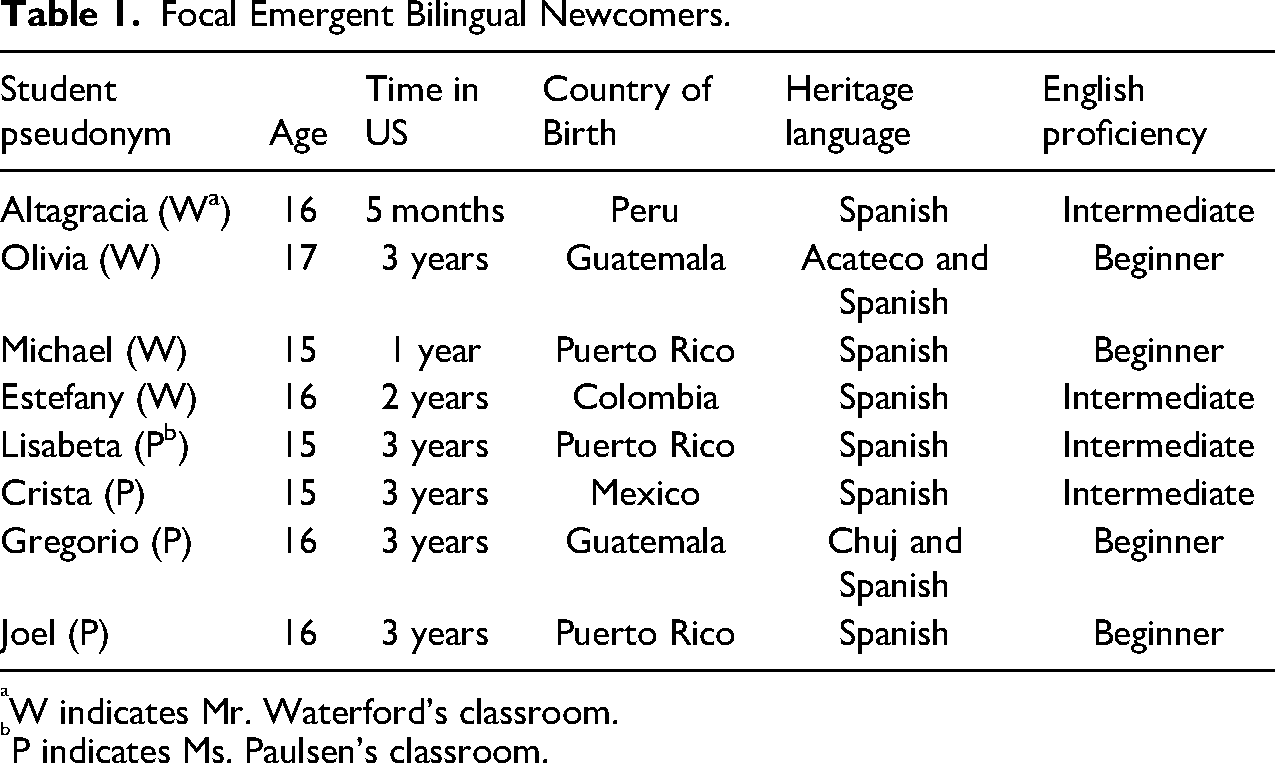
W indicates Mr. Waterford's classroom.
P indicates Ms. Paulsen's classroom.
Pacheco and Brown engaged in all processes of data collection and analysis, acting as participant-observers (Spradley, 1980). Using constructivist grounded theory (Charmaz, 2006), our goal was to combine our own etic perspectives on CoPs with the emic perspectives of CoP members, seeking to “hear, to see, and to begin to experience reality as the participants do” (Marshall & Rossman, 2006, p. 100). Pacheco and Brown are both White and former secondary teachers, with Brown having previously taught science education in the local district at another high school. Pacheco is proficient in Spanish and is a former secondary EB teacher.
Data Collection Analysis
Data for the present analysis (see Table 2) were collected over four months in Spring 2019. Pacheco and Brown observed 19 instructional periods of Mr. Waterford's 7th period biology class, and 17 instructional periods of Ms. Paulsen's 5th period biology class. Pacheco and Brown created fieldnotes from these observations, attending to joint enterprises valued in each CoP, resources or tools used by focal students and teachers to engage in these enterprises, and roles or forms of engagement performed by EBs and teachers. Pacheco and Brown conducted semi-structured interviews with teachers in January to understand their perspectives on science education, effective instruction for EBs, their views on the relationship between language and content, and their instructional context. The eight focal students were interviewed in May to understand their views on class participation, experiences with science education in home countries, and ideal science learning experiences. Interviews were conducted in Spanish with the assistance of a graduate student from Puerto Rico. All interviews were audio-recorded and transcribed.
Data Analysis and Sample Codes.
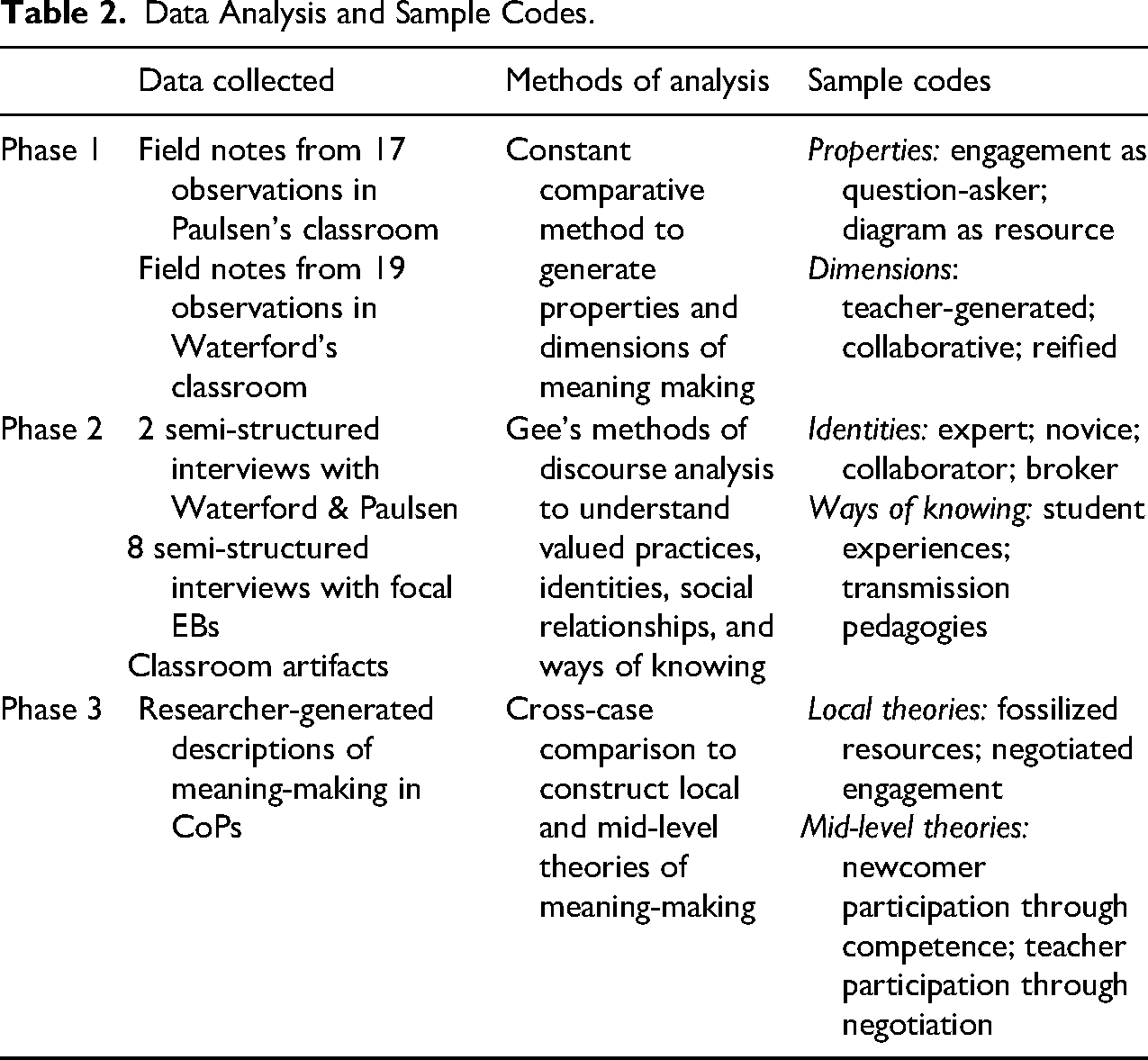
Data were analyzed in three related phases to understand meaning-making in each classroom, and CoP aspects that shaped meaning-making. In Phase 1, we used the constant comparative method (Corbin & Strauss, 2015) to identify moments of meaning-making, which we understood as opportunities to negotiate resources, engagement, and joint enterprises, as per Wenger’s (1998) description. Pacheco and Brown coded fieldnotes independently, and then met to discuss and refine codes. We first open-coded fieldnotes to identify properties of meaning-making, or what resources, forms of engagement, and enterprises were valued in each classroom. We then used axial coding to identify dimensions of these properties, addressing how each CoP shaped meaning-making.
In Phase 2, we analyzed interview transcripts to understand student and teacher perspectives on meaning-making in their CoPs. We used Gee’s (2011) methods of discourse analysis, in which discourse reflects and constructs a speaker's relationship to valued practices or activities; to identities or performed roles; to social relationships; to resources and forms of capital; and to belief systems or ways of knowing. Our third phase of analysis involved a cross-case comparison of the two CoPs through comparing researcher-generated narratives of each CoP. This phase involved constructing a local theory of how meaning-making occurred in each CoP from analyzes from phase 1 and 2. We then compared findings to generate mid-level theories for how meaning-making might occur in similar classroom contexts (Yin, 2009).
Findings: Competence and Experience in Two Classroom Communities
We begin by showing aspects of meaning-making across the CoPs by attending to the “interplay between social competence and personal experience” (Wenger, 2000, p. 227). Social competence includes uses of resources and forms of engagement valued by a specific community. Personal experience reflects the histories, goals, and identities of individual community members. When a newcomer makes meaning in a classroom community, they shape the community with their personal experiences while simultaneously being shaped by that community's social competencies. Figure 1 below illustrates this relationship.
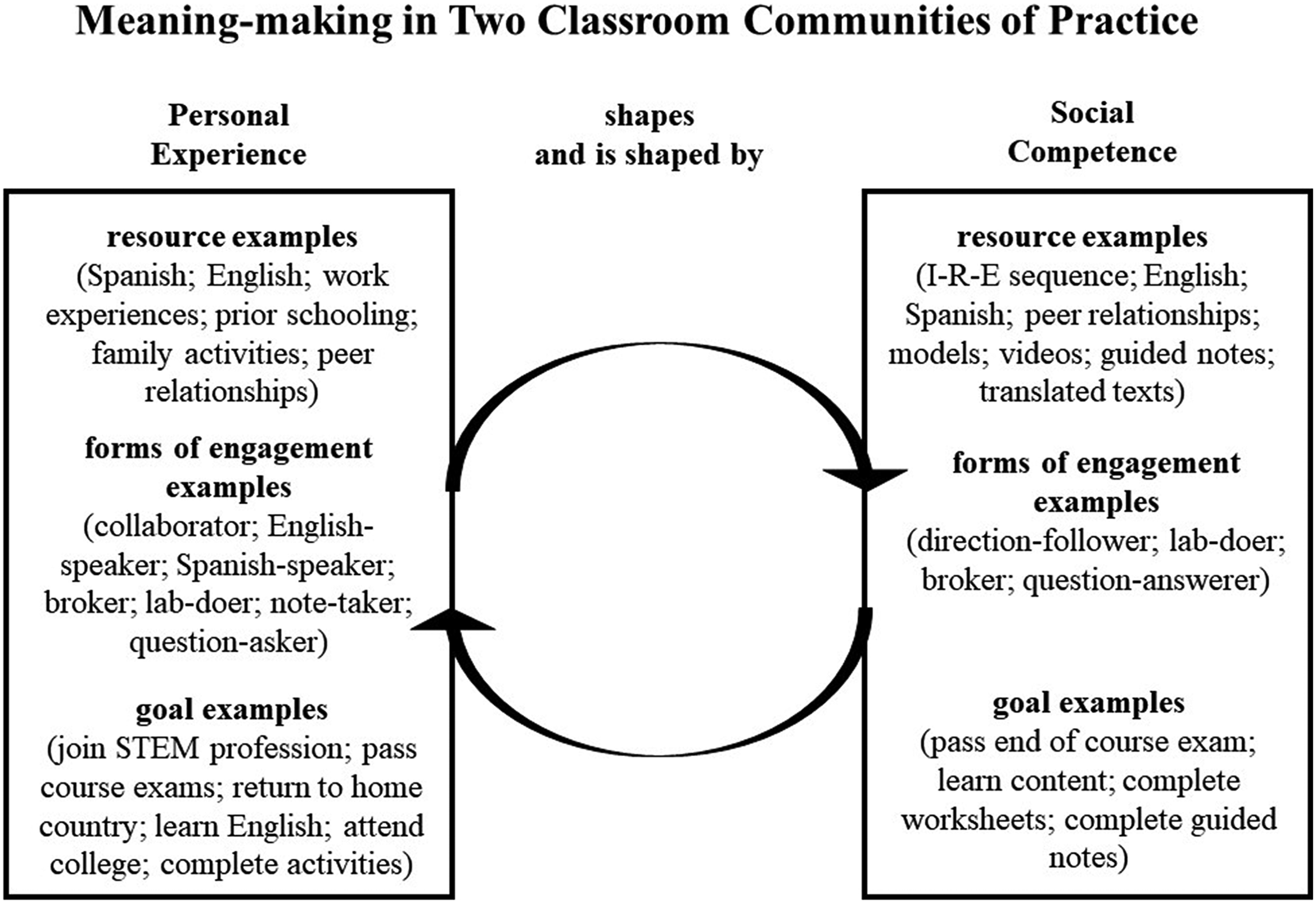
Meaning-making in two classroom communities of practice.
Negotiating Resources in Mr. Waterford's Classroom
In Mr. Waterford's 7th period biology classroom, pairs of students sat behind tables arranged in three columns facing the front of the room. EBs all sat next to one another, and found ways to offer support through discussions in Spanish and comparing notes during lectures (fieldnotes, February 11, 2019). In our interview with Mr. Waterford, he described his teaching as an attempt “to give a foundation to build on before they get into the cool hands-on stuff,” and our observations consisted primarily of lecture-based instruction. Typically, he gave students guided notes and explained concepts with the support of diagrams, videos, or realia, such as a chicken embryo or animal skeleton (fieldnotes, March 21, 2019). Towards the end of each class, students would begin homework or collaboratively review homework from the previous evening. When reflecting on his instruction for EBs in his interview, he acknowledged he was “still in that stage where [he is] trying any and everything [he] can.”
Below, we focus on two resources—known-information questions and translated worksheets—which reflected the social competence encouraged in this community. While these resources show potential for engaging students in the science and engineering practices outlined by the NGSS, we use these representative examples to illustrate challenges to meaning-making across our observations. The examples show constraints to meaning-making when students’ use of the resource did not shape the community's social competence.
Known-information questions
Within Mr. Waterford's delivery of content, he used question-asking—a discursive resource—which helped build understandings of scientific content (van Zee & Minstrell, 1997; Shepherd, 2020), signal engagement in the community's endeavors, and perform roles valued in the CoP. Question-asking can be a means for teachers to model how scientists ask and refine questions, an essential practice outlined by the NGSS. At times, Mr. Waterford's question-asking involved requests for information, as in prompting students to read answers from homework (fieldnotes, March 12, 2019). On a few occasions, he asked students to evaluate the accuracy of an answer offered by a classmate (fieldnotes, February 26, 19). He regularly used known-information questions (Mehan, 1979), or requests for responses in which he had a fixed or known answer in advance, within class lectures (e.g., fieldnotes, February 19, 2019). We did not observe EBs ask any questions in whole-class discussion across our observations.
These known-information questions followed the I-R-E sequence (Cazden, 1988) where Mr. Waterford would make a bid for information, a student would respond, and Mr. Waterford would evaluate this response. We describe one exchange with Mr. Waterford and two students (fieldnotes, March 7, 2019) as an example of how this resource may have constrained, rather than afforded, EB meaning-making. We assert that the use of this resource did not invite students to then align their experiences or understandings of content with the goals established by Mr. Waterford. Rather than student participation shaping social competence, Mr. Waterford offered a rigid structure of what competence could include.
Below, the class is learning about evolution and natural selection, and Mr. Waterford engages Estefany, a newcomer born in Colombia with emerging proficiency in English:
So, with the finches. What information might be passed down to the next generation? Estefany?
I don't know.
Well, Bryce?
The big beaks.
The genetic code. The genetic code is passed from one generation to the next.
(fieldnotes, March 7, 2019)
In this exchange, Mr. Waterford has the opportunity to collaboratively build understandings about heredity through question-asking. While Estefany “doesn't know,” it is unclear what she does not know; it is ambiguous if she does not understand the language used or the content discussed (see Bunch, 2013 for a discussion). Mr. Waterford does not follow up and ask what she is confused about, nor does he offer an alternative discursive resource, such as an opportunity to turn and talk with a partner in Spanish or English, to build or display content understandings. Instead, the known-answer questions serve as a resource for students to slot in “correct” answers to Mr. Waterford's requests. Even when Bryce offers an accurate answer (the big beaks), Mr. Waterford rephrases his contribution to meet an expected response (the genetic code is passed …).
From a CoP perspective, we suggest that this resource is fossilized, leaving no opportunity for community members to reshape its structure or function through adapting and aligning their own experiences when using the resource. This fossilization stands in contrast to reification (Wenger, 1998), where a resource takes shape as community members bring their own experiences and goals to that resource. Estefany's participation does not shift the community's activities to then interrogate what she does or does not know, nor does her engagement reshape the question-asking structure. We hold that though she and Bryce comply with Mr. Waterford's request, very little meaning-making occurs. Rather than this resource moving Estefany towards central participation, her “not knowing” pushes her to the CoP's periphery as Mr. Waterford moves on to engage Bryce. This finding buttresses our conjecture that both teachers and students in urban science classrooms need opportunities to shape the community's resources for meaning-making to occur.
In contrast to this exchange, Estefany shared in her end-of-year interview that she had previous experiences with this very topic. She told us in Spanish: … the things I learned in Colombia, then I started to see here. For example, in Colombia I learned about DNA and so when I got here and they started talking about DNA, I knew some things and some terminology.
When using the resources valued in this CoP, such as known-answer questions, Estefany had few opportunities to leverage this background knowledge. She worried about her abilities to take notes “while [Mr. Waterford] is explaining,” and struggled to interact with classmates during lecture, telling us that “he is very strict when talking in the classroom, so that we almost never talk but I speak in Spanish with my side partner.” When Mr. Waterford attempted to engage her with known-answer questions during note-taking, the use of this resource demanded a narrow view of what information was valued in this CoP, and moreover, a narrow view of how information could be displayed. Miller and Zuengler (2011) note that this fossilization has the potential for pushing newcomer students towards the edge of a classroom community, rather than towards its center. Gamez and Parker (2018) note similar findings in their work on science education in new destination urban classrooms, where teachers of newcomers asked questions with a “discrete endpoint” and did not “deviate from that purpose” (p. 401) Though Estefany had knowledge of the content and a desire to engage in the discussion, this resource did not afford an avenue for meaning-making.
Translated texts
The above description is not meant to portray Mr. Waterford as an uncaring or ineffective teacher; he scaffolded lectures with multiple modalities, including diagrams (e.g., fieldnotes, March 14, 2019) and videos (e.g., fieldnotes, March 26, 2019), and used question-asking in an attempt to maintain engagement and assess understandings. At the beginning of nearly every observation, he also provided EBs with a translated version of an informational text or the day's guided notes. In his interview, he spoke of EBs struggling with a “language barrier,” and recognized that heritage languages could support them in accessing content. The use of translated texts, created by Mr. Waterford through Google Translate, had the potential to scaffold participation in valued disciplinary practices, including obtaining and evaluating information, forming questions, and defining problems.
However, this resource's utility might have been constrained due to its alignment with the other resources and goals that informed the community's social competence. Wenger (1998) describes the importance of correspondence between community resources, and moreover, correspondence between resources in relation to shared goals. When resources align with community members’ goals and other resources, their forms and functions can then be shaped through participation. For Michael, a student born in Puerto Rico with intermediate English proficiency, we noted some evidence of alignment between translated texts and his goals. In his end-of-year interview, he told us that translations provided a quick reference for clarifying meaning: When [Mr. Waterford] sometimes gives us a paper in English, sometimes he also gives it to us in Spanish. If he gives you the paper in English and in Spanish, which do you use? Almost always, because he explains in English, I almost always use English. But things I don't understand I use them in Spanish.
Michael highlights two important ways that translated texts related to meaning-making. Michael can negotiate how this resource works towards his goal of making sense of content, appropriating the translations for “the things [he doesn't] understand.” However, this quote points to the ways that this resource's utility is constrained due to a lack of alignment with other CoP resources. As Mr. Waterford “explains in English” and other course materials and texts are coded in English, Michael relies primarily on English to access content. We are not suggesting Mr. Waterford must lecture in Spanish to facilitate Michael's use of Spanish, nor are we suggesting it is inherently problematic that Michael relies primarily on English to engage with content. We are suggesting, however, that this resource's utility is limited as social competence is centered around English. Other work with EBs in urban contexts suggests similar findings; Martínez-Roldán (2015), for example, demonstrates how students’ multilingual practices in an after-school program actually encouraged the hegemony of English, as these practices did not align with the monolingual goals and ideologies within activities.
Estefany further illustrates Martínez-Roldán's findings, reflecting on the importance of English: Because there are words I don't know how to write them in Spanish, so I write them in English and, because the tests and everything's in English, I read everything in English.
Using Spanish does not align with Estefany's own experiences of being able to write new academic content in Spanish. Moreover, she recognizes the need to use English for tests, thus limiting the value she places on writing in Spanish. Both she and Michael suggest that translated texts—though intended to scaffold understandings of difficult content—did not align with community activities and resources, such as exams coded in English and class lectures, nor did they align with students’ goals for learning English and experiences with academic Spanish. Extensive work in translanguaging pedagogy (Garcia & Li, 2014) shows that heritage languages are more than just crutches for accessing English, and can serve as important bridges between students’ identities and classroom goals (Langman, 2014). We ask how these resources might have supported meaning-making if students had opportunities to compare English and Spanish texts to find similarities and differences within content, or collaboratively translate or create definitions of key ideas into Spanish (see Jiménez et al., 2015). This finding affirms our conjecture that meaning-making relates to more than newcomer proficiencies with linguistic resources; instead, we assert that how a community positions this resource—in this case, Spanish—shapes how EBs can use this resource to make meaning in urban classrooms.
Social Competence and Personal Experience in Mr. Waterford's Classroom
In Mr. Waterford's classroom, we observed a misalignment between student experience and the resources valued in the CoP, suggesting that students had few opportunities to shape social competence. We observed social competence as slotting in answers to Mr. Waterford's questions, demonstrating achievement on unit exams, and completing worksheets during lectures. Students’ oral participation in question-asking was limited to English, and we did not observe any questions asked by newcomers in whole-class discussion. Yet, in their final interviews, EBs described wanting to tackle hands-on projects, create diagrams, and apply their previous learning from their home countries. Student perspectives and goals, which inform personal experience, remained excluded from the competence valued in this CoP.
Furthermore, the translated worksheets also show a possible misalignment between social competence and personal experience. Our findings suggest the limited power of these texts in aligning resources and goals in the CoP, as EBs stated that translated texts did not help them demonstrate competence on exams, and moreover, conflicted with their desire to learn English. We assert that heritage languages can be robust resources in urban science classrooms, but instruction must structure opportunities to use these languages to shape valued CoP activities, such as small-group discussion, or seeking evidence to justify claims.
Negotiating Forms of Engagement in Ms. Paulsen's Classroom
Ms. Paulsen's fifth period biology classroom was a lively setting with students regularly engaging in spirited whole-class discussions informed by their experiences and prior learning (e.g., fieldnotes, April 18, 2019). Students sat in pairs at blacktop desks, flanked by lab benches around the room's perimeter. Ms. Paulsen gave lectures in front of the classroom, making use of a whiteboard and demonstration area. EBs sat together at desks, a decision made by Ms. Paulsen to encourage collaboration. In her interview, she spoke of this decision as a means to “help the kids, because passing [the Biology End of Course exam] is a big deal.” Those who shared heritage languages would quietly communicate with one another, but mostly sat in silence (e.g., fieldnotes, January 28, 2019). Ms. Paulsen was conflicted about a disconnect between her ideal and actual biology teaching, telling us: I’d love to be doing labs all the time, taking them outside, showing them things, but I feel a little overwhelmed with the content that I have to get in … [they’re] not gonna get the content from a lab that [they’re] gonna get from me telling [them].
In our observations, we saw students engaged in a range of experiences, from lab activities—on topics such as bird beak adaptations, mushroom dissection, and pollination—to individually completing worksheets. To support EBs, Ms. Paulsen attended primarily to unfamiliar vocabulary through collaborative groupings and morphological instruction (e.g., homo in homozygous) (fieldnotes, February 11, 2019). She shared, “when I talk about something, you know, I try to at least give them the root words so they can maybe relate to a word in their language.”
Below, we describe two forms of engagement—participation in lab experiments through procedural information, and participation in discussions through language brokering. We argue that the examples show constraints to meaning-making when these forms of engagement did not align with the richness and competence within students’ experiences.
Engaging through procedural information
We observed opportunities for newcomers to engage as collaborators within the CoP's joint enterprises, including worksheet completion, and most noticeably, lab experiments. Ms. Paulsen placed a premium on providing lab experiences, noting that students could actively participate and act as scientists. Her intuition was well-founded—when asked, “What is difficult for you in biology class?” in their interviews, Crista, Gregorio, and Lisabeta all shared that language during lectures was indeed the biggest challenge, and that using Spanish in labs helped them.
Still, Ms. Paulsen struggled to encourage engagement that aligned to rigorous disciplinary meaning-making. She told us of such challenges when scaffolding conceptual understandings during labs: I always hear kids say they don't make connections between lab and the content. I mean, even more advanced kids, sometimes, don't make connections. They’re not processing information…I think they just don't make connections, even if you have, you know, simple questions at the end of the lab, that had to do exactly with what we just talked about in class. For some reason, they see it as completely separate.
Student engagement in lab activities centered on information about procedures and protocols, such as properly focusing a microscope and dissecting a mushroom stipe (fieldnotes, March 7, 2019). Similar to findings from studies of EBs in other urban classrooms (see Hos, 2020), this focus on procedures positioned students as completers-of-tasks, rather than epistemic agents who actively construct knowledge (Miller et al., 2018). For example, Gregorio, a student from Guatemala with beginner English proficiency, worked with Joel, another student with beginner proficiency, to dissect a mushroom. There was little guidance in contextualizing language, such as the term gills, which could apply to mushrooms and fish alike. Instead, the overwhelming majority of instruction focused on procedural information: Turn to the page that says, ‘Mushroom dissection lab.’ [points to the page] The main thing you need to do is read the lab. I’m not going to read it to you, but I’m going to explain a few things (fieldnotes, March 7, 2019).
Over the next seven minutes, Ms. Paulsen demonstrated lab procedures by modeling (“Forceps [holds up forceps]. In science class we call these forceps and you use them to pick up pieces of the mushroom”). We then observed Gregorio and Joel focusing their collaboration solely on microscope adjustments. When they moved on, they asked Ms. Paulsen for assistance: Miss, [Gregorio] wants you to explain everything. Explain everything again? You can read. Just read the lab. (field notes, March 7, 2019).
Joel attempted to explain the procedure to Gregorio in Spanish, which delayed the group's start. Problems then resurfaced with focusing the microscope, further impeding the group's progress. As the class period neared the end and other students packed up, the two boys remained at their bench with their lab handout left incomplete. Rather than using Spanish and English to discuss features of mushrooms, the two students collaborated to make sense of class instructions. Rather than engaging in this CoP as doers of science, the two collaborated as doers of directions. This finding aligns with studies of newcomers in different secondary subject areas where students’ engagement is limited to rote activities, rather than rich engagement in a discipline (see Salerno & Kibler, 2015).
We note the importance of procedural understandings to engage in disciplinary practices, such planning and carrying out investigations. Instruction that focuses solely on this aspect of scientific activity, however, might fail to engage students’ experiences with science, their heritage languages, and other aspects of identities that help them build conceptual knowledge critical to biology. While Gregorio and Joel described labs as their favorite parts of the class, the CoPs’ activities failed to align their interests with the robust goal of deepening conceptual knowledge. Thus, though lab activities suggested potential for student meaning-making, an extended focus on following procedures constrained these opportunities. This finding speaks to our conjecture that supporting newcomers relates to their opportunities to participate as full participants in the classroom community; though Gregorio and Joel eagerly engaged in the lab activity, the activity itself did not incorporate their experiences or build on their goals.
Engaging as language brokers
EBs with more advanced English proficiency asserted identities as language brokers, or interpreters, between Ms. Paulsen and Spanish-dominant students (Orellana & Reynolds, 2008). While Ms. Paulsen did not understand Spanish, she encouraged this brokering, thus affording students with limited English proficiency a chance to participate in instruction (e.g., fieldnotes, March 14, 2019). Similarly, we regularly observed EBs using Spanish while collaborating (e.g., fieldnotes, February 26, 2019). However, we did not observe Spanish being used by Ms. Paulsen or non-EB students. Moreover, language brokering was used primarily to transmit content from Ms. Paulsen to students, and never from students to Ms. Paulsen.
Recognizing the value of eliciting and building on students’ prior knowledge, Ms. Paulsen began a lesson on the importance of plants by asking students to “discuss three ways you use plants or products made from plants” (fieldnotes, March 12, 2019). She circulated as students discussed, with Lisabeta, Crista and Joel collaborating in Spanish. After five minutes, Ms. Paulsen directed the class to the whiteboard: Okay. Let's talk about our answers. What’d y’all come up with? [Writes answers on board as students call out apple, peach, salad, walked on grass.] [quietly to Joel] ¿Cómo se dice caña de azúcar? Miss, she said ‘sugar cane.’ [to the class] Y’all are too loud, quiet down. [sugar cane is not recorded on board.] Crista, do you have something to add? [Shakes her head no] Dijimos caña de azúcar. Alright, let's move on. Open your packets to the first page. (fieldnotes, March 12, 2019)
Lisabeta and Crista participated in the discussion exclusively in Spanish, with Joel serving as broker. For reasons unknown, Ms. Paulsen did not take up their contribution, and instead, continued with her lecture. As a result, the prior knowledge that she spent ten minutes eliciting was not integrated with the authoritative knowledge presented in her lecture, thus signaling misalignment between EB engagement and the type of engagement valued in the CoP.
We note that Ms. Paulsen strived to engage students and provided multiple opportunities for newcomers to collaborate and serve as language brokers. However, she faced two challenges in doing so. First, she struggled to recognize student engagement in Spanish as a part of the community's social competence; Spanish became an aid to make sense of English, but did not become a resource for shaping class discussion, a valued community activity. Second—and similar to her experiences with lab experiments—she struggled to connect student engagement with rigorous biology content. In other words, the richness of this form of engagement—or, personal experience—did not align with the activities valued in this CoP—or, its social competence. While recent work shows potential in leveraging heritage languages to participate in disciplinary practices, such as modeling (Pierson et al., 2021), teachers like Ms. Paulsen still face challenges in shaping classroom activities through such resources.
Ms. Paulsen continued the Plants unit and created a lesson where the goal was to explain pollination and seed dispersal (fieldnotes, March 14, 2019). Her lecture was followed by a lab activity where students worked in pairs to germinate lima beans. During lecture, Ms. Paulsen referred to examples around the school and elicited student input to help connect content with student experiences. She introduced mechanical seed dispersal, using bees as an example, and reiterated the parts of flowers important for reproduction.
[to the class] Why do you think pollen comes in all shapes and sizes? These eggs become fertilized and then become… [points to female student who is eating an apple] is about to eat some…
Seeds.
…Yep! The ovary with fertilized eggs.
[Gregorio and Joel talk with one another. Joel says ‘huevo’ to Gregorio and points to the zygote in the diagram]
Look at this diagram. [displays graphic with examples of how seeds disperse with violets, milkweed, and maple.] Seed dispersal happens by the wind. All over the parking lot there are these maple seeds right now. Has everyone seen them?
Yeah! (fieldnotes, March 14, 2019)
While Ms. Paulsen elicited and recognized students’ experiences, she fell short of connecting these resources to the ambitious content aims set forth in the NGSS. While Gregorio and Joel used Spanish to identify new vocabulary (huevo for egg), they did not use their linguistic resources to make predictions, identify processes, or explain the phenomenon being observed. Though both Ms. Paulsen and the students recognized Spanish as a valid resource for engaging in the activity, the community positioned students to engage as labelers and identifiers, rather than co-constructors of scientific knowledge. Despite the use of multiple and powerful resources, including diagrams, linguistic resources, and realia, Gregorio and Joel did not use these resources to work towards goals other than vocabulary identification.
Personal Experience and Social Competence in Ms. Paulsen's CoP
Ms. Paulsen faced similar challenges to Mr. Waterford in aligning students’ personal experiences with the CoP's social competence. Despite students’ desire to participate in lab experiments, to use heritage languages to discuss and make sense of scientific phenomena, and to use experiences outside of the classroom, students and Ms. Paulsen struggled to align these experiences with the community's shared endeavors, which included mastering procedural information and completing worksheets accurately.
Community members like Joel acted as brokers and attempted to bridge community members’ experiences with the competence valued in the CoP. Nonetheless, Ms. Paulsen struggled to recognize these contributions within class discussion. We assert that the richness within student experience—including heritage language resources, experiences with gardening at home, cooking with parents, problem-solving in after-school jobs, and goals to enter STEM professions—was not aligned with the procedural tasks that characterized competence in this CoP. Whereas Mr. Waterford's classroom struggled with meaning-making due to a fossilized view of competence, Ms. Paulsen's CoP struggled with meaning-making due to a social competence that could not encompass the robustness of students’ experiences.
Discussion and Implications
Our study of newcomer emergent bilinguals’ meaning-making in two urban 9th-grade biology classrooms shows two major findings. First, in addressing our first research question of how EBs make meaning, we found that students attempted to bridge aspects of personal experience with the social competencies valued within the community of practice. This included using heritage languages as resources, engaging in the community as brokers and collaborators, and in attempting to realize goals of learning English and content within the community's endeavors. These findings affirm prior work that shows newcomer EBs in urban settings leveraging familiar linguistic resources to make sense of new content (e.g., Daniel & Zybina, 2019), and suggests how students’ prior academic experiences and future goals can inform coursework (e.g., Barton & Tan, 2009; Koch et al., 2019). Estefany, an EB student in Mr. Waterford's CoP, exemplifies this finding; she spoke of using Spanish and English to take notes during class lecture, her experiences studying DNA in middle school when in Colombia, and her wish to pursue a career in medicine. We found that EBs attempted to leverage the multiple facets of their personal experience to participate as legitimate members of the classroom CoP.
In addressing our second research question of how CoPs shape participation, we found that misalignments between social competence and personal experience constrained meaning-making. For a student like Estefany, her past experiences, future goals, and heritage language did little to shape the resources, activities, and goals of the CoP. In Mr. Waterford's classroom, social competence included complying to requests for information, completing guided notes with ‘correct’ responses, and passing exams. In our observations and interviews, we found that student participation did not shape these competencies, despite students’ stated desires to engage meaningfully in the CoP, such as Estefany's wish to do well on class exams. In Ms. Paulsen's CoP, on the other hand, social competence was defined by following procedural information and generating surface-level connections to out of school experiences. We found that Ms. Paulsen struggled to align students’ heritage languages and experiences with science to rigorous disciplinary learning.
We offer three implications for secondary science education with newcomers in urban classrooms. First, our findings illustrate a need to engage students in rigorous activities that build on and expand the resources and experiences EBs bring to classrooms. Heritage languages, for example, are more than crutches to access English-language content. In agreement with a growing body of research that documents how heritage languages can deepen engagement and build conceptual knowledge (see García & Li, 2014), these resources can be accessed in rigorous activities set forth by the NGSS, such as asking questions and defining problems, planning and carrying out investigations, and evaluating information.
Second, our findings illustrate the need to structure learning experiences with goals, resources, and forms of engagement that can shift or take shape through student participation. In terms of leveraging language, Schoerning and colleagues (2015) argue that when teachers recognize the content in student speech, rather than accuracy of vocabulary use, they create an “avenue for agency” that positions students as “stakeholders in the science classroom” (p. 256). In terms of leveraging student experience, Beltramo (2017) found that groupings of teachers alongside their Latino students informed active participation, “which helped to develop mutual engagements among members, shared tools for communication, and spaces for greater student agency and new enterprises” (p. 25). Our findings begin to uncover mechanisms by which such deep engagements take shape; as students and teachers have opportunities to offer, align, and refine the competencies valued in a community, meaning-making can occur.
Lastly, our findings shed light on the complex and challenging work asked of teachers when engaging in rigorous science instruction. Teachers of biology in urban classrooms, in particular, face challenges in implementing a curriculum that encourages breadth, rather than depth (Baker, 1991). The end-of-course exam in this study's context adds to this challenge; teachers attempted to cover as much material as possible through encouraging memorization of terms and processes, rather than through engaging in science and engineering practices. For teachers to support the many EBs in their classrooms (NCES, 2018), more professional development must tackle how teachers can address challenges in language while engaging students in rigorous scientific activities.
We have used these findings to inform the second phase of our design research project: the creation of an instructional protocol that addresses EB needs and strengths while fostering opportunities for student meaning-making (Pacheco et al., 2022). This protocol includes six elements—affirming identity, attention to language, collaboration, multiple modalities, funds of knowledge, and socio-political consciousness—that aim to bolster EB participation in science and engineering practices. The third and most recent phase of this project includes the refinement and validation of this protocol through implementation in twelve classrooms across the state.
Still, a major question left unexplored and an avenue for future research is how teachers like Mr. Waterford and Ms. Paulsen can leverage aspects of their own personal experience to shape EB meaning-making. Both teachers explicitly stated desires to meet the needs of their students, and attempted to do so through translated texts, collaborative activities, class discussions, and attention to vocabulary. Still, both struggled to scaffold EB meaning-making of biology content and practices. More research must address how teachers can leverage their existing understandings of language, content, and their students to support disciplinary engagement. In the same ways that research calls for instruction that builds on the cultural and linguistic strengths that EBs bring to classrooms (e.g., Beltramo, 2017; Loera et al., 2018; Morales-Doyle, 2017; Volk, 2021), more work must explore the rich experiences within teacher identities. Lyon and colleagues (2018) argue that addressing such issues is paramount, as “effective science instruction for students in need of language and literacy support is one of the most pressing issues facing the science education community today” (p. 1289).
Conclusion
We conclude by recognizing the desires of newcomers and their teachers to make meaning in their classrooms. Just as Mr. Waterford tried to “make my ESL kids engage more,” his student, Altagracia, spoke about her wish to excel in biology so she could eventually study cardiology, even when there were moments she “felt like falling asleep.” Similarly, just as Ms. Paulsen spoke of her sustained efforts to leverage models and heritage languages, her student, Crista, spoke of a desire to use Spanish to help make sense of new content. Our study shows the importance of finding opportunities to align these goals, balancing students’ personal experience with the different forms of social competence valued in a community. We assert that in urban classrooms, when students and their teachers can shape the goals, resources, and forms of engagement valued in that community, they will have opportunities to make meaning.
Footnotes
Acknowledgments
This research was made possible by a College Research Incentive Fund Large Grant from the College of Education at the University of Florida.
