




Abstract
Washability is seen as one of the main obstacles that stands in the way of a wider market success of e-textile products. So far, there are no standardized methods for wash testing of e-textiles and no protocols to comparably assess the washability of tested products. Thus, different e-textiles that are deemed equally washable by their developers might present with very different ranges of reliability after repeated washing. This paper presents research into current test practices in the absence of e-textile-specific standards. Different testing methods are compared and evaluated and the need for standardized testing, giving e-textile developers the tools to comparably communicate and evaluate their products’ washability, is emphasized.
Textile-integrated conductive materials or electronics, also referred to as smart textiles or e-textiles, are a rapidly growing class of products. These hybrid e-textiles can be characterized as textile products with additional functionality provided by the electronic or electrically conductive components. Examples of these added functions are sensors, lighting, heating, stimulation, or recording of internal or external parameters. Simultaneously, e-textiles constitute electronic products with additional—textile typical—requirements, resulting from integration into a textile base. This is especially true for wearable e-textiles, products that are designed to be worn on or close to the body. To ensure wearer well-being, they need to be sufficiently breathable and comfortable. 1 Textile typical usability also requires an e-textile to be flexible and—depending on the application—stretchable enough to withstand a range of mechanical stresses during use—mainly tensile, but also bending, shear, torsion, or compression stress. 2 Just as textiles without integrated systems, wearable e-textiles can become stained during their use and therefore need to be cleanable or washable. 3 During the washing process, characterized by the four interdependent factors of time/duration, mechanical action, temperature, and chemistry/biology, also labeled Sinner’s factors, 1 , 4 different strain scenarios occur that the e-textile needs to be able to withstand. Especially with a large fraction of e-textile products developed for medical, personal protective equipment (PPE), and sports applications, resulting hygiene requirements make washability an essential property. 5 E-textiles should hold up to a (use-oriented) type and number of (household) washing cycles during their life cycles, or, in the case of medical or PPE products, even industrial washing if applicable. 6 From the viewpoint of experts and researchers that work on smart or e-textiles, washability (or a lack thereof) represents a key factor in the lack of commercially successful products. 1 , 5
The need for integrated conductive and electronic components to exhibit a level of washability comparable to their textile substrates also arises from a growing demand for more sustainability. The production of a cotton or polyester shirt alone entails about 4 kg of CO2. 7 This impact from the textile base is further increased by the integrated electronic or conductive components. Thus, from a sustainability viewpoint, great care has to be taken to keep the system functioning and in use for as long as possible, reducing the need for replacement. For cyclically used textiles—a use phase followed by a cleaning process that restores the product’s serviceability—this need for an extended lifetime requires the product to be as robust as possible to the strain resulting from the washing or cleaning processes. The complex composition of e-textiles makes this much more challenging than for textile-only products, because all components, with their very different vulnerabilities, have to withstand the cleaning process. 8
To assess, improve, and evaluate the extent of an e-textile’s reliability when subjected to repeated washing procedures, test cycles have to be run. A reliable comparability of different e-textiles’ washability—important, among other things, to communicate to consumers—is only possible if this testing is done under defined circumstances following similar or even standardized protocols. So far, no proper standards exist that allow for such comparisons. In the absence of e-textile-specific washing standards, test protocols from adjacent fields, in more or less modified form—textile standards being the most common—are used to assess the washability. Or, in lieu of standardized methods, individually designed test protocols are applied to appraise washability. 6 Because of this great variability of methods, comparability of different test results is low/limited. In many cases, the tested products are deemed washable, even though they exhibit poor fastness to washing procedures. 8 Some sources even claim washability with no (apparent) prior testing. 9 , 10
This article aims at gaining insight into and analyzing current wash testing practices for smart and e-textiles. A short overview of existing standards for e-textiles precedes a review of scientific publications featuring wash testing of e-textiles. The information about the particular test practices given in the reviewed sources is often incomplete. This can be attributed to wash testing not being the central matter of most publications, but rather one of several reliability tests run to assess a newly developed product or technology—often the main focus of the reviewed publications.
Current situation in standardization
The number of existing standards especially conceived for hybrid e-textiles to date is very low. Of the existing ones, most cover either terminology and/or definitions like ISO/PRF TR 23383 and ASTM D 8248:2020. Others give test methods for resistance measurement of textile-based products: AATCC 76 for fabrics, AATCC 84 for yarns, and CSN EN 16812 for conductive tracks on textiles (see Table 1). IPC-8921 provides terms and definitions, as well as a method for testing the resistance of conductive textile materials. There are current efforts to overcome this lack of e-textile-specific standardization, though. Several other standards are anticipated to be finalized within the next few years (some examples are given in Table 1). These are expected to improve the situation by covering a wider range of issues, including reliability and washability (like IPC 9881 and IEC 63203 204-1).
Existing, upcoming, and external standards for e-textiles
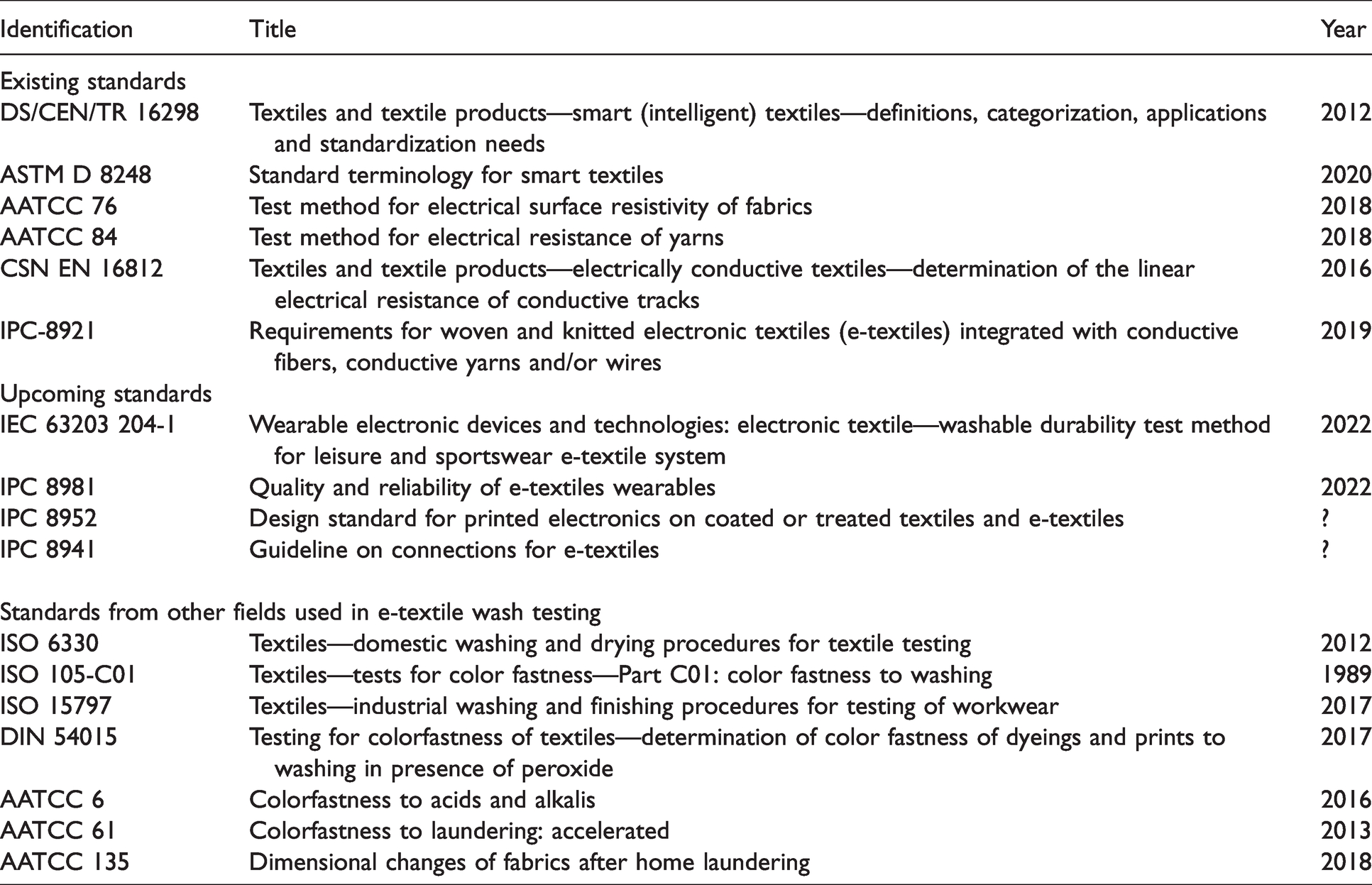
The most commonly used standard from adjacent fields when testing the washability of e-textiles is ISO 6330 Textiles—domestic washing and drying procedures for textile testing. 6 Within this standard, a range of household washing and drying procedures are given, reflecting the variety of actual household washing programs. The standard provides testing conditions and instructions for the three most common types of washing machines: horizontal-drum front-loading machines, predominant in Europe, and agitator or impeller type vertical-drum top-loading machines found mainly in America and Asia, respectively. 11 The scope of the standard includes not only textiles, but also “other textile articles”—a term that can be applied to hybrid smart or e-textiles—allowing for the standard to be extended for their testing. Not included in the standard are guidelines or recommendations concerning the number of wash cycles that should be conducted nor criteria on how washing reliability can be assessed after testing. Other less often applied standards include ISO 105-C01:1989 Textiles: tests for color fastness—part C01: color fastness to washing, ISO 15797:2017 Textiles: industrial washing and finishing procedures for testing of workwear, and AATCC 61 Colorfastness to laundering: accelerated.
Although presently not (yet) used for e-textile testing, another standard worth mentioning is IEC 60456:2010 Clothes washing machines for household use—methods for measuring the performance. This standard’s scope is not textile wash testing, but the evaluation of washing machines. Included are testing protocols for household washing programs cotton, easy care, and wool. In contrast to the widely used ISO 6330, cleaning capability is assessed and the range for the wash load ranges from 2 to 10 kg. Due to their relative harshness, the applicability of the cotton and easy care washing procedures featured in IEC 60456 for e-textile wash testing would have to be evaluated.
Washability test practices
A literature review of publications about e-textile development or reliability has been carried out to evaluate current wash testing protocols for e-textiles. A total of 73 publications that include a section on wash testing have been selected to serve as a basis for this analysis. Although extensive, this selection is not an exhaustive representation of e-textile wash testing. Since the focus of this article is to evaluate the current testing situation, only research published in 2010 or later has been considered. The reviewed sources have been clustered into four groups according to the employed test practices (due to extensive testing with different methods, two sources have been included in both the household and alternative methods cluster):
wash testing according to ISO 6330 (31 publications); wash testing according to other standards (13 publications); wash testing under household washing conditions (19 publications); wash testing with alternative test methods (12 publications).
The assessment of washability depends on the intended application of the tested product as well as its projected frequency of cleaning and total number of cleaning cycles during its lifetime. 6 Underwear or sports clothing, products that will be washed after (almost) every use phase—and under sufficiently harsh conditions to ensure hygiene requirements are met—need to be much more robust to washing-related strain than a jacket that will only be cleaned once or twice per year. To determine if and how product types influence the washability test practices for e-textiles, the type of tested product is included in the analysis.
This evaluation of e-textile wash testing practices does not include testing performed by e-textile producers. Those test practices could differ from the surveyed literature sources, but are rarely disclosed to the public.
Testing according to ISO 6330
The following section gives an overview of 31 publications that include wash testing of e-textiles according to ISO 6330, 1 ,12–41 (Table 2). From the sources that state the standard version used, 16 follow the newest 2012 version, and 11 the previous 2000 version.
According to ISO 6330, the test vehicles should be washed in a standard-compliant washing machine (vertical or horizontal axis). For a total of 2 kg, additional base load (cotton, cotton–polyester blend, or polyester, depending on the textile material of the test vehicles) has to be added to the machine. The test vehicles should not account for more than half of the total load. One of six standardized detergents, the amount varying with the type of machine and detergent used, has to be added to the machine and one of various given wash programs—differing in their harshness—has to be run. Table 3 shows the ranges of the washing factors for each of the machine types. Afterwards, the test vehicles should be subjected to one of six given drying methods. 11 Further instructions are given as to how the test vehicles should be prepared and conditioned, as well as specifications for the water hardness. Neither the number of wash cycles nor a method to evaluate the washability of the tested samples are provided by the standard.
Wash testing according to ISO 6330a
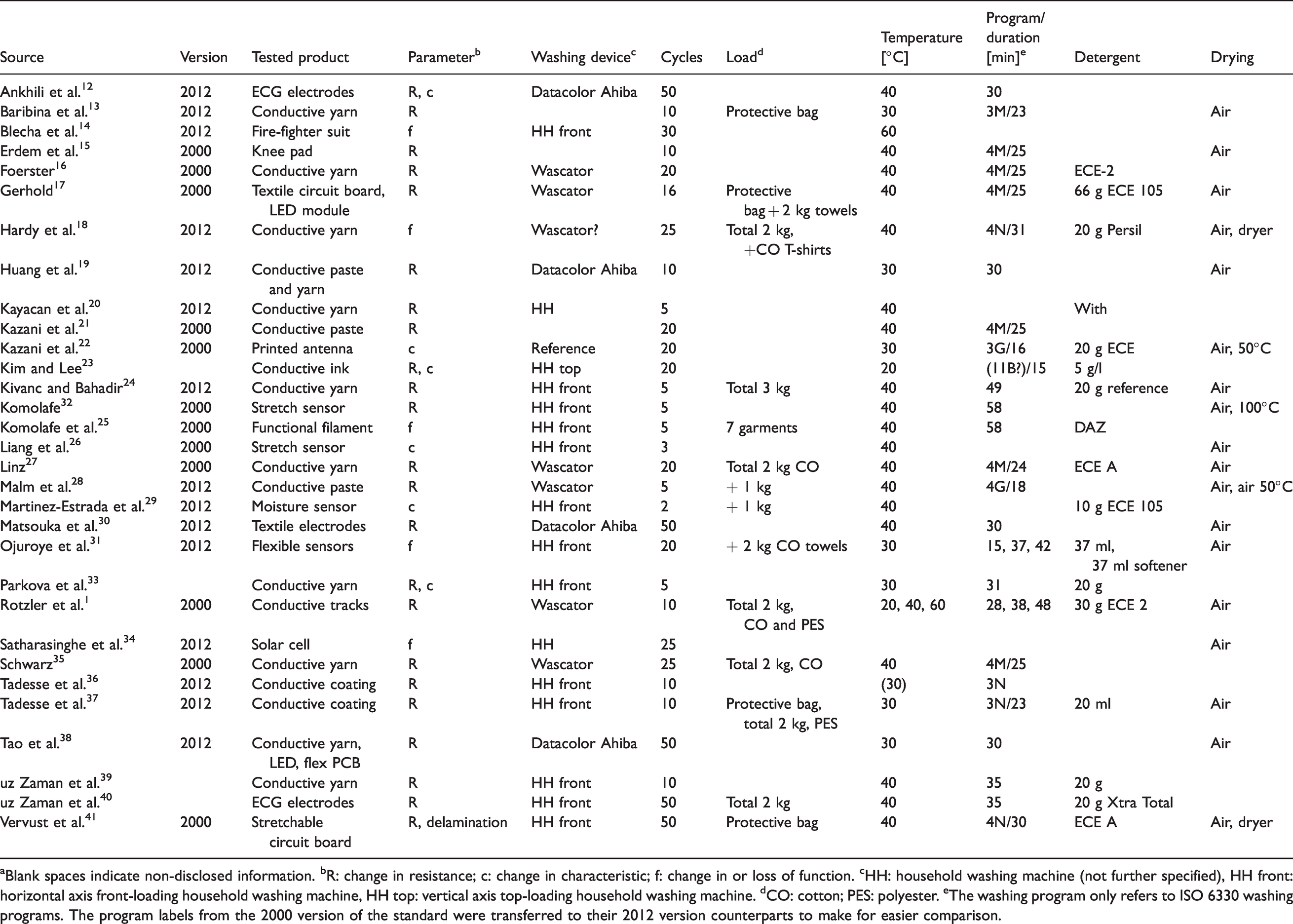
aBlank spaces indicate non-disclosed information. bR: change in resistance; c: change in characteristic; f: change in or loss of function. cHH: household washing machine (not further specified), HH front: horizontal axis front-loading household washing machine, HH top: vertical axis top-loading household washing machine. dCO: cotton; PES: polyester. eThe washing program only refers to ISO 6330 washing programs. The program labels from the 2000 version of the standard were transferred to their 2012 version counterparts to make for easier comparison.
Washing factor ranges for ISO 633042

Wash testing according to other standardsa
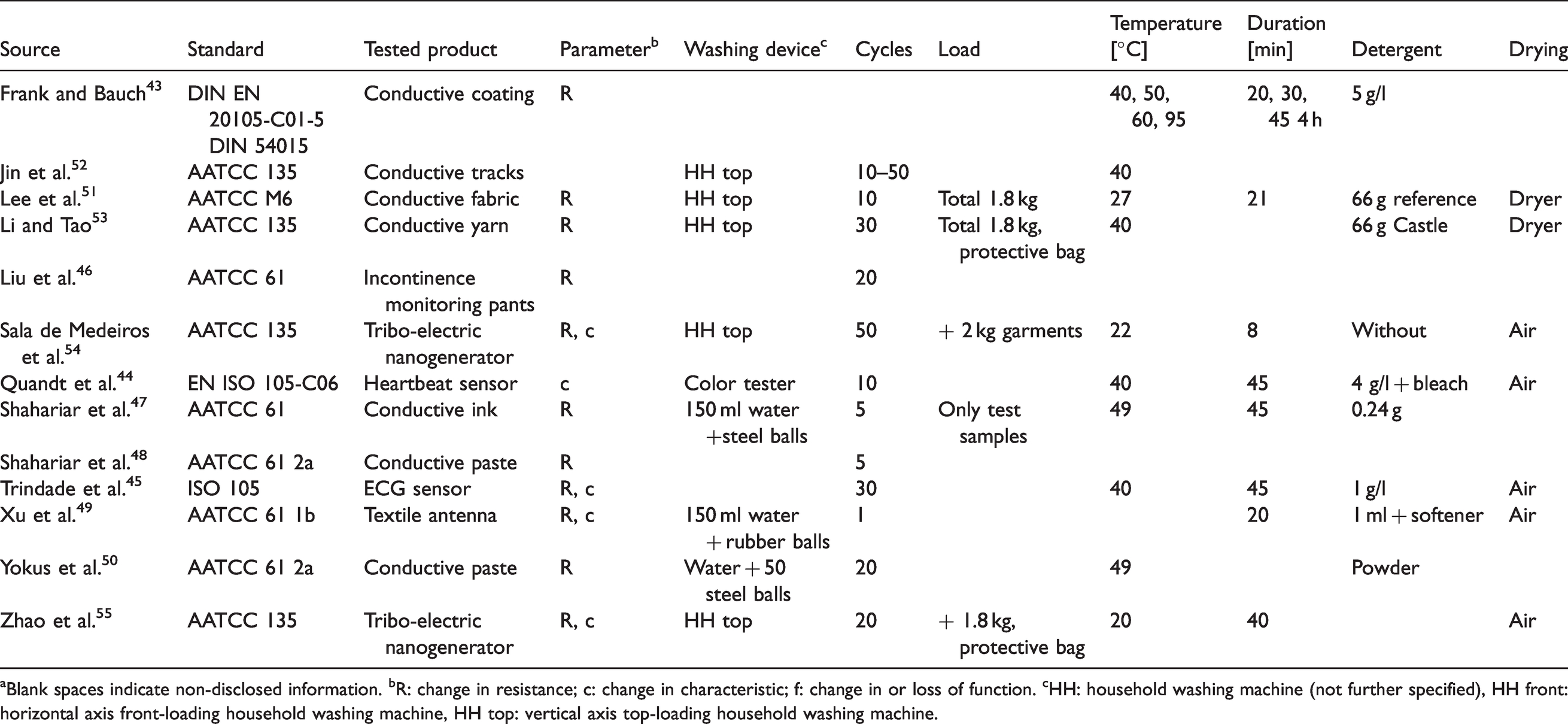
aBlank spaces indicate non-disclosed information. bR: change in resistance; c: change in characteristic; f: change in or loss of function. cHH: household washing machine (not further specified), HH front: horizontal axis front-loading household washing machine, HH top: vertical axis top-loading household washing machine.
A large majority of the sources test conductive textile material (yarn, filaments, or textiles) integrated into a textile base substrate by different methods (knitting, sewing, weaving, embroidering, laminating) or conductive pastes, inks, or coatings applied to textiles. In many cases, these conductive elements are shaped into antennas, electrodes, or conductive tracks. A commonality between those tested products is that they can be considered semi-finished goods, but not fully functional e-textile systems. Some of the examined products have a more complex composition than mere conductive material: Gerhold and Tao et al. test conductive tracks with added LEDs, 17 , 38 while Ojuroye et al. and Komolafe et al. subject sensors, LEDs, and other modules embedded on kapton-filaments to repeated washing. 25 , 31 Satharasinghe et al. test their e-yarn equipped with miniaturized solar cells for washability. 34 Only one fully functional system, a fire-fighter suit, is among the tested products. 14
Even though there is no reference given in the standard on how to assess the washability after testing, a similar method is chosen in many of the presented examples from the literature. In 22 of the reviewed sources, a change in resistance after (repeated) washing is used to rate the washability of the tested product. Three of these use more than one method for their assessment. 12 , 23 , 33 Washability is also evaluated through changes in the functionality of components or the whole structure, 14 , 18 , 25 , 31 , 34 , 41 as well as altered sensor and antenna properties or characteristics. 12 , 22 , 23 , 26 , 29 , 33 In one instance, the quality of integration is included as a measure for washability: Vervust et al. test their washed samples for delamination. 41 As mentioned above, a large share of the tested e-textiles are not fully functioning systems, but rather single components such as conductive textiles or conductive threads, as well as sensors or antennas without connected modules. For these components, testing for a change in resistance or conductivity is a valid method to assess their washability. In the case of complete, fully functional devices (especially with more complex components present than just conductive textile materials), other parameters have to be used to fully assess the system’s washability. Changes in or (partial) loss of function, changes in sensor or antenna properties, methods already employed by some of the reviewed sources, might provide a better choice.
Another aspect of testing not covered in the standard is the number of wash cycles that should be run to test a product’s washability: only the conditions and procedures are provided. The average number of cycles run in this cluster is 19, but there is a large variation in the number of conducted test cycles (see Table 2): Martinez-Estrada et al. wash their test samples only twice, while Liang et al. test for three cycles. 26 , 29 In contrast, five sources have conducted 50 wash cycles, four of which stem from the University of Lille. 12 , 30 , 38 , 40 Gerhold does not run a predetermined number of cycles, but instead stops testing at the first occurrence of detached components, after 16 cycles. 17 Depending on the type of e-textile and its intended use, the number of wash cycles that a product should be able to withstand without function- or security-compromising damage changes. 1 The difference in number of test cycles could be attributed to this connection. Yet, none of the sources relate the number of cycles to the foreseen use of the tested e-textile. Liang et al. rather claim their stretch sensor provides sufficient washability after testing for only three wash cycles, even though the sensor will be integrated into a dance leotard—a product likely to be washed after each or at least every second use—leading to much higher washing requirements than only three cycles. 26
Compliance of the reviewed test methods with the specifications of the standard
Even though all sources in this cluster claim to test according to ISO 6330, the degree of conformity with the testing instructions provided by the standard varies considerably. The evaluation of testing procedures from each cited source reveals pronounced differences in practices, even though the same standard is used as a basis. Hardy et al.,
18
Kazani et al.,
21,22
Linz,
27
Schwarz,
35
and Tadesse et al.
36
,
37
are among those who follow specifications quite closely. Others rather use the standard as a rough guideline for wash testing.
While some sources claim to wash according to a specific standard program, they use a regular (typically non-programmable) household washing machine. These machines do not normally feature the standard programs within their range of available washing programs. It is unclear if the 6330 programs are indeed installed in the machines used for testing. Another possibility is that these sources rather employ a regular household washing program resembling the stated standard program—like Komolafe et al., who explain that their program is only similar, but not identical to program 6A.
25
Ojuroye et al.
31
and uz Zaman et al.
39
,
40
use multiple household washing programs including silk/delicates and wool/handwash, while Rotzler et al.
1
test nine different, self-programmed washing programs to assess washing factor influence in the form of a Design of Experiments (DoE). Most sources do not elaborate on the reasons for choosing a specific test program. Linz bases their choice of program 6A/4M on research into standard programs most often employed in e-textiles wash testing.
27
Ojuroye et al. test their touch and proximity sensor with three household washing programs that represent “typical washing programs for textiles.”
31
Express and silk, two household programs, were chosen by uz Zaman et al. due to their similar run times.
40
Kazani et al. wash their conductive textile with 6A/4M due to the program’s relevance to the function of the tested textile, but do not elaborate on what this relevance entails.
22
Rotzler et al. model the center point of their DoE washing programs after a household delicates program due to the agreement among many experts that e-textiles should be washed gently.
1
,
6
Evaluation of the testing methods in this cluster reveals significant disparities even when the same standard is claimed to be used as a basis. Most sources follow the standard only partly—maybe attributed to the available resources and their degree of compliance with standard requirements. Publications from the same institutions show some similarities in wash testing, but there is still variation.
Testing according to other standards
Apart from ISO 6330, other standards that are used as a basis for e-textile wash testing include ISO 105 Textiles—tests for color fastness,43–45 DIN 54015 Testing of color fastness of textiles—determination of color fastness of dyeings and prints to washing in presence of peroxide, 43 AATCC 61 Colorfastness to laundering: accelerated,46–50 AATCC 6 Colorfastness to acids and alkalis, 51 and AATCC 135 Dimensional changes of fabrics after home laundering,52– 55 (Table 4).
Similar to the previous cluster, most of the tested products are conductive textiles or textiles coated with conductive paste or ink. In two cases, the washability of a tribo-electric nanogenerator is assessed. 54 , 55 Liu et al. test conductive yarn knitted into underpants to monitor incontinence, 46 Quandt et al. and Trindade et al. test textile sensors, 44 , 45 and Xu et al. test an antenna. 49 None of the tested products represents a fully functional system: further components or modules are not included in the testing.
The majority of the sources in this cluster use a change in resistance as an indicator for the washability of the tested products—comparable to the results on testing according to ISO 6330. Of those that provide their method for assessing washability, only Quandt et al. do not use resistance as an indicator; instead, they rely on a change in sensor characteristics. 44
If testing is done according to the American standards AATCC 135 and AATCC M6, a top-loading washing machine is employed (the predominant type in the USA). Testing according to AATCC 61 is not conducted in a regular washing machine, but in laboratory testing equipment similar to the previously mentioned Datacolor Ahiba IR. Quandt et al. also use a laboratory testing device, the Roaches Washtec color fastness tester. 44 Unlike all other wash testing reviewed in this research, the method given in AATCC 61 is an accelerated test, with one cycle equivalent to five regular-machine washing cycles, according to the standard. Acceleration is achieved by the addition of steel or rubber balls to the washing container. 56 The applicability of such harsh treatment for e-textiles has to be assessed, however. Colorfastness, the original scope of the standard, is not inconsiderably affected by friction on the textile surface, so the additional wear generated by the balls can lead to accelerated color loss. For e-textiles that are more susceptible to mechanical damage, this method might not be suitable—especially for products more complex than mere conductive textiles.
The washing temperatures are slightly higher than in the previous cluster, with a mean temperature of 46,2°C. As with the tests according to ISO 6330, 40°C is most prevalent. High washing temperatures of 60°C and more are solely employed by Frank and Bauch 43 and only three of the cited sources wash with less than 30°C. 51 , 54 , 55
Air-drying is more common than tumble-drying. In cases where detergent use is elaborated on, powdered detergent is used except for Xu et al., who also add softener along with liquid detergent. 49
A single wash cycle in this cluster has a duration of between 20 and 45 min. The exemptions are Frank and Bauch, who run cycles of different lengths and temperatures, among them cycles with a duration of 4 h, 43 and Sala de Medeiros et al. who wash for 50 cycles of only 8 min each. 54 The average number of cycles is 22, similar to 19 in the ISO 6330 cluster. If each cycle of the accelerated tests according to AATCC 61 is counted as five cycles, the average cycle count within the cluster of tests according to other standards rises to 40.
Liu et al. give good washability as a requirement for their incontinence monitoring pants as it is projected to be washed frequently during its use. 46 Due to the results of their testing, several of the sources claim their product features satisfactory, 53 unprecedented, 47 or a good level of 55 washability, while others only deem the tested e-textiles washable. Li et al. compare the results of the programs normal and delicates, as well as washing with and without a protective bag. 53 Quandt et al. assume that the good washability results of their heartbeat sensor originates in the use of conventional textile production techniques (embroidery). Their use of hospital-grade detergent is substantiated by the intended use of their sensor in a medical context. 44 Similar to the sources from the previous cluster, elaboration on the reasons for choosing specific testing methods and washing parameters is missing in most cases.
Testing under household washing conditions
This cluster contains testing conducted in household washing machines (top-loading vertical axis and front-loading horizontal axis) without a standard as a guideline. Testing parameters for each of the sources can be found in Table 5.57–75
Wash testing under household conditionsa
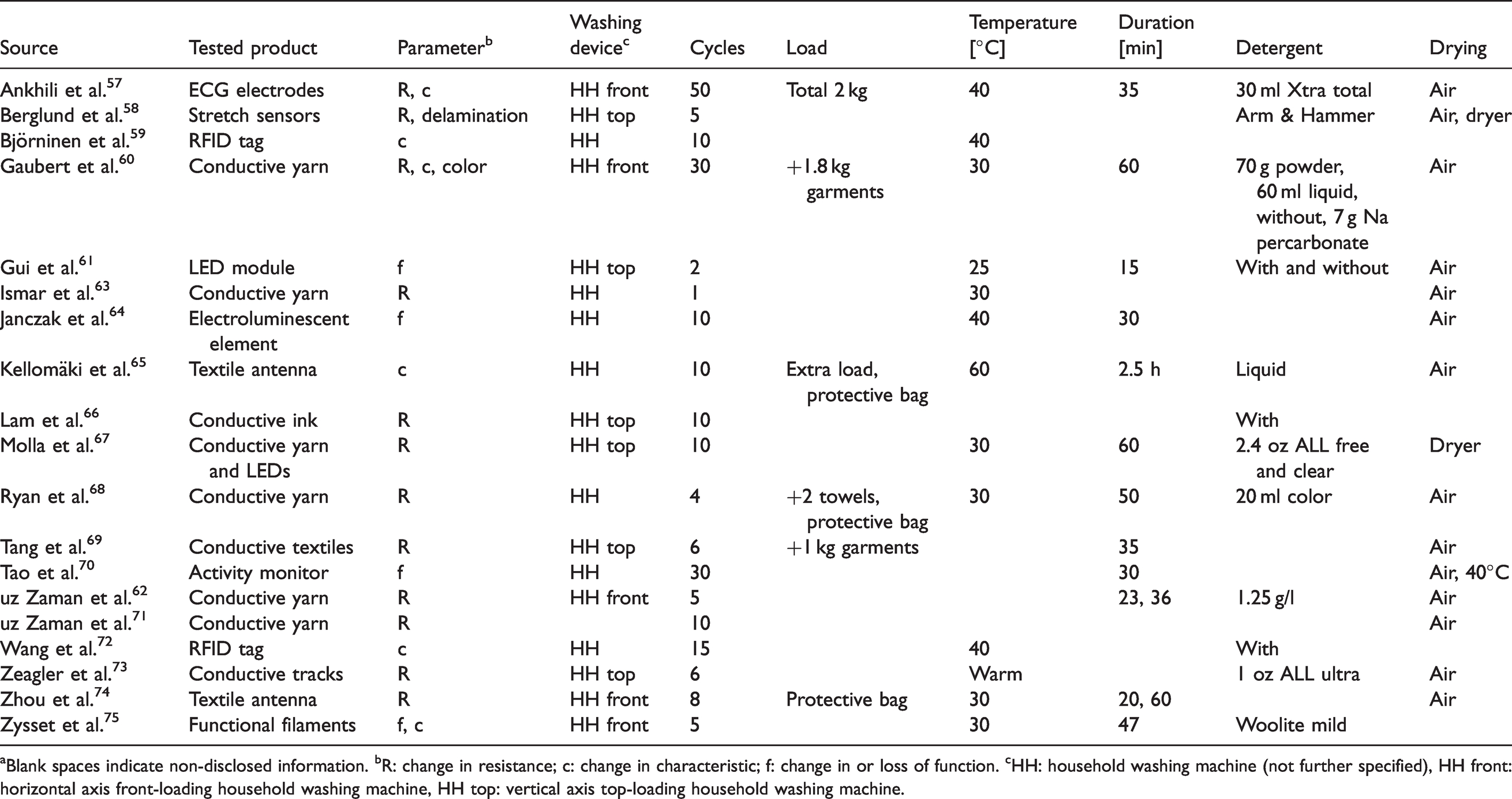
aBlank spaces indicate non-disclosed information. bR: change in resistance; c: change in characteristic; f: change in or loss of function. cHH: household washing machine (not further specified), HH front: horizontal axis front-loading household washing machine, HH top: vertical axis top-loading household washing machine.
Wash testing with alternative methods.a
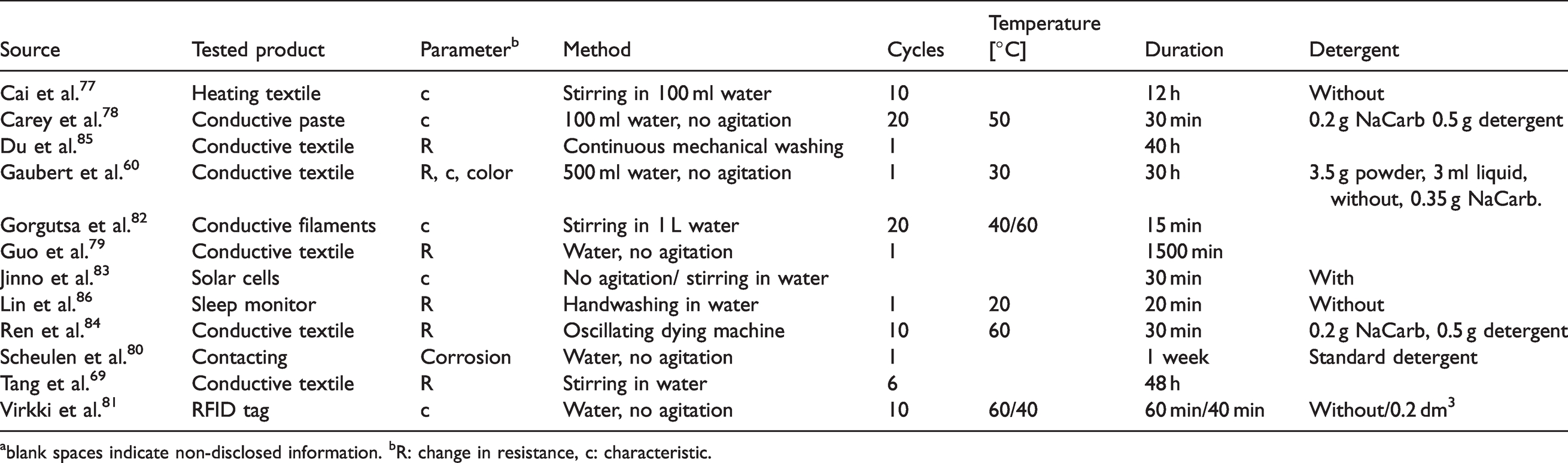
ablank spaces indicate non-disclosed information. bR: change in resistance, c: characteristic.
The tested e-textiles are mainly conductive textiles or sensors, electrodes, antennas, and RFID tags made from conductive textile material without further components. Janczak et al. test printed electroluminescent displays. 64 Gui et al. and Molla et al. include LEDs, 61 , 67 Zysset et al. use sensor modules on functional polymer filaments, 75 and Tao et al. use electronic components embedded in Polydimethylsiloxane (PDMS). 70 Consistent with the standard-based testing practices, change in resistance is the predominant parameter to assess washability. Besides an increase in resistance, Berglund et al. include the extent of delamination as a measure for washability, while Gaubert et al. also consider a change in color of the tested metallized textiles. 58 , 60 Changes in functionality or sensor and antenna characteristics are also employed to rate and assess washability.
In almost half the cases where a washing temperature is given, testing is done at 30°C; 40°C has the second highest incidence. Gui et al. wash at 25°C and Kellomäki et al. at 60°C. 61 , 65 Only four sources wash for more than 10 cycles. 57 , 60 , 70 , 72 Both the washing temperatures and the average number of washing cycles are lower, but the average duration of a single cycle is significantly longer (47 min) than in the two previous clusters.
The use of liquid detergent is more common than in standard-based testing. 57 , 60 , 65 , 67 , 68 , 73 , 75 As not all sources provide information about detergent use, this number might be even higher. Air-drying is predominant; a tumble dryer is used only on two occasions. Similar to the results of Hardy et al., the research of Berglund et al. reveals tumble-drying to be more damaging to their stretch sensors than washing. 58
In some cases, test samples are not only washed in a washing machine, but also placed in water (with and without detergent) for an extended amount of time in a parallel test. This is done either to compare results from washing with those from immersion only, or to evaluate the influence of moisture and water on the tested samples separately from washing. 61 , 65 , 68 Additional testing for Gaubert et al. and Tang et al. is so extensive that both sources are also included in the following cluster, testing with alternative methods.
Compared to the previous two clusters, a larger number of sources give reasons for choosing specific washing conditions or test protocols. Ankhili et al., Gaubert et al., Lam et al. and Molla et al. choose a household washing program and machine because they claim that a user will wash their e-textile in a similar manner when using the product. 57 , 60 , 66 , 67 Uz Zaman et al. use commercial instead of standardized detergent because of similar reasoning. 71 Gaubert et al. additionally justify their choice of program by referring to their garment manufacturer client’s specifications, while Zeagler et al. argue that warm washing with regular agitation provides harsher conditions, so if the tested samples withstand this treatment, they would withstand gentler washing as well. 60 , 73 Björninen et al. compare their washing results to those of other publications in which similar e-textiles have been washed for the same amount of washing cycles, implicating a choice of testing parameters based on literary research and the need for comparability. 59
With lower temperatures, longer cycles, and a higher incidence of liquid detergent, testing in this cluster resembles actual (gentle) household washing more closely than the standard
Testing with alternative methods
In some of the sources, wash testing is not conducted in a washing machine, but with alternative methods (Table 6). These methods include placing the samples in water or wash liquor (without further agitation) 60 ,77–81 and stirring the samples in a beaker. 69 , 77 , 82 , 83 Others employ laboratory testing equipment, such as the previously mentioned dyeing unit Datacolor Ahiba, 84 or subject the samples to “continuous mechanical washing.” 85 Lin et al. wash their samples by hand in water without detergent present. 86 Gaubert et al. 60 and Tang et al. 69 also test their samples under household conditions, comparing results. Carey et al. claim their test method represents the industry standard and reference Ren et al., who indeed use a similar method—although they test for only 10 cycles instead of 20 and at a different temperature. 78 , 84 Gorgutsa et al. reason that their method represents common practice and refer to previous studies as well as the manufacturer’s guidelines. 82
The complexity of the tested e-textiles is quite low. As in the three previous clusters, a majority are conductive textiles with no further modules. The solar cells tested by Jinno et al. are among the most complex products in the alternative washing methods cluster. Although Guo et al. test graphene paper, they claim that it constitutes an e-textile. 79 Due to the test set-up of the alternative methods, the test samples in this cluster are washed without any additional load.
In half of the cases, a change in resistance is the indicator for washability—the lowest percentage of all the clusters. Shifts in characteristic properties are utilized just as often. Scheulen et al. only test for occurrence of corrosion in their magnetic contacts. 80
In contrast to the previously mentioned testing procedures, some of the alternative tests run for a considerably longer time, from 12 h up to 1 week. 60 , 69 , 77 , 79 , 80 , 85 The average number of test cycles is lower than for the other clusters, which relates to the number of very long-running tests in which fewer cycles are conducted. Testing temperatures are highest when alternative methods are employed, with an average testing temperature of 47°C; in one-third of the cases the washing temperature is at or above 50°C. 78 , 81 , 82 , 84
The comparability of the alternative methods with actual wash cycles is not sufficiently researched. Only Tang et al. 69 test their samples both by stirring in water and in a household washing machine, while Gaubert et al. compare the household washing results for their conductive textiles with placing them in water with different types and amounts of detergent. 60 Gaubert et al. find in their research that if the tested conductive textiles are only exposed to a single one of the four Sinner’s factors—in their case either chemistry in the form of detergents or mechanical agitation—the resulting damage is quite limited. Not until multiple factors act and interact at the same time do significant losses in conductivity occur. 60 , 69 The methods employed in this cluster are thus (possibly) unreliable for a correct estimation of washability under real usage conditions. This is especially true where samples are just put into water without agitation, and in one case even without detergent. 81 Nevertheless, washability of the tested product is deemed satisfactory in most sources. Cai et al. claim their heating textile is just as washable as regular textiles. 77 To assess the influence of a single factor of the washing process (e.g., water, detergent, or washing temperature), the alternative methods might be able to provide valid results, though.
Critical evaluation of current e-textile wash testing practices
This research on test methods to assess washability of e-textiles reveals a large range of varying practices. Within the following section, the suitability of the employed methods is considered.
Comparison of average values for all clusters: Table 7 gives an overview of the average values of cycle count, temperature, cycle duration, total washing time, and the incidence of a change in resistance as a measure for washability for all four clusters. If very long cycles are omitted, the average duration is very similar for standard-based testing and alternative methods testing at 33, 32, and 32 min, with household tests taking significantly longer on average at 47 min. The number of conducted cycles is higher in standard-based testing. Even though the cycles are longer, the total average washing time with household methods is lower than in standard-based testing due to the lower cycle number. At 45.0°C, 47.1°C, and 46.2°C, the temperatures in the clusters of alternative methods and other standards are higher than in the other two clusters.
Average values for all clusters
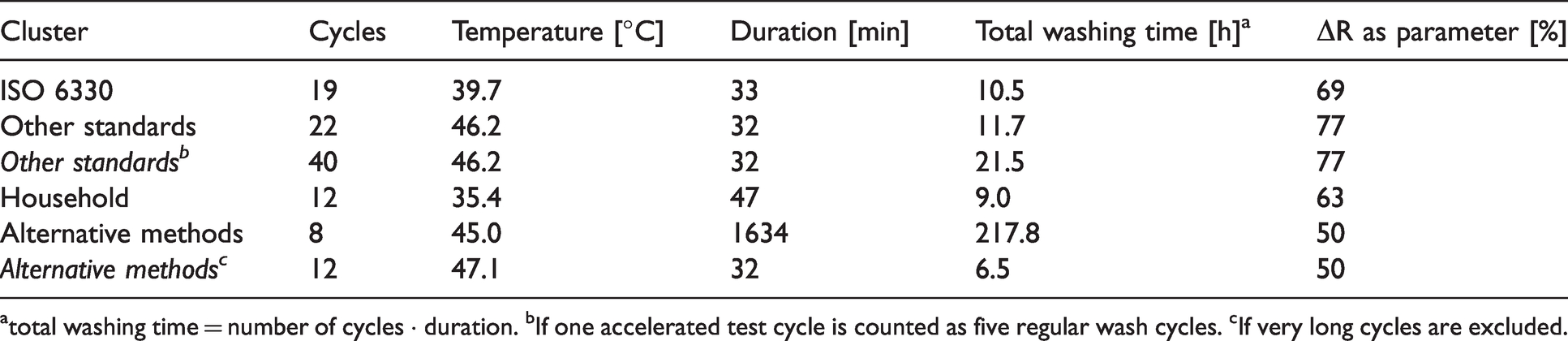
atotal washing time = number of cycles · duration. bIf one accelerated test cycle is counted as five regular wash cycles. cIf very long cycles are excluded.
Are the employed testing methods able to adequately estimate the washability of the tested products? Can equivalent, accelerated, or alternative tests obtain correct results for reliability estimations? A change in resistance is the parameter most often used to assess washability, but is not necessarily useful for fully functional systems. Since a majority of the e-textiles tested in the researched publications are only conductive textiles or otherwise non-complex in composition, a change in resistance is an adequate measure, however.
Some of the reviewed papers suggest that alternative test methods (including the standard-based tests not conducted in washing machines) might not be able to provide correct estimates of washability under real washing conditions. Accelerated testing according to AATCC 61 might be equally unreliable—a lack of comparative testing does not allow for a conclusive verdict. The standard (which requires its execution in laboratory testing equipment), although conceived for textile washing tests, is not intended to assess general washability, only colorfastness. The influencing factors that affect colorfastness are not equal to those that affect washability. The standard’s potential for an accurate estimation of washability—especially for e-textiles—is therefore disputable. On the other hand, if the accelerated tests according to AATCC 61 are factored into the average cycle count of the testing according to other standards cluster with five cycles for each accelerated cycle (as intended by the standard), the average number of wash cycles for this cluster increases to 40 (from 22). This is a much higher cycle count compared to the other three clusters. The use of accelerated testing can thus lead to an increased number of overall wash cycles, enabling possibly a more accurate assessment of washability—especially for e-textiles with a high projected cleaning frequency. Due to resource and time constraints, conducting an equivalent number of non-accelerated tests for new e-textile developments might not be feasible. The testing methods have to be specifically conceived for e-textiles, though, to ensure that the acceleration does not lead to failure mechanisms that would not occur in non-accelerated testing. 87 Wash testing results from Rotzler et al. show that cracks in textile metallization only occur above a threshold washing temperature. 1 An accelerated test featuring a higher washing temperature could thus lead to a worse estimate of washability compared to repeated washing at the lower temperature. The same might be true for an increased mechanical strain through the addition of steel balls to the washing container, the method provided by AATCC 61. The development of suitable accelerated or equivalent testing protocols needs to be preceded by a thorough analysis of failure mechanisms and the matching contributing influence factors for a range of different e-textiles. 87
Are the test protocols capable of cleaning the product? The main purpose of a washing process is the ensuing cleanliness of the laundry. This aspect is not addressed by any of the reviewed sources except Rotzler et al. 1 Neither is the cleaning capability taken into consideration when choosing a suitable testing protocol. The intended use and the resulting typical product life cycle should be factored in before choosing reliability-testing methods. With regard to wash testing, the kind of staining a product will experience as well as its projected cleaning frequency (e.g. underwear/sports clothing: after every use; jackets/outerwear: only a few times during the life cycle) have to be taken into account. Protocols employed in the washability evaluation of a product should be capable of removing use-specific staining reliably and satisfactorily. The product in turn should withstand these wash protocols for as many cycles as are to be expected during its intended life span. Only then can the product be deemed washable. 1 Within the scope of an e-textile washing or reliability standard, the cleaning capabilities of the provided washing programs could be included, facilitating the choice of a suitable testing method for e-textile developers. The methods of the aforementioned IEC 60456 could be used as a basis for the assessment of cleaning capabilities for future e-textile washing programs. 89
Does the test protocol include safety concerns? Because of the presence of electronic components, or at least electrically conductive materials in e-textiles, possible health or safety issues could arise for the user (or the environment) in the case of a damaged or malfunctioning product caused by the washing process. Potential dangers include electric shock, overheating, and ignition. Toxic or otherwise problematic substances can contaminate the washing water—metallized textiles are prone to losing their metal coating over time during washing. 88 So far, these security concerns are not properly addressed by any of the reviewed publications. The focus rather lies on retaining functionality.
How do the chosen wash programs relate to actual customer laundry practices and industry suggestions? The average temperature for the household cluster is 35°C. Combined with the average cycle duration of 47 min and a high incidence of liquid detergent, the values of this cluster are a good representation of gentle household washing conditions. On the other hand, the standard-based testing with a higher cycle count reflects the number of washing cycles during the life cycle of most actual textile products to a greater extent. The average washing temperatures in standard-based testing and the alternative methods cluster are much higher than the 30°C that are recommended (for textiles in general and especially so for delicate laundry items) by a growing number of detergent industry and sustainability experts. With campaigns like I PREFER 30, these efforts are communicated to consumers, encouraging a more energy-conscious and laundry-preserving washing behavior.90 The default temperature for a majority of washing programs aimed at delicate laundry items in household washing machines is already set to 30°C. 76 Furthermore, some types of e-textiles are damaged by higher washing temperatures due to the effects from a mismatch of the coefficient of thermal expansion (CTE) of the involved materials 1 —another argument for testing at rather lower temperatures than current practice.
Do the currently used test programs allow for some kind of comparability? A large share of the cited sources test similar materials: conductive textiles or yarns. The methods employed differ profoundly, however, making washability comparisons difficult. This large variation is the result of a lack of e-textile-specific standardization, as researchers are unable to draw their methodology from a common source. Yet even when testing is done at the same institution, the employed methods are often not consistent (enough) for a comparable appraisal of washability. Until standards are implemented, testing at the same—or even at several connected—institutions should be as uniform as possible to achieve at least local comparability.
Taking diverse product requirements into account, a range of testing protocols should exist for e-textiles—not unlike the different washing programs provided by ISO 6330—but the overall variety should be smaller than in the current situation. An e-textile specific wash testing standard will be able to alleviate this lack of comparability.
Do the specific test protocols reflect the intended use case of the products and the product type? The majority of sources researched in this paper do not base their choice of washing protocol on the type of tested product or its intended use. Apart from a few exceptions, no selection criteria are given and the employed methods are either (seemingly) arbitrary or based on common practice. Since the cleaning needs and ensuing reliability requirements of an e-textile during its lifetime strongly depend on the product type and its usage conditions, both should be considered when choosing a suitable protocol to assess washability.
If a standard is used, how strictly are the guidelines followed? As the analysis shows, most sources that use ISO 6330 as a basis for their testing follow the standard quite loosely, and even in cases with greater accordance not all guidelines are followed. This lack of compliance could be attributed to the standard being conceived for textile (not e-textile) testing and thus not completely meeting e-textile-specific requirements for wash testing. Another reason could be a lack of standard-compliant equipment and resources (like a climatized lab or water of a specific hardness). Where other standards are used, the extent of compliance is generally higher than with testing according to ISO 6330, but there are still differences in practices.
Is there insight into the influence of different factors of the washing process on e-textiles? Very few sources research general e-textile washability. Gaubert et al. investigate the influence of different kinds of detergent on the washing results of conductive textiles. 60 Rotzler et al. research the influence of washing temperature, cycle duration, and mechanical strain on multiple types of textile-integrated conductive tracks, as well as the influence of different textile substrates on the washability. 1 The effect of textile substrates is also examined by Kazani et al. 21 Toward the development of suitable (standardized) test methods for e-textiles or prospective e-textile-specific washing programs for household washing machines, more research into how different e-textiles are influenced by which kind of washing conditions will be necessary.
Conclusion
The presented insight into current e-textile wash testing methods is limited by the researched sources’ lack of fully disclosed methodology on wash testing. Unavailable information on industry practices further narrows the degree of overall understanding of the topic. Despite these limitations, this paper is able to underscore the need for e-textile-specific standardization to overcome the existing lack of comparability between differing employed methods. Even though no proper e-textile standards exist yet, in 60% of the reviewed publications a standard is already used as the basis for their washability testing—with varying degrees of compliance. This number shows that the willingness to use standards is high among researchers.
The currently used standards all stem from the textile field, lacking an adequate consideration of the integrated electrically conductive and electronic components of e-textiles and potential safety concerns that might arise. A future standard should provide a range of washing programs for different kinds of washing devices. These programs should reflect different conceivable use cases for e-textiles concerning cleaning frequency, hygiene requirements, and possible staining. Different requirements stemming from the respective materials and manufacturing methods employed for a specific e-textile need to be considered as well. To allow for a feasible way to estimate long-term washing reliability, accelerated or equivalent test methods will have to be provided as well. The scope of such a standard should include suitable evaluation methods, enabling users of the standard to reliably and comparably assess their product’s washability. To develop such specialized testing methods, more insight into how different washing conditions affect various types of e-textiles is needed—especially if accelerated testing methods are to be developed. Only a joint effort of interdisciplinary experts from all areas involved in e-textile development will lead to suitable standardization.
Footnotes
Declaration of conflicting interests
The authors declared no potential conflicts of interest with respect to the research, authorship, and/or publication of this article.
Funding
The authors received no financial support for the research, authorship, and/or publication of this article.
