




Abstract
Although educational aspirations are widely viewed as central to attainment, less is known about how they translate into academic behavior. This study investigates the behavioral consequences of aspirations using nationally representative data from South Korea and dynamic panel models with individual fixed effects. Results show that aspirations predict both self-study time and private tutoring time even after accounting for prior behavior and unobserved individual characteristics. However, the aspiration–behavior link varies by age and socioeconomic status, especially for tutoring time. The aspiration–tutoring relationship strengthens as students grow older and is more pronounced among those with highly educated parents. These patterns reveal systematic differences in aspiration–investment alignment, which refers to the extent to which students can convert their educational goals into concrete academic behaviors, highlighting a novel mechanism through which socioeconomic disparities in educational outcomes persist.
Keywords
Introduction
For decades, scholars have emphasized students’ ambitions for education as central to academic achievement and long-term socioeconomic outcomes (Ditton, Bayer, and Wohlkinger 2019; Khattab 2015; Lekfuangfu and Odermatt 2022; Schoon and Cook 2021; Sewell, Haller, and Ohlendorf 1970; Sewell, Haller, and Portes 1969; Wu and Bai 2015). These insights have informed a wave of policy interventions aimed at raising aspirations among disadvantaged youth, grounded in the belief that motivation, if sufficiently cultivated, can overcome structural barriers (e.g., Australia Department of Education, Employment and Workplace Relations 2009; Department for Education and Skills 2007; Social Exclusion Taskforce 2008). These efforts have coincided with rising aspirations among marginalized groups (Goyette 2008; Rizzica 2020), yet disparities in educational attainment persist. Disadvantaged students with high aspirations often fail to translate their aspirations into higher education participation (Harrison and Waller 2018; Rizzica 2020), and if they do attend college, they often drop out without attaining a degree (Payne 2023).
One line of critique suggests the contemporary “college-for-all” ethos may have inflated students’ aspirations to the point they function more as normative scripts than as motivational forces (Rosenbaum 2001, 2011). These scholars argue that when students’ aspirations become detached from their actual skill sets and available opportunities, especially in contexts where easy-to-access, low-quality institutions are poised to capitalize on their underpreparedness, their motivational power may be weakened. This disconnect can lead to “lost talent” as students pursue educational pathways misaligned with their capabilities (Reynolds et al. 2006).
Other scholars have highlighted methodological limitations in prior research, suggesting causal influence of aspirations on achievement may be overstated due to endogeneity issues (Dochow and Neumeyer 2021; Fishman 2019). Apart from long-standing concerns over unobserved individual heterogeneity, the reciprocal process where aspirations and academic behaviors affect each other and behavioral state dependency might lead to overestimation of aspiration effect (Dochow and Neumeyer 2021; Schoon and Ng-Knight 2017).
Together, these critiques suggest the need to examine whether educational aspirations have a genuine motivational effect that extends beyond mere stated preferences. Prior research has extensively documented the long-term consequences of aspirations (Ditton et al. 2019; Khattab 2015; Lekfuangfu and Odermatt 2022; Schoon and Cook 2021; Wu and Bai 2015), yet relatively little is known about whether and how aspirations are enacted through academic behaviors.
This study seeks to address this gap by investigating the behavioral translation of educational aspirations, examining how and under what conditions these aspirations translate into concrete academic effort. Building on a growing body of research documenting behavioral correlates of educational ambition (Baek and Hwang 2011; Domina, Conley, and Farkas, 2011; Dunatchik and Park 2022; Graham and Pozuelo 2023; Lee, Kim, and Yoo 2024), I focus on time spent on self-study and private tutoring as indicators of students’ behavioral investment in their goals. I extend the literature by investigating whether the aspiration–behavior link is moderated by socioeconomic status (SES) and whether this relationship changes as students mature and approach high-stakes educational transitions. The findings provide one important piece of the puzzle in explaining why rising aspirations among disadvantaged students have not yielded reductions in attainment gaps across social groups.
I examine this question using longitudinal data from South Korea (hereafter, Korea), a context that provides a critical test of aspiration–behavior theories due to its combination of near-universal high aspirations (Korean Educational Development Institute [KEDI] 2022), extraordinary academic time investment (Jeong 2014), and persistent socioeconomic inequalities (Byun and Park 2017). To address methodological challenges in this area, I use dynamic panel models with individual fixed effects (Moral-Benito, Allison, and Williams 2019; Williams, Allison, and Moral-Benito 2018). This approach enables more robust estimation of the aspiration–behavior link by accounting for prior behavioral trends, unobserved individual characteristics, and potential reverse causality.
This study makes three key contributions to the literature. First, it enriches sociological models of status attainment by specifying the proximate behavioral mechanisms (e.g., academic time use) through which aspirations potentially influence attainment and documents aspiration–behavioral investment alignment as a novel mechanism of inequality. Second, it advances methodological approaches to studying aspiration–behavior links by accounting for unobserved, time-invariant confounders and dynamic interdependencies. Third, it contributes to policy debates by clarifying when and for whom aspirations are most likely to translate into effort, highlighting the limitations of aspiration-raising initiatives in isolation.
Translating Aspirations Into Behavior: A Theoretical Framework
The Wisconsin model of status attainment (Sewell et al. 1969, 1970) conceptualizes aspirations as motivational constructs that mediate the relationship between students’ social origins and their educational outcomes. Aspirations are formed through a combination of family background, academic performance, and the expectations of significant others. Once established, aspirations guide students toward behaviors deemed conducive to educational success, functioning as internalized goals that influence behavioral choices (Haller 1982; Woelfel and Haller 1971). This view is supported by empirical findings that aspirations independently predict educational attainment even after controlling for family background and prior achievement (Ditton et al. 2019; Khattab 2015; Lekfuangfu and Odermatt 2022; Schoon and Cook 2021; Wu and Bai 2015).
The Wisconsin model identifies aspirations as important precursors to attainment, yet it offers limited insight into how these motivations are enacted. Motivational theory of life-span development (Heckhausen, Wrosch, and Schulz 2010, 2019) complements the sociological model by specifying how individuals translate abstract goals into concrete action. In this theory, primary control refers to individuals’ attempts to influence their external environment to align with personal goals. The theory distinguishes between different modes of primary control: selective primary control, which refers to personal effort and resources invested in goal-relevant activities, and compensatory primary control, which involves mobilizing external resources when individual effort alone is insufficient.
In educational settings, self-study exemplifies selective primary control, reflecting students’ investment of time and effort toward academic goals, which have been shown to play a critical role in educational success (Burger 2021; Galla et al. 2014). Private tutoring reflects compensatory primary control because it requires external support from parents in terms of financial resources and parental involvement (Martinez-Yarza, Solabarrieta-Eizaguirre, and Santibáñez-Gruber 2024; Park, Byun, and Kim 2011). Whereas self-study is largely a matter of individual agency, tutoring depends on “co-agency,” wherein students’ educational goals are enacted through parental involvement (Salmela-Aro 2010). Conceptualizing time investment in both self-study and private tutoring as a behavioral manifestation of students’ engagement with their aspirations extends the status attainment model by specifying the proximate behavioral mechanisms that mediate between aspirations and attainment. This perspective also broadens the life-span developmental model by applying its core concepts to educational inequality and stratification.
A growing body of research suggests that students with higher aspirations indeed invest more time in academic activities. Korean students with higher aspirations are found to invest significantly more time in both self-study and private tutoring (Baek and Hwang 2011; Lee et al. 2024). Similar patterns are documented across different national contexts, with educational aspirations linked to time spent on homework, self-regulated learning, and other forms of academic activities (Domina et al. 2011; Dunatchik and Park 2022; Graham and Pozuelo 2023; Wei 2024). However, these associations are difficult to interpret causally due to unobserved individual differences that may influence both aspirations and academic behaviors. The relationship is also likely reciprocal, with students who study more developing higher aspirations and vice versa (Schoon and Ng-Knight 2017), introducing the risk of reverse causality. Both aspirations and effort also exhibit state dependency, with past levels shaping future trajectories (Dochow and Neumeyer 2021). Addressing such methodological concerns is crucial for examining causal mechanisms with greater confidence.
SES and the Capacity to Engage with Aspirations
Time is a critical input for academic development (Carroll 1989). Students who spend more time on academic tasks (e.g., homework, self-study, or private tutoring) tend to perform better in school (Chen and Lu 2009; Liu 2012; Ozyildirim 2021). This association has been observed in high-pressure educational contexts like Korea, although the magnitude of the effect varies by subject, student background, and form of time use (Jeon 2024; Kim 2010; Kim and Paik 2016; Seo 2018). 1 Not all students, however, are equally positioned to invest time in their education. Students from lower-SES backgrounds often face structural constraints, such as competing responsibilities and a lack of suitable study spaces at home (Cheal 2003; Paulus, Spinath, and Hahn 2021). Even when time is available, the translation of aspirations into concrete action can be undermined by limited access to learning materials, academic support, and parental guidance. By contrast, high-SES families typically cultivate structured environments that reinforce academic routines and provide oversight and encouragement (Davis-Kean 2005; Hoff and Laursen 2019). These disparities are more pronounced for private tutoring because high-SES parents are more likely to arrange supplementary lessons, make informed choices about tutoring options, and monitor academic progress (Bray and Lykins 2012; Jerrim 2017; Lee 2005). Such forms of parental involvement are not only financially demanding but also time- and knowledge-intensive (Park et al. 2011), creating substantial barriers for disadvantaged families.
A less explored but theoretically crucial question is how SES conditions the translation of aspirations into time investment. This shifts the focus from comparing absolute levels of aspiration or behavior to examining how effectively aspirations are translated into action across social strata. This distinction is critical in a contemporary society, where high aspirations are increasingly widespread but outcomes remain stratified (Goyette 2008). If disadvantaged students are just as motivated but less able to act on their goals, this may reflect a key mechanism of persistent inequality—one that aspiration-raising policies alone are unlikely to overcome.
Two competing perspectives theorize how SES may moderate the aspiration–behavior link: “resource substitution” and “resource multiplication” (Ross and Mirowsky 2006). The resource substitution perspective suggests that aspirations may play a stronger behavioral role among lower-SES students, who compensate for limited material support and cultural capital with their own agency. This substitution is most plausible for self-study time, a behavior that falls largely within the realm of individual control. Existing research provides some support for this compensatory logic, showing that students who lack socioeconomic resources rely more on individual agentic resources, such as study effort, school engagement, and valued personality characteristics, for academic progress (Mele, Buchmann, and Burger 2023; Schoon and Cook 2021; Shanahan et al. 2014). In contrast, the resource multiplication perspective suggests that resources tend to reinforce each other. This view suggests that high-SES students are better able to translate aspirations into both self-study and tutoring time because they benefit from structured routines, parental oversight, and access to educational resources. For low-SES students, aspirations may remain unacted on due to the absence of such enabling conditions. Supporting this perspective, Billari, Hiekel, and Liefbroer (2019) show that higher-SES individuals are more likely to realize their intentions in key life domains, suggesting that individuals’ (and their families’) agentic capacity to link aspiration and behavior is stratified (see also Deluca and Rosenbaum 2001; Jeon 2024).
For self-study, resource substitution and multiplication lead to competing predictions; for tutoring, only resource multiplication likely applies given its dependence on parental investment:
Age, Development, and Institutional Timing
The relationship between educational aspirations and academic time investment may change as students mature and approach key educational transitions. This study focuses on students aged 10 to 14, a critical period for the development of aspirations and motivation. During this period, children become aware of academic hierarchies and start ruling out pathways they see as incompatible with their desired social standing, forming a “zone of acceptable alternatives” for educational attainment (Gottfredson 1996). Students’ aspirations thus become increasingly meaningful predictors of behavior. Consistent with this idea, Park (2022) shows that early adolescence is a decisive period for Korean students when both self-determined motivation and external pressure are strongly present.
Students’ ability to act on their goals improves with age as self-regulation, time management, and metacognitive skills increase (Heckhausen 1998; Montroy et al. 2016; Zelazo and Carlson 2012). These gains improve students’ ability to sustain effort, making age a useful proxy for readiness to act on aspirations. In Korea, this stage also precedes the high school academic/vocational tracking decision, making it a particularly informative window to observe how aspirations guide behavior before institutional placement narrows future options. Motivation also tends to intensify near critical academic transitions, such as track selection or high-stakes exams. As deadlines loom, goals become more meaningful and commitment increases, strengthening the aspiration–behavior link (Heckhausen et al. 2010, 2019). Research supports this pattern, showing academic effort ramps up as important deadlines approach (Capelle et al. 2023). Tutoring likely reflects this pattern most clearly because parents are typically more attuned to these approaching deadlines (Forster and van de Werfhorst 2020).
However, this developmental trajectory may be counteracted by institutional constraints. As students progress through the school system, academic workloads intensify, discretionary time diminishes, and school schedules become more rigid (OECD 2023). In Korea, for instance, time spent on both self-study and tutoring declines over the school years (Jeong 2014). These constraints may weaken students’ capacity to act on their aspirations through time investment.
Korea as a Critical Case
Korea offers a theoretically informative setting for studying how educational aspirations translate into academic time investment. First, high educational aspirations are nearly universal, reflecting not only the expansion of higher education but also long-standing cultural traditions that link academic attainment to moral cultivation and social mobility, often described as “education fever” (Kim and Bang 2017). In 2022, 84 percent of Korean primary students with specific aspirations aimed for higher education, a figure that rose to 96 percent among lower-secondary students (Ministry of Education 2022). This mirrors international college-for-all trends (Goyette 2008; Rosenbaum 2011) but with even greater saturation. Under such conditions, aspirations risk functioning as normatively mandated signals rather than distinctive individual orientations even though qualitative differentiation within higher education goals persists (Yong, Schoon, and Shure 2025). If aspirations operate only as social conformity, little behavioral correlation should be observed. If aspirations retain genuine motivational properties, however, even constrained variation should translate into measurable differences in effort.
Second, Korea's institutional structure creates severe constraints on discretionary time and academic behavior. Students already dedicate exceptional time to academic activities; first-year lower-secondary students spend approximately 2.5 hours on self-study and an additional 2.2 hours in private tutoring per school day (Jeong 2014), far exceeding the OECD average (OECD 2016). The academic/vocational track selection at age 15, which has substantial significance for higher education trajectories, intensifies competition from primary school onward (Byun and Park 2017; Lee 2005; Shin and Min 2024). In such a high-pressure environment, any additional effort requires substantial sacrifice. If aspirations can predict behavioral variation under such constraints, this provides strong evidence for their motivational power.
Third, Korea's extensive shadow education system, with 80 percent of students participating in fee-based private tutoring (KEDI 2022), creates an environment where family resources directly translate into educational advantages. This allows separation of individually controlled behaviors (self-study) from resource-dependent strategies (tutoring), enabling examination of how SES moderates different pathways through which aspirations become action.
The value of Korea as a critical case lies not in its representativeness but in its capacity to reveal fundamental mechanisms operating under extreme conditions. Countries differ in the extent to which academic success is believed to secure mobility, the intensity of pressure to succeed, and the level of parental and social investment in learning, but Korea exemplifies these forces in particularly concentrated form. If subtle differences in aspirations can generate behavioral variation in a system marked by universal ambition, severe time constraints, and pervasive competition, this provides compelling evidence that aspirations exert genuine motivational effects. This “stress test” logic strengthens confidence that aspiration–behavior links matter in less constrained environments even if their specific expressions and magnitude differ across educational contexts. Recent research documenting similar aspiration–effort correlations in developed and developing countries supports this generalizability (Domina et al. 2011; Dunatchik and Park 2022; Graham and Pozuelo 2023; Wei 2024), suggesting a common underlying cognitive-motivational process linking aspirations to goal-directed behavior.
Methods
Data and Sample
Korean Education Longitudinal Study 2013 (KELS2013; KEDI 2023) is a nationally representative annual panel study designed to examine the educational experience and development of Korean students. 2 The study used a two-stage stratified cluster sampling to select 7,324 fifth-grade students in 2013. In the first stage, schools were randomly selected from four region-based strata proportional to the student population size in each stratum. In the second stage, students were randomly sampled within the selected schools (KEDI 2019). KELS2013 collected data not only from students but also from their parents, teachers, and school principals, providing comprehensive information on students’ educational experiences within their familial and institutional contexts.
For the present analysis, I used data from Waves 1 to 5, following students from fifth grade in primary school (age 10,
Measures
Time allocation
Time spent on self-study was calculated as the sum of two student-reported measures at each wave: average daily time spent on homework and independent study beyond homework assignments. For homework time, which was reported in one-hour intervals, I used the median value of each interval. Time spent on private tutoring was measured from parent-reported data on weekly hours devoted to paid out-of-school instruction for Korean, English, and mathematics, including cram schools, one-on-one tutoring, and online instruction. To maintain consistency with the self-study time measure, I converted weekly private tutoring hours to a daily basis by dividing by seven. For both time measures, I treated values exceeding 3 SD from the mean as outliers and coded them as missing given the limited time available in a day.
Educational aspirations
At each wave, participants were asked which education level they plan to achieve, ranging from lower secondary to doctorate. Each level of education was converted into corresponding years of education (lower secondary = 9 years, upper secondary = 12 years, junior college = 14 years, university = 16 years, master's degree = 18 years, and doctorate = 22 years). I adopted this continuous operationalization to facilitate estimation in the dynamic panel fixed-effects models using full-information maximum likelihood, which cannot accommodate categorical or ordinal variables.
SES
Parental education and family income capture distinct dimensions of advantage; education reflects cultural capital and knowledge of the educational system, and income represents material resources (Bukodi and Goldthorpe 2013). I thus treat these dimensions separately rather than as a composite. Students were classified as “higher education (HE)” if at least one parent held a higher education degree and “no HE” otherwise, following prior research showing that being first in a family to go to college is an important barrier to university participation and intergenerational mobility (Adamecz-Völgyi, Henderson, and Shure 2020; Byun and Park 2017). About 64 percent of students in the sample had at least one college-educated parent. Family income, averaged over the five-year period and adjusted for inflation and household size, was categorized as “low income” (bottom tertile) versus “middle to high income” (remaining two-thirds), aligning with the education-based classification while capturing meaningful resource disparities. Although correlated, only 55 percent of no-HE students were low income, confirming that these indicators reflect distinct aspects of socioeconomic disadvantage. 3
Controls
Following the Wisconsin model (Sewell et al. 1969, 1970) and prior research (Baek and Hwang 2011; Hill and Wang 2015; Kim and Bang 2017), I include time-varying controls for parental aspirations for their children's education, school performance, and emotional school engagement. Including parental aspirations helps separate whether tutoring reflects a joint strategy shaped by both student and parent (e.g., parents arranging tutoring when children show strong ambitions) or simply captures the independent influence of parents’ own hopes for their children's attainment. School performance and engagement represent ability differences and general academic motivation that might drive both aspirations and effort. Parental aspirations were measured through parents’ responses to the question, “What level of education do you hope your child will attain?” These responses were converted to years of education, consistent with the coding of children's educational aspirations. School performance was assessed by the average test scores in Korean, English, and mathematics, which were administered annually as part of the KELS2013 survey. Standardized scores within each wave were used. Emotional school engagement was measured as the mean value of four items, each rated on a 5-point scale. These items included “I enjoy taking classes at school,”“I like to participate in class,”“I like going to school,” and “I feel comfortable during class” (ordinal reliability α = .88–.92). Given the potential trade-off between self-study and private tutoring within limited time budgets, I included time allocated to each activity as a control variable when analyzing the other activity. Descriptive statistics for all variables and correlations of key variables are provided in Tables S1 to S3 in the online supplement.
Analytic Strategy
Confounding due to omitted variables and the lagged effect of the dependent variable presents significant challenges to making robust inferences about the effect of educational aspirations. Individual fixed-effects models are commonly used to control for unobserved individual heterogeneity by estimating within-person differences, but these models rely on the strict exogeneity assumption (Clarke et al. 2015), which requires that explanatory variables be uncorrelated with the error term at all time points. This condition is violated in the presence of lagged dependent variables as predictors and reverse causality (Allison, Williams, and Moral-Benito 2017). Moreover, individual fixed effects tend to introduce too many parameters, leading to incidental parameter problems. The potential correlation between the starting value of the dependent variable and the individual fixed effect (known as the initial conditions problem) further complicates the simultaneous use of lagged dependent variables and fixed effects (Wooldridge 2001).
To address these issues, I estimate dynamic panel models with fixed effects using the maximum likelihood-structural equation modeling (ML-SEM) approach (Allison et al. 2017; Moral-Benito et al. 2019; Williams et al. 2018). In contrast to the generalized method of moments (GMM), which eliminates fixed effects through differencing and addresses endogeneity with instrumental variables (for an overview of GMM, see Bond 2002), ML-SEM models fixed effects as a latent variable and estimates it jointly with the initial condition and observed outcomes. This approach also relaxes the strict exogeneity assumption by permitting correlations between explanatory variables and past errors—thus addressing concerns of reverse causality—while treating the initial value of the dependent variable as exogenous. ML-SEM offers several advantages over GMM. First, it does not require arbitrary assumptions about the initial value and provides more efficient estimation in finite samples (Moral-Benito 2013). Second, the SEM framework handles missing data more effectively using full-information maximum likelihood (FIML). This approach also allows greater flexibility in specifying, testing, and relaxing model constraints (Williams et al. 2018).
The dynamic panel model estimated in this study is defined by the following equations:


where the time allocation (
The analysis proceeded in two steps. First, I estimated two dynamic panel models with fixed effects to examine the relationship between educational aspirations and time allocated to self-study and private tutoring. I then allowed the coefficients for lagged effect (
All analyses incorporate customized sampling weights to account for the complex survey design and sample selection probabilities (details on weight construction are available in the online supplement). The main analysis was guided by STATA package xtdpdml (Allison et al. 2017; Moral-Benito et al. 2019; Williams et al. 2018), which was used to generate an R script for the lavaan package. This script was further modified to incorporate scaled test statistics, sampling weights, and multigroup analysis. 4 I applied FIML estimation to all available cases to minimize bias from missing data and attrition. Robust standard errors address non-normality in the data distribution.
Results
Descriptive Findings
Figures 1 and 2 describe the trends in educational aspirations and academic time investment, showing disparities by parental education and income. Across all groups, educational aspirations show a general decline, indicating a process of goal adjustment toward more realistic expectations. Table S2 in the online supplement provides more detailed evidence that students’ aspirations tend to converge toward university-level education while rejecting options that are socially unacceptable (e.g., lower secondary) or too difficult to obtain (e.g., postgraduate levels). The SES gap in aspirations remains persistent, with a larger disparity observed when SES is defined by parental education. However, it is notable that even students from lower-SES backgrounds typically continue to aspire to higher education.
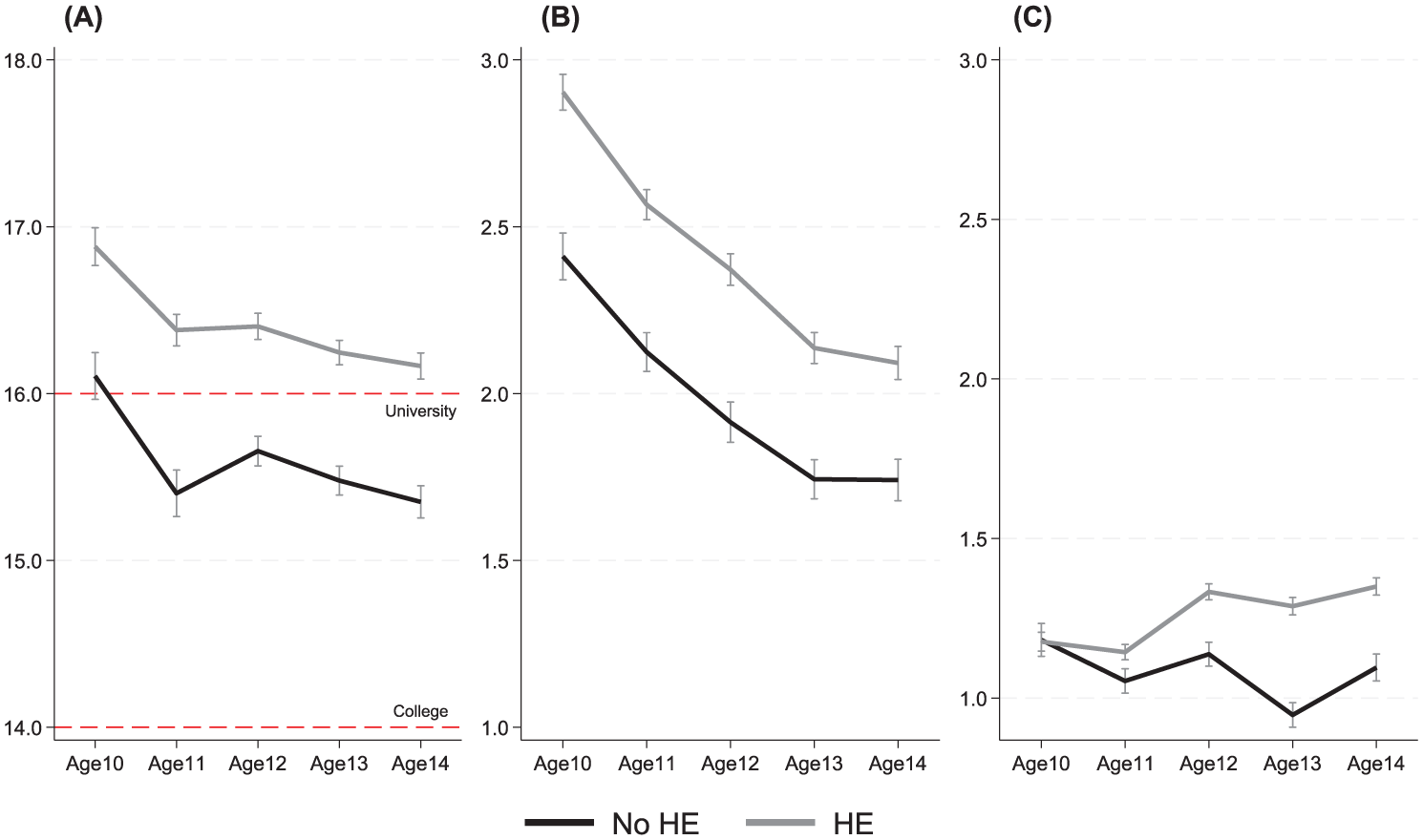
Educational aspirations and time use by age and parental education: (a) educational aspiration, (b) self-study time, and (c) tutoring time.
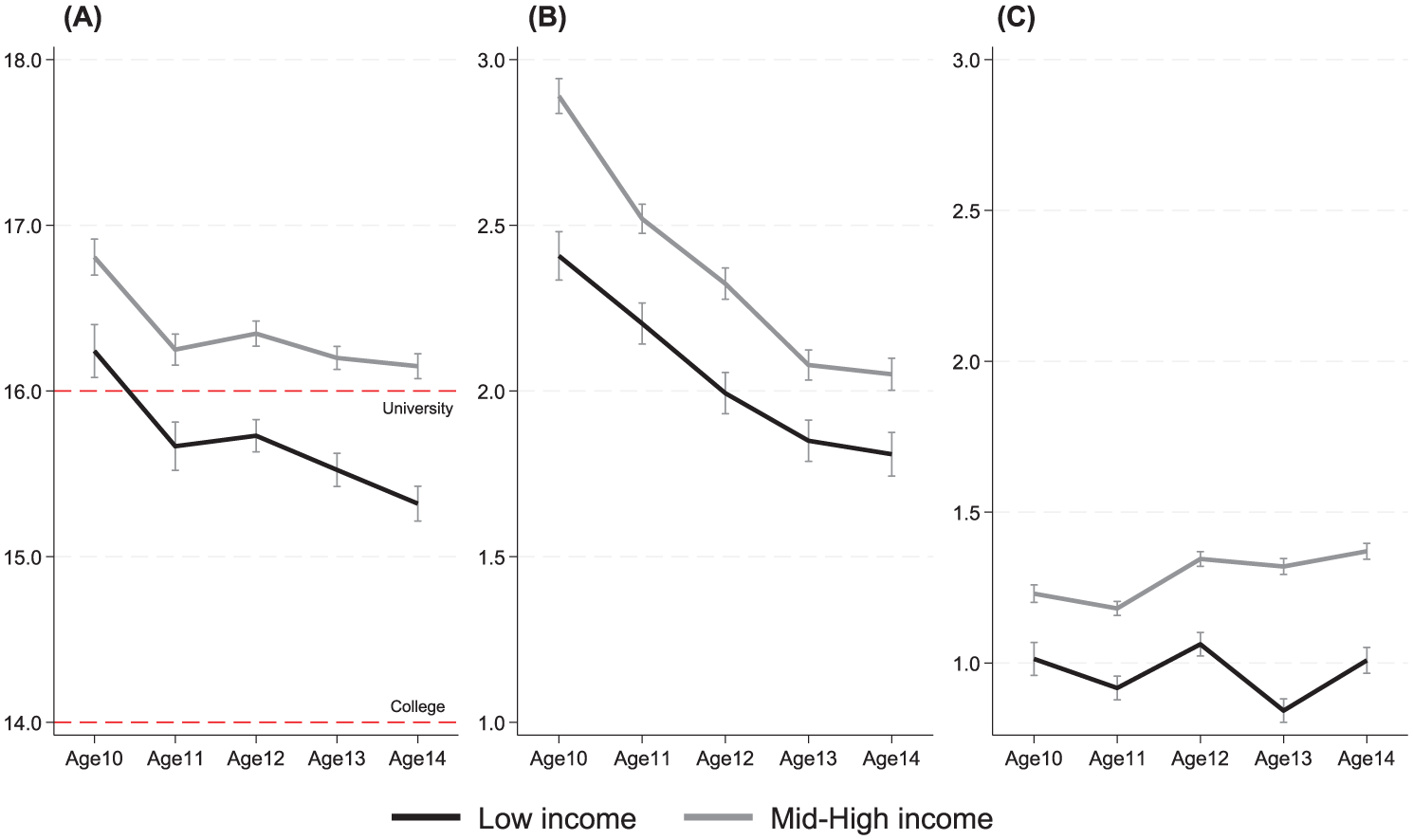
Educational aspirations and time use by age and family income: (a) educational aspiration, (b) self-study time, and (c) tutoring time.
A similar decline is seen in self-study time, with higher-SES children starting at around 2.9 hours/day at age 10 (t0) and dropping to about 2.1 hours/day by age 14 (t4). Their lower-SES peers drop from about 2.4 hours/day to roughly 1.7 to 1.8 hours/day, again showing a persistent SES gap, more pronounced for education-based measures. In contrast, tutoring time trends differ by SES. Children from higher-SES families experience an increase in tutoring time from 1.2 to 1.4 hours/day, whereas students from lower-SES families remain flat or even decline slightly. This results in a widening SES gap in tutoring time over time, with a more pronounced divergence when SES is defined by income.
These findings highlight enduring SES-based disparities in both educational aspirations and academic time use. However, the relationship between these gaps remains unclear. Whether lower time investment among disadvantaged students directly results from lower aspirations or instead reflects broader structural constraints on translating aspirations into sustained academic engagement requires further investigation.
Educational Aspirations as Predictors of Time Investment across Time
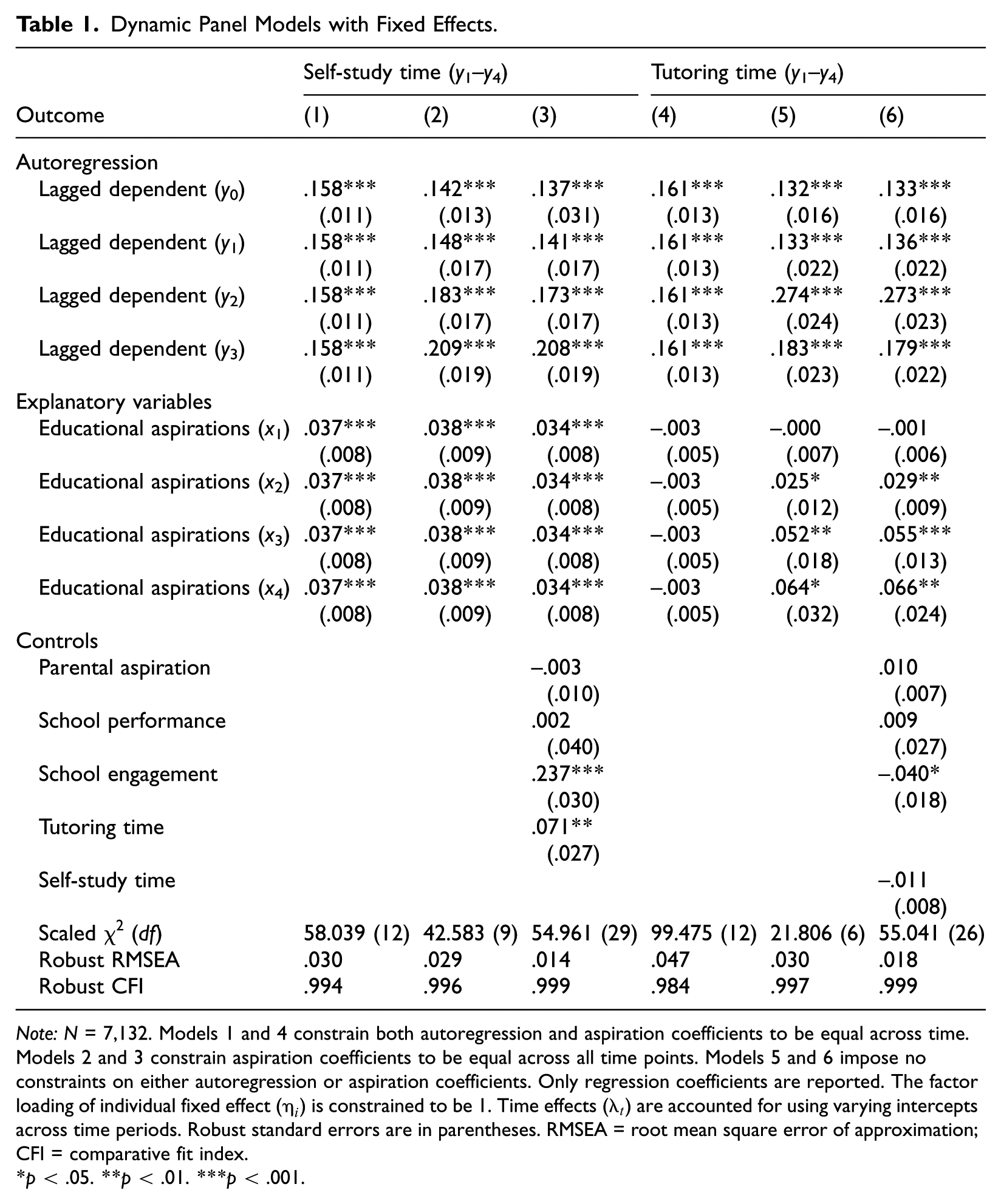
Table 1 presents the results of dynamic panel models examining the influence of educational aspiration on time allocation patterns. Models in columns one and four assume time-constant effects for both educational aspiration and the lagged dependent variable. To test whether these associations remain stable or vary over time, I considered three alternative model specifications: (a) allowing autoregressive effects to vary while keeping aspiration coefficients constant, (b) allowing aspiration coefficients to vary while keeping autoregressive effects constant, and (c) allowing both to vary. I selected the best-fitting and most parsimonious model for each dependent variable based on goodness-of-fit indices (see Table S4 in the online supplement). For self-study time, the best-fitting model allowed autoregressive effects to vary while constraining aspiration coefficients (see column two in Table 1). For tutoring time, the best-fitting model allowed both autoregressive effects and aspiration coefficients to vary over time (see column five). Models in columns three and six incorporate time-varying controls.
Dynamic Panel Models with Fixed Effects.
Note:
N = 7,132. Models 1 and 4 constrain both autoregression and aspiration coefficients to be equal across time. Models 2 and 3 constrain aspiration coefficients to be equal across all time points. Models 5 and 6 impose no constraints on either autoregression or aspiration coefficients. Only regression coefficients are reported. The factor loading of individual fixed effect (
p < .05. **p < .01. ***p < .001.
The results show positive associations between educational aspirations and both self-study and tutoring time even after accounting for individual fixed effects and the lagged dependent variable. These relationships remain robust after further controlling for parental aspirations, school performance, school engagement, and time spent on the other type of learning activity. The strength of the association between aspirations and self-study remains stable over time, with the coefficient for aspirations steady at .034. To contextualize, students aspiring to complete university rather than stopping at high school (i.e., a four-year difference) typically dedicate 8 additional minutes per day to self-study throughout the period examined. In contrast, the relationship between aspirations and tutoring increases from a nonsignificant negative value at
Moderating Effect of SES
To assess whether the relationship between educational aspirations and time investment differs by SES, I conducted two multigroup analyses based on parental education and family income. Chi-squared tests, which compare these multigroup models against the original models constraining all parameters to be equal across SES groups, indicate significant differences in model parameters across groups for both classification methods.
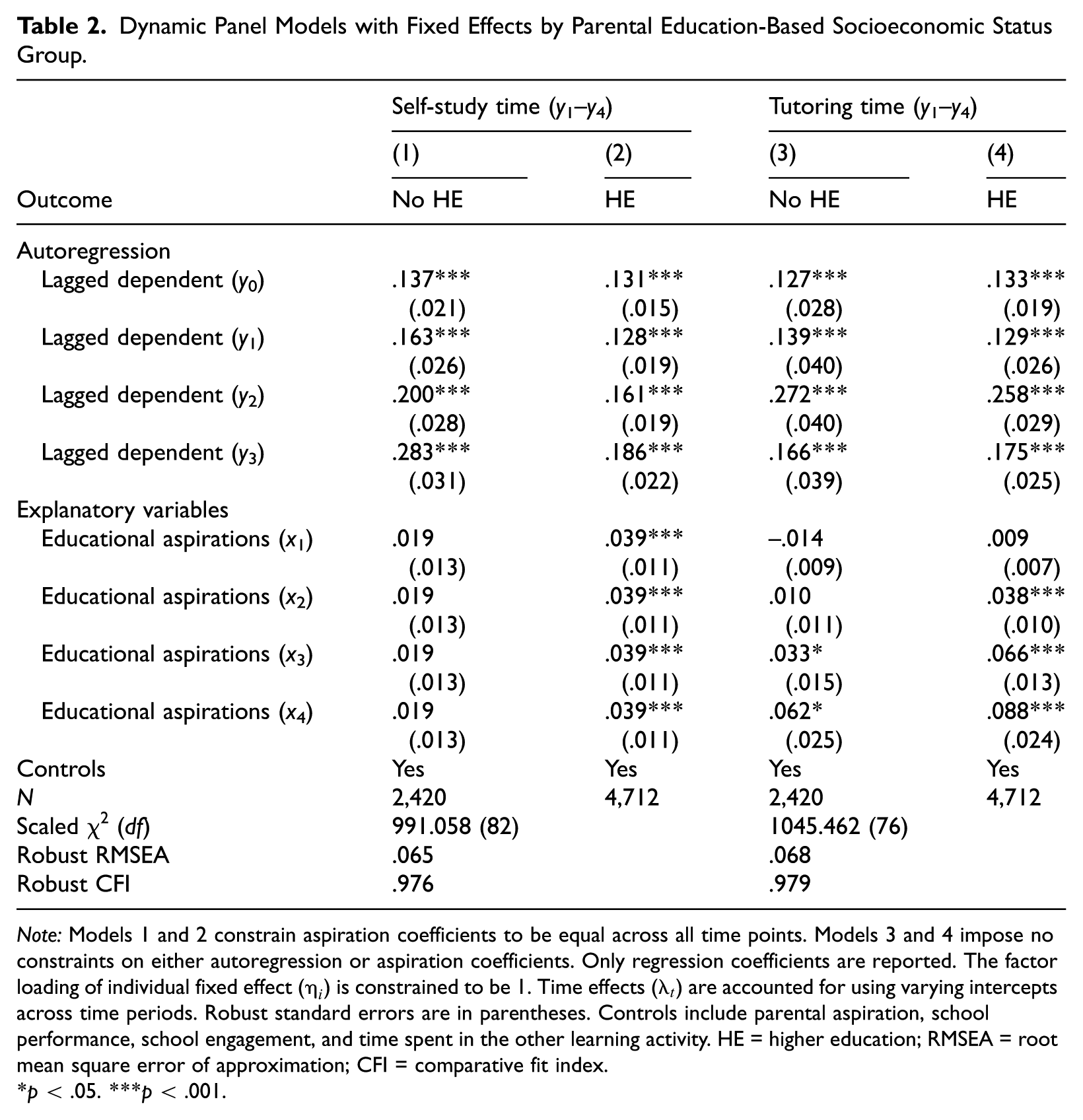
Table 2 presents the results based on parental education. For self-study time in columns one and two, we see a stronger association with aspirations for HE-parent students than for their less advantaged peers: The aspiration coefficient is .039 and statistically significant for HE-parent students, compared to .019 and nonsignificant for students with no-HE parents. However, a Wald test comparing these two coefficients suggests the difference is not statistically significant (see Table S5 in the online supplement). Columns three and four show that the previously detected strengthening association between aspiration and tutoring time is found in both SES groups. In the no-HE group, the coefficient increases from –.014 (nonsignificant) at
Dynamic Panel Models with Fixed Effects by Parental Education-Based Socioeconomic Status Group.
Note: Models 1 and 2 constrain aspiration coefficients to be equal across all time points. Models 3 and 4 impose no constraints on either autoregression or aspiration coefficients. Only regression coefficients are reported. The factor loading of individual fixed effect (
p < .05. ***p < .001.
Table 3 summarizes the results of the multigroup analysis based on family income. Columns one and two show that the socioeconomic disparity in the link between aspiration and self-study time virtually disappeared. The gaps in the tutoring time model in columns three and four also diminished. Some differences in the aspiration coefficients remain, but the Wald tests indicate these differences are not statistically significant at all time points (see Table S4 in the online supplement). As with the parental-aspiration-based analysis, we see an increasing trend of the aspiration–tutoring time relationship for both low- and mid-high-income groups.
Dynamic Panel Models with Fixed Effects by Income-Based Socioeconomic Status Group.
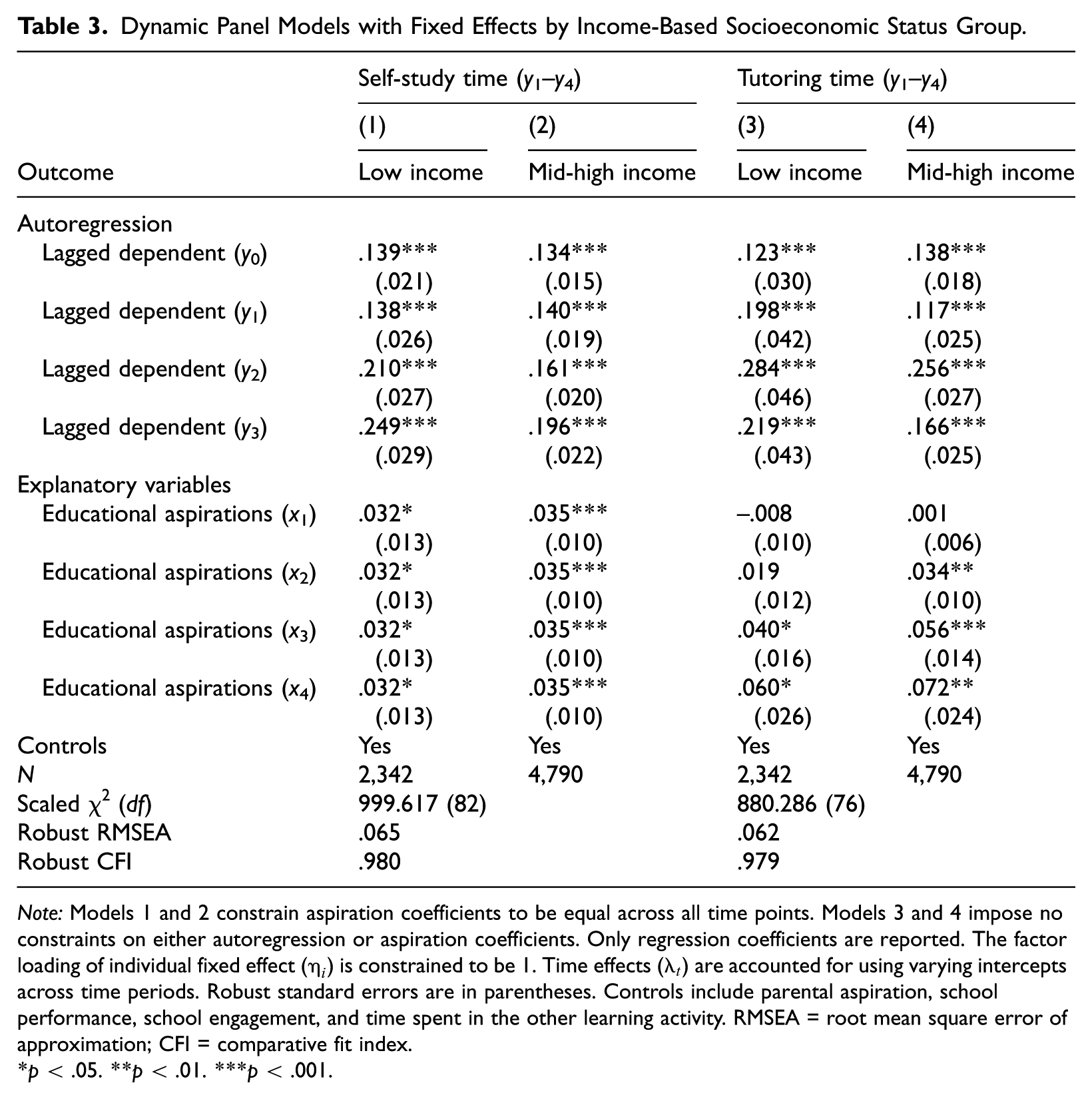
Note: Models 1 and 2 constrain aspiration coefficients to be equal across all time points. Models 3 and 4 impose no constraints on either autoregression or aspiration coefficients. Only regression coefficients are reported. The factor loading of individual fixed effect (
p < .05. **p < .01. ***p < .001.
These findings support neither Hypothesis 2a nor Hypothesis 2b, which anticipated a heterogeneous association between aspirations and self-study time across SES. The SES group differences in the aspiration and self-study time link are not statistically significant. Hypothesis 3 receives partial support. When operationalizing SES through parental education, the data reveal statistically significant differences, confirming the predicted moderation effect. When using family income as the SES indicator, these differences, although present, do not reach statistical significance.
Additional Analyses
To support the findings, I conducted extensive additional analyses. First, I replicated the estimation using alternative models, including pooled ordinary least squares (OLS), fixed-effects models, and systems-GMM method. Pooled OLS produced upward-biased coefficients for aspirations because it could not account for unobserved confounding factors. The fixed-effects model addressed this concern but substantially biased the lagged outcome term due to violations of strict exogeneity. Not surprisingly, GMM estimates aligned most closely with the main results, although limitations remained regarding handling missing data and detecting time-varying relationships (see Table S6 in the online supplement).
Second, I examined the effect of academic time investment on school performance using dynamic panel models with fixed effects. Both self-study and private tutoring significantly predicted performance, confirming time investment as a key mechanism linking aspirations to outcomes (see Table S7 in the online supplement).
Third, if the true causal effect of aspiration is lagged rather than immediate, failing to account for this temporal pattern could result in misleading conclusions (Leszczensky and Wolbring 2022). To address this concern, I estimated models including only lagged aspirations and both lagged and concurrent aspirations. Both showed poorer fits than models with contemporaneous effects (see Table S8 in the online supplement), supporting a concurrent relationship between aspiration and time investment.
Fourth, I tested alternative SES thresholds with parental education defined as bachelor's degree or higher (reducing the HE group to 50 percent) and family income split at the median. Patterns were largely similar, although the tutoring difference by parental education became insignificant, suggesting parents’ higher education experience itself, rather than degree type, is key for supporting children's academic goal pursuit (see Tables S9 and S10 in the online supplement).
Fifth, to examine robustness to missing-data patterns, I more conservatively restricted the analytic sample to students with at least two or three valid observations for key variables (88.8 percent and 77.7 percent of the total sample, respectively). Although these restrictions reduce sample sizes and affect representativeness, the dynamic panel fixed-effects estimates for the key parameters remained substantively unchanged across these samples, showing the findings are robust to nonresponse and attrition (see Tables S11 to S14 in the online supplement). Finally, to assess the effect of excluding extreme values in time investment, I replicated the analyses using raw time measures; the main findings remain consistent (see Tables S15 and S16 in the online supplement).
Discussion
This study advances research on educational aspirations by shifting attention from the long-term outcomes of aspirations to their behavioral consequences in daily life. Using high-quality panel data and dynamic panel fixed-effects models, I show that aspirations are linked to concrete academic time investments through both self-directed and parent-facilitated behaviors. These results support a core assumption of the Wisconsin model: Aspirations function not simply as preferences but as motivational intentions that guide goal-oriented action (Haller 1982; Sewell et al. 1969, 1970). The dual pattern of engagement also reflects the importance of both student agency and parental co-agency in pursuing academic goals (Heckhausen et al. 2010, 2019; Salmela-Aro 2010). These findings align with a growing body of research documenting behavioral correlates of educational ambition (Baek and Hwang 2011; Domina et al. 2011; Dunatchik and Park 2022; Graham and Pozuelo 2023; Lee et al. 2024; Schoon and Ng-Knight 2017), but they strengthen the evidence by accounting for individual fixed effects, prior levels of time use, and reverse causality.
The age-differentiated findings offer further insight. The stable relationship between aspirations and self-study suggests a balance between growing motivational readiness (Heckhausen 1998) and mounting institutional constraints on discretionary time (OECD 2023). In contrast, the strengthening association between aspirations and tutoring time, particularly around key educational transitions, likely reflects parent-led strategies in anticipation of high-stakes decisions, often before students fully comprehend their long-term significance (Forster and van de Werfhorst 2020). These patterns indicate that although self-directed effort continues to matter, the translation of aspirations into concrete action increasingly depends on external facilitation, especially in private-resource-intensive systems like Korea's (Lee and Shouse 2011).
The magnitude of these alignments is nontrivial. A four-year difference in aspiration predicts approximately 8 additional minutes of daily self-study and 16 additional minutes of tutoring by age 14, equivalent to 6.9 percent and 20.6 percent of the respective averages. These investments can translate into school performance gains (3.79 points; calculated based on Table S7 in the online supplement) equivalent to about one-quarter of the typical annual growth in school performance (15.77 points between ages 13 and 14). Given the reciprocal reinforcement of aspirations and effort (Schoon and Ng-Knight 2017), even small differences accumulate, helping explain why early disparities can cast long developmental shadows. This study focuses on time investment, but the same logic may extend to other channels, such as extracurricular involvement, advice seeking, or network building, through which aspirations may or may not be enacted.
Not all students, however, are equally equipped to act on their aspirations. The capacity to translate aspirations into tutoring time is stronger among students with more highly educated parents, and this gap appears as early as primary school. Where advantaged families more effectively facilitate this translation, aspirations become cumulative advantages (Ross and Mirowsky 2006). I found no significant SES differences in the relationship between aspirations and self-study, offering limited support for the compensatory effect hypothesis. Prior studies emphasizing the importance of effort for disadvantaged students (Mele et al. 2023; Schoon and Cook 2021) often treat effort as a predictor of educational outcomes, whereas here, I examined the earlier stage of whether students can translate their aspirations into effort. That is, even when motivation is present, structural barriers may hinder its conversion into sustained academic behavior. These findings extend prior knowledge by revealing that inequality is not simply about who aspires (Bernardi and Valdés 2021; Berrington, Roberts, and Tammes 2016) or who invests more (Bray and Lykins 2012; Jeong 2014; Jerrim 2017) but whether students can bridge the two. This study introduces aspiration–investment alignment, that is, the extent to which students are able to convert ambition into sustained academic effort, as a distinct mechanism of educational inequality, shifting the analytic focus from merely raising aspirations or effort to ensuring their alignment.
A noteworthy pattern is the salience of parental education over family income in moderating the aspiration–tutoring time link. Although both parental education and family income are positively associated with tutoring participation overall (and income gaps in participation are somewhat larger; see Figures 1 and 2), only parental education determines whether aspirations translate into greater tutoring time. This suggests that informational and cultural capital, such as knowing how to navigate the tutoring market or identify forms of support aligned with children's long-term goals, play a distinct role beyond financial resources (Park et al. 2011). At the same time, in Korea's highly saturated shadow education market (Lee 2011), tutoring has become a normatively expected practice across socioeconomic groups, likely dampening income-based differences in its responsiveness to aspirations. Notably, KELS data indicate that lower-income families devote a larger share of their income to tutoring (9–12 percent vs. 7–9 percent). Similar levels of aspiration-aligned tutoring may therefore mask substantial differences in relative burden, echoing research showing that disadvantaged families with educational prestige orientation often stretch their resources disproportionately to support children's educational ambitions (Cuevas 2019; Lee and Shouse 2011). The absence of income-based moderation should not be interpreted as the absence of inequality; instead, this finding reflects unequal strain and highlights the need for policies that reduce the disproportionate burden placed on low-income families as they work to support their children's aspirations.
Korea served as a critical test case for understanding how aspirations translate into academic behavior under extreme conditions. The finding that aspirations predict study effort even when students face near-universal high aspirations and severe time constraints provides compelling evidence that motivational mechanisms operate when structural factors might overwhelm individual differences. The basic cognitive-motivational process linking aspirations to goal-directed behavior should generalize across educational systems; the moderating role of SES should also appear wherever educational success depends on both individual initiative and family resources, although specific forms vary across contexts. However, Korea's absolute levels of time investment and the prominence of private tutoring reflect context-specific institutional arrangements that limit direct applicability to systems with different structures. Nevertheless, Korea's case illuminates why rising aspirations have not eliminated achievement gaps internationally: Motivation alone proves insufficient without the structural conditions necessary to translate educational goals into sustained academic effort.
Several limitations warrant consideration. First, the dynamic panel fixed-effect models reduce concerns about unobserved individual heterogeneity, but they cannot eliminate potential omitted variable bias from time-varying unobserved factors. Second, the reliance on self-reported time investment introduces measurement issues such as recall errors and social desirability bias (Carbonaro 2005). Moreover, measurement differences between student-reported self-study and parent-reported tutoring time limit direct coefficient comparisons, although within-person estimation reduces reporter-specific bias. Third, this study focuses only on the quantity of academic time investment without accounting for its quality. Shorter periods of focused study may be more effective than longer durations of low-quality engagement, which the current analysis cannot capture. Nevertheless, given that high-SES students are more likely to benefit from environments that support effective learning, the SES-based disparities observed in this study likely hold and if anything, may be underestimated. Fourth, the continuous measure of educational aspirations imposes a linear interpretation of differences between education levels, which does not capture qualitative distinctions across qualifications. Moreover, although the study distinguishes levels such as two-year college, four-year university, master's, and doctorate, it cannot account for variation in institutional prestige within each level, which is a key dimension in the Korean education system. Future research will benefit from more detailed measures of aspirations to examine how such system-level features shape the aspiration–behavior links.
Despite these caveats, this study contributes to the sociology of education in several ways. Theoretically, it moves beyond treating aspirations and investments as separate domains by documenting aspiration–investment alignment as a novel mechanism of inequality. The findings show that educational disparities arise not only from who aspires or who invests more but also from whether students can translate their ambitions into sustained academic effort, a process structured by socioeconomic background. Methodologically, this study demonstrates the value of dynamic panel approaches for studying motivation–behavior links. The temporal modeling revealed that aspiration–tutoring associations strengthen as students approach high-stakes transitions, which static cross-sectional or fixed-effects models would miss entirely. These models also offer stronger causal leverage than do static correlations and open new possibilities for studying other domains where motivation and action unfold in tandem, such as course selection, extracurricular participation, or school/college persistence. Practically, the results call for rethinking raising-aspirations interventions. What matters is not merely aspiring but also being able to align aspirations with investments such as study time and tutoring access. Effective interventions must target the structural conditions that enable aspiration–investment alignment rather than aspirations alone, particularly during early adolescence, when students’ aspirations and motivation develop. In summary, this study emphasizes that aspirations matter most not as end states but as dynamic capacities whose realization depends on the social structures in which young people are embedded.
Supplemental Material
sj-docx-1-soe-10.1177_00380407261432647 – Supplemental material for From Aspiration to Action: Socioeconomic Disparity in the Translation of Educational Goals into Time Investment
Supplemental material, sj-docx-1-soe-10.1177_00380407261432647 for From Aspiration to Action: Socioeconomic Disparity in the Translation of Educational Goals into Time Investment by Anna Yong in Sociology of Education
Footnotes
Acknowledgements
The author extends sincere gratitude to the Korean Educational Development Institute for providing access to the data and to all children and parents who participated in this study. Special thanks to Professor Ingrid Schoon, Professor Nikki Shure, and four anonymous reviewers for their valuable feedback on earlier drafts of this article.

Ethical Considerations
This study is based on secondary data and received approval from the Research Ethics Committee at the author's affiliated institution.
Funding
The authors received no financial support for the research, authorship, and/or publication of this article.
Declaration of Conflicting Interests
The authors declared no potential conflicts of interest with respect to the research, authorship, and/or publication of this article.
Supplemental Material
Supplemental material for this article is available online.