




Abstract
Guidance counseling is well known to foster enrollment in higher education among students from low social origins in the United States and Canada. However, because students in these North American countries face obstacles that do not exist in many European countries, generalizing previous findings to the European context is difficult. Against this background, we use a randomized controlled trial to investigate guidance counseling in Germany. Our results reveal that individuals from low social origins are more likely to enroll in higher education due to the program. Furthermore, we find substantial effect heterogeneity across social origin groups. Due to the program, individuals from high social origins enroll less frequently in higher education and more frequently in vocational training. Based on these opposing effects across social origin groups, we find that the program reduces inequality in higher education enrollment by approximately 70 percent.
Social inequality in university enrollment exists in many countries (Breen et al. 2009; Pfeffer 2008; Shavit and Blossfeld 1993). Because a higher education degree provides a decisive advantage for future earnings (OECD 2022:80), social selectivity in university enrollment carries significant implications for individuals’ careers and lives. Social disparities during the transition to higher education in many European countries thus prevent young people from realizing their potential and contradict calls for equal opportunities.
In light of these economic and normative concerns, politicians, practitioners, and researchers have shown increasing interest in educational interventions to reduce the social gap in university enrollment. Herbaut and Geven’s (2020: Figure 2) systematic review of experimental and quasi-experimental intervention studies evaluating programs to close the gap highlights that individualized guidance counseling raises enrollment rates among students from low social origins. Closer examination reveals that these studies were conducted exclusively in the United States and Canada (Herbaut and Geven 2020). However, the institutional context in the United States and Canada differs from that of most European countries, where specific obstacles to enrollment for students from low social origins are less prevalent. For example, in many European countries, tuition fees are either not charged or are relatively low, and barriers to financial support are comparably minimal. Therefore, it remains uncertain whether guidance counseling would similarly foster enrollment among students from low social origins outside North America.
Furthermore, previous research on interventions to reduce enrollment inequalities has adopted a one-sided view of social inequality by focusing solely on students from low social origins. However, examining students from all backgrounds is essential because the impact of educational programs on inequality depends on whether treatment effects vary by social origin. In addition, counseling may have opposite effects across social origin groups in certain countries, such as German-speaking countries, the Netherlands, and Denmark, where nonacademic vocational education and training (VET) can be an attractive alternative for students from high social origins following individualized counseling (Birkelund and van de Werfhorst 2022; Hillmert and Jacob 2003; Rözer and van de Werfhorst 2020). In this case, counseling would reduce inequality from both angles because the enrollment rates of different social origin groups would converge. So far, individualized guidance counseling has rarely been investigated regarding effect heterogeneity by social origin (however, see Belasco 2013:795; Castleman, Page, and Schooley 2014:335). This lack of research may be due, at least in part, to the significant time and effort required to provide and evaluate extensive one-on-one programs for both social groups.
To address this gap in research, we investigate (1) whether guidance counseling fosters access to higher education for students from low social origins in Germany and (2) whether it reduces social inequalities in enrollment due to heterogeneous effects by social origin. We conducted a large, preregistered, randomized controlled trial (RCT) 1 of a program providing intensive guidance counseling by professional counselors to senior high school students, observing their enrollment after high school graduation. Our research design aligns with the expanding experimental literature in sociology, particularly in field experiments (Greenberg and Shroder 2004; Herbaut and Greven 2020; Jackson and Cox 2013). It embeds a “real-world” program regularly offered by university counseling services. We built on this using an experimental design and advanced experimental methods to analyze data from 1,056 students across 30 schools in the federal state of North Rhine–Westphalia.
Our contributions are fourfold. First, we estimate the effect of guidance counseling on university enrollment for individuals from low social origins in Germany. This estimation addresses whether educational programs aiming to encourage enrollment among students from low social origins are effective outside North America, especially in a context with fewer barriers to higher education access. Thus, this study responds to Herbaut and Geven’s (2020) call to test high-intensity interventions in contexts outside the United States and Canada. Examining such an intervention in a European context sheds light on students’ postsecondary choices and socioeconomic attainment opportunities in a different institutional setting.
Second, by investigating heterogeneous effects across students from different social origins, we thoroughly assess the potential of interventions aimed at reducing inequalities in higher education enrollment. Specifically, we explore differing or even opposing effects for students from low and high social origins because reducing inequality may involve changes on both sides. With educational programs targeting enrollment disparities becoming widespread across Europe, it is crucial to investigate whether (and under what conditions) such programs influence educational pathways to better understand how inequality is reduced and reproduced. Evaluating the efficacy of such programs contributes to broader work in the sociology of education on how educational institutions and policies can shape educational inequality (see DiPrete and Fox-Williams 2021; Pietrzyk, Jacob, and Erdmann 2023).
Third, prior sociological research in Europe has primarily examined low-intensity information interventions, which have led to limited improvements in widening access for students from low social origins (e.g., Ballarino et al. 2022; Barone et al. 2017; Ehlert et al. 2017). In contrast, our study provides field-experimental evidence showing that intensive guidance counseling can help reduce enrollment inequalities. Theoretically, simply alleviating information deficits in low-intensity interventions—such as knowledge about the costs and benefits of a higher education degree, including financial aid and future earnings potential—appears insufficient to change educational choices; these efforts need to be complemented by personalized assistance. Hence, our study may inform theoretical considerations and sociological research on educational decision-making and strategies for reducing social inequalities, going beyond addressing (low origin) students’ perceptions of rational choice parameters, such as the costs and returns of educational degrees.
Finally, our study contributes to research in the broader sociological field of counseling and inequality. Counseling has a long history in North America, reflected in classic sociological studies (e.g., Cicourel and Kitsuse 1963) that examine how guidance counselors categorize students in high school (e.g., distinguishing between college-going and non-college-going students), advise and guide them through education, and contribute to social stratification through influencing educational and career choices. In recent years, research in the United States has not only experimentally investigated the quantifiable effects of counseling on enrollment but also refined the classic actor and process-oriented perspective. For example, scholars have explored how counselors operate within their political and institutional context (Blake 2020, 2024; Sattin-Bajaj et al. 2018) and how they shape relationships with the students they advise (Holland 2015). In Germany, initial steps toward the professionalization and institutionalization of the guidance profession and the recent implementation of programs comparable to those used in North America have drawn the interest of researchers, who are approaching the topic from various perspectives (for building a trusting relationship, see Schuchart and Siebel 2023; for an edited volume on counseling from a broad perspective, see Erdmann et al. 2025). Inspired by international research, a broad sociological perspective on guidance and inequality is emerging in some European countries. Within this developing field, our study serves as a field experiment to evaluate the effect of an extensive counseling program on higher education enrollment and social inequality. Our findings suggest the guidance counseling program promotes enrollment among students from low social origins and reduces inequality in enrollment due to heterogeneous effects based on social origin.
Background
Fostering Higher Education Enrollment of Students from Low Social Origins
Many programs aimed at encouraging higher education enrollment among students from low social origins draw on sociological findings regarding the causes of social disparities during educational transitions. These interventions are based on assumptions of rational choice theory or cultural reproduction theory, both of which are frequently applied in empirical research on educational inequalities.
From a rational choice perspective, social disparities in educational decisions stem from the primary and secondary effects of social origin (Boudon 1974; Breen and Goldthorpe 1997; Erikson and Jonsson 1996). Primary effects relate to differences in academic performance, which depend on social origin due to variations in access to material and nonmaterial resources. Secondary effects denote differences in how individuals estimate the costs, benefits, and probability of success associated with educational alternatives.
In contrast, Bourdieu and Passeron’s (1971) cultural reproduction theory posits that social inequality in educational choices arises from existing class cultures inscribed in individuals as habitus. This class-specific habitus encompasses language conventions, social attitudes, and lifestyles that shape educational behavior and aspirations. Inequalities in educational choices partly emerge because the habitus of higher classes aligns closely with the academic system. The distance between the sociocultural codes of the academic system and the habitus of individuals from low social origins can evoke feelings of being “out of place” or excluded, potentially discouraging some students from pursuing higher education. Both theories have received (partial) support through empirical studies (e.g., for rational choice theory, see Barone, Triventi, and Assirelli 2018; Schindler and Lörz 2012; for reproduction theory, see Aschaffenburg and Maas 1997; Sullivan 2002).
Educational programs that promote the enrollment of students from low social origins are frequently based on assumptions derived from these approaches. These programs can be classified into information-only and information-and-support interventions (see also Herbaut and Geven 2020). This distinction overlaps with theoretical foundations.
In the first type of intervention, students are typically provided with general information about the costs and benefits of higher education in group settings (e.g., Ballarino et al. 2022; Barone et al. 2017; Ehlert et al. 2017; Kerr et al. 2020). Students from low social origins are particularly assumed to have incomplete or biased information, a disadvantage these interventions aim to mitigate.
The second type of intervention is more comprehensive, providing information and support, typically in one-on-one sessions delivered by professionally trained advisers (e.g., Avery 2010; Ford et al. 2014). In these programs, students receive individually tailored information about educational pathways and are supported in various ways, such as being encouraged to consider higher education as a viable option. These students also receive concrete assistance during the enrollment process, including help with completing application forms and expanding their social networks. This assistance helps reduce the social distance between these students and higher education while strengthening their social support. Students from low social origins are assumed to particularly need tailored information and comprehensive one-on-one encouragement and support.
A significant body of methodologically sophisticated research on such interventions demonstrates that programs providing information and support are effective in fostering the enrollment of students from low social origins (for overviews, see Herbaut and Geven 2020; Robinson and Salvestrini 2020). Of the 17 studies included in a systematic review of the effects of information and support interventions (Herbaut and Geven 2020), most investigations identified significant effects on enrollment, with three-quarters reporting effect sizes greater than 5 percentage points. However, according to Herbaut and Geven’s (2020) review, experimental research on assistance or individualized guidance has, thus far, been conducted exclusively in the United States and Canada.
In Europe, researchers have primarily investigated less comprehensive interventions through experiments examining classroom-based information sessions on the costs and returns of higher education, information on financial aid, and text message “nudges.” This work has led to pessimistic evaluations because none of these studies consistently identified a program effect on student enrollment (e.g., Barone et al. 2017; Ilie et al. 2022; Kerr et al. 2020). Some interventions only fostered the enrollment of specific student subgroups, such as those from low social origins who aspired to enroll in higher education (Peter, Spiess, and Zambre 2021).
No experimental study has examined guidance counseling and its effect on enrollment in Europe, which may be partly due to the relatively short history of guidance counseling in Europe compared to the North American context (for the United States, see Gysbers 2005). The lack of research may also be attributed to the comparatively high effort required for experimental studies on intensive one-on-one programs compared to providing information sessions or sending text messages. Evaluating extensive one-on-one programs necessitates collaboration with institutions that offer professional advice and their funding institutions (cf. Cook 2002).
Heterogeneous Effects on Higher Education Enrollment by Social Origin
Most interventions and studies aimed at reducing social inequality in enrollment focus on students from low social origins, operating under the assumption that increasing university access for this group would reduce inequalities and that this group requires additional information and support. This approach has largely overlooked students from higher social origins even though such students may also participate in programs delivered to high school students. For example, students from high social origins often engage in low-intensity, class-based information sessions and frequently take part in personalized guidance counseling. Many counseling programs targeting university access and career development are open to all students regardless of social origin.
Even more importantly, heterogeneous effects by social origin are significant for research on educational policies because such heterogeneity provides insights into a program’s effects on social inequality. Inequality refers to the gap in enrollment between social origin groups, so a program’s impact on inequality depends on the difference in a program’s effect between social origin groups (cf. Pietrzyk and Erdmann 2020).
Indeed, theoretical reasons support the belief that educational programs in general and guidance counseling in particular may affect enrollment heterogeneously based on social origin. As mentioned previously, the estimation of costs, benefits, and success probability of higher education and social distance to higher education depends on social origin. Therefore, the positive effect of guidance counseling on enrollment—driven by counselors correcting information biases and providing support—may be more significant for students from lower social origins than those from higher social origins.
Opposing effects across social origin groups may occur if counseling fosters enrollment among students from low social origins while simultaneously reducing enrollment among students from high social origins. In this case, the program’s effect on inequality would exceed its impact on students from low social origins. Such opposing effects are likely in education systems with valuable alternatives to higher education. In these settings, counseling may help unlink social origin from educational decision-making by introducing students from high social origins to worthwhile alternatives that differ from their parents’ educational pathways.
Indeed, research suggests that students from high social origins do not consciously elaborate on these alternatives. More specifically, they do not question whether they will enroll in higher education—they only deliberately evaluate their choice of institution and area of study (Glaesser and Cooper 2014; Smyth and Banks 2012). Professional advisors may introduce these students to alternatives to higher education, informing them about labor market outcomes and further career prospects after VET, topics about which privileged students presumably have incomplete information.
Previous research on programs targeted at all students has primarily investigated low-intensity programs, such as information sessions. Studies have found weak or no effects on enrollment for any social group (e.g., Barone et al. 2017; Peter et al. 2021). However, although guidance counseling is the most effective way to promote the enrollment of students from low social origins, only a few studies have included more privileged students in counseling programs. Two experimental studies (Castleman et al. 2014:335; Renée 2023:15) and one quasi-experimental study (Belasco 2013:795) found descriptive effect heterogeneity based on social origin with (short) support interventions in the United States and Canada. Students from low social origins benefited more from the programs than did their privileged peers. However, these countries are not strong test cases for investigating heterogeneity based on social origin because there are no valuable alternatives to higher education. The U.S. labor market is structured around generic rather than specific job skills, so higher education is the “default postsecondary education option for U.S. students” (Haas and Hadjar 2024:279). Therefore, low-achieving students are also motivated to enroll in higher education in the United States (cf. Haas and Hadjar 2024).
The German Context
Studying the effects of counseling on inequality in university access in Germany is beneficial for several reasons. First, even though secondary education is strongly stratified, leading to social selectivity in acquiring the university entrance qualification (Haas and Hadjar 2024), inequality in the transition to higher education remains prevalent (Hillmert and Jacob 2010; Reimer and Pollak 2010). Recent data indicate that only 65 percent of students from low social origins with a higher education entrance qualification actually enroll, compared with 82 percent of their peers from high social origins (Quast, Mentges, and Buchholz 2023). Because the returns of postsecondary educational pathways differ, these educational choices likely translate into unequal labor market positions. Among individuals who obtain the higher education entrance qualification, those who graduate from universities of applied sciences earn about 1.25 times more than people who opt for vocational training, and university graduates earn about 1.4 times more than graduates of vocational training (Glocker and Storck 2014:119). 2
Second, the question of whether results on guidance counseling obtained in the United States and Canada are generalizable to Europe is not a trivial one. In North America, students face high costs, a complex financial support system, and a highly stratified higher education system. Support with financial costs may (partly) drive the positive effect of counseling on enrollment given that interventions that focus exclusively on financial support have been influential in the United States (Bettinger et al. 2012). In contrast, stratification in higher education is lower in Germany (as in many other European countries), and tuition fees are low or absent. Students from less affluent families can receive financial support to (partly) cover their living expenses through a needs-based, state-run financial support system (BAföG).
However, the aforementioned theoretical aspects, empirical results on social and cultural distance, and potential information deficits all suggest that counseling may also affect students from low social origins in Germany. In addition, Germany’s strong VET sector, which constitutes an alternative option to enrolling in higher education (Hillmert and Jacob 2003), may play an important role in counseling high school leavers. In Germany, VET is often discussed as a way to “divert” students from low social origins (e.g., Shavit and Müller 2000). VET is less academically demanding, promotes careers in lower- and medium-level management, and offers good earnings prospects (Reimer and Pollak 2010) despite its relative disadvantage compared to higher education. Guidance counseling that provides targeted support to students from low social origins might encourage them to opt for higher education rather than VET to reach their full potential. Moreover, because VET can be a valuable alternative, professional advice may also motivate some students from high social origins to pursue VET instead of enrolling in higher education if it better suits their interests or occupational goals.
In alignment with previous research, we expect guidance counseling to encourage enrollment among students from low social origins in Germany (Hypothesis 1). We expect the effect of guidance counseling on enrollment to vary depending on social origin, with a more pronounced effect for students from low social origins and potentially even a reduction in enrollment among students from high social origins (Hypothesis 2). Due to this heterogeneity, we expect counseling to contribute to a decrease in social inequality in enrollment (Hypothesis 3).
Research Design
The Counseling Program
We investigated our research questions in the context of a guidance counseling program operated by universities and universities of applied sciences in the German state of North Rhine–Westphalia. This program focused on intensive student counseling through one-on-one sessions in upper-secondary schools. Certified counselors from university advisory services, who typically hold a university degree, delivered the sessions.
The program’s primary goal was to foster university enrollment among students from low social origins. During these sessions, counselors provided tailored advice based on students’ needs, including guidance on VET versus university enrollment, selection of higher education institutions, choice of study area, and requirements for university admission and financing studies. The program was designed to offer long-term support, continuing after students graduated high school, and was tailored to students’ individual needs, so the number, duration, and content of the counseling sessions varied. In the sample studied, students participated in an average of five counseling sessions, with one in four continuing to engage with the program after high school graduation. 3
The content of the counseling sessions differed in detail, but we identified several important topics based on students’ retrospective assessments of how they benefited from the program (note that we do not use these subjective assessments to draw conclusions about the intervention’s effects). A central topic was information on postsecondary education: Approximately 40 percent of respondents reported feeling better informed about postsecondary education in general due to the advice they received. Around 33 percent stated the advice they received helped them develop more realistic expectations regarding their postsecondary path. Career choice was another significant area, with approximately 30 percent of respondents indicating counseling increased their certainty about the professional career they wanted to pursue. The program also helped expand students’ support networks. Around 44 percent of respondents reported feeling better informed about additional advice and support services as a result of the guidance, and 14 percent indicated they made important contacts related to their chosen postsecondary education. In terms of financial planning, around 14 percent of respondents said they benefited from the advice provided. Aside from financial planning, no pronounced differences emerged between social origin groups regarding the number, duration, or content of counseling sessions, as indicated by retrospective assessments.
Data: The RCT
The study “Future and Career Plans Before High School Graduation (ZuBAb)” was an RCT conducted in North Rhine–Westphalia, a German federal state, at upper-secondary schools to evaluate the counseling program (for an overview, see Pietrzyk et al. 2019). Thirty schools participated in the RCT. 4 On average, the participating upper-secondary institutions serve sociostructurally disadvantaged students. These schools offer the highest general educational certificate (Abitur), a prerequisite for higher education enrollment (Gymnasien and comprehensive schools; Gesamtschulen, with an academic track).
As shown in Figure 1, the RCT and panel surveys were performed in several stages. The first step involved a baseline survey targeting all students in the selected schools in their penultimate year before high school graduation. This survey consisted of a paper-and-pencil questionnaire asking students about their professional aspirations, postschool pathways, social environments, interests, and various psychosocial competencies.
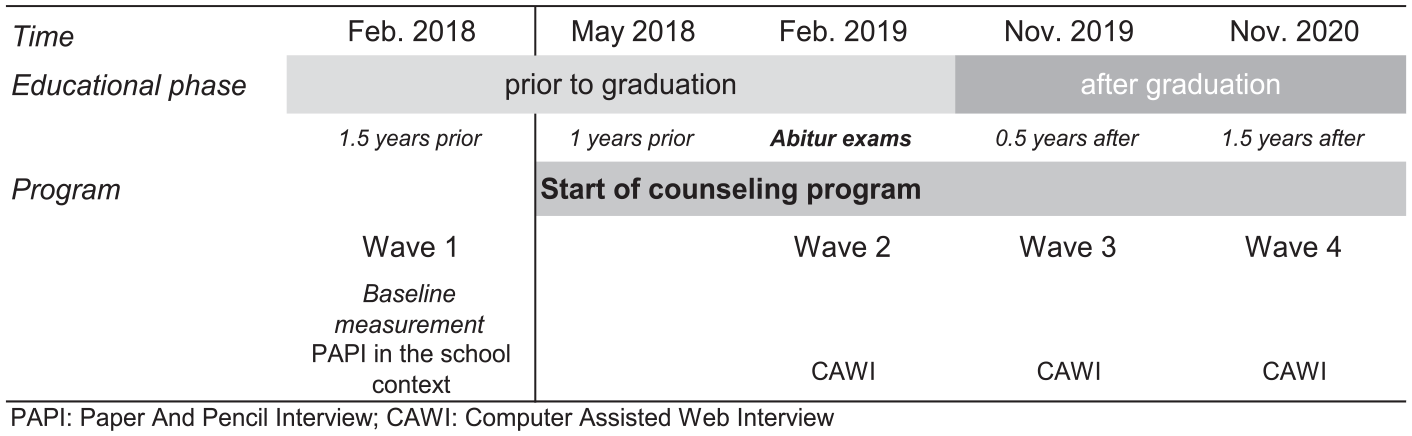
Study schedule.
Second, we could not include all students who participated in the baseline survey in the RCT due to the limited program delivery capacities of the counselors involved. We thus randomly and individually selected 1,344 students for RCT participation, prioritizing those from low social origins to align with the program’s target group. Students who did not provide information on their social origins or who were from high social origins were included in the RCT only if participation slots remained at their school after all students from low social origins were considered. However, because students from low social origins are underrepresented in upper-secondary schools in Germany’s highly stratified secondary-school system, the number of individuals included from low social origins was only slightly higher than those from high social origins (n = 703 from low social origin; n = 615 from high social origin; n = 26 no information on social origin).
The third step of the RCT involved randomly and individually assigning participants to either a treatment condition (involving program participation) or a control condition (without program participation). We did this at an equal ratio and with school and social origin as blocking variables. A researcher external to the study’s research team—from GESIS, the Leibniz Institute for the Social Sciences—conducted the randomization process to ensure adherence to scientific standards. Consequently, relevant predictors of enrollment (e.g., academic achievement and intention to enroll in higher education at the baseline measurement) were equally distributed between the experimental conditions (see Table 1). Furthermore, t tests for mean differences between the experimental conditions regarding predictors of higher education enrollment did not reveal any significant differences (see Figure A1 in the online supplement). Students assigned to the control condition were not expected to receive one-on-one counseling in schools about postsecondary education because schools had no counseling other than the investigated program.
Distribution of Predictors of Enrollment between Experimental Conditions at Baseline Measurement.
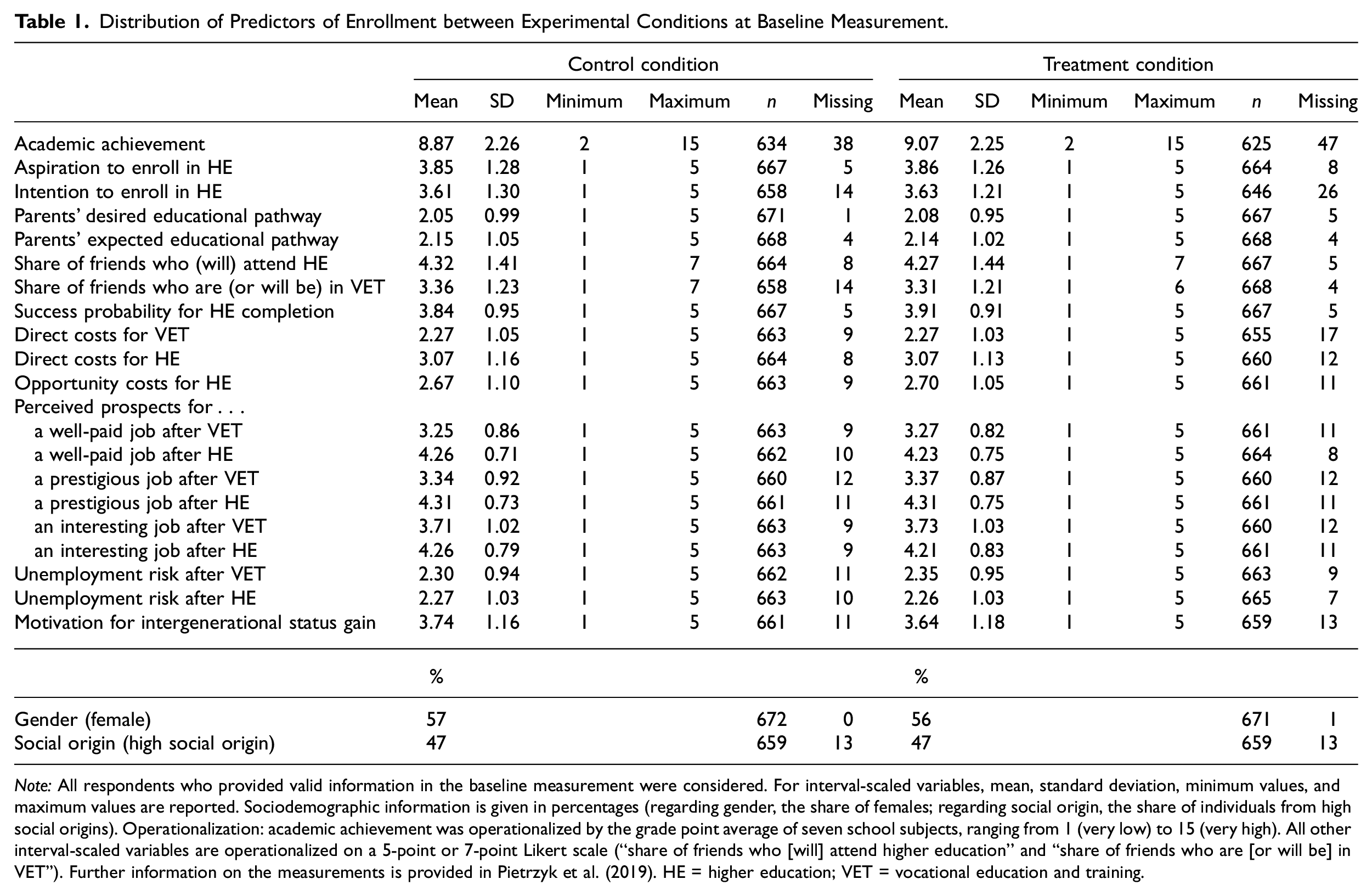
Note: All respondents who provided valid information in the baseline measurement were considered. For interval-scaled variables, mean, standard deviation, minimum values, and maximum values are reported. Sociodemographic information is given in percentages (regarding gender, the share of females; regarding social origin, the share of individuals from high social origins). Operationalization: academic achievement was operationalized by the grade point average of seven school subjects, ranging from 1 (very low) to 15 (very high). All other interval-scaled variables are operationalized on a 5-point or 7-point Likert scale (“share of friends who [will] attend higher education” and “share of friends who are [or will be] in VET”). Further information on the measurements is provided in Pietrzyk et al. (2019). HE = higher education; VET = vocational education and training.
Fourth, the program commenced immediately after the baseline measurement and the subsequent random assignment of students to experimental conditions. Accordingly, counseling began approximately one year before participating students graduated from high school. The compliance rate with the experimental conditions was approximately 80 percent (see Table A1 in the online supplement). We surveyed participants in three additional waves to gather information on their educational pathways, future career plans, and other relevant characteristics.
We used the data from Panel Wave 4, collected 1.5 years after high school graduation, to examine enrollment. However, due to panel attrition (21 percent) and item nonresponse (less than 1 percent), the main results are based on responses from 1,056 individuals. 5 This total includes 563 participants from low social origins (n = 283 in the treatment condition; n = 280 in the control condition) and 493 participants from high social origins (n = 244 in the treatment condition; n = 249 in the control condition).
Operationalization and Methods
We were interested in the program’s effect on enrollment for students from low social origins and whether this effect differed by social origin. We defined social origin based on parents’ highest educational degree: If neither parent had a higher education degree, the student was classified as having low social origin; if at least one parent graduated from higher education, the student was classified as having high social origin. Social origin is a multidimensional construct shaped by factors such as parents’ occupation and education, but parental educational attainment predicts children’s completion of higher education more strongly than parental occupation in Europe (cf. Palmisano, Biagi, and Peragine 2022). In Germany, parental education is strongly associated with the transition to higher education (Müller et al. 2017:342), probably due to strong associations between educational attainment and labor market positions (Müller, Steinmann, and Ell 1998) and the comparatively low costs of education.
We operationalized educational choice based on the postsecondary educational pathway in which respondents were enrolled 1.5 years after leaving upper-secondary school. We distinguished between three categories: higher education, which reflects enrollment in higher education regardless of whether it was a university or a university of applied sciences; VET; and no postsecondary enrollment.
To assess the counseling program’s effect on enrollment, we used an intention-to-treat analysis. This method considers participants’ random assignment to experimental conditions rather than their actual participation in the program, allowing for estimation of the program’s effect under real-world conditions (Hollis and Campbell 1999). 6 We measured the program’s effect on educational choice using multinomial logistic regression, with educational choice as the outcome variable and assignment to experimental conditions as the independent variable, incorporating robust standard errors. Our main model includes an interaction between assignment and social origin, and we followed Mize’s (2019) recommendations for testing this interaction by providing estimates for first and second differences. 7 To further investigate the program’s effectiveness in reducing social inequality in enrollment, we compared the social gap in educational choices between experimental conditions based on our main model, providing a clear assessment of the program’s capacity to address social inequalities.
Descriptives of the Analytic Sample
To ensure that panel attrition between the baseline measurement and Wave 4 did not introduce bias, we assessed whether a balance remained between the experimental conditions regarding key predictors of higher education enrollment. Table 2 presents descriptive statistics for the analytic sample at Wave 4. We observe no imbalances between the experimental conditions in the analytic sample. Furthermore, t tests comparing mean differences in predictors of higher education enrollment across the experimental conditions reveal no significant differences (see Figure A2 in the online supplement).
Distribution of Predictors of Enrollment (Measured at Baseline) between Experimental Conditions for the Analytic Sample.
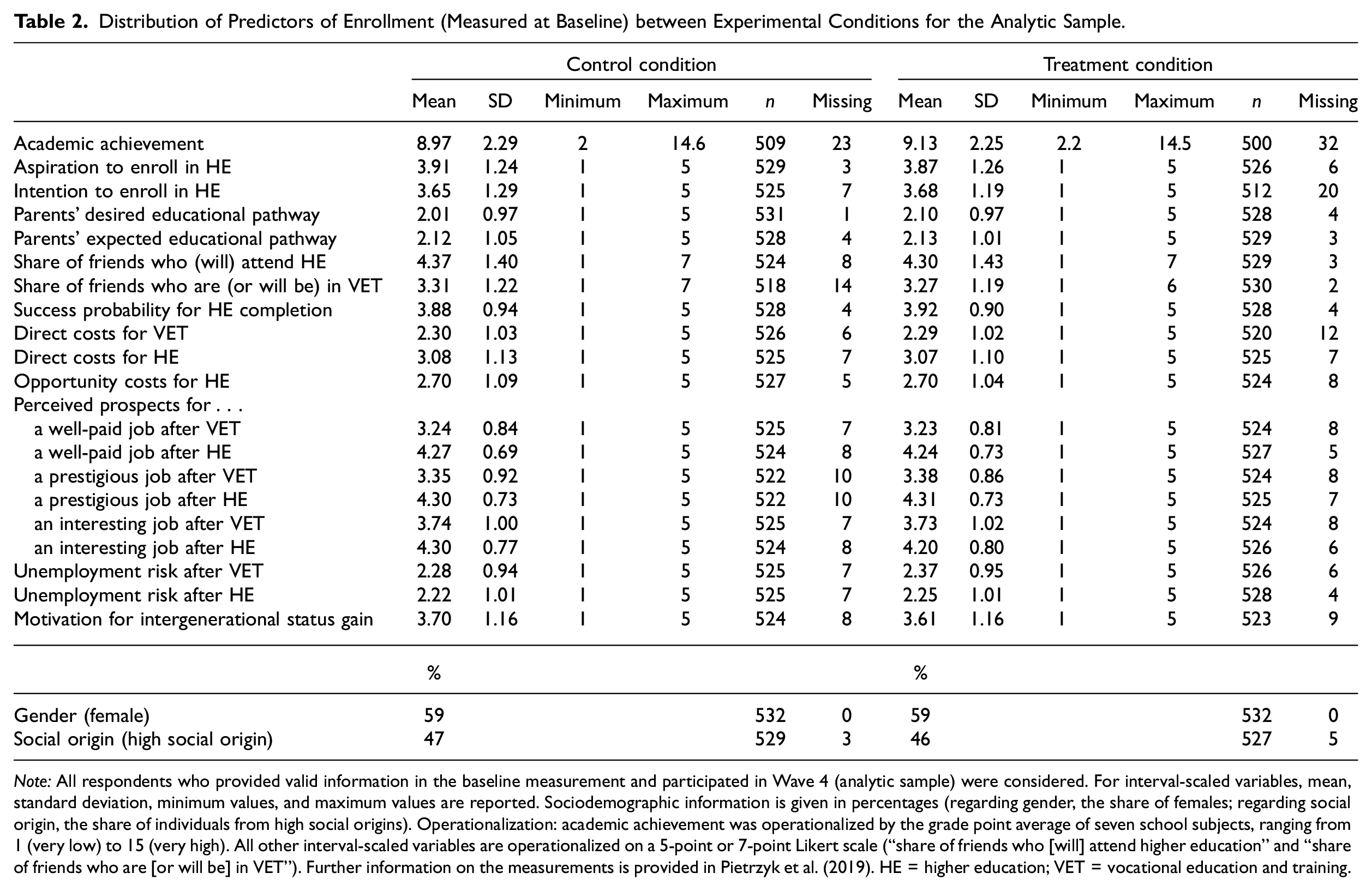
Note: All respondents who provided valid information in the baseline measurement and participated in Wave 4 (analytic sample) were considered. For interval-scaled variables, mean, standard deviation, minimum values, and maximum values are reported. Sociodemographic information is given in percentages (regarding gender, the share of females; regarding social origin, the share of individuals from high social origins). Operationalization: academic achievement was operationalized by the grade point average of seven school subjects, ranging from 1 (very low) to 15 (very high). All other interval-scaled variables are operationalized on a 5-point or 7-point Likert scale (“share of friends who [will] attend higher education” and “share of friends who are [or will be] in VET”). Further information on the measurements is provided in Pietrzyk et al. (2019). HE = higher education; VET = vocational education and training.
In addition, we constructed a simple contingency table displaying the frequencies of educational choice for the two social origin groups based on their experimental conditions (see Table 3). The data indicate that individuals from low social origins experienced a significant increase in enrollment in higher education due to the treatment, with an 8.24 percentage-point difference (p < .05). In contrast, students from high social origins showed a decrease in higher education enrollment, with a −6.63 percentage-point difference (p < .10) associated with the treatment.
Descriptives of Educational Choice by Social Origin and Experimental Condition.
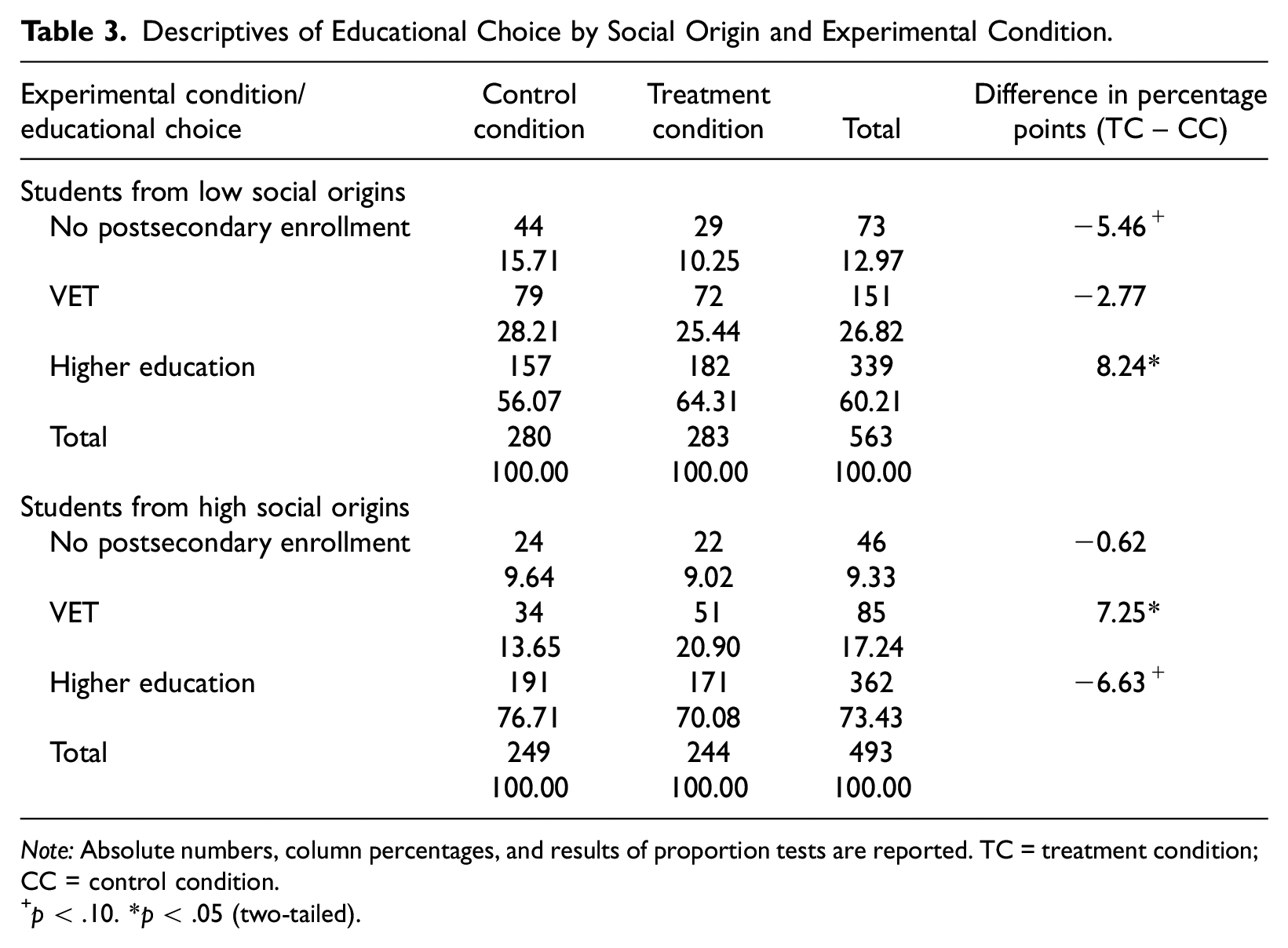
Note: Absolute numbers, column percentages, and results of proportion tests are reported. TC = treatment condition; CC = control condition.
p < .10. *p < .05 (two-tailed).
Results
Does the Program Foster Higher Education Enrollment among Students from Low Social Origins?
We began our empirical analysis by considering whether the counseling program fostered higher education enrollment for students from low social origins in Germany. The program indeed enhanced higher education enrollment among students from low social origins by 8.2 percentage points (p < .05; see Figure 2). Respondents in the treatment condition were more likely than those in the control condition to enroll in higher education. Conversely, we see a descriptive, although statistically nonsignificant, negative treatment effect of −2.8 percentage points on entering VET for students from low social origins (p > .10), suggesting a lower likelihood of entering VET in the treatment group. The program also positively influenced overall postsecondary enrollment, as shown by a treatment effect of −5.5 percentage points (p < .10) on the “no postsecondary enrollment” option. Thus, the program led to substantially greater higher education enrollment for students from low social origins, indicating that these students benefit from counseling in Germany, as Hypothesis 1 predicted.
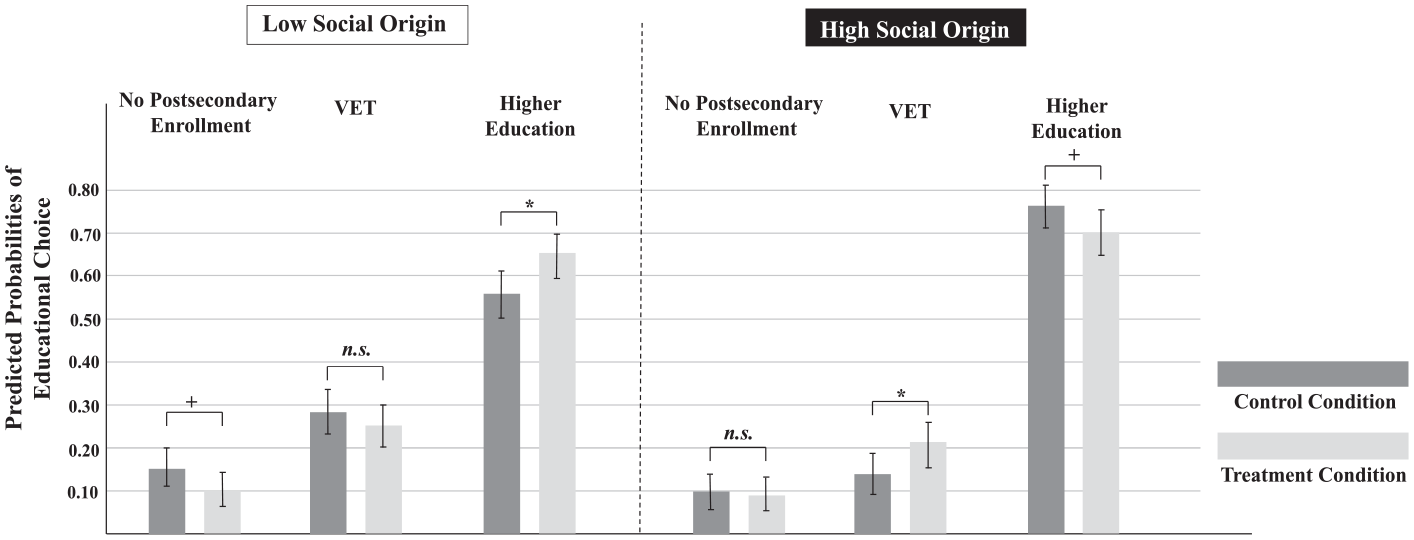
Probability of educational choice by social origin and experimental condition, focus on treatment effects.
Does the Program’s Effect Differ by Social Origin?
Next, we examined whether the program’s effect varied by social origin, focusing on the treatment effect for students from high social origins (see Figure 2). In contrast to the effect observed for individuals from low social origins, we found a negative treatment effect on higher education enrollment for students from high social origins (−6.6 percentage points; p < .10). Students from high social origins were (descriptively) less likely to be enrolled in higher education in the treatment condition than in the control condition. In addition, for these students, the program had a positive effect on entering VET, with a 7.2 percentage point increase (p < .05), again contrasting with the descriptive treatment effect for entering VET among students from low social origins. We do not see a treatment effect on postsecondary enrollment overall for students from high social origins because the probabilities of not enrolling were similar between the treatment and control conditions.
To gain a clear assessment of opposing effects between social groups, we tested the interaction effects between assignment and social origin using second-differences tests (for more details, see Table B1 in the online supplement). For the treatment effect on higher education enrollment, we found a difference of 14.9 percentage points between social origin groups (p < .01). This result indicates opposing treatment effects across social groups regarding higher education enrollment. Conversely, we see opposing treatment effects for entering VET, with a difference of −10 percentage points between social origin groups for this educational choice (p < .05). For the option of no postsecondary enrollment, the results show no significant interaction between assignment and social origin (−4.8 percentage points, p > .10).
To summarize the main results, we find opposing effects between high and low social origin groups, as anticipated in Hypothesis 2. Higher education enrollment among students from low social origins was enhanced by approximately 8 percentage points. Conversely, enrollment of students from high social origins was reduced by around 7 percentage points.
To further explore the positive treatment effect on entering VET for students from high social origins, we analyzed whether the treatment effect differed by academic achievement. Specifically, we ran a multinomial logistic regression model—with educational choice as the outcome—focused on students from high social origins. We included an interaction between assignment and achievement before high school completion (measured by grade point average across seven school subjects at baseline) and tested the interaction for first and second differences. The results indicate that program participation encouraged low-achieving students to enter VET, with an effect size of 17.7 percentage points (p < .01). We found no significant treatment effect for students with intermediate or high achievement levels. Correspondingly, effect heterogeneity by achievement, as reflected by second differences, is statistically significant for entering VET (p < .05 for both comparisons; see Table C1 in the online supplement).
Does the Program Reduce Social Inequality in Higher Education Enrollment?
Finally, to assess the extent to which the program reduced the social gap in higher education enrollment, we compared this gap between experimental conditions using the probabilities of educational choices predicted by the interaction model from our main analysis. The results indicate a substantial social gap in higher education enrollment in the control condition, predicted to be 20.6 percentage points (p < .001; see Figure 3). Only 56 percent of students from low social origins were predicted to enroll in higher education in the control condition compared to 77 percent of students from high social origins. Conversely, we see a large social gap for entering VET at −14.6 percentage points (p < .001) in the control condition, with students from high social origins being less likely to enter VET. A social gap also appeared in the likelihood of not enrolling in postsecondary education (−6.1 percentage points; p < .05), which also disadvantaged students from low social origins, which we did not expect.
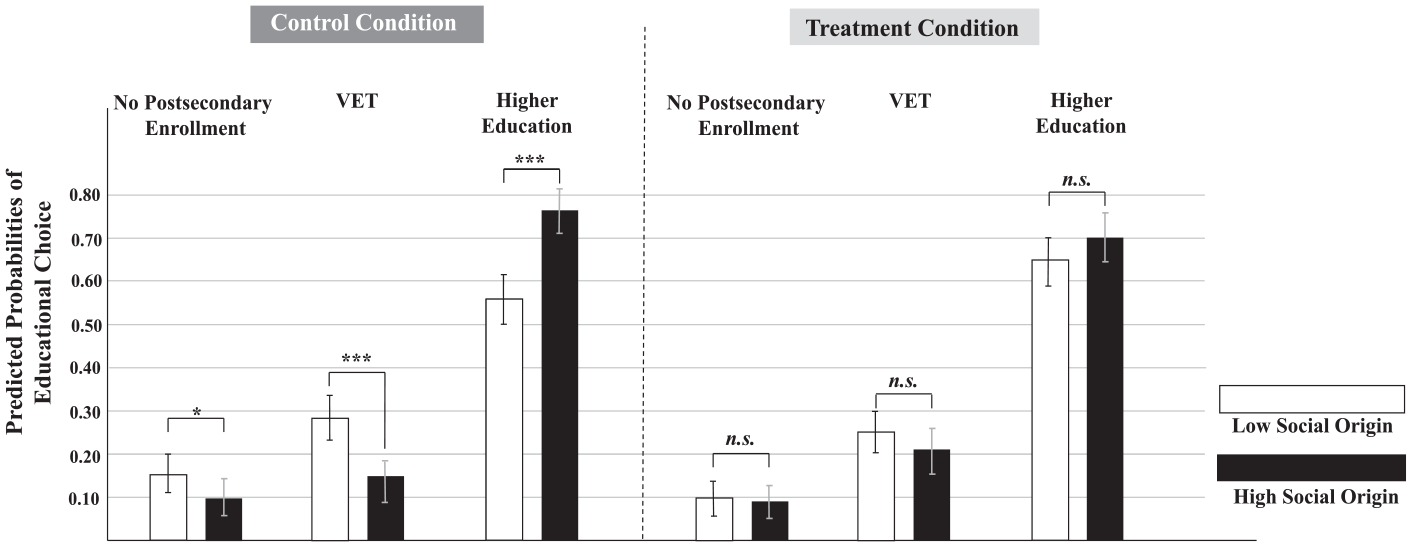
Probability of educational choice by experimental condition and social origin, focus on inequality.
In contrast, social gaps for all educational choices are not statistically significant in the treatment condition (see Figure 3). For higher education enrollment, the social gap in the treatment condition is reduced to just 5.8 percentage points (p > .10). The difference between control and treatment conditions suggests the program reduced inequality in higher education enrollment by 14.9 percentage points (p < .01). This reduction represents about 70 percent of the original 20.6 percentage point gap, implying the program reduced the social gap in higher education enrollment by roughly 70 percent. Conversely, the social gap in VET enrollment in the treatment condition was reduced to −4.5 percentage points (p > .10), indicating a decrease in inequality for entering VET by −10 percentage points (p < .05). We do not find a significant social gap in the likelihood of not enrolling in postsecondary education in the treatment condition.
The considerable reduction in social inequality in educational choices, in line with Hypothesis 3, reflects the opposing effects between social origin groups described earlier: Students from low social origins enrolled more frequently in higher education and (descriptively) less frequently in VET when assigned to the treatment condition, whereas students from high social origins enrolled less often in higher education and chose VET more frequently.
Discussion and Conclusions
Given the persistent social inequalities in university access, educational programs aimed at reducing the social gap in higher education enrollment have attracted considerable attention from politicians, researchers, and practitioners. However, no research has yet experimentally examined whether intensive information and support interventions—which effectively foster enrollment for students from low social origins in North America (for an overview, see Herbaut and Geven 2020)—also reduce inequality in university access in Europe. To address this gap, we used an RCT to determine in Germany (1) whether a guidance counseling program fosters higher education enrollment of students from low social origins and (2) whether this program reduces social inequality due to heterogeneous effects by social origin. Our use of unique experimental data allows for causal inferences of high internal validity regarding the effects of an intensive and individualized guidance counseling program.
The program fostered higher education enrollment among students from low social origins by 8 percentage points. Our results from Germany thus align with findings from the United States and Canada, showing that guidance counseling can boost enrollment rates for students from low social origins. Regarding effect sizes, we found the program’s effect on enrollment among individuals from low social origins to be similar to that of comparable North American interventions offering information and support (cf. Herbaut and Geven 2020: Figure 2), which is noteworthy. In Germany, students do not encounter the challenges posed by a highly stratified higher education system or a complex landscape of tuition fees and funding opportunities, as in the United States and Canada. Our findings may thus encourage politicians, researchers, and practitioners to develop and test intensive counseling programs across various national contexts.
We broadened the focus beyond students from low social origins by examining the program’s heterogeneous effects on students from low and high social origins. Past experimental studies on the effect of guidance counseling have largely overlooked students from high social origins (however, for low-intensity information sessions or relatively short support interventions, see Barone et al. 2017; Castleman et al. 2014; Peter et al. 2021). Investigating this privileged group was essential because an educational program’s effect on inequality depends on its effects across social origin groups (cf. Pietrzyk and Erdmann 2020). Furthermore, the favorable labor market prospects of VET in Germany imply the potential for opposing effects between social groups. Indeed, the program influenced students from varying social origins differently: It enhanced higher education enrollment for students from low social origins while reducing it for students from high social origins, encouraging them toward VET. This shift was particularly evident among low-achieving students from high social origins, who favored the less academically demanding but still rewarding VET. This redirection might reduce higher education dropout rates among individuals from high social origins. However, these results regarding heterogeneity by achievement require more investigation. Given these opposing effects across social origin groups, the program is estimated to have reduced the social enrollment gap by 15 percentage points, or approximately 70 percent (from a 21 point gap in the control group to a 6 point gap in the treatment group).
These results of opposing effects across social origins groups and the resultant impact on inequality in enrollment are notable for several reasons. First, from a methodological standpoint, our findings emphasize the importance of examining multiple social origin groups when assessing a program’s effect on inequality. This type of investigation can be resource-intensive, particularly for a one-on-one intervention delivered by professionally trained staff. However, our results indicate that intensive interventions may also affect educational pathways of students from high social origins, making this effort worthwhile.
Second, for research in the sociology of education and policy, our findings suggest guidance counseling may be a more effective tool for reducing enrollment inequality than previously thought. Past studies primarily focus on students from low social origins. Our results suggest that inequality can be reduced more effectively when it is tackled from both sides (i.e., intervening with both advantaged and disadvantaged groups). Specifically, the program reduced inequality by around 15 percentage points when both social origin groups were considered. Studies that only examine program effects on individuals from low social origins generally identify smaller inequality effects. Only a few extensive, long-term programs report effects larger than 15 percentage points for individuals from low social origins (Herbaut and Geven 2020: Figure 2). The potential for educational programs to influence inequality across the full spectrum of social origin groups suggests that including privileged groups may be beneficial, even if it seems counterintuitive.
Third, the observed effects of guidance counseling on inequality in the United States and Canada—now also seen in Germany—along with the recent scaling up of many programs suggest a need for more systematic consideration of educational programs in the sociology of education. For example, the program evaluated in this study, first introduced in 2011, is now available in about one-third of upper-secondary schools in North Rhine–Westphalia, Germany’s most populous federal state. This expansion could have notable consequences for social inequality in higher education enrollment in this region. Hence, researchers should consider the implementation and reach of specific educational programs because these factors can influence enrollment rates and the distribution of educational attainment at an aggregate level (Pietrzyk et al. 2023). Furthermore, it may be beneficial to examine not only how educational programs change inequality in university access but also whether these changes are accompanied by new mechanisms that effectively maintain inequalities in higher education (Lucas 2001).
In addition, our results provide theoretical catalysts for inequality in higher education enrollment in several ways: challenging existing theories and stimulating theory building. First, experimental research on the effectiveness of various interventions can challenge current explanations of social disparities (Ballarino et al. 2022). Studies consistently show that merely providing information in low-intensity interventions rarely affects university enrollment decisions (e.g., Barone et al. 2017; Ilie et al. 2022; Kerr et al. 2020) or does so only for specific subgroups (Peter et al. 2021). However, the significant effects of intensive one-on-one counseling suggest future research should more closely examine aspects of information processing, social networks, and psychological factors. One-on-one counseling may go beyond information delivery to actively support how information is processed. Behavioral economists suggest that people often make suboptimal decisions due to challenges in processing unfamiliar information and managing multiple choices (Lavecchia, Liu, and Oreopoulos 2016). Counselors may have guided students in navigating a wide array of information and options, providing a level of individualized support absent in group-based, low-intensity interventions. The descriptive data, which suggest participants felt better informed about postsecondary education due to the program, reinforce this view. Furthermore, counseling might have expanded participants’ social support networks, aligning with cultural reproduction theory, which links educational attainment to social capital (Bourdieu and Passeron 1971). Again, participants’ retrospective evaluations support this notion. Counselors can also help students transform their intentions into concrete actions by assisting with and overseeing application and enrollment processes. From this perspective, enrollment becomes a stepwise goal-achievement process, addressing obstacles such as a lack of confidence or uncertainty about reasonable next steps.
Second, effective interventions can stimulate theory building. Because guidance counseling has proven effective in different national settings, various program components (e.g., support in breaking down enrollment barriers and taking tangible steps) may offer valuable starting points for theory development. Nevertheless, this introduces the first limitation of our study: We cannot identify which components and mechanisms of the program drive its effects. Future research should examine specific elements of guidance counseling to enhance our empirical understanding and theoretical development. In this context, it would be beneficial for studies on the effectiveness of interventions to be linked to findings from the broader field of research on counseling and inequality, such as how counselors build trusting relationships (Holland 2015) and navigate institutional constraints (Blake 2020, 2024; Sattin-Bajaj et al. 2018).
A second limitation is that we only studied enrollment in higher education. Follow-up studies could examine long-term outcomes associated with program participation, including satisfaction with chosen paths, successful completion, and career progression. In particular, studies should explore the “diversion” of low-achieving students from high social origins. Understanding whether these students are better off abstaining from higher education is significant for assessing the program’s effects on individual benefits. It is worth noting that some students from high social origins might enroll in higher education after completing VET, which could restore social inequality (Hillmert and Jacob 2003).
A third limitation is that we could not observe spillover effects in our study. Students assigned to the treatment condition may have shared information and experiences from the program with their peers in the control condition, which could have influenced enrollment in the control group. If so, our program effect estimates would be conservative because they would be biased downward. However, spillover effects could be significant for policymakers in determining the extent of program implementation if a few participants (“seeds”) are enough to rally their peers. Furthermore, spillover effects could address the theoretical question of how strongly peers influence one another’s educational decision-making.
Fourth, our analyses do not allow for detailed conclusions about how program implementation and upscaling would affect social inequality in enrollment at the macro level in Germany because some crucial parameters require further specification. For example, the social composition of participants under real-world conditions influences a program’s effect on social inequality in enrollment at the macro level (Pietrzyk and Erdmann 2020). According to our estimates, the program’s effect on social inequality in enrollment at the macro level would be most significant if both social groups participated. However, state-funded programs might focus on a target group due to political decisions. Furthermore, our estimates may slightly deviate from nationwide program effects because our sample consisted of schools attended, on average, by disadvantaged students in a disadvantaged federal state in Germany. This bias hampers our ability to generalize the results nationwide. Future research should investigate whether program effects are lower or higher in more privileged areas; both directions are theoretically possible.
Finally, we narrowed inequality in higher education enrollment to one educational transition by focusing on enrollment inequality among students who obtain a higher education entrance qualification. However, the unequal proportions of individuals from low and high social origins who ultimately enroll in higher education (total enrollment inequality) are not solely due to inequality among students with entrance qualifications; it is also relevant that secondary schools are stratified, and not all lead to the acquisition of a higher education entrance qualification. Prior work provides some rough estimates regarding inequalities in the transition to secondary schools and higher education among eligible students (these estimates reduce the complexity of the education system and educational inequality to a few aspects) and how these inequalities contribute to total enrollment inequality. According to these estimates, total enrollment inequality in Germany is 53 percentage points (Kracke, Schwabe, and Buchholz 2024:5). To get a back-of-the-envelope calculation of how the program affects total enrollment inequality, we can use Kracke et al. (2024) estimates, recalculate the transition rates (not shown), and assume the intervention reduces about 70 percent of the inequality in enrollment among eligible students. In such a scenario, total enrollment inequality is reduced from 53 percentage points to 34 percentage points, reflecting a 19 percentage point reduction, or about 36 percent. These considerations make it clear that from a policy perspective, it is advisable not only to provide individualized counseling to students seeking a university entrance qualification but also to take measures to reduce educational inequality at younger ages.
Despite these limitations, our study provides an empirical starting point, based on a rigorous methodology, for investigating the potential of intensive information and support interventions to reduce inequality in higher education enrollment based on social origin in Europe, where there are fewer enrollment obstacles than in the United States and Canada. As we have shown in previous studies, the program we investigated can mitigate gender-specific disparities in the choice of study area (Erdmann et al. 2023) and reduce the enrollment gap associated with a migration background (Pietrzyk et al. 2023); thus, intensive information and support interventions appear to be a potent instrument for reducing multiple inequalities. We hope that researchers focusing on the sociology of education will recognize this potential by further investigating how interventions, as part of educational policies, shape educational inequality. Additionally, future research should explore the theoretical questions regarding which mechanisms drive program effects and what we learn about explanations for educational inequality based on investigations of effective interventions. This interplay between policies, theoretical considerations, and empirical results contributes to the growing interest in educational programs aimed at reducing educational inequality.
Supplemental Material
sj-docx-1-soe-10.1177_00380407251323888 – Supplemental material for Guidance Counseling Can Reduce Inequality in University Enrollment in Germany
Supplemental material, sj-docx-1-soe-10.1177_00380407251323888 for Guidance Counseling Can Reduce Inequality in University Enrollment in Germany by Irena Pietrzyk, Melinda Erdmann, Juliana Schneider, Marita Jacob and Marcel Helbig in Sociology of Education
Footnotes
Funding
The author(s) disclosed receipt of the following financial support for the research, authorship, and/or publication of this article: This project was supported by the Ministry of Culture and Science of the State of North Rhine–Westphalia (MKW-NRW). The content is solely the responsibility of the authors and does not necessarily represent the official views of the MKW-NRW.
Research Ethics
All human subjects gave their informed consent prior to their participation in the research, and adequate steps were taken to protect participants’ confidentiality. The project was approved by the Berlin Social Science Center (WZB) Institutional Review Board.

Supplemental Material
Supplemental material for this article is available online.
Notes
Author Biographies
References
Supplementary Material
Please find the following supplemental material available below.
For Open Access articles published under a Creative Commons License, all supplemental material carries the same license as the article it is associated with.
For non-Open Access articles published, all supplemental material carries a non-exclusive license, and permission requests for re-use of supplemental material or any part of supplemental material shall be sent directly to the copyright owner as specified in the copyright notice associated with the article.
