




Abstract
Studies consistently show the detrimental effect of school absences on pupils’ achievement. However, due to an accumulation of multiple risks, school absenteeism may be more harmful to achievement among pupils from lower socioeconomic status (SES). Using a sample of upper-secondary students from the Scottish Longitudinal Study (n = 3,135), we investigated whether the association between absences (overall, sickness, and truancy) and achievement in high-stakes exams varied by family SES dimensions (parental education, class, free school meal registration, and housing). The findings for overall absences and truancy show no statistically significant differences across SES groups. However, sickness absences were more harmful to the achievement of lower SES students than higher SES students. Differences between the most and least disadvantaged groups were found on all SES dimensions except for parental education.
Ample evidence indicates that school absences are detrimental to pupils’ academic achievement (Aucejo and Romano 2016; Gershenson, Jacknowitz, and Brannegan 2017; Gottfried 2010, 2011; Gottfried and Kirksey 2017; Klein, Sosu, and Dare 2022; Morrissey, Hutchison, and Winsler 2014; Smerillo et al. 2018). For instance, children who were frequently absent during early kindergarten had lower literacy grades at age 15 (Ansari and Pianta 2019). Additionally, higher levels of absenteeism in high school was associated with lower course grades or GPA, and an increased likelihood of high school dropout (Kirksey 2019). The mechanisms by which absences influence achievement are likely complex. According to the faucet theory, pupils enhance their learning through frequent exposure to education input, which stops if the exposure is turned off (Entwisle, Alexander, and Olson 2001). In other words, pupils who are absent from school miss out on teacher-led lessons, which adversely affects their achievement; more time spent in school, in contrast, is associated with improved educational outcomes (Bodovski and Farkas 2007; Fitzpatrick, Grissmer, and Hastedt 2011; Heatly, Bachman, and Votruba-Drzal 2015; Marcotte and Hemelt 2008). Apart from learning loss, absenteeism can also indirectly affect achievement because pupils miss out on peer interactions and other activities beneficial to their learning (Kirksey 2019; Morrissey et al. 2014). A contrary perspective is that absences do not primarily influence achievement due to learning loss. Instead, the association between absences and achievement reflects the effects of multiple out-of-school challenges that absent students face (Pyne et al. 2023; Singer et al. 2021).
Irrespective of the mechanisms, the association between school absences and academic achievement may be moderated by family socioeconomic status (SES). Due to an accumulation of multiple disadvantages (Evans, Li, and Whipple 2013; Rutter 1979), school absences may be more negatively associated with achievement among pupils from lower-SES backgrounds than among their high-SES peers. The theory of compensatory advantage (Bernardi 2014) further suggests that life-course outcomes are less dependent on previous adverse events among children from privileged backgrounds. These heterogeneous effects across family SES on children’s developmental and educational outcomes have been shown for birth weight (Torche and Echevarría 2011), prenatal stress (Torche 2018), divorce (Grätz 2014), sibship size (Tanskanen, Erola, and Kallio 2016), starting school early (Bernardi and Grätz 2015), and poor grades (Bernardi and Triventi 2020). Likewise, school absenteeism may be more harmful to low-SES pupils because of the challenges of living in high-poverty neighborhoods (McCoy et al. 2015), school absence policies that disproportionately penalize disenfranchised pupils (McNeely et al. 2021), parents lacking the economic and educational resources to compensate for missed lessons (Ready 2010), and parents working inflexible hours, thereby limiting their capacity for greater involvement in children’s schooling (Domina 2005).
Studies on the moderating role of SES in the association between school absences and academic achievement are sparse and show mixed results. Evidence of a stronger negative effect of absenteeism on achievement among low-SES pupils was found among children in kindergarten and elementary school (Aucejo and Romano 2016; Gershenson et al. 2017; Ready 2010). Using a composite SES measure and the Early Childhood Longitudinal Study (ELCS-K), Ready (2010) showed that the negative association between school absences and children’s math and reading achievement growth was stronger among low-SES children than their advantaged peers. Based on administrative data from North Carolina public schools, Aucejo and Romano (2016) and Gershenson et al. (2017) found that missing school had stronger adverse effects on test scores in reading and mathematics among low-income students. However, Gershenson et al.’s (2017) findings were not replicated in the data from the nationally representative ELCS-K. In contrast, Smerillo et al. (2018) showed that the detrimental effect of teacher-rated chronic absences in middle school on educational outcomes (math achievement, high school completion) was stronger among pupils of mothers who completed high school than among their peers whose mothers did not. However, this study was based on an urban cohort of low-income, predominantly African American students from the Chicago Longitudinal Study. Using administrative education data from government schools in Western Australia, Hancock et al. (2017) found that the associations between secondary school absences and numeracy and reading achievement were similar across parental education and occupation groups.
Research on the moderating effect of family SES on the association between school absences and achievement must account for the multidimensionality of both SES and school absenteeism (Klein et al. 2020; Sosu et al. 2021). For example, family SES can be conceptualized from a resource (e.g., income, free school meals, housing) or human capital (e.g., parental education, job status) perspective. These dimensions are correlated but uniquely influence developmental and educational outcomes through different mechanisms (Bukodi and Goldthorpe 2013; Schenck-Fontaine and Panico 2019). In addition, pupil absences can be due to various reasons, such as truancy or sickness, that may interact differently with SES dimensions in their effect on academic achievement.
This study contributes to the literature by analyzing whether the association between school absenteeism and academic achievement during secondary schooling varies across different SES dimensions. Additionally, we examine whether the moderating role of family SES on the absenteeism–achievement link depends on the reason for school absence (truancy or sickness).
Theoretical Background
School Attendance and Achievement: Moderation by SES
Extensive prior work shows the detrimental effect of school absences on pupils’ academic achievement (e.g., Aucejo and Romano 2016; Gershenson et al. 2017; Gottfried 2010, 2011; Gottfried and Kirksey 2017; Kirksey 2019; Klein et al. 2022). However, evidence of socioeconomic inequalities in educational outcomes (e.g., Chmielewski 2019; Reardon 2011) suggests that the link between school absences and learning outcomes varies across family socioeconomic circumstances. According to the cumulative risk theory (Rutter 1979), the number of risk factors children experience predicts their developmental outcomes. The risk of developmental disorder increases with the number of stressors experienced. In other words, the accumulation of risk is the critical determinant of educational outcomes. Exposure to multiple risk factors (low SES, frequent school absences) is more detrimental than exposure to a single risk factor (Evans et al. 2013). Cumulative risk theory, therefore, suggests that absenteeism has a greater negative impact on low-SES students.
The moderating role of family SES in the association between absences and achievement may also depend on the SES dimension. Studies have highlighted the role of different SES dimensions (e.g., income, education, housing) in shaping children’s developmental and educational outcomes (Bukodi and Goldthorpe 2013; Schenck-Fontaine and Panico 2019). For instance, family income determines the ability of families to invest in the goods and services crucial for children’s academic achievement (Linver, Brooks-Gunn, and Kohen 2002; Mayer 1997; Yeung, Linver, and Brooks-Gunn 2002). As a result, school absences may be more detrimental to achievement among pupils from disadvantaged families because they cannot invest in extra resources (e.g., books, private tuition) to help their children catch up with missed lesson content (Ready 2010). This argument is consistent with the compensatory advantage hypothesis, which suggests that high-SES families have the resources to compensate for adverse life experiences, such as school absences (Bernardi 2014). It also aligns with the literature on the summer learning gap, which shows pupils from lower socioeconomic backgrounds gain fewer academic skills during summer holidays than do their peers from higher socioeconomic backgrounds due to the multiple disadvantages they face during school holidays (Alexander, Entwisle, and Olson 2001, 2007; Burkam et al. 2004; Downey, Von Hippel, and Broh 2004; Kuhfeld 2019; Von Hippel, Workman, and Downey 2018).
Parental education and higher job status may be beneficial for children’s educational outcomes via parental involvement, such as supporting learning at home, attendance at parents’ evenings, or membership in parent-teacher associations (Barg 2019; Bhargava and Witherspoon 2015; Hoover-Dempsey, Bassler, and Brissie 1987; Lareau 2002; Lareau and Horvat 1999; Lee and Bowen 2006). Parents with lower educational qualifications may lack the knowledge to support learning at home effectively (Altintas 2016; Dotti Sani and Treas 2016; Kalil, Ryan, and Corey 2012). Parents with lower job status are likely to have relatively unstable and unpredictable work schedules and may, therefore, not have the temporal flexibility to be more involved in children’s education (Han 2005; Joshi and Bogen 2007; Li et al. 2014). Hence, parents with lower education and job status may not have the knowledge, skills, and time to help their children catch up with missed content during periods of absence. Work inflexibility may further prevent parents from engaging with their children’s school to address the consequences of absence (Domina 2005). These perspectives suggest that school absences may be more harmful to achievement among pupils whose parents have lower qualifications and job status.
Social housing aims to provide low-income families with better accommodations, but it can lead to residential segregation and a higher concentration of poorer families in deprived neighborhoods (Newman 2008). Evidence suggests that social housing tenants are at greater risk of poor housing and neighborhood quality (Tunstall 2011). This concentration of social housing in deprived communities may harm children’s developmental outcomes due to social, structural, and relational factors (McCoy et al. 2015). Disadvantaged neighborhoods lack the institutions and physical resources, such as libraries and well-resourced schools, that support children’s cognitive development and educational achievement (Leventhal and Brooks-Gunn 2011). Relational perspectives suggest that social interactions, norms, and behaviors critical to children’s development vary by neighborhood poverty. Affluent neighborhoods tend to have more positive social interactions between schools and communities, supporting children’s developmental and educational outcomes. In contrast, due to pressures from multiple stressors, social relations tend to be less supportive in disadvantaged neighborhoods, with detrimental consequences for child outcomes (McCoy et al. 2015). For instance, social housing tenants are less likely to agree that individuals get on well together in their local area and are more likely to be concerned about crime (Laurence and Heath 2008; Tunstall et al. 2011).
Consequently, school absenteeism may interact with other school and neighborhood experiences in shaping socioeconomic disparities in educational outcomes (Romero and Lee 2007). For instance, schools in low-SES neighborhoods may be unable to provide the support and resources needed to help absent pupils keep up with the curriculum requirements (Morrissey et al. 2014). These perspectives suggest absenteeism is more strongly associated with achievement among children growing up in social housing because of fewer resources in their neighborhoods or less positive relational support to help them catch up on missed learning.
Previous studies on the moderating role of family SES for the link between absenteeism and achievement have found mixed results. These differences in findings may be due to different operationalizations of SES. For example, studies using SES measures capturing financial resources (e.g., free and reduced-price lunch, poverty) found moderation in the expected direction (Aucejo and Romano 2016; Gershenson et al. 2017), whereas studies using parental education or occupation did not (Hancock et al. 2017; Smerillo et al. 2018). However, no previous research has compared the moderating role of these SES dimensions in a single study. This comparison may provide nuanced guidance on which groups are most affected by school absences and how to reduce absences via targeted interventions. Additionally, it may provide theoretical insights into the possible mechanisms by which socioeconomic inequalities in the absenteeism–achievement link emerge.
Reasons for Absence and Moderation by SES
Children are absent from school for various reasons, including sickness, family holidays, and truancy. Different reasons for school absence may affect pupils’ academic achievement differently. For instance, evidence suggests that broad categories of unexcused absences are more detrimental to academic achievement than excused absences (Gershenson et al. 2017; Gottfried 2009). Other studies have found the association between school absences and academic achievement to vary across more precise reasons (Hancock, Gottfried, and Zubrick 2018; UK Department for Education 2016).
Aside from learning loss, truancy may be associated with individual factors such as problem behaviors (Eaton, Brener, and Kann 2008; Hallfors et al. 2002; Rocque et al. 2017; Zhang et al. 2007), structural challenges such as neighborhood disadvantage, out-of-school harms, and school-level policies that disproportionally penalize disadvantaged groups (McNeely et al. 2021; Mireles-Rios, Rios, and Reyes 2020; Singer et al. 2021). These factors, in turn, are associated with educational outcomes and thus may exacerbate the harmful effects of truancy on pupils’ academic achievement (Dornbusch et al. 2001; Fergusson and Horwood 1995; Jeynes 2002; Pyne et al. 2023). Additionally, students who miss school due to truancy may experience greater alienation from their peers, teachers, and schools (Finn 1989; Wilson et al. 2008) and possibly receive limited support to help with learning (Roorda and Koomen 2021). The moderating role of SES in the link between absences and academic achievement may be stronger for truancy because families must compensate for learning loss and mitigate individual-, neighborhood-, and school-level challenges. This may be more difficult for low-SES parents than high-SES parents because they must deal with multiple challenges, including socioeconomic pressures, likely prejudice from schools, and less time for involvement in their children’s education due to nonstandard work schedules. Truancy may also be particularly damaging for students growing up in social housing because the consequences of truant behavior may depend on relational support and structural resources to mitigate problem behavior and feelings of disengagement (Strand, Anbäcken, and Granlund 2015; Teasley 2004).
Sickness absences may be detrimental to students’ academic performance because they may indicate underlying health conditions, such as mental health issues, that have a lasting effect on learning and achievement (Pijl et al. 2021). Low-SES families experience health inequalities due to unequal access to health services, discrimination, and poor-quality housing, which limit their ability to manage their health effectively (NHS Health Scotland 2014), so sickness absence may have a disproportionately negative effect on the academic achievement of children from low-SES families. In addition, while students who are absent due to illness may be more motivated to make up for lost learning, the educational achievement of students from lower socioeconomic backgrounds may be more negatively affected due to a lack of resources to make up for missed lesson content and the cumulative effect of dealing with ongoing economic and health issues.
If some types of absence have more heterogeneous consequences for achievement across family SES, addressing socioeconomic inequalities in these school absences will be vital. Understanding variation in the association between absences and achievement by family SES and the reason for absence will also enable us to adopt a more targeted approach to mitigating the consequences of absenteeism. Previous studies examining the moderating role of SES in the association between absenteeism and achievement have focused on overall absences (Aucejo and Romano 2016; Gershenson et al. 2017; Ready 2010; Smerillo et al. 2018) or differentiated between authorized and unauthorized absences (Hancock et al. 2017). No existing studies have examined whether the moderating role of SES varies with more precise reasons for school absence.
The Current Study
The current study investigates whether family SES dimensions moderate the association between school absences and academic achievement. Compared to previous research using one type of family SES, for instance, a composite SES score (Ready 2010) or free and reduced-price lunch (Aucejo and Romano 2016), we consider a rich set of socioeconomic characteristics (parental education, parental class, housing tenure, free school meal registration). We test whether SES-specific associations between absences and achievement vary across the reasons for absence (truancy and sickness). We use unique population-level data from the Scottish Longitudinal Study (SLS), which links census information, school administrative data, and public examination records for pupils in postcompulsory education.
Scotland has a comprehensive schooling system in which children generally remain together in the same school setting until the end of compulsory schooling (S4, ages 15–16). Scottish primary education lasts seven years (P1–P7), and secondary education lasts six years (S1–S6). At the end of compulsory (S4) and postcompulsory (stages S5/S6, ages 16–18) schooling, students in Scotland take national examinations, which are highly consequential for school continuation, entry into higher education, and labor market outcomes (Iannelli and Duta 2018; Iannelli, Smyth, and Klein 2016). At the compulsory stage (S4), students sit exams in two mandatory subjects (math and English); there are no compulsory subjects in the postcompulsory phase (S5/S6). At both stages, students can decide the number of subjects and the qualification level within each subject at which they wish to sit their exams.
Methods
Data and Sample
We used the Scottish Longitudinal Study, a large-scale, anonymized record-linkage study designed to capture a representative sample of the Scottish population. Data can be linked from various statistical and administrative sources such as national census data (1991, 2001, 2011), vital events data (births, deaths, marriages), the National Health Service central register data (migration into and out of the country), and education data (2007–to 2013). SLS members were selected using 20 semirandom birthdates covering 5.3 percent of the Scottish population.
We obtained ethical approval for the study from the Strathclyde Institute of Education Ethics Committee. The SLS Research Board approved using the SLS data for Project 2018_007. All analyses took place in a Safe Setting Place following established protocols set up by the data holders for the safe use of the data for research purposes (SLS-DSU n.d.).
Our SLS sample consists of two pupil cohorts in their final year of compulsory schooling (Stage S4) in 2007 and 2008, who were followed into upper-secondary schooling stages (S5/S6). For the selected SLS members, we used linked information on attendance and reasons for nonattendance from administrative school records, information on academic achievement from the Scottish Qualifications Authority (SQA) data, and socioeconomic background characteristics from school census data and the population census 2001. The SQA attainment data provide complete information on pupils’ academic achievement in national examinations at the end of compulsory (S4) and upper-secondary schooling (S5/S6). These are the only stages in the Scottish education system in which students are assessed in national exams.
Because our analysis requires household information on socioeconomic background characteristics, we excluded from our sample pupils who were absent during the census 2001 (n = 814) or did not live with their parents (n = 214). We also do not consider pupils with no SQA information on their achievement (n = 128). In addition to these sample restrictions, we excluded pupils who attended special schools, repeated a school year, or skipped a consecutive school stage (n = 62); due to their characteristics, the association between absenteeism and achievement likely differs from the main sample. However, small sample sizes do not allow us to conduct subgroup analyses. Given that only 9 percent (n = 396) of cases are affected by item nonresponse on any of the variables considered (either in the outcome or censoring model), we focused on a complete case analysis (n = 4,419). In addition, when data are “missing not at random,” multiple imputation results are frequently more biased and less efficient and have poorer coverage than listwise deletion (Pepinsky 2018).
In this article, we restrict our sample to pupils (n = 3,135) who transitioned from compulsory (S4) into postcompulsory schooling (S5/S6) because these are the only students for whom we can model achievement growth, that is, we have achievement measured across two time points (from S4 to S5/S6). To correct for this selective dropout from compulsory to postcompulsory education (n = 1,284), in our final sample, we used inverse probability of censoring weighting (see the “Analytic Strategy” section).
Measures
Academic achievement
We measured students’academic achievement using grades obtained from national standardized examinations at the end of compulsory schooling (S4, ages 15–16) and postcompulsory schooling (S5/S6, ages 16–18) in Scotland. At the end of compulsory schooling, students in our sample, for the first time, took high-stakes national standardized exams in about eight subjects (“Standard Grades”), of which only English and mathematics are compulsory. Depending on their future educational plans, students could choose to take exams at a given difficulty level (i.e., foundation, general, or credit). Some students exit school after this stage, and others progress to the postcompulsory stage (S5/S6).
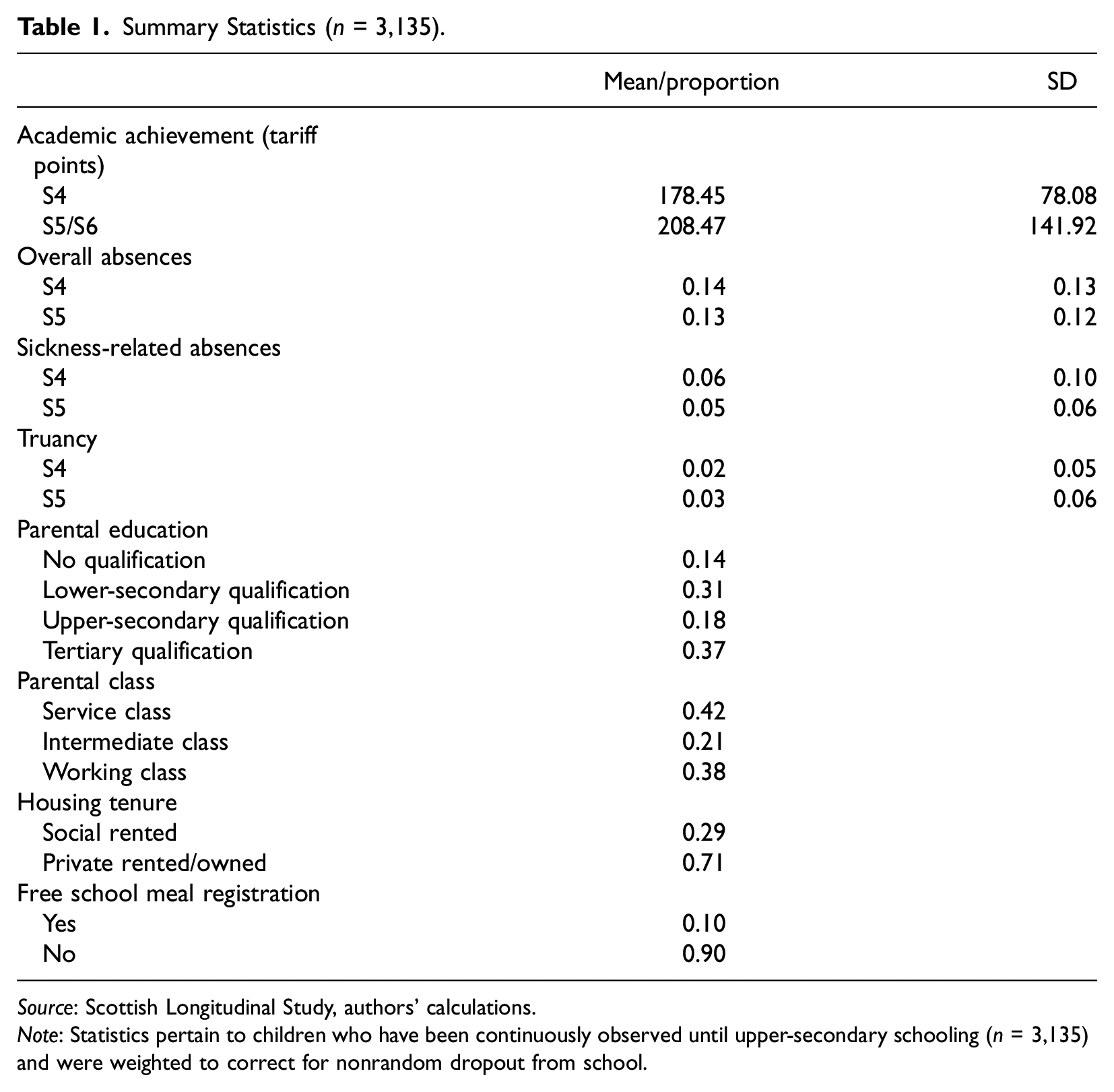
In S5 or S6 (post-compulsory education) our student sample sat exams in subject-specific examinations. Some students completed all their exams after S5 and then leave school. Others took exams in S5 for some subjects and in S6 for others. Students were permitted to take exams in any number of subjects at any level of difficulty. Students primarily took “Highers” and “Advanced Highers” exams, with the latter being more challenging than the former; they could also take the “Intermediate 1” and “Intermediate 2” exams, which correspond to the S4 Standard Grades general and credit levels. Grades in S4 and S5/S6 were awarded for each subject using an alphanumeric system to determine admissions to higher education and high-demand programs. These examinations were set and administered by the SQA, the national body responsible for awarding qualifications in Scotland. To effectively deal with the Scottish system’s complex nature, we operationalized academic achievement as a continuous outcome using the extended version of the Universities and Colleges Admissions Service Scottish tariff points system (for more details, see Table S1 in the online supplement and Section 3.3 in Scottish Government 2012). This converts achievement across all subjects for each student into tariff points. Universities use these tariff points in combination with subject choices for decisions on admissions to their institutions. The average tariff point gained in the final year of compulsory schooling was 178.45 (SD = 78.08), and the average tariff point after postcompulsory schooling was 208.47 (SD = 141.92).
School absenteeism
We measured overall absences as the percentage of days a pupil was absent from school regardless of the reason for being absent. The total number of days attended includes school attendance, educational visits organized by the school, other attendance out of school, and medical and dental appointments lasting less than half of a school opening day. To account for differences in the length of the school year between different school authorities and students, we calculated the ratio of the number of days attended and the number of possible days in each school stage. We then subtracted the resulting proportion from 1 to obtain the proportion of overall absences.
Schools in Scotland report specific reasons for absence following government guidelines for recording absenteeism (Scottish Government 2019). These include authorized reasons where parents contact the school and explain why their child cannot attend. For example, schools can authorize absences for sickness, exceptional domestic circumstances, or family holidays. When a child does not attend school, and the parent has not contacted the school to indicate their child will be absent, it is assumed the child is either missing or truant until the school receives an explanation. Schools must contact a parent or the child’s emergency contact to determine why the child was absent (Scottish Government 2019).
Sickness-related absences refer to the percentage of days a pupil was absent from class due to sickness and for which no alternative educational arrangements were provided. Proof of illness, such as a parental letter or medical certificate, is required in these cases. Truancy is measured as the percentage of days a pupil was absent and for which the pupil or parent did not provide an adequate explanation (e.g., sickness, exceptional domestic circumstances). This does not include situations where a student was suspended from school for a fixed period because schools know why the pupil missed school.
We calculated all absence measures for the final year of compulsory schooling (S4) and the first year of upper-secondary schooling (S5). We limited the measure of absences to S5 because we do not have information on absences in S6 for students who left after S5. Moreover, students who stay until S6 sit most of their exams in S5. Ifwe considered their absences in S6, we would partlymeasure the exposure after the outcome. Pupils missed 14 percent of their overall school days in S4 (SD = 0.13) and 13 percent in S5 (SD = 0.12). In S4, pupils missed 6 percent of their days due to sickness (SD = 0.10) and 2 percent due to truancy (SD = 0.05); in S5, students missed 5 percent due to sickness (SD = 0.06) and 3 percent due to truancy (SD = 0.06).
Family SES
Our family SES dimensions include parental education, class, housing tenure, and free school meal (FSM) registration. The average correlation among all SES dimensions was .34 (minimum = 0.24; maximum = 0.43). The correlation matrix is presented in the online supplement (Table S2).
We measured parental education with the highest educational qualification among parents using four categories: (1) no qualification (14 percent), (2) lower-secondary qualification (Standard Grade/GCSE or equivalent; 31 percent), (3) upper-secondary qualification (Highers/A-levels or equivalent; 18 percent), and (4) tertiary education including college below-degree (HNC/HND or equivalent) and first-degree/higher-degree or equivalent (37 percent).
We measured parental social class with the National Statistics Socioeconomic Classification (Goldthorpe 2007) using three classes: (1) The service class comprises higher and lower managerial, administrative, and professional occupations (42 percent); (2) the intermediate class includes intermediate occupations and small employers and own-account workers (21 percent); and (3) the working class consists of employees in lower supervisory and technical occupations and semiroutine and routine occupations and individuals who have never worked and are long-term unemployed (38 percent).
We measured FSM registration as a binary variable, indicating whether a pupil was registered to receive free school meals (10 percent). FSM registration identifies students living in low-income and out-of-work households (Hobbs and Vignoles 2010).
Housing tenure indicates whether pupils lived in social-rented accommodation (29 percent) or owner-occupied/privately rented accommodation (71 percent). In Scotland, public authorities (mainly councils) and housing associations (registered social landlords) predominantly own and manage social housing. Table 1 provides summary statistics for all variables.
Summary Statistics (n = 3,135).
Source: Scottish Longitudinal Study, authors’ calculations.
Note: Statistics pertain to children who have been continuously observed until upper-secondary schooling (n = 3,135) and were weighted to correct for nonrandom dropout from school.
Analytic Strategy
To exploit longitudinal information (T = 2) on student absences and academic achievement from compulsory (S4) and upper-secondary schooling (S5/S6), we estimated first-difference (FD) models (Allison 2009) in which we “difference out” person-specific time-constant unobserved heterogeneity (

where
We estimated these FD models for each SES group separately to test whether the association between overall absences and academic achievement varies across SES dimensions. We then performed Wald tests to examine the equality of coefficients from these FD models across groups in each dimension.
In a separate model, we estimated associations between within-student changes in the specific reasons for absence (sickness absence and truancy) and academic achievement growth. The FD model is shown in Equation 2:
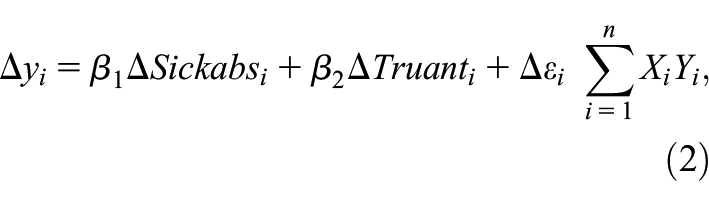
where
To correct for selective inclusion in our sample of upper-secondary students (nonrandom censoring), we weighted all analyses by inverse probability of censoring weights (Hernán and Robins 2006). Using these weights created a pseudo-population that would have been observed had censoring been random regarding our covariates (including academic achievement, school absenteeism, and sociodemographic and health characteristics).
The censoring weight cw is formally defined as the ratio of the unconditional probability that pupil i is observed in the sample and the same probability conditional on covariates. Because probabilities are unknown, they are estimated via logistic regression.

Table S3 in the online supplement shows the results from a logistic regression estimating the denominator of the censoring weight for dropout after the compulsory stage (S4). Table S4 in the online supplement presents summary statistics for this censoring weight.
Findings
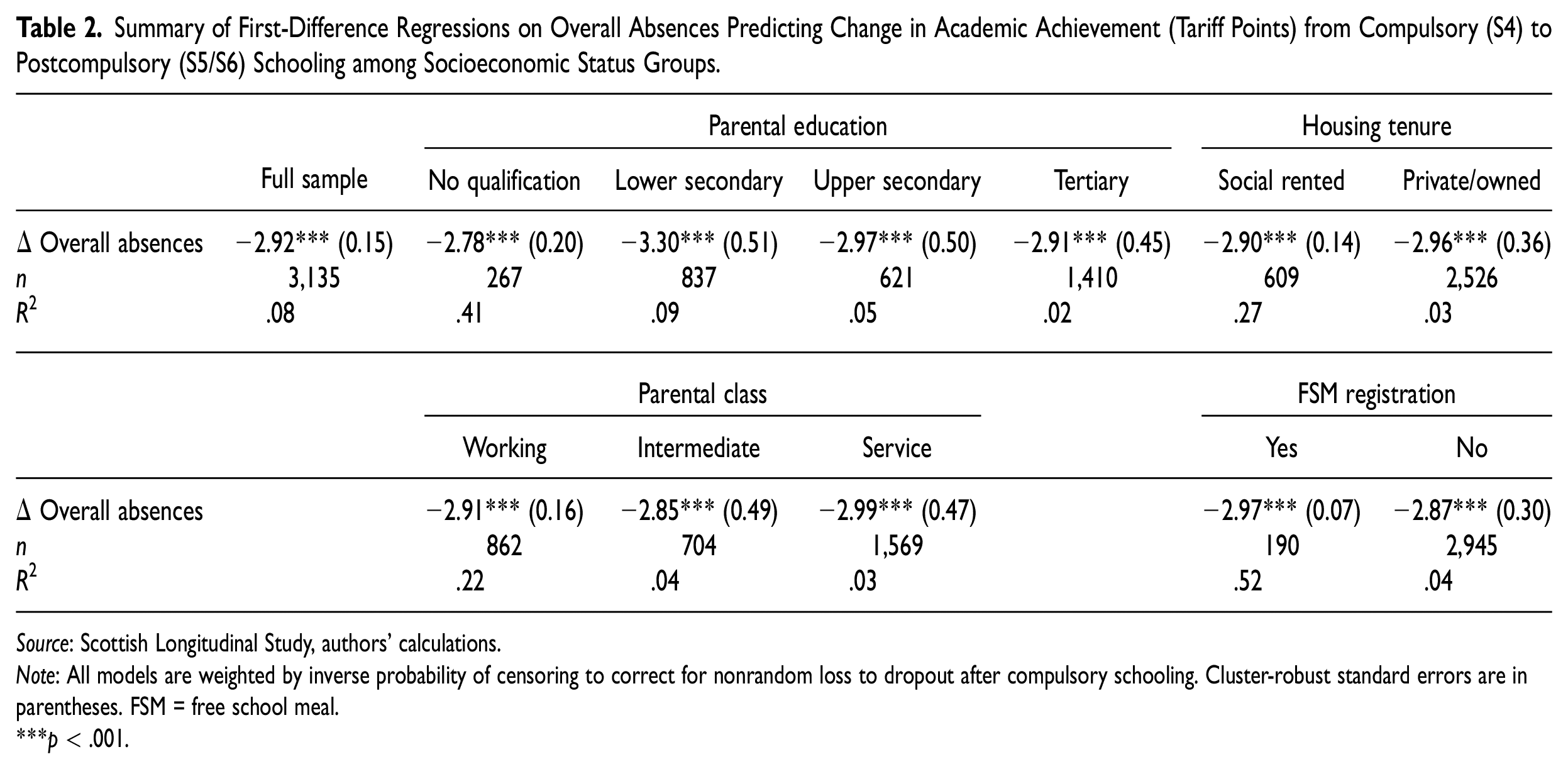
Table 2 shows the FD regressions for the total sample and different SES groups when measuring absences overall. In these models, we tested whether changes in the percentage of absences between S4 and S5 were associated with achievement growth from the compulsory (S4) to upper-secondary (S5/S6) school. Among all students (n = 3,135), changes in overall absences are negatively associated with achievement growth. A 1 percentage-point increase in overall absences is associated with lowering academic achievement growth by 2.92 tariff points (SE = 0.15, p < .001).
Summary of First-Difference Regressions on Overall Absences Predicting Change in Academic Achievement (Tariff Points) from Compulsory (S4) to Postcompulsory (S5/S6) Schooling among Socioeconomic Status Groups.
Source: Scottish Longitudinal Study, authors’ calculations.
Note: All models are weighted by inverse probability of censoring to correct for nonrandom loss to dropout after compulsory schooling. Cluster-robust standard errors are in parentheses. FSM = free school meal.
p < .001.
The FD estimates among the considered SES groups are equally statistically significant at the .01 percent level and similar to the FD estimate among the total sample. Findings from the Wald test (Table S6 in the online supplement) do not show any significant differences in the association between change in overall absences and achievement growth across SES categories. None of the pairwise comparisons of FD estimates for each SES dimension indicate that the null hypothesis of equality of coefficients can be rejected (see Table S5 in the online supplement).
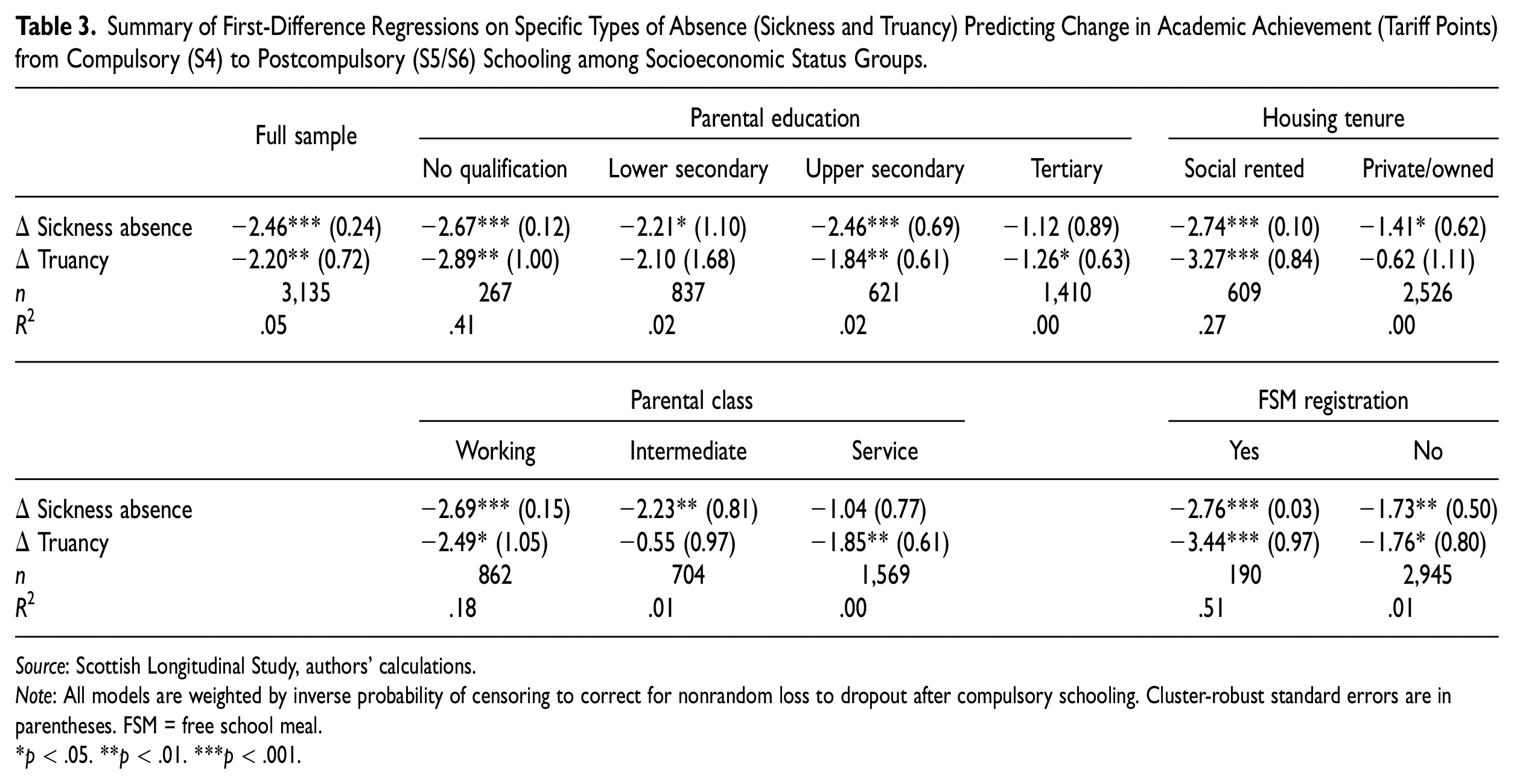
Table 3 presents the findings on sickness absence and truancy from FD regressions among the total sample and different SES groups. In the total sample, a 1 percentage-point increase in sickness absences is associated with lower achievement growth of 2.46 tariff points (SE = 0.24; p < .001). Findings from the Wald test (Table S6 in the online supplement) show significant heterogeneity in the association between sickness absences and achievement across SES categories of parental social class, FSM registration, and housing tenure.
Summary of First-Difference Regressions on Specific Types of Absence (Sickness and Truancy) Predicting Change in Academic Achievement (Tariff Points) from Compulsory (S4) to Postcompulsory (S5/S6) Schooling among Socioeconomic Status Groups.
Source: Scottish Longitudinal Study, authors’ calculations.
Note: All models are weighted by inverse probability of censoring to correct for nonrandom loss to dropout after compulsory schooling. Cluster-robust standard errors are in parentheses. FSM = free school meal.
p < .05. **p < .01. ***p < .001.
For parental class, we see a difference in the effect of sickness absences on achievement between pupils from service- and working-class households, χ2(1) = 4.39, p = .036. Specifically, among pupils from service-class households, a 1 percentage-point increase in sickness absence is associated with lower achievement growth of 1.04 tariff points (SE = 0.77; p > .05), compared to 2.69 tariff points (SE = 0.15; p < .001) among pupils from working-class households. None of the other pairwise comparisons are statistically significant.
For housing tenure, we found significant differences in the effect of sickness absences on achievement, χ2(1) = 4.28, p = .039. Whereas the FD estimate is −1.41 (SE = 0.62; p < .05) among pupils living in private rented and owned accommodations, it is −2.74 (SE = 0.10, p < .001) among pupils growing up in social housing. Lastly, we found a significant difference in the FD estimate of sickness absence between students registered for free school meals and those not registered, χ2(1) = 4.47, p = .035). Among FSM-registered students, a 1 percentage-point increase in sickness absence reduced achievement growth by 2.76 tariff points (SE = 0.03, p < .001), compared to 1.73 tariff points (SE = 0.50, p < .01) among students not registered for FSM. Findings from the Wald test indicate no significant difference in the association between sickness absences and achievement across parental education categories (see Table S6 in the online supplement).
Regarding truancy, we found that a 1 percentage-point increase in absences is associated with lower achievement growth by 2.20 tariff points (SE = 0.72, p < .01) in the full sample. However, results from the Wald test show no statistically significant heterogeneity in the association between truancy and achievement across SES categories (see Table S6 in the online supplement).
Discussion
Our article contributes to the literature on school attendance by investigating whether the link between secondary-school absences and achievement varies with family SES. We used several SES dimensions as moderators, such as parental class, parental education, FSM registration, and housing tenure. Studies have shown that these SES dimensions uniquely shape children’s educational and developmental outcomes (Bukodi and Goldthorpe 2013; Schenck-Fontaine and Panico 2019) and may therefore indicate different mechanisms by which family circumstances mitigate or exacerbate the effect of absences on student achievement. We also examined whether the moderating role of SES varied across specific reasons for absence (i.e., sickness, truancy).
In line with the literature (Aucejo and Romano 2016; Gershenson et al. 2017; Gottfried 2010, 2011; Gottfried and Kirksey 2017; Klein et al. 2022; Morrissey et al. 2014; Smerillo et al. 2018), our findings show that school absences overall had adverse consequences for academic achievement among all pupils. This was equally confirmed for truancy and sickness absences: Higher absences were associated with lower academic achievement. Consistent with our hypothesis, we found evidence for a stronger negative effect of sickness absences on the achievement of pupils from lower compared to higher SES backgrounds. These differences in the effect of sickness absence on achievement were statistically significant for SES indicators of social class, FSM, and housing tenure. Only parental education was not a significant moderator for the association between sickness absences and educational achievement. The moderating effects of SES dimensions for overall absences and truancy were contrary to our expectations. The results show that the detrimental effect of overall school absences on academic achievement was similar for pupils from different socioeconomic strata irrespective of how we measured SES. Likewise, truancy was equally detrimental to the achievement of pupils from lower and higher SES backgrounds.
Family SES heterogeneity in the effect of sickness absences on academic achievement suggests that low-SES students are more likely than high-SES students to suffer the negative consequences of being absent due to illness. Consistent with the cumulative risk theory (Evans et al. 2013; Rutter 1979), pupils exposed to multiple risk factors (sickness absence, low SES) had significantly lower achievement progress than did peers exposed to a single risk factor (i.e., sickness-related school absences). In other words, high-SES students recover more quickly from sickness absence learning loss, possibly because they must address only one risk factor (sickness) or because their families use assets to catch up on missed lesson content (variation by parental class and FSM). Furthermore, low-income students may have more entrenched health problems, or their families may find it difficult to effectively manage their children’s health due to disparities in access to health care (NHS Health Scotland 2014), impairing their children’s ability to focus on learning. This suggests that the association between SES and school attendance and achievement extends beyond learning loss, including the numerous out-of-school harms students face (Pyne et al. 2023; Singer et al. 2021). Given that we found no significant variation by parental education, SES differences in parental involvement in children’s catching up on learning due to sickness absences appear less significant.
Our results showing no discernible differences in the link between overall absences and achievement across socioeconomic groups align with Hancock et al.’s (2017) study in Australia, but they are at odds with studies from the U.S. context (Aucejo and Romano 2016; Gershenson et al. 2017; Ready 2010) showing that overall school absences are more strongly associated with achievement among pupils from lower socioeconomic backgrounds. In other words, our findings and that of Hancock et al. (2017) imply that family SES may not mitigate the harmful effects of overall school absences on academic achievement. Overall absences have detrimental consequences for children’s educational outcomes regardless of socioeconomic circumstances. Aside from the country context, the considered school stage may explain this discrepancy in results. The U.S. literature focused on elementary school children, whereas our study and Hancock et al. (2017) considered the middle or high school stages. In addition, we examined overall achievement across all subjects, whereas previous studies used specific subjects, such as mathematics and reading test scores, as the outcome (Aucejo and Romano 2016; Gershenson et al. 2017; Ready 2010).
Regarding truancy, our findings contradicted our hypothesis, indicating that truancy-related absences were detrimental to all socioeconomic groups. We hypothesize that the lack of heterogeneity is due to the repercussions of truancy across socioeconomic contexts. Regardless of socioeconomic status, students absent due to truancy may experience alienation and disengagement from their peers, teachers, and school (Wilson et al. 2008). In addition, schools may implement punitive policies for truancy, and teachers may be less sympathetic toward truant students, regardless of their family’s socioeconomic status, due to negative attitudes toward behavioral infractions (Roorda and Koomen 2021). Finally, due to truancy’s association with other behavior problems, such as substance abuse and delinquency, high-SES parents may be unable to use their resources to mitigate their children’s learning loss.
Our study has several limitations that are worth mentioning when interpreting the findings. First, although we used a FD estimator accounting for all unobserved time-constant student heterogeneity, we cannot exclude the possibility of time-varying student confounders or confounding at the teacher/classroom level. Second, our findings relate only to the majority student population in Scottish state schools and the upper-secondary school stage and cannot be generalized to all students and stages. Third, although there are strict and detailed guidelines by the Scottish government on how to record absences in Scottish schools, it is possible that schools and teachers vary in how they record the reason for absences or families vary in the extent to which they contact schools to explain their child’s absence, thereby raising concerns about the validity of the documented reasons for absences.
Despite these limitations, the current findings have implications for enhancing educational outcomes. First, given the adverse effects of absenteeism on academic performance, policy and practice interventions are required to prevent school absenteeism and ensure positive learning outcomes for all students. Systematic reviews indicate that support-based interventions, such as parental engagement, improving transportation, school bonding, and incentive-based strategies, are more effective than punitive approaches (e.g., Education Endowment Foundation 2022; Freeman et al. 2018; Keppens and Spruyt 2020; Stein and Grigg 2019). Second, our findings suggest interventions should go beyond encouraging school attendance and instead target the underlying causes of school absence. Such interventions will necessitate addressing students’ socioeconomic and health issues outside of school (Pyne et al. 2023; Singer et al. 2021). Third, efforts to close the socioeconomic achievement gap must address absences, particularly sickness absences, as a key mediator between family socioeconomic circumstances and educational outcomes. Not only are school absences socioeconomically stratified (Klein et al. 2020), but they have become more so since the COVID-19-related school closures (Sosu and Klein 2021). Our findings further indicate that sickness absences contribute to the achievement gap by causing greater harm to students from disadvantaged socioeconomic backgrounds, requiring greater attention. This is significant given that unexcused absences have been the primary focus of research and policy (e.g., Conry and Richards 2018; Gubbels, van der Put, and Assink 2019). We argue that addressing entrenched socioeconomic health disparities across children’s educational life courses is a key strategy for reducing school absenteeism and achievement disparities.
To conclude, the current study provides new and robust evidence on the moderating role of SES in the association between school absenteeism and academic achievement. Unlike previous studies, we examined the moderating role of different SES dimensions and considered specific reasons for absences. While overall absences, truancy, and sickness absences are detrimental to student achievement, we also demonstrated heterogeneity in the effect of sickness absences by SES. Hence, our study advances our knowledge by showing that the reason for absence is important when estimating SES moderation of the absence–achievement association. Future studies need to differentiate between different reasons for absenteeism and consider the intersection between family SES and reasons for absence, such as sickness, when quantifying the relative contribution of school absences to SES-achievement gaps.
Supplemental Material
sj-docx-1-soe-10.1177_00380407231191541 – Supplemental material for School Attendance and Academic Achievement: Understanding Variation across Family Socioeconomic Status
Supplemental material, sj-docx-1-soe-10.1177_00380407231191541 for School Attendance and Academic Achievement: Understanding Variation across Family Socioeconomic Status by Markus Klein and Edward M. Sosu in Sociology of Education
Footnotes
Acknowledgements
We would like to thank Sofia Pimenta for help with copyediting. We are grateful to Dr. Lynne Forrest for guidance and assistance during data management and analysis. The help provided by staff of the Longitudinal Studies Centre–Scotland (LSCS) is acknowledged. The LSCS is supported by the ESRC/JISC, the Scottish Funding Council, the Chief Scientist’s Office, and the Scottish Government. The authors alone are responsible for the interpretation of the data. Census output is Crown copyright and is reproduced with the permission of the Controller of HMSO and the Queen’s Printer for Scotland.
Research Ethics

Funding
The author(s) disclosed receipt of the following financial support for the research, authorship, and/or publication of this article: The study is funded by the Economic and Social Research Council Secondary Data Analysis Initiative Award ES/R004943/1.
Supplemental Material
Supplemental material for this article is available online.
Author Biographies
References
Supplementary Material
Please find the following supplemental material available below.
For Open Access articles published under a Creative Commons License, all supplemental material carries the same license as the article it is associated with.
For non-Open Access articles published, all supplemental material carries a non-exclusive license, and permission requests for re-use of supplemental material or any part of supplemental material shall be sent directly to the copyright owner as specified in the copyright notice associated with the article.
