




Abstract
Existing research generally confirms a countercyclical education enrollment, whereby youths seek shelter in the educational system to avoid hardships in the labor market: the “discouraged worker” thesis. Alternatively, the “encouraged worker” thesis predicts that economic downturns steer individuals away from education because of higher opportunity costs. This study provides a formal test of these opposing theories using data from the United States compared with similar sources from the United Kingdom, Germany, and Sweden. I investigate whether macroeconomic stimuli—including recessions and youth unemployment fluctuations—matter for enrollment decisions. Analyses rely on 10 years of detailed individual-level panel data, consisting of birth cohorts across several decades. Across data sources, results show enrollment persistence in secondary education is stronger in response to economic downturns. These patterns differ sharply for tertiary-enrolled students and those who recently left higher education. Surprisingly, U.S. youths display an increased hazard of school leaving and a decreased hazard of educational reenrollment in response to adverse conditions. In contrast, European youths tend to make enrollment decisions supportive of discouraged-worker mechanisms or insensitivity to adverse conditions. The U.S.-specific encouraged-worker mechanism might be explained by the relative importance of market forces in one’s early career and the high costs of university attendance, which induces risk aversion with regard to educational investment. The discussion addresses the consequences for educational inequality.
Keywords
Educational sociologists are increasingly concerned with new diffuse relationships among education, training, and work. Contemporary students are older, have longer initial educational processes, and return to education much more frequently (Pallas 1993). In the past few decades, empirical research has examined the increasing heterogeneity in enrollment patterns, including delayed entry into college and stop-outs, confirming that modern connections between educational preparation and work-life outcomes are understood better as life course trajectories rather than simple one-time transitions from school to the labor force (Desjardins, Ahlburg, and McCall 2006; Goldrick-Rab and Han 2011). This shift requires urgent focus on educational reentries throughout people’s 20s, including the consequences for educational inequality and labor market stratification.
An important contextual mechanism of school leaving and educational reentry remains understudied in the sociology of education: the influence of macroeconomic conditions. Little is known about how and to what extent decisions of labor market entry and educational reentry depend on adverse conditions. Consensus suggests that a recessionary economy makes staying in school (longer) and returning to school (faster) the most rational choices; this is called the “discouraged worker” effect of macroeconomic decline. Upward trends of aggregate rates of higher-education attainment accord with downward macroeconomic cycles in the United States (Barr and Turner 2013), providing no reason to question the idea that macroeconomic stimuli promote educational attainment. However, aggregate data on cyclicality provide less information on how macroeconomic forces affect educational decision-making, particularly ignoring the consequences for stratification and inequality during the school-to-work trajectory. If students persist in education longer or become more likely to reenroll in response to adverse conditions, these behaviors should be treated as mechanisms that unfold over the course of a person’s school-to-work life course.
Hence, the first contribution of this study is a formal and comprehensive test of the discouraged-worker effect using multicohort individual-level data that follow enrollment behavior from age 16 onward. Analyses of these panel data address the direction and strength of the (dis)encouraged-worker effect across educational groups, concentrating on individuals short of a bachelor’s degree, who therefore have most to gain from (more) higher education. The approach examines how a system of action at the macro level—the state of the macroeconomy—influences social signals that operate at the micro level (Coleman 1990). The current study considers two forms of adverse conditions experienced by youths in school and the labor market: large-scale shocks (i.e., national recessions) and changing opportunity structures in the market (i.e., youth unemployment rates).
A second contribution is an assessment of country variation in the association between macroeconomic shocks and individuals’ educational enrollment decisions, covering the United States, the United Kingdom, Germany, and Sweden. I selected these four countries based on availability of high-quality panel data and similarities in terms of higher-education participation and economic prosperity. At the same time, the distinct features of their educational system, labor market allocation, and welfare state likely shape individuals’ educational decision-making in different ways. Existing classifications of school-to-work pathways, which emphasize cross-national variation in (re)enrollment necessity, market forces, and the costs of education, inform my hypotheses with regard to the direction and strength of the discouraged-worker effect.
Results reveal unexpected microlevel effects in the United States compared with European countries. Contrary to the discouraged-worker hypothesis, poor macroeconomic conditions in the United Stated made lower-educated students more likely to leave the educational system early while simultaneously making college noncompleters less likely to reenter the educational system. These results favor the procyclical “encouraged worker” thesis. Importantly, youths with similar educational backgrounds in the selected European countries displayed enrollment behaviors in line with the discouraged-worker thesis.
Literature
The Economy and Postsecondary Enrollment
The extent to which macroeconomic conditions shape students’ and school leavers’ decisions is studied largely by economists who concentrate on concurrent trends in macroeconomic indicators and postsecondary enrollment. Such studies point to a countercyclical relationship between objective employment conditions and educational attainment: Worse conditions lead to higher enrollment. This relationship is explained by the fact that education functions as a shelter during economic downturns, whereby both students and school leavers avoid the hardships of highly competitive labor markets (i.e., unemployment) and instead invest in future opportunities by staying enrolled. The countercyclicality of education is called “warehousing” in life course research (Shanahan, Elder, and Miech 1997). The causal relationship between economic downturn and college education appears plausible given recent national descriptive statistics. For example, during the Great Recession, higher-education enrollment increased faster than expected based on the U.S. Department of Education’s 2005 projections (Carnevale, Jayasundera, and Cheah 2012)—21 million students in 2010 as opposed to the 18.7 million expected—and the average increase in higher education enrollment was strongest in states hit hardest during the recession (Long 2014).
The countercyclicality of educational attainment unfolds in U.S. data across three decades (Card and Lemieux 2001; Charles, Hurst, and Notowidigdo 2018; Dellas and Koubi 2003; Dellas and Sakellaris 2003; Ewing, Beckert, and Ewing 2010; Light 1995; Méndez and Sepúlveda 2012; Pöyliö 2020). Kienzl, Alfonso, and Melguizo (2007) and Betts and McFarland (1995) show that the countercyclical relationship holds in community college, and Bedard and Herman (2008) find this pattern in graduate school. Scholars have drawn similar conclusions from analyses conducted with data from the United Kingdom (Clark 2011; McVicar and Rice 2001; Pissarides 1981; Rice 1999) and Sweden (Fredriksson 1997) as well as several other high-income countries. 1
However, some studies report a reverse effect—a procyclical relationship—or no sensitivity to worsening macroeconomic conditions. Felstead and Green (1996) find nearly no effect of economic downturns on higher-education attendance in the United Kingdom between the 1970s and the 1990s. Rice (1999) and Manski and Wise (1983) find fluctuations in unemployment have a negligible influence on college enrollment in the United States. Kienzl and colleagues (2007) show that college students’ persistence is lower during times of decreasing market wages and stable tuition costs. Other studies suggest (stronger) procyclical relationships between the state of the macroeconomy and educational attendance for specific subgroups and demographics, such as men (Card and Lemieux 2001; Johnson 2013; Petrongolo and San Segundo 2002) or high academic performers (Bedard and Herman 2008).
Discouragement and Encouragement
The most common argument for why school persistence and reenrollment are higher during economic downturns is that young individuals are responsive to the balance between the costs of education (including foregone wages) and expected returns in the labor market. If average wages are declining or stagnant, or unemployment rises, the expected gain from seeking employment in the youth labor market is lower (Dellas and Koubi 2003). Thus, conditional on stable costs of education, rapidly decreasing average wages steer young individuals away from the labor market and into the educational system.
A countercyclical decision might also be rooted in career strategies. Individuals’ educational aspirations increase if they consider a high-unemployment labor market to be the least desirable place for their own benefit (Taylor and Rampino 2014). Recent school leavers might strategically use education as a human capital catch-up opportunity if they are losing against competitors in the labor market (Mroz and Savage 2006). In such a case, individuals might attain more education simply to gain leverage for better positions after a recession or switch career paths to an industry less affected by a recession (Carnevale et al. 2012). This translation of macroeconomic trends to individual decision-making led to the discouraged-worker hypothesis, which is an explanatory mechanism of persistence and reenrollment decisions in response to adverse market conditions.
However, the opposite decision—leaving school early or staying in the labor market—is also a plausible rational outcome under some conditions. For clarity, these decisions can be summarized as supportive of an encouraged-worker hypothesis, which became more relevant since Salazar, Cebolla-Boado, and Radl (2019) showed that educational expectations decreased across average-performing students during the Great Recession in 24 developed countries.
The most important validation for encouragement—preferring work over education during recessions—relies on a different interpretation of shifts in the education cost-benefit balance caused by recessionary economic conditions. Because recessions coincide with lower wages and higher risk of unemployment, the perceived payoffs of credentials effectively decrease. From this perspective, investment in educational attainment yields lower expected returns during a recession than during an economic boom, possibly leading to procyclical enrollment behavior.
Furthermore, financial hurdles to invest in education might become too large during a recession. Dellas and Koubi (2003) theorize that individuals become less inclined to attain (more) education in response to economic downturns because their current (peak recession) level of disposable income and availability of external funds do not allow them to invest or reinvest in skill acquisition. This procyclical dynamic occurs because recessions can introduce all kinds of liquidity constraints that hinder investment, including temporary income loss and decline of borrowing opportunities. A coinciding upward shift in tuition might be an additional factor contributing to lower predicted cost-benefit outcomes. This is a likely scenario for the United States because public universities tend to increase their tuition during downturns due to budget cuts (Barr and Turner 2013; Norton Grubb 1988).
Aside from business cycle shifts in the cost-benefit framework, recent research in behavioral economics gives reason to believe individuals can become hesitant to take on new risks as a function of broader contextual rather than individual-level dynamics. For instance, in experimental settings, Cohn and colleagues (2015) found that financial investors develop more risk aversion if they are primed in a (fictive) recession and are also less likely to invest or purchase during subsequent economic bust cycles. Furthermore, research in political science shows that individuals become more sensitive to media (García 2013) and (negatively) adjust their consumer sentiment during recessions (Blood and Phillips 1995; Goidel et al. 2010). Thus, even if microlevel budget constraints were assumed to be nonexistent during economic downturns, the societal signal of a recession itself could trigger an avoidance of investments.
Figure 1 shows how the contrasting theoretical expectations link with potential outcomes. Each panel represents a dependent variable: the school-leaving hazard (among students) and the reenrollment hazard (among school-leavers). If adverse macroeconomic conditions are associated with slower school leaving, or if indicators of economic slowdown are associated with faster reenrollment, the discouraged-worker theory is supported. Alternatives for each direction of transition between school accord with the encouraged-worker theory; that is, conditional on enrollment means faster school leaving, and conditional on being in the labor market means slower reenrollment.
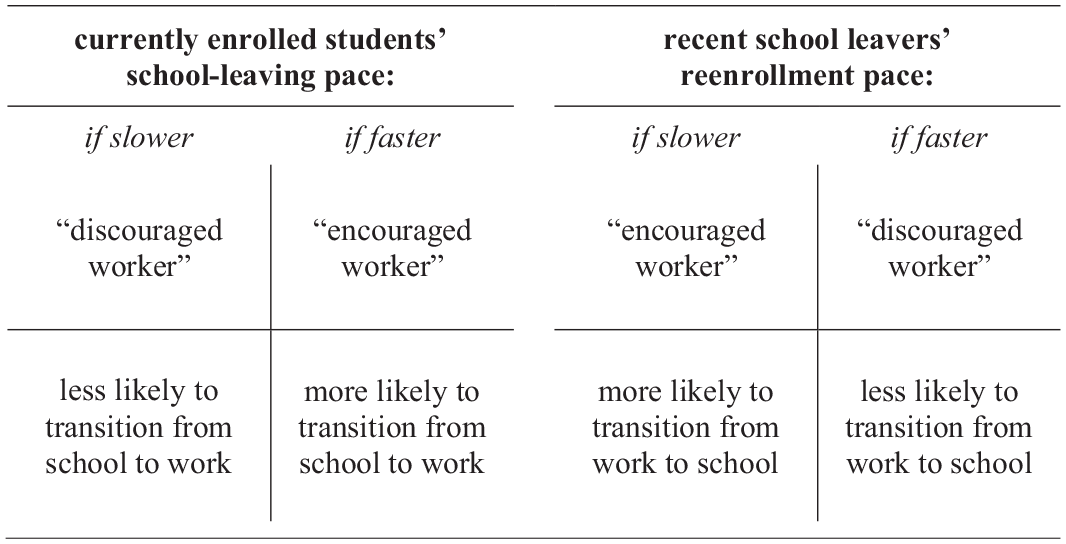
Association with adverse macroeconomic condition.
Country Variation in School-to-Work Paths
To date, no overarching theoretical framework has specified whether the countercyclical enrollment trend would vary in strength or could change direction—toward an encouraged-worker effect—across countries. However, a substantive stream of sociological research has examined the school-to-work pathway in broader terms. I therefore draw hypotheses regarding country variation in the cyclicality of enrollment behavior by combining classifications of (1) the educational system, (2) the labor market structure, and (3) the welfare state regime type.
First, despite educational policy changes within countries over time, the differences between countries’ educational systems remain vast. The upper panel of Table 1 summarizes these contrasts. Typologies of educational systems generally focus on the age of selection, academic versus vocational schooling, the higher-education completion level, the connection between elite schools and desired jobs, and the strength of connection between vocational curricula and jobs (Brint 1998). Contemporary classifications are particularly concerned with cross-national variation in forms of tracking (Ianelli and Raffe 2007; Shavit and Müller 1998), the degree of standardization and vocational training in secondary and tertiary education (Allmendinger 1989; Kerckhoff 2001), and the school-leaving age (Lavrijsen and Nicaise 2015).
Institutional Structure of the School-to-Work Trajectory and Discouraged-Worker Hypothesis.
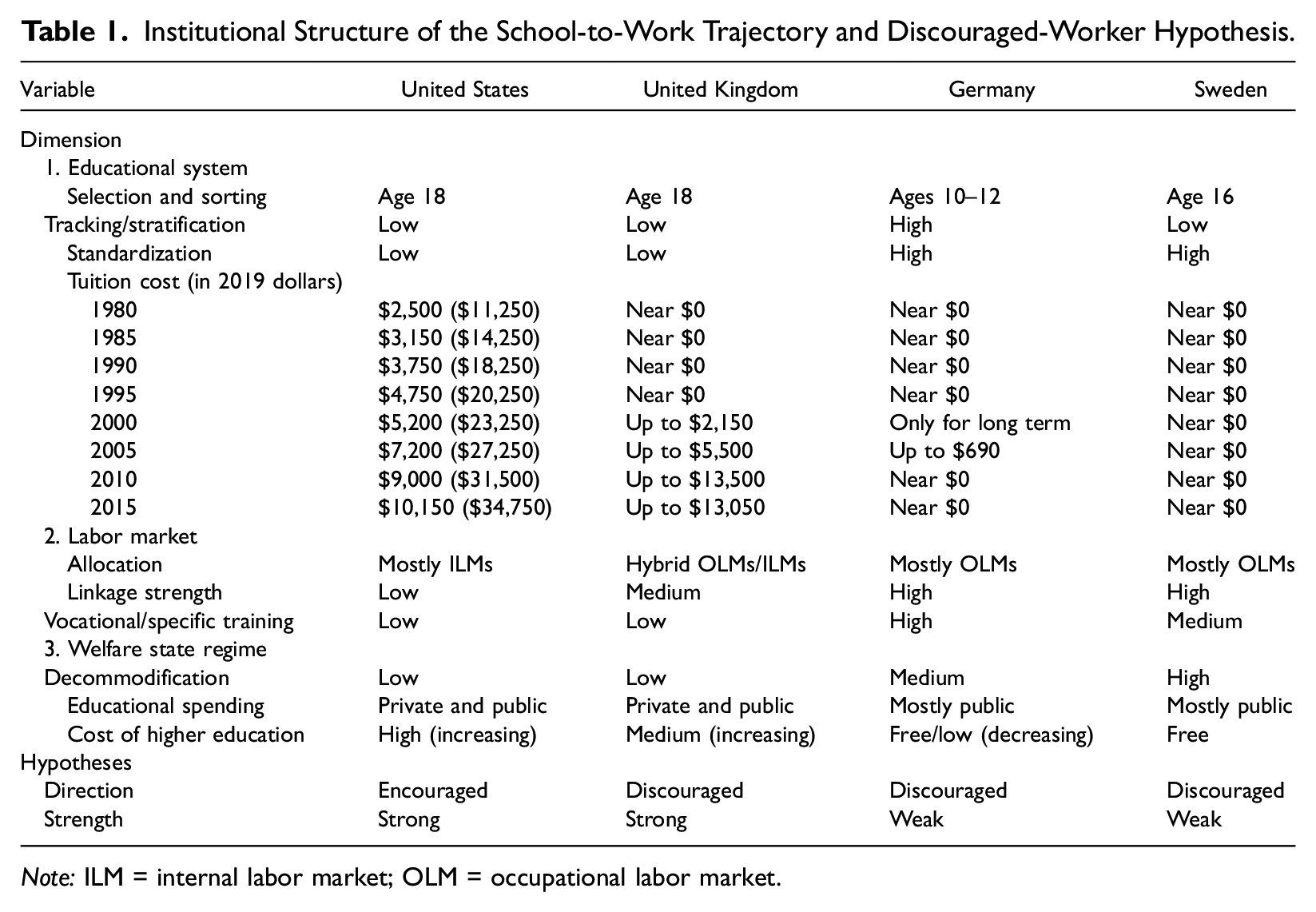
Note: ILM = internal labor market; OLM = occupational labor market.
The U.S. and U.K. educational systems are characterized by relatively weak forms of standardization and tracking and (late) formal selection upon high school completion. 2 Germany’s school system is characterized by a high level of standardization and early selection (ages 10–12) into tracks. Labor market entry for vocational-track students is firmly embedded in a profession through the apprenticeship system. Sweden’s educational system similarly comprises standardized programs but contains less tracking and a much later selection. The route to the initial school-to-work transition is lengthier in Germany and Sweden compared with the United States and United Kingdom. These differences are also apparent in the average age of the first school-to-work transition: around 20 in Germany and Sweden, compared with 19 in the United Kingdom and 18 in the United States. 3 The extent to which educational systems formalize and structure the transition to the labor market potentially influences the sensitivity of youths’ enrollment decision-making to any external shock, including macroeconomic downturns.
Second, differences in countries’ educational pathways are also reflected in the stratification and matching mechanisms of early labor market careers (see the second panel of Table 1). Labor market allocation with tight connections between educational programs, first occupations, and subsequent career progression—that is, occupational labor markets (OLMs)—is most common in northwestern European countries, including Germany and Sweden (Gangl 2003; Shavit and Müller 1998). In contrast, the U.S. and U.K. labor markets are characterized by allocation through internal labor markets (ILMs), whereby early career progression relies more heavily on on-the-job training. These labor market regimes display weaker “linkage strength” between educational programs and occupations (DiPrete et al. 2017). As a result, U.S. workers’ early careers are more erratic compared with the work lives of similarly aged Europeans (Müller 2005).
Labor market allocation pathways are consequential for the capacity and necessity of enrolled students to leave education earlier and of school leavers to reenroll. For instance, if educational programs in upper-secondary and postsecondary institutions provide relatively tight links to occupations, the prospect of a job provides fewer incentives to leave the education system prematurely. Conversely, systems relying more on general education in secondary and postsecondary education are possibly more sensitive to pull factors from the labor market. Differences between labor market regimes in typical job-entry prerequisites of first-time school leavers could therefore exacerbate during macroeconomic decline. Because school leavers in Germany and Sweden are more embedded in specified occupational sectors, market fluctuations are less likely to affect their trajectories, compared with their U.S. and U.K. counterparts.
Third, welfare state research examines the relative strength of decommodification through redistribution via taxation, social insurance, and universality of assistance programs (Esping-Andersen 1990). Studies consistently show a stark contrast between liberal welfare states (e.g., the United States and United Kingdom), which provide a limited social safety net and protection against market forces, and social-democratic (e.g., Sweden) and corporatist (e.g., Germany) states. As Marshall ([1950] 2006) argues, the degree of “social rights” embedded in these regimes define the state’s responsibility to use the educational system as a substitute for market allocation of formal training. In other words, substantive investment in accessible public education is a form of decommodification by its very nature (Iversen and Stephens 2008; Willemse and de Beer 2012).
One important feature of welfare states’ social contract is the anticipated cost of higher education, which varies dramatically between the four countries. Table 1 shows average college tuition for the cohorts studied. Echoing their regime types, the United States is the outlier: U.S. tuition rates were substantially greater in the 1980s and 1990s compared with the other three countries. U.S. tuition rates skyrocketed in the 2000s to average between $10,000 (public) and almost $35,000 (private) (College Board 2019). Attending college in the United Kingdom has long been almost free of charge, but tuition costs steadily increased in the past few decades to a maximum of about $13,000. In contrast, college attendance costs less than several hundred dollars in Germany and Sweden and is sometimes supplemented with need-based grants. Although the U.S. system provides substantive need-based grants and subsidized loan opportunities, students who pursue a postsecondary degree usually have to consider higher financial hurdles. The youngest U.S. and U.K. cohorts included in the study—born in the 1980s—were leaving secondary education in times of sharply rising costs of college attendance.
In summary, a combination of structural factors determines the contexts of enrollment decisions for students and recent school leavers, yet the extent to which macroeconomic downturns trigger longer or shorter stays in school across these contexts remains unknown. Nonetheless, based on the three dimensions of the school-to-work trajectory, we expect more pronounced sensitivity to recessions in U.S. and U.K. enrollment patterns. This is because educational enrollment decisions in these countries contain more pronounced financial components, partially due to the lower relative level of decommodification and the stronger market dependency. In addition, for the United States, the direction of the association between macroeconomic downturns and enrollment behavior might be reverse—that is, an encouraged-worker effect—given the low linkage strength and high costs of education. This could trigger perceptions of higher opportunity costs of remaining enrolled and risk aversion with regard to reenrollment.
Analytic Strategy
Measuring Countercyclicality
The approach used in this study improves on extant research regarding countercyclicality of postsecondary enrollment by observing mechanisms comprehensively. First, this study uses survival analysis in standardized data for both paths separately: from school to the labor market and from the labor market back to school. Observing the persistence in either institution for a considerable time reveals the total propensity of school leaving and reenrollment. Furthermore, the influence of the unemployment level on continued education stabilizes only after several years (Sievertsen 2016). Analyses therefore assess the timing of youths’ attainment decisions that depend on macro conditions in panel data covering up to 10 years, and across multiple cohorts, to reveal the full scope of discouraged- and encouraged-worker effects of economic downturns.
Second, extant research typically draws on unemployment—a measure of the opportunity structure—to study the extent to which economic conditions matter for enrollment decisions. This study follows this tradition. However, the state of the labor market does not always correspond to shocks—that is, the unemployment rate may shift some time after the start of a recession and thus differ from the youth unemployment rate (ages 15–24). In addition, entering a recession differs conceptually from labor market fluctuations because it is a strong societal stimulus, affecting consumer sentiments through widespread communication in media (García 2013). The current study tests whether a nationwide recession, too, affects educational attainment behaviors. Furthermore, the analyses test both macroeconomic indicators against each other to examine whether recessions have a unique effect on school leaving and reenrollment over and above the opportunity structure in the labor market.
Third, countercyclicality of higher-education attainment has thus far been studied in single-country data. This study therefore assesses educational (re)enrollment mechanisms as embedded in markedly different school-to-work structures. The analyses contrast U.S. panel data with comparable data and research designs from three other high-income countries: the United Kingdom, Germany, and Sweden. Although no prior empirical evidence suggests the discouraged-worker effect operates differently across countries, we assume substantive cross-national variation in the direction and size of the discouraged-worker effect based on the theoretical framework (see Table 1).
The analysis begins with a series of tests of the discouraged-worker theory, split into two questions: (1) Are students discouraged or encouraged to stay in education by worsening economic conditions? (2) Conditional on having left daytime (i.e., full-time) education for the first time, what is the influence of several macroeconomic conditions on reenrollment probability? In combination, these analyses model the relationship between macroeconomic shifts and survival in the educational system (transitioning to work) and the labor market (transitioning back to education). To account for heterogeneity among education groups, the school-leaving analysis concentrates on secondary- and tertiary-education attendees. The reenrollment analysis similarly concentrates on individuals who have most to gain from reenrollment: school leavers who entered the labor market with just a high school diploma and, separately, school leavers with higher-education attainment less of a bachelor’s degree.
Data and Method
Data were drawn from large longitudinal data sets with detailed monthly observations of positions in education and the labor market, from compulsory school age (16) through early work life until age 25. These data sets are characterized by low attrition and considerable sample size. Aside from birth cohort selection, respondents were included in the sample if they were enrolled full-time in education at age 16 (
Specification and Selection of Country’s Longitudinal Data Sets.
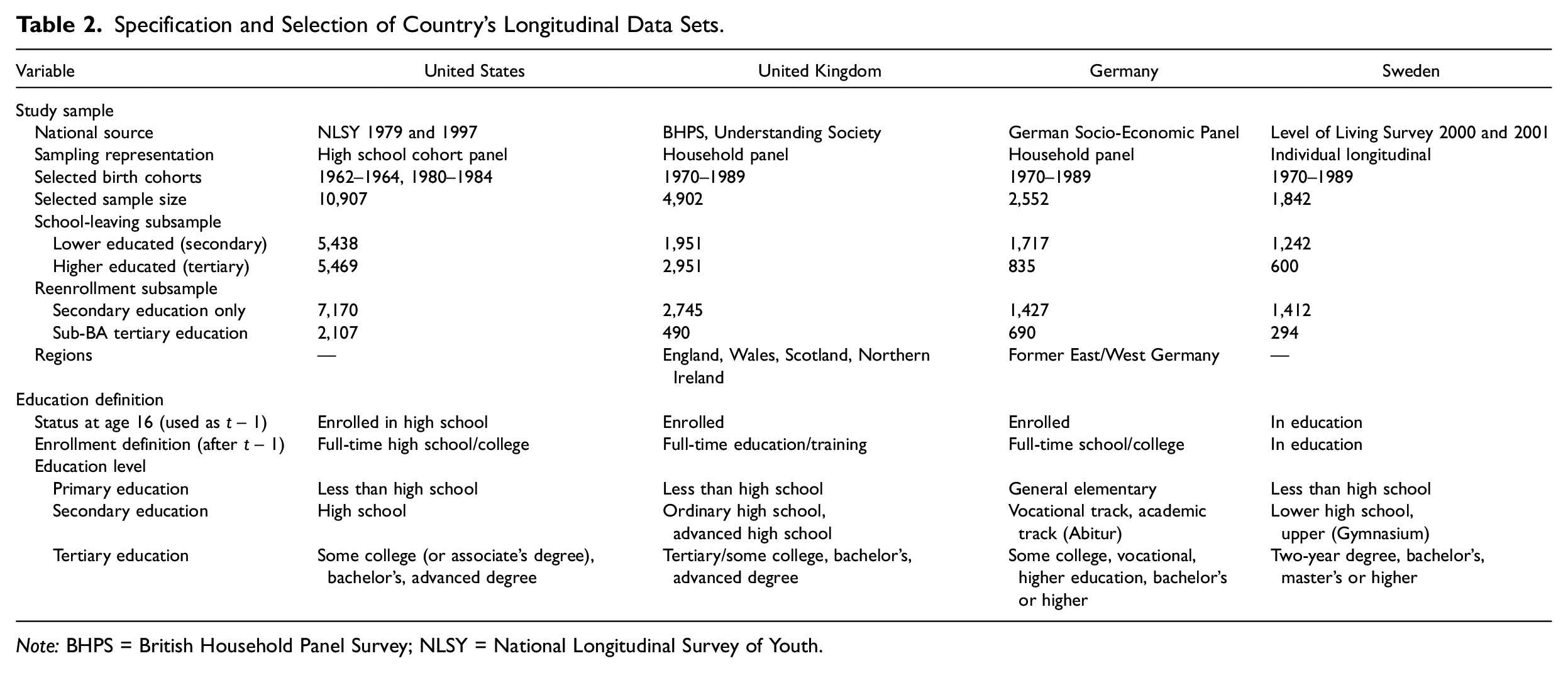
Note: BHPS = British Household Panel Survey; NLSY = National Longitudinal Survey of Youth.
Data from the United States consisted of the National Longitudinal Survey of Youth (NLSY) for 1979 (birth cohorts 1962–1964) and 1997 (birth cohorts 1980–1984). 4 These representative samples of high school students follow respondents through adulthood (Bureau of Labor Statistics 2014, 2015). Data for the United Kingdom were drawn from the British Household Panel Survey (BHPS 1991–2007; Maré 2015) and Understanding Society (University of Essex 2017). German data come from the similarly organized German Socio-Economic Panel (GSOEP; Schupp et al. 2017). Respondents were initially sampled to represent West German households, so former East German households were added to the sample after reunification. Data for Sweden consist of two nationally representative individual-level surveys (2000 and 2010) of the Level of Living Survey (LNU; Stockholm Universitet 2010). These interviews covered work, education, health, and family and were supplemented with retrospective employment histories. To allow for comparisons of the same cohorts across countries, the study samples include only individuals born in the 1960s thru 1980s. The data generalize to slightly different populations: U.S. data represent high school populations, U.K. and German data stem from household panels, and Swedish data represent the entire adult population.
Regarding macroeconomic conditions, the Organization for Economic Cooperation and Development (OECD) defines a recession as two quarters of negative GDP growth. In this study, I initially defined the start and end dates of recessions using statistics drawn from the OECD website. However, some national bureaus of statistics or influential research organizations (e.g., the National Bureau of Economic Research in the United States) perceived certain recessions as lasting longer than did the OECD. In such cases, I used the longer recession time period to reflect nationally relevant societal signals of the state of the economy. For youth unemployment (i.e., ages 15–24), I drew statistics from the Federal Reserve Bank of St. Louis, which keeps monthly historical records of most developed nations. The consumer confidence level provides a robustness check. Regarding school leaving, both indictors of the macroeconomy are lagged by two years to distinguish cause and effect and represent realistic reference points of enrolled students—that is, the average youth unemployment rate and any recession during this time period. The key independent variables refer to the year in which an individual first entered the labor market.
For survival in the educational system, each respondent’s
A first school-to-work transition was defined as any first observed, non-full-time education position after age 16 but only if non-full-time enrollment was longer than seven months (i.e., more than one semester). This conservative definition does not capture short stop-outs or longer breaks from education. The first non-full-time educational position is selected as the “transition” because it marks dependency on the (labor) market. Similarly, to assess educational reenrollment, subsequent observations of education were coded as first return to education if the respondent’s status was full-time enrollment in high school, college, or training after initial transition to the labor market. Missing employment data were due to respondents leaving the study prematurely and not returning in subsequent interview years. Hence, right-censoring was adjusted for in predictive models.
I estimated effects of the macroeconomy on enrollment using Cox (1972) proportional hazard regression models. For each of the four countries, a series of baseline survival models contains only the key independent variable, measuring the macroeconomic condition and its timing, and predicting school leaving or reenrollment. A second full model includes all relevant sociodemographic controls. A third model tests both macroeconomic indicators (youth unemployment and recession) simultaneously in a model with all controls.
Covariates
Research on stratification in the educational system and the labor market has identified significant gender, race, and social class effects in both school leaving and reenrollment (Astone et al. 2000; DesJardins et al. 2006; Elman and O’Rand 2007; Jacob and Weiss 2010). All predictive models in this study therefore account for gender, migration background, and an indicator of social class background (father’s occupational status or years of education). The analyses of the two Anglo-Saxon countries also control for race. The two continental European countries lacked reliable variables regarding race, which makes the migration background variable more relevant. The immigrant population in Germany consisted largely of Turks, and Swedish first and second generations were predominantly Middle Eastern and Finnish. To allow for regional variations in education and labor market structures, all models for the United Kingdom contain controls for any of the four countries within the kingdom, and all models for Germany include a dummy variable for being former East German.
The literature identifies several additional sociodemographic factors associated with the likelihood of returning to education, and this study controls for such covariates. The most important of these factors is the degree of educational preparation prior to labor market entry (Astone et al. 2000; Elman and O’Rand 2007). Moreover, older workers experience higher opportunity costs because adulthood shifts their preferences in favor of both leisure and generating necessary income (Stratton, O’Toole, and Wetzel 2007), requiring a control for age. Marital status and offspring are included in the models predicting reenrollment, as these reflect potential hurdles regarding family responsibilities that often negatively affect women’s further educational attainment (Home 1998; Scala 1996). Appendix D in the online supplement presents control variable estimates, which are generally consistent with prior research.
I conducted analyses of survival in education using respondents’ highest educational attainment (i.e., secondary only, higher education only, or bachelor’s degree completion), which were not mutually exclusive. Models that predict labor market reenrollment are also split between a group with no postsecondary attainment (secondary education only) and a group who attained higher education but never graduated with a bachelor’s degree (sub-BA). These models include additional controls for within-educational tier paths, depending on the country (e.g., vocational program or Gymnasium in Germany). The bottom panel of Table 2 presents education variables that are coded to allow for the best possible comparisons of the bachelor’s-degree level (or equivalent) and higher, and relevant lower-tertiary levels and high school diplomas.
The secondary- and tertiary-education samples differ slightly in terms of individuals’ socioeconomic backgrounds. In all four countries, individuals in the higher-education groups come from higher social class backgrounds compared with people in the secondary-education samples. The lower-education groups consist of disproportionally more racial/ethnic minorities and individuals with migration backgrounds, but these differences are less evident in the United States and United Kingdom (see Appendix A in the online supplement).
Findings
Descriptive Statistics
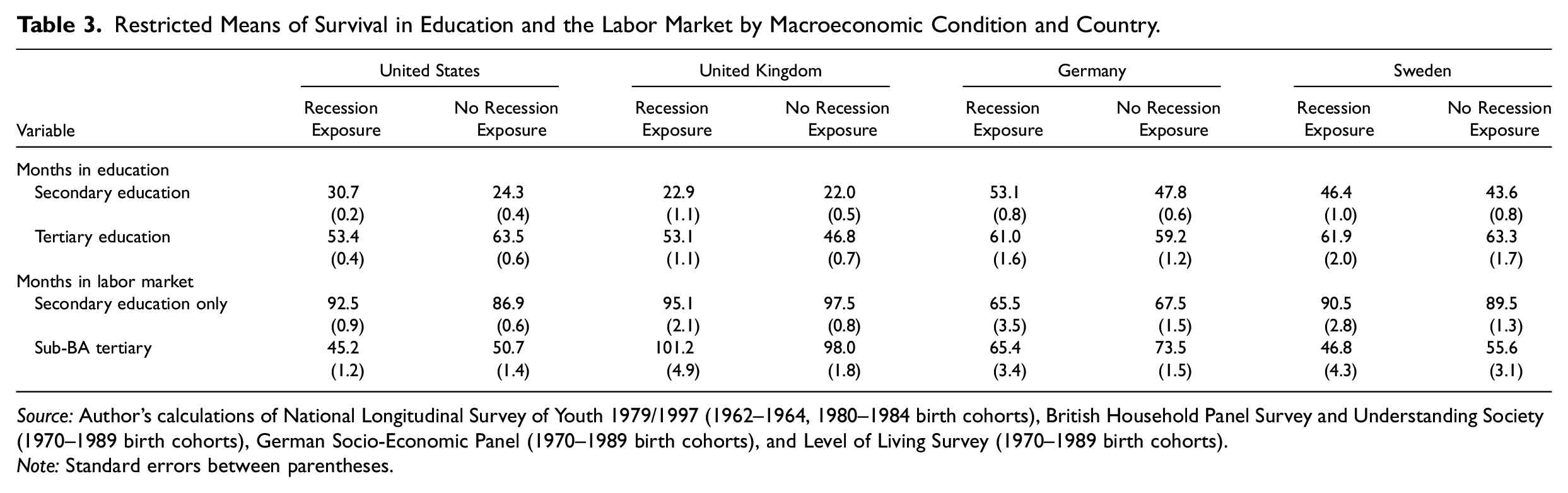
A first indication of the economy’s role in persistence in education is the mean number of months survived calculated separately for people who experienced a national recession during high school versus those who did not. Table 3 shows higher average survival in education among lower-educated students who experienced a recession (46.4 vs. 43.6 months) in Sweden (rightmost columns). German data contain a similar pattern: higher average secondary-education survival during recessions (53.1 vs. 47.8 months). However, the two Anglo-Saxon countries deviate from this pattern. In the United Kingdom, students exposed to a recession stayed in school longer but only in the college-going subsample (53.1 vs. 46.8 months). Despite U.S. lower-educated students staying longer in secondary education if they experienced a recession, the average number of education months among college-enrolled students was lower in the recession group (53.4 vs. 63.5 months). Appendix C in the online supplement plots survival curves that visually demonstrate the cross-national variation in school-leaving patterns.
Restricted Means of Survival in Education and the Labor Market by Macroeconomic Condition and Country.
Source: Author’s calculations of National Longitudinal Survey of Youth 1979/1997 (1962–1964, 1980–1984 birth cohorts), British Household Panel Survey and Understanding Society (1970–1989 birth cohorts), German Socio-Economic Panel (1970–1989 birth cohorts), and Level of Living Survey (1970–1989 birth cohorts).
Note: Standard errors between parentheses.
One subpanel down in Table 3, the survival means apply to the reverse trajectory—months in the labor force conditional on a school-to-work transition. Analyses were split between recent labor market entrants with only secondary education (i.e., seeking higher-education upgrades) and those with sub–bachelor’s degree attendance (i.e., seeking college completion). Most European observations suggest a slightly shorter stay in the labor force among individuals who experienced a recession after labor market entry compared with people who entered the market during a period of economic growth. This gap is slightly larger among the U.S. higher-educated, sub-BA group yet not statistically significant. In contrast, and surprisingly, recent lower-educated labor market entrants in the United States had longer stays in the labor market than did people exposed to a recession (92.5 vs. 86.9 months).
Descriptive statistics regarding school leaving suggest sensitivity to recession among secondary-education students in Germany and Sweden and among tertiary-education students in the United Kingdom, in the direction of the discouraged-worker hypothesis. However, in the United States, comparisons of the mean number of education months between individuals who did and did not experience recessions suggest an encouraged-worker effect most salient among tertiary-enrolled students and lower-educated labor market entrants. Subsequent multivariable survival models assess whether these mean differences represent plausible real effects.
School Leaving
To assess the influence of individual characteristics on the relationship between macroeconomic indicators and school leaving, the initial estimates (gray markers) from survival models do not contain any controls (Figure 2). A second model adds all control variables (black markers), whereby substantive shifts may be indicative of moderation and heterogeneity through sociodemographics. A third model combines both indicators of macroeconomic interest, such that the estimates (hollow square markers) indicate the effect of a recession on school leaving, net of the youth unemployment rate, and vice versa. I focus on the second model and the main effects, and the third model serves as a robustness check to assess the extent to which the macroeconomic trigger of interest has a unique effect on school enrollment. The upper panel of Figure 2 presents the hazard ratios (HRs) of first labor force entry for currently enrolled students in secondary education.
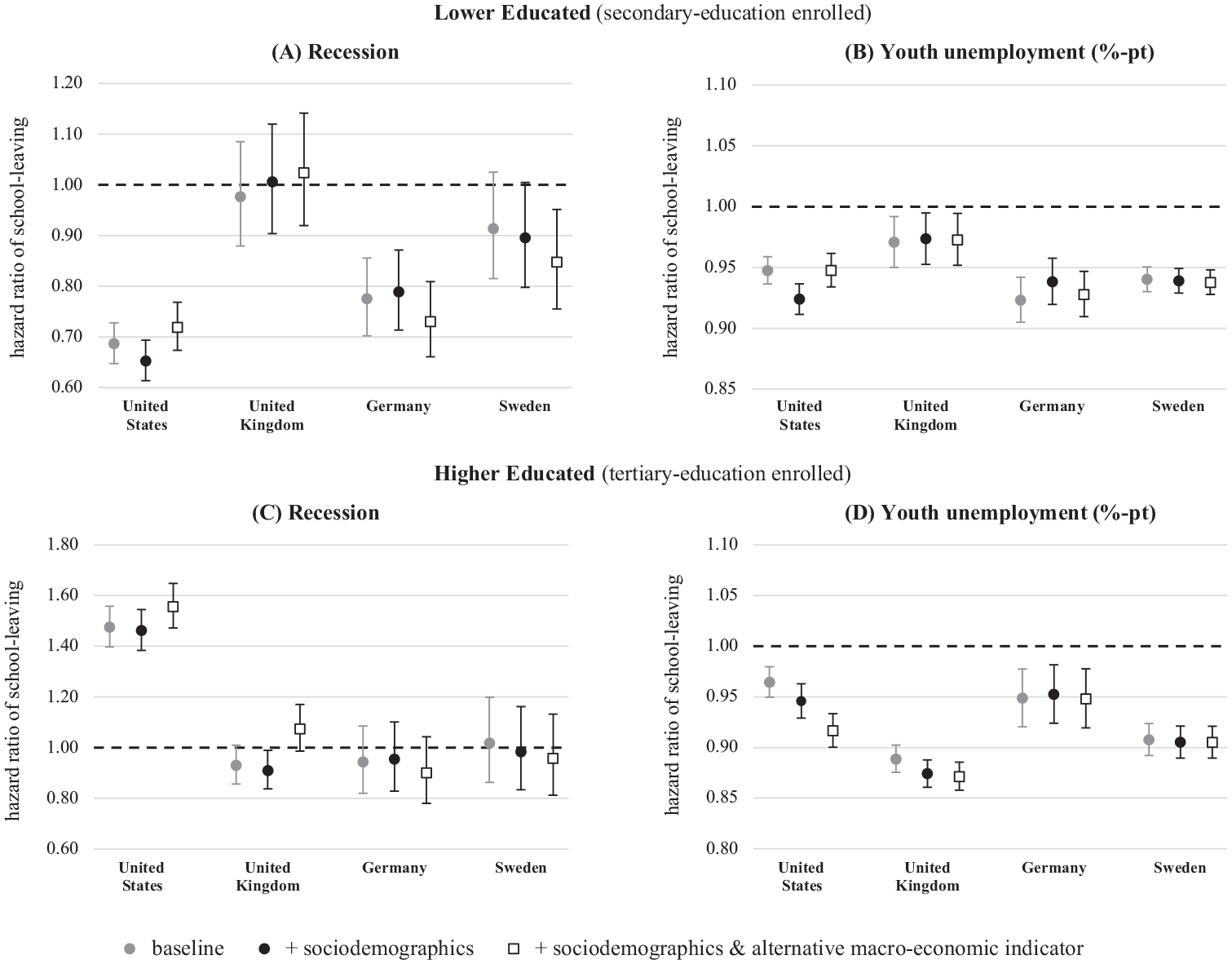
Survival in education by educational group and macroeconomic indicator.
Graph A shows the influence of a recession during typical high school years. All point estimates are below the HR of 1, suggesting a reduced propensity to leave education in response to a recession in all four countries. This effect, however, is not significant in the United Kingdom and significant only after adjusting for the youth unemployment rate in the Swedish data. Based on the main effects of a recession (black markers), lower-educated German students stayed longer in education if a recession occurred prior to entry (HR = 0.79, a 21 percent reduction in the occurrence of labor market entry). The effect appears larger among equivalent students in the United States (HR = 0.65), although a between-country test was nonsignificant. Thus, a U.S. recession strongly discouraged high school students from leaving education: We see a 35 percent reduction in labor market entry chance compared to a nonrecessionary economy.
To expand analyses to the opportunity structure of macroeconomic fluctuations, Graph B of Figure 2 shows the HR estimates of the youth unemployment rate during high school. The estimates suggest a countercyclical effect of unemployment on school completion in the form of persistence in secondary education (black markers), which remains significant after adjusting for the effect of a recession (hollow squares). In all four countries, the HRs suggest lower likelihood of school leaving after adding all control variables. Such discouraged-worker effects are somewhat more pronounced in the United States (HR = 0.92), Germany (0.94), and Sweden (0.94), compared with the United Kingdom (0.97). Thus, a 1 percent increase in youth unemployment reduces risk of labor market entry by 6 percent, 6 percent, 8 percent, and 3 percent, respectively.
I took the same approach for college-enrolled students and their survival propensity in response to the two macroeconomic indicators. Graph C of Figure 2 shows a pattern of recession effects at the secondary-education level. The HRs of Germany and Sweden are approximately 1, suggesting no sensitivity to recession during college years on persistence propensity. As indicated by the model controlling for all sociodemographics (black marker), U.K. college students are less likely to leave school during a recession. The recession effect disappears after further controlling for the youth unemployment rate during college years—the likely driving mechanism behind positive effect on college persistence. However, we see a strong positive relationship between recessions and the school-leaving hazard among U.S. higher-education students. After adjusting for sociodemographics, the HR of 1.46 suggests the propensity of labor market entry increases substantially in response to a recession experienced during college. This encouraged-worker effect persists after adjusting for the youth unemployment rate (third model). In other words, the association between the recession signal and faster labor market entry among U.S. college students seems unrelated to shifting opportunity structures.
Graph D of Figure 2 shows that the effect of youth unemployment on the labor market entry pace of higher-education students remains negative in all four countries, including the United States. Based on the HRs, and after controlling for sociodemographic variables, a 1 percent increase in youth unemployment is associated with a reduction of school-leaving propensity by 5 percent in the United States, 13 percent in the United Kingdom, 5 percent in Germany, and 9 percent in Sweden. Adverse conditions in the youth labor market are thus associated with increased college persistence at the micro level.
In summary, secondary-education students’ educational pathways largely corroborate the discouraged-worker hypothesis for both macroeconomic indicators and thereby the shelter function of education during economic downturns. The findings are markedly different for students enrolled in higher education, where HRs suggest no sensitivity to a recession in the European countries. In contrast, the U.S. estimates for higher-education students indicate that a recession shock yields faster labor market entry—an encouraged-worker effect.
Reenrollment
To address reenrollment decisions in response to economic slowdowns, I generated a series of survival estimates from subsamples of school leavers, measuring reenrollment propensity up to 10 years after initial labor market entry. Emphasis is on two groups who have the most to gain from additional human capital acquisition: those who entered the labor market with no prior higher-education attendance (plausibly seeking college attendance in the future) and those who entered the labor market with some college experience yet no bachelor’s degree.
Regarding the former, Graph A of Figure 3 plots HR estimates of a recession in the year of labor market entry on educational reenrollment. A substantial influence of the control variables is evident as all HRs become larger models that include sociodemographics (black markers). The attenuation of the estimates suggests at least some of the discouraged-/encouraged-worker effects vary based on sociodemographics. HRs from Germany and Sweden indicate no sensitivity to recession, but the postcontrol estimate of the United Kingdom does. Thus, a recession upon labor market entry is associated with faster educational reentry among young individuals with only high school education (HR = 1.85). Even after controlling for sociodemographics of U.S. lower-educated youths in the labor market, only respondents with high school completion had a lower propensity of reenrollment in response to recession (HR = 0.85). In support of the encouraged-worker hypothesis, a recession yielded a 15 percent average reduction of educational reenrollment. As shown in the third model, the recession effect does not hold when adjusting for the youth unemployment rate. Thus, insofar as a U.S. recession is associated with a lower likelihood of reenrollment, this encouraged-worker mechanism runs, to a large extent, through the coinciding (increasing) youth unemployment rate.
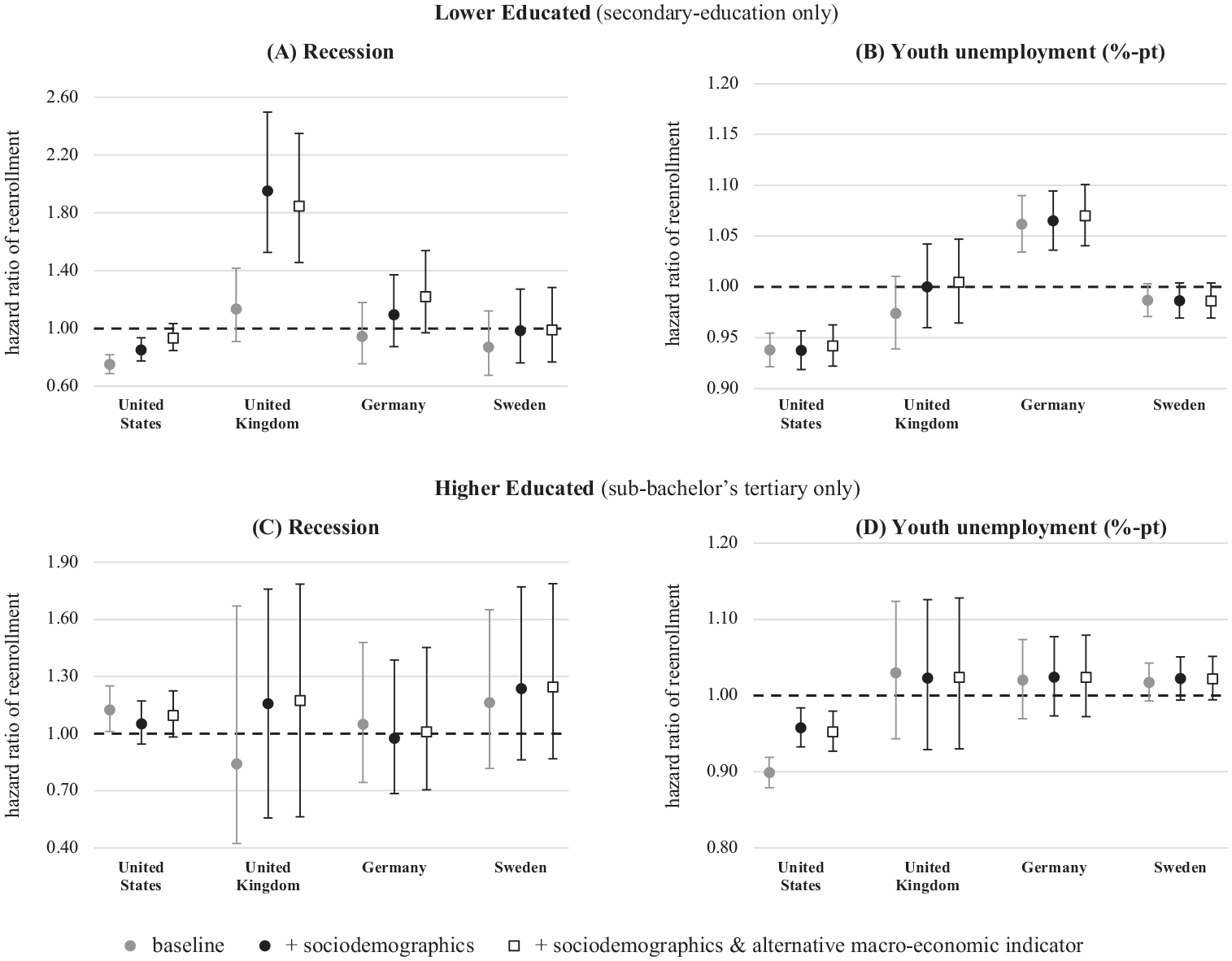
Survival in the labor market by educational group and macroeconomic indicator.
Graph B of Figure 3 shows the influence of the opportunity structure—the youth unemployment rate—on reenrollment of recent high school leavers. Reflecting the encouraged-worker effect, the U.S. models show that youth unemployment indeed suppresses reenrollment among lower-educated youths in the labor market, thereby trumping the effect of a recession (hollow marker). More precisely, the HR (0.94) suggests a small but significant 6 percent reduction per 1 percent increase in youth unemployment. Among the European countries, the model for Germany is the only one that unequivocally supports the discouraged-worker hypothesis for respondents who entered the labor market with no more than high school education (HR = 1.07). Estimates suggest British and Swedish youths remain nearly insensitive to such macroeconomic fluctuations, as indicated by an HR of about 1.
We next address how former higher-education attendees (short of a college degree) responded to a recession and high youth unemployment. Graph C of Figure 3 shows no effect of a macroeconomic shock to reenrollment propensity in any of the four countries, even when adjusting for the youth unemployment rate (hollow markers). Note, however, that most of the point estimates from the multivariable models are positive and substantive, suggesting a trend toward the discouraged-worker hypothesis. Graph D of Figure 3 suggests the same insensitivity of sub-BA members of the labor force to macroeconomic conditions regarding reenrollment decisions in the United Kingdom, Germany, and Sweden: All HRs are positive but not statistically significant. However, the HR for the United States (0.96) suggests a 6 percent reduction in reenrollment propensity is associated with a 1 percent increase in youth unemployment. This U.S.-specific finding supports the encouraged-worker argument. Importantly, the effect of the youth unemployment rate remains stable after adjusting for a recessionary macroeconomic condition. This reaffirms the strong effect of the opportunity structure—more so than the recession signal—on U.S. youths’ decreased propensity to reenroll during macroeconomic downturns.
Young individuals in the labor force in the three European countries appear much less responsive to macroeconomic conditions. However, apart from the recession estimate among higher-educated school leavers, all models with U.S. data corroborate the encouraged-worker hypothesis through various measures of macroeconomic decline. Younger individuals who had the most to gain from educational reenrollment—those with no college or sub–bachelor’s degree college—stayed longer in the labor market during recessions and when the opportunity structure was least favorable.
Development of Encouragement
To assess the timing of the recession shock effect in the United States, Figure 4 plots the two most salient U.S. encouraged-worker effects. These graphs depict the profound effect sizes over paths in education and the labor market. The predicted survival curves in Graph A of Figure 4 show enrollment persistence is similar for the recession and nonrecession groups early during college students’ education; this is an expected trajectory for many higher-education attendees, as
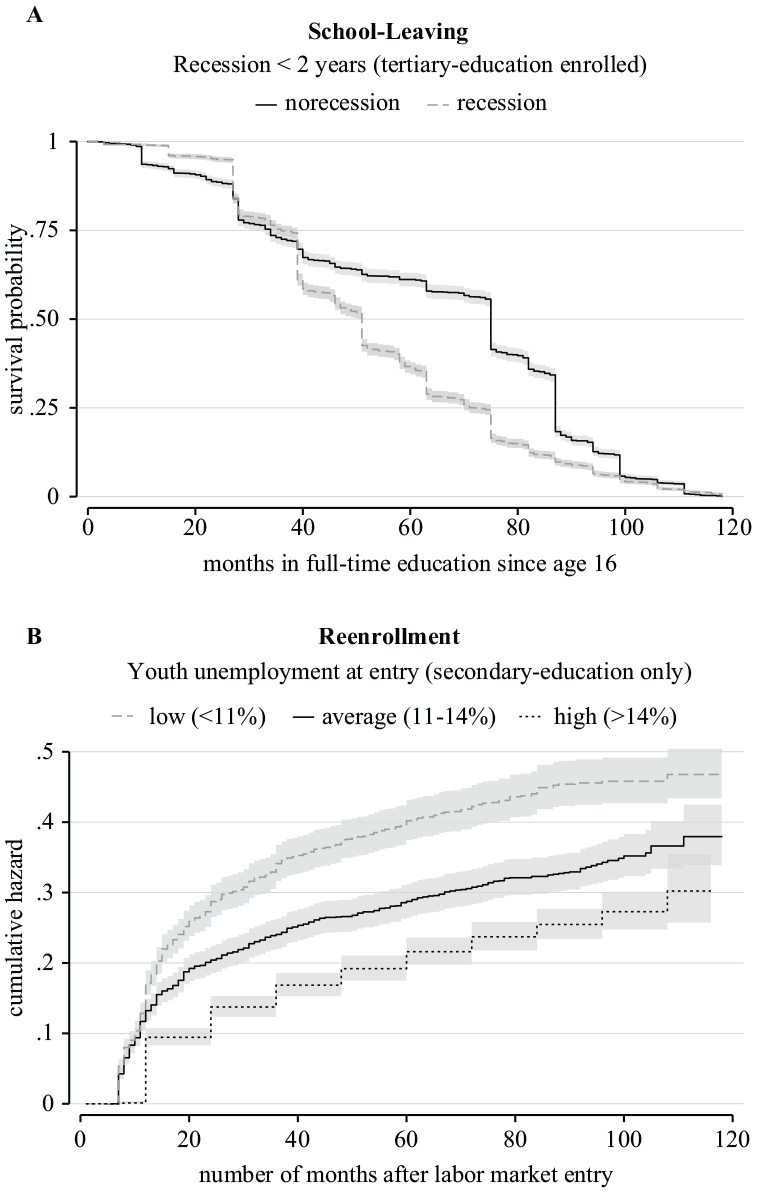
The encouraged-worker effect in the United States.
Graph B of Figure 4 shows the cumulative hazard of educational reenrollment, conditional on an initial school-to-work transition, among school leavers with only secondary education. The youth unemployment rate—categorized for visualization purposes—shows a proportional dynamic in relation to reenrollment: The higher youth unemployment, the slower the reenrollment pace of college noncompleters. Similar to school leaving, the reenrollment-reducing influence of the youth unemployment rate becomes apparent around month 20—the second year after the first school-to-work transition. The hazard gap is maintained throughout subsequent years and remains proportional between the unemployment exposure groups. In other words, experiencing a recession in the United States upon labor market entry influences youths’ enrollment decision-making almost immediately, and the effect stabilizes during subsequent years. These findings corroborate Sievertsen’s (2016) finding of stabilization of macroeconomic effects on enrollments.
An unexplained phenomenon is why some U.S. youths became encouraged workers in response to adverse macroeconomic conditions. A crucial component of the encouraged worker hypothesis is the possibility that risk aversion can be acquired during a recession, as has been shown in the effects of recession priming, studied in behavioral economics (Cohn et al. 2015). Formal tests of acquired risk aversion are beyond the scope of this study.
However, one way to characterize such acquired risk aversion is to consider reenrollment into U.S. higher education as a financial investment. If this is true in the societal sense, high consumer uncertainty—an index measure of people’s likelihood to purchase or invest—should be just as predictive of reenrollment propensities as a recession, partially reflecting the severity of macroeconomic declines. Results shown in Appendix F in the online supplement corroborate the same negative influence of consumer uncertainty on reenrollment hazard for both educational subgroups in the United States. This is consistent with research on procyclicality of educational enrollment claiming a causal link between recessions and immediate decline of financial investment. More generally, insofar as recessions trigger discouraged- or encouraged-worker mechanisms, consumer uncertainty should display HRs largely consistent with the recession estimates in all four countries. This is the case.
Robustness Checks
I conducted a series of additional robustness checks to assess whether key findings are sensitive to slightly different measurement techniques of the independent variables (see Appendix F in the online supplement). The school-leaving models rely on two-year lagged indictors of the macroeconomy to approximate the causal order of events. However, use of one-year lags for recessions and youth unemployment leads to similar substantive outcomes. Furthermore, U.S. data from the Bureau of Labor Statistics allows us to create a regional youth unemployment rate for predicting education survival and reenrollment. Significance levels and effect sizes remain similar to the analyses conducted with national youth unemployment. In addition, because the West and East German economies remain distinctly different, a robustness check included only West Germans as well as West German–specific versions of the independent variables. The findings are consistent with the sample that included a control for region. Finally, this study includes youths born between 1970 and 1989 for analyses on the European countries and birth cohorts of the early 1960s and 1980s for the United States. This means U.S. youths are more likely to have experienced the early-1980s recession. A robustness check that excludes U.S. cohorts who faced this particular recession in their educational decision-making does not lead to substantive changes to the recession effects on school leaving and reenrollment.
Conclusion
This study assesses whether a countercyclical relationship between adverse macroeconomic conditions and educational attainment can be observed at the micro level. Research conducted with aggregate, time series, and cross-sectional data suggests higher attainment during macroeconomic slowdowns must operate through a discouraged-worker mechanism within individuals over time. That is, recessions and rapidly shrinking opportunities in the labor market should favor lengthier educational careers, and youths who enter recessionary labor markets should seek shelter from these adverse market conditions by returning to education.
Despite convincing statistics regarding enrollment figures, no study has tested the discouraged-worker hypothesis using U.S. longitudinal data, nor has any work assessed whether disproportionally higher enrollments are the result of prolonged educational careers or reentries into education. The motivation for this study was rooted in the idea that individual decision-making should be the focal mechanism to understanding discouragement from labor market participation. Evidence suggests incentives for educational attainment are different for current students than for recent labor market entrants. It is thus plausible that such incentives vary by educational background, such that high school graduates’ next aspiration is simply college attendance, whereas for college leavers, both persistence and reenrollment create a focus on completing a bachelor’s degree.
Based on data from four distinct countries in terms of their educational systems and labor market characteristics, the survival models suggest a strong discouraged-worker effect for secondary-education-enrolled students. Adverse macroeconomic conditions are associated with decision-making that boosts high school graduation and persistence in secondary education in the United States, the United Kingdom, Germany, and Sweden—a finding that holds for persistence in higher education. One exception is that U.S. higher-education students became less likely to stay enrolled in response to a recession, representing a form of the encouraged worker effect. Importantly, the U.S.-specific encouraged-worker effect appears only for recessions—societal shocks—and seems unrelated to the youth unemployment rate.
Analyses of reenrollment decisions yield telling results in Sweden: No macroeconomic indicator of slowdown was associated with an increased or decreased probability of educational reenrollment. Several survival models applied to German and U.K. data also suggest insensitivity to macroeconomic shocks and the business cycle, and some returned significant HRs that corroborate the discouraged-worker hypothesis among lower-educated school leavers. In contrast, U.S. youths who entered the labor market with no more than a high school diploma, as well as those short of a bachelor’s degree, became less likely to reenroll in response to deteriorating market opportunities: As youth unemployment increased, the hazard of reenrollment decreased. A recession had a similar encouraged-worker effect among the lower-educated group; however, testing the two macroeconomic indicators against each other showed that the opportunity structure is likely the dominating mechanism.
In regard to results of the U.S. analyses, the most striking finding is one of heterogeneity. When breaking down analyses to mimic more realistic positions and incentives, educational decision-making in the United States indicates a discouraged-worker mechanism for some groups but a surprising encouraged-worker effect for others. These findings suggest that considering U.S. education as a shelter metaphor is misleading because it appears applicable only to secondary-education persistence. For the vast majority of students who are short of a college degree, it is more plausible that the shrinking opportunity structure during macroeconomic decline steers them away from continuing or returning to education rather than the other way around.
The encouraged-worker effect among tertiary-enrolled students (leaving sooner) and school leavers with no bachelor’s degree (slower reentry) might be best explained by the school-to-work pathway in the United States compared with the other three countries. Structural attributes of this transition phase, such as the younger school-leaving age and relatively limited reliance on occupational labor markets, allows for market forces to interfere with enrollment decisions. In addition, the United States’ low level of decommodification of higher education might make educational investments riskier for individuals in their early 20s. Contrasting the null findings of reenrollment hazards in Sweden and Germany, where education is nearly free, with more commodified approaches to educational investment in the United States is warranted. Future research should examine why some U.S. youths are more risk averse regarding educational investments, assessing the precise relationship between fluctuating tuition rates and expected market returns.
Nonetheless, the country variation in enrollment behavior in response to recessions is in line with hypotheses drawn from classifications of education, the labor market, and the welfare state. The current study uses the same research design on comparable panel data across four countries that are well represented in traditional theoretical frameworks of the educational system and welfare state regime. Future research would benefit from including data from more countries and cohorts to reveal the role of costs of educational attendance or labor market structures in greater detail. For instance, current school leavers in the United Kingdom face tuition costs comparable to those of the U.S. students included in this study. Assessments of their future education and work trajectories can further expand the study of financial hurdles during economic downturns in comparable contexts of decommodification.
Another novelty of this study is the use of two distinct macroeconomic indicators. The current study considers youth unemployment to reflect the market opportunity structure, and a national recession, as defined by bureaus of statistics, is understood as a societywide “shock.” The results indicate that separating these two components of economic downturns matters for interpreting the encouraged-worker effect found in the United States. More precisely, among enrolled students, the societal shock—a national recession—uniquely triggers the encouraged-worker effect. Conversely, the encouraged-worker effect on recent school leavers’ slower reenrollment pace seems driven by the opportunity structure—the youth unemployment rate. In other words, U.S. students who never entered the labor market are sensitive to a recession, whereas individuals dependent on the market are, logically, most responsive to the observable opportunity structure.
The results of this study have implications for interpretation of the shelter function of U.S. higher education. This article focused on lower-educated youths’ enrollment and reenrollment decisions, that is, individuals who have not graduated from a four-year institution or graduate school. This analytic focus is rooted in the idea that economic downturns might paradoxically reduce inequality because those most in need of education become more likely to persist or reinvest in human capital acquisition (Erola 2009). In other words, if the proposed shelter function of education can be inequality reducing during economic downturns, evidence for a discouraged-worker effect should be found among education levels just below the highest educated. However, current findings do not support such a mechanism in the United States. Both high school–only and some-college workers became more hesitant to reenroll at the college level. Despite some inequality-reducing findings drawn from the three European countries, the net effect of recessions on educational attainment in the United States was thus likely inequality inducing.
Note that macroeconomic slowdowns cannot be selected into. Experiencing a recession during formative education, and weathering one after labor market entry, should be treated as exogenous. These results demonstrate that adverse macroeconomic conditions disturb decision-making, spurring new research questions. One important follow-up question should address why some U.S. youths become less inclined to persist and reenroll in response to slowdowns. A technical answer that accords with human capital theory is that the opportunity costs of education become too high. If expected future earnings decrease substantially due to a recession, the value of a degree to reach that position decreases, and the investment in attainment becomes too high. The extent to which these dynamics contain socio(economic) heterogeneity should be addressed in sociological approaches.
Finally, results from this study yield a clear set of hypotheses for how future economic downturns and unemployment shocks could affect educational enrollment patterns and how these may vary across countries and educational subgroups. The COVID-19-induced recession of 2020 might follow the same patterns reported here: a greater sensitivity to the business cycle in the United States compared with European countries as well as encouraged-worker effects for college-enrolled students and school leavers with no bachelor’s degree. However, the magnitude of the 2020 recession, as well as the consequences of the pandemic itself for educational attainment, could sharpen these discrepancies. Aggregate enrollment rates of specific cohorts provide some context, but this study’s analysis demonstrates that the full scope of an economic downturn on (re)enrollment propensity spans several years.
Supplemental Material
Appendixes_DW_Sep2 – Supplemental material for Encouraged or Discouraged? The Effect of Adverse Macroeconomic Conditions on School Leaving and Reentry
Supplemental material, Appendixes_DW_Sep2 for Encouraged or Discouraged? The Effect of Adverse Macroeconomic Conditions on School Leaving and Reentry by Dirk Witteveen in Sociology of Education
Footnotes
Acknowledgements
I thank my dissertation committee (Paul Attewell, Janet Gornick, Richard Alba, and Mary Clare Lennon) for the insightful comments during the early stages of the study. I also thank the members of the Nuffield College postdoc writing group and Asher Dupuy-Spencer for engagement in the theoretical development of the paper.
Research Ethics
This study uses both publicly available anonymized datasets for analysis of the United States and restricted-access anonymized datasets for analysis in the United Kingdom, Germany, and Sweden. It was thus not subject to review by the institutional review board for the protection of human subjects. More information about the protection of the anonymity of respondents can be obtained via the data suppliers (see “Data Accessibility Statement”).
Data Accessibility Statement
U.S. data from the National Longitudinal Survey of Youth 1979 and 1997 can be accessed through the Bureau of Labor Statistics (www.nlsinfo.org) upon registration. U.K. data (British Household Panel Survey and Understanding Society) have restricted access (www.understandingsociety.ac.uk). Data from Germany (German Socio-Economic Panel) have restricted access (www.diw.de/en/soep). Data from Sweden (Level of Living Surveys) have restricted access ( ).
).
Supplemental Material
Supplemental material is available in the online version of this journal.
Notes
Author Biography
References
Supplementary Material
Please find the following supplemental material available below.
For Open Access articles published under a Creative Commons License, all supplemental material carries the same license as the article it is associated with.
For non-Open Access articles published, all supplemental material carries a non-exclusive license, and permission requests for re-use of supplemental material or any part of supplemental material shall be sent directly to the copyright owner as specified in the copyright notice associated with the article.
