




Abstract
In recent years, many Americans have grown critical of the cost of college, often drawing distinctions between which degrees are more and less worthwhile. These discussions have emerged at the same time that working-class and indebted students have become increasingly prevalent in higher education, underscoring vast differences in social origins and economic resources even among students at the same institution. Do Americans tend to make sharp distinctions between degrees they consider worthwhile and not? Or are these considerations reserved mostly for students with social and economic disadvantages? In this article, we assess how social class and educational debt affect public beliefs about what students should study in college. We conducted a nationally representative survey experiment (N = 1,121) that asked respondents how likely they would be to recommend fields of study for students with different combinations of social class background and educational debt. We find that Americans make clear class-based distinctions in recommending fields of study. Working-class students, much more than upper-middle-class students, are expected to study majors with high pay and employability. By comparison, we find few effects of student loans net of social class. Data from the open-ended portion show that Americans are more likely to consider upper-middle-class students’ skills and interests and working-class students’ chances of getting a good job, suggesting that working-class students face a societal emphasis on attaining financial security that encourages their restraint in young adulthood. Implications for the study of social class and higher education are discussed.
Keywords
In the past half-century, the cost of higher education has increased dramatically in the United States. In 1969, the average cost of attendance at a four-year college, including tuition, housing, and meals, was about $11,500 in constant 2019 U.S. dollars. In 2019, the cost was nearly $29,500 (Irwin et al. 2021:Table 330.10), with attendance at some private institutions exceeding $80,000 (Livesay 2023). Partly because of these cost increases, many Americans have been critical of the value of higher education (Mitchell and Belkin 2017; Quadlin and Powell 2022). In editorials, news stories, and television segments, commentators have questioned whether college is worth the cost and if a college degree is necessary to succeed in today's economy (Appiah 2018; Leonhardt 2014). These debates have continued despite much research showing that a bachelor's degree carries a substantial wage premium on average as well as a range of occupational, social, and other benefits (Hout 2011).
Notably, however, some degrees are implicated in these discussions more than others. Debates about the value of higher education frequently center on specific fields of study, suggesting that Americans are differentially critical of pathways through college. Some degrees, such as those in the natural sciences and engineering, are broadly recognized as lucrative (Cohen 2020; Matz 2016), which often coexists with the belief that these degrees are worthy of individual and societal investment (Daniels 2015). Other degrees, such as those in the liberal and performing arts, may be regarded less positively—sometimes drawing ire from lawmakers who seek to eliminate degree programs perceived as lacking value for the individual and society (Quinn 2025). These considerations about the value (or lack thereof) of specific degrees may be particularly relevant for students from working-class backgrounds or with student debt. Increasingly, college students have become more class-diverse (Wilbur and Roscigno 2016) and face different economic constraints (Houle 2014b), thus raising questions about the extent to which all students can and should pursue specific pathways through higher education.
In this article, we consider questions about the value Americans ascribe to different college degrees and, in turn, the extent to which their beliefs depend on students’ social origins and economic constraints. We ask: To what extent do Americans recommend a range of college degrees for today's youth? How do these recommendations differ for students from different class backgrounds and for those with and without student debt? And, finally, why do Americans make the recommendations they do? We assess these questions using data from a survey experiment conducted with a nationally representative sample of U.S. adults. We showed each respondent a description of a student whose social class and debt had been experimentally manipulated. Then, we asked respondents to what extent they would recommend eight fields of study for that student, which we use to proxy a range of characteristics that may be salient to students and members of the public. Finally, half of the respondents were asked to explain their recommendations in their own words.
In using an experimental approach with a general population sample, our focus is on Americans’ normative beliefs about what youth should study in college. This is different from an observational study that might, for example, examine individual correlates of major choice among college students, which are more common in the extant literature (e.g., Davies and Guppy 1997; Goyette and Mullen 2006). Our experimental approach offers two important complements to this research. First, the experiment gauges the extent to which Americans attribute value to college degrees consistent with their perceived economic value. As we have discussed, lawmakers and others have been critical of degree programs that generate little revenue for institutions and relatively modest economic returns for the individual. A recent article in The New York Times claims, “[f]or years, economists and more than a few worried parents have argued over whether a liberal arts degree is worth the price. The debate now seems to be over, and the answer is ‘no’” (Hartocollis 2023). Yet although these debates have occurred among academics and politicians, they rarely incorporate input from members of the public, particularly using large-scale, nationally representative data. Our experiment thus provides insight into how ordinary Americans think about the value attached to specific college degrees.
Second, the experiment assesses the extent to which Americans prescribe pathways through college that are specific to students’ social class and debt. The notion of class-based pathways has a long history in the sociology of education. Influential scholars, including Bowles and Gintis (1976), theorized that students in different social classes are taught different skills and demeanors in preparation for their different roles in the workplace. Our experiment thus examines the extent to which Americans endorse class- and debt-specific pathways that are consistent with notions of social reproduction. Although this is a popular critique of schooling (Bowles and Gintis 1976; Willis 1977), less research has examined Americans’ normative beliefs about these ideas, making this a key contribution of the study.
Background
Although scholars have considered the extent to which fields of study are socially patterned, less research has examined social norms and beliefs about higher education. In many ways, these constructs are interrelated. Prior research demonstrates the close connection between people's beliefs (as expressed in survey experiments) and their behaviors (Hainmueller, Hangartner, and Yamamotod 2015). In the sociology of education specifically, scholars have used survey experiments to unpack the social and cultural mechanisms that underlie decision-making in education. Research has considered, for example, how Americans think about the teaching of critical race theory (Myers and Urena Hernandez 2025) and the distribution of educational resources between siblings (Quadlin 2019). More generally, social psychologists have described the process through which social norms and behaviors continually reinforce each other (e.g., Mead [1934] 1962) such that students are likely aware of and may well be influenced by these norms when they make educational decisions. That said, we should not expect our results to match attainment patterns exactly, in part because respondents in survey experiments do not experience students’ constraints directly. In the discussion section, we outline the biggest divergences and consider their implications.
In this section, we draw on theories of human capital to make predictions as to how Americans prescribe pathways through college. Whereas some perspectives suggest students should make choices without regard to their background, others suggest students’ choices should differ according to their social class and economic circumstances. We consider each of these perspectives before describing the study we designed to test these ideas. We also should note at the outset that our study does not focus on several other student characteristics that may shape perceptions of higher education pathways, most notably race/ethnicity and gender. These are key predictors of selection into college and student debt (DiPrete and Buchmann 2013; Houle and Addo 2022) and are likely to invoke beliefs about which majors are best for students, but experimental designs are necessarily limiting in the number of conditions that can be tested (Druckman 2022). These constraints led us to invest our statistical power and empirical focus in the main characteristics of interest, that is, social class and debt, but we discuss considerations related to race/ethnicity and gender throughout this article.
Human Capital and Careerist Approaches to Higher Education
Theories of human capital highlight the role of education in improving one's economic prospects. In particular, these perspectives emphasize the need to maximize one's return on investment when choosing between otherwise similar training (Becker 1964). Given data showing that fields of study can lead to highly divergent earnings throughout one's career (Kim, Tamborini, and Sakamoto 2015), human capital theory broadly would suggest that students choose majors that maximize return on investment.
This perspective is consistent with the view, common among students, that college is intended primarily to help them launch their careers, with less emphasis on matters such as learning or personal development (Arum and Roksa 2014; Binder, Davis, and Bloom 2016). Research by Astin, Astin, and Lindholm (2010) shows that first-year college students in the mid-1960s cited “developing a meaningful philosophy of life” as their most important value, but more recently, first-year students have ranked “being well-off financially” as most important. Scholars cite data points such as these as evidence of a neoliberal turn in higher education, with students taking an increasingly transactional approach toward college (Saunders 2007).
Public discourse surrounding higher education often takes this careerist perspective as a given, describing high-paying majors as “safe bets” that are worthy of investment and low-paying majors as “poor bets” that students should avoid. The U.S. Department of Education (2021) produces College Scorecards that provide data on median earnings by institution and major, thus signaling to students that they should use this information to guide their decision-making. Many parents caution their children to avoid the liberal arts in particular, concerned that “choosing English or history as a major would doom them to lives as impecunious schoolteachers” (Pearlstein 2016). In Silva and Snellman's (2018:574) interviews with parents of young adults, one mother described a humanities degree as “a license to wait tables,” echoing concerns among the interviewees that such degrees do not beget well-paid work.
Some institutions have taken this a step further, using fields of study to inform students’ financial aid and debt repayment terms. Purdue University's recent income-share agreements, for example, offered different repayment terms for students in different majors. As the university president explained in the Washington Post, “A chemical engineer . . . is likely to negotiate a much lower repayment rate or shorter repayment term than her art history roommate” (Daniels 2015). Such disparities across fields of study reinforce the belief that high-paying majors are valuable for institutions and individuals and lower-paying majors are not. Based on this evidence, we predict the following:
Hypothesis 1: Americans will recommend high-paying majors more highly than low-paying majors.
Although there are compelling reasons to expect that Americans’ beliefs about fields of study are guided by their perceptions of economic value, this strict human capital perspective is not consistent with some common notions of higher education. Indeed, college is frequently idealized as a time of exploration. Popular depictions of higher education focus on the “fun” side of campus life (e.g., partying, drinking) and the freedom students have to meet new people, try new activities, and think creatively (Armstrong and Hamilton 2013; McCabe 2016; Stuber 2009). Writer and professor Malesic (2023) describes this more transformative notion of college by saying, “The career orientation and the culture of knowingness take for granted the outcomes of college—jobs, knowledge—and gloss over the means. But the means are everything: the books, teachers and fellow students who will change your life.”
Perhaps paradoxically, this perception of college as a time of exploration may be especially strong in the context of high college costs and student debt. Because many students will have much economic liability after college, including but not limited to debt repayment, higher education may be seen as students’ last years of freedom before they enter the “real world” (Hamilton 2016). This perspective would broadly suggest a null relationship between a major's typical pay and respondents’ recommendations, presumably because respondents see other factors as equally or more important than a major's economic value. We do not list this as a formal hypothesis because this is a nonrelationship between variables, but we raise this as a reasonable alternative to Hypothesis 1.
Potential Sources of Effect Heterogeneity: Social Class and Student Debt
Thus far, we have not made distinctions between different groups of students. This approach is consistent with human capital theory, which emphasizes return on investment regardless of students’ personal characteristics (Becker 1964). But to what extent does this expectation vary? Are all young adults held to the same expectations to maximize economic value? Or is this perspective most strongly applicable to working-class or indebted students?
As mentioned earlier, students come to college with vastly different economic resources, particularly in the past few decades because they have become more class-diverse and taken on more educational debt (Houle 2014b; Wilbur and Roscigno 2016). Members of the public may weigh these factors carefully when considering what students should study in college. Moreover, although social class and debt are correlated, they are ultimately distinct and may have independent effects on perceptions of major choice. We begin by considering the potential effects of social class, followed by the potential effects of student debt. We suspect a strict human capital or careerist approach will be seen as essential for working-class and indebted students but less normative for others.
Social class and public beliefs about major choice
We first consider how students’ social class affects public beliefs about major choice. The notion of class-stratified pathways has a long history in the sociology of education. A prominent example is Bowles and Gintis's (1976)“correspondence principle,” which emphasizes the role of schools in (implicitly and explicitly) preparing students for their stratified labor market positions. Working-class students, who are seen as destined for working-class jobs, might be taught to memorize facts and follow the rules, whereas upper-class students might be encouraged to think creatively in anticipation of upper-class careers. Higher education does not offer a perfect parallel because colleges theoretically prepare students for at least middle-class careers. But given that fields of study offer different economic returns and opportunity structures, our study of normative beliefs offers an important complement to research that has documented class stratification in education (Bowles and Gintis 1976; Rivera 2016; Willis 1977).
Most of the empirical literature in this area focuses on the experiences of low-income students in higher education—which, although not sufficient to classify one as working-class, is usually considered a necessary component of working-class status (Roscigno et al. 2023). This literature emphasizes the practicality that many low-income students exercise in higher education. For example, low-income students often do not apply to selective colleges because they assume they cannot afford them (Hoxby and Avery 2012), they may delay their enrollment or attend associate’s-level institutions to reduce costs (Cox 2016), and they may attend college close to home and live with family (López Turley and Wodtke 2010). This practicality may also extend to major choice. Research shows that low-income students gravitate toward fields of study that have a clear corollary in the labor market—for example, accounting majors become accountants, education majors become teachers (Roksa and Levey 2010)—because these majors are perceived as realistic. Fields of study that are more intellectual, with less application to a career, may be seen as too impractical to be worthwhile (Katchadourian and Boli 1985; Monaghan and Jang 2017). Due to the constraints working-class students may face, we might expect members of the public to exercise caution when recommending fields of study for this group.
In contrast, major choice may be seen as less consequential for upper-class students, who attend college with much greater economic and informational resources. Upper-class students typically experience young adulthood with ample parental funding, often for many years after college (Bandelj and Grigoryeva 2021; Rauscher 2016), and they benefit from their parents’ labor market experiences and social capital in launching their careers (Wright, Roscigno, and Quadlin 2021). As a result, upper-class students may not have to be self-reliant and can use their early 20s to “find themselves” as they decide on a pathway (Hamilton 2016). Many popular television shows about the postcollege years (e.g., Girls, Broad City, Friends, Gilmore Girls) feature characters who receive regular cash gifts from family. As Lena Dunham's character exclaims in the first scene of the HBO series Girls, which debuted in 2012, “Do you know how crazy the economy is right now? I mean, all my friends get help from their parents.” These depictions of privileged young adults contribute to the belief (whether accurate or not) that upper-class students do not need to focus too much on their careers in college. These students may be seen as free to choose a lower-paying field of study, without a direct corollary in the labor market, whereas working-class students may be seen as obligated to take a career-centered approach. We thus predict the following:
Hypothesis 2a: Americans will recommend high-paying majors more highly for working-class students compared to upper-class students.
Hypothesis 2b: Americans will recommend low-paying majors more highly for upper-class students compared to working-class students.
Educational debt and public beliefs about major choice
Finally, we consider how student loans affect public opinion about major choice. We treat this consideration as separate from social class because research shows these are correlated with but ultimately distinct from each other. Many working-class students accrue debt to attend college, but some do not because they are eligible for Pell grants and other financial aid that limits their borrowing (Houle 2014a). Upper-class students also may accrue debt depending on their sibship size, liquidity, and other factors (Zaloom 2019). Accordingly, debt is largely separate from social class in shaping students’ experiences in higher education and beyond (Oh 2022). Importantly, a student's amount of debt may be a key factor that guides public beliefs about major choice. Our approach in this article is to assess how members of the public respond to a median amount of debt, as we describe in the methods section, but we discuss this further throughout.
Similar to our predictions for working-class students, we expect Americans to recognize student debt as a key factor that warrants caution in major choice. The rise in student debt is one of the most dominant cultural narratives surrounding higher education today (Dwyer 2018). As of early 2024, Americans owed more than $1.7 trillion in student debt, more than all other debt categories except mortgage debt and more than double the amount owed 20 years ago (Hanson 2024). This trend has intensified debates over the value of college, even at a time when the college premium has never been higher, especially for working-class youth and others who are statistically unlikely to complete college (Brand 2023).
Some recent research has focused on notions of deservingness among student loan borrowers, especially in the context of President Biden's debt cancellations during the COVID-19 pandemic. Most studies find relatively high support for student debt relief, suggesting that Americans perceive student loans as unjust or overly punitive (SoRelle and Laws 2024). We might surmise, then, that people recognize the constraints debt can impose. This may lead them to recommend high-paying majors for indebted students to guard against the cost of student loans.
Given the widespread media coverage devoted to student debt (Quadlin and Powell 2022) and the caution youth may be encouraged to exercise on account of their debt, we expect debt to shape Americans’ beliefs about fields of study. Specifically, we anticipate that indebted students will be encouraged to major in high-paying fields, whereas this expectation will be less central for debt-free students:
Hypothesis 3a: Americans will recommend high-paying majors more highly for indebted students compared to debt-free students.
Hypothesis 3b: Americans will recommend low-paying majors more highly for debt-free students compared to indebted students.
Data And Methods
We use original data collected in a nationally representative survey experiment with support from Time-Sharing Experiments for the Social Sciences (TESS). Survey experiments are an increasingly common method of data collection because they allow for robust causal inference and capture people's beliefs better than observational survey data (Druckman 2022). TESS is considered the “gold standard” for survey experiment data collection because designs are peer-reviewed and hypotheses and resulting data are posted online. 1 In addition, the data are collected on a high-quality panel of respondents through AmeriSpeak/NORC, who are randomly selected using address-based sampling and random digit dialing methods. This study was fielded in September 2019 using a random sample of AmeriSpeak panel members. All quantitative analyses include survey weights benchmarked against the Current Population Survey, effectively making the sample representative of the U.S. adult English-speaking population. Descriptive statistics for the sample are shown in Table 1.
Descriptive Statistics (N = 1,121).
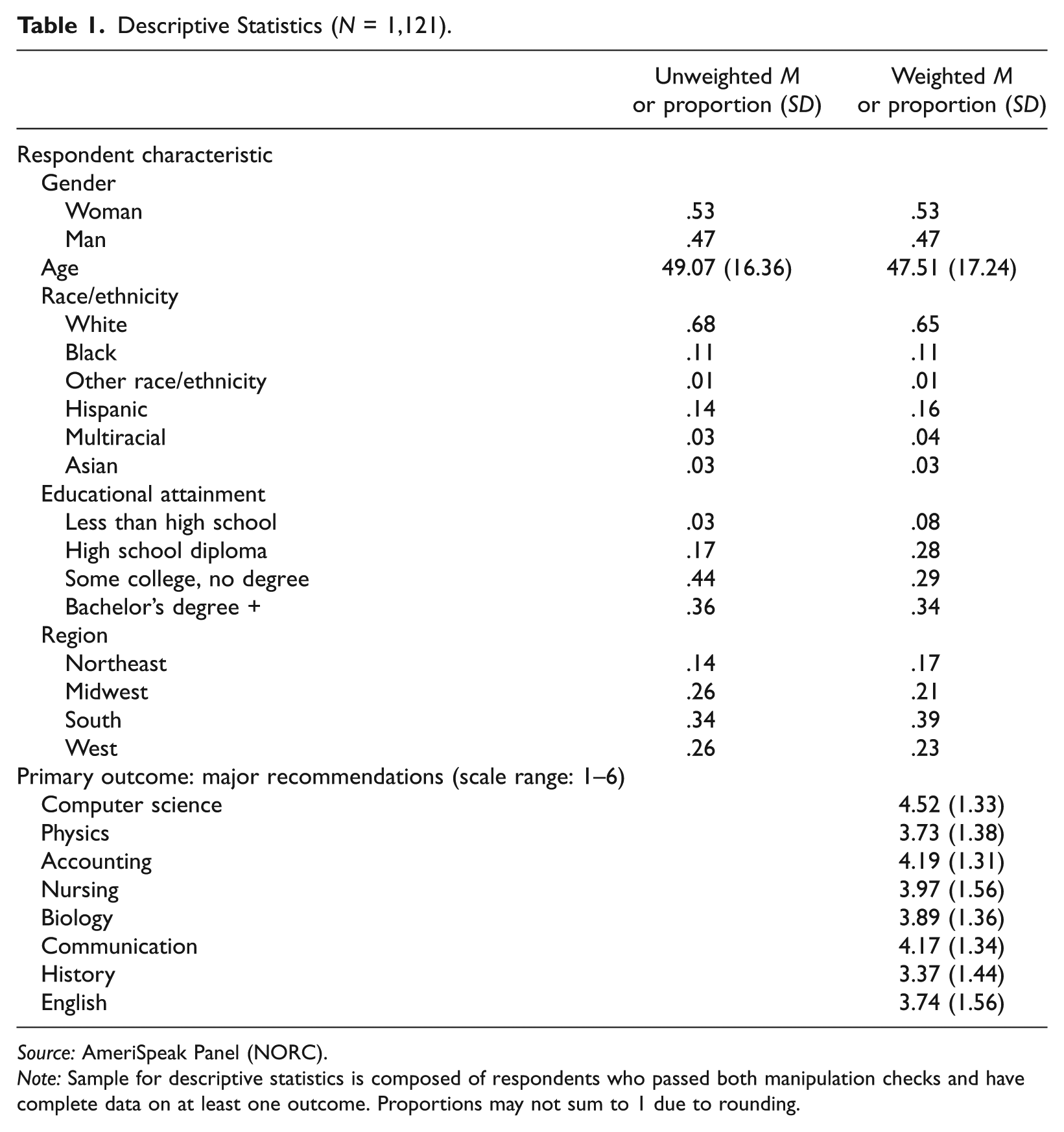
Source: AmeriSpeak Panel (NORC).
Note: Sample for descriptive statistics is composed of respondents who passed both manipulation checks and have complete data on at least one outcome. Proportions may not sum to 1 due to rounding.
Experimental Design
Respondents were randomly assigned to 1 of 12 vignette conditions describing an incoming college student. The vignettes experimentally manipulated the student's social class, debt, and gender using a 2 × 3 × 2 factorial design (all 12 vignettes and the survey instrument are shown in Part A of the online supplement). As an illustration, consider the following vignette, which describes a working-class woman with student loans (experimental portions have been underlined for emphasis):
Social class was manipulated using parents’ occupations. Parents of working-class students were described as factory workers, and parents of upper-middle-class students were described as lawyers. We use occupations to manipulate social class because they signal parents’ education, income, and occupational prestige, which are core components of class background (Blau and Duncan 1967). We pretested these occupations to ensure they are perceived as relatively gender neutral, and we purposefully chose occupations that are not too closely tied to any of the majors in the survey (as opposed to, for example, doctor, which might prompt respondents to recommend biology or another STEM subject).
Student debt was signaled using three approaches. To signal indebtedness, we described students as accruing “about $30,000 in debt.” This is not an insubstantial amount of debt, but it is well below the $100,000+ anecdotes that are frequently cited in the media. To signal no debt, we described the university as covering the cost of tuition that families could not pay so the student will graduate debt-free. Because elite colleges have generous financial aid, it is plausible an upper-middle-class student would receive grants from these institutions, which helps us avoid confounding the social class manipulation. We also randomly assigned one-third of respondents to receive no information about college funding, which we use to gauge respondents’ baseline beliefs about social class prior to introducing debt. This condition allows us to assess, for example, whether respondents make distinct recommendations for fields of study simply because the idea of debt is invoked (i.e., either its presence or its absence compared to no mention). Each of these iterations is discussed in the results section.
Gender is not our main characteristic of interest, partly because the dynamics of gender and major choice have been covered extensively in the literature (e.g., Charles and Bradley 2009; Correll 2004). We manipulated gender essentially to test whether the effects of social class and debt were consistent across men and women students. We generally find this is the case, as we discuss briefly in the results. We used the names “Michael” for men and “Emily” for women because they were among the most popular baby names in the early 2000s. We chose not to manipulate race/ethnicity explicitly because doing so in a comprehensive way would require many experimental categories, thus limiting our ability to analyze the main contrasts of interest (i.e., social class and student debt). That said, race/ethnicity is an important factor that may affect public beliefs about major choice over and above students’ economic circumstances; we return to this issue in the discussion section.
In all vignettes, we described students as attending a highly ranked private university for two main reasons. First, as noted earlier, these institutions are by far the most likely to offer generous financial aid like what is described in the “debt-free” vignettes. Second, we wanted to convey that this is a high-achieving student who could succeed in any field. If respondents were presented with a lower-achieving student, they might try to optimize for “easy” fields of study, and this could confound the social class and debt manipulations. That said, because relatively few students (especially working-class students; Hoxby and Avery 2012) attend highly ranked private universities, it is important to keep in mind this represents the best-case scenario in terms of students’ academic preparation, institutional support, and potential opportunities. We thus consider this a conservative test of our hypotheses given that students at less selective institutions might be expected to take fewer risks.
Main Outcome: Major Recommendations
After viewing the vignette, respondents were asked how likely they would be to recommend eight fields of study for the student on a scale of 1 (very unlikely) to 6 (very likely). We used a 6-point scale, without a middle/noncommittal response category, because respondents in survey experiments may gravitate toward the middle category as a way of evading the task (see e.g., Quadlin 2019). Without the ability to choose a neutral response, this scale construction induces greater heterogeneity by compelling respondents to think critically about whether and to what extent they recommend each major for a student.
The fields were history, nursing, accounting, biology, physics, English, computer science, and communication. We chose these majors because they vary systematically across criteria that have been studied extensively in the higher education literature (Horn and Zahn 2001; Quadlin 2017), as outlined in Table 2. 2 Median annual wages are drawn from the American Community Survey and are reported for workers ages 25 to 59 with only a bachelor's degree in a given field (Carnevale, Cheah, and Hanson 2015). These wages range from a high of $83,000 (computer science) to a low of $53,000 (English). We do not expect respondents to know each major's precise earnings, but we do expect them to have general notions about which majors are more and less lucrative. We array the majors in this order throughout the analyses to gauge the extent to which respondents’ recommendations align with these pay data. The other criteria we varied—sex composition (male-dominated/female-dominated), STEM classification (STEM/non-STEM), and degree of linkage to the labor market (applied/academic)—are correlated with wages but may introduce additional variation in respondents’ recommendations. In general, we expect male-dominated, STEM, and applied majors to be positively associated with perceptions of pay and employability, although we did not ask respondents for these specific impressions directly. These major criteria are discussed as applicable throughout the results.
Characteristics of Majors Used in Survey Experiment.
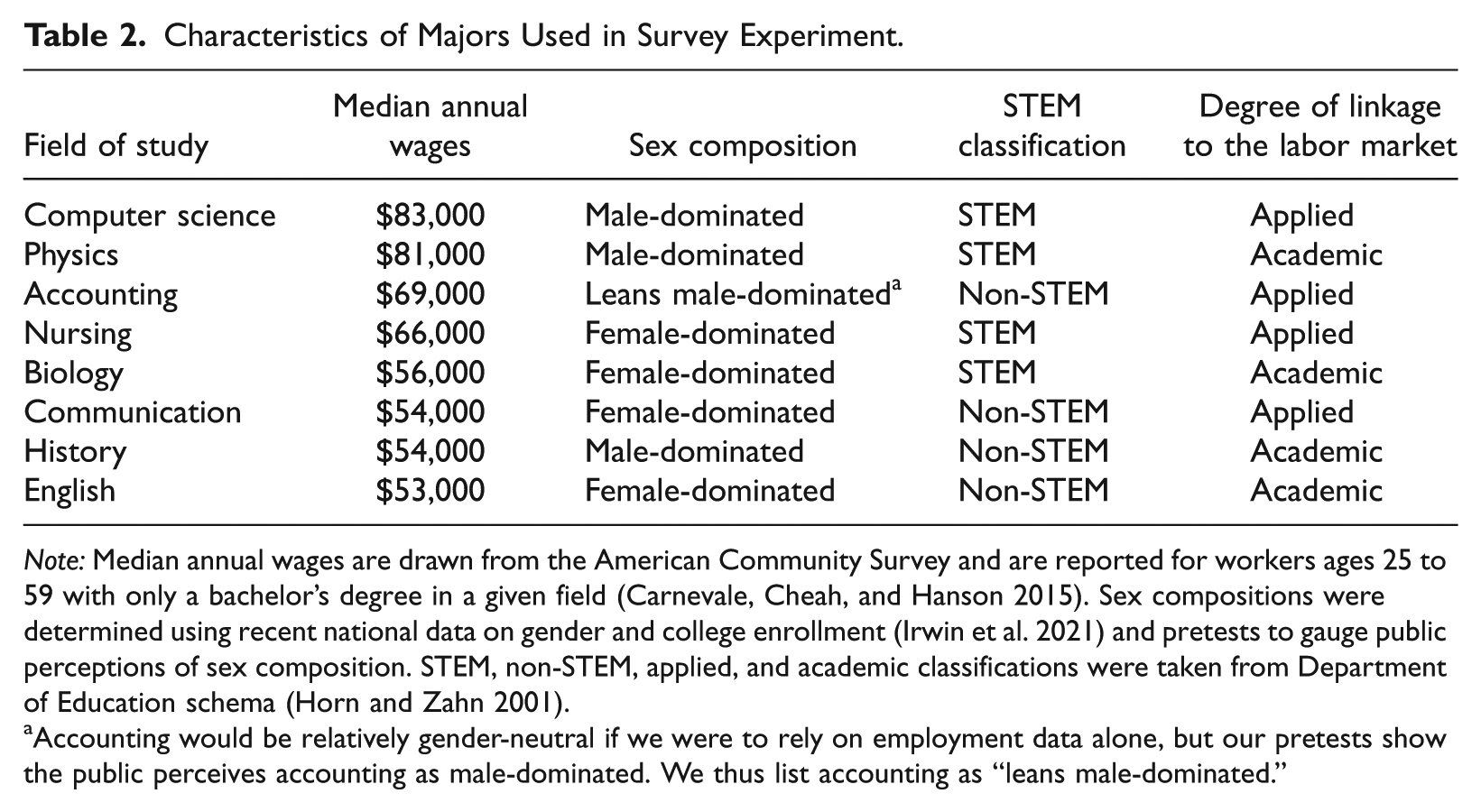
Note: Median annual wages are drawn from the American Community Survey and are reported for workers ages 25 to 59 with only a bachelor's degree in a given field (Carnevale, Cheah, and Hanson 2015). Sex compositions were determined using recent national data on gender and college enrollment (Irwin et al. 2021) and pretests to gauge public perceptions of sex composition. STEM, non-STEM, applied, and academic classifications were taken from Department of Education schema (Horn and Zahn 2001).
Accounting would be relatively gender-neutral if we were to rely on employment data alone, but our pretests show the public perceives accounting as male-dominated. We thus list accounting as “leans male-dominated.”
Open-Ended Item and Coding
After rating how likely they would be to recommend each major, half of the respondents were randomly selected to receive the following prompt:
When you were thinking about what [Michael/Emily] should study in college, what were the most important factors you considered? In your own words, please write a few sentences explaining why you feel this way.
All three authors reviewed the open-ended responses and made a preliminary list of themes. The third author then created a codebook, including definitions of each code, and pilot-coded 10 responses from each condition. All three authors reviewed the results of pilot coding, which we discussed and iterated twice before arriving at a final codebook. The third author used this final codebook to generate a complete set of coded data. Following Rivera and Tilcsik (2016), we examined the prevalence of codes by experimental condition (crossing the social class conditions with the conditions about debt), identified illustrative quotes for highly prevalent themes, and considered combinations of themes that characterized each experimental condition.
Analytic Strategy
We begin by assessing respondents’ mean recommendations for the full sample using t tests of means to compare majors. We then examine the effects of each focal manipulation (i.e., social class and student debt) using ordinary least squares regressions. Because respondents were randomly assigned to conditions, the inclusion of sociodemographic controls should not alter the effects of the experimental manipulations (Mutz 2011), but we include controls for respondent gender, age, race/ethnicity, education, and region. The analytic sample ranges from 1,112 to 1,117, depending on the outcome. At the end of the results section, we use the open-ended data to clarify and further probe some of the main findings in the numerical data.
We used two manipulation checks to gauge retention of the vignette character's social class and debt. About 81 percent of respondents correctly remembered the parents’ occupations, and another 81 percent correctly remembered how the vignette character was paying for college (or that no information was presented). 3 We restrict the analyses to respondents who passed both manipulation checks, which was equally likely across conditions. As would be expected, the effects are less pronounced when the full sample is included in the analyses, although the substantive results are identical to those reported here.
Some readers may question whether all respondents are well informed enough about college majors to be able to complete the study. One could reasonably argue that respondents who have not attended college are not familiar enough with college majors to judge their strengths and weaknesses. To address this point, we conducted a supplementary analysis to test for effect heterogeneity across levels of respondent education, which we describe briefly in the results section.
Results
Field of Study Recommendations across Median Wages
We begin by considering respondents’ recommendations across the full sample. Figure 1 shows mean recommendations for each major in the data, from left to right in order of median annual wages. In general, respondents’ recommendations unfold in a pattern that follows the gradient of median annual wages. This is consistent with Hypothesis 1, which predicts that respondents will be more likely to recommend high-paying majors than low-paying majors in the pooled sample of students. In Figure 1, we use computer science as our point of comparison because this is the highest paying major in the survey in addition to being male-dominated, in STEM, and with a high degree of linkage to the labor market. Respondents’ mean recommendation for computer science, 4.52 on a scale from 1 to 6, is the highest of all, significantly higher than all other majors at the .001 level.
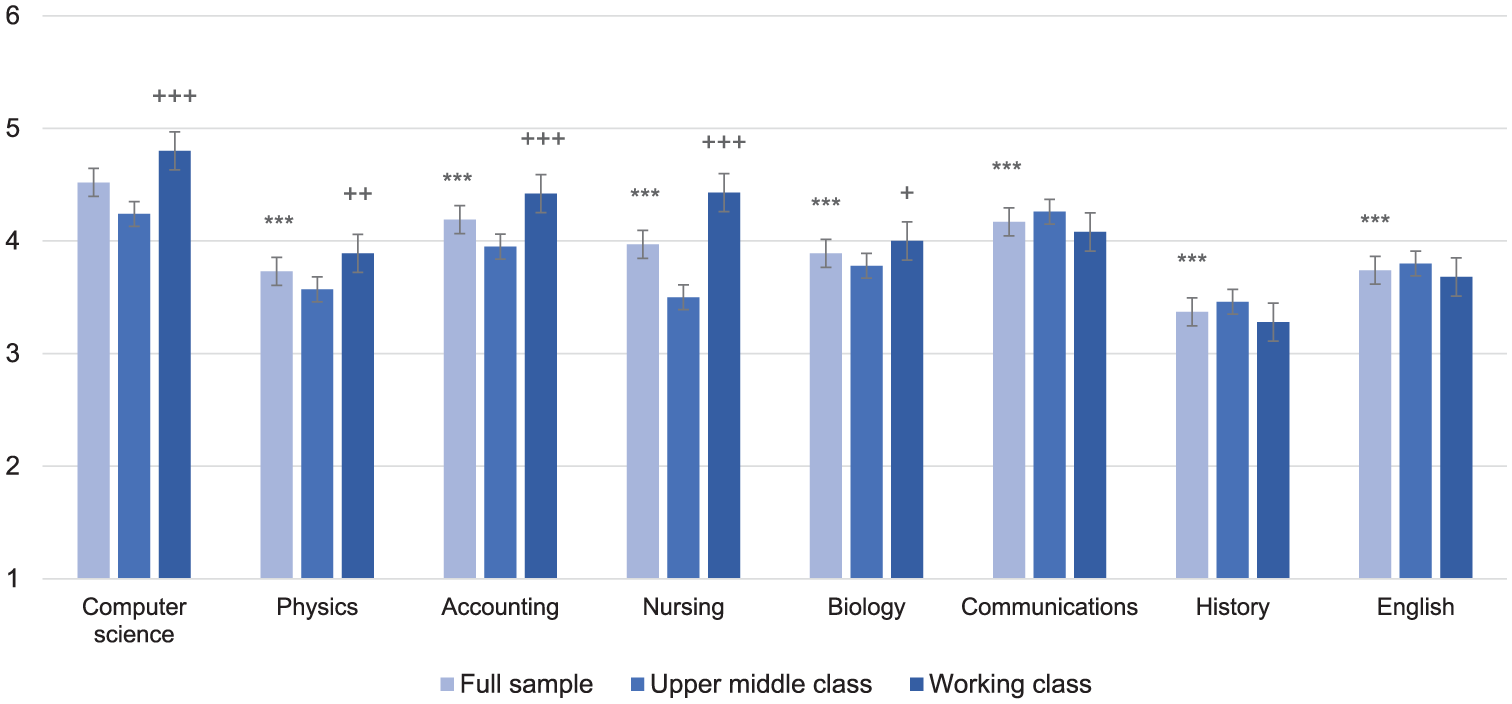
Respondents’ recommendations for fields of study: full sample, upper-middle-class, and working-class vignette characters.
Respondents’ recommendations are broadly in line with the pattern of median annual wages, but two majors in particular stick out from this trendline. First, respondents were particularly unlikely to recommend physics, with a mean recommendation of 3.73. This is statistically equivalent to the mean recommendation for English (3.74), although higher than the mean recommendation for history (3.37) at the .001 level. We suspect this major was relatively unpopular because it is quite small, representing about .5 percent of bachelor's degrees in a recent cohort (Mulvey and Nicolson 2020), and respondents may have been unfamiliar with it. Physics also does not have a clear corollary in the labor market the way computer science, accounting, and nursing do, and thus, respondents might have been less likely to recommend physics. There could also be a taste-based explanation to the extent that respondents did not personally enjoy their high school physics classes, do not have an affinity for physics, or have little understanding of what a physics major could do for work.
Second, respondents were particularly likely to recommend communication, with a mean recommendation of 4.17. This is statistically equivalent to the mean recommendation for accounting (4.19) despite accounting majors earning about $15,000 more per year than communication majors (Carnevale et al. 2015). We speculate that respondents may have rated communication highly because they perceived it as providing broad-based training that could translate to many jobs. For example, one respondent in the open-ended data said, “Good communication skills . . . would prepare Michael for the widest selection of career choices.” Respondents also may not have realized just how little the average communication major earns, and they might have been less likely to recommend it if they were provided with this information. These ultimately are empirical questions that can be addressed in future research.
Although respondents generally rated majors in order of median pay, we also should highlight that all eight majors were recommended relatively highly. The average responses for nearly all majors are comfortably above the median point in the scale, and very few respondents rated majors with 1 and 2 (see Part B of the online supplement). Thus, we might conclude that respondents had positive feelings about most majors, or at the very least, they did not strongly oppose any of these pathways through college.
Effects of Social Class
Figure 1 also includes the causal effects of the social class manipulation, showing marginal predictions and significance tests derived from the regressions in Part C of the online supplement. Overall, we find that Americans have distinct beliefs about how students from different social classes should approach higher education. Respondents were more likely to recommend computer science (p < .001), physics (p < .01), accounting (p < .001), nursing (p < .001), and biology (p < .05), all for working-class students. These are the five highest paying majors in the data, representing fields of study that are not only lucrative but also have strong linkages to the labor market. In terms of sheer point estimates, the majors with the largest divides between upper-middle- and working-class students are nursing—a field with relatively high pay and a well-known labor shortage (Rosseter 2024) 4 —and computer science—the highest paying field in the survey and one that is expected to grow substantially in the coming years (Bureau of Labor Statistics 2022).
It bears repeating that all of respondents’ recommendations are in the direction of working-class students rather than upper-middle-class students. Respondents, in other words, did not think any majors were particularly beneficial for upper-middle-class students even though they had distinct views about what would be advantageous for the working class. The point estimates are higher for upper-middle-class students in communication, English, and history, but none of these contrasts reach statistical significance. Thus, the results are consistent with Hypothesis 2a but not Hypothesis 2b. Americans are indeed more likely to recommend high-paying majors for working-class students, but low-paying majors are not seen as any more advisable for the upper classes. 5 Although this pattern reflects a greater number of recommended majors for the working class compared to the upper-middle class—which may, on its face, be indicative of greater perceived latitude in major choice among the working class—we see the nature of these recommended majors as encouraging a particular brand of duty among working-class students specifically, as we will discuss.
Effects of Student Debt
Next, we assess whether respondents made different recommendations according to students’ methods of paying for college. Table 3 presents mean recommendations for each experimental condition (debt, no debt, no information) and three significance tests, again derived from the regressions in Part C of the online supplement. Column 1 indicates whether respondents recommended different majors for students with and without student debt, which is the main contrast of interest. The next two columns show whether respondents recommended different majors simply due to the presence or absence of payment information. Column 2 compares the no information and debt conditions, and Column 3 compares the no information and no debt conditions.
Respondents’ Recommendations for Fields of Study: Debt, No Debt, and No Payment Information.
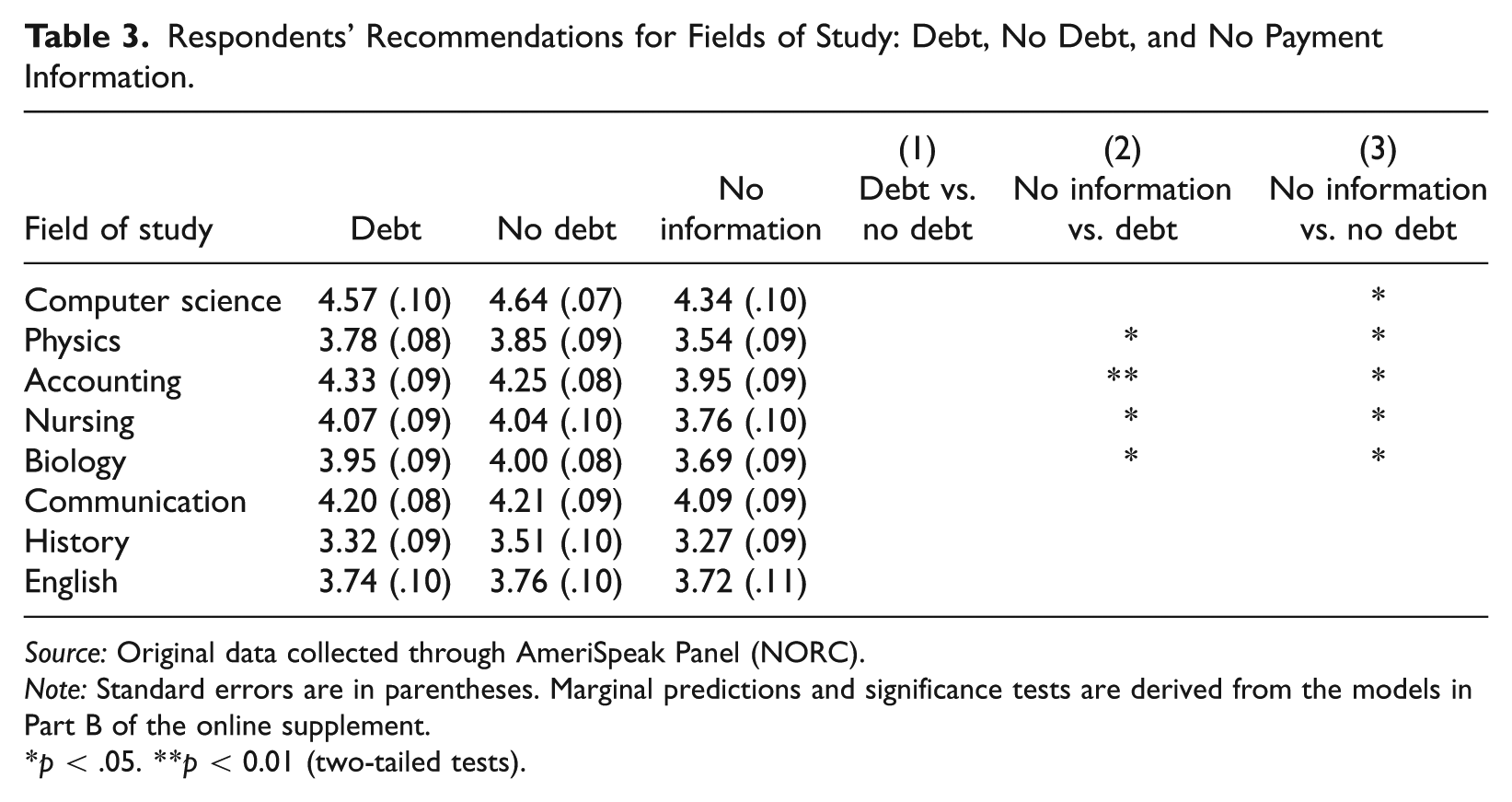
Source: Original data collected through AmeriSpeak Panel (NORC).
Note: Standard errors are in parentheses. Marginal predictions and significance tests are derived from the models in Part B of the online supplement.
p < .05. **p < 0.01 (two-tailed tests).
The results in Table 3, Column 1 are clear: For all fields of study in the data, respondents did not distinguish between indebted and debt-free students, in contrast with Hypotheses 3a and 3b. This result may be surprising considering the great emphasis on student debt we have seen recently in the media and in politics. It may well be, however, that debt and indebtedness are perceived as less important than social class in shaping expectations for higher education pathways. One possibility we mentioned earlier is that the amount of debt we used in this condition, $30,000, was not enough to drive normative beliefs about major choice. In the grand scheme of things, respondents may not have thought $30,000 in loans was enough to affect decisions about what to study in college—as opposed to $50,000+, which might have seemed more consequential. These are important possibilities that we consider further in the Discussion SECTION and that can be tested directly in future research.
The next two columns in Table 3 compare recommendations between the no information and debt conditions (Column 2) and between the no information and no debt conditions (Column 3). Here, we see that respondents were more likely to recommend several majors merely because student debt was mentioned and regardless of whether students were actually indebted. As an illustration, consider the results for accounting. When the student's method of funding was not mentioned, the mean recommendation was 3.95. Yet this recommendation increases to 4.33 in the debt condition (p < .01) and to 4.25 in the no debt condition (p < .05). We observe similar patterns throughout Table 3 for other high-paying majors, such as computer science, physics, nursing, and biology. Overall, we suspect the mere mention of debt—rather than debt itself—prompted respondents to think about how each of these majors might affect students’ career prospects. Regardless of whether students had debt, respondents gravitated toward high-paying majors when they were reminded that college costs money that someone, or some institution, must provide.
Supplementary Analyses
In addition to the main effects discussed in depth in the main text, the main effects of gender are shown in Part C of the online supplement. We found few main effects of gender apart from the model for nursing, which shows that the public is more likely to recommend nursing for women than for men net of social class and college funding. We also examined models with interactions between each of the experimental manipulations, as shown in Part E of the online supplement. We found few significant interactions in these models, suggesting that the effects of student gender, social class, and indebtedness operate similarly regardless of other characteristics. In an exception, we find that respondents are particularly unlikely to recommend accounting for upper-middle-class women and particularly likely to recommend biology for working-class indebted women.
Finally, readers may have questions about the potential contrast between respondents who have and have not attended college. Of the (unweighted) sample, 80 percent have at least some college education, and it follows they would have knowledge of fields of study. But is this also true of respondents who never attended college? This question is important because the results could be unreliable if a large number of respondents lack the specific knowledge needed to complete the task. We divided the sample into respondents with at least some college versus no college, and we then used seemingly unrelated estimation to test whether the effects of social class and debt differ across education groups. These results are summarized in Figure 2.
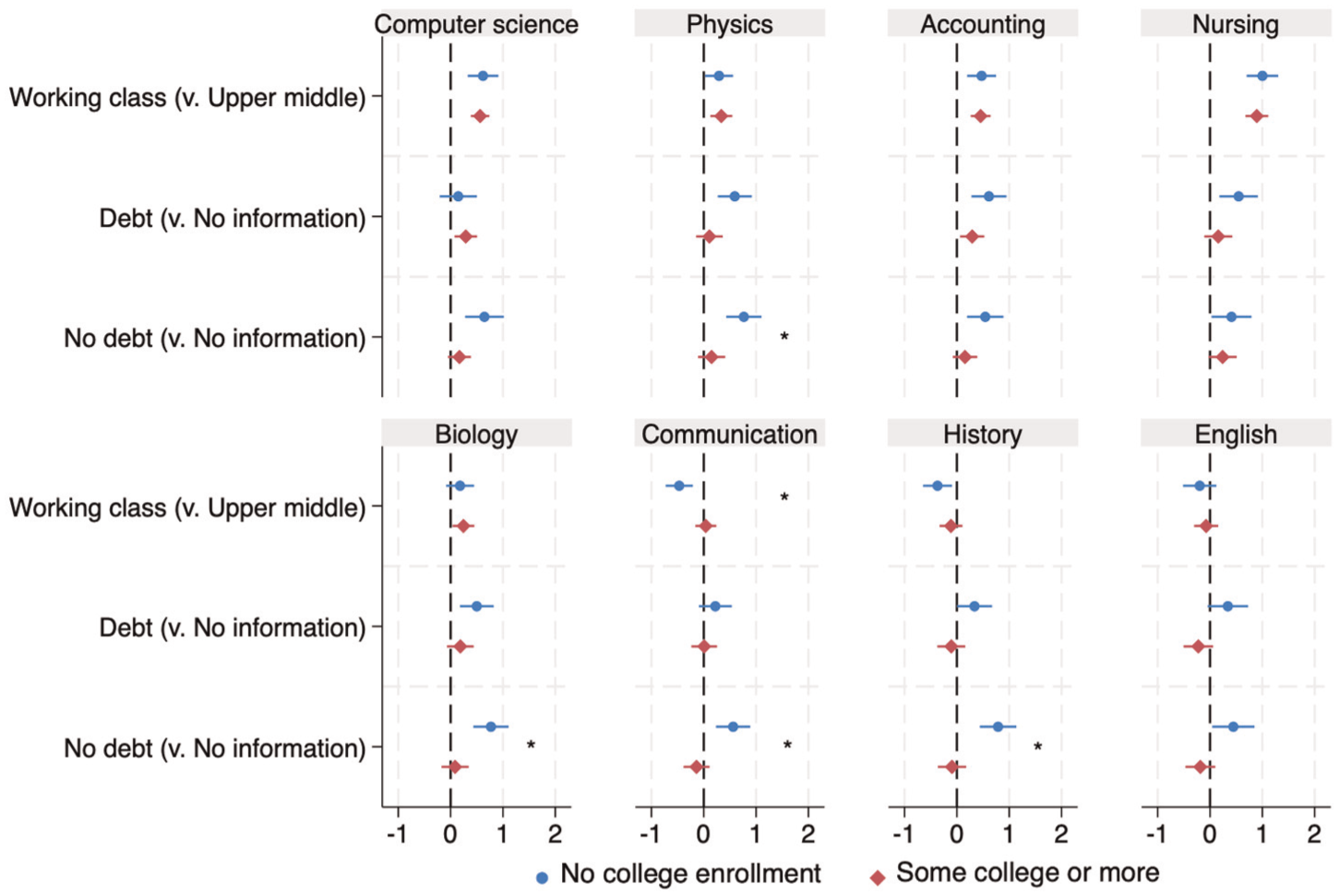
Effects of experimental conditions: respondents with no college enrollment versus those with some college or more.
Overall, we find that respondents with and without college attendance are highly aligned in their beliefs about major choice. The effects of social class, for example, are consistent across education groups with only one exception (communication). This consistency in the effect of social class is substantively important because, as we discussed, Americans as a whole make different recommendations for students in different social classes. We see some exceptions in the bottom part of Figure 2, which suggest non-college-educated respondents were more likely to recommend several majors when students were described as debt-free. Perhaps these respondents perceived debt-free vignette characters as unconstrained in a way that was more tempered among the college-educated. In most cases, however, respondents with and without college experience had strikingly similar beliefs about fields of study. We conclude that the cultural narratives surrounding college majors are strong enough to have permeated even those with no personal experience in college. 6
Open-Ended Data
Finally, we consider the themes that emerged in respondents’ open-ended narratives. Recall that half of the respondents were randomly assigned to explain the most important factors they considered when making major recommendations. In what follows, we focus on themes that arose from respondents who read a vignette about an indebted or debt-free student for both social class groups.
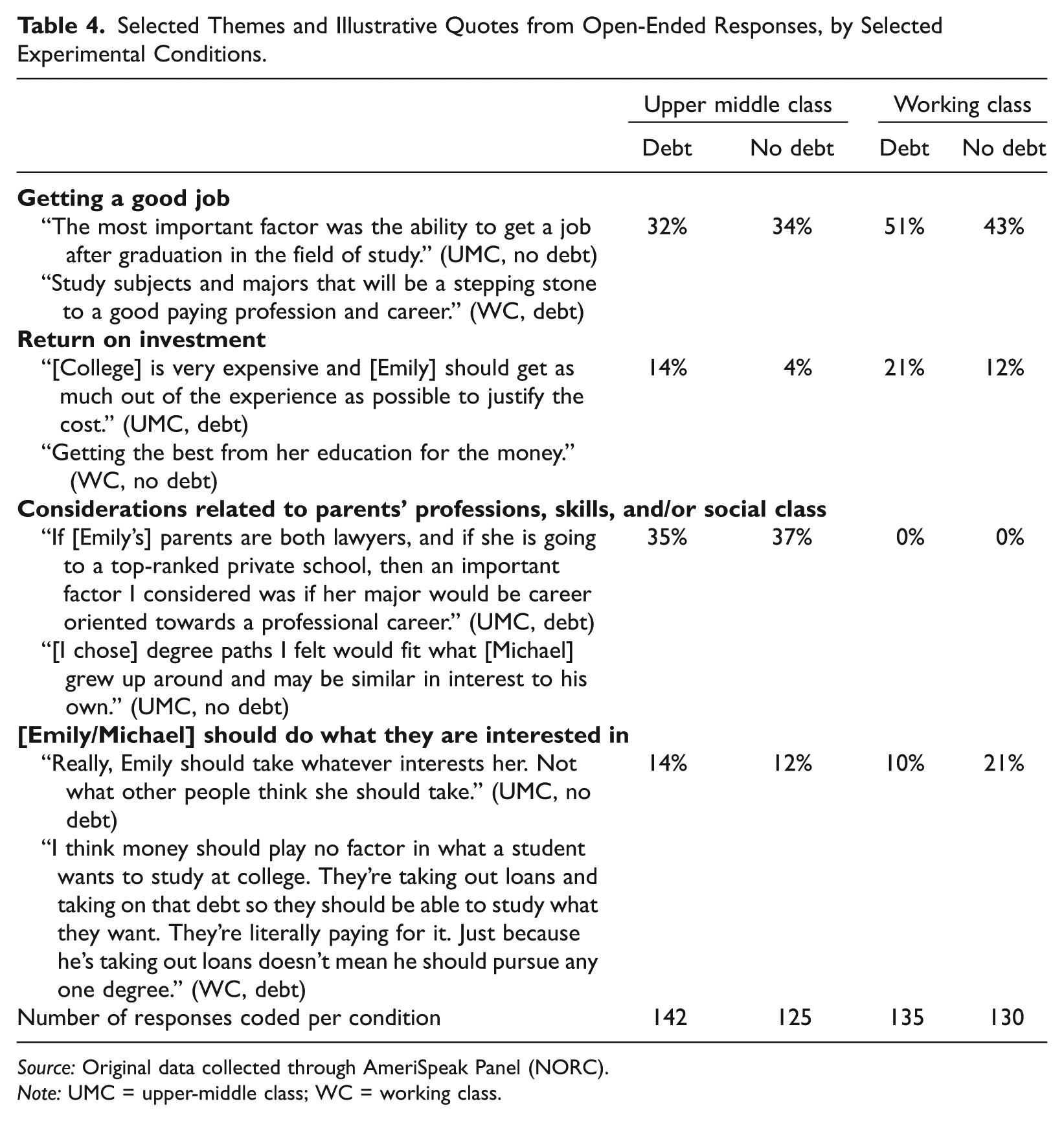
Table 4 shows selected themes and their prevalence in each experimental condition and example quotes. We found that respondents afforded different freedoms and placed different constraints on students’ choices depending on their social class. Respondents thought all students should target majors that would lead to a good job, but this was especially paramount for working-class students and even more so for working-class indebted students. Respondents also expressed that students should be free to let their interests and passions guide them. But whereas upper-middle-class students were afforded this freedom regardless of how they were paying for college, respondents expressed this view for working-class students more commonly when they were debt-free.
Selected Themes and Illustrative Quotes from Open-Ended Responses, by Selected Experimental Conditions.
Source: Original data collected through AmeriSpeak Panel (NORC).
Note: UMC = upper-middle class; WC = working class.
Consistent with Hypothesis 1, the most common theme in the data was the importance of choosing a major with good employment prospects. One respondent explained, “I’d recommend fields where [Emily] could find lasting employment, a good salary, and those that would put her potential to good use.” Another said, “I would be thinking about a field that is in high demand and guarantees a job soon out of college.” There was some variation in what respondents considered a “good job.” As shown in these examples, many respondents discussed notions of pay and employment rates in relevant industries. Although rarer, some respondents mentioned obtaining a high-prestige job and having a rewarding career, such as the respondent who said it was important to “be able to get a worthwhile profession” and one who said the important factors were “salary, happiness, [and job] relevance.”
Getting a good job was a common theme across all conditions (40 percent), but this response occurred more frequently in working-class (47 percent) than in upper-middle-class (33 percent) conditions. This pattern suggests that when respondents recommended computer science, physics, accounting, nursing, and biology more highly for working-class students in the quantitative portion, these recommendations were indeed related to the perceived earnings and employability of these fields, consistent with Hypothesis 2a. Although we saw concern for economic and employment outcomes in all conditions, respondents were substantially more likely to raise this issue when discussing working-class students.
Additionally, respondents were more likely to mention debt in the working-class conditions. Although interactions between social class and debt are not significant in the quantitative data (see Part E of the online supplement), the qualitative data suggest debt is relevant under some circumstances. We counted how often respondents mentioned “debt,”“loans,” or the $30,000 described in the vignette. Only in the working-class/indebted condition did a substantial portion of responses (17 percent) include such references. These answers emerged in only 8 percent of responses in the upper-middle-class/indebted condition and in less than 2 percent of responses in the debt-free conditions. Some respondents even eschewed the idea of debt for upper-middle-class students, such as one who said, “$30,000 isn't much!”
The most prevalent themes were on the broad topic of constraint, but a notable minority (14 percent) said students should choose a major that interests them. Many respondents speculated about the student's interests because these were not specified in the vignette. Respondents said things such as “Michael can study whatever he wants” and “Whatever topic he is most passionate about.” This theme was similarly prevalent in the working- and upper-middle-class vignette conditions.
Yet we also observed unique ways that students’ interests were discussed according to social class. For example, over one-third of responses in the upper-middle-class conditions (36 percent) mentioned parents’ occupations, usually as a way of guessing the student's interests. As one respondent said, “Perhaps the genetics of his two parents, who are lawyers, make Michael's strengths conducive to lawyer-like activity.” Another said, “[I chose] degree paths I felt would fit what he grew up around and may be similar in interest to his own.”
Perhaps surprisingly, the freedom to follow one's path also was described in hopeful terms for working-class, debt-free students. Respondents were most likely to optimize for students’ interests in this experimental condition (21 percent), perhaps because these students were seen as being given a rarefied opportunity. One respondent said, “She is going to a college that will pick up the tab so I think she should go and study what she really wants.” Another said, “[Michael] can choose whatever path. I only know his parents are factory workers, and that doesn't matter when it comes to Michael's path.” A minority of respondents in this condition made vague references to challenges students might face in pursuing their goals. For example, one respondent said, “I think it's good to have an open mind and [for Michael] to be given an equal opportunity to study whatever he wants. All professions need a diverse group of people.” Such comments referred to the idea that there may be a disjuncture between what is seen as the “smart” thing to do (i.e., maximize pay) versus the “ideal” thing to do (i.e., maximize interest). Overall, however, respondents were optimistic about working-class, debt-free students’ ability to pursue their interests. We did not expect this pattern to emerge because respondents were more likely to recommend high-paying majors for working-class than upper-middle-class students and we do not observe a debt interaction in the numerical data. We take this as an indication that attending a prestigious college with the promise of no debt is seen as extraordinary and worth taking advantage of.
When working-class students were described as indebted, respondents were much less encouraging of their autonomy. As shown in Table 4, when we look at the working-class conditions specifically, respondents were only about half as likely to encourage indebted students to follow their interests in college (10 percent) compared to students who were described as debt-free (21 percent). This is consistent with recent research on the concept of “passion” and which students are most readily able to pursue their passions (Cech 2021). Although some respondents encouraged working-class students to choose pathways according to their interests, this encouragement was much less common when students had debt to repay.
Discussion
Using data from an original survey experiment, this article examined public beliefs about pathways through college and how these beliefs vary for students from different social classes and with and without student debt. We find that overall, Americans recommend higher paying majors more highly than lower paying majors. This pattern is consistent with a human capitalist approach to higher education, in which college degrees are seen as having value consistent with their perceived economic value. Importantly, however, we find these recommendations are seen as more imperative for working-class students than for upper-middle-class students. We see this in the quantitative portion, in which working-class students are more strongly advised to major in computer science, accounting, nursing, and other fields tied to high pay and employability. We also see this in the qualitative portion, in which working-class students are more frequently described as needing to get a good job (although if they are debt-free, respondents are willing to optimize for students’ interests).
As we discussed, the notion of class-based pathways has a long history in the sociology of education, and our study complements this research by showing that Americans prescribe class-based pathways through college. On one hand, we can certainly understand why Americans believe that working-class students should pursue college degrees that are closely linked to high-paying jobs. A working-class college student who earns a degree in computer science, for example, will likely experience much upward mobility in their lifetime. One interpretation of this finding is that members of the public understand the rigidity of the U.S. social class hierarchy and they want working-class college students to succeed against what they think are long odds. This is not something many respondents mentioned in the open-ended data, but it could be an implicit component of their perspectives.
On the other hand, we should recognize the inequality inherent in a society in which upper-class youth are normatively expected to have more latitude in choosing higher education pathways. Expectations of constraint among working-class students may reinforce existing social class structures through moral beliefs about what is appropriate and what is not depending on a person's background. In particular, working-class students may receive the message that college degrees are most worthwhile if they are closely connected to an industry with high pay and employability. By the same token, these students may be particularly likely to infer over time that they should not pursue majors that are more loosely connected to the labor market and occupations for which there is no clearly defined educational pathway. Both of these scenarios may involve tenuousness in the early career that is seen as risky and therefore inadvisable for the working class. For example, no specific educational credential prepares one for a career as a politician, and those who pursue this career face low odds of success and potentially years of low-paid work; however, the payoff to this unstable early career is potentially enormous in terms of social influence and economic returns. To the extent that working-class youth are encouraged to seek stability in their early careers, they may ultimately self-select out of competition for positions in the uppermost tiers of society, thus making the class structure more rigid and reducing the rate of social change. These mechanisms are slightly outside the scope of this article given our focus on fields of study rather than occupations specifically, but these are potentially important linkages between society-wide beliefs, individual-level behaviors, and broader class structures that can be examined directly in future research.
Research has demonstrated the connection between beliefs and real-world behaviors (Hainmueller et al. 2015), but we should not expect our results to match attainment patterns exactly, in part because our respondents do not experience the constraints students face in everyday life. One area where we see misalignment is in public beliefs about STEM majors. Prior research shows that low-income students are underrepresented in STEM majors, such as physics, engineering, and computer science (Patnaik, Wiswall, and Zafar 2020). Yet respondents were more likely to recommend such majors for working-class than for upper-middle-class students, presumably because STEM majors embody the high-pay/high-employability criteria seen as vital for the working class. In many ways, this is an encouraging pattern. It shows the public believes in working-class students and their ability to finish degrees that are often characterized as academically challenging. But at the same time, this pattern underscores the durability of barriers to STEM completion for working-class students. Although working-class students are perceived as having great economic incentive to complete STEM training, they are less likely to do so than their upper-class peers, partly because class-specific barriers persist along the STEM pipeline (Svoboda et al. 2016).
Many of the most striking findings pertain to social class, yet we find mostly null effects with regard to student debt. Specifically, respondents were about equally likely to recommend each major to indebted versus debt-free students. The amount of debt is important to keep in mind, however. We described indebted students as graduating with about $30,000 in loans, which is approximately the median for students at this type of institution. It is certainly possible the observed effects might have been larger if we had described the student as facing more debt given that media accounts often focus on individuals who owe $50,000 to $100,000+ (Jackson 2022; Quadlin and Powell 2022). We thus think it is reasonable to speculate that if respondents were presented with a more extreme amount of debt, they might have been more likely to recommend majors with high pay and employability net of students’ social class.
Importantly, though, $30,000 already is a very large amount for most Americans. This is nearly half the median household income in the United States; more than one-fifth of our sample reported a household income less than $30,000. The fact that $30,000 had such decidedly null effects suggests the dollar amount may be relatively unimportant, especially given that Americans have a high threshold for what they consider “normal” amounts of debt in the name of higher education. This is an important point that scholars have made when discussing the ubiquity of debt-holding among the U.S. middle class and among parents of college students in particular (Zaloom 2019). Because going to a good college is considered an essential piece of children's class reproduction and because debt is seen as temporary, middle-class parents may take on considerable debt for their children's college (Cooper 2014; Quadlin, Conwell, and Rouhani 2024). If this is the prevailing logic, then even high amounts of debt may not shape Americans’ beliefs about higher education pathways—particularly at elite colleges like the one described in the vignette—not only because they have very high sticker costs but also because graduates of these colleges experience a high average wage premium (Dale and Krueger 2002). Future research could vary the amount of debt to determine whether there is a tipping point and if so, where it lies.
Future research could also assess the role of race/ethnicity in shaping normative beliefs about higher education. We did not manipulate race/ethnicity in this study, partly because doing so in a comprehensive way would require a very large sample size. The students in these vignettes, who were likely perceived as White, may be seen as having different skills, capabilities, and interests relative to students described as Black or in another racial group. Given prior research on race and affirmative action (Alon 2015; Kluegel and Smith 1983), we might expect Americans to perceive Black students as less capable than White students even if they are both described as attending a highly ranked private university. These perceptions may, in turn, affect individuals’ beliefs about the appropriateness of STEM majors and other challenging fields of study. Notably, in our data, we find few racial differences in the extent to which respondents recommended fields of study (see Parts B and C of the online supplement), but this does not tell us how student race affects these recommendations per se.
In conclusion, we return to a point we observed briefly in the results but that acts as an important backdrop for the study. Although Americans tended to rate majors differently according to their median pay and the student's social class, all the majors in the study were rated quite highly. Very few respondents said they would be highly unlikely to recommend any major, from STEM to the liberal arts. We thus might conclude that Americans have positive feelings about or at least do not oppose each of these potential pathways through college. At a time when higher education is under criticism—some degrees more than others—Americans by and large see this as an experience that enhances young people's lives, whatever form it may take.
Supplemental Material
sj-docx-1-soe-10.1177_00380407261427410 – Supplemental material for Who Can Afford to Be an English Major? Economic Origins, Debt, and Public Beliefs about Higher Education
Supplemental material, sj-docx-1-soe-10.1177_00380407261427410 for Who Can Afford to Be an English Major? Economic Origins, Debt, and Public Beliefs about Higher Education by Emma D. Cohen, Natasha Quadlin and Shiva Rouhani in Sociology of Education
Footnotes
Acknowledgements
We are grateful to Brian Powell, Long Doan, and research assistants for the Constructing the Family and Higher Education Survey for their thoughtful comments on this project. We also thank the TESS principal investigators, Jamie Druckman and Jeremy Freese, for their feedback on the study design. Previous versions of this article were presented at Duke University, the University of Notre Dame, and the 2022 meeting of the American Sociological Association in Los Angeles. We thank audience members for their feedback, in particular Jessi Streib, Angel Harris, Chloe Gibbs, Amy Langenkamp, Joel Mittleman, and Jordan Conwell.
Authors’ Note
The first two authors contributed equally to the manuscript and are listed alphabetically.
Funding
The authors disclosed receipt of the following financial support for the research, authorship, and/or publication of this article: The authors collected the data for this article with support from Time-Sharing Experiments for the Social Sciences, which receives funding from the National Science Foundation (Grant No. 1628057), and the Indiana University Department of Sociology.
Research Ethics
The research reported in this article was approved by the Institutional Review Board at Indiana University.

Supplemental Material
Supplemental material for this article is available online.
Notes
Author Biographies
References
Supplementary Material
Please find the following supplemental material available below.
For Open Access articles published under a Creative Commons License, all supplemental material carries the same license as the article it is associated with.
For non-Open Access articles published, all supplemental material carries a non-exclusive license, and permission requests for re-use of supplemental material or any part of supplemental material shall be sent directly to the copyright owner as specified in the copyright notice associated with the article.
