




Abstract
This article draws on fine-grained analyses of video recordings of service interactions at the cafe counter to revisit the notion of rapport and conceptions of the customer in interactive service. We examine customers’ agency in building rapport and how it shapes interactions with staff. The article contributes to three areas of research. For the sociology of work and employment, it sheds light on customers’ agency and pro-active contribution to service through rapport. Second, for interactive service scholarship it shifts the perspective on rapport from solely the service employees’ task, to a collaborative accomplishment, and one that customers establish as much as employees do. Lastly, the article revisits service work in third places, emphasising the staff–customer encounter’s role in the creation and maintenance of sociability. The article thereby recasts the enjoyment of conviviality in service encounters against a utilitarian backdrop.
Keywords
Introduction
While the service economy was becoming predominant in the 1990s, customers became part of the subject matter of sociology of work and employment, opening the way to extensive research about their role. Whereas critical approaches emphasised customers’ power over service employees and their alienating force, others turned to the more positive and varying forms of influence customers can have on employees’ experience and on service itself. Among the latter proponents, and in a move to reframe interactive service as not merely functional but made from human relationships, Bolton and Houlihan (2005) called for further acknowledgement of customers’ agency, ‘their capacity to act as moral agents and resist and re-shape the very rules that confine them’ (Bolton and Houlihan, 2005: 692). Yet, this promising perspective was not followed by much examination of customers’ actions in situ.
In business and marketing research, the ‘social view’ (Czepiel, 1990; Czepiel et al., 1985) of service encounters as ‘first and foremost social encounters’ (McCallum and Harrison, 1985: 35) is far from recent. It is reflected in, among others, a longstanding concern for rapport (Gremler and Gwinner, 2000, 2008), which is seen as an important element of service encounters, potentially improving customer satisfaction or creating relationships. Research typically focuses on employees’ communicative practices in building rapport (e.g. Campbell et al., 2006; Lin and Lin, 2017) and on customers’ post hoc perception of rapport. In other words, rapport is invariably considered as befalling on employees, as their sole responsibility and task. This tradition of research frames customers as puppets in the hands of employees and obscures their agency; thereby it fails to take seriously the fact that service encounters are inherently collaborative accomplishments.
Face-to-face service interactions are pervasive in the hospitality industry. This article is concerned with a particular setting of interactive service in hospitality: cafes in the UK. Cafes, like diners or pubs, are known as ‘third places’ (Oldenburg,1989); places that foster daily communal sociability and are core settings for civil society emerging with modernity (Laurier et al., 2001). Related research in sociology, urban geography and economic sociology has focused mainly on how interactions in third places contribute to civil society and communities. They highlight different forms of sociability between rural and urban areas, and how these forms evolve, as third places themselves and forms of conviviality, change. However, this strand of research tends to obscure the interactive service work that structures encounters in third places, focusing instead on customers’ forms of inhabiting third places.
Our research takes a Workplace Studies approach (Luff et al., 2000; Suchman, 2007) to focus on interactions between members of staff and customers at the cafe counter. The findings derive mainly from systematic and detailed analyses of video recordings informed by ethnographic fieldwork. The analysis of video includes talk, embodied conduct and orientation to, and use of, the material environment. We focus on a typical phase of service encounters: payment, jointly processed at the counter, at the end of service, by staff members and customers. We examine how customers use the time during payment to either initiate rapport-building themselves or engage in rapport-building in response to staff members’ standard questions. In identifying their methods, the article sheds light on ‘the customer [as] an equal and visible partner in the analysis of interactive service work’ (Llewellyn and Hindmarsh, 2013: 1406).
The Customer in Interactive Service
Since the 1990s, with the rise of the service economy, the sociology of work and employment has made considerable advances in understanding customers (du Gay and Salaman, 1992; Leidner, 1993), shifting the view of the employment relationship from a dialogic one to a ‘service triangle’ (Korczynski, 2013; Leidner, 1999). With the acknowledgement that customers have an impact on not just parts of, but the whole organisation of work, the latter was recast as a ‘customer-oriented bureaucracy’ (Korczynski, 2002). Within predominantly critical approaches seeking to expose power relationships (e.g. Bélanger and Edwards, 2013; Deery et al., 2002), the figure of an omnipotent and tyrannical ‘sovereign customer’ (du Gay and Salaman, 1992: 615) and the ‘consumer as king’ (Bolton, 2002) paradigm arose, emphasising the double pressure exerted on service workers by both employers and customers. A number of critical studies around this issue built on the notion of emotional work (Hochschild, 1983). Other scholars questioned the figure of the sovereign customer, some dismissing it as a ‘myth’ (Korczynski and Ott, 2004: 575). The emerging interest in customers then took a new turn, sending the employment relationship to the background and bringing to the foreground the employee–customer dyad to reveal the more complex and multifaceted aspects of these relationships reframed as essentially human ones (Bolton and Houlihan, 2005; Korczynski, 2009). Part of this reframing involved developing more nuanced views of customers to explore different possible roles and representations, and to make way for, and better understand, customers’ agency.
Few studies have followed suit with a concern for customers’ actual contribution to interactive service. Those that did centred on customers’ perceptions or experience of service as a result of various features of provision, such as contact frequency (Dagger et al., 2009), or service employees’ behaviour, such as smiling (Barger and Grandey, 2006) or personalised service communication performance (Ford, 2003). Later studies investigated customers’ contribution from the employees’ perspective; for example, their affiliative behaviour as perceived by employees (Holman, 2016) or employees’ interpretative framework of customers (Storer, 2023). Marketing research on value co-creation (e.g. Mustak et al., 2013; Prahalad and Ramaswami, 2004; Vargo and Lusch, 2004) constitutes a notable exception by acknowledging customers’ contribution in value co-creation through communication. However, the focus largely remains on how employees can support customers’ value creation. For example, Salomonson et al. (2012) find that sales representatives’ communicative skills – attentiveness, perceptiveness and responsiveness – involve customers as ‘feelers’, ‘thinkers’ and ‘doers’; yet they do not show what this means in practice and is therefore subject to their interpretation.
It is only recently that research has begun to reveal customers’ contribution to service by coming to grips with interactional practices. Challenging the assumption that service employees are solely in charge of personalising service, Kevoe-Feldman (2015) identifies customers’ methods for obtaining personalised service in telephone calls with company representatives. Other studies of face-to-face settings examine embodied practices with video analysis. Llewellyn (2016) explores the practical work done by customers as they handle cash money at the gallery desk, sparing words, timing the payment process or avoiding delicate rejections, while Llewellyn (2021) focuses on how customers display their knowledge of products and prices, and how employees rely on these public displays. Llewellyn and Hindmarsh (2013), introducing the notion of inferential labour, show the value of customers’ conduct for service workers to infer what customers want and what kind of customer they are. Our study builds on this growing body of studies which have provided insights on customers’ work in service encounters and how they shape the emergent trajectory of the encounter and its outcome. In particular, we reconsider customers’ pursuit of sociability and conviviality as it is interactionally tied to the routine service inquiries of service staff.
Rapport Finding and Conviviality
The pursuit of sociability in studies of service-sector labour is gathered together under the idea of rapport-building. Rapport is used in describing the institutional and instrumental pursuit of positive relationships with clients, customers, patients and so on. Accordingly, it has been extensively researched in the social sciences in a variety of settings, such as sales encounters (Campbell et al., 2006; Clark et al., 2003; Kaski et al., 2018), police interviews (David et al., 2018), corner shops (Placencia, 2004), the apparel retailing industry (Lin and Lin, 2017), bars (Placencia and Rueda, 2011) and survey interviews (Lavin and Maynard, 2001).These studies remain cautious around what we should understand by rapport even as they reveal systematic and setting-specific mechanisms and outputs, which encourage or damage it. In interactional studies, rapport is treated as having equivalences with social solidarity (Clark et al., 2003), affiliation and alliances (Lavin and Maynard, 2001) and identity recognition. While the term ‘building’ points to a cumulative, instrumental and teleological sense, we want to hold on to a more open sense of rapport through finding affinities and common interests and pursuing intimacy (Jefferson et al., 1987).
Small talk used to be considered as ‘minor, informal, unimportant and non-serious’ (Coupland, 2000: 1); however, there is increasing evidence that small talk accomplishes a variety of institutional goals, such as diverting attention from delicate examinations in healthcare (e.g. Hudak and Maynard, 2011), or monitoring welfare while also implicitly providing recommendations for self-care in social work (Iversen et al., 2022). In other words, in organisations, talk that seemingly departs from the immediate task is nevertheless a resource in accomplishing institutional care-work and in creating relationships; it has, then, a dual function. In practice, small talk has long been valued because finding rapport starts with departing from the script (Lavin and Maynard, 2001), from the order of service (Chan and Chandra-Sangaran, 2019; Crang, 1994) or from the task at hand, through ‘conversational activities that go beyond the service transaction and participants’ roles as service providers or customers’ (Placencia and Rueda, 2011: 193).
Research on interactive service is predominantly concerned with rapport as output, defined as ‘a customer’s perception of having an enjoyable interaction with a service provider employee, characterized by [the customer’s perception of] a bond between the two parties in the dyad’ (Gremler and Gwinner, 2000: 91–92). Drawing on a review of business and marketing literature, Gremler and Gwinner explore a range of rapport-building behaviours, such as attentive or common grounding behaviour. The exclusive focus on customers’ perception, however, reflects and reproduces a one-sided perspective and the assumption that building rapport, for the customer to perceive, is the employees’ responsibility and task.
This assumption extends well beyond interactive service and business and marketing research. In the above studies, for example, Campbell et al. (2006) focus on salespersons’ sociolinguistic behaviours to overcome prospects’ objections and move beyond the exploration phase of the relationship; Placencia and Rueda (2011) on bartenders’ talk with customers; Clark et al. (2003) on sales representatives’ methods based on assessments and affiliation with prospects; or David et al. (2018) on police officers in the early interrogation phase to create a sense of collaboration with suspects and use it later in adversarial questioning. Customers, or lay participants, are rarely considered as pro-active in building rapport (Placencia, 2004) and rapport itself is emptied of authentic interest and enjoyment of one another’s company. It is almost always instrumental and rarely convivial.
Sociability and Third Places
Third places, a term coined by Oldenburg (1989), are between the intimacy of the home and the formality of the workplace, semi-public venues such as cafes, diners and pubs. They offer a unique opportunity for sociability and the formation of relationships outside of work or home (e.g. Ferreira et al., 2021; Thurnell-Read, 2021). Accordingly, research in sociology, urban geography and economic sociology focuses on the role of third places for creating and sustaining communities (e.g. Cabras and Mount, 2017; Ferreira et al., 2021; Henriksen and Tjora, 2014; Thurnell-Read, 2023) and social support (e.g. Hickman, 2013; Rosenbaum, 2006). Recent scholarly discussions revolve around the diversification and evolution of third places over time, their changing functions and patrons’ experience (e.g. Ferreira, 2017; Lane, 2018). For cafes, a major change has been the widespread development of national and international chains since the 1990s (e.g. Ferreira et al., 2021; Thompson and Arsel, 2004; Woldoff et al., 2013) and the emergence of the ‘cafe worker’ (e.g. Henriksen and Tjora, 2018; Mimoun and Gruen, 2021). A range of studies lament the decline of sociability in the face of these changes, and the threat to the building and sustaining of communities (e.g. Clark, 2007). Other studies bring to the fore new phenomena with positive effects on civil society, such as place attachment (e.g. Rosenbaum et al., 2007; Sandiford and Divers, 2019) or urban multiculturalism (e.g. Jones et al., 2015). Even the infamous cafe worker, whose focus on their devices and unavailability for social interaction is predominantly frowned upon (e.g. Simon, 2010), seeks connection through a ‘brief interaction with staff and the possibility of observing people around them’ (Ferreira et al., 2021: 26) and thereby contributes to sociability.
In longstanding research on different forms of pub sociability, Thurnell-Read (2021: 74) notes that all forms ‘hinge on the involvement of pub staff to facilitate smooth social interactions’. In ‘occasional pub going’, customer–staff interactions are ‘mediated . . . by a framework of customer service, with [pub goers] . . . expecting friendly and efficient service’ (Thurnell-Read, 2021: 73–74). Further, the established roles and institutional structures of service in hospitality ‘allow strangers to interact in a way that transcends the barriers of social status’ (Czepiel et al., 1985: 14), and create an occasion for friendly, sociable conversation (Laurier and Tuncer, 2025). It is in these customer–staff interactions that the convivial values of service encounters and the economic values of third places overlap and interplay in the everyday life of cafes, maintaining the ‘delicate balance between the moral economy and the exchange economy’ (Thompson and Arsel, 2004: 639). Our article connects research on third places and on interactive service by moving beyond the staff’s perspective and projects to examine customers’ organisation of their embodied actions in pursuing and finding rapport with staff members.
The Study
Setting and Data Collection
This article builds on the second author’s research on cafes in the UK spanning two decades, drawing mainly on video recordings of naturally occurring interactions, informed by fieldwork. The data are from a 2016 collection assembled from three days of recording in an independently owned, city-centre cafe.
The project’s methods were approved by the University of Edinburgh ethics committee. For data collection, two wide-angle cameras were placed, respectively, in front and behind the counter to provide complementary perspectives. Staff gave their informed consent, while customers’ consent was gained via posters and leaflets on each table with information on the project and instructions on how to proceed if they wished to withdraw from the research. The data are reproduced in transcripts on numbered lines including hearable features of speech, descriptions of relevant embodied conduct in grey font, and image captions located in the lines of talk with a # sign. The participants’ faces on the images were blurred to ensure anonymity.
Approach
Our study sits within Workplace Studies (Luff et al., 2000; Suchman, 2007), using systematic and fine-grained analysis of video data, drawing on ethnomethodology and conversation analysis (Garfinkel, 1967; Sacks et al., 1974). The analyses include talk, embodied conduct and use of the material environment. The analyses aim at understanding staff members’ and customers’ practical problems and practical reasoning from their perspective, which they can infer from each other’s publicly available conduct (Hindmarsh and Llewellyn, 2018). This approach has made significant contributions to understanding the practical accomplishment of service in various settings, from dentistry (Hindmarsh and Llewellyn, 2018) to call centres (Whalen and Vinkhuyzen, 2000) through to hair salons (Oshima and Llewellyn, 2024).
Data Analysis
Initially interested in payment, we extracted 55 payment instances from our video corpus, which we systematically analysed looking for recurrent or otherwise interesting practices and phenomena. Our focus narrowed to 18 instances where staff members and customers engaged in small talk, as an empirical entry to conviviality.
We carried out detailed analyses looking for methods and systematicity across these 18 instances, returning across multiple data sessions to explore the trajectories in which small talk arose. Three sequential formats were selected for more detailed examination. In one, the customer or staff member resumes a previous conversation and builds on an existing relationship, and the customer sooner or later appears as a regular. In the second trajectory, one party initiates small talk with a question or comment drawing on an observation, for example ‘It’s quiet this morning’ from a customer or ‘So graduations day?’ from a staff member (three staff-initiated, two customer-initiated). In the third trajectory, the staff member asks a standard question that leads to some small talk (11 instances).
Initiating Small talk and Building on Staff Questions
The findings focus on the latter two trajectories, one with one party initiating small talk with a question or comment, the other with the staff member asking a standard question. Two types of standard questions were examined: ‘next-activities questions’ (eight instances) such as ‘What are you doing for the rest of the day?’ and ‘service assessment questions’ (five instances) such as ‘How was everything for you?’ The first can be heard as initiating small talk, while the second is part of the routine order of service. The five videos analysed below include different categories of customers: one-time customers, potential repeat customers and one regular customer. The analyses reveal strong similarities, across types of standard questions and customers’ category, in how customers, in first or second position as speakers, initiate small talk and through it search for and find rapport with staff members. What will become apparent is that the local problem is whether the customers do wish to not only begin small talk but to continue it in order to find, or fail to find, rapport. The customers, in other words, as with Llewellyn and Hindmarsh’s (2013) findings, guide the staff in their desire for sociability at the cafe counter.
Customers Initiate Small Talk
In this first section we will examine how customers initiate small talk in the pursuit of rapport. In Excerpt 1, we join the payment interaction after the member of staff and the two customers 1 have agreed on splitting the bill and adding a tip, which the staff member concludes with ‘lovely stuff’ (line 1). She then uses the credit card machine and one of the customers’ credit card (line 2).
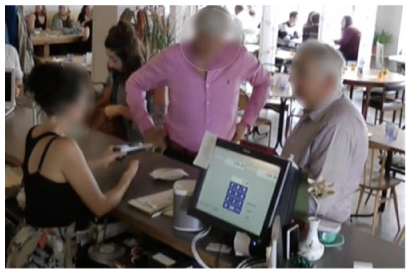
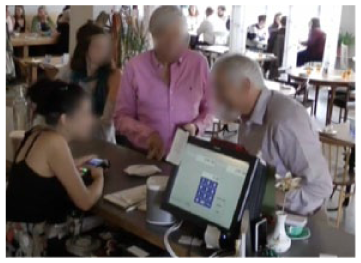
Just as the staff member proffers the payment machine to the customer on the left (Image 1.1), the customer on the right reads aloud a menu item from the wall, in a singsong voice: ‘chicken and ginger broth’ (line 3). The member of staff responds in overlap with a positive assessment: ‘it’s a good ’un’ (line 4), which aligns with the customer’s assessment: ‘that sounds good (.) hmm mm’ (line 5). Indeed, the overlap that anticipates correctly the positive agreement is itself a show of rapport (Goldberg, 1990). What this assessment–agreement sequence is producing contrasts with the salespersons’ rapport-building method identified by Clark et al. (2003) in pursuing sales precisely because the sale is long since complete, it is, instead, initiating and inviting small talk.
By offering a new topic, through a matched action of a noticing about the customers (‘so graduation’s today I take it’, line 7), the staff member accepts the wider invitation to small talk. However, the customer goes one step further with a tease: ‘do we stick out like a sore thumb’ (line 11). The tease produced with laughter, rebukes the staff member for making unwarranted inferences out of their appearances, ‘initiating a move into intimate interaction from a status he perceives as non-intimate so far’ (Jefferson et al., 1987: 160). He and the staff member then look at each other and bend forward in laughter (Image 1.2), shifting rapidly into a form of intimacy from their earlier involvement in payment (Goodwin, 2007).
Across both turns and as payment is being processed, the customer initiates small talk by identifying ‘common interest . . . to make an initial connection and keep the conversation flowing’ (Gremler and Gwinner, 2008: 316), an activity previously identified in marketing research, albeit attributed to employees. Using a noticing from the cafe’s environment, the customers, through assessing and then teasing, lead the search for rapport. The staff member is also responsive to the customer’s pursuit, by doing more than the instrumental work of payment, in returning a noticing about the customers and hearing the rebuke as an invitation to intimacy.
Customers Build on Next-Activity Questions
We join Excerpt 2 when the member of staff, looking for some change in the tip box to complete one of the customers’ payment, asks ‘what are you doing for the rest of the day’ (line 1, Image 2.1). They are leaning towards one another because the staff member is looking into the tip box while retrieving change and the customer failed to hear the staff’s question first time around.
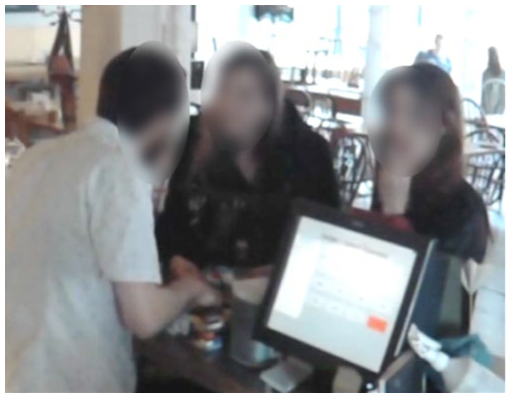
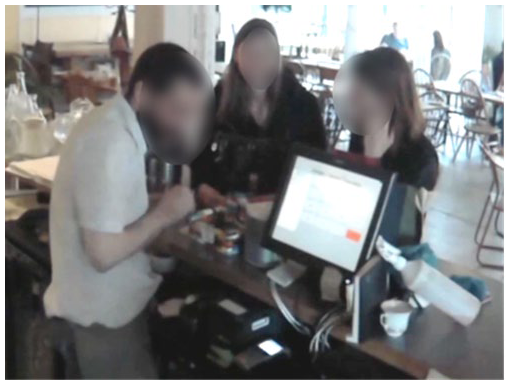
The customer on the left answers informatively: ‘uh probably doing a walking tour’ (line 2), which the staff member acknowledges with: ‘nice’ (line 3). Whereas the staff’s brief assessment is closing implicative, the customer on the right expands with ‘in the city if it doesn’t rain,’ (line 4), and ‘because they said it was going to rain’ (line 5). Weather is hearable as a small talk invitation. Between those two turns of talk, she makes a funny, worried face while looking at the staff member; she is visibly pursuing a response (Goodwin, 1980). Meanwhile, the member of staff aligns to the customer’s willingness to engage in small talk by peering outside through the windows, with a pointing finger, showing that he is looking at the weather outside, and saying: ‘it is meant to be heavy rain coming’ (line 6). He builds on her topic to offer his help with ‘so maybe go now’ (line 9), not only as a staff member but also as a local resident encountering tourists, and the sequence ends on affiliation through laughter, mutual gazes and smiling (Image 2.2).
While the sequence enabled by the standard question could end after line 3, the customer’s expansion from line 4 onwards, accompanied by her pursuit through sustained gaze, is decisive in pursuing small talk and on a local knowledge topic that offers the staff member the rights to advice-giving. The advice is markedly directive and treated as potentially a move towards intimacy via the customer’s hearing of it in their laughter. The fact that these customers pursue and provide resources for finding rapport, even though they are tourists and unlikely to become regulars, emphasises what is happening as non-utilitarian work around the payment task and their commitment to sociability, independent from the prospect of building customer relationships.
As we join Excerpt 3, after handing back her cash to the customer with ‘there you are’, the staff member offers a similar ‘next-activities’ small-talk initiator: ‘have you got a busy day ahead?’ (line 1).
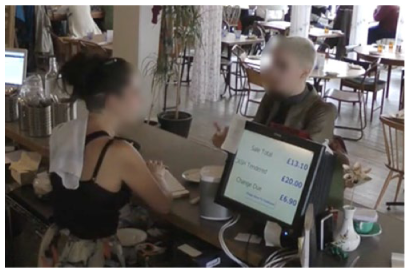
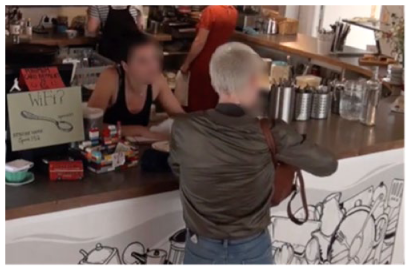
The customer answers with ‘u:m: very relaxed touristy kind of day so yeah’ (line 3), both confirming and correcting a potential implication: she will be busy, but as a visiting tourist for a ‘relaxed’ day, not as a local worker (an identity that the staff member might have inferred from her appearance). The staff member acknowledges and affiliates with ‘lovely (.) that’s good a nice wee wander about’ (line 4); and with the uptake ‘fabby’ (line 7) moves towards closings. While the encounter could close on this affiliative sequence, the customer takes the floor again (line 5, Image 3.1) and expands with ‘yeah exactly I hope it doesn’t rain too much though’ (line 6). Not unlike in Excerpt 2, by using the topic of weather as a hearable small-talk initiator, the customer invites further conversation. In an embodied and literal shift of stance, as it was with Excerpt 1, the staff member leans towards the customer (Image 3.2), seeking to create a sense of intimacy, and ventures a mildly indelicate piece of advice: ‘well then you just have to dive into a pub and have a whisky’ (line 8). In doing so, she uses the customer’s newly established tourist identity, to suggest daytime drinking, which the customer accepts: ‘I’m totally fine with that’ (line 11).
As with Excerpt 2, the customer’s expansion on line 5 is decisive in showing her openness to engage in small talk, even as the staff member moves towards closing. It is the customer, again, who is offering material for the member of staff to build on, though this time it is the staff member that makes the step, via their improper suggestion, towards finding rapport.
Through analysis of our collection, we identified a common systematics of interaction that are produced by the participants in Excerpts 2 and 3:
01 Staff ‘Next-activities’ standard question
02 Customer Informative answer
03 Staff Assessment/acknowledgement, third position, potentially closing turn
04 Customer Expansion of initial answer
While customers in turn 2 may be merely answering the question, the expansion in 4 (a) provides additional material for small talk and (b) pursues affiliation: it is both leading the search for rapport and establishing the resources for it (e.g. weather as a topic, see Iversen et al., 2022). Besides, customers produce these expansions even when staff members work towards closing small talk or the encounter in 3, and even when it is established that the customer is most likely a one-time customer. What we have also shown in Excerpts 1 and 3 is both parties leaning towards one another while shifting to shared laughter in their talk as marking a shift in their participation, in particular, their affect, which then displays their finding rapport with one another (Goodwin, 2007).
Customers Build on ‘Service Assessment’ Questions
Commonplace at the end of service encounters, customer experience-checks are a closing component of the order of service (Oshima and Llewellyn, 2024). The customer’s assessment of their experience, even if negative, is considered important for businesses because ‘successful completion . . . can bring satisfactory closure to the event, and may even help retain clients’ (Oshima, 2014: 32). We consider here how assessment sequences are used by customers in seeking and finding rapport.
In Excerpt 4, while waiting for the customer’s bill to come out of the printer (Image 4.1), the staff member asks: ‘and how is: was everything for you’ (line 1).
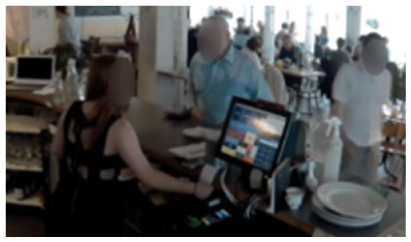
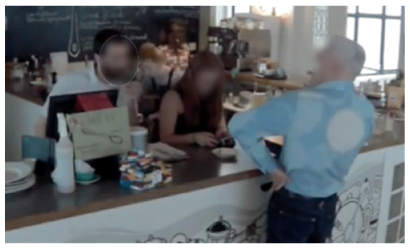
With ‘ah w- lovely as always of course’ (line 2), the customer provides a positive assessment that applies for his experience that day as well as for prior visits, categorising himself as a regular customer (D’Antoni and De Stefani, 2022; Laurier, 2013). His status as a regular is there for the staff member’s awareness even though she showed no earlier sign of recognition. She positively acknowledges solely his assessment with ‘ggr↑ea:t’ (line 3) – in line with the pattern identified above. Then the customer repeats and expands on his regular status: ‘u:hm which is why we keep coming ba:ck and back and ba:ck’ (line 4), which the staff member positively acknowledges again (‘↑yea:h I’m gla:d’, lines 5 and 6), still displaying no signs of recognition. While at one level the customer is establishing their status as a regular, they are also offering resources to the staff for future rapport in providing much more than a minimal positive assessment. ‘Everything’ was ‘lovely’, they are devoted to the workplace and by implication its staff and on such a basis they display their existing rapport with the cafe as institution.
Meanwhile, a second staff member has arrived behind the counter and started drinking from a glass. Pursuing him, as a further recipient for their talk, the customer sustains looking at him during his utterance on line 4, until the staff member returns his look. Why the customer does this becomes clear when the staff member nods to him in a sign of recognition. The customer then addresses him with a mildly improper, and humourously teasing, mis-recognition: ‘that
Although the service experience-check is hearable as part of the routine order of service, the customer uses it in the same way that the next-activities questions studied above are used; that is, to display his willingness to engage in small talk. His highly positive assessment at the outset prepares the ground for an expansion and thus is already geared towards building rapport with the first staff member. Then, he takes the lead in establishing his status from satisfied customer to regular, by bringing in the second staff member who knows him. In a swift shift of participation status, he displays his existing relationship with staff. The value and accountability of customers undertaking these affiliative practices are distinct from those of staff members, they are not compromised by their pursuit of instrumental rapport-building. We have a sense in this encounter of established rapport re-activated in the jump straight into teasing rather than through small talk.
Customers Manifestly Refuse to Engage in Small Talk
We have been interested so far in customers’ methods to pursue and find rapport, by offering a topic, in expansive answers to standard questions and around delicately indelicate proposals. Our data comprise a contrastive case that sheds additional light on customers’ agency in rapport. In Excerpt 5, two customers have approached the counter, and when they are about to speak with the staff member, they lower the volume of their ongoing, private conversation (lines 1 and 2). The staff member moves towards the till (line 1) and begins processing their payment with a tap on the till screen (Image 5.1).
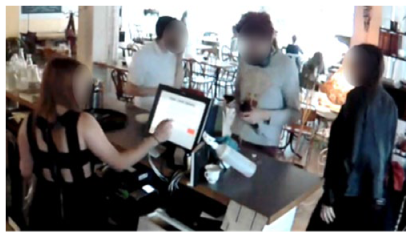
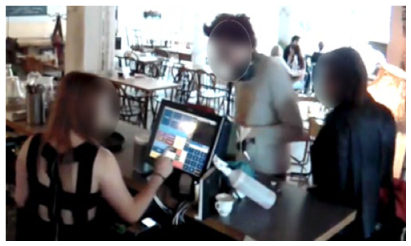
While the staff member asks a typical service assessment question (‘Was everything okay for you guys?’, line 4), one of the customers (on the left) puts their conversation on hold (‘anyway’, line 5) and answers the staff member, ‘yeah it was great’ (line 6), a brief high-grade assessment serving as a no-problem report on the service. The other customer follows with her own assessment: ‘yeah it was fine yeah,’ (line 7). Meanwhile she has also maintained her body orientation towards her partner (Image 5.2), only turning her head towards the staff member. In thereby forming a body torque rather than turning fully towards the staff member, she frames the suspended interaction with her partner as her main involvement and that with the staff member as a temporary, inserted one (Goodwin, 2007; Schegloff, 1998). Shortly after, the staff member initiates payment with ‘all in all o:r you pay separately’ (line 8), effectively accepting the absence of an invitation for small talk. Payment will remain the only topic until the customers leave.
The customers’ assessments, by discarding any problems, satisfyingly answer the service assessment question; they are nonetheless non-expansive. Through her lack of uptake in third position, unlike the appreciative response in Excerpt 4, the staff member demonstrably orients to their suspended conversation; she solely and quickly deals with their payment. In other words, the customers rely on the method identified and analysed so far, albeit in reverse, by showing no interest in small talk – that they are ‘only paying’ – both through the design of their answer and their embodied conduct. They sustain the bare order of service and prioritise their customer-to-customer interaction. Conversely, the member of staff provides good service by recognising customers who do not want to engage in small talk.
The earlier analysis of Excerpts 3 to 5 brought to the fore the context-sensitive and contingent nature of service assessment (see Orlikowski and Scott, 2014). In Excerpt 5, the customers’ curt and general assessments seem to have more to do with their current project – avoiding engaging in small talk to prioritise their suspended conversation – as with their actual experience. Conversely, in Extract 4 the customer’s praise is as much a device to re-establish their rapport with the staff as an actual assessment of service.
Discussion
Our study has shed new light on the customer–employee dyad (Bolton and Houlihan, 2005), showing how customers and staff actively produce the shape of the service encounter. In doing so, it further contributes to our ideas of rapport and third places by examining customers’ actions in initiating (or avoiding) small talk, pursuing intimacy and more generally producing the pleasures of sociability. We have shown that the service interaction between staff and customers is as much a setting for the pursuit of sociability as talk between customers. The order of service provides an institutional framework for customers, as they talk to and answer staff, to borrow and then display whether they welcome or reject the search for rapport.
In their analysis, Llewellyn and Hindmarsh (2013) brought to the fore customers’ subtle cues on which staff rely to do inferential work to process orders. We showed how, in the context of payment at the cafe counter, customers offer up more of who they are explicitly in ways that both show openness and provide the resources to find rapport (Laurier and Tuncer, 2025). And the lurking risks of one party making an inference, noted by Llewellyn and Hindmarsh, can be used by customers as an invitation to intimacy (with ‘do we stick out like a sore thumb’). Rapport is bound up with intimacy, a passing intimacy between strangers suddenly and sometimes intensely affiliating. In his classic work on third places, Oldenburg (1989) makes much of the casual affiliations and purposeless connections that are often overlooked despite being abiding forms of civil life in society.
Furthermore, this article has situated seeking, and potentially establishing, rapport, as part of customers’ concerns and interests as much as employees’, and shows that having an enjoyable interaction matters to customers notwithstanding business interests or the possibility of a service relationship. Whereas rapport has been hitherto tightly yoked to business and transactions, as an important lever to improve customer satisfaction or to make sales, this article develops the concept of rapport by setting it against this utilitarian, instrumental backdrop. It recasts it in the realm of sociability, social connection and enjoyment, where affinity and bonds are more often than not, integral to the service encounter and disconnected from the prospect of gains. As examples with one-time customers demonstrate, the ephemerality of the bond deters neither party from engaging in small talk. The enjoyable moment is worthy in and of itself for them, for us, as persons. Service encounters are bound up with the sheer fun of the human association.
Having focused on the customer, in concluding we can briefly reconsider the staff’s side: how staff members, by offering several slots for customers to either expand and engage in small talk, or move towards closings, have a mechanism for monitoring whether to engage in small talk or in a variety of ways to pursue or re-establish rapport with tourists, proud parents or regulars. In other words, we can re-examine the interaction examined earlier from rapport-building as done by employees to enabled by employees mindful of customers’ lead in seeking a convivial conversation at the counter. Indeed, one way of avoiding the hint of institutional treason in the idea of rapport-building as a form of institutional accumulation is in following the customer’s lead, especially in the low status and lowly paid jobs of the hospitality frontline. Our study may have paradoxical implications for cafe workers in bringing to the fore not what staff’s scripts should be, or, what best builds rapport, but rather by advising them to consider carefully what the customer does before trying to seek rapport. Not that we are returning to the past ideas of customer as king but that rapport has to be found, more than it has to be built, and that staff might not know what they have in common nor whether they, as yet, understand one another well. It can easily misfire and requires being attentive to invitations found in the practices we summarised above. The staff’s labour of doing so is in what customers reveal about their status, identity, plans, commitment, humour and more.
Conclusion
Drawing on fine-grained analyses of video recorded service interactions at the cafe counter, this article revisits the notion of rapport and conceptions of customers in interactive service, examining their agency in finding and pursuing rapport. Drawing on systematic analyses of naturally occurring interactions of payment at the counter informed by ethnographic fieldwork, we identified an interactional sequence and practices through which staff members and customers can invite, engage in, or evade, the emergence of small talk. We recast rapport as a non-utilitarian component of service interactions, supporting the findings in research on third places and its concern for sociability and community-building.
In the past decade, service and hospitality settings such as cafes and bars have been undergoing major technological transformations, a number of which remove customer–staff interactions at the counter in favour of ordering and paying at a screen thereby threatening the pursuit and finding of rapport. Further research on interactive service and in the sociology of work and employment is needed on how these recent developments have transformed the organisation of work and sociability in third places.
Footnotes
Acknowledgements
We would like to thank Pentti Handdington and Antti Kamunen for starting this work with us a long time ago, as well as Clara Iversen and Marie Flinkfeldt for exciting discussions on small talk.
Funding
The authors received no financial support for the research, authorship and/or publication of this article.
