




Abstract
This article conceptualises rescue as a complex, relational process, rather than a singular, one-off event against ‘modern slavery’ and human trafficking. This processual understanding of rescue highlights the inter- and intra-group dynamics among and within saviours (state actors, NGOs), victims (rescued workers) and offenders (employers), and shows how competing motivations between and within these groups shape rescue outcomes. By shifting the analytical focus of rescue from an event to a process, the article provides a robust conceptual foundation for rethinking rescue as a site of negotiation, contestation and structural critique. Drawing on a Delhi-based multi-sited ethnography involving 47 rescued workers across sectors such as sex work, brick kiln labour and construction work, and 20 law enforcement officials and civil society actors, the article also responds to long-standing calls to de-exceptionalise sex work in critiques of rescue by considering other labour sectors and genders.
Introduction
When individuals face exploitation or forced labour, one of the most debated responses is the act of ‘rescue’. Rescue is often regarded as a one-off event – ‘a moment of radical temporal break’ (Govindan, 2013: 521) – that involves the physical removal of individuals from a situation of exploitation. Activists assert that rescues are ‘critically important to ending slavery’ (End Slavery Now, n.d.). From Bangladeshi factories to Indian brothels and Polish truck stops, rescue is often portrayed as a heroic act, a selfless saviour liberating an innocent victim from the clutches of an evil offender (Balgamwalla, 2016; Hill, 2024).
These heroic acts of freeing the victim are most visible, and often most celebrated, as success stories on anti-trafficking non-governmental organisation (NGO) websites: ‘When we came home [after rescue], we felt we were liberated’ (Free the Slaves, n.d.a); ‘Now [after rescue] we are not facing any problems. Now we are free’ (Free the Slaves, n.d.b). Such accounts position rescue as a transformative and definitive passage from exploitation to freedom. This dominating perspective has led to a proliferation of NGO-led rescue programmes, international humanitarian organisation-led acclaim and accolades for the NGOs involved, and state-led streams of funding for them (Kempadoo, 2015; Sharapov, 2014; Shih, 2023).
Critics, however, point to the limitations of rescue. They argue that rescue can be inherently violent and coercive, whether conducted by the police (Kotiswaran, 2011; Musto, 2010) or by NGOs (Howard, 2017; Okyere et al., 2021; Ramachandran, 2022; Walters, 2016). More significantly, rescue is founded on the assumption that a criminal intervention (in conjunction with the police), such as a rescue operation, will fix exploitation in the workplace, leaving the structural issues that enable this exploitation unaddressed (Molland, 2018). This isolated focus on rescue as an event involving a saviour and a victim does not engage with structural questions, such as why people choose the work they do despite how exploitative it might be (Brennan, 2014; O’Connell Davidson, 2015). Therefore, critics argue that simply removing individuals from their existing livelihoods can actually increase their vulnerability to workplace exploitation (Brennan, 2014; Okyere, 2017) and exacerbate existing social inequalities based on caste (Najar, 2023), race (Hill, 2024) or gender (e.g. Kotiswaran, 2011; Walters, 2016).
During Delhi-based ethnographic fieldwork in 2019 on rescue and its aftermath, I too viewed rescue and post-rescue as distinct stages, assuming rescue to be a singular event limited to the physical removal of individuals from exploitation. However, as the fieldwork progressed and I analysed its data, I realised that rescue was more complex. Existing critical frameworks did not provide the theoretical tools to conceptualise rescue in a way that captured the diverse actors involved, the conflicts among them and their varied aspirations and motivations for the act of rescue, all of which ultimately shaped the experiences of those rescued. Further, existing empirical critiques are limited in both sectoral scope (with a heavy focus on sex work) and the range of actors studied (few studies analyse all actors collectively; for exceptions see Kotiswaran, 2011; Ramachandran, 2022). This is understandable given that research on rescue is often constrained by restricted access to sensitive information, mistrust among actors and difficulties in tracking rescued individuals, particularly migrant workers, thereby hindering the development of comprehensive, multi-actor analyses of rescue.
Importantly, new developments have encouraged us to move beyond an event-based understanding of rescue. For instance, media reports in India have highlighted that even those positioned as ‘saviours’, such as NGOs and state actors, can have conflicting motivations and agendas, a lack of alignment that calls into question the idea of rescue as a heroic act. While NGOs frequently emphasise rescue and prosecution as key strategies in combatting forced labour and ‘modern slavery’ in India, these narratives have been challenged by state actors. Thus, for example, the Supreme Court has issued orders against the forced rescue of sex workers (The Business Standard, 2025) and, in another instance, state representatives publicly expressed their disregard for global reports such as the Global Slavery Index (Tribune News Service, 2016).
In combination, these insights point to the need for a more nuanced conceptualisation of rescue that moves beyond an event-based understanding, and I have, therefore, adopted a processual understanding of rescue as an analytical lens for the purposes of this study. I ask how we can understand rescue as a process, and what this reveals about the limitations of event-based perspectives. By conceptualising rescue as a complex, relational process, I aim to uncover the competing motivations, conflicts and dynamics among various actors that are often not considered when rescue is viewed as a singular event. This conceptualisation is much needed not just to address recent developments in the Indian context but also to advance the conceptual and political critiques of rescue as an intervention in humanitarian/development work more broadly.
Drawing on a multi-sited ethnography involving 47 workers and 20 law enforcement officials and civil society actors in Delhi and the National Capital Region (NCR) of India, my study makes three contributions. First, it conceptualises rescue as an ongoing relational process in which actors with varied and often conflicting motivations negotiate outcomes. This perspective shifts the focus from the event of rescue to the processes and interactions that shape its outcomes. Second, by interrogating inter- and intra-actor dynamics within the rescue process, the study reveals how competing motivations, tensions and power asymmetries among saviours (state actors, NGOs), victims (rescued workers) and offenders (employers) break the neat, homogenous categorisation of these actors in the popular imagination of rescue as a one-off event. Third, the study challenges the dominant criminal-centric approach to rescue. It identifies, counterintuitively to prevailing narratives, why structural factors are often acknowledged by state actors such as the police but overlooked by NGOs and activists.
The remainder of the article proceeds as follows: a review of the literature on rescue and the Indian context introduces the main theoretical, conceptual and political debates; this is followed by an account of the study’s methods and findings and a discussion that analyses how conflicting motivations among actors lead to the conceptualisation of rescue as a process.
Literature Review
Rescue as an Event-Based Industry
The acceleration of globalisation, both economically and culturally, saw new migration opportunities emerge after 1989, which had, by the 1990s, become integral to the understanding of human trafficking (Shih, 2023). A variety of social movements, some dating back to the 18th century, had coalesced into a broader anti-slavery movement (Choi-Fitzpatrick, 2015) but, until 1999, the prevailing discourse viewed all forms of slavery under the umbrella of human trafficking. This perspective became entrenched in international frameworks, such as the Palermo Protocol, and domestic legislation, such as the USA’s Trafficking Victims Protection Act (TVPA, 2000). The latter institutionalised rescue as a primary strategy in the fight against trafficking, with mechanisms such as the annual Trafficking in Persons (TIP) Report ranking countries on the basis of their success in conducting rescue operations (Choi-Fitzpatrick, 2015) as well as other anti-trafficking interventions such as prevention and rehabilitation strategies (Shah, 2007).
In the early 2000s, a significant shift was proposed by Bales (2005), who suggested that the global rise in human trafficking should be considered a modern form of slavery. He compared contemporary exploitation practices to historical systems, such as chattel slavery in Mauritania and the Devadasi system in India. This reframing of human trafficking as ‘modern-day slavery’ transformed the way it was institutionalised in policies and executed through specific prevention, prosecution and rehabilitation strategies (Chuang, 2006; Molland, 2018). Primarily, modern slavery became a human rights issue to be addressed through punitive actions such as rescue and raid operations (Bernstein, 2018; Musto, 2010). It catalysed national and international anti-slavery campaigns, laying the groundwork for much of the ‘rescue’ rhetoric of the early 2000s (Bernstein, 2018; Choi-Fitzpatrick, 2015; Gallagher, 2010; Molland, 2012) and reinforced the belief that ‘modern slavery’ can be eradicated through rescue efforts (Hill, 2024).
The effectiveness of the rescue-equals-freedom narrative has, however, increasingly been challenged by scholars. For example, O’Connell Davidson (2015) argued that the concept of ‘modern slavery’ is not only a descriptive term but also a tool of global governance, shaping policy and influencing public perception of rescue operations. Within this framework, exploited workers are victims, employers and intermediaries are offenders, and NGOs and state actors are saviours who conduct rescue to free victims and punish offenders (Hill, 2024). This ‘rescue fantasy’, argues Kempadoo (2015), legitimises rescue efforts as altruistic and bolsters the moral superiority of the rescuers.
Further critiques also challenge the straightforward division of roles of those involved in rescue – victim, offender and saviour – and the way in which the complex, often contradictory dynamics that shape the lived experiences of those within exploitative systems are ignored. For instance, research has shown that NGOs themselves often criminalise workers and conduct forced rescues, sometimes even coaching victims to provide testimonies that fit predefined narratives (Molland, 2018; Walters, 2016), inadvertently engaging in practices that further disempower the very individuals they claim to be freeing (Molland, 2012). This dynamic reflects a troubling trend among both state and non-state actors who, while ostensibly working to alleviate suffering, may be complicit in the perpetuation of carceral logics (Molland, 2012, 2018). Similarly, the binary nature of the offender–victim dyad is often unclear as victims engage in relationships of simultaneous patronage and exploitation (Molland, 2012) or kinship (Dasgupta, 2024) with employers/offenders.
The relationship between the state and victims is also not straightforward, particularly in sectors such as the sex industry, where both state policing and NGO interventions often rely on an assumption that all victims conform to a specific archetype. In India, the UK and beyond, police have sometimes neglected to identify trafficking victims who do not fit this ‘ideal victim’ model, characterised by innocence, vulnerability and passivity (Haynes, 2009). On occasion, police officers have even ignored trafficking within their jurisdictions or dismissed it as too complicated or time-consuming to address (Clawson et al., 2006; Farrell et al., 2008; McCarthy, 2015). Instances of police collaboration with sex workers, providing tip-offs prior to raids (Anasti, 2020), show that the saviours themselves can be conflicted in their motivations.
To account for complexities such as these, some scholars have conceptualised anti-trafficking interventions in relation to systemic structures of state and ideological power. For instance, the concept of ‘carceral protectionism’ (Musto, 2010) frames rescue efforts as protective interventions that allow exploitation to thrive and frequently result in the criminalisation of those they aim to protect. Bernstein (2012) critiques rescue as a form of ‘carceral feminism’, which positions the issue of trafficking within a moralising framework blind to the broader socio-economic conditions that give rise to exploitation referring to a ‘masculine politics of militarised rescue’ (Bernstein, 2010: 63) in which the focus on individual victims and perpetrators obscures the structural dynamics of labour mobility.
While such critiques of rescue challenge the assumption that it is solely a criminal justice intervention, they often remain narrowly focused on the act of rescue itself. Analytically, using carceral politics frameworks, they consider how police forcibly remove victims (Walters, 2016), how NGOs encourage compliance (Ramachandran, 2022) or how rescue disrupts livelihoods (Shih, 2023). However, they take the criminality associated with the intervention of rescue as their starting point, limiting their analysis to static roles – victim, offender or saviour – within the rescue event. In contrast, this study adopts a processual understanding that emerged during data collection and analysis. Further, in conceptual terms, existing critiques often adopt a dyadic understanding of relationships, focusing on narrow actor pairings such as victims and offenders, or victims and saviours. Thus, studies of carceral policing examine law enforcement targeting of sex workers (Kotiswaran, 2011), while critiques of NGOs highlight forced rescues of domestic workers (Ramachandran, 2019) and sex workers (Walters, 2016). Yet, as illustrated in the introduction, conflicts exist not only between actor groups such as victims and saviours, but also among saviours themselves (the state and NGOs). This article asserts that conceptualising rescue as a process requires all actors, their motivations and their relational negotiations to be considered. Empirically, critiques of rescue remain disproportionately focused on the sex industry, despite calls to de-exceptionalise sex work in anti-trafficking debates (Parmanand, 2022). While some scholars – such as Ramachandran (2019) on domestic workers, Okyere (2017) on children’s labour in Ghanaian fishing and Howard (2017) on child labour in Southern Benin – have broadened this scope, their analyses often centre on women or children, sidelining the role of other vulnerable groups, including men and workers in non-sex industries. This article marks a significant empirical shift by encompassing multiple genders and both sex and non-sex industries, offering a more comprehensive analysis of rescue.
Old and New Rescue Dynamics in the Indian Context
India provides a unique context in which to address limitations in the dominant conceptualisations of rescue. The country’s legislative framework, shaped by both global movements and local realities, reflects the complex, evolving understanding of slavery, forced labour and trafficking. Since its independence in 1947, India has introduced key laws such as the Immoral Traffic (Prevention) Act (ITPA) of 1956 and the Bonded Labour System (Abolition) Act (BLSAA) of 1976. These laws were influenced by international shifts, including the colonial abolitionist movements and contemporary US-led anti-trafficking initiatives, as well as the domestic politics of post-independence India (Kotiswaran, 2011).
The ITPA, modelled after the 1949 UN Convention, aimed to criminalise various forms of sex work and trafficking, focusing on the ‘protection’ of women and children. Critics such as Kotiswaran (2011) and Dasgupta (2024) have argued that the ITPA inadvertently limits the autonomy of sex workers, with sex workers often resisting rescue or detention in homes and even returning to sex work post-rescue (Walters, 2016). By prioritising the rescue event, the law perpetuates stigmatisation and neglects the conditions that prompted sex workers into such work in the first place.
The BLSAA aimed to address the historical practice of bonded labour by focusing on key indicators such as indebtedness and caste-based servitude. The law sought to identify, rescue and rehabilitate bonded labourers but has been criticised for its lack of effective implementation, particularly with regard to post-rescue rehabilitation assistance (Agarwal, 2024). Despite the significance of the BLSAA, research into its associated rescue efforts, and critiques thereof, are virtually non-existent. Several factors likely contribute to this lacuna: scholarly interest has centred largely on the ITPA and issues related to sex work, while individuals rescued under the BLSAA are often difficult to trace owing to their marginalised status and frequent migration.
A global reading of the contexts in which these Indian laws have been enacted, deployed and debated shows how the popularity of rescue within their context has been shaped by global anti-trafficking infrastructures, particularly the US State Department’s TIP Report on India (US Department of State, 2023), which currently ranks it in the ‘Tier 2’ category. The ranking suggests that while India has made strides in addressing trafficking, significant gaps remain. For instance, the 2023 TIP Report comments: ‘These [anti-trafficking legislation] efforts included significantly increasing prosecutions and convictions of traffickers and increasing investigations and convictions . . . The government increased identification [and rescue] of trafficking victims.’
Scholars such as Shah (2007) argue that the US government’s focus on trafficking in South Asia has encouraged India’s policy responses to focus on rescue as a quick and measurable indicator of fighting trafficking. The TIP Report has played a crucial role in pushing for stronger prosecutions of traffickers and increased efforts to identify and rescue victims over the years, with activists seeking India’s ascent of the TIP rankings.
Latterly, national sovereignty concerns have led state representatives to publicly express their disregard for global reports such as the Global Slavery Index (Tribune News Service, 2016) and to criticise NGOs for conducting forced rescues (The Business Standard, 2025), suggesting a deepening divide in narratives of the ethics and efficacy of rescue operations. This friction raises important concerns about not only the influence of western-driven anti-trafficking initiatives but also India’s domestic anti-trafficking movement, which is increasingly shaped by micro-tensions between local actors and local realities, signalling an opportune moment in which to examine how power dynamics, competing priorities and broader socio-political contexts shape the politics of rescue.
Methodology
Between January and July 2019, I conducted a multi-sited ethnography with internal migrant workers rescued under the ITPA and BLSAA in Delhi and NCR. Data were collected from 47 workers (rescued between 1983 and 2019) and 20 key informants. Other than three participants who identified as Muslim, the workers were from marginalised castes (Dalits and Adivasis) and had been rescued from various forms of labour, including sex work, construction, brick kilns, domestic labour, manual scavenging and stone-cutting. All worker names have been anonymised using pseudonyms, and case-specific details such as places of rescue and demographic identifiers have either been removed or only partially hinted at to ensure confidentiality, especially in light of ongoing legal cases. Full ethical approval was granted by my university’s (University of Bristol) research ethics committee, which involved detailed discussions regarding consent, confidentiality and the safety of both researcher and participants.
Fieldwork focused on Delhi/NCR. The region’s role as a key site for both migration and anti-trafficking activism makes it an appropriate context for this study. The workers involved became targets of rescue for two reasons. First, as internal migrants, they often lose access to welfare entitlements, including food, housing and healthcare, because these are tied to proof of residence in the local state. This increases their dependence on employers over debt and/or wage advances, often seen as indicators of bondage by modern slavery activists (Ramachandran, 2019). Second, the informal nature of their work aligns with the increasing assertion by modern slavery activists that informal sites are centres of modern slavery (Free the Slaves, 2019: 9). After rescue, legal proceedings related to their cases take place in Delhi’s courts.
Both ITPA- and BLSAA-inspired rescues follow a raid–rescue–rehabilitation model. A coalition of state and non-state actors, including labour officers, police, lawyers and NGOs, work together to rescue workers, navigate legal proceedings and oversee rehabilitation. While NGOs play a crucial role in the immediate rescue, post-rescue trajectories are heavily influenced by state actors, whose decisions are shaped by institutional norms, personal biases and relationships with NGOs.
Initial contact between rescuers and workers occurs through various means: direct engagement by NGO activists looking for instances where they can conduct rescues, tips from informants, or workers seeking help after escaping their employers. Rescue typically begins with NGO-led raids in collaboration with police, who accompany the NGOs for safety and investigative purposes. NGOs often counsel rescued workers immediately, framing their experiences – often through a lens of coercion and victimhood – using terms such as ‘forced’, ‘trafficked’ or ‘coerced’ to align with the requirements of the relevant law (Ramachandran, 2022). These narratives are critical in determining whether workers will be classified as victims eligible for rehabilitation or offenders subject to prosecution. After counselling, workers are taken to police stations to make written statements and, in some cases, to government hospitals for medical examinations. Under the ITPA, women are placed in state-run shelter homes, where they may be detained for years against their will as legal cases drag on almost indefinitely (Walters, 2016). While workers are not detained under the BLSAA, they must attend court hearings in Delhi, which can also continue for years.
Locating participants for this study proved challenging. I worked as a volunteer caseworker with a human rights organisation, accompanying workers during their daily journeys to courtrooms and other administrative offices, enabling me to document workers’ experiences in a variety of settings, including sites of rescue, courts, police stations, workplaces and NGO offices.
In the initial days of fieldwork, I noted that ‘rescue’ extended beyond the brief moment of being removed from exploitative work. It involved ongoing interactions with multiple actors and took place across different spaces simultaneously. This finding led me to explore how different actors, such as the NGOs, state actors and the workers themselves, had divergent motivations that did not always align with the expected outcome of rescue, that is, ‘freedom’ from exploitation. To account for these initial observations, I developed a processual understanding of rescue for subsequent data collection and analysis.
Interviews with workers ranged from one to eight hours in length, with the average being two hours. Longer interviews often involved multiple sessions, which could enable the corroboration of information provided. I also conducted interviews with 20 key informants, including NGO workers, union members, lawyers, police, state officials and policymakers. Interviewing a variety of actors, often involving similar cases, enhanced the credibility of information and facilitated data triangulation. Most interviews were audio recorded and transcribed for analysis. Where interviews could not be audio recorded, I made handwritten notes at the time of the interview and typed them up later. I also wrote reflective notes at the end of each day of fieldwork. The ethnographic data gathered from 47 workers and 20 key informants amounted to approximately 1000 A5-pages of field notes, observations, government documents and policy reports.
Given the extensive and varied nature of the data collected (including interviews, observations and case files), as well as the complex timeline of events (e.g. the rescue process, court appearances and migration patterns between cities and worksites), I used an abductive analysis approach (Timmermans and Tavory, 2012). This approach, which combines top–down theoretical guidance (the chosen analytical lens being ‘rescue as a process’) with bottom–up analysis of the data, allowed for a rich analytical account of the findings.
My analysis showed that motivations were not fixed but shifted over time, even within the same stakeholder group, extending the moment of rescue. Rather than being a linear or uniform process, rescue varied depending on the actors involved, their evolving motivations and their relationships with one another. This complexity required ‘rescue’ to be reconceptualised as a dynamic, multifaceted process rather than a singular event. Given the variability across cases in both process and outcomes, I first attempted to represent this visually (Figure 1). This representation underscored two key points: first, that examining rescue analytically demanded a processual approach, and, second, that fully capturing this process required illustration of the complexity of interactions and motivations involved, both between actor groups and within them. To make the figure both comprehensible and conceptually accessible, I coded the data to track how intra- and inter-group dynamics shaped the rescue process, resulting in diverse, and at times conflicting, outcomes (see Findings, first and second sections). These outcomes were not always beneficial for workers, challenging the dominant anti-trafficking narrative that assumes rescue to be a one-time event that inevitably leads to freedom (see Findings, third section).
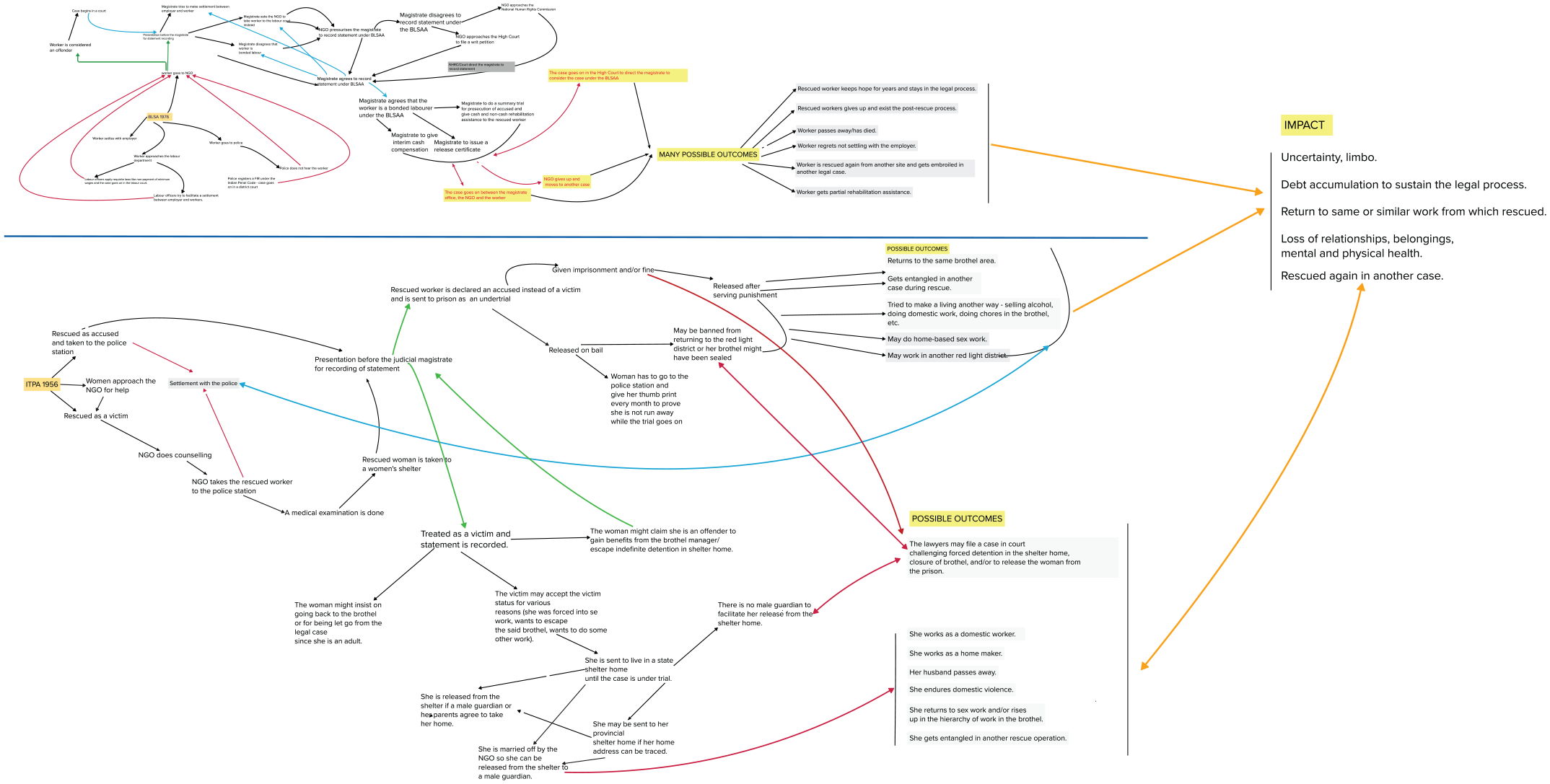
Figure depicting the processual nature of rescue under the BLSAA 1976 and the ITPA 1956.
The figure is not representative of all cases under the two laws. Rather, it aims to illustrate, based on workers’ stories, the processual nature of rescue, which, as shown in the figure, is far from a one-time event. Under both laws, a rescued worker goes through multiple stages during which their very status, as victim or offender, is questioned before they can hope for justice, rehabilitation or freedom. Even when they persist with the legal process in the hope of receiving some justice, they often remain entangled in it for years, casting doubt on the efficacy of the rescue process itself.
Readers can trace each law separately through the figure. For instance, by following the arrows under the BLSAA 1976, it becomes evident that rescue is neither straightforward nor does it bring immediate relief from exploitation. Between the moment a rescue is proposed and the time the state formally rescues the victim, several negotiations and delays come into play.
Findings
Inter-Group Dynamic: Varied Motives and Multiple Outcomes of Rescue
Rescue, often framed as a singular event, is typically portrayed as a collaborative effort between state actors and NGOs, aimed at saving victims and punishing offenders (employers), yet I found that the motivations of these actors are far from straightforward; they are heterogeneous and frequently conflict with the interests of the workers they aim to rescue. NGOs, under pressure to demonstrate measurable outcomes, often ‘script’ workers’ testimonies to align with legal criteria (Ramachandran, 2022). For example, in a 2019 brick kiln rescue, workers Amal and Akash were coached by NGO worker Atul to construct narratives that conformed to the BLSAA:
Since you both have come to us directly, you will not be qualified as bonded labourers [because bonded labour, by definition, requires rescue]. However, your families can be bonded labourers since they are still there (at the worksite). Your wives have to say they are bonded and have not been allowed to leave the kiln.
Yes, they will say what the problem is.
What problem?
The owner beat us, did not give us wages and coerced us into work.
If they do not say this, no case will be registered. I will send my people [social workers] to the district judge’s office. The police are also there.
When we went to the district judge’s office, they told us to go away.
When the higher authority instructs him [the district judge], he may not say anything. Do not say all this in front of him; otherwise, he will get angry. Just say that ‘He did not listen to our case; the rest we do not know.’ Okay?
The rescue itself was violent, with the police siding with the owner, who offered the workers money for train tickets home in exchange for their agreement not to register a case. The workers were divided in their decision: some wanted to take the money and go home because it was sufficient for them to get out of the kiln, but others wanted to be rescued and to fight for their unpaid wages. The NGO insisted that all of the workers must claim bonded status, otherwise it could not help any of them, even though this was not necessary for legal proceedings. If all of the workers agreed to file a case under the BLSAA, it would increase the headline number of workers rescued, illustrating how NGOs often prioritise symbolic victories over practical outcomes for workers. Akash, one of the rescued workers, recalled:
The Sir from the NGO threatened everyone; only then did we all leave the kiln. Some people said they did not want to file a case. Being out of the kiln was enough. The owner gave them money for a ticket back home.
This articulation of ‘threat’ exemplifies how NGO-led rescues can themselves reproduce forms of institutional capture, wherein workers perceive institutional actors not as saviours but as oppressors, echoing research into forced rescue in the context of sex work (e.g. Molland, 2018; Walters, 2016) where workers are promised jobs by NGOs after rescue that did not exist; see, for example, Walters’ (2016) study of sex work rescues in Hyderabad.
Following the brick kiln rescue, the workers were taken to the NGO office for a two-day investigation, during which they were housed in shelters, the NGO office or on railway platforms. The NGO sought to file a case under the BLSAA, so that many workers, while eager to return home, were coerced into providing video testimonies that depicted them as bonded labourers. Six years later, no legal action had been taken, and most, if not all, of the workers had returned to work in another kiln.
This case underscores how an NGO focus on creating legally viable narratives can overshadow workers’ lived experiences. For NGOs, rescuing and registering a case under the BLSAA serves as proof of impact, while police view it as an unwelcome additional workload, and employers strive to avoid legal entanglements. For many workers, the consequences – loss of livelihood, legal entanglements and prolonged uncertainty – often outweigh any perceived benefits. As Brennan (2014) notes, individuals within exploitative systems weigh the risks and benefits of intervention pragmatically, resisting simplistic binaries of ‘freedom’ and ‘bondage’.
In other witnessed instances, workers’ decisions reflected this more pragmatic calculus, as exemplified by Aveer, a circular migrant working in a Haryana brick kiln and restricted from leaving the worksite until the end of the working season, when he called an NGO worker for rescue:
If you can do anything significant, get me unpaid wages, only then come and rescue me. Otherwise, don’t come. My daughter’s honour is at risk, and the owner is in a powerful position. Maybe when the season ends, I will beg, and he will give me something. If you come, I may not get even that.
Aveer’s conditional participation in rescue on the guarantee of wages illustrates his carefully calculated decision to try and protect both his livelihood and family. Myra, a sex worker, demonstrated a similar attitude: ‘The NGO said [at the time of rescue], “We will give you a good job, come with us.” I told them, “When we were living on the footpath, no one came.” Now we are earning, and they come. Why?’
Myra’s words reflect Walters’ (2016) observation that the underprivileged often view rescue efforts as economically disempowering rather than liberating. For workers such as Aveer and Myra, rescue is not synonymous with liberation but rather is a disruptive process that jeopardises their survival strategies. Drawing on Ramachandran’s (2022) work on sex workers in Delhi, such refusals highlight the recognition that, despite constraints, exploitative work can be the ‘best available option’ when individuals evaluate exploitation on the basis of pragmatic considerations, enduring what can be tolerated and resisting what goes too far (Brennan, 2014). These structural factors, including livelihood insecurity, help explain why some workers in exploitative situations may not view rescue as freedom; that is, they may choose not to leave their worksites or may opt to wait out their immediate circumstances.
The conflicting motivations of various actors became even more obvious when state actors’ involvement in rescue was analysed. Despite being tasked with law ‘enforcement’, literature shows that state actors will often dismiss cases, mediate informal settlements or align with employers to maintain local economic and political stability (Clawson et al., 2006). In one instance, 18 construction workers had been evicted or had escaped – according to the different claims made by the NGO and the workers involved – from a construction site after protesting months of unpaid wages. Someone directed the workers to an NGO, which contacted the district administration, seeking to have them classified as bonded labourers, a designation that could unlock legal protections and compensation under the BLSAA. The district labour officer, after brief consultations with an employer representative eager to absolve his company of legal action, announced that the workers could receive unpaid wages on the basis of the government’s minimum wage standards, provided that they did not pursue legal action under the BLSAA.
The workers went into a huddle and the NGO staff urged them to reject the deal, emphasising the potential benefits of filing a case under the BLSAA and promising compensation that extended beyond unpaid wages. The workers decided to file the case, reject the minimum wage offer and walk away. The NGO assured them it would continue to pursue the matter in court. Over the following weeks, as other cases took priority, the workers’ calls to the NGO went unanswered. In a follow-up phone call with the workers in 2023, they told me that they now regretted their decision and should have taken the wages offered. Without these wages, and with little hope of any other compensation, they had returned to work on a different construction site, working once again in similarly exploitative conditions. In the meantime, the NGO had, in a public statement, declared the workers ‘freed’ – an extremely hollow victory that belied the messy reality of their struggle.
This case, like many others, reveals the fraught nature of rescue. Rather than a singular act of liberation, it is an ongoing process entangled with law, power and survival. Here, the workers were initially confused by the contradictory messages of the NGO and the labour officers. Once the NGO had persuaded them, the workers aligned themselves with it, hoping for rightful compensation. Later, the workers expressed regret in trusting the NGO, underscoring the temporal and relational dependencies of rescue. By framing rescue as a process rather than a radical break, it is easier to see how different actors’ motivations may conflict with one another yet also shift over time: NGOs seek legitimacy through legal validation, state actors oscillate between enforcement and complicity, employers prioritise economic interests and workers navigate structural constraints to make pragmatic choices.
Intra-Group Dynamic: Conflictual and Counterintuitive Motivations
The examples of the previous section demonstrate that the motivations of offenders, victims and saviours are far from unilateral. Motivations diverge not only between actor groups but also within them. Employers, for instance, navigate a fluid spectrum ranging from coercion to conditional assistance, working with authorities to evade scrutiny while simultaneously providing workers with limited support to deter legal action. Workers exhibit equally diverse agency: some actively engage in rescue (Amal and Akash) while others resist it (Aveer and Myra), prioritising economic survival over the questionable promises of a better life post-rescue. These tensions underscore broader relational dynamics in the rescue process that operate far beyond any singular event.
Similarly, not all NGOs unilaterally support rescue. Based on their experience in the sector and ideological beliefs, NGO workers offered differing reflections. One NGO activist, working with sex workers and their children for over 35 years in GB Road, Delhi’s red-light district, said:
In the 1995 Beijing Platform for Action, trafficking gained prominence. Hillary Clinton elevated the issue, and Indian NGOs began securing funds from the US State Department in the early 2000s. Rescues followed, but these were chaotic and violent. Women were dragged out, sometimes while feeding their children, and arrested, instead of brothel managers . . . Today, many ‘rescued’ women have returned to GB Road.
This reflection underscores the paradox inherent in many, if not most, rescue operations. While framed as pathways to freedom, the lived experiences of ‘rescued’ individuals often remain unchanged. Women forcibly removed from brothels during raids frequently returned to similarly exploitative situations, exposing a disconnect between the ideological imperatives driving NGO interventions and the structural inequalities perpetuating exploitation (Walters, 2016). These findings align with critiques of moral paternalism in anti-trafficking governance, which argue that rescue often disregards the socio-economic realities that compel workers to endure exploitative conditions (Parmanand, 2022).
State actors, too, demonstrate conflicting motivations. As seen in the brick kiln and construction site cases above, state representatives prioritised the interests of employers, often at the expense of workers. State (saviour) inaction or complicity is often portrayed as a reason for their non-collegial relationship with NGOs (also saviours), as evidenced in the 2023 TIP Report:
Some district magistrates dismissed or misclassified bonded labour cases due to traditional practices and allegedly dissuaded victims from pursuing cases or mediated cases in lieu of criminal prosecution. However, police did not always file FIRs [First Information Reports] to officially register a complaint or correctly file FIRs under trafficking crimes; officials often settled cases at the complaint stage and did not always arrest suspected traffickers.
This portrayal of state officials reflects a broader belief in the literature and in policy as to state complicity in exploitation and/or state reluctance to engage in cases owing to increased workloads (Farrell et al., 2012). Such reluctance is, however, more complex than mere self-interest or collusion with employers, as one police officer explained:
These are illegal brothels, everyone knows. We only interfere when there is a case of trafficking of a minor or someone is forcefully kept in a brothel. If we remove all women, then who will give them work? They are also trying to make the best of their situation.
This pragmatism, shaped by the structural realities of migrant sex workers’ lives, reflects an acute awareness of the precarious balance that police maintain. In this example, law enforcement becomes less invested in the rhetoric of ‘rescue’ and more attuned to the survival strategies of sex workers, recognising that interventions may exacerbate vulnerabilities without providing sustainable alternatives. Magistrates likewise grapple with tensions between socio-economic norms and rigid legal frameworks while implementing the BLSAA. One remarked:
If the employer gives an advance, the worker is considered bonded under the BLSAA. However, no worker will work if an advance is not given to cover subsistence and travel expenses. We all give advances to helpers in our homes, so are we all bonded labour keepers?
Such reflections challenge simplistic framings of exploitation within global anti-trafficking discourses. The magistrate’s invocation of everyday practices – such as offering advances to domestic helpers – disrupts the dominant narrative that equates all pre-wage transactions (debts/advances) with coercion. His assertion reflects a more structural understanding of the workings of the 92% of India’s economy that is informal, echoing scholarly arguments from Bernstein (2018) that the focus of rescue on the individual, and not the structures, enables claims that the problem can be found in a wide range of situations and conditions that can affect anyone, anywhere, at any time (in this case, the informal economy that is heavily dependent on pre-wage transactions).
In this study, the sidelining of systemic causes was, counterintuitively to the popular imagination, critiqued by the state actors rather than the NGOs (except one that works with sex workers in Delhi’s red-light district), and it was the latter, driven by accountability to funders and moral imperatives, that often pressured state actors for action that was immediate and visible; that is, rescue. Thus, one law enforcement officer lamented: ‘NGOs want us to act immediately and declare workers bonded to show their impact. But on the ground, it’s not so simple. We get caught between the law and field realities.’
Such narratives reveal the variations in motivation across instances. By exposing the conflicting motivations among saviours, state actors and NGOs, this analysis moves beyond legal critiques of rescue to uncover the systemic contradictions within anti-trafficking governance. Rather than excusing state inaction or idealising NGO efforts, it provides a critical framework for understanding why interventions often fail to achieve their stated goals. Rescue is not a singular act of liberation but a contested process shaped by competing interests, shifting motivations and conflicting visions of freedom, even within the same actor group.
From Single Moment to Ongoing Process
Viewing rescue as a process shows more clearly that it is not a linear or singular event, but rather a complex, multifaceted process shaped by interactions, power dynamics and the competing interests of various actors. It unfolds through ongoing negotiations among multiple actors, each with distinct motivations for, and visions of, rescue. These differing visions often exist not only between groups but within them too, undermining the clean victim–offender–saviour characterisation commonly employed to justify rescue. Thus, rather than a straightforward intervention in which all of the actors, with the exception of the offender, share a common vision, each actor, be it worker, NGO or state official, holds a different vision of rescue. In consequence, the outcomes of rescue become similarly unpredictable and multifaceted (see Figure 1), challenging the singular outcome described by organisations such as Free the Slaves. These outcomes range from workers returning to exploitative work, as seen in the brick kiln and construction site cases described above, to the rejection of rescue altogether, as articulated by individuals such as Myra and Aveer, rendering the unilateral outcome of ‘rescue as freedom’ not only fragile but also extremely vulnerable to interpretation and manipulation.
The processual nature of rescue becomes especially clear in the context of the intra- and inter-group conflicts that arise. Not all individuals embrace the labels, such as ‘victim’, imposed by the dominant narratives. Some workers, such as Myra, refuse to be rescued, while others, such as Aveer, condition rescue on the vision of freedom they desire (in this instance, the guarantee of unpaid wage settlement). This emphasises the importance of recognising workers’ subjectivities and the diverse factors that influence their decisions, from the perceived risks of rescue to the need for income and the uncertainty of post-rescue conditions. Many workers prefer to leave (exploitative) work on their own terms, paying off debts or securing alternative livelihoods, perceiving them as more tangible forms of liberation than externally imposed rescue. As O’Connell Davidson (2015) suggests, this resistance challenges the assumption that all workers would desire or embrace rescue. For many, staying in work that might be perceived as exploitative can still appear less dangerous than returning to extreme poverty or abusive familial situations. Workers’ resistance to rescue is not, therefore, a rejection of freedom per se, but simply a refusal to accept rescue as it is conventionally understood, especially when it fails to account for their lived realities.
As ‘saviours’, state actors and NGOs are not unified either. While some NGOs genuinely advocate for workers’ rights, their visions of rescue may not always align with workers’ best interests. Howard (2017) found that in Southern Benin, some actors, driven by personal commitments to social justice, would resist or undermine rescue while complying superficially with funders’ expectations. Other NGOs may frame their efforts as moral missions to free individuals from exploitation (Musto, 2022; O’Connell Davidson, 2015), which Molland (2018: 780) describes as a ‘politics of emergency’ that provides immediate moral satisfaction without addressing the structural causes of exploitation, prioritising the arrest of traffickers and the rescue of victims while neglecting the broader systemic issues that sustain poor working conditions (Balgamwalla, 2016). Many state actors also challenge the dominant portrayals of them as either corrupt or in cahoots with NGOs in pursuit of saviourhood. While some may be driven by the desire for recognition, or be motivated by personal or institutional interests, others may explicitly recognise the structural limitations of rescue, criticising NGOs for their lack of understanding of migration dynamics and accusing them of being profit-driven or overly focused on rescue statistics rather than long-term solutions.
Rescue is thus not a definitive moment but a site of struggle and contestation that precedes and follows an act of physically removing a person from exploitation; a site of processual negotiation where competing and often contradictory discourses on victimhood, heroism and criminality intersect and are shaped by the ongoing, multi-actor process of negotiation, resistance and conflicting motivations.
Conclusion
To conclude, this study makes critical contributions that shift the discourse surrounding rescue interventions in contemporary anti-trafficking and labour exploitation frameworks. First, it reconceptualises rescue as an ongoing, dynamic process, extending its theoretical relevance beyond trafficking to encompass broader humanitarian and labour contexts. This processual understanding reframes rescue as a continuous process shaped by conflicting motivations, structural barriers and shifting power dynamics, rather than as a singular or linear moment of liberation. By attending to the fluidity of rescue, it highlights that workers’ post-rescue trajectories, far from being predetermined or assured, routinely emerge as contingent and fragmented, influenced by the intersecting interests of NGOs, state authorities and the workers themselves. This reframing challenges the prevailing assumption that removal from exploitative conditions guarantees freedom, instead presenting liberation as an iterative, contested and deeply contextual process.
While rescue is often idealised as a noble act, particularly in contexts such as natural disasters, domestic violence, fires or war, considering rescue as a process interrogates its more contentious applications. For example, in cases involving asylum seekers rescued at sea, in which migrants are often criminalised as smugglers (Achilli, 2024) and/or detained following rescue (Mainwaring and DeBono, 2021), a processual perspective of rescue can expose the ethical complexities and unintended consequences of such interventions.
Second, the study destabilises the static roles traditionally assigned in rescue narratives, particularly those of victim, saviour and offender (Kinney, 2015). By foregrounding the multiplicity of actors involved, each with distinct objectives, strategies and interpretations of justice, a processual framework challenges the binary framing of workers as passive victims and rescuers as unproblematic saviours. Workers, often assumed to lack agency, are revealed to actively negotiate their rescue, whether through resistance to interventions, strategic compliance or returns to the same or similar work. This dynamic highlights the agency of workers within structurally constrained environments, reconfiguring it not as overt resistance but as complex decision making shaped by intersecting social, legal and economic factors. Moreover, the study contributes to the long-standing call to de-exceptionalise sex work (Parmanand, 2022; Shah, 2007) by broadening the scope of analysis to other labour sectors. It brings to the forefront the diversity within and across actor groups, considering variations in gender, role, work type and context, thereby providing a stronger conceptualisation for the study of sex work alongside other sectors where rescue interventions are prominent.
Finally, the study questions the moral and legal assumptions underpinning current rescue frameworks, particularly those that frame trafficking as a criminal justice issue and rescue as its logical remedy. By exposing the structural factors neglected by criminal-centric approaches, it reframes the role of state actors in rescue interventions. State authorities, far from embodying the unilateral role of saviour, often resist or undermine rescue efforts owing to competing political, economic or ideological interests. This aligns with Ramachandran’s (2019) work on the rescue of Indian domestic workers, situating the rescue process within broader debates on the limitations of criminal justice approaches to trafficking and labour exploitation. By challenging these paradigms, the study provides a robust conceptual foundation for rethinking rescue as a site of negotiation, contestation and structural critique.
While the sample for this article encompassed diverse labour sectors, actors and types of work, it was confined to the Indian context. Future studies could explore the experiences of rescue as a process in other contexts, examining how motivations and conflicts might differ or diverge significantly from those observed in India. In addition, this study focused primarily on ground-based rescue operations across various sectors. With the emergence of new technologies for identifying potential cases of exploitation, such as satellite imagery, future studies on the processual nature of rescue could incorporate such elements into their analysis: how they influence the rescue process, the motivations of the actors involved and the potential outcomes.
The conceptual and analytical value of viewing rescue as a process extends beyond better understanding of actors’ motivations and conflicts; it also provides a critical lens through which to examine a range of anti-trafficking interventions involving diverse stakeholders with competing interests. These include supply chain reporting on slavery, detention centres for rescued asylum seekers arriving by sea and consumer-focused anti-slavery campaigns that encourage the public to identify and report instances of slavery through apps or helpline numbers. Future research in these areas can shed light on their underlying power dynamics, assess their effectiveness and interrogate the key question: who designs these interventions, and who ultimately benefits – or suffers – as a result?
Footnotes
Acknowledgements
I would like to sincerely thank the editor and the two anonymous reviewers for their meticulous engagement and constructive guidance on the article. I am thankful for their time, labour and encouragement. I am also thankful to mentors who read various drafts of the article and to workers and organisations who continue to trust me with their stories.
Funding
The author received no financial support for the research, authorship and/or publication of this article.
Ethics statement
Full ethics approval for this study was granted by the University of Bristol Research Ethics Advisory Committee. Reference number 1753714.
