




Abstract
Family social class background significantly influences parents’ relationships with schools, yet the intersection of class with disability is often overlooked. This study draws on qualitative interviews with 17 majority middle-class parents of autistic young people attending mainstream schools in England, highlighting how social class and disability shape those relationships. Parents actively engaged in their children’s education, deploying economic, social and cultural capitals, and developed expertise in autism to advocate for necessary support and avoid their children falling behind. However, they often felt their efforts were discredited and that they were subject to schools’ expectations of how parents and children ‘should’ behave. This led to parents internalizing blame, and exercising self-surveillance to uphold their identities as ‘good’ parents and not jeopardize support. Theoretically, integrating a Bourdieusian approach within a Foucauldian framing enhances understanding of how parents’ privileged positionings can be weakened by schools’ interpretation of their children’s difference.
Introduction
This article focuses on how families of children with special educational needs and disabilities (SEND) manage relationships with schools. Mainstream sociology explores how social class, gender and ‘race’ animate relationships between home and school (Lareau, 2003; Reay, 1998), but we highlight here the intersection of social class with disability. This builds on a recent Sociology article, where Chatzitheochari and Butler-Rees (2023) draw attention to the need to examine how disability status and parental social class interact to reproduce (dis)advantage and stigma in schools. Existing research suggests that middle-class families with disabled children can use their social, cultural and economic capitals to gain educational advantages, for example through pushing for specific diagnoses whereby extra educational support and chosen educational settings can be accessed (Holt et al., 2019). In a context of falling funding and rising demand for SEND provision, a recent UK government report argued similarly that whether children receive support too often depends on ‘how well their parents can navigate an often chaotic and adversarial system’ (Public Accounts Committee, 2025: 1). We focus here on elements within that process of navigation for one group of parents with autistic children. The context is one of rising mental health issues, exclusion rates and non-attendance among the 18% of pupils – about 1.7 million – with identified SEND in the UK in 2024 (Long and Roberts, 2024; Shafan-Azhar and Bottomley, 2024). In this fraught landscape, relationships between home and school, and what impacts and shapes them, require urgent attention.
This article presents findings from a study funded by the British Educational Research Association (BERA) in 2020–2021, exploring how families with autistic children in mainstream schools in England experienced COVID-19 lockdowns (Oliver et al., 2021). Though we expected our findings to relate to the pandemic’s impact, we were surprised by the extent to which our sample of mostly middle-class parents wished to discuss regular school life before lockdowns and their fears of reintegration in schools afterwards (Vincent et al., 2023). It was clear that many of the parents were able to utilize their resources to advocate for their children. However, rather than feeling secure in their relative advantage, their narratives revealed deep unease about their relationships and their contested positions within the educational field. This indicated broader questions about the constraints parents face in navigating their children’s needs, and limits of their abilities to leverage class-based resources in education.
Our analysis offers a novel conceptual contribution by integrating insights from Bourdieu and Foucault, who are often employed separately in research in this field. Bourdieu highlights how a middle-class background unlocks advantages in the educational sphere (Lareau, 2003; Vincent et al., 2012) including in relation to disability (Holt et al., 2019). However, we show here that disabilities – especially non-visible ones like autism (for some) – complicate a Bourdieusian analysis since it offers insufficient focus on why parents’ valuable cultural resources in the field of SEND are discredited. This led us to Foucault, whose work draws attention to the roles of performativity and accountability in education (Bradbury, 2019) and the discursive construction of disabilities (Tremain, 2015; also Mullen, 2015 and McGuire, 2016 in relation to autism). Our exploration here showed that parents felt subjected to normalizing discourses around how young people and their families ‘should’ be, in the midst of contested interpretations of autism (Nadesan, 2005).
Our focus on autism is important here, since research shows how as an often-misunderstood condition, autistic people can be subject to stigma arising out of a ‘perceived distance from normative ideals of skills and behaviour in school settings’ (Chatzitheochari and Butler-Rees, 2023: 1156; also Farrugia, 2009). Autism is identified by differences in social communication and interaction, restricted or repetitive behaviours and/or sensory behaviours and interests (DSM-5-TR 2022). However, as we illustrate, the behavioural assumptions and standardized procedures of mainstream schooling – that pupils follow instructions, sit still and so on – can be challenging for autistic young people to follow (McKeever and Miller, 2004). They may struggle to meet the unwritten rules and ‘common sense’, doxic understandings of teachers about what children and young people should be like, including around ‘bodily dispositions (i.e. comportment, ways of talking, eating, sitting, touching, etc.)’ (Edwards and Imrie, 2003: 253). Likewise, research shows that parents (especially mothers) often take on heightened responsibility for advocating for neurodivergent children, navigating complex bureaucracies, experiencing blame and stigma (Blum, 2015). In this light, expectations of families and children with SEND can be understood as reflecting normalizing tendencies for the control and cultivation of human bodies.
In our analysis, we aim to draw on Foucault’s work together with Bourdieu’s to develop an analysis of the diverse practices of differently positioned agents by highlighting the ‘disciplinary power and discourse’ (Lewis and Hardy, 2015: 250), which families seek to contest. By using Bourdieu’s and Foucault’s work in this way, we hope to illuminate two aspects. First, the degree to which middle-class parents with plentiful supplies of social, economic and cultural capital utilize these to try to secure extra resources – such as educational support, increased teacher attention and understanding – for their children, alongside investing intensive personal labour to help with their education. Second, we also discuss how, in response to their children struggling to ‘fit in’ with the standardized expectations of mainstream schooling, parents deploy their capitals with caution, straddling a fine line in asserting their children’s ‘difference’, as well as seeking to maintain positive relationships with teachers.
Policy and Theoretical Context
Tensions are rising around the educational support for children with SEND in mainstream education in England following the COVID-19 pandemic, implicating parents in diverse ways. Relationships with schools are becoming increasingly combative for some families, since for many young people with SEND, school is an increasingly difficult place to be, evidenced in increasing exclusion rates, including ‘unofficial’ exclusions (Gill et al., 2019; Ofsted, 2018). The Children’s Commissioner (2019) noted how children are often ‘managed out’ of education, ‘because schools fail to understand or support their behavioural and educational needs’. Imperatives over recent years in mainstream schooling around attendance, discipline, behaviour control and attainment (e.g. Bennett, 2020) have been criticized for failing the most vulnerable and not accommodating children’s diverse needs (Children’s Commissioner for England, 2019, 2023). High rates of mental health issues, a 22% increase in home schooling between 2023 and 2024 (Hattenstone, 2024) – the highest since the pandemic – and a persistent absence rate 1 of 21% (Gov.uk, 2024) indicate problems in mainstream schooling. Whilst acknowledging the challenges around SEND, Education secretary Phillipson (2024) nevertheless also vowed to ‘get tough’ on the ‘epidemic’ of absenteeism by focusing on families, with ‘no apologies for fining, or indeed ultimately prosecuting, parents for children’s non-attendance’.
In 2014, the Children and Families Act aimed to substantially strengthen SEND support, increasing parents’ choice, as well as enshrining in law schools’ responsibilities to meet children’s SEND needs, via ‘Education and Health Care Plans’ (EHCPs). However, in a climate of increased need, requests for EHCPs are often denied, or, if granted, are inadequately implemented, leading to observations that the current system ‘inadvertently perpetuates tension’ and creates adversarial relationships between local authorities and parents (ISOS, 2024: 55). Parents are increasingly engaging in legal challenges, with 98% of tribunal appeals in 2022–2023 finding in families’ favour (Gov.uk, 2023). Rather than address the growing need for SEND support, however, a new narrative began to emerge from the ranks of the former Conservative government, questioning the authenticity of middle-class parents’ claims. In 2023, then-Minister Michael Gove claimed that local authorities, under funding pressure, found it difficult to distinguish between ‘deserving’ families and ‘those with the loudest voices, or the deepest pockets, or the most persistent lawyers’ (Harris, 2024). Others criticized the rising ‘parental expectations’ and ‘demand’ for spiralling SEND-related costs. Then-Local Government Minister Simon Hoare noted: ‘We always just have to keep a weather eye on the sharp-elbowed middle classes, who are very good at understanding the system and have friends and colleagues who are professionals and who can help advocate in particular cases’ (Oral evidence, The House of Commons Levelling Up, Housing and Communities Select Committee, 2023). This interpretation chimes with a sociological Bourdieusian interpretation of the advantages that middle-class families can access in the educational sphere. Here, education is understood as a specific field governed by its own ‘game’, whose fundamental aim is sorting and selecting, and in so doing, privileging middle-class knowledges, ways of speaking, acting, educational pathways and certifications (Thomson, 2014). Family social class backgrounds influence the ability of young people to meet educational ideals and achieve professional success (Vincent et al., 2012). Research shows that middle-class parents deploy their capitals to get their children to the ‘best’ schools (Triventi et al., 2020) and engage in ‘concerted cultivation’ to develop their children through additional extra-curricular activities (Lareau, 2003). All these help smooth the path of the child to elite higher education and careers (Weis et al., 2014). Working-class families, by contrast, may struggle to meet the doxic understandings shaped by the white, middle class, on which school success rests (Crozier and Davis, 2007).
Research with families with disabled or neurodivergent children shows that, equally, social class and ethnic backgrounds influence their ability to meet doxic expectations at school (Chatzitheochari and Butler-Rees, 2023). Holt et al. (2019) demonstrate how disabled young people from affluent and educated families, ‘gain access to specific labels and what is locally considered the “best” education’, possessing the dispositions and knowledge to be able to secure diagnoses and provision. However, other research complicates this picture; Blum (2015: 92) argues that a reading of only privilege ‘oversimplifies’ the difficulties of such families, who face particularly tensions around class reproduction, ‘because so much class transmission is at stake’ (Blum, 2015: 92).
Evidence from our study indeed suggests a more complex picture; though parents certainly benefited from resources, they felt far from secure in their children achieving educational success. We argue for the explanatory role of Foucauldian theory here. Foucault’s explication of biopolitics posits the school as an institutional apparatus of governance and discipline, that seeks to manage, control and even exclude those who depart from hegemonic norms of behaviour (Lewis and Hardy, 2015). In Discipline and Punish, Foucault (1977: 136) articulates how institutions aim to create docile bodies ‘that may be subjected, used, transformed and improved’. His perspective sheds light on the underlying set of assumptions that structure school life, which set expectations of how ‘the child’/‘the teenager’ should be, what they should do and how they should behave. These assumptions are informed by social practices, institutions and medical and psychological discourses that then declare certain behaviours ‘pathological’.
Foucault explains how biopolitical governance, such as the use of population-level statistical norms and averages, generates ‘dividing practices’ that produce categories of ‘normal’ and ‘abnormal’ (McGuire, 2016; Mullen, 2015; Tremain, 2015). Construing the abnormal as a threat then warrants intervention into people’s lives to discipline them via the ‘imposition of normalised expectations of behaviour and the comprehensive surveillance of subjects’ (Lewis and Hardy, 2015: 249). As we explore below, much of this responsibility falls on parents; Davidson (2021) draws on Foucault to explore how amid growing diagnoses of neurodiversity, contemporary American parenting discourses emphasize parents’ responsibility for not only educational success, but increasingly for a child’s emotional control. Being able to self-regulate behaviour and sensory responses becomes a measure of the child’s ‘potential economic viability and success’ (Davidson, 2021: 1139) with those struggling assessed and medicalized.
In what follows, we first employ Bourdieu to show how young autistic people and families from middle-class backgrounds are caught up in the ‘game’ of mainstream schooling and use their capitals, including specific knowledges acquired around SEND, to seek support (Holt et al., 2019). However, we show how that support is still often denied in the face of financial struggles of schools, as well as through recourse to expectations that reflect schools’ normalizing tendencies to manage and control difference. We then explore how parents respond through self-surveillance and regulation of their own behaviour, to reflexively avoid tropes of ‘the pushy middle-class parent’, which risk jeopardizing their children’s educational futures.
Methodology
The research involved online interviews with 17 parents (15 mothers, two fathers) of autistic children, most over 10 years old, as well as six autistic young people. We conducted two surveys at recruitment and at follow-up stages, collecting data on family demography, occupational backgrounds, children’s diagnoses and experiences of returning to school post-pandemic. This article primarily reports parental perspectives, while autistic children’s own accounts of their schooling will be developed in future work. The parental disclosures about pre-pandemic times and relationships with schools were unexpected, thus we did not seek teachers’ perspectives in the original study, though we recognize this would be valuable for further study.
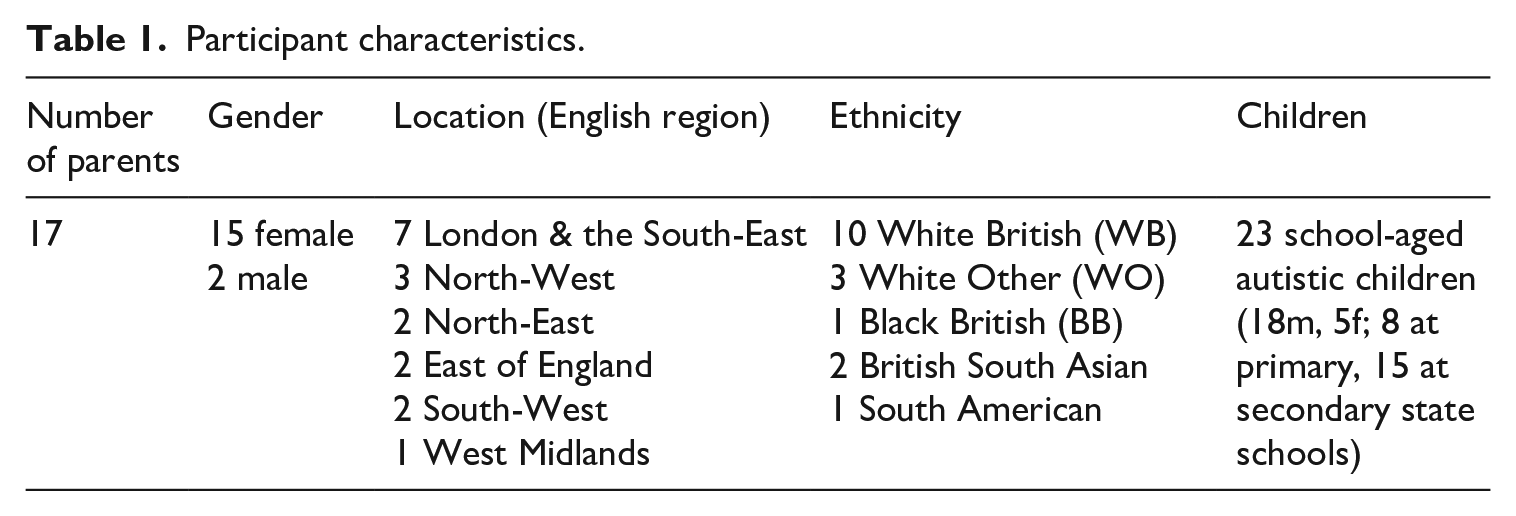
The study’s sample was self-selecting, based on parents opting-in via social media and through adverts to SEND support groups across England. This resulted in a largely middle-class sample of parents (all parents, no carers in this instance), as defined by parents’ self-described occupation. We acknowledge that more nuanced occupational and educational information would have provided more detail about parents’ education and family backgrounds (e.g. whether first or second generation middle class). Our sample was relatively small, including 14 parents in professional roles (requiring a degree and/or sustained training), two in routinized occupations and one who did not disclose sufficient information. Participants were mainly White British (10) but also British Asian, Black British, White Other and Latin American and came from diverse areas of England (see Table 1).
Participant characteristics.
Given the small numbers and varied racial/ethnic backgrounds of the non-White British parents, we have not pursued an analysis that focuses on race here, although we see further understanding of the intersection of class, race and disability (see, for example, Gillborn, 2015) as a key area to which we would wish to contribute in future work. Nicole, a Black British mother was the only parent who commented on the interaction of race and disability for her child, Tom (aged 17 years). She noted that the combined invisibility of autism as a disability and the ‘hypervisibility’ of being a Black British boy – an identity vulnerable to prejudicial assumptions about disruptive behaviour and low academic achievement (Wallace and Joseph-Salisbury, 2021) – combined to give Tom ‘the worst of both worlds’. He responded to this by working to stay ‘very, very contained’ to avoid stereotypical representations (Vincent et al., 2023).
Two mothers in the sample identified as autistic, raising issues of voice and representation as we were non-autistic researchers speaking with mainly non-autistic parents about their autistic children (albeit some young people also participated). However, we drew on the lived experience of one of us, who is a parent to three autistic children attending mainstream schools. An advisory group (who were not interview respondents) of four mothers with autistic children also helped shape research strategy and discussed emerging themes.
We conducted (recorded) semi-structured interviews with participants via Zoom during the lockdown, with interviews lasting between 60 and 90 minutes. We also carried out interviews with six young people (White British; one female, five male; 11–17 years) whom we approached via their parents, but negotiated consent with separately. Alert to the emotive nature of the topics under discussion we ensured regular opportunities to pause or stop the interviews. However, we found many parents felt positively about discussing their experiences. We followed strict ethical protocols, supported by an enhanced ethics application at our institution. All participants’ names are disguised with pseudonyms.
The data were hand-coded, using thematic analysis (Braun and Clarke, 2019). We looked for consistent themes according to categories informed by existing literature (e.g. the activation of capitals) that were latterly refined, adapted or abandoned in further analysis. Coding was discussed as a team to ensure we shared understandings, and all team members reviewed the transcripts, gaining familiarity with and across them.
Playing the Game: Modified Capitals
Our observations focus first on how middle-class parents use their capitals to manage their children’s educational lives. All the parents we spoke to were supportive of education and the rules of the game regarding schools’ functions of sorting and selecting people (Thomson, 2014). This was evident among our sample where parents drew on ideas of ability as fixed and innate (Bradbury, 2019). Several viewed their children as academically gifted: Lily referred to Robert (aged 10) as ‘cognitively bright’, Laura called her eldest son ‘the brightest in the school’, Grace described Milo (6) as ‘really bright, in the top [group]’ and Beatriz noted Alejandro (8) as ‘someone with such a big memory, so clever, making relations and associations quickly’. They expressed pride in their children’s academic orientations, which possibly operated as a defence against stigmatizing views of autism.
Nonetheless, parents struggled to reconcile their children’s cognitive ‘brightness’ with lesser academic success. Their children faced challenges meeting the normative expectations of assessments and high-stakes tests in contemporary schooling (Bradbury, 2019). Parents suggested these struggles arose from limited support at school and felt pressure to compensate. Laura (White British) for example, had a critical view of her son Ryan’s (16) schooling: He’s missed years and years of school. And for me at the minute it’s just a case of I’m dragging him through his last few months, and I just want him to pass a few . . . the most important GCSEs. And really if he’d have had the support when he needed it he’d be leaving school with 12 A*s, but you know, what can you do?
The narratives echoed traits of middle-class anxiety identified in other studies, for example evident in parents’ ‘risks’ in sending children to state schooling (Reay et al., 2011). However, these parents were less concerned with getting ahead, than avoiding their children falling behind, ‘missing out’ or stalling in their educational journey. Beatriz was critical of her son Alejandro’s (8) educational provision that impeded his progress, describing the school as acting ‘more like a babysitting service [. . .] trying to manage [his] behaviour’. She describes her son’s experience of routinely being sat outside class in the library with a teaching assistant: ‘it just felt like a year that he kind of lost’. Donna also referred to Daniel (13) being ‘already three years behind’. This anxiety of ‘lost’ time heightened immeasurably for many parents during lockdown.
To mitigate the risk of ‘falling behind’, parents invested heavily in organizing their children’s educational lives. Blum (2015: 94) identifies how middle-class families face an ‘imperative to maintain class transmission’, and this is exemplified by Laura as she assumed an individualized responsibility to educate Ryan. Her labour included extensive liaison with schools, where she referred to the ‘20 emails a week’ exchanged with teachers to seek accommodations for Ryan’s anxiety and sensory preferences. In lockdown, parents also attempted to adapt and teach themselves what their children often found to be inaccessible curriculum content sent by schools. Laura explained that Ryan: ‘did nothing, he did nothing. They kept sending reams and reams, so I would sit and try and do this stuff with him because I thought History – he’s going to miss huge chunks of the syllabus.’
Parents were able to call upon relevant capitals in their involvement and advocacy, especially through their own professional knowledges. Our sample included a social worker, teacher and academic, all with relevant knowledge and expertise regarding autism. They utilized social capital via personal networks of influential contacts, and used economic capital to buy in specialist provision and pay for legal challenges to circumvent the limited provision on offer (Holt et al., 2019). For example, Lily (White British) was a teacher and her husband, an educational consultant; this helped them access high-level medical support for Robert (10): He’s under doctors in London and that’s how we’ve managed to be able to get stuff for him because they’ve basically trumped the local teams to be able to get that support. But if I hadn’t have had [that] I don’t know how we would have got stuff for him.
Jaz, a British Asian academic, also possessed cultural and social capital that placed her in an advantaged position in the field of schooling: I guess I was quite lucky because I’d worked in a lot of schools around [the city] and the surrounding area, so I knew where I needed to go [. . .] [In the chosen school], their SEN support is fantastic. [. . .] One of my students [works professionally] in schools, so she very much [said] ‘you need to send Amir [6] there’.
Jaz references being ‘lucky’, but Ingram et al.’s (2023: 154–155) interpretation seems appropriate here: that good luck ‘operates unconsciously as a trope for the misrecognition of privilege’. Likewise, John (White Other) deployed cultural capital – in this case his familiarity with policy texts as a government benefits advisor – to ‘quote word for word the regulations’ to the headteacher to secure his daughter Eva’s (14) place at school during lockdowns. Unlike the mothers in McKeever and Miller’s (2004) study who acquiesced to medical professionals in realizing the ‘rules of the game’, these parents were less likely to refrain from querying or correcting teachers (although below we identify limits to this). This may be explained by the ambivalent professional status of teachers, who enjoy a habitus less ‘invested with [legitimate] cultural, economic and social capital’ (McKeever and Miller, 2004: 1181) than medical professionals.
Finally, parents often deployed a specific form of cultural capital, based on a largely self-taught, specialist knowledge of autism. Our sample included six parents who had studied, researched or had professional experience of working with autistic children, often after having left other careers to care for their children. For example, Laura had given up her role as a midwife, but later became a local councillor, explaining her move as ‘purely because of the SEN thing’. Beatriz was employed as a careworker, but her son’s experience fostered her interest in neuroscience, leading to part-time study at postgraduate level. Nicole also developed a career in the autism field. She described her journey of accrual of specialist cultural capital; initially she felt ‘overwhelmed with this whole new world of terminology’, a place she described as ‘confusing and distressing’. Over a 10-year period, she acquired social and cultural capital, as she ‘attended courses and legal training and just got a whole library of books’.
Parents like Nicole thus self-educate and become familiar with institutional languages, legal frameworks and systems used for the diagnoses of autism, to arm themselves in their struggle for educational provision (Blum, 2015; Dunleavy and Sorte, 2022). Possession of this specialized body of knowledge allowed parents to attempt to reposition themselves in the field of schooling as sources of impartial expertise, rather than through a subject position as ‘X’s mum/dad’ with all the subjectivity and emotion that positioning implies. This type of capital has some similarities with Yosso’s (2005: 79) ‘resistant capital’ fostered among minoritized parents, referring to ‘those knowledges and skills fostered through oppositional behaviour that challenges inequality’, albeit this is grounded in this case through lived experience rather than histories of oppression. This expertise went some way to help challenge assumptions of mainstream schooling around ‘the order of things’. In particular, parents drew on increasing societal awareness of neurodiversity and counter-discourses that frame autism as a ‘potentially positive “neuro-variation”’ (Nadesan, 2005: 205) to inform their knowledge and aspirations for their children. Greg (White British), for example, describes how his discovery of neurodiversity reframed his thinking: I hadn’t heard this whole other idea about it [autism] being a difference and not a deficit. And I’ve actually spent a bit of time speaking to autistic adults, and hearing a totally different . . . perspective on it, right. And they spoke a lot about this neurodiversity paradigm as opposed to the pathology paradigm, right. And it’s been mind-boggling for me, right, because all of a sudden you don’t have to look at it like it’s a tragedy.
Greg combined his growing knowledge with insight from his professional role in social work, to challenge provision offered to his son. Referring to an ineffective ‘social story’ [resource used to guide autistic children via visual representation] offered by his son’s school, he explained, ‘I said, “look we’ll make our own social story [. . .] I’ll send it in” [. . .] I’m lucky enough to be able to access some resources that I could use through my job.’ Greg’s specialist knowledge and resources allow him to ‘play the game’ in order to mitigate the weaknesses he sees in his son’s experience of mainstream education.
Limiting Capitals: Blame, Disbelief and Becoming ‘the Awkward Parent’
You could be a lawyer and you still feel like a child when you’re talking to your child’s school. (Nicole) I can get a little bit frustrated [with school], [. . .] there’s something like a red flag goes off in your head where you think ‘Oh my God they don’t know what they’re doing.’ (Greg)
Nicole’s and Greg’s observations reveal that although parents cultivate their children’s educational lives, this often failed to deliver the results they wished for. In this section, we show how parents felt their questioning of the doxa of schools placed them in a somewhat antagonistic position, where their knowledges were at times ignored, and they felt misunderstood. Rather than only focusing on the middle-class ‘entitlement’ identified above and in other studies (Holt et al., 2019) we also therefore explore further how parents become constrained by disciplinary technologies in how they are able to wield their capital and knowledge of the rules of the game. To advance this understanding, we nuance our Bourdieusian analysis by nesting this within a Foucauldian perspective that sheds light on how constraints arise due to the categorization within schools that judges both autistic and family behaviours according to norms of production of ‘docile bodies’.
Our findings suggest that even where parents might expect to be strongly positioned in the field of schooling as well-informed professionals, they reported feeling that their knowledge and capitals were futile (cf. Holliday Morgan and Stahmer, 2021 on minoritized mothers). Lily reflected on her privileged position in her relationship with schools, but described engaging with the local authority as ‘a nightmare trying to fight for him, it’s just relentless’. She explained, ‘My husband and I know the system really well, we’re both teachers, we’re very experienced. And even with that knowledge it’s been really, really hard.’ They felt undermined by bureaucratic struggles, ‘battles’ and ‘fights’ of attrition with under-resourced schools unable to sustain the intensive support they felt their children needed (Dunleavy and Sorte, 2022). De Wolfe (2014) noted the symbolic violence of the bureaucracy of procedures, especially where parents are asking for change which challenges the dominant doxa, the logic of practice and the capitals at stake in the field. Lily lamented, ‘There are just parents everywhere struggling to try and get the right provision for their child, and it’s really sad that they’re having to fight and fight, ’cos they’re tired anyway.’
Participants reflected that the intensity of parental advocacy was costly in terms of time, emotional labour and financial resources. For instance, Jaz, a lecturer, was able to remain in work while caring for her son due to the flexibility offered by her employer, but nevertheless noted the mounting costs of private therapies: ‘So that’s £100 a week. And then another £65 for the OTs [occupational therapists]. . .. we can’t do it.’ This is especially felt by mothers who had given up their own professional careers, like Laura. While it is a position of privilege to be able to do so, abandoning careers also came at considerable financial and emotional costs (Blum, 2015). Employing an independent educational psychologist to assess Ryan (16) for the lengthy legal procedures, Laura observed: And I thought we’re in quite a reasonable position because my husband has a decent job, but our house is falling down . . . I’ve got cardboard holding plaster on the walls, because I am anticipating having to spend a minimum of what, £5-grand, maybe 10, on the next tribunal [legal proceedings].
A common source of difficulty emerged from what parents felt was a ‘misrecognition’ of their children’s issues within the disciplining tendencies of schools, where their autistic children were interpreted as ‘unruly bodies’ ‘whose physiological excesses are seen as disrupting the disciplined control of schooling’ (Erevelles, 2000: 34). Though parents expressed deep appreciation of particular teachers who understood or ‘got’ their child, this was often described as the exception. Appreciation was also articulated through commentary less about a teacher’s expertise and in more personal terms. Thus, Lily referred to her child’s ‘lovely’ teacher, and Laura, to the ‘wonderful’ Year 5 teacher, as ‘the only one that sussed him out on his first day’. By contrast, parents recounted how other teachers misinterpreted incidents related to autism as evidence of their children ‘misbehaving’, wilfully ‘defying’ teachers and ‘choosing’ negative behaviours. This ranged from minor classroom incursions, such as rocking on a chair, flicking a rubber band or playing with a pen, to more severe forms of disruptions in autistic meltdowns or shutdowns. Some of these activities are recognized as a presentation of autism known as ‘stimming’ – self-stimulatory behaviour – which can include making certain noises or movements to manage emotions and achieve comfortable levels of sensory stimulation (National Autistic Society, n.d.). However, according to parents, some teachers interpreted this sensory regulation as wilful disruption, leading to exclusions or negative labelling of their child (see also Children’s Commissioner for England, 2023: 23).
An example is provided by Helen (White, British) whose son, Matthew (16) was told off and sent out of class for tapping rulers and leaning back in his chair. According to Helen, teachers read such behaviours as defiance, as Matthew, ‘doing it purposefully to annoy . . . them’. Helen offered an alternative reading, informed by her experiential understanding of autism, ‘Well he’s not defying you, he’s rocked on his chair since he was a baby, it’s a sensory thing.’ Parents’ experiential understandings of their child’s need for sensory and emotional regulation, or as an expression of (dis)comfort contrasted with some teachers’ interpretation of students ‘choosing’ to disobey rules. And where some of the teachers viewed pupil behaviour as individual pathology, parents felt this enabled schools to reframe the problem as arising from failures in parental discipline, rather than a schooling issue. For example, Nicole described how Tom’s (17) acute anxiety – which made it intensely challenging for him to participate at school – was understood by some teachers as demonstrating his choice of non-compliance, and revealing of her own parenting deficits. She articulated the belief she met at Tom’s primary school that ‘clearly you’re not parenting him properly’, where she experienced: A huge sort of prejudice that I [. . .] wasn’t bringing him up properly. [. . .] There’s an assumption that he can listen to instructions and behave. ‘He’s choosing not to use his red card’
2
I was told. But when you’re talking about kids with emotional dysregulation, they don’t always have the time to understand that they’re going to have a meltdown. But [his teachers] only perceived it in terms of his aggressive or defiant [behaviours]. You know, lots of really negative language, and I really had to fight to reframe it all. (Nicole, Black British)
Tom’s lack of obvious cognitive impairment further supported teachers’ views. As reported by Nicole, they thought: ‘well, he’s a bright child, there are no obvious developmental issues, so therefore nothing’s wrong with him, apart from he’s just being naughty’.
Similarly, Harry (11) was anxious about attending school, something that some staff members perceived as a reaction that his parents could and should control, but over which the school relinquished responsibility. His mother Gosia (White Other) told us how they reclassified the behaviour as deviant: The school announced from now on that they were treating Harry as a truant [. . .] And the school said, ‘all provision is great in the school, he just has to come and take advantage of it, we’re not doing anything else’.
Gosia felt the school expected her as a parent to manage Harry’s ‘unruly body’ and comply (Erevelles, 2000), explaining how she was told to: ‘Maybe just push him in’ [i.e. physically through the gate when reluctant to go into school]. So we sometimes can’t . . . He gets to the gate and he can’t go in, or sometimes he just won’t cooperate with the morning routine at all. It’s very difficult because we’re being pressured to deliver as parents on our responsibility. . . The absences are not being authorized because there is no recognition this is SEN or anxiety, this is a choice according to the school [. . .] They are very strongly saying they are meeting all his needs and Harry’s difficulties are mostly because of our bad parenting.
Interestingly it is the attendance officer, the official source of disciplinary sanctions for non-attendance, who later intervened, proposing a compromise of two ‘soft days’, where absences would be authorized. This indicates how teachers’ responses are formed in response to the disciplining pressures of schools in contexts of high stakes testing and accountability, where attendance and behaviour are linked to attainment. If parents are seen as failing to produce children with ‘docile bodies’ (Foucault, 1977) however they may internalize blame. Nicole, who also worked with parents of other autistic children, observed: And lots of parents have told me about how they feel like a bad parent and their own mental health suffers when the teachers are saying ‘well haven’t you told him or her not to do that?’ And ‘don’t they understand X, Y, Z?’ And ‘why did they thump that child in the playground?’ And all these questions that appear very full of blame.
Another challenge that families reported was feeling ‘disbelieved’, especially when their child’s presentation of autism was less visible, revealing misunderstandings. Autistic children can appear to be ‘fine’ in school while autistic traits are displayed at home, in a common phenomenon known as ‘masking’. Halsall et al. (2021) describe masking as ‘camouflaging’, and ‘hiding’ autism-based behaviours to manage social situations, with the aim of fitting in with others. This is especially common in girls. For autistic young people, however, masking costs considerable emotional energy, and can result in the expressions of pent-up feelings when in the relative safety of home. Nevertheless, parents felt again that some teachers misunderstood this, and assumed parental claims around their children’s challenges to be exaggerated, invented (Blum, 2015), unconnected to school life and revealing problems of parenting. In Blum’s (2015: 91) study, one parent observed, ‘Well, he’s acting out at home, it must be something that we’re doing’ (emphasis in original). Similarly, Samantha, Olivia’s (11) mother said: They [primary school] just really struggled to see it, because at school she was so co-operative. I could see how hard she was working [to mask]. . . because we were having big outbursts [at home]. . .They just didn’t believe me I don’t think. (Samantha, White British)
Other mothers also reported feeling disbelieved, resonating with Dunleavy and Sorte’s (2022: 336) claims of some families experiencing ‘gaslighting’ where they felt some teachers were ‘denying their reality’: There’s still been certain members of staff who don’t believe there’s something wrong or that you’re making things up, when your child’s at home self-harming and getting very angry. And they won’t accept that it’s something happening in their classroom that’s making your child feel like that [. . .] even though they look OK at school. (Lily, White British; son Robert, 10) The SEN department did not see anything, they literally didn’t think there was anything wrong with him, they even put us through refusing to accept his autism diagnosis. (Laura, White British; son Ryan, 16)
Disbelief is especially problematic since parents are reliant on school inputs to multi-agency assessments in children’s diagnosis and support assessments (e.g. for EHCPs). Parents found themselves in a catch-22, where needs were more likely recognized if physical disruption occurred. Here the ‘abnormality’ of ‘an unruly body’ signals something obviously ‘wrong’ and this becomes the necessary catalyst to gain support. Thus, it was only once Leah (9) displayed disruptive behaviour her mother Rachel (White British) reflected wryly that the school would respond to her concerns: ‘[Leah] started kicking off at school – which I was quite happy about [laughs] because they finally listened to me.’
Such examples reveal how categorization practices in schools work as disciplinary technologies that reiterate disability as both visible and homogeneous (Davidson and Orsini, 2013). Though certain behaviours of the unruly body, evidenced earlier, are undesirable, they nevertheless make the condition more visible and ‘fixed’ as a disability, which can be tied to requirements (or not) for provision and support. When autism presents in more ambivalent manifestations, such as when children like Robert, as Lily described, ‘look OK’, its blurred nature can be perceived as more problematic – and more challenging as a result. This is noted by Donna (White British) who compared her older autistic son, Olly, who attended special school, to her younger autistic son, Daniel (13), in mainstream school and noted: ‘I’m finding it really difficult with Daniel because he’s in that more “between worlds” situation. Olly is special needs, it’s in your face, you can’t deny it. Daniel’s in this grey area.’ Within ‘the grey area’, we find that parents’ advocacy for their children must reinstate their children’s difference and insist on the relevance of their child’s autism to argue for more appropriate understanding and provision. This drives parents down formal diagnostic routes to ‘claim children’s legitimate difference’ to harness support (Davidson, 2021: 1135). This may be particularly acute for parents of autistic girls, where their autistic traits may be more subtle and their needs not recognized due to a higher tendency to mask, be compliant and not ‘seem autistic’ (Halsall et al., 2021). The approach can be risky for parents however; McGuire (2016) observes that advocacy itself sets their children apart as ‘other’, whereby the presentation of these bodies as requiring intervention sustains the dominant cultural orientation against autism.
Finally, we also noted how parents respond through self-surveillance and reflexivity in their interactions with schools to defend against tropes of the ‘pushy parent’. They reported taking care to avoid adopting too combative a positioning and thereby being scapegoated as ‘difficult’ or ‘awkward’, through normalizing judgements of ‘appropriate’ parental behaviours. All such labels, they felt, risk the family being reinscribed again as the ‘problem’ and limiting parents’ potential success in advocating for their children. This led to some parents avoiding raising legitimate concerns, such as Beatriz whose child Alejandro (8) spent most of a school year outside his classroom with a TA. Though she expressed deep unhappiness to us, she nevertheless avoided complaining, referring to herself as ‘not that pushy parent’. Greg, a social care practitioner, also commented: I’ve seen this first hand, . . .. as a parent and as a practitioner really – I think you can very quickly get labelled as a difficult parent, and you can also kind of . . . you can kind of get a reputation. And obviously you want to build relationships with the staff that are supporting your children – and some people just don’t like to be challenged about things, do they, unfortunately?
Greg reluctantly accepted what he felt were unsuitable arrangements when during lockdown he was asked to keep his son, James, out of school for three days at very short notice due to a TA’s absence. He explained that ‘because I don’t want to be labelled as an awkward parent again, we accepted that one through gritted teeth’. A few parents ‘othered’ themselves as trouble-makers. As Laura explained, ‘Parents don’t complain because they’re terrified [but] then nothing will change. Because you just get the odd few like me, that everybody then thinks is really annoying.’ The exercising of caution that Beatriz and Greg adopt might seem to be examples of parents modifying capitals, choosing how to play the game and considering when best to deploy their capitals, for example around when to push forward with their arguments or requests. However, the reluctance expressed by the participants suggested that they did not feel they had any choice but to (ruefully) accept school practices. Indeed, most parents felt resigned to the limits of their parental advocacy, corresponding with Bourdieu’s (1998: 103) notion of symbolic violence: an understanding that when something ‘went without saying, that there was nothing else to do’.
Conclusion
Our research sheds light on the complex dynamics shaping relationships between home and school among middle-class families with autistic children in mainstream schools. Following the example of Hannus and Simola (2010) we employ both Bourdieu and Foucault as providing ‘a complementary rather than conflicting methodology to better understand macro- and micro-considerations of power and governance’ (Lewis and Hardy, 2015: 250). We show how on one hand, these families experienced advantage, utilizing economic, cultural and social capitals that are valuable in the fields of schooling. Their middle-class privilege drove them towards an intensive cultivation, and the development of a specialist form of cultural capital around understanding of autism. However, the aim was less about pushing their children ahead, than a means of advocating for their children to avoid them ‘falling behind’. Nevertheless, parents felt frustrated at times, subject to normative expectations of how both children and parents ‘should’ be, and experienced their knowledge being recast as invalid. Facing misunderstandings of autism by some teachers, they felt their children were positioned as either disruptive of ‘the disciplined control of schooling’ (Erevelles, 2000: 34) or as not quite ‘different enough’ and thus, less deserving of additional support.
As a consequence, some parents felt required to insist on their children’s autistic difference. However, this is a risky process; McGuire (2016: 262) claims that even current discourses advocating for autism support ultimately sustain the dominant cultural orientation against autism, casting some bodies as requiring, and as being necessarily, the site of intervention. This is essentially the case for parents here, where capitals were often deployed in ways that focus on their children’s difference, through medicalized language and expertise in bureaucratic processes that, as we have argued in relation to Foucauldian production of difference, categorize and set their children apart as ‘other’. As a result, parents have to walk a very fine line to keep the emphasis on difference and not disorder/deficit (Runswick-Cole, 2014). Although the language of neurodiversity has increased public awareness and acceptance in recent years, reductive and stigmatizing conceptions of autistic people remain (Botha et al., 2022). Caution was also evident in parents being conscious of unfavourable narratives of parent-blaming for their children’s difficulties, or of being overattentive and pushy. They themselves felt obliged to reflexively monitor, self-censor or acquiesce to avoid disrupting ‘schools [. . .] standardized views of the proper role of parents in schooling’ (Lareau, 1987: 73). The parents revealed internalized blame and self-surveillance, especially in seeking to avoid being ‘difficult’, and were thus subject to normative expectations of behaviour that their children also experience. Such framings we conclude, require parents to activate their capitals with caution, so as not to alienate those who educate their children.
Though middle-class families with autistic children are our focus, there are indications from our data that other vectors of difference, such as race/ethnicity (Blum, 2015) are relevant (see, for example, Nicole’s words on the intersection of race and disability above), which our limited sample size does not allow us to expand upon with confidence. Certainly, more attention is needed on how social class backgrounds of families with disabled children, in combination with other vectors of difference, such as race/ethnicity, gender, place, location and family configuration (including carers as well as parents) affect relationships with schools and educational experiences (Holt et al., 2019; Wilson and McGuire, 2021). Our research develops that agenda, by drawing attention to the nuances of marginalization within education systems, the mechanisms by which exclusion occurs, as well as understanding of which parents can (and cannot) advocate successfully for their children and why.
Footnotes
Acknowledgements
We would like to thank the participants in this study, the parents in our advisory group as well as the funders of the research through a small grant, the British Educational Research Association. Appreciation too to Bronwen Jones, who assisted with some coding and offered helpful insights. Finally, we would like to thank the anonymous reviewers of the article for their deep engagement and extremely constructive suggestions on earlier versions of the article.
Funding
The authors disclosed receipt of the following financial support for the research, authorship and/or publication of this article: this work was supported by the British Educational Research Association [grant number COVIDOLIVER].
Ethics statement
The research was approved via Institute of Education, University College Research Ethics Committee (number REC 1413).
