




Abstract
Women’s higher college completion rates and greater economic returns to education are regarded as a pathway towards economic gender equality. However, gender-segregated educational choices contribute to persisting gender segregation in the labour market and the gender pay gap. Few studies have explored how the returns to education vary based on the gender composition of fields of study. Using comprehensive register data from Norway, this study examines the link between income and gender-typed fields of study across education levels. Consistent with prior research, we find that women experience larger relative returns to higher education, indicating that women have more to gain from investing in education. Moreover, female-dominated fields yield lower returns compared with gender-balanced and male-dominated fields across all education levels. Lastly, and contrary to the ‘glass escalator’ notion, the economic penalty associated with female-dominated education is greater for men than for women.
Introduction
Over the past decades, there has been a reversal of the gender gap in educational attainment in most western countries, with more women than men graduating from higher education. The female advantage in college completion has sparked debates about whether men are falling behind within the education system and in society at large (DiPrete and Buchmann, 2013). Moreover, it has been documented that the relative returns to higher education are larger for women than for men, meaning that women have more to gain economically from pursuing higher education (e.g. Charles and Luoh, 2003; Diprete and Buchmann, 2006; Dougherty, 2005; Hubbard, 2011; Trostel et al., 2002). The increasing educational attainment of women combined with their larger economic returns to education is often viewed as the most promising path towards economic gender equality (Mandel and Rotman, 2021). At the same time, however, men and women often pursue different types of education, contributing to persistent gender segregation in the labour market, which in turn is an important reason for the gender pay gap (Charles and Bradley, 2009; Østbakken et al., 2017). Against this backdrop, we examine the association between education level, the gender-typing of fields of study and income for men and women using Norwegian population-wide register data.
Relative returns to education, also referred to as higher education premiums, are usually conceptualised as the pay gap between those who have higher education degrees and those who have not. It is this relative measure of returns to education that has been shown to be larger for women than for men, suggesting that women have greater incentives to invest in education compared with men (Mandel and Rotman, 2021). Despite the widely acknowledged argument that education and skills associated with women are undervalued in terms of pay and status (e.g. Correll, 2001; Ridgeway, 2011), few studies have taken the gender composition of fields of study into account when examining relative returns to higher education. We argue that this is important, given that men and women tend to choose different fields of study across all levels of education.
In contrast to the relative returns to higher education, the absolute levels of returns have usually been shown to be higher for men than for women (Mandel and Rotman, 2021; Reisel, 2013). This means that on average, men earn more at each level of education. While the relative returns to higher education are relevant for assessing individuals’ incentives to pursue higher education, absolute measures have been argued to be more suitable for cross-group comparison since they reveal the added purchasing power associated with higher education (Mandel and Rotman, 2021).
Given the increasing significance of education for labour market opportunities in advanced economies and the persistent gender pay gap, it is important to investigate the ways in which economic returns to education are gendered. In this article, we contribute to the literature on gendered returns to education in several ways. First, we examine economic returns in relative terms by investigating how the association between education level, gender composition in fields of study and income differs according to gender, which has implications for our understanding of individuals’ incentives to pursue different types of education. Second, we examine gender differences in the levels of returns by investigating the income differences between men and women with the same level and gender typing of education. By analysing population-wide register data, including detailed information about income and education for multiple cohorts, we are able to investigate returns to education in a Scandinavian context. Norway has a high proportion of women in the workforce and moderately high levels of educational and occupational segregation. Because of the compressed wage structure, however, the impact of labour market segregation on earnings is weaker than in countries with higher levels of income inequality, and the returns to higher education are also lower than the Organisation for Economic Co-operation and Development (OECD) average (Reisel, 2013). In light of these contextual features, Norway makes for an interesting case to study the gendered aspects of the economic returns to education.
Background and Expectations
Gender Differences in Returns to Higher Education
While studies of the gender pay gap usually aim at identifying factors that explain why women earn less than men, studies of returns to education focus on how education translates into labour market outcomes, such as pay, and how these returns vary between different groups of graduates. Previous research has documented that education level is positively associated with income, even though the relative economic returns to higher education have been shown to be smaller in Norway than in most other European countries, reflecting the compressed wage structure (Barth, 2005).
Several studies have examined how the association between education level and income differs by gender, and a recurring finding is that the relative returns to higher education tend to be larger for women than for men (Arrazola and de Hevia, 2006; Reisel, 2013). In other words, women gain more economically by pursuing higher education than men do. In terms of broader measures of material well-being, such as standard of living and protection against poverty, Diprete and Buchmann (2006) have found that women’s returns to higher education in the USA appear to have risen more quickly than those of men, which they argue may partially explain why more women than men now complete college education. This argument is in line with the human capital perspective, typically applied in the economic literature, which views education as an investment in human capital, and assumes that positive returns to education provide an incentive to invest in education (Reimer and Steinmetz, 2009).
While it is well documented that field of study is important for earnings and other labour market outcomes (e.g. Kirkeboen et al., 2016; van de Werfhorst, 2002), few previous studies have taken the gender composition in fields of study into account when examining gender differences in the returns to education. The studies that do examine the labour market returns associated with gender-typed fields of study, which we will discuss in further detail below, have mostly focused on fields within higher education. Since men and women are unequally distributed across both fields of study and education levels, the reference categories used to calculate relative returns differ for men and women. To better understand gender differences in returns to education, it is therefore necessary to examine the economic returns to gender-typed fields of study across different levels of education. Previous comparative research has suggested that men’s lower returns to higher education in Norway is a result of the comparably high labour market returns associated with male-dominated vocational education at the upper-secondary level (Reisel, 2013). The study in question did not examine the association between gender composition in field of study and returns, however, and it remains unknown whether women who choose male-dominated vocational upper-secondary education are able to reap the same economic reward.
In contrast to relative returns, the levels of returns have generally been found to be larger for men, meaning that men earn more than women with the same level of education (Reisel, 2013). Mandel and Rotman (2021) argue that focusing solely on relative returns understates how education impacts the actual purchasing power of men vis-a-vis women, and that one should also look at the gender gaps in absolute economic gains from education.
Based on both theory and previous research, we expect the relative returns to higher education to be larger for women than for men. By contrast, we expect the levels of returns to be higher for men than for women.
Returns to Female-Dominated and Male-Dominated Fields of Study
It is a recurring finding that female-dominated fields of study yield lower economic returns than gender-balanced and male-dominated fields (Leuze and Strauß, 2014; Ochsenfeld, 2014; Reimer and Steinmetz, 2009; Smyth, 2005). Indeed, the fact that women tend to earn less than men with the same level of education has been linked to their enrolment in different fields of study (Morgan, 2008). Moreover, in some countries female-dominated fields of study have been found to be associated with higher risks of unemployment (Germany) and low-status jobs (Germany and Spain) (Reimer and Steinmetz, 2009). However, while many jobs historically performed by men have contracted or disappeared, demand for workers has surged in many female-dominated jobs, suggesting that female-dominated fields of study may also lead to more secure job opportunities (Yavorsky et al., 2021).
When examining the association between gendered educational choices and labour market returns, it is important to consider the pervasive role of gender in all realms of society (Ridgeway, 2011). Sociological explanations of educational gender segregation typically point to gendered socialisation and gender stereotypes as drivers of gender-differentiated educational and occupational choices, thus arguing that educational investments are made within a normative space where economic returns are but one part of the equation. Since gender shapes social expectations and norms, the costs of choosing gender-atypically can be high. Although the topic of this study is the association between gender-typed education and economic returns in the labour market, rather than the reasons why men and women tend to choose different fields of study, the cost of non-conformity is relevant for understanding why so many women choose female-typed education despite the documented fact that these fields generally yield lower returns.
Theoretically, there are two types of explanations of the lower pay associated with female-typed education and work (England, 2018). While these theories primarily concern jobs and occupations, the strong association between the gender-typing of fields of study and occupational gender-typing makes them relevant for discussing the returns to gender-typed education. The first group of perspectives draws on the idea of specialisation within the family, which is often attributed to the economist Becker (1993). The main idea is that men usually assume the role of primary breadwinner, which makes them more invested in paid work than women who specialise in childcare and housework. Two explanations link gendered specialisation to lower pay in jobs that are predominantly female.
The first perspective that draws on the concept of specialisation posits that the lower pay in female-dominated jobs reflects ‘compensating differentials’ (Kilbourne et al., 1994). The main argument is that jobs offer both pecuniary and non-pecuniary rewards, and that women, due to gendered specialisation within the household, place a higher importance on certain non-pecuniary rewards, such as flexible or convenient work hours, desirable work conditions and job satisfaction.
The second specialisation perspective attributes the pay gap between male-typed and female-typed jobs to differences in human capital, specifically to disparities in job-specific skills. According to the human capital perspective, differences in pay reflect differences in knowledge, skills, experience and productivity (Becker, 1993). The pay gap between male-typed and female-typed jobs is thus viewed as a result of men’s over-representation in jobs requiring high levels of job-specific skills. These skills are argued to be more important to employers than general skills. Since women, on average, spend more time on childrearing and housework, they are believed to be more likely to interrupt their careers, and to work part-time. By contrast, men are believed to be more likely to invest in their careers, and therefore to acquire higher levels of job-specific skills. Since a high level of on-the-job training is risky both for employers and employees, both parties have incentives to maintain long-term employment relationships. Therefore, employers may offer long-term contracts with large returns to experience. Consequently, jobs that require a high level of skill specificity tend to pay more than occupations that demand more general skills, and the lower pay of female-typed jobs reflect their low levels of job-specific skills (Tam, 1997).
The implication of both of these perspectives is that the association between the share of women in a job and pay is spurious, since it is argued to disappear once the appropriate measures of human capital are controlled for. By contrast, proponents of the devaluation perspective maintain that there is a causal relationship between the gender-typing of a job and pay, and that predominantly female jobs pay less precisely because they are female-dominated (England, 2018). The main premise of the devaluation thesis is that the lower pay of female-dominated jobs compared with male-dominated jobs requiring similar levels of education and skills is a result of a cultural depreciation of work associated with women. Devaluation is thus consistent with what Petersen and Saporta (2004) have dubbed valuative discrimination. Correll (2004) argues that women as a group, and stereotypical female characteristics, are considered to be lower in status than men and stereotypical male characteristics. The higher status of men and male characteristics can be linked to the socially shared notion that men are more competent at ‘what matters’ than are women (Ridgeway, 2011). Notions of who, and what types of competences, are worthy of status and rewards are embedded in our culture and reflected in how gender-typed work is compensated. The devaluation thesis asserts that the lower status of women is transmitted to female-dominated jobs, making employers see predominantly female jobs as less valuable, less demanding or simply less worthy of pay than predominantly male jobs (England et al., 2007b). A final part of the devaluation argument is that once occupational wage disparities are set up, institutional inertia perpetuates the gendered wage gap between occupations, setting these cultural biases in stone. This means that relative wage scales become institutionalised. Although the devaluation perspective and the economic explanations are often viewed as competing perspectives, their implications do not differ with regard to our research question, since all perspectives predict that female-dominated fields of study will yield lower returns than gender-balanced and male-dominated fields of study.
Based on the devaluation thesis and the perspectives focusing on gendered specialisation, as well as results from previous research, we expect the relative returns to female-dominated fields of study to be consistently lower than gender-balanced and male-dominated ones across education levels. In light of the previously documented high returns to male-dominated vocational education at the upper-secondary level in Norway, we also expect the relative returns to higher education to be greater in female-dominated fields of study compared with male-dominated fields of study.
Returns to Gender-Atypical Educational Choices
Research on the careers of gender minorities, that is, those who have pursued gender-atypical career paths, has suggested that gender-atypical choices often have different implications for men and women. On the one hand, studies have shown that many women face significant challenges when entering male-dominated occupations, such as lower pay and delayed career progression compared with their male colleagues (Foley et al., 2022; Galea et al., 2020). These obstacles are often described through the ‘glass ceiling’ metaphor (Reskin and Roos, 1990). On the other hand, studies of men in female-dominated occupations have indicated that men often ride a ‘glass escalator’, which implies that they encounter structural advantages that enhance their careers compared with their female counterparts (Williams, 2013).
Previous research on the labour market consequences of gender-atypical educational choices has produced somewhat inconclusive results, and few previous studies explicitly address the economic returns to gender-atypical choices. Consistent with the glass ceiling perspective, women were found to be particularly disadvantaged in terms of unemployment if they graduated from male-dominated fields of study in Germany and Spain (Reimer and Steinmetz, 2009). Conversely, gender-atypical education was not associated with penalties in the labour market for either gender in Israel (Katz-Gerro and Yaish, 2003). A recent Norwegian study of the career trajectories of young adults with vocational education at the upper-secondary level showed that men with female-dominated education had better career trajectories in terms of earnings and employment compared with their female counterparts, while women with male-typed education had less favourable trajectories compared with their male counterparts (Lorentzen and Vogt, 2022). As a result, the two gender minorities converge in terms of labour market outcomes. By contrast, female-dominated vocational education has been suggested to be more beneficial than male-dominated vocational education for women in Finland (Prix, 2013). Lastly, Leuze and Strauß (2014) found a stronger wage penalty of female-dominated education for men than for women among higher education graduates in Germany. Nevertheless, however, men who graduated from female-dominated fields of study still earned more than women who graduated from the same fields. This last finding highlights that the extent to which being a gender minority leads to more or less favourable labour market outcomes depends on what constitutes the reference group (i.e. the gender majority in the same field or same-sex individuals in gender-typical fields) (Lorentzen and Vogt, 2022). While the concept of the glass ceiling may be appropriate to describe the disadvantage that women with male-typed education face relative to men with male-typed education, women with male-typed education often fare better than women with female-typed education who typically experience the poorest labour market outcomes.
In the present study, we examine the returns to gender-atypical educational choices in two ways. First, we compare the association between gender composition in field of study and income between the gender majority and gender minority. Based on the glass ceiling idea, the income penalty associated with female-dominated education should be smaller for men than for women. Based on the glass escalator idea, the income premium associated with male-dominated occupation should be smaller for women than for men.
The Norwegian Context
Several contextual factors related to the organisation of the welfare state and the educational system are relevant to the association between gender, education and economic returns. First, Norway is considered to be a social democratic welfare regime, which entails a dual-earner family model, extensive publicly subsidised day care, long parental leave, high taxes, a compressed wage structure and a large public sector where approximately 70% of employees are women. Although family policies aimed at reconciling paid and unpaid work were initially seen as making women less attractive to the private sector (Mandel, 2010), recent studies suggest they have a positive impact on women’s positions in the labour market (Hook and Li, 2020). Norway has a high level of unionisation and a centrally coordinated collective bargaining system. While the collective wage-setting institution known as ‘pattern bargaining’ (frontfagsmodellen) creates an overall more egalitarian wage structure, it has also been argued to perpetuate the gender pay gap, since male-dominated industries are the pace-setters in the collective wage-bargaining process (Wagner and Teigen, 2022).
Moreover, the Norwegian education system is characterised by late tracking, and approximately half of each cohort is enrolled in vocational upper-secondary programmes, which are also highly segregated by gender. Higher education in Norway can be described as a mass system. As it is tuition free, and admission is regulated mainly by grades from upper-secondary school, educational fields, rather than institutions, are what constitute status, prestige and economic rewards in Norway (Strømme and Hansen, 2017). Male-dominated and female-dominated education programmes are unevenly distributed across education levels in Norway, and while the proportion of boys in vocational education at the upper-secondary level is 60%, the proportion of women in higher education is approximately 60% (https://www.udir.no/tall-og-forskning/publikasjoner/utdanningsspeilet/utdanningsspeilet-2021/vgo2/). This reflects the fact that the largest female-dominated occupations typically require bachelor-level higher education (e.g. nurse, social worker, kindergarten teacher), whereas the largest male-dominated occupations typically require a vocational upper-secondary education (e.g. plumber, carpenter, electrician). In terms of educational gender segregation, education level and field of study are thus closely intertwined. This educational structure has historical roots and is related to the expansion of higher education. As the number of university students increased in the 1960s, regional colleges were established to provide more post-secondary education. The courses offered at these institutions were created to fulfil the growing demand for welfare-oriented jobs in the public sector, which were mainly filled by women. From the 1970s, many of these programmes were integrated into the higher education system, contributing to the large influx of women in higher education. This gendered aspect of the expansion of higher education in Norway is thus an important historical backdrop to the over-representation of women in higher education.
Data and Methods
Data
We use population-wide register data made available by Statistics Norway. These contain information about the Norwegian population over several years, gathered from public registers. Information about income is collected from the central tax register. One advantage of using information from tax registers is that individual differences in memory and reporting are minimised compared with self-reported income. Consistent with previous studies of the association between education and income (e.g. Harding and Munk, 2019; Mastekaasa, 2009), we measure income in the mid-30s (age 35 ± one year) since we are interested in the impact of education at a point in time when most individuals have completed their education and are in a phase of establishing themselves. Our dependent variable is average income in the 34–36 age interval for the birth cohorts 1971–1985. By comparing individuals at a certain age, rather than at a certain point in time after graduation, potential monetary advantages of working rather than studying are taken into account. The income variable is based on yearly occupational income, which is the sum of employee income and net income from self-employment during the calendar year. We only include people who have completed their education at least two years prior to turning 35, and people with incomes higher than the basic amount of the national insurance scheme (1G) in order to exclude individuals who are not working, or who have negative income or short-term income. 1
Education level is measured as the highest level of education obtained, gathered from the Educational Data Base (NUDB). We define three categories based on the following levels of the NUS2000 code (first digit): upper-secondary education (3); 2 bachelor’s or short-cycle tertiary education (5–6); master’s or equivalent level (7). Those who have completed an education at a doctoral level (8) are included in the last of these categories. 3
Gender composition in field of study is based on the gender composition in groups of education programmes distributed across the three education levels (defined by the three first digits in the NUS2000 code). We measure gender composition in each individual’s graduation year, and use a 70% cut-off level, meaning that groups of education programmes with more than 70% women are categorised as female-dominated, those with fewer than 30% as male-dominated and those in between as gender-balanced. This is done at upper-secondary, bachelor’s and master’s levels. We have run sensitivity tests with 65 and 75% cut-off levels and the results do not differ substantially from the ones presented here. Online Appendix Table 1 shows the largest groups of education programmes within each category.
Occupational gender segregation can be viewed as the outcome of a process with two temporally distinct steps, in which men and women (1) first sort into different fields of study and (2) then enter systematically different occupations when they transition from education to the labour market (Ochsenfeld, 2014). The second step is conditional on the first. However, the focus of this article is the consequences of the first of these two steps, which is why we have not included controls for occupation or sector. 4 We have, however, included controls for working hours and background variables. We include a simplified variable measuring whether the individuals work part-time or full-time based on contract-stipulated working hours. Working less than 30 hours per week is measured as part-time, while working more is categorised as full-time. Unfortunately, our data do not contain information about actual working hours, and we are thus unable to control for overtime. Parents’ income levels in deciles are measured as the combined income level of the parents when the reference person was 10–18 years of age. Parents’ education is measured as their highest level of education when the reference person was 16 years of age. The classification of parents’ education is based on the parent with the highest level. Dummies for year are used as controls to adjust for time-specific tendencies in the labour market. We also control for non-western immigrant background, since previous research has indicated that the gender typicality of educational choices and labour market returns also differ between those with immigrant and non-immigrant backgrounds (Reisel, 2014). 5 The distribution of the variables is shown in Table 1. Mirroring the fact that the largest female-dominated occupations typically require bachelor-level higher education, whereas the largest male-dominated occupations typically require a vocational upper-secondary education, the most common level of education for men is upper-secondary education (53%), while the most common level of education for women is bachelor’s degree (48%).
Descriptive statistics.

Figure 1 depicts mean income (inflation-adjusted to 2015 Norwegian Krone (NOK)) by gender composition in field of study, education level and gender. First, the figure clearly shows that men receive higher income than women at all levels and types of education. Second, income is generally higher among those educated in male-dominated fields of study; this is the case for both men and women across all levels. Conversely, those educated in female-dominated fields of study have lower income compared with those educated in gender-balanced and male-dominated fields across all levels. The difference between female-dominated fields vis-a-vis the gender-balanced and male-dominated ones is more pronounced for men than for women and the gap increases by education level. Lastly, it is noteworthy that women’s mean income at each education level is similar to the income of men at the education level below.
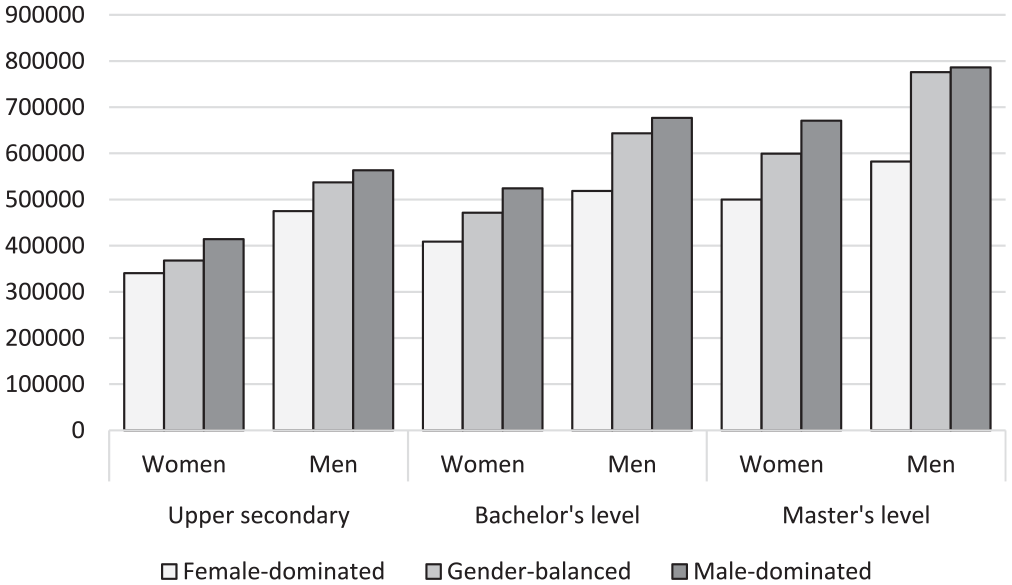
Mean income (NOK) by gender composition in field of study and education level.
Methods
We run linear regression models, using logarithmically transformed income. We hence measure income in relative terms, common when measuring income to avoid any problems associated with the right-skewness of the dependent variable that can violate the normality assumption (Ermini and Hendry, 2008). 6 All models are controlled for parents’ level of education, parents’ income, part-time work, immigrant background and measurement year. We present separate models for men and women but have also run joint models with three-way interactions in the appendix (Online Appendix Table 2). The relative returns to higher education are examined by assessing the coefficients for education level. The association between gender composition in fields of study and income are examined by assessing the coefficients for gender composition. To examine how the relative returns to higher education differ according to the gender composition in field of study, we present the marginal effects of education level by gender composition in fields of study. Marginal effects can be interpreted as the predicted income difference by the independent variable in question, in this case education level. Lastly, the levels of returns are examined by assessing the predicted income levels by gender, education level and gender composition in fields of study.
Results
The results for Model 1 in Table 2 show that although women earn less than men regardless of education level, the relative returns to higher education are larger for women than for men. For men, the average income difference between those with upper-secondary education and those with bachelor-level education is 12%, while the difference for women is 18%. The average income difference between those with upper-secondary education and master’s-level education is 28% for men and 36% for women. All these coefficients are significantly different between men and women (see Model 1 in Online Appendix Table 2), confirming the expectation that the relative returns to education are greater for women than for men.
Ordinary least squares (OLS), logarithmically transformed income at age 35 ± 1 year. All models control for parents’ education, parents’ income, immigrant background, year, part-time work.

Notes: standard errors in parentheses.
p<.05; **p<.01; ***p<.001.
Turning to the gender composition of fields of study, Model 2 includes the variables for female-dominated and male-dominated fields, with gender-balanced fields as the reference category. The coefficients thus show the association between the gender composition of a field of study and income, controlled for educational attainment. Consistent with our expectations, the results for both men and women show that female-dominated fields of study are associated with lower income than gender-balanced fields, and that male-dominated fields of study are associated with higher income than gender-balanced fields.
The interaction between education level and gender composition is introduced in Model 3, and the marginal effects of education level by gender composition in field of study are presented in Figure 2. Contrary to our expectations, the relative returns to higher education are larger in male-dominated than in female-dominated fields of study for both men and women.
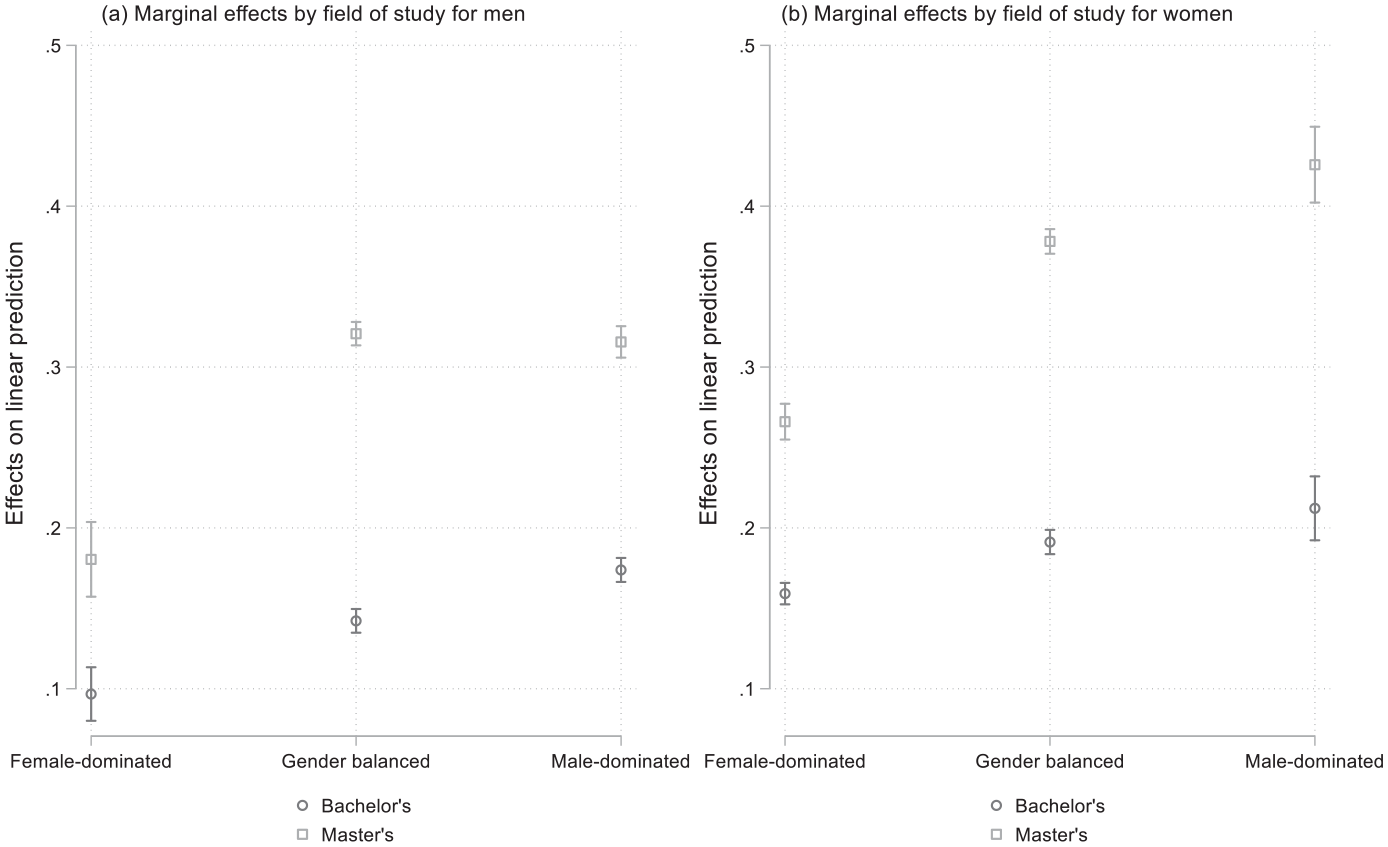
Marginal effects of education level by gender composition in field of study. 95% confidence intervals.
Moreover, the interaction terms introduced in Model 3 suggest that the economic disadvantage associated with female-dominated fields of study is more pronounced for those graduating from higher education than those with upper-secondary education. This is the case for men and women alike. The income reward associated with male-dominated education is not smaller for women than for men, which contradicts the glass ceiling expectation. The income difference between female-dominated and gender-neutral upper-secondary education is notably larger for men than for women, however, meaning that men receive a larger income penalty when choosing female-dominated education. The interaction terms indicate that this holds across all levels of education. This runs contrary to what we expected based on the glass escalator idea, which suggests that men are advantaged when entering female-dominated fields and occupations.
One possible explanation for this somewhat unexpected pattern could be a selection of low-performing men into female-dominated education. Given the strong correlation between parental education and school performance, some of the potential selection is already taken into account since all models include controls for socio-economic background. Ideally, we would include controls for school performance. Unfortunately, the Norwegian registers only have information on school grades for younger cohorts than those included in our analytic sample. In an attempt to examine this further, we have run additional models for a younger cohort where we include controls for previous school performance (see Online Appendix Figure 4). The results are not directly comparable since income is measured at a younger age (age 30), and the analysis only includes one measurement year. Nevertheless, the results do not indicate that the larger economic penalty men receive from completing female-typed education can be explained by selection based on school performance, except for at the upper-secondary level. The results do suggest, however, that gender-balanced fields of study are less economically rewarding when previous school performance is taken into account.
To assess the gender differences in levels of returns, we present the results as predictive margins (based on Model 3 in Online Appendix Table 2). Figure 3 plots predicted income based on gender composition in field of study and gender, across education levels, with controls. First, Figure 3 confirms our expectation that levels of returns are higher for women than for men for all combinations of gender composition in field of study and education level.
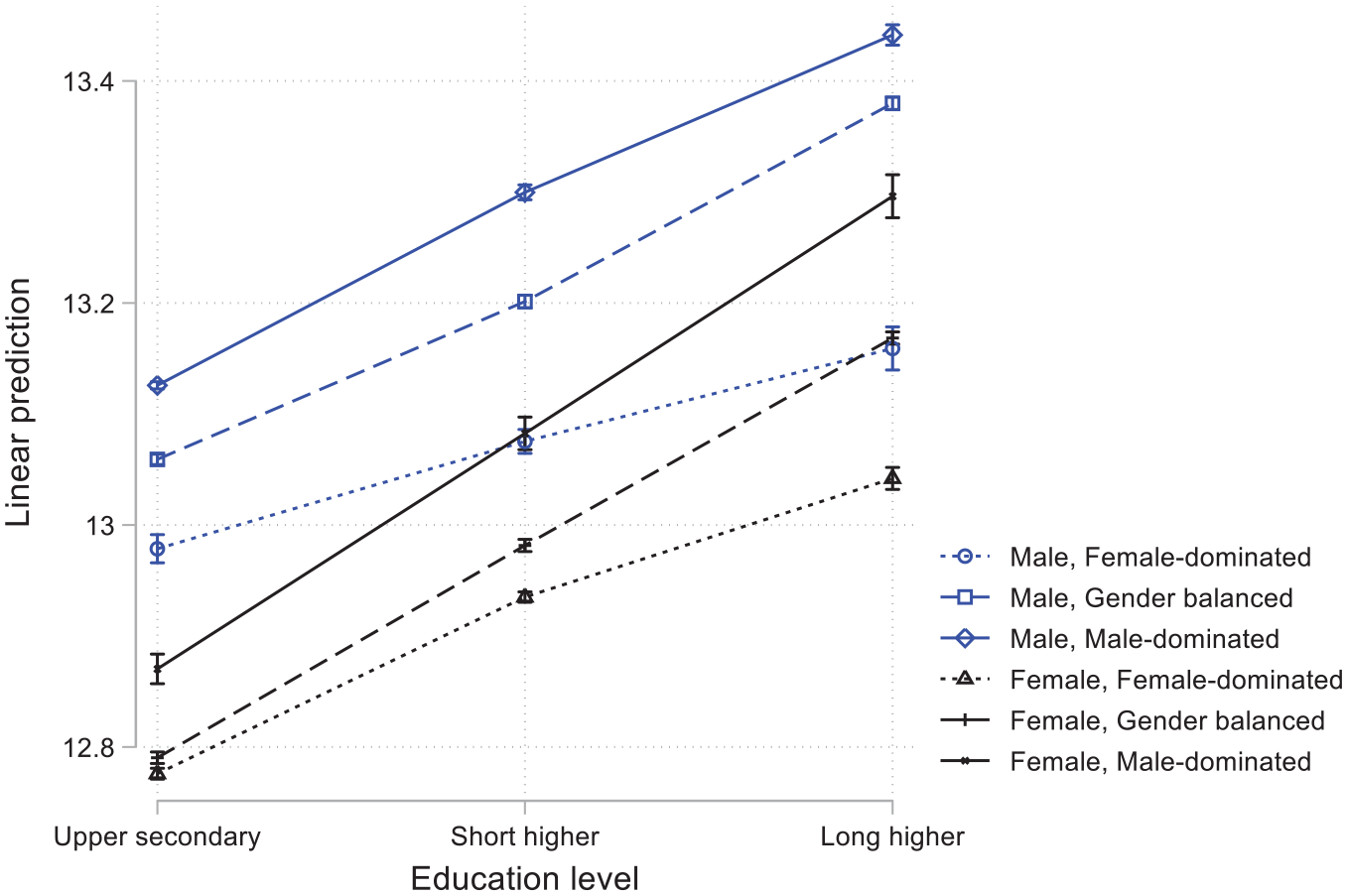
Predictive margins (log income) by education level and gender composition in field of study (with all controls). 95% confidence intervals.
Moreover, Figure 3 shows that male-dominated fields of study yield substantially higher levels of returns than gender-balanced and female-dominated fields at all education levels, and this is the case for men and women alike. The differences between male- and female-dominated fields of study are particularly pronounced among men, which reflects that the income penalty associated with female-dominated education is larger for men than for women as reported above. For women, Figure 3 confirms that gender-atypical education is economically rewarding, even though the differences between male- and female-dominated fields are smaller among women than men, except for at the master’s level. The difference between gender-balanced and female-dominated upper-secondary education is small for women, but female-dominated fields of study yield lower returns than gender-balanced and male-dominated fields at both bachelor’s and master’s levels.
Figure 3 also shows that the two gender minorities, that is, men with female-typed education and women with male-typed education, receive similar levels of returns when completing education at the bachelor’s level. Moreover, the income gap among the two gender minorities is reversed at the master’s level, where men with female-dominated education receive lower levels of returns than women with male-dominated education.
Lastly, it is striking that women have to complete male-dominated master’s level education to surpass the level of returns men receive from male-dominated and gender-balanced upper-secondary education. 7
Discussion and Conclusion
In this article, we have analysed administrative register data for several Norwegian birth cohorts to examine the association between the gender typing of fields of study, level of education and income. We add to previous research by taking the gender composition of fields of study into account when examining the returns to higher education. We examine gender differences in the relative returns to higher education, and in the levels of returns for all combinations of education level and gender composition. Lastly, we contribute to the literature on gender minorities by examining the returns to gender-atypical education.
Some limitations should be addressed. First, by measuring income at one point in time for the cohorts under study we fail to capture the potential life course differences in income stemming from gendered educational choices. Second, we are unable to rule out selection bias related to previous academic performance, since information about school grades is unavailable for the birth cohorts we study. As mentioned above, however, we have run additional analyses including controls for previous school grades for younger cohorts (Online Appendix Figure 4) to check whether men’s lower returns to female-dominated education is a result of selection bias. Third, although register data provide rich information on education and income, they do not disclose the motivations and preferences that underlie educational choices differentiated by gender. Nevertheless, the focus of our study has been the labour market returns associated with gendered educational choices, and not why men and women tend to choose different educational paths in the first place. Finally, we do not have information on workplaces, and hence do not examine their role in shaping gender differences in income. Even though we have control for sector in sensitivity analyses, it is likely that there are other differences between occupations and workplaces that men and women select into, regardless of their level and field of education, that are important for their income (e.g. Avent-Holt et al., 2020; Bol and Weeden, 2014; Williams, 2013). Moreover, union density and bargaining power have been shown to be important for wage differences between jobs and occupations (Bol and Drange, 2017; Sakamoto and Wang, 2017).
In line with our expectations, and mirroring results from previous research, our analyses have shown that the relative returns to higher education are larger for women than for men. In light of human capital theory, which posits that the relative returns to education reflect individuals’ incentives to invest in education, our findings suggest that women have greater economic incentives to pursue higher education than men. Although the relative returns men and women receive to their educational investments may inform our understanding of gender differences in the incentives to obtain different levels of education, relative measures of returns fail to capture how men and women at different education levels fare in the labour market compared with one another. Our results showed that while women receive larger relative returns, the levels of returns are higher for men than for women for all combinations of gender typing and education level. As a result, women with bachelor-level education have lower average incomes than men with upper-secondary education at the age of 35. This could possibly reflect the shorter amount of time this group has been active in the labour market compared with those with upper-secondary education as their highest level of education. However, additional analyses where income was measured five years after completion rather than at age 35 produced a similar pattern (results are available from the authors upon request).
With regard to the gender composition in fields of study, both economic and sociological theory predict that female-dominated fields of study are associated with lower economic returns than male-dominated fields. Most previous research on the association between gender composition in fields of study and labour market returns has limited its focus to higher education. Our results confirmed that female-dominated fields of study yielded lower returns across all levels of education. The theoretical perspectives discussed earlier do not differ in their empirical implications with regard to this association, and the results do not tell us whether the lower returns associated with female-dominated fields of study reflect devaluation of female-dominated education, compensating differentials or human capital differences. Although they are often thought of as competing explanations for the lower pay associated with female-typed work, we would argue that these mechanisms need not be mutually exclusive. The devaluation perspective has been developed as a theory about the gender wage gap and inequality between jobs or occupations. The idea is that male- and female-dominated occupations that are comparable in terms of skill requirements and the complexity of the work tasks are valued and rewarded differently. However, the idea is not that male- and female-dominated jobs need to be identical in terms of skills and demands to be comparable. In this sense, the devaluation perspective can be viewed as complementary to the more conventional economic approaches to wage disparities, such as those building on the idea of gendered specialisation within the household (Busch, 2018). One might, however, question the applicability of the explanations building on gendered specialisation in the Scandinavian countries where the dual earner/dual (or state) carer model is the norm.
According to England et al. (2007a), one reason for the persistent negative relationship between the proportion of women in a job and pay is that occupational wage gaps are institutionalised. This is especially relevant in Norway, where the centralised wage bargaining process is influenced by the wage settlements of male-dominated industries (Wagner and Teigen, 2022). Consequently, the wage disparities between male-dominated and female-dominated occupations are more likely to persist, despite Norway’s strong performance on other gender equality indicators and a relatively compressed wage structure. This might explain why the efforts to increase higher education opportunities for women and improve the professional status of female-typed occupations have resulted in higher educational requirements without an accompanying rise in economic rewards.
With regard to the returns to gender-atypical educational choices, our results suggest that completing female-dominated education leads to a larger income penalty compared with gender-balanced and male-dominated education for men. Although this finding runs contrary to our expectation based on the glass escalator idea, it is consistent with previous results from Germany regarding the wage returns to female-dominated fields in higher education (Leuze and Strauß, 2014). Moreover, experimental research on gender discrimination in job hiring has shown that female applicants are considered to be more suitable for jobs in female-dominated occupations, suggesting that men graduating from female-dominated fields of study may face specific labour market barriers that could also be reflected in income (Birkelund et al., 2021; Schaerer et al., 2023). That the economic penalty associated with female-dominated education is even larger for men than for women indicates that female-dominated fields do not simply pay less because they are numerically dominated by women. Although the income penalty of completing female-dominated education is larger for men than for women, it is important to note that men with female-dominated education still earn more than women with female-dominated education at all education levels. Lorentzen and Vogt (2022: 65) found that among young adults in Norway with vocational upper-secondary education, the two gender minorities ‘meet in the middle’ in terms of labour market trajectories. When examining income at age 35, our results show a similar pattern for the gender minorities with bachelor-level education. Moreover, we saw a reversal of the income gap for the gender minorities with master’s-level education, as women who graduated from male-dominated fields earn more than men who graduated from female-dominated fields.
In sum, we believe our findings contribute valuable insights both to our understanding of gendered returns to education, and to the research on the labour market positions of gender minorities. Our results confirm results from previous research regarding larger relative returns to higher education for women. In contrast to most previous research on gender differences in the returns to education, however, we also take gender composition in field of study into account. The results confirmed that female-dominated fields yield lower economic returns across all education levels. Interestingly, completing female-dominated education carries a larger income penalty for men compared with women, which runs contrary to the glass escalator notion. These findings may shed some light on why so few men choose female-dominated fields of study. Given the large and growing demand for labour in many female-dominated occupations, such as those within the healthcare sector, the recruitment of men is an important policy issue. Examining the income levels of the gender minorities revealed converging income levels among those with bachelor-level education. Additionally, women with male-dominated master’s degrees earn higher incomes than men who graduated from female-dominated fields at the same level. That women outnumber men in higher education has sparked public concern that men are falling behind in the labour market. Given the disparities in returns to male-dominated and female-dominated fields of study, however, a joint focus on education level and gender composition may yield a more nuanced understanding of the labour market opportunities available to young men and women, compared with a sole focus on gender disparities in educational attainment.
Supplemental Material
sj-docx-1-soc-10.1177_00380385241303448 – Supplemental material for Gendered Returns to Education: The Association between Educational Attainment, Gender Composition in Field of Study and Income
Supplemental material, sj-docx-1-soc-10.1177_00380385241303448 for Gendered Returns to Education: The Association between Educational Attainment, Gender Composition in Field of Study and Income by Sara Seehuus and Thea Bertnes Strømme in Sociology
Footnotes
Data Availability Statement
We are not allowed to share our data due to strict data protection rules set by the Norwegian data protection agency.
Funding
The authors disclosed receipt of the following financial support for the research, authorship and/or publication of this article: this work was supported by the Research Council of Norway under Grant number 283603.
Ethics Statement
Ethical approval for use of the register data analysed in this study has been granted by SIKT (Norwegian Agency for Shared Services in Education and Research).

Supplemental Material
Supplemental material for this article is available online.
Notes
References
Supplementary Material
Please find the following supplemental material available below.
For Open Access articles published under a Creative Commons License, all supplemental material carries the same license as the article it is associated with.
For non-Open Access articles published, all supplemental material carries a non-exclusive license, and permission requests for re-use of supplemental material or any part of supplemental material shall be sent directly to the copyright owner as specified in the copyright notice associated with the article.
