




Abstract
This article interrogates shared reading between parents and young children, theorised as ‘sensory affinities’, understood through a sociological lens. I argue that reading cannot be confined to educational aspects, and towards increased prominence for relational dimensions. I explore the narratives of 29 parents/carers of reading with young children. Drawing on data on the embodied aspects of reading, Mason’s concept of affinities illuminates the sensory facets of reading applied to family intimacies. Interventions have hitherto distilled literacy from the wider social context. However, an understanding of reading in the context of families from diverse backgrounds, yields insights into the sensory character of everyday family life. Findings are of significance to sociology broadly, and specifically, families and relationships. Centring families facilitates a fuller understanding of literacy practices. Finally, the focus on an everyday, tangible practice such as reading can support understandings of hidden and taken-for-granted dimensions of family life.
Introduction
The benefits of reading with children are conceptualised according to schooled discourses that prioritise language acquisition, vocabulary breadth, complexity of talk and reading targets (Bus et al., 1995; Mol et al., 2008; Snow, 1994). Families are positioned as key supporters of children’s reading, but the contribution of reading to everyday family life is rendered secondary to educational development (Nutbrown et al., 2017). This Economic and Social Research Council (ESRC) funded study sought to understand the barriers and motivations for shared reading, contextualised within everyday family life.
Drawing on interviews with 29 parents across two cities in the north of England, I suggest that shared reading is a practice of closeness and that its associated sensory dimensions generate ‘potent connections’ – conceptualised as affinities (Mason, 2018) – between parents and children. Findings illuminate parents’ and children’s shared reading practices, theorised as sensory affinities. Centring families augments relational aspects of reading, extending this from established educational dimensions. This is relevant because social life is mediated through the sensory. Connections are accomplished through talking, listening and physical proximity, evident in a multitude of practices and relationships. For Mason (2018), affinities are ‘potent connections’ to people, pleasures, behaviours and things. Sensations such as seeing, touching, smelling and hearing are core to this. Affinities are underpinned by intimate practices, and rendered possible by the senses. As I will demonstrate, this is a feature of shared reading practice.
Intimacies refer to ‘practices of close association, familiarity and knowledge’ (Jamieson, 2005: 189). Reading, though a facet of everyday and family life (Pahl and Rowsell, 2020), is typically framed as educational, rather than relational and embodied. Formal activities such as reading books take precedence over incidental, everyday practices like deciphering shop signs or adverts. Reading however, transcends skill and incorporates practices, relationships, patterns and contexts (Rowsell and Pahl, 2015). Shared reading entails a child’s engagement in sustained attention on a text, with another person – usually an adult – over a prolonged period. This could be a child reading to an adult, an adult reading to a child, or both. It is ‘dynamic . . . surrounded by talk, laughter and play’ (Levy and Hall, 2021: 127). Joint focus on a text and co-constructed meaning indicates relational dimensions at play (Levy and Hall, 2021). Shared reading is simultaneously a literacy activity and family practice. As such, conceptual frameworks from studies of families and relationships and literacy respectively are relevant: family practices (Morgan, 1996), and literacy as social practice (Pahl and Rowsell, 2020). In this article, these complement one another and facilitate deep understandings of the granularity of family life, and the contribution shared reading makes. Studies of families and relationships consider sensory and embodied properties such as touch, physical proximity, sexualities, body work and care as fundamental to intimate relationships (Gabb, 2008; Jamieson, 2005; Morgan, 2011; Twigg, 2000). Similarly, literacy – which entails reading, speaking, listening and writing – draws on the sensory and warrants further exploration. There is therefore merit to applying a sensory sensibility to understanding family practices (Mason, 2008), and specifically shared reading as a family practice, as this article demonstrates. The analysis yields understandings of how aspects of family life might be harnessed to inform educational practice. In doing so, I extend the existing evidence base in relation to shared reading, which tends to privilege educational aspects over the relational.
Inspired by scholars in family and personal life (Finch, 2007; Morgan, 1996), the article deploys a definition of family that emphasises relationships, practices and diversity, transcending a specific structure limited to one household. The article conceptualises shared reading as not just an educational endeavour, but a family practice. As such, I encompass sensory dimensions of everyday family life and relationships (Morgan, 2020). Shared reading makes an important contribution to family life, relationships and routines (Levy and Hall, 2021). There is however, scope to bring the idea of sensory aspects as fundamental to deepening intimacies into sharper focus. In privileging families in conceptualisations of literacy practices, the research makes a contribution to sociology, particularly families and relationships.
Sensory Intimacies and Affinities within Families
To situate the findings, the analysis is underpinned by theorisations of the sensory, intimacies and affinities, which fuel family life as considered below.
Mapping the ‘sensorial turn’ across the social sciences, notably in anthropology, sociology and geography, Pink (2015) cites increased attunement to the senses. These are typically informed by western conceptualisations dominated by vision, hearing, touch, taste and smell. Everyday practices including housework, gardening and food have been subject to sensory analysis (Pink, 2015). Sociologists, particularly those informed by phenomenological tradition, have engaged with the sensory (Bennett, 2014) in areas including sports (Nettleton, 2015) and health (Harris and Guillemin, 2012). In studies of personal life, Mason and Davies (2009) pioneered the use of sensory methodologies to understand family resemblance, arguing that sensory attunement is vital, and that its execution must incorporate nuance and entanglements. Accordingly, they caution against separating the sensory domains with discrete methods that directly map onto them. Mason and Davies also emphasise the importance of stratification such as class, race or gender, which are inherently sensory too. Furthermore, a theorisation of the sensory should encompass the tangible and the intangible, such as energy. In literacy research, academics have engaged with sensory themes that have paid attention to visual and aural dimensions (Hackett, 2015). The research this article is based on did not specifically employ sensory methods. However, the ubiquity of the senses in everyday life, in families and in literacy, as well as ‘the corporeality and multisensorality of any social encounter or interaction’ (Pink, 2015: 19), meant they were a prominent theme without being explicitly sought.
Families are the site for a multitude of intimate practices. Scholars of families, relationships and personal life emphasise the minutiae of family life, considering families as a verb, rather than a noun (Morgan, 1996). Conceptualisations of personal life centre affective and communicative dimensions over structural elements (Jamieson, 1998). Shifting from what families are to what they do shifts the focus to intimate practices. Intimacy comprises practices that denote ‘close association, familiarity and privileged knowledge’ as well as robust attachments and closeness (Jamieson, 2005: 189). There has been a tendency for intimacy to be conflated with sexuality, and thus the preserve of adults rather than children (Davies, 2016). However, broader understandings decentre sex between couples and encompass other intimacies, including parent/child (Gabb, 2008; Jamieson, 1998). Such intimacy requires ongoing parent/child engagement to ‘know and understand’ one another through ‘talking and listening, sharing thoughts, showing feelings’ (Jamieson, 1998: 158), including verbal communication and sensory enactments. This definition informs perspectives on shared reading in the context of families.
Understandings of shared reading in families must also consider the ‘potent connections’ between individuals as ‘affinities’ (Mason, 2008). Mason conceptualises these as fixed, negotiated, ethereal and sensory and that they overlap and interact. Within this theorisation, kinship is understood in terms of forces, rather than reduced to fixed and ‘natural’ phenomena. This perspective incorporates fluidity, for example, time together (kinship as practised), that which is not rationally explained (the ethereal) and sensory connections, including face-to-face contact. This article focuses on the sensory affinities and the connections generated: tone of voice, facial expressions and physical contact and so on, which are apparent in shared reading.
Intimacies and sensory affinities are relevant to understanding reading in the context of families. The data below suggest that studies of families and literacies, respectively, stand to gain from methods that incorporate a sensory awareness. Proponents of affect theory consider the relevance of embodied meaning making and the role of emotions and sensations seen in everyday life and in reading encounters specifically (Burnett and Merchant, 2018; Ehret, 2018; Stewart, 2007; Wetherell, 2012). This article will conceptualise literacy as sensory. However, the aim of this article is to understand shared reading in the context of family intimacies, located in sociological approaches to family and personal life. It therefore necessitates a focus on affinities in terms of individuals coming to know one another, rather than affect as distinct from the social (Mason, 2018).
At this juncture, I wish to establish the materials that are included in shared reading. In the ‘digital age’, texts include paper and digital formats. Extant debate has asserted the dominance or use of print books compared with digital texts. However, as I seek to understand the relational dimensions of shared reading, I employ an inclusive definition, rather than adding to such discourses.
Researching Family Literacies
The article draws on data from in-depth, semi-structured interviews with 29 parents of young children across two cities in the north of the UK. This formed part of a broader research programme designed to understand the role of shared reading in children’s language development but was a distinct study. University ethical approval was granted.
Participants ranged between 21 and 36 years of age, with the majority being in the 26–35 range. Of the 29, 14 had two or more children. While seeking an even gender balance, the voluntary nature and recruitment strategies (detailed below) yielded mothers, with just one father taking part. The sample included single parents, co-parents living apart, couples and multi-generational households. Participants typically discussed families as a unit throughout the interview. Approximately half of the sample comprised ethnic groups including: Asian/Asian British (n = 3), Pakistani British (n = 3), Mixed White and Other (n = 2), Arab (n = 3), Black (n = 1) and over half identified as White British/Irish (n = 17). Participants had a range of qualifications: 12 were educated to degree level or higher; eight to GCSE level, while five did not have any formal qualifications. A sample overview is presented in Table 1. Two cohorts were recruited to enhance the diversity of the sample. Because the study sought to understand families, the two datasets were not analysed separately, and this article is derived from data from both samples.
Participant overview.
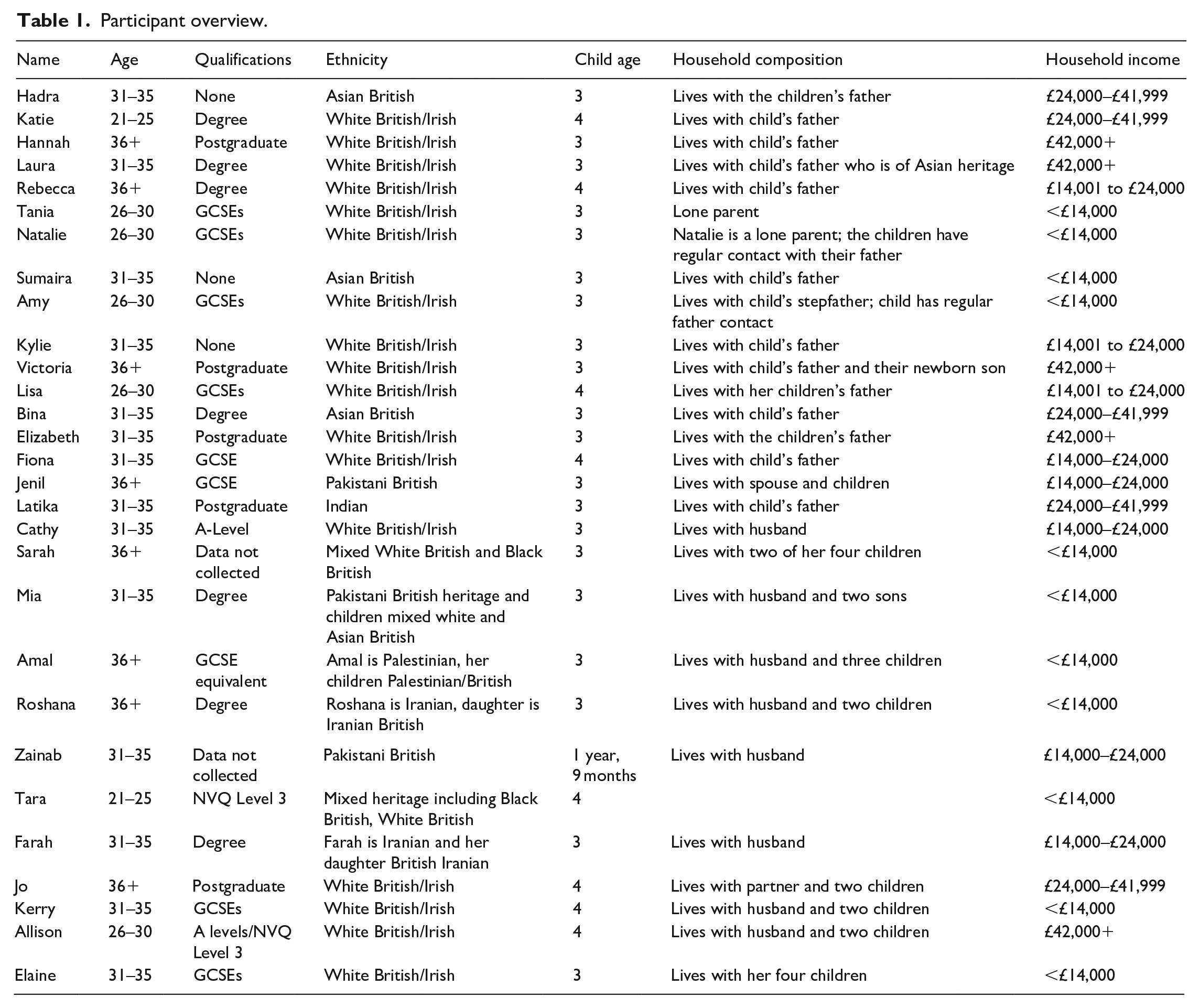
The two cohorts of participants from City A and City B were recruited via distinct means. Participants from each city resided in areas considered relatively disadvantaged according to Indices of Multiple Deprivation. This extended the evidence on children’s literacy beyond the middle-class samples that typically dominate the field.
In City A, a flyer advertising the research was distributed to parents of nursery children from five schools. In addition, face-to-face recruitment at playgroups, children’s centres and health visitor drop-ins in low- and mixed-income areas took place. Participants were sought whose children were pre-school to minimise school discourses of reading that may be pervasive among parents of older children. Participants’ children were mostly aged three and four years.
In City B, nine participants were recruited from two sets of parents attending sessions led by The Reader Organisation across schools and libraries in the city and who were participating in the broader research project. Parents taking part in this study completed a questionnaire, administered by a researcher at the lead university. They were subsequently invited to a second research strand, which entailed video observations (Lingwood et al., 2023) and the interview component of the study, which informs this article. Of course, participants in City B had signed up to reading sessions and the broader study, arguably indicating a prior interest in literacy. However, this is countered by Sample A being derived from broader, everyday family settings and the open research design described below. Data suggest that all families were keen to read with their children and this did not differ between the cohorts, despite the involvement with reading sessions in City B.
The research team were experienced in conducting interviews in homes on sensitive issues. The research design facilitated the practice of ethical research conducted by ‘outsiders’ with different educational, cultural and ethnic backgrounds in participants’ own homes and included families in lower income households. First, the method was underpinned by a desire to achieve an insight into family life broadly, with a view to understanding where reading did or did not feature in the everyday. Second, the research team were transparent that as academics with an interest in families, our role was not to assess, measure or evaluate reading. The study design acknowledged the socially desirable nature of reading (Kurschus, 2015). Therefore, interviews did not initially seek to explore reading practices in isolation but asked participants to describe their typical day, their families and their biographies. Reading sometimes did not feature until 45 minutes into the interview. The approach, influenced by narrative inquiry, generated rich descriptions of family life, everyday routines and activities (Phoenix et al., 2020). This included household members and other key individuals, the rush to get children to nursery, prepare meals, the intensity of the bedtime routine – thus facilitating an understanding of how reading was located – or not – in everyday family life. Data were generated by a research team whose primary research expertise lay in social inequality (Jenny Preece) and families (Mel Hall), rather than literacy. Interviews took place at home and were audio recorded on a digital device and transcribed verbatim by the researcher. Participants were given a £10 shopping voucher of their choice in recognition of their time. In the interests of anonymity, pseudonyms are used and identifying information removed.
The research team (the Principal Investigator and two researchers) independently engaged in a process of open and thematic coding influenced by Braun and Clarke (2021). Upon transcription, interview data were analysed in three phases: open coding, code clustering and thematic coding. This entailed reading and re-reading transcripts, followed by identification and comparison of themes. A definitive set of codes was established, though subsequent data analysis has been carried out to acquire a deeper understanding in light of current literacy and family research. This iterative process applied a sensory awareness (Harris and Guillemin, 2012).
Analysis indicated that shared reading was not limited to educational properties, and this was not the primary driver. Families were motivated to read because of the potential for family display and family practices (Levy and Hall, 2021). In undertaking research with predominantly mothers, it became immediately apparent – at the point of data generation – that in narrating their everyday lives, participants were sharing the connectedness of family members. Reading provided an avenue for intimacy, connections, relationships and memories as the data show (Gabb, 2008). The sensory character of the data was prominent as participants described cuddling up, reading aloud, voices, conversations and laughter, illustrating families as sensory spaces, reading as a sensory experience and the intimacies accomplished. These are explored in the findings section below.
Findings: Shared Reading as a Sensory Practice of Intimacy
Affinities between family members are invoked by the sensations experienced in social interaction. As Mason (2018: 7) states, ‘We sense others. We know what they are like and who they are by seeing, touching, smelling, hearing and generally experiencing the sensations of them, at the same time as they are experiencing the sensations of us.’ The data on shared reading illustrate the ‘emotional and embodied’ (Morgan, 2020: 734) nature of family life. Jamieson (2011: 152) refers to ‘practices of intimacy’ to encapsulate those ‘which cumulatively and in combination enable, create and sustain a sense of a close and special quality of a relationship between people’. Shared reading is a family practice (Hall et al., 2018) that is inherently sensory. This sensorium is multifaceted including – and not limited to – embodiment, sensations, touch, feel and sound as is evident in the data. If intimacy requires ‘constantly working with the child to know and understand [them]’ (Jamieson, 1998: 47) then shared reading makes an important contribution on account of the talking, listening, sharing thoughts and feelings that happen in this encounter (Jamieson, 1998). The data show how the visual, sound and tactile aspects facilitate powerful connections. These are ‘entangled’ and do not operate in isolation (Mason and Davies, 2009). Consequently, the analysis employs Mason’s conceptualisation of ‘sensations’ rather than ‘the senses’. The analysis below considers the visual and aural properties of shared reading, followed by the consideration of this as physical and entangled.
Visual and Aural Affinities
Visual and aural aspects of shared reading are inherent in looking at books and narrating text together. Findings corroborate existing research on the visual properties of literacies such as illustrations (notably in children’s books), text and materiality (Flewitt, 2013). In this study, parents considered the value of images in the encounter, as these participants suggest: When he was about a month old . . . We had a book . . . everything in it was black and white shapes, so I used to sit with him on my lap and show him . . . it had faces which babies love . . . he’d sit and look at it. (Elizabeth) Sometimes we don’t read the story, we just have to look at the pictures and see what’s on the page. (Cathy)
However, the visual elements of family life that drive relationships can be incorporated in an analysis of shared reading practices in the context of families. These give rise to affinities and add weight to the relational aspects of literacy (Pahl and Rowsell, 2020). Such visual elements do not simply relate to language or text, but encompass family members’ smiles, mannerisms and gestures. Existing research in family and intimacy has shown that face-to-face contact is fundamental to relationships, and shared reading facilitates this. This takes reading beyond an instrumental, educational practice. In this study, parents such as Tania and Kerry took visual cues as a sign of their child’s enjoyment: I can see him, literally, like, it’s like you can see him taking it in . . . you can see him thriving off it. (Tania) You see the excitement on [their] faces, and, the way they’re reacting to the book. (Kerry)
Previous research emphasises the importance of face-to-face contact in facilitating the continuation of relationships, including children’s, in the context of upheaval including separation/divorce (Davies, 2016), parental incarceration (Oldrup, 2019) and migration (Baldassar, 2008). Exploring a comparatively mundane, everyday activity such as shared reading extends understandings of how the sensory allows parents and their children to know one another in the everyday. The data on shared reading, indicate that this is two-fold. First, parents experienced joy in watching their child, which might be the minutiae of facial expressions or enjoying their child’s development. Second, the potential to bear witness to visual cues of their child’s reciprocation in shared reading, which is crucial to motivating parents to read with very young children (Levy and Hall, 2021).
Additionally, face-to-face interactions are the conduit for multisensorial affinities (Davies, 2016). Sound – specifically voices – was particularly salient in parents’ accounts of reading with their children. Several participants, such as Natalie, reported that they had read to her children prior to birth: When they were babies, I used to read to them in my stomach, as weird as it sounds. In the book when you’re pregnant, it says to read to them, stories, sing the nursery rhymes to them, and we sung them, that’s how I got them to sleep when they were babies . . . my babies always lied on me so I’d be on the couch with a book and it’s nice for them to hear your voice as they’re going to sleep. Just chilling out with them. (Natalie)
Indeed, early childhood studies presents voice as crucial to parent–child attachment and brain development. In utero, foetuses become familiar with their mother’s voice, which positively impacts premature infants (Nagy et al., 2021; Williamson and McGrath, 2019). Natalie’s account above shows her perception of reading as a tool for maternal bonding. Additionally, parental speech is thought to correlate with children’s language development and literacy (Snow et al., 2021) and participants such as Elaine considered that shared reading from a tender age supported their development: Babies can’t see from when they’re born, but . . . when you’re reading the book . . . you’re still talking to them from when they’re born and then that’s what they learn from. (Elaine)
Additionally, sound is multifaceted and parents appeared to use it for varying effects. Reactions were crucial in encouraging families to continue to read with their child as indicated by these participants: Quite a few times there’s been a big word and he’s said ‘what does that mean?’, and I think ‘oh that is good, you are listening, you’re not just sat there staring because you’re getting sleepy and just want to cuddle on my knee’ . . . even if you’re not following the story you’re hearing the words. (Hannah) I think ‘is she just staring at the book and not listening to a word I'm saying?’. I’ll stop and ask her what’s going on, or what she thinks . . . I know she’s listening. (Kerry)
Furthermore, reading elicits emotional response. Prior research on incarcerated parents found that recorded bedtime stories sent to children provoked emotions including comfort and anxiety (Andersson and Björkhagen-Turesson, 2023). In a domestic context, data in this study suggest that sound had the capacity to infuse the reading encounter with variety, humour, energy and calm. This indicates the role of the sensory in invoking atmospheres and serving different purposes for relationships and family life. This was seen by participants such as Bina who seemed keen to make reading fun and utilised voice to instigate laughter: I make loud noises and stuff (laughs) . . . say a word out of the book like loud, not shout, but loud, or say it really quiet, and just like, you know, do like things with my hands and stuff, and you know, like, just make her giggle and laugh.
The data reiterate the contribution of shared reading to family bonding, but that the laughter and humour help make this enjoyable and perhaps serve important affective purposes as it is not merely feedback, but joyful feedback. As these participants stated: I just do funny things to make her laugh. I do impressions, funny voices. That’s our more bonding time, reading and things like that. She does it with me mum, me sister . . . it’s different voices all the time so it’s different . . . if she laughs, I’m laughing . . . make it fun . . . if you act it out, do different voices, make it fun, she’ll wanna do it. (Amy) I am not looking at it from the point of ‘ok, she’s gonna do this’, because I know in school she’ll get it. At this point, yeah, just for enjoyment really. Like she reads a book, it’s more the feedback that I get, like she’s enjoying it or, we’re entertaining her. (Bina)
The potential for this was enhanced in multi-person households that garnered differing dynamics. Kylie and Bina identified the contrast between their reading with their children, compared with their husbands’ and identified variations: His Dad reads differently . . . a lot more into the voices and all that . . . I sometimes think, ‘do I bore you?’ cos his Dad goes ‘raaaaaaar’ but then when his Dad reads to him, it doesn’t settle him, it makes him hyper. If his Dad’s reading but Bradley doesn’t get into his book, he’ll get into more the story in his head so he’ll be acting it out. (Kylie) I’m ok with reading out loud . . . I don’t get embarrassed or anything like that, but my husband, he’s slightly more . . . he reads it, the same book in a slightly different way . . . I’m like ‘no, no, no! You do it like this!’, and he’s like ‘I have my way of saying to her what this’ . . . or ‘you’re making a different noise to what I make with her’, and he’s like ‘oh just shut up!’ (laughs) ‘I’m gonna read it the way I want to.’ (Bina)
These excerpts highlight reading as a family practice within the private realm. However, the act of reading aloud in the public sphere further suggests the intimacy implicated in reading as indicated by the self-consciousness experienced reading in public. For example, at a parent/child reading group, Elaine described reading in front of adults. She had been permitted to ‘pass’ her turn, ‘one of the other Mums done it, and then I done it . . . it was just me building, ’cos I hadn’t read out aloud for ages. I read to [my children], but not other adults . . . it was different.’ This suggests an intimacy and privacy, resonant with other aspects of family intimacy that occur behind closed doors.
Conversely, reading is synonymous with lack of noise. Spaces typically associated with reading such as libraries are characterised by silence, which contrasts with the noise often associated with family life and children’s activities. Although it is important not to limit shared reading to bedtime reading (and thus conceptualise it as one of a multitude of reading practices rather than the definitive shared reading activity), the established relationship between storytime and bedtime points towards the capacity for calm and its sensory nature. As these parents stated in relation to reading at bedtime: It’s calm . . . life isn’t always calm with a three-year-old. I think it’s just something that we share, that nice little calm time. It’s a little connection. (Rebecca) It’s kind of dedicated time with no other distractions, it’s also a calm activity, he is a boisterous little boy that does a lot of running around and playing . . . by the time we get to bedtime he can be quite wound up, so it’s a good way of kind of bringing the level back down to a quiet, quiet time. Like, the reading itself isn’t quiet, we get stuck in . . . we look at the book noisily and stuff, but it’s relatively quiet compared to the rest of the day. (Elizabeth)
These descriptions show that within this context, reading offered an opportunity for ‘shush’. The data also point towards the physicality of shared reading and that the intimacies explored are overlapping, interacting with one another, as considered below.
Embodied, Entangled Intimacies
As the context earlier established, intimacy is partly accomplished through embodied expression and closeness. Shared reading includes physical engagement with an object such as a book or a tablet and therefore leads to intimacy: I think [the books] all ripped . . . these ones, this is a newer one but they were all like touchy feely ones, erm, pull up things and that. We’ve had a lot of books die in the earlier years! (Tania)
The tactile properties of books to children have been capitalised upon, and are simultaneously drivers and barriers to reading in families. Physical books can motivate children to read, but fear of damaging books (particularly borrowed ones) could deter parents from reading as some parents described. Additionally, the physical interactions between family members were striking in the data. Touch and closeness are part of the fabric of family life, particularly with small children (Gabb, 2008; Morgan, 2020). Intimacy is accomplished through bodily proximity, and physical intimacy is considered a key element of healthy communication (Gabb, 2008; Twigg, 2000). The data in this study include rich descriptions from parents of reading with their child of an encounter imbued with closeness, trust, intimacy and connection (Urry, 2003). These excerpts suggest the closeness that occurs: He normally sits on my lap really cuddly . . . very neat with his little hands like crossed over, just on his lap . . . it’s a very kinda close, bonding thing with him. (Cathy) I want her to get a bit sleepy and I lay her down, get her all nice and snug . . . I lay next to her and I’ll hold the book and I’ll read it, and then I’ll say ‘night time’, and she’ll start crying saying ‘again, again!’ or ‘get me another book’. (Zainab)
In the context of families, shared reading produces intimacy via a variety of elements: sustained attention on a shared book together, the scheduling at the end of the day and the sensory practices described. Smells were experienced as a result of close proximity, as Kylie described: ‘he’s all bathed and fresh and I can get into bed with him’. Davies (2016) argues, physical intimacy applies to children, and reading provides an important avenue for this in everyday family life.
The data also illustrate that the senses do not operate in isolation and are entangled (Mason, 2008). The data highlight the interaction of the physical with other sensory affinities. A quiet, soothing voice might yield stillness and closeness; a loud, interactive encounter prompts movement. As Kylie stated: ‘With me . . . he’ll sit and look at the pictures but with his Dad the book is more in his imagination, not looking at the words and the pictures . . . acting it out.’ Zainab described looking at books, making noises and her daughter’s response: I just make loud noises and stuff . . . do like things with my hands and stuff, and you know, like, just make her giggle and laugh.
The data indicate that different senses come into play, but also that shared reading is relational and these relationships are fuelled by overlapping sensory connections. Literacy practices are embodied, sensory and material because they entail a physical body that moves and vibrates to produce and take in sounds (Gallagher et al., 2018; Maclure, 2013). When parents read to their children, or listen to their child reading aloud, sensations and affinities are involved. Kylie described a combination of quiet, noise and physical proximity through her and her son’s body: ‘That was our little five minutes of shush . . . a kiss and cuddle and have our books.’ Therefore, in addition to developing children’s reading, family relationships are practised and displayed (Finch, 2007; Morgan, 1996). The act of reading with her longed-for daughter, cemented Zainab’s motherhood: ‘I enjoyed it . . . it was nice to know . . . I’ve got a little baby of my own, and I’m reading to her.’
Acknowledging that sensory affinities fuel atmospheres, two prominent illustrations are apparent in the data above. Firstly, the excerpts explicitly reference laughter and humour, which were persistent themes. Humour is a feature of everyday life (Cormack et al., 2017) and a family practice (Phoenix et al., 2017). Expressions and gestures (visual) and sound (voices) invoke laughter – itself a sound – poignantly illustrating sensory affinities. Second, these physical aspects point to shared reading as an embodied pleasure, enjoyed precisely because parents enjoy cuddling their child or hearing them laugh. Reading is conceptualised in terms of pleasure (Kurcirkova and Cremin, 2020) and these data add another layer to this potential.
This analysis demonstrates the relevance of Mason’s (2008) ‘sensory affinities’, which comprise kinship. These ‘potent connections’ between bodies, experienced by family members are physical, material and sensory. Physical or embodied interactions, facial expression and voice each foster connections, bringing the sensory into relationships (Mason, 2008). Applying sensory affinities to shared reading extends this to demonstrate how sensorial family practices affirm bonds between kin. To conceptualise shared reading as solely educational inhibits understandings of its potential for family affinities. The sensory affinities detailed above, coupled with the time together reading facilitates (Levy and Hall, 2021) leads to intimacy, rendering shared reading a family practice. This is articulated by Cathy, who privileges bonding and laughter over educational dimensions: It’s still a bonding moment . . . like she’s asking me questions . . . then she’ll say like a silly answer, which gets us both giggling and then it gets into that . . . it’s always a bonding, it’s never like a serious, I never look at it as ‘oh, this is because it’s educating you and we’re gonna do it like a strict teacher kind of thing’, no, this is more of a fun interaction, bonding. It’s increasing their development . . . but that’s not all it’s for.
Discussion and Conclusion
I have conceptualised shared reading as a sensory family practice, adding to previous research that emphasises the social elements of literacy (Henning, 2019; Rowsell and Pahl, 2015). Perspectives of shared reading are applicable to sociology more broadly, including understandings of families and relationships. The analysis highlights how support for educational practices can be consolidated through these perspectives, as well as offering methodological contributions as outlined below.
As established by scholars in personal life, families share time together and practise intimacy in a multitude of ways. By centring families in understandings of shared reading practices, the article contributes to studies of families and relationships in illuminating sensory affinities. Family practices tend towards the private realm and mundane everyday activities, and the implicated meanings are unacknowledged. Exploring a practice that tends to be framed as educational has facilitated exploration of a specific practice, adding to understandings of family life. The combination of each of the senses in shared reading means it offers a unique illustration of family affinities. As Allen-Collinson and Hockey (2015: 64) suggest, it is necessary to ‘make strange and wondrous the taken-for-granted, to see with fresh eyes the mundane things of everyday life’ as this analysis has achieved. The research also makes a contribution to sensory sociology through drawing attention to the sensory nature of family reading. Furthermore, the analysis has only scratched the surface of the sensory, focusing on tangible senses. There is scope to extend this to ethereal sensations and beyond. The study therefore affirms previous calls for family studies to utilise sensory approaches (Mason, 2008; Mason and Davies, 2009).
Methodologically, findings point towards opportunities for educational research, and specifically, literacy studies to capitalise on the senses, since the subject matter is inherently sensory. I have highlighted the gains to employing a sensory sensibility at the point of data generation and analysis. While the research had not specifically sought to elicit sensory affinities in shared reading, the open, biographical, family-centred approach garnered rich descriptions of the contribution reading makes to families’ everyday lives. The study demonstrates that understandings of hidden and socially desirable practices necessitate a novel approach. Families and relationship studies have an excellent track record here, which could be drawn on by other disciplines (Gabb, 2008). It is challenging to conduct research on abstract phenomena, such as the senses. Similarly, there are difficulties studying socially desirable practices such as reading. Deploying narrative approaches to understand a specific practice, such as reading, can ameliorate these challenges.
Analysis of an identifiable family practice, according to a sociological lens indicates that this can be deployed to inform educational support. Reading practices are intricately related to family intimacies, and the relationship is recursive. As such, an appreciation of the complexities of everyday family life, and specifically, sensory aspects, deepens understandings of family life. To focus on sensory affinities supports understandings of the contribution reading makes to family life and could be capitalised on by those who wish to support families with shared reading. Data add weight to arguments by academics in studies of family and intimacy, who urge for a ‘move away from a goal-oriented, individualised framework which limits articulations and understanding of what it means to be a parent and instead acknowledge the significance of intimacy, emotionality and reciprocity; elements that are present- rather than future orientated’ (Dermott and Pomati, 2016: 139).
Interventions designed to encourage families to undertake shared reading tend to assume a deficit (i.e. that families are not reading according to a prescriptive model) and distil reading practice from broader family contexts (Levy and Hall, 2021). This study has extended previous research to argue that families from a socio-economic cross-section are keen to read with their children (Levy and Hall, 2021) and that its value should not simply be understood in terms of educational benefits. These data show the crucial role shared reading can play in terms of family intimacies, and in turn, that family sociology provides fruitful insights into literacy practices. Clearly, families enjoy reading with one another, and the affinities described above are core to this.
Scholars have sought to understand why ‘shared reading’, that is, reading between parents and children, might not be practised in some families, with barriers including lack of time (Justice et al., 2015). However, much research is based on a definition of reading in the most formal sense and overlooks the social, which is ripe for exploration. There is potential to bring the sensory to the fore in efforts to promote shared reading. There is a tendency for reading interventions to focus on skills and resources, for example, story sacks and library-based sessions hosted by specialists. Understanding reading in the context of sensory, familial affinities has the potential to consolidate support for families keen to enhance shared reading. Practitioners might suggest parents reflect on family lives and focus on pleasurable, sensory aspects and draw attention to closeness and bonding. Practitioners can contribute to supporting reading, but such efforts must be grounded in family life, with families positioned as the experts on their family. There are echoes of this in the BookTrust’s Book, Bath and Bed campaign, which looks to incorporate shared reading in family practices and inform future activity. Family affinities might be drawn on to encourage reading – for example, the role of humour. A focus on the sensory may support interventions that are sensitive to confidence in reading aloud (Duncan, 2020) and the impact of learning difficulties such as dyslexia (Skinner, 2013).
Being more informed by everyday family life could enhance literacy support and transcend educational aspects. Additionally, children’s literacy practices have been equated with listening and conflated with the production and comprehension of ‘recognizable and representational’ speech (Gallagher et al., 2018: 465). Criticism has been levelled at this one-dimensional approach to children’s shared reading, and the findings here document the purposes shared reading serves in terms of parent/child relationships. This adds weight to arguments for reading to be conceptualised beyond the educational benefits it serves (Levy and Hall, 2021).
The purpose of the study was to extend the evidence base in terms of including a wider range of families, and with relation to social class and ethnicity, this has been achieved. Further research is required in terms of capturing fathers’ and children’s perspectives. In giving due attention to sensory aspects of the data, the research has revealed further gaps in the literature. If, for example, tactile dimensions of shared reading are prominent, then how does this work in families where the ease of touch cannot be taken for granted? Gabb (2008: 87) asserts that family bodies ‘are familiar to one another; they grow up together, boundaries shift as children mature, but physical and affective space remains shared’. However, this is a normative construction and physical contact between children and adults is constructed as risky (Morgan, 1996). For instance, guidance for adoptive and foster families cautions against touch and the tactile aspects of family life cannot be assumed (Gabb, 2008; Tankred-Luckow, 2020). How might shared reading be experienced by these families? Similarly, if reading privileges sight, hearing and speech, how might this correspond to parents and children who have different communication practices, on account of visual or hearing impairments? Explorations of reading within the context of families must therefore actively seek accounts of a range of families in order to obtain a fuller picture. Such approaches are a matter for social justice. Furthermore, it is vital to broaden understandings of how shared reading happens and what practices these consist of. Since this research has been completed, the advent of COVID-19 has revealed new facets of family practices, for example, how we continue to relate to one another without being able to be in close proximity and increased emphasis on home literacy practices in light of school closures. Further research in development by the author and colleagues will extend understandings of shared reading and everyday life in new contexts.
Footnotes
Acknowledgements
This research was carried out under the leadership of Dr Rachael Levy (Institute of Education, UCL) and I would like to express my thanks for mentorship and support. I also wish to acknowledge the crucial input of Dr Jenny Preece, University of Sheffield, in data generation. Thank you to Dr Jenny Van Hooff and Dr Lauren White for providing reviews of previous drafts and to the anonymous reviewers for their constructive comments.
Funding
The author disclosed receipt of the following financial support for the research, authorship and/or publication of this article: the research was supported by the ESRC as part of the project, ‘Promoting language development via shared reading’, grant number ES/M003752/1.
