




Abstract
This article explores how mundane objects are passed on through kinship networks and how these practices become part of the ‘doing’ of family and kinship. Using Mason’s concept of affinities, I illuminate four strands of material affinities, each of which illustrates how passed on objects can reproduce, imagine and memorialise kin connections both biological and social, and in and through time. Crucially, I argue that it is everyday objects in use which reveal how materiality and kinship are woven together. By starting from the object rather than the subject material affinities are brought to life, illustrating how materials are inscribed with kinship both physically and imaginatively, but in turn inscribe kinship practices, operating as central characters in family narratives. The article stems from research exploring everyday contemporary thrift and involved one-to-one interviews and a Mass Observation Directive on the subject of ‘Being thrifty’.
Introduction
This article explores how mundane objects are passed on through kinship networks and how these practices become part of the ‘doing’ of family (Morgan, 2011a). In doing so, it joins sociological debates concerning kinship and materiality. Drawing on Mason’s (2008) work on affinities as a means of understanding the creativity of kinship practices, I use the concept of ‘material affinities’ to explore how objects are passed on as part of family practices. This focus on passing on recognises the importance of materiality in reproducing and sustaining kinship and highlights the need for further study in this area. Significantly, this article starts from the object rather than the subject; weaving together the biography of the object with that of the owner (Humphries and Smith, 2014). This reveals how the agency of objects – their fibres, textures, patterns and forms – construct and create material affinities between kin (Miller, 2005).
To date, the limited research on the ‘passing on’ of objects within kinship networks has focused primarily upon inheritance practices (Finch and Mason, 2000; Price, 2010). Such work has centred upon the importance people place on inherited objects, often categorising them into either items which are treasured, objects Finch and Mason (2000) refer to as ‘keepsakes’; or those which are kept out of necessity and familial duty, referred to as heirlooms. This distinction highlights how some objects are deemed to embody the memory of their previous owner, acting as a symbolic reminder and representation of that person; while others are deemed devoid of association and sentiment. Such work illuminates how inheritance practices reveal highly personal and emotionally charged experiences which are ‘a central feature in the making and doing of kinship’ (Finch and Mason, 2000: 162).
This article contends that the ‘passing on’ of objects between kin occurs in a number of ways, not just through inheritance. ‘Passing on’ therefore becomes an umbrella term for a range of ways in which objects move between kin. For example, objects are passed on between living kin to ensure their continued use. Likewise, the sorts of objects which are ‘passed on’ are not always easily identifiable as either keepsakes or heirlooms. Often they are rather mundane, everyday items retained because they hold some sentimental significance, but also because of their residual use value. In other words, they still work and they still ‘do the job’. Thus, a crucial argument of this article is that passing on is not just about symbolism and sentiment, but that the actual materiality of objects – what they afford – can also be central. Furthermore, the sentiment and symbolism associated to objects is often brought to life through their continued use. These are not objects exhibited on mantelpieces or displayed in ‘special’ cabinets for all visiting to see. They are spades, bread knives and patched up dungarees, found in wardrobes, kitchens and sheds; items which are mundane, ordinary and everyday, but still nonetheless significant to the making and doing of kinship. Thus, material affinities emerge because of the material and sensory qualities of everyday objects and objects in use.
This article stems from research exploring everyday contemporary thrift through the lens of materiality, temporality and practice. It was never my intention to explore practices of passing on but these emerged vividly through one-to-one interviews and a Mass Observation Directive on the subject of thrift I issued. I illustrate the varied debates on inheritance, passing on and kinship, and how they are interwoven with debates on materiality. This article uses the terms ‘kinship’ and ‘family’ interchangeably, thinking of them generously rather than restrictively (Finch and Mason, 2000: 4). Similarly, my definition of objects is fluid, appreciating materials not as bounded containers, but as part of the flows of everyday life (Ingold, 2010). I draw upon empirical findings to identify four different types of material affinities. These are: inherited mundane objects in use; handed down objects; repurposed objects; and objects as family reminders. Each of these focuses on mundane objects to reveal different passing on practices, illuminating how kinship is reproduced and sustained through the sensory and material qualities of objects and, importantly, through their continued use. As I show, objects and their associated practices operate as receptacles for memories, reminders of family traditions and imaginaries of family past, present and future. Overall, the article highlights the need for studies of relationality and kinship to pay greater attention to the importance of everyday materiality, and its role in the making and doing of family.
Inheritance, Kinship and Materiality
Inheritance has long been an under-researched subject within the social sciences. Most research on this topic has centred upon how land, property and money are transmitted between generations, exploring how inheritance practices reproduce class systems and reveal gender inequalities (Goody et al., 1976; Price, 2010). A ground breaking study by Finch, Mason, Hayes, Masson and Wallis during the 1990s, shifted the focus towards researching inheritance not just as a means of wealth transmission, but as key relational practice in the making and doing of kinship. This work moved away from studying the inheritance practices of the landed and the wealthy to instead investigating those of ‘ordinary’ people (Finch and Mason, 2000: 23). Through their focus on the minutiae of inheritance – what is passed on, to whom and what does this signify? – this study reveals the intimacy and emotion of inheritance practices and how they construct kinship groups in and through time. One central strand of this work explores the symbolic value of inherited objects and how objects which are passed on among kin become imbued with meaning and memories (see also Price et al., 2000). The authors categorise objects into two groups – heirlooms and keepsakes. The former are described as objects which recipients feel they have a familial duty to keep but which are of little symbolic value to them; while the latter are defined as items to be treasured, acting as symbolic reminders and representations of their previous owners. Keepsakes highlight the individualised and highly personal practices of passing on for both donor and recipients – involving emotionally charged decisions by the donor about which objects, who receives them; and from the perspective of the recipient, how they are accepted.
Finch et al.’s study enhances a growing body of work which appreciates kinship as a creative, ongoing and flexible practice. Over the last 20 years the notion of ‘family’ as a noun and its resonance as a singular, concrete unit with little room for flexibility, has been replaced with ‘family’ as an adjective – reflecting a range of practices which differ from one kinship group to another. David Morgan’s (2011a, 2011b) work has been crucial in arguing that family should be considered a set of practices through which a sense of family is created. Focusing on the ‘doing’ of family, this work explores the active, everyday experiences of family life. This ethos of flexibility is reflected in the now well-known distinction between ‘families we live by’ versus ‘families we live with’ (Gillis, 1996). Gillis’ (1996) concept reveals the fluidity and the role of the imaginary involved in negotiating a sense of family. In these approaches family and kin are not simply biological relatives but anyone we form kin-like ties with. Carol Smart’s (2007) work expands this reflexive approach, to encompass all relationships and aspects of personal life. Smart (2007: 37) defines five overlapping elements: memory; imaginary; biography; embeddedness; and relationality, which can be used to think about how personal life and intimate relationships are produced and sustained. In this sense kinship is part of a much broader appreciation of personal relationships and the ‘relational, embedded and connected’ nature of everyday life (Mason, 2004).
The creative, ongoing nature of kinship is further exemplified by the work of Mason (2008) and the concept of affinities. Mason defines four overlapping dimensions of affinities which people draw upon to describe kinship connections. Fixed affinities are things about kinship which feel fixed, such as physical resemblances with others. Negotiated and creative affinities closely overlap fixed affinities, reflecting instances where kin ties are debated with others, or, as described in work on assisted conception (see below), are constructed to legitimise kinship. Ethereal affinities cover ties that are seen to be other-worldly and mysterious; elements that are not easily or rationally explained. Lastly, sensory affinities cover physical, bodily and material connections, such as smell, touch and sound. Importantly, Mason (2008: 41) notes the significance of ‘material affinities’, drawing upon examples of objects which are passed on and which offer sensory connections with loved ones passed. This article starts from this notion, exploring how kinship is reproduced and sustained through material affinities. However, a key argument is that material affinities are created not just by objects, but specifically by objects in use. In other words, my definition of material affinities is grounded in practice.
The concept of materiality and its relationship to kinship is under-researched. As Mason (2008: 41) notes ‘sociology has been slower […] to engage with the sensory and material worlds of kinship’ than other disciplines. Anthropology, for example, has a long history of exploring the social lives of objects. Mauss’s work (2001 [1925]) The Gift produced greater understandings of the symbolic and memorialising powers of objects and their abilities to forge relationships and connections between people. Later work has explored the biographies of objects, and their ability to move through different regimes of value, depending upon their context and ownership (Appadurai, 1986; Kopytoff, 1986). Such work appreciates the personalisation of objects and how a ‘biographical aspect’ is ‘never completely irrelevant’ regardless of an object’s perceived material worth (Appadurai, 1986: 13).
It could be argued that recent sociological studies on how kinship is creatively produced through practices, such as genealogy (Kramer, 2011a, 2011b), assisted conception (Nordqvist, 2017; Nordqvist and Smart, 2014) and ultrasound technologies (Roberts et al., 2017) represent a form of embodied materiality (Holmes, 2018a, forthcoming). Such studies explore how kinship is actively and creatively negotiated via various mechanisms, including those which involve a focus on bodily material, for example identifying physical resemblances with others or perceived ‘passing on’ of personality traits. With ultrasound technologies this results in an object – the ultrasound image; used to ‘demonstrate resemblance, and that resemblance is a marker of “family” connection, biogenetic or otherwise’ (Roberts et al., 2017: 537). Yet, despite the links to materiality, such work does not identify itself as having a material focus, nor does it unite materiality with kinship.
Studies of material culture have touched upon aspects of kinship. At the fore is Hallam and Hockey’s (2001) work on death, memory and material culture, exploring the importance of objects in memorialising loved ones passed. Work on the home makes similar interventions. Hecht (2001: 123) illustrates how objects within the home can create a ‘private museum of memory’. Likewise, Hurdley’s (2006) work on mantelpieces studies the narratives people construct around objects on display and the connections made between identity and memory. Widerberg (2010), in her study on childhood memories of home, similarly draws on memories of furnishings, objects, smells and atmospheres as a means of sensory place making. Such studies engage with material culture, paying particular attention to the sensory power of objects, and how they connect us to others. Nevertheless, with the exception of Hallam and Hockey (2001), their primary focus is on objects as containers for narratives of their owner (Digby, 2006). They act as receptacles of memories and a means of identity production, yet their own agency and biography in creating kinship is underplayed. These are objects which gather dust, treasured items placed on display, but with little functional use.
In contrast, are studies focused on consumption which explore the materiality and agency of everyday objects within the home, but which do not focus specifically on kinship. Gregson (2007) explores how mundane objects accumulate within the home and the practices of ridding and remaining which occur. A current project by Woodward (2017), investigating ‘Dormant Things’, looks at items people no longer use but choose to keep; objects which are often resigned to attics and the back of cupboards. Although such work is not directly about kinship practices, it undoubtedly links consumption and materiality to inheritance practices. As Gregson (2007: 19) notes, these are objects ‘which can never be thrown away […] that pass between the generations, and which are used by families to constitute the inalienability of the family’. Yet, the key difference is that these studies place the object as opposed to the owner as their central focus. The biography of the object is interwoven with that of the owner (Humphries and Smith, 2014). This provides a rich account of how the agency of objects – their fibres, textures, patterns and forms – structure everyday lives (Miller, 2005). Such accounts though do not address this directly in relation to kinship.
As the above has shown, there is a clear gap in contemporary sociological debates on kinship and the influence of materiality. This article goes some way to bridging this lacuna by focusing on the passing on of objects between kin and the varying ways in which this occurs. It starts from the object, analysing the various practices such objects afford and the ways in which they reproduce kinship. A focus on mundane objects reveals that passing on is not just a practice associated with inheritance, but occurs in a number of different ways. Furthermore, the article illustrates that to appreciate how kinship is interwoven with materiality we must explore objects in use, as well as objects which are on display or hidden away.
Methodology
This article stems from a three-year project researching everyday thrift through the lens of practice, materiality and temporality. Using a range of qualitative methods it has developed a critical understanding of the landscape of everyday thrift. Primary data collection was situated in the north-west of England and involved in-depth interviews with 30 people of varying socio-economic backgrounds, genders, ethnicities and ages about their everyday practices. I also spent 18 months conducting ethnographic research with four local voluntary organisations, including a food bank, a credit union and community growing scheme. Interviewees were recruited both through the organisations and also independently through snowballing techniques. Despite my efforts to recruit equal numbers of men and women, I interviewed seven men and 23 women. This does imply a particular gendering to the research and while not crucial to this article, I do reflect on this in the discussion. Alongside this, I issued a Mass Observation Directive on the subject of contemporary thrift.
This article draws extensively on both my interview data and also the Mass Observation Directive responses. As noted, it was never my intention to explore ‘passing on’ but rather this subject emerged through my one-to-one interviews. The majority of interviews took place in people’s homes and focused on the activities of making, mending, extending and lending, rather than specifically asking people how they were thrifty. Being in the home and discussing primarily home-based practices I actively encouraged participants to talk about and show me objects which were central to these practices. Often, and in keeping with other material-based studies, these objects had various narratives and stories attached to them; many of which were about the biography of the object itself – where it had come from, what is was used for, but also involved narratives of the individual and their kin (Woodward, 2016). Where possible, and with participant permission, I took photographs to build up a visual record of objects, most of which were ordinary items found around the home (Pink, 2013). These images formed part of my analysis, providing a visual representation of the objects and a reminder of their materiality.
The Mass Observation Directive entitled: ‘Being thrifty’ was issued in Summer 2016 (see http://www.massobs.org.uk/images/summer_2016_final.pdf). The Mass Observation Project (MOP) has long been a rich resource for scholars. Directives are issued three times a year to a panel of approximately 500 respondents, some of whom have been writing for MOP since 1981. The directives explore varied themes, enabling respondents to write anonymously about their everyday lives and opinions. Mass Observation Directives are not without limitations, for example while significant work has been done to diversify the panel just over 60 per cent of the respondents are women, with the south-east of England being the most represented region. However, work to improve the age range of respondents has been successful, with the 27–40 and 41–50 age brackets growing considerably. The directives provide ‘insights into the subjective experiences of people through their own narration’ (Sheridan, 1996: 15), providing in-depth and quality material for researchers (for more information on MOP see Casey et al., 2014; Kramer, 2014). My directive followed on from my interviews, therefore giving me the opportunity to specifically ask respondents about items which were ‘handed down to them’. This was phrased in such a way as to not suggest just inherited items, but rather to get participants to think about any objects they had been given by others in a variety of situations. The directive received 169 responses from the pool of responders ranging from half a side of A4 through to six pages of thoughts. The responses, the audio recordings from the interviews and the visual data were triangulated and thematically coded.
Material Affinities of Passing On
Clearly emerging from the data were varying means of ‘passing on’ objects within kin networks –these were objects inherited from deceased relatives; objects handed down from living kin, objects repurposed and objects which act as family reminders. By making the object central, the interconnections between the material and relational spheres were revealed. These material affinities illuminate how kinship can be layered within everyday objects, and their sentimental value realised and celebrated through their use. The four strands I focus on reveal in differing ways how stories, memories and imaginaries of kin, both biological and social, are made material through objects in use; their material traces and flows weaving together kinship networks.
Inherited Mundane Objects in Use
The first material affinity of passing on relates to inherited items from kin. Importantly, these are objects which are not easily classified as either heirlooms or keepsakes (Finch and Mason, 2000). Rather, as the following illustrates, these are items which interweave sentiment for kin who have passed away with a desire (many participants argue a necessity) to keep an item because of its remaining use value. Such items range from gardening tools, kitchen utensils, clothing and items of furniture. What is striking about these objects is their ordinariness; items which are used every day and which are valued for their material qualities, as illuminated by the following quotes: My mother had a set of Le Creuset saucepans which are virtually indestructible. I use them every day.
1
(MO Respondent: S2207) Also in the kitchen are lots of pieces of cutlery; some from my mum, some from my grandad. Not a set, just random knives and forks accumulated over the years. They never wear down or break down so we just keep using them.
2
(MO Respondent: T5672)
Both of these respondents talk about mundane items which have been inherited. Who they have inherited them from, in these cases parents and grandparents, is a key part of the narrative. Yet, both quotes suggest that such items are not of huge sentimental significance. S2207 refers to her mother’s pans as something she uses ‘every day’, while T5672’s description of random collections of cutlery does not signify that they are treasured possessions. Rather, the emphasis in these quotes is that these objects are kept because they keep working – they are good at what they do, therefore there is no need to replace them. Thus, while their history is relevant and associations with deceased loved ones are made, the key to their continued existence is their material qualities.
For others the sentiment attached to such mundane objects is more obvious: I do have a number of things that have been handed down to me: gardening tools; DIY tools; and knitting needles. I keep them mainly for sentimental reasons, but they are much better quality than (for example) the spades and forks you can buy now. The gardening tools have sound wooden handles which are smooth and polished with use, and they are so strong. They are beautiful to look at, unique and will keep going for longer.
3
(MO Respondent: W5881) I have a few items handed down to me that I still use and have saved me purchasing these objects. I have kitchen baking items, tablespoons, screwdrivers and other tools, tape measures, etc. and have probably held on to them more for sentimental reasons than money-saving purposes.
4
(MO Respondent: W4376)
While the sentiment for these items is clear, it is also balanced with recognition of their material value. These items are kept because of the attachments they enable people to have with deceased loved ones, but they are also kept because they still work. Just like W4376, many participants and respondents mentioned how it would be pointless to replace these everyday items with new ones, when the ones they had still worked. As per W5881, many drew on the quality of such items, being better made and more durable than contemporary counterparts. W5881 also touches upon how these are objects which are admired for their material qualities. She uses the word ‘strong’ to reflect the tools’ abilities and quality. However, interestingly she also describes the tools as ‘beautiful’ and ‘unique’; words not readily associated with gardening equipment. I contend that for W5881 the material qualities of these items are heightened because of the sentimental connections these objects enable. In other words, the tools and their material qualities – how they look and feel – become part of the sentiment for her loved ones that this respondent experiences and vice versa in that further sentiment is extended to the object.
How the physical use of such mundane inherited items connects people to deceased kin was another significant emerging element. One interview participant, Sandra, 5 talked about the significance of a flour shaker (Figure 1) which she inherited from her mother. The shaker not only acts as a reminder of her mother, but when Sandra uses it, as she notes, it reminds her of ‘something mum and I did together… because I started baking with mum when I was five or six’. Thus, it is not just ownership or display of the shaker which reminds Sandra of her mother, but the physical act of using it which reconnects her with memories of her childhood and her mother. Through using the shaker in her own baking practices Sandra reinforces the kin ties she has with her deceased mother; memorialising times gone by through this form of material and very much sensory affinity.
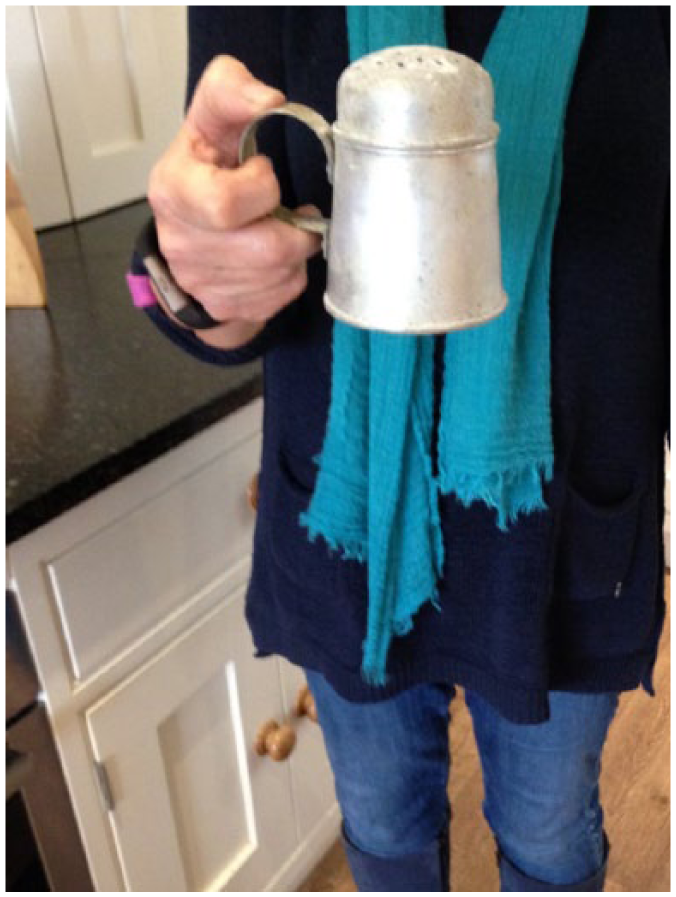
Sandra’s flour shaker.
Interestingly, this physical use of objects as a means of reinforcing and sustaining kin ties is not limited to items inherited by one generation. This is somewhat counter to Finch and Mason’s (2000: 154) argument that objects do not retain their special ‘keepsake’ status after more than one transmission because this requires the recipient to have direct personal memories of the original owner. My work has revealed that often second transmission inherited items can act as a means of reinforcing and sustaining kin ties because of their passed on, layered history within a kinship group and because of their repeated generational use. One participant, Diana, 6 reveals this through a bread knife (Figure 2) she inherited from her mother:
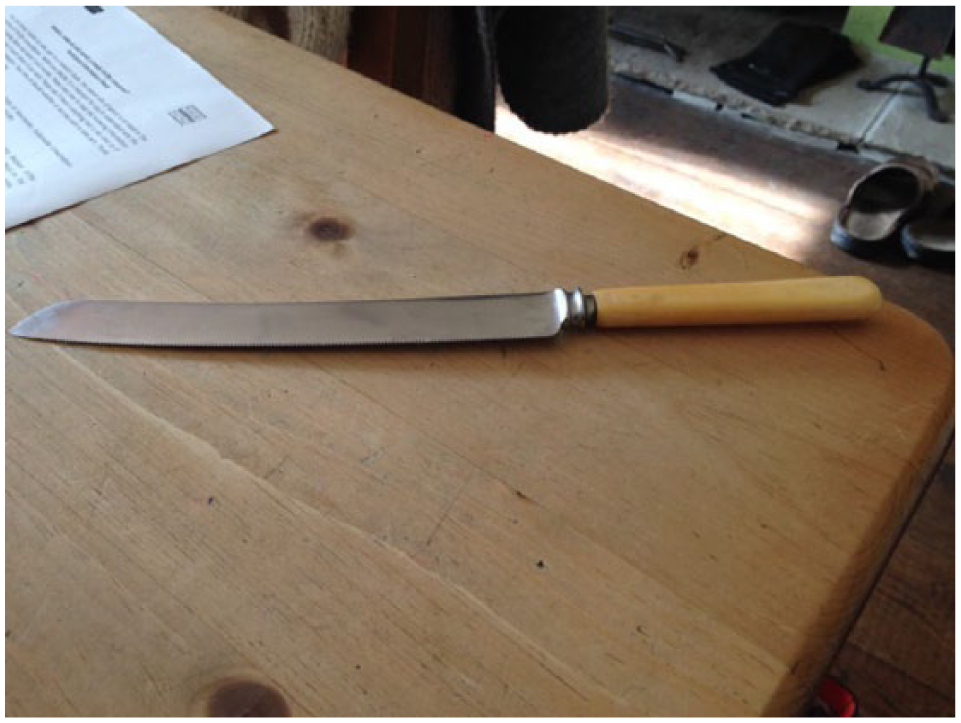
Diana’s bread knife.
She got it from her mum and it was her mum’s wedding present… So yeah it’s a hundred years old… I just really like it. I just think ‘This is so old!’ I know it’s not ancient, you know, but it’s how my mum held it, and her mum, you know. I’ve got some of those horrible plasticky ones, but they just don’t feel as nice. I don’t know.
For Diana the importance of the bread knife is that through its use it has the power to link her not just to her mother, whom she does have personal memories of, but also to previous generations. The material and sensory qualities of the knife at work create ethereal affinities to past kin (Mason, 2008). Holding and using the knife enables Diana to imagine her own mother, but also her grandmother using it, forging kin connections with both whether she has personal memories of them or not. In the same way that Kramer (2011a: 390) describes how people studying their genealogy ‘experienced connectedness with their ancestors through the sensory experience of recreating their actions or returning to meaningful places’, inherited objects which may be on their second or third (or more) transmissions offer the possibility to tap into layers of imagined and creative affinities with kin. Furthermore, such connections are made more accessible and imaginable through objects in use.
What we see through this strand of material affinity is that kinship practices are revealed through the inheritance of mundane items, as well as objects defined as treasured ‘keepsakes’ or hidden ‘heirlooms’. Such everyday objects may not strike us as specific things we have inherited or been ‘chosen’ to have via a will, nor are they objects that we necessarily cherish. These may be things we ‘acquire’ after a loved one’s death and choose to keep in part because they are still materially valuable. Nonetheless, this does not weaken the sentiment these objects hold, but rather often this sentiment is closely entwined with, perhaps even obscured by, the potential residual use value such objects have.
Handed Down Objects
The second material affinity of passing on illuminates objects which are handed down between living kin, as opposed to inherited items. It is important to note that previous studies have focused on this type of passing on of objects. While taking different approaches, broadly such work has explored how objects and materials are circulated throughout different personal networks and social groups (see Clarke, 2001; Evans, 2012; Gregson, 2007; Holmes, 2018b; Pahl, 1984). However, this work does not explicitly engage with how this form of ‘passing on’ acts as a means of expressing kin connections.
In this strand, ‘passing on’ is often referred to by participants as ‘handing down’; items which move from one generation of kin to another. A great deal of this involves clothing handed down between siblings or other close family members of similar ages (see also Clarke, 2001), but also includes furniture and larger household items (see also Gregson, 2007). As the following quotes illustrate, this form of passing on is imbued with humour and warmth, and the opportunity to reproduce family traditions and relive family jokes: when I was growing up we had second-hand and hand-me-down everything … It was a running joke in our family that during one of Grandad’s slide shows the second youngest cousin would point to a photo of the youngest cousin wearing some lovely flared dungarees and say ‘I wore those!’ That chant would go all the way up through the cousins who had previously worn the same item of clothing.
7
(MO Respondent: T4715) I have some furniture handed down from my grandparents… My siblings and cousins are amused that I haven’t got around to replacing them, especially the living room suite which we all remember from gatherings at my grandparents’ house.
8
(MO Respondent: V3773)
These quotes illustrate how handed down items are significant in memorialising family practices. They form a central reminder of family traditions – the flared dungarees celebrated through Grandad’s slide show or the old furniture as a reminder of family gatherings – their ‘handed-downness’ becoming a quality of the object itself. These objects form and become part of mnemonic communities (Misztal, 2003); their collective memories making and sustaining kinship, in these instances through humour and warmth shown for these objects and the connections they conjure. Such objects provide the opportunity to imagine family times gone by, relive past family events and reproduce family traditions. In the case of the dungarees, they no longer exist, but their material memory lives on, interwoven within the mnemonic community, ensuring its active reproduction and continued existence. With the old furniture it is through its presence and continued use that memorialising is made possible. These objects operate as material affinities interconnecting the relational and material spheres, becoming part of the practice of ‘doing’ family, and a mechanism for not simply memorialising but also displaying and celebrating kinship.
Repurposed Objects
The third strand of material affinity concerns items which have been passed on between kin, either through inheritance or other means, but which have been altered to extend or enhance their use and keep them within circulation within the kinship group. This strand emerged from querying the extent to which participants and respondents engaged in ‘upcycling’ or repurposing practices. While there is not the scope to deal with this here, many participants and respondents noted how such practices were deemed fashionable pursuits, yet were things they had always done as part of everyday household management (see Hall and Holmes, 2017; Holmes, 2018b). The ways in which passed on objects were repurposed further exemplifies the complex interweaving of sentiment for loved ones with residual use value, as the following quotes illustrate: We’ve got tables that my dad made… you know the circular doors out of corner kitchen units. Two of them together on top, all painted and it’s all white. We’ve got a massive table about that big, circular table, and underneath it’s my dad’s table!
9
(Sharon, Interview participant) I mean that [pointing to a small bench] is the bottom of a wardrobe that belonged to my gran, and when I’ve not got that on [a big orange cushion], I’ve got a piece of wood that we made and polished and whatnot to put on the top of it, because it dips.
10
(Heather, Interview participant)
Both of these quotes mention passed on items of furniture which have been altered for use within the participants’ homes. Sharon’s living room table uses a smaller table her father made as its foundation, while Heather’s seat (Figure 3) is made from a drawer from the bottom of her grandmother’s wardrobe. These items are particularly fascinating as a form of material affinity because they expose not just the everyday mundanity of passed on objects, but also their ‘slippery’ status within the home. These items are not treasured keepsakes; part of sacrosanct displays protected by glass cabinets and elevated untouchable positions around the home. If they were so cherished, participants would not risk altering them for fear of damaging them beyond repair and further display or use. Rather they have taken risks with them to ensure their continuation in some form. In part, this is because they are still deemed useful, their material qualities offering further possibilities and residual use value, but there is also sentiment for family interwoven into these narratives.
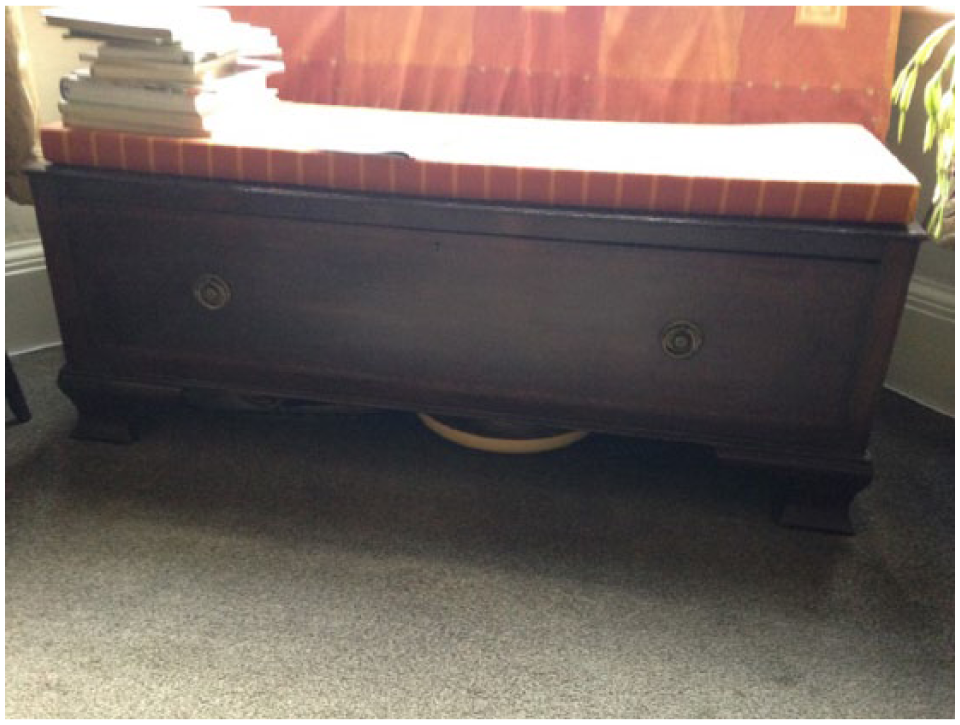
Heather’s wardrobe seat.
These objects are reminders of their original owners despite their enhancements. Yet, they are also a source of pride, pride that these objects and their associated memories continue to ‘live on’ and pride at accomplishing the task of altering them into something ‘new’ and useful (Campbell, 2005; Gregson and Crewe, 2003). Campbell’s (2005) craft consumer is a figure who finds pride through DIY and the personalised things they produce. As Campbell (2005: 37) discusses: ‘the arena of craft consumption could become highly valued because it is regarded as an oasis of personal self-expression and authenticity’. I argue that these passed on objects are already personalised because of whom they represent, but are given another layer of personalisation through their repurposing. These objects interweave old family narratives with new ones, drawing upon the sentiment preserved in their very fabric for loved ones passed, with new material qualities and affinities created by their enhanced status and the work and pride which has gone into producing them. Thus, layers of kinship are inscribed into their material form both physically and imaginatively.
Objects as Family Reminders
The final strand of material affinity involves objects which are not physically passed on between kin, but rather objects which act as reminders of family times passed. I have chosen to include this strand because it too is central in illuminating how everyday objects are intertwined with the doing and making of family, despite such objects being retained rather than passed on. These objects take different forms: from items used every day to items which hold more of a ‘special’ status. My first example draws on items owned by my oldest participant, Edna. At 95 years old, Edna
11
had some extraordinary ‘ordinary’ objects within her home, many with a tale attached. Edna got married in 1941 and still uses objects she bought and received around this time: So we went to Rochdale, and we got this wedding dress…. And it had a train on, you know. Anyway… oh, and that day I bought a rolling pin. [laughs] It’s true! [laughing]. I have one pan in my kitchen, and it’s a Swan pan. Now, we hadn’t been married very long and somebody was selling these pans, and they were a set of pans, so I said I’d have some. And I had to pay sixpence a week for these pans. And when I told the husband, he was annoyed. He said, you shouldn’t go into debt for that. But anyway, we paid these off and I still have one pan.
Despite being over 75 years old, both the rolling pin and the pan are still used by Edna and can be found in her kitchen (Figures 4 and 5). These objects epitomise all of the material values discussed in the previous sections. They have been kept for so long because they still ‘do the job’, having material qualities which are deemed to outstrip those of newer items. However, they are also kept because over time their sentimental significance has grown. The rolling pin is inextricably linked to the more ‘sacred’ item of Edna’s wedding dress (repurposed as a child’s dress several decades ago); its purchase always a reminder of that significant time in Edna’s life. The pan, the last remaining one of a set, acts as a reminder of an argument early on in her marriage to her husband – a man who passed away many years ago. Thus, these objects and their continued use have the power to conjure up memories of past events and passed kin in Edna’s life, enabling her to memorialise times gone by and reflect on the kin she has around her now. Their age only adds to their sentimental significance as a material affinity.
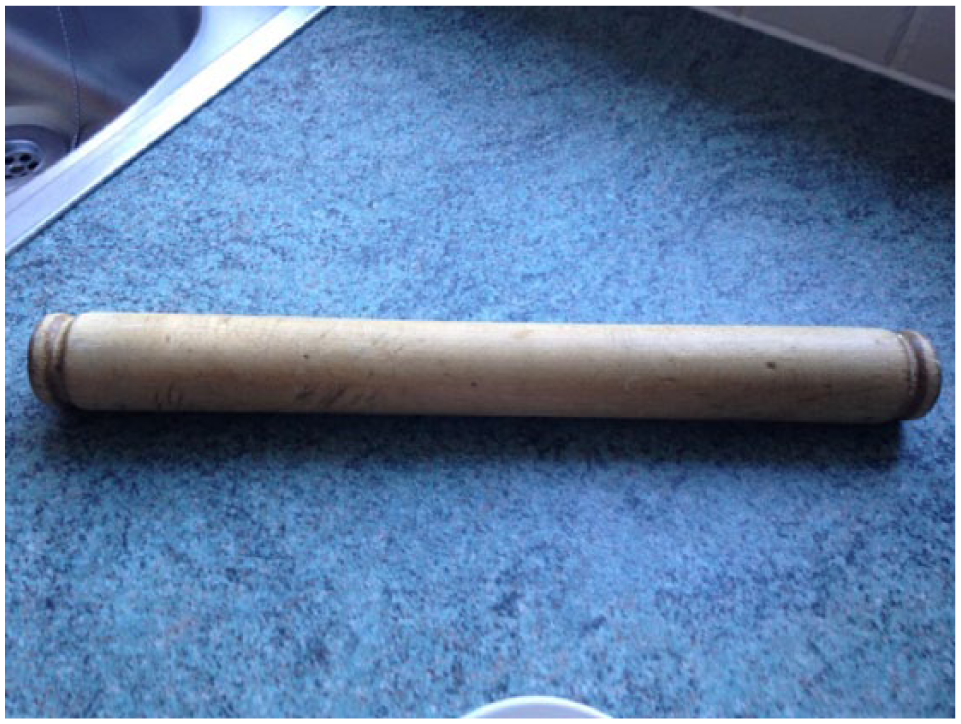
Edna’s rolling pin.
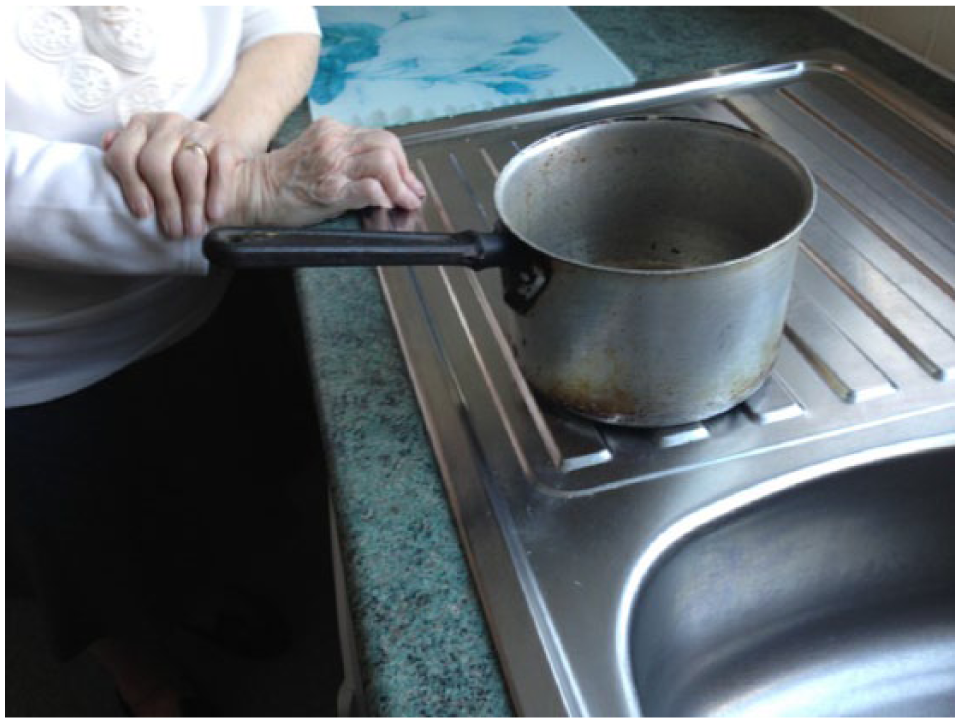
Edna’s pan.
Finally, while this article is firmly positioned in highlighting how mundane items can enable kinship, it is worth mentioning the significance of ‘special family crockery’. Many of the participants I interviewed mentioned that they had a ‘special’ set of crockery, cutlery or glassware for specific occasions: I have a set that we got bought when we married. They’re kept in a different cupboard…. And we also have two boxes of cutlery that were bought for a wedding present that comes out when we have visitors. It’s just like tradition to get it out isn’t it?
12
(Ruth, Interview participant)
Reflecting their position in the realms of sacred items, as Ruth’s quote illustrates, such ‘special’ objects are stored in distinct places – in different cupboards away from the everyday crockery, or in display cabinets for others to see. Importantly, such crockery illuminates several elements of kinship. First, it acts as a sentimental reminder of the significant occasion for which it was purchased, often a wedding gift, or setting up a home. Second, these special items are crucial to the displaying of family. As participant Edna describes ‘years back, if you had a china tea set you were everybody… it was only for best …if company came’. Having a china tea set or special crockery set for visitors is part of the displaying of family – that is families we live by (Gillis, 1996). Such objects are a marker of status, a material imaginary of the sort of family we wish to display. However, third, such items also mark out families we live with, becoming engrained in family traditions, gatherings and practices. Thus, while they are not used every day, and their treatment, storage and significance is different from ‘ordinary’ items, their continued material presence ensures that they become part of the everyday mundanity of ‘doing’ family – they are part of the material affinities of family.
Discussion
The four material affinities of passing on I outline in this article demonstrate the close relationship between kinship, relationality and materiality and the need for further sociological study into what have so far been separate spheres. By making the object central I have illuminated the material-kin biographies everyday objects can hold. Material affinities reveal how the material and sensory qualities of objects help to shape and construct kin ties, through memorialising, imagining, celebrating, ‘reckoning’ and displaying kin ties, both biological and social, in and through time. Yet, this is an interconnected process whereby objects become inscribed within kinship, sometimes physically through material changes such as repurposing, and/or imaginatively through the ties objects are deemed to represent, but they also become central components of that kinship network. In other words, they are characters of these kin ties – the handed down dungarees, the special crockery sets – holding a novel and special place in particular family narratives. They are physically and imaginatively central to their stories. I have argued that these material affinities are heightened through objects put to use; as engaging objects in practice reveals how materiality and relationality are folded and layered together within the sensory and material qualities of objects. The passing on of mundane objects to intimate others is part of the ‘ordinary complexity’ of kinship (Mason and Tipper, 2008: 443). These items are passed on because they are still useful, but this ‘use’ is complexly interwoven with ‘reckoning’, choreographing and celebrating kin ties, both biological and social (Edwards, 2005). As participant Edna concludes: ‘you can’t take memories away from what you’ve got’. Indeed, the affinities materials have the power to conjure – imagined or otherwise – are not easily removed, even when objects or their associated owners no longer exist. As Ingold (2010: 4) notes like ‘knots whose constituent threads far from being contained within it, trail beyond, only to become caught with other threads in other knots.’ The objects and materials described bind together a plethora of other ‘things’ from people to memories, to practices, imaginaries, to other objects.
This work has revealed subtle gender differences with regards passing on practices. While the majority of my interviewees were women, and there are more female Mass Observation respondents than men, many men did mention items which had been passed on to them. The significant difference was the level of sentiment expressed. The majority of quotes I have used are from women because many of the female participants/respondents engaged at length with what such passed on objects meant, while men were generally less expressive. This is not to say that the men in my study did not value such items sentimentally, more that they were much more matter-of-fact about what had been passed on and their uses. This echoes Finch and Mason (2000: 169) and their conclusion that women take ‘a leading role in the symbolic practices’ of passing on. This may be linked to women’s essentialised role as caregivers within the family and the gendered division of labour within the household (Hall, 2016; Zelizer, 2011). Meaning that the role of valuing and organising passed on items, and the emotional forms of labour this entails, falls to women. This speculation is worthy of further study – why do women take such a role in interpreting and valuing passed on items?
In sum this article offers an approach for sociologists to explore the relationship between materiality and kinship. It broadly unites the often disparate fields of the sociology of family with that of the sociology of consumption and materiality. Although it focuses on ‘passing on practices’ it opens up the possibilities which further work on material affinities may offer. Starting from the object and not the subject provides a means to illuminate the minutiae of our everyday relationships with materials, unpicking their very fabric and form to explore how they interweave us with those around us. Of course not all objects hold significant sentiment or may connect us clearly to others, but as the data have shown many do and the possibilities for future work in this area are plentiful. For example, further study could explore how objects afford affinities with others in different spaces and settings – such as places of work, home or leisure. How they enable social as well as biological forms of kinning. In the same way that language operates as a means of social kinning to describe ‘like-family’ relationships (Mason and Tipper, 2008: 450) – for example, through the use of ‘aunty’ or ‘uncle’ to describe a close friend of the family, or how close friends may think of their relationships as being ‘like a sister or brother’ – so objects may perform a similar role by providing material affinities (Mauthner, 2005). Other possibilities may include how objects are used to de-kin, as well as kin, such as through break-ups or divorce settlements (Nordqvist and Smart, 2014). A broader approach may consider how objects are ‘relational, embedded and connected’ to other objects and places as well as people in wider webs of relationships (Mason, 2004). Materials are part of everyday lives and relationships, and their influence should not be undervalued.
Footnotes
Acknowledgements
I would particularly like to thank Professor Jennifer Mason and Professor David Evans for their very helpful comments on earlier drafts of this article. I am also grateful to Fiona Courage, Joe Williams, the Trustees of the Mass Observation Archive and the Mass Observation correspondents. Reproduced with permission of Curtis Brown Ltd, London on behalf of the Trustees of the Mass Observation Archive. Copyright The Trustees of the Mass Observation Archive.
Editor Note
This article was submitted by the author, Helen Holmes, who is currently an editor of Sociology. The article followed the process as detailed in the BSA Terms of Reference. The article was edited by the Chair of the Board. The article underwent the journal’s usual peer review process with a minimum of two peer reviewers. During the process the author had no access to information regarding the article beyond that available to all authors.
Funding
This research was supported by a Hallsworth Research Fellowship, University of Manchester.
