




Abstract
An ongoing debate in the literature is around the existence and constitution of a so-called ‘global elite’. This article enters that debate – seeking to understand what connected but also divided a group of wealthy young people occupying a transnational space. It examines consumptive practices at one of the most expensive secondary schools in the world, educating a cross-section of the globally wealthy in Switzerland. The article offers insights into the boredom that pervaded this group, shaping some of the consumptive practices that bound its members. It also argues that other consumptive practices reflected consciously articulated differences within this group, such as national- and linguistic-based social groupings. The case study offers a unique opportunity to examine consumption as a lens onto cohesion and distinction within a particular group of transnationally located, wealthy young people, thus contributing to scholarship around the nature of the ‘global elite’ at large.
Introduction
There is an ongoing debate in the literature around the existence and form of a so-called ‘global elite’ – a group characterised by ‘its unequaled level of wealth and global interconnectedness, its transnational ubiquity and concentration in the planet’s major global cities, its specific culture, consumption habits, sites of sociability and shared references’ (Cousin and Chauvin, 2021: 1). This debate is rooted in scholarship on a ‘transnational capitalist class’, which emerged in the early 2000s (Carroll, 2010; Robinson, 2004; Sklair, 2001), but has most recently evolved to look at this group’s educational choices (Lillie, 2021b), nightlife (Mears, 2020), movement of finances (Hoang, 2022), investment strategies (Fernandez et al., 2016) and professional networks and demographics (Ischinsky and Tisch, 2023; Young et al., 2021). However, it is not entirely clear whether the ‘global elite’ is a cohesive group or, instead, one comprising individuals who ‘may have the possibilities of coordination but do not always use them or even know how to use them’ (Cousin et al., 2018: 227).
This article broadly contributes to the scholarship examining degrees of cohesion and distinction within the global elite at large, by studying the consumptive practices of a particular group of transnationally located, wealthy young people. The transnational space of study mirrors some of the other sites of investigation that recent scholars of elites have focused on: Saint-Tropez (Bruno and Salle, 2018), exclusive nightclubs (Mears, 2020) or upper-class neighbourhoods in São Paulo and Delhi (Paugam et al., 2017). In this article, we focus on the role of consumption, as it emerged as a significant part of everyday practices and of the ways members of the group we examined sought to position themselves.
This is a significant addition to the body of literature seeking to understand the practices and processes of reproduction that might be driving and sustaining the presence of such a group. Our analysis focuses specifically on consumption both as a practice that connects these young people, the inheritors of global capital, but also as a practice that divides them. It therefore allows us to test the extent to which consumption as a lens offers analytical purchase for studying the constitution of and relations within the ‘global elite’.
We argue that in a transnational space – one in which a cross-section of young people from around the world live and study together in relative isolation in the Swiss Alps – we are able to focus on the practices that bind these young people and also to reveal the tensions between them. Our field site is one of the most expensive schools in the world, which educates young people aged 12–18 from over 40 countries, in Switzerland. The fees to attend the school (109,000 Swiss Francs, or £98,000 per year), and the low number of scholarships available, mean that the young people in our study primarily come from extremely wealthy families. Although the practice of consumption is not relevant only to the study of the wealthy, the study of consumption within this particular group (wealthy young people) allows us to contribute to a particular area of scholarship that is concerned with the existence and nature of a global elite.
This article starts by reviewing what we know about different consumption practices among the wealthy in various national spaces. After this, we detail our research methodology and examine consumption as a shared practice that cuts across the particular group we studied, and how it is linked by our participants to boredom. We then argue that the transnational space of our field site is still informed by national affiliations, evidenced through the composition of various friendship groups. Understanding this is crucial to making sense of particular consumptive practices as a way of expressing divisions within this group. We thus argue that consumption offers a lens into the commonalities and consciously articulated differences among this particular group of young people. This contributes to the extant scholarship by showing that the specificities of the ‘consumption habits’ of the global elite at large (Cousin and Chauvin, 2021: 1) may help us further characterise the extent to which they display intergroup cohesion and distinction.
Consumption Practices among the Wealthy
Sociological thought has frequently linked how the rich consume to an assertion and signalling of their superiority. This idea often builds from Veblen’s (1899) treatise on conspicuous consumption and the so-called ‘leisure class’. Others have also theorised such signalling, perhaps most famously through fashion (Simmel, 1957) and cultural taste (Bourdieu, 1984). We here take the Bourdieusian approach of seeing consumption as a form of distinction. Focusing on the French bourgeoise, Bourdieu (1984) argues that choices in taste are choices made in opposition to those of other social classes in order to ‘distinguish’ oneself as part of a particular class – and, notably, as not part of another. In this way, different tastes also become a basis for social judgement.
The existence of a modern ‘elite class’ has been most influentially argued for by Savage et al. (2013), based on the Great British Class Survey from 2011. Using latent class analysis to construct a model of British society, Savage et al. (2013: 234) defined the ‘elite’ as ‘a relatively small, socially and spatially exclusive group at the apex of British society’, characterised primarily by its vast economic resources. Most important for this article is how, then, to conceptualise a ‘global elite’ rather than a particular national elite. As noted in the introduction, we understand this group to be characterised by ‘its unequalled level of wealth and global interconnectedness’ (Cousin and Chauvin, 2021: 1) – characteristics reflected among our participants.
Although we speak to this body of scholarship around the existence and form of a global elite, we consciously do not refer to our study sample as an ‘elite’ or a ‘class’; instead, we label them as a group of wealthy young people. While their parents’ social location renders them part of various national elites, and in some cases a transnational financial elite, many of the young people in our sample were sent to this educational institution specifically with the ambition of elevating their future social location from belonging to a national elite, to a perceived transnational elite (Lillie, 2021a). Participants understood that via the international credentials they would achieve, the transnational networks they could forge and their anticipated future global mobility, they could reasonably expect to join a global financial elite.
Various modes of consumption by the wealthy seem to be an agreed lens through which to study this group and differentiate them from other groups. However, consumption practices of the wealthy and upper classes are specific to the epoch and national context (Daloz, 2010). As to epoch, consumption trends have changed over time, mainly from highbrow to ‘omnivorous’ (Bennett et al., 2009; Hahl et al., 2017; Khan, 2011). As to national context, consumption patterns vary across geopolitical space. In France, the wealthy focus on displaying cosmopolitanism (Cousin and Chauvin, 2014); in Finland, on hard work and perseverance (Kantola and Kuusela, 2019); in Sweden, on an egalitarian ethos (Törnqvist, 2019); in the USA, on subtlety (Sherman, 2018). In the UK, this has changed over time from leisure to the fine arts, to a blend of highbrow and everyday pursuits (Friedman and Reeves, 2020). In these examples, drawn exclusively from the so-called Global North – Europe, the Nordics and the USA – the wealthy do not focus on conspicuous consumption.
However, there are national spaces in which this does appear to drive their practices. In India, for example, the wealthy feel a need to display that wealth, to legitimise their position (Bhandari, 2019). In Vietnam, conspicuous consumption is part of a strategy to attract investors and therefore capital influxes to the local economy (Hoang, 2022). In China, such consumption is used as a way of enhancing one’s perceived status (Jin et al., 2015). Conspicuous consumption may thus be a trend in the so-called Global South – although, in Brazil and Puerto Rico, for instance, wealthy families reject consumerism and instead lean on austerity to morally justify their economic positions (Ramos-Zayas, 2020).
Returning to Bourdieusian theory, it makes sense that norms around signalling social class through distinction would change depending on the geopolitical space at hand. These spaces often constitute ‘fields’, meaning contextualised spaces in which such tastes are negotiated and assigned value (see also Bourdieu, 1993, 1996). What ‘works’ in one field may not necessarily work in another. An interesting problematic is then what happens in the transnational space, where there would not appear to be a dominant national field to guide questions of taste.
We understand the transnational space as comprising ‘systems of ties, interactions and exchanges that spread across and span the world’ (Rizvi, 2011: 184). This echoes long-standing sociological arguments that the nation-state is in decline (Bauman, 2000) and that we should move beyond it as a unit of analysis (Beck and Willms, 2004) and instead embrace a ‘mobilities paradigm’ (Sheller and Urry, 2006). Although we do not examine mobilities as such, we do study a space inhabited and shaped by young people from around the world, whose ties and influences come not just from their home countries or their educational institution’s location (Switzerland), but also from their networks in, travels to and futures envisioned in third spaces. This is in line with Cousin and Chauvin’s (2021) review of social science literature on elites, which shows the ‘global super-bourgeoisie’ are not entirely unconnected from their national fields.
The few studies examining that transnational space have shown that there, conspicuous consumption drives practices among the wealthy. Mears’s (2020) study of the global party and nightclub circuit, for example, documented extreme practices of consumption that confer status through the unrestrained spending of money and perceived hedonistic practices. Related to their movement between spaces, the super-rich have been shown to indulge in ‘super-luxury’ – purchasing jumbo jets, super-yachts and race cars (Featherstone, 2013). On the Saint-Tropez peninsula, conspicuous consumption among the globally wealthy has evolved into so-called ‘conspicuous seclusion’ (Bruno and Salle, 2018). It appears as if the transnational space is one in which consumption is highly visible – that this is, indeed, the practice of distinction among the transnational rich.
Our field site, which can also be considered a transnational space, reflects the dominant findings above. Yet, we extend these findings by further arguing that such consumption practices reveal important tensions among this group as their different national affiliations are signalled at the same time as their shared positioning as transnationally located, wealthy young people. The significance of this lies not only in its empirical contribution to knowledge about the meaning of consumption practices among this particular group, but also in its theorisation of consumption as a lens onto cohesion and distinction within the global elite at large.
Methodology
Our data were collected at the Leysin American School (LAS). LAS is the real name of the school, which we use with the permission of the Head of School, but all participant names are pseudonyms. A boarding school in the Swiss Alps, LAS began in the 1960s as a school for the sons and daughters of the American Cold War elite (Mills, 1956), stationed abroad. Over time, as the Cold War morphed into global capitalism (Saull, 2007), the school evolved in parallel into an institution for the globally wealthy (Lillie, 2022).
Charging 109,000 Swiss Francs (£98,000) per year in fees, not including additional costs of roughly 20,000 Swiss Francs (£18,000) per year, LAS is supposedly one of the most expensive schools in the world. Admission to the school is effectively mediated by ability to pay. At the time of the fieldwork, LAS educated young people aged 12–18, almost all of whom paid the full fees out of pocket. Those young people hailed from 40 countries across the globe. The top five nationalities combined made up only 54% of the student body: Russian (17%), American (12%), Chinese (11%), Mexican (9%) and Brazilian (5%). The regions of the globe, as defined by the United Nations (UN Statistics Division, 1999), that were primarily represented were Europe (37%), Asia (34%), Latin America (14%) and Northern America (13%). The remaining students came from Africa (1%) and Australia (<1%). Despite being in Switzerland, less than 3% of students at LAS were Swiss.
This cost and student body profile is relatively typical for Swiss boarding schools. Although there is no definitive answer as to why wealthy families from around the world seek an education in Switzerland, it has been theorised that schools in the country draw on Switzerland’s association with wealth to claim a spatial and symbolic proximity to economic resources (Delval, 2022). That association is derived not only from the country’s wealthy population, with Swiss adults being, on average, the richest in the world (Shorrocks et al., 2022), but also from its banking sector focused on private wealth management (Araujo, 2020; Bertron, 2018). Many schools activate this proximity to their advantage when marketing themselves to a global and wealthy clientele (see also Gamsu, 2022).
The cross-sectional study informing this article was conducted over 15 months from 2016–2018. Ethical approval was granted by Lillie’s institutional review board as well as by the head of LAS. To collect data, Lillie interviewed students and administrators, made observations and studied archival sources. Here, we draw on interviews done with students from the final year group (ages 17 and 18) and observations made of the final two year groups (ages 16–18); both methods are described in more detail below. The examples from the data in this article have been chosen because they illuminate a broader phenomenon among the young people studied.
Access was negotiated through Lillie’s professional history at the school. She had worked there as a college guidance counsellor and member of the residential staff. Being an ‘insider researcher’ can present various ethical dilemmas. These arise both in the fieldwork stage, such as around delineating between what is said to the ‘researcher’ for use in analysis and what is said to the ‘person’ on a private basis, and in the analysis stage, for example around balancing analytical objectivity with the personal relationship that exists between the researcher, the site and subjects (Lillie and Ayling, 2021). However, being an ‘insider’ is also often the only way to get access to elite educational institutions (see also Gaztambide-Fernández, 2009; Howard, 2008; Khan, 2011).
There were also data collection issues that arose from this positionality. As will be seen in the quotes included in this article, students referred to Lillie as “miss” – a standard form of address applied to all female teaching staff at the school and so one that, although not necessarily connected to respect, did delineate teachers from students. That this label was also used in interviews suggests that the power dynamics at play between teachers and students in the school context also extended to the interview context. However, Lillie noted that participants openly discussed a number of prohibited behaviours (drinking, smoking, etc.) in the interviews, which would have been risky to do in the more formal relationship that characterised staff–student relations.
The ethical and data collection dilemmas that being an insider can pose were in part mitigated by reflecting on the research process with Maxwell, an outsider, and analysing and writing up the collected data together. The two authors discussed general ways to conceptualise this positionality (with Maxwell having done similar work in other, nationally located elite schools, but as an ‘outsider’ – Howard and Maxwell, 2021; Maxwell and Aggleton, 2015), ways to understand particular incidents that occurred and how to theorise the resultant impact on data collection and analysis. With both Lillie and Maxwell being white and well educated but economically middle class, they processed the consumption habits of the students together from a position of some distance, but not total foreignness.
Interviews were conducted with 19 young people aged 17 and 18 at the school, which was 20% of the final year group, from which they were all drawn. Consent for interviews was given by all interviewees in person and by their parents via email. One of the participants had a full scholarship to the school; the rest paid the fees out of pocket. Their parents were almost always business owners, although there were some notable exceptions in the arts: for example, a jewellery designer and an art collector.
Participants were chosen through stratified purposive sampling, which ensures that each group is represented in the final sample by selecting participants from different ‘strata’ (Patton, 1990, 2014). We defined ‘strata’ according to how well represented one’s home country was in the year group, as we knew from observations that this largely shaped a student’s experience of LAS. We then chose particular participants according to theoretical, contextual and practical parameters (Gaztambide-Fernández, 2009: 228–231). Theoretically, students were drawn from different geopolitical areas, for example, the so-called Global South and Global North; contextually, from different friendship groups and family wealth backgrounds; practically, from those who consented to participate. We had an insightful sample rather than a perfect one.
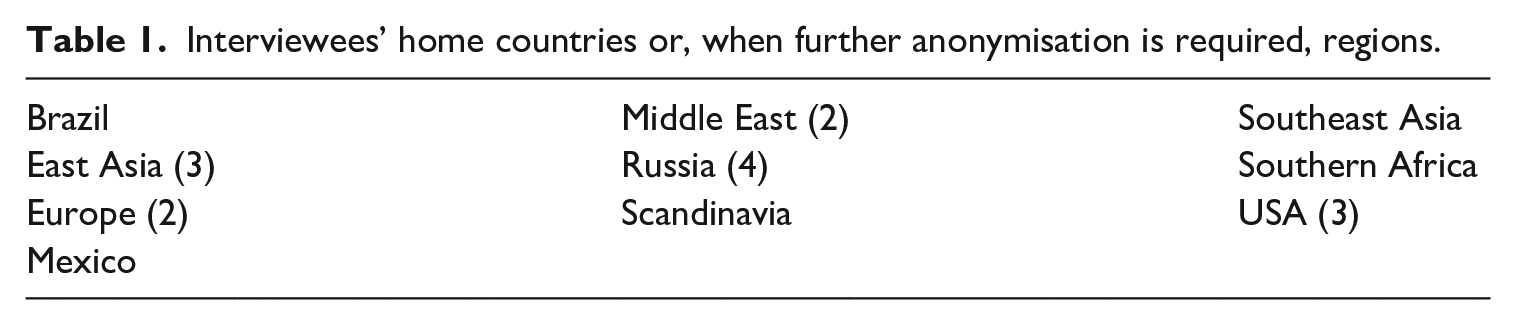
Table 1 lists the countries represented in this sample of 19, which roughly mirrored their representation in the overall year group, but not necessarily in the entire student body.
Interviewees’ home countries or, when further anonymisation is required, regions.
Lillie conducted the interviews following a semi-structured interview guide. She asked about students’ backgrounds, sense of home, journey to and impressions of the school, and future trajectories. She did not specifically ask about money or consumption, but the topic frequently came up in response to questions about the school’s culture. On average, the interviews lasted 52 minutes. All interviews were transcribed by Lillie.
Lillie also made observations of the final two year groups at the school, which she recorded by hand in a notebook. Observations were approached as a way to provide data on how everyday life unfolded for these students, and which practices shaped their day-to-day interactions. Through intense watching, listening and reflexive questioning (Hammersley and Atkinson, 2007), Lillie focused on chronicling how and by whom both public and private spaces were used at different times, who socialised with whom and how, and the changes that occurred when new people entered the space. She did not specifically focus on consumption practices but later saw this as an important theme threaded through the encounters she recorded.
Both the interviews and the observations were thematically coded by Lillie and Maxwell. Coding categories were developed inductively and refined throughout the data analysis, following the process set out by Braun and Clarke (2022). Although consumption practices were not an initial focus of the study, the authors began to notice the frequency with which boredom and consumption came up in the collected data. They developed secondary codes referring to those themes and then mapped how the incidences of those codes related to participants’ social networks, socio-economic backgrounds and nationalities.
An Introduction to Consumption at LAS
On the first day of the school year, Lillie walked from her residence in a student dormitory to her office in one of the classroom buildings. With the school being located in a ski village in the Swiss Alps, the 1-kilometre, 20-minute walk involved an elevation gain of about 100 metres. Lillie wore Keds. She was surprised to be passed by students not on foot, but in taxis – a 4-minute drive that, she later learned, cost a flat fee of 10 Swiss Francs (£9). Once in the building, she noted students walking through the halls in their uniforms, yes, but punctuated with designer scarves and purses (for the young women), luxury brand sneakers and high-end jewellery (primarily, Cartier bracelets and Rolex watches). But it was a moment at the first dormitory meeting of the year, welcoming the students back, that permanently planted the seed in Lillie’s mind that consumption practices at LAS were of analytical relevance. Making small talk with one of the students, she asked which airline the young woman had taken from the USA to Switzerland. The young woman replied, ‘Oh, miss. I don’t fly commercial.’
Indeed, young people at LAS consumed – and displayed that consumption – with ease. Their shopping habits were extravagant. They returned from school trips to Geneva with enormous shopping bags from Chanel, Gucci, Louis Vuitton and other luxury brands. They showcased their items in their dorm rooms, the young women lining up luxury house purses on their couches; the young men, high-end watches on their desks. And, of course, they wore their items to class and to school events, like Prom. At the time of fieldwork, it was in vogue for the young women to have an Alexander McQueen dress (£2000–£8000) for the event. There was also the constant replacement of items, evidenced most by what could be found in the donation bins for locally living refugees: a Louis Vuitton backpack (£2000), a Bottega Veneta iPhone case (£250), Arc’teryx ski jackets (£900). The question for the authors then became: what purposes do such practices of consumption serve?
The Treadmill of Consumption
One of our first observations of what drove such practices of consumption was an overriding sense of boredom experienced by participants – who seemed to continuously seek to infuse excitement, a sense of purpose, change and mobility into their lives. For example, Helena was continuously seeking out new places and interesting things to do. She initially decided to study in Switzerland because in her home country of Brazil, she ‘started getting really bothered by routine – getting up, seeing the same people, doing the same things every weekend’. And yet now, she saw Switzerland not as her mother described it to her (‘the most glamorous place ever’) but as ‘grassland everywhere. You can spend maximum two days in Geneva without being bored.’
Helena laid out where this pattern of boredom comes from: I get bored of [Brazil] ’cause for me, I’m going after something when I want that thing, you know? I look forward to it. I need it. Like, I’ll move mountains to have it. But when I actually have it, when I’m actually there or if I had it for a long time, it’s just meaningless to me. Brazil is not something I have to conquer. It’s going to be there for me, always. I know that if I want, I can take a flight to Brazil, like it happened on the long weekend. I wanted to go back to Brazil. I just took a flight. I know I’m going to be there.
For her, what was interesting was ‘the chase’. She desired what was out of reach (Campbell, 1987) and yet, with resources that allowed her to purchase whatever goods or experiences she wanted, like a last-minute weekend trip from Switzerland to Brazil, little remained out of reach for long. This ease seemed to heighten her desire for a challenge, while also making it harder to find one that was difficult to attain.
Narratives generated by our young participants were replete with mentions of boredom. Ya-Hui, from Taiwan, had also hoped that moving to study at LAS would ensure ‘you won’t be bored’. Emily, who was born and raised in the USA but moved to Saudi Arabia for her father’s job and then to LAS reported, ‘I get bored with places easily.’ Both Emily and Ya-Hui expressed the need to move frequently in order to stave off the potential of feeling bored and getting stuck in one place and with one set of experiences. Magnus’s narrative echoed those sentiments. He ‘got a little bored of just kind of being in [Scandinavia]. It all seemed very quiet and sleepy where we were.’ His father was then offered a job in the Middle East, which, to Magnus, ‘seemed like the way out’, and so the family moved. After a few years there, however, Magnus ‘kind of want[ed] to get out because I felt like I was a little stagnant, just going through school in a very monotonous way’. By chance, he met a LAS student at a music festival who explained, ‘Oh, I’m going to boarding school in the Swiss Alps with, you know, skiing opportunities and all that.’ Magnus reflected in his interview, ‘and that sounded so much cooler than being in high school in a desert’.
Among LAS students, boredom seemed pervasive. Drawing on the sociology of boredom, we understand this affectivity as ‘express[ing] the idea that either a given situation or existence as a whole is deeply unsatisfying’ (Svendsen, 2005: 22). Many at LAS seemed to experience a kind of ‘existential’ boredom. In trying to find contentment, those feeling existential boredom permanently seek the next new thing (Svendsen, 2005: 45). But for these students, that search was often in vain, as continually pursuing novelty arguably breeds its own ‘tedium of eternal sameness’ (Moran, 2003: 179). In other words, as has traditionally been argued, boredom drives attempts to pursue newness, often through consumption (a new school, new adventures, new clothes), since we want what we cannot have (Campbell, 1987), but paradoxically are disappointed when we get what we want (Simmel, 1978).
And getting what they wanted was often the case for the young people at LAS. They had, it appeared, almost unbridled access to economic means that facilitated a particular way of tackling the boredom and restlessness they described. This consumption-oriented approach to fending off those feelings brought them together. As one participant put it, ‘When your families are rich, you especially enjoy shopping and spending money’ (Wei). Particularly since shopping trips and weekends away were usually done in groups, this shared interest helped facilitate cohesion among the students. Another participant succinctly explained: ‘[money] translates into where kids travel together, who kids hang out with, attitudes towards school, like . . . I think that’s a big factor’ (Luke).
The (Trans)national at LAS
As noted in the introduction, we consider LAS to be a transnational space, but also saw, as Cousin and Chauvin (2021) noted, that the ‘global super-bourgeoisie’ are not unconnected from national fields. For instance, while relative wealth and boredom-driven consumption connects the young people at LAS across countries of origin, consciously articulated differences emerge through their national- and linguistic-based social groups.
The young people at LAS did not necessarily feel connected to others in their home countries. When interview participants described their relationships to people ‘back home’ or discussed time spent there, there was the sense that their primary community had become their globally mobile, wealthy peers at LAS: ‘[At LAS], you can experience different things while in Russia, they stay in their community. They grow up in the same region. They live a really super small life’ (Tanya, from Russia).
At the same time, Guozhi, a student from Southeast Asia, explained, ‘In an ideal world, the point of LAS would be to bring students from all around the world together to create citizens of the world.’ However, he instead saw ‘students from Russia coming here and making friends with a student from Ukraine and going back without ever talking to students from Japan or ever knowing where Malaysia is.’ The young people at LAS stuck with peers from their cultural comfort zones, forming social groups based on shared nationalities and/or languages.
Natalia, from Mexico, offered a reason for this: loyalty. On the one hand, it was comforting for her to have a Mexican social circle at LAS, to ease the transition to living abroad for the first time. On the other hand, she said, ‘I was also sad because I really wanted to expand and meet other people from different nationalities . . . [but] the path is kind of predetermined for you by your nationality.’ Natalia further explained, ‘I like it because you kind of immediately have friends . . . but it’s also kind of hard to do your thing. If I wanted to sit with other friends, they’d [the Mexicans] be like, “Are you mad at us?”’ Although Natalia could have plugged into other social circles through her sports teams, for instance, she felt that fostering such relationships risked her social standing within her national group.
Our observations also reveal homophily by national and language group in how LAS students arranged themselves when given the freedom to do so. For instance, at an assembly, students in the year group that we studied primarily sat with their linguistic groups, with five language groups (Arabic, Chinese, Japanese, Russian and Turkish) contained entirely among themselves. Observations in the library showed that, on average, 80% or more of occupied tables had only one language group at that table. Those in the cafeteria showed that, on average, 60% or more of occupied tables had a single language group. Students socialised primarily with either their language group or an evenly mixed group of languages – and rarely in situations where their language was in the minority. Even in situations where students could not choose their own seats, like in classrooms, homophily came out in their informal interactions with one another. Of 276 observed side-conversations, 164 (59%) were between people of the same language group, in that language – the top three languages being Russian (55%), Chinese (19%) and English (14%).
Young people at LAS were thus identifying with their transnationally positioned peers while also forming national- and language-based cliques among themselves. While relying on cliques based on nationality, language and/or culture might have been exaggerated by their youth (see also Vincent et al., 2018), our ongoing research longitudinally following this group shows that these allegiances become further embedded in their young adulthood – a finding that also mirrors other research on networks of the transnational business elite (Hartmann, 2009). Understanding these national- and language-based divisions lays the ground for understanding how consumption among the wealthy young people we studied was also used as a form of distinction between them.
Consumption for Differentiation
LAS students often made audibly clear that the items they bought were above a certain monetary value. For instance, two American young women were hanging out in the dormitory lounge one evening, discussing shopping. One of these women, whose father inherited a lucrative family business and was an extreme sport athlete, announced to the other, whose father owned an entertainment label, ‘I never buy anything under a thousand. It’s just not worth it.’
Yet the whole scene was a bit more complicated. One of the only two full-scholarship students was also there, making instant ramen noodles. She had no communication with the others, verbal or non-verbal; when the noodles were ready, she left. The two Americans were either oblivious to or unbothered by having this conversation in the midst of someone known to the community to have very few financial resources. They instead seemed to signal that their very loud conversation about consumption in this public space was, in fact, a private one – or at least one that belonged only to those in their in-group.
This scene illustrates what Mears (2020: 238) documented in her study of the global nightclub circuit: ‘displays of waste’ expressing ‘economic domination’ of the rich over the non-rich. Other examples of consumption to assert dominance also emerged in our data – not necessarily over the few students on scholarships, but over others in a different (national) grouping. Sitting with her friends at a formal dinner event in the cafeteria one night, for instance, a young European woman called across the room to a young Russian woman at another table, with a mix of disbelief and horror: ‘My scarf! You’re wearing my old scarf!’ The Russian did not respond, but a response was anyway not awaited. The first young woman was already explaining to Lillie, ‘My Pucci scarf. I donated it. It’s so last season.’ Notable here is not only that she highlights the luxury house (Pucci, scarves: £400) but also that she makes absolutely clear that this other young woman is wearing her last-season throwaways. The conversation moved on, but the young woman brought up the scarf at least three other times throughout the dinner.
Consumption-driven competition was often observed among the students – illustrating distinction-making practices within the group of wealthy young people at the school. Given the very small number of non-wealthy students in the cohort, we see such practices of distinction as taking place within a group of wealth inheritors (the bubble this transnational group of young people lived in – Maxwell and Aggleton, 2010).
Such competition, particularly between national cliques, came to the forefront at school-sponsored events. At ‘International Night’, each country represented in the student body was given a table to showcase the culture of that country. This event, hosted but not subsidised by the school, carried a number of costs for students: namely, providing culinary tasters for around 200 students and 50 staff, arranging for decorations and procuring traditional clothing from their country to wear. This event turned into an informal competition between national groups to produce the ‘best’ table – particularly between the Russians and the Saudis, who every year flew in roast lamb shoulder and rice from the Kingdom. This example is a significant one, rooted in a long-standing rivalry between these two national groups: ‘There has always been kind of a tension, like a fighting, between Arabs and Russians. Miss, it’s tiring. They fight for the stupidest stuff ever. Every time they’re together at a [night]club . . . it turns into a fight’, Nathalie, from Mexico, explained.
There was also a practice of setting up ‘backrooms’ in restaurants in town, where students went when they had ‘free time’ between classes and evening check-in at their dormitories. They had dinner there, but also, we heard second-hand, would smoke and drink alcohol against school rules. This practice was part of a performance of consumption between national groups about who could pay for the best ‘backroom’ and the most expensive (and highest percentage) alcohol, as well as for a blind eye from the restaurant owners. In these examples, distinction was not based on different modes of consumption, as noted in other research on consumption in different national fields, as discussed in the literature review. Instead, it was based on the conspicuous level of consumption, signalling the higher status of a particular group within this transnational group.
LAS also sponsored an annual auction for the students, to raise money for an orphanage in Tanzania. Auctioned were items ‘donated’ by the school staff, ranging from homemade food to a ‘get out of homework free’ card to an overnight slumber party in the library. One episode at the auction left a lasting impression on the community: two young men, one Chinese and one Mexican, got in a bidding war over a plate of eight brownies. The Chinese student eventually won them for 800 Swiss Francs (£700). In the frequent retelling of this story in the following weeks, however, it was inevitably ‘the Chinese kids’ who ‘won’ – praise attributed to the national group as a whole.
Excessive spending was a mode of distinction found across all national and linguistic sub-groups at the school, put to work to reflect consciously articulated differences within the larger group of young people there. As such, consumptive habits in this space offer a lens onto tensions within this wealthy group. This supports Cousin et al.’s (2018: 227) broader suggestion that a ‘global elite’ ‘may have the possibilities of coordination but do not always use them’ and that the ‘global super-bourgeoisie’ continue to be informed by the national (Cousin and Chauvin, 2021).
Conclusions
The existence of a ‘global elite’, and its cohesion as a distinct social group, is far from clear. We speak to scholarship around this phenomenon by studying consumptive practices among a group of wealthy young people. Extant research has highlighted differences in consumption across various national fields (as more or less conspicuous) but suggested that within transnational spaces, it is a key practice that binds (Bruno and Salle, 2018; Featherstone, 2013; Mears, 2020 – see the literature review in ‘Consumption Practices among the Wealthy’ above). It is argued that the main driver of such practices is to signal distinction over other, less dominant groups (Mears, 2020).
However, our empirical material has highlighted two significant extensions to our understanding of the extremely wealthy. One, that a main driver of conspicuous consumption was a sense of ennui – that life could become monotonous and not varied enough, lacking adventure and thrill. Two, that conspicuous consumption was a way of creating distinctions and practices of domination between members of that group.
The affective state of boredom and dissatisfaction were understood to drive consumption in this group of wealthy young people. Thus, although this feeling of ennui was articulated as being experienced by the individual, it was a common feeling binding members of the group together. The approach to managing this ‘existential’ state was also shared by the group. While such an existential state has been shown to afflict a much larger cross-section of society (Campbell, 1987), the young people at LAS are distinctive in their access to economic resources that make their particular solution one that reinforces their distance from other groups in society, and closeness to each other.
Such extravagant purchasing power thus becomes, as argued in the literature on the global elite, an ‘ultimate expression of economic domination’ (Mears, 2020: 238) of the rich over the non-rich. This was also illustrated in the moments observed between the full-fee-paying students and their very small cohort of scholarship peers. However, more critically, our analysis has been able to identify that level of consumption as a form of distinction within this group, a way of seeking to secure status. Here, purchasing power is displayed through the buying and consuming of the most expensive goods.
Within the limited space in which these ultra-rich young people can differentiate themselves, the connection between cultural artefact and the economic capital needed to secure it, is made visible – this is how symbolic capital is deployed and made central to status recognition. Critically, in the context studied, the negotiation of status is less individualistic but done to secure sub-group recognition around shared national and linguistic origins. This offers key insights into what shapes relations within the ‘global elite’, requiring further empirical examination.
Our analysis therefore suggests that consumption can be more widely theorised as a practice that simultaneously signals both shared positionings (here, as transnationally located, wealthy young people) and different affiliations (here, national and linguistic ones). The significance of this lies, most directly, in the potential power that consumption then holds as an analytical lens to studying within-group cohesion and distinction within a ‘global elite’. But future research should also take a closer look at other practices that may reveal yet more insights into cohesion and distinction within various wealthy groups, as well as practices of social positioning within and how members navigate these tensions. Such practices may include the educational credentials secured, the types of social networks nurtured and so forth. Such practices may also, by extension, highlight modes of inclusion and exclusion to/from these groups – with important implications for how we more broadly understand who belongs to the ‘global elite’, whether those individuals form a distinct social class, and how such a class has come into being.
Having collected the data in 2016–2018, we are aware that the world has faced a number of key moments since then that have potentially challenged, at least in the short term, how consumption among wealthy individuals might play out. The COVID-19 pandemic, for example, limited in-person interactions and thus, live displays of wealth. Sanctions on rich Russians following the invasion of Ukraine also appears to have driven such individuals to conceal their money and, by extension, their consumptive habits. What long-term effects such moments will have on how the wealthy consume and, more importantly, on the meanings both driving and revealed by such practices, is yet to be seen, but also makes the ongoing examination of this group all the more interesting.
Footnotes
Acknowledgements
We would like to thank the anonymous reviewers for their time and suggestions, as well as Alex Hoppe and other colleagues at the MPIfG for their comments on an early draft of this article.
Funding
The authors disclosed receipt of the following financial support for the research, authorship and/or publication of this article: this research was funded by the ESRC doctoral training programme.
Ethics Statement
Ethical approval was granted by Lillie’s institutional review board as well as by the Head of School at the Leysin American School.
