



Abstract
This article focuses on unpacking the processes of how a rapidly rising group of urban upper-middle-class Chinese families decide to send their only children to the United States on their own for private secondary education. The article analyzes the socio-historical background of such choice and lays out these families’ various paths to opting out of the neoliberal school-choice market in China and eyeing American private secondary education as the ‘best’ option. Based on in-depth interviews with 33 parents in several Chinese mega-cities, the author demonstrates that Chinese urban upper-middle-class families choose such a transnational educational choice as a silent exit from the anxiety-ridden Chinese education system. Situated in the socio-historical transformation of contemporary Chinese society, the reasons for exiting range from dissatisfaction with the political narrative to educational aspiration of a ‘well-rounded’ education and resistance against the test-oriented pedagogical practices at school. This ethnographic research provides a unique perspective to engage with works on elite education in a global context and enriches the theorization of the global middle classes.
Introduction
With education becoming increasingly global (Kenway and Langmead, 2017), middle-class families throughout the world are deploying different strategies searching for ‘better’ education for their children (Ball and Nikita, 2014; Heiman et al., 2012; Koo, 2016; Rutz and Balkan, 2010). From 2005 to 2015, the number of Chinese students attending private American high schools grew more than 70-fold, from 628 to 44,033. 1 This article reveals how this rising number of urban Chinese upper-middle-class families decide to send their only child to the US on their own for private secondary education. Such transnational school choice incurs significant costs for these families, both economically (averaging around $50,000 a year, including tuition and living expenses) and emotionally (Tu, 2016).
Previous research on the topic of global school choice and mobilities of global households mainly focuses on international students seeking higher education (Bhandari and Blumenthal, 2013; Ma and Garcia-Murillo, 2017; Mosneaga and Winther, 2013; Stein and Andreotti, 2015), global households treating education as part of their migration strategy (Abelmann et al., 2014; Chiang, 2008; Fong, 2010; Orellana et al., 2001; Waters, 2015; Zhou, 1998), or the ‘local’ school choices of middle-class families that move together globally (Beech et al., 2021; Maxwell and Yemini, 2019; Maxwell et al., 2019). This research provides a unique angle where emerging urban upper-middle-class parents exit the local school-choice market and send their children away to a foreign country for private secondary education, with the belief that it is the ‘best’ choice available in the global educational market. I unpack such processes by contextualizing them in socio-historical structure and the local neoliberal school-choice market. Existing research on such a global schooling strategy has mainly focused on university or tertiary students, and not on secondary students. My work calls attention to studying global educational strategies at an earlier stage both empirically and theoretically.
In conversation with the literature on the educational strategies of the global and transnational middle class and drawing on 33 interviews with urban upper-middle-class Chinese parents from several mega-cities of China between 2015 and 2017, I demonstrate that Chinese urban upper-middle-class families choose such a transnational educational choice as a silent exit from the anxiety-ridden Chinese education system. Situated in the socio-historical transformation of contemporary Chinese society, the reasons for exiting range from dissatisfaction with the political environment to educational aspiration of a ‘well-rounded’ education, and resistance against the test-oriented pedagogy at school. Through unpacking this transnational school choice, I contribute to the further theorization of the global middle class(es), especially those who are globally minded but remain locally grounded. Understanding their educational strategies for their children provides a window for observing the potentiality of transnational class reproduction.
The global middle class(es) and parental anxiety around education
The global middle class is not yet a refined concept. Previous work attempts to theorize it through ethnography (Heiman et al., 2012) to bring the ‘global’ and ‘middle class’ together to interrogate ‘the relationship between global economic shifts and middle-class formation’ (p. 4). Koo (2016) identifies two meanings of the global middle class (GMC): (1) all the middle classes that exist in the world or (2) the affluent and globally oriented segments of the middle class in developing countries. He uses the latter definition to analyze the case of the South Korean GMC through three dimensions: economic base, consumption pattern, and educational practices. The emerging group of Chinese parents who send their children to the United States for private high school belongs to the latter conceptualization of the GMC.
Another group of scholars (Ball and Nikita, 2014; Maxwell et al., 2019) argue for the importance to study ‘the plurality of the global middle class(es) and their school choice’ yet they adopt a rather narrow definition of GMC to include only those ‘globally-mobile professional parents.’ In this section, I demonstrate the commonality of the emerging globally minded but locally grounded GMC through the discursive frame of education and the theoretical relevance of including such a group in the discussion of GMC and their school choice.
The Chinese urban upper-middle class, like their counterparts in India and South Korea, considers education in the Western capitalist societies as a desirable and positional good, as well as a strategic move toward securing privileged class positions by acquiring global, social, cultural, and symbolic capital (Matthews and Sidhu, 2005; Mitchell, 2003; Ong, 1999; Waters, 2005). Similarly, Lan’s (2018) research shows that Taiwanese middle-class parents practice ‘global security strategies’ when it comes to education. She considers transnational mobility and cultural negotiation as class-specific and location-sensitive strategies and recognizes that strategic conducts of parenting involve ‘not only thoughtful plans and purposive actions but also emotional struggles with conflicting responsibilities and defensive reactions to the structural constraints they encounter’ (p. 12).
The avid focus on education among the global middle class is not limited to East Asian countries. Middle-class parents in the Middle East (Rutz and Balkan, 2010), Latin America (Ramos-Zayas, 2020), Africa (Cohen, 2004), and the United States (Cooper, 2014; Katz, 2012; Lareau, 2011; Nelson, 2012) all harbor great anxiety about their children’s future. The anxiety manifests in parents’ strategic planning and large financial investment in their children’s education. Lareau (2011) famously proposes the idea of ‘concerted cultivation’ practiced by the American middle class, demonstrating their dedication to orchestrate children’s activities to make them excel at schools. As Katz (2012: 186) points out, the middle-class American parents channel their ‘ontological insecurity and everyday anxiety stroked by contemporary political-economic, geopolitical, and environmental conditions’ into managing and framing childhood, that is, treating the child as accumulation strategy and exhausting parental resources. Cooper (2014: 126) further argues that the affluent families perform ‘security upscaling,’ that is, they manage their anxiety through worrying more and by ‘attempting to perfect the world around them.’ According to Cooper’s argument, affluent parents still feel they are underprepared financially for their children’s education. The shared anxiety, as all these scholars have demonstrated, is interlinked with raising a globally competitive child in the increasingly intertwined global economy.
In addition to the discussion around parental anxiety and the security measures they take, Bourdieu’s (1987) theory of different forms of capital has become a valuable and common framework to analyze parental practices, strategies, and investment in children’s education. He considers all forms of capital – economic, cultural, social, and symbolic – as different types of resources that are convertible under certain conditions and can thereby define one’s life chances and social trajectory. One important aspect of cultural capital is the capacity of social class to ‘impose’ advantageous standards of evaluation on the educational institution (Lareau and Weininger, 2003). However, when the field of practice expands to the global educational market, parents from a foreign country may not easily influence the standards of evaluation on the educational institution, making the conversion of capital less smooth between fields. The Chinese upper-middle-class parents transfer their economic capital to pay for tuition and living costs of their children’s American private secondary education, and in turn, their children are expected to acquire cosmopolitan cultural capital (Igarashi and Saito, 2014) and institutional cultural capital (i.e., the educational credentials of an American private high school, and perceived advantage to secure entrance to American reputable colleges). Although whether such expectation will be met is uncertain and beyond the scope of this article, it is theoretically intriguing to ask how and why a group of Chinese upper-middle class choose an expensive ‘outsourced’ private secondary education for their children in the first place and its implication for understanding other anxious upper-middle-class families’ educational strategies globally.
Secondary school choices in China
The commodification of secondary education
Since the 1980s, the education market in China underwent a process of privatization and commodification, encouraged by changing state educational policy. 2 Apart from the public schools, a variety of private and quasi-private institutions, including private (minban) schools, international schools, and international-curriculum classes within public schools 3 emerged (see Table 1).
Secondary school choices in China.
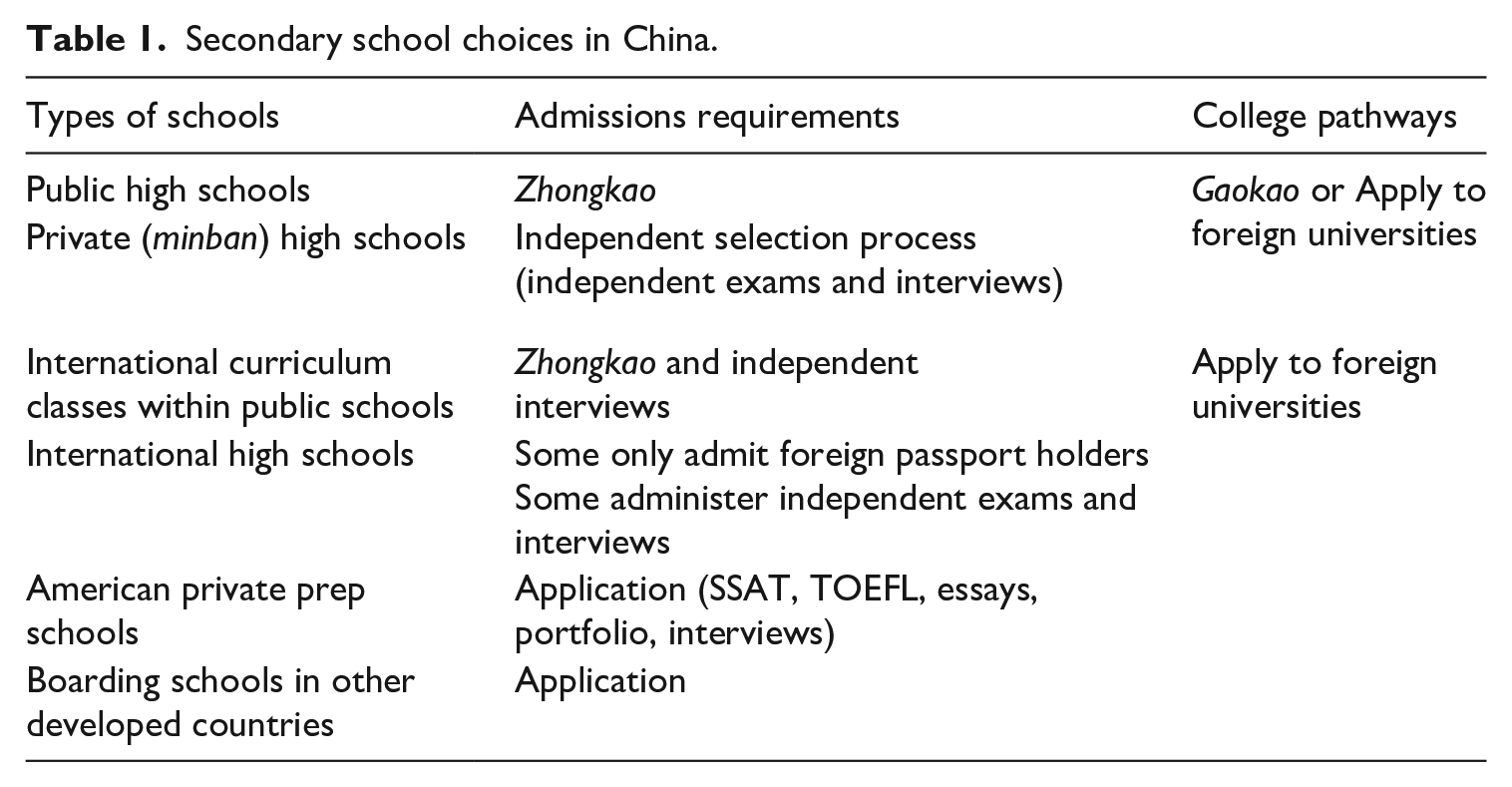
This is a dramatic shift for Chinese students who used to have only one clear route to colleges and universities: excelling in the standardized Senior High School Entrance Examination (hereafter zhongkao) from a public junior high school to get into the most academically competitive public high school, and then acing the National College Entrance Examination (hereafter gaokao) to enter a reputable public university. This new neoliberal educational market pushes every parent to take full responsibility for their families’ educational strategy. High school is beyond the nine-year compulsory education in China, making the high school choices even more towards marketization. Parents and their children have, in effect, become consumers of education and are continuously making consumer choices.
Various high school choices have led to two pathways to college: one through the notoriously competitive high-stakes gaokao, and the other through application to foreign universities. The two pathways require different sets of preparations. With all this attention on education, the for-profit ‘shadow education system’ (Bray, 1999), including tutoring and language schools, became extremely popular. Those students on the track of gaokao attend private tutoring to learn the content before it is taught in school to get ahead of the class and to review and strengthen content that they have already learned at school. Those who are on the track of entering the American education system usually enroll in language classes preparing for the Test of English as Foreign Language (TOEFL) and other ‘enrichment’ programs. 4 Chinese parents are overwhelmed with choices of different educational pathways and enhancement tutoring services. Moreover, as most of these parents still only have one child, 5 that child bears all the hope of their parents. This leaves little leeway for failure, making the stakes of an educational decision at the secondary level very high.
Educational strategies of Chinese families
Since educational pathways have become more individualized in China, parents bear more pressure. Though overwhelmed by choices, affluent families have an edge in the current increasingly unequal education system in China. Research shows that families with higher household income are more likely to utilize private tutoring services and have higher levels of spending on it (Zhang and Xie, 2016). Hong and Zhao (2015) also find that upper-middle-class Chinese parents provide more opportunities for their children to participate in cultural activities, attendance at shadow education, and own more books at home. However, they do not find significant differences in parenting attitudes. Hong and Zhao conclude that there are no distinct class differences in habitus in urban China, but significant class differences in the capital dimension. They find the line from Xiaogang Feng’s film Big Shot’s Funeral – ‘successful people are those, whenever they buy something, they don’t care about buying the best but only the most expensive!’ – to be an excellent footnote to the Chinese middle class.
The childrearing strategies of urban upper-middle-class Chinese parents substantiate previous research on parental strategies for class reproduction in other countries: enrolling their younger than five-year-old children in ‘enrichment’ activities (extracurricular creative and sporting classes) (Vincent and Ball, 2007), creating opportunities for cosmopolitan experiences and spaces (Horst, 2015), and believing in their children’s endless potential (Nelson, 2012). Though filled with anxiety around children’s competitiveness in the education market, Chinese parents, especially mothers, struggle between the demands of a competitive education system and the concern to protect a child’s happiness (Kuan, 2015). Many mothers were working professionals before but quitted jobs to take care of their children to fulfill the polarized goals of childrearing. Parents are highly engaged in the process and decision making behind choosing schools at every level. Student choice of a high school in China is a parent-initiated school choice (Liu, 2020).
Data and method
To capture the educational strategies and practices of Chinese parents outsourcing high school years to American private secondary schools, I used a qualitative approach combining multiple-case sequential in-depth interviews and multi-site participant observation. In sequential interviewing, each case provides an increasingly accurate understanding of the research question (Small, 2009; Yin, 2013). This method treats each interview as a case and adjusts interview questions based on the previous case. Such a sample, by design, is not representative.
I conducted sequential interviews with 33 parents sending their children to US high schools. The interviews were conducted in mega-cities such as Beijing, Shanghai, and Guangzhou, where the upper-middle-class families are mainly situated, during three consecutive summers from 2015 to 2017 and the winter break in January 2017. 6 Due to the heterogeneous nature of the Chinese upper-middle class, I intentionally reached out to parents of different educational backgrounds, professions, and regional locations. The majority (27 out of 33) of the parents I talked to are the mother of the child. It corresponds to previous research (Fong, 2007; Kuan, 2015; Lan, 2018) that mothers take the major responsibility when it comes to their children’s education.
The length of each interview ranged from one to six hours, with an average of an hour and a half. I keep in touch with all my interviewees via a messaging app. Most of the face-to-face interviews were conducted at cafes, restaurants, or the interviewee’s home. When I conducted interviews at the interviewee’s home, I usually got to spend at least half a day with the family. I conducted the interviews in the language that interviewees prefer, mostly in Chinese and local Shanghai dialect, with some occasional usage of English. 7
I recruited informants through personal connections and online posts and continued recruitment using snowball sampling. I also recruited parents through the educational consultants I interviewed. 8 Besides sequential in-depth interviews, I conducted participant observation at high school recruitment events organized by American schools, and high school application workshops organized by educational consulting firms in China. I learned about the process of applying to American private high schools and met more potential interviewees during the participant observation. Participant observation at those events helped me partly witness Chinese families’ experience of applying to and choosing schools, and to understand their aspirations, stress, and anxieties. I transcribed all the interviews verbatim and analyzed fieldnotes and transcripts in MAXQDA. Data were coded for reasons of choosing US private high schools or exiting the Chinese educational system, childrearing strategies, and parents’ own working and educational experiences that influenced such choice. The coding process is recursive to ‘double-fit data and theories,’ following an abductive analysis approach (Timmermans and Tavory, 2012).
Situating upper-middle-class Chinese families in the socio-historical context
A family that can project to pay for a million-dollar education is hardly a middle-class family by Chinese standard and can readily be treated as ‘wealthy,’ ‘affluent,’ or ‘elite.’ Most of these families own more than one property in the city that they reside in, hence it is common for these parents to think of this ‘outsourcing education package’ in exchange for a property they owned. An average 1000-square feet apartment in Shanghai or Beijing usually costs more than half a million US dollars. Based on the 2012 China Family Panel Studies, Xie and Jin (2015) estimate that the average adjusted household wealth was 422,000 yuan (approximately $66,800 9 ). The median value was 158,000 yuan (approximately $25,000) and the 90th and 95th percentile was 692,000 yuan (approximately $109,000) and 1,128,000 yuan (approximately $178,700) respectively.
The families I studied mostly belong to the top 5% in China in terms of property ownership. The reason I continue to categorize them as ‘upper-middle class’ is that none of them consider themselves ‘elite’ or ‘wealthy.’ They self-identify as ‘middle class.’ Among them, there are doctors, university professors, medium-size business owners, county-level government officials, software developers, managers, and bankers at multinational firms. The perception of eliteness for them is linked to a gigantic amount of wealth or political power, which they do not have access to. In this research, I choose to adopt their language of class identification. In addition, they are spending a huge amount of their resources on children’s education because they consider education as the top priority and almost all of them have only one child.
These parents, benefiting greatly from the economic growth of China, are a generation of new wealth. They are mostly born in the 1960s and 1970s, and have witnessed tremendous changes in China in their lifetime: the lingering influence of cultural revolution in the 1960s, the economic reform in the 1980s, the return of gaokao in 1977, the family planning policy instilled in the late 1970s that allowed them to have only one child. Some of their families have gone through wealth deprivation over the Cultural Revolution, yet the majority of them benefited greatly from the economic reform and now stand at the top of the income bracket. Most of them have gone through some hardships in their youths and none of them have wealthy parents. They achieved their own upward mobility through a combination of education, hard work, and investment in the stock market and property. They live a life far different from their parents, and their children are now living in a world with options that they could not even imagine when they were young. Thus, though comfortable with their income and wealth, they are uncertain about their children’s future and grow anxious with all the newfound educational options that their children now have. They cannot resort easily to personal experiences or generational knowledge to conceive a clear pathway to success or happiness for their children. When analyzing their educational choices and struggles for their children, it is important to situate those choices within their socio-historical biographies.
Various pathways to exiting
Chinese school systems appear from outside as a contest model where every individual has equal access to the selection process, like a sporting event where many compete for a few recognized prizes and the selection is supposedly solely based on personal efforts (Turner, 1960), i.e., zhongkao and gaokao. However, those who got sorted out in the previous contest do not have the chance to re-enter the contest. Also, the location of the student’s household registration status determines which contest one can participate in. Some families I talk to, although residing in Beijing or Shanghai, do not have a household registration status (hereafter hukou) in these cities. Therefore, their children cannot take both zhongkao and gaokao in these cities. Instead, they need to go back to their hometown where their hukou is to take the exams. Each region uses a different set of curricula, so many of them opt out of the public-school system and only attend private and international schools and decide to go to foreign universities. American private high school and the following public and private universities’ admissions process is closer to a sponsor system, where a selection process is controlled by a group of elites who are deemed to be best qualified to judge merit. Such a system makes transnational educational choices possible.
As visualized in Figure 1, multiple pathways lead these families to choose American private high schools. Parents need to decide whether they are going to opt out of the Chinese test-oriented education system at various stages of their child’s life, depending on their children’s academic performance and personal preferences. Among various exiting points of the Chinese educational system, three typical pathways emerge: (1) completely opting out of the competitive Chinese education from the very beginning and going through international schools in China from K-8 and then directly to American high schools; (2) debating between top public schools in China and top boarding schools in the US and choosing American elite prep schools over the Chinese public key-point schools; 10 (3) only looking for the American option when their children appear to be unable to secure a spot at public key-point schools or any Chinese high schools. 11
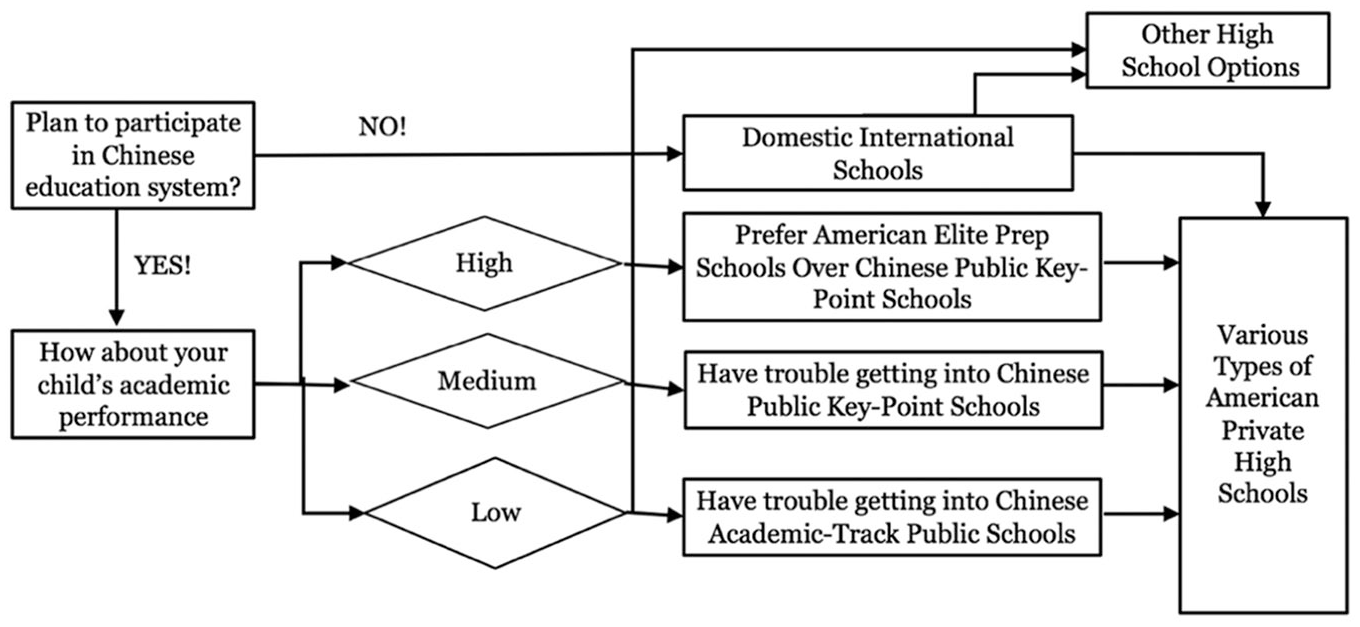
Parents’ educational strategy flowchart.
The most prepared parents had been strategically planning the educational path to American private secondary education even before the child was born. They hired native English speakers to converse with their children from early on, arranged sports and arts activities with the understanding that those activities are not necessarily valued by the Chinese education system yet highly emphasized by the American private secondary schools. Concerning whether their children can get used to American schools, parents provided opportunities for their children to do some trial-runs, such as summer camps in the US and family trips to an English-speaking country. Each of these steps requires a time investment in choosing the services and monetary investment to cover the hefty fees. This group of parents tends to speak English fluently, have studied or worked overseas, or work in a multinational corporation. That is, apart from the economic advantage, they also possess cultural capital that can be transmitted to their children via the transnational educational process. Other parents mainly learned about American private secondary education from their social circle or commercial educational consultants. The latter actively associate it with ‘elites’ or ‘aristocracy’ and paint a rosy picture of ‘climbing Ivy,’ a term referring to getting into Ivy League colleges.
In each case, the children ended up in various types of American private high schools, ranging from the top American elite boarding schools to a private high school that few people have ever heard of. Students who were academic high-achievers and had ‘well-rounded’ and well-balanced skills are more likely to end up in elite boarding schools. Students whose English skills are limited and did not have stellar records are more likely to attend regional private schools.
A strategic exit strategy: Reasons for outsourcing education
These parents perceived the American education system as ‘the best education’ they could provide for their children. They consider such choices as providing the ‘best’ educational ‘opportunity,’ ‘resources,’ ‘quality,’ and ‘system.’ When interrogated further on why they choose American schools instead of Canadian or British schools, some talked about the geopolitical position of the US as being the most powerful country in the world and thus must have better schools; others stated ‘American schools are simply better’ as a matter of fact. A further explanation referred to the fact that the US has the highest number of highly ranked universities globally, as parents and students often compare the rankings of American universities to the most prestigious ones in China. According to US News and World Report’s Best Global Universities ranking in 2020, the top two universities in China (Tsinghua University and Peking University in Beijing) ranked only 36th and 59th respectively, with dozens of American universities ranked higher. Gaokao is notoriously competitive, making overseas study serve not only as a more favorable option in terms of university ranking and global competitiveness but also in terms of a better choice for children’s well-rounded growth, which I will discuss more in later sections. Unfamiliar with many newly emerged school choices, parents apply a consumption logic when it comes to high school choice. Upper-middle-class consumers in China are known to opt out of domestic products and go for more expensive foreign items instead (Hanser and Li, 2015), reflecting affluent consumers’ way of circumventing what they perceive to be problematic in the Chinese marketplace and choosing foreign goods whose quality they perceive to be more trustworthy. The educational choice of outsourcing education shows a similar logic, with most of the parents expressing discontent with the current Chinese education system on the one hand and choosing the most expensive educational option available on the other hand; in this case, the American private secondary education is the most expensive educational good on the global market. When explaining their reasons for exiting, parents draw from their personal educational experience and observation of their children’s schooling experience. Three layers of factors emerge as the source of dissatisfaction with the current Chinese schools: (1) discouragement of critical thinking and the teaching of the political narrative of Communist Party of China (CPC); (2) excessive focus on studying, not valuing a ‘well-rounded’ education; (3) rote-memorization and repetitive drills for zhongkao – some consider such pedagogical practices a mere waste of time.
Discouragement of critical thinking
According to some parents, the current school system tended to favor a specific type of student that they deemed unfit for their child. Several parents mentioned that their children ‘think a lot (xiang de bi jiao duo),’ which went against the ideal student – who should be quiet, obedient to teachers’ guidance, and excel at schoolwork – in the Chinese context. Others mentioned that their children were nonconforming, e.g., speaking up in class or causing issues that led teachers to frequently contact the parents. Jiangang, a Shanghai father of a 16-year-old daughter, elaborated, First, domestic education is not disparate from when I grew up. It’s still like this even after several reforms. It’s still brainwashing and focuses on mathematics, physics, and chemistry (MPC). I don’t think the kid has to learn that much MPC unless she wants to study sciences or engineering in the future. Secondly, when it comes to humanities, it’s definitely brainwashing . . . That’s not good for kid’s cultivation. My daughter is still worth cultivating. She thinks a bit more than her peers. At least I think American education is still cultivating ways of thinking.
Many other parents shared Jiangang’s comments on the lack of training in critical thinking within the Chinese education system. They also mentioned the benefits of having a broader range of knowledge in humanities and social sciences and cited that as a motivation for opting out. In contrast, in China, although students are required to learn Chinese (literature), mathematics, and English (language learning) and could choose to take zhongkao and gaokao in either sciences (physics, chemistry, and biology) or humanities and social sciences (history, politics, and geography), sciences subjects enjoy more prestige and tend to recruit students that are considered ‘smarter.’ Humanities subjects, in many schools, focus more on rote memorization and less on analytical skills.
Apart from the disappointment in the education system, Jiangang showed strong dissatisfaction with other aspects of the political and social life in China. He elaborated on how the ‘common sense and history’ he was taught were ‘not true’ and how society had been ‘unfair’ and ‘unjust’ in the past decades, and he did not want his daughter to ‘grow up in this environment.’ Leilei, a Beijing mother of a 14-year-old daughter, expressed a similar sentiment, I hope that my daughter will still have the ability to be happy when she’s forty . . . I had a chilling moment when I heard the actors said, ‘let’s tightly unite around the great helmsman’ during the CCTV Spring Festival Gala (Chunwan).
12
It was quite striking for me and reminded me of the past. I don’t want my kid to grow up under such narratives.
Both Jiangang and Leilei touched upon how the current Chinese education system followed the political narrative of the CPC and did not encourage critical thinking. They both mentioned that they valued their children’s ability to think ‘independently.’ They, along with many parents, worried that their children would completely internalize the political narrative of the CPC through education and wanted to protect their children from it. It is worth mentioning that not all teachers limit their course content to standardized textbooks, and many find ways to teach in a creative and critical way. However, teachers like this, according to some parents and students, were more likely to be found in elite key-point schools, which are hard to get into through the centralized exam, to begin with.
Valuing ‘well-roundedness’ and quality education
Another common concern of the parents was that the Chinese schools focus too much on studying for exams and thus restraining their children from participating in other activities. Such a single-minded focus on studying becomes especially notable when the child starts to enter the second semester of eighth grade and zhongkao is approaching the end of ninth grade. Physical education classes and other ‘less important’ classes, such as arts and music, usually give way to ‘more important’ classes such as mathematics. Tracy, a Shanghai mother of an 18-year-old girl, confessed that she sometimes ‘faked’ sick leaves for her daughter to attend sports and cultural events. Her daughter only got away with it because her grades were decent, and the teacher was not too strict on her. Vicky, a Guangzhou mum of a 17-year-old boy, was not that lucky. Her son was a good tennis player but performed poorly at school, failing his math exams frequently. She complained that the teacher treated her son harshly. After sending her son to a Northeastern private school in the US, her son got to represent the school in a tennis competition and performed relatively well in school. Therefore, she was quite content with her decision.
These parents value ‘well-roundedness’ as most American elite private schools do, that is, ‘keeping the “perfect balance” of sports, academics, the arts, and extracurricular activities while maintaining a solid academic record and a steady group of friends’ (Gaztambide-Fernández, 2009: 215). Similar to American upper-income parents, they also choose American private schools after deciding that their children require a more individualized education for their needs and strengths (Pugh, 2009). The source of the parents’ concern of developing well-balanced children, however, could have been domestic. In 1999, ‘Quality Education’ (suzhi jiaoyu) was adopted as an official narrative of educational reform, which encourages schools to commit to the ‘all-around development of moral, intellectual, physical, aesthetics and labor education’ (de zhi ti mei lao quanmian fazhan) (Ministry of Education of the People’s Republic of China, 1999).
Opposition to test-oriented education
A third recurrent reason for opting out was parents’ opposition to the test-orientedness of Chinese education. Most of them had experienced similar pedagogical methods during their school years and found it futile. They did not want their children to ‘waste’ time practicing drills and rote memorization. Choosing to outsource high school education to the US means that these students do not need to participate in the educational practices of doing drills repetitively and spending a year studying for zhongkao. They then can save time to develop other skills, such as social, artistic, and athletic skills. Ying, a former primary school English teacher and mother of a 17-year-old boy, stated, [Other] Chinese parents always say, ‘just hang in there for another year. Life will become easier when you graduate from high school.’ They are wrong. Learning is not like that. The purpose of learning is not to vent after exams, and to tear apart all the books after gaokao. These parents think their children should enter college and then start to date and play [and stop studying]. I don’t want my kid to study in such an environment. College is just a starting point, not the end. Seriously, some of my good friends, all they do is to drive kids around for different tutoring classes over the weekend. They are constantly asking around for tutoring information. What kind of knowledge do these kids learn? They are only good at doing drills!
Ying went on to compare her son, who was already attending an American private high school, to her friends’ children who were still attending Chinese high schools. She observed that children like her son were more social and mature and knew how to talk to adults in social events, while ‘the Chinese kids’ were very ‘immature’ and only knew how to play with smartphones in those situations. She attributed such differences to the different education systems.
Exiting the Chinese education system
Instead of voicing their dissatisfaction with the teachers or higher authorities in a system with few opportunities to ‘voice’ discontent, they choose to quietly ‘exit’ the system and outsource the education to the American private high schools. As Hirschman (1970) pointed out, voice option is often costly and conditioned on the influence and bargaining power of the consumers and members of the organization. In this case, the parents found bargaining with the Chinese state for an overhaul of the education system hardly possible and therefore chose the more efficient and individualistic route, American private secondary education. The reasons for opting out of the Chinese education system thus consist of three layers: the macro-level of disagreement with the political narrative of the CPC, the meso-level educational desire of ‘well-rounded’ education, and the micro-level specific criticism of the test-oriented pedagogical practices at school. These three layers are deeply intertwined. For example, on the micro- and meso-level, the test-oriented pedagogy is by its nature against a possible well-rounded education, as it requires students to prioritize their energy on the exams, at the cost of giving up other activities. On the macro- and micro-level, a dominant political ideology that cannot be easily challenged tends to reproduce pedagogies that favor rote learning.
There is still a broad spectrum in terms of the degree of dissatisfaction with the education system or Chinese society at large among families who choose to outsource high school education to the US and exit the Chinese system. On the extreme end, the disagreement runs further than the education system and is a manifestation of a broader dissatisfaction with the political environment of Chinese society, as Jiangang and Leilei described. On the other end, some parents help their children to exit the system for a better chance to get into American elite universities, and such an educational strategy is a pragmatic and carefully measured choice rather than an ideological one. For example, Dr Zhang, a social science professor at a prestigious university, chose the American elite boarding school his son got into over an elite Shanghai public high school and mentioned that, You can compare a[n American] school with another [Chinese] school. The school that my son ends up at is better [than that elite Shanghai key-point high school]. If it is a less prestigious American boarding school, then it may hold no advantage over the Shanghai school.
Dr Zhang’s son would have attended the elite key-point high school affiliated to the prestigious university he teaches at if his son had not left for the elite boarding school in the US. That high school is known for having a wide range of choices in extracurricular activities. It even offers some elective courses that can be considered as advanced humanities and social sciences. A steady portion of students from this high school gain entrance to reputable American universities each year. He found that the American elite high school that his son attends ‘differs significantly’ from a Chinese public school as it has a stronger focus on music and sports, and he was satisfied with the school choice. School comparisons such as the one Dr Zhang made are more common among families with academically high-achieving students, as those students are likely to get into both the elite key-point high school in China through exams and elite private boarding schools in the US. For them, the choice becomes very concrete: whether they prefer the Chinese or the American curriculum, whether they want to hang out with elite Chinese or elite American students, whether they prefer some ‘more advanced’ mathematics training 13 or more choices in humanities and social sciences, and whether they want to develop interests other than the academic ones.
No matter how each family differs on the composition of the three layers of reasons to opt out, they all reach the same conclusion: outsourcing high school education to the US is the ‘best’ educational commodity they can provide for their children.
Conclusion and discussion
The phenomenon of outsourcing education to American high schools is comparatively new in China and is a class-specific educational practice due to the high financial costs. The change also resonates with the neoliberal turn in the Chinese educational market, where education has become a commodity with multiple choices available. Parents with financial resources feel obligated to be ‘good’ or ‘responsible’ consumers on behalf of their children, a role that their past life experiences have not generally prepared them for. Believing in the existence of a perfect choice and being anxious to obtain it, the parents I interviewed decided to send their children to American high schools by justifying their choices as the ‘best’ option.
The educational strategy of outsourcing follows a similar logic to gated consumption – opting out of domestic products and choosing more expensive foreign ones. The reasons for opting out mostly lay in parents’ discontent with the current education system in China as well as dissatisfaction related to social and political life. Though making these decisions individually, and for some apolitically, it is essentially also a silent collective choice. A report by China CITIC bank and Hurun (2016) finds that more than 50% of high-net-worth Chinese (individuals with at least 10 million yuan – roughly $1.6 million in investable assets) expect to send their children abroad for education before college. Although the high-net-worth Chinese are only a tiny portion of the entire population, their influence on public opinions could be tremendous. An outsourced education is an educational consumption in exchange for American experiences, tastes, lifestyles, a ‘well-rounded’ development, and some uncertainties of the children’s life trajectories. Further research is needed to understand what it entails for state–society relationships and whether the authority considered it as a silent challenge to the legitimacy of the Chinese state.
Such choice is worth noticing as it happens at the same time when American education reformers have expressed dissatisfaction with their own education system and resorted to the Chinese and other East Asian education systems for lessons (Boylan, 2016; Tucker, 2016). When American educators call for more STEM education and even more standardized testing, this group of Chinese parents suggests otherwise. They are discontented with the Chinese education system and regard the American system, especially those private schools’ emphasis on well-roundedness, critical thinking, and creativity, as better. Their perceptions of the two education systems provide valuable insights for researchers of different education systems and policymakers to explore the ideal form of education further.
Researchers may also turn their attention to a deeper understanding of the increased globalization and internationalization of education. Education is increasingly becoming a commodity throughout the world. With the convenience of the Internet and the availability of the commercial educational consulting and tutoring industry, those with economic resources, in this case, the urban Chinese upper-middle-class parents, are more likely to look at the global educational field when they are choosing a suitable education for their children, and more importantly, the pathway for transmitting advantages. Understanding the mechanism of such pathways in a global context is an important topic for future research. It is worth noticing that with the increasing geopolitical tension between the US and China, it becomes unclear how transnational and transferrable these advantages will be any more. Urban upper-middle-class Chinese families may experience greater uncertainty for their transnational educational choices. It also remains unclear whether the ongoing pandemic will call an end to such a transnational school choice. Unpacking the processes of such a transitional school choice also calls for including these globally oriented but locally grounded GMC in the conversation about global school choice. These choices are not only made possible by the increasingly intertwined global capitalist economy and market, but also very likely will deepen global inequality and reproduce privileges and differences between nations on a larger scale.
Footnotes
Acknowledgements
I would like to thank Adrienne Atterberry, Vadricka Etienne, Derrace McCallum, and the anonymous reviewers and editors for their valuable comments and suggestions on this article.
Funding
The fieldwork of this research was partly supported by the Doctoral Student Research Grant (DSRG) Program (Round 12 and 14) at the Graduate Center, City University of New York. I also thank Max Planck Society to make this publication open access.
