




Abstract
This article draws on biographical interviews with migrants to assess their aspirations and capabilities to become entrepreneurs. By augmenting mixed embeddedness emphasis on contextual factors with Sen’s capabilities framework, we contribute to extant sociological debates on the interaction of structure and agency, the conceptualisation of aspirations, the non-pecuniary aspects of entrepreneurship and the role of institutions in neoliberal Britain. We argue that structural barriers drive the formation of aspirations to become entrepreneurs while at the same time limit their capabilities to do so. Entrepreneurial agency must be seen as relative autonomy, effective in strategic decision making but limited to the weak financial position in which migrant entrepreneurs operate.
Introduction
How are the entrepreneurial aspirations of recently arrived migrants to the UK realised or frustrated? Evidence suggests that migrants worldwide achieve successful business start-ups (Collins et al., 2017). Supranational institutions (e.g. Entrepreneurship Action Plan, European Commission, 2020) and national governments (Home Office, 2019) increasingly promote migrant and refugee entrepreneurship to alleviate socio-economic exclusion. In a rare study of migrant enterprise support in Europe, Rath and Swagerman (2015) found measures focused on migrants’ supposed ‘deficiencies’ rather than on the removal of structural constraints. Recent policy measures to support refugee and migrant entrepreneurs in Europe (Solano et al., 2019) are similarly innocent of structural impediments to entrepreneurial agency (Ram, 2019).
We address this gap by exploring the interplay of structural factors and agency with migrant entrepreneurs (including refugees) in Birmingham, UK. We draw on biographical interviews to challenge the simplistic policy notion that entrepreneurship is axiomatically a decent and sustainable source of employment for migrants. Our theoretical approach augments Kloosterman’s (2010) mixed embeddedness (ME) perspective – which emphasises contextual constraints – with the sensitivity to agency afforded by Sen’s (1985, 1989) capabilities approach (CA). Mixed embeddedness (Kloosterman, 2010; Kloosterman et al., 1999) foregrounds analysis of structural barriers to migrant entrepreneurship (though social networks are acknowledged). It builds on Polanyi’s (Granovetter, 1985; Polanyi, 1957) key insight that economic action transcends individuals and is strongly structured by social institutions, values and norms. Mixed embeddedness shows structural factors cast a long shadow over migrant entrepreneurship, and shifts the emphasis from ‘what do entrepreneurs want to do?’ to ‘which spaces in the market are available for them?’. Besides illuminating the gravity of structural factors, ME helps us to discern how market and institutions interact with social relations and networks that shape the entrepreneurial activities of migrants. Therefore, this mixed embeddedness (institutions/market and social relations) takes into consideration the role of structure and the networks migrant entrepreneurs mobilise. While ME’s expansive analysis of contextual conditions is crucial to understand the ‘sorting’ of migrant entrepreneurs into particular economic and spatial locations, less well articulated are the ways in which agents navigate these constraints (Ram et al., 2017; Villares-Varela et al., 2018). Theorisation of agency within ME is underdeveloped (Ram et al., 2017; Storti, 2018). We argue that supplementing ME with CA enables us to develop a more balanced account of migrant entrepreneurship by strengthening the conceptualisation of agency and by accounting for the non-pecuniary aspects of migrant entrepreneurship.
The capabilities approach (CA) emerged from Sen’s (1985, 1989, 1999) work on international economic development. Dissatisfied with the prevailing view of development as a passive process dependent on overseas aid for the disadvantaged economies of the Global South, he argued people should be treated as the active agents of their own advancement. Sen’s view of human potential extends beyond the narrowly material dimension to include wider quality-of-life issues such as freedom and autonomous control of one’s own life. This key insight is an important feature of the non-pecuniary aspects of migrant entrepreneurship, and is underplayed by ME. Migration studies have recognised the potential of CA to explain emigration decisions, with scholars like Carling (2002), Carling and Schewel (2018) and de Haas (2010) developing an aspiration/capability model, which expressly recognises the way that aspiration is a necessary but not sufficient condition for emigration since many do not have the capabilities to do so. The aspirations/capabilities framework has also been used to analyse the decision to stay, move or re-emigrate by looking at the facilitating/constraining role of policies in decision making (Toma and Villares-Varela, 2019). Yet, CA has rarely been applied to migrant entrepreneurship, save for a handful of studies on opportunity recognition (Lassalle, 2018) and motivations (Rametse et al., 2018). This focus on aspirations and capabilities speaks directly to core sociological debates on the interaction of structure and agency (Cederberg and Villares-Varela, 2019; Villares-Varela et al., 2018), the conceptualisation of aspirations (Hebson, 2009; Shah et al., 2010) and the role of institutions in shaping how migrant entrepreneurs navigate the enabling and constraining features of neoliberal Britain (Edwards et al., 2016).
For present purposes, we understand agency as the actions taken by individuals to express their power and we view it as a ‘temporally embedded process of social engagement, informed by the past but oriented to the future’ (Emirbayer and Mische, 1998: 963). This approach is consonant with an interest in migrants’ and refugees’ entrepreneurial aspirations because, as Morris (2020: 277) shows in the context of welfare policy, it infers that ‘actors carry into the present not only future oriented projects, but a variety of relations and obligations already established’.
We draw on the narratives of 44 aspiring and existing migrant (including refugee) business owners in Birmingham (UK) to examine how contextual constraints shape individuals’ available options and choices. In this article, the term ‘entrepreneur’ covers owners of businesses (with or without employees). Our data show that structural constraints simultaneously shape the aspirations of becoming an entrepreneur and the capabilities to do so.
By explaining these intricate processes, our contribution is three-fold. First, enhancing ME with CA facilitates a context-sensitive account that helps us to understand the aspirations for migrants and refugees. Here, ME is enriched by the application of CA, which helps to develop a more nuanced understanding – emphasising creativity and precarity – of an increasingly important organisational form at the bottom of the labour market (Bloch and McKay, 2015; Edwards et al., 2016).
Second, we contribute to debates in sociology on the dynamic linkages between agency and structure (Hvinden and Halvorsen, 2018), particularly in the context of migration (Bakewell, 2010; Cederberg and Villares-Varela, 2019) and migrant employment (Caetano, 2015; Hall, 2015; Netto et al., 2019). These debates stress the importance of the social, political and economic context in which migrants navigate their lives (Netto et al., 2019), and the ‘time, place and conditions’ (Archer, 2012: 55) in which their economic activity occurs. The importance of the latter is noted in CA, which emphasises the heterogeneity of lived experiences and the importance of individual choices and agency (Egdell and Beck, 2020), and the role of non-monetary aspirations of entrepreneurship.
Third, enriching ME with CA is potentially beneficial to policy-makers too because it facilitates a balanced account of the economic and social value of migrant enterprise. Our findings question simplistic policy assumptions by providing a nuanced understanding of the interaction between structural factors and the mechanisms constraining and enabling change in the trajectories of migrant entrepreneurs.
Enhancing Mixed Embeddedness (ME) with a Capabilities Approach (CA)
Mixed embeddedness (Kloosterman, 2010) emerged at the turn of the millennium as a reaction against the then dominant migrant business narrative skewed towards explaining the remarkably large supply of migrant firms without reference to the demand for them. Prompted by pioneering research in the USA (Light, 1972), British writers (Ward, 1986; Werbner, 1990) presented disadvantaged minorities such as South Asians as actually privileged in the role of entrepreneur, where they could enjoy exclusive access to support networks of family and co-ethnics, a source of low-cost labour, pooled capital, loyal consumers and shared information. Little attention was paid to the role of market and institutions, and ME’s main insight was to point out that the confines of the social capital enclosure placed severe limits on the number and size of firms. The word ‘embedded’ is indispensable for showing that business activity is anchored in various supporting relationships. Here ME’s contribution is to juxtapose this informal sphere with the larger external world where under-resourced outsider firms must compete with established incumbents. Hence, migrant firms gravitated to easy-to-enter sectors requiring minimal funding and expertise, which accounts for their concentration in corner shop retailing, catering, taxi driving and other poorly rewarded activities.
Migrant entrepreneurship scholars have used ME to illuminate the weight of structural factors in the entrepreneurial outcomes of ‘superdiverse’ migrants (Jones et al., 2014), the opportunity structures of migrants in large metropolitan areas (Price and Chacko, 2009), the role of migration policies (Wang and Warn, 2018) and the importance of transnational networks and dynamics beyond structural factors (Bagwell, 2018; Solano, 2020).
Studies informed by ME (Bagwell, 2018; Falcão et al., 2021; Sepulveda et al., 2011) certainly acknowledge the exercise of entrepreneurial agency, though not in a manner that fully recognises the influence of non-economic motives: ‘migrants who devote considerable time to economic pursuits, seeking to establish themselves as entrepreneurs, can hardly be expected to segregate themselves from the non-economic needs that shape their social identity’ (Storti, 2018: 33). The (unduly) neat matching of structure and opportunity is clear in Bagwell’s (2018) notion of ‘transnational mixed embeddedness’, deployed to explain how Vietnamese entrepreneurs in London ‘seized’ opportunities abroad – where extended family were located – to grow their enterprises. Falcão et al.’s (2021: 1724) use of ME to examine the funnelling of highly skilled Brazilian migrants to low valued added service sector enterprises highlights, in the authors’ view, the importance of ‘cultural adaptation’ to the host society. These studies underplay the extent to which migrants’ entrepreneurial action is shaped by commitments that transcend individual interests (Storti, 2018) and are embedded in ‘transaction economies’ predicated on the mobilisation of an ‘infrastructure of care’ (Hall, 2021: 76, 165) as well as economic gain. The challenge is to ‘explain how these heterogeneous goals are mixed’ (Storti, 2018: 33), and it is one that CA can address.
Enhancing ME with CA helps to account for the interdependence between aspirations and the context of migrant entrepreneurs. The realisation of freedoms in CA is enabled by human capability, defined as the ability of human beings to lead their lives as they value and to mobilise and maximise the choices they have available (Sen, 1999). Here, freedom is central to quality of life and the capacity for development. Martha Nussbaum (2006: 76–78) offers a more precise formulation comprising 10 capabilities: life; bodily integrity; bodily health; senses, imagination and thought; emotions; practical reason; affiliation; other species; play; and control over one’s environment. In a similar vein, Sayer (2012: 585) maintains that development should encompass ‘wellbeing’, where material progress is not an end but a means to the enjoyment of freedom of movement, freedom from violence and access to education. This echoes Sayer’s (2011) view of agency, which combines theoretical or evaluative reasoning – the way things are – with practical reason. In this view, normativity is seen ‘more in terms of the ongoing flow of continual concrete evaluation, and less in terms of norms, rules, procedures, or indeed decisions and injunctions about what one ought to do’ (Sayer, 2011: 97).
Moving beyond the development arena, this logic of empowerment applies to many contexts, including the problems faced by migrants and refugees attempting to insert themselves into the economic life of their adopted society. In the entrepreneurial field, an approximate theoretical engagement with the resources available to entrepreneurs and their capacity to mobilise them features in Nee and Sanders’ (2001) ‘forms of capital’ approach in which the labour market trajectory of immigrants is shaped by their access to and deployment of financial, human and social capital (Cheung and Phillimore, 2014). Originally formulated by Bourdieu (1986), ‘capital’ refers to the resources necessary to achieve social status, specified as ‘financial capital’ alongside the additional resources of ‘human capital’ (expertise and accredited qualifications) and ‘social capital’ (informal support networks of friends and family). ‘Capabilities’ and ‘forms of capital’ map onto each other insofar as the economic resources described by the latter are vital enablers for the entrepreneur; for aspiring entrepreneurs, financial and human capital (funding and expertise) tend to be decisive, with a primary task of enterprise support being the plugging of shortfalls in these two central keys to entrepreneurial capability. At the same time, close attention needs to be paid to social capital, the personal networks of friends and family whose provision of a range of essential business resources is often mentioned in the migrant business literature (Flap et al., 2000; Ram and Jones, 2008).
In the present case, however, we argue CA is essentially more closely applicable to entrepreneurship than the ‘forms of capital’ perspective because of its recognition of non-pecuniary aspects (Nussbaum, 2011: 34), with personal independence seen by its recipients to be as valuable as material outcomes. The role of business ownership as lifestyle and livelihood is widely acknowledged (Morris et al., 2015), a perspective fitting well with Sen’s emphasis on development as self-realisation. While acknowledging this need to develop personal capabilities, Sayer (2012: 580) also warns that CA is open to misinterpretation because of failures to specify ‘the social structures that enable or limit human capabilities in particular situations’. Echoing this, Orton (2011: 356) stresses the need for an appropriate ‘environment for the development of capabilities and real freedom of choice’. There is little point in developing the intrinsic qualities of an individual if external conditions do not permit this extra new capacity to be applied; Sayer (2012: 583) underlines this by critiquing the tendency ‘to imagine that training skilled workers produces skilled jobs for them’. Echoing Rath and Swagerman’s (2015) critique of ‘agency-centric’ business support policies that ignore structural barriers, Sayer (2012: 583) laments that ‘the tendency to elaborate internal capabilities but not the external conditions of their achievement easily becomes complicit in neoliberal discourses’; blame for failure is pinned on the actors themselves rather than their unfavourable environment.
We argue for a balanced theoretical exploration of migrant entrepreneurship by acknowledging the multi-faceted agency of migrant entrepreneurs (including non-pecuniary motivations) and the vital part played by the strategic deployment of business resources. In this respect the present article engages with Vincent et al. (2014: 372), who are critical of ME’s lack of attention to the agency of migrant entrepreneurs, an element becoming obscured by the foregrounding of ‘structural constraints rather than . . . agential capacities’. In addition, CA’s emphasis on the ‘human’ side of entrepreneurship will be relevant because it ‘enhance[s] one’s knowledge base, build[s] skills, and develop[s] elements of an entrepreneurial mindset that can be applied in all facets of one’s life’ (Morris et al., 2015: 721). From a theoretical point of view then, we would argue that CA allows us to build upon and refine the findings derived from ME. We might argue that migrant entrepreneurs’ often lofty aspirations enable them to overcome many of the iron restrictions imposed by the host economy. Our data show that respondents certainly display many of the traits customarily ascribed to the self-expressive social actor, what Emirbayer and Mische (1998: 1006) describe as ‘capacity for imaginative and/or deliberative response’ to the pressures of the business environment.
Research Design and Methods
Sampling and Data Collection
We adopt a qualitative approach to capture the mechanisms and processes by which aspirations and capabilities shape the occupational trajectories of both aspiring entrepreneurs and established business owners. The respondents were foreign born and arrived in the UK within the previous five years of data collection (arrival post-2013) as either economic migrants (defined here as new migrants) or asylum seekers (defined in this research as refugees). The ‘politics of bounding’ render the categorisation of ‘migrants’ and ‘refugees’ problematic because the ‘lives of those on the move are complex. They are not simply a sum of the categories that are constructed around them’ (Crawley and Skleparis, 2018: 59). We adopt an ‘inclusivist’ view that holds that everyone who changes their place of residence is a migrant, regardless of the causes and circumstances; refugees are included (Carling, 2017). Although the structural positions of migrants in our study are diverse, studying them together allowed us to identify common patterns in aspirations and capabilities irrespective of country of origin and migratory status; it also aided the analysis of entrepreneurial agency. We acknowledge the differential impact of refugee and migration policies on the trajectories of individual entrepreneurs, although the analysis of these processes is beyond the scope of this article.
The 44 interviewees comprised seven aspiring entrepreneurs and 37 established business owners. Including aspiring entrepreneurs enabled us to account for those potential business owners who have not realised their aspirations to understand the obstacles they found in their way.
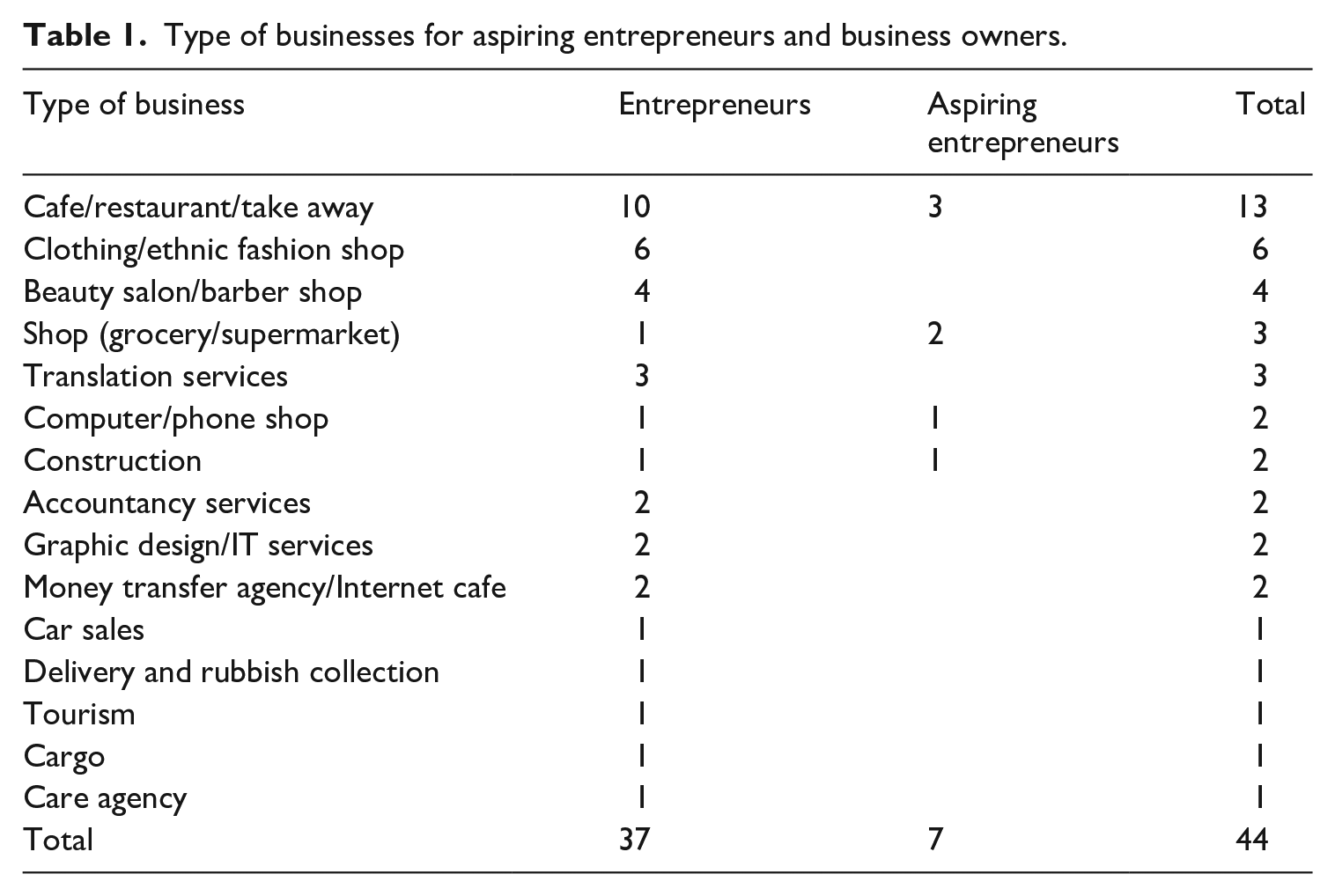
Our sample comprised 35 men and nine women, which reflects the gendered flow of the countries of origin of some our participants, and the link between recent arrivals and business start-up, which can be more difficult for migrant/refugee women (Villares-Varela et al., 2017). The main countries of origin of interviewees are Eritrea (12), Somalia (9), Iran (4) and Sudan (3). Respondents were well educated: two-thirds had higher education degrees, and most others had completed secondary education. Their businesses are of small size and concentrated in retail, catering and personal services (see Table 1).
Type of businesses for aspiring entrepreneurs and business owners.
We were aware of the ethical implications of working with potentially vulnerable populations, such as migrants and refugees. The project complied with the ethical research requirements of the University of Birmingham (UK) and was guided by principles of no harm, voluntary participation and confidentiality. Interviews were carried out by the authors and research assistants with links to some communities included in our sample. Questions regarded as particularly sensitive, such as the migratory status of participants, were not asked explicitly, and respondents elaborated upon this information voluntarily when narrating their migration and working life trajectories. Housing and migrant organisations facilitated the initial contacts, and chain sampling (Penrod et al., 2003) was used to gather new participants. Informal contacts were also used to diversify the profile of our interviewees. We used a biographical approach (Kontos, 2003) to cover different life stages in relation to the formation of aspirations and the enabling/constraining factors to realise these. This approach is conducive to studying entrepreneurship as a process intertwined with life, migration and occupational trajectories (Kontos, 2003). Therefore, the data collection followed a biographical logic, comprising migration trajectories and decisions; life and professional aspirations; level of education; occupation in the country of origin and other countries of residence; occupational aspirations and trajectory in the UK; formation of aspirations to start up the business; steps taken; reasons behind failed attempts; business support; and barriers and opportunities.
The fieldwork took place in Birmingham (UK), which is one of the most diverse cities outside London (ONS, 2019). This focus on the UK’s second largest city complements the preoccupation with London in migration studies (Bagwell, 2018; Datta et al., 2007; Sepulveda et al., 2011). Birmingham’s non-white British population comprises almost half of its one million plus citizens (ONS, 2019). The total number of non-UK born migrants and refugees in Birmingham is about 250,000 (Birmingham City Council, 2020). The city has a long history of immigration, encompassing post-commonwealth migrants from the 1950s to 1970s, and dispersal of asylum seekers from 1990 to the present day. Birmingham’s unemployment rate of 8% is over twice the UK rate and is severe in areas of the city dominated by migrant communities (Birmingham City Council, 2020). Following rapid deindustrialisation in the 1970s, the city has entertained global pretensions, ambitious urban regeneration programmes and a celebratory multicultural discourse – these sit alongside ‘the persistence of entrenched inequalities, exacerbated by austerity policies’ (O’Toole, 2021: 2503).
Data Analysis
We analysed interview transcripts and followed an iterative process, initially deductively by applying our conceptualisation to the accounts provided by the respondents and then inductively, by re-sorting the data to pre-set categories but also by developing new ones. The trustworthiness of our data was ensured in several ways. Each author reviewed interview transcripts as the research proceeded. Regular discussions were held with the research assistants; this allowed issues to be clarified and further data to be collected where there were gaps. Second, the authors met regularly to discuss emerging patterns in the data. Finally, we asked an experienced qualitative researcher (not directly involved with the project) to assess our empirical materials and the procedures that we followed. She reviewed our interview schedules, a random selection of transcripts and approach to data analysis to assess the plausibility of our conclusions.
Findings
Our analysis of the strategies and outcomes of aspiring and existing business owners highlights three themes that show the value of augmenting ME with CA. First, entrepreneurs find, on the one hand, limited opportunities in the British labour market that fosters their aspirations to become business owners. On the other hand, as proffered by ME, an array of institutional constraints limits the potential for business entry and growth of these ventures. Second, capability-building is often a matter of transforming latent potential into manifest resources, rather than building from scratch and is shaped by structural constraints (which ME suggests results in the intensive use of co-ethnic networks to sustain survival-oriented businesses). Finally – as emphasised by CA and underplayed by ME – success for many entrepreneurs includes non-pecuniary outcomes such as self-realisation and a sense of contribution to wider society. We consider each issue in turn.
Structural Barriers Driving Entrepreneurial Aspirations and Growth
The role of aspiration in human development is emphasised by Appadurai (2004), who focuses on the way self-willed agency takes over from passivity and enables individuals to map out their future. In our sample, the structural constraints encountered by migrant workers, particularly in relation to the mismatch between occupations held in the country of origin and those available in the UK, drove aspirations to become business owners, as anticipated by ME. For example, interviewee IR_A01, an aspiring entrepreneur from Iran, explains the difficulties in finding a job after his experience as an English teacher back in his country of origin: I was accepted as an English teacher [in Iran]. I found it difficult . . . to be a teacher here . . . Then I started working caring for old people, but it was difficult . . . the wages are too low [. . .] Sometimes I think about opening a business here.
Similarly, ET_B21 moved from a high civil service job in Ethiopia to an entry level retail job until he opened his internet cafe: Back in my country of origin I was working in . . . the finance department of Ethiopian Ministry of Tourism. Here [in the UK] to support myself I was looking [for] any kind of job. I found a sales assistant role and continued until I opened my business.
The punitive ensemble of institutional constraints identified by ME erases refugees’ previous work experiences and credentials, and fosters reliance on economic activities within migrant networks. Instructive here is the experience of Eritrean hair salon owner R_23: I have a diploma in hair styling from my country of origin, where I used to own a hairdressing salon . . . I could not find work [in the UK] relating to my profession because when I fled my country, I could not bring documents proving my qualifications. I worked five months as a warehouse operative as I needed income to support myself. My wish was to have my own hair salon because I have the skills and experience.
These illustrations are a reminder of Sayer’s (2011) warning of the fallacy of assuming that personal development only depends on the individual’s will without taking into consideration the weight of structural constraints and market conditions on the agent’s capabilities. Experiences of discrimination in employment compounded the difficulties faced by many respondents, as illustrated in the two cases below: When I came to this country my target wasn’t to study, then once I discovered what the environment of the labour market is I decided to further my studies . . . I worked for seven years in warehouses, catering and other different jobs and I found very difficult to get other jobs . . . There are a lot of opportunities . . . but you’re only going to get them if you have the knowledge of the law and life in Britain. If you don’t know anything about this people will use you. (YE_H44, man, partner in accountancy firm from Yemen) Sometimes I think when they want to employ someone with the same background it’s easier for them. So sometimes I suspect discrimination. (SY_A26, man, owner of take-away business from Syria)
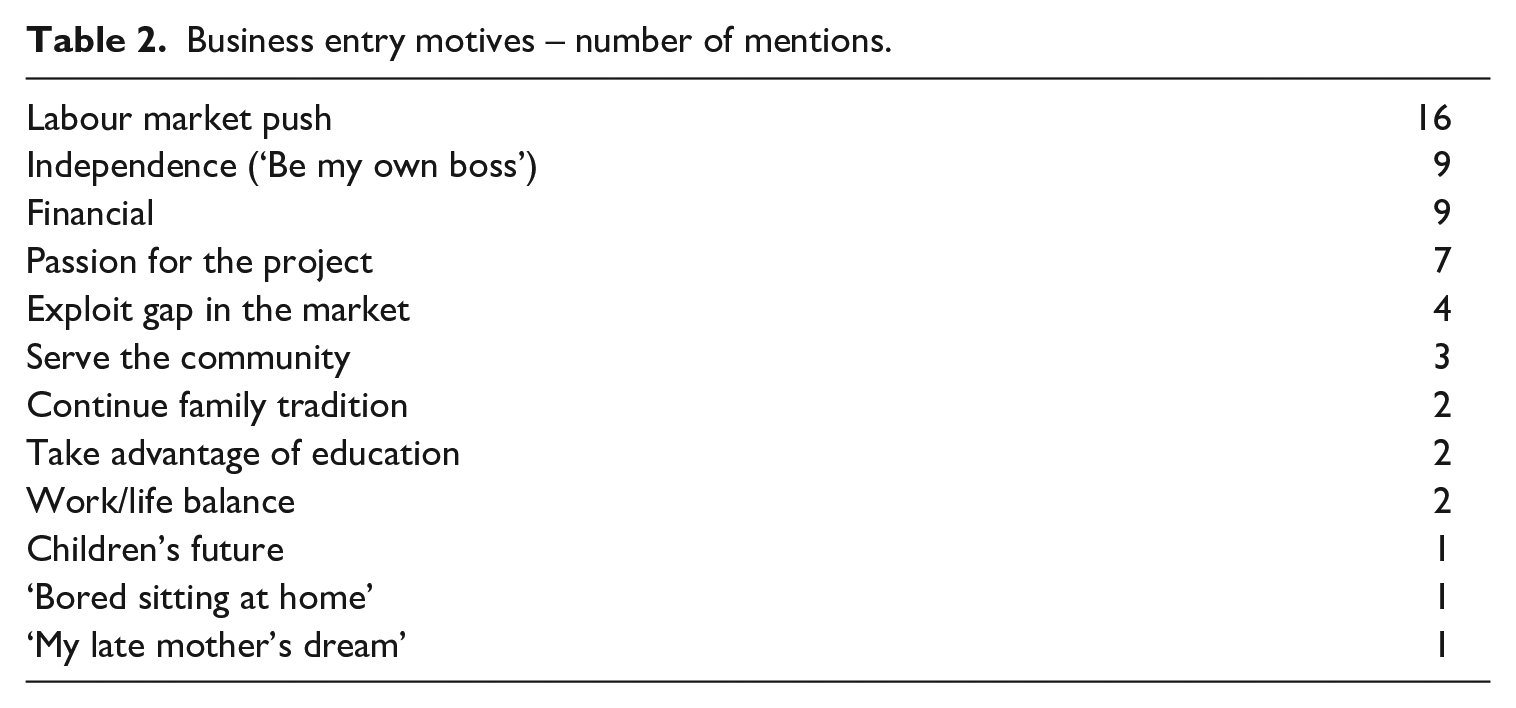
Hence, negative labour market experiences fuel the aspirations of refugees to become self-employed and secure a modicum of independence. Although the search for independence and financial gains are common motives for business entrants everywhere (Storey, 1994), the mismatches between high human capital and low occupational status are particularly acute for vulnerable groups, such as minorities, migrants and refugees. These processes are reflected in the reasons for becoming an entrepreneur (Table 2). Business ownership protects against labour market rejection. The lack of job opportunities combined with aspirations for independence fuels business start in the classic migrant niches predicted by ME: grocery stores, clothing stores, computer repair shops, construction and housing companies, restaurants, cafes, car dealer firms (import–export).
Business entry motives – number of mentions.
The impact of these limiting structural constraints is presented in opposition to the positive aspects of becoming a business owner. Aspiring entrepreneur IR_A01 is keen to be ‘the boss of myself’. Flexibility is important for another aspirant, SD_E04, who prefers to be ‘free rather than being obliged to work certain hours’. Wider benefits to the community motivate SD_E04: ‘The main advantage of being an entrepreneur is you are your own boss as you are creating job for yourself and possibly for the local community’, underlining the important role of informal social networks in migrant entrepreneurship, as highlighted by ME (Kloosterman, 2010).
Perhaps the most striking evidence of high ambitions is the way that respondents’ aspirations rarely stop at successful business start-up, with a majority declaring future planned expansion. This contrasts with previous findings about the aspirations of small business owners, only a minority of whom have been found to be growth-oriented entrepreneurs (Storey 1994). ‘Close-up’ analyses of migrant entrepreneurship (Hall, 2021; Ram et al., 2017) reveal high levels of ambition and resourcefulness among business owners operating in seemingly unpromising market environments. There are 26 cases in our data where the desire to grow the business is explicitly mentioned, sometimes coupled with ambitious plans for diversification and widening the customer net. This is the case of Sudanese business owner SO_B40 who owns a small-scale clothing and perfume shop who is actively pursuing growth by aiming to go online. Others are getting offers to enter into partnership to fuel expansion, as is the case for SY_A26 who owns a take-away business, and EG_A03 who aspires to employ 50 people to open four more restaurants.
Structural Conditions Constraining the Agency of (Aspiring) Entrepreneurs
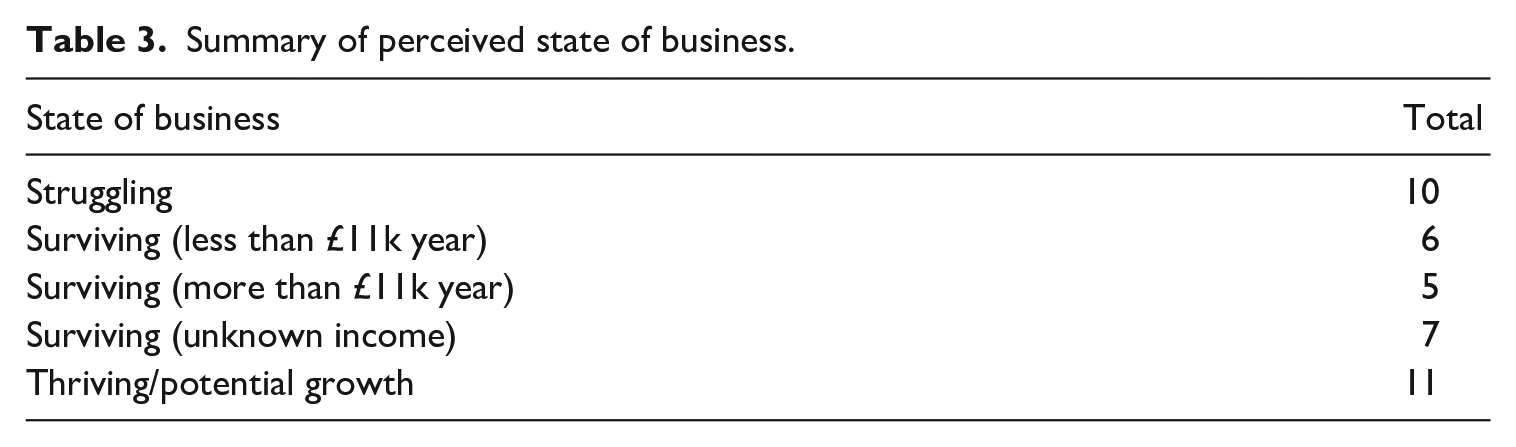
These remarkable aspirations ought to be measured against the present reality and the capacity for realisation, recalling the importance of ME (Kloosterman, 2010) in analysing these trajectories. Structural forces drive immigrant and other ethnic minority firms to poorly rewarded market niches. This applies to many in our sample. Most firms are marginal micro-businesses with no employees and precarious survival, dependent upon the proprietor’s self-exploitation through long hours and the use of informal networks, and low turnover (see Table 3).
Summary of perceived state of business.
Paltry returns are widely reported, as with restaurateur EG_A03: ‘It [the business] is just making me survive. That’s it.’ The income of take-away owner SY_A26 fluctuates, but he believes he earns less than the statutory minimum for workers: ‘I think it’s lower than the National Minimum Wage.’
Hence, despite high aspirational levels for business ownership, structural conditions are constraining both entry and growth. Aspiring entrepreneurs are aware of how newcomers are exposed to a series of additional barriers to business formation, particularly under-funding (Jones et al., 2014). The latter features prominently in their accounts, a condition closely linked to their outsider status (Kloosterman, 2010). R_23 speaks for many: ‘I did not do any liaison with the banks, I hear from people that the interest is high and if you do not pay them your credit history will be damaged.’ IR_A01 complains, ‘a refugee cannot do it [access a loan] because they are new. If I want to open a business . . . I need . . . money.’
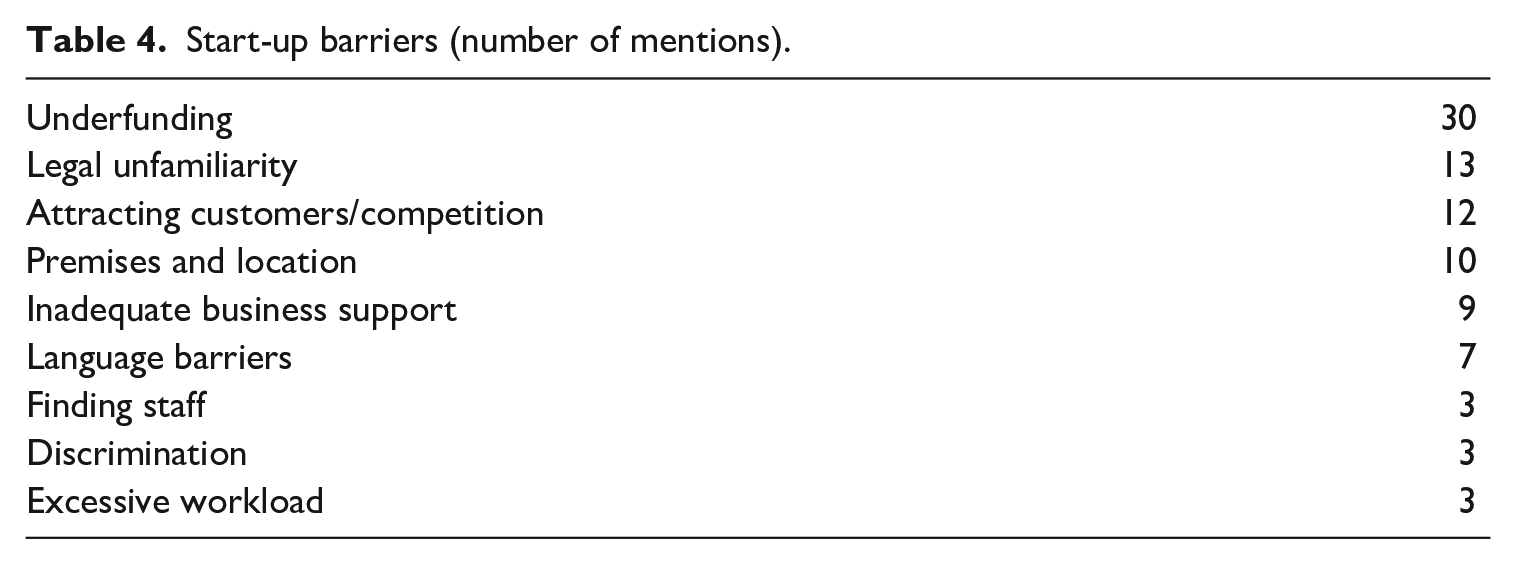
Table 4 confirms that this inability to raise sufficient finance is the most frequently mentioned barrier to business start-up. Replicating the age-old immigrant business experience, bank avoidance is almost always self-imposed due to feelings of alienation and intimidation, as well as perceptions of bank discrimination (Ram and Jones, 2008). Underfunding is a significant barrier to start-up and the survival of these firms.
Start-up barriers (number of mentions).
Institutional and market conditions also shape the range of market opportunities open to immigrant entrepreneurs (Kloosterman, 2010). As Table 1 shows, the types of businesses migrants establish are heavily biased towards the activities of catering, retail and personal services. Though this broadly echoes previous research on the market segregation of migrant entrepreneurs (Carter et al., 2015), what is most striking about this concentration is that it falls some way short of the absolute, amounting to around two-thirds of the sample, showing that a sizeable minority of entrepreneurs have been able to find a little more ‘wriggle room’ than would be predicted by ME. We might see this as a powerful example of the struggling interplay between entrepreneurial agency and structural constriction.
The Search for Self-Realisation beyond Financial Returns and Transformative Capabilities towards Breaking out
The sectoral entrapment and low returns in our sample show that most businesses are struggling to survive. However, self-realisation, the freedom attached to being a business owner and the opportunity to forge a sense of collective contribution are important considerations too. The meaning of entrepreneurship in such cases transcends the primarily economic accounts evident in ME. This is conveyed by SO_25 when she narrates that although the returns are not sufficient, the business gives her freedom, that it is her mum’s ‘dream job’ and how it helps them to connect with the local population: I have to keep my other job but because it’s a family business and my mom’s dream we’re going to keep it going [. . .] and I’ve got a lot of people coming in, even white people coming in [and] you’ll have a nice chat and discuss things and I think that having open communication and having dialogue with other communities will always help integration. (SO_25, woman, owner of traditional clothing shop from Somalia)
Similarly, SO_35 explains again how flexibility and freedom are paramount to business outcomes, even though returns are not high. Satisfaction also derives from integration in British society by engaging with neighbours from the city and beyond: The business pays for our salary . . . It’s low, but you have the freedom of running your business . . . [It] has enabled me to integrate with . . . different communities . . . Some customers come all the way from other parts of Birmingham . . . I like that I serve and integrate with British society through this business. (SO_35, man, owner of phone repair shop from Sudan)
For several respondents, optimism about the future is based on realistic self-appraisal of skills and previous business experience. One of the key features of the present sample is that almost two in five have entrepreneurial experience in their countries of origin, often as outright owners. Previous scholarly work (Collins et al., 2017; Edwards et al., 2016; Shane, 2008) suggests that this kind of family business background is a key predictor of a successful business career, which puts a more realistic complexion on our respondents’ optimism (see Edwards et al. (2016) for Britain and Collins et al. (2017) for Australia). It is worth reiterating that the evaluation of migrant and refugee resources is beset by many contradictions, with financial hardship often going together with entrepreneurial experience and other relevant human capital (see Collins et al., 2017 on the refugee entrepreneurship paradox), as is the case in our sample.
Typical of the way the present respondents combine academic attainment with practical experience are cases like R17, who graduated in mechanical engineering while working in his family’s business in Eritrea; R20, who obtained a business diploma while acting as a manager to his family’s import–export firm; R8, who was a director of his family’s business in Senegal before graduating in Social Sciences. Moreover, not only have a majority obtained either degree level or technical qualifications prior to arriving in Britain but also many have achieved or are currently working towards UK qualifications. Additional capability-building is already in progress, undertaken by the respondents on their own behalf.
The aspirations for business entry and growth, coupled with these capabilities (Sen, 1999) lead to some examples of owners ‘breaking out’ to mainstream activities. Exemplifying the originality and talent necessary for such market relations are respondents running such breakout activities as translation services, computer repairs, accountancy and graphic design, which have led to businesses that are perceived as thriving and towards aspirations for growth (see Table 3). Qualifying this, however, we would note the hurdles that have to be overcome to achieve these start-ups.
This is the case of Eritrean proprietor of an interpreting and translation company, who derives satisfaction and a comfortable living from his ‘work with solicitors, law firms, local authorities, and social services’ (ER_27). Yet to get to this point, this science graduate worked as a cleaner for three years, until switching to working for an interpretation agency. His testimony contains several references to discrimination while working as a cleaner ‘it was a bad experience for me to be discriminated by management . . . I was discriminated against salaries’ (ER_27). Similar occupational mismatches and discriminatory experiences are mentioned by most breakout businesses, such as the Eritrean co-owner of a sizable accountancy firm, whose initial four years in Birmingham were spent in warehouse night shifts and university accountancy classes by day. Evidently market exclusion is far from an absolute state and advantageous market repositioning as advocated by ME (Kloosterman, 2010) is possible but only by incurring heavy personal costs not necessary for mainstream entrepreneurs.
Discussion and Conclusion
Our aim in this article has been to achieve a balance in the application of the agency/structure dialectic to migrant entrepreneurship by addressing how individual capabilities are intertwined by the social positions and structural factors migrants (and refugees) hold in Britain (Hall, 2021). We effected this balanced approach by augmenting the strongly contextualist ME perspective with CA’s sensitivity to migrant entrepreneurs’ subjective concerns, well-being and creativity. The result is a richer portrait of the value of migrant entrepreneurs and the amplification of entrepreneurial agency within ME.
Migrants are often portrayed as an economic burden and threat to social cohesion, but the present sample is richly endowed with the skills to contribute to British society. Exclusionary barriers render these as latent rather than manifest for practical purposes, and subject to wide mismatches between aspirations, capabilities and opportunities in the labour market (Virdee, 2014). Our data show that labour market exclusion conditions the aspirations and capabilities to become entrepreneurs in two different directions: on the one hand, exclusion drives migrants and refugees to become small business owners while on the other, meagre earnings restrict personal savings, which leads to the under-capitalisation of business start-ups. When this is added to the non-recognition of credentials and sector saturation the obstacles to business entry are multiplied. These findings confirm the main premises of ME in relation to the gravitation of migrant entrepreneurs to ‘low value, low return’ occupations that require minimal funding and skills.
Our findings demonstrate the interplay of structure (in line with ME) and agency (enabled by CA) in a specific time, place and context. Nonetheless, the constraints and opportunities for refugees documented may have wider import. Studies of more established minority entrepreneurs (Jones et al., 2014; Villares-Varela et al., 2018) point to the persistence of racialised exclusion from labour and product markets, and the myriad ways – including innovation, bricolage and self-exploitation – entrepreneurs respond to such constraints. Such studies show that the specific commercial vulnerability of entrepreneurs cannot be solely attributed to their newness and how racialised structural disadvantaged seemed to be an enduring constraint for entrepreneurs. Bringing CA to the analysis helps us to understand how human potential extends beyond the narrowly material dimension to include wider quality-of-life issues such as freedom and autonomous control of one’s own life, as explained in our data. This key insight is an important feature of the non-pecuniary aspects of migrant entrepreneurship, which is underplayed by ME.
Two wider implications follow from these findings. First, enriched by the theoretical resource of CA, ME can escape its instrumental conflation of agency with market repositioning, and move closer to a balanced approach encompassing everyday concerns and future plans (Emirbayer and Mische, 1998; Sayer, 2011). Crucial here are the pecuniary and non-pecuniary aspects of entrepreneurship. Tempering ME with CA guards against a ‘deficit narrative’ and reveals migrant entrepreneurs to be ‘intricately varied and reliant on social care and cultural prowess as much as economic savvy’ (Hall, 2021: 91).
Second, the structural conditions that ME addresses draw attention to the limitations of policy initiatives that are ‘agency-centric’. This is of crucial importance for the design and implementation of migrant and refugee entrepreneurship policies (Rath and Swagerman, 2015) where the individual characteristics of entrepreneurs underpin the measures of national and supranational institutions. We have seen here that due balance should be given to the aspirations and capabilities of migrants, but also to the disadvantaged social position they occupy. Hence, entrepreneurship should not be considered necessarily as the panacea for the labour market and social integration of migrants. Fostering the recognition of skills, fairness and equality of opportunities in paid employment could also be important elements of policy that support migrants’ aspirations. This sociological approach can therefore assist practitioners to understand their situation, identify barriers and opportunities for change, and implement solutions, while never losing sight of how generative mechanisms operate to constrain and/or enable change in particular settings (Kontos and Poland, 2009).
Footnotes
Acknowledgements
We are grateful to Professor Paul Edwards, the anonymous reviewers and the editor Professor Vanessa May for their insightful and helpful comments.
Funding
The authors disclosed receipt of the following financial support for the research, authorship and/or publication of this article: the project ‘The aspirations and capabilities of migrant and refugee entrepreneurs’ (2015–2017) was co-funded by the Economic and Social Research Council (ESRC) Impact Acceleration Account (University of Birmingham), and the social enterprise Ashley Community & Housing (ACH) Ltd.
