




Abstract
Despite increasing social pressure to use new digital technologies, older people’s adoption of them remains below other age groups. This article contributes a sociological dimension to exploring what facilitates learning and using digital technology in later life. We focus on the understudied group of older people who are frail, living in care homes and most likely to be digitally excluded or restricted. Drawing on data from a longitudinal mixed methods study of a co-designed communication app for older people, we explore how attempts to bridge the ‘digital divide’ unfold in time. Using the concept of affordances, we show how adoption of a new communication technology is shaped by its design, learning contexts and surrounding social actors. With this work we contribute to novel sociological understandings of technology adoption that are critical for digital inequality research.
Keywords
Introduction
In the last decade, older people (aged 65+) have significantly increased their uptake of digital technologies such as the internet and smartphones (Anderson and Perrin, 2017). Yet, they are still less likely to adopt those technologies when compared to younger people and are more likely to cease use with age (Berkowsky et al., 2018). Lack of skills to engage with digital technologies – or ‘digital illiteracy’ (Gilster, 1997) – has been a factor of digital exclusion in later life (Francis et al., 2019; Neves and Vetere, 2019). Digital exclusion affects the use of public services that are continuously migrating to an online format; limits access to services and goods that can enhance convenience, independence and quality of life (e.g. online shopping, banking, etc.); and restricts entry to spaces of social and civic engagement (Francis et al., 2019; Neves and Vetere, 2019; Neves et al., 2013; Quan-Haase et al., 2018). As such, learning to use new technology and acquiring digital literacy in later life are burgeoning research topics in the digital divide literature (Barnard et al., 2013; Betts et al., 2017; Broady et al., 2010; Mitzner et al., 2008; Tsai et al., 2015). However, we still lack richer contextual and long-term approaches to understand how learning digital technologies intertwines with use, particularly in later life and when impacted by frailty or institutional living. A sociological understanding of these contexts and interactions is largely missing in the literature, which remains dominated by psychology, information science and human–computer interaction.
To address this gap, we draw on a deployment study of a co-designed accessible communication app in an aged-care facility. This three-month mixed methods study observing how older people living in institutionalised settings learn to use digital technologies allowed us to follow learning dynamics in situ, the adoption/non-adoption of an app and the interplay of social and technical contexts. To flesh out all these elements, we employed the concept of affordances, developed by ecological psychologist JJ Gibson (1979). Affordances are the properties of objects in an actor’s environment that emerge from the actor’s practical engagement with the objects. The concept, despite its origin in psychology, allows a focus on the relations between users (with various skills, bodily capacities, and interests) and technologies (often designed with a standard user in mind) in the learning process. Thus, it offers an entry-point for a relational sociology of technology. This relational point of view is particularly warranted to understand how, as cohorts age into older adulthood, they are met with the demand to adapt to ever new technologies.
We also sought to further develop the concept of affordances and draw out its sociological elements. We attend to the learning process to explore the emergence of affordances, adding a durational dimension to existing discussions of the concept. In doing so, we make a theoretical contribution to affordances: we locate these properties throughout the context or environment, as they emerge out of relations with both technological artefacts and social actors (e.g. instructors, family members). We employ a combination of the Actor-Network methodological directive of symmetry (Latour, 1993) – which posits that sociologists should not reserve acting capacities to humans at the expense of nonhumans like technology – and a return to Gibson’s (1979) original work on the concept. This combination means that any element of the environment potentially affords practices, and so affordances should not be restricted to the technological artefact (see Anderson and Sharrock, 1992). The inclusion of a refined affordance concept will expose how variously disposed people in particular contexts learn, use and potentially adopt new technologies. Adoption here refers to a process in which technology users incorporate the technology into their lives (Renaud and Van Biljon, 2008: 211).
Working in aged-care contexts, we looked at social and technical dimensions of affordances, emerging out of relations between (a) older people and other social actors and (b) older people and technological artefacts. We were interested in how these affordances shape learning processes and use. Our study elucidates the connection between these ‘sociotechnical’ affordances and learning, using and adopting new technologies through a range of methods including interviews, usability and accessibility tests, scales and field observations.
This article offers a rich sociological understanding of how frail older people living in care settings – one of the least likely groups to adopt new communication technology (Neves et al., 2018b) – learn to use such technology in later life. This critical knowledge adds to digital inequalities literature by showing an assemblage of sociotechnical relations within an overlooked but fast-growing social group.
Learning Digital Technology in Later Life
As we uncover links between digital and social inequalities, scholars are paying more attention to the relationship between the use of new digital technology in later life and learning processes among older people (Barnard et al., 2013; Betts et al., 2017; Broady et al., 2010; Mitzner et al., 2008; Tsai et al., 2015). This emerging body of literature has shown three important themes: willingness, type of training and support, and diversity. First, older people can be willing and enthusiastic about learning to use new technology despite assumptions of technophobia in old age (Betts et al., 2017; Mitzner et al., 2008; Neves and Amaro, 2012; Tsai et al., 2015). Overall, older people acknowledge the benefits of digital technology for social connectedness and other social gains, and most would like to learn how to successfully use them (Betts et al., 2017; Neves et al., 2019). Feeling excluded, stigmatised or seen as incompetent with technologies are common concerns among older people in industrialised countries (Betts et al., 2017).
Second, that willingness and enthusiasm is shaped by the training and support available (Barnard et al., 2013; Betts et al., 2017; Mitzner et al., 2008; Wolfson et al., 2014). For instance, Mitzner and colleagues (2008) found that older people prefer to receive training before using new technologies and want targeted digital training rather than the more common general training. They also concluded that older people care about the trainer and the learning delivery – negative experiences affect adoption, attitudes towards technology and perceived self-efficacy (Czaja et al., 2006; Mitzner et al., 2008). In fact, differences between older and younger people seem to rest more on levels of confidence (self-efficacy) than knowledge, as older people tend to present lower confidence about technology usage and underestimate their computer skills (Broady et al., 2010; Marquié et al., 2002). More recent studies show the significance of one-on-one training, supportive environments, adjusted pace, structure and feedback, removal of inaccessible jargon and personalisation to meet specific needs and lifestyles (Barnard et al., 2013; Betts et al., 2017; Wolfson et al., 2014).
Third, older people constitute a diverse population and age is not an isolated factor of digital exclusion; the so-called ‘age-based digital divide’ intertwines with other factors such as education, social class, status, living settings, social norms and attitudes (Neves et al., 2018b). The question remains how to link these themes concerning digital inequality and older people with the uptake and use of technology.
The widely employed Technology Acceptance Models (TAMs) have been used to understand uptake and even digital learning among broader populations. These behavioural models predict acceptance and use of digital technology by evaluating factors such as perceived usefulness, perceived ease of use and attitude towards use, among other variables (Francis et al., 2019). Those who perceive an app as not only useful but also easy enough to use, for example, will be more likely to adopt the technology and incorporate it into their lives. Criticisms of these models observe their individualised approach to technology use, neglecting the impact of diverse social and technical contexts (Neves et al., 2018a). In response, variants including the Senior Technology Acceptance and Adoption Model (STAM) were developed (Renaud and Van Biljon, 2008). The STAM includes ‘user context’ as shaping intention to use a particular technology. User context, however, is defined by demographic and personal factors such as age and functional ability. We argue that to understand learning, use and adoption of new technologies in later life, we require a combined framework of social contexts, actors and technological properties that acknowledges the heterogeneity of the older population and its multiple needs and desires. A concept that incorporates this heterogeneity and places due emphasis on the context in which technologies are used is the ‘affordance’, to which we now turn.
Affordances: Standardised Bodies and Language
To enrich the notion of context in models like STAM, we deploy the concept of affordances, drawn from both the ecological psychology of JJ Gibson (1979) and a strain of the sociology of technology (Bloomfield et al., 2010; Davis and Chouinard, 2016; Hutchby, 2001, 2003). Gibson (1979: 129) sought to understand how the environment presents itself to an organism or animal – not as a set of ‘abstract physical properties’ that persist irrespective of the animal, but as elements of the lived space of the animal that ‘afford’ certain behaviours, given ‘the posture and behavior of the animal being considered’. For Gibson, the external world as it is experienced varies according to the anatomical structure and interests of the organism. For example, the surface of a body of water does not afford walking for a human being but does for a water insect whose body enables such a practice. At the same time as he offers this constructivist account, Gibson balances it with a realist recognition of the constraints of the external world. So, in this example, the chemical properties of the water remain the same even as its solidity varies according to the bodies that approach it. A thoroughgoing relational approach is apparent here, with the body and its capacities at the centre (see Martin (2011) for similar uses of affordance theory in relational sociology).
The affordance concept and its associated theory have found wide deployment in sociological studies of technology (Bloomfield et al., 2010; Davis and Chouinard, 2016; Hutchby, 2001). Broadly, these authors invoke it to mediate between realism and constructivism. We observe, furthermore, a fractal process: not only is the affordance offered as a ‘third way’ between realism and constructivism, but it too has its own realist and constructivist interpretations, rehearsed in this journal (Bloomfield et al., 2010; Fussey and Roth, 2020; Hutchby, 2001, 2003; Rappert, 2003). Our present use is intended to complement the constructivist dimension of the ‘Social Shaping of Technology’ approach (MacKenzie and Wajcman, 1999). This approach was devised to resist ‘technological determinism’ by depicting the design and use of technology as the outcome of relations between social actors. We bring this theory into dialogue with affordance theory by focusing first on the corporeal side of Gibson’s dyad – how the body (its physical aptitudes and capabilities) permits certain affordances of technologies to express themselves – and second on the immediate social environment and the contribution of language to the emergence of affordances.
Affordances concern a relational phenomenon embedded in the body. With its emphasis on the body, the theory suggests that a technological artefact does not exist ‘in itself’, with a certain ease or utility inscribed into it, but is defined in relation to its user and her capacities. This is especially important when we consider for whom technologies are designed and developed. As Hanson (2010: 502) writes, ‘[o]lder adults’ views typically are not at the core of design decisions’. Furthermore, given age-related physiological and psychomotor changes (Fisk et al., 2009: 15ff.), older people approaching a piece of technology do so with different bodies than, for example, younger adults or infants, permitting different affordances to emerge. Bloomfield et al. (2010) have explored this process in relation to the body defined as ‘disabled’, navigating technology designed with different capacities in mind. In our case, the user is less ‘standardised’ than in most studies, since we followed a co-design approach in which users – with various intentions and capacities – were involved in the design of the technology.
We complement previous studies employing affordances by paying due attention to their social dimension. As others have suggested (Michael, 2000), in Gibson’s attempt to preserve elements of a realist approach, he tends towards an unmediated, ‘asocial’ encounter between the animal and its environment (Costall, 1995: 474). Deploying Gibson’s affordance theory, sociologists of technology, despite their remit, risk neglecting the social and falling into a vision of one-to-one interaction between ‘man and machine’. To appreciate this is to recognise that social relations are built into the artefact and mediate interactions with it – in the form, for instance, of intended message recipients and those offering formal and informal instruction. In the present study, we emphasise ‘the “co-presence” of other social actors and other objects’ (Bloomfield et al., 2010: 420) that mediate between the user and the technology bearing affordances. Extending the affordance concept, we seek its presence not only within the artefacts themselves, but throughout the broader ‘sociotechnical’ context (see Anderson and Sharrock, 1992; Wellman et al., 2003). We focus on the affordances present in verbal instruction and direction regarding technology use.
Ideally, as in a pedagogical situation (Bourdieu and Passeron, 1994), this would involve the transmission of requisite information from instructors to recipients, equipping the latter with the skill to use the technology in question, and permitting its affordances to express themselves (Hutchby, 2001: 447). Yet this ideal communication does not necessarily hold in reality. Applying a relational framework to this instructor–recipient dyad, Bourdieu and Passeron (1994: 21) assert that different relationships ‘to language and specifically to the value of language’ influence the efficacy of instruction according to social (and personal) background – specifically, according to how much the instructor’s background assumptions differ from her recipient’s (1994: 35ff.). The more they share – especially regarding language – the higher the chances that instruction will be successful and that the words will afford learning.
Just as pedagogical instruction often presupposes a standard pupil – with results varying according to how proximate the real pupil is to this standard – so too does technology design; it often presupposes a standard user, through the ‘inscription’ of specific values and meanings into the technology. Our study permits observation of how ‘the “configured user”, enshrined in the artefact, met face to face with “actual users”’ (Grint and Woolgar, 1997: 91). For Grint and Woolgar (1997: 21), a wide distance prevails between inscription and interpretation, such that what users interpret (or how they use a technology) is not given in the design, but is subject to constant negotiation and struggle. Still, sociologists of technology such as Hutchby (2001, 2003) have employed the affordance concept as a control against perceived excesses of Grint and Woolgar’s interpretive approach, which Hutchby (2001: 450) deems to depict ‘the technologies themselves . . . as essentially empty’. He casts affordances as constraining properties within technologies that are brought out by users disposed to elicit them. Our particular case – with its co-design approach – presents an interesting perspective on this debate, since specific affordances, tailored to a specific set of users, are ‘built in’ to the technology as anticipated by the end-users themselves (Norman, 1999: 39). Aligning with those who tend towards constructivism, we apply the affordance concept to account for the regularities of different ‘interpretations’ or uses. With the relational emphasis of the theory, anticipating that the artefact will afford to some what it does not afford to others, we have some means of tracing Grint and Woolgar’s negotiated interpretations. Our sociological focus remains on the different relations that variously embodied people maintain with artefacts and how these are engendered or discouraged by their contexts.
In the next sections we identify the emergence of affordances and their dynamics by tracking the process of learning to use a new digital technology. Following Bloomfield et al. (2010: 422), we observe that affordances ‘emerge as situated, and indeed ongoing, accomplishments’. By examining how the skills necessary to use technologies are learned, we can trace these ongoing accomplishments with their incremental progressions and setbacks.
The Study: A Co-Designed Communication App
Based on a combined theoretical framework that looks at affordances contextually, this article addresses the following research question: what social, personal and technical factors facilitate learning digital technology among frail older people living in a care home? To answer this question, we drew on an action research project that included a long-term deployment of a novel communication technology. The research project aimed to co-create and test a digital technology to help enhance social connectedness (meaningful connections) and alleviate social isolation and loneliness in later life, particularly among frail and institutionalised older people. The technology was an accessible communication app for tablets, developed with and for older people who were frail due to motor impairments, lived in care homes, sought more social contact with family and friends, and experienced social isolation and/or loneliness (Baecker et al., 2014; Neves et al., 2015). Through the app, users can send audio, images and videos as well as pre-set text messages (waves) to a list of contacts that appears as a digital photo-album (Figure 1). These messages are sent and received as email attachments, so family and friends do not have to use the app. The app does not support typing, as users struggled with motor, visual and dexterity issues. The interface is based on large icons that can be tapped or swiped. The app is asynchronous because during the design phase, participants preferred controlling when they could communicate with family and friends.
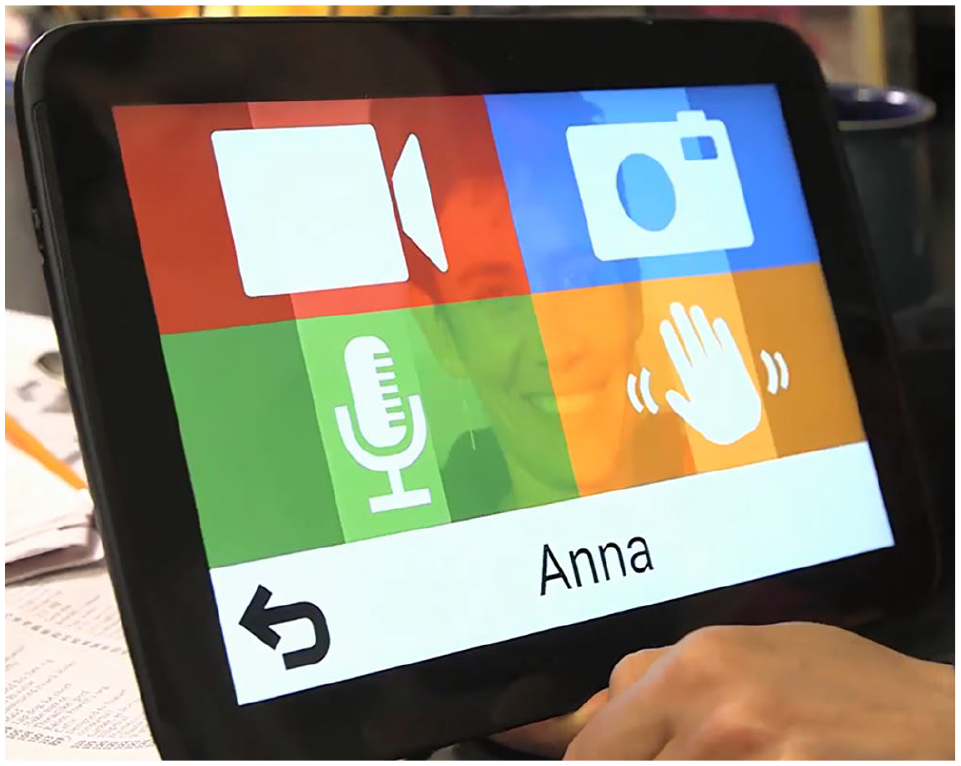
Accessible communication app with four options: wave (pre-defined), audio, picture and video message (right to left).
As noted above, ‘Social Shaping of Technology’ (MacKenzie and Wajcman, 1999) guided the design and implementation of the technology, as we considered a variety of social, cultural, economic and symbolic elements that interacted to shape the development, deployment and outcomes of the technology (Neves et al., 2018a). By exploring the interaction between the intentions of designers and deployment by users, we offer an understanding of learning, use and adoption of new technology in later life and a sociological perspective on the digital divide.
Methods
Data and Procedures
Data come from a three-month deployment study of the app in a Canadian care home (2015). The app was deployed to evaluate adoption and use of the technology and its feasibility to enhance social connectedness among frail residents. The study proceeded in three stages: pre-, mid- and post-deployment. Pre-deployment included an initial training session, semi-structured interviews with participants and study partners (at least one relative or friend had to be involved as we were testing a communication tool) and the administration of two scales (Abbreviated Duke Social Support Index and the three-item UCLA Loneliness scale). Mid-deployment (six weeks after pre-deployment) involved semi-structured interviews with participants and the re-administration of the aforementioned scales. Post-deployment comprised semi-structured interviews with participants and study partners, re-administration of the scales and usability and accessibility tests (these tests include tasks and questions to evaluate how easy, satisfactory and accessible a technology is for users). Throughout the study we collected field observations, and the app logged use, namely frequency and type of messages sent and received. Interviews were audio-recorded and usability and accessibility tests were video-recorded to allow us to see how participants interacted with the device. Interviews, tests and field notes were analysed with qualitative profiling and thematic analysis. Qualitative profiling allowed crafting of rich individual profiles, whereas thematic analysis was employed to identify themes within and across cases (Saldaña, 2015). The scales were analysed with descriptive statistics and Friedman and Sign tests, and logs with log analysis.
The initial training session was one-on-one and lasted 45 minutes on average. It showed participants and study partners how to use the tablet and app, incorporating an interactive component that required participants and study partners to exchange different messages (e.g. picture, video, audio and text) during the session. This way, both sides of communication were illustrated. Following a learner-centred approach known as andragogy (Knowles et al., 2014), the training session emphasised the active role of individuals in the learning process. Participants led most of the session after we presented the app and its functions. Participants used an iPad restricted to our app, which they kept to use as they saw fit during and after the study. Study partners used their computers, tablets or mobile phones. After the training sessions, participants received an accessible printed manual. The literature emphasises the importance of text-based manuals (Betts et al., 2017; Mitzner et al., 2008), and our prior work indicated that participants required written material, a glossary and a place to add notes (Baecker et al., 2014). The manual included those features and written and visual information regarding the gestures required to interact with the technology (swiping and tapping) and the app’s functionalities. Our weekly visits (field observations) were also used to recap those functionalities and gestures since most participants had no experience with touchscreen devices. Although we had only planned one training session per participant, participants requested more informal training meetings throughout the study.
The University of Toronto’s Ethics Board approved the study (Ref. 31111). Participants signed an informed consent form and provided verbal consent. We obtained permission for a maximum three-month study duration from our ethics committee and the facility due to issues of frailty and life expectancy. As we worked with a frail population in sensitive settings, our conduct encompassed both procedural ethics and ethics-in-practice, since we had to dynamically adapt the research to minimise potential negative effects on participants such as stress or discomfort with the technology or study.
Participants
We recruited a purposive sample of 12 residents at a Canadian care home. Following two information sessions, interested residents signed up for the study. Additionally, staff invited residents at risk of social isolation and loneliness due to frailty or reduced social connectedness to participate. Of 21 potential participants, we were only able to enrol 13 due to our selection criteria, which excluded individuals with dementia or conditions rendering them unable to provide consent. These decisions were negotiated with the staff, as our ethics protocol precluded us from having access to medical records. The sample included a married couple who wanted to share a device and who were counted as a single user (Paul-Martha). This duo responded to the interviews together, but the husband mainly answered questions since the wife did not use the app independently. One participant withdrew in the first month because of lack of interest. The final sample (see Table 1) included four men and eight women, with ages ranging from 74 to 95 (M = 83, SD = 5.51). All participants spoke English, and were Canadians and British, American, Italian, Japanese and Latin American Canadians.
Participant sociodemographic characteristics.
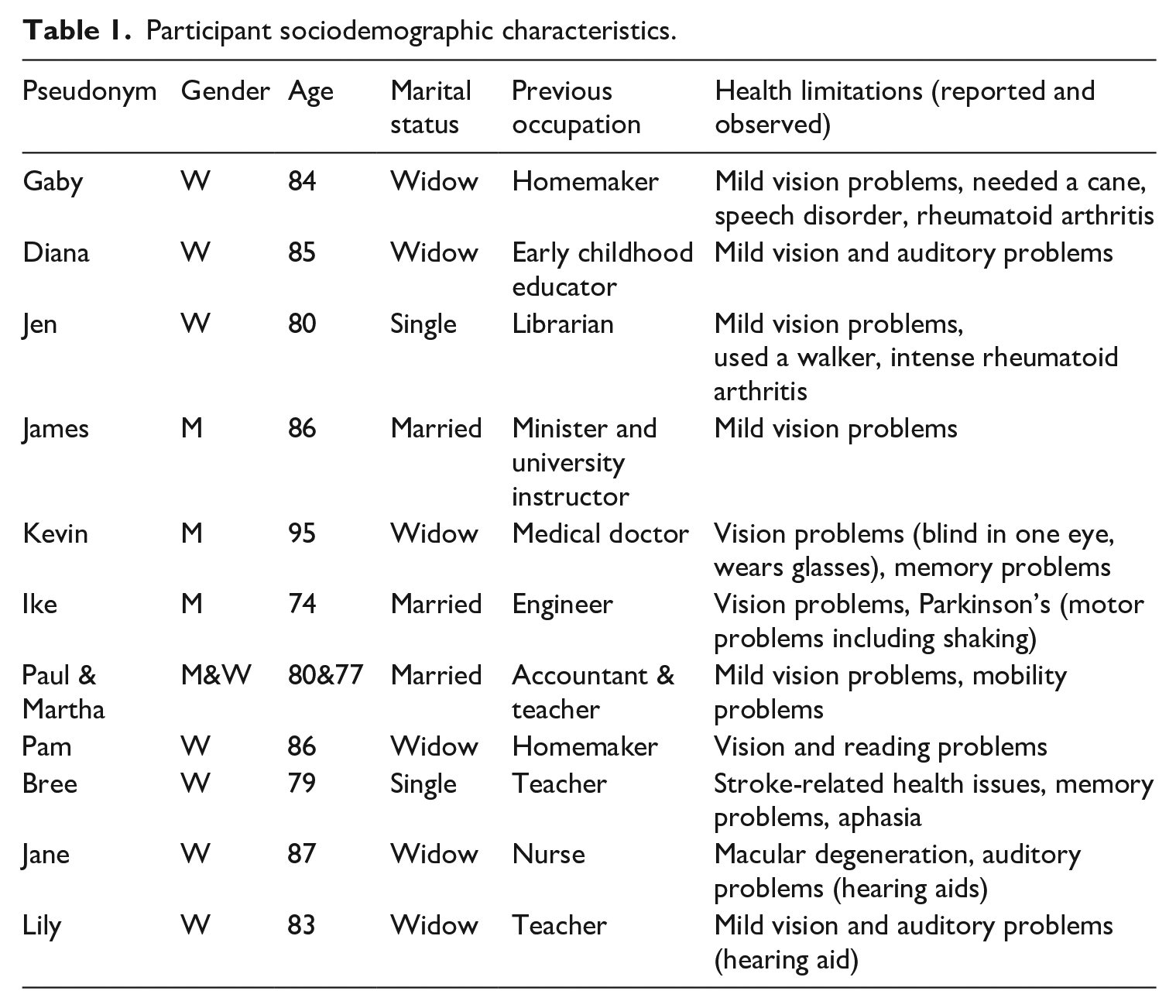
Levels of digital literacy – that is, digital skills and experience with digital devices – differed. Relying on a basic categorisation of digital literacy, when the study began:
four had never used a digital technology before (no digital literacy);
three had already used a computer, but showed a basic operational understanding of the technology, using it only to play cards or write but not to access the web or employ other functions (low level digital literacy);
five had used computers, email and/or smartphones, yet struggled with some functions such as web search, online communication and text messages (medium level digital literacy).
Small non-representative samples are usual in long-term deployment studies with this population due to ethical concerns, life expectancy compression and health issues (Neves et al., 2018a) – yet, the richness of the study design and data allowed us to explore in-depth learning and using a technology over a period of time.
Findings and Discussion
Training and Uptake
At the end of the study all except one participant had adopted the app – Martha, part of the wife–husband duo, stopped using the app before post-deployment. She indicated that she did not need the app, because the telephone provided the necessary means for communication with her children. Regarding frequency of use, at mid-deployment, four participants used it daily, five weekly and two occasionally (i.e. once every two weeks). At post-deployment, nine participants used it weekly and two occasionally. This change in frequency of use – from daily to weekly – seemed related to learning processes: at the start of the study, participants were still learning and would practise sending messages, whereas at the end most were familiar with the app and able to adapt it to their specific communication needs. The most used functions were audio and video, with the ‘wave’ (pre-set text) being the least used at post-deployment. Some participants preferred to receive messages; others wanted to both receive and send messages. Findings from the interviews, logs and field observations also showed different patterns of communication within intergenerational family circles: participants preferred to receive text, while family and friends mainly sent picture and video messages; family and friends favoured receiving picture and video messages whereas participants preferred sending audio messages; and family and friends wanted a real-time communication app, while participants praised the asynchronicity of the tool.
The different frailty levels and circumstances of participants did not affect their willingness to learn to use the technology, as supported in the literature on technology and later life (Betts et al., 2017; Mitzner et al., 2008; Neves et al., 2018a; Tsai et al., 2015). But their internalised assumptions about ageing and technology were also visible, especially concerning confidence and self-efficacy (Czaja et al., 2006; Mitzner et al., 2008). We confirmed the importance of andragogy practices to teach digital skills in later life, from one-to-one training to adjusted pace (Barnard et al., 2013; Betts et al., 2017; Wolfson et al., 2014). Nonetheless, while the technology was co-designed with older people (end-users) to match their requirements, participants needed various scenarios and experiences to: (1) understand the tool and (2) use it for communication with relatives and friends who had their own preferences and expectations. The learning sessions had to be framed by a constant awareness of wider sociotechnical dynamics, such as intergenerational differences. This became clear as the sessions seemed to have a function beyond instruction, with some participants deriving other social benefits from them.
Despite our assumption that one session would suffice, we conducted an average of four training sessions per participant. Sessions were requested by participants, providing time and space to learn and practise. For instance, Diana reported that ‘one-on-one contact is very good’, and for Ike and Bree, it took them ‘a long time to do things’ and the sessions were ‘extremely helpful’. The training sessions seemed to act as a space to practise how to use the tool and as a different activity to add to their standardised routine. Additional support was given informally during field observations.
The manual was used by all participants except Jen. Jen was one of the least frequent users and relied heavily on researchers to use the app, which might explain why the manual was not perceived as useful. For some, it was highly valued and used: Gaby, for example, highlighted content and took notes on the manual, using it to refresh her knowledge, and Ike would rely on it every time he used the device. For others, the manual was ‘very useful’ and used at the beginning but less so at mid-deployment as participants became more familiar with the device. Yet, all praised the importance of the manual to get started. Pam conveyed, ‘I wouldn’t have tried it on my own without it.’ Finally, for three of our participants, the manual was not frequently used, even at the start of the study. James reported that it was ‘a last resort’ and duo Paul-Martha emphasised that they ‘learn intuitively’. We also observed a few proxies – that is, family members who would support participants with their use of the technology and approach us on their behalf if they had questions. This overview sketches the position and distribution of affordances. In particular, the interplay of personal dispositions and desires as well as participants’ social and physical contexts enables technological characteristics to operate as affordances for participants.
To Afford or Not to Afford? Facilitating and Hindering Learning
Analysis of interviews, usability and accessibility tests, and field notes identified five overarching themes that address our research question. The themes correspond to Janus-faced factors; that is, that can both facilitate and hinder learning digital technology in later life, namely: skills, social support, learning strategies, immediate context and instruction and communication. In terms of skills, the five participants who had successfully used a computer before felt more equipped to learn to use the app. But it also meant that, at times, their pre-existing models of technology would further complicate their understanding of the new technology when processes differed. For example, Diana had used email before and was sometimes confused by how the app was sending replies, since it did not correspond to a traditional email system. Prior negative experiences were a hindering factor for two of our participants. For instance, Jen explained: ‘I was a librarian and they kept changing the system. When I got used to one they would change it. I had enough of it and decided to retire . . . I am not very mechanical.’ Lily was given a new laptop and was struggling to understand how to use it, comparing it to her old computer. This experience was affecting her to the point that she confided: ‘I’m really quite scared of it.’ She had lost her confidence – ‘I am not confident now, no confidence in myself while using the laptop’ – and despite having a friend helping with the new system, ‘he was kind of losing a bit of patience with me when I had difficulties’.
In terms of social support, most participants were assisted by relatives. Grandchildren were particularly invested mentors. They operated as mediators between the technological artefact and the user, permitting affordances to emerge through their informal instruction and encouragement. Nevertheless, different understandings and use of digital technology expose intergenerational differences. Grandchildren preferred to send videos and receive videos/images, while participants mostly sent audio and preferred to receive text messages. Additionally, grandchildren would not receive replies within a day and thought it was frustrating. Grandparents showed surprise and confusion when we told them that grandchildren were expecting quicker replies, as they wanted to ‘take time and think about what to say back’. Highly engaged families seemed to compensate for low/non-existent levels of digital literacy – two of our participants became enthusiastic users regardless of having no prior digital experience. But this also meant that a lack of social support seemed to hinder learning and use. For Jen, not having close relatives or friends interested in communicating with her limited her learning and use of the device. For other participants, their families favoured real-time communication and would sometimes answer to a message sent via the device by calling instead of replying with messages. For instance, Kevin reported: ‘I’m somewhat disappointed in my kids, they all, they preferred to use FaceTime.’
Learning strategies encompassed exploration, aids (manual, notes, relatives, researchers), practice, attitudes and trial and error. Participants displayed different learning strategies, often combined: six learned mainly through exploration of the app, four learned with the manual and five mentioned constant practice. All showed positive and negative attitudes: the positives related to wanting to learn and challenge themselves; the negatives included self-deprecation as a way of justifying errors or not knowing a function, but also as a way of releasing tension. Kevin would often say ‘I have a couple of problems [with the app] – it’s probably plain stupidity (laugh).’ These negative attitudes were particularly visible during the usability and accessibility tests. All participants used trial and error in their gestures and interactions with the device. Thus, the device affords even the kind of use that is not inscribed in it. Our video data show participants trying different gestures when tapping or swiping was not responding to their touch, such as tracing or circling icons. These gestures were not taught by us and emerged throughout the study as users were trying to make sense of how to interact with the app and what we meant when we would instruct them to swipe or tap.
These findings are consistent with early and recent research on technology and affordances. With respect to the former, it is clear that what the technology affords changes according to participants’ dispositions and attitudes, as well as the concrete living and social arrangements in which they are enmeshed (Costall, 1995). Those equipped with pre-existing skills responsive to the demands inscribed in the tablet were more readily able to realise these demands. Reflecting recent research on affordances (Bloomfield et al., 2010), our findings further show that, regardless of skills, participants’ pre-existing dispositions enabled novel uses, such as new gestures, not immediately inscribed in the technologies themselves.
Immediate context included participants’ living arrangements and the technology. First, the care home provided independent units and ample public spaces with integrated technology (from an Information Technology (IT) room to screen displays). This facilitated privacy, social interaction and conveyed a sense of technology’s conspicuousness. These physical, social and symbolic features provided an appropriate setting for learning and use. However, living in an institutional setting can hamper learning and use as some participants reported not using the video or image options as ‘things are always the same . . . there’s nothing new to show’. Additionally, while the app was accessible and user-friendly (as designed with and for older people), the tablet was a regular iPad. Some participants struggled with the tablet as they could not find the on/off button (smoothly embedded in the tablet) and had issues with the sleeping/on mode. This was due to dexterity issues and loss of sensitivity in their fingertips. Here, the relational character of affordances is clear. Participants’ dispositions and bodily aptitudes combine with the physical arrangement of the technology to enable use or to inhibit it. Although we had the option of designing hardware alongside the software, our exploratory fieldwork showed that older people want to use the hardware they see their relatives using. They do not want to feel incompetent or stigmatised with a ‘special type’ of tablet, even if using conventional hardware is associated with the aforementioned limitations for this population. Another issue emerging for two of our participants related to the video shown during the recruitment sessions – in the video, a non-frail older woman demonstrates how to use the app in a family context. Both James and Kevin compared themselves to the woman in the video, mentioning at the post-interview that they were unable to operate at that level. As Kevin noted: ‘I don’t think everybody could adapt like that lady did. And you know, that’s what it is. Well, I thought that at the time I was really good. But, uh . . .’
Finally, instruction and communication relate to the study and the researchers, bearing both positive and negative consequences. On the one hand, the study reached its goals of capturing learning, adoption and use from an andragogical approach, which enabled participants to learn, use and adopt – or not – at their own pace during the three-month study. The oral and written instruction informed participants’ use and ideally permitted the affordances of technology to manifest themselves. On the other hand, our data analysis uncovered two dimensions that might have hampered learning and adoption processes. The first dimension pertains to language and communication and the second to identity practices, or what we named ‘reversed impression management’.
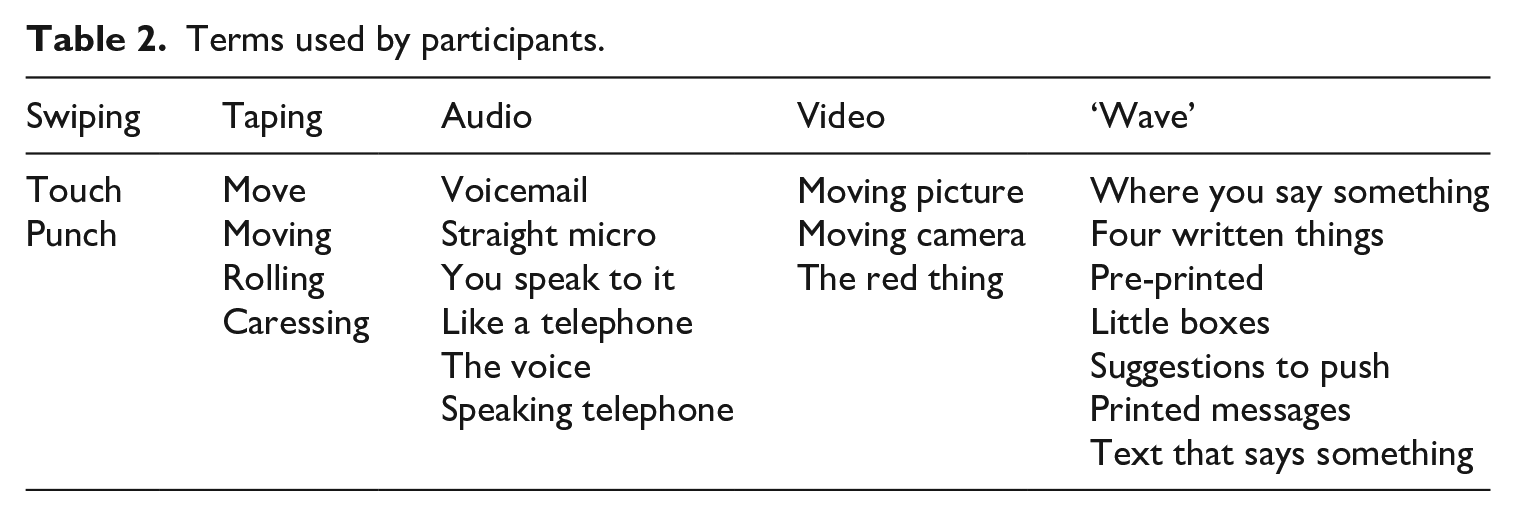
Since the beginning of the study, researchers used terms that they did not perceive as jargon but as ‘correct’ digital expressions, such as ‘tapping’ and ‘swiping’. The manual also included these expressions, which were used consistently by researchers throughout the study. But at the end of the study, only two participants, James and Kevin, had adopted that terminology. We identified several terms that participants used during the study (see Table 2). For instance, instead of tapping, ‘touch’ or ‘punch’; instead of swiping, ‘move’, ‘moving’, ‘rolling’; and instead of audio message, ‘voicemail’, or ‘speaking telephone’. Only the picture message seemed to be referred to as picture or photography. As one participant stated: I am still not sure about the words you lot [researchers] use . . . I don’t know some words, it’s like ‘hello, from the other side’ when some of you speak . . . I know I sound like an old woman . . . but I am an old woman. (Field notes)
Terms used by participants.
Despite the reflexivity embedded in the study, these communication issues mostly emerged in the final phase of data analysis. We realised that language could have hindered learning and use. While during the study we did consider language – albeit briefly – our understanding was that we were using the ‘right’ and ‘mainstream’ terms. This brought to light an unresolved tension between wanting participants to learn the common terms to avoid intergenerational differences and ensuring their first-person voices were being heard.
Related to these language and communication issues are impression management performances by researchers. While participants frequently engaged in impression management efforts (Goffman, 1956) – for instance, through giving overly positive feedback about the app (in an effort to be seen as a ‘good participant’) that we had to continuously challenge, or by using their impairments and age-based perceptions and norms (‘old’, ‘not mechanical’, ‘being a woman’, etc.) to justify issues with learning, technology functions or errors – so did we. Researchers were engaging in self-presentation in a type of reversed impression management. We were teaching the ‘right terms’ and the ‘proper concepts’, fulfilling our role as scholars. This meant a constant negotiation of identities from participants, researchers, relatives, friends and staff members. As noted by Tseëlon (1992), impression management need not imply deceptive concealment, but only the fact that the situation is defined in advance and so calls forth one impression among many in an actor’s repertoire. In our case, the scholarly situation calls forth a particular, authoritative persona and encourages one to impress this persona upon others. For this reason, it is important to include human actors – such as instructors – within the ‘context’, as elements potentially furnishing affordances to participants. Here, however, with errant communication, we observe either no affordance emerging or, worse still, a kind of discouragement owing to a feeling of alienation on the part of participants. This can be understood through Davis and Chouinard’s (2016) conception of affordance, which suggests that given a particular relational configuration, utterances and demonstrations can operate not as facilitating but as discouraging actions.
Conclusion
Far from the interaction between a technology and its user being an immediate one, a number of mediations are seen to pass between them. Although willing to learn to use digital technologies that others in their networks routinely employ, older people often find their attempts stifled: either by internalised negative stereotypes about older users (ageism), or by technologies that seem built for others. At age 83, Don Norman (2019), pioneer of user-centred design, recently observed: Despite our increasing numbers the world seems to be designed against the elderly . . . And when companies do design things specifically for the elderly, they tend to be ugly devices that shout out to the world ‘I’m old and can’t function!’
The social contexts in which technology is embedded affect everything from the designers’ imagined user to users’ own applications of the technology.
This embedding also demonstrates that what facilitates learning can also hinder it. In each theme that we identified – namely, skills, social support, learning strategies, immediate context and instruction and communication – what afforded learning in some instances hindered it in another. For instance, the ‘immediate context’ shows that living settings can enhance but also diminish the learning processes and uses afforded by the technology. On the one hand, the aged-care facility provided privacy and a sense of technology domestication in its public spaces. On the other, environments were always the same as participants were facility-bound, affecting their interest in taking pictures and videos, which were family and friends’ preferred messages.
Understanding how older people learn and adopt new digital technology – paying attention to their sociotechnical contexts as well as previously acquired habits and current attitudes – is crucial to address digital inequalities in later life, especially in the context of a growing ageing population. Researchers have distinguished between effects owing to the age of older people and those owing to the habits and attitudes acquired during the formative and working years of their cohort or ‘generation’ (Rama et al., 2001). These different effects suggest that it is not one’s age in isolation, but also one’s cohort that shapes ‘technological aptitude’. The technological aptitude of the current cohort of younger people is no safeguard against digital exclusion in later life, since, as sociologists have shown, technology and its usage are not static but change over time (Neves et al., 2018b). Conversely, our needs, aspirations and skills also tend to change in the life course depending on structural and agentic factors, such as living settings and personal choices (Quan-Haase et al., 2018). This suggests that the ‘same’ technologies can become different in relation to changed circumstances and uses.
Our use of the affordance concept allows us to grasp the relational and dynamic character of technology: we can thus trace the interplay between changing technologies and changing aptitudes and desires of diverse users. While technologies and users will shift in their capabilities over time, a sociological focus on the relationship between them will need to remain primary.
Alongside the sociological contribution of this article, we provide insights into technology use and adoption in later life that can inform social policy to tackle the digital divide(s). A comprehensive digital inclusion policy must account for diverse social contexts and avoid the ‘one-size-fits-all’. For example, digital literacy programmes targeting older people should consider both individuals’ needs and aspirations (personalisation) and their social contexts, such as living settings or family interaction (contextualisation). Additionally, andragogical teaching – that is, a learner-centred approach – should further integrate learning practices that place older people as learning partners (rather than subjects) and deconstruct internalised ageism regarding technology aptitude. Through a sociological lens that draws on affordances, we show that learning to use new technology in later life rests on various sociotechnical factors; these factors challenge assumptions of homogeneity or passivity of frail older people and highlight the need for a relational understanding of people and technology.
Footnotes
Acknowledgements
The authors would like to thank participants and staff of the aged-care facility. We are also grateful to Ron Baecker, Rachel Franz, Christian Beermann, Rebecca Judges, Mags Ngo, Nadia Nassar, Cosmin Munteanu, Annette Mayer, Chris Arnold, Hubert Hu, Benjamin Rabishaw, Sarah Crosskey, Kate Sellen and all former TAGlab members who contributed to the InTouch project at the University of Toronto. The first author would also like to thank Maria Helena Barbosa for her unconditional support. In addition, both authors are grateful to Ashley Barnwell and Signe Ravn for their comments on drafts of this article.
Funding
The authors disclosed receipt of the following financial support for the research, authorship and/or publication of this article: this work was supported by GRAND NCE as well as by AGE-WELL NCE Inc., both members of the Government of Canada’s Networks of Centres of Excellence research programme. It was also supported by a Monash University Research Grant.
