




Abstract
This article examines trends over time in the propensity to volunteer as a charitable trustee in England and Wales. It makes use of unique, newly available administrative data. The results show sizeable, progressive and extensive declines in trusteeship by birth cohort: compared to the 1945 birth cohort, more recent cohorts through to 1980 show successively lower propensities to volunteer. These results represent the strongest empirical evidence to date in support of sociological theory which argues that the nature of volunteering is changing, with a reduction in a ‘collective’ style of volunteering characterised by long-term, regular and intensive commitment. The results also highlight a key challenge for policy: to sustain the voluntary work of trustee boards – which lies at the ‘heart’ of what it means to be a charity – in the context of sizeable cohort declines in the propensity to serve.
Keywords
Introduction
Sociological interest in volunteering has grown considerably in recent decades. At the individual level there is interest in the extent to which volunteering has positive implications for employment, health and well-being. As a collective activity there is interest in the role that volunteering plays in promoting social integration and in the development of civic skills, values and behaviours. As a productive activity there is a focus on how volunteering contributes to the provision of social welfare and to tackling social problems. Overall, ‘the current weight of expectation about the contribution [volunteering] can make to individual development, social cohesion and addressing social need has never been greater’ (Rochester et al., 2010: 1). From an academic perspective volunteering has now assumed its ‘rightful place’ as a key element of sociological enquiry (Wilson, 2012: 176). However – despite the extent of sociological interest – analyses of long-term trends in volunteering remain relatively scarce (Musick and Wilson, 2008; Wilson, 2012). 1
This article describes long-term trends in the propensity to volunteer as a trustee for a charitable company in England and Wales. The specific focus on governance is important: the voluntary contribution of trustees is rarely examined in research on volunteering (Rochester et al., 2010: 177) – despite their strategic leadership role in ensuring that a charity’s activities are aligned with its mission (Anheier, 2014). We study the UK context, where long-term studies of volunteering are particularly rare. 2 The UK is an interesting case to study given its long history of voluntary organisational activity and a perception that, compared to other country contexts (Putnam, 2000), trends in social capital have been relatively robust to decline (Hall, 1999). We make use of unique longitudinal administrative data that follow individual trustees of charitable companies over time. Therefore, we are able to describe long-term trends not only in the propensity to serve as a trustee of a charitable company – but also in the underlying dynamics of joining and leaving the trustee board. The study is the first of its kind.
The article proceeds in the following way. First, we outline influential sociological theory which argues that the nature of volunteering is changing, with a reduction in a ‘collective’ style of volunteering characterised by long-term, regular, intensive commitment, and an increase in a ‘reflexive’ style of volunteering characterised by short-term, irregular and incidental involvement (Hustinx and Lammertyn, 2003). Second, we review the few existing empirical studies on long-term trends in volunteering. We argue that there is an important disjuncture between theory and empirical work. Existing empirical research examines trends in the overall proportion of the population engaged in volunteering. These studies are not well placed to examine the changes predicted by Hustinx and Lammertyn’s (2003) theory, which would lead us to predict not so much changes in the overall level of volunteering but rather to predict changes in the predominant style of volunteering and therefore changes in the kinds of voluntary work being undertaken. Third, we provide the rationale for this article’s specific empirical focus. We argue that examining trends in trustee board membership is a good test of theory, which in outlining a weakening basis for a collective style of volunteering predicts decline in the kind of regular, long-term, intensive commitment characteristic of serving as a trustee. Fourth, we describe the salience of our research from a policy perspective. We then proceed to the empirical work.
Theoretical Background: The Changing Nature of Volunteering
Hustinx and Lammertyn’s (2003) theory argues that modernisation and individualisation are leading to changes in the nature of volunteering. Specifically, their theoretical approach makes a connection between a changing social context, changes in individuals’ biographies and changes in the ‘style’ of volunteering. Processes of modernisation and individualisation are seen to gradually weaken fixed social configurations associated with the nuclear family, gender-specific role divisions, religion and local community. This leads to changes in individuals’ biographies: life courses that were previously ‘predefined’ within collectively prescribed patterns of behaviour are now ‘perceived, interpreted, decided and processed by individuals themselves’ (Beck and Beck-Gernsheim, 2002: 4; Hustinx and Lammertyn, 2003). Thus, the traditionally standardised life course is gradually replaced by a plurality of ‘reflexive’ ‘do it yourself’ biographies where the impetus is placed on individuals to tailor their own life trajectory (Beck and Beck-Gernsheim, 1996; Hustinx, 2001). Hustinx and Lammertyn (2003) use the terms ‘collective’ and ‘reflexive’ volunteering to describe this biographical shift and the hypothesised influence on volunteer activity. While ‘collective’ volunteering is naturally inscribed in collective patterns of behaviour, ‘reflexive’ volunteering is embedded in an autonomously monitored life course: the individual world of experience becomes ‘the principal frame of reference’, and the decision to volunteer is dependent on ‘personal considerations in the context of highly individualized situations and experiences’ (Hustinx and Lammertyn, 2003: 172).
In the ‘reflexive’ context the increasing instability of family and work life is seen to affect individuals’ availability for volunteering. More recent birth cohorts have experienced a ‘more fluid’ life course with respect to employment and family than preceding birth cohorts. There are British birth cohort studies in 1946, 1958 and 1970, involving repeated surveys of individuals throughout their lives, providing a valuable opportunity to describe relevant differences in individuals’ life courses between these cohorts. The 1946 cohort members experienced high post-war levels of employment, at a time when middle-class jobs were expanding rapidly, and benefited from a strong welfare state and public support for large industries (Makepeace et al., 2003). The great majority of men, benefiting from the economic independence associated with relatively secure jobs, were married by age 25 (Ferri and Smith, 2003). Their living standards improved throughout their lives and they were established in careers, and therefore more likely to survive increases in unemployment, by the time of periods of recession. The 1958 cohort experienced a buoyant labour market on leaving school but experienced high levels of unemployment in their early 20s following the 1981 recession (Makepeace et al., 2003). Meanwhile the 1970 cohort entered the labour market in the mid-1980s, when unemployment had risen significantly, with negative consequences for youth labour markets (Makepeace et al., 2003). This cohort were affected by a shift away from an active labour market policy, a retrenchment of the welfare state amid concern about the level of public expenditure, a decrease in membership of labour unions and an increase in absolute downward social mobility (Woods et al., 2003). More generally the 1970 cohort and subsequent cohorts have faced more uncertain occupational and family trajectories. In terms of family life, they have experienced a growing diversity in living arrangements, delayed union formation and childbearing, a decline in marriage and an increased experience of cohabitation, partnership dissolution and lone parenthood (Ferri and Smith, 2003). In terms of occupations, they have experienced the decline of the ‘job for life’ in a labour market characterised by uncertainty and insecurity, the growth of ‘portfolio careers’ as people increasingly change jobs and careers and an increase in nonstandard work arrangements (Woods et al., 2003).
These structural changes in employment and family life are seen to be associated with an increasing level of biographical uncertainty. However, more fundamentally it is the wider process of individualisation, which sees a shift towards self- rather than collective monitoring of individual life narratives, which leads to an increased level of biographical uncertainty and precarity (Beck et al., 1994). While in a collective frame strong group-based identities and modes of behaviour promote a more predictable life course, in a reflexive context greater individual freedom of choice ‘intrinsically implies more uncertainty’ (Hustinx and Lammertyn, 2003: 169). Therefore, the reflexive shift is inevitably accompanied by growing individual insecurity: ‘the do-it-yourself’ biography is always a ‘risk biography, a state of permanent . . . endangerment’ (Beck and Beck-Gernsheim, 1996: 25). Previously ‘clear pathways’ through adult life have been replaced by ‘individualised pathways’ through adulthood characterised by uncertainty and risk (Beck et al., 1994), with ‘a much greater emphasis on individual resources and capabilities’ in determining the way the life course is constructed (Bynner et al., 2003: 309).
Hustinx and Lammertyn (2003) argue that these changes in individuals’ biographies affect the social basis of volunteering. The individualised biography is more precarious and discontinuous, fragmented into a ‘sequence of separated and not necessarily coherent incidents and episodes’ (Hustinx, 2010: 238). Thus, individuals’ availability of time is less predictable and more compressed (Hustinx and Meijs, 2011). Since volunteering is seen as a ‘biographically embedded’ activity (Hustinx and Lammertyn, 2003: 170), this increased level of precariousness is hypothesised to affect the nature of volunteering and in particular the time structure of involvement – specifically through a transition towards short-term, irregular and incidental involvement characteristic of a ‘reflexive’ style of volunteering rather than the long-term, regular and intensive commitment characteristic of a ‘collective’ style of volunteering (see Macduff, 2005; Rochester et al., 2010; Wilson, 2012). Compared to ‘collective’ volunteering, which is defined by collective goal setting, enduring commitment and strong organisational attachments, ‘reflexive’ volunteering is shaped by individual preferences, is non-committal and sporadic, with volunteers developing only weak attachments to any particular organisation (Hustinx, 2001; Rochester et al., 2010).
Note that Hustinx and Lammertyn (2003: 171) do not intend this distinction between ‘traditional, collective’ and ‘modern, reflexive’ volunteering to be regarded as a rigid dichotomy but rather as a continuum between two theoretical ‘ideal-types’. Similarly the aim is not to envisage a ‘complete rupture’ over time in which new styles of volunteering come to ‘replace’ old styles, but rather to recognise an environment in which volunteering is now characterised by a mixture of ‘reflexive’ as well as ‘collective’ styles and where the basis for the collective style is weakening. Their framework draws a distinction between more subjective and more objective levels of analysis, with the former focusing on changes in motivations and cultural value orientations and the latter focusing on the implications of social-structural changes. We have focused on outlining the socio-structural elements of the framework given particular interest in thinking through the possible implications of a changing macrosocial context for volunteering. This is a theme which is widely recognised to be under-researched in the literature (Ellis Paine and Hill, 2016; Hustinx et al., 2010; Musick and Wilson, 2008; Wilson, 2000).
Empirical Evidence: The Need to Align with Theory
There are very few empirical studies examining long-term trends in volunteering (Musick and Wilson, 2008; Wilson, 2012). In the UK context, in particular, studies of long-term volunteering trends are especially rare. One of the few examples – Lindsey and Mohan’s (2018) review of relevant survey information – reports a broad stability in the proportion of the population in England involved in volunteering since the end of the 1970s. Meanwhile the few studies examining long-term volunteering trends in the USA provide a mixed evidence base. The analysis of certain US social surveys points to an increase in volunteering. Thus Ladd (1999), using data from a series of Gallup surveys between 1977 and 1995, reports an increase in the proportion of the US population involved in ‘charity or social service activities’. According to DDB Needham Life Style data, between 1975 and 1999 there was an increase in the number of times that people report volunteering in the previous year (Goss, 1999). However, Goss (1999) and Putnam (2000) argue that, since the increase in volunteering in the Needham data is concentrated among the over 60s, the period trend simply reflects the high voluntary engagement at older ages of the ‘long civic generation’ born between 1910 and 1940. From this perspective the increase in volunteering at older ages is masking lower levels of volunteering in later ‘baby boomer’ birth cohorts born between 1950 and 1965. Thus Putnam (2000) concludes that what is an apparently anomalous result – in that the trend in volunteering stands in contrast to declines in other forms of engagement including political participation and voluntary association membership – is not, in fact, an exception to broader generational declines in social capital. To test Putnam’s (2000) thesis Rotolo and Wilson (2004) use the National Longitudinal Survey of Labour Market Experience (NLSLME) to compare the volunteering behaviour of women in the 1923–1937 and 1944–1954 birth cohorts at the same age. They find that the more recent cohort in fact contributes more hours of volunteering per week. Similarly Einolf (2009) does not find support for Putnam’s thesis: using data from the Midlife in the United States panel study, he finds that at comparable ages the first baby boom cohort, born between 1946 and 1955, did more volunteering than the preceding ‘silent’ (1936–1945) and ‘long civic’ (1926–1935) birth cohorts. Indeed, Einolf is optimistic that, going forward, boomers will continue to volunteer at higher levels than did preceding cohorts at comparable ages. This stands in stark contrast to the assessments of Goss (1999) and Putnam (2000) who argue that the apparently optimistic results from survey data merely reflect an ‘Indian summer’ of volunteering before generational declines in volunteering become evident. Therefore, there is no consensus about the nature of long-term volunteering trends.
Importantly our existing knowledge about time trends in volunteering has been based on the analysis of questions which provide relatively little analytical insight. Thus, the Needham surveys contain a single question relating to how many times respondents did volunteer work in the previous year. In the NLSLME the question is ‘in the past 12 months did you do any unpaid volunteer work?’ while respondents to the Gallup surveys were asked ‘do you, yourself, happen to be involved in any charity or social service activities, such as helping the poor, the sick or the elderly?’ In the UK the British Household Panel Survey asks about people’s involvement in ‘unpaid voluntary work’ while its successor Understanding Society asks about ‘unpaid help’ to organisations. These questions do not get close to the actual nature of the voluntary work undertaken. Therefore, when we analyse responses to these questions to consider trends in volunteering as a whole, we conflate together a huge variety of different tasks, miss much valuable information and examine changes in an analytical construct which lacks internal coherence (Wilson, 2000):
survey research can tell us whether a person is a volunteer, but that term is so vague as to tell us very little about what that person does as a volunteer. It is the equivalent of knowing that someone is employed or ‘in the labour force’ without knowing much about how they spend their working day . . . Only at the level of the [volunteer] task is it possible to glimpse the real work millions of volunteers are doing. (Musick and Wilson, 2008: 418)
In particular, we argue that there is an important disjuncture between the nature of theory and the nature of empirical work examining long-run trends in volunteering. Hustinx and Lammertyn’s (2003) theory would lead us to predict not so much changes over time in the overall level of ‘volunteering’, but rather changes in the kinds of volunteering that people undertake. Therefore, existing empirical work on long-term trends, which in focusing on ‘volunteering’ in general conflates potentially diverging trends across the full variety of volunteering tasks, is not well placed to examine the kinds of changes predicted by theory. Indeed, while theory posits that the nature of volunteering itself has been undergoing ‘radical change’ (Hustinx and Lammertyn, 2003: 167), the body of existing quantitative research examining long-term volunteering trends treats volunteering as a ‘stable factor’. Therefore, the idea of a transition from ‘traditional, collective’ to ‘modern, reflexive’ types of volunteering remains largely unsubstantiated in empirical work (Hustinx and Lammertyn, 2003).
We argue that, to align with sociological theory about how the nature of volunteering is changing, the way forward for empirical research is to consider long-term trends in volunteering which are disaggregated at the level of particular volunteer tasks. Wilson (2000: 233) warns against using ad-hoc ‘folk’ taxonomies of volunteering (‘school-related, helping the elderly. . .’) which are not ‘sociologically useful’. Instead a more helpful approach is to be guided by sociological approaches to the study of work which consider the vertical stratification of tasks – from more closely supervised, repetitive, low-skilled roles, on the one hand, to those which involve considerable autonomy and decision making, are varied and high-skilled. For example, Musick and Wilson (2008) point to Harris’ (1996a: 57) classification of volunteer tasks into ‘governance’ roles (a member of a board), ‘operational’ roles (involvement in the provision of services) and ‘support’ roles (like fundraising or providing administrative support). This article, in examining those volunteering to serve on the trustee board of charitable companies, has a specific focus on a governance role. It seeks to be at the ‘frontier’ of a new research agenda on volunteering by bringing together a substantive motivation to understand long-term trends with a conceptual clarity that, by focusing on a particular volunteer task, is well placed to test theory about how the nature of volunteering is changing.
Substantive Focus: Serving as a Charitable Trustee
Importantly, Hustinx and Lammertyn’s (2003) theoretical framework provides a rationale for this article’s specific empirical focus. This is because there is a particular substantive basis for expecting a changing social context to have affected individuals’ availability to serve as a trustee to a greater degree than it has affected other volunteering tasks. Specifically, the increasingly precarious and uncertain nature of individuals’ biographies associated with social transformations may not be well aligned to the time structure of engagement as a trustee board member – the long-term, regular and intensive commitment to a particular organisation which is characteristic of a ‘collective’ style of volunteering. Serving as a trustee is time-intensive: on average trustees devote five hours per week to their roles (Lee et al., 2017). This reflects the nature of the institutional environment. As part of the ‘mixed economy of welfare’ charities play a prominent role in the provision of a variety of services, resources and activities conducive to social welfare and well-being (Kendall, 2003). Harris (2001: 173, 175) describes how charitable trustees often find themselves ‘managing large-scale service[s]’, being ‘signatories to contracts’; ‘carrying accountability for complex budgets and major fund-raising’; ‘subject to tight, even intrusive, regulation’; ‘subject to the monitoring requirements of their funders’; taking on ‘supporting and leadership roles’ to help paid staff and service volunteers; and ‘securing resources [to ensure organisational survival] in the face of uncertain funding streams’. Thus, there is ‘widespread recognition’ of the ‘challenging’ nature of being a member of a trustee board (House of Lords, 2017: 23). Indeed, Harris (2001: 181, emphasis in original) warns that the policy environment and associated ‘burden’ on trustees ‘may have the perverse effect of discouraging the impulse to active citizenship . . . on which the very survival of the voluntary sector depends’. Overall, there is seen to be a ‘growing discrepancy’ between the ‘collective rhythm’ of organisational demands and the more ‘unpredictable’, unstable and compressed schedules of the individual (Hustinx and Meijs, 2011: 10). Thus, it is the interaction between the changes in individuals’ lives and the nature of the social policy context – where increasingly uncertain and discontinuous biographies are becoming less conducive to a demanding trustee role – that provides a strong theoretical basis for expecting decreases in the propensity to volunteer as a member of a charitable trustee board. Indeed, there have been concerns that it is becoming harder for charitable organisations to recruit trustees (House of Lords, 2017; Lee et al., 2017). However, thus far, there has been no empirical evidence which has been able to engage with this concern directly by examining changes over time in trustee board membership.
Policy Context: Charitable Companies in England and Wales
The empirical work in this article relates to the trustee board membership of charitable companies: organisations which are charitable in status and companies in structure. Charitable status is the primary legal framework for voluntary organisations in England and Wales. As voluntary organisations, charities are formal bodies which are self-governing, independent of government, not profit-distributing and which benefit from meaningful contributions of voluntary work and/or philanthropic donations (Kendall, 2003). Charitable status is also underpinned by the specific criterion of ‘public benefit’: an organisation should ‘benefit the public in general or a significant section of the public’. Charitable companies have an incorporated structure: they represent an entity independent of their members. Therefore, incorporated charities are able to perform key duties in their own legal capacity – such as employ paid staff, deliver services under contracts, enter commercial agreements and own land or other property. In contrast unincorporated charities (associations and trusts) are not able to enter contracts or commercial agreements in their own name, land or property has to be ‘held’ on the charity’s behalf and the trustee board members are personally liable for what the charity does.
From a policy perspective this research is of particular salience. Indeed, of all the different volunteer tasks, it is particularly important to examine trends in trusteeship given the nature of the functions that are served by volunteers in this role. Harris (1996b) groups these functions under five main headings: being the employer; formulating and ensuring adherence to an organisation’s mission; securing appropriate resources; representing the point of final accountability; and providing the link between the organisation and its stakeholders. Thus, those serving as trustees perform a governance role through providing oversight and direction. The work of trustee boards guides the roles that charities play in civic life: their role in the provision of a wide range of public services; their role in providing advocacy, advice and information; and their role as the front line of support for vulnerable groups (House of Lords, 2017). Indeed, in many ways it is the trustees who constitute the ‘very heart’ of voluntary organisations: voluntary organisations may or may not involve volunteers in ‘operational’ roles, have members, or receive charitable donations, but they cannot be understood to be part of the voluntary sector without voluntary involvement in the governing board (Harris, 2001: 171). 3 Therefore, studying trends in trustee board membership not only provides empirical insights relevant to considering the future of governance in the midst of a changing social context for volunteering: it also provides a window into changes that are central to the very identity of the voluntary sector.
Data and Method
A Cohort Approach
This article examines trends over time in the propensity to serve as a trustee of a charitable company in England and Wales. It adopts a cohort approach to the analysis of trends: it compares different birth cohorts in terms of their propensity to serve at comparable ages 4 (Musick and Wilson, 2008; Rotolo and Wilson, 2004). The use of birth cohorts for the study of social change is well established (Ryder, 1965). The approach also aligns with relevant theory about volunteering. In Hustinx and Lammertyn’s (2003: 170) framework volunteering is seen as a ‘biographically embedded’ activity, and changes in volunteering are seen to result from a ‘biographical shift’: changes in the life course resulting from broader societal transformations that change individuals’ availability for volunteering. Therefore, a cohort perspective is valuable because it provides a ‘macro-biography’ (Ryder, 1965: 859) – an empirical framework for considering how a changing social context relates to hypothesised changes in volunteering behaviour.
Data
To facilitate our cohort analysis, we bring together information from three different sources:
We use administrative data from Companies House to provide the numerator for our cohort perspective. Charitable companies in England and Wales are required to complete annual returns not only to the Charity Commission, which regulates charities in England and Wales, but also to Companies House, the United Kingdom’s Registrar of Companies. The Register of Companies has detailed information on individual trustee board members. This includes each board member’s date of birth, sex, date of appointment and (where applicable) date of resignation, indexed by unique company number. We have this information for the population of individuals, including both current board members and those that have resigned, to have been trustee board members of charitable companies between 1999 and 2016 inclusive. We use these data to identify the number of trustees by combinations of birth cohort, age and sex.
We use population data from the Office for National Statistics to provide the denominator for our cohort perspective. We obtain a series of successive mid-year population estimates for each of the years 1999–2016 (Office for National Statistics, 2000–2017), providing the number of residents of England and Wales by single year of age and sex in each year of our analysis period. We use these data to calculate the ‘exposure’ for our cohort perspective: the number of individuals available for, or ‘at risk’ of, trustee board membership by birth cohort, age and sex. We match these exposures to the relevant numerators from the Companies House data to examine the propensity to serve as a trustee by birth cohort, age and sex.
We use administrative data from the Charity Commission’s Register of Charities to disaggregate our cohort analysis so that we can examine trends in trustee board membership for different kinds of charities. The Register of Charities has comprehensive information at the organisational level, including longitudinal financial data and information on the organisation’s field of activity. We have information on the population of charities to have existed in England and Wales between 1999 and 2016. We link the information in the Charity Commission data to the Companies House data on trustee board members using a common unique identifier, the company number.
Therefore, our approach illustrates the potential of repurposing administrative records to create cohorts of individuals for analysis (see Connelly et al., 2016). The data have a number of important strengths. First, as administrative data, they facilitate a focus on examining change in a specific volunteering task that would not be possible through social surveys which would lack the necessary sampling size: volunteering as a trustee is still a ‘rare event’ in the context of the total population. Second, the large number of records provides a distinctive temporal resolution: in contrast to social surveys which necessitate a certain level of aggregation to minimise sampling error, the volunteering behaviour of adjacent single year birth cohorts can be compared if needed. Third, we do not have to rely on self-reports of volunteering, which can be prone to measurement error (Rooney et al., 2004). Fourth, since they are accumulated from successive years of administrative reporting from individual organisations about their board members, the data provide a long span of information that is recorded in a consistent way and which is not affected by the secular decrease in response rates and associated increase in non-response bias which has affected estimates of changes in volunteering based on successive social surveys (Abraham et al., 2009). Fifth, since we can identify the sex of board members, we can examine whether cohort trends are similar for men and women. While the majority of board members are men, we might expect the sex difference in board membership to be reduced in more recent birth cohorts: in terms of education, which is a key predictor of volunteering, there have been more sizeable increases in tertiary-level educational attainment between the 1946 and 1970 birth cohorts for women than for men (Makepeace et al., 2003); in terms of employment, which according to social integration theory is positively associated with volunteering, the proportion of women in their early 30s who are employed increased between the 1946 and 1970 cohorts from 54% to 74% 5 while the corresponding proportion of men decreased from 99% to 90% (Woods et al., 2003). Sixth, since we can link the data on trustees to organisational characteristics, we can consider whether trends in trustee board membership differ for different kinds of organisations (Cornforth, 2014; Musick and Wilson, 2008).
Finally, and importantly, the data follow individual trustees over time. Reviews of the literature on volunteering (Musick and Wilson, 2008; Wilson, 2012) have recognised longitudinal perspectives to be rare and therefore a priority for research. Volunteering is a dynamic process: people join and leave their roles with voluntary organisations. The policy implications of a decline in volunteering would be different depending on whether this reflects fewer people joining or more people leaving: the former might suggest the need for an increased emphasis on recruitment; the latter more emphasis on the nature of the volunteer experience. However, as McCulloch (2014) points out, measurement error can have significant implications for the accuracy with which these transitions are estimated. Specifically, given the widely recognised difficulties with estimating volunteering using survey data (Musick and Wilson, 2008), measurement error at any time point is likely to lead to an over-estimation of the transitions in and out of volunteering using successive surveys. This is where administrative data have an advantage: as Connelly et al. (2016) argue, data derived from the operation of administrative systems are particularly valuable for recording information that is more difficult to collect accurately in a social survey context – like the start and end of spells of volunteering. Therefore, our study provides a valuable opportunity to examine not only the trends in the propensity to serve on the trustee board of a charitable company – but also the underlying dynamics of joining and leaving the board.
The data also have limitations. The first relates to coverage. We are able to examine trends relating to serving on a trustee board of a charitable company. However, we are not able to examine trends relating to serving on the trustee board of unincorporated charities because detailed data on the board members of these organisations – in terms of their dates of birth and dates of appointment and resignation as trustees – are not available. The data on trustee board members are collected by Companies House and are therefore only available for charities that are companies. Therefore, our results relate to a subset of the wider charitable sector. Of the c.167,000 active registered charities in England and Wales, c.35,000 (21%) are incorporated. However, charitable companies account for more than 70% of aggregate charitable income. This is because most registered charities are small, with the majority having an annual income below £100k, and most of these small charities are unincorporated. In contrast, around half of all charities with an income between £100k and £1m, and around 80% of those charities with an annual income of more than £1m, are incorporated. Compared to unincorporated charities, charitable companies are more likely to be involved in providing services (62% vs 33%) and in providing advocacy/advice/information (44% vs 17%).
The second data limitation relates to changes in coverage. Since the 1990s, a growing number of charities have opted to incorporate as charitable companies rather than remain as unincorporated trusts or associations. Over this period the total number of registered charities has remained stable, such that the percentage of charities that are incorporated has risen from 8% to 21%. The scope of the Companies House data on trustee board members therefore changes over time: the increase in the proportion of charities that are incorporated means that we have information on the board members of 8% of charities in 1999 and 21% of charities in 2016. This change in data coverage affects the approach to analysis. We are interested in comparing the voluntary experience of different birth cohorts at the same age. However, comparing the proportion of the 1949 birth cohort aged 50 who volunteer as trustees of charitable companies (in 1999, the beginning of the analysis period) with the proportion of the 1966 birth cohort aged 50 who volunteer as trustees of charitable companies (in 2016, the end of the analysis period) is not comparing like with like: there are more charitable companies in 2016 than 1999, and therefore more trustees of charitable companies. This does not reflect an increase in engagement but simply reflects the increased proportion of charities with a company structure, and therefore an increasing proportion of trustee board members within the scope of our Companies House data, at the end of the analysis period. Therefore, to ensure consistent comparison over time we analyse a consistent panel of organisations that are already incorporated at the beginning of the analysis period, since their year of incorporation was before 1999, and are active throughout the analysis period from 1999 to 2016. This panel contains information on 10,266 charitable companies and 273,935 individual trustee board members (with 206,057 appointments and 211,872 resignations over the analysis period), contributing 1.5m person years of trustee board membership between 1999 and 2016. Table 1 presents the number of observations by different covariates used in the analysis. Figure 1 provides a Lexis diagram showing the birth cohorts that we examine, and the ages through which we follow these birth cohorts, during the analysis period.
Number of observations by covariates.
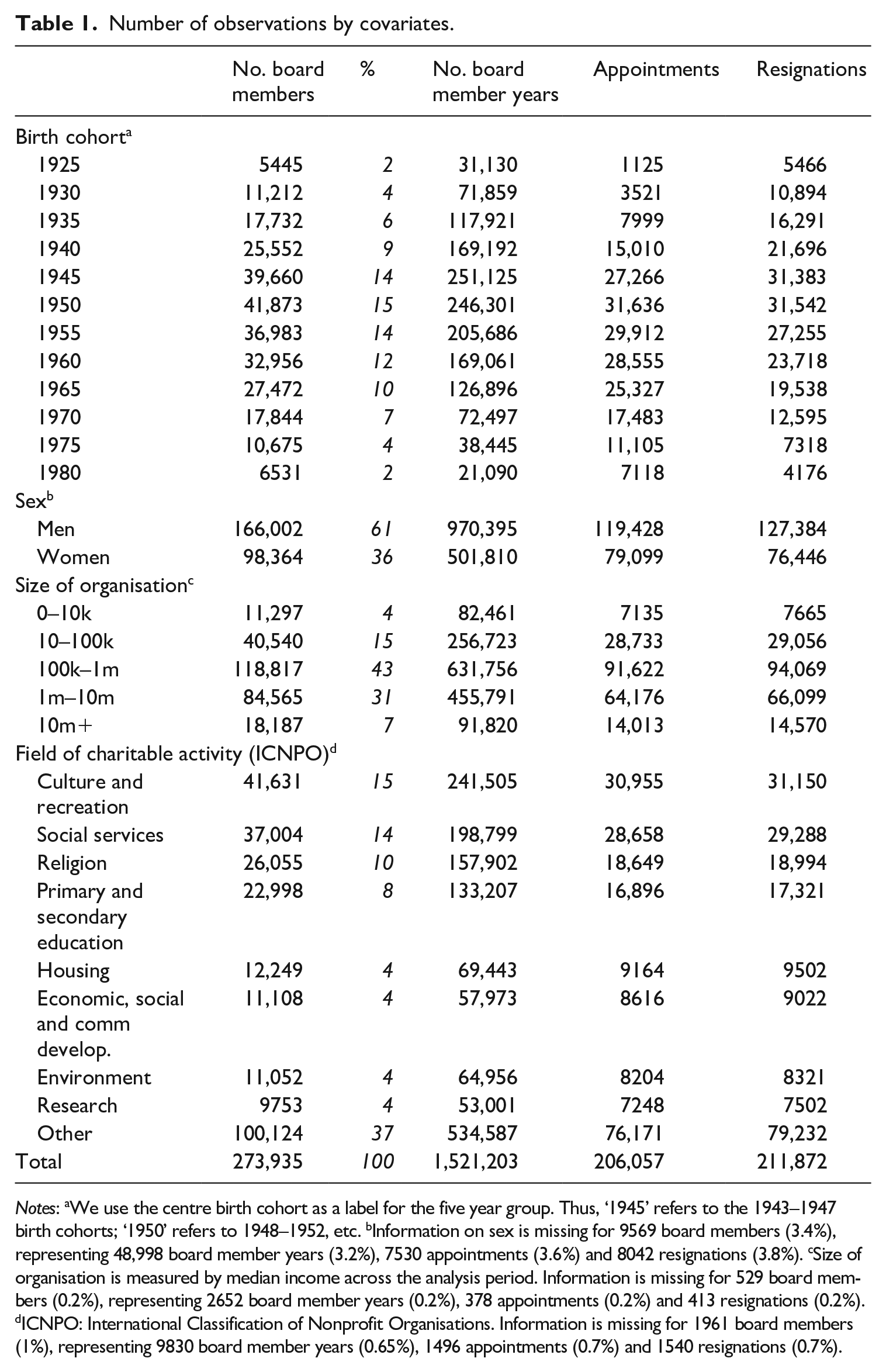
Notes: aWe use the centre birth cohort as a label for the five year group. Thus, ‘1945’ refers to the 1943–1947 birth cohorts; ‘1950’ refers to 1948–1952, etc. bInformation on sex is missing for 9569 board members (3.4%), representing 48,998 board member years (3.2%), 7530 appointments (3.6%) and 8042 resignations (3.8%). cSize of organisation is measured by median income across the analysis period. Information is missing for 529 board members (0.2%), representing 2652 board member years (0.2%), 378 appointments (0.2%) and 413 resignations (0.2%). dICNPO: International Classification of Nonprofit Organisations. Information is missing for 1961 board members (1%), representing 9830 board member years (0.65%), 1496 appointments (0.7%) and 1540 resignations (0.7%).
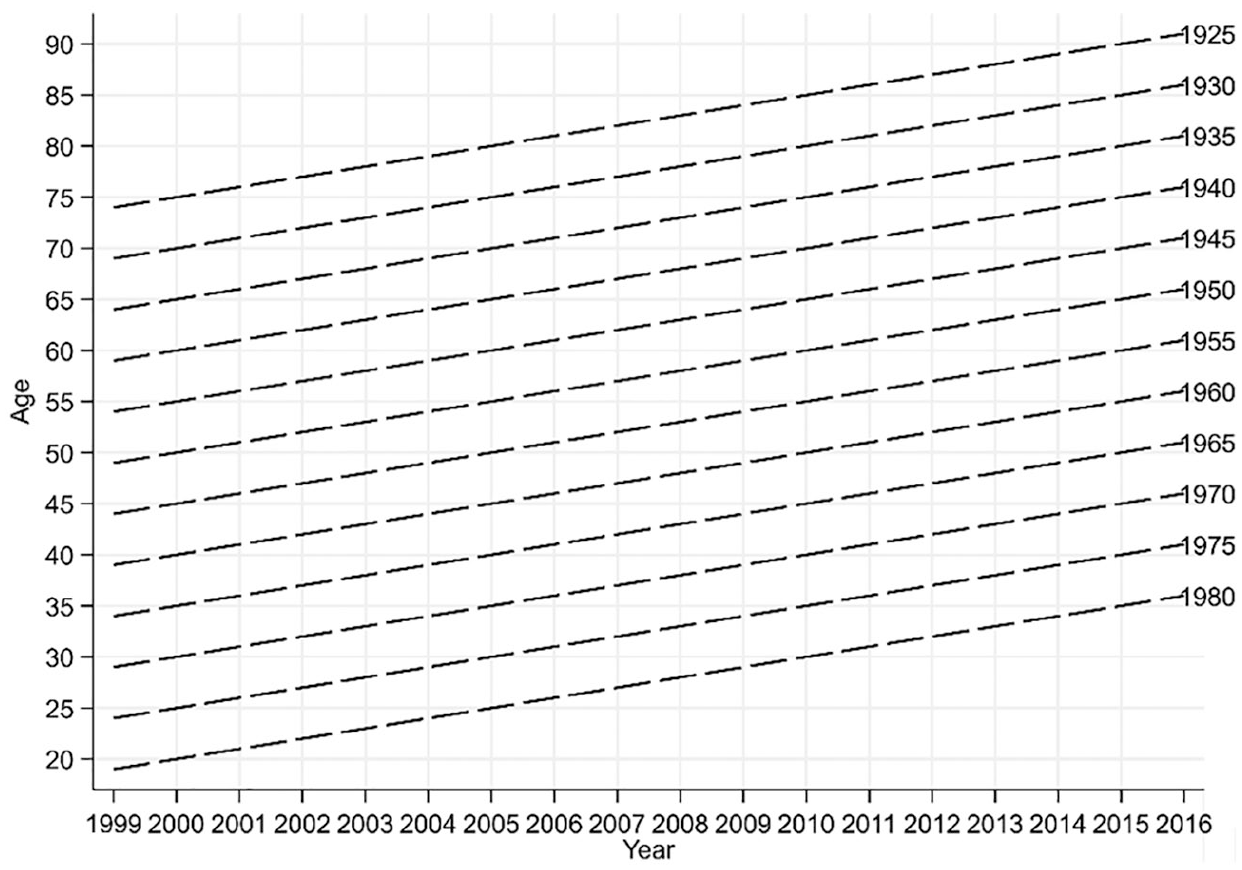
Lexis diagram showing the age ranges (vertical) that we observe for each birth cohort (diagonal) over our analysis period (horizontal).
Models
We begin the analysis by examining cohort variations in trustee board membership. Our dependent variable y, the proportion of people who volunteer as a board member of a charitable company, is observed in the interval [0, 1]. Therefore, we use a fractional regression model, a generalised linear model with a binomial distribution and a logit link function (Papke and Wooldridge, 1996):

where
We then consider the dynamics of trustee board membership through examining individuals joining (‘appointments’) and leaving (‘resignations’).
6
To describe cohort patterns in being appointed as a trustee of a charitable company we use a fractional regression model using the same framework as in equation (1): here, y is the proportion of people who are appointed as a trustee and the vector of parameters
To describe cohort patterns in the hazard of a trustee resigning from the board, we use a piecewise exponential proportional hazard survival model of the form

where
When examining cohort variations in trustee board membership, and in rates of appointment and resignation, we begin by examining overall trends and then consider whether these trends extend to a variety of different kinds of charitable organisations. We group birth cohorts into five-year intervals from 1925 (for cohorts born 1923–1927) through to 1980 (for cohorts born 1978–1982). To facilitate interpretation, we present our regression results graphically.
Results
The results show sizeable differences by birth cohort in the proportion of the population serving as trustees of charitable companies (Table A1 in Online Appendix 1, model A1). Figure 2 illustrates these differences graphically. 9 There is a distinctive inverted U-shaped age pattern in trustee board membership: the proportion of people serving peaks at around the age of 60 while low proportions serve in early adulthood and at the oldest ages. Patterns by birth cohort are evident when comparing proportions serving as board members at the same age. The 1945 10 birth cohort shows the highest level of engagement. The proportion serving in the 1945 cohort at age 55 is 39 per 10,000 people – a higher proportion than those serving at age 55 in the 1950 cohort (37 per 10,000), the 1955 cohort (33 per 10,000) and the 1960 cohort (27 per 10,000). Thus at age 55 the proportion serving in the 1945 cohort is 7% higher than the 1950 cohort (relative risk (RR) = 1.07; 95% confidence interval (CI) 1.05–1.09), 20% higher than in the 1955 cohort (RR = 1.20; 95% CI 1.17–1.22) and 44% higher than in the 1960 cohort (RR = 1.44; 95% CI 1.41–1.48). Indeed, from 1945 to 1970 each subsequent birth cohort shows lower levels of engagement than previous cohorts at comparable ages. Thus, the proportion serving in the 1960 cohort at age 40 (16 per 10,000) is 23% higher than at age 40 in the 1965 cohort (13 per 10,000; RR = 1.23; 95% CI 1.19–1.28) and 57% higher than at age 40 in the 1970 cohort (10 per 10,000; RR = 1.57; 95% CI 1.52–1.63). Note that, while there are sizeable successive declines in the proportion serving in successive cohorts between 1945 and 1970, there is no evidence of sizeable decline after 1970: the 1975 and 1980 birth cohorts show similar levels of engagement to the 1970 birth cohort. Meanwhile there is an evidence of an increase in engagement between cohorts from 1935 to 1945: at age 70 the proportion serving in the 1945 birth cohort is 6% higher than in the 1940 cohort (RR = 1.06; 95% CI 1.04–1.07) and 13% higher than in the 1935 cohort (RR = 1.13; 95% CI 1.11–1.14).
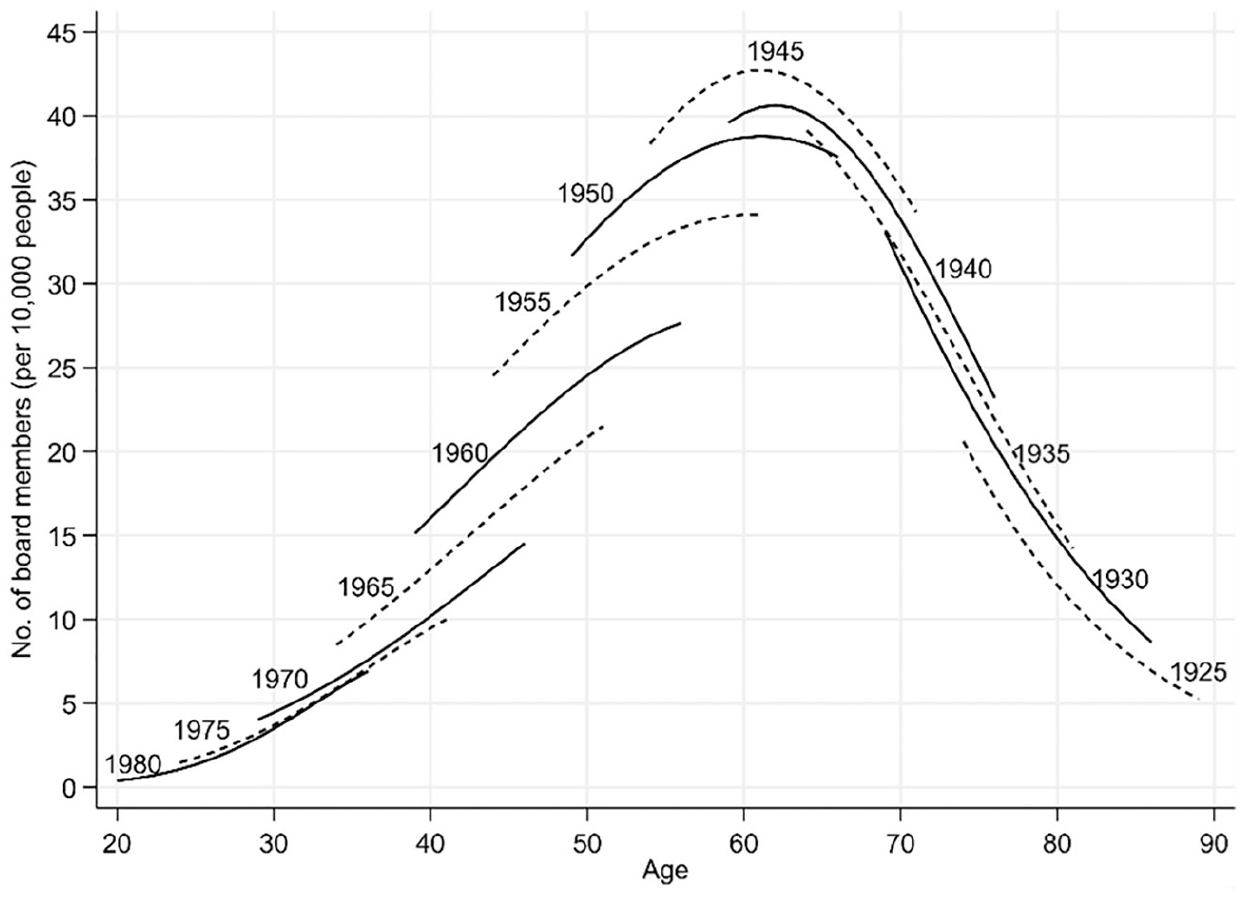
Trustee board membership by age and birth cohort.
Figure 3 (Table A1, models A2 and A3) disaggregates the overall results by sex. Importantly the differences in charitable board membership by birth cohort are even more sizeable when we restrict analysis to men specifically. At age 55 the proportion of men serving in the 1945 birth cohort, 55 per 10,000 people, is 12% higher than at age 55 in the 1950 cohort (RR = 1.12, 95% CI 1.10–1.15), 32% higher than at age 55 in the 1955 cohort (RR = 1.32, 95% CI 1.29–1.35) and 70% higher than at age 55 in the 1960 cohort (RR = 1.70, 95% CI 1.65–1.74). In turn, the 1960 cohort shows much higher levels of engagement than subsequent cohorts: at age 40 the proportion of men serving, 18 per 10,000, is 29% higher (RR = 1.29, 95% CI 1.23–1.34) than at age 40 in the 1965 birth cohort and 67% higher than at age 40 in the 1970 birth cohort (RR = 1.67, 95% CI 1.60–1.74). Notably for women the decline in the propensity to serve as a trustee board member starts later and, while still sizeable, is less pronounced than for men. Indeed, for women there is no evidence for any decline between the 1945 and 1955 birth cohorts. There is a sizeable decline between 1955 and 1970: the proportion serving at age 45 in the 1955 cohort, 18 per 10,000, is 18% higher than at age 45 in the 1960 cohort, 34% higher than in the 1965 cohort and 65% higher than in the 1970 cohort. As with men there is no evidence of significant further decline between the 1970 and 1980 birth cohorts.
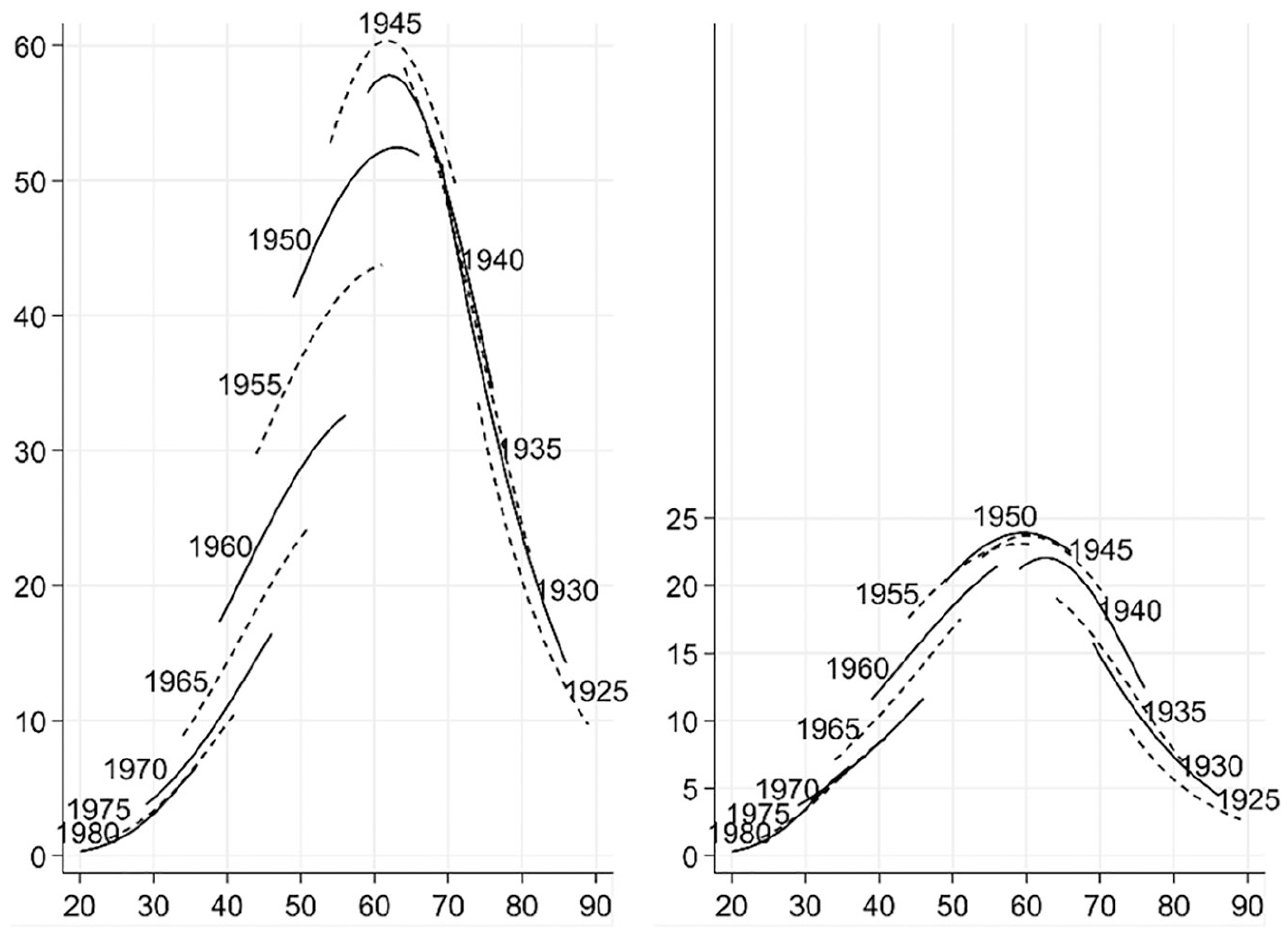
Trustee board membership by age and birth cohort, for men (left panel) and women (right panel).
Our covariate data on charities allow us to disaggregate cohort trends for different sizes and kinds of organisation. In terms of charitable size, there is evidence that smaller charitable companies have been affected by particularly large relative cohort declines (Table A1, models A4–A8; Figure 4). Thus when we restrict analysis to organisations with an annual income of between £10k and £100k, 11 the proportion of individuals serving as trustee board members at age 55 in the 1945 cohort is 58% higher than at age 55 in the 1960 cohort; in turn, the proportion serving at age 40 in the 1960 cohort is 64% higher than at age 40 in the 1970 cohort. Larger charities are more robust in showing smaller relative declines. Nevertheless, even for the largest charities cohort declines are still sizeable: for charities with an annual income of more than £10m, the proportion of individuals serving as board members at age 55 in the 1945 cohort is 34% higher than at age 55 in the 1960 cohort; in turn, the proportion serving at age 40 in the 1960 cohort is 51% higher than at the same age in the 1970 cohort.
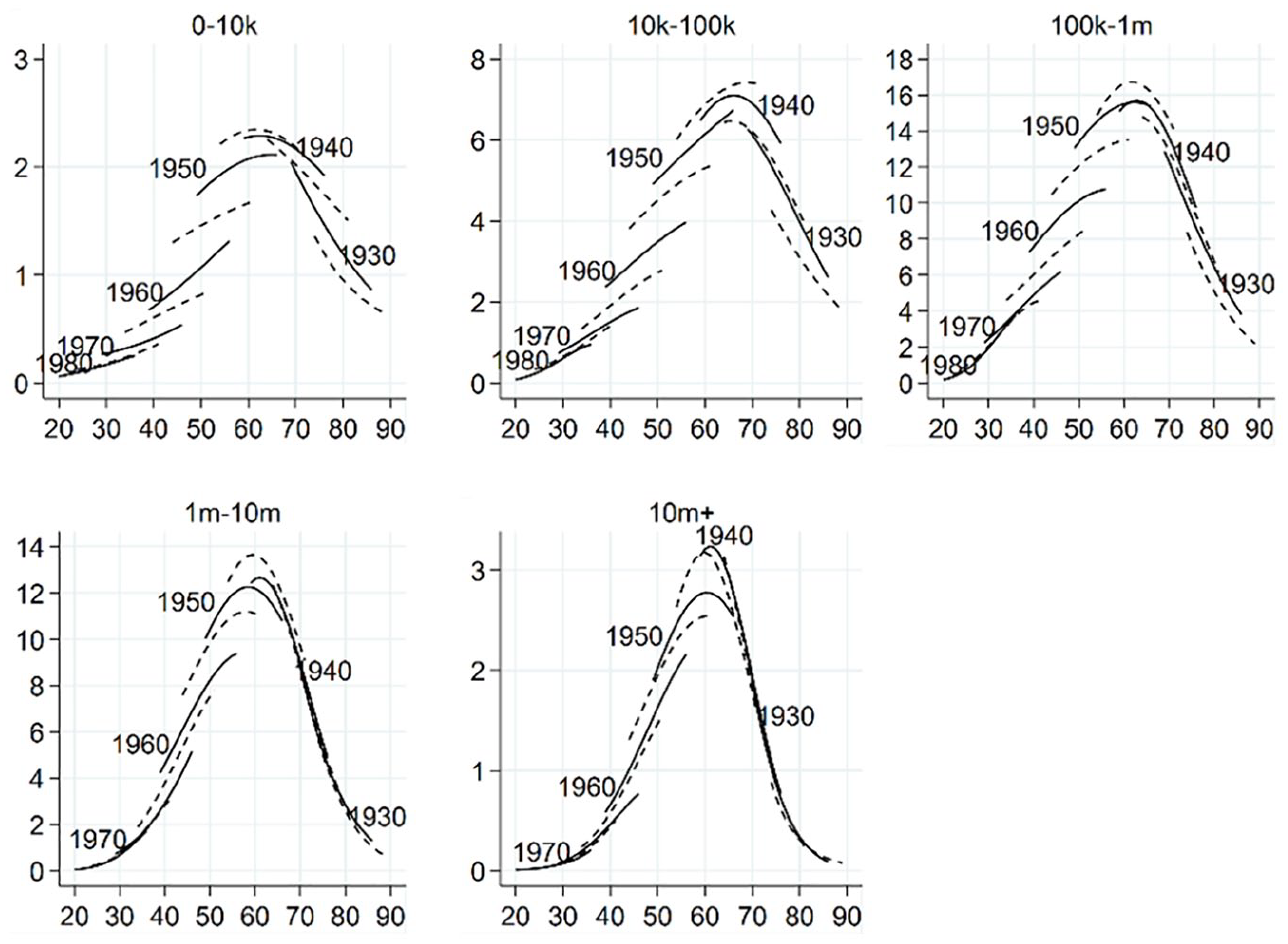
Trustee board membership by age and birth cohort, for charitable organisations of different sizes.
To examine trends for different kinds of organisation, we use the International Classification of Nonprofit Organisations (ICNPO) to categorise organisations according to their primary field of activity. 12 Importantly there is no evidence that the cohort decline in trustee board membership is restricted to a particular ‘vertical field’ of charitable activity. On the contrary, there are sizeable cohort declines across the full range of charitable fields – including organisations providing social services, those involved in culture and recreation, those involved in economic, social and community development and those related to education (Table A2, models A9–A17; Figure 5).
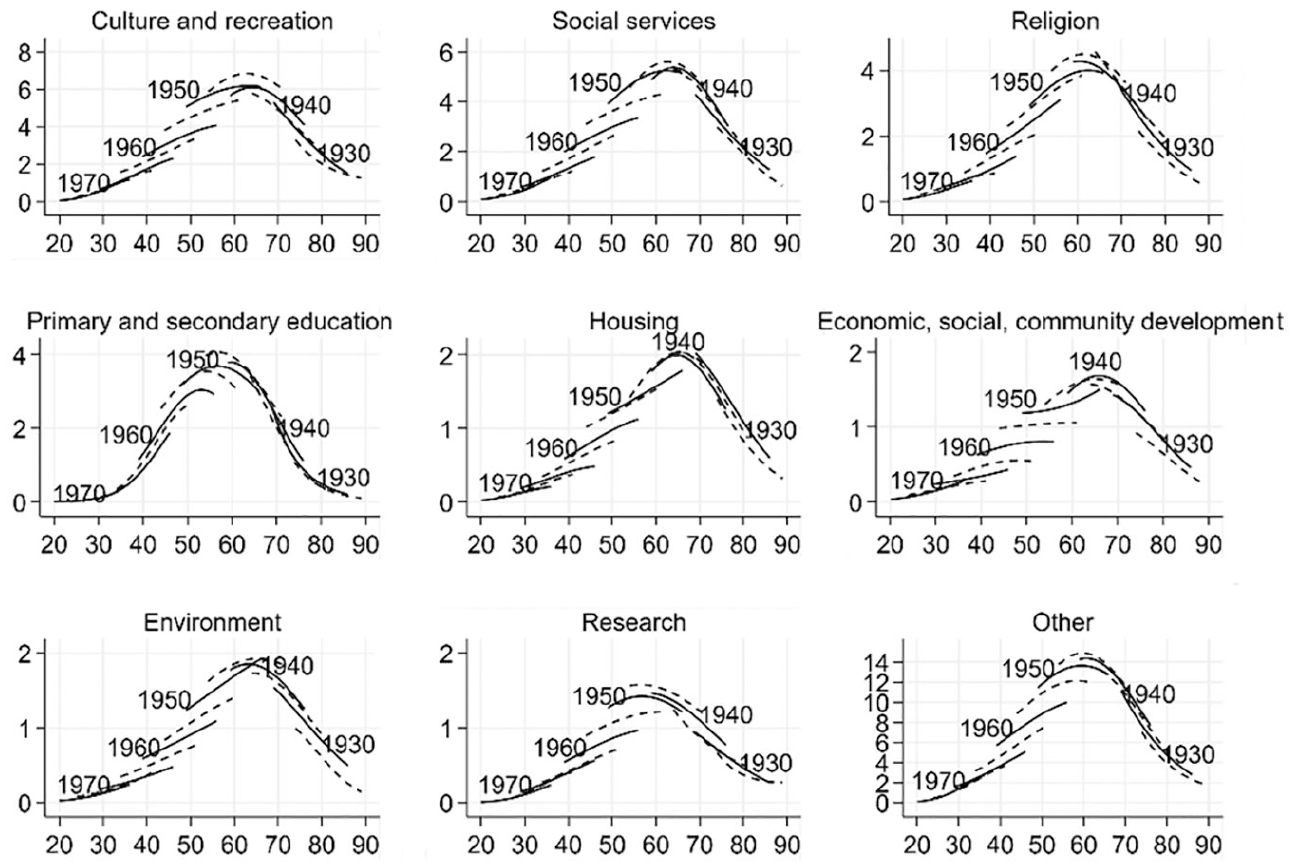
Trustee board membership by age and birth cohort, for charitable organisations in different fields of activity.
Appointments and Resignations
To what extent does the cohort decline in trustee board membership reflect a decrease in appointments or an increase in resignations? Figure 6 (Table A3, model B1) presents trends in the proportion of the population appointed as board members. There are clear indications of a progressive decline in appointments between the 1945 and 1970 birth cohorts. Thus the proportion appointed at age 55 in the 1945 cohort is 11% higher than in the 1950 cohort (RR = 1.11; 95% CI 1.06–1.15), 30% higher than in the 1955 cohort (RR = 1.30; 95% CI 1.25–1.34) and 50% higher than in the 1960 cohort (RR = 1.50; 95% CI 1.44–1.56). In turn, the proportion appointed at age 40 in the 1960 cohort is 23% higher than in the 1965 cohort (RR = 1.23; 95% CI 1.18–1.28) and 53% higher than in the 1970 birth cohort (RR = 1.53; 95% CI 1.47–1.60). Note that, as with patterns in board membership, there is no evidence of sizeable further declines between the 1970 and 1980 birth cohorts. Figure 7 (Table A3, models B2–B3) disaggregates trends in appointments by sex. As with patterns in board membership, cohort declines in appointments are particularly sizeable for men while declines in appointments of women start later and are less sizeable. Note that, as with patterns in board membership, smaller charitable companies have been affected by particularly large relative cohort declines while larger charities show smaller but still sizeable relative declines (Table A3, models B4–B8; Figure 8). Meanwhile there is evidence that the cohort decline in appointments extends across the full variety of different fields of charitable activity (Table A4, models B9–B17; Figure 9).
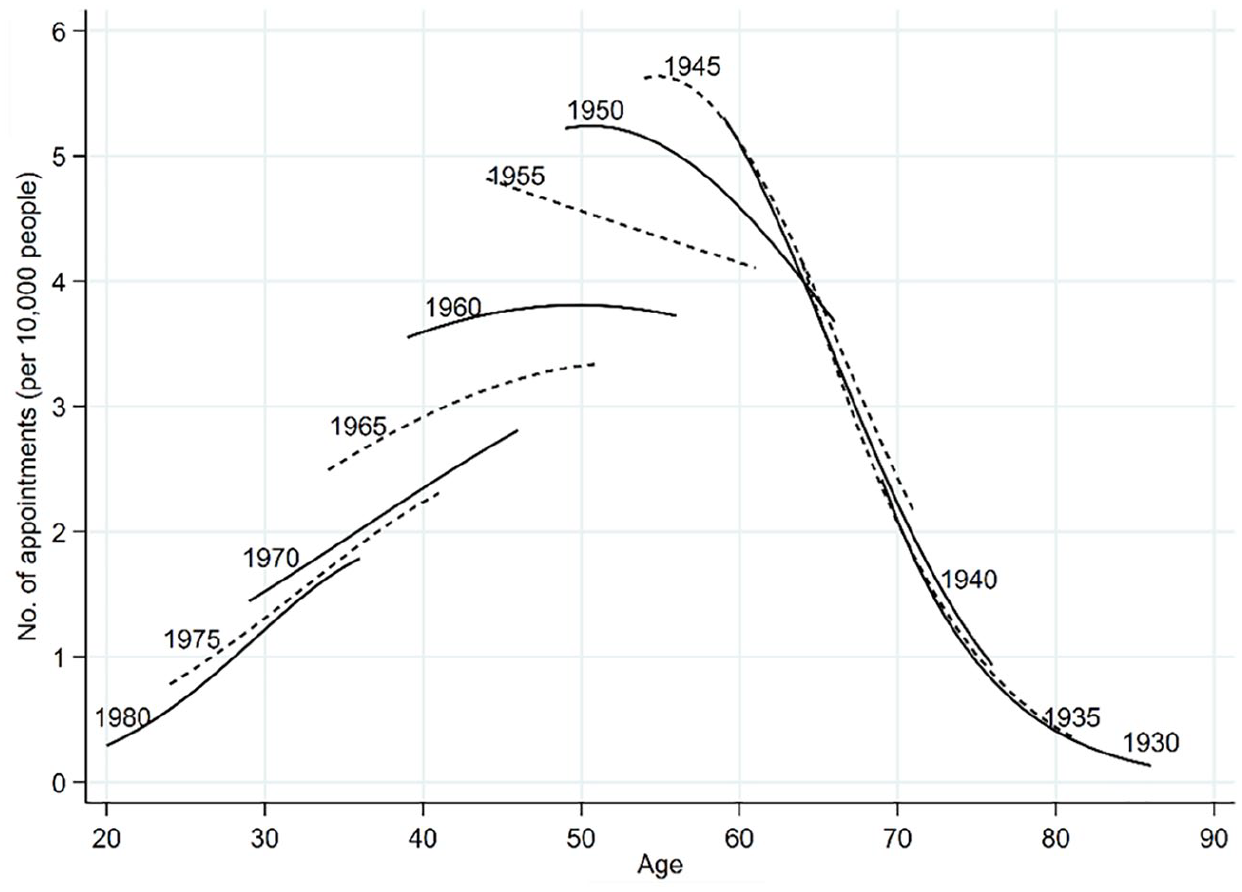
Appointment as a trustee board member by age and birth cohort.
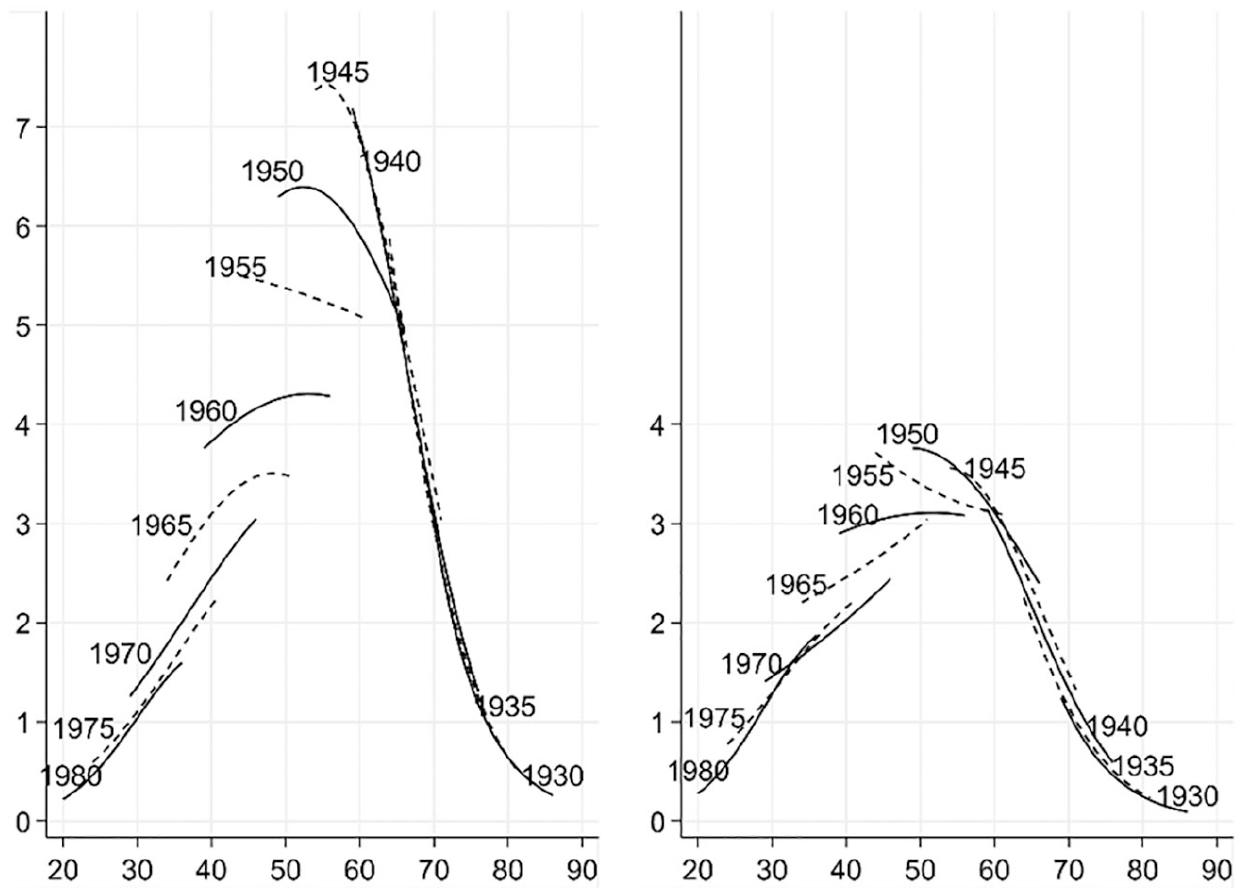
Appointment as a trustee board member by age and birth cohort, for men (left panel) and women (right panel).
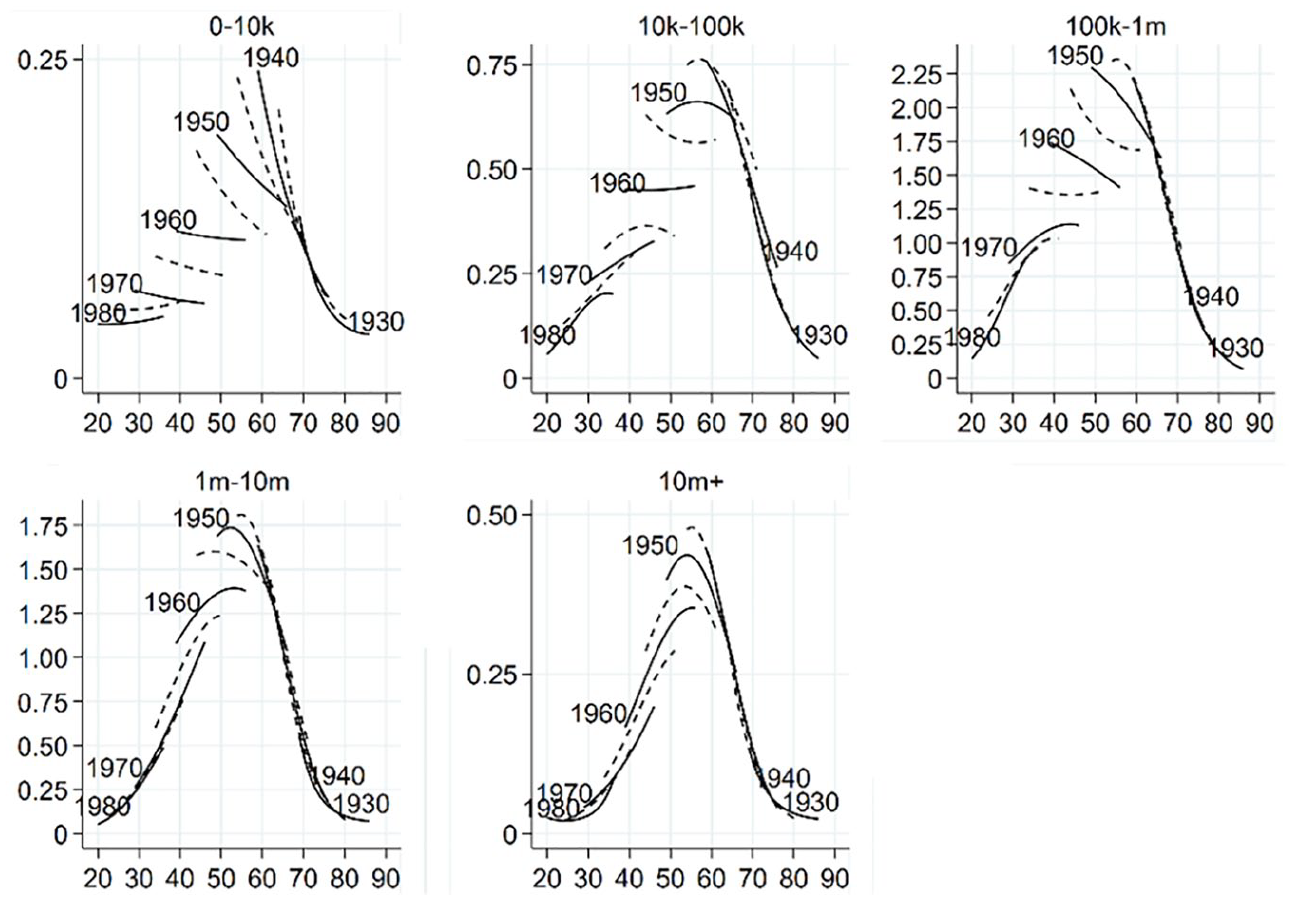
Appointment as a trustee board member by age and birth cohort, for charitable organisations of different sizes.
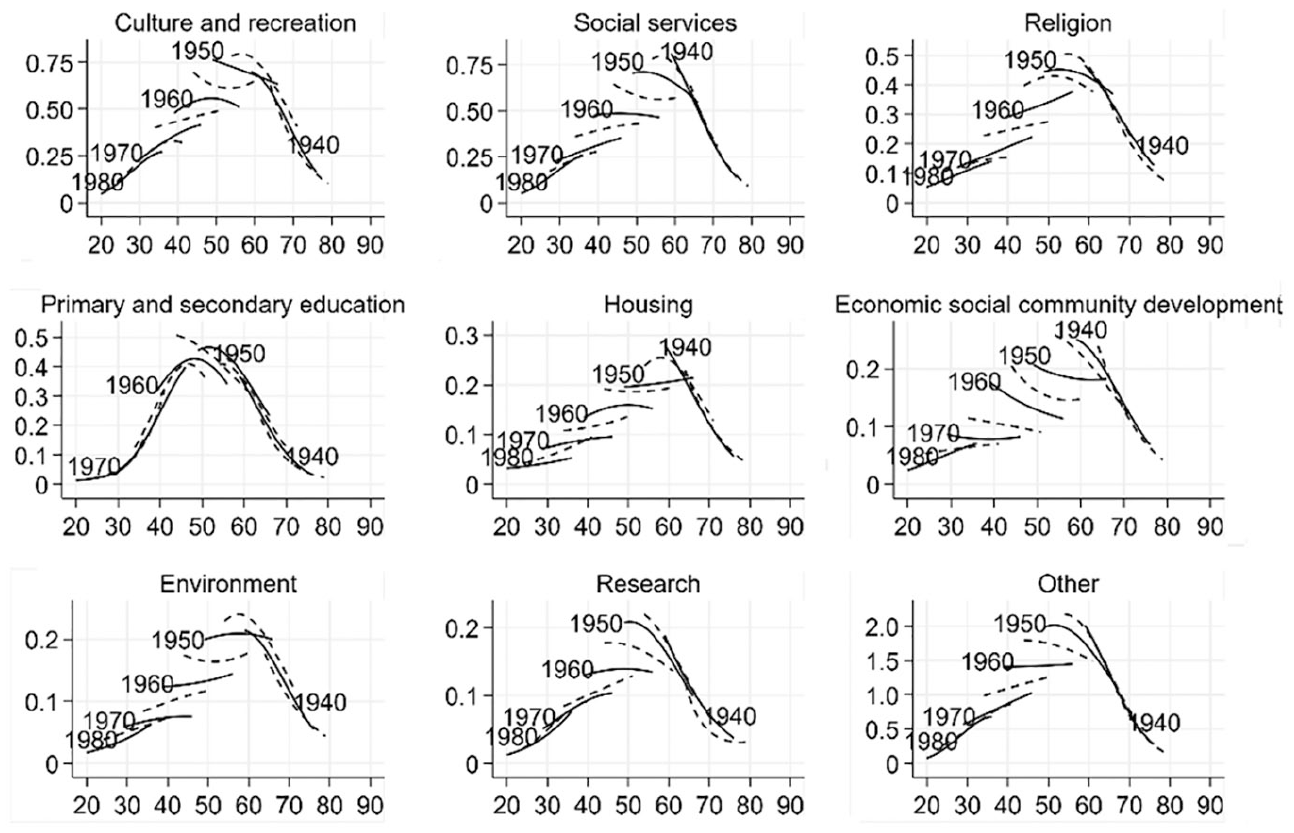
Appointment as a trustee board member by age and birth cohort, for charitable organisations in different fields of activity.
Figure 10 (Table A5, model C1) presents trends in the rate or ‘hazard’ of resignation per 100 board member years. There is a U-shaped age pattern in the rate of resignation: the rate of resignation is highest when the board member is very young or very old. Importantly there is no evidence to suggest that more recent birth cohorts have an increased propensity to resign: any differences between cohorts at comparable ages are minimal and not substantively significant. Therefore, there is stability between cohorts in the rate of resignation. This is true when examining trustee board members as a whole (Figure 10), but also when examining men and women separately, and when considering board members serving in different fields of charitable activity and for different sizes of organisation. 13 Therefore, it is clear that the decreased propensity to serve as a trustee board member in more recent birth cohorts (Figure 2) reflects a decrease in the propensity to join the board rather than an increase in the propensity to leave.
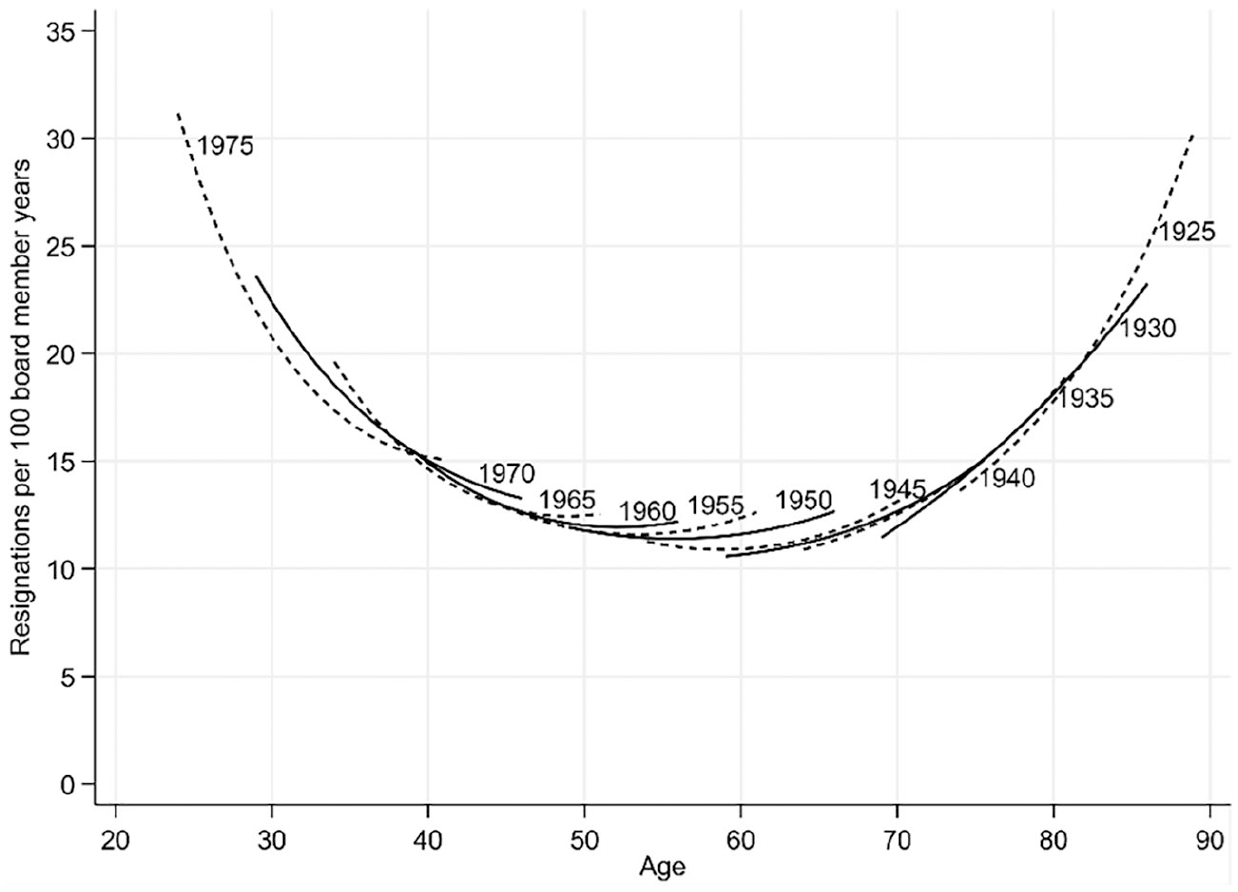
Rate of resignation as a trustee board member by age and birth cohort.
Robustness of Results
We emphasise a number of points about the robustness of our results. First, the results are not sensitive to how the panel of charitable companies is defined: analysis of alternative panel specifications also reveals clear cohort declines in trustee board membership (see Online Appendix 2). Second, we emphasise that these clear cohort declines are not simply a structural artefact caused by the large size of baby boom birth cohorts combined with a lack of available trustee board member positions. Indeed, over our analysis period there were more board member resignations than there were appointments, reflecting a decline in the number of active trustees by 8%, while more charitable companies experienced a decline in the number of trustee board members than an increase. This is consistent with a host of qualitative evidence about a preponderance of vacant positions on charitable boards and about the difficulty of recruiting charitable trustees (House of Lords, 2017; Lee et al., 2017). Third, we emphasise that the cohort declines are not a function of analysing a set of organisations that are ‘fading away’ or that are on the decline. On the contrary, charitable companies have experienced increases in income over recent decades. Indeed, the organisations in our panel experienced a median real 14 increase in income of 26% over our analysis period.
This article’s results apply to the board membership of charitable companies. This specific focus is strategically important since incorporated charities account for the majority of total aggregate charitable income. We are not able to examine trends for unincorporated charities. Note that there is a substantive basis for expecting particularly sizeable cohort declines in the board membership of unincorporated charities: unincorporated charities are on average smaller than charitable companies; there is anecdotal evidence that smaller charities are facing particular challenges in recruiting board members (Cornforth, 2014; Harris, 2001); and this article’s own analysis shows that smaller charities have seen the most sizeable cohort declines. However, it will not be possible to examine trends for unincorporated charities until detailed data on their board members become available. Therefore, an important practical implication of our analysis relates to the fundamental importance of expanding the nascent voluntary sector data infrastructure.
Discussion
This study is the first time a cohort decline in any form of volunteering has been observed in the UK – a country where forms of engagement have been previously considered robust to decline (Hall, 1999). Indeed, it is one of very few studies to have examined long-term volunteering trends in any country context and, as far as we are aware, the first study in any country to document sizeable cohort declines.
These results represent the strongest empirical evidence to date in support of sociological theory which argues that the nature of volunteering is changing, with a decrease in a ‘collective’ style of volunteering characterised by long-term, regular and intensive commitment (Hustinx and Lammertyn, 2003). The few existing empirical studies, which have focused on examining trends in ‘volunteering’ in general (see Einolf, 2009; Goss, 1999; Ladd, 1999; Lindsey and Mohan, 2018; Musick and Wilson, 2008; Putnam, 2000; Rotolo and Wilson, 2004), have not been well placed to examine the kind of changes predicted by Hustinx and Lammertyn’s (2003) theory. Indeed, examining trends in volunteer participation in general ‘as if it were a uniform and robust entity’ provides limited insights: it treats volunteering as ‘a stable factor’ rather than recognising that the nature of voluntary involvement may itself be changing over time (Hustinx et al., 2010: 423). In contrast, this article’s substantive focus on trustee board membership is sensitive to Hustinx and Lammertyn (2003)’s theory, which does not predict changes in the overall level of volunteering but rather predicts changes in the predominant style of volunteering: alongside an increase in irregular and incidental ‘reflexive’ volunteering, a decline in the kind of regular, long-term, intensive ‘collective’ volunteering characteristic of serving as a board member.
We should be cautious in making conclusions about the reasons underlying the observed cohort decline in board membership. Hustinx and Lammertyn’s (2003) approach is to use sociological modernisation theory as an analytical framework for understanding changes in the nature of volunteering: they make a connection between macrosocial processes of modernisation and individualisation, changes in individuals’ biographies and changes in the availability for volunteering. The ‘collective’, stable and standardised life course is seen to be gradually weakened, while there is a growth in a plurality of ‘reflexive’ autonomously monitored biographies. Therefore, rather than being embedded in collective behaviours, the decision to volunteer is dependent on personal considerations in the context of highly individualised life situations characterised by uncertainty (Hustinx and Lammertyn, 2003). There are also structural changes in people’s biographies associated with ‘the increasing instability of family and work life’ (Hustinx and Meijs, 2011: 9). Together these changes mean that the individualised biography is considered more precarious and discontinuous. This is seen to affect the style of volunteering by reducing individuals’ capacity to engage in collective forms of volunteering. The ‘uncertainty of the individualised life’ is seen to lead more recent cohorts ‘to keep open their options for continuous revision and reorientation’: if people ‘realise that they cannot make a one hundred per cent commitment, they prefer not to get involved at all’ (Hustinx, 2001: 70–71). Applying Hustinx and Lammertyn’s (2003) theoretical framework to this article’s empirical focus on board members, there is hypothesised to be a growing ‘biographical mismatch’ between supply-side biographical changes and a challenging trustee role. Indeed, serving as a trustee not only requires time but more specifically the commitment of regular time (see Lee et al., 2017). Since ceteris paribus volunteering is more attractive to the resource-rich than the resource-poor (Musick and Wilson, 2008), the 1945 cohort, whose biographical continuity provides the necessary ‘enabling resources’, show a high propensity to serve. In contrast the biographical discontinuity of the 1970–1980 cohorts is seen to provide a less conducive setting for the necessary long-term commitment to volunteer as a trustee. 15 Instead of long-term commitment the uncertain and discontinuous nature of life courses is seen to be more conducive to irregular and incidental ‘reflexive’ volunteering, with frequent entries and withdrawals according to individual biographical conditions (Hustinx and Lammertyn, 2003).
Considering Alternative Explanations
This article’s results are consistent with Hustinx and Lammertyn’s (2003) theory about the importance of supply-side changes in individuals’ biographies and the associated decline in a ‘collective’ style of volunteering. However, we also consider three possible alternative explanations for the cohort differences in board membership that we observe.
First, since our data on board members only include information on sex, age and birth cohort, it is possible that there are unobserved compositional differences between cohorts in individual-level covariates that are important to volunteering. In particular, we do not have data on individuals’ educational background. Education is considered the most consistent individual-level predictor of volunteering (Musick and Wilson, 2008): more educated individuals are better informed about social issues; have an increased awareness of how organisations are governed; have developed the ‘civic skills’ important to volunteering; and have more extensive social networks, which increases the probability of being asked to serve. However, we note that more recent cohorts are more highly educated than cohorts that preceded: between the 1946 and 1970 birth cohorts the proportion with tertiary-level qualifications increased from 16% to 32%, while the proportion with no qualifications declined from 45% to 14% (Makepeace et al., 2003). Indeed, not controlling for cohort differences in educational level is a conservative analysis (see Musick and Wilson, 2008; Putnam, 2000): the cohort differences in board membership are more remarkable considering the rise in educational attainment, given that more educated people are considered more likely to volunteer. Therefore, compositional differences in educational level cannot be regarded as an explanation for the cohort declines in board membership that we observe. However, it is possible that the less sizeable cohort decline in board membership observed for women than for men (Figure 3), which has reduced the sex difference in board membership in more recent birth cohorts, reflects the stronger mitigating role of increases in educational attainment for women: between the 1946 and 1970 birth cohorts the proportion of women receiving tertiary-level qualifications increased from 10% to 32%, a more sizeable increase than that of 21% to 31% for men.
Second, since volunteering is a function not only of individuals’ availability but also of organisational needs (Musick and Wilson, 2008), it is possible that there are relevant demand-side changes associated with board member recruitment over our analysis period. Indeed, there is evidence that, particularly for voluntary organisations involved in public service delivery, social policy trends towards marketisation and professionalisation have seen a growing demand for specialist expertise including business skills and financial management. There is evidence for a greater ‘active selection’ of volunteers, with more formalised recruitment procedures focusing on existing skills and previous experience (Ellis Paine and Hill, 2016), as some voluntary organisations narrow the range of people they consider suitable for board membership (Harris, 2001). However, the pervasive nature of decline in board membership (Figure 5), which is evident across all fields of charitable activity and not only in fields like social services where public service delivery is prominent and trends towards marketisation and professionalisation most significant, suggests that the observed cohort declines are unlikely to be mainly driven by demand-side changes in trustee recruitment.
Third, there may have been changes in the costs and benefits of volunteering as a board member which, under the rational choice theory of volunteering, affect individuals’ decision to serve. We find no evidence in the literature that the benefits of board membership – whether ‘private’ benefits (including skills development, the ‘warm glow’ of helping others, or the social recognition that the role provides) or ‘public’ benefits (the ‘altruistic benefits’ related to the organisations’ mission that an individual may value in their own utility function) – have changed over time. However, literature does suggest that the ‘costs’ of volunteering may have changed as, in fields of charitable activity like social services where public service delivery is prominent, marketisation and professionalisation mean that the experience of serving as a board member is becoming more challenging as the complexity of board responsibilities increases over time (Ellis Paine and Hill, 2016; Harris, 2001). Nevertheless, the pervasive nature of declines in board membership (Figure 5), which are evident even in fields of charitable activity where social policy changes have been less marked, together with the lack of evidence for any increase over time in the propensity for board members to resign (Figure 10), mean that it is unlikely that cohort declines in board membership have been driven mainly by increases in the ‘costs’ of volunteering (see also Online Appendix 3).
Overall, certain features of the patterns that we observe – the pervasiveness of the cohort decline across different fields of charitable activity, and the dynamics which show that cohort declines reflect a decline in appointments rather than an increase in resignations – are more consistent with the importance of supply-side biographical changes than with these three alternative explanations. However, it is unlikely to be possible to establish definitively the causes of the decline in board membership using empirical methods. Therefore, caution is needed. In this respect, we make a distinction about the extent to which this article is able to provide support for the explanatory logic, as opposed to the predictions, of Hustinx and Lammertyn’s (2003) theoretical framework: while this article provides strong evidence supporting their predictions about a weakening in a ‘collective’ style of volunteering, we are not able to prove their explanation that these changes in volunteering stem from the biographical consequences of broader social-structural transformations.
Implications for Policy
This article’s results are consistent with a host of anecdotal evidence that charities are finding it increasingly difficult to recruit trustees (House of Lords, 2017; Lee et al., 2017; Vernon and Stringer, 2009). Recent estimates suggest that 74% of charities are finding it difficult to recruit trustee board members and that more than half of all charities now have at least one vacancy on their board (Getting on Board, 2017). Meanwhile the particularly sizeable cohort decline for smaller charities is consistent with accounts that smaller organisations, lacking the resources to undertake effective recruitment and the extensive networks through which to approach potential trustees, are experiencing particular recruitment difficulties (Cornforth, 2014). However, while these recruitment challenges are widely recognised by practitioners, the dynamics underlying the recruitment difficulties – in terms of the sizeable declines in successive birth cohorts in the propensity to serve – have not been recognised before.
These recruitment challenges are unlikely to recede. This article does not seek to project future trends in the supply of trustees. Nevertheless, the nature of the trends reported here provides helpful context. Over our analysis period of 1999–2016 the 1945–1950 cohorts, who show the highest levels of trustee board membership, have been at the stage in the life cycle where the propensity to volunteer as a board member is also at its highest: the peak ages for serving are when individuals are in their 50s and 60s (Figure 2). Figure 2 also shows that, while more recent cohorts show successively lower levels of trustee board membership, there is no evidence for meaningful change by cohort in the shape of the trustee age distribution. Therefore, our judgement is that more recent cohorts – for example the 1965–1980 cohorts – are likely to continue to show low levels of engagement as they age and progress through the peak ages of serving. As the 1945–1950 cohorts now age to a stage beyond these peak ages of engagement, this is likely to provide further pressure on an already challenging social context for recruiting trustees. Indeed, while the 1960s baby boom provides an increase in the absolute number of individuals reaching the peak age of serving, the decrease in the propensity to serve by cohort is an order of magnitude larger than this increase in cohort size. Therefore, in contrast to prominent optimistic predictions about the future supply of volunteers (Haldane, 2019), the potential for a ‘civic demographic dividend’ for trustee board membership is unlikely to be realised.
There is concern about the impact of a shortage of trustees on the effectiveness of trustee boards as they seek to carry out their functions. It is important to emphasise that board effectiveness is contingent on a variety of factors, including the structure of the voluntary organisation (Harris, 1996b), the nature of the skills base of board members and the quality of induction arrangements and relevant training. Note too that, while board members are involved in governance, organisational governance is wider than board members since it also involves paid managers, ‘rank and file’ members and advisory groups (Cornforth, 2014). Nevertheless, it is the board members who – in the absence of formal ownership (Hansmann, 1996) – are entrusted with the organisation and with ensuring that the organisation’s activities are aligned with its mission (Anheier, 2014). Furthermore, while ensuring an adequate supply of trustee board members is by no means a sufficient condition for the effective functioning of boards, it may be a necessary one. Indeed, the Charity Commission (2016) argues that – alongside the appropriateness of the regulatory and governance framework within which boards operate, and the availability and quality of guidance and training to support board members – the adequacy of the supply of board members is one of three important factors affecting the quality of the board’s work.
In turn, the work of trustee boards ‘is crucial to the effectiveness of charities and the sustainability of the [charitable] sector going forward’ (Charity Commission, 2016: 219). They provide ultimate accountability for the management of charitable funds and assets. Unless boards are effective in their role as a ‘critical friend’ to management, charities may begin doing work that is ineffective or outside of their mission (Vernon and Stringer, 2009). Given the importance of the role, and in the context of widespread concern across the charitable sector about the difficulties faced in trustee board member recruitment, the lack of previous research examining trends in volunteering as a trustee is a serious omission. Therefore, in the absence of previous work, this article not only provides important empirical evidence in support of Hustinx and Lammertyn’s (2003) sociological theory about how the nature of volunteering is changing. It also serves to highlight for the first time the nature of a key challenge for public policy: to sustain and support the voluntary work of trustee boards, which lies at the ‘very heart’ of what it means to be a charitable organisation, in the context of sizeable cohort declines in the propensity to serve.
Supplemental Material
Online_Appendix_final_version – Supplemental material for Serving as a Charitable Trustee in England and Wales: Trends in Volunteering by Birth Cohort
Supplemental material, Online_Appendix_final_version for Serving as a Charitable Trustee in England and Wales: Trends in Volunteering by Birth Cohort by David Clifford in Sociology
Footnotes
Acknowledgements
The author is grateful for the continued support of Professor John Mohan, director of the Third Sector Research Centre, University of Birmingham. The Charity Commission data contains public sector information licensed under the Open Government Licence v3.0 ( ). Many thanks to the Charity Commission for providing access to data from the Register of Charities and to David Kane for making available the classification of English and Welsh charities according to the ICNPO. Many thanks to the reviewers and editors for their thoughtful and constructive comments and suggestions.
Funding
The author disclosed receipt of the following financial support for the research, authorship and/or publication of this article: this research is funded by the award to the author, by the Leverhulme Trust, of the Phillip Leverhulme Prize for Social Policy (£100,000; 2018–2021).
Supplemental material
Supplemental material for this article is available online.
Notes
References
Supplementary Material
Please find the following supplemental material available below.
For Open Access articles published under a Creative Commons License, all supplemental material carries the same license as the article it is associated with.
For non-Open Access articles published, all supplemental material carries a non-exclusive license, and permission requests for re-use of supplemental material or any part of supplemental material shall be sent directly to the copyright owner as specified in the copyright notice associated with the article.
