




Abstract
Ukraine’s efforts to resist the Russian invasion have sparked unprecedented levels of civic engagement. While the more tangible efforts to alleviate immediate needs have been prominently featured in mass media and elsewhere, the norms and values that shaped this large-scale collective effort often remain behind the scenes. Approaching narratives of volunteering through a critical cultural sociology lens, we find that wartime involvement constitutes a shift from duty-based norms in which citizens are required or expected to engage in civic activities, to forms of engaged citizenship which contribute not just to the state, but also to the wellbeing of those in need. In this context, volunteering facilitates the emergence of civil society that often occupies the space outside of the currently defined institutional contexts and works through the collective shaping and contestation of social norms and values. Documenting these dynamics provides valuable new insights into the important role volunteerism plays in broader sociopolitical transformations, especially in non-Western and postcolonial contexts where the processes of civil society development take many forms and may be easily overlooked.
Introduction
On the face of it, the difference between volunteers and activists seems straightforward: the former focus on alleviating immediate needs, while the latter aim to introduce social and political change, and thus alter the structural conditions of their emergence (Eliasoph, 2013). Yet, significant crisis events such as wars often unsettle this distinction and necessitate rethinking of the ways in which volunteering can lead to social change. In this article, we situate this inquiry in the contemporary Ukrainian context 1 to understand how norms and values of volunteering shape civic associational life in state-building projects. Our specific interest is in the categories of meaning that define the contemporary Ukrainian state and the role citizens and volunteers play in narrating social change and engaging in a collaborative construction of futures in significant crisis events.
Since the beginning of the first phase of the Russian-Ukrainian war, which started in 2014 with the illegal annexation of Crimea and the subsequent orchestration of insurgency in the Donetsk and Luhansk territories by Russia, Ukraine’s efforts to prevent an encroaching occupation have sparked unprecedented levels of civic engagement. By 2016, tens of thousands of volunteers have contributed time, labour and financial resources to support the Ukrainian Armed Forces deployed to forestall further military activities in eastern Ukraine. While the more tangible efforts to alleviate immediate needs have been prominently featured in mass media and elsewhere, the norms and values that shaped this large-scale collective effort often remained behind the scenes. In this project, we focus on how Ukrainian civilians narrate their wartime volunteering, approaching the phenomenon through a critical cultural sociology lens. Specifically, we analyse the role narratives play in structuring the volunteers’ everyday experiences and trace the emergence of critical civic vocabularies that reconstitute the category of citizenship, as well as unravel the multiple roles relegated to volunteers therein. Our findings demonstrate the need for researchers to be sensitive to the ways that volunteers may simultaneously be focused on alleviating immediate needs while also laying the foundation for broader cultural and political change. This is especially significant in non-Western and postcolonial contexts, where the processes of civil society development take many forms and may be easily overlooked.
Background: Civic Associations in Wartime Ukraine
Over the 30 years of Ukraine’s independence, civil society has often been a subject of contrasting assessments. On the one hand, the formal metrics of associational life such as official registration, membership, fiscal revenue and policymaking impact in the country have remained comparatively low (Palyvoda and Galota, 2010), leading some scholars to conclude that Ukraine has a weak civil society (Howard, 2003, see review of literature in Baća, 2021). On the other hand, an emerging body of literature points to more informal and decentralized forms of associational life driving the transformations of state–society relations (e.g. Boichak and Jackson, 2020; Krasynska and Martin, 2017; Oleinik, 2018). The vast majority of these developments have solidified and become apparent at the backdrop of Ukraine’s Maidan Revolution and the subsequent occupation of the eastern parts of the country by Russia in 2014. Our main analytical focus in this article is therefore the changing nature of norms and values that drove those wartime civic initiatives, and the ways in which their participants construed their contribution to a broader social change in the country. Before we engage with the volunteers’ narratives directly, this section provides a background on the norms and values of civic associational life in Ukraine and their recent dynamics.
In a study published before the 20th anniversary of Ukraine’s independence, Kuzio (2011: 89) described the Ukrainian state as ‘immobile’ – inert, unable to move and/or resolve socio-economic and political issues impeding its progression toward a democracy. Compared to the first decade of its independence, Ukraine’s national unity appeared significantly more fragmented across regional, religious and ethnic lines (Kuzio, 2012). In the light of its oftentimes divisive and inconsistent domestic and foreign policymaking, the Ukrainian state-building project was largely ineffective on its path toward establishing the rule of law and fighting rampant corruption (Kuzio, 2012). Kuzio explains that these difficulties were largely precipitated by public alienation from state affairs and unprecedentedly low levels of public trust – a lasting Soviet legacy that was left unchanged with Ukraine’s independent statehood in 1991. In this setup, state–society relations presented as an elaborate facade: In Post-Soviet Ukraine, elites and the state pretend to respect their people (especially during election campaigns) and they repay this ‘kindness’ by pretending to pay their taxes. Oligarchs pretend to be law abiding citizens when they are living and undertaking philanthropic activities in western Europe but revert to rapacious baron capitalists upon returning to Ukraine. (Kuzio, 2012: 430).
It is perhaps unsurprising that Russia chose to exploit those weaknesses in their sustained attempts to influence Ukraine’s domestic and foreign politics by orchestrating elections for the benefit of pro-Russian candidates, assassinating prominent journalists and political activists, and otherwise intervening in the country’s economic and cultural life (Boichak, 2022). Despite an overall low level of state legitimacy and public trust, these external attempts at interference have been met with waves of popular resistance, once in 2004 – the Orange Revolution, and for the second time in 2013–2014, during the Revolution of Dignity also known as Maidan (Lokot, 2021).
Revolutions are moments of mass collective mobilization that aim to overthrow the existing political, cultural and economic set of relations in the country (Lawson, 2019). Yet, in spite of the declarations made by protesters in 2004 during the Orange Revolution (in which one in five Ukrainians took part), there were distinct lags in adopting crucial anti-corruption legislation and high populist and anti-elitist sentiment among the masses (Kuzio, 2011). In November 2013, the Maidan protests opposing then-President Yanukovych’s refusal to sign the Association Agreement with the European Union turned violent with the deployment of riot police against the peaceful protesters at the Independence Square (Maidan Nezalezhnosti) in Kyiv. This revolutionary context marks a palpable change in the dynamics of civic associational life – as Diuk (2014: 13) posits, ‘while pushing for specific political goals, the people behind this movement [Maidan] were also trying to build a structure that would be the first to bridge the interests of the various civic and political groups since independence and provide a basis for nurturing the next generation of national leaders’. The changes in the civic norms and values brought about by the Revolution of Dignity were therefore seen as significant (or revolutionary, for that matter) in the light of their potential to remove some of the domestic constraints that ‘immobilized’ the Ukrainian state for the first two decades of its independence.
The subsequent Russian military intervention has necessitated further solidification of the volunteer movement in Ukraine, shaping a distinct identity of a volunteer as someone contributing time and resources to support the soldiers of the Ukrainian Armed Forces fighting off the Russian invasion (Boichak, 2017; Boichak and Jackson, 2020). Volunteering was largely seen in the society as a tangible avenue to resist illegitimate occupation of the country – as explained by Oleinik (2018: 369), such initiatives may ‘constitute a core element of the civic model of a nation’. Historically, the democratizing effect of wartime volunteering has been explained by increased public involvement in generating resources in the moment of crisis. However, as we demonstrate in this work, civic voluntary initiatives may contribute to state-building projects through defining particular norms and culture of the relationships between the Ukrainian state and its citizens.
Scholars in Western academe have conventionally considered Ukraine, along with other post-communist countries, as weak civil societies based on low levels of participation in formal voluntary organizations and low levels of trust in political institutions (Gatskova and Gatskov, 2012; Howard, 2003; Mishler and Rose, 2001; Pop-Eleches and Tucker, 2011). Recently, other scholars have criticized this depiction, noting how the conventional focus on formal voluntary organizations ignores other less structured yet important dimensions of civic engagement, including informal forms of communal assistance and contentious political activities (Baća, 2021; Foa and Ekiert, 2017; Jacobsson and Korolczuk, 2020; Krasnyska and Martin, 2017). Consequently, focusing solely on participation in formal voluntary organizations and trust in political institutions and ignoring these other dimensions provides an incomplete and potentially inaccurate sense of civic life and risks ignoring potentially important efforts to expand democratic practices. With this in mind, we turn to investigating the concepts of volunteering and social change to inform our understanding of their political significance in contemporary Ukraine.
Volunteering and Social Change
Volunteering is an altruistic, prosocial form of civic engagement in which people contribute their time, money, or in-kind resources to help others, achieving collectively established goals (Anheier and Scherer, 2015; Musick and Wilson, 2007). Volunteer labour differs from other forms of public or private engagement: it is an activity performed in the public sphere, outside of the individuals’ home, without legal obligation or expectation of pay, that results in a benefit or a set of benefits to clearly defined individuals or groups (Anheier and Scherer, 2015). Some of these distinctions largely depend on their cultural context (such as, in the case of helping distant relatives or receiving a stipend in exchange for volunteering services), but this activity is generally known to lie outside of the state and its institutions yet results in the creation of some kind of a public good (Musick and Wilson, 2007). While the more tangible outcomes of volunteering have traditionally been the object of scholarly attention (Anheier and Scherer, 2015; Olson, 1971; Musick and Wilson, 2007), narratives that shape large-scale collective efforts have often remained behind the scenes (e.g. Dromi, 2020). In this article, we therefore shift the focus from the resources mobilized and generated by the volunteer communities to the norms and values that contribute to social change and political culture through volunteering initiatives.
Until the early 2000s, the literatures on volunteering and political activism have each had conceptually distinct objects of analysis and trajectories of development, rarely overlapping with one another (Eliasoph, 2013). Indeed, researchers often make a sharp distinction between the two. Whereas political activism seeks to address major social issues by ushering in macro-level changes to the political system, volunteers focus on caring for the immediate needs rather than trying to tackle the sociopolitical source of the problem (Eliasoph, 2013). Social movements scholars have been predominantly concerned with the changes in the political systems, as well as the role of social structure and institutions in defining the opportunities and constraints for collective action (Mellucci, 1996). Organized political activity has historically been a prerogative of the wealthier and more educated social strata, whereas marginalized groups were relegated to self-help and other commonplace, mundane forms of collective action that did not aim to achieve structural change (Scott, 1985). This scholarship highlights collective learning processes in societies: individuals draw on their everyday resources to engage in collective reconstitution of links between the state, markets and society (Rodríguez-Muñiz, 2017). Seen from this angle, civic associations often mediate the complex and sometimes contentious relationships between the state and its citizens (Rodríguez-Muñiz, 2017), occupying the space between systems and the everyday (Eder, 2015).
So, where does the culture of volunteering fit into state-building projects? In this work, we turn our attention to the norms and values of civic associational life collectively constructed in the process of volunteering. While volunteering does not always aim at achieving systemic change within or outside of institutions, it often foregrounds and exposes the systemic issues that necessitate its emergence (Eliasoph, 2013). When focused on providing care to underserved populations, volunteering turns into a powerful site of activism (Tronto, 1993). Prior work has recognized how activists’ efforts may result in the creation of new identities, norms and values that have broader political implications. For example, Bennett et al. (2013) describe how members of civic organizations that disavow politics identify principles for their idealized future democratic system, including inclusivity, representativeness, respect and responsiveness to citizens. Annavarapu and Levenson (2021) call for researchers to adopt a relational model that focuses on how the way political actors see the state – their understandings of the state’s power, responsibilities, and limitations – guides their actions as well as the state’s actions. These works help us to recognize how the beliefs that guide activists’ actions may promote new civic norms – expectations about the appropriate roles and responsibilities of citizens and the state in civic and political life (Dalton, 2008; Shah et al., 2017), but research into this dimension of volunteerism remains underexplored.
Narratives of volunteering serve as a basis for the construction of critical civic vocabularies that reframe the meaning and the relationship between citizens and the state. As a site of competing nation-building projects that have juxtaposed themselves to the country’s Soviet past, Ukraine makes for an excellent case study of the role narratives play in filling the space between the state-led discourses and the citizens’ everyday practices at the backdrop of wars (Eder, 2015; Zychowicz, 2020). Crucially, Dalton (2008) posits that the culture of citizenship may be driven by two sets of norms: duty-based citizenship includes norms pertaining to social order, such as voting and obeying laws; engaged citizenship includes norms associated with communitarianism and political autonomy, such as helping those worse off, participating in voluntary groups, and being politically independent-minded.
A sensitivity to the potential broader effects of volunteerism on the political culture of citizenship is especially important in the context of young democracies such as Ukraine. Volunteers’ efforts in the ongoing Russian–Ukrainian war highlight the valuable sociopolitical dynamics that are missed when researchers only focus on participation in formal voluntary organizations or trust in political institutions when trying to evaluate the strength of a country’s civil society. Much of volunteers’ work to support the war effort has happened outside formally recognized/registered non-profit organizations (Boichak, 2017). Documenting these dynamics will provide valuable new insight into the important role volunteerism may play in broader sociopolitical transformations. Keeping these goals in mind, in this article we answer the following two research questions:
What are the civic norms and values that motivate and guide the actions of volunteers in the Russian-Ukrainian war?
What is the broader significance of the culture of volunteering within the Ukrainian state-building project?
Data and Methods
This study is part of a larger project, for which the first author interviewed 24 Ukrainian civilians who were involved in various voluntary initiatives to support the Ukrainian military and civilian population at the onset of the Russian invasion, between 2014 and 2016. Participants were based in Ukraine at the time of interview and self-identified as volunteers. Our sample included 12 men and 12 women aged between 26 and 45 years old and residing in cities across seven administrative regions representing Ukraine’s centre, north, west and east (Kyiv, Lviv, Dnipro, Rivne, Ternopil, Ivano-Frankivsk and Donetsk oblasts, see Figure 1). The semi-structured interviews focused on how participants’ volunteering began as well as the goals and mission of their activities. The interviews were conducted in the Ukrainian language and lasted on average 36 minutes.
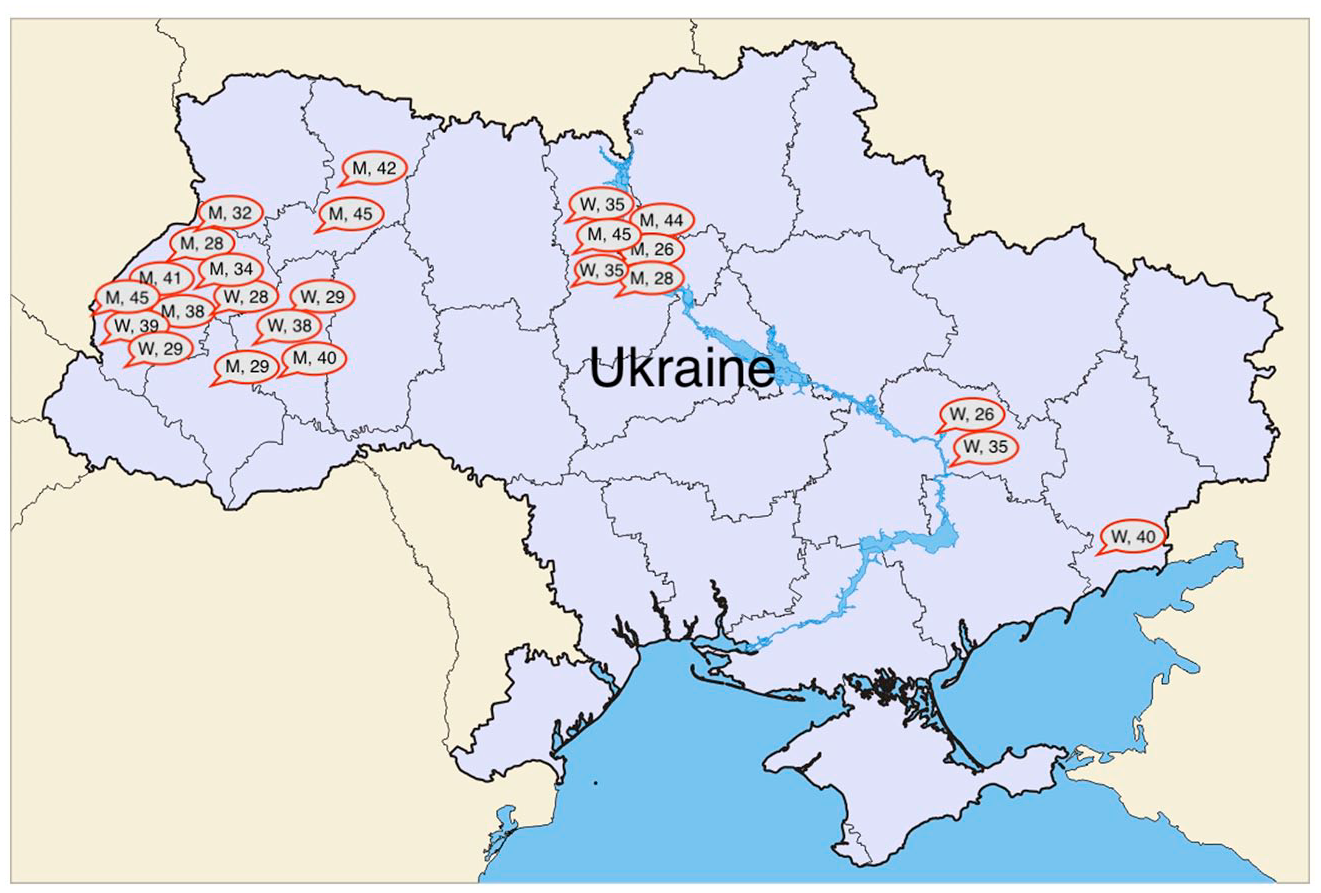
Sample demographic and their location. Image credit: Sven Teschke, CC BY-SA 3.0.
Method: Narrative Analysis
Narratives – stories that link relevant characters and events into a plot to make a point (Poletta and Gardner, 2015) – are central to the construction of collective action frames and facilitation of social actions in moments of crisis (Jacobs, 1996). Cultural sociologists have demonstrated how narratives help social groups make sense of the world by rendering events or issues into comprehensible stories (Smith, 2005; Somers, 1992; Steinmetz, 1992). In this way, narratives provide people with a ‘shared language’ (Hart, 1992: 634) or worldview that promotes social solidarity and the ability to collectively mobilize (Hart, 1992; Jacobs and Smith, 1997; Smith, 2005; Somers, 1992). In this work, we are specifically interested in exploring how the narratives that volunteers construct provide insight into the broader political significance and potential long-term political outcomes of their volunteering.
In this study, we approach narratives as ‘compact messages falling somewhere between war and speech’ (Schechner, 1969: 98 as quoted in Zychowicz, 2020) – radical actions that aim to discursively challenge the status quo in the context of Russian military aggression. After the audio recordings had been transcribed and translated into English, 2 we followed a conventional narrative analysis approach (Jacobs, 2000; Smith, 2005). As we read the transcripts, we paid particular attention to the characters that reappeared throughout people’s stories, and how they were portrayed both in terms of morality and their level of agency – the impact their actions have on broader social events. We also paid attention to the events that reappeared in the transcripts, including events that happened in the past, descriptions of the present, and future possibilities. In doing so, we were hoping to capture the synchronic and diachronic elements of collective action (Melucci, 1996) that constituted wartime volunteering.
The coding process involved an inductive, iterative and collaborative approach: both co-authors separately analysed the same subset of the transcripts. We then shared and synthesized our findings, applied the framework to another subset of the corpus, updated the framework as needed, and repeated this process until we had analysed the entire corpus and generated a suitable analytical framework that captured the major narrative dynamics present in the transcripts. We then re-examined the entire dataset with this initial framework in mind, identified additional elements in the volunteers’ narratives, and constructed a final narrative framework. While composing our findings, we often revisited the transcripts to confirm that our representations of the volunteers’ narratives were accurate. In exploring the significance of our findings, we paid particular attention to the civic norms volunteers conveyed in their narratives. We were guided by relevant work on civic norms while also remaining sensitive to the dynamics of the data. We were particularly influenced by Annavarapu and Levenson’s (2021) push for researchers to examine how people see the state, including their understandings of the state’s power, responsibilities and limitations. We were also influenced by Dalton’s (2008) distinction between two types of citizen norms, including duty-based citizenship and engaged citizenship explored in the previous section.
We have divided the findings into two separate sections. In the first section, we examine the other major characters that appear in the narratives besides the volunteers themselves and how the volunteers portray these characters. In the second section, we explore how volunteers portray themselves and the different narratives they construct based on what they consider to be the goals or desired outcomes of their activism.
Major Characters in Volunteers’ Narratives
Volunteers included a variety of different characters in the narratives they constructed to guide and represent their efforts, the most prominent being Ukrainian soldiers, citizens/civilians, the State (including the military command), and the Enemy. The volunteers collectively provided multiple portrayals for each character and described how they helped each of these characters achieve their highest (or most diminished, in the Enemy’s case) levels of agency over social outcomes (see Figure 2). Through these characterizations, the volunteers thus placed themselves as agents of civil society transformations, often centring their narratives on their contribution to Ukraine’s future. In the following sections, we begin by analysing the volunteers’ portrayals of major characters and their narrative significance, and then zoom out to gauge the political and cultural significance of volunteering in democratic state-building.
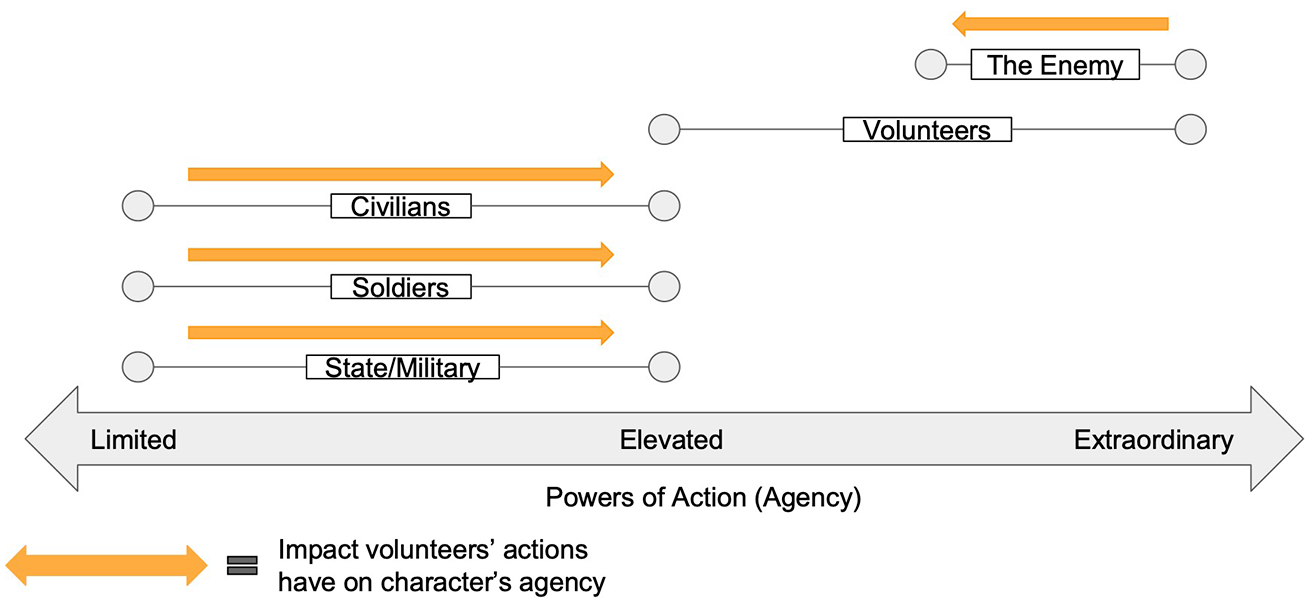
Major characters mapped against their narrative significance.
Citizens/Civilians
We found two broad portrayals of the agency the Ukrainian civilian population had concerning the war and Ukraine’s future: ‘ordinary humans’ and ‘agents of change’. Beginning with the former portrayal, volunteers characterized some Ukrainian civilians as essentially living an existence completely separate from the war or what one volunteer referred to as ‘ordinary people living their ordinary lives’ (Interview #11). These accounts described civilians as external observers of the war efforts. Some volunteers felt that this separation was natural or even necessary to shield civilians from wartime atrocities – rhetorically placing it outside the duty-based citizenship norms. For example, one volunteer noted that they were initially ‘surprised by how far away people from the West [of Ukraine] are from the battlefront, how civil life goes on there’ but also explained that the ‘[c]ivil population does not, and should not have the war as part of their reality’ (Interview #2). Like their grandparents who knew the horrors of the Second World War, the volunteers must strive to keep the civilians as far away from truly experiencing the war as possible. These accounts portray civilians as a neutral population that must be protected from the grim reality of the war.
At the same time, some volunteers expressed resentment about this separation between the peaceful civilian lifeworld and the battlefront atrocities: understanding that the war is not real for most people was too hard to handle. Coming back from the war, you cannot believe that the people around are still living their peaceful lives as if nothing was happening, as if the war was nothing more than a special operation that will soon be over and therefore not worth people’s attention. (Interview #8)
This seems to articulate a version of Ukrainian citizenship that includes a duty to defend the country in wartime, which clashes with the portrayals of civilians with minimal agency over its conduct and outcome. Volunteers also expressed some frustration over what they considered to be civilians’ lack of interest in the war: It is evident that there are two worlds: there are those who fight to defend their country, and there’s an ambivalent mass who grew tired of this reality show who cannot wait for it to be over or have long since switched their attention to something else [. . .] Should the ceasefire be violated tomorrow, some people will wake up to this reality – but most will keep on like nothing’s happening. Those who gave it their all, their last – will continue to do so. The others will stand by and watch. (Interview #9)
Similarly, a different volunteer noted that their fundraising efforts had significantly slowed down since 2014–2015: ‘people just lost interest. They feel comfortable living as if there is no war’ (Interview #4). Such accounts characterize the civilians as passive: although they are not deliberately sabotaging the war efforts, they remain oblivious or indifferent to grassroots activism.
At the same time, some of the volunteers’ efforts focused at least in part on the communitarian norms of assisting the civilian population harmed in the conflict. Volunteers described how the war had devastated eastern parts of Ukraine, leaving many civilians without means of subsistence. For example, one volunteer explained: These people can no longer work in the fields, because those have been turned into minefields – so they lost the key resources to sustain their livelihoods. Many of them are elderly, and they cannot leave their house because they have to take care of their cattle, their crops, etc. – so they learned to disregard the everyday shelling and carry on. Helping the internally displaced persons is an important part of our activism. (Interview #14)
Volunteers also noted that they were focusing at least part of their efforts on particular populations – ones they felt were especially vulnerable or in need of assistance, such as those displaced by the war, orphans, as well as the families of the soldiers killed in action. For example, one volunteer described their volunteerism in the following way: ‘We want our soldiers to come back home alive. But we also help those who got internally displaced because of the conflict, there are a lot of kids whose fathers died in this war, so we see it as our mission to help them.’ (Interview #3). These accounts describe the hardships experienced by some of Ukraine’s civilian population and show the critical junctures at which the volunteers intervened. Their portrayal of these groups as deserving of help exhibit the communitarianism norm that expects citizens to help those that are worse off (Dalton, 2008), which constitute norms of active citizenship.
The volunteers’ portrayals of civilians we’ve explored thus far do share a common element: regardless of whether civilians require help, need to be kept separate from the realities of the war, and/or live in denial, this portrayal does not treat citizens as active agents in national/international events. Yet, such portrayals are not static; the volunteers that presented them also expressed aspirations for a critical role of civilians in Ukraine’s future. For example, the volunteer we previously quoted who described ordinary Ukrainians as ‘passive and uninterested’ also noted that their long-term mission is ‘to make Ukrainian citizens more conscious and responsible. I’m sure [our organization] will exist after the war is over – we will just shift our focus to raising a new generation of good citizens through our volunteer work’ (Interview #22). Another volunteer explained that ‘It’s the [Ukrainian] people who have the agency to act; it is not the responsibility of our President or government to win this war for us – therefore, victory is in the hands of all of us and we have no right to stay passive’ (Interview #24).
Volunteers saw their work as mobilizing for a shift between duty-based and engaged norms of citizenship, noting that civilians will become more involved not only when they experience the war first-hand, but also by contributing to the effort in any meaningful way – as one volunteer described, civil society was being built through the process of ‘connecting people with volunteering networks’ (Interview #14). Volunteers considered it their mission to mobilize citizens to possess a certain level of agency or control over future events: These psychological transformations are well underway, and they will be quite generative in the long run as long as we don’t give up. It is too easy to give up and say it’s hopeless – but we are watched by our own children, and if we don’t make an effort – they will live in a country where one cannot achieve anything while honestly playing by the rules [. . .] I don’t even know what kind of future I want for my own children if nothing changes. (Interview #6)
This aspirational ‘agents of change’ portrayal suggests that civilians could be mobilized to support the volunteers’ efforts, indicating a potentially elevated level of agency for Ukrainian citizens, albeit one that is currently underrealized. It is clear that the majority of volunteers wish there was more support for the Ukrainian Armed Forces coming from the civilian population, especially in light of the diminishing public enthusiasm with each subsequent year of the war. Importantly, the source of this support lies within the citizen’s individual and collective agency – while it is not a general civic duty, it is up to each citizen to get involved in volunteering to the extent they deem appropriate – as one volunteer aptly summarized, ‘Nobody will tell you what to do: you come, look at the situation, and decide what it is you want to do to help’ (Interview #2). These portrayals constitute a shift from duty-based norms in which citizens are required or expected to engage in civic activities (Dalton, 2008), to forms of engaged citizenship which extend beyond voting in elections and include a variety of ways to contribute not just to the state, but also to the wellbeing of those in need.
Soldiers
The Ukrainian Armed Forces, hereby referred to as the ‘soldiers’, were prominently featured in the narratives. While the interview participants spoke about issues happening at various levels of the military hierarchy, they often focused on the relationships between the Ministry of Defence policies and the everyday battlefront experiences of the soldiers: ‘If the commander is good, the soldiers will be well-equipped. But oftentimes, commanders don’t care about anything, and that is when [the volunteers] step in and help’ (Interview #3). Many recall the lack of essential resources at the very beginning of the military conflict, and the sustained negative effect inefficient supply processes have on the soldiers’ chances for survival. The soldiers’ needs included food, water, clothing, medical equipment, vehicles, and topographic maps, among others. A former soldier who was later involved in activism highlighted the discrepancies between the ‘objective reality’ of a military conflict and the ways it is documented and appears on paper, which created numerous bureaucratic impediments that limited the agency of the soldiers.
Although some volunteers suggested that the military provision of essential equipment had improved over time, volunteers noted that some needs were still not being met. One volunteer explained: Although the Army rules and norms have changed, the state is still unable to supply the soldiers with everything they need – and that is where we come in. The Army has come a long way, and anyone who knows it from the inside knows this to be true – but there is still a way to go. For instance, there is a lot of technical equipment that the soldiers need, but it is still not incorporated into their agenda. (Interview #12)
A different volunteer that provided soldiers with transport vehicles noted the following: Almost all of our military divisions have a dire need in transport, even though things look fine on paper. The question is, does that stuff [that’s on paper] actually work? So that’s why we’re bringing so many cars from abroad for our military needs. Because the ones they have – they have never been out of the garage, they’re old and dilapidated and will stay there. Our military ambulances are those old Soviet automobiles (we call them ‘pills’) – if a combatant sustains a wound, they may die from being transported in this vehicle. So, this is where we come in – the needs that have not been outlined or included in policies/statutory documents – we aim to cover those, as nobody will cover them in the nearest future. (Interview #4)
Self-reliant, agile, and unencumbered by restrictive military policies, volunteers could quickly source and deliver the necessary tactical equipment straight to the (battle)front-line beneficiaries without making them liable for its loss or destruction, which often happens in combat scenarios. Ironically, collaborating with volunteers directly helped soldiers focus on their strategic goals rather than spend time and effort applying or petitioning for resources through traditional, hierarchical channels. Yet, rather than being juxtaposed to traditional military supply chains, such horizontal, networked collaboration was portrayed as complementary to the military institutions and did not aim to replace them in the long term.
Soldier portrayals tend to discursively mirror those of citizens: for some, they are ordinary humans trying to survive the war. One volunteer described soldiers as ‘whoever they could find to serve the mobilization order’ and ‘the only ones left that have no money to pay them [i.e. the state] off’ (Interview #16), recognizing the ways in which privilege affords the ability for some to evade military service. Like citizens, some portray soldiers as coming from precarious backgrounds, lacking skills and/or proper training, with low morale. On the other hand, many volunteers portray soldiers as warriors who fight with dignity on behalf of their loved ones. In this version of the portrayal, soldiers were heroic defenders of the country who are protecting their families and the whole country from and encroaching occupation and the casualties of war: ‘when the boys stop holding the battlefront, we will lose even more of our territories’ (Interview #6); ‘these are our [Ukrainian] troops, and we owe our protection to these boys, so it is our duty to help them in whichever way we can, feed them, clothe them, and make sure nothing bad happens to them while they’re out there, otherwise there’ll be war’ (Interview #14). In this instance, the agency of the soldiers appears to have been further elevated with the volunteers’ support as they continue to beat the odds and get through impossible scenarios. In the words of a volunteer, there is a reciprocal relationship between soldiers and volunteers: ‘they defend us, we protect them’ (Interview #18). This again highlights the value of communitarianism – helping those that are in need (Dalton, 2008) – emerging as a powerful driver of wartime social change and contributing to the norms of engaged citizenship.
State
The portrayals of the Ukrainian state occupy a prominent space in some of the volunteers’ narratives, while being notably absent or occupying a minor role in others. In analysing those narratives, it is important to acknowledge that the state’s limited ability to supply adequate provisions for the soldiers was the main reason for volunteerism in this context. These legacies of diminishing output legitimacy with regard to care for the conflict-affected populations, ongoing since the Soviet times, might explain some of the volunteers’ attempts at circumventing the state institutions altogether and setting up alternative, informal, yet more efficient logistics/supply chains to tackle the urgent war-related needs. In this case, it is the citizens/Ukrainian people that took on the function of a collective state-like actor in lieu of the existing state institutions.
The Ukrainian state has two overarching portrayals, which the participants connect either to their past and present everyday experiences of living in Ukraine, or to their imaginaries of the future. In the first portrayal, the state is an inert and highly bureaucratized entity external to the people, which is usually consistent with the collective experience of living in the Soviet era. A few participants make this connection explicit, recognizing Ukraine’s inheritance of Soviet inefficiency and corruption: ‘people have been disillusioned ever since the Soviet Union. They think, once you encounter bureaucracy and need to spend time in those offices filling out those tons of applications – nothing good will ever come out of it’ (Interview #18). Understandably, the agency of this character is quite limited due to its heavy reliance on citizens to bridge the gaps in governance: ‘the war kills bodies, and corruption gnaws on our souls. Nations die because of corruption, when there is no more soul left’ (Interview #6). Hence, this portrayal of the State is that of an embattled actor fighting war on the outside and corruption on the inside. In this context, the volunteers’ efforts model the norms of engaged citizenship by ‘lending a hand’ to the state in the times of crisis.
Along with the soldiers and the state, interview participants generally attributed a low level of agency to the military command, from the Ministry of Defence to the commanding officers ‘on the ground’. Often described as disorganized, inefficient, and ‘fully cooked in the Soviet Army system’ (Interview #19), they were seen as a bureaucratic impediment to an efficient conduct of national defence operations. One volunteer explained that navigating the bureaucracy has become so difficult for soldiers that ‘it is oftentimes more convenient for the soldiers to ask volunteers to provide them with equipment, than to ask their commanders, as the procedure is overly bureaucratized and takes weeks’ (Interview #12). Unlike the predominantly romantic portrayals of the soldiers who were often seen as either heroes or victims in this scenario, the portrayals of the military command discursively mirrored the more tragic depictions of the state: inefficient, mired in corruption, and unable to fulfil its basic functions, with not much hope going forward. For this reason, volunteers explained that they often chose to work horizontally, cooperating directly with the soldiers while avoiding institutional intermediaries (the military command).
At the same time, volunteers who have had experiences of cooperation with the Ministry of Defence or individual military commanders construct more mundane narratives, reporting initial reluctance on the part of the military, but eventual collaboration with volunteers on a list of strategic priorities. One interview participant shared an example of defence philanthropy, whereby strategic defence operations were partially outsourced to a shadow Ministry of Defence. According to the participant, the reason the acting Ministry of Defence was having difficulties was their ‘antiquated’ policy documents and procedures (Interview #16). In another example, a military veteran who became a volunteer after returning home from war described the dire need for policy change within the country’s military institutions as a transition from process-oriented to results-oriented frameworks. Volunteers’ accounts of their collaborations with the country’s military command rarely touched on the broader social stakes involved in the process: even if volunteers could help the military command become self-sufficient, the latter was unlikely to be the ones at the forefront of systemic social change. This suggests that most volunteers were not aiming at ‘working themselves out of the business’ as they would in the duty-based framework – instead, they situated themselves and their efforts in the dynamic environment, recognizing the need to adapt to rapidly changing needs and circumstances.
This recognition, underpinned by emerging civic norms and values, is a key factor driving social change in this young democratic state. In these dynamic portrayals, the state is an entity constitutive of its people. In this narrative, citizen action or inaction has a significant impact on daily life: ‘So, the most important thing here is to get the public institutions to really work – to do the things that are within their mandate and that they have to do. It shouldn’t all have to fall on the shoulders of ordinary people’ (Interview #16). Moreover, some participants came to actively question the future of the state after the war: ‘It’s this idea that simply winning the war in and out of itself is not enough – what are we winning it for? What happens after we kick out the Russians?’ (Interview #7), highlighting the stakes of actively participating in governance through their grassroots initiatives. These narratives show how volunteers’ efforts are shaped by how they ‘see’ the Ukrainian state (Annavarapu and Levenson, 2021). The imaginaries of the state and its military are rooted in the fact that the volunteer-driven, grassroots forms of military–civilian cooperation are not always scalable and hardly translate into the country’s civil society helping the country’s military; to the contrary, in this instance we can see the romantic narratives of volunteerism feed directly into the geopolitical outcomes, even if this means at times bypassing the military institutions in the process. Volunteers’ portrayal of the state as constitutive of its people also aligns with the norms of engaged citizenship. Consistent with these norms, volunteers believe it is vitally important to cultivate a more active citizenry capable of driving social change from within, or at times outside institutions.
The Enemy
In their interviews, the volunteers often describe what they considered to be the key threat or enemy of the Ukrainian people. Volunteers depicted Russia as a clear and present danger to Ukraine. For example, one volunteer explained that part of their effort involves raising awareness about the ‘truth on how Russia aims to destroy the Ukrainian culture’ (Interview #8). Another volunteer explained that being part of the volunteer movement means supporting those fighting ‘to defend their country’ (Interview #9). Similarly, others described their mission as ‘to stand up to the enemy united’ (Interview #24) and noting that Ukrainian soldiers are ‘fighting for our country’ (Interview #15).
In addition to Russia, some of the volunteers identified a second major threat to Ukraine: corruption. The way the volunteers described this phenomenon suggested that it did not have a single source. Corruption could be found at all levels of the government, the military, and even among ‘scammers’ pretending to be volunteers raising funds for the army. At all these levels, individuals manipulated public resources and institutions to serve their own self-interest at the expense of the Ukrainian people. This corruption had become systemic, an omnipresent reality throughout Ukraine. The volunteers’ accounts suggested that Ukrainians had tolerated it for far too long and the corruption would prove fatal if left unchecked. For example, one volunteer explained how the focus of their volunteerism has shifted since 2014. This volunteer noted: Back then, it seemed like we were facing two distinct problems – corruption was the old one, the war was a newer one [. . .] But overall, my priorities have shifted – now, it is understood that, in order for there not to be war, there should not be corruption in the country. For there not to be corruption, it is our responsibility to take action [. . .W]e should start fighting corruption and bribery from below, from within. The results won’t be immediate, but in 5, 7, 10 years we will reap the benefits and change the country for the better. And once the country is changed, the current issue of fighting a war will be out of question. (Interview #6)
Most notable about this volunteer’s account is the depiction of corruption as the reason the current military conflict had not been prevented. In this way, Russia is clearly an enemy, but corruption is ultimately responsible for the state’s inability to fight back. This raises an important point about the geopolitical costs of corruption – ironically, an issue affecting not just Ukraine, but the invading Russian army, as well. Recognizing and actively working to mitigate those costs are a crucial first step to the creation of a new civic model of the Ukrainian state. In this model, citizens not only drive the introduction of anti-corruption legislation (which would largely correspond with the norms of duty-based citizenship), but also enact social change ‘on the ground’ through their refusal to engage in the acts of corruption and thus undermine Ukraine’s defence capabilities.
The way volunteers construct the category of the enemy align with what cultural sociologists consider to be the high dramatic narrative genres, including romance/tragedy and the apocalyptic genre (Smith, 2005). These narrative genres provide dramatic accounts of good versus evil with the results having major social ramifications. Consistent with these genres, the volunteers’ accounts portray Russia as deliberately trying to destroy Ukraine. Volunteers’ accounts also suggest that Russia must possess a considerable amount of agency if they are capable of completely dominating if not annihilating Ukraine. Similarly, the volunteers consider corruption to be both morally evil and incredibly powerful given their portrayal of corruption as devouring the ‘soul’ (Interview #6) of Ukraine and rotting the Ukrainian state and civil society to the point of destruction. Although the volunteers indicate that the stakes are nearly if not existentially high and each enemy possesses immense power, the volunteers do not suggest that either enemy’s power is all-encompassing.
The broader significance of Ukrainian volunteers’ efforts becomes more visible by exploring the narratives they construct. In their portrayals of the other major characters, volunteers promote engaged citizenship norms and construct a vision of an idealized future democratic Ukrainian civil society where people play an active role in making sure the state functions appropriately and those in need receive help. The significance of this culture of volunteerism becomes even clearer in how volunteers portray themselves and the goals of their work. We explore these aspects in the next section.
Volunteers’ Understanding of Themselves and Their Work
In the prior section, we explored how the volunteers portrayed soldiers, civilians, state and its military institutions, and the enemy. Our analysis demonstrates how the volunteers generally understood their role as mediating the relations between the soldiers and civilians and helping these groups maximize their agency at the backdrop of an ongoing war. This function is consistent with the western understanding of civil society as mediators between the state, the market and the citizens (Rodríguez-Muñiz, 2017). In this section, we explore how volunteers portray themselves and the long-term goals of their efforts, driving social change through the construction of civic vocabularies that reconstitute the relationship between citizens and the state.
Implicit but also often explicit in volunteers’ portrayals of social groups was the understanding that the soldiers, civilians, and by extension Ukraine in general would sustain incommensurable harm in the war without the volunteers’ efforts. Some of the volunteers made clear that they understood their personal role in defending Ukraine: To be honest, in 2014 many of us panicked. The war had begun, we needed to do something or else we’d be the next ones getting shelled. All of the boys who went there [to war] were heroes, and here you are living your civilian life, so you do what you can to help the others out there. There was this sense of an impending doom – that Ukraine will fall apart if you personally won’t step up and do something. (Interview #13)
Consistent with this portrayal, a different volunteer noted that their original mission was ‘to save the country’ (Interview #12). A volunteer provided a similar description in their account of their activism in Mariupol, explaining: [W]hen those troops got stationed at Mariupol, they were living in tents and lacked basic means of subsistence – it was a particularly cold spring, and they were not equipped with warm clothes, they did not have food – so our volunteering started from attempting to provide the soldiers with those basic things. (Interview #14)
Volunteers also described themselves as extremely motivated and capable of quickly identifying and solving serious issues despite significant obstacles: The volunteer disregards the barriers and does what has to be done. That’s the whole point of volunteering – to figure out how to work around the barriers so that the Army could do what they have to do. These people work at maximum bandwidth, at full capacity. (Interview #9)
Another volunteer explained that volunteers had to possess ‘the ability to immediately react to the [military’s] needs’ and explained that There were many days [in 2014] when we would find out what they need in the morning, collect it by the afternoon and ship it [using a delivery service]. That was peak speed and efficiency – we either had what they needed here, or we could quickly raise funds to purchase what was needed. (Interview #6)
Volunteers proudly shared accounts of being able to quickly acquire vital supplies and deliver them to those in need, such as rare antibiotics for soldiers or even creating an entirely new supply chain to get resources (such as camouflage netting) directly to the soldiers on the battlefront. At the same time, volunteers felt that their hard work did not come without a cost. Some of the activists emphasized the toll their work has taken on them: This is not easy – many of our families fell apart due to this constant pressure – it’s very time demanding, and not all families provide understanding and support in this situation. So, this is a very delicate matter [this volunteering], but as of right now – we continue. (Interview #4) Now, in 2016, the movement seems more dispersed, and there are many reasons: people are exhausted, both physically and financially, so there are objective reasons why it is less active than before. However, we got so deeply involved in it that we have no right to stop. (Interview #12) [P]eople have got physically tired. Only the strongest ones are left, many people couldn’t take it and left. I would have loved to go to the beach for a few days and turn off my phone, but I cannot abandon thousands of people standing behind my back. (Interview #17)
In all these examples, volunteers explained that their work does take a toll, yet through their solidarity they remained motivated and committed to continue their volunteerism: ‘we share a certain affinity, where we see through each other and understand each other’s aspirations and intentions. There’s like an invisible bond connecting us into a sort of a community’ (Interview #14).
The importance the volunteers attached to their work was also present in the way some of the interviewees described themselves as fighters or defenders of Ukraine. For example, the previously mentioned volunteer that described their mission as ‘to stand up to the enemy united’ added that ‘we will only achieve it if we organize’ (Interview #24). This depiction of volunteers as ‘fighters of an invisible battlefront’ was also present in the account a different volunteer provided for how they became involved with a volunteer team: ‘[T]hey said, hey, come join us as this is no less important than being out there at the battlefront holding a machine gun. And so I did’ (Interview #1). It is clear from these examples that volunteers understood their work as not just supporting soldiers or helping civilians, but actively working to avoid the loss of human life at the battlefront and prevent civilian harms. In many instances, volunteers have expanded the locus of the armed conflict from the battlefronts to ‘the rear’ (Interview #9) where these grassroots processes were unfolding: When the boys stop holding the battlefront, we will lose even more of our territories. On the other hand, there has to be a strong, powerful, and educated civil society that’s backing them from behind and that can overthrow the deeply ingrained corruption which caused the war. (Interview #6)
In this scenario, winning a war had less to do with the enemy body counts, and more with winning over the hearts and minds of the Ukrainian citizenry and the Ukrainian soldiers. By expanding the conflict from the enemy lines and exposing corruption as being just as deathly at the enemy’s bullets, volunteers collectively constructed the dual teleological goal of keeping the soldiers alive and recognizing the value of each human life – which is a stark contrast with the infamous Soviet treatment of their soldiers as ‘cannon fodder’ which still largely defines the culture in the Russian army.
Volunteers’ Ultimate Goals
The volunteers reported a variety of collectively established goals or imagined outcomes for their work that ranged from a focus on alleviating some of the immediate needs of soldiers, veterans and civilians to ushering in radical changes at the societal level (see Figure 3). Volunteers often expressed goals that were focused more on alleviating immediate needs or helping an existing social institution function better (i.e. located closer to the Narrative #1 and #2 portion of the narrative scope spectrum in Figure 3). On the other hand, other volunteers shared that the ultimate goal of their efforts is to drastically transform Ukrainian society (i.e. located closer to the Narrative #3 portion of the narrative scope spectrum in Figure 3).
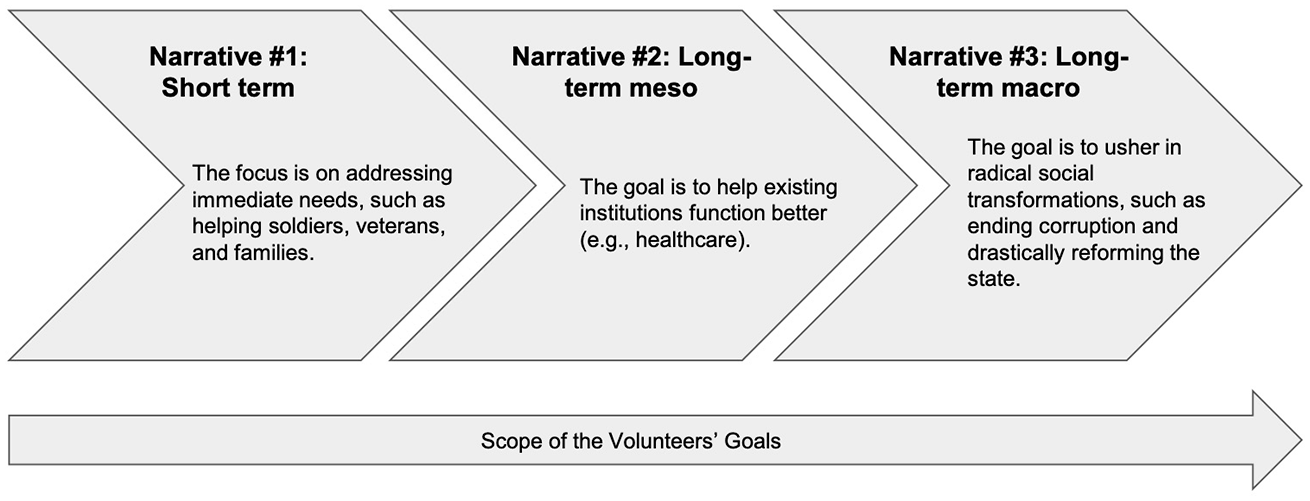
Narrative spectrum of the volunteers’ goals.
Consistent with literature on volunteering (Anheier and Scherer, 2015; Musick and Wilson, 2007), some volunteers’ efforts remained focused on addressing immediate needs of clearly defined groups, such as providing Ukrainian soldiers with vital supplies and helping veterans reintegrate into society. In their accounts, these volunteers did not admit their efforts being motivated to pursue any broader social transformations. For example, one volunteer provided the following response to a question on what volunteer organizations may tackle after the war: I don’t have the time to think that far into the future. All I can think of is the immediate aftermath. What’s next? What are we going to do tomorrow? I know Russia has stationed their forces on our northern border, as well – just north of Vinnytsia. What’s going to happen? So, we’re trying to take it one day at a time, and just get through the day. I think we will start making strategic, long-term plans once at least something is clear [. . .] There’s no point to do so now [. . .] Even if the war ended overnight, the volunteers would have things to do for the next ten years going forward. They could probably spend those next 10 years crowdfunding prosthetics for the veterans. (Interview #9)
For this volunteer, their work was so focused on addressing the immediate needs that they found it difficult to consider the focus of future efforts. And yet, through their sustained action in these areas the volunteers personified and enacted communitarian norms in their everyday life. These norms contribute to shifting the duty-based citizenship model in favour of practices of engaged citizenship.
Other volunteers discussed longer-term outcomes beyond addressing the immediate needs of soldiers, veterans, and other groups. The scope of these long-term goals varied. Some volunteers hoped to improve how vital Ukrainian institutions – such as the military, public health, social services – function (closer to Narrative #2 in Figure 3), thus engaging in collective reconstitution of links between the state, markets, and society (Rodríguez-Muñiz, 2017); others expressed aspirations for a macro-level transformation of Ukrainian governance and civil society in general (closer to Narrative #3 in Figure 3), occupying the space between systems and the everyday (Eder, 2015). Beginning with the former, volunteers described how their long-term mission was to improve Ukraine’s healthcare system, veteran services, or the field of Ukrainian cartography. For example, one volunteer explained that they were applying to attend medical school with the goal of becoming a medical doctor. This volunteer explained that it was their ‘life goal’ to ‘develop palliative medicine in Ukraine, and to improve healthcare in Ukraine’ (Interview #2). Similarly, a different volunteer explained that in addition to helping the military, they were also working to ‘get Ukrainian healthcare up to the world standards’ (Interview #21).
Several of the volunteers’ ambitions expanded beyond improving or complementing the services of single institutions to transforming Ukrainian society in general. These volunteers shared that their long-term goal was to eliminate corruption and/or strengthen Ukrainian civil society, and thus radically alter how the Ukrainian state functions (e.g. close to Narrative #3 in Figure 3). As previously discussed, some volunteers attributed the war to passivity that had permeated the Ukrainian state. These volunteers believed that preventing future crises and living in a democratic, prosperous Ukraine would only be possible if Ukrainians came together to take a more active role in governance. For example, one volunteer explained: In fact, from the very beginning [of volunteering] we tried to not build a rigid, vertical, hierarchical organization – there was a reasonable expectation of grassroots involvement, which happens when the civil society matures and is able to set its own agenda locally, based on the principles of transparency and accountability. This was especially important to achieve in the east of Ukraine, where the democratic traditions had been previously less developed. Now, I can say that our organization is like a living organism: there are many of us, and our goal now is to reform the Ukrainian government, especially at the regional and local level. We educate ourselves on how to read legislative documents, and developed an understanding that government decisions are more easily influenced at the stage of their drafting, not after the fact. (Interview #14)
A different volunteer provided a similar account, explaining: All we’ve done up to this point should have been done by the State and its institutions [. . .] I would also be truly happy if the most adequate of us [volunteers] will eventually run for office, occupy key posts in the legislative or executive branch on various levels, and have the decision-making power. Because the change we need in this country is systemic. (Interview #16)
Based on their accounts, these volunteers believed that truly addressing the challenges facing Ukraine requires more than just providing certain groups with vital resources and instead demands a complete change in governance. Perceived through a critical lens, the ways in which volunteers portray themselves and the ultimate goals of their work further demonstrate how volunteers’ efforts promote and are guided by engaged citizenship norms (Dalton, 2008).
Discussion and Conclusion: From Volunteering to Social Change
The mechanism of social change is subtle – it often lies in minute, everyday acts of care and solidarity with others or refusal to engage in the acts of corruption. These acts, together with the narratives that represent them, foster the emergence and adoption of vocabularies and norms of engaged citizenship. Consistent with principles of communitarianism, volunteers are compelled to step in to help those in need, which includes the Ukrainian state. Consistent with how volunteers portray other characters, their account of their own actions should not be perceived uncritically: even when they say they are only fulfilling immediate needs, their actions facilitate social and political change. In the process of volunteering, people not only attempt to alleviate issues – they also promote and/or create a new civic and political culture. In this way, volunteerism is political even if the immediate goal may not be the restructuring of the political system.
‘Putin never expected this to happen. He could have never foreseen the volunteer movement fuelling the resistance from within the country’ (Interview #9). Yet, as we find ourselves making final amendments to this manuscript, we see this resistance being key in fighting off the full-scale Russian invasion for many months. This heroic collective effort has been made possible, in part, by the volunteers who have laid the foundations for the new norms and values that drove their wartime civic initiatives and are now feeding directly into the geopolitical outcomes. The Revolution of Dignity, the annexation of Crimea, and the Russian–Ukrainian war have turned out to be pivotal historical moments for the construction of civic vocabularies that will continue to shape the everyday experiences of being Ukrainian in the forthcoming years. This is not to say that duty-based citizenship cannot lead to social change – but in this particular case, we see the norms of engaged citizenship as significant in fomenting sociopolitical transformations in the wartime.
The Russian invasion is not only a contestation of Ukraine’s state borders – it is also a contestation of the categories through which volunteers were constructing their subjectivities, such as ‘citizen’, ‘volunteer’, ‘soldier’, and ‘state’. Volunteers’ desire to improve vital Ukrainian institutions such as the military, public health, and social services essentially portray ‘good’ citizens as those that actively work to make sure social institutions promote the collective good. Volunteers who portray their long-term goals as macro-level change to Ukrainian civil society also promote participation forms of engaged citizenship norms. Such volunteers suggest that the only way to remedy the current situation is for the people to create a strong civil society where citizens are actively involved in the political process.
The Constitution of Ukraine recognizes ‘human life and health, honour and dignity, inviolability and security are of the highest social value in Ukraine [. . .] Provision of those rights and freedoms is the main duty of the State’ (Constitution of Ukraine, 1996, Article 3). As we have demonstrated in our findings, the provision of these fundamental human rights and freedoms partially fell on the shoulders of volunteers whose efforts both drew attention to the value of a human life at the battlefront – ‘we want our soldiers to come back home alive’ (Interview #3) – as well as facilitated the provision of these rights on behalf of the Ukrainian state – ‘this is what Ukraine looks like’ Interview #14). These portrayals of the state and its citizens mirror the structural changes in the sources of power: contrary to the classical, sovereignist approach, in which the state is an external entity governing the citizens, volunteering helped citizens see themselves as constitutive elements of a new form of governmentality. Situating themselves and their efforts in highly dramatic social narratives about the present and future of Ukraine, volunteers engaged in collective construction of the norms of engaged citizenship.
Consequently, the volunteers are able to resist the Russian invasion not only through generating resources for the soldiers ‘holding the fort’. Through their acts of engaged citizenship, they are actively pushing against the portrayals of Ukraine as a ‘failed state’ by crafting solidarities across citizens around their participation in grassroots voluntary initiatives. In this sense, ‘crafting the victory’ takes on a range of symbolic meanings in hybrid conflict scenarios through their redefinition of the category of ‘people’ on whose behalf the war is being fought, constituting a stark contrast from the Russian President Vladimir Putin’s portrayal of the Ukrainian people as ‘a sack of potatoes’ (Address by President of the Russian Federation, 2014) to agents capable of driving social change. If anything, narratives of volunteering that surround this war actively push back against one of the main organizing principles of modernity – sacrificing human lives in the service of institutions; instead, they highlight the elevated social significance of a broad spectrum of human suffering and casualties at a much larger scale than the combat deaths, a traditional metric used to distinguish wars from other types of political conflicts (Boichak, 2021). In doing so, these narratives of care and challenging domination through survival (Tronto, 1993) foreground human dignity as a key moral value behind volunteers’ efforts, as well as the multiple levels on which personal security concerns translate into national security issues.
In this context, the notion of engaged citizenship facilitates the emergence of civil society that often occupies the space outside of the currently defined institutional contexts and works through the collective shaping and contestation of social norms and values. It might be that over time, these norms of engaged citizenship will get institutionalized and perceived as a public duty, highlighting the fact that the distinction between duty-based and engaged citizenship is socially constructed and negotiated in moments of crisis. A sensitivity to this is integral to understanding the political significance of volunteerism in contexts that do not fit the western hegemonic model of governance (Mouffe, 2013). Still, it is equally important to explore these processes in Western contexts since doing so will allow us to be sensitive to the ways that volunteer efforts reify or provide alternatives to the existing relationships between citizens and the state.
Footnotes
Acknowledgements
The authors wish to thank the interview participants for their brave and selfless effort in supporting Ukraine’s resistance against the Russian invasion. It has been a privilege to know you and share your stories with the world.
Funding
This open access publication has been supported through the University of Sydney’s Faculty of Arts and Social Sciences Open Access Fund.
