




Abstract
This article draws on 27 interviews with women (with exclusive and non-exclusive sexual orientations) to understand the role of pornography in the construction of female sexuality. Building upon research that moves beyond the ‘negative effects paradigm’ in the study of pornography, we show that consuming pornography is both disciplining and empowering for women. Our informants recognise that pornography reproduces and promotes patriarchal discourses of sexuality, but they manage to use it to reach a state of pleasure (exercise of fantasy, sexual gratification) and perfection (optimal way of performing sex). We also show pornography’s role in cultivating a renewed understanding of female sexuality. In this process, aspects of the genre are questioned, negotiated and reconciled in order to continue using pornography to satisfy desire. We contribute to ongoing debates about the role of pornography in society by documenting the experiences of women whose voices have been hitherto underrepresented in the literature.
Introduction
Pornography, as a term, refers to stimulating, visual materials that depict sexual acts with the primary intention to arouse the ones viewing it. Sociocultural and technological changes in the past few decades have made pornography more accessible and normalised; specifically, digitalisation has enabled access to those materials considerably (Ashton et al., 2018; Attwood, 2009). Indeed, men and women consume pornography frequently, while some even share self-created sexually explicit photos and videos online; that is, ‘amateur pornography’ (Hardy, 2009; Paasonen, 2011).
As a result, along with increased access to pornography and its scope, its impact on sexual education has also been on the rise (Albury, 2014; Attwood et al., 2018). Prior studies illustrate that consuming pornography helps individuals to make sense of their sexual identity and to learn particular skills, although there is no consensus in the literature about what porn teaches or how it works as an educator (Albury, 2014). Finally, Attwood et al. (2018) argue that pornography also plays a role in the construction of sexuality in a broader sense, referring to its impact on ‘erotically significant aspects of social life and social being, such as desires, practices, relationships and identities’ (Jackson, 2006: 106).
Even so, several controversies still permeate the production and consumption of pornography, potentially affecting how individuals both interpret and use it. McCormack and Wignall (2017) condense these controversies under the ‘negative effects paradigm’ (NEP hereafter), a strand of research that examines negative attitudinal and behavioural consequences of pornography. According to NEP, pornography promotes sexually risky and predatory behaviours because many young adults educate themselves sexually through porn without engaging in conversations with their partners or peers, revealing a lack of porn literacy (Albury, 2014).
Furthermore, pornography has been discussed under NEP as a genre that depicts the subjugation of women. Anti-porn feminism flourished during the ‘sex wars’, a wave of public debates about the porn industry that took place in the United States in the 1970s and early 1980s (Ciclitira, 2004). Dworkin (1981) famously argued that pornography is women’s exploitation and oppression and suggested that consuming violent pornography normalises sexual aggressiveness towards women (e.g. rape). Even though such arguments have been empirically disproven (Hardy, 2015; McKee, 2012), they still influence much of the debate surrounding pornography (Smith and Attwood, 2014).
A considerable number of studies contested this paradigm and called for a move away from the sole exploration of the negative effects of pornography, opening up new avenues for comprehending the genre and its societal implications (Attwood, 2002; Comella and Tarrant, 2015; Hardy, 1998, 2000, 2015; McCormack and Wignall, 2017; Paasonen, 2011; Williams, 1999). This research stream highlights the role of pornography as a form of leisure, exploration, and education (McKee, 2012), and seeks to uncover its influence on sexual desire, sexual identity and sexual practices. Yet, empirical studies have mostly dealt with male understandings and experiences (e.g. Hardy, 1998; McCormack and Wignall, 2017), while women’s stories about the genre have received much less attention (Ciclitira, 2004; Neville, 2018; Smith, 2007).
Sociological literature focusing on women presents strikingly different perspectives on their perceptions and usage of the genre. On the one hand, prior studies report that women experience feelings of shame and guilt about consuming pornography (Wilson-Kovacs, 2009). Additionally, it is argued that ‘mainstream’ (i.e. mostly heterosexual) pornography does not provide pleasurable representations of sex for women (Neville, 2015, 2018); as such, women might find specific categories, such as erotica (Chadwick et al., 2018; Hardy, 2015) or gay pornography (Neville, 2015, 2018), more enjoyable. On the other hand, many studies come along with the claim that consuming pornography is an important emerging practice for women’s explorations of their sexual desire, and overall understanding of their sexuality (Ashton et al., 2019; Gurevich et al., 2017; Williams, 1999).
However, prior literature lacks an in-depth qualitative account of the intricate influence of pornography on female sexuality. We find that women navigate between an understanding of pornography as a form of oppression and an understanding of pornography as a way to pleasurably deal with sexuality. In our study, we draw on Foucauldian conceptualisations of power and pleasure (Evans et al., 2010; Foucault, 1984, 1985; Glick, 2000; Williams, 1999), aiming to enhance the sociological understanding of women’s consumption of pornography.
Pornography Consumption and Sexuality
The ubiquity of sex and sex representations in western cultures has been discussed extensively across disciplines. Terms such as ‘pornographication’, ‘pornified’, and ‘porno-chic’ (McNair, 2013; Paul, 2005) are often used to illustrate how sex has become more visible and liberalised. As a result, cultural sexualised texts increasingly interfere with individuals’ sexualities (Attwood, 2007; Attwood et al., 2018). In The History of Sexuality, Foucault (1984, 1985) argues that sexuality is an open and complex historical system, saturated with power, and modern sexuality in particular is constructed according to a conjunction of knowledge and power that disciplines bodies and pleasures. In Foucauldian terms, cultural sexualised texts (e.g. pornographic materials) act as points of knowledge, power and truth in which sexuality is specified and disciplined. However, according to Williams (1999), Foucault’s disciplinary powers have operated more on women’s bodies and pleasures since men have historically been considered the subjects of erotic discourse, with women being the primary objects (Hardy, 2000).
The perception of women as ‘passive’ erotic objects in pornographic materials originates from the work of anti-porn feminists such as Andrea Dworkin and Catharine MacKinnon, who, during the ‘sex wars’, claimed that women in pornography are reduced to faceless bodies meant to be used (usually with violence) for male pleasure. However, pro-censorship and anti-pornography feminism has been heavily criticised for its problematic associations with right-wing politics and its homophobic rhetoric (Williams, 2004). For example, not all pornography depicts violent acts and seeing all non-normative sexual acts as sexist and violent delegitimises them as valid and pleasurable sexual preferences for women (Rubin, 1995). Anti-censorship proponents have also cautioned against increased state power over the genre, arguing that legislation is mostly vested in patriarchal interests (Rodgerson and Wilson, 1991). Yet, Maddison (2009) finds that the highly emotionally and politically charged terrain of pornography, and a certain reluctance to adopt purely anti-porn stances render it difficult to produce a substantial critique of materials that feature excessive violence towards women.
Since the 1990s, however, a new strand of sociological research has emerged, arguing for a paradigm shift in how pornography is studied (Hardy, 1998, 2000, 2015; McCormack and Wignall, 2017; Paasonen, 2011; Williams, 1999). This approach, commonly known as ‘porn studies’ (Attwood and Smith, 2014), seeks to contextualise pornography consumption within existing cultural frameworks and aims to provide in-depth interpretations of how pornography is produced, consumed, and integrated into everyday life (Attwood, 2002; Comella and Tarrant, 2015).
Contemporary research on pornography shows that consuming porn is a form of leisure, play, and entertainment (McKee, 2012). McCormack and Wignall (2017) find that pornography is a pleasurable experience for young men that can also provide various educational merits. Similarly, Smith et al. (2015) find that pornography consumption constitutes a leisure activity for young people, and an erotic experience through which they can relieve boredom and explore their nascent sexual identities. Yet, empirical research to date tends to focus mostly on the agency of men, either as enactors of bad behaviours influenced by pornography or as sexual agents who find pleasure through pornography and learn from it. Both in the history of sexuality and in porn studies, women’s pleasure has not been traditionally theorised outside of a dominant male economy (Williams, 1999), and it has received considerably less attention than men’s (Ashton et al., 2019).
The scarcity of empirical research focusing on women could be attributed to pornography being usually considered as beyond their reach and interest. Neville (2015) argues that this is due to social expectations warranting women to refrain from public displays of their sexuality and pornography’s openness to the depiction of sex. For example, Wilson-Kovacs (2009: 156) suggests that discussing porn preferences is a taboo topic for women, and as such, ‘pornography is simply what the male partner invariably chooses’. However, recent work shows that women are relaxed and curious about their partners’ habits and are often those who initiate joint pornography consumption (Böhm et al., 2015).
In addition, because pornography is often understood as a genre created by men for men (Hardy, 2009), many studies have argued that women tend to prefer erotica (Chadwick et al., 2018) on the basis that it would prioritise women’s pleasure (Hardy, 2015; Sonnet, 1999). For example, Wilson-Kovacs’ (2009) informants argued that erotica caters more to women’s needs than mainstream porn. Other studies have also shown that women who do not see themselves represented in mainstream pornography, gravitate towards alternative categories (e.g. online slash fiction) with which they can experiment safely and freely (Neville, 2018).
However, recent findings illustrate that women can, and do achieve sexual pleasure by consuming pornography (Hambleton, 2016; Liberman, 2015; Taormino et al., 2013). Women have as much interest as men in the transgressive and the visually objectifying dimensions of the erotic (McNair, 2013). Yet, their relationship with pornography has been described as nuanced and oftentimes paradoxical (Ashton et al., 2018, 2019; Chowkhani, 2016). For example, Smith (2007) shows that women can find both pleasure and boredom in pornographic tales. More recently, Gurevich et al. (2017) examined the role of pornography in women’s sexual desire and agency and found that porn acted as an unavoidable cultural reference point that was both rejected and recapitulated by their informants. In addition, Chadwick et al. (2018) showed that when women are active consumers of pornography, they employ different strategies in order to negotiate risky or problematic content. Other qualitative analyses of women’s experiences also reveal the nuances of consuming pornography (Ashton et al., 2018, 2019; Parvez, 2006); porn is found to enhance pleasure (e.g. provokes physical arousal, encourages body positivity, shared pleasure and fantasy) and to impede pleasure (e.g. lacks genuineness, misrepresents female pleasure, prioritises male pleasure, exacerbates body image issues, raises concerns for actors’ well-being).
Ciclitira (2004: 293) finds that those who enjoy pornography can experience contradictory feelings about the genre for being feminist and yet deriving pleasure. As a result, some women turn to purely feminist pornography to satisfy their needs. According to Liberman (2015), feminist beliefs play a central role in women’s taste development for feminist pornography. Following a ‘third-wave’, ‘sex-positive’ feminist ideology, feminist pornography has emerged as an antithesis to the mainstream porn industry. Taormino et al. (2013: 260–262) argue that feminist porn is ethical, as it ‘creates its own iconography and is committed to depicting diversity in gender, race, ethnicity, nationality, sexuality, class, body size, ability and age’.
While current studies provide an important foundation, we are only beginning to understand what it means for women to be consumers of pornography. Williams (2004: 1) argues that, ‘today porn studies addresses a veritable explosion of sexually explicit materials that cry out for better understanding’; we are, indeed, in need for more empirical evidence of women’s stories about the genre in order to better understand its influence on female sexuality.
Methodology
Participant Selection
Our qualitative study provides an empirically grounded understanding of women’s consumption of pornography. We interviewed 27 women who are mostly educated to degree level. Our informants are aged between 20 and 48 years old (mean age 29), with both exclusive (16 individuals) and non-exclusive (11 individuals) sexual orientations (see Table 1). Pseudonyms were used to protect our informants’ anonymity.
Participants’ profile.
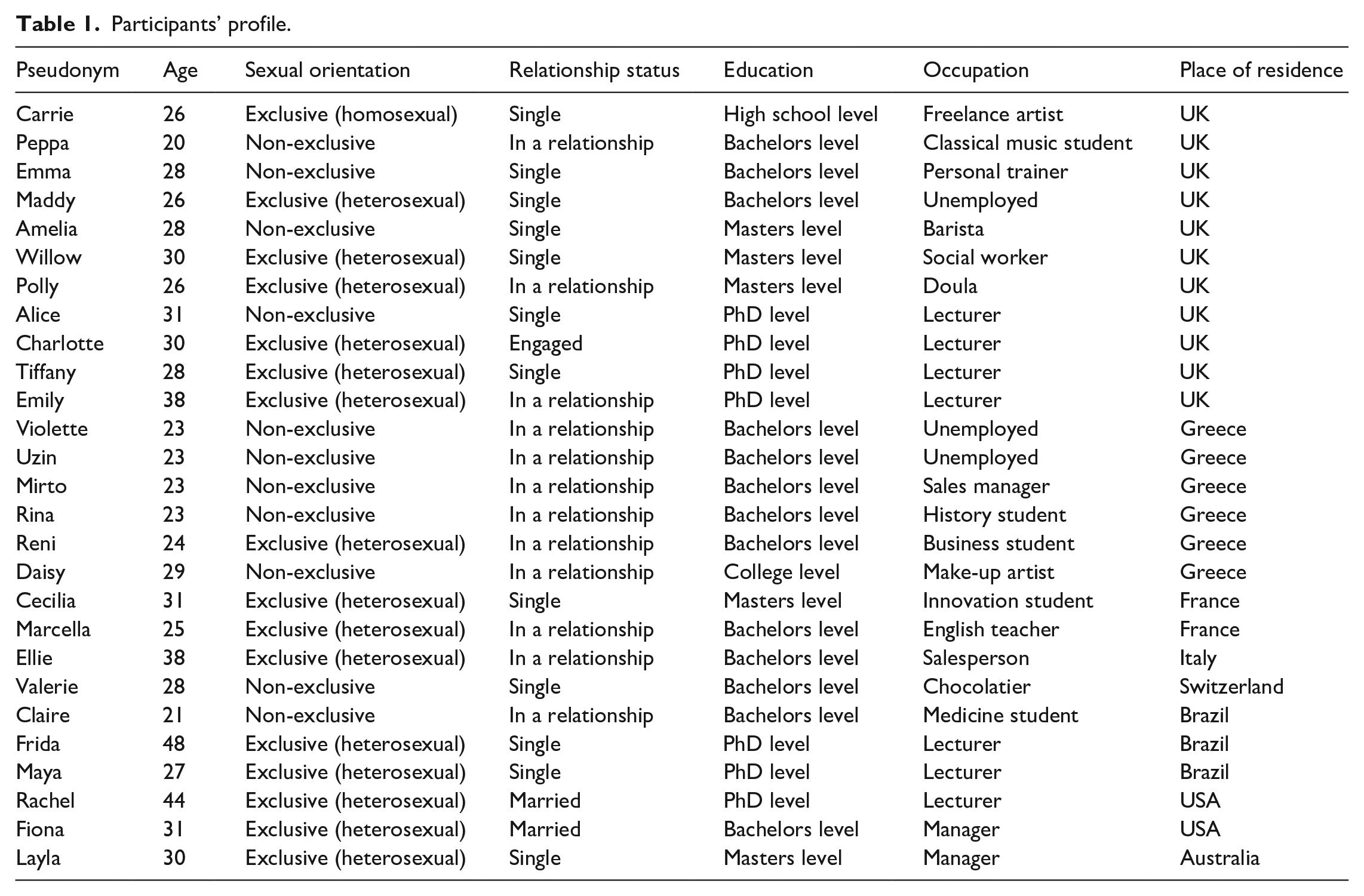
Regarding recruitment, we followed a mixture of purposeful and snowballing techniques (Patton, 2002); first, we reached out to initial informants through our personal networks. Afterwards, our initial informants introduced us to additional women who agreed to be interviewed. Our eligibility criteria were that participants had to be women who consume pornographic materials and are willing to share their experiences with us. All informants received a ‘participant information sheet’ explaining the aims of the research and the interview process and signed a ‘consent form’. Ethical approval was gained from the first author’s university.
Data Collection and Analysis Procedures
The interviews (up to 78 minutes; average interview: 50 minutes) were conducted by both authors and were audio recorded and transcribed. In-depth interviews (Denzin, 2001) were chosen to allow women to convey the meanings of their own experiences freely and to enable them to communicate the logic by which they understand pornography. As Smith (2012: 160–161) argues, in the study of pornography consumption ‘it is important to recognize the very individual personal histories that are intertwined with the sense-making and pleasures of pornography’. In the course of the interview, we used open-ended, non-directive questions and probes (McCracken, 1988) to build an in-depth understanding of our informants’ consumption of pornography. At the beginning of the interview we inquired about our informants’ sexual identities, sexual experiences, and sex life to understand ‘the context and sexual circumstances of the person consuming it’ (McCormack and Wignall, 2017: 979). We then moved on to discuss their consumption of pornography in more detail.
Our interviews, like all data sources in interpretivist approaches, were a part of an iterative circle that involved continuously moving back and forth between conceptualisation, data collection, data analysis, and theory building (Dey, 1993). As such, our findings emerged inductively, following a modified grounded theory approach (Charmaz, 2014). Both authors employed a constant comparative logic of analysis (Glaser and Strauss, 1967): we first coded the interview transcripts independently, and then discussed and developed our emerging codes into axial and selective codes. As our research progressed, we revised our initial set of codes and categories by engaging with prior theory to achieve a higher level of abstraction (Urquhart, 2013). Through this process, we were able to produce a theoretical storyline grounded in and driven by our empirical data. We ceased data collection when theoretical saturation was reached.
Findings
In this section, we show how our informants (1) use pornography in order to reach a state of pleasure (exercise of fantasy, sexual gratification), and perfection (optimal way of performing sex); (2) react towards pornography that reproduces and promotes patriarchal discourses of sexuality; and (3) use pornography to cultivate a renewed and refined understanding of female sexuality.
‘Always Been My Own Activity, My Own Pleasure’: Locating Pleasure in Pornography Consumption
Our analysis reveals that consuming pornography is an important means through which women enact their sexual fantasies, learn, and experiment with their bodies and partners (Ashton et al., 2019; Attwood et al., 2018). Regarding fantasies, our informants find that pornography can satisfy sexual situations that they have not yet explored, or do not necessarily wish to explore in their real lives: ‘not the kind of sex that I would like to perform in real life, but pornography is the outlet of some fantasies, maybe as an exploration of desire as well’ (Alice). Rina discusses further: In the content that I watch, I am no longer self-conscious about it. As a young girl, I had the impression that what you watch is what you want to do, and I was like. . . ‘I don’t want to do it, why do I like to watch it?’ Now I understand that this isn’t the case, you can watch something that you wouldn’t do, that excites you to watch.
As Rina says, pornography is seen as an outlet for fantasy, and not a reflection of real-life sex. It is evident that what Rina watches differs from her real-life desires and experiences, as in Willow’s case, who identifies as a straight woman: ‘I watch a lot of lesbian porn, and I’ve never had sex with a woman.’ Violette makes a similar comparison by stating that her porn tastes would not appeal to her in real life: I have a specific fantasy which has nothing to do with my real actions and life. [Although] I am looking for affection in my sexual experiences [. . .], the porn that I usually choose is [. . .] for example, group sex with 30 men and one woman [. . .] and that is something that helps me to come. So, I choose to watch that. Despite all my actions in real life.
Interestingly, for our informants finding pleasure in pornography was not impeded by not being able to identify with certain erotic narratives (Sonnet, 1999; Wilson-Kovacs, 2009). These interviewees used pornography in a moment of solitude (Smith, 2007), and as such, they did not seem to consider the consequences of consuming pornography. They justified their usage as a moment of fantasy, where, for example homosexuality and sexual domination were equally stimulating despite being separated from real-life sexual practices.
Our analysis also shows that women use pornography purely for sexual gratification. Violette sums up the utility of pornography for masturbation: ‘Porn helped me to come very easily, every time that I wanted to masturbate, I would watch porn, and I needed porn to come.’ Willow elaborates: I use porn in a very functional way, like it’s not something I would put on my TV and relax and settle in for the evening or for an hour, it’s just not what I would use it for. [. . .] I’ve always used it in a very functional way.
Willow’s narrative illustrates that watching pornography is a short-lived practice (McCormack and Wignall, 2017). She finds that pornography can be used as a resource for quick arousal that does not require any particular effort. Alice’s experiences also show the instrumentality of porn, but for her it is also useful for relaxation: [It] has always been my own activity, my own pleasure, and it’s also, an instrument for when I’ve had a long, rough day, I feel really tense, and the only thing I want is to relieve some physical tension and therefore I decide to masturbate, and the easiest thing for me to do is to masturbate and log on to one of those websites.
Although our informants mostly consume pornography alone, our interviews revealed that they also use it with partners in order to experience joint pleasure (Böhm et al., 2015). Emily elaborates: Sometimes we do this with my husband, so this would be, not most of the time, but this would be like a pre-start for us, before having sex, so we are quite happy seeing other people doing what we are going to do in a couple of minutes.
Emily and her husband use pornography as a form of foreplay that provides an addition to their ‘typical’ sex life and spices up their sexual encounter (Attwood et al., 2018). Similarly, Polly states: ‘just for something different, like, not all the time, but it’s just “why don’t we put something on?”’. Unlike Wilson-Kovacs (2009), we found no evidence of porn usage aiming solely to please a (male) partner. Yet, our informants expressed that during joint consumption, they choose material that will be enjoyable for both partners. Peppa explains: I think it’s been something that I’ve picked, but it wasn’t necessarily something that I would have picked if it was just me, I’d pick something that would try to incorporate both of us in that I know that they would like that as well if that makes sense.
In this case, choosing material needs to reflect both partners’ preferences in order to ensure that they will both have a pleasurable experience. As Peppa states, this process requires a degree of flexibility and compromise.
Finally, in line with prior research (e.g. Albury, 2014; Attwood et al., 2018; McCormack and Wignall, 2017), our informants spoke of the educational merits of pornography. Our analysis reveals that women are using pornography in order to become conscious about female sexuality, its experiences and its limits. Daisy explains:
I began to have a sex life, and I wanted to learn new things that I didn’t know, to see what the others were doing, it started from curiosity.
Do you remember what kind of categories you used to choose, when you wanted to learn new things?
I had tried everything. Not all the videos but from every category, but I watched many videos. I think I was interested in everything, to watch and learn.
Pornography helped Daisy to understand what sex entails and enabled her to develop a sexual repertoire by browsing different porn categories (Gurevich et al., 2017). Learning how to satisfy sexual needs and how to perform sex was essential for our informants, as Mirto suggests: It wasn’t for my pleasure, at all. It was all about sex education. About positions and how can I do all these things to stimulate someone else. For instance, I remember trying to learn about blowjobs. And also, learning about sex positions was quite important to me.
Mirto explains that she used pornography to discover different sexual techniques (Parvez, 2006), as for her, ‘it was all about sex education’. Similarly, Tiffany explains: ‘I was watching in an informative kind of manner [. . .] I think I was just watching to see what they were doing, what is sex, why are they doing it, how they feel pleasure.’
In essence, pornography consumption was part of our informants’ cultivation of a sexual self (Foucault, 1985); it related to bodily pleasures and also provided a road-map for our informants, who used it as an educational tool (Albury, 2014) through which they could figure out how to achieve and give pleasure.
‘I Think They Take Pleasure in Seeing That They’re Forcing the Woman to Do Something’: Contested Pornographic Representations
Our informants understand that pornography is a locus where sexuality is specified and disciplined (Foucault, 1984). As such, they react towards pornographic materials that reproduce and promote patriarchal discourses of sexuality. For example, Valerie explains why consuming pornography can be quite complicated for women: Pornography is a product that I consume, and I’m not really shy about it, but it’s a very broad and difficult world to navigate for a woman, because right now, the way it is presented in [the] mainstream [porn industry], you can stumble into endless unpleasant things. I think it’s something that is pretty male-dominated.
According to Valerie, pornography is a male-dominated genre and the male-gaze (Mulvey, 1975) is ever-present in the majority of pornographic materials. Our informants recognise that in those, women are mostly presented as sexual objects for erotic contemplation (Hardy, 2000). Another interviewee, Emma, describes what she understands to be a male-centred approach in pornography: I definitely say it’s much more intense, I guess there’s much more demoralisation, it’s much rougher, it’s very, for the male lead role, they’re kind of taking control, and that’s this kind of one-sided almost relationship, and it’s very hardcore.
Emma’s take illustrates that certain pornographic materials prioritise male pleasure (Ashton et al., 2019). She argues that the performance becomes almost entirely a one-sided pursuit of pleasure. In this scenario, the sexual satisfaction of women is inconsequential, and as such, it is not surprising that many informants have used terms such as ‘submission’ (Ellie), ‘degraded and mistreated’ (Uzin), ‘normative, heteronormative scheme of things’ (Violette), ‘male attitude’ (Alice) and even ‘humiliation’ (Cecilia) to reflect on women’s role in certain pornographic materials.
However, when interviewees were prompted to describe further what they did not like about the genre, they emphasised the representation of women’s pleasure. Our informants argued that male pleasure is usually better represented than female pleasure in the genre (Ashton et al., 2019). Violette explains: This is a big deal for me. The way women are represented in porn is more male-centric. And also, through porn you can see men’s pleasure as a more important aspect. It’s like men use women for their pleasure. Porn is over when the man comes, until his orgasm.
In Violette’s case, the sexual act and the pleasure derived from it are contested. As Willow puts it: ‘[the woman] doesn’t look like she’s having a good time’. Both excerpts indicate a general perception that women are ‘faking’ or ‘acting’ their pleasure for the male audience. These impressions have been discussed elsewhere (Neville, 2015, 2018) as examples of how the male-gaze in the genre results in inauthentic representations of female pleasure. As the perception of authenticity is what makes pornography feel ‘real’ (Hardy, 2009), the lack of it causes frustration, or even boredom (Smith, 2007). Emily describes how she knows that women’s pleasure is ‘fake’: You can tell that the women are pretending, that they don’t like it so much. The way that they are coming on an orgasm, the way that they are looking at their partners, the way that they masturbate sometimes. I think it’s more the expression on the face that is fake.
Emily finds that women’s arousal, facial expressions, and movements do not reflect her understanding of how most women experience pleasure (Ashton et al., 2019). In addition, when it came to expectations of sexual performance, our informants compared depictions of sex in porn with their own personal experiences. For example, Peppa states: ‘Some women can orgasm really quickly, but I think it’s unrealistic a lot of the times how quickly women can orgasm, and obviously everyone is different but things like orgasming together, that’s not super realistic.’ Peppa’s quotation illustrates how perceptions of authentic versus fake reactions during certain sexual practices highlight the discrepancy between real-life sex and sex in pornography (Gurevich et al., 2017). Picking up such discrepancies hinders women’s identification with the actors and makes it nearly impossible to concentrate on the erotic narrative.
Our informants also discussed other elements that are considered fake, such as body types: ‘the female figure is flawless, it is less real somehow’ (Daisy), with the idea of ‘less real’ being described by Emily as ‘huge boobs, huge ass, everything huge’. Our interviewees find that the ‘typical’ body type in mainstream pornography is fetishised, which increases their misidentification with the aesthetics of the genre. Rina discusses why it is impossible for her to identify with certain porn actors: The average woman when she is having sex, she is sweaty, her make-up is gone, most of them don’t have those long nails, it really seems so fake to me. When I watch mainstream porn videos, I don’t watch famous porn stars who look stunning because it’s fake, I can’t be excited, I can’t identify with them.
Rina highlights once again how women’s representation in certain pornographic materials deviates from women’s experiences in real-life sex. Here, she talks about both bodily reactions (e.g. sweating) and body aesthetics (e.g. long nails).
A final point regarding the controversies around pornography relates to women’s awareness of scandals and abuses that happen in the porn industry (Ashton et al., 2018). Our informants have had some contact with criticisms of the industry through either reading (e.g. feminist books, feminist book clubs) or popular media (e.g. documentaries). For example, Charlotte notes: There’s been loads of articles, also by former porn actresses that actually found the years within the industry very harmful. Sometimes they caught diseases, but they had to continue working, and sometimes it was really horrible things, like anal prolapse, because they were doing things that are just plain unhealthy for the body.
Charlotte’s narrative illustrates her empathy with female porn actors’ experiences (Parvez, 2006). She talks of how these stories have complicated her understanding of the genre. Similarly, Carrie explains how empathising with female porn actors sometimes impedes her pleasure: It’s hard to separate the fact that some women do this as means to survive, and sometimes I’ve seen porn before where I’m, like, that doesn’t really look like she’s enjoying herself, is she having a good life? And then my head would get wrapped up in this thing, and worrying about her well-being, and it’s not fun.
Such criticisms of the effects of pornography for the social actors involved in it influence women’s interpretations of the genre. In general, we observed that our informants’ exposure to feminist and pop-culture discourses has affected their view of the porn industry (Ciclitira, 2004); it has made them more aware of problematic representations and more empathetic for actors’ well-being (Parvez, 2006).
‘I Found It Powerful Almost, Saying That I Watch Porn’: Pornography and Sexual Empowerment
Our analysis revealed that consuming pornography enabled our informants to cultivate a renewed and refined understanding of female sexuality and inspired them to perform it differently. For example, Rachel explains how pornography enabled her to confront societal expectations of desired female sexuality. In particular, her narrative about her first orgasm shows the role of pornography in understanding herself as an erotic subject, rather than object (Hardy, 2000): I think it helped me learn about my desires, my body, how I should touch myself, things I like, things I didn’t like [. . .] I think I learned to be more confident with my body, with my desires, with the things I want to do, with the things I want the guy to do with me. I think you have to accept and normalise sex [. . .] I had my first orgasm when I was 26, 27, really late, so why it took so long for me? And then, I think it was because of my environment, you know, girls don’t do that, they cannot have this kind of desire, they cannot have these kinds of pleasures, and when you see porn, there’s sometimes porn that you see very normal people, and think yeah, we can have this kind of pleasure, we can have this kind of desire, why not?
In Rachel’s case, watching pornography enabled her to cultivate a renewed understanding of how female sexuality can be expressed. She was able to redefine her perception of the kinds of desires, behaviours, and pleasures that women can experience by watching ‘normal people’ have sex. In that sense, pornography can ‘unlock’ aspects of sexuality that were previously unknown or suppressed: ‘It helped me to unlock aspects of my sexuality, to get to know [. . .] who you are’ (Rina).
Similarly, Peppa’s account highlights how the use of pornography for self-pleasure and discovery can be considered empowering. She compares watching pornography to using sex toys and argues that both can promote a positive and open outlook on female sexuality (Evans et al., 2010): I found it powerful almost, saying that I watch porn. Or, we’re, like, talking about it, especially in front of guys, it shocked people and I find it quite funny because why wouldn’t I have watched porn? And I think seeing women, masturbating or seeing women having sex, or going out of their way to have sex, I think it could help produce a positive outlook on having sex, and it’s okay to buy a vibrator if you want one, it’s okay to have a night in and just masturbate.
Peppa’s quotation also illustrates that women are often excluded from conversations about pornography and when they do participate, they are met with disbelief (e.g. ‘it shocked people’). In that sense, admitting to watching pornography can feel powerful because it allows women to perform their sexuality differently. It also normalises women as consumers of pornography and de-fetishises them as primary objects of erotic discourse (Hardy, 2000).
Peppa also highlights the importance of seeing female porn actors experience pleasure, as such behaviours can inform women’s subsequent sexual practices. In that sense, exposure to pornography can inspire women to resist dominant patriarchal notions of sexuality that prioritise male pleasure and discipline female pleasure (Williams, 1999). Cecilia explains her preference for materials with a ‘female-focused’ narrative: In the video that is made for the female audience, I think they make foreplay that it will be 50 per cent for her and 50 per cent for him. Like, he’s going to do oral sex, he’s going to have time, he’s going to pay attention, she’s not going to moan and scream all the time, she’s, like, having real pleasure [. . .] normal.
Cecilia’s outlook suggests that female-focused pornographic materials tend to pay equal attention to women’s and men’s pleasure. She finds that actors are conscious of each other’s pleasure and it is evident that they communicate during their sexual encounter. As such, female porn actors do not seem to be performing solely for the male audience (Neville, 2018). Carrie discusses further how this is achieved in amateur lesbian pornography: But I think you can just kind of tell how women are with each other, and I think that’s why I prefer to watch [. . .] amateur [porn]. They are actually in a relationship, because you can tell they are comfortable with each other, and that they have done this before, and they are very comfortable having sex and they know what they are doing [. . .] I guess because we’ve always had our sexuality oppressed, and we’re not really supposed to, you know, have these sexual feelings and desires, and we’re just supposed to be quiet, lie back and think about England or whatever, I think it can be empowering for women to take hold of their sexuality and use it, however they want, however they feel comfortable, so yeah, I think for some women it could be really empowering.
Carrie explains why this category appeals to her more than mainstream lesbian pornography by highlighting the importance of intimacy between actors as a signifier of authenticity (Hardy, 2009), and juxtaposing this type of pornography to societal expectations about female sexuality. According to Carrie, participating in amateur lesbian pornography can be empowering for women because it allows them to use their sexuality as they please.
Our analysis further indicates that our informants’ feminist beliefs have led them to engage with alternative pornographic categories, such as feminist pornography (Liberman, 2015). Women who understand and acknowledge the existence of this type of pornography tend to support it (Taormino et al., 2013). For example, one informant, Layla started to watch pornographic videos after having contact with feminist pornography. She explains why: Feminist pornography is more real. I can relate to it, because that’s how we have sex. There’s also a focus on the guy, and it’s not all about huge dicks, it’s more about the conquest of it, I would also say the positions and whatever, it’s not as radical and well, acrobatic and whatever, it’s something that you could do at home, and the focus, the camera, is not only directed on penetration, but on the whole thing. If you see the couples, they are real couples that are doing it, so you have the tenderness, exchanging love, something much more natural. [. . .] in feminist porn, they usually wear condoms, so it’s more realistic, and it’s something about preventing diseases as well.
Layla finds that feminist pornography represents more accurately real-life sex and hence she feels that she can relate more to it. In that sense, the erotic narratives represented in feminist pornography, although mediated, depict a more ‘authentic’ sexual performance (Hardy, 2009). Invoking notions of ‘authenticity’ and ‘realness’ here helps to decode and differentiate feminist porn from mainstream porn. As such, the director and the way she appropriates feminism in her work play a central role (Liberman, 2015). For example, Layla mentions condoms, while Uzin explains that ‘positions and the power dynamics are different’. Amelia explains further: I can see the women are more empowered, the vision of women is different. In mainstream porn, or at least in what I watched, the focus is on men’s pleasure, and women [. . .] don’t have the power, don’t show it as much, whereas in this other kind of porn there’s another kind of frame, the images are different, the focus is on something else rather than a man fucking a woman and nothing else.
Our informants’ comparisons illustrate how feminist directors are reclaiming and redefining pornography (Taormino et al., 2013). According to Amelia, these types of pornographic materials empower women because in them women are given agency and power, and thus are not represented as passive erotic objects (Hardy, 2000).
Discussion
Our aim was to provide an in-depth understanding of the role of pornography in the construction of female sexuality. Building upon research that moves beyond the ‘negative effects paradigm’ in the study of pornography (Attwood, 2002; Comella and Tarrant, 2015; Hardy, 1998, 2000, 2015; McCormack and Wignall, 2017; Paasonen, 2011; Williams, 1999), we showed that consuming pornography is both disciplining and empowering for women. Our informants recognise that pornography reproduces and promotes patriarchal discourses of sexuality, but they manage to use it in order to reach a state of pleasure (exercise of fantasy, sexual gratification) and perfection (optimal way of performing sex). We also show the role of pornography in cultivating a renewed understanding of female sexuality and thus its role in enabling our informants to perform it differently. In this process, aspects of the genre are questioned, negotiated and reconciled in order to continue using pornography to satisfy desire. Our findings also show that women re-articulate the dubious and contradictory meanings that emanate from this controversial genre to align the pleasure they derive from pornography with its meanings in their lives.
It is important to note that all our interviewees were open to talk about pornography and have had contact with at least some feminist discourses, even if only through pop culture. However, we believe that with the pervasiveness of feminism in pop culture (Munford and Waters, 2014), these types of discourses will spread to other social strata. In our study we did not unpack cultural differences in women’s consumption of pornography, therefore future research could aim to provide a better understanding of how women from different cultural backgrounds engage with pornography. Finally, we did not aim to provide a generalisable conceptualisation of pornography consumption. Our study is exploratory and given our sampling strategy, future research is needed to examine if our findings are generalisable to different demographic groups.
In line with other qualitative research (e.g. Ashton et al., 2018, 2019; Attwood et al., 2018; Parvez, 2006) this study showed that women use pornography in different ways: to exercise fantasy, for sexual gratification (solo or with partners), and for learning how to give and achieve pleasure. While much of the previous literature has focused on demarcations that set apart women’s from men’s consumption, we find that women use pornography in a fairly similar way to men as reported in recent studies (McCormack and Wignall, 2017). Prior research suggests that women are able to identify more with the erotic narratives in erotica (Chowkhani, 2016; Hardy, 2009; Wilson-Kovacs, 2009) or other alternative porn categories (Neville, 2015, 2018), and therefore tend to prefer them. Our study, however, shows that women also find pleasure in mainstream pornography, including hardcore categories, even though they do not always identify with the actors and stories. We find that porn tastes can be quite different from real-life sexual preferences. Consuming pornography in that sense allows women to explore sexual practices that they have not experienced in real life or do not necessarily intend to mimic (Gurevich et al., 2017). As such, when women use pornography to stimulate their imagination, they do not consider the consequences of watching sexual acts that would be undesirable in real life. Pornography, thus, is a source of experimentation and education (Albury, 2014) for women. Our informants have learnt a lot about female sexuality, its experiences and its limits through porn, and it enabled them to develop a sexual repertoire and to discover different sexual techniques (Parvez, 2006).
The undeniable cultural reach of pornography (McNair, 2013) renders it, in Foucauldian terms, a point of knowledge, power, and truth where sexuality is specified and disciplined (Foucault, 1984, 1985). Pornography provides powerful sexual scripts and templates of behaviour for modern sexual subjects in which male and female pleasure is articulated. In line with other studies (Ashton et al., 2018, 2019), we find that women have reservations about the representation of female pleasure and are conscious of the male-gaze (Mulvey, 1975) in pornography. According to Gurevich et al. (2017), women’s enjoyment of pornography despite their reservations poses ideological and aesthetic dilemmas. Inauthentic and inaccurate representations of female pleasure, bodily reactions, and body aesthetics cause women to feel uncomfortable in knowing that their sexuality is influenced by the genre. Whether embraced or contested, consuming pornography is implicated in the ordering and re-ordering of women’s pleasure. As such, the erasure or misrepresentation of female pleasure profoundly impacts on women’s sensemaking of porn-sex and the pleasure derived from it. Contestations of pornography in feminist and pop-culture discourses further taint women’s view of the genre, both in terms of women’s representations and actors’ well-being (Ciclitira, 2004; Parvez, 2006). In that sense, engaging with pornography becomes a controversial consumption practice.
Our study also relates to wider feminist debates about female sexuality, ‘empowered eroticism’, and politics of choice and consumerism (Attwood, 2007; Evans et al., 2010; Glick, 2000). Although our informants did not position their porn consumption within a post-feminist discourse, they discussed the role of pornography in feeling sexually empowered. Consuming pornography enabled them to cultivate a renewed and refined understanding of female sexuality and inspired them to perform it differently. Pornography also helped them to understand themselves as an erotic subject, rather than object (Hardy, 2000). Our informants argued that their engagement with the genre helped them to acquire a more positive and open outlook on female sexuality. However, as Gavey (2012: 719) argues, ‘feeling empowered is not necessarily the same as being empowered’. The conditions that enable sexual agency are also actively (re-)produced through institutions that specify and discipline (female) sexuality (Foucault, 1984, 1985). As such, when we consider women’s pornography consumption, it is important to acknowledge that female empowerment is ambivalent and multidimensional (Peterson, 2010). Women who consume pornography can feel empowered on one level (e.g. feel sexual pleasure) and disciplined on another level (e.g. internalise a ‘pornified’ version of sexuality).
Footnotes
Funding
The authors received no financial support for the research, authorship, and/or publication of this article.
