




Abstract
This article responds to dual calls for researching and theorising everyday social phenomena in postcolonial studies on the one hand, and serious engagement with the postcolonial within the discipline of sociology on the other. It focuses on the everyday lives of asylum seekers living on asylum seeker welfare support in the UK. Asylum seekers offer a good case study for exploring the postcolonial everyday because they live in poverty and consequently experience daily harms at the hands of the state, despite the UK fulfilling its obligations to them under human rights law. The article proposes a conceptual framework drawing together sociologies of the everyday, necropolitics and slow violence in tracing how hierarchical conceptions of human worth impact on the everyday.
Introduction
Over the past two decades governments across Europe, and indeed the Global North more broadly, have pursued immigration policies which seek to exclude migrants arriving from the Global South, and foreign policies which seek to contain them in their countries of origin (Achiume, 2019). There are a growing number of scholars working from broadly postcolonial perspectives who are drawing attention to the ways in which extreme forms of border violence, in the Mediterranean and at the French/British border for example, are not new (e.g. Davies et al., 2017; Saucier and Woods, 2014). This work collectively argues that the necropolitics (Mbembe, 2003), of allowing boats to sink, closing borders, detaining adults and children who are seeking refuge from persecution and burning down spontaneous camps occupied by homeless migrants amount not only to the violation of human rights, but more broadly point to a general consensus among politicians and publics that some human lives are worth less than others. The postcolonial intervention is to theorise such phenomena not as new, or as contra to liberal western values, but as the logical contemporary expression of historically embedded colonial/modern, racially hierarchical worldviews which have their roots in colonial enterprise (see Mayblin, 2017; Mignolo, 2009).
What has been less well theorised is how these hierarchical conceptions of human worth impact on the everyday. Indeed, we are more broadly lacking a way of conceptualising the postcolonial everyday beyond the realm of the cultural (Farrier, 2012; Procter, 2003). How might we recognise and conceptualise the ways in which the everyday lives of migrants of precarious status, and particularly asylum seekers and the undocumented, are cut through with the same logics of unequal humanity? 1 In answering this question this article focuses on the everyday lives of asylum seekers living in the UK and proposes a conceptual framework drawing together sociologies of the everyday (e.g. Sztompka, 2008), necropolitics (Mbembe, 2003) and slow violence (Nixon, 2011). In doing so the article responds to calls for researching and theorising everyday social phenomena in postcolonial studies on the one hand (Procter, 2003), and serious engagement with the postcolonial within the discipline of sociology on the other (Bhambra, 2016).
Asylum seekers offer a good case study for exploring the postcolonial everyday because many are close to economic, social and cultural death at the hands of governments who nevertheless subscribe to human rights law. In the UK successive governments have restricted the welfare and working rights of asylum seekers in order to reduce economic ‘pull factors’ which are thought to attract disingenuous applicants (Mayblin, 2016). Though there is no empirical evidence that welfare or work act as pull factors (Mayblin and James, 2016), a series of legislative acts have nevertheless been passed which have prevented asylum seekers from accessing the labour market, have moved them out of the mainstream benefits system and have steadily decreased the levels of financial support paid to those going through the asylum system. While policy programmes focused on the reception of asylum seekers are meant, within the framework of human rights law, to protect, some other unspoken logic makes the systematic impoverishment of asylum seekers – living in poor housing, banned from working, dependent on meagre welfare support payments – acceptable. In order to access support individuals must be able to demonstrate that they are destitute. The rate of financial support (known as ‘Section 95’ support) was, at the time of this research, £36.95 per person per week (since increased to £37.75). This figure was determined on the basis of what the poorest 10 per cent of the British population spend per week on essential living items only (Mayblin, 2017). If we accept the premise that the poorest 10 per cent of the population are living in poverty, since their income is below 60 per cent of the median income (the poverty line), then it appears that the UK Home Office are taking ‘essential living needs’ to entail the bare minimum to enable survival irrespective of whether an individual is surviving in poverty.
Empirically, this article explores the everyday effects of this policy regime. It reports on interviews with asylum seekers living on ‘asylum support’ welfare payments in a city in the north of England. Interviews focused on the fabric and routines of their everyday lives, because marginalisation is so often experienced and felt at the banal level – eating, washing, travelling and socialising. The everyday has long been a key concern of sociology, and recent years have seen a renewed interest in the quotidian within the discipline (Neal and Murji, 2015; Pink, 2012; Sztompka, 2008). This turn to the everyday entails focusing on ‘what really occurs in human society’, at a level somewhere ‘between structures and actions’ (Sztompka, 2008: 26). It is here that: the constraints of structures and the dynamics of actions produce the real, experienced and observable social events, the social-individual praxis making up everyday life, in fact the only life that people have, which is neither completely determined nor completely free. (Sztompka, 2008: 26)
Much of this work is interested in making the everyday extra-ordinary in order to see it with fresh eyes (Pink, 2012). It is partly in the everyday, then, that the dehumanising effects of public policies can be observed.
At the same time as presenting new empirical data, this article develops a conceptualisation of the postcolonial everyday that can be operationalised within the social sciences, which in turn contributes to the burgeoning body of work on the sociologies of the everyday. Work on the everyday within sociology is littered with the words ‘mundane’, ‘banal’ and ‘ordinary’. But ‘ordinary’ cannot be equated with ‘harmless’. An important contribution of sociologists of the everyday has been to render this ordinariness analytically significant. For the participants in this research, the everyday is a site of intense harm, of slow violence (Nixon, 2011). These narratives of the everyday are discussed in relation to Mbembe’s theory of sovereignty as necropolitics. As Neal and Murji (2015: 813) have argued, the power of the sociology of the everyday is in seeing the ‘big’ in the ‘small’, the fact that everyday ‘practices, emotions, social relationships and interactions also reflect convergences with and manifestations of wider social factors, forces, structures and divisions’. It is through these narratives of the everyday lives of asylum seekers, we argue, that we can see the logics of postcolonial necropolitics at work in the slow violence inflicted upon them.
The Postcolonial Present
The atrocities which occurred in Nazi Germany, and the absence of a legal onus on other European states to offer protection to those fleeing the regime, precipitated the drafting of new international laws securing the rights of human beings, irrespective of their ethnicity, religion, gender, age or the colour of their skin. Yet many have observed that access to human rights is uneven in the present, and that the human rights framework was exclusionary at its inception (Mayblin, 2017; Mignolo, 2009; Simpson, 2004). The colonial powers went to great lengths to limit the access of colonised peoples and people of colour to human rights as they were originally being drafted. As decolonisation unfolded many formerly colonised countries added the names of their countries to the human rights conventions, and fought for, and gained, the right to asylum for non-European refugees in 1967. And yet, the legacies of ideas of human hierarchy, which made the exclusion of millions of people from ‘human’ rights during the late colonial era, live on. The governance of international migration today therefore amounts ‘to multilateral projects for the regional containment of Third World persons beyond the First World’ (Achiume, 2019: 7).
This project of regional containment makes sense within the context of 500 years of colonial enterprise which established and cemented norms of human hierarchy. The idea that some societies are modern (ahead), while others are traditional (behind) and need to catch up or ‘develop’ is one which originated in and through the Enlightenment. This is what decolonial scholars, following Anibal Quijano (2000), term coloniality/modernity – the way in which the colonial worldview (coloniality) went hand in hand with the idea of First World modernity. It has been argued elsewhere that not only are whole countries and regions of the world deemed ‘unmodern’ and therefore ‘backward’, racially and culturally alien to Europe, but that this is also embodied – migrants seeking sanctuary are often racialised and thus imbibed with unmodernity (Mayblin, 2017). Their lives, then, are more easily expendable, they are more easily impoverished, detained without charge, socially, culturally and physically excluded. Importantly, this logic is internal to liberal western values, not a denigration of them. While in this earlier work Mayblin (2017) looked at policy programmes, she did not take the analysis down to the level of the everyday lives of asylum seekers. Indeed, postcolonial studies more broadly has been accused of neglecting the everyday (Procter, 2003), just as sociology has been accused of neglecting the postcolonial (Bhambra, 2016).
Some scholars of refugee studies have applied the concept of ‘bare life’ to the everyday as Agambian perspectives have grown in popularity. From this perspective asylum seekers are included through exclusion (Agamben uses ‘the camp’ as the focus of his analysis) and are consequently reduced to ‘bare life’, nothing more than biological life (see Darling, 2009 for an overview). And yet, as Davies and Isakjee (2019) point out, such perspectives are often dehistoricised and particularly disconnected from colonial racialisation. They argue in their discussion of the Calais migrant camp that it is the fact of being ‘kept alive but in a state of injury’ (Mbembe, 2003: 21), the spatial exclusion and the being exposed to gradual wounding which characterises such contemporary camps, as opposed to outright extermination. Indeed, since the political violence against people of colour in the colonies was racist, was routine, and did not (often) aim at genocidal murder, a comparison with everyday colonial violence makes more sense than a comparison with the extermination camps focused on by Agamben. In this article, then, it is Mbembe’s work on necropolitics which, we argue, offers the most adequate framework for analysing narratives of everyday life on asylum support in the UK.
Necropolitics is concerned with ‘those figures of sovereignty whose central project is not the struggle for autonomy but the generalised instrumentalisation of human existence and the material destruction of human bodies’ (Mbembe, 2003: 14). In a 2003 article in Public Culture, Achille Mbembe built upon Foucault’s conception of ‘biopolitics’ but argued that in eliding histories of colonialism, the concept of biopolitics is impoverished. He wrote that ‘race’ is often the principle marker of subjectification and within this context ‘power (and not necessarily state power) continuously refers and appeals to exception, emergency, and a fictionalised notion of the enemy. It also labours to produce that same exception, emergency, and fictionalised enemy’ (2003: 16). This is made possible, as discussed above, as a consequence of the embodiment of unmodernity within a hierarchical conception of the human.
For Mbembe, the structure of the plantation system and its aftermath ‘manifests the emblematic and paradoxical figure of the state of exception’ (2003: 21). Enslaved people were ‘kept alive but in a state of injury, in a phantomlike world of horrors and intense cruelty and profanity’ (2003: 21). As others have observed (most notably Edward Said), colonial occupation involved the production of a ‘large reservoir of cultural imaginaries’ (Mbembe, 2003: 25). These imaginaries were not just cultural, however, they ‘gave meaning to the enactment of differential rights to differing categories of people for different purposes within the same space’ (2003: 25). In the context of colonialism ‘sovereignty means the capacity to define who matters and who does not, who is disposable and who is not’ (2003: 27, emphasis in original), and ultimately, necropower works towards ‘the creation of death-worlds, new and unique forms of social existence in which vast populations are subjected to conditions of life conferring upon them the status of living dead’ (2003: 40, emphases in original). Necropolitics, then, is aptly applied to Europe’s contemporary migrant camps.
What we are interested in here, is how these logics of human hierarchy extend not only to those physically and politically marginalised and subject to very real bodily violence, but how states can also be seen to deploy these same definitions of who matters and who does not in the contemporary postcolonial moment, while fulfilling their legal obligations to those making an application for asylum. These legal obligations are therefore fulfilled to an absolute minimum, to a point where asylum seekers are merely prevented from physically dying, though often with long-lasting consequences. They are, in many cases, being ‘kept alive but in a state of injury’ (Mbembe, 2003: 21). The outcome is a form of slow violence (Nixon, 2011). That is, ‘violence that occurs gradually and out of sight [. . .] an attritional violence that is typically not viewed as violence at all’ (Davies and Isakjee, 2019: 214). If necropolitics is, in its most visible form, governing through death, slow violence is both its mode of operation and its effect at the level of the everyday. Indeed, the concept of slow violence allows us to make sense of the extent of the harm done by the state, within the context of that state still meeting its human rights commitments. In the next section we sketch out what this looks like in relation to UK policies of asylum seeker welfare support.
Method
This article draws on qualitative research data gathered as part of a larger ESRC funded project looking at the economic rights of asylum seekers in the UK. Thirty semi-structured interviews were conducted in late 2017 with asylum seekers who were in receipt of Section 95 support and who resided in one city in the north of England. The interviews lasted on average one hour and were conducted in the interviewee’s first language in a location of their choosing. Three refugee community researchers (authors 2 and 3 and a fourth researcher who has chosen not to be named) who respectively spoke Arabic, Farsi and Amharic conducted the interviews. The community researcher approach recognises that those who have traditionally been viewed as research objects in fact ‘possess skills, knowledge and expertise that can enable them to make a wide range of valuable contributions to research projects’ (Goodson and Phillimore, 2012: 3). Interviewers in this project had themselves been through the asylum system. They had insider knowledge about everyday life on asylum support, were able to contribute to improving the interview questions to ensure that they were culturally appropriate, adapted them to their linguistic communities and were able to access potential interviewees who would otherwise have been ‘hard to reach’. These interviewers received training in qualitative interviewing as well as ongoing mentoring and support through the course of conducting the interviews. This approach is not without weaknesses. The PI (Mayblin) was not able to recruit a female researcher, for example. Female interviewees seem to have been honest in their answers but of course it is not possible to know what they may have held back.
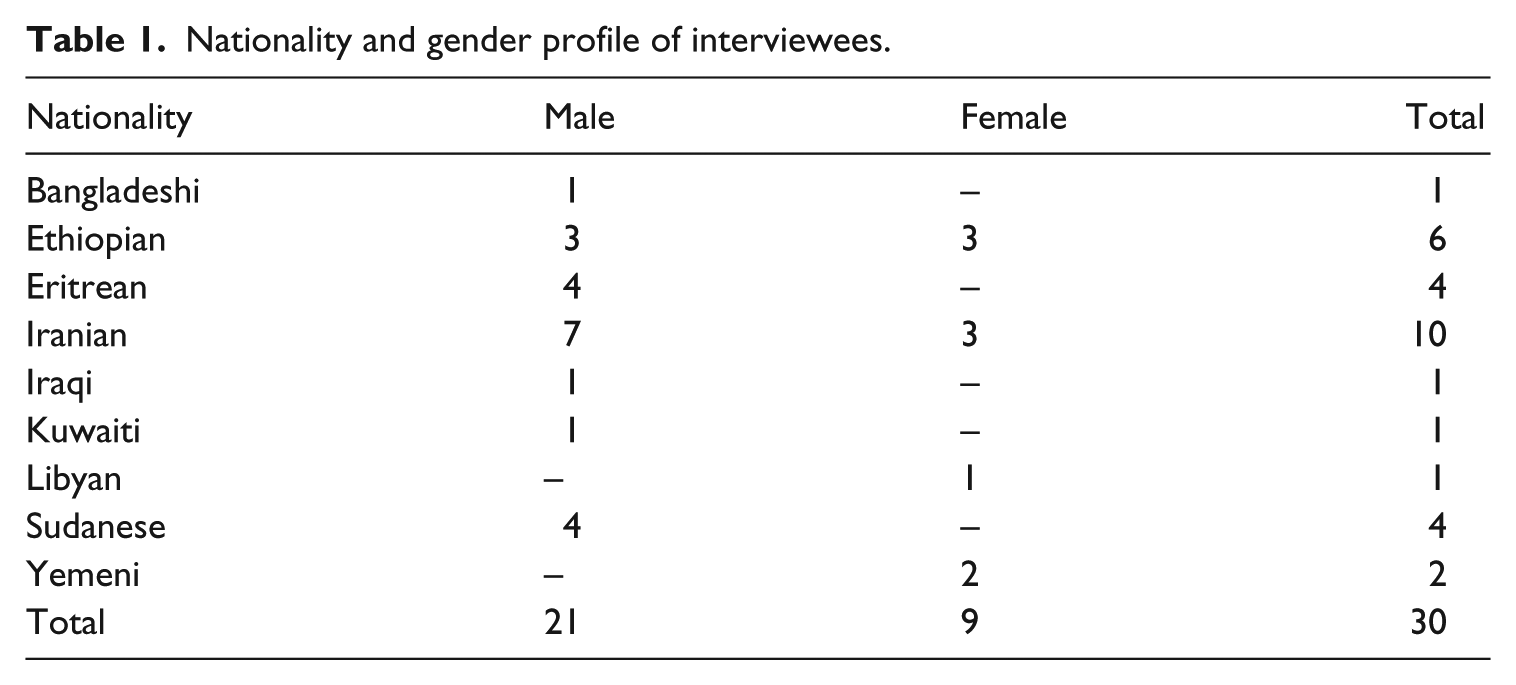
Interviewees were initially approached by the refugee community researchers at an asylum seeker drop-in centre, after which a snowballing approach was used with an additional target of three female interviewees per language group. Sometimes asylum seekers can be nervous about being interviewed by co-nationals but our interviewees were under no pressure or obligation to be interviewed and in fact all seemed very keen to share their experiences and views on asylum support in the UK. Table 1 shows the nationality and gender profile of the interviewees as disclosed at interview. The sample includes a range of nationalities and a third of the interviewees were female. Because of the fact that Arabic is spoken in more countries than Farsi and Amharic, the Arabic-speaking researcher interviewed a broader range of nationalities than his Farsi- and Amharic-speaking counterparts. Interviewees had been living on asylum support between one month and five years at the time of interview. Nineteen of the 30 interviewees had been on asylum support for over six months; of those 10 had been on asylum support for over 12 months. They ranged in age from 19 to 53. This was the only personal information that was directly asked for. In the interest of minimising harm, the aim was to make the interviews as little like a Home Office interrogation, and as much like a conversation, as possible.
Nationality and gender profile of interviewees.
Once transcribed, interviews were coded using Nvivo software in a multi-layered approach. First, according to particular aspects or sites of the everyday: transport, food etc. Second, on emerging themes (e.g. survival strategies, dehumanisation). Third, cross-cutting themes around necropolitics and slow violence.
Everyday Life on Asylum Support
Interviewees were asked about their everyday life on asylum support, exploring the themes of food, clothing, everyday transportation, grooming and toiletries, and socialising. These themes are of course all interlinked in complex ways. Through the descriptions of these apparently mundane topics, interviewees described the intense harms experienced at the level of the everyday. Every area of everyday life was discussed and described as a source of stress and anxiety. In this way the necropolitics of control enacted through slow violence at the level of the everyday was ever present.
Shopping
Interviewees explained how challenging everyday life is while living on such a constrained budget. They went into great detail about the plan that they have devised for living on this limited income. Budgeting includes a whole host of other related skills including being able to find the cheapest goods, shopping in different shops for different items and sharing this knowledge with others: We are living with minimum of everything. We had a friend here and he was very good at knowing where to buy different things, for example he knew that we can find tuna in Poundland for £1 but in Tesco it’s £1.50; so, we were buying tuna from Poundland not Tesco. If a pack of tuna was £1 and there were 5 inside, then we share it between 5 people and everyone had to pay only 20p. (Kamran, Iranian, M)
Interviewees emphasised how being careful with one’s budget is vital, which can make spending as little as possible very time consuming. An unexpected expense could trigger a budgetary crisis: Yesterday, I went to [the shop] to buy some food for £10, when I wanted to pay for the food the shopkeeper told me it is £18. I spoke with the shopkeeper about the prices and he said the prices on some items are wrong that is why you have to pay £18. Now (Wednesday), I have only £17 or 18 for the rest of the week. So, now I am very restricted financially as I can’t make any phone calls or anything like that. (Gabriel, Sudanese, M)
When comparing their life at home to their life now, all but one said that though going home was not an option owing to the persecution that they faced, their everyday life back home was better. Often this was articulated in terms of being free to buy simple things such as food and toiletries without worry: It affects me from every single aspect of my life. For instance, I used to buy whatever I wanted when I was in Iraq because I had enough of money to do that. However, I am now restricted and can’t buy what I want [. . .] Yes, it was much better before what happened in Iraq. (Shahram, Iraqi, M)
Having crossed the line of modernity (the line between ‘being’ and ‘non-being’ in Fanon’s (1967) terms) the respondents did not, then, encounter greater civilisation, but were faced with the everyday articulation of a hierarchical view of human worth and the extent to which the British state was willing to tolerate their suffering.
Food banks are one option for people on a limited income. Around half of the interviewees had visited them but all raised the emotional toll of feeling ashamed: It is the worst feeling. You know when I go there, I feel like I am a thief. I don’t want anyone to see me especially the Libyans because I don’t want them to say I am a refugee. (Fatima, Libyan, F) It is a feeling of death [. . .] Believe me it felt so awful that my legs were shaking [. . .] They were very kind people and smiling all the time but still you feel terrible. We refugees like me and you were not poor people in our countries, we just had to escape from death to survive. But you don’t believe how terrible I felt, standing in the queue in coldness for a bag of food. (Hossain, Iranian, M)
In this way the interviewees spoke of visits to food banks as moments where the slow violence being enacted against them was thrown into relief. The ‘feeling of death’ alludes to a social death where one has become like ‘poor people in our countries’, a discursive association which brings to mind the experience of ‘becoming black’ upon arrival in the metropole described by Frantz Fanon (1967) – one does not know one is low down in the hierarchy of humanity until this fact is encountered in the necropolitical logics of western host societies.
Eating
Every interviewee gave rich descriptions of the food that they miss from their home countries. They described the names and ingredients of dishes but almost without exception explained that they could not cook the food that they prefer because they do not have enough money. The majority of people limited themselves to one or two meals per day to save money, explaining simply that ‘if we have three meals, then the money we receive will finish quickly’ (Musa, Sudanese, M). Around a third of people commented that through eating less, combined with walking everywhere (as they cannot afford bus fares, discussed below), they have lost weight since coming to the UK. Indeed, always walking for transport increases hunger, and yet still they must limit their meals. Many interviewees explained that they are often hungry and must therefore eat very filling, but cheap, foods such as rice and pasta. Such accounts are clearly indicative of impoverishment.
The slow violence of poverty produced stress, anxiety and shame, and these had physical and mental effects. For example, one interviewee explained that he had lost weight since arriving in the UK from Iraq but that it was not just a simple case of eating less because of budgetary constraints: It could be due to having little food on daily basis for a period of time or it could be associated with being stressed all the time and you don’t have the appetite to eat at all. [. . .] It could be a money-wise problem or psychological and stress problems. Sometimes you have food and you can eat but you don’t feel that you want to eat anything. So, all the factors are intertwined. (Shahram, Iraqi, M)
Interviewees were asked what mealtimes are like in their house. Most, having previously explained that food is an important social aspect of their culture, said simply that they eat two meals, mostly alone. Others had friends, often of the same nationality, who they shared costs with. One interviewee explained that she and a friend had devised a strategy through which they could eat the cultural food that they prefer while on a budget. Their compromise is that they only eat half a meal once a day: We get a meal and then we share it between us [. . .] they give you a plate of rice and two big pieces of beef meat, two or three naan, two bowls of soup, and water. And with this food we can provide all the nutrition our body needs, like protein and vitamins and it will fill us. And these all cost £6 and we share it between us. So we will have £2 left each [per day], and we use this for self-hygiene things as a lady requires some hygiene products every month. As I mentioned I only eat one meal per day and I don’t eat breakfast and dinner [. . .] It was a difficult at the beginning, but now I’m okay. (Laleh, Iranian, F)
Through budgetary burden sharing, asylum seekers who are lucky enough to have friends to share with gained more than simply better, or more, food: ‘If we wanted to enjoy ourselves a lot then we all gathered together, around four or five people and buy a whole chicken together with some tomatoes and cook it as our special meal. We have a good time’ (Kamran, Iranian, M). If an individual runs out of money before the end of the week (because of unexpected expenses for example), these ties of mutual support are invaluable: ‘When that happens, at least one of us will still have some money such as £5 so we will eat bread and eggs for two days’ (Ibrahim, Sudanese, M). Through these survival strategies we see the banality of the postcolonial everyday enacted as slow violence. Small harms (such as temporary hunger) are done today through policies of purposeful impoverishment and collectively these harms, or gradual woundings, add up to something much greater.
Clothing
Clothing is the outward articulation of ourselves, a representation of our identity written on to the body that we present to the world in public. In this sense, clothing is an important source of self-confidence, but also potentially of shame. All but one of the interviewees said that they worry about it, and have lost confidence through having inadequate resources to buy clothes. For example: Appearance is very important in communicating with others. If my self-confidence is high then I can come and talk to you and feel better about myself. But when I see that I don’t have a good appearance, I can’t allow myself to communicate and talk with others, even just to say a hello. (Kamran, Iranian, M)
In some cases, this meant having a variety of fashionable outfits to choose from, while for others it meant simply having clothes that are suitable for the weather or shoes that do not smell. In all cases, clothing was represented as performing vital social functions: I mean it does affect my confidence for example sometimes when I am out and about I want to be neat and clean, smartly dressed, you know we women like to dress smartly, like to shine out but I don’t have confidence to get together with people because I don’t have enough money to do that. Sometimes when I get together with people and compare myself with them and feel inferior, so I lose my confidence. (Beza, Ethiopian, F)
The embodied physicality of everyday shame and the extent to which shame can frame one’s being in the world came out in many of the narratives of the everyday. One interviewee described how he has been wearing the same outfit for more than 18 months, since he arrived in the UK, as he cannot afford to buy new clothes. Since he is never without these clothes, unless he is asleep, he has come to call his outfit his ‘friend’. And yet he is equivocal about this outfit that has become his friend as it is a source of everyday shame for him: I sometimes get upset and humiliated, because, being worn for a long time my shoes have started to stink. If they were trainers, I could wash them, but they’re leather shoes so I can’t [. . .] And when you always wear the same clothes and only one pair of shoes, that makes people move far away from you and I know that it is my shoes, they smell bad. I couldn’t do anything about that. Once when this happened on the bus I really felt so sad and upset. Believe me or not that day I was crying the whole night. I even asked myself how long do I stay like this? [. . .] I feel inferior. (Dawit, Ethiopian, M)
From this we can see that being kept alive through the provision of just enough support to cover essential living needs nonetheless inflicts harms which are difficult to quantify. The woundings of poverty are slow but relentless. Equally, in being viewed as inferior in the design of policy, asylum seekers are then produced as inferior, internalising a sense of being ‘less than’ in their presentation of self.
Personal Grooming
Interviewees reported budgeting very carefully in order to be able to afford soap, shampoo and gender-specific items such as sanitary towels and men’s razors. Most said that they buy these items at a particular shop where all goods cost just £1, even if they must travel a long distance to get to this shop. Many interviewees expressed a specific concern with being clean and hygienic, and particularly with hand washing, which requires extra resources, of both money and time: I need to go to three or four stores to compare the prices [of handwash] and then I need to [walk to] town, Home Bargain, Aldi, Savers. So, which one is cheaper because weekly I finish one or two bottles of handwash. (Abdul, Bangladeshi, M)
These mundane aspects of personal grooming are part of our sense of who we are because they reflect many other aspects of our lives. Through their accounts of practices of personal grooming interviewees expressed surprise and disbelief at their present situation, and mourning for the loss of their prior life in which they did not feel themselves to be at the bottom of a hierarchy. Such things as which shampoo to buy were done almost unthinkingly in this previous life: Honestly, not being able to buy the appropriate cleaning products is affecting me very much [. . .] The prices are not suitable for me at all. So, I have to buy one item and use it. For instance, I use the same soap for my face, my hair and my body. I have to do that in order to save some money for other things [. . .] Of course, it affects me a lot. It affects me psychologically because I used to be [. . . pause . . .] but now I am another person. (Salem, Yemeni, M)
This mourning for a particular version of the everyday in which one is able to control the public image that one presents to the world as well as private acts of personal grooming reflects a loss of identity, the becoming of a new person, a ‘poor person’. Again, through designing policies which assume racialised inferiority, the state produces people as inferior.
Transport
The issue of how they move around the city was, for many, one of the central struggles of their everyday lives. All asylum seekers reported being unable to use buses unless they very carefully saved money in other areas, such as by eating only one meal per day. Because they cannot use public transport, all of the interviewees explained that they travel around the city on foot. A minority said that they enjoy walking and as they are healthy it was not a problem for them. For others, the fact of having to always travel on foot was emblematic of the everyday harms experienced: Yes. I always walk. I walk for short and long distances. For the long ones, I feel I am torturing myself by walking [but] if I buy a bus ticket, then I won’t have food for that day. (Ahmed, Kuwaiti, M) I have walked so much around this city with a buggy that I can see all the blue veins in my feet, it’s called sciatica. It all comes from walking a lot, believe me sometimes I can’t sleep at nights; I have to buy pain killers to help me sleep at night. (Hossain, Iranian, M)
It is thus in the slow violence of the physical challenges endured, that the corporeal harms of the policy regime are most clearly observed. The strain of walking is to a great extent determined by the location of one’s assigned residence. Thus, the market logics which dictate the selection of asylum seeker housing (i.e. cheap housing in unpopular locations) have the power to limit or multiply the harms inflicted by the policy regime.
While the everyday is an ordeal when one must always walk, the budgetary constraints placed on the asylum seekers mean that any unexpected expense can cause a crisis which risks pushing them into destitution: I had an appointment with my solicitor in Birmingham. I was worrying about the two-way coach ticket cost. I paid £25 for my ticket and only £10 was left [for the week]. I said I had to ask one of my friends to help me with food in that week. I missed the coach. I had to pay extra £5 in order to amend my ticket and allow me to get on the next coach. I contacted my friend and told him about what happened. He told me to pay the £5 and he will help me in the rest of the week. I was very distressed as I paid £30 for the coach ticket. My friend told me you really had a bad luck. He helped me a lot. Honestly, I was thinking about how to cope with the rest of the week as I already spent £30 to go to Birmingham. If my friend had not helped me, I would be a homeless person. It affected me a lot. (Ahmed, Kuwaiti, M)
Equally, in an emergency, budgetary constraints can mean risking serious bodily harms: We walk to the hospital, and if we know there is an appointment in advance we save some money [for a bus] in case it is windy or rainy on the day of the appointment. But if it is like an emergency, I went yesterday with my children, the small one had to go to the children’s hospital in an emergency and we had to walk. But later [when we were leaving] it was raining. We had no money and so we could not take a taxi. We came home by walking and everybody was very wet. (Abdul, Bangladeshi, M)
In these ways the weather has a huge impact on the everyday lives of asylum seekers. Equally, an unexpected event such as an emergency hospital visit or the missing of a coach can punctuate the everyday slow violence with the potentially catastrophic.
The physical and psychological impacts of living in poverty are clear from the interviews, and are interconnected. For example, one interviewee explained that he has a heart condition and needs to go to another city which is an hour away by train to have an operation. He has had to borrow money from friends for train fares to this city for pre-operation appointments, and explained: just thinking about my sickness and having a shortage of money makes me terrible. Because when I go to [that city] I get stressed a lot, thinking of how I can get there and back, I did feel like this, confused. And [the doctor said] I need to eat better and healthy food. Because I am sick, I need to take good care of myself and I am trying my best but the money is not enough. But what can I do if it is not enough? (Kofi, Eritrean, M)
Being unable to use public transport is a form of immobilisation which can have significant implications. Through being immobilised, asylum seekers are contained within their local areas, which has knock-on effects in other more banal aspects of their life in relation to attending appointments and seeing friends.
Socialising
Mutual support from other asylum seekers was, for some, a lifeline. It provided an economic buffer, a means of sharing costs, opportunities for socialising and sharing information. But around a third of interviewees from different national and linguistic backgrounds explained that though they suffer acutely from loneliness, they actively try not to make friends because of the shame induced by their financial situation. This exchange is typical of the narratives provided: I haven’t tried to make any friends [. . .] I don’t want to be involved with them [potential friends] a lot by going out together [. . .] because I might be embarrassed by any situation which I can’t deal with [. . .] For instance, they might say let’s go to the cinema or a cafe or go somewhere and I can’t afford going with them. I don’t want anyone to pay for me. It is better not to go with them in the first place so that you will be in the safe side and not embarrass yourself [. . .] I can’t tell them that I don’t have enough money [. . .] I always want to show them that I am good and I am leading a normal life like anyone else. But from the inside I feel so upset and sad. I can feel the inside pain [. . .] I feel really depressed and upset. I even cry without any reason. I feel demoralised and frustrated. It is really painful for me. (Salem, Yemeni, M)
As mentioned above, this type of behaviour – of craving company and yet avoiding it out of shame – is despite the fact that socialising with people from one’s home country or region can be hugely beneficial. But the lack of social contact is taking a clear toll on the interviewees and was frequently related to dehumanisation: socializing is very important [. . .] for every human being it is very important [. . .] now I am getting mentally ill because of missing this [. . .] It has a big effect on my life. Being cast away from people is so very difficult. I couldn’t even explain what this life is. (Hamid, Eritrean, M)
These narratives are stories of a demeaning life of being socially ‘cast away’, economically and culturally excluded, and being dehumanised by the process. Indeed, the definition of slow violence is that it goes unseen as it is not one but many banal everyday acts and events.
Desires to Work
All of the interviewees believed that if they could work everything would be different: they would have money, friends, a less harmful normality. The majority assumed that they would be expected to work while awaiting a decision on their asylum application, and had not known about ‘asylum support’ before arriving. The desire to work was therefore connected to many other aspects of the everyday, but also wrapped up in memories of the past: You know in Sudan, if you are free, you will be able to work and you are not prohibited from working [. . .] So, you would have a good and a quiet life and nobody is responsible for you. So, you feel it is better in Sudan because you are allowed to work. (Gabriel, Sudanese, M)
The quote below demonstrates the ways in which the past and present, the big and the small, are all interconnected in the unfolding of slow violence of the everyday: I want to work so that I can be able to support myself. I want to form relationships with people, I want to dress smartly. I feel so lonely. I am giving up on life because I am unable to live by myself. Getting to this country helped me to settle down a little, but when I was staying in another country while traveling here I tried to commit suicide. Do you understand? The doctors are helping me, giving advice and prescribing me some medicines [. . .] I am getting better sleep now. And the stress is reduced. Right now I feel especially loneliness. I couldn’t say that I am able to support myself. This money is not enough for me to live on. (Mustafa, Eritrean, M)
Being prevented from working is one of the many aspects of being ‘cast away’ and gives meaning to ‘the enactment of differential rights to differing categories of people for different purposes within the same space’ (Mbembe, 2003: 25). The position of asylum seekers as ‘not welcome’ is realised in their simultaneous enforced dependency and poverty. Neal and Murji (2015: 813) write of the ‘recurring, connective threads of the ordinary and the routine’ which link individuals to others in society and form the fabric of the everyday. But the ongoing trauma of the everyday can also in part be about the loss of connective threads to wider society.
Discussion
Those interviewed for this research are, in many cases, being ‘kept alive but in a state of injury’ (Mbembe, 2003: 21). They are being exposed to ‘gradual wounding’, both physical and psychological. These outcomes are not accidental, they are intentional. As politicians of various political persuasions have explained, life in the asylum system is meant to be hard so that more asylum seekers are not ‘pulled’ to the UK by the promise of a better life. We can say, then, that while human rights law is meant to ensure the equality all human beings, it is clear that there is a practical regime of differential humanity operating here; that conditions of impoverishment and endangerment are simply more tolerable for some human beings than for others in Britain today, if fewer make applications for asylum in the UK. How do we make sense of this regime of differential humanity, where some people are not deemed worthy of the same levels of care if they are seeking asylum? The answer is in the dominance of hierarchical conceptions of human worth.
Necropolitics is concerned with ‘those figures of sovereignty whose central project is not the struggle for autonomy but the generalised instrumentalisation of human existence and the material destruction of human bodies’ (Mbembe, 2003: 14). This article has shown how practices of human classification and differentiation which set some apart from others and gives rise to unequal treatment impact on the everyday lives of asylum seekers in the UK. What sets this perspective apart from Agambian inspired analyses is the acknowledgement that those who are set apart in these ways have crossed the line of modernity, or what Fanon (1967) called the line between the zones of ‘being’ and ‘non-being’. Though restricting the economic rights of asylum seekers has not been shown to have any impact on the numbers of asylum applications received (Mayblin and James, 2016), it does have other necropolitical effects which may be viewed favourably by policy makers. Most notably, this policy regime subdues asylum seekers. Their bodies are, to paraphrase Davies and Isakjee (2019) made docile through pain, as they endure the slow violence (Nixon, 2011) of the policy regime. And yet, this is not so much a spectacle of pain because the impoverishment of asylum seekers disperses them, and in the case of the interviewees in this research, it removes them from the public sphere – from public transport, from clothing shops, from restaurants, from anywhere but the cheapest supermarkets. Participants in this research were very busy with survival, so docile in the face of perpetual wounding, that any possibilities for resistance were quietened. Many could not meet friends, or communicate with family; they were isolated and through their isolation they were disempowered.
We might assume that such phenomena represent a crisis of modern humanism (Squire, 2017). But the point of necropolitics is that ‘modern humanism’ has always been exclusionary, that our toleration of differential humanity has a long lineage and was operationalised through slavery and colonialism. My aim in this article has been to show how these logics of human hierarchy extend not only to those physically and politically marginalised and subject to immediate bodily violence, such as in the Calais migrant camp, but how states can also be seen to deploy these same definitions of who matters and who does not while fulfilling their legal obligations to those making an application for asylum. These legal obligations are therefore fulfilled to an absolute minimum, to a point where asylum seekers are merely prevented (not always successfully) from physically dying. Necropolitics is extended through a focus on the realm of the ordinary, and the concept of slow violence enables this through drawing attention to ‘calamities that are slow and long lasting, calamities that patiently dispense their devastation while remaining outside our flickering attention spans’ (Nixon, 2011: 6). This contributes to the postcolonial literature in sociology in that it moves the analysis from the macro to the micro and in doing so offers an example of how sociology, in its interest in the everyday, can offer much to postcolonialism.
Where this connects to the existing literature on sociologies of the everyday is in revealing the ‘big’ in the ‘small’ – the ways in which national debates on immigration, and policy discussions on aggregate numbers of annual asylum applications, on economic burdens and deservingness, translate into the everyday lives of asylum seekers in the UK. The man going to five different shops to compare prices of handwash, the Sudanese friends cooking together to share costs, the man pushing a buggy alone for two hours to take his son to a hospital appointment, the women meeting once a day to eat a meal in a Kurdish restaurant together. These are the everyday lived realities of much larger structural processes.
Footnotes
Acknowledgements
We would first like to acknowledge the fourth researcher who has chosen not to be named in publications but who we loved working with and whose wisdom and insight were of great benefit to us all. Special thanks to all of the interviewees who kindly gave up their time to be interviewed as part of this research, some of whom have become dear friends. Thanks to Hannah Lewis, Joe Turner, Sarah Neal and Gurminder K Bhambra for offering comments on early drafts of this article, and to the anonymous peer reviewers who offered very positive and constructive comments.
Funding
The authors disclosed receipt of the following financial support for the research, authorship and/or publication of this article: This research was funded by an ESRC Future Research Leaders grant ‘Asylum, welfare and work in the age of austerity’ (No. ES/L011468/1).