




Abstract
Asylum policies present decision-makers with a difficult trade-off between falsely rejecting deserving applicants (false negatives) and falsely accepting undeserving ones (false positives). How does the public view this dilemma? Using original survey data from 26 countries (n = 27,429), this study provides novel evidence on public attitudes regarding these two types of errors. Our analysis reveals a complex landscape of public opinion: the largest single group of respondents (nearly 40%) considers both mistakes to be equally serious, declining to prioritize one over the other. Among those who do choose, there is a significant preference for avoiding false negatives. We find that these distinct positions are not random. Attitudes on this issue are strongly associated with overall asylum policy preferences, and key predictors such as welfare chauvinism, nativism, and political ideology systematically distinguish those who prioritize false negatives, those who prioritize false positives, and those who view both errors as equally grave. These findings highlight that public support for the international refugee regime is shaped by at least three distinct viewpoints on administrative fairness, providing crucial insights for policymaking on asylum and immigration.
Introduction
Public attitudes toward asylum policies can play a formative role in how countries respond to refugee protection needs. While a substantive body of literature has studied how the public views immigration and asylum, we know surprisingly little about how the public views more specific trade-offs that are often inherent in asylum decision making. Specifically, we still have no knowledge of how the public views the trade-off between a false rejection of deserving applicants (false negatives), versus false acceptances of undeserving ones (false positives).
In the international protection system, individual political asylum remains one of the most important protection tools. Implemented exclusively by states, the success of the international protection system heavily depends on their ability and willingness to provide asylum to those who need protection. However, due to the discretionary nature of decision making in asylum applications, often nurtured by a lack of relevant information, decision makers can make two mistakes: Rewarding the undeserving, which is a false positive, and failing to reward the deserving, which is a false negative (Goodin 1985; Cappelen, Cappelen and Tungodden 2023).
To illustrate, an applicant for political asylum qualifies for protection if he or she has a well-founded fear of being persecuted for reasons of race, religion, nationality, membership of a particular social group or political opinion in accordance with the 1951 Refugee Convention. 1 The determination of whether an applicant has a well-founded fear is not always obvious due to information scarcity, and decision-makers are then forced to rely upon indirect indicators of deservingness (eligibility), such as country of origin, which correlate only imperfectly with those characteristics that constitute the real grounds of deservingness (Gibb and Good 2013).
Both these mistakes might damage not only the output legitimacy of international law and the international refugee protection regime but also the credibility of the states that implement them. Not the least, political asylum decisions are often decisions about the fate of people whose lives are in danger. In principle, policymakers may attempt to curb both types of mistakes but, in practice, information scarcity means that decisions will inevitably err in some proportion. Therefore, understanding public attitudes toward asylum framed in terms of fairness, and thus eschewing the bogus-refugee pitfall, 2 provides crucial insights into whether the public prefers a more lenient or stringent asylum regime, which may in turn affect policy design, implementation, and framing.
In this article, we present novel evidence from original survey data collected across 26 countries to explore how the public evaluates the dilemma of errors in asylum decision-making. To do this, we designed a survey question that asks respondents to directly compare the seriousness of a false negative versus a false positive in asylum decisions. The data was collected through nationally representative samples in each of the 26 countries, totaling over 27,000 respondents.
Our findings make several key contributions to understanding public opinion on asylum policy. First, we demonstrate that the public is largely divided into three distinct groups. While there is a notable segment of the population that is more troubled by wrongfully denying protection (false negatives), and a smaller segment more concerned with wrongly accepting applicants (false positives), the largest single group consistently maintains that both errors are equally serious. Second, we show that these preferences are not merely abstract but are strongly linked to overall support for more open or restrictive asylum policies. Third, by analyzing a range of individual-level variables, we identify factors, such as welfare chauvinism, nativism, and political ideology, that systematically explain why an individual prioritizes one error over the other, or why they think the errors are equally bad.
Understanding these public preferences related to false positives and false negatives is essential because they have the potential to influence not only asylum policy, they also contribute to broader societal discussions concerning the international refugee protection regime and its legitimacy across different national contexts, potentially affecting political support for international protection commitments.”
Background
The trade-off between false positives and false negatives is fundamental to asylum decision-making and policy design (Cappelen, Cappelen and Tungodden 2023). Asylum officers, when deciding whether to grant asylum or not, can err in either of two directions: denying a claim which is in fact well-founded (a false negative) or accepting a claim which is in fact ill-founded (a false positive). The mistakes can arise, among other reasons, because having a “well-founded fear of being persecuted” is an unobservable characteristic that correlates imperfectly with indicators employed by the administrators, such as evidence presented by the applicant.
In an ideal scenario, asylum procedures could entirely avoid both false positives (incorrectly granting asylum to undeserving applicants) and false negatives (incorrectly denying asylum to deserving applicants). However, in real-world administrative systems, decision-makers inevitably face limited resources, imperfect information, and time constraints (Goodin 1985; Cappelen, Sicakkan and Van Wolleghem 2023). Together with inherent information asymmetries between claimants and authorities, there is often a practical trade-off in system design (Dahlvik 2018). Thus, policymakers and administrators alike must at times weigh the relative seriousness of these two errors, a judgment that involves deciding whether to prioritize one or to insist on minimizing both with equal vigilance. The stricter the interpretation of the qualification criteria for applicants to be granted refugee status (or subsidiary protection status), the less likely it is that false positives are produced. Conversely, the more liberal the interpretation of such criteria is, the more false positives can be produced, while the number of false negatives decreases. To illustrate, the stricter the grounds for inadmissibility of asylum claims, for example, stringent identification document requirements, the lower the recognition rates (Van Wolleghem and Sicakkan 2023, 2024), but the more likely it is that false negatives are produced.
False positives and false negatives are not merely administrative inefficiencies. They represent fundamentally different types of moral failures. False negatives potentially return people to persecution or death, violating humanitarian principles and international legal obligations. False positives may undermine public trust in the asylum system and divert resources from genuine refugees. Understanding public attitudes toward these different failures provides insight into the moral weights citizens assign to different types of errors in high-stakes decisions where perfect accuracy is unattainable (Goodin 1985).
Unlike many other administrative contexts, asylum decisions involve life-or-death consequences, are governed by international legal frameworks, and sit at the intersection of humanitarian obligations and national sovereignty concerns. This distinctive combination makes studying error preferences in this domain particularly valuable for understanding broader public attitudes toward immigration policy and international obligations.
Previous research indicates that asylum officers’ criteria for screening are heavily influenced by their own rules and values “derived from ambiguous stereotypes nurtured by officers’ experiences and social prejudices.” (Jubany 2011: 74). As Ramji-Nogales et al. show in the United States, there exist astounding disparities between recognition rates from one adjudicator to another, even within the same office, so that, in their words, “in many cases, the most important moment in an asylum case is the instant in which a clerk randomly assigns an application to a particular asylum officer or immigration judge” (2007: 296). Concurrently, Chand, Schreckhise and Bowers (2017: 182) find that, in the United States, from 2009 to 2014, “immigration judges on average grant asylum as often as 96% and as low as less than 1%.” Such findings indicate the discretionary nature of asylum application decisions, and the likelihood that the officers’ attitudes toward false negatives and false positives affect their decisions.
Asylum policies have become stricter in the last two decades (Hatton 2011; Sicakkan 2023; Van Wolleghem and Sicakkan 2024), and research suggests that stricter asylum policies in destination countries reduce the total outflow of asylum seekers (Brekke, Røed and Schøne 2017; Holzer, Schneider and Widmer 2000). We furthermore know that media outlets in many western countries tend to portray asylum seekers as having “bogus” claims and therefore as “unworthy” of protection (Schuster and Solomos 1999; Zimmermann 2011; Esses, Medianu and Lawson 2013; Blinder and Allen 2016; Ng, Choi and Chan 2019), fueling public perceptions of asylum seekers being economic immigrants and a burden for the welfare state (Heizmann and Ziller 2019). If a substantive part of the electorate is very averse to false positives, this perception of many bogus claims can sway them to prefer stricter asylum policies.
The risk of making false positives and false negatives does not exist uniquely in relation to refugee issues but also in relation to many other policy domains. To illustrate, research in a welfare state context indicates that people dislike false positives more than they dislike false negatives (Cappelen, Cappelen and Tungodden 2023). In other words, people prefer welfare benefits to a person who is unworthy of such benefits, to not providing benefits to those who are deserving. A similar tension is fundamental to the judicial system, which constantly grapples with how to weigh the error of finding an innocent person guilty (a false positive) against the error of letting a guilty person go free (a false negative).
In sum, navigating the tension between false positives and negatives poses an endemic challenge with far-reaching implications for asylum policy and the international refugee regime. Gaining insight into the public's attitudes toward this challenge, whether they prioritize one error or view both as equally serious, is thus essential. Next, we discuss factors that may shape these positions.
Theoretical Framework
The main objective of this study is to explore public attitudes toward the normative dilemma posed by false positives and false negatives in asylum decisions, and thus to provide novel evidence on an important dimension of social preferences that has not yet been systematically explored in the asylum literature. Our approach is explanatory. To shed light on what explains the adoption of these different normative positions: prioritizing the avoidance of false negatives, prioritizing the avoidance of false positives, or viewing both mistakes as equally serious, we include in our model independent variables that previously have been shown to associate with preferences for both migration and asylum policies. Research reports that Europeans’ sentiments toward asylum-seekers and refugees are affected by two very different kinds of concerns: On the one hand, Europeans are worried about the safety of people who are fleeing violence and persecution. Most Europeans view asylum as a fundamental human right, embracing the ethics that everyone has a right to life and liberty, independent of which nationality they happened to be born with (Joppke 1997; Newman et al. 2015; Bansak, Hainmueller and Hangartner 2016; Jeannet, Heidland and Ruhs 2021). On the other hand, Europeans are also concerned about various types of threats posed by immigration, be they economic or cultural (Sniderman, Hagendoorn and Prior 2004; Hainmueller and Hopkins 2014).
Following earlier findings in research, we expect that cultural, as well as economic concerns, may affect attitudes toward false positives and false negatives. To theorize causal directionality, we draw on the established hierarchy in political psychology that distinguishes between values, attitudes and opinions (Homer and Kahle 1988; Tourangeau and Galešic 2008; Milfont, Duckitt and Wagner 2010). Accordingly, cultural and economic concerns are best understood as relatively stable, general attitudes that reflect broader values about solidarity and membership (Taber and Lodge 2006; Oeberst and Imhoff 2023). They are part of an individual's ideological system. In contrast, the trade-off between errors in decision-making presents the respondents with a novel, unfamiliar dilemma, to which they are prompted to construct a response on the spot, on the basis of deeply rooted worldviews (Lodge and Taber 2005). Following that logic, the general attitudes relating to cultural and economic concerns likely structure more specific opinions, although it is unclear which aspects of people's prior belief system structure their interpretation of trade-offs in asylum decision-making 3 .
Related to economic concerns, previous research indicates that immigration attitudes are shaped by sociotropic worries related to the impact that immigration can have on the national economy (Hainmueller and Hopkins 2014; Cappelen, Sicakkan and Van Wolleghem 2023). Out-groups such as immigrants and asylum seekers can spur competition over scarce resources, thereby increasing prejudice and negative feelings toward them (Hermanni and Neumann 2019).
Relatedly, previous research indicates that “welfare chauvinism”—the idea that citizens are unwilling to grant social rights to residents with foreign origin (Andersen and Bjørklund 1990)—is widespread across Europe (e.g., Van Der Waal, De Koster and Van Oorschot 2013; Cappelen and Peters 2018). In line with our distinction above between values, attitudes and opinions, we theorize that welfare chauvinism constitutes a general attitudinal predisposition related to the distribution of societal resources, which causally shapes more specific attitudes in various policy contexts, including asylum policy. Individuals holding welfare chauvinist views perceive societal resources as scarce and think that priority should be left to native citizens rather than immigrants and asylum seekers. Thus, when facing the question of errors in asylum decisions, welfare chauvinistic individuals would be especially concerned about false positives, mistakenly granting asylum to individuals perceived as undeserving, because they associate such errors with increased economic burdens and unfair competition for limited welfare resources. This reasoning aligns with social identity theory (Turner et al. 1979), which holds that individuals categorize themselves and others into groups, leading to in-group favoritism and out-group exclusion. We thus reason that welfare chauvinistic attitudes reflect a broader concern with protecting in-group resources and status, which manifests in greater vigilance against potential out-group benefit from administrative errors.
Setting economic threats aside, previous research strongly suggests that perceived cultural threat is important for understanding immigration-related attitudes (Scheepers et al. 2002; Hainmueller and Hopkins 2014). A main fear shared by many is that heightened ethnic and religious heterogeneity undermines the native citizens’ culture and tradition (Sniderman, Hagendoorn and Prior 2004; Meidert and Rapp 2019). Specifically, nativism—the idea that non-native elements, be they people or ideas, represent a threat to the native communities and something the native majority group needs protection against—have been shown to have a negative effect on immigration/asylum attitudes (Higham 2002; Knoll 2013; Cappelen, Sicakkan and Van Wolleghem 2023). We expect nativism to correlate with attitudes toward false positives and false negatives. A nativist, concerned about preserving cultural homogeneity, would arguably prefer false negatives over false positives because false negatives decrease the number of foreigners and thus heterogeneity.
Attitudes toward “citizenship” are another way of measuring threat perceptions (Cappelen, Sicakkan and Van Wolleghem 2023). Citizenship theories anticipate a treatment of people based on the degree of their insider-ness (Bader 1995), and the more a person is being perceived as part of the community of citizens, the less of a threat they pose. Previous research indicates that people who have an exclusive notion of citizenship, tend to have negative attitudes toward immigrants/asylum-seekers (Sicakkan 2005; Cappelen, Sicakkan and Van Wolleghem 2023). In other words, people's conception of what it means to be a member of a community associates with immigration preferences, and some of these conceptions more easily accommodate newcomers than others (Schildkraut 2007; Hainmueller and Hopkins 2014). By employing the same logic as above, we expect people with a restrictive notion of citizenship to favor false negatives over false positives.
The extent to which people perceive of immigrants and asylum seekers as culturally or economically threatening is likely moderated by their political orientation. It has been documented that people on the right side of the political spectrum (right-wingers), more than people on the left side of the political spectrum (left-wingers), feel economically/culturally threatened by newcomers, which again can cause them to adopt a more anti-immigrant stance (Semyonov, Raijman and Gorodzeisky 2006, 2008; Canetti et al. 2016; Mudde and Kaltwasser 2013). It could also be that beyond feeling more threatened, right-wingers, since they exhibit a status quo bias (Wilson 2013), are less welcoming toward newcomers and diversity than left-wingers. These observations lead us to expect that in asylum issues, right-wingers are more worried about false positives than left-wingers.
Finally, we expect there to be an association between preferences for protection of asylum seekers and attitudes toward the two mistakes: To what extent do citizens agree that their country should admit more people who need protection from persecution outside their own country, and how does this preference correlate with how they trade off false positives against false negatives? People who are negative toward the admission of more asylum seekers could be inclined to dislike false positives more than false negatives. Conversely, people who are more positive toward more admissions, could be inclined to dislike false negatives more than false positives.
Data
This study relies on web survey data from 26 countries, selected as a function of their overall immigration regimes, proximity to migrant-sending countries, citizenship regimes, status as a host or transit country, and response to the United Nations’ Global Compact on Migration. 4 In all the countries, a survey firm hired for the purpose of this study recruited nationally representative samples (+18 years old) on a set of interlocked observable characteristics: age groups, gender, and area of residence. Sample recruitment followed the quota-sampling method whereby respondents were selected to match predetermined quotas based on known population distributions of these demographic characteristics (see Groves et al. 2009). Poststratification weights (with range 0.328–3.862) were calculated to correct for unbalanced samples and applied for all statistics that imply inferences on larger populations. Each national sample includes a minimum of 1,000 respondents (2,000 for the United States), amounting to a total of 27,429 respondents. The countries are Austria, Belgium, Canada, Croatia, Czech Republic, Denmark, Estonia, France, Germany, Greece, Hungary, Italy, Lithuania, Mexico, the Netherlands, Norway, Poland, Romania, Slovakia, Slovenia, South Africa, Spain, Sweden, Turkey, the United Kingdom, and the United States. The appendix provides more information on the data collected and the survey providers involved in collecting the data.
False Negatives and False Positives
To measure how people weigh the relative seriousness of a false negative versus a false positive we asked the following question
5
: To be granted asylum, the asylum seeker must meet the conditions of being recognized as a refugee: He or she must have a well-founded fear of being persecuted because of race, religion, nationality, political opinion, or membership of a social group.
Suppose you agree with a set of such conditions in your country, and that you think they are appropriately strict. Due to lack of relevant information, it can sometimes be difficult for the authorities to know with certainty whether an asylum seeker actually meets the conditions for being granted asylum. This can lead to two types of mistakes:
That an asylum-seeker who meets the conditions is
That an asylum seeker who does not meet the conditions is
Which of these two mistakes do you find most serious (do you most want to avoid)? Choose one of the options:
a. It is clearly the most serious that an asylum seeker who meets the conditions is not granted asylum b. It is somewhat more serious that an asylum seeker who meets the conditions is not granted asylum c. Both errors are equally serious d. It is somewhat more serious that an asylum seeker who does not meet the conditions is granted asylum e. It is clearly the most serious that an asylum applicant who does not meet the conditions is granted asylum
As previously emphasized, our main ambition with this research is to explore how the public evaluates the seriousness of these two potential errors; and secondly, we want to shed light on heterogeneity, what leads individuals to prioritize one mistake over the other, or to insist that both are equally serious.
We note that while administrative errors occur across policy domains, asylum decisions represent a distinct context with unique moral, legal, and political dimensions. This study examines attitudes toward errors specifically in asylum contexts. The survey question is unambiguously framed within the asylum domain—it explicitly asks about “asylum seekers,” “conditions for being granted asylum,” and references the specific legal and humanitarian context of refugee protection including the 1951 Convention criteria. 6
Independent Variables
To test the effect of explanatory factors at the individual level, we employ several independent variables that align with discussions in the theory section.
Inclusive citizenship sentiment is measured by the following items, which we index in the analysis:
How much do you agree or disagree with each of the following statements?
7
a) Minorities whose ancestors and family have lived in the [Country] for generations should have the same citizen rights as the majority b) People of foreign ancestry who are born and raised in the [Country] should have the same citizen rights as the majority c) Immigrants not born here but who have been granted the [Country]'s citizenship should have the same citizen rights as the majority d) All citizens of [Country] should be able to enjoy the same citizen rights without discrimination
These items concern the rights attached to different levels of membership to the citizenry (Kabeer 2005); ethnic minorities (a), second- or third-generation migrants (b), first-generation migrants who acquired citizenship (c), and the all-encompassing category of every citizen in the country (d). We first run a Principal Component Analysis (PCA) to examine correlation patterns among items a–d. We then compare the resulting component to the arithmetic mean of the same items. Considering high correlation between principal component and mean (r = 0.999), we use the arithmetic mean as a measure of this variable. This allows more readily interpretation of coefficients.
Nativism was measured by asking the respondents to what extent they agree with the statement that people whose ancestors and family have lived in their country for generations should always come first. 8 By stating that the country's native people always should come first, the statement alludes to the nativist rhetoric that considers the members of the dominant ethnic group as the only full members of the nation (Mudde 2007; Golder 2016).
Welfare chauvinism was measured by asking the respondents whether refugees (already admitted and living legally in their country) should be given access to different services and benefits. They were asking the following question:
When it comes to the refugees already admitted and living legally in [country], your country should…
9
a) Give them access to education, competence-building, and job-seeking on equal terms as citizens b) Give them access to existing social benefits and services on equal terms as citizens c) Give them privileges beyond citizens’ entitlements to enable them to earn a decent living (e.g., free vocational training, cost-free investment credits, public-funded traineeships etc.)
We construct an indicator following the same process as that of our inclusive citizenship variable: we first run a PCA, compare its results to the mean of the items considered, and opt for using the arithmetic mean of the items above as a measure of this variable.
Political affiliation was measured by an item asking the respondents where they would place themselves on a scale from left (0) to right (10). To study the effect of self-interest, we asked the respondents about their income and employment status. Income comprises three values: low, middle and high. The range of incomes relies on the distribution of gross monthly income relative to the median of monthly gross personal income at the country level. Low income is thus considered to fall beneath 60% of the median; high income is above 140% of the median; and middle income is in between. Employment status consists in a categorical variable with values: employed permanently full-time, employed permanently part-time, employed fixed-term, freelance, student, job-seeker, pensioner, and people on social benefits.
People's support for admission of asylum seekers in their country is captured by their agreement (lower values on a 1–7 Likert scale) or disagreement (higher values on the scale) with the statement: “(This country) should help people who need protection from persecution outside their own country: by admitting more people who flee persecution on their own and apply for protection in (this country).”
We control for age, gender, and country of origin. 10 Further controls: Trust in various institutions was measured by asking the respondents how much, from 0 to 10, they trust: (a) the United Nations; (b) regional organizations such as the European Union or the African Union; (c) their country's central government; and (d) the local government where they live. The effect of economic concerns at the individual level is tested through the respondents’ income levels, defined as low, middle, or high. 11 We also test for respondents’ work status: employment contract type, unemployed, retired, student, or on social benefits. Finally, we account for how salient immigration is for the respondents by asking them how important they rank immigration among other issues. 12 Likewise, we test the effect of perceived migration pressure by asking the respondents what they think the share of foreign residents in their country is. We compare their answer to that of official estimates of the actual foreign resident component in the country's population and create a scale variable ranging from 0 (the respondent's estimate is below or equal to actual percentage) to 8 (the respondent's estimate is more than 250% the actual percentage). The appendix provides more information on categories.
At the aggregate level, we test the effect of economic sociotropic concerns by employing macroeconomic variables: GDP per capita based on purchasing power parity, GDP change (annual %), and unemployment. We furthermore employ several controls to capture possible drivers of the cultural threat approach at the aggregate level. This includes migration pressure, which has proven to affect people's opinion on migration and refugees as some countries have received more migrants and/or asylum seekers over the years than others (Hopkins 2010; Koos and Seibel 2019). Migration pressure is captured through the percentage of foreigners residing in the country, the number of asylum claims lodged in the country over the past 3 years (per thousand residents), and change in the number of asylum claims being lodged in the country (between 2018 and 2020). This also includes the percentage of Muslims in the country, and support for far-right political parties. The appendix presents the variables and their sources at greater length.
Method
Our dependent variable is a scale with five values ranging from the categories “false negative is clearly more serious” to “false positive is clearly more serious.” We employ linear regression models to test our expectations. Since the dependent variable is not continuous, Ordinary Least Squares is not the most suited modeling function. We use it nonetheless, for at least two reasons. First, modeling scale dependent variables with linear regression tends to yield estimates with limited bias and loss of efficiency. Second, linear regression produces readily interpretable results. To ensure our results are robust to model specification, we resort to multinomial logistic regression with the response “both mistakes are equally serious” as base outcome. Results are presented in the Online Appendix. We model the nonindependence of our observations through fixed effects as well as through random intercepts where we test cluster-level determinates. The results presented are largely consistent across specifications. The standard errors reported are White-Huber robust.
Results
People's attitudes to mistakes in asylum decision-making follow four interesting patterns (Figure 1). First, a large share of the respondents (39.7%) considers both mistakes to be equally serious. Further analysis of the characteristics of these respondents reveals that they tend to have more moderate attitudes in terms of welfare chauvinism, nativism, inclusive citizenship, and right-left self-placement while their distribution in terms of other covariates closely follows that of respondents expressing clearer preferences connected to false positive and negative (see Online Appendix for a detailed analysis). Second, a larger share of respondents prefers the answers at the end of the spectrum, that is, that either mistake is clearly more serious. Third, a larger share of respondents thinks that false negatives (36.5%) are, overall, more serious than false positives (23.9%). Fourth, most countries display a response pattern similar to Figure 1, except for Estonia, Hungary, the Czech Republic and Slovakia, for which the share of respondents who prefer false positives is larger than the share that prefers false negatives (see Online Appendix). These differences do not seem to be connected to country-level differences but rather to the overrepresentation of specific individual characteristics in these countries, such as welfare chauvinism and nativism. The Czech Republic, Slovakia, and Estonia display particularly high levels of welfare chauvinism and nativism. Hungary presents a relatively high level of welfare chauvinism, but average nativist sentiment. The Online Appendix provides more detail on cross-country heterogeneity.
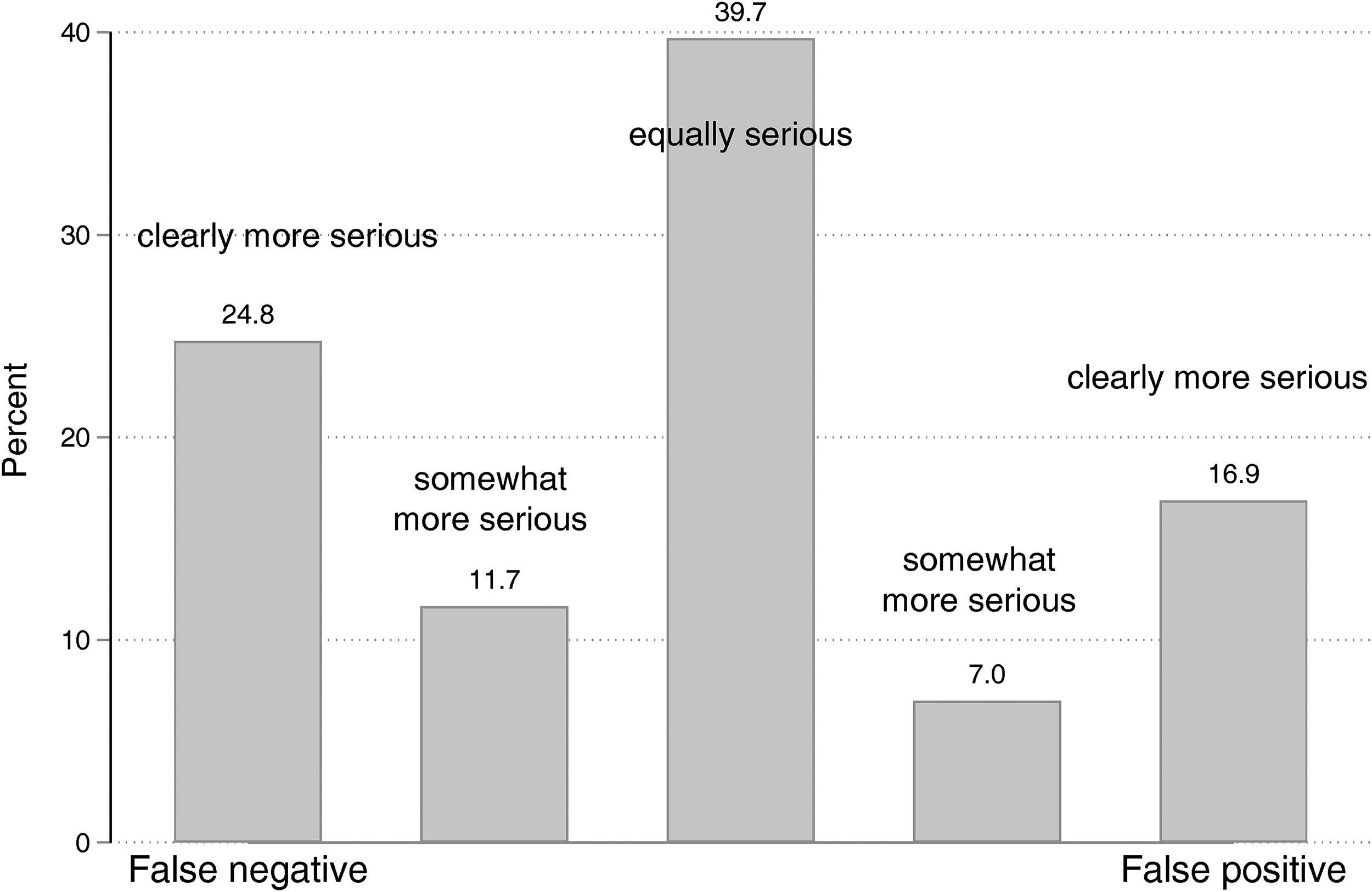
People's attitudes to mistake in asylum decision-making.
Figure 2 depicts country-level percentages of respondents preferring false negative and false positive (“clearly” and “somewhat” more serious categories aggregated). While most countries display a similar pattern of response, the difference between them lies in the magnitude of their preference for either type of mistake.
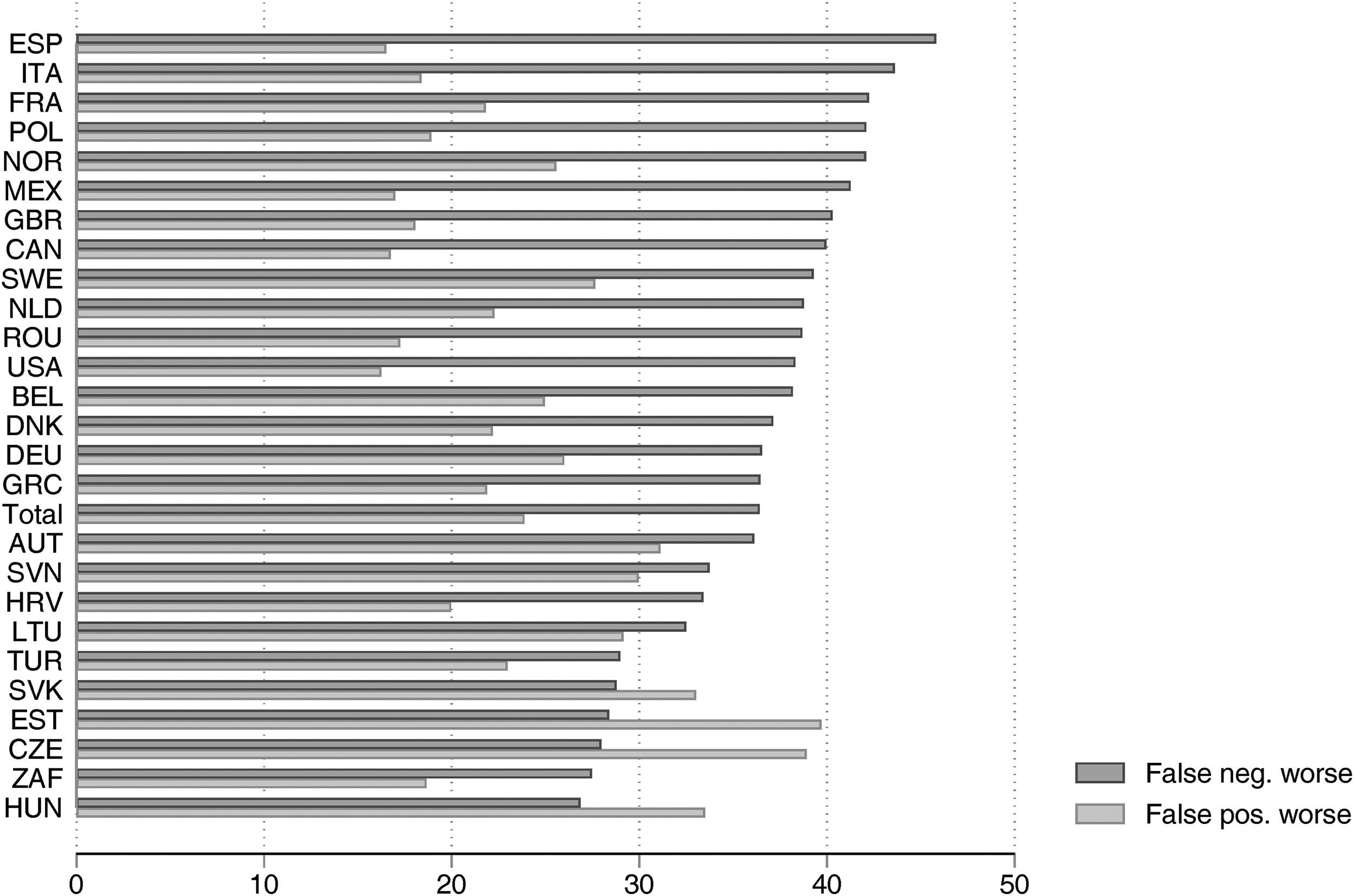
False negative is worse vs. false positive is worse, percentages in each country.
What Explains People’s Evaluation of Decision-Making Errors?
Our results are presented in three steps. Firstly, we analyze cross-country variations by testing our hypotheses regarding country attributes while accounting for respondents’ sociodemographic characteristics. Secondly, we explore the relationship between specific attitudes and respondents’ preferences concerning false positives and negatives. Lastly, we delve deeper into the cross-country disparities depicted in Figure 2, which were inadequately explained in the first step.
Step 1: Explaining Cross-Country Heterogeneity
Figure 3 reports the results of three linear regression models with country random intercepts. Country-level variables are inserted in sequence to test the effect of the economic situation (GDP per capita, change in GDP, and unemployment), societal demographic and political features (percentage of foreign residents, percentage of Muslim residents, and percentage of votes for far-right political parties), and macrocharacteristics more directly connected to asylum (number of asylum applications per thousand inhabitants, change in number of asylum applications in the 2 years preceding data collection). The number of country-level variables inserted at once is necessarily limited by the number of countries (26) present in our sample. For the estimation of country-level effects in multilevel models, the effective degrees of freedom are determined not by the total number of respondents but by the number of level-2 units. This imposes a strong limitation on the number of parameters that can be estimated at the country level. 13 As a reminder, the dependent variable ranges from 1 (false negative is a more serious mistake) to 5 (false positive is a more serious mistake).
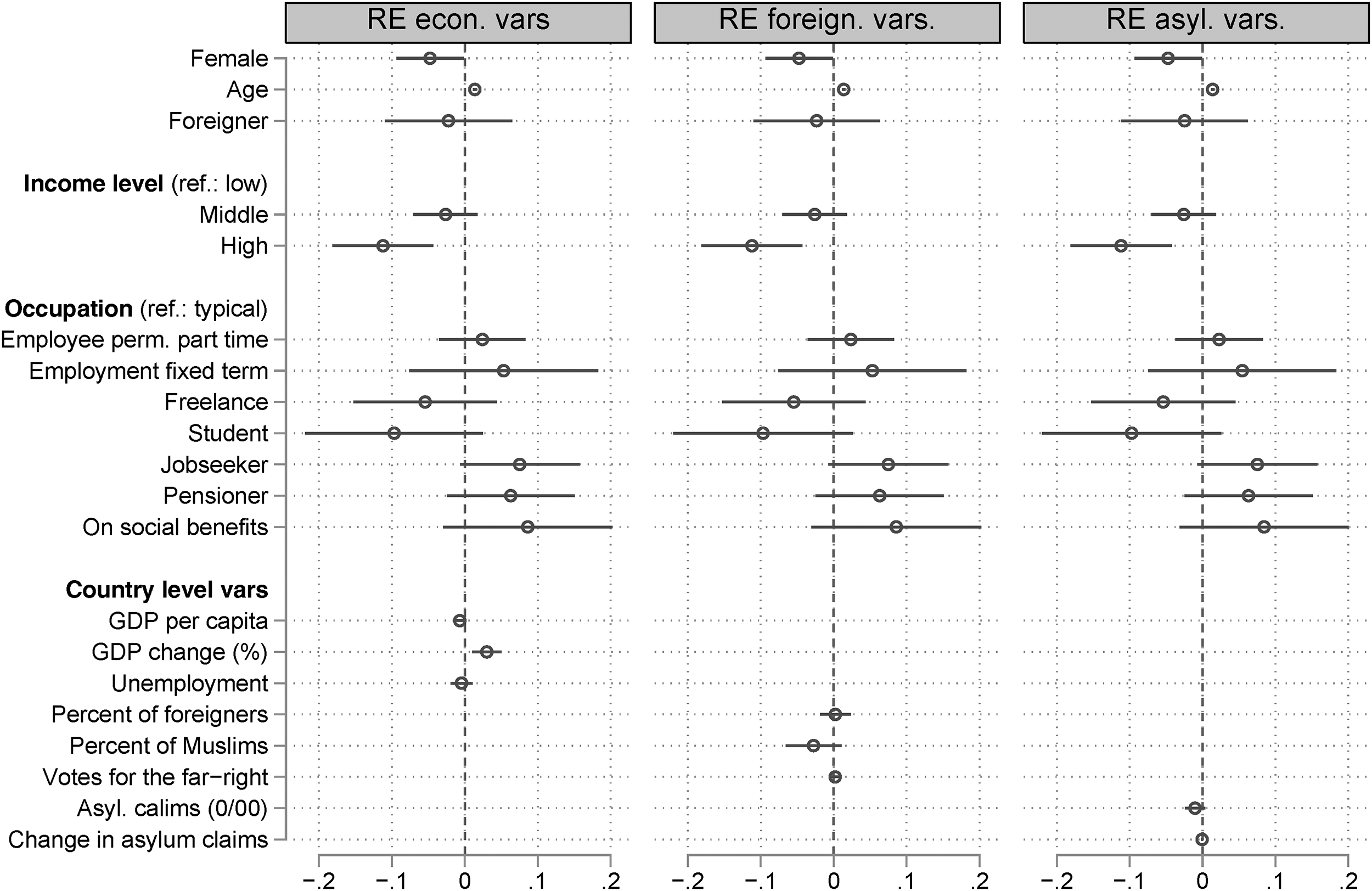
False positive/negative and country-level features, OLS coefficients.
This examination of the potential impact of country-level variables on preferences for false positives and negatives shows that none of the country-level features tested have a statistically significant and robust effect on people's attitudes toward the two types of mistakes. 14 This result is consistent with the results yielded by Variance Component Models which indicate that only 4.7% of total variation is due to country clustering. However, the analyses reveal a significant effect of respondents’ income on preferences for false positives/negatives. High-income earners are more likely to consider false negatives as the more serious mistake compared to low-income earners, which aligns with previous findings on economic threat perceptions and immigration attitudes (see inter alia Hainmueller and Hopkins 2014). Occupational status also appears as a relevant determinant of people's preferences for false positives/negatives, although the coefficients do not withstand changes in model specification, as is evident in Figure 4. We thus dismiss this result.
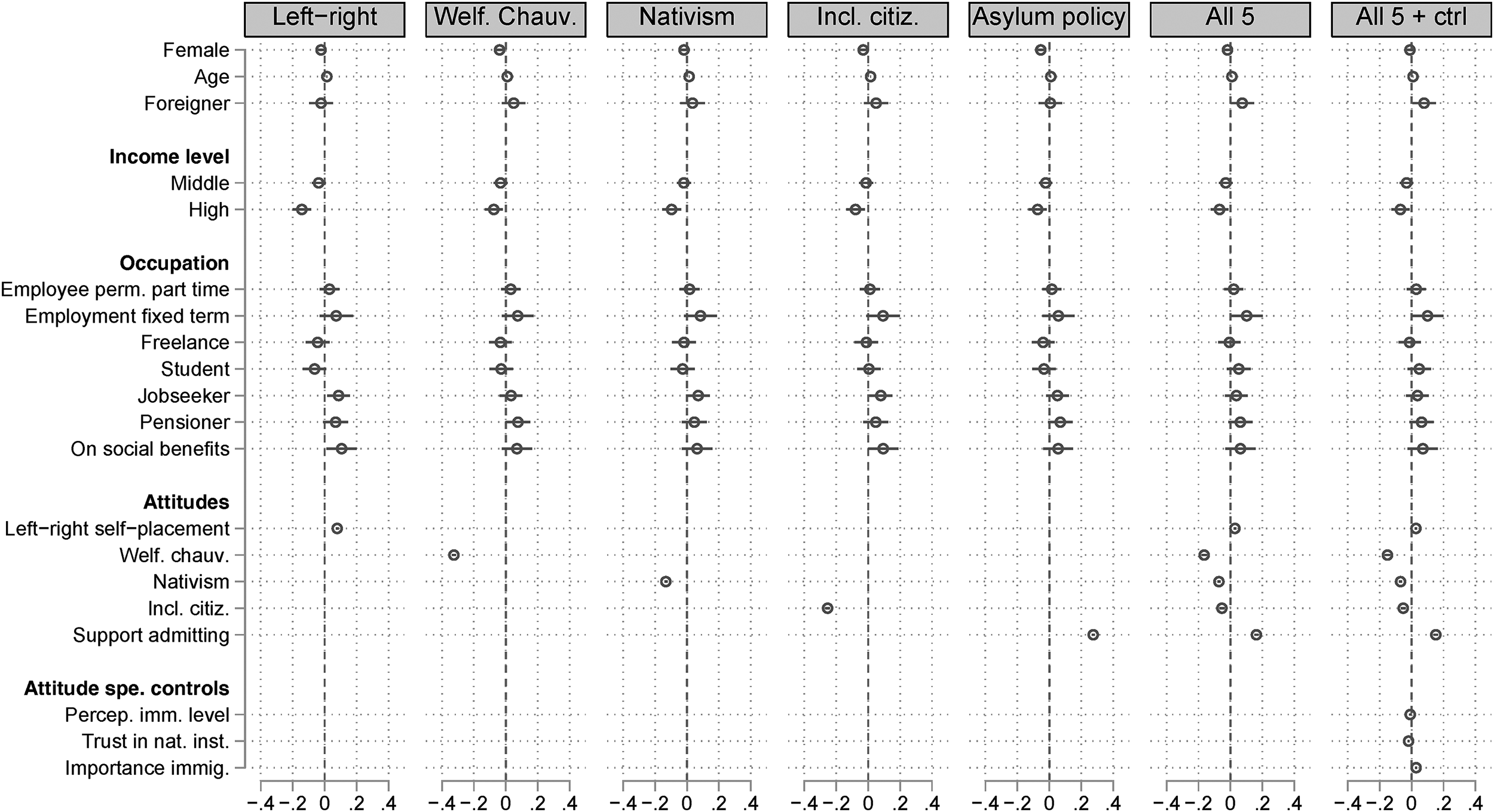
False positive/negative and political attitudes, OLS coefficients.
Step 2: The Effect of Political Attitudes on False Positive/Negative Preferences
We now test our core expectations relating to the effect of specific attitudes—political ideology, welfare chauvinism, nativism, inclusiveness, and support for asylum policy—on preferences for false positives/negatives. We proceed with seven additional models. The first five introduce our variables of interest individually, controlling for the sociodemographic features listed above and for country heterogeneity with country-fixed effects. 15 The sixth models add the five variables together, while the seventh one adds attitudinal specific controls (perception of immigration levels, trust in national institutions, and importance of immigration for the respondent). The results are produced in Figure 4.
Welfare chauvinism is the most consistent determinant of false negative/false positive preferences. It affects respondents’ answers across models, and its coefficients are sizable and statistically significant. Adding welfare chauvinism also substantially increases the overall proportion of variance explained by the model (+11 percentage points). More welfare chauvinistic individuals tend to view false positives as the more serious mistake.
Furthermore, our analysis reveals a strong association between individuals’ support for admitting asylum seekers (position on asylum policy) and their preferences regarding false positives and false negatives. Specifically, we find that the more respondents disagree with admitting asylum seekers into their country, the more likely they are to perceive false positives as a more serious mistake. This finding highlights the interconnectedness between attitudes toward asylum policy and perceptions of errors in welfare states.
Political ideology, nativism, and inclusive citizenship affect preferences for false positives/negatives, although the size of their coefficients significantly decreases in the presence of other political attitude covariates. Specifically, those placing themselves at the right of the political spectrum, those exhibiting more nativist views, and those with more exclusivist conceptions of citizenship tend to find false positives the more serious mistake.
Step 3: Explaining the Remaining Cross-Country Variation
Step 1 yielded unsatisfactory results: while Figure 2 above describes the existence of large differences across countries, our country-level explanations proved unable to capture them. In this step, we take a more descriptive approach and examine bivariate associations between country averages of our variables of interest. Figure 5 presents a selection of them. As the slopes and concentration of data-points around the lines indicate, cross-country differences seem to be explained by the different distribution of individual preferences rather than by each country's macrocharacteristics. For instance, the first graph (top left corner) indicates that country averages of welfare chauvinism, an individual-level attitude, are strongly and linearly correlated to national aggregates of the dependent variable. Conversely, country-level variables (such as GDP or unemployment) present flatter slopes and more dispersion of data-points.
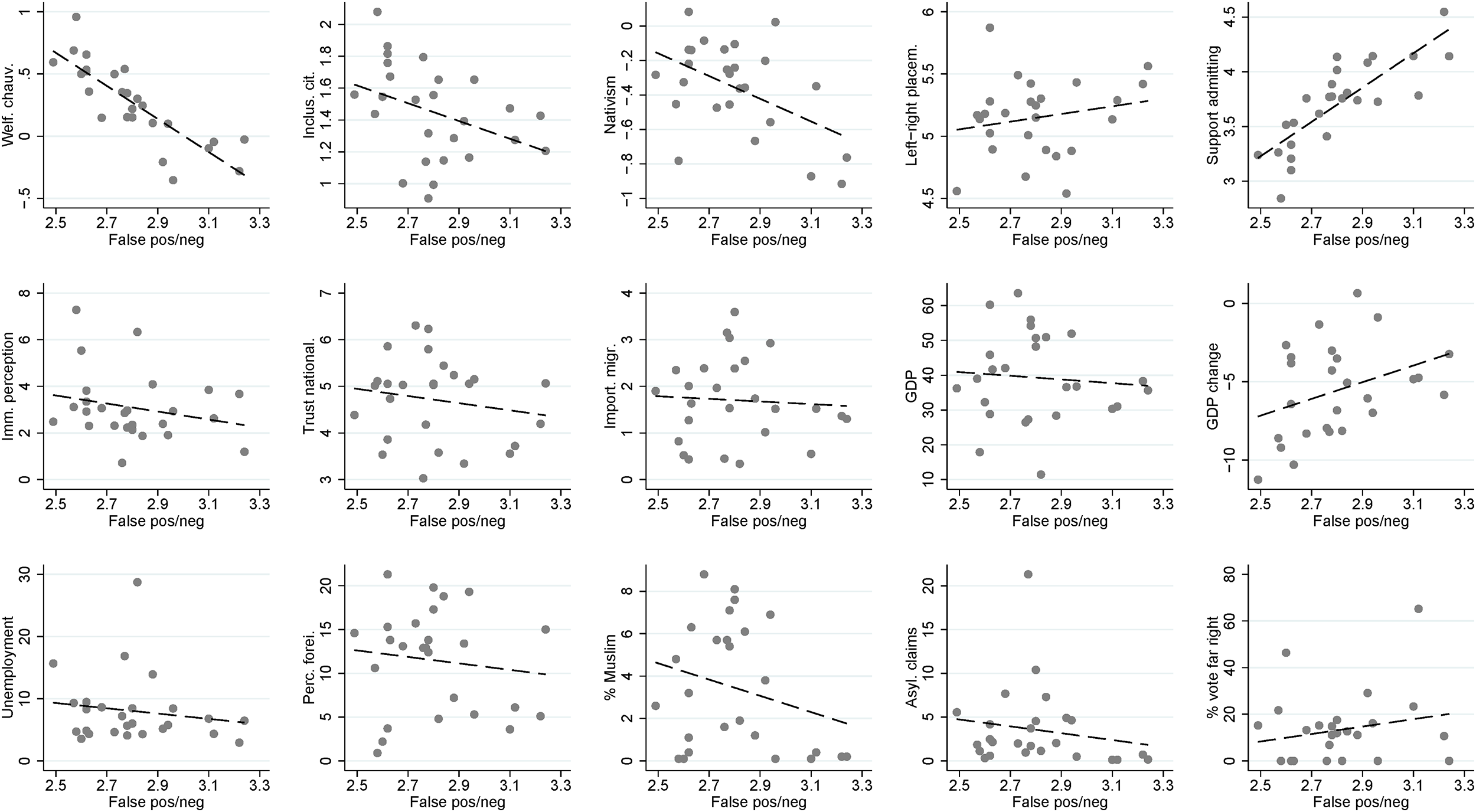
Bivariate relationships between false positives/negatives and variable of interests, country averages.
Conclusion
This study provides a novel and nuanced account of public preferences regarding errors in asylum decision-making across 26 diverse countries. Our central finding is that the public is not simply divided into two camps. Instead, the largest single group of citizens holds the normative position that falsely rejecting a deserving applicant and falsely accepting an undeserving one are equally serious mistakes. Alongside this plurality view, we find a significant group that prioritizes avoiding false negatives and a smaller, but still substantial, group that prioritizes avoiding false positives.
Our analysis also sheds light on the factors that shape individuals’ attitudes toward these two types of mistakes. We find that sociodemographic characteristics, such as gender, age, and income, are associated with people's preferences. Women, younger individuals, and high-income earners are more likely to prioritize the avoidance of false negatives, while men, older individuals, and low-income earners tend to be more concerned about false positives. These findings suggest that personal experiences and socioeconomic status may influence how people weigh the costs and benefits of asylum decisions.
We would like to emphasize yet again that attitudes toward administrative errors in asylum decisions are not merely reflections of general preferences about bureaucratic mistakes, which is substantiated by our findings. The systematic variation in preferences based on factors specifically relevant to immigration (welfare chauvinism, nativism, political ideology) indicates that respondents are engaging with the asylum-specific nature of these decisions. Furthermore, the strong association between error preferences and other asylum-specific attitudes confirms we are capturing domain-specific judgments rather than general administrative preferences.
Our finding that attitudes toward asylum policy associate with preferences for false positives and false negatives is important for several reasons. First, it sheds light on public perceptions of the fairness and effectiveness of asylum systems. If individuals perceive that false positives are widespread, they may view the system as being too lenient or providing benefits to those who do not deserve them. Conversely, perceiving a high prevalence of false negatives may lead individuals to believe that the system is failing vulnerable individuals who are in genuine need of protection.
Moreover, our study highlights the crucial role of political attitudes in determining preferences for false negatives and false positives. Welfare chauvinism emerges as the most consistent predictor, with individuals who hold welfare chauvinistic views being more likely to consider false positives as the more serious mistake. This finding underscores the importance of addressing concerns about the perceived economic burden of asylum seekers and refugees on host societies. Political ideology, nativism, and conceptions of citizenship also shape people's attitudes, with those on the right side of the political spectrum, those with nativist views, and those with exclusivist notions of citizenship being more averse to false positives.
Interestingly, while we observe some cross-country variation in attitudes toward false negatives and false positives, our analysis shows that cross-country variation is better explained by the distribution of individual-level preferences within countries rather than by macro-level characteristics such as GDP or unemployment rates. This finding emphasizes the need for policymakers and researchers to consider the heterogeneity of public opinion within countries when designing and evaluating asylum policies. In this respect, our results offer clear guidance: given that the largest single group in our 26-country sample is the one that views both errors as equally serious, the most broadly resonant—and likely politically safest—public stance for a government is one that acknowledges the gravity of both mistakes. Framing policy as a commitment to improving accuracy to minimize both errors, in line with the objectives of international refugee law, is likely to find more support than a position that explicitly prioritizes one type of risk over the other.
Our study contributes to the growing literature on public attitudes toward asylum and refugee issues by providing a nuanced understanding of how people navigate the trade-offs inherent in asylum decision-making. The widespread preference for avoiding false negatives over false positives has important implications for policy design and implementation. It suggests that policies aimed at minimizing false negatives, such as investing in more accurate and efficient asylum adjudication processes, may garner greater public support than those focused solely on reducing false positives.
Furthermore, our findings highlight the need for targeted interventions to address the concerns and attitudes that shape people's preferences regarding asylum decision-making. Efforts to combat welfare chauvinism, promote inclusive conceptions of citizenship, and foster a more nuanced understanding of the asylum system could help build public support for policies that prioritize the protection of refugees while maintaining the integrity of the asylum process.
In conclusion, our study provides insights into the complex interplay of individual-level factors and political attitudes that shape public preferences for false negatives and false positives in asylum decision-making. By shedding light on these dynamics, we hope to inform the development of more effective and responsive asylum policies that balance the imperative of protecting the vulnerable with the need to maintain public trust and support.
Supplemental Material
sj-docx-1-mrx-10.1177_01979183251399146 - Supplemental material for Decision-Making Mistakes in Asylum Policy: A Comparative Study of Public Opinion
Supplemental material, sj-docx-1-mrx-10.1177_01979183251399146 for Decision-Making Mistakes in Asylum Policy: A Comparative Study of Public Opinion by Cornelius Wright Cappelen, Hakan G. Sicakkan, and Pierre Georges Van Wolleghem in International Migration Review
Footnotes
Acknowledgement
We would like to thank the editor and the three anonymous reviewers for very helpful comments. We also thank Alexander Cappelen (Norwegian School of Economics) and Bertil Tungodden (Norwegian School of Economics) for inspiration and very valuable comments and suggestions.
Funding
The author(s) disclosed receipt of the following financial support for the research, authorship, and/or publication of this article: This article is part of PROTECT The Right to International Protection: A Pendulum between Globalization and Nativization? ( ), a research and innovation project which is funded by the European Union's Horizon 2020 Framework Programme and coordinated by the University of Bergen (Grant Agreement No 870761).
Declaration of Conflicting Interests
The author(s) declared no potential conflicts of interest with respect to the research, authorship, and/or publication of this article.
Data Availability Statement
The data used for this article is available in abidance with the FAIR principles of Findability, Accessibility, Interoperability and Reusability. Data is stored on Sikt, the Norwegian data repository. DOI: https://doi.org/10.18712/NSD-NSD3068-V3.
Supplementary Material
Supplemental material for this article is available online.
Notes
References
Supplementary Material
Please find the following supplemental material available below.
For Open Access articles published under a Creative Commons License, all supplemental material carries the same license as the article it is associated with.
For non-Open Access articles published, all supplemental material carries a non-exclusive license, and permission requests for re-use of supplemental material or any part of supplemental material shall be sent directly to the copyright owner as specified in the copyright notice associated with the article.
