




Abstract
This article examines the effects of China’s household registration (hukou) system, which divides the population into rural and urban sectors with differential benefits and entitlements, on the link between intergenerational social mobility and people’s well-being. Using China General Social Surveys of 2005 and 2011, we find that upward mobility has a similarly positive effect in the urban and the rural sectors but downward mobility has a markedly negative effect chiefly in the rural sector. We propose a thesis of ‘asymmetrical permeability’ to account for the findings. In the context of rapid economic development and staggering institutional reform, the upwardly mobile in both sectors enjoy ample socio-economic resources as provided by the advantaged destination classes whereas the downwardly mobile depend very much on the hukou status they have. In the urban but not rural sector, families in advantaged positions are able to protect the downwardly mobile offspring in their well-being. It is therefore the differences in the hukou system that explain the differential acculturation.
Introduction
Sociologists have long been interested in the consequences of intergenerational social mobility on people’s subjective well-being (SWB). Numerous studies have been conducted on developed countries and, in more recent years, growing interest has also been shown for developing countries. However, rather little attention has been paid to the additional stratification forces in society which are as entrenched, if not more so, as social class. In this article, we seek to make a contribution to scholarship in this area by examining the consequences of intergenerational social mobility on well-being for people situated in different institutional sectors (the urban and the rural sectors) in contemporary China.
Over the last four decades, China has adopted an increasingly market-oriented economy but has also maintained a tight control over socio-political institutions. The economic reforms have resulted in an unprecedented development, especially in the urban sector and the coastal areas but institutional reforms such as the household registration (hukou) system have been very slow. The hukou system was established in the 1950s for purposes of population administration and control by dividing China’s vast population into rural and urban sectors. The urbanites had access to state-provided benefits such as employment, housing, healthcare, pensions and other entitlements whereas people in the rural sector were denied access (Cheng and Selden, 1994). Since the reform in the 1980s, the hukou administration has been gradually relaxed, but the urban-preferential policies still exist. As a consequence, life in the rural sector is structurally disadvantaged. Good jobs are rarer in the countryside in the first place, and even for those fortunate enough to gain occupancy to professional-managerial positions, their children have to keep the rural hukou status which gives them basically the same life chances as those from peasant families. Scholars have noted the very limited upward mobility opportunities for the rural sector (Wu and Treiman, 2007) but to our knowledge, no research is currently available on the consequences of social mobility on people’s well-being experience in the two sectors. We seek to make a contribution to this scholarship.
Drawing on the China General Social Surveys (CGSS) of 2005 and 2011, we show that the hukou system plays a crucial role in moderating the effect of intergenerational social mobility on people’s well-being. Within both urban and rural sectors, the upwardly mobile are little different from the stable members in the destination classes, but the downwardly mobile’s well-being is rather different, depending on their hukou status. For the urbanites, downward mobility is not acutely felt, but for those in the rural sector, the consequences are palpable. This difference can be attributed to differential acculturation arising from the hukou system and is unexpected from the classical sociological accounts.
We propose a thesis of ‘asymmetrical permeability’ to account for the findings of differential acculturation. Underlying the differential acculturation is, we believe, a two-pronged process: socio-economic and institutional. China has experienced 40 years of economic development, creating many opportunities for upward mobility and generating a relatively fluid class boundary. As a result, the upwardly mobile are able to acquire substantial socio-economic resources and have many chances to make friends with those in the new class. This will enable them to assimilate themselves into the destination class with relative ease, rendering their mobility a positive experience. At the same time, in China’s family-centred cultural tradition which is still well maintained, families are expected to provide their downwardly mobile offspring with sufficient support to help them mitigate the impacts of downward mobility. Yet, due to the hukou system, intergenerational transmission of class advantages is rather weak in the rural sector, even for those who managed to have high-status jobs.
This article is structured as follows. In the next section, we give a brief introduction to the hukou system. We then review the previous research on intergenerational mobility and well-being, and discuss how these effects may vary, depending on the hukou status. After that, we introduce our data and methods, followed by presentation of our findings. We conclude the article by discussing some of the implications of our results.
China’s Social Changes and the Hukou System
There are two main features which distinguish present-day China from other societies: economic reforms and institutional stability. The last few decades have witnessed unprecedented economic changes in China, with industrialisation, urbanisation and marketisation going hand in hand, transforming it from a predominantly agricultural to an increasingly industrial country, from a mostly rural to a largely urbanised society and from a centrally planned to an increasingly market-oriented economy. As a result, China has seen rapid economic growth, with the GDP increasing at around 10% per annum up to around 2013 (decelerating to around 7% thereafter). The occupational structure has also undergone much upgrading. As a result, a great deal of social mobility has taken place, with upward mobility exceeding downward mobility.
Yet, it is equally noteworthy that, in spite of the rapid economic development, many institutional arrangements established in the period of planned economy have retained their influence, the most important of which is the household registration (hukou) system. The system was established in 1958 to serve as an administrative tool for restricting population migration and for allocating resources between the urban and rural sectors. Rural people had no access to state-provided benefits and entitlements whereas urbanites were looked after almost from cradle to grave. The vast majority of the rural population were expected to remain as peasants regardless of parents’ socio-economic status. In the last few decades, the control has been relaxed, allowing rural people to obtain urban status in small and medium-sized towns and cities, yet the fundamental divide between metropolitan cities and the rest of the country still exists, exerting a powerful influence on people’s life chances.
The two features discussed above have a particularly strong impact on mobility and well-being in China. Given the rapid socio-economic development taking place in the country, one might ask whether the newly released opportunities have given the upwardly mobile a level of well-being which is commensurate with their improved social positions and which is also comparable to that of the stable members in the classes, and whether the downwardly mobile have likewise seen their declassement as a ‘fall from grace’, to borrow from Newman (1999 [1988]), as reflected in their perceived well-being.
More importantly, given the institutional stability of the hukou system, it is crucial to ask whether the mobility experience is similar in urban and rural sectors alike. Previous research has shown that hukou plays an important role in people’s life chances. For example, Wu and Treiman (2007) found a much higher rate of downward social mobility among people with a rural hukou origin than among those with an urban hukou origin. As compared with their urban peers, advantaged parents with a rural hukou status are less able to protect their descendants from falling down the social ladder. Yet rather little is known about the consequences of such downward mobility in terms of people’s well-being experiences, an issue that we seek to address in the present study.
Previous Research and Hypotheses
The effect of intergenerational social mobility on well-being has been examined in several developed countries such as the United States (Houle and Martin, 2011), Belgium (Daenekindt, 2017) and in post-socialist countries such as Bulgaria, Russia, Poland and former Czechoslovakia (Marshall and Firth, 1999). However, studies on transitional societies are rather limited and, to our knowledge, no research is available differentiating hukou sectors in China. The few existing studies tend to focus on the overall population. For instance, Zang and De Graaf (2016) found that the downwardly mobile were quite happy and described them as ‘satisfied losers’. While the finding is important, the authors did not explore further where the ‘satisfied losers’ were located. We suspect that there might be different kinds of ‘losers’, some more satisfied than others, depending on their institutional locations and associated mobility trajectories. Similarly, Zhao et al. (2017) found a notable difference at the population level between those experiencing inter- and intragenerational downward mobility, with the latter feeling much more dissatisfied.
In order to explore how hukou differentiations may affect the well-being outcomes of intergenerational mobility in China, we start from potential mechanisms underlying the relationship between mobility and well-being, from which we then propose three hypotheses.
The first thing to notice is that moving into a different social position may require extra efforts for the acquisition of social norms associated with the destination class, which would increase stress and have detrimental effects on people’s well-being. As compared with the immobile who could conduct their lives in a largely normal and unaffected way, the mobile are uprooted from their previous environment and would find it difficult to adapt themselves to the new norms and conditions of their destination class. This is indeed the famous ‘dissociative’ thesis proposed by Sorokin (1959). Simply put, the thesis holds that social mobility, whatever the direction, will have serious negative outcomes on people’s psychological well-being causing, as he put it, ‘a permanent mental strain’ (Sorokin, 1959: 510). For over half a century, the thesis has been subjected to a wide range of empirical tests and has rarely been fully corroborated (see Daenekindt, 2017 for an excellent review).
An alternative thesis on this issue, also known as the ‘acculturation’ theory, was proposed by Blau (1956), who shifted the focus from mobility to position effects. According to him, the norms and resources of both origin and destination classes will play an intricate role in determining the behaviours and attitudes of the mobile who ‘do not have sufficient opportunity for complete acculturation to the values and style of life of the one group, nor do they continue to experience the full impact of the social constraints of the other’ (Blau, 1956: 291). As a result, the behaviours and attitudes of the mobile will lie somewhere in between those of the non-mobile members in the origin and the destination classes.
According to the acculturation thesis, mobile individuals differ from non-mobile ones because they are not only continuously affected by the situation in their current social positions, but also retain certain characteristics from their past mobility trajectories. From Sorokin to Blau, the emphasis is shifted from mobility per se to the acculturation of social positions, and the consequences of social mobility are no longer depicted as uniformly negative but may exhibit varying combinations of origin and destination configurations.
What is of particular note for our present purposes is the notion as apparent in Blau’s theory that it is the lack of social connection that will play a key role in the intermediateness of social integration and associated well-being of the mobile. Yet another important mechanism should be noted here, namely, that of the inheritance of socio-economic resources from the origin class. Sociologists have devoted considerable attention to the examination of how the various forms of family resources function in the social mobility process. In the same vein, family resources may also play a role in shaping the well-being level of descendants subsequent to their mobility. From this perspective, the upwardly mobile from disadvantaged families may not have as much access to parental socio-economic advantages as do those stable in the higher class positions whereas the downwardly mobile may benefit from substantial parental resources, subject to the differential possession of such resources between the urban and the rural sectors.
On the basis of the foregoing discussions, we propose three hypotheses regarding the impact of intergenerational mobility on well-being and its potential variations in different hukou sectors:
Hypothesis 1: as would be predicted by the dissociative thesis, the experience of mobility (both upward and downward) would have a uniformly negative effect on people’s well-being, with the mobile groups having significantly lower well-being levels than do the non-mobile groups regardless of the direction of mobility.
Hypothesis 2: following the acculturation thesis, we would expect the mobile groups to have well-being levels falling somewhere in between those of the stable core members, with little difference between the upwardly and the downwardly mobile groups.
The differences in the hypotheses derived from the classical theories are apparent. Yet, there is also a commonality between the hypotheses, which pertains to the similar stresses to be experienced by the mobile individuals in both rural and urban sectors. If either hypothesis holds, we should expect to see no significant hukou differences.
Hypothesis 3: given the disparities of socio-economic resources in the origin classes, we would expect the upwardly mobile to fall behind and the downwardly mobile to fare better than the stable core members in the destination classes in well-being. Furthermore, given the hukou differentiation in resource allocations, we would expect that origin classes would have a smaller impact in the rural sector than in the urban sector.
Of particular note in this regard is the different emphasis in Hypotheses 2 and 3. The former views the disruption of social networks as a causal factor for the intermediateness in well-being, and the latter puts more weight on the socio-economic resources of origin versus destination classes as the key factor. For a similar level of intermediateness, the underlying mechanisms may be different. In order to test the three hypotheses, we need to examine the mobility and the position effects simultaneously. To avoid the multicollinearity problem, we use the diagonal reference models (DRM) designed by Sobel (1981, 1985). The DRM has been employed in a wide range of studies such as on fertility patterns, social attitudes and political preferences (Sobel, 1985; Tolsma et al., 2009; Weakliem, 1992). Its application in well-being research is rather limited although there have been some studies in recent years (Daenekindt, 2017; Houle and Martin, 2011; Zang and De Graaf, 2016; Zhao et al., 2017). The model will be detailed in the Method section. Before that, we introduce the data and key variables to be used in the article.
Data and Variables
We use data from the China General Social Surveys (CGSS) of 2005 and 2011 for the present analysis. Both datasets are national representative samples covering 28 and 26 provinces and municipal cities in the two years respectively in mainland China using the multistage stratified sampling method. The CGSS was initiated in 2003 and has been conducted annually or biennially since then. The CGSS 2005 and 2011 include similar questions on physical and mental well-being. The sample size is 10,372 in 2005 and 5620 in 2011. Considering the potential influence of social change between the two years as well as the difference in sample sizes, we checked the descriptive data for the two years respectively before pooling them. We first give a brief account of the key variables to be used.
Well-being is measured in this study as the respondents’ subjective evaluation of their physical and mental states drawing from five items: (1) ‘Overall, how would you rate your health?’; (2) ‘In the last month, how often were your daily activities affected by health problems?’; (3) ‘In the last month, how often did you experience bodily aches or pains?’; (4) ‘In the last month, how much of a problem did you have with feeling sad, low or depressed?’; (5) ‘In the last month, have you been troubled with negative emotions (such as depression or anxiety) so that you couldn’t achieve your goal in work, study, or other activities?’ Each indicator has an ordinal response scale with five or six options. Instead of selecting one single question, we measure subjective well-being (SWB) in a more systematic way by combining information contained in all five indicators. We used the Latent Class Analysis (LCA) method and obtained a binary response mode with a ‘high-level well-being’ group and a ‘low-level well-being’ group, 1 which is our outcome of interest for the analysis. We also conducted further analysis in which physical and mental well-beings were measured separately. The main findings are similar and the results on separate analyses are available on request. 2
Class position is measured using the information on employment status and occupational position of the respondent’s current (or last main) job and their father’s job. Initially, a full 11-class schema was created, namely, higher- and lower-grade professionals and managers (Classes I and II), higher- and lower-grade of routine non-manual workers (Classes IIIa and IIIb), small employers, own-account and self-employed agricultural workers (Classes IVa, IVb and IVc), forepersons and lower technicians (Class V), skilled manual workers (Class VI), unskilled manual workers and agricultural workers (Classes VIIa and VIIb). As the 11x11 table would result in some cells having small numbers, we collapsed the categories into three classes: ‘salariat’ (I, II and IVa), ‘intermediate’ (IIIa, IIIb, IVb and V) and ‘manual’ (VI, VIIa, VIIb and IVc).
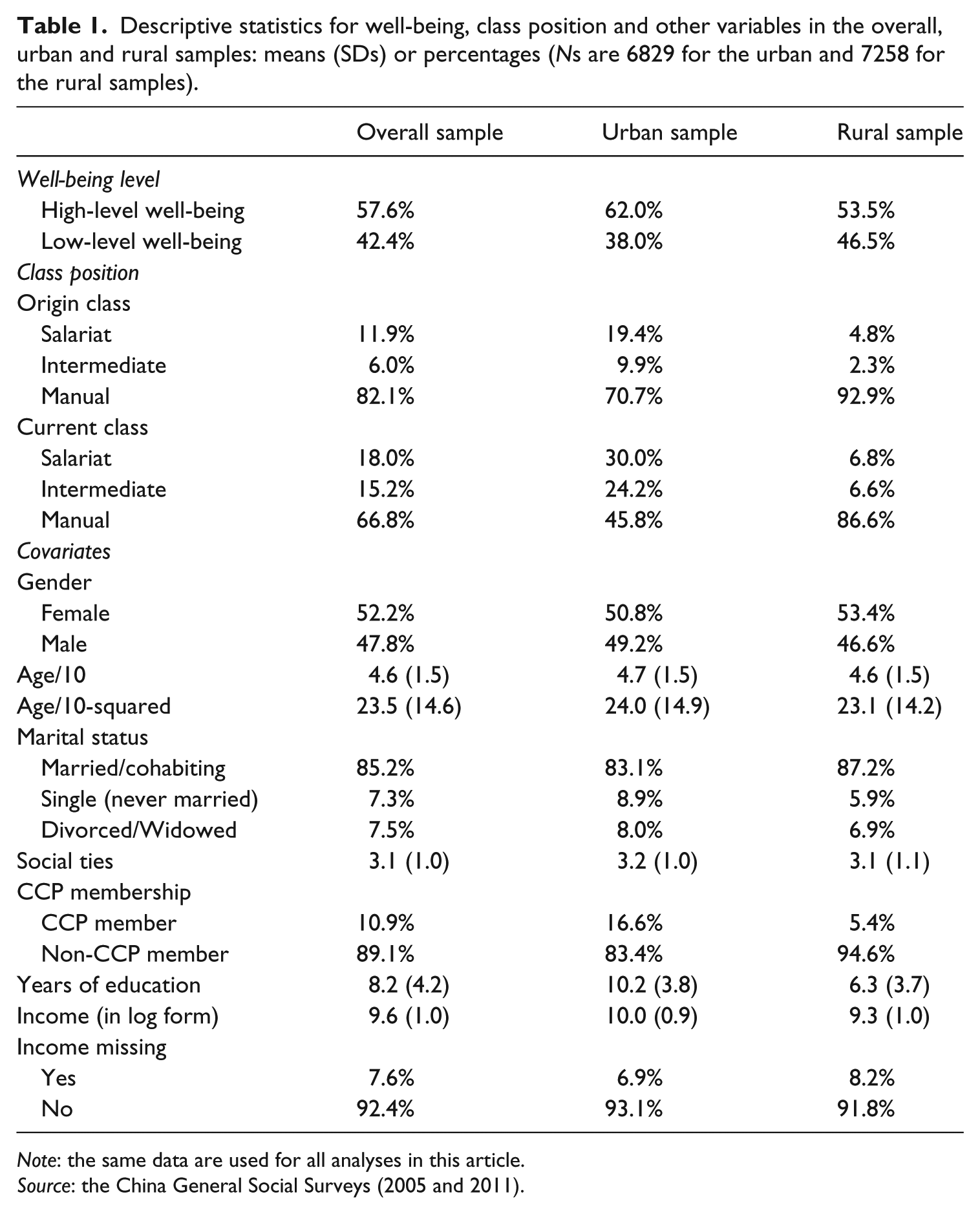
We use the respondent’s current hukou status to obtain the urban and the rural samples. In addition, there are a range of other factors which we shall use as control and explanatory variables, including gender, age, age-squared, marital status, Chinese Communist Party (CCP) membership, level of education and total annual incomes. Except for income, the number of missing cases for all other control and explanatory variables is less than 1%, and we excluded the missing cases on these variables. For income, which has 7.6% missingness, we imputed the missing values with the mean income and included a dummy variable indicating the missingness in the models. As is shown in the results, there is no significant difference between those who reported and those who failed to report incomes. The working sample consists of 14,087 individuals. The descriptive statistics for all variables in the overall sample and in the urban and rural subsamples are shown in Table 1.
Descriptive statistics for well-being, class position and other variables in the overall, urban and rural samples: means (SDs) or percentages (Ns are 6829 for the urban and 7258 for the rural samples).
Note: the same data are used for all analyses in this article.
Source: the China General Social Surveys (2005 and 2011).
Method
As noted earlier, we use the diagonal reference model (DRM) in this study to assess intergenerational mobility effects on people’s well-being in China, and we complement the analysis with logit models for further exploration of the mediating roles of social capital and other resource factors. The DRM parameterises the acculturation process through which people’s well-being perceptions are shaped by both origin and destination (current) classes; that is, position effects. In addition, an independent mobility effect that may exist over and above this partial determination can be assessed. In the DRM, the acculturation effect is operationalised by comparing the behaviours and attitudes of a mobile group with those of the immobile groups residing in the prior and the current classes. As the immobile groups (are believed to) represent the core of certain classes and define their norms, they are set as the referents so that the acculturation effects can be estimated by the extent to which the mobile groups resemble the typical values and behaviours of the immobile groups. Based on this logic, the baseline model is constructed as follows:

where

where


The two models have different implications despite their similar appearance: Equation 3a emphasises the power of the origin class whereas Equation 3b highlights the effect of the current position (for more details, see Weakliem, 1992).
Equation 4 tests the existence of the mobility effect over and above the acculturation influence. In our study, two mobility terms will be incorporated so that the influence of upward and downward mobility experiences can be examined separately:

In the preceding models, all diagonal variability is assumed to be unobservable random effects. In Equation 5, various control variables are allowed in the estimation of

In order to examine whether the weight parameter

The diagonal reference model offers a parsimonious way in which the acculturation process is represented statistically and the mobility effect can be captured independently. In spite of some limitations, the DRM is by far the most suitable approach for our present purposes. The models are estimated on the basis of the maximum likelihood procedure and Chi-square test is used to compare the nested model fits.
Results
Descriptive Analyses
Table 2 shows the probabilities of having high-level well-being for people with different mobility trajectories. At the overall level, we find, as shown in the last row of Table 2, a clear association between class and SWB, with 54.3, 52.0 and 41.9% of respondents in the salariat, intermediate and manual classes reporting high levels of well-being. We also report the data for the overall sample (Panel 1) and by hukou status (Panels 2 and 3). For the overall sample, an asymmetrical pattern is found in the off-diagonal cells. For instance, for the long-range upwardly mobile from the manual to the salariat positions (the bottom left cell in the panel), the probabilities of having high-level well-being are similar to those of the stable salariat and distinctly higher than those of the stayers in the manual class, while for people who experienced long-range downward mobility from the salariat to the manual class (the top right cell in the panel), their well-being level is the same as neither that of the stable salariat nor that of the stable manual workers, but somewhat in between.
Probabilities of having a high-level well-being (N = 14,087).
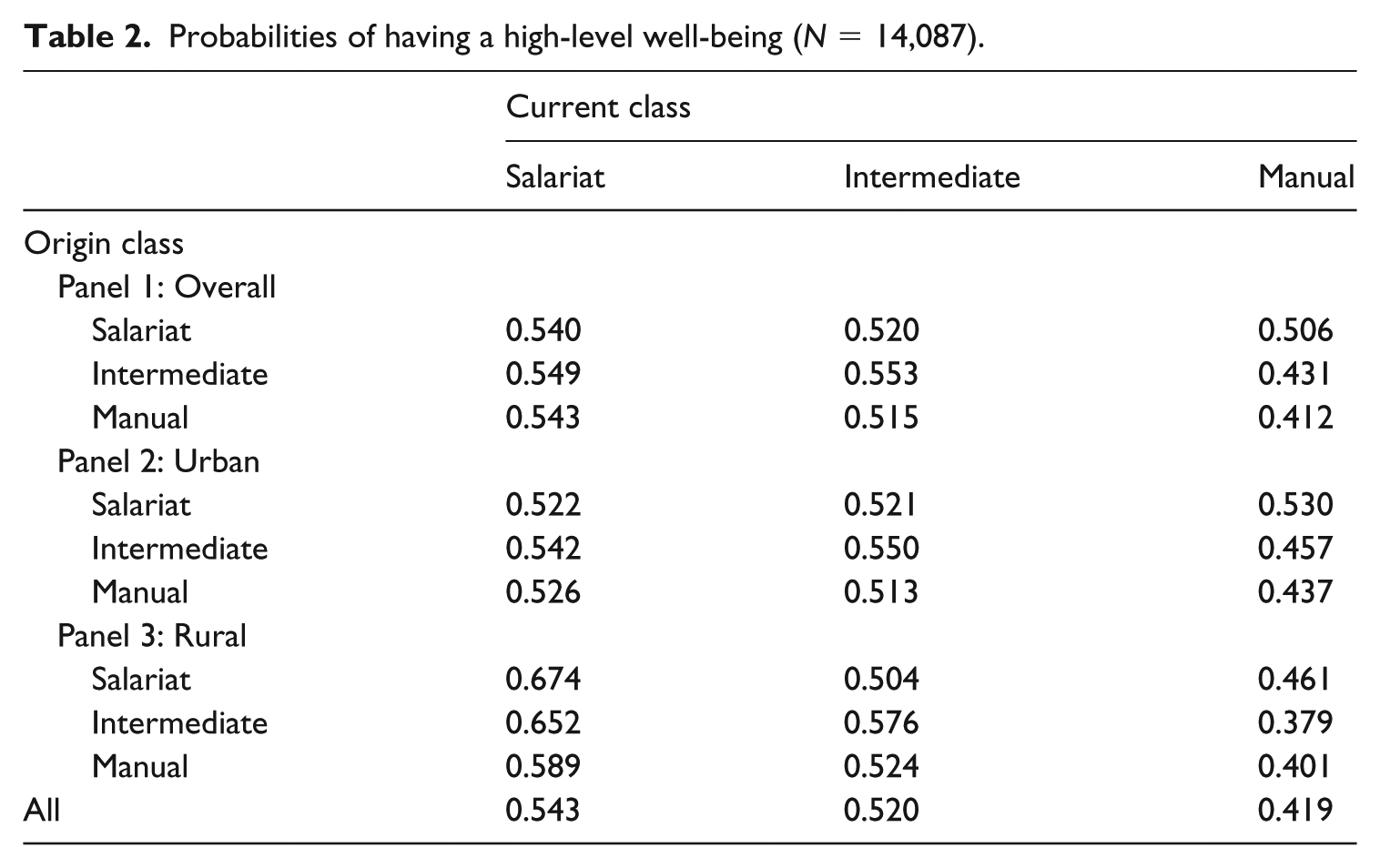
Turning to hukou impacts, we find, in Panel 2 for the urban sample, that the long-range upwardly mobile are little different from the stable salariat in terms of their well-being level, and that the long-range downwardly mobile retain their well-being advantage, with SWB being no different from that of the stable salariat. For the rural sample as shown in Panel 3, we find a similar pattern for the upwardly mobile, but the well-being level of the long-range downwardly mobile is much lower than that of their stable origin class peers, at 0.674 and 0.461, or by 21 percentage points, and is only above that of their stable peers in the destination class by 6 points. It thus seems that the long-range downwardly mobile in the rural sector are not as well protected as their urban peers.
In sum, the patterns that emerged from descriptive analysis show that both mobility trajectory and institutional arrangement (hukou status) play an important role in affecting people’s well-being. We now move to modelling exercises to assess the net effects.
Diagonal Reference Models: The Overall Sample
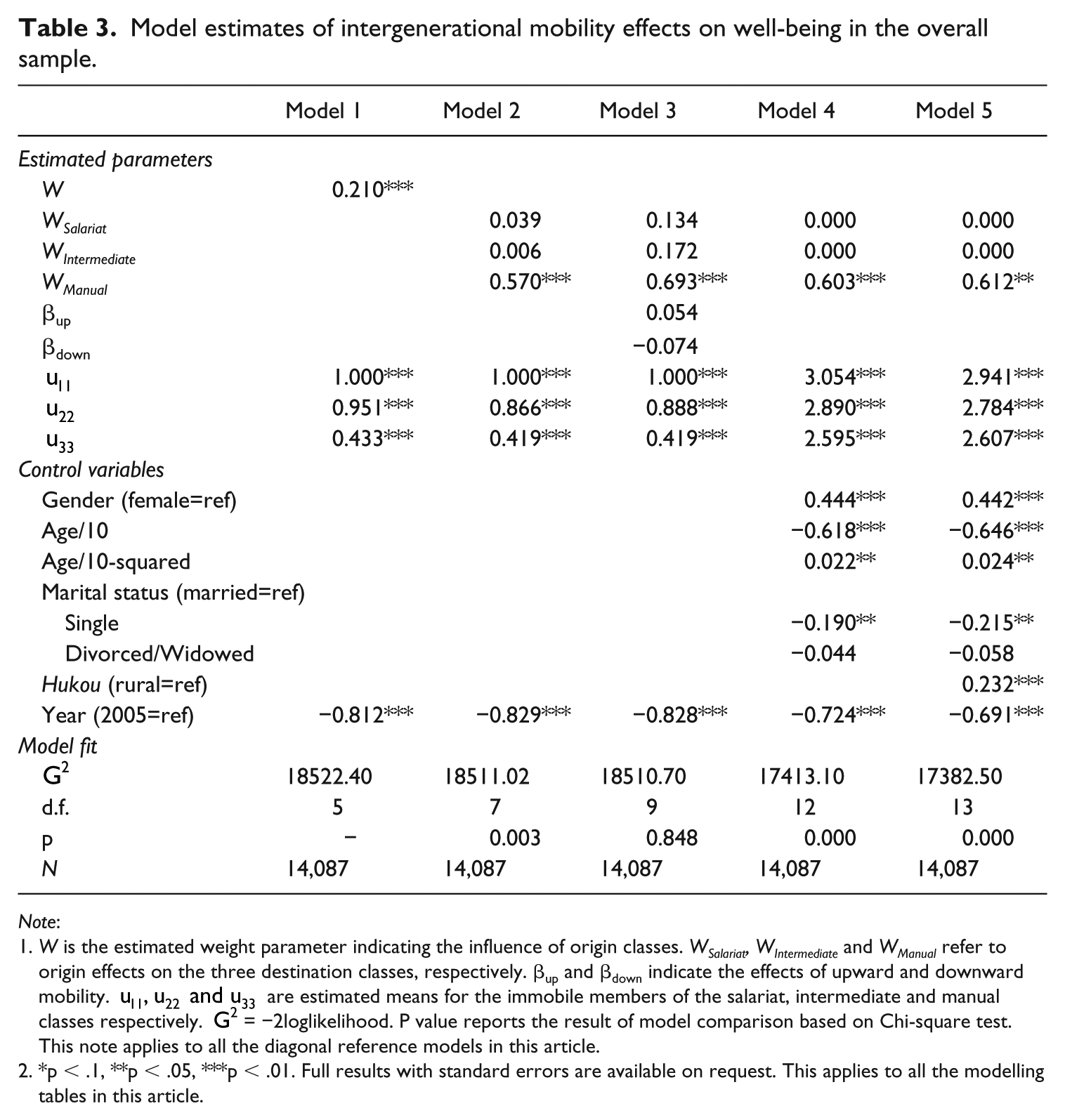
In order to explore the potential acculturation and mobility effects, diagonal reference models are used, with results shown in Table 3. As the two years’ data display very similar patterns in both descriptive analysis and DRM modelling, they are combined in the following analysis, with the year effect controlled for.
3
In the baseline model (Model 1), a single weight parameter is estimated with the assumption that an identical influence applies to all classes. We can see that while
Model estimates of intergenerational mobility effects on well-being in the overall sample.
Note:
W is the estimated weight parameter indicating the influence of origin classes. WSalariat, WIntermediate and WManual refer to origin effects on the three destination classes, respectively. βup and βdown indicate the effects of upward and downward mobility.
*p < .1, **p < .05, ***p < .01. Full results with standard errors are available on request. This applies to all the modelling tables in this article.
Given the predominant role of the destination classes on well-being, we used Equation 3b rather than 3a so that the weight parameter can be freely estimated for different destination classes. Model 2 shows that the values denoting origin weights for those currently in the salariat and the intermediate classes are very small and non-significant (0.039 and 0.006) whereas the value denoting the origin weight for those currently in the manual position has a substantial and statistically highly significant effect (0.570). This implies that the influence of origin versus destination is rather different for people in different classes, confirming the pattern of asymmetry as observed in Table 2. Comparing the two models, we find a significant improvement in fit of Model 2 over Model 1. The results in Model 2 suggest, in simple terms, that for those in salariat and intermediate positions, their well-being is predominantly shaped by their current class, and the impact of their origin class is negligible. However, for those in the manual class, origin class has a substantial and significant influence.
In Model 3 of Table 3, we test whether there are independent mobility effects that could be detected. Two dummy variables for upward and downward mobility are added but neither shows a significant impact beyond the origin and the destination effects already included in the model, and the model reveals no significant improvement in fit over the preceding one (p = 0.848). In light of this, the mobility variables are removed in the subsequent models. There is thus no support for the dissociative hypothesis of an additional negative mobility effect on well-being, consistent with the results in previous studies (Marshall and Firth, 1999; Zang and De Graaf, 2016). After removing the mobility terms, Model 4 includes a series of control variables. While men and the married are found to have higher SWB, age has a curvilinear effect, and the basic patterns with regard to position effects in Model 4 remain similar to those in Model 2.
Model 5 includes hukou status and shows that urbanites have a significantly higher SWB. We also conducted analysis on interaction effects between hukou status and weight parameters as suggested by Equation 6 above. The interaction effects for WSalariat*hukou, WIntermediate*hukou and WManual*hukou were non-significant, yet there was a risk that the model might mask the effects of other factors that were also affected by hukou. In order to have a more accurate estimation, we split the overall sample by hukou status and conducted separate analyses (see the next section).
In sum, the DRM analysis on the overall sample suggests a different influence of position effects on people’s well-being: for those moving upwardly into salariat and intermediate classes, their well-being level resembles that of the stable members in these classes, but for those experiencing long-range downward mobility into the manual class, especially in the urban sample, they would have appreciably higher levels of well-being than do the stable manual workers. In addition, the influence of both upward and downward mobility appears to be derived from the resource effect of the origin and the destination classes (position effects), rather than from mobility experiences per se (mobility effects). In short, Hypothesis 1 on net negative mobility effects has received no support, and Hypotheses 2 and 3 on the intermediateness in social integration and associated levels of well-being have received partial support, with special regard to downward mobility in the urban sample.
Diagonal Reference Models: Different Hukou Sectors
In light of the patterns as shown in Table 3, we conduct further analysis of mobility effects on well-being within each hukou sector, with the data shown in Table 4. Models 1 and 3 were run with a single weight parameter, and Models 2 and 4 allowed the weight parameter to be freely estimated for different destination classes. For simplicity, all models were estimated with the control variables included, and we dropped models with mobility variables (prior analysis showed no mobility effect).
Model estimates of intergenerational mobility effects on well-being by hukou status.
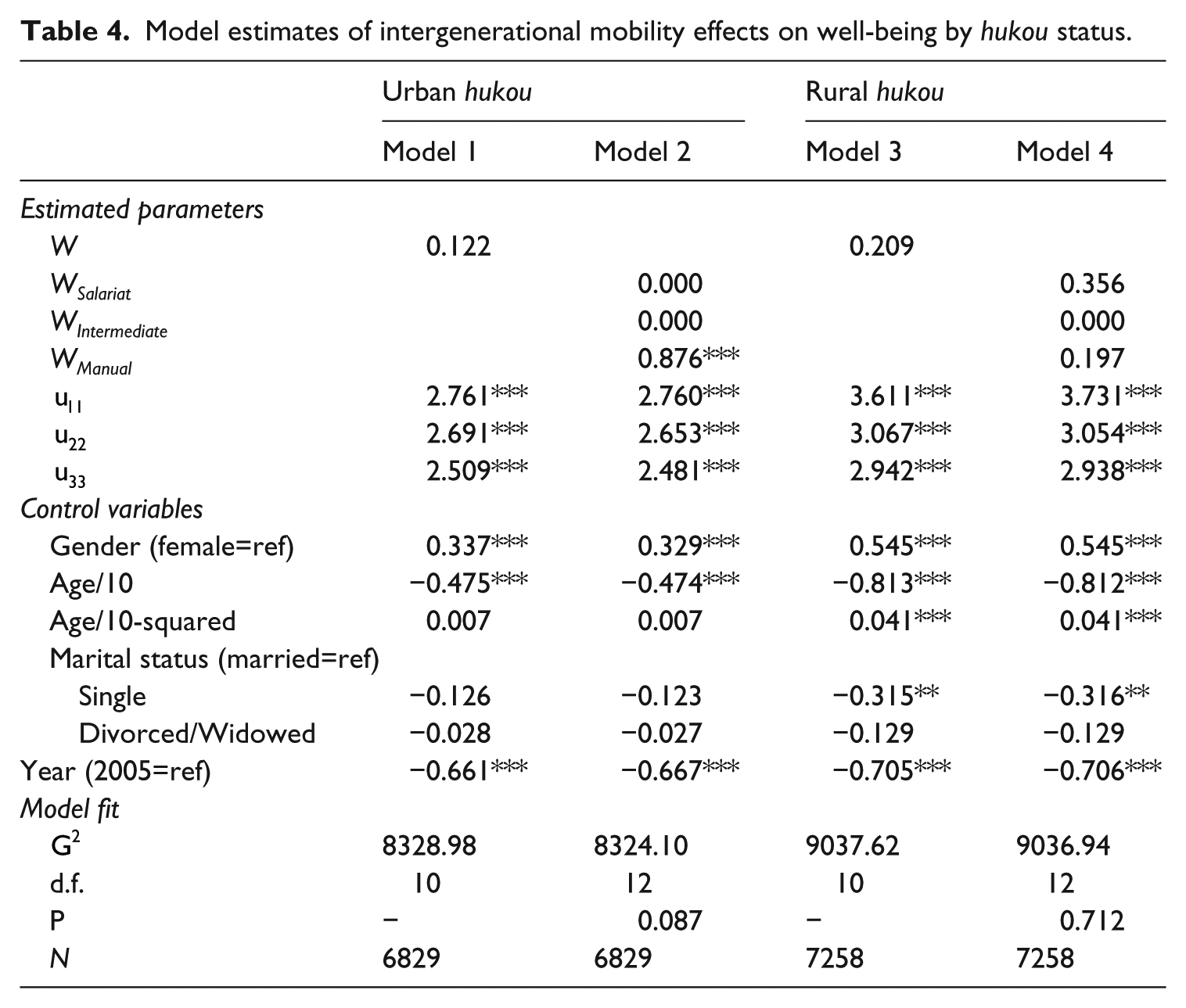
The data under models 1 and 3 in Table 4 show that, in both urban and rural sectors, the destination rather than the origin class has a dominant impact on people’s well-being. Furthermore, under models 2 and 4 of the table, we find that, for those situated in salariat and intermediate classes, origin effects are negligible. However, the origin class has a significant and substantial impact (0.876, which is larger than the impact in the overall sample, 0.603, in Model 4, Table 3) on the well-being level of those downwardly mobile into the manual class in the urban sector whereas the influence is statistically non-significant and substantively small (0.197) in the rural sector.
The separate analysis by hukou thus reveals a clear pattern of differential acculturation: the superior family resources of advantaged origin class in the urban sector do seem capable of protecting their offspring’s well-being even when they experienced a long-range downward mobility, but no such patterns are seen in the rural sector. The intermediateness shown in the origin effect on the manual class in the overall sample (Model 4 of Table 3) conceals the real divergence in the different institutional sectors.
An important question that arises at this juncture is why a well-being advantage is only found among the downwardly mobile with an urban hukou, and why complete acculturation is found in the salariat and intermediate classes while different patterns are found among the manual workers conditional upon their hukou status. In order to gain a better understanding, we now move to logit models to make further explorations.
Logit Regression Models
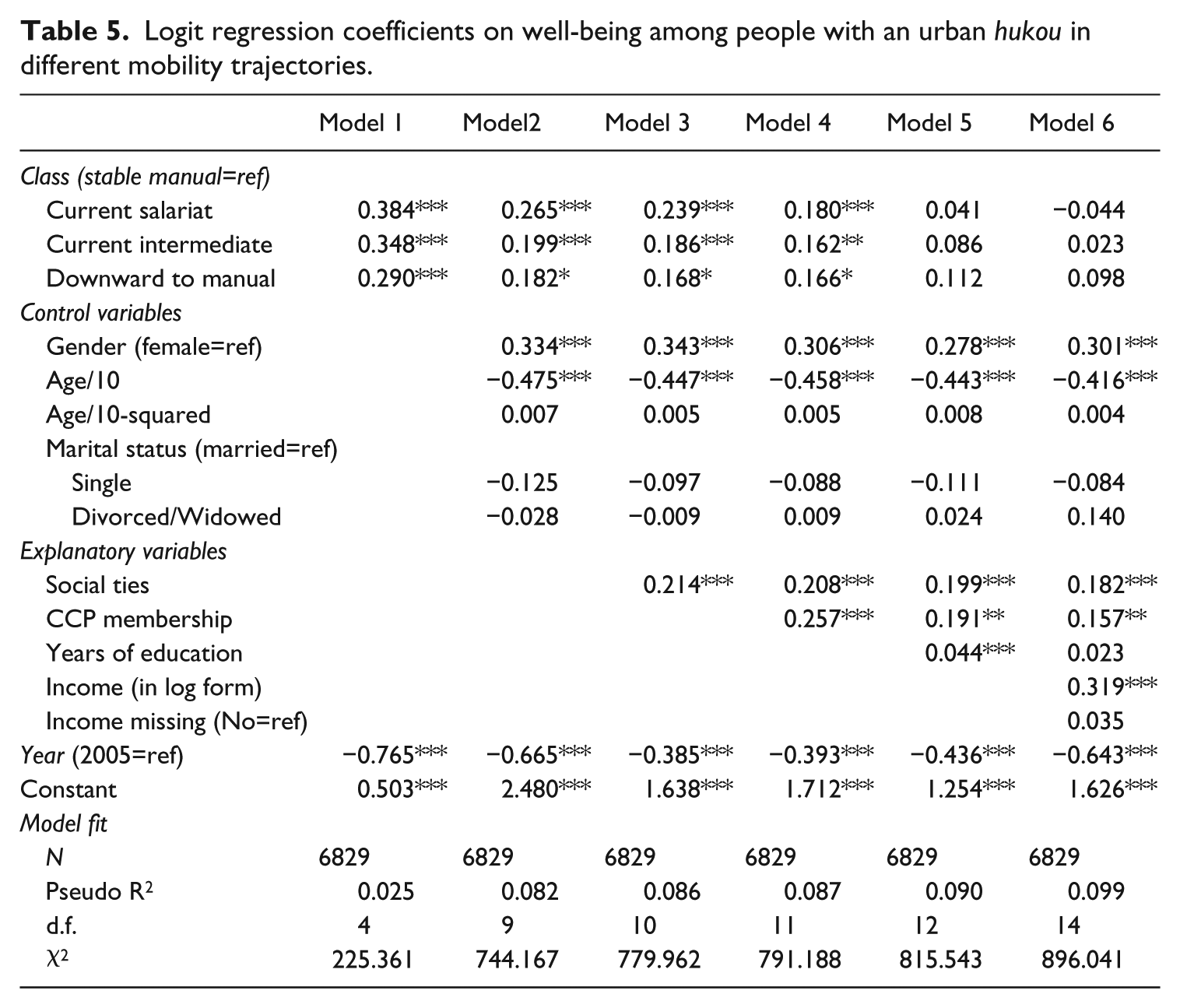
As no mobility effect was found in the preceding analysis, we conducted tests on underlying mechanisms using logistic regression models. To recap the findings in Tables 3 and 4, people upwardly mobile into salariat and intermediate classes have no well-being difference with the stable members in the two classes but this is not the case for the downwardly mobile. In view of this, a new variable is created to indicate the four types of trajectory-based class position: current salariat, current intermediate, downwardly mobile to manual positions, and stable manual workers. As for social ties, we should, conceptually, include social relations with both origin and current class peers, but only the former is available in the data and is incorporated in the model, which is measured by frequency of contact with kin (family members and relatives). With regard to embedded resources, three variables are used: membership in the Chinese Communist Party (CCP), years of education, and total annual income, indicating political, human and economic capitals respectively. These resources are not only associated with respondents’ current social positions, but also reflect origin effects. People from a higher family background are more likely to have CCP membership, higher education and parental support in China. Therefore, we include the three variables to test the third hypothesis. Control variables include gender, age, age-squared and marital status. The model results are shown in Tables 5 and 6 for urban and rural sectors respectively.
Logit regression coefficients on well-being among people with an urban hukou in different mobility trajectories.
Logit regression coefficients on well-being among people with a rural hukou in different mobility trajectories.
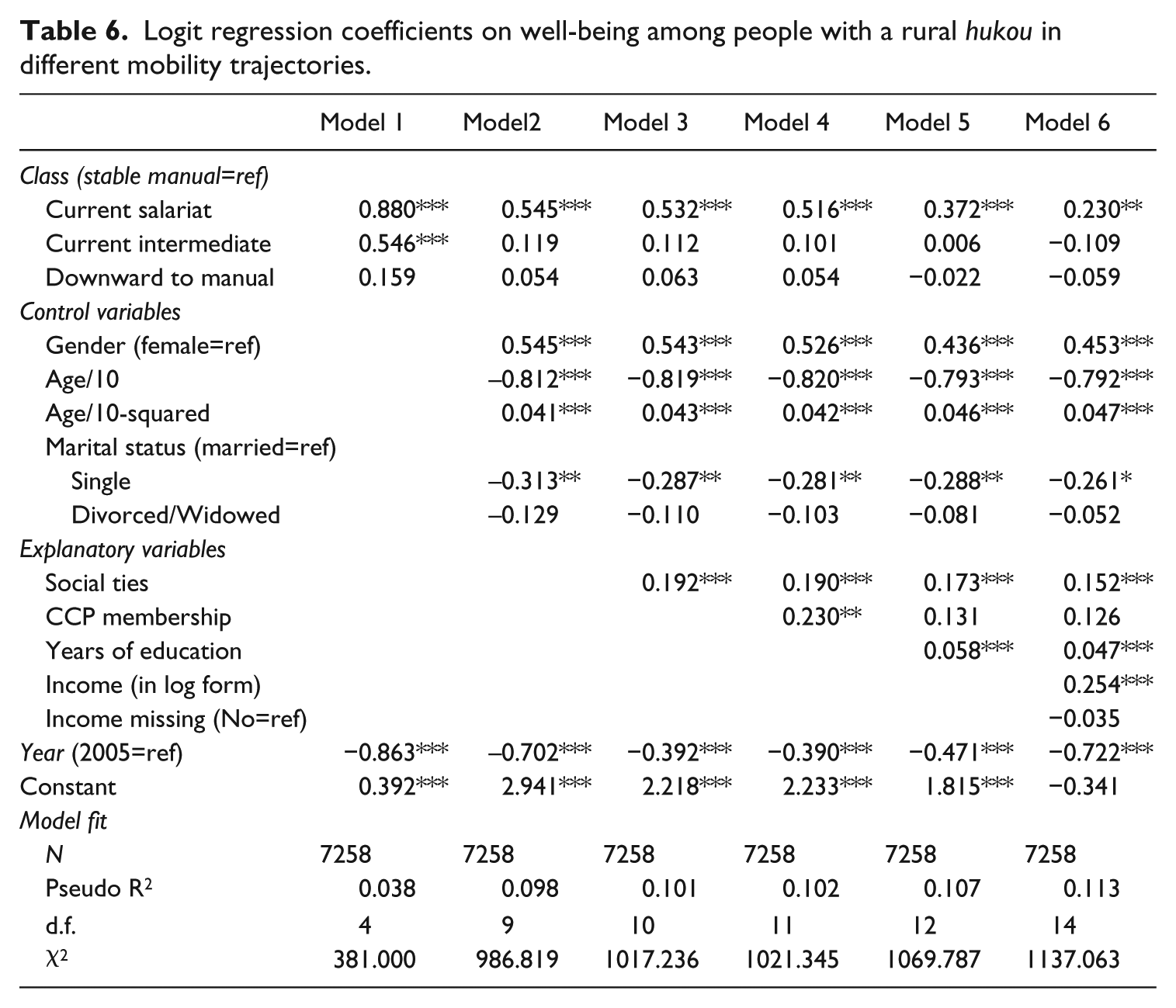
The baseline model (Model 1) in Table 5 shows a clear well-being gradient across the four groups in the urban sector. Compared with the stable manual class, people in the other three groups (including the downwardly mobile) all have significantly higher levels of well-being. The gradient is also seen in Table 6 for the rural residents, but here two features are highlighted: first, the very low SWB level of the stable core manual workers (peasants) brings the SWB level of the stable salariat into a sharp relief, much sharper in fact than in the urban sector. Under Model 1, the coefficient is 0.880 for the rural stable salariat whereas the corresponding coefficient is only 0.384 for their urban counterparts as shown in Table 5. Second, for all models in Table 6, we notice that the coefficients for the downwardly mobile are non-significant as compared with the stable core peasants, suggesting that, insofar as SWB is concerned, those whose parents were in higher social positions but who have themselves fallen off the social ladder have only negligible advantage over their peers who have been peasants for generations. Overall, the most salient feature in the two tables is that the well-being advantage of the downwardly mobile over the core members in the destination class is only found in the urban sample.
With regard to the control variables, we note the same pattern as exhibited in the DRM. Other things being equal, males and married respondents tend to have higher levels of well-being, and age has a curvilinear effect, which is basically the same in both urban and rural sectors. These features also largely hold when more explanatory variables are included from Models 3 to 6. All explanatory variables on social networks, CCP membership, education and income are shown to play a non-negligible role on SWB. While all these factors act as underlying mechanisms for the incomplete integration in downward mobility in the urban sector, embedded resources (pertaining to Hypothesis 3) seem to exert a larger explanatory power than do social ties (pertaining to Hypothesis 2).
Conclusion and Discussion
Sociologists have been concerned with the possible negative effects of social mobility for a long time. In this article, we have sought to make a new contribution by studying the effects of intergenerational mobility on well-being in China as conditioned by the institutional arrangement: the household registration (hukou) status. We thus brought class and hukou effects under direct interrogation and our main findings can be summarised as follows.
First, people upwardly mobile into professional-managerial (salariat) and intermediate social positions were little different from the stable core members in these classes in terms of their subjective well-being.
Second, those downwardly mobile into manual positions exhibited a well-being level in between those of the origin and the destination cores at the overall level but this intermediateness masks a real divergence by institutional settings. The well-being level of the downwardly mobile is similar to that of the stable core members in the origin classes for the urban sector, but is little different from that of stable members in the destination class for the rural sector.
Third, while social ties do play a salient role in people’s well-being, it is disparities in socio-economic resources as shaped by class position and hukou status that assume the predominant importance on the well-being consequences of social mobility in contemporary China.
Our analysis gives little support to Sorokin’s dissociative hypothesis and only partial support to Blau’s acculturation theory. There is hardly any evidence that social mobility per se would lead to ‘a permanent mental strain’ as Sorokin claims, nor is there evidence that the upwardly and the downwardly mobile would be equally half acculturated as Blau argues. Rather, our analysis shows a pattern of differential acculturation conditional upon institutional settings. For urban residents, the upwardly mobile are fully acculturated into the destination classes and the downwardly mobile are also protected by their parental resources. For the rural residents, while the upwardly mobile enjoy adequate acculturation, the downwardly mobile are little different from the other peasants. While the similarity of the upwardly mobile in both sectors can be explained by the possession of socio-economic resources residing in the current (destination) class and by the prevalence of similarly mobile peers for sociability, the differences of the downwardly mobile between the two sectors must be explained by virtue of institutional differences rooted in hukou. As compared with their urban peers, the downwardly mobile in the rural sector have few channels for counter-mobility (Wu and Treiman, 2007). It is also the case that due to the hukou divide, the income and wealth disparities between the urban and the rural sectors are large, even for people in the same class. Thus, rural salariat will not have as much accumulated wealth as do their urban peers, which will have a negative impact on their ability to protect their offspring who have experienced downward mobility.
Overall, our findings suggest a more accurate storyline than predicted by the classical accounts for the impact of intergenerational social mobility, in both upward and downward domains, on well-being in transitional China. While the results are encouraging, we must keep them in perspective. First, the hukou system is still playing an important role in shaping the effect of social mobility on people’s well-being, and there is evidence of increasing social differences between the urban and the rural sectors in the reform period. In spite of recent reforms, hukou is still a chasm ‘between heaven and earth’ (Treiman, 2012), with the peasants having the least favourable social-economic conditions and the lowest levels of well-being. Second, although the reforms have engendered more upward mobility, stable manual workers still remain the largest section of the population in China, being 61 and 57% in the two years’ samples used in this study. Finally, while the acculturation of the upwardly mobile was facilitated by the upgrading occupational structure and the greater chances for ‘connubrium’ and ‘commensality’, the future may not be as bright. The economic growth rate has fallen, which will limit opportunities for upward social mobility; and income inequality is intensifying, which will rigidify class divisions, impede cross-class interaction and reduce people’s SWB. These and other developments of social rigidification may exert powerful influences on people’s aspirations, mobility strategies and life chances including well-being perceptions. Future research could explore how the unfolding social structures, mobility trajectories and institutional changes will impact on social cohesion in China as new and better data sources become available. In addition, international comparisons between China and other societies would help to reveal whether our findings apply to other social contexts with different institutional arrangements or whether it is only a ‘Chinese exceptionalism’. Similarly, future research could explore whether the pattern of asymmetrical permeability in acculturation as discussed in this article is reflected in the integration practices of, say, immigrant groups in the destination countries.
Footnotes
Acknowledgements
We thank the anonymous reviewers and the attendants at the British Sociological Association Annual Conferences at Aston University (April 2016), UK for their suggestions. We alone are responsible for any error that remains in the article.
Funding
This work was supported by the Samual Chan Scholarship and the Overseas Research Scholarship from the University of Manchester, the Economic and Social Research Council (ES/K002198/1, ES/I035168/1), China Natural Science Foundation (71010090) and Engineering and Physical Sciences Research Council (EP/H02171X/1). The generous support is gratefully acknowledged by the authors.