




Abstract
Existing research on the platform economy highlights a contradiction between autonomy and control. Based on an analysis of online chats and in-depth interviews with food delivery couriers in Riga, the capital of Latvia, we theoretically deepen the explanation of the sense of autonomy identified in algorithmically managed workplaces by analysing how workers’ identity is related to the other identities workers have. Our theorization of autonomy in platform employment is based on Dworkin’s concept of autonomy and uses Merton’s distinction between role-set and multiple roles. Our data demonstrate how couriers’ autonomy is severely limited due to conflicting, algorithmically mediated relationships within their role-set. At the same time, we also show how an ability to control one’s working schedule, emotional well-being and, to some extent, income gives those engaged in food delivery flexibility in dealing with their multiple roles and thus improves the self-governing of their lives.
Introduction
This study offers a theoretical perspective on autonomy in gig work as an ‘independent contracting that happens through, via and on digital platforms’ (Woodcock & Graham, 2020, Introduction, para. 6). Based on our fieldwork with food delivery couriers in Riga, Latvia’s capital, we argue that gig work provides couriers with greater relational autonomy than standard employment. As such, this study contributes to explaining the autonomy paradox that emerges in research on platform employment and indicates the tension between algorithmic control and autonomy. With this study, we seek to contribute to the growing literature on platform work and foster the sociology of autonomy C. Wright Mills urged more than half a century back (Mills, 1959/2000). It also contributes to the debate surrounding the EU directive on platform work that seeks to reclassify couriers as employees, arguing that such arrangements shall be evaluated with more caution as they may put the autonomy couriers seek at risk.
Most of the research on the platform economy indicates the ambiguous character of this type of work (Vallas & Schor, 2020). On the one hand, the platforms, governments, city officials and international organizations praise the autonomy, freedom and flexibility workers can enjoy in platform work since they believe it adds to economic growth (Rosenblat & Stark, 2016; Shibata, 2019, 2020). Gig workers mention the flexibility to work when and how much one wants and autonomy from the supervising eye of a boss as two positive aspects of gig work (Milkman et al., 2021; Schor et al., 2019; Wood et al., 2019). Especially, platforms provide opportunities for workers such as mothers of young children, who find it challenging to be employed in standard employment (Milkman et al., 2021).
On the other hand, beneath this discourse of autonomy, platforms enjoy a lack of commitment towards workers (Shibata, 2020). The gig economy feeds on the neoliberal ideology of autonomy that frames and renders workers responsible for their precarity (MacDonald & Giazitzoglu, 2019; Zwick, 2018). Critical accounts point to the precarity of gig work (Barratt et al., 2020; MacDonald & Giazitzoglu, 2019; Ravenelle, 2019; Woodcock, 2020), the isolation and alienation of workers (Glavin et al., 2021), and their exploitation using misclassification of employees as independent contractors and targeting of the most vulnerable groups of society, such as immigrants (Altenried, 2021; Lam & Triandafyllidou, 2022; Zwick, 2018). Scholars point to the asymmetry of power and information between the workers and the owners of the platform (Rosenblat & Stark, 2016; Vallas & Schor, 2020) and the use of algorithmic management and gamification (Attoh et al., 2019) for surveillance and control (Lata et al., 2023; Mendonça et al., 2023).
In this article, we untangle this contradictory vision by theorizing autonomy in the platform economy not only as an issue of the workplace but as connected to broader biographies of gig workers. We ask, what is the relationship between autonomy in the platform economy and gig workers’ social histories?
In a broad sense, autonomy as an attribute of a subject who can ‘express his or her own goals and interests’ (Marshall, 1998, p. 31) was addressed by the founding fathers of sociology. Karl Marx warned that autonomy had been seen as disappearing under harsh and alienating capitalist–employee relations. Emile Durkheim was concerned with social order and integration issues, where both lack of autonomy and excess autonomy were seen as detrimental to social integration or connection. Mills (1959/2000) noted that in contrast with the expectations of Enlightenment thinkers that rationality would lead to more freedom or autonomy, rationalization and bureaucratization in all spheres of life had made people unable to use their rationality for the sake of their practice of freedom, leading to rationality without reason, to a man as a ‘Cheerful Robot’ that is alienated from society and self, ‘uneasily unaware’ of limits of his autonomy. In these circumstances, Mills (1959/2000) argued, freedom or autonomy would become a key problem to be addressed using ‘sociological imagination’. More recent scholarship reveals how the discourse of individual autonomy and freedom has been used as an ideational mechanism to establish a neoliberal regime (e.g. Harvey, 2005; Ozoliņa, 2019).
Most of the literature on the platform economy, primarily from the organization of work perspectives, points to the tension and paradox between autonomy and control in the platform economy. Building from a broader perspective of sociology as a study that explores relationships between individual biographies and the social histories they are embedded in, we develop an understanding of autonomy that helps to explain this tension. To do so, we combine philosophers Dworkin’s notion of autonomy with Merton’s theoretical distinction between role-set and multiple roles.
Our theoretical argument stems from the data gathered during fieldwork with food delivery workers in Riga, the capital of Latvia. Latvia, one of the three Baltic states and the former Soviet Republic, embraced radical neoliberal reforms after the Soviet collapse (Appel & Orenstein, 2016; Bohle & Greskovits, 2007), which led to the shrinking welfare state and rising poverty and income and wealth inequality (Brzeziński et al., 2020; Eglitis & Lace, 2009; Ozoliņa, 2019).
Latvia is an ‘emerging labour market’ for platform-based work (cf. Arriagada et al., 2023). Food delivery platforms entered relatively recently – Wolt in 2017 and Bolt Food in 2020. In 2024, there were reportedly about 13,000 active food delivery workers in Latvia (Zalamane, 2024), all registered as independent contractors, therefore responsible for their social protection. Even though gig work is more prevalent among young males, gig workers in Latvia come from all social strata – locals and immigrants, youth and seniors, low-skilled and well-educated. Unlike Western European contexts where gig work is tied to unemployment, Latvia has maintained a low unemployment rate of around 7% since 2017 (Official Statistics Portal, 2005), and the economic appeal of gig work stems from comparatively low wages and a significant shadow economy that accounts for 26.5% of GDP and is dominated by undeclared employment (OECD, 2024; Sauka & Putnins, 2024). Low-wage earners choose not to formalize work due to ‘high social security contributions’ (OECD, 2024, p. 11). In this context, we can see certain parallels in the subjective experience of Latvian gig workers to those reported in middle-income countries, such as South Africa (Chinguno, 2023) and Georgia (Diakonidze, 2023), where work on food delivery platforms is not perceived as more precarious than traditional jobs available in the market. Overall, the Latvian case provides an empirical context that differs from more often researched Western European cities and enriches understanding of the complicated relationship between autonomy and control in this new flexible working format.
In what follows, we provide the literature review and the theoretical frame to consider autonomy in the platform economy. Then, based on our fieldwork, the details of which are explained in the methodology section, we provide evidence for our line of theoretical thinking about autonomy in the platform economy.
Theorizing autonomy in the platform economy: In between role-set and multiple roles
Autonomy in the studies of the platform economy
Several studies have focused on understanding autonomy in the platform economy and organization, where algorithmic control increasingly replaces managerial control. These studies focus on autonomy as a specific facet of the workplace, labour process and workers’ identity. Since workers must constantly give up some autonomy to be paid, these studies explore the dynamics and tension between autonomy and control. In their theoretical study on autonomy in platform work, sociologist Pichault and management scholar McKeown focus on self-employed or independent professionals in the gig economy (Pichault & McKeown, 2019). They challenge the conventional view of autonomy among self-employed professionals at the workplace as ‘an agentic quest for freedom by individuals rejecting traditionally subordinate working relationships’ (p. 60). They distinguish autonomy from independence where the latter refers to ‘not being dependent on another’ (p. 63). They conceptualize autonomy in the workplace as ‘a state of being self-governed’ (p. 63, citing Fineman, 2002). To understand self-governance in the platform economy more nuancedly, they analyse autonomy regarding work status, work content and working conditions and how these manifest various degrees of control and supervision. Autonomy in work status refers to what subtype of self-employed status independent professionals choose, how free they are to choose their status and what social protection it implies. Autonomy in work content refers to how daily work is coordinated and controlled. Autonomy in working conditions refers to the ability to control one’s work conditions, such as skills, time, space and income. They also indicate that the greater autonomy, the less social protection, a fact also documented among Brazilian gig workers who view the tension between autonomy and social protection as their choice (Felix et al., 2023). The model Pichault and McKeown (2019) theorize provides a ‘matrix’ to analyse independent professionals’ autonomy in the workplace.
In the light of this matrix offered by Pichault and McKeown (2019), the food delivery workers we explore in this study have limited autonomy. They are independent contractors in terms of their work status, and they can control, to some extent, their income by arranging a more intensive or extended work schedule. However, the platforms algorithmically manage and control the allocation of tasks, routes and delivery fees. So, the couriers have only limited autonomy regarding work content and conditions. In this context, where the degree of autonomy is analysed at platform organizations, a comparative study of non-profit and for-profit food delivery platforms in Germany (Ruiner & Klumpp, 2022) that focuses on workers’ perceptions of autonomy and control is relevant. These authors find that in both platforms workers perceive autonomy ‘as having the choice of accepting orders and engagements, the routes to take, and the temporal organization of work’ (p. 12). While in both cases, ‘autonomy and control occur concurrently’ (p. 13), perceived autonomy was greater in the voluntary context than in the for-profit context since for-profit riders perceived greater managerial and algorithmic control.
Several studies focus on the relationships between algorithmic control and autonomy through in-depth accounts. Cameron (2020) studies workers on ride-hailing platforms and distinguishes between structural and psychological autonomy. The first refers to the objective conditions, for instance, algorithmic control at a workplace that affects workers’ autonomy, while the latter refers to the ‘sense of autonomy’ or subjective accounts of autonomy. She finds that algorithmic control is present and limits riders’ autonomy at work. However, workers still have ‘a sense of autonomy’ when they comply, engage or deviate from algorithms’ commands. Also, other studies have demonstrated that workers seek to resist and bypass algorithms through various ‘tricks’ (cf. Altenried & Niebler, 2024). Drawing on data from crowd workers in Southeast Asia and Sub-Saharan Africa, Wood et al. (2019) find that despite the control algorithmic management exerts over employees, they feel autonomous in their work since there is no direct supervision either by platforms or clients. Workers also felt autonomous in connecting with clients across the globe and perceived that platform work exposes them to new job-related experiences they would not have had in standard employment. Workers are also autonomous in controlling their earnings despite the intensity of work platforms’ demands on workers. Altenried’s (2021, p. 6) ethnographic account of food delivery immigrant workers in Berlin demonstrates that food delivery workers are ‘tightly controlled by the app’. However, these apps also ‘offer a degree of autonomy as compared to working under the direct command and insight of human managers. This is a feeling shared especially by riders who recount experiences with racist managers in previous jobs.’ Algorithmic management offers to avoid emotional abuse in the workplace.
Other scholars talk about the paradox of autonomy in the platform economy. Shibata (2019, p. 275) studies crowd work in Japan and theorizes that workers ‘experience a paradoxical form of autonomy that is felt as freedom but leads to (sometimes unacknowledged) limitations’. Crowd work in Japan intensifies workers’ exploitation but hides it under the euphemism of autonomy and freedom workers have internalized. Workers, thus, sense some autonomy, but they also feel controlled. She then proposes to see it as a paradox where a sense of autonomy coexists with control and precarity (pp. 275, 284–285). Drawing on Klein’s (2017) writing, Shibata (2020) argues that such autonomy shall be seen as ‘fictitious’. In Shibata’s reading, then, workers are like Mills’s (1959/2000) ‘cheerful robots’ that are ‘uneasily unaware’ of the limits of their autonomy. Other studies contribute to this view by arguing that platforms’ algorithmic management and flexible work arrangements lead to exploitation and ‘hyper-precarious’ situations (Altenried, 2021; Lata et al., 2023; Mendonça et al., 2023). Cameron (2020, p. 157), however, based on her ethnographic fieldwork with raid-hailing platforms, argues that workers’ sense of autonomy is not necessarily false because precisely by enabling their sense of autonomy, workers feel they have control over algorithmic management.
We acknowledge the merit of workplace and platform organization studies which document the relationship between autonomy and control as dynamic, often tense and paradoxical. However, based on our study of food delivery workers in Riga, we want to offer an alternative explanation of autonomy in the gig economy by considering the broader context of workers’ biographies. We follow Mills’s (1959/2000) invitation to address autonomy using ‘sociological imagination’, which means looking at the phenomenon as contingent upon the relationships between biography and social history. Work-related decisions can only be understood with the broader social histories of workers. Even job choice in the platform economy is contingent upon workers’ biography. In that sense, autonomy is not only a matter of workplace but can be seen as connected to broader biographies of workers. This view of workers as human beings with many roles and goals helps to minimize the tension between autonomy and control. Theoretically, we rely on Dworkin’s conceptualization of autonomy and Merton’s notions of role-set and multiple roles to build this argument.
Solving autonomy paradox
Dworkin’s (1988) conceptualization of autonomy and Merton’s distinction between role-set and multiple roles provide an insightful way to interpret autonomy in the platform economy. Taken together, they allow a better understanding of how food delivery couriers can experience a sense of autonomy when their working conditions are severely controlled by platform algorithmic management.
In the studies of autonomy in the platform economy, autonomy is often seen in terms of control and freedom (Pichault & McKeown, 2019; Shibata, 2019; Wood et al., 2019, among others). Dworkin (1988, p. 18), however, emphasizes that ‘[l]iberty, power, control over important aspects of one’s life are not the same as autonomy, but are necessary conditions for individuals to develop their own aims and interests and to make their values effective in the living of their lives’. Freedom of platform workers to choose their work schedule and control their income does not signal autonomy but is necessary to achieve autonomy in one’s life. For example, we later demonstrate a variety of reasons why gig workers prize the flexibility the work platforms offer. According to Dworkin, autonomy is a sense of ability to control one’s life in the situation that history has given and a related sense of coherence. He writes
. . . autonomy is conceived of as a second-order capacity of persons to reflect critically upon their first-order preferences, desires, wishes, and so forth and the capacity to accept or attempt to change these in light of higher-order preferences and values. By exercising such a capacity, persons define their nature, give meaning and coherence to their lives, and take responsibility for the kind of person they are. (Dworkin, 1988, p. 20)
In this light, autonomy refers to reflection on one’s life and the agency to form one’s life as one wishes in response to these reflections and the specific context history offers. Sociologically, Dworkin (1988, p. 17) argues that personality, character, social class and culture may affect autonomy. He gives an example of a philosophy professor exercising his autonomy in a different manner than a farmer. What is essential for our argument, in the light of data we will demonstrate in the following sections, is that Dworkins emphasizes that the ‘choice of the kind of person one wants to become, maybe influenced by other persons’ (p. 18). Dworkin here alludes to relational and not individualistic views on autonomy (Lee, 2023). A human is not one man’s island but is constantly interconnected with others in his private and public life. One’s autonomy ‘can only be developed within a society’ (see Lee, 2023, citing Barclay, 2020, p. 57). Individuals’ embeddedness in various social circles affects their choices as they navigate their lives and strive for a sense of coherence. For this reason, to understand autonomy among gig workers, it is highly relevant to understand Dworkin’s ideas of autonomy in the context of Merton’s distinction between role-set and multiple roles.
Merton (1957, p. 110) argues that we each occupy various statuses in our society where each is associated with ‘an array of roles’. For example, the food delivery courier status includes such roles as a person who picks up the food for a restaurant, a person who delivers the food for a client, a business partner and a service user for the platform, a taxpayer for the state, a driver vis-a-vis drivers and pedestrians in the traffic, a competitor to and/or fellow worker of other couriers of the platform. Merton calls it a ‘role-set’, which means the ‘complement of role-relationships in which persons are involved by virtue of occupying a particular social status’ (p. 110). Those in a role-set might have conflicting relationships towards a status holder because each has a different location in the social structure, and ‘they are apt to have interests and sentiments, values and morale expectations differing from those of the status-occupant himself’ (p. 112).
For example, in the case of couriers, clients pay for couriers’ service and expect the food to be delivered as soon as possible and in the best condition; restaurants’ chefs and servers expect them to deliver their food for profit but do it in a way invisible to other restaurant clients, as well as to be patient, especially when the food is delayed; the state expects them as independent contractors to be loyal taxpayers; while platforms expect couriers to be ready to work when demand is high for the price the platforms have set. Clients, restaurants and the platform evaluate couriers’ work based on their expectations, and these evaluations in quantified format serve as input data for algorithms that manage couriers’ work. The diverse role-relationships in a courier’s role-set inadvertently come into conflict. For example, a restaurant delays food, but clients are desperate to receive it on time, while platforms algorithmically manage how fast couriers shall complete their tasks. Couriers have little control over her/his performance. However, her/his further algorithmic management depends on how clients, restaurants and the algorithm evaluate their performance. Expectations embedded in evaluative schemes become an algorithmic panopticon of control (Woodcock, 2020).
Nevertheless, despite the loss of autonomy to algorithmic management, couriers still feel autonomous (e.g. Cameron, 2020; Ruiner & Klumpp, 2022; Shibata, 2019, 2020), and Merton’s distinction between role-set and multiple roles offers an explanation for this paradox. His theory allows us to deepen the explanation of the sense of autonomy identified in algorithmically managed workplaces by analysing how workers’ identity is related to the other identities workers have. Merton explains that multiple roles mean that people occupy more than one social status in their life and, respectively, ‘an array of roles’ each status implies. So besides being a courier, one is also a parent, a son or a daughter, a friend or a worker in another place, and so on. From this perspective, gig work offers a sense of autonomy since, due to its flexible nature, it improves couriers’ ability to navigate their aims and intentions (cf. Dworkin, 1988, p. 18). To accommodate the diversity of other roles, gig workers do not have to negotiate their schedule with a supervisor, an unavoidable practice in standard employment relationships. In gig work, they find it much easier to navigate their need for income with other obligations to maintain a sense of coherence in their lives (cf. Dworkin, 1988).
The notion of ‘relational autonomy’ addressed in the recent literature on precarity strengthens the link between multiple roles and a sense of autonomy even more. Relational autonomy means that ‘human beings [are] profoundly dependent on desires for sociality, intimacy, and relations of care in both their lives and work’ (Ivancheva & Keating, 2020, p. 254). Relational autonomy implies no ‘firm division between life and work’ (Ivancheva & Keating, 2020, p. 254). Millar’s (2014) research on garbage workers under flexible work relationships utilizes the notion of ‘relational autonomy’ to explain the situation of the working poor in a Rio dump. She finds that this seemingly precarious job is preferred over standard employment options because it helps to ‘sustain relationships, fulfill social obligations, and pursue life projects in an uncertain everyday’ (p. 32). In other words, this job gives opportunities for self-governance under the conditions one has. In a similar vein, gig workers choose this work arrangement because it helps them navigate the multiple roles they have in their life better than other standard job options; it helps them to practise ‘responsibility for the kind of person they are’ and achieve ‘meaning and coherence to their lives’ better (Dworkin, 1988, p. 20). So, bringing the notion of role-set and multiple roles together to understand the food delivery courier sense and practice of autonomy, we argue that a courier’s status limits autonomy at work but gives more autonomy concerning other statuses and roles they fulfil.
Methodology
Our analysis of gig workers’ experiences in Latvia is based on 56 semi-structured in-depth interviews conducted from July 2022 to June 2023 with food delivery couriers working through Wolt and Bolt platforms in Riga. We also rely on supplementary data of publicly available online communication among couriers.
Both platforms were unwilling to share sociodemographic data on their couriers. For this reason, in our recruitment, we aimed at sociodemographic diversity and followed available estimates of platform workers’ social demographics elsewhere (Papakostopoulos & Nathanael, 2021; Wolt, 2023). Our sample, in terms of age and gender composition, reflects similar results to a 2022 Wolt-funded Europe-wide survey where 55% of Wolt couriers are between 18 and 34 years old, 26% are between 35 and 55 years old, and 90% are males (Wolt, 2023). We have no data on the proportion of immigrants in the overall courier population, but our observations suggest that, in contrast with other national contexts where the vast majority of the couriers are immigrants (Altenried, 2021; Lam & Triandafyllidou, 2022), in Riga, more than half of couriers are locals (similar to e.g. Diakonidze, 2023). Elsewhere, we suggest that in the Latvian socioeconomic context, this job is comparatively well paid, and this may account for the large proportion of locals on the platforms (Ķešāne & Spuriņa, 2024). The large proportion of locals can be explained by the relatively recent presence of platforms in Latvia.
Twenty-one interviewees were recruited by circulating an invite online, 24 by approaching couriers on the street and 11 by snowballing. Young male students were significantly more responsive to the online invite, therefore, in our recruitment on the street, we purposefully reached out to non-students, couriers above 30 and women to ensure that the collected material represents the diversity of experiences and life situations of food delivery gig workers in Riga. We stopped conducting interviews when we felt we had reached saturation in the scope of experiences (Mason, 2010). Saturation was reached much faster with immigrants because almost all immigrant gig workers recruited mainly on the street turned out to be international students and thus shared similar motivations for this job. The sociodemographic composition of our sample appears in Figures 1 and 2.
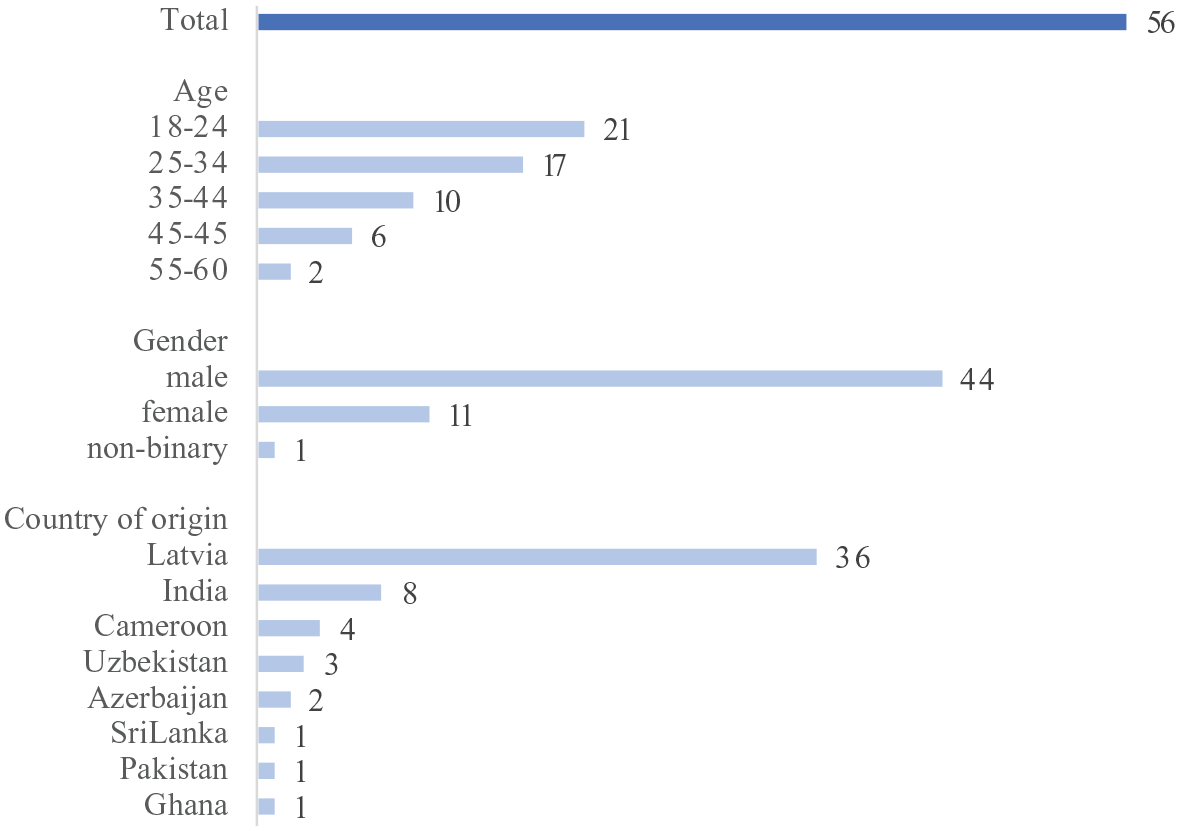
The number of interviewees by age, gender, and country of origin.
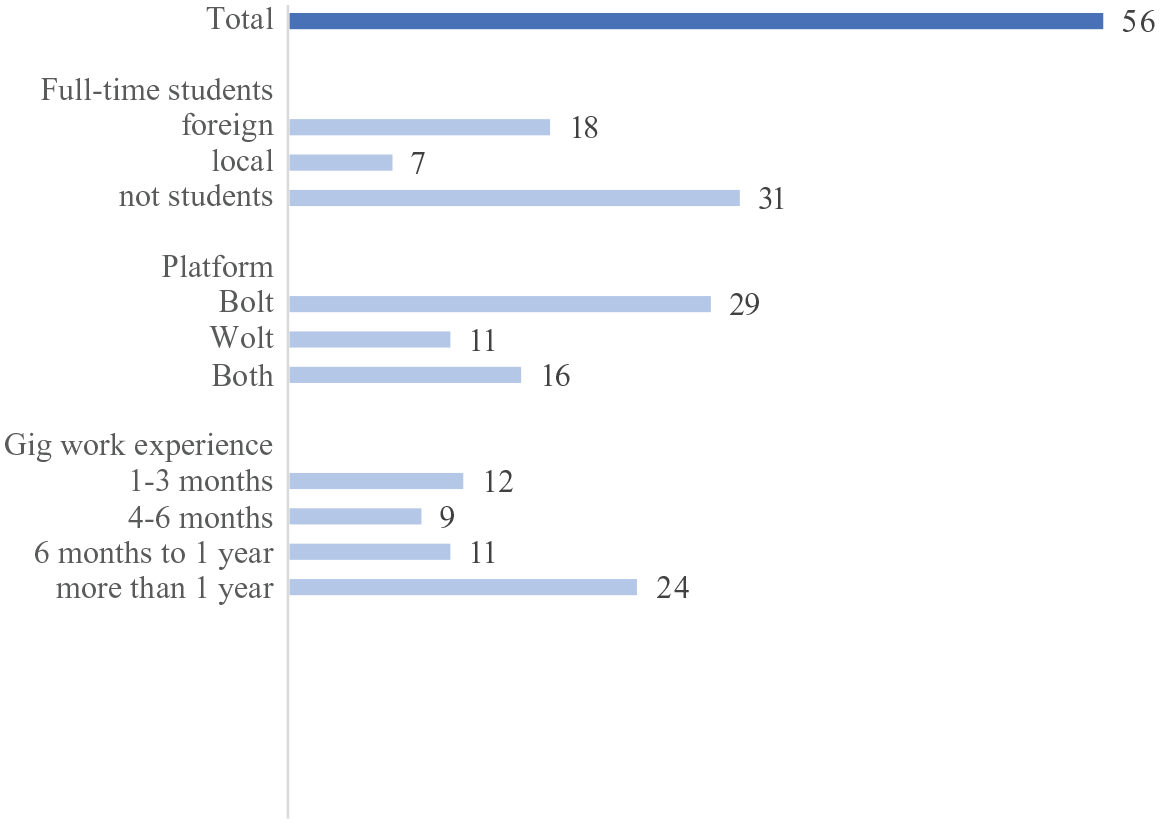
The number of interviewees by their current status as a student and their gig work experience.
Interviews varied in length from 40 minutes to 2 hours, 63 minutes on average. All interviews were conducted in public places after obtaining informed consent from a respondent.
Dworkin (1988, p. 17) emphasized that we could access autonomy by looking at what a ‘person tries to change in his life, what he criticizes about others, the satisfaction he manifest (or fails to) in his work, family and community’. As we developed our questionnaire we tried to include themes to access respondents’ practice and perception and autonomy from multiple angles, and these themes are as follows: (1) career trajectories and the motivation/choice of gig work; (2) precarity and employment status; (3) daily routine and work–life balance; (4) algorithmic control and agency; (5) cooperation with other couriers and societal attitude; and (6) subjective feelings about gig work. All interviews were recorded and transcribed. The transcripts were anonymized by assigning each transcript a number and each interviewee a nickname that will be used to assign quotes in this article.
During interviews and data analysis, we paid attention to respondents’ meaning-making. We also considered that individual narratives are ‘never fully individual’ and reveal ‘shared experiences’ of social realities (Barabasch & Merrill, 2014, p. 288). To develop our theoretical line of thinking we focused on what is common across our diverse respondents in terms of their sense and practice of autonomy. We used our ‘sociological imagination’ to avoid respondents’ bias by situating their narratives and behaviour in the broader context of Latvia. Both authors read all the interviews twice. During the first read, we coded data according to the six themes listed above. In the second reading, we focused on analysing how the sense and practice of autonomy appears across these themes.
Openly accessible Telegram chats among local couriers provided additional insight into topics directly addressed in the interviews. We have approached and used the chat data considering researchers’ ethical responsibilities (King, 1996; Roberts, 2015). We do not reveal the exact name of the chat group; names and identification numbers of individual members are removed to ensure complete anonymity; and to guarantee further anonymity, in reporting, data are not cited verbatim but paraphrased (King, 1996, pp. 120–127). We accessed and analysed messages exchanged by two online groups for food delivery couriers in Riga that covered a period from January 2021 to November 2023 and consisted of 6,522 messages, primarily text and audio messages, but also photos and videos. During this period, both groups combined had 356 members. From those, 175 could be considered active, having posted at least one message. All the audio messages were transcribed. The resulting data corpus was systematically analysed and coded using the same themes and focus as the interviews.
Data analysis
Autonomy in couriers’ role-set
Similar to gig workers in other countries (e.g. Cano et al., 2021; Mendonça et al., 2023; Woodcock, 2020, among others), food delivery couriers in Riga are independent contractors, but this autonomous work status coexists with stringent algorithmic management that defines their work content and conditions (cf. Cameron, 2020; Pichault & McKeown, 2019). Wolt and Bolt platforms algorithmically manage delivery fees, routes of deliveries and, most importantly, allocation of incoming orders among couriers that, in turn, define each courier’s work efficiency. The earnings of couriers largely depend on how many ‘well-paid’ orders they receive and how little they must stay idle. We find that the courier’s role-set matters the most in the allocation of orders because clients’ and restaurants’ relationships with couriers, among other things, serve as input data for the algorithm that distributes the orders.
Even though the platforms claim that orders are allocated based on each courier’s location and an incoming order goes to the courier who is closest to the restaurant, it is clear that many other variables affect the final output, such as couriers’ performance evaluation by others in the courier’s role-set, e.g. clients and restaurants.
Clients and restaurants evaluate couriers, and algorithms consider this evaluation as they allocate orders. There have been cases when gig workers were blocked from the platform, meaning no tasks were allocated to them, for several days due to clients’ complaints.
They can lock a courier [out of the platform] for several days or even forever. . . I had a case once – I delivered an order and rang the door, but nobody answered. I rang three times without an answer. I decided to put the package at the door and mark it as delivered, reasoning that the client would open the door and see it. Once I did it and was about to leave, a man opened the door and started yelling that I had put the delivery on the floor. I apologized and explained the situation, but he continued yelling. Two days later, I was blocked out of the platform for 5 days because of this guy’s complaint. (60, woman, auto, N0007)
There are also situations when restaurants delay their food deliveries, and clients are not satisfied with the situation and hold couriers responsible. In other cases, couriers are held accountable for spilled food, even though the restaurant’s inadequate packaging caused it. The work conditions of couriers, including their chance to get new orders, are subject to conflicting relationships within a role-set.
Another thing is that some clients give bad ratings for restaurant delivery or somewhat, and that affects the courier. [. . .] For example, suppose you are a client and order something from a restaurant, and the restaurant causes a delay. In that case, people think the courier is causing the delay while getting the delivery. And if the client gives a bad rating, that will also affect the courier. (25, male, auto, India, N0023) If you go to McDonald’s most of the time. . . When you take it from McDonald’s, you destroy the order because they don’t close the cap very well. [. . .] I don’t like that situation. You go, open the bag, and see that the order is destroyed. I am looking at the customer ‘hello’. . . [laughs]. (19, male, auto, Azerbaijan, N0030)
In one of the platforms, couriers can choose a double order option, which means that they can pick up two orders from a restaurant or two and deliver them to two clients. The platform algorithm sets the logistics of the route. Our respondents have reported a situation when the platform route requires them to deliver the most distant order first. The other client who got his food second complained about why the courier has been wandering around with his food. Such situations affect how clients evaluate couriers’ performance.
Sometimes you take a double order and drive by a client. The client sees where you are, but the application does not allow you to deliver the second order before the first. It has sequenced the orders. But the client sees that you are passing him by. (46, male, auto, N0006)
We can consider even other drivers in traffic as part of the couriers’ role-set. Traffic may affect the algorithmic calculation. Couriers often get jammed in traffic, so they delay their client deliveries. Clients who do not understand this situation may give the couriers a bad rating. The character of role relationships in the couriers’ role-set affects how the algorithm will treat couriers and how orders will be allocated. Couriers are aware of that and try to keep good relationships in a role-set. Both in restaurants and with clients, they try to manage emotion (Hochschild, 1979) by being polite and understanding.
In the courier’s role-set, platforms expect couriers to be ready to work when demand is high for the price platform algorithms have set. There is a base fee for each delivered order on both platforms. Additionally, in calculating the delivery fee for each order, the algorithm considers the delivery route and time. The pay for a delivery is based on the distance from the restaurant to the customer but does not cover the way to the restaurant. Therefore, the best-paid orders are those with a short distance to the restaurant and a long distance from the restaurant to the client. Workers are paid for the route platforms recognized as the fastest, not for the route couriers choose. At times of high demand, the platform might offer a bonus or increase the rates.
Due to how platforms algorithmically manage delivery fees, respondents complain about the illogical allocation of tasks where food locations are far from couriers’ positions. In online chats, couriers share screenshots of the orders, where they must drive about 10 km to a restaurant to pick up an order to be delivered across the street from the restaurant, consequently receiving a minimum fee (e.g. Chat 2, Msg.398, 03/10/2023, 07:21:10). There are also cases when a courier accepts going a long distance to pick up an order. However, the order gets cancelled en route, and a courier ends up not being paid (e.g. Chat 2, Msg. 434, 03/10/2023 09:56:11).
The algorithmic calculation of expected delivery times and fees does not consider the actual condition of the delivery route. In online chats, couriers complain to each other about addresses that look easily accessible on a map but can be reached only with a tractor, a tank, or a helicopter due to highly muddy, bumpy, or often wholly blocked-off streets (Chat 2, Msg. 387-397, 02/10/2023 21:40:28 – 02/10/2023 22:47:38). Sometimes the algorithmic calculation of a fee is disproportionate to the required task. For example, an auto courier reported having delivered lunch for 20 people and was paid only two euros because it was a single order and its delivery route was very short (Chat 2, Msg. 215-241, 30/09/2023 16:29:01 – 30/09/2023 18:09:04).
Even though couriers have some freedom to choose which order to deliver, their ability to reject orders is limited by so-called activity ratings. Couriers have limited freedom to reject an order since the rejection of too many orders can be punished by blocking the couriers’ account. For example, on the Bolt platform, the activity level must be at least 80%, which means that couriers cannot cancel more than two out of 10 orders without getting penalized.
For Bolt, the number of orders matters. Activity statistics. If statistics drop below 80%, it is bad, then they start to take interest in you. Then it would help if you were careful – you can’t reject one after another. (47, male, bicycle and auto, N0019) I will be honest – I don’t like delivering in the city center. There is nowhere to park, and I get a fine if I leave [the vehicle] on the road with emergency lights. . . I try to reject orders in the center. However, if I reject two ‘centers’, my activity rating drops, and I must work hard to get it back up. I have to deliver at least four orders in a row to get it back. (60, female, auto, N0007)
Objectively looking at the algorithmic management on the Wolt and Bolt platforms and according to Pichault and McKeown’s (2019) matrix of autonomy in platform work, couriers’ autonomy in the their role-set is minimal. Workers have little autonomy to organize work and fees for their service according to their choosing. Nevertheless, similarly to what has been found by Cameron (2020) and Altenried and Niebler (2024), we have observed that couriers retain some ‘sense of autonomy’ over their work content and conditions by ‘imagined control’ over algorithms. Many have developed beliefs about managing the platform algorithm to get orders more efficiently. Some believe they must be on the move to be privileged by the algorithm, while others choose to be in places with more restaurants open; others work for both platforms simultaneously.
I never sit in one place. I have a theory that the system likes a moving courier more than an idle one. Some time ago I thought let’s sit and read a book, but it was a mistake. I met a colleague and asked, is it that bad – there are no orders coming, I have only four. He said that he had eight. You must move, he said. (35, non-binary, bicycle, N0013)
Looking at couriers’ status from the perspective of role-set allows us to see how autonomy manifests in the platform work. According to Dworkin (1988), to explain autonomy, one must look at the whole person and not only the person as a worker. One has to analyse how the courier’s status is compatible with other positions in life and whether this combination allows the courier to feel autonomous, as someone who has agency over his life.
Couriers’ multiple roles and autonomy
If we look at a courier status as one of the multiple statuses a courier has in their life, then we see that food delivery work gives couriers a sense of agency and coherence. The ability to control one’s working time and schedule gives flexibility in dealing with the multiple statuses and roles couriers have and improves the self-governing of one’s life. Many respondents with prior experience in standard employment saw gig work as far more compatible with the status of a student, a caretaker (of a pet, an ill relative, or self), an artist, a parent, a partner, a friend, and others. Consistently with Dworkin (1988), the flexibility gig work offers becomes a crucial condition to maintain that sense of agency and coherence over one’s life or, in other words, autonomy.
You can choose to work half an hour, to deliver just one order, and nobody will blame you. It is great. I worked while being a first-year student. Got into a car right after classes. (21, male, auto, N0004) You are your own master. I worked in MONO [anonymized fast food chain company] for 11 hours daily. I could not move either left or right. Here, I can come in whenever I want and get off whenever I want. [. . .] Then I go home for an hour to care for my very ill dog. (60, female, auto, N0007) I began to look for a job, but the first month of the summer, June, was fairly busy with folk dance classes since we were training for the song and dance festival in the USA. Thus, it took work to apply for any job. I could not be at work from eight to seven in the evening – I needed flexible employment. And then I found Bolt. (18, male, bicycle, N0022)
For some of our respondents, extra income from couriering helped them deal with ups and downs in business and maintain the status of a small entrepreneur they enjoyed. Consider the story of Ēvalds, a 49-year-old entrepreneur. For nearly 30 years, he ran a firm that produces outdoor advertising ephemera. He explained that his business used to be most intense in the summer and least intense in the winter. All the time, he accumulated enough savings to live through the winter, but not anymore. He relates this to the Covid-19 pandemic and the rising utility costs due to the Russia – Ukraine war. He said the food delivery option was the best for him as he could flexibly combine it with the management of his business:
This winter somehow hit the most. Let us see how it will be over the summer. During the summers, I could save more for the winter, but this year, due to the world’s situation [meaning the war and Covid pandemic], I don’t know why, but there was less work. I had less savings for winter. And then, in December, I decided I had to do something about it. [. . .] it was important for me to be in my firm during the day. In any other job, I would need to be from a certain hour to a certain hour. Here I can come when I can. If something happens, I can choose not to work. Nobody controls me, and don’t ask me – where are you? (47, male, auto, N0029)
Gig work is also appreciated for the emotional independence it provides. Several respondents emphasized increased emotional well-being compared to their prior experience in a standard employment setting. Gig workers praised the opportunity to have flexible work schedules, which would be difficult in standard employment where they would need to negotiate their schedules with their supervisors. Several of our respondents saw working under a boss as emotionally challenging.
IT jobs involve regular ill-treatment. Therefore, I prefer to work for myself. Then, I can be sure that nobody mistreats me. I can work when I want. I can take a vacation when I want. I can easily adjust my vacation plans to my wife’s. I can babysit whenever it is needed. When my wife comes home, I can leave for work. Moreover, I do not have to worry if she is caught in traffic and is running late. I do not have to rush. I can wait for her and leave when she comes in. On sleepless nights – I can get up and bolt. (36, male, auto and bicycle, N0009) I love that I am independent. I do not have to obey anybody. I motivate and control myself. I have worked for many bosses. I know how it is. It is not ‘tasty’ nowadays. My current work is in a way ‘tasty’. (41, male, bicycle, N0010)
This observation resonates with Altenried (2021), who observed that immigrant riders in Berlin prefer this job as it helps to avoid racist managers and supervisors. Emotional well-being improves couriers’ abilities to deal with other roles and responsibilities they have in their lives, such as being a partner or a parent, whereas the experience of emotional abuse at work negatively affects relationships at home (Carlson et al., 2012). Some respondents have also pointed out that this job allows them not to work when they do not feel like working. Gig work thus serves people’s emotional needs and personality better than standard employment.
I do not plan ahead, what I am gonna do in seven days or three days. It depends on my mood. (29, male, auto and bicycle, N0018) I get mad about the traffic or a customer upsets me. . . then I simply stop working. [I] Do not keep driving when you are agitated. . . (46, male, auto, N0006)
Some respondents indicated that platforms offer greater financial autonomy than standard employment. Despite platforms controlling the fees, the flexibility of schedule gives gig workers a certain control over their income (cf. Wood et al., 2019). If a sudden necessity arises, a gig worker can work extra hours to provide for themselves or their family. Such an opportunity also helps them better fulfil other goals, including various hobbies, in their lives.
I have worked 15 hours for half a month or 42 hours per week, in the spring – even 242 hours. It varies. In August 2021, I worked 7 days per week, morning till night. I wanted some extra money and worked. (29, male, auto and bicycle, N0018)
Bolt couriers received their income weekly, and Wolt couriers received it bi-monthly. The wage schedule of the platforms is also perceived as more favourable than a monthly paycheck for standard employment in Latvia. An option to conduct payments in cash, available on the Bolt platform, provides access to immediate income and thereby allows for the dealing of short-term financial difficulties. This option may empower gig workers emotionally since gig-workers do not need to depend on others or feel bad in the eyes of others if they need to borrow money to make a living.
If I need like €50 immediately, I don’t need to ask my friends, my family. Ok, if I put on Bolt, then I will get within four to five hours, and mostly I will get my cash. (27, male, auto and bicycle, India, N0024)
An option to deal in cash only and the status of independent contractors provides an opportunity to evade reporting taxes. Many couriers keep their tax payments to a minimum or avoid them altogether by underreporting income or setting up a foreign bank account and not reporting income. This is nearly the only option to maintain a decent life for workers in debt and threatened by bailiffs. Some of our respondents reported they had experienced such difficulties, being, in a way, victims of financial neoliberalism. The insolvency process in Latvia keeps debtors’ income to a state-defined minimum, which is low in Latvia given high living expenses. To ensure that their debt is paid, bailiffs allow them to keep this minimum, but the rest must be paid to a credit institution. For example, Signe, a single mom in her forties who took unsecured loans to pay for her daughter’s medical bills, said that she finds it difficult to work under conventional labour contracts since these debt collectors always inform her employer, affecting how they treat her and even asking employers to pay her debt to the bailiffs directly. In gig work, she feels more comfortable due to her self-employed status. For Signe and many others, platforms offer an opportunity to be outside the institutional control of aggressive debt collectors.
Conclusions
The study demonstrates that gig work gives workers autonomy regarding multiple roles despite the algorithmic management platforms exert over workers. We add to the debates on algorithmic control by deepening the explanation of ‘the sense of autonomy’ (e.g. Cameron, 2020; Shibata, 2019, 2020) identified in algorithmically managed workplaces by analysing how workers’ identity is related to the other identities they have. Following Dworkin (1988), we analyse autonomy as an overall sense of control and coherence over one’s life, and, following Merton (1957), we distinguish between role-set and multiple roles, which helps to account how the sense of autonomy at work and overall life are connected. Given this theoretical lens, we find that gig work as a non-standard and flexible employment opportunity allows couriers to self-govern their other statuses and roles – such as being a parent, an artist, a small entrepreneur, a parent, a student, a friend, etc. The sense of autonomy we find among gig workers does not mean that workers are ‘uneasily unaware’ of the algorithmic control they are subjects of. Similarly to Cameron (2020) and Altenried and Niebler (2024), we see that workers perceive the control and think of ways to bypass it.
This study also contributes to studies of precarity, which seek to understand why, despite the seeming precariousness platform work generates, workers pursue this type of work. There are concerns that the precariousness these jobs generate regarding wages, social security, and gaming built into algorithms limits workers’ autonomy. In the Latvian context, we find that in terms of wage and emotional well-being, it is not more precarious than any other standard employment opportunity (Ķešāne & Spuriņa, 2024). Compared to the jobs some of our respondents had before, this job is precarious but grants relational autonomy and thus gives coherence to one’s life. Diakonidze (2023) writes about ‘internalized precarity’ among Georgian taxi drivers who do gig work because alternatives are even more precarious. Based on our data, we would like to argue that the option to choose gig work when other job alternatives do not fit in the practice of relational autonomy manifests agency and not necessarily a sense of subjection the notion of ‘internalized precarity’ suggests.
Lastly, by looking at workers’ autonomy as related to their multiple roles, this study contributes to the studies of the meaningfulness of work (e.g. Bragger et al., 2021). In capitalism, where workers’ identity and efficiency are prioritized over other identities workers have as human beings, our findings show that the flexibility platforms offer may challenge the prioritization of workers’ identity and foster work–life balance. We observe that people put up with their former and more established careers because they prefer the flexibility to balance their multiple roles better. Our findings also show how the availability and flexibility of platform employment nurture small businesses that would be regarded as nonprofitable and thus likely to close down.
Similarly to platform workers across the globe, our respondents also indicate that platforms could do more to improve couriers’ working conditions and well-being, especially regarding delivery fees, transparency of algorithmic management and social security. However, based on our data and similarly to Van Doorn et al. (2023), we should look carefully at the new EU directive on platform work that seeks to reclassify gig workers as employees. Some respondents indicated that framing their work as a standard employer–employee relationship may risk their ability to practise relational autonomy. Our data convey that gig workers should be able to choose their status for the sake of their relational autonomy as well as autonomy regarding work status (cf. Pichault & McKeown, 2019).
Footnotes
Acknowledgements
We sincerely thank our informants for sharing their stories. We thank the three anonymous reviewers for their guidance, critique and advice. It was greatly appreciated and very helpful.
Funding
This research is funded by the Latvian Council of Sciences’ Program for Fundamental and Applied Research, project title ‘Meaning and Practice of Autonomy in Gig Work: Sociocultural Inquiry in Experience of Wolt and Bolt Delivery Workers in Riga’ (Project No. lzp-2021/1–0521).
