




Abstract
The ‘globalization turn’ in the sociology of class has led to the resurgence of studies comparing social classes in Europe over the past 20 years and to question the methodological nationalism of the class analysis. But it has also paid little attention to the selection of the most appropriate empirical tools for quantifying class in a comparative approach. This article explores the links between occupations, class structures, and countries by applying the French and the Portuguese occupational classifications to both countries. France and Portugal are an especially suitable pairing for comparative study because social class and inequalities are central to sociological research in both countries, and their divergent intellectual histories produced different tools for quantifying social stratification. The Portuguese classification, which attaches great importance to the ownership of capital, helps to understand the diversity of the class position of the self-employed and the structure of the economic elites. The French classification, based on employment status and qualifications, highlights the role of diplomas and the public/private divide. Ultimately, the Portuguese social structure appears to be more polarized than the French one. This cross-national and cross-classification comparison brings to light features of the social structures of the two countries and the contrasts between them that would have remained a blind spot if we had used an international classification. Paradoxically, these national classifications help to overcome methodological nationalism and ethnocentrism.
While class analysis has long been restricted to the nation-state, the economic globalization and the internationalization of social relations have fostered a ‘globalization turn’ in the sociology of class (see Atkinson, 2007; Beck, 2007, in the English-speaking world; see also Boltanski, 2014; Wagner, 2020, for France). This has led to the resurgence of studies comparing social classes in Europe over the past 20 years. Those studies, which were primarily drawn from the field of quantitative sociology, were not only engaged in a competition to establish the dominant explanation for social inequalities but also sought to advance their own class schema for understanding social stratification. The authors have frequently engaged with debates concerning the optimal means of quantifying social inequalities. These include discussions surrounding the relative merits of the occupational versus Capitals, Assets, Resources (CARs) approaches (Savage, 2016), as well as the nuances of the latter within the occupational approaches, namely the contrasting nominalist and realistic class schemas. The neo-Weberian class schema (Erikson & Goldthorpe, 1992) gradually overtook Wright’s (1997) Marxist schema and spread across Europe (Rose & Harrison, 2010) and beyond (Smallenbroek et al., 2022). It has been criticized for being blind to changes in the labor market and horizontal class divisions (Oesch, 2006). It is now used to compare social mobility in Europe (Breen, 2005) but its results can be crude, and it is unsuitable for social analysis in some national contexts, such as France (Brousse et al., 2010), Germany (Müller et al., 2006), and Greece (Maloutas, 2007).
Bourdieusian approaches have for a while been rather peripheral in comparative social stratification research, but three recent studies have brought them more to the fore. In a special journal issue on social classes in Europe (Penissat & Siblot, 2017), Brousse (2017) tested the social space hypothesis (Bourdieu, 1984) on a European scale. Her analysis depicts a European social space structured by both the volume of capital and its composition (economic and/or cultural). It also reveals a tripartite class structure (low/middle/high) that varies markedly across European countries. Atkinson (2020) largely confirms these findings in OECD countries and proposes analyzing specific national social spaces such as France (Atkinson, 2021) and Germany (Atkinson & Schmitz, 2024). Challenging the national scale of class analysis, Hugrée et al. (2020) have documented the social distances separating social classes on a continental scale. By testing theoretical approaches to stratification beyond a single country, these studies remind us that occupational classifications still structure our knowledge of social class, and illustrate how useful these classifications remain for comparing class inequalities across Europe, despite economic and technological change.
While Erickson, Goldthorpe, and Portocarero’s class schema (known as EGP) is now often used as a ‘one-size-fits-all’ measure for comparing social classes (Barone et al., 2022), the literature makes it clear that European class comparisons are based on different occupational classification systems. Atkinson uses the International Labour Organization’s International Standard Classification of Occupations (ISCO), Hugrée et al. prefer the European Socio-economic Groups (ESeG) established by Eurostat (Meron et al., 2016), while Brousse favors an ad hoc classification inspired by the French Professions et Catégories Socioprofessionnelles (PCS; Professions and Socio-Professional Categories).
This point interests us because it forms part of the ongoing debate surrounding ‘methodological nationalism’ (Faist, 2014; Schäfer, 2023; Wimmer & Schiller, 2003) and ‘methodological cosmopolitanism’ (Beck, 2007) in relation to occupational approaches. Nevertheless, little attention is directed towards the selection of the most appropriate empirical tools for quantifying class in a comparative approach. It is challenging to conduct a social class comparison without making use of occupational classifications. However, these classifications are not entirely equivalent, and none of them is neutral. International occupational classifications (such as ISCO or ESeG) are useful for analyzing social inequalities between countries: these provide valuable opportunities to consider the ways in which class positions are shaped at a scale beyond that of the nation-state, within the context of globalization. However, these categories are inadequate for examining inequalities within the social context of a single country, which still frame class relations. Although they seem a good option for avoiding ‘methodological nationalism’, one could also argue that international classifications are colored by ethnocentrism because they are based on conditions in Western countries of the global North and fail to promote an empirically ‘methodological cosmopolitanism’. Conversely, national classifications and class schemas are tied to the social history, state, and sociological traditions of a single country. As they are the expression of national visions and divisions, they have greater analytical power than international classifications within one particular national space; with use, they impose a nationwide schema for perceiving the social world (Desrosières, 2002). They are therefore thought to have little to offer international comparison.
This article aims to transform this neglected methodological issue into a discussion of the implications of country-specific conceptions of social class in Europe. Other studies have documented the strengths and weaknesses of different theories for comparing social stratification in Europe, whereas we wonder what might emerge if the social structure of one country were to be analyzed using tools designed in, and for, another. Such a shift has two implications for research. First, by focusing on the most concrete dimension of class analysis, we question the links between occupations, class structures, and countries that are at the heart of this form of analysis. Secondly, by choosing to apply equivalently two national classifications to the same two countries, we paradoxically avoid methodological nationalism: instead of choosing a dominant class schema and studying a more peripheral country with it, as if the swap was insignificant, we will use two national classifications symmetrically, and analyze the results of this comparison. In so doing, we combine the quantitative analysis of social structure with the sociology of quantification in continuity with work both old and new (Bouchet-Valat & Jayet, 2019; Lebaron & Page Pereira, 2015).
This article compares the French and Portuguese classifications by applying them both to each country. Pairing these two countries is especially enlightening because France is considered central in the European space, while Portugal is seen as peripheral. Social class is a central sociological theme in both countries, but their intellectual histories differ, as do the tools used to measure class. If less known than the EGP class schema, Bourdieusian class theory has given the French PCS classification greater international visibility than Portuguese class schemas. We chose to study the period following the 2008 financial crisis, when inequalities between European Union countries and their social class increased, and focused on the year 2014, often taken as the crisis’s turning point.
We first explain why we chose to work with the European Union’s Labor Force Survey (EU-LFS). We then present and compare the Portuguese schema developed by Almeida, Costa, and Machado (ACM) and the French schema (PCS), and explain how we adapted each to the EU survey (EU-ACM and EU-PCS). We then demonstrate that structural differences and gaps between Portugal and France can appear significant or minor, depending on the scale of analysis and which national classification is used. Lastly, fine-grained analysis and crossed comparisons reveal persistent differences rooted in the social history and specific contemporary dynamics of each country.
EU-LFS data: Blind spots and strengths for comparison
European-level social class research uses a variety of sources: in the studies cited earlier, Atkinson uses the International Social Survey Program (ISSP), Brousse the EU’s Statistics on Income and Living Conditions (EU-SILC), and Hugrée et al. the EU-LFS, EU-SILC, Adult Education Survey (AES), and European Working Conditions Survey (EWCS). Each data source offers different opportunities for analysis depending on how their categories were constructed or whether they take a social-class approach. These differences come from the history of the institutions that designed them (for statistics or research, public or private, national or international), their intended purpose, and how they were built. We chose to work with Eurostat’s EU-LFS.
EU-LFS is the result of Eurostat’s effort to reduce the heterogeneity of data produced by national statistical institutes and consolidate that information into a common platform. A review of this initial heterogeneity is necessary to better understand the nature, strengths, and limitations of LFS data. In brief, Eurostat takes an ‘output harmonization approach’. 1 It provides national statistical organizations with a list of required ‘core variables’ and a reporting calendar, and then harmonizes and aggregates that national data EU-wide. National surveys contain much more data than the core variables, and they are significantly different from each other.
The French Enquête Emploi en Continu (EEC; Continuous Employment Survey) and the Portuguese Inquérito ao Emprego (IE; Labour Survey) attest to the heterogeneity of national surveys. While both are intended to produce current data on employment and unemployment, the EEC is also designed to produce structural data on employment, work, and socio-professional categories to fuel academic research (Goux, 2003), which is only a secondary objective of the IE (Torres, 2009). Questionnaire and documentary analysis of both revealed that the 2014 EEC questionnaire was 91 pages long, with 134 questions on primary and secondary activities, 64 on education and training, 29 on geographical and social origin, and 18 on the last job held. Four hundred pages of documentation were made available to researchers. The 2014 IE questionnaire had 48 questions on professional activities, with only one on occupation (C4), none on whether the job was private or public sector, 10 questions on education and training, 8 on the last job held, and none on social background. There is no explanatory documentation for researchers. 2
Moreover, researcher access to survey microdata varies by country, confirming the different functions of these data in each: in France, researchers have ready access to datasets and use them regularly, but the equivalent data are rarely used in the routine production of knowledge in Portugal, and access requires a demanding accreditation procedure (see Appendix 1).
Several studies have already shown the benefit of using the EU-LFS to compare social structures at the European level, and indicated its failings. For example, Portuguese researchers identified general trends such as the rising proportion of intermediary and skilled occupations, the decline in industrial workers, the development of routine administrative jobs in the service sector, and the different paces of these trends in different countries (da Costa et al., 2000), emphasizing the central role of educational systems in the process (Mauritti et al., 2014). Peugny (2018), a French sociologist, calls for analysis of social structure polarization due to the rising proportion of low-skill jobs and the relative decline in jobs requiring moderate qualifications, a dynamic that varies from country to country.
These authors lament that some variables are too aggregated (occupation, educational level, business size), that it is difficult to discern workers with multiple jobs, and social background is lacking. To this we add the regrettable absence of information on whether the employer is public or private, since this distinction is fundamental to European social structure (Hugrée et al., 2015). Lastly, EU-LFS does not permit analysis of the socio-professional characteristics of the unemployed, retirees, or the non-employed in general (Baraud et al., 2022) and revenue data are limited and hard to compare. Despite these limitations, the sample size and quality of the EU-LFS make it a peerless data set for conducting detailed comparative analysis of social class and socio-professional position by varying the utilized classifications.
In 2014, the EU-LFS database contained 1,754 million individuals, 3 including 167,243 for Portugal and 530,025 for France. The survey had 40 variables concerning professional activity (plus derivative variables), 13 on education and training, 1 on income, and 7 on the previous job. 4
Which socio-professional classification for what sociological purpose?
The quantitative sociology of class interprets society using a variety of theoretical frameworks, class schemas, and socio-professional classifications (Bouchet-Valat & Jayet, 2019). Before comparing these tools empirically, we should review how they are designed. Comparing France and Portugal is especially informative on the methodological and theoretical issues behind classificatory choices (Borges Pereira & Siblot, 2017). For example, Portuguese sociologists have crafted their own analytical schema distinct from the national statistical classification, while the proximity of French statisticians and sociologists has led to the creation of a state classification that is widely used by researchers. 5
Portugal: Rival research classifications
The histories of the professional classifications of the Instituto Nacional de Estatística (INE; known as Statistics Portugal in English) and those used by Portuguese sociologists are relatively distinct.
The INE classification is mainly a national version of international classifications. The first Classificação Nacional de Profissões (CNP: National Classification of Professions) was established in 1966, based on the first (1958) version of ISCO. The subsequent CNP 80 was an update to account for the 1968 ISCO modifications. The 1994 CNP followed the release of ISCO 88, deepening the national categorization. The 2010 classification, Classificação Portuguesa das Profissões (CPP; Portuguese Classification of Professions), took the groups and sub-groups of ISCO 2008 down to the finest of the four nesting levels, where it introduced additional headings for a total of 708 occupations (half from ISCO and half new: Classificação Portuguesa das Profissões 2010). 6
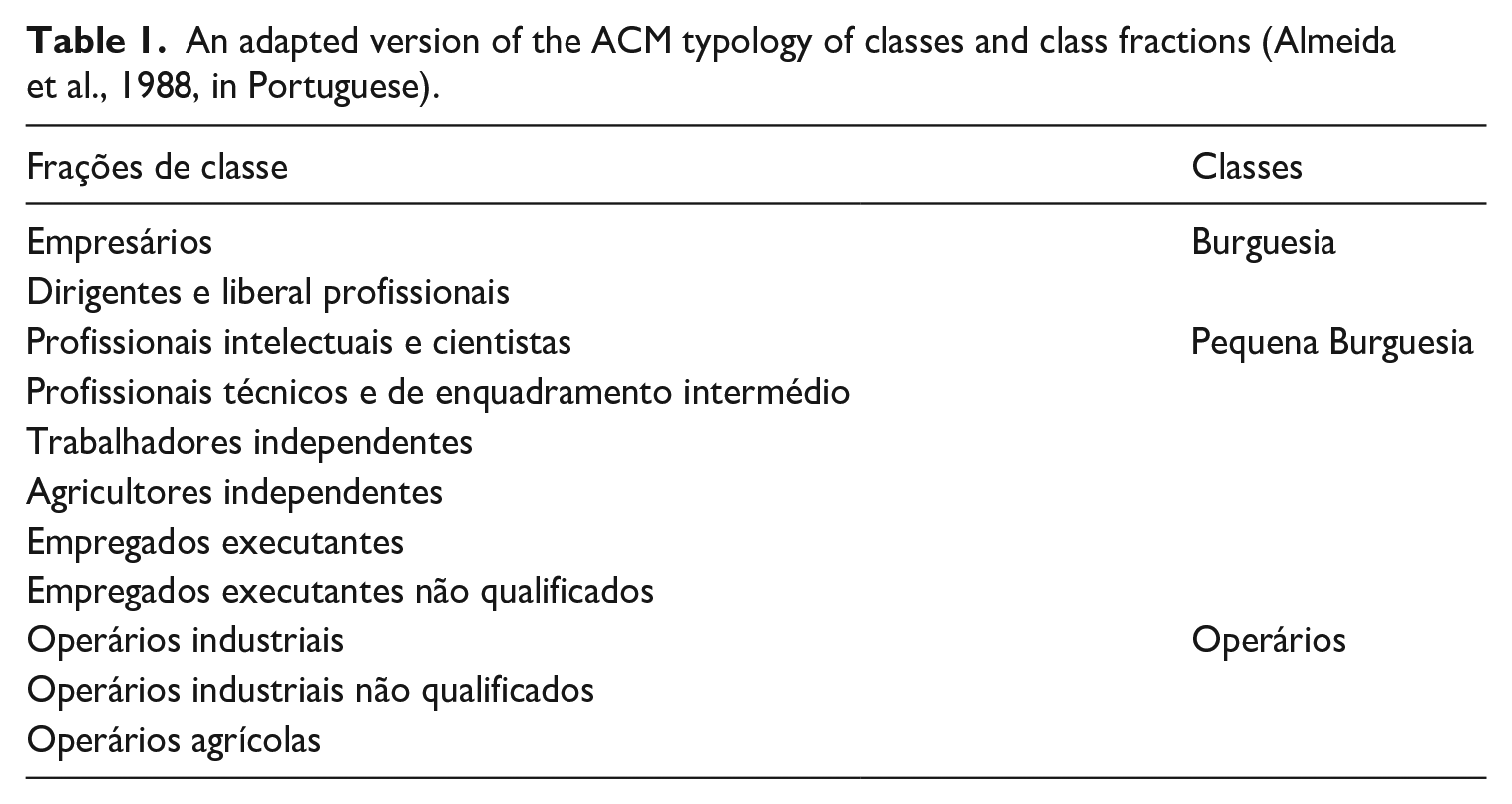
In parallel, sociologists developed their own class schemas. Sociology was banned in public universities during the dictatorship (1926–1974) and developed afterwards, focusing on social class. In 1978, Madureira, Pinto, and Almeida developed the first Portuguese class typology (tipologia das classes e frações de classes) at the individual and family group levels, influenced by Poulantzas, Wright, Bourdieu, and Bertaux. Ten years later, Almeida, Costa, and Machado built a new version, referred to as ACM (Almeida et al., 1988), which has been updated several times since. Minor adjustments have been made since the 1990s, and sociologists have developed ‘matrices of construction’, a coding method crossing large occupational groups and employment status to reconstruct this typology from the INE classification. Portuguese sociologists use other typologies as well, either a class schema akin to the EGP or a classification based more on Wright, but ACM is the most common (Roldão, 2009).
We present this typology (see Table 1) in Portuguese out of respect for the choice of words and their connotations, which are highly significant in the classification. It will be translated afterwards.
An adapted version of the ACM typology of classes and class fractions (Almeida et al., 1988, in Portuguese).
France: The hegemony of the state classification
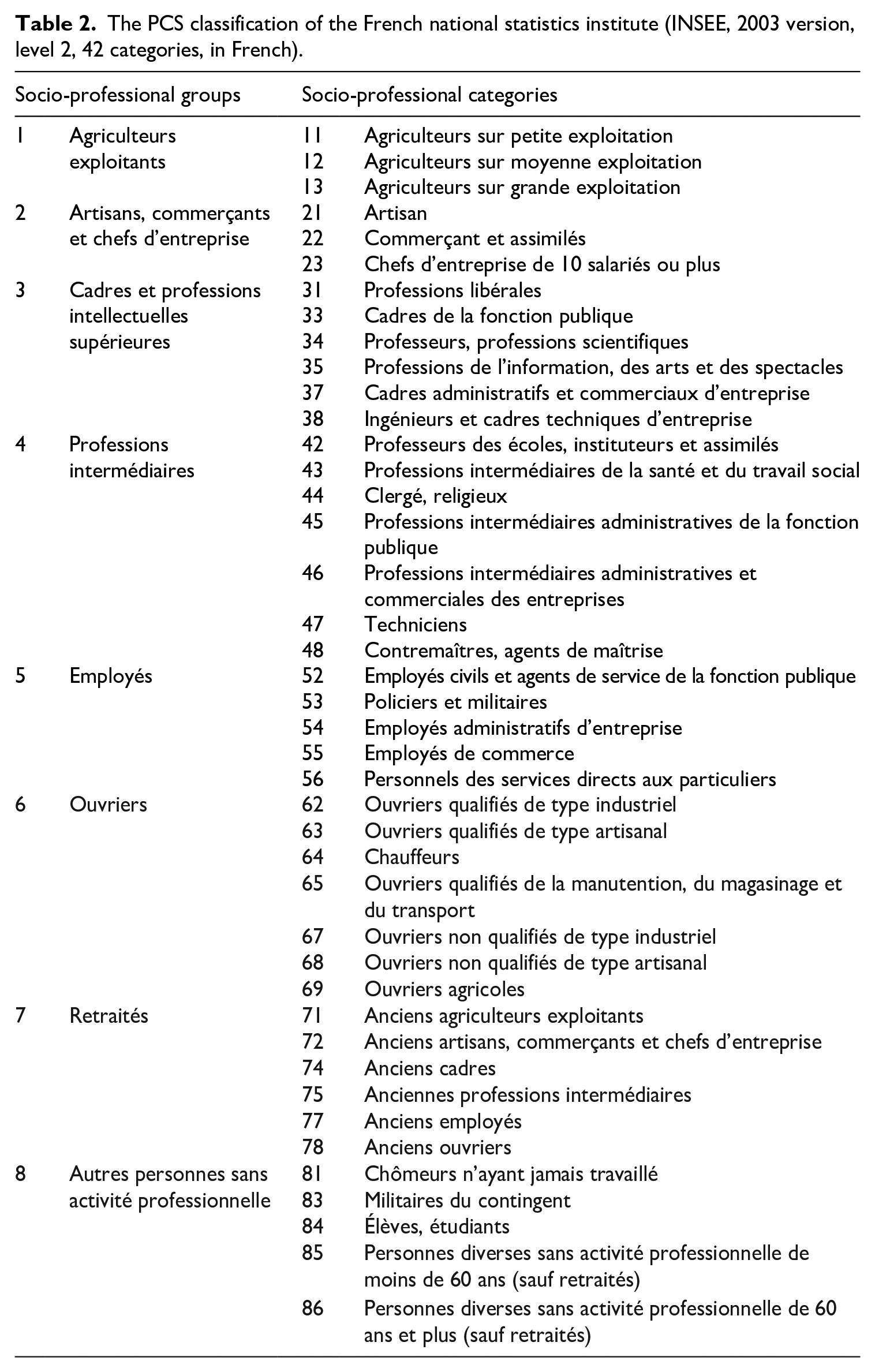
French sociologists differ from their counterparts elsewhere in Europe because they usually use the classification of the National Statistics Institute (INSEE) as a class schema (Amossé, 2013). INSEE’s PCS was developed in 1954, redesigned in 1982, and updated in 2003. 7 This classification combines three categorization systems: professional classifications from labor law, everyday conceptions of jobs, and principles of social structure primarily from Bourdieusian sociology. These criteria are relatively close to those people use to situate themselves in French social space (Penissat et al., 2015). The 2003 PCS had 8 main socio-professional groups, 24 sub-groups, 42 categories, and 486 occupations. 8
French sociologists have used this classification enthusiastically since the 1950s to study inequality, mobility, and social class using quantitative data. Sociologists debate class boundaries, internal divisions, terminology, and even the relevance of the notion of class, but no-one has produced a typology to compete with INSEE’s. It is still used in a wide range of theoretical approaches to class and inequality (Hugrée & Siblot, 2022).
As with the Portuguese ACM typology, in Table 2 we present the PCS in French and translate it in subsequent tables.
The PCS classification of the French national statistics institute (INSEE, 2003 version, level 2, 42 categories, in French).
Two visions of the ‘main divisions’ in French and Portuguese societies
In an article about Brazil arguing for a ‘transnational approach to class structures,’ Lebaron and Page Pereira (2015) stressed the importance of classification and schema choice in social structure analysis. They applied two schema that produced contrasting images of Brazil: while a purchasing-power schema depicted Brazil as a ‘middle-class’ society, a Marxist schema revealed 80% of the population to be workers subjected to exploitative relations. Inspired by their work, we will use the French and Portuguese classifications to reveal the effect each has on our understanding of each country, and the implications for social class comparison. After reviewing the principles of representation and division of the social world underlying each classification and introducing our methods for rebuilding them within EU-LFS, we will use their aggregated levels to make a general outline of social classes in Portugal and France.
Different representations of class structures
The PCS classification was designed on the basis of multiple variables and the principle of realism, using commonplace vernacular and institutional conceptions of occupations in France. French sociologists widely agree on a reading of social class that places a relatively heterogeneous blend of occupations in the ‘Upper Classes’: Cadres 9 and Higher Intellectual Professions, and Heads of Businesses of 10+ Employees (excluding Farmers, Tradespeople, Shopkeepers). They consider Intermediary Professions the equivalent of the ‘Middle Classes’, and place Laborers and Basic Employees in the ‘Working Classes’ (in the plural, les classes populaires).
The Portuguese ACM class schema is largely a legacy of Marxist theory. The criteria of property ownership and position in relations of exploitation predominate. Using theoretical criteria to designate social classes, it is more ‘nominalist’ (Desrosières, 2002) than the French classification. Its ‘Bourgeoisie’ consists of the more limited combination of Entrepreneurs with Upper Managers and Liberal Professions. The ‘Petite Bourgeoisie’ is broader, including Professionals, Intellectuals, and Scientists; Technicians and Intermediate Managers; the Self-Employed; and Farmers. There is debate over the position of ‘Routine Employees’, which are generally put in the Petite Bourgeoisie, whereas the ‘Working Class’ (in the singular, classe operária) consists of Industrial Workers and Agricultural Workers.
Due to design, the French PCS’s ‘Upper Classes’ are broader than in the Portuguese ACM’s ‘Bourgeoisie’, and the Portuguese ‘Petite Bourgeoisie’ is much broader than the PCS’s ‘Middle Classes’. The ‘Working Classes’ in France include Basic Employees (largely service workers) in addition to Laborers, while the Portuguese schema reserves its ‘Working Class’ for Workers.
Coding national classifications in the EU-LFS
We rebuilt both national classifications within the EU-LFS survey. Due to the available variables, the resultant classifications were not strict equivalents to ACM and the PCS, so we called them EU-ACM and EU-PCS. The coding was firstly based on the variable identifying the occupation (ISCO 2008, level 2). EU-LFS includes a variable for job-seekers’ last occupation, but it has a poor response rate, with 24.4% of the unemployed residing in France and Portugal leaving it blank. We thus limited analysis to the actively employed, which is a major limitation, especially as it disproportionately sidelines subaltern workers, who are more affected by unemployment. We excluded non-employed people for the same reason, which is another significant limitation (see Baraud et al., 2022), and only included people over the age of 25, an age by which most people’s educations have ended.
Building the EU-ACM variable seems simple at first, because it is based on only two core variables of the EU-LFS: occupation (ISCO 2008, level 2) and status (employee or self-employed). However, it requires additional variables to distinguish between owners of big businesses and the small-scale self-employed (based on the number of employees) and determine the extent of supervisory responsibilities.
The EU-PCS was built on the basis of previous coding work by Brousse (2017), with adjustments to account for the shift from ISCO 88 to ISCO 08. It combines the same core variables: occupation, public/private status, employer size, activity sector, supervisory responsibilities. For lack of a variable on the public or private nature of the employer (a central aspect of the PCS), we followed the lead of Hugrée et al. (2015) and sorted according to activity sector, designating occupations in health, social work, and education as public sector. This rather rough approximation was the only way to account for the public/private distinction. The EU-PCS and the PCS have two notable differences: the PCS classifies primary school teachers as an Intermediary Profession but the EU-PCS considers them Cadres and Higher Intellectual Professions (ISCO 3 makes no distinction between levels taught), and the PCS distinguishes between workers in industry and those in the trades, whereas the EU-PCS puts them in the same category (ISCO 3 does not make a distinction). Data missing from the EU-PCS mainly relate to the lack of information on employer size or the supervisory responsibilities of certain respondents (6% for France, 7% for Portugal).
Two aggregated quantifications of Portuguese and French social structures
Using these classifications to quantify various social groups of both countries is a reminder of how much our knowledge of a social structure owes to variations in the tools used to describe it. We will start the comparison by looking at the aggregated level of the EU-ACM and the EU-PCS (Tables 3 and 4).
French and Portuguese social structures as seen through EU-ACM (original aggregated level).
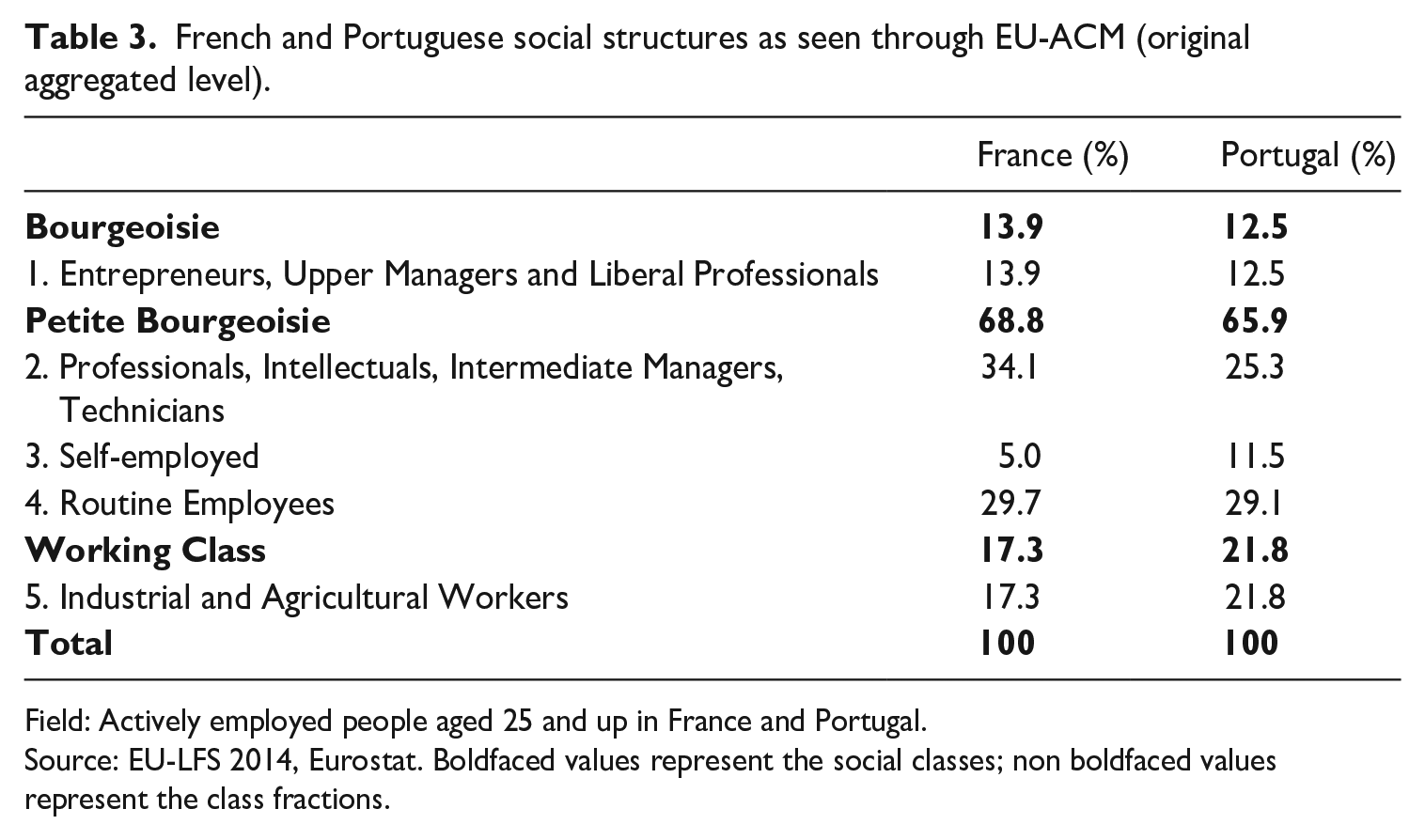
Field: Actively employed people aged 25 and up in France and Portugal.
Source: EU-LFS 2014, Eurostat. Boldfaced values represent the social classes; non boldfaced values represent the class fractions.
French and Portuguese social structures as seen through the EU-PCS (aggregated level).
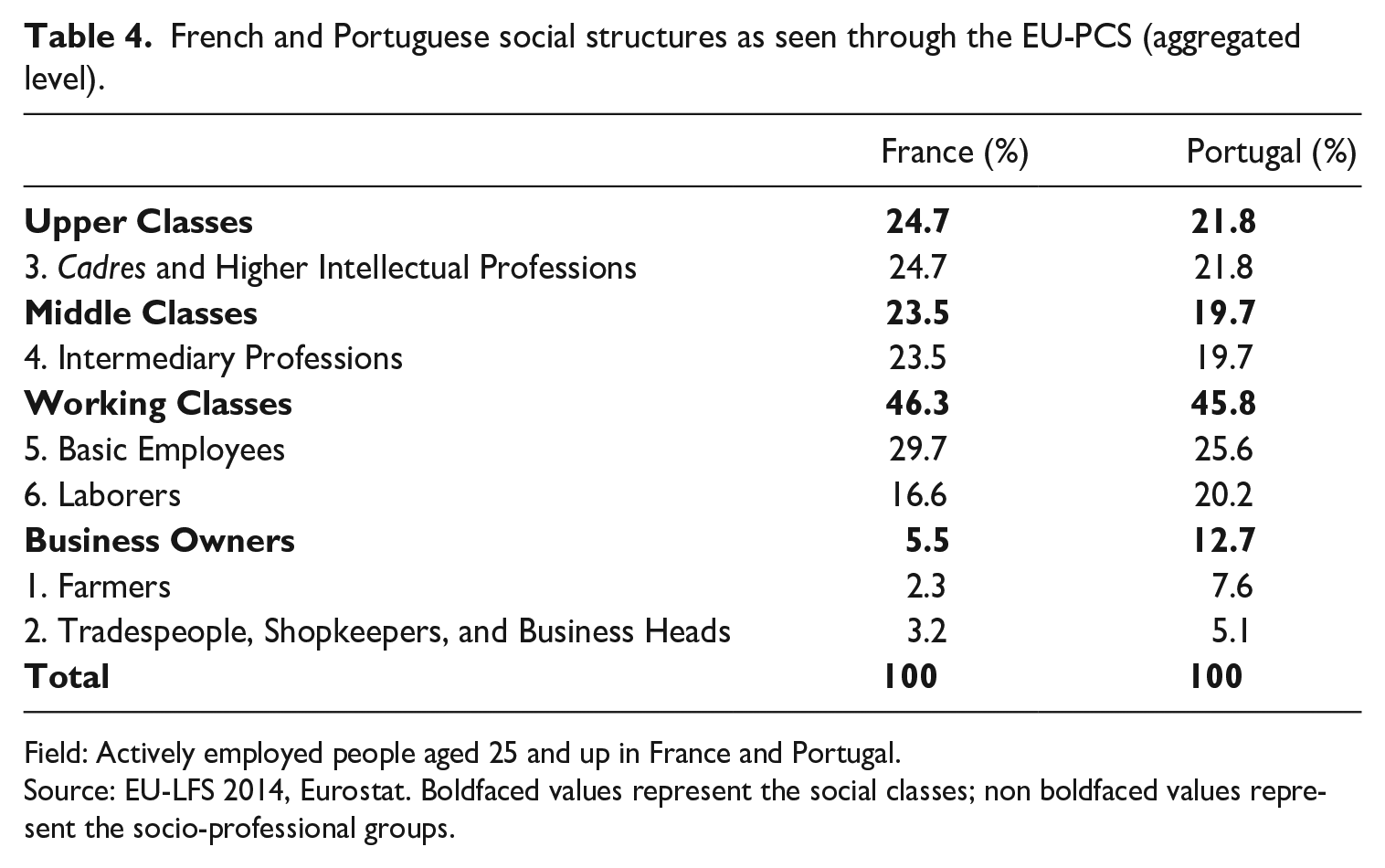
Field: Actively employed people aged 25 and up in France and Portugal.
Source: EU-LFS 2014, Eurostat. Boldfaced values represent the social classes; non boldfaced values represent the socio-professional groups.
If we use the EU-ACM class schema (aggregated in five categories, according to the most commonly used version), the Bourgeoisies are proportionally comparable, and the Working Class somewhat larger in Portugal. The largest social class by far is the Petite Bourgeoisie, which accounts for 69% of the actively employed in France and 66% in Portugal. That being said, this broadly defined Petite Bourgeoisie differs significantly in each country: the Self-employed Petite Bourgeoisie is distinctly larger in Portugal (12% versus 5%), while the Intellectual Petite Bourgeoisie is more developed in France (one third of the actively employed in France, one quarter in Portugal). The Routine Employee Petite Bourgeoisie is comparable (30% in France, 29% in Portugal).
The EU-PCS classification (aggregated into six categories) paints a different picture. The Upper, Middle, and Working Classes are of comparable proportions in the actively employed populations of both countries. The composition of the Working Classes differs, because the proportion of Basic Employees is higher in France (30%, + 4.1 points), and the proportion of Laborers is higher in Portugal (20%, + 3.6 points). Another notable difference at this aggregated scale is the share of Self-employed people. They are essentially split into two social groups (Farmers plus Tradespeople, Shopkeepers, and Business Heads), but some Self-employed occupations (lawyers, doctors, and, more rarely, some mid-level health professionals) are counted in the Cadre group. These occupations are the ones most excluded from class analysis in France, despite their consistently significant history and function in the social structure, and they are even more important in Portugal, where they account for 13% of the actively employed population (5.5% in France).
This first comparison shows that national typologies from different social and intellectual histories highlight different aspects of social structure. The Portuguese typology indicates notable differences between salaried/wage-earning and self-employed fractions, and between the economic and cultural fractions of the Petite Bourgeoisie. It also reveals how concentrated economic and cultural capital and political power are within the Bourgeoisie, whereas the French classification hides the power-elite within the much broader Upper Classes. The French classification provides a more precise account of internal differences within the Working Classes, which are changing rapidly but differently in each country, and calls for a finer comparison of the two constituent subaltern groups – the largely male group of Laborers and the generally female group of Basic Employees.
These initial findings called for a deeper analysis of internal differences in the composition of the main class groups. For this subsequent analysis we used a more detailed level of analysis and varied the choice of national classification system according to gender, region of social space, and predominant form of capital.
Class fractions, gendered dimensions of class difference, and educational gaps in France and Portugal
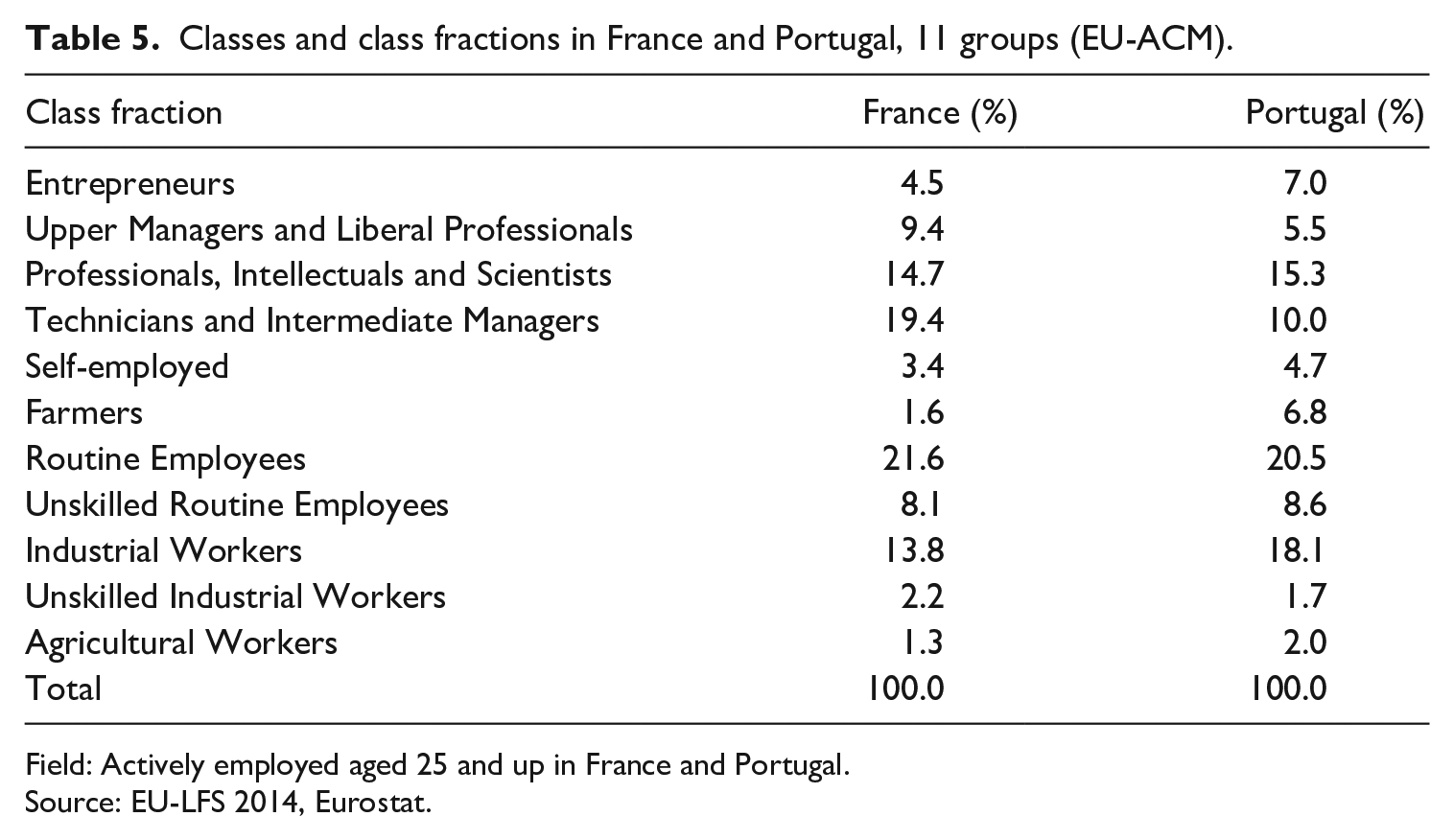
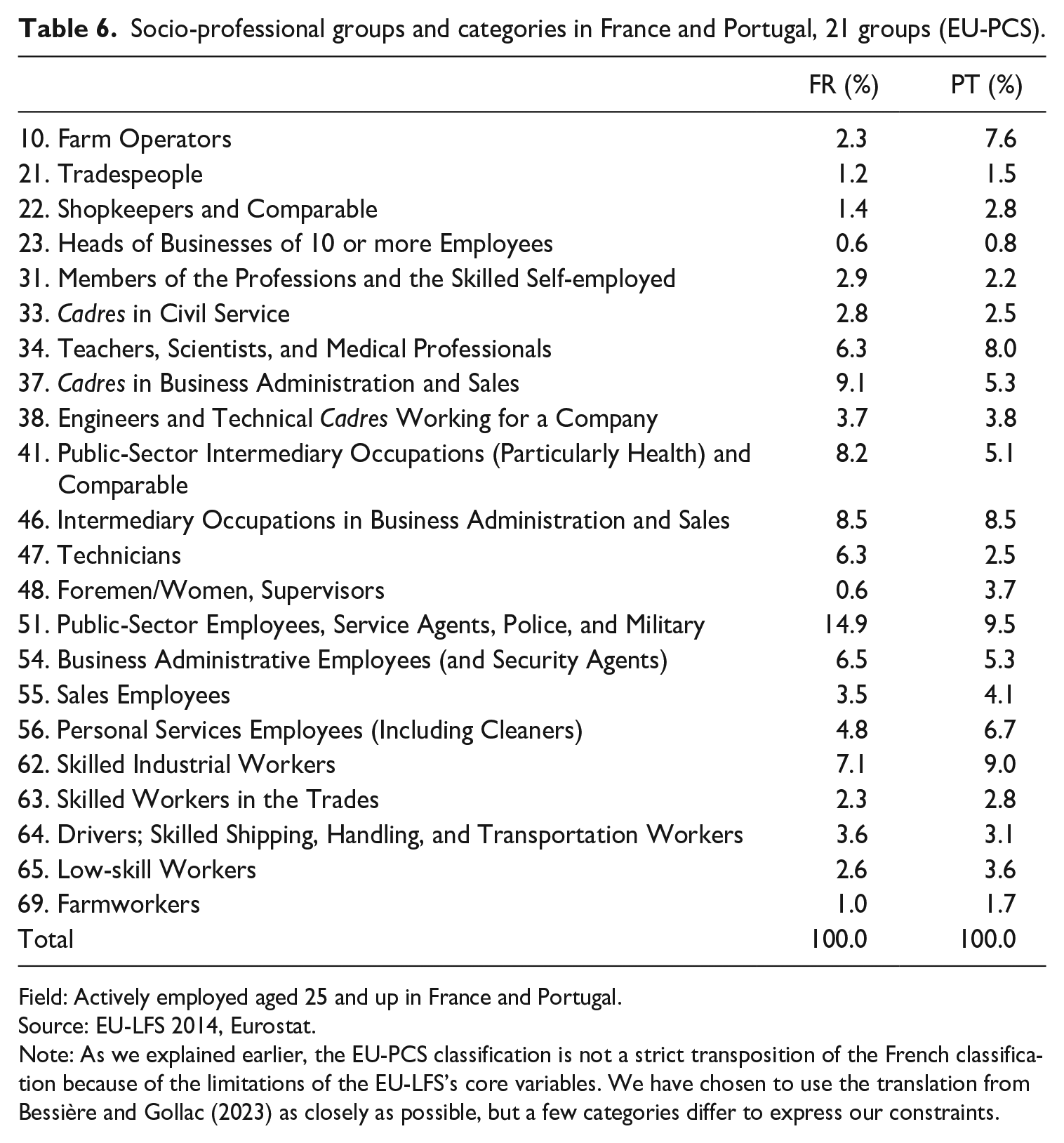
Methodological studies of social stratification have assessed the relevance of various national class schema and classifications either by their consistency and ability to rank groups (e.g., Chan & Goldthorpe, 2010; Evans, 1992) or by studying structural homologies (in Bourdieu’s sense, 1984) between positions and the practices or attitudes that they reveal (e.g., Page Pereira, 2019). We take a different tack, by conducting a contextualized sociological analysis of French and Portuguese social structures (see Tables 5 and 6). More than identifying how effective these schemas are, we aim to identify their respective capacities to uncover salient or subtle differences between two social structures and elucidate them with knowledge of their national contexts.
Classes and class fractions in France and Portugal, 11 groups (EU-ACM).
Field: Actively employed aged 25 and up in France and Portugal.
Source: EU-LFS 2014, Eurostat.
Socio-professional groups and categories in France and Portugal, 21 groups (EU-PCS).
Field: Actively employed aged 25 and up in France and Portugal.
Source: EU-LFS 2014, Eurostat.
Note: As we explained earlier, the EU-PCS classification is not a strict transposition of the French classification because of the limitations of the EU-LFS’s core variables. We have chosen to use the translation from Bessière and Gollac (2023) as closely as possible, but a few categories differ to express our constraints.
The Portuguese typology reveals the unequal weights of the Self-employed (including small business owners) and Farmers, while the French classification exposes the influence of public employment on social position. Combining both schemas permits a novel analysis of the gendered dimensions of class relations and the differing roles of certified cultural capital (educational attainments) in each country. We conclude by using differences between the results to sketch a portrait of the social classes in France and Portugal.
Small business ownership and small-scale farming in Portugal versus public employment in France
Of the 11 class fractions comprising the most detailed level of the EU-ACM schema, three concern social agents who are not on a wage or salary: Entrepreneurs (business owners with at least one employee, regardless of their activity sector), Farmers (self-employed, with no employees), and the Self-employed (non-farming self-employed people with no employees). This categorization exposes the weight of small business owners, something the French classification does not show because it lumps together all businesses with 0–10 employees.
The first finding of the EU-ACM class schema is that self-employment is more common in Portugal, where 7% of Entrepreneurs (classed in the Bourgeoisie) have at least one employee, and 11.5% are Self-employed with no employees (classed as Petite Bourgeoisie). This places Portugal’s Self-employed markedly lower in the social space than those in France (where Entrepreneurs represent 4.5%, and all Self-employed without employees 5%).
Furthermore, the EU-ACM reveals another key finding that refines this analysis: the importance of Farmers (with no employees) in Portugal (6.8%, versus 1.6% in France), which is the most striking difference between the two countries. The persistence of very small farmers may be explained by the notable presence of the occupation of ‘subsistence farmer’ (ISCO 631, 632, and 633), which represent 78% of Farmers in Portugal. These ‘subsistence’ farming occupations are left blank for France in the EU-LFS, since farm work is considered to be for commercial ends rather than subsistence. This class fraction has historic structural importance in Portuguese society. It was long marked by deep poverty, and is widely thought to be disappearing with development of the agricultural industry, particularly in the south (Pereira et al., 2021), which is far from being the case. Clustering Agricultural Workers with these small Farmers accounts for 8.8% of the working population, making farming significant among dominated groups in Portugal. They only add up to 3% in France, where farming is more intensive and farms are getting bigger (Chardon et al., 2020).
If applying the Portuguese typology revealed different proportions of the Self-employed (especially small Farmers), the French classification made it possible to observe another key distinction between the working populations of each country: the proportions of public and private employment. This distinction is absent from the EU-ACM, but it is central in the PCS. Of the 17 employee categories in the EU-PCS, four contain a majority of public jobs: Cadres in Civil Service; Teachers, Scientists, and Medical Professionals; Public-Sector Intermediary Occupations (Particularly Health) and Comparable; and Public-Sector Employees, Service Agents, Police, and Military. Together they represent 33.2% of the working population in France and 25.1% in Portugal, revealing the importance of public employment in both countries, but especially in France.
Moreover, public employees are structured differently in each country. The category Teachers (counting teachers of all levels), Scientists, and Medical Professionals and the category Public-Sector Cadres are somewhat more significant in Portugal than in France (10.5%, 9.3% in France), while Public-Sector Intermediary Occupations (Particularly Health) and Comparable accounts for 8.2% in France but only 5.1 in Portugal. These gaps are largely due to the fact that nurses and midwives are generally categorized as ‘Health associate professionals’ (ISCO 32) in France and as ‘Health professionals’ (ISCO 22) in Portugal, which is due to coding and the unequal ranking of these occupations in each national socio-professional hierarchy (Divay & Girard, 2019 for France; Cantate et al., 2020, for Portugal).
Furthermore, France counts 14.9% Public-Sector Employees, Service Agents, Police, and Military, and Portugal 9.5%. The high proportion of subaltern public employees in France is mainly due to the fact that cleaning and food service in public institutions are still partly done by public employees (either as civil servants or as contractual workers): 28% of Public-Sector Employees, Service Agents, Police, and Military are ‘cleaners and helpers’, a category not found in the Portuguese public sector. This proportion of low-skill public employees is singular in Europe, and a notable French characteristic (Hugrée et al., 2020).
Gendered dimensions of class differences
The participation of women in the employment market has long been stronger in Portugal than in France. In Portugal, paid domestic employment was a significant opportunity for rural women into the 1970s, and later industrialization made greater use of female labor (Tavora & Rubery, 2013), while in France, female employment dipped in the 1950s–1970s (Maruani & Meron, 2012).
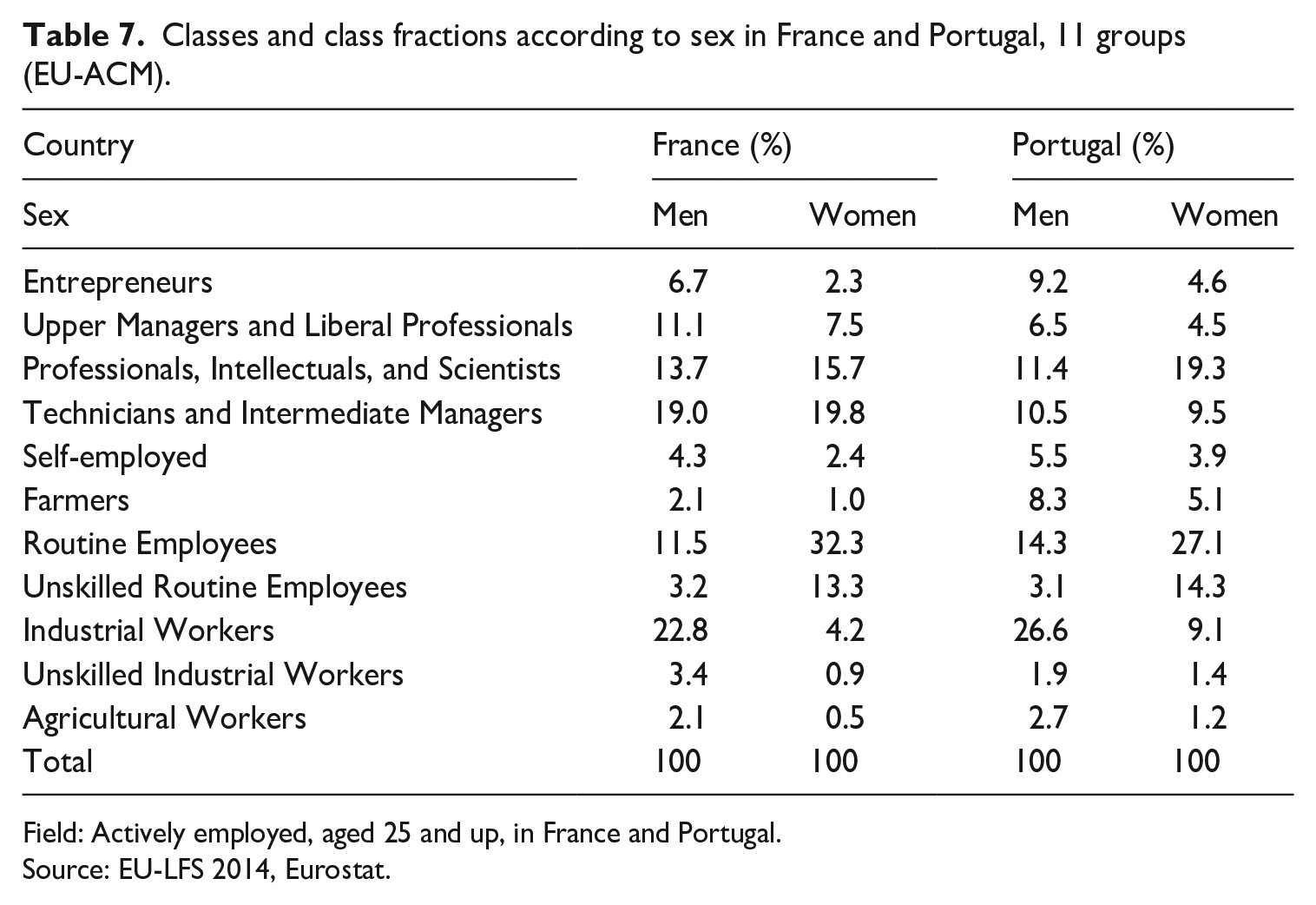
Female and male population structures also differ between the countries, as we see when looking at the proportion of working men and women in each class fraction (Table 7). We use the EU-ACM for this because it gives a more synthetic representation of class structure difference according to gender, enhancing the analysis of the whole with an examination of the occupations composing the class fractions at the level of ISCO 3.
Classes and class fractions according to sex in France and Portugal, 11 groups (EU-ACM).
Field: Actively employed, aged 25 and up, in France and Portugal.
Source: EU-LFS 2014, Eurostat.
Firstly, the Portuguese typology uncovers gendered differences within the dominated classes. In both countries, the main group of jobs held by men is Workers (skilled, unskilled, and agricultural: 28% in France, 32% in Portugal), and a major share of women’s jobs are as Routine Employees (Skilled and Unskilled: 46% in France, 41% in Portugal). In both countries, the percentage of men who are Self-employed with no employees (14% in Portugal, 6.5% in France) is significantly higher than that of women (9% and 3.5%). However, gender segregation between subaltern industrial and service jobs is lower in Portugal: the percentage of women who are Industrial Workers is higher in Portugal than in France (9% versus 4%), and the proportion of men who are Routine Employees, skilled and unskilled, is higher (17% in Portugal, 14% in France)
This comparison also reveals the importance of the group Professionals in women’s employment in Portugal (19.3%), which is 3.6 points higher than France, while 20% of women in France are Technicians and Intermediate Managers in contrast to 9.5% in Portugal. This gap is partly because nurses have different positions in each country (see previous section) – they represent 13% of this class fraction among women in France, and 1% in Portugal – but more generally, it also indicates a greater polarization of the female social structure in Portugal, between a dominant pole composed of skilled (but non-leadership) occupations with high cultural capital (notably in education and health) and a subaltern pole, when women in France tend to hold more middling positions.
There are more men than women in the higher fractions of the Bourgeoisie in both countries, but the compositions differ. There are significantly more jobs requiring very high qualifications in France: Upper Managers and Liberal Professionals and Professionals, Intellectuals and Scientists account for 11% and 14% of men’s jobs, compared to 6.5% and 11% in Portugal, but Portugal has more Entrepreneurs (9% versus 7%). France has twice the percentage of men who are Technicians and Intermediate Managers relative to Portugal (19% and 10%). There is also social polarization of men in Portugal, but, relative to women, the male dominant pole consists more of the highest class fractions with high economic capital, such as Entrepreneurs and Private-Sector Upper Managers (representing 62% of Upper Managers and Liberal Professionals), although they likely possess high cultural capital as well.
This analysis of the class structures of the female and male working populations demands deeper study of the forms of class distance in Portugal and France and how they are related to cultural capital, as access to post-secondary degrees has changed dramatically in both countries.
Educational distance and class distance
One of the more striking differences between the French and Portuguese social structure is the role of educational degrees in the ranking of social groups and the making of class boundaries (see Appendix 2 and 3), a consequence of very different political and educational histories. We will primarily approach this topic through the EU-PCS classification, which puts educational attainments at its core by design.
Between the 1960s and early 2000s, France experienced two education booms. The first occurred in lower secondary schools (middle schools) in the 1960s and 1970s and the second in upper secondary schools (high schools) in the 1980s and 1990s; 63% of the population earned a baccalauréat (capping the completion of secondary studies) in a generation. Since the early 2000s, the percentage of baccalauréat holders has surpassed 80% under a novel policy intended to ensure that 50% of the young generation obtain a three-year undergraduate university degree, post-baccalauréat (Brinbaum et al., 2018). Meanwhile, Portugal had very low educational levels under the Estado Novo (1933–1974) and a dramatic break following the Carnation Revolution, when a policy to catch up on education gradually extended mandatory schooling (from age 6) from six to nine years of school in 1986, and 12 since 2009 (Pinto, 2011).
Despite the rapid rise in educational levels in Portugal, the gaps between educational durations and diplomas in Portugal and France are still consequential, and the connection between social position and certified cultural capital works differently in each society. Comparison of the educational composition of all social categories reveals an educational gap between the top and bottom of the Portuguese social space that is significantly wider than in France: the dominant categories are very highly educated, while the dominated categories have very little schooling.
In Portugal, Master’s and doctoral degrees are powerful markers of social boundaries separating the upper classes from the rest, despite developments stemming from the expansion of access to higher education (Abrantes, 2022). Between 75 and 90% of Members of the Professions and the Skilled Self-employed; Teachers, Scientists, and Medical Professionals; Cadres in Civil Service; and Engineers and Technical Cadres working for a Company have a Master’s or doctoral degree, which are very rare there, seemingly indicating that these occupations are central to processes of social closure and the monopolization of opportunity. In France, these degrees are more common but also less necessary for reaching those positions: fewer than 40% of Cadres in Civil Service or Teachers, Scientists, and Medical Professionals have one (the vast majority have the equivalent of a bachelor’s degree), and under 60% of Members of the Professions and the Skilled Self-employed or Engineers and Technical Cadres working for a Company. However, the lesser importance of a Master’s or doctoral degree to reach a top occupation in France conceals registers of educational distinction that the European statistical tool cannot record. For instance, degrees from the elite and selective ‘grandes écoles’ are central to the social reproduction strategies of the dominant classes in France (Pasquali, 2021).
Falling under the Middle Class or Petite Bourgeoisie, most people in the Intermediary Professions in both countries have upper secondary educational qualifications (ISCED 3). This corresponds to the level required for access to higher education: the twelfth year of school in Portugal, and the baccalauréat or another secondary-level vocational qualification in France. But a significant share of people in Intermediary Professions in France have a short post-secondary degree (ISCED 5), which pulls the category higher in the educational hierarchy than Portugal, where a lower secondary education (ISCED 2) is more common in this category.
This gap is much wider for Laborers, who attend school longer and have more educational qualifications in France. A majority of French Laborers have upper secondary educational qualifications (ISCED 3) – 54–65% of all Laborer categories excluding Farmworkers – but such levels are much rarer in Portugal (8–17%). Inversely, 51–71% of Laborers in Portugal have no more than a primary school education, in contrast to 7–16% of those in France.
Basic Employees are also in contrasting situations, but inversely so: in France, Basic Employees’ educational levels are similar to Laborers’ (except Business Administrative Employees, who are closer to the Intermediary Professions); in Portugal, Basic Employees’ educational levels are closer to those of the Intermediary Professions (except personal services employees, being closer to Laborers). This partly explains Portuguese sociologists’ choice to define them as a fraction of the Petite Bourgeoisie rather than the Working Class, and French sociologists’ choice to place them in the Working Classes rather than the Middle Classes. This demonstrates the importance of distinguishing between skilled and low-skill Basic Employees in social typologies.
The dearth of institutionalized cultural capital is particularly striking in Portuguese farming: respectively, 18% of Farm Operators and 10% of Farmworkers (as defined by the PCS) never attended school, while 66% and 64% only finished primary school. This confirms their specific position in Portuguese society and its dominated classes, with no equivalent in France.
Conclusion
In Europe, conceptions of social class are usually considered from a theoretical perspective. The ‘globalization turn’ in the sociology of class has led to important theoretical debates and results but those often underestimate the most concrete dimensions of the process of comparing class structures and social inequalities. We have emphasized the impact of classification systems and argue in favor of combining the sociology of quantification and quantitative sociology to compare social classes in Europe. Exporting the national categorizations of France (the PCS classification) and Portugal (the ACM typology) is an original way of broadening the discussion on the links between social class and country.
First, this methodology highlights the extent to which classifications are central to quantifying social structures and inequalities. Sometimes criticized for their inability to take account of social transformations (e.g., Uberization), they remain essential for analyzing social inequality at the scale of one or more countries. Indeed, despite transformations in individuals’ social conditions, sociologists have largely found their social positions unchanged. Secondly, this methodology demonstrates that national classifications can be fruitful for making limited comparisons and describing a pair of class structures, by applying them at a detailed level and combining quantification with contextualized socio-historical knowledge of the relevant countries.
Finally, this analysis fosters understanding of both long-standing and recent differences between the countries. Both classifications reveal the unequal weight of business owners and the self-employed in Portugal and France. The EU-ACM schema reveals a difference in the position of small business owners (more numerous in Portugal), and the persistence of very small subsistence farmers in Portugal. Combining Agricultural Workers and Subsistence Farmers shows that low-income farm labor is a significant component of the dominated classes in Portugal without equivalent in France. Routine employees predominate in both countries, but the gap between skilled and low-skilled workers is more marked in Portugal. In France, the Working Classes are notable for a significant presence of public employees and a strong gender division between Laborers and Basic Employees, but the range of educational attainments among subaltern workers in France is narrower than in Portugal. Portuguese Basic Employees have educational attainments closer to those of the Intermediary Professions, and Laborers have very low educational levels. Skilled non-managerial categories also differ by country: in Portugal, skilled occupations (particularly in health and education) are strongly feminized and have high concentrations of cultural capital, but occupations with moderate qualifications are of lesser weight than in France. The Portuguese social structure thus appears to be more polarized than the French. At the top of the social space, the composition of the Bourgeoisie, though of comparable size and principally male in both countries, differs: Entrepreneurs predominate in Portugal, but Upper Managers and Liberal Professionals predominate in France.
The EU-PCS classification makes it possible to specify the educational basis of the social distance between social groups, revealing a social structure where cultural capital is much more polarized in Portugal than in France. Possessing educational attainments is vital to achieving dominant positions in both countries, but it is especially marked in Portugal, where the attainments of the upper categories are especially high (even more so than France), while the attainments of groups in the middle of the social hierarchy are much lower, and those of dominated groups (Laborers, Basic Employees, small Farmers) are particularly low.
Given the vigorous sociological discussion of social stratification and class, rising inequality, and how to improve theoretical and methodological tools to facilitate comparative readings of social realities, the contextualized use of national classifications makes it possible to advance these conversations while avoiding a homogenizing view of social structures in different countries. Our study’s findings prove the interest of further such enquiry.
Footnotes
Appendices
Acknowledgements
We would like to thank Juliette Rogers for her work translating and editing this text.
Funding
This article comes from a research program on social class in France and Portugal called ‘Social classes and inequalities in France and Portugal’, International Program for Scientific Cooperation (PICS), PICS0790, CNRS.