




Abstract
This article focuses on embodiment and the centrality of embodied methods to multi-species research. We argue that taking the body as our methodological starting point is essential to researching human–animal relations but that bodies engage with and are engaged by the research process in a multiplicity of ways. In this we follow Vinciane Despret’s analysis of the partial affinities between animal scientists’ bodies and the animals they are researching and suggest that sociology’s distinction between sociology of and sociology with the body glosses over the complexities of inter-corporeal encounters. We explore these questions through a discussion of our multi-species ethnography of dog training cultures in the UK, looking at the training of companion dogs, guide dogs and police dogs. We pay attention to the different forms of embodied engagement that these training cultures make possible for us as researchers and reflect on the place of embodied communication in both the training and research relationship. We consider the disembodied training necessitated by the transition to online classes during the Covid pandemic and the consequences of this for our ability to create partial affinities with the dogs and their humans. We argue that the methodological challenges of our times require that we develop methods that attend to our multi-species world, rather than focusing exclusively on the human, and that bring into being a social reality which is less anthropocentric.
Introduction
Studying animals – other than the human animal – within sociology and the social sciences more generally raises theoretical and methodological challenges (Carter & Charles, 2018; Taylor, 2012). Primarily it challenges the focus on the human and questions the conceptual underpinnings of sociology, particularly our ideas of the social, how social relations are constituted, and inter-subjectivity. It also, and problematically for sociology, leads to a questioning of the idea that the social is bounded (Tsing, 2013, p. 27) and of the need for ‘a concept of the social’ (Ingold, 1997, p. 247). In addition, it is associated with a move away from a focus on the human towards post-humanism, which within sociology is resisted (Taylor, 2012). This is unsurprising given sociology’s humanist underpinnings, which are fundamentally challenged by a de-centring of the human (Carter & Charles, 2018; Colombino & Bruckner, 2023; Miele & Bear, 2023; Pacini-Ketchabaw et al., 2016).
Taking animals seriously also contributes to debates about methods that are appropriate for the times we live in, characterised, as they are, by digital cultures and the environmental crisis, both of which make it increasingly difficult to conceptualise human societies as bounded entities. Methodological challenges are rooted in different ways of understanding the world and, within sociology, various critiques have been mounted calling for live methods, which attend to the sensory, affective and embodied dimensions of social life (Back, 2012), and a recognition that methods ‘help to make realities’ and are part of an ontological politics (Law & Urry, 2004, p. 404). Similar debates can be found amongst those researching human–animal relations where existing methods have been criticised because they focus on the human, language and the symbolic thereby reproducing the human–animal boundary; they are both performative and ineluctably anthropocentric.
In this article we explore the methodological challenges posed by researching animals and the possibilities of going beyond methodologies that are dependent on words. We argue that embodied methods are crucial to researching human–animal lives and reflect on the different engagement of researchers’ bodies during an ethnographic study of three UK dog training cultures. In this we take inspiration from Despret’s analysis of animal scientists’ bodily involvements in their research encounters with animals (Despret, 2004, 2013) and heed Haraway’s call for methods that enable us to address ‘embodied cross-species sociality’ (2003, p. 75). We argue that researchers’ corporeal engagements with those they are researching are multiple. We show that our embodied encounters with our participants, both dog and human, are differentially shaped by training cultures and the practices that characterise them and consider how corporeal absence during lockdown affected the sensory and embodied experience of fieldwork. First, however, we explore the engagement of ethnographers’ bodies in different research contexts, arguing that there is a continuity of experience between those researching humans and animals. Consequentially, we suggest that one way of developing methods that bring into being a less relentlessly anthropocentric social world is to take the body as methodological starting point (Csordas, 1993).
The body as methodological starting point
It has been argued that in order to develop methodologies that are less anthropocentric, we need to see animals as embodied and entangled with others and with their environment (Buller, 2015). Furthermore, non-representational approaches are required that let animals ‘speak’, recognise the continuity of the social and the natural – a reality that Haraway gestures towards with her ‘natureculture’ (Haraway, 2003) – and draw on both natural and social sciences (Buller, 2015, p. 375). One such approach is material semiotics, which is inspired by ANT and expressly challenges the anthropocentrism of the social sciences by displacing the agentic human subject and defining agency as a product of networks rather than being peculiarly human (Knappett & Malafouris, 2008). This approach has been influential, particularly within animal geography (Johnstone, 2008; Kohn, 2013; Miele & Bear, 2022), leading to a focus on material practices and the objects (multiple) they enact (Law & Miele, 2011; Mol, 2002). Elsewhere we have used this type of approach to investigate the practices that bring a police dog into being and to explore embodied inter-species communication (Smith et al., 2021). Multi-species ethnographic research also explores human–animal entanglements with a commitment to giving as much weight to the animal participants as to the humans (see e.g. Kirksey & Helmreich, 2010). Important as embodiment is for such methodologies, especially those derived from ANT, the body neither constitutes their methodological starting point nor are the researcher’s embodied ways of knowing and communicating necessarily attended to. This limitation is overcome by methodologies that recognise the embodied foundations of the research encounter and, within sociology and anthropology, such methodologies are often phenomenologically inspired (Crossley,1995a; Ingold, 2000; Johnstone, 2008; Pink, 2010; Wacquant, 2005). Here we explore embodied methodologies across different disciplines showing they share similarities; these similarities, and an attentiveness to embodied communication, are, we shall argue, an important way of developing less anthropocentric methodologies for studying both humans and animals (see also Tomlinson, 2024).
Feminist thinkers have long argued for the centrality of the body to social research; recognising that embodied knowledge is situated and partial (Haraway, 1988) and that ‘epistemic truths’ are ‘multiple and conflicting’ (Pitts Taylor, 2015, p. 21; see also Viveiros de Castro, 2004). The emergence of the body as an important element of sociology, while owing much to feminist insights, is more recent and is captured in the idea of carnal sociology which ‘recognises the active role of the body in social life’ (Crossley, 1995a, p. 43); it sees the body as both object to be studied and the material basis of subjective experience (Despret, 2004; Wacquant, 2015).
Embodied methodologies are particularly promising for studying human–animal relations as they provide a possible answer to the question of how we can know the other while recognising that such knowledge is partial (Wemelsfelder, 2012). Rather than a focus on mind, attention is paid with and to the body with inter-subjectivity being recognised as embodied intercorporeality (Csordas, 1993, 2008) and, in order to understand the other, whether human or animal, ‘somatic modes of attention’ which are a crucial part of ethnographic research are required (Csordas, 1993; see also Forster, 2022). This refers to ‘culturally elaborated ways of attending to and with one’s body in surroundings that include the embodied presence of others’ (Csordas, 1993, p. 138) and, as we shall see, involves an openness to being affected and thereby transformed during the research encounter. We need to ‘develop forms of attentiveness that can admit to the fleeting, distributed, multiple, sensory, emotional and kinaesthetic aspects of sociality’ (Back, 2012, p. 28).
Attempts to develop these ‘forms of attentiveness’ include both ethnographic research and the use of visual methods. Ethnographic research based on participant observation is an embodied practice which requires co-presence (Csordas, 1993; Forster, 2022; Wacquant, 2015) although some suggest that while both empathy and embodied co-presence are central to participant observation, in the context of digital cultures, empathy can suffice when bodily co-presence is neither possible nor part of the experience of research participants (Madden, 2014). Participant observation has been likened to undergoing an apprenticeship (Pink, 2011) with the body being deployed ‘as an intelligent instrument of practical knowledge production’ (Wacquant, 2015, p. 7). Embodied knowledge develops through doing: researchers come to know with their bodies the practices of boxing (Wacquant, 2004), glass blowing (O’Connor, 2007), running (Allen-Collinson, 2011) and climbing (Bunn, 2016) or simply living as part of another culture (Forster, 2022). The importance of doing alerts us to the bodily and sensorial engagement central to ethnographic research and the bodily transformations that are part of it (Low, 2012; Retsikas, 2008; Wacquant, 2005). These embodied practices and the adoption of the bodily techniques which are part of the culture being studied can be conceptualised in terms of habitus which, at one and the same time, is both object and method of analysis (Wacquant, 2015).
Similar arguments are advanced in relation to researching other animals where bodily co-presence is seen as crucial to understanding what matters to them (Despret, 2004, 2013; Ingold, 2012). Sanders and Arluke, for instance, when researching dogs, recognise the need for ‘intimate involvement with the animal other’ (Sanders & Arluke, 1993, p. 378) and, for Shapiro, communication is enabled through an embodied understanding of each other’s intentions as they are expressed in bodily movement (Shapiro, 1990). Primatologists discuss changes in their bodily dispositions (or habitus) as they develop ways of being that are in tune with the animals they are studying. Barbara Smuts, who studied baboons, felt that she ‘was turning into a baboon’ (Smuts, 2001, p. 299); she knew without thinking when it was time to run for shelter with her sense of timing becoming a baboon’s sense of timing. Her account is reminiscent of O’Connor’s description of how a bodily incorporation of timing was crucial to her ability to blow glass (O’Connor, 2007). Furthermore, both Smuts and Strum, who also studied baboons, talk about seeing the world from a ‘baboon’s perspective’. These embodied knowledges, involving researchers incorporating the bodily techniques of those they are studying, enable a ‘being with’ the other which is essential to understanding what matters to them in their worlds (Despret, 2013; Dutton, 2012).
Empathy is important both to ethnography and to understanding what it is that matters to animal and human others (Madden, 2014; Shapiro, 1990). It may be understood as feeling what the other feels and some ethologists do indeed claim that they achieve this (Despret, 2013). But, for Despret, empathy is neither simply about feelings nor is it a cognitive process; it is an embodied process which ‘attunes bodies’ (Despret, 2013, p. 71) and constructs ‘partial affinities’ which create the possibility of ‘embodied communication’ (Despret, 2013, p. 51). Embodied communication involves researchers opening themselves up to the possibility of being affected, adopting an affected perspective, and being transformed; a process that is understood as ‘becoming with’. Thus, Smuts’s immersion in baboon society transformed both her bodily comportment and her sense of self.
In light of this, it can be argued that some ethologists engage in affective ethnography which involves ‘being with and becoming with others’ (Gherardi, 2019, p. 742); indeed, Strum likens herself to an ethnographer (Despret, 2013, p. 54) – an indication that ethnographic methods are well-suited to researching animals. This was suggested many years ago by Donna Haraway (Noske, 1992, 1993) in her claim that participant observation and ‘its intersubjective, nonreductionist way of acquiring knowledge’ was the most appropriate way of studying the animal other (Noske, 1993, p. 190). Latterly it has been argued that primatologists are actually conducting social research and that it is only the refusal of social science to acknowledge that animals are subjects that prevents this being more widely accepted (Lestel, 2014; see also Noske, 1992, 1993). This argument can be expanded to include research with animals other than primates and indeed has been by those advocating multi-species ethnography as a method (Hamilton & Taylor, 2017).
Visual methods which capture bodily interactions are sometimes part of such ethnographic research. Images can evoke ‘the sensory and affective dimensions’ (Pink, 2011, p. 272; see also Fijn, 2012) of the research environment as well as being an aid to observation (Smith et al., 2021). Smuts, for instance, used video recordings of her baboons as an aid to observation, while Wemelsfelder, an animal welfare scientist, suggests that observing visual recordings of animals can be sufficient for gaining an understanding of an animal’s perspective (Wemelsfelder, 2012). By this she means comprehending an animal as a subject engaged in a meaningful world that matters to them (cf. Despret, 2004, p. 131, 2013; Lorimer, 2010). For her, understanding an animal’s perspective, while dependent on ‘being with’ the animal, does not necessarily require bodily co-presence. Being with the animal can involve ‘observation from some distance or be technologically mediated’ and video recordings which show the animal’s ‘body language’ in the context where it takes place can facilitate this (Wemelsfelder, 2012, pp. 229–230). 1
In the sociological literature a distinction is made between sociology/ethnography of the body and with/from the body – the distinction between body as object and body as subject (Despret, 2013; Pink, 2010). Our research was concerned with both and, as we show, there are different forms of bodily involvement with other animals which contribute to the creation of knowledge and complicate this distinction. We argue that forms of embodied knowledge arise from embodied communication through the creation of partial affinities and the mutual transformations they entail. This is more than paying attention to the body and bodily involvement in the research process; it involves not only paying attention with the body but also being open to being affected/moved by animal bodies (Despret, 2004; Tomlinson, 2024). This is a way of countering sociology’s methodological anthropocentrism and moves beyond the distinction between a sociology of or with the body. Embodied communication and the partial affinities on which it depends are more messy and transformative, for all parties, than this categorisation acknowledges. In what follows we look at examples from our ethnography of dog training cultures to explore the different ways bodies construct partial affinities and whether this is possible without bodily co-presence.
Researching dog training cultures
Our research into dog training cultures was a multi-species ethnography primarily based on participant observation. 2 Our primary interest was in exploring the training practices characterising different training cultures and how they shaped relations between dogs and humans in order to evaluate claims that new, more empathetic forms of human–animal relations are emerging (see e.g. Charles et al., 2021; Franklin, 1999; Wlodarczyk, 2018). Animal training, like ethnography, is an embodied practice and, as ethnographers, we embedded ourselves in each training culture for a number of months. We needed to pay somatic attention to both the animal and human participants and become comprehensible to our animal informants. In order to do this we used a range of methods, from interviews through participant observation to visual recordings, both moving and still, including recordings from body cams worn by dogs and trainers. The project was inter-disciplinary, drawing methodologically from both social and natural sciences and bringing together approaches from sociology and human geography. We planned to explore five dog training cultures in the UK, companion dogs, guide dogs, gundogs, therapy dogs and police dogs, but the pandemic intervened, affecting the methodology of two of the case studies: gundogs and therapy dogs. We had completed the other case studies before the first lockdown in 2020 but had to change the methods used in the therapy dog case study and were unable to complete the gundog case study. Instead of intensive participant observation, our observations were truncated and, in their place, we experimented with the use of body cams on both the dog and the trainer and conducted a small number of online interviews.
Here we draw on our embodied engagements in three different training cultures – companion dogs, guide dogs and police dogs. We discuss the methods we used to capture our experiences of inter-species bodily interactions and how they make different demands of the researcher’s body. Our participation in the training cultures was shaped by the cultures themselves and deepened our awareness of what embodied research can mean. First, we explore the ‘sensory apprenticeship’ one of us experienced and how she began to develop the habitus of a companion dog trainer. We then reflect on the engagement of all our senses in the fieldwork, as we followed the rhythms of the guide dog through the movement of her harness or participated in the affective atmospheres of police dog training. Finally, we explore what changes when ‘being there’ is technologically mediated, looking at the disembodied methods and ‘partial encounters’ (Forster, 2022) necessitated by the transition to online training during the Covid pandemic. Throughout we are attentive to the ways in which bodies, both human and animal, are engaged in multi-species research and the partial affinities they create. We are particularly interested in the different modes of embodied interaction called forth by the three training cultures which provide insights into their similarities and differences.
Developing a training habitus
We have suggested that Despret’s notion of ‘becoming with’ is akin to the process of developing a habitus where culturally-specific body techniques are incorporated by novices to a culture (see e.g. Butler & Charles, 2012; Crossley, 1995b). In the training process, both human and canine bodies are transformed, becoming ‘more human’ or ‘more dog’ and producing and reproducing ‘humanity’ and ‘animality’ (Birke et al., 2004; Haraway, 2003, 2008; Schuurman & Franklin, 2015). This creates an ‘embodied empathy’ through which ‘feeling/thinking/seeing bodies undo and redo each other, reciprocally though not symmetrically’ (Despret, 2013, p. 51) in a way that changes ‘who and what they become together’ (Haraway, 2008). But, while ‘Scientists [or ethnographers/trainers] and animals are fleshy creatures which are enacted and enacting through their embodied choreography’ (Despret, 2013, p. 69), sometimes the choreography is clumsy or does not work. This was particularly clear when one of us became an apprentice dog trainer in one of the companion dog classes. This was purely fortuitous and arose because one of the trainers had to go into hospital and Rebekah, who had been ‘hanging around’ for a while, was asked to help out in the class. Apprenticeship, like habitus, became ‘both the object and the means of enquiry’ (Wacquant, 2005, p. 465); she was learning an embodied craft through doing and began developing a training habitus in a close parallel with Wacquant’s boxing and O’Connor’s glass blowing (O’Connor, 2007; Wacquant, 2005). Learning how to teach others to train their dogs meant that both she and the dogs submitted to a discipline based on bodily pedagogies (Shilling, 2007) and the absorption of body techniques (Crossley, 1995b). Bodily pedagogies can result in ‘a vastly heightened performative capacity’ (Shilling, 2007, p. 14), which was certainly the case for those dogs subject to the discipline of guide dog or police dog training and, to some extent, for us.
Rebekah’s fieldnotes show that this embodied learning was not straightforward:
My body seemed clumsy and unable to communicate effectively with the dogs. Simple hand movements to entice dogs into sit or down positions met with confused resistance, whereas under the trainer’s instruction the dogs performed effortlessly. On one occasion I attempted to engage with a nervous dog, holding out my hand gently as I would with an unfamiliar cat. The dog flinched and backed away growling, eyeing me suspiciously. Later the trainer pulled me to one side – ‘never lean over an anxious dog’ she said ‘approach them from the side and let them come to you’. I felt close to tears. My inter-species communication skills had failed me. (Fieldnotes, 11/11/19)
Warkentin (2010) draws upon the work of eco-feminists such as Val Plumwood (2002) to argue that attention to the role of one’s own body in the research process can foster new forms of ‘openness’ and ‘invitation’ towards non-human others, cultivating awareness of ‘embodied expressiveness’ and creating more ethical ways of being in the world. Through active participation in the research environment Rebekah found that she had to adapt her own bodily comportment and attune herself to the bodily interactions of the dogs.
Whilst, unlike Sanders (Sanders & Arluke, 1993), she did not (at least consciously) begin to act like a dog, like Shapiro (1990), she did find herself paying increased attention to the ways in which she moved her body, her tone of voice and gestures. Such recognition heightened her sensitivities to the bodily movements of the other humans and canine responses; minute differences in gesture or body position can make all the difference to inter-species communication and she underwent what Ingold (2011) terms an ‘education of attention’. Such skills are difficult to teach on a theoretical level and emerge through practical embodied experience and engagement in embodied communication which is part of the training relationship.
On many occasions she felt like a fraud as clients asked her for advice or information, or she failed to demonstrate an exercise correctly. She felt uncomfortable repeating advice that she had overheard from other trainers, rather than from her own experience. When luring the novice dogs into position for a new exercise she found that her arm movements were not significantly demonstrative to show the dogs what was required of them and her timing of rewards too slow. Such failures drew her attention to the difficulties faced by new canine–human partnerships, particularly within the distracting environment of the training class, and to the fact that becoming an effective trainer not only requires attending to the affective state of the dogs but, at the same time, engaging with the dogs’ human companions. As her confidence grew she found herself using a louder and more expressive voice and more deliberate body movements to capture the dog’s attention. She became more skilled at pre-empting dogs’ intentions and reading their body language (Wemelsfelder, 2012), sensing when they were likely to make a run for it or lunge at another dog, or using more calming and gentle techniques to encourage nervous or sensitive animals. She was learning through doing and, in the process, beginning to learn about embodied communication between dogs and humans.
Such practical embodied engagement provides a valuable opportunity for developing new forms of attentiveness to non-human worlds and addresses calls for more direct engagement with animals and the use of the human body as a research tool. Through engagement of her own body in the research process she gained a more visceral understanding of training practices and developed new forms of ‘availability’ to the canine participants. She became more ‘dog-centred’, learning from both her human and non-human teachers (Prę gowski, 2015) to attune herself to canine emotions, preferences and bodily communications, developing appropriate corporeal and ethical responses. In other words, she began to develop a training habitus which was attuned to dogs and their behaviour in partnership with their humans and was, by definition, embodied.
Guide dog training: Becoming with
Developing a training habitus that enables an understanding of the dog’s perspective can also be thought of as a process of being and becoming with (Despret, 2004; see also Dutton, 2012). This process transforms both partners in the relationship and has been described as a merging or loss of a sense of self (Smuts, 2001). Becoming with is a way of understanding the guide dog owner’s relationship with their guide dog; something which was central to guide dog training culture. Michalko, following Goffman, understands this relationship in terms of the ‘two-in-one’, writing of himself and his guide dog: ‘we cannot be separated. My self is now our self. Smokie’s self too is our self’ (Michalko, 1999, p. 91). This merging is an embodied process, a ‘common bodiliness’ (Mouret, 2019, p. 108), in which ‘our “corporeal schema” [is] modified to include the equipment that we use’ or, as in the case of guide dogs and those they assist, to include the animal with whom we are working (Crossley, 1995a, p. 54). We ‘dwell’ in the animal as part of our body (Shilling, 2007). Despret discusses a similar merging between a ‘perfectly trained’ horse and their rider, when the rider has only to think of the movement they wish to accomplish with the horse for the horse (and rider) to do it (Despret, 2004, p. 115). For Smuts, such embodied communication is based on cooperation and mutual attunement and, when describing greeting rituals among baboons or between her and her dog, she speaks of the co-creation of ‘an entity – the dance – that transcends their individuality’ (Smuts, 2008, p. 143).
We cannot claim to have experienced becoming with to the extent that means that guide dog and guide dog owner become one entity (Michalko, 1999). On the contrary, we often experienced a lack of communication between us and the dogs, especially when we took a guide dog’s harness in place of their trainer; this brought home to us that our bodily ways of being were neither those of a guide dog trainer nor of a guide dog owner. Despite that, we were able to feel the movements of the dog’s body through the harness, creating a connection that is not possible with a lead, and felt the ways in which our own bodies responded, communicating our emotional state and intentions; the dogs often picked up that we were unsure or uncomfortable and did not perform in the way that they did for their trainers. This is clear from our fieldnotes.
Nickie wrote about the first time she took a trainee guide dog’s harness:
She [the dog] was OK but kept looking to Ali [her trainer] for reassurance, I’m not surprised as I was a bit unsure about what I was meant to be doing. She did very well although was less good at stopping at kerbs that are flat with me than she had been with Ali, it seemed as if her confidence went a bit. (Fieldnotes, 9/8/18)
Nickie’s lack of confidence affected the dog and the way she performed the tasks she was being asked (rather incompetently) to do. Later Nickie’s experience was different. At this point she had been watching the trainer, studying how she held the lead and harness and how she moved in relation to the dog. This seeing enabled the beginnings of a bodily understanding (Wacquant, 2004):
I was quite surprised when Ali gave me the lead and harness, but it was fine. . . . She [the dog] walked quite fast, and there was quite a bit of tension in the harness handle, and I found that I had to really concentrate to begin with so that I wasn’t putting any tension on the lead. I’d been watching Ali’s way of using the lead so tried to do the same as her and keep it loose at all times. . . . It’s amazingly difficult to focus on the dog and watch the traffic so that you know when to cross the road. . . . It was also quite hard not to anticipate the stopping at the kerb and cue her by putting pressure on the harness or slowing down. . . .. as we progressed I got better at doing what I was supposed to. (Fieldnotes, 19/1/19)
This extract shows that different elements – how to handle the technology of guide dog training – the lead and harness – and how to be aware of the pavement edge, the traffic, your own bodily movements and those of the dog – have to be consciously thought about; nothing is second nature as it is for the trainer. The ‘practical, embodied know-how and mastery’ (Crossley, 1995a, p. 54), in other words a training habitus, is not present. Such experiences made us very aware of the embodied knowledge that we lacked and that the trainers had built up through many years of experience.
This embodied knowledge enabled the trainers to understand the dog’s perspective and was evident not only in their ability to communicate with the dog but also in the way they understood what the dog was feeling. Ali described one of the dogs in her ‘pack’ as ‘immature’ and unable to deal with the responsibility of guiding. This was clear from the way he responded to the technology of lead and harness. When the harness handle was flat on his back and Ali held the lead he walked quite confidently along a busy street but when she picked up the harness handle he moved differently, surging ahead; this indicated to Ali his discomfort and inability to cope with the responsibility of guiding. She knew that he would not make it through the training because of the way he behaved, not only when in harness but also when he greeted people and other dogs and his generally slightly insecure approach to life. And although she could explain how she drew this conclusion, the translation of her embodied knowledge into words was very different from her ability to understand in a visceral way how the dog was feeling.
As well as having an embodied understanding of the perspective of the dogs they are training, would-be trainers are encouraged to experience the sensory world of someone who is partially sighted and, to this end, they undergo a blindfold walk. The trainers suggested that we also perform a blindfold walk so as to experience being guided by a dog. This experience was very different from that of being in the position of trainer; communication was still embodied and technologically mediated, but the sensory experience was not the same:
I was a bit anxious about it but decided that I just had to trust Jasper. . . . I held the harness quite loosely and he led me really well. It was quite an amazing experience just following the dog where he wanted to take me. And also I had to tell him he was good and to give him the instructions to go forward, left etc. (Fieldnotes, 9/8/18)
Nickie had to trust Jasper to keep her safe – of course one of the trainers was just behind them to make sure that nothing went wrong – and through holding the harness ‘loosely’ she conveyed to him that he was in charge albeit at the same time she had to tell him when to move forward and turn and to encourage him. When the walk ended:
It was almost a pity to take the blindfold off – relying on a dog like that creates a very special feeling which isn’t there when you’re the one in charge. You’re very aware, through the harness, of how the dog’s moving and when it’s changing direction – something you don’t have when the dog’s not on a harness. . . . I really liked Jasper before that experience and even more after it! (Fieldnotes, 9/8/18)
The trust she placed in Jasper and the bodily connection through the harness created an affective connection between them. He was a confident dog and she opened herself to this thereby feeling confident in his ability to guide her safely. She began to feel something of the merging of the self reported by those who are guided by guide dogs (Michalko, 1999); a partial affinity, mediated by technology, was created.
Police dog training: Sensory ethnography and affective atmospheres
Researching with/from the body involves attention to our own bodies’ responses to the animals and to the affective atmospheres of the training events (Gherardi, 2019, pp. 749–750). Such sensory engagement is described by Dian Fossey in her account of encountering gorillas: ‘Sound preceded sight. Odor preceded sound in the form of an overwhelming musky-barnyard, humanlike scent. The air was suddenly rent by a high-pitched series of screams. . . . Peeking through the vegetation, we could distinguish an equally curious phalanx of black leather-countenanced, furry-headed primates peering back at us’ (Fossey, 1983/2001, p. 3). Sensory engagement was also important for us.
In contrast with the guide dogs, where we often took the harness in place of the trainer, the opportunity for embodied interaction with the police dogs varied. Sometimes we were kept at a distance but, even then, we shared bodily experiences and training atmospheres: the cold frosty mornings on the training fields as the fog lingered over the hardened grass, the damp atmosphere of the woodlands as dogs conducted their searches, the excitement evident in their body language as they caught the scent, straining on their leashes as their handlers struggled to keep up.
One morning Rebekah accompanied the officers on a building search in an abandoned police station. On entering she was immediately aware of the stale musty atmosphere, the squeak of polished floors and the slightly unnerving sensation of an empty building. The dogs clearly felt it too, barking excitedly and leaping as they took in the new scents and objects. The first task was to scent the building to provide confusing trails for the dogs to follow, walking from room to room, up various echoey staircases. Rebekah, the trainee handler and trainer then returned to the entrance whilst one of the officers hid in an empty office. Once the dogs had sniffed an article impregnated with his scent, the warning rang out in the empty silence, ‘police officer with a dog, make yourself known or I will release the dog’. Blaze picked up the trail and Rebekah, the trainee handler and the trainer followed her around the building, paws slipping on the smooth surfaces as she pulled on the lead, a sense of anticipation building as she got closer, ears back in concentration. Despite the knowledge that this was just a training exercise Rebekah’s heart jumped in her chest when Blaze finally found the concealed officer, barking furiously as he emerged from behind a filing cabinet, hands above his head in surrender. The exercise demonstrated the shared bodily experiences of this game, the thrill of the chase, the nervous anticipation of what might lurk behind partially open doors. Whilst Rebekah could not experience the smell-scape in the same way as Blaze, the dog’s body language gave clues, the uncertainty if she temporarily lost the trail in the mix of scents, the straining when she knew she was close, her canine sensibilities giving her the distinct advantage.
During our guide dog ethnography, which we conducted over the course of a long, cold winter, the shared sensory experiences of sounds, smells and weather, our wet shoes and frozen fingers created an empathy with the dogs, who refused to sit on cold damp pavements and walked carefully around puddles. We developed an ‘embodied empathy’ based on the shared sensory experience of spending long days walking the streets. But although, in some ways, we shared the same bodily experiences, in others our experiences were different because of our different bodily ways of being, particularly differences in our abilities to scent where dogs have a significant advantage over us. 3 These partial affinities, however, gave us a partial understanding of the dog’s perspective and this is, perhaps, all that we can hope for if we recognise the ‘un-knowability’ of the other. Wemelsfelder argues that ‘acknowledging another’s un-knowability lies at the core of knowing them as subjects, however uncomfortable this makes scientists feel’ (Wemelsfelder, 2012, p. 230). This recognition of others as subjects together with a receptivity ‘to the limits of knowing’ (Page, 2017, p. 18) has been linked to being vulnerable and open to the ‘unexpected affective and sensorial demands upon researchers in representing the lives of others’ (Page, 2017, p. 18), precisely what Despret is referring to in her discussion of the construction of partial affinities and how the ability to be affected is central to being and becoming with animal others (Despret, 2004, 2013).
These examples demonstrate very different experiences of shared bodily connections: beginning to develop a trainer’s habitus with companion dogs, the corporeal understanding of the dog’s movements with guide dogs, the embodied empathy generated by shared training atmospheres with the police dogs and guide dogs and the shared sensory experiences generating partial affinities between us and the dogs. In addition, we were privy to human participants’ experiences of their embodied relationships with the dogs they were training or working with through observing, participating and talking. However, the Covid-19 pandemic and the first lockdown in March 2020 brought our fieldwork to an abrupt halt and made us much more dependent on the visual and observation.
Lockdown: Corporeal absence
In the absence of co-presence, sight reasserts its privileged place (Hockey & Allen-Collinson, 2009) and visual methods become an even more important way of getting at the embodied and non-verbal (Smith et al., 2021). They enable ‘an exploration of “elusive knowledges” comprising tacit, aesthetic, and embodied aspects of . . . life that are difficult to articulate’ (Gherardi, 2019, p. 747). We used visual methods as part of our multi-species ethnography as a ‘form of ethnographic note taking’ (Pink, 2011, p. 272), as a way of evoking affective atmospheres (Fox et al., 2023) and as a way of exploring embodied dog–human interactions. We also used them as a means of understanding the dog’s perspective, their practical engagement with the world (Crossley, 1995a; Ingold, 2000), through the use of Qualitative Behaviour Assessment (Wemelsfelder, 2012). Here, however, we want to explore their more limited use in the context of corporeal absence and to explore how these ‘partial encounters’ affected our ability to create partial affinities. We had completed our fieldwork in all three training sites prior to the first lockdown in March 2020, but the companion dog training was the only one to move online. This allowed us to continue a connection with trainers and their clients and we decided to extend our fieldwork in order to explore the changes attendant upon a disembodied research encounter.
We observed the weekly online classes for a further six months; our observations were of live calls with dogs and their handlers which were not recorded. The disembodied experience of remote observation meant that we were thrown back to relying on the human participants’ accounts, while our own embodied participation was reduced to viewing dog–handler interactions on a small screen (see Figure 1). From being an assistant trainer Rebekah was suddenly a passive observer with no possibility of interacting or developing a relationship with the participants, human or canine. She was able to understand some of what was going on between them but it was impossible to construct the partial affinities needed for embodied communication or creating a ‘shared life-world’ (Forster, 2022, p. 11). The process created the ‘ideal’ disembodied observer who has no means of interacting with those she is observing and of whom those being observed, particularly the dogs, are unaware. This makes the relation very different from the embodied relationship established with dogs and handlers during ethnographic fieldwork. The sensory experience is impoverished with the loss of sounds, smells, touch and corporeal engagement with the wider training atmospheres that are so important in inter-species communication. Sight becomes paramount.
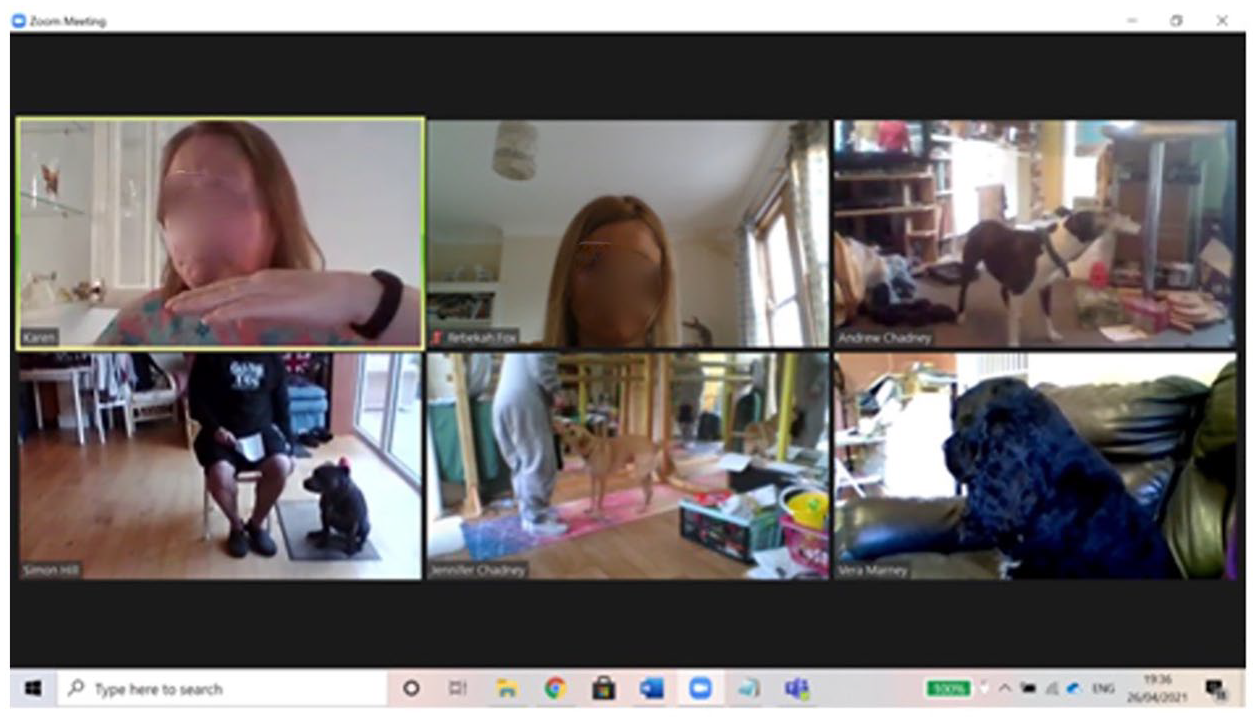
Companion dog training classes online.
Many of the training exercises were familiar to Rebekah and because of this she felt some empathy with the trainers and owners, but the lack of co-presence meant that her disembodied experience was not comparable even to that of the human participants. She was an observer rather than a participant, which was not the case for those she was observing. The trainers, with their embodied skills, were better able to understand the technologically mediated interactions and, in that sense, could ‘be there’ although, even for them these online classes lost something:
From a perspective of someone actually training though I find I benefit so much from watching other people work with their dogs, which I can’t do on Zoom, that is what I really miss about group classes, be it dog training, or dance classes, watching them get it wrong, or do it a different way, by actually watching the dogs and things I can say ‘oh yeah I didn’t pick up on that’. (Companion dog trainer)
In these Zoom classes dogs interacted only with their human companion or other family members, which eliminated the opportunity for embodied engagement with the dogs and their handlers. It also made the embodied learning, which is part of developing a training habitus, or even experiencing the training atmosphere, impossible.
The disembodied experience of watching companion dogs interacting with their handlers limited our ability to ‘read’ the dogs and understand how they were experiencing the training. As ethnographers, we were unable to immerse ourselves in the training culture and could no longer absorb ‘bodily knowledge through practical osmosis and visual mimesis’ (Wacquant, 2005, p. 454). The practical doing was absent from our remote observation; participation had been removed leaving only observation which, contra Madden (2014), did not allow us to become part of the culture. What remained was an affinity with the way the trainers were experiencing the training encounter. For them and for us, the technology available – a laptop with small boxes and even smaller figures inside the boxes – made it hard to ‘read’ the embodied interactions we were watching.
Discussion and conclusions
In this article we have explored the different ways bodies construct partial affinities and how the embodied communication that results gives rise to knowledge. We have argued for the body as methodological starting point (Csordas, 1993; Forster, 2022) and that this is crucial to multi-species research, particularly when developing an understanding of training cultures and their sensory and affective atmospheres. We have also suggested that sociology with/from the body takes different forms. Here we reflect on the different ways our bodies were involved in the research, what this can tell us about the possibilities of understanding animals’ perspectives and what it can contribute to discussions of methodologies appropriate to our times.
Engaging in embodied interaction through active participation in training cultures, which involved corporeal engagement with dogs, handlers and trainers, was a central part of our methodology. Through this we created an affective, embodied attentiveness to others, both human and animal, and gained a more visceral understanding of training practices by developing new forms of ‘availability’ to the canine participants.
Bodily co-presence is particularly important to the development of a corporeal attunement to dogs’ ways of being in the world and embodied communication. We were immersed, with the dogs and their humans, in different training environments and responded in an embodied way; but our inter-corporeal experiences differed, both between ourselves as researchers and between the different training cultures. In all three training cultures, we became attuned to the dogs’ bodily ways of being. In the companion dog classes, becoming an apprentice trainer incorporates an ability to construct partial affinities with the dogs through learning to ‘read’ their bodies; this involves developing an embodied attunement to them which becomes habitual (Forster, 2022) and is part of the transformational process of becoming with the dog (Dutton, 2012). Through this process of bodily attunement we made ourselves comprehensible to the dogs, our movements became meaningful to them in the same way that theirs did to us; we became something that mattered to them in their environment.
There were other ways in which partial affinities were created. We experienced the same affective atmospheres and shared the physical discomfort of the cold and the rain with the dogs. which created a shared empathy: ‘a tool that attunes bodies’ (Despret, 2013, p. 71) and constructs partial affinities. The removal of the sense of sight in the blindfold walk created a partial connection through the technology of the harness; this was embodied and affective and, importantly, unmediated by another person. We were not learning through doing but very literally becoming with a guide dog. This was different from the partial affinities constructed when standing in for a guide dog trainer when our own and the dog’s affective states were shared. These multiple bodily engagements and mutual affectings complicate the idea of sociology with/from the body and suggest not only that it is complex but also that it overlaps with the sociology of the body (Crossley, 1995a).
Embodied methodologies do not operate in isolation and, for us as for Despret’s animal scientists, the ‘embodied practicalities of knowing are part of the story’ rather than the whole of it (Despret, 2013, p. 69). The other parts involve words and observation, both of which arise from and depend upon embodied practice and ways of knowing. Embodied ways of being with animals can be represented by human participants through words albeit their translation involves a loss precisely of the embodiment of knowing, its practicality, its second sense or intuition (Crossley, 2007; Forster, 2022; Inckle, 2010). This contributed to our understanding of the way embodied knowledge facilitated understanding and communication between trainers and dogs even when we ourselves had not developed the partial affinities which make such communication possible.
We also found that the disembodied, partial encounters associated with remote training made it impossible to construct partial affinities. While remote training enabled observation, the sensory dimensions of the training culture were lost and the encounters were partial because they were not ‘based on bodily co-presence’ (Forster, 2022, p. 1). We could engage in a sociology of the body, to a limited extent, but not with the body which, we suggest, is an essential part of engaging with the animal other.
A question that we raised earlier is how bodily attunement to animals and their humans can develop at the same time. For us, becoming and being with was complicated by the fact that we were working with humans as well as with dogs. We developed a trainer’s habitus – partially – and began to be able to ‘read’ the dogs without thinking. We learnt what was important to them, how a crowded street was unsafe or a ball signified fun. But we found it hard to ‘read’ them when ‘being there’ was technologically mediated. And we had to ensure that we paid attention to the dogs even in the company of their handlers. Without embodied co-presence this was more difficult, particularly given the technological limitations within which we were working, and the construction of the partial affinities upon which embodied communication depends was impossible. Moreover, becoming a social partner requires a shift from object to subject (Smuts, 2001) for which bodily co-presence is needed. For these reasons we agree with Csordas that embodiment is an important ‘methodological principle’ (Csordas, 1993) whether those we are researching are human or other animal.
We began this article by suggesting that, in order to meet the methodological challenges of our times, methods need to be developed that attend to our multi-species world and bring into being a social reality which is less anthropocentric. A first step in this process is developing methodological resources that include both the human and non-human and recognising that non-human animals are not passive recipients of human agency but, rather, ‘socially . . . active partners’ (Haraway, 1997, p. 8). We suggest that this can be done through an embodied engagement in the research process that not only recognises inter-species embodied sociality but opens the researcher to the creation of partial affinities with both animals and humans. Partial affinities arise in many different ways, as we have shown, and make possible embodied communication and the emergence of new forms of knowledge which are, in a deep sense, co-created with animals. Tomlinson makes a similar argument in her discussion of the ‘felt sense’ in horse–human communication and how this opens up the possibility of horses being co-creators of knowledge (Tomlinson, 2024). Taking the body as methodological starting point and creating the conditions for embodied communication has the potential not only to include animals methodologically but also to counter sociology’s anthropocentrism. A willingness to be open to the creation of partial affinities and the vulnerability this involves for us as researchers is, we suggest, an important way of enabling a methodological inclusion of other animals in the sociological imagination and the social science project more broadly. Arguably, it is essential that we develop such inclusive methodologies for our disciplines to remain relevant and to be able to grasp the multiple socialities of our multi-species world.
Footnotes
Acknowledgements
We wish to thank everyone, both human and canine, who participated in the research and welcomed us so warmly into their training cultures. We also thank the organisations with whom we worked; without their collaboration the research would not have been possible and we are deeply grateful. Finally, we thank Bob Carter, Alison Sealey and Carol Wolkowitz for their feedback on earlier versions of this article and the anonymous reviewers and editor for their thoughtful comments.
Funding
The research on which this article is based was funded by the Leverhulme Trust [RPG-2017-219].