




Abstract
This article probes the crucial role of the body, embodiment, and sensation in the way people encounter large-scale processes of climate change in the city of Rotterdam, the Netherlands. Exploring how urban denizens in one of the more temperate regions of the world come to know, speak, and conceptualize climate change in their everyday life, we aim to revitalize a conceptual engagement with embodiment and sensation as meaningful modes of knowing and situating the large-scale realities of climate change. Drawing on a series of group conversations with diverse urban dwellers, we empirically (1) highlight moments, settings, and practices within which climate change is sensed as a local and material reality; (2) trace recurring epistemological questions and anxieties that arise around the register of sense-able experience; and (3) show how moments, settings, and practices within which climate change appears as a sense-able reality generate novel forms of what we coin climatic care practices, in which people try to modulate and manage their exposure to changing climatic conditions in the city. In our conclusion, we underscore the multiple and fragmented character of climate change in the everyday lives, knowledges, and practices of these city dwellers; reflect on methodological possibilities to further address climate change as an everyday reality in Western urban settings; and emphasize the urgency of attuning to climate change as a sensed, in addition to a cognitively known or contested, reality at the level of social theory as well as policy-making.
Climate change in Western European cities: Contested and slippery
Climate change is deeply affecting urban populations across the world. Particularly so in high-risk geographical locations, climate change is an undeniable and often destructive force. From heat stress, affecting in particular more vulnerable urban dwellers such as the old, infirm, and the very young (Zhao et al., 2021), to escalating precipitation levels and flooding that make neighborhoods, even cities as a whole, unlivable (Hemmati et al., 2022); to forest fires that threaten to destroy urban and rural communities (Norman et al., 2021): climate change in such contexts is intimately known through its violent and destructive effects.
Yet some locations have – up until now – largely avoided these more sudden and extreme effects. Typically, they have managed to do so as a result of a combination of geographical luck and global privileges, which themselves are the consequence of histories of colonial and imperial dispossession and extraction (Pulido, 2018). Yet the effects of global warming are nevertheless intensifying rapidly, and cities in particular are vulnerable to extreme precipitation levels and heat stress (Hemmati et al., 2022). Meanwhile, both climate change denial and climate change uncertainty (about its anthropogenic origins) are considerable among these Western European populations (Lübke, 2022).
In this context, the question whether and how Western European and globally privileged city dwellers sense climate change as a reality in their everyday lives assumes central importance. How and where does climate change register to people, not as a policy issue, but as an everyday reality at the visceral and experiential level? Where and how does it affect the way they make sense of climate change itself, and their own place in a changing world? How can we methodologically and conceptually attend to climate change – a notoriously abstract and slippery object – in the way people experience their daily environments?
In this article, we inquire into how and where a diverse group of urban dwellers sense and make sense of climate change in their everyday life; how they make sense of these sensations; and how they attach consequences to these in everyday life. Doing so, we empirically and conceptually center the relatively neglected dimension of sensory experience and embodiment in the context of climate change. While sociological approaches have made important progress addressing the impacts of climate change on social arrangements, including a crucial focus on (often intersectional) vulnerabilities and risks (e.g. Mearns & Norton, 2009), researching people’s attitudes, beliefs, and opinions about climate change (e.g. Shwom et al., 2015), and examining people’s emotional responses to and lived experiences of climate change (e.g. anxiety, hopelessness, see e.g. Renouf, 2021), little attention has so far been paid to how and where people sense climate change with their bodies, and how they make sense of these sensations, including possible doubts, hesitations, and anxieties. Meanwhile, an emerging body of research under the banner of ‘critical heat studies’ (Hamstead, 2023), as well as studies into water rights and citizenship in the Global South (Sultana, 2020), are probing the relationship between changing climatic conditions on the one hand, and the (often intersectional) experiences and vulnerabilities these generate in contemporary urban settings.
Emphasizing climate change more broadly as entailing not just heat and heat stress, but also more frequent extreme weather events such as storms and heavy rainfall and disruptions to seasonal rhythms, this article probes how climate change is sensed and experienced by embodied urban citizens. In conversation with (and indebted to) feminist theorizing on the body, our research is hence experimental and speculative in the sense that it seeks to uncover what can be learned from and with the body and the senses about the notoriously abstracted and more-than-local entity called ‘climate change’ (Neimanis & Hamilton, 2018; Weston, 2017), and the way it informs and transforms everyday life. As such, it may also help decision-makers and policymakers to craft interventions that resonate with people’s everyday lives and experiences, particularly where these are sensed and experienced by different urban populations, whose encounters and sensations are mediated by ‘differential and intersecting vulnerabilities’ (Amorim-Maia et al., 2023, p. 2) such as gender, age, ability, social class, and race. At the same time, this project goes beyond a focus on heat and thermal sensation by incorporating a focus on the way people experience and make sense of other weather extremes, including heavy rainfall and storms.
Drawing on a focus-group based study of the way citizens in Rotterdam, the Netherlands, sense and make sense of climate change in their everyday lives, we show, first, how and where these Rotterdam citizens experience and sense climate change, paying particular attention to concrete encounters, material sites, and practices within which climate change materializes as an experiential and embodied reality. At the same time, these sensations, we learned, are marked by specific and recurring uncertainties, hesitations, and contestations. People in other words do not attribute a stable or uniform meaning to these sensations and may actively contest these drawing on other ways of knowing or conceptualizing climate change. Analyzing what we conceptualize as uncertain epistemologies of climate change, we show how Rotterdam citizens explore, negotiate, and contest their sensed experiences in their engagement with climate change, and highlight the role of alternative ways to make sense of their experiences. What we call alternative registers of sense-making include, firstly, a register of objectivity that privileges (knowledge of) formal and quantitative data over everyday sensory experiences, and secondly, a register of displacement that situates ‘real climate change’ or ‘climate change proper’ as something that takes place elsewhere or projects it into the future. Third, we show how people’s situated and mediated sensations of climate change generate specific concerns for differently embodied subjects, and as such generate different strategies and tactics. Detailing how the sensation of climate change affects people’s everyday doings in and movements through the city, we emphasize an emerging constellation of what we call climatic care practices, in which people try to mitigate and modulate their own exposure to changing conditions. Crucially, as we will show, these climatic care practices also further materialize the reality of climate change as an ongoing matter of concern in everyday life.
We will first situate our concerns theoretically, in the following section, where we connect a theorization of the sensing body with contemporary approaches to climate crisis and urban environments. In the third section we situate our account methodologically and highlight the specificities of our cases and the methodological approach taken. In the fourth part we analyze how and where people sense climate change; how this register of sensation and experience is supplemented and/or challenged by alternative registers of knowing and understanding climate change; and draw out climatic care practices as they emerge in response to the sensed realities of climate change. In our concluding section, we draw out conceptual tools to further future research and comment on the way our analysis allows us to reframe ethical and political problematizations of climate change in Western European contexts.
Sensing one’s way through change
In highlighting the body and sensation and their role in apprehending realities of climate crisis, we take our cue from a recent body of research (Amorim-Maia et al., 2023; Hamstead, 2023; Sultana, 2020) that tracks the way climate crises impinge on and are co-constitutive of people’s everyday lives. This analytical move is not obvious, perhaps, as contemporary publics have learned to distinguish between, on the one hand, ‘the weather’ as an everyday reality and, on the other, ‘the climate’ as an object of scientific knowledge production (van Oorschot & van Balen, 2023). While productive in the sense that it allows specific publics – including policymakers as well as scientific experts – to point to long-term trends related to the emission of CO2 even where these are not (yet) felt in everyday life, the distinction between weather and climate has recently attracted criticism. Emphasizing how this distinction abstracts climate change away from the level of everyday knowledge and experience, Hulme (2010, p. 273) suggests that this ‘sterile idea of a disembodied and unsituated climate change’ sidelines everyday sensation and sense-making of climate change, while simultaneously placing ‘universalizing demands on our imaginations and behaviors’ (p. 273).
In contrast, we sought to place sensing and sense-making agency into the hands of our interlocutors. With this methodological and epistemological shift also comes a more ontological assumption, namely, that large-scale abstractions – be it ‘capitalism’, ‘the state’, or in this example, ‘climate change’ – are never wholly abstract, and that while they always have a more-than-local character, are also (partially) concretely and locally experienced (Hulme, 2010; van Oorschot, 2021; Weston, 2017). In this context, Kath Weston’s retheorization of the senses in times of climate change is particularly helpful. In her recent work (2017) on the viscerality of ecological demise, she suggests that: . . . [i]n practice and in bodily sensation, climate and weather often go hand in hand. . . . [P]eople who use eyes, wrists, and perspiration to search out evidence of changing climatic conditions may not always be ‘confusing’ weather with climate so much as puzzling out the relationship between the two. (Weston, 2017, p. 121)
Approached from this perspective, ‘global climate change becomes entangled with the irrepressible personal experiences of local weather’ (Hulme, 2010, p. 273).
Asking the question how, at the level of everyday life, climate change is sensed, urges us to direct attention to the way human bodies are implicated in a multiplicity of different environments. Here we are inspired by a recent body of work within feminist approaches to the body and embodiment. Foregrounding differentiated exposures (Alaimo, 2017), techno- and other often visceral intimacies with ecological demise (Weston, 2017), historically and politically shaped ‘weathering’ practices (Neimanis & Hamilton, 2018), and more-than-human breathing amid ecological as well as political, suffocating structures (Irigaray & Marder, 2016; van Balen, 2023), these approaches highlight the human body in its relations with both social and ecological environments. Similarly, disability scholars have approached ‘the materiality of bodies firmly embedded in the contexts of their environment and their history’ (Garland-Thomson, 2005, p. 1566), and in doing so have conceptualized the material body as a source of knowledge (Flynn, 2020) about one’s environments. Taking our cues from Neimanis and Hamilton (2018), who urge us to think ‘socially, politically and materially differentiated bodies in relation to the materiality of place’ (p. 80), we bring this understanding of the body and sensation to the study of climate change to ask: how and in what sites and settings do people sense and experience this abstracted thing called ‘climate change’? How do they make sense of these sensations? And how do people practically and concretely respond to these?
Highlighting the enmeshing of bodies in specific environments also aids in casting light on the way various environments shape bodily sensation. Firstly, domestic spaces particularly are important environments within which people navigate their bodies’ needs and vulnerabilities (Kenner, 2021; van Balen, 2023; Vine, 2019), as they are often the primary site in which crucial human needs such as sleeping, preparing food and eating, physical touch, and so on are met. These domestic spaces are themselves enmeshed within broader urban geographies and assemblages (Anderson & MacFarlane, 2011), which in turn – feminist thinkers remind us – are textured by power relations, capital, and social difference (Kinkaid, 2020). Secondly, cities, as locations of social, economic, and political marginalization, are also important sites to think through the consequences of climate change. Their built environment represents specific risks to the health and well-being of urban citizens, particularly a lack of green spaces and an overabundance of heat-retaining materials (concrete, asphalt) (Hsu et al., 2021). But other climate change-associated events such as the seasons shifting, as well as the consequences of more frequent storms and heavy rainfalls, are also affecting cities. Storms may cause significant damage to the built environment and disrupt traffic and public transportation. Meanwhile, the overabundance of concrete and asphalt contributes to increasing instances of urban pluvial flooding, in which existing urban stormwater infrastructures, unequipped for extreme levels of rainfall, fail to absorb stormwater and rain. Cities are also salient arenas in which both global capital and associated processes of gentrification are playing out, and in which ‘greening’ efforts not rarely lead to an intensification of gentrification and its broader politics of displacement and social abandonment (Anguelovski et al., 2019). As highly uneven social and economic locations, cities are also and always sensory landscapes (Landry, 2012), in which intersecting patterns of inequality and access shape people’s sensory and embodied experience (Amorim-Maia et al., 2023; Sultana, 2020). Yet here, too, it is important to not generalize the city as (one singular) landscape, but to attend to the way power relations shape the sensuous experience of, and encounters within, cities (Degen, 2008). Existing social and economic power-relations, for instance, materialize heat, thermal discomfort, and heat insecurity differently for different urban populations (Hamstead, 2023).
Drawing together a relational and material conception of the body and its domestic and urban environment, our concerns can be characterized as an attempt to resituate climate change (cf. Hulme, 2010) as an everyday, differently experienced and sensed reality in contemporary urban settings. This approach also allows us to probe how people sense and make sense of these bodily and material experiences; how they negotiate and contest these embodied knowledges; and how they attach meaningful and practical consequences to these.
Situating the case
In this study we aimed to explore if and to what extent climate change registers as an experiential and sensed reality to differently situated and variously abled city dwellers. As we aimed to open up this particular conceptual space, we sought out the open-ended and interactive method of the focus group. While focus groups have a history in marketing research, and are there often used as captive settings in which the researcher tries to tease out individual opinions (Lezaun, 2007), we approached them instead as arenas of social sense- and meaning-making (Smithson, 2000). Working in a team of five researchers – two PIs and three student assistants – we worked in pairs (usually one PI and one student assistant) to welcome participants, introduce our approach, highlight consent procedures (including an opt-out possibility both during and after the focus group), explain confidentiality and anonymity, and moderate the discussions. Where possible, these focus groups either took place in settings familiar to the participants (their neighborhood association, a library, a school, a home for the elderly) or – in case no such place was available – at the university both PIs were affiliated with. To assist these group conversations, we prepared a booklet which presented some visual materials (e.g. a heat map of the city of Rotterdam) and some news items on the effects of climate change in Rotterdam specifically, taking care to extend the focus beyond heat and heat waves to include heavy rainfall, extreme storms, and atmospheric pollution. In some focus groups, this booklet became crucial to elicit conversation, particularly in the group of non-native Dutch speakers with a migration history. In other focus groups, people were much more at ease drawing on their own knowledge and experience, for instance in the urban gardening group, whose work directly engages with seasons and weather and climate conditions. Not wanting to privilege more textual and verbal forms of knowing over more age-appropriate modes of communication (Literat, 2013), we elected to use the visual method of collaborative drawing in the group of primary school children. In this group, we asked the participating children to draw their experiences and associations with climate change and to reflect on them together, first in groups of roughly eight students, and then with the whole group. Meanwhile we spoke Dutch with non-native speakers of Dutch.
It is evident that our emphasis on verbalizations in the focus groups has specific effects on the data. Rather than ethnographically tracing our informants’ everyday lives, for instance, we relied on self-reporting in the context of a group conversation and on the collective forms of sense-making that ensued. While the limitations of this approach are not insurmountable for the purposes of charting these sensations, their contestations, and their practical consequences, we will comment on these limitations and outline recommendations for future research in the concluding section of this article. Another salient aspect of these focus groups is the fact that they took place throughout winter and early spring – increasingly a time of significant storms and heavy rainfall in the Netherlands – so that significant heat stress was not present at or around the moment of these focus groups. This may also have shaped the discussions, including what we demonstrate (see next section) to be people’s contestation of the present realities of climate change.
The research took place in Rotterdam, the Netherlands. Rotterdam is an interesting case to start thinking about climate change and the way it impacts Western European urban centers. Geographically, it is located close to the North Sea and lies meters below sea level. Sometimes described as a ‘concrete tub in a soggy landscape’, the city regularly suffers from pollution and heat stress. Meanwhile its pluvial drainage system is rather dated and has proven unable to manage heavy rainfalls in recent years, leading to incidences of urban pluvial flooding. Socially and economically, Rotterdam, the second largest city in the Netherlands and its most important port city, has been struggling to redefine itself as a result of post-industrialization following the 1980s and 1990s (van den Berg, 2017). It was also a crucial breeding and testing ground for a right-wing critique of ‘multicultural society’ in the early 2000s which has now become dominant in Dutch political discourse, and for the last 15 years, consecutive municipal governments have invested in top-down gentrification and strategies of urban renewal (Doucet & Koenders, 2018). These developments – post-Fordism, gentrification, and right-wing policy imaginaries and practices – have predictably reproduced and magnified large inequalities between the city’s white and non-white populations, as well as between social classes. In this sense, Rotterdam is a rather typical case of a broader class of previously industrial port cities (e.g. Antwerp, Marseilles) that aim to reinvent themselves as ‘entrepreneurial’ (van den Berg, 2017, p. 35) – which reimaginations of the city are often coupled with gentrification, precarization, and social abandonment.
As we were interested in opening up an underexplored conceptual space, we were interested in maximizing variability in our selection of participants. On the basis of the conception that climate change is differentially sensed and experienced depending on people’s specific embodied relations to their material and social environments, we selected a range of different people. In Table 1, we detail the specific participant groups, specify the sampling criteria for these participant groups, provide a (necessarily brief) justification and provide the number of participants per focus group. When and where differences between the groups become apparent and relevant to the data we will comment on them throughout the text, yet in this piece we focus on emerging themes, contestations, and practices across these different focus groups. Conversations ranged from 45 minutes (in the smaller groups) to 2 hours. All conversations except the conversation with primary school aged children were recorded and transcribed fully. For the conversation with primary school children all moderating researchers (three) drew up detailed observation reports after the session. All adult participants were informed of our informed consent procedures and signed informed consent sheets prior to participation. In the case of school children, we sought consent from their parents with a formal letter sent through their children’s school, which we received.
Overview of focus groups, abbreviations for the purposes of this text, theoretical justifications, and participant numbers (total N = 62).
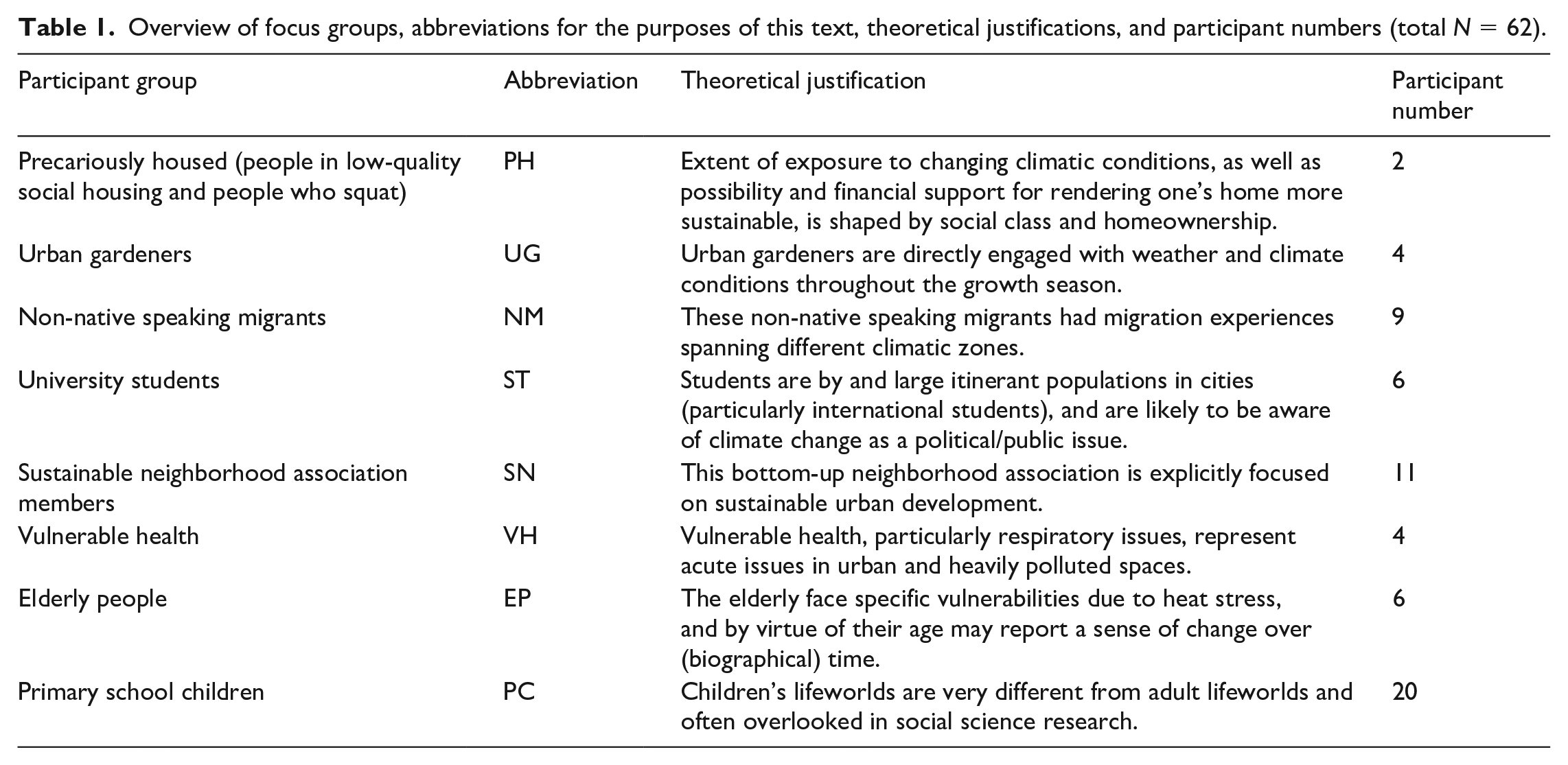
Table 1 demonstrates the varying theoretical justifications for including specific groups. To ensure anonymity, specific quotes, phrases, and insights will be attributed to specific informants by detailing the specific focus group and the participant number, e.g. ‘VH1’ refers to speaker 1 in the Vulnerable Health group conversation. In the conclusion, we reflect more fully on the potential of other methods, e.g. ethnographic methods and transect walks, to elicit further materials that can enrich this study’s focus on self-reported data.
Sensing climate change
The weather in Capitals
When asked about how and where they sense climate change, a majority of our participants were quick to mention rising temperatures as directly affecting their everyday life. ‘The heat, is so much more palpable the last years’ (SN1). It particularly affects people in their homes: ‘I have a home with quite a lot of light, a lot of windows. And in summer it is completely unbearable, to be honest’ (VH4). However, many of our participants emphasize that what they sense is not just a matter of heat. One of the urban gardeners – attuned to the well-being of his small share of crops in his allotment – told us that he thought: . . . the weather is, like, capitalized. The weather used to be. . . like normal letters. But now the weather is capitalized. If it rains, it RAINS. (UG2)
Indeed, climate change was a matter, too, of torrential rain: . . . take those horrendous torrents. You can’t leave the house, the city’s drainage system cannot manage them, the drains spew their contents right into your home. (SN10)
Particularly the participants in the vulnerable health group were very attuned to the way their bodies sensed and responded to weather extremes: In general changes are a problem for me. So changes in humidity for instance mean I automatically have a problem. (VH2)
The domestic space has a dual role in people’s sensing of climate change. On the one hand, the home is a shelter for ‘capitalized weather’, particularly for the elderly, who emphasize that they prefer to stay inside than go outside. On the other hand, the home can also be an amplifier of weather extremes, particularly in the aforementioned case of heat. As heat tends to linger, people would express serious concern about their exposure, particularly at night. Meanwhile people’s houses were also vulnerable to damage. Torrential and driving rain, leading to damp walls and water damage, was mentioned as causing lasting effects to some of their dwellings. Moreover, in the vulnerable health group, lingering moisture and dampness was particularly present as a factor that amplified long-standing respiratory problems (VH4).
The home was not the only location in which climate changed was sensed. Many pointed to changes in the urban environment. One participant, for instance, registered with some unease that maple tree seeds used to fall around the time of their birthday, but do not do so anymore (PH1). Another notices more pests and ‘plant troubles’ in their allotment garden, and that the trees are coming into leaf much earlier, which makes them vulnerable to springtime frosts (UG2). Or one notes that the grassy berms, often overlooked, are incredibly yellow so soon into the summer, looking burnt by the sun (NM1). Importantly, these data point in the direction of direct as well as more roundabout forms of noticing climate change in everyday environments. Noticing climate change, for many, was a matter of being able to attend to the abnormal: . . . obviously the most immediate [change] is the weather [. . .] so it is nice that that is tangible. But then on the other hand you notice it in other ways as well, you notice changes, things that feel abnormal to you. (ST2)
Becoming attentive to change also tends to require a sense of biographical time: of being able to contrast and compare things as they are now to how they used to be. One of the participants in the elderly people group told us that ‘there used to be a bigger difference between winter and summer’ (EP2) when she was young, while a member of the vulnerable health group commented on memories of abundant bird song in her youth that she had not realized she had been missing: I visited my family in Germany a few months ago, and I was cycling there. . . And all of a sudden I notice bird song, and I realize, it sounds like my childhood! (VH1)
People’s sensations of climate change, then, are fragmented and multiple, often appearing in specific moments of increased attention and attunement to one’s body, to its senses, and to one’s environments. These observations and sensations often come as a shock, and often pierce a sense of the normal and expected.
Making sense of these sensations, many of our participants expressed not only doubts and uncertainties (which we examine below as alternative registers people bring to bear on these sensations), but also expressed a deep sense of powerlessness. Noticing change, then, tended to be accompanied by a highly limited sense of social and political agency in times of climate calamity: As a person you can’t control it. It is just really unsettling, uncomfortable, it makes you feel small. Usually I am a very optimistic person. Normally what I tell myself is: OK, it doesn’t have to be changed in one day, we can still do stuff about it [climate change]. But at other points it really does make you fall into this sense that ‘it’s out of my hands’, if you understand what I mean? (ST2)
Similarly, one of the members of the sustainable neighborhood association told us about a feeling of ‘being unsettled. It is so large and. . . extensive. It is far away, but also close by. You can maybe act and do something, but what exactly?’ (SN1). For many, being affected by climate change also meant questioning their own capacity to fully apprehend and affect it in turn. In the words of one of the participants in the vulnerable health focus group: It is just. . . inconceivable almost. It is so big and shapes so many facets of our society, we cannot really get our heads around it. (VH4)
In general, these insights allow us to conclude that climate change registers as a sensed and experiential reality in people’s lives, particularly the domestic space, which operates as both shelter and amplifier to temperature extremes and sudden events such as storms and heavy rainfall. This also means that a lack of insulation and upkeep on social housing especially renders people more vulnerable to suffering negative consequences: the climate and the weather are irreducibly mediated by material and political arrangements. However, memory and biographical time play a large role in the extent to which people can attune themselves to change, which appears less as a gradual process than as sudden shocks to everyday modes of registering the normal. Yet, as we will see, many informants, while talking about the way they sense climate change, also expressed significant unease and doubts about this register of sensation and experience. It is to these we turn in the next section.
Uncertain epistemologies of climate change
As researchers we were fascinated with the regularity by which people expressed epistemological questions such as: is this really climate change or ‘just weather’? Is it a question of my own faulty memory, perhaps my own ‘growing awareness’, or are things really changing? While talking about climate change and the way it could be sensed, UG2 notes for instance: I have to say there are quite a few things I find super complex to judge, you know, if it is really climate change, or whether it is my own growing awareness of climate change and my own projections.
Like her, many participants expressed feelings of not being entirely sure that what they just discussed as a matter of climate change and everyday life was truly or really climate change. While on the surface these responses may be approached as evidence of a lack of ‘climate literacy’, they are, to our mind, conceptually important moments in which people question the register of sensing and experience and draw on alternative framings in order to supplement or question their sensed experiences. In order to further theorize about the way climate change is sensed and made sense of by a variety of publics, we want to zoom in on two especially salient alternative registers that our participants would draw on to make sense of these epistemological questions.
Knowing climate change
The first of these alternative registers is the register of (presumed) objectivity. Often, people try to weigh their own sensed experiences against what they learn from formal and often quantitative sources – in which the latter are generally approached as more authoritative and objective than their own subjective sense. Questioning her own biographical memory and sense of change, one of the sustainable neighborhood collective members, for instance, locates the more objective truth of climate change in what she learns from newspapers: so. . . I have been thinking about the question, the question if you can sense change. And I think it is a very difficult question. 40, 50 years ago I lived in a village, and when it stormed the shingles would fly off the roofs, too. And well, we also had a storm a few weeks ago. The difference, I cannot really quantify it. [. . .] So I can’t say that it is worse now than it was then. But when I read the papers I think: yes, it is getting worse. But I can’t experience that, right? How can I really perceive this change in the short life that I have? (SN9)
These doubts were recurring throughout our research. Is what I feel simply a matter of (variable) weather, or is it a sign of a broader trend (climate)? How can I be sure of the answer to this question? Crucially, many of our participants would refer to quantitative sources and information and position these as more authoritative than their own sensed experience. Challenging the approach to global warming as an everyday, concrete, and experiential reality, some of our participants sometimes echoed the rigid and ontological distinction between ‘weather’ and ‘climate’ (Weston, 2017).
Projecting climate change
In speaking about their experiences with and of climate change, many participants also expressed some unease with the presumed focus on the here (the city of Rotterdam) and now (the year 2021). For some, what they were sensing right now was not, or not yet, ‘real’ climate change. People were quick to locate climate change somewhere else, like for instance Sub-Saharan Africa or the Middle or Far East where, it was suggested, the real catastrophe is currently unfolding. A fascinating example of this focus on other places – the spatial projection of climate change – was at work in the group conversation involving primary school aged children. Asking them to draw specifically where and how they think they might feel climate change, all three groups immediately and unprompted started out drawing a globe, which was then filled in with smaller drawings of causes of climate change such as factories and cars. Asking the school aged children to reflect more directly on their own lives, one of us was admonished by one of the school children to understand that ‘this here [pointing at the drawing of the planet] is the more important issue’. Similarly, many participants, questioning their own sense of change, would highlight that the real issue was taking place elsewhere, or that the ‘real’ issue was a matter of the entire world. Fascinatingly, this gesture, while ostensibly highlighting the way ‘everything is connected’ (SN10), also became a way in group conversations to reorient attention away from its local manifestations.
Others located climate change not necessarily someplace else, but conceived of it as something yet to come in the near or more distant future, as for instance VH3: ‘the next generation, and the generation after that one, they are the ones who are really going to suffer’. Similarly participant number 2 in the group of elderly participants told us she is not worried for herself, ‘but for my grandchildren, I do worry’ (EP2). With a solidifying academic interest in ‘techniques of futuring’ in a context of climate calamity (Oomen et al., 2022), then, also comes the necessity to recognize moments in which climate change itself is rendered into a problem to come – rather than a present reality born out of extractive, exploitative, and expropriative colonial histories that are ongoing in the present (Povinelli, 2021). Some participants recognize, incidentally, the way our current predicament is rooted in what Povinelli (2021) would call the ‘ancestral catastrophe’ – the rootedness of global warming in colonial expropriation, forced displacement, and ecocide. For instance, situating himself in another sense of time, a participant in the precarious housing group stated that ‘there are already people who cannot live anymore in their areas close to the Sahel; islands are disappearing, indigenous tribes are already displaced by US colonialism’. Continuing, he warned emphasized that ‘We’re not going to be the first to experience this uprooting [ontworteling], but yeah – it is going to happen’ (PH2). At the same time, this sense of ‘us not being the first’ is again coupled with a conception of a future ‘change to come’, hence testifying to the particular salience of futuring in people’s engagement with the reality of climate change. Here, too, the figure of ‘future generations’ plays a particular role in the evoked ‘generational timescape’ (White, 2017), reconfiguring climate change as something that will mostly and most seriously affect one’s children, or one’s children’s children.
Taken together, the register of objectivity (that questions the body’s sensation and biographical memory) and the register of projection (that displaces or futures climate change) show that the register of everyday, embodied experience of climate change is not uncontested. While the register of sensing and experience helps probe the way large-scale climatic processes affect everyday life, our data also show that people are grappling for ways to attend to other modes of knowing and to climate change as it unfolds in other places, or will unfold into the future. Here, our participants are epistemologically engaged in the question of what it is possible and relevant to know about climate change, as well as the question where and when it is actually taking shape. In the conclusion, we will reflect on the methodological, conceptual, and political implications of this particular finding.
Climatic care practices
For many of our participants, the sensed reality of extreme weather called for everyday and practical tactics to manage their own and their loved ones’ exposure to the elements, particularly to heat. As an amplifier of heat, the home in particular was a place to carefully manage – or escape. Some participants for instance spoke of spanning large cloths over the garden and windows in order to keep the sun out. Other emphasized the important of airing out the hot air at the end of the day, often using ventilators to keep the air circulating. Some sought refuge outside in the shade of trees and parks, particularly in the evening, testifying to the crucial role such spaces have as ‘climate shelters’ (Amorim-Maia et al., 2023). Drawing regular baths, particularly for babies and younger children, was also mentioned as a way to keep cool. Other tactics extended beyond the home and affected people’s travel and movement through the city. ST5 for instance relates how he chooses a different route through the city on hot days: Something that’s really annoying to me, and this is very practical, is when I have to do groceries I have to walk down this street, and there are no trees at all. It is just so very hot. Scorching. Really unpleasant. So I take a detour to the shop. It’s not the fastest way but on a day like that I choose to do that.
These everyday practices are productively understood as climatic care practices. Here, we draw inspiration from the notion of atmospheric care. This notion, developed by Vine (2019), draws attention to processes and practices in which ‘the atmosphere’ and its capacity to affect bodies is problematized, modulated, and managed. Writing ethnographically about the ‘toxic possibilities’ of particulate matter pollution and its dangerous effects on people struggling with respiratory illnesses in the Californian context, Vine (2019) draws our attention to practices through which people manage and modulate their exposure to airborne pollutants, for instance the everyday practices of dusting and cleaning. As ‘attempt[s] to actively nourish human life by cultivating rather than curtailing the air’s breathability’ (2019, p. 23), these practices reconfigure domestic space, everyday routines, as well as familial relationships. In a similar vein, we seek to emphasize the above discussed practices as practices of climatic care. Like atmospheric care, they require an attunement to the way one’s own body and that of one’s loved ones are affected by specific climatic conditions in specific spaces, particularly the home. But climatic care practices are focused primarily on modulating people’s exposure to extreme temperatures – particularly heat – rather than pollution. And unlike atmospheric care practices that often focus on the inside of people’s homes, climatic care practices extend beyond the home, particularly for those in low-cost social housing, which tends to be built to let the sun and the heat in: ‘our apartment, it is on the third floor. In summer, we take the kids, take the food outside and eat beneath a tree’ (NM3). As such, climatic care practices are moments of improvisation in which routines of everyday life must be reinvented.
Common-sense and everyday, these strategies may have important repercussions for the way people relate themselves to climate change. As material reminders of people’s exposure to (more extreme) weather, these practices also often materialize the reality of climate change in one’s everyday life, raising further questions, for some of our participants, about one’s ‘footprint’ on this earth. Indeed, caring for one’s own exposure to climate change often also entailed coming to care for ‘the climate’ itself. Mentioning examples of recycling, mending one’s own clothing, and composting, one of the urban gardeners (UG2) related these efforts to an attempt to ‘keep this attention [to climate change] on the surface’. Here, our analysis points in the direction of what Ourabah (2022) analyzes as the way the efficacy of everyday sustainable practices and ‘everyday environmentalisms’ lies less in their impact on climate change proper than in the way they materialize climate change as an ongoing matter of concern in everyday life. Crafting these strategies, in other words, made people reflect on climate change as an everyday reality and not rarely generated concern about their own role in the larger world. For some, this included a concern with the exploitative and damaging infrastructures of capital accumulation that are the necessary requisite for ‘regular life’ in late capitalist, Western European settings. For UG4, for instance, these strategies are a deeply held part of a movement to reclaim my life from consumerism. [. . .] I actually want to have to think about the way I consume. I want to think about it, re-engage my thinking process and refuse to just be on autopilot, just feeding the machine. I want to care again.
For some of our participants, then, their exposure to a changing climate raised urgent questions about their own bodies, what their bodies need, and how their bodies thrive. For those, the implication of their bodies in specific environments, spanning from the domestic sphere to the urban, and to larger networks of power and capital all assumed crucial importance. Stretching climates ranging from the domestic climate to the planetary, these practices then both materialize and problematize the body, its environments, and the affective relationships between the two.
De/composing climate change: Methodological, conceptual, and political speculations
In this contribution, we have approached climate through the lens of embodiment and sensation. Conceptually, this gesture has made people’s everyday engagements with climate change legible in a register that highlights the material body and its enmeshing in specific environments. People with vulnerable health and urban gardeners proved especially attuned to change, further demonstrating that the extent to which people become attuned to climatic realities is deeply shaped in and through embodiment and emplaced, embodied practices.
At the same time, our data also demonstrate that this register of climate change as something that can be sensed directly is itself questioned and contested. Here, two alternative registers stand out in particular: the register of objectivity, which approaches climate change as only properly known and understood in quantitative, supposedly more objective epistemologies; and the register of projection, in which climate change is variously projected onto other places (the Global South), scales (the globe), or other times (the future, future generations). Meanwhile, people actively try to manage their own and their loved ones’ exposure, particularly to heat. Common-sense, everyday tactics of spanning cloth fabrics, drawing baths, finding different routes through the city, and seeking shade become legible as climatic care practices. These care practices, importantly, are not simply a matter of finding shelter or reprieve, however, but also and crucially have the potential to materialize and further engender a broader, everyday concern with climate change as a matter of everyday life.
Methodologically, there are yet untapped possibilities to zoom in on the relationships between bodies, environments, and climate change. While our approach – loosely structured focus groups – contributed greatly to teasing out individual experiences and social sense-making, they require and place emphasis on people’s verbal accounts, reasonings, and meanings. Our experimentation with visual formats in the primary school group however points in the direction of visual methods as relevant tools to help render associations and displacements of climate change partially accessible. However, sensuous ethnographic methods attuned to people’s sensuous experience of and participation in the urban offer a promising venue of research to further unpack the sensory dimension of people’s experiences of climate change (see e.g. Low, 2015). Moreover, the fact that most of the sensations and practices we highlighted here take place in the domestic sphere would also call for a more sustained ethnographic approach, in which the relations between climatic care practices and other forms of reproductive labor could be highlighted in more detail (see e.g. Ourabah, forthcoming). Moreover, methodologically it would also be helpful to explore urban spaces in more detail, so that for instance transect walks (Okoko & Prempeh, 2023) are promising instruments to track how and where in urban space climate change is felt, and how that reshapes people’s movement and dwelling in the city. Crucially, our research took place in late winter and early spring, which may have had the effect of drawing out concerns with rainfall and storms rather than pressing issues around heat stress (although that, too, was present in our data). To uncover people’s concern and experience of climate change in the broadest sense, it is crucial researchers time their studies to take place in a variety of seasons and particularly in summer.
In this conclusion we wish to reflect on these findings and draw out some resonances and further questions. First, it is important to pause with the fact that our research took place in a Western European context, which – as stated in the introduction – has had a particular geographic luck as well as the global privilege to so far avoid the more disastrous extreme weather we are currently witnessing as unfolding across nations in the Global South, as well as in for instance the South of the US and in Australia. In this context, it is imperative to note that the modes of projection we were witness to – the reorientation of the question to involve other times and places, as well as a reliance on presumably objective data – involve a particular epistemological politics of displacement of the issue, the plausibility of which displacement is undergirded by longer histories of colonialism and expropriation. While these Western European city dwellers, in other words, may still have the privilege of ‘puzzling out’ the relation between weather and climate (Weston, 2017, p. 121), large amounts of people, including indigenous communities and their specific histories of ecological disaster and displacement, know ecological devastation much more intimately and much more directly (Povinelli, 2021). At the same time, our analysis, documenting a historical moment in which global warming is increasingly impinging on these globally privileged city dwellers, points in the direction of a relevant if yet contested register in which to address climate change.
Building on these insights, we may wonder: what if politicians and policymakers were to insist on the intelligence of our emplaced, situated bodies in figuring out our condition in this world? What if they converse with people less as ‘holders of opinions’ about climate change, or ‘bearers of interests’ when it comes to climate change, but as directly and irreducibly affected by climate change as a material and embodied reality? Drawing on these data, it would be possible to address climate change not as a homogeneous process, but as a varied and uneven process that is filtered through, amplified, and/or modulated in a variety of socio-material arrangements and infrastructures, ranging from precarious social housing to class and race. Instead of individualizing and neoliberal sustainability policies targeted at those who privately own their house (e.g. subsidies for solar panels, insulation, and so on), this register of emplaced bodies with differing vulnerabilities to global warming calls for public, collective, if differentiated approaches to livability in contemporary cities. For example, strong investments in and the ‘future-proofing’ of social housing, as people in such housing are particularly vulnerable to heat stress, will be required, just as placing a significant emphasis on ‘greening’ not as a technique of gentrification, displacement, and abandonment (Anguelovski et al., 2019) but as a broader public investment to provide ‘climate shelters’ (Amorim-Maia et al., 2023) and increasing cities’ capacity to manage torrential rainfall. Recent advances in critical heat studies (e.g. Hamstead, 2023), urban planning, and climate mitigation (e.g. Amorim-Maia et al., 2023) as well as the study of water, water rights, and water infrastructures (Sultana, 2020) similarly point in the direction of taking seriously how ‘adaptive and maladaptive practices, agency, powerlessness and resistance play out in people’s everyday and mundane experience’ (Hamstead, 2023, p. 156). Emphasizing differential vulnerabilities, exposures, and lived experiences as relational, situated, and embodied is also key in the attempt to connect issues of weather and climate to agendas of environmental justice.
Throughout this piece we find a special resonance with Stenger’s call to move away from grand theorizations of climate crisis – as evident in the totalizing ‘Anthropocene thesis’ – which ‘leaves thinkers at the balcony, contemplating and babbling, with no other task but that of discussing the best way to formulate our eminent responsibility or our incapacity to connect knowledge and action’ (Stengers, 2021, p. 82). Too often, climate change is something those in the privileged West agonize or indeed pontificate about – not something that is already here and already irreducibly shaping our socio-material lives. The proposition to think with the body and with sensation as such is a speculative proposal that aims to compose ‘climate change’ and (highly problematic concept of) the ‘Anthropocene’ in a different key (Weston, 2017). Emphasizing climate change as something that is experienced in and through differently emplaced bodies, we have aimed to ‘awaken the imagination’ (Stengers, 2021, p. 86) of what it means to be a body in a changing city and a changing world. Drawing out connections with the social study of public formation and the role of materialities of various sorts in such processes (Marres, 2012; Ourabah, forthcoming), we may wonder how and where we can see the emergence not only of (individual) climatic care practices but also train our eye to discern emerging collective modes of climatic care.
Footnotes
Acknowledgements
We thank first and foremost all our participants in the focus groups for their time and their serious and caring engagement with our research project. We also wish to thank our three wonderful student assistants, with whom it was such a pleasure to work: Gina de Boer, Luuk van Dongen, and Maaike van Papeveld. We also thank the anonymous reviewers, whose support for and feedback on this article have been of immeasurable value to our writing and revisions. We thank, too, Dr Robin van Akker, whose professional and personal support of our original grant proposal was crucial to its success. Last but not least, we thank Marguerite van den Berg and Massilia Ourabah, as well as all participants in the Dolphins/School for Joyful Militancy workshops for their joyful engagement with our ideas and the materials presented here.
Funding
This research was part of the project ‘Can you Sense it Change’ funded by the Dutch NGO Rotterdams Weerwoord.