




Abstract
Sociological interest in research with nonhuman animals is growing, but theoretical discussion of the importance of ‘multi-species ethnography’ or ‘embodied empathy’ has not, as yet, yielded many practical, qualitative methods. Taking as its case study the systematic cultivation of ‘the felt sense’ in an equine-assisted personal development site, referred to here as The Forge, this article discusses what role our bodies should play in ethnographic research with nonhuman animals if we wish to approach, in the words of Vinciane Despret, ‘what matters’ to them. In particular, it explores the potential of the ‘felt sense’, worked through somatic-emotional and attentional practices, for achieving greater researcher reflexivity in the field. Using stories, drawings and videos from the research site, I show that finding ‘clean communication’, a place from where the horse’s active voice can begin to be ‘heard’, requires an embodied, reflexive methodological labour that, following Beth Greenhough and Emma Roe, I describe as ‘experimental partnering’. This understands the horse’s behaviour as phenomenologically co-produced, rather than as an object of study, but nonetheless requires clients to cultivate a critical distance from their emotions and assumptions. I argue that the practical techniques employed have methodological relevance for human–animal relations in the field.
Keywords
It is striking how rarely papers in human–animal relations speak of the animals themselves. I was listening to a presentation on riding school relations recently, which described the moment a vulnerable teenager suddenly kicked a horse hard, and the horse shot off, almost unseating her. An interesting analysis followed of the teenager’s decision, what it said about her expression of agency, and the researcher’s role in the interaction. This being a human–animal studies conference, however, it was notable that when asked for their assessment of the experience of the horse, the result was a visible shrug: ‘I don’t know. I’m not a horse expert’ (my emphasis). Is this response enough, ethically and epistemologically, when we research in contexts of human–animal interaction? As sociologists, the question goes to the heart of our beliefs about the extent of subjectivity in other animals, the modern divide between culture and nature, and, therefore, what kind of ‘expertise’ counts for whom.
This article, based on an ethnographic investigation of an equine-assisted personal development site, brings horses back into the frame, and does so from the perspective of a methodological question. Given the mostly nonverbal nature of communication between humans and other animals, what role should our bodies play in social research which seeks, however partially, to learn something of a nonhuman participant’s experience? 1 I also ask what lessons could be learned for a more embodied, affectively charged and multisensorial human sociology, and highlight the importance of ‘the felt sense’ and embodied reflexivity to both projects.
Multi-species ethnographies
There has been a concerted effort in recent decades to challenge the normative exclusion of nonhuman animals from sociology, including from within the pages of this journal (Cudworth, 2015; Peggs, 2012). This is part of a wider cultural realisation that traits previously considered exclusively human are, in fact, distributed across the animal kingdom; and is also part of a wider critique of the narrowly linguistic, symbolic interactionist foundations of the discipline (Blackman, 2021; Wilkie & Mckinnon, 2013). Most accounts of animal intersubjectivity, however, have focused on the social construction of mindedness and agency by human owners. Notwithstanding their usefulness, there is increasing discomfort about researcher reliance on human narratives and the absence of the animals themselves from subsequent accounts. Lindsay Hamilton and Nik Taylor, arguing that ethnographers can and should ‘listen for the voice of the animal’ (2017, pp. 51–52), warn that relations of power can be inherent in the kinds of voices we choose to ignore. Conversely, multi-species ethnographies that take animals seriously can challenge anthropocentric legacies, and develop richer, more diverse accounts of social life.
This is not to minimise the difficulty, both epistemological and ethical, of such a project. Scholars should be rightfully wary of a methodologically careless, uninformed, or even colonialist attitude towards difference, when beings may inhabit vastly different phenomenological worlds (Madden, 2014). We should also keep in mind that a modern quest to know animals has often underpinned their objectification and exploitation. A greater comfort with uncertainty should be at the heart of non-invasive, respectful relationships with nonhuman others (Nimmo, 2016). However, where we are confident of our ethical intentions and epistemological commitments, we can engage better with nonhumans, become more attuned, and see and hear less narrowly. Engaging with ethological expertise is important, albeit with awareness of its often very different epistemological and ontological assumptions (Lestel, 2011). But as creatures with shared embodiment and sentience, and as sociologists with a broad epistemological commitment to Verstehen (Weber, 1925/1978, pp. 8–9), how we empathetically attune to individual animals’ bodily activities, emotions and communications seems crucial (Hamilton & Taylor, 2017). Yet arguably, doing so is a challenge when, even in human studies, sensory and non-representational approaches to embodied communication remain in their infancy. As Rachelle Chadwick points out: ‘less work has taken on the task of grappling with how we translate these theoretical insights into concrete methodological tools and approaches’ (2017, p. 55).
This article explores the methodological potential of embodied, empathetic and sensory methods through a case study with an equine ‘expert’ who uses qualitative, interpretive methods to allow, in her words, ‘the horses’ voices to be heard’. In particular, it examines why and how a craft-like skill known as the ‘felt sense’ was cultivated in clients participating in equine-assisted personal development retreats. It argues that this craft offers methodological tools for researchers interested in better attending to the animals in human–animal relations. Beginning with fieldnotes from one participant’s interaction with a horse, I show that the key methodological strengths of this ‘felt-sense’ practice lay in the cultivation of multisensory attention and embodied reflexivity, whose practical development I describe. Drawing on the work of Greenhough and Roe (2014), I argue that The Forge engaged in an ‘experimental partnering’ that allowed greater mutual intelligibility between horse and human to emerge. Taken together, these methods demonstrate, I argue, how horses’ behaviour is understood to be phenomenologically co-produced, rather than an object of study; with the horses playing an active role in the shaping of knowledge. Nonetheless, clients are encouraged to find a ‘clean communication’ that accounts for, or works to dissolve, their own emotional states or assumptions. I conclude by considering some of the implications of The Forge’s methods for a more methodologically advanced and reflexive multi-species ethnography, before briefly reflecting on its relevance for embodied encounters in human research.
Reciprocating bodies
Over the last two decades, there has been a gradual theoretical turn towards conceiving of human social agency as embodied, kinaesthetically attuned and affectively charged, rather than narrowly limited to linguistic exchange (Blackman, 2021; Mason, 2018; Thrift, 2008). Through qualitative immersion in these different registers of attunement, researchers are urged to cultivate new forms of social analysis, including ‘an attention to how a wider range of the sense(s) changes the quality of data and makes other kinds of critical imagination possible’ (Back, 2012, p. 29). Sandelowski even argues that ‘We should spend as much time developing our visual, tactile, and other sensory skills, as we currently spend on developing our “reading” skills’ (2002, pp. 111–112), and a few radical projects such as The Somatic Toolkit have begun to do just that, drawing on dance practice to heighten sensory awareness and embodied reflexivity before ethnographic activity (Kieft et al., 2019).
However, due to a lingering dualist divide, conventional sociological practice still often delegates the behaviour of nonhuman animals to the biological sciences (Nimmo, 2012), where qualitative, embodied immersion is usually rejected in principle. There, the embodied presence of the researcher should either remain stoically ‘neutral’, or its impact should be systematically controlled for. But there have been notable exceptions in field studies, where qualitative, interpretive approaches have led to important discoveries. Vinciane Despret (2013) argues that the few ethologists who have truly sought the animal’s ‘perspective’ – what matters to the animal, as a felt experience – use their bodies carefully and consciously to invite affective exchange. They aim ‘not just to understand what something merely means for another being, but also how something matters for it’ (Despret, 2013, p. 55). She describes, for example, how Barbara Smuts realised that she had to learn and imitate baboon behaviour so that they allowed her to get close enough to observe them, using her own embodied behaviour as a tool to invite response. Such practitioners affect the animals, and make themselves ‘available’ to be affected in return. Their bodies are continually ‘undoing and re-doing’ each other (p. 57) and participants are thus ‘invited to other modes of being, other relationships’ (p. 60). This means, Despret argues, that empathetic connections with other animals are only ever ‘partial affinities’: contingent, fleeting and unfinished.
A body of sociological work – and that of related disciplines – is gradually emerging, which is aligned with this more qualitative, affective, processual paradigm in human–animal studies. Such work often draws on phenomenological theories to ground a heightened attentiveness to reciprocal relations and embodied attunement. Embodied empathy is, as Elise Aaltola (2013) puts it, ‘a perceptive tool, via which the mental contents of others may manifest’ (p. 460). The mutual entrainment of bodies is helped by remembering how consciousness itself has been forged with and through other animals, in our bodies, imaginations and practices (Dillard-Wright, 2009). Probably the most influential example was Kenneth Shapiro’s use of ‘kinaesthetic empathy’ in an empirical study of his dog Sabaka’s daily life. Shapiro (1990) describes this as a ‘bodily sensitivity’ to Sabaka’s ‘intention or attitude or project’ as he observes and accompanies him. The project reveals to him just how much meaning for Sabaka is fundamentally staked out in terms of ‘possible moves, possible ways of living and maintaining space’ (1990, p. 199). Indeed space, he claims, seems to be the primary ontological framework for his dog.
Critical attentiveness
Anticipating the criticism of so-called ‘anthropomorphism’ (an insensitivity to the otherness of other creatures), the authors above all urge various kinds of critical attentiveness in their methodologies, or ‘critical anthropomorphism’ (Irvine, 2004, p. 69). In her discussion of helping her horse, K. P, overcome a life-changing injury, Ann Game (2001) discusses how attuning to other animals means attending to the difference between ‘true sympathy’ and ‘self-identification’ – the latter being indulgent feelings of sorrow or pity. In self-identification, one’s own distress forecloses the imagination from others’ needs. ‘True sympathy’ she says, ‘involves a fearless capacity for otherness and difference . . . a non-attached holding of self and other’ (p. 7).
Meanwhile, an essential cultivation of ‘immediacy’ furnishes both Shapiro’s description of ‘kinaesthetic empathy’ with his dog and Aaltola’s case for empathy as a perceptual tool (Aaltola, 2013, p. 463; Shapiro, 1997, p. 279). For Aaltola, indeed, immediacy replaces objectivity. The experience is not fully elaborated on, but is associated with what all three authors describe as a forgetting of self (Aaltola, 2013, p. 464; Game, 2001, p. 8; Shapiro, 1997, p. 278) – portrayed as a feeling of total absorption in the other. Aaltola believes that achieving the requisite fullness of attention for this experience requires the placing aside of cognitive enquiry, as well as the releasing of effort, self-absorption and cultural assumptions: [Attention] is enabled by letting go of all effort and of allowing the obvious to emerge from behind our attempts to make sense of the world. In particular, one is to let go of self-serving, self-directed conceptualizations. . . . Thus, anthropocentric and anthropomorphic ramifications may be set aside by truly placing one’s attention on the animal – exclusive of self-interest and obvious cultural preconceptions. (Aaltola, 2013, p. 462)
These defences of embodied empathy have been influential in studies that wish to listen for the voice of animals (Hamilton & Taylor, 2017, p. 51) but they have two key problems. Firstly, empathy, as Despret argues, is not a romantic state of nature, but has ‘to be cultivated, nurtured, educated’ (2013, p. 61). It is disappointing, then, that this literature tends to be as light on methodological detail as in embodied human sociologies. After all, it is one thing to conceive of these states, and quite another to achieve them, never mind with reliable discipline. Game’s distinction between ‘true sympathy’ and ‘self-identification’ assumes significant emotional intelligence. The emotional-attentional states of ‘immediacy’ and ‘forgetting of the self’ sound almost rhapsodic; the letting go of ‘self-serving’ intentions requires substantial self-awareness; and many sociologists would argue that excluding ‘cultural preconceptions’ is simply impossible. There is also very little information on the other party: how the animal actually responds to such embodied shifts, or to the failure to achieve them.
Yet however mystical these emotional-attentional states may seem, the fact that they are so consistently repeated across the literature, including that belonging to noted animal ethologists (Hutto, 2005; Smuts, 2001), should give pause for thought. After all, there are established ‘somatic modes of attention’ (Csordas, 1993) in Western culture dedicated to developing a heightened sense of immediacy, the forgetting of self, the placing aside of ruminative mindsets, and sensitive reciprocities. These include meditation and performance methodologies (Pagis, 2009; Thrift, 2008). Something concrete, perhaps, is therefore referred to, even if the methods often seem obscure.
But at the very least, these practices of self-awareness and attention may well require sustained and significant work on the embodied habits and perceptual repertoire of our habitus (Bourdieu, 1977), on which the sociological literature, primarily concerned with linguistic and identity-centric forms of reflexivity, is sparse. A more embodied reflexivity might be more capable of noticing how one’s own emotional state, habitual patterns of embodied expression or agenda-driven mindset may affect the rapport between participant and researcher, and the researcher’s ability to remain present and responsive to what is offered. In other words, it might foster an ‘art of listening’ (Back, 2007) in the multiple registers of social life, something that may be even more important with nonverbal humans and/or nonhuman animals.
Equine-assisted personal development
Equine–human cultures provide a rich starting point to investigate the role of embodied empathy and reflexive awareness in foregrounding animal experience. In riding cultures, athletic, goal-orientated tasks and the greater strength of the horse require close attention to horse body language. Likewise, horses are culturally renowned for their sensitivity to the kinaesthetic-emotional state of their riders, and there are many scholars reflexively discussing the practice of riding (Argent, 2012; Brandt, 2005; McVey, 2017). However, riding is not necessarily a desirable or accessible experience to researchers.
The growing practice of ‘Equine-Assisted Personal Development’ (EAPD), however, seems to hold more promise for an exploration of ‘what matters’ to horses, since, as I will show, relationships are built from the ground, horses are usually free to express their preferences, and the ‘personal development’ of human clients requires a close attention to human and equine bodies and emotions. In what follows, therefore, I explore embodied empathy and reflexivity from the perspective of the work of an EAPD practitioner and equine behaviour expert. Through a diverse mixture of 30 years’ experience as a rider, trainer, owner, equine pharmacognosy, natural horsemanship student and EAPD practitioner, Erin claims specialist expertise in the ecology, biology and behaviour of horses.
Setting the scene
EAPD has emerged out of a nexus between ‘natural horsemanship’ techniques, purportedly based on horses’ natural social relationships, and animal-assisted therapies. It offers the opportunity to explore life skills such as mindfulness, self-awareness and improved communication skills. Participants typically work on the ground with horses – no riding is involved. Simple tasks are set by a facilitator in an enclosed arena, where the horse is loose and allowed to respond to the client as they wish. The details of this spontaneous interaction form the basis of non-directive feedback and discussion. Reflexively interpreting the horse’s moves is key to this practice; and yet at the time of writing there has been no empirical work, to my knowledge, on its sociological significance for the understanding of horses. Indeed, the exponential growth in equine-assisted therapies in the UK has received scant attention from the humanities, whilst animal experience and agency are almost entirely eclipsed in the dominant psychological literature, concerned primarily with EAPD’s impact on human wellbeing (Gorman, 2017).
‘The Forge’ is a small EAPD organisation in a rural location in the south of England. It offers group retreats, private sessions and facilitator training, run by owner Erin. Erin primarily emphasises her equine experience, although she has some training in therapeutic practices. She decided a decade ago to leave a promising career in show-jumping in order to change her relationship with her competition horses, and offer them a more natural, extensive environment. Her current herd of 14 comprise of these original members, as well as many rescues. None are now ridden, and all live year-round in extensive fields, rotated with the seasons.
Erin’s EAPD work was chosen because of its unusually strong emphasis on the teaching of horse behaviour and communication, including time observing the horses in the fields and learning basic horse ethology. The importance of ‘listening’ to the horse was frequently claimed as a driving force in her work, allowing the horse’s subjectivity and agency to be recognised in the interaction. It had, she claims, ‘given them their voice back’. This was against what she described as a culture of unreflexive labelling in riding culture, for example, calling an aggressive horse ‘just a moody mare’, without attending to the possible reasons for the horse’s behaviour.
Borrowing heavily from therapeutic philosophies, The Forge’s website describes how it uses ‘the felt sense’ to ‘learn how to be with horses, learn about their behaviour and communication’. 2 The ‘felt sense’, coined by Eugene Gendlin in 1978, is now widely used by therapeutic practitioners to describe a dynamic, affective landscape of ever-shifting sensations, embodying a source of knowledge about the world (Levine, 2010, p. 150). Erin is also influenced in this respect by the work of natural horsemanship expert Bill Dorrance and his direction to find a ‘feel’ for the horse. Finding the felt sense, The Forge’s website argues, is a craft-like skill, involving ‘learning to be in the present moment’ and ‘quietening the mind’.
The first two days of each three-day retreat are spent taking turns working individually with a horse in one of the arenas. Before the clients arrive, Erin brings some of the herd from the fields into a corral, trying as far as possible, she says, to choose those who ‘present themselves’ to her. In the session, she asks each person privately what intention they want to work with, and then asks them to choose their horse from the corral. The client returns to the arena and Erin leads in the horse, releasing them without a head collar. She retreats behind a fenced off area with the other participants, who watch silently, and take notes. There is deliberately no task, no instructions and minimal speech. The person can approach the horse if they wish, or not. Erin looks for how that person deals with the interaction, how they meet its challenges, and what shifts in the emotions of horse and human take place. She comes in at various points with questions for the client – ‘how do you feel about what’s playing out?’ ‘Is that reflective for you in your own life?’ At the end of their interaction, a discussion takes place and the client’s peers may also be invited to give feedback.
Methods 3
Approximately three weeks of ethnography was conducted at The Forge over a period of six months, primarily through attending the three-day ‘beginners’ and ‘advanced’ retreats. Each retreat was composed of a small group of four. In common with most equine-centred demographics, nine out of ten participants were women. All were white, and all but one were aged over 50. As well as participant observation, I conducted three, hour-long, semi-structured interviews with Erin, and one with ten participants after each of their retreats had ended. I also took some video footage which is presented in this article. This could only be taken from a fixed position, some distance away, so as not to disturb the sensitive horse–human encounters. However, the advantage was in being able to scrutinise subtle micropolitical events that might have been missed in real time (Bear et al., 2017, p. 244; Lorimer, 2010, p. 243). The footage was also used as visual elicitation material in interviews to help participants re-engage with sensory memories of their equine encounters. The videos are overlaid with the relevant section of audio from the participants’ interpretive commentary.
Data included fieldnotes, interview transcripts and visual materials, including daily reflective drawings which Erin asked us to complete. The organisation and all participants, horse and human, have been given pseudonyms, and the data anonymised as far as possible. Analysis took place through the coding of written data using NVivo; and through making analytic notes on video frames (iMovie). The research was given ethical approval by the University of Manchester and the ten retreat attendees who agreed to participate signed consent forms covering ethnographic, interview and visual material.
In what follows, I use a vignette from my fieldnotes to illuminate the nature of The Forge’s methodological engagement.
Janice, Alfie and Evy
It’s Day One of the beginner’s retreat. Janice, an experienced horse-owner, is waiting as Erin leads Alfie through the gate into the indoor arena. She removes his halter, briefly strokes his cheek and joins us behind the fence. He’s a small compact horse, dull brown-black, with a quiet nature. He stares at us each in turn, ears pricked, before lowering his head and ambling around the arena, breathing in its scents.
When Alfie becomes still, Janice rises to her feet and walks purposefully over to him. She gives him a confident rub on the shoulder. He moves away. She turns on her heel and walks away, hands on hips. Over the next 15 minutes, this became a repetitive pattern. He would accept her coming near, but ease away as soon as her hand came close. She would then turn abruptly and walk away. It felt quite unsettling to watch.
Erin asked how the session had been for Janice. Janice said that he wasn’t really interested in her, that he wouldn’t ‘let her in’. Erin said, ‘did you notice that every time you turned away from him, you put your hands on your hips? Do you know what that is about?’ ‘Hmm, don’t know’ said Janice. ‘Just be aware’ said Erin.
Jemma, another client, added: ‘If he didn’t respond the way you wanted him to, you turned away straight away. I wondered how it would be to go slower with him?’
Janice said, ‘You’re right. I set my intention for the session to work with “shutdown”, deliberately, to see how he would respond.’ She explained that she had a problem with anger. ‘It’s awful. When I’m like that – people scatter to the four corners’. Erin asked her what she had observed about Alfie. She said that Alfie had been unsettled, ‘keeping an eye on her’ the whole session. ‘And he was like “oh no! Not going near there! That’s scary that is!”’ Erin and Janice briefly explored Janice’s fierce temper, her need to take control, and how that might have played out in interaction with Alfie.
Day Two. Janice chose a different horse, Evy, a slender, graceful black mare with white socks. The interaction began in an unpromising way. It was a windy day and Evy seemed anxious, pacing briskly around the arena and whinnying sharply to the herd. Again, Janice kept her distance, briefly coming to greet her with a stroke on the nose, but moving calmly and smoothly away at the first turn of the head and going to lie down in the sand, resting on her elbows to watch as Evy’s pace gradually settled, and Evy rolled in the sand. Eventually the horse settled to a place by the fence, dragged her bottom a few times across the posts and cocked a hind hoof. Janice walked calmly over to stand beside her, lowering her gaze. Evy reached out to sniff her and Janice gently stroked her neck. Evy nosed her face and rested her chin on top of her head. They stood together for ten minutes, sometimes completely still, sometimes with Janice stroking Evy, sometimes with Evy shifting her head from side to side, or snuffling her hair.
Afterwards we sat with blankets and cups of tea out in the sunshine. Janice was visibly moved by her experience with Evy. She said ‘She was so giving. For those minutes, nothing else existed. There was nothing else in the world.’
The next morning Janice presented a visual representation of her experience (Figure 1).
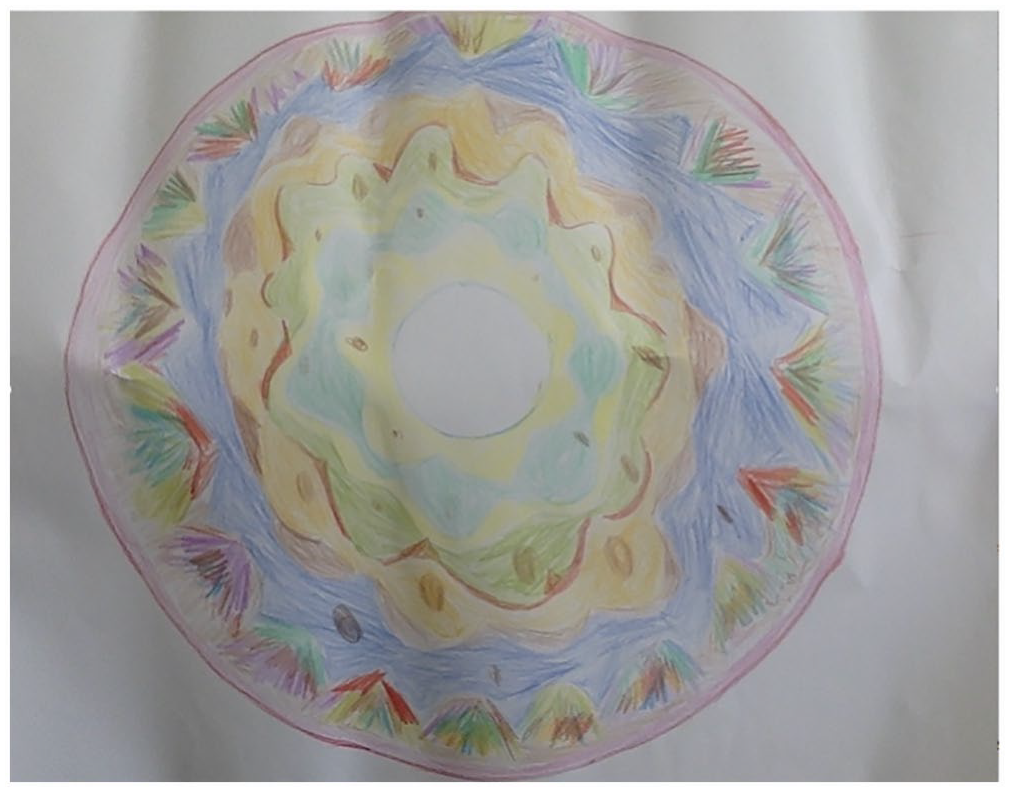
Janice’s drawing.
She explained how the pink border around the edge is the ‘barrier’ to a communication with the horse. The grassy clumps around the edge represent her busy thoughts and objectives. Working towards the centre is a movement towards a present-moment state. Finally she reaches the clarity of the white space, the space of ‘connection’: ‘When I make a connection there’s just nothing. There’s nothing in my head. It’s just this. . . you’re in. . . awe almost of this. . . critter. With these big soft brown eyes.’
Janice’s arrival at the white space is significant because it is reminiscent of the fullness of attention, the ‘forgetting of self’ (Shapiro, 1997) and the bracketing of analytic enquiry that the scholars discussed above believed was so important to a critical practice of interspecies enquiry: one which avoided anthropocentric or self-centred interpretations and cultivated empathetic immediacy. At The Forge, these moments with the horse were conceived as finding ‘connection’, which in turn was thought to enable what Erin called ‘clean communication’: a place from where the horse’s active voice can begin to be ‘heard’.
As we can see from Janice and Evy’s encounter, connection requires a reflexive methodological labour in order to shift habitual modes of self-presentation and practice, get latent emotions and busy minds ‘out of the way’, and find this present moment sense of immediacy and communion. Janice explores the effect of her defensive emotional presentation on Alfie, and then works on her self in order to achieve what she feels is a much more rewarding experience with Evy. The horse’s behaviour is therefore understood to be, at least in part, a response to her own feelings. Their story helps explain how, in practice, this embodied, responsive reflexivity is worked through a ‘felt-sense’ orientation to the relationship. It encompasses, for example, imaginatively recreating emotions, adopting various body positions, experiments with rhythm, sensitive placement of eye contact, touch, proximity, distance and so on, so that Janice can learn whether the horse is receptive to her emotional presentation and the contact she has sought. When she experiences ‘connection’ with Evy, it is as a visceral feeling of complete absorption, what Lorimer might call an ‘interspecies epiphany’ (2007, p. 921). Ruminative and emotional cogitations are experienced as dissolving into emptiness: ‘there’s just nothing’. It mirrors Erin’s concept of ‘clean communication’ and the ‘forgetting of self’ mentioned in the literature above.
In what follows, I will first explain how this responsive reflexivity made horses and humans more attuned and intelligible to each other, in the ‘undoing and redoing’ of their bodies (Despret, 2013, p. 57), using Greenhough and Roe’s (2014) concept of ‘experimental partnering’. With a view to the implications for a more somatically attuned and species-inclusive sociology, I will then explore how The Forge achieved skilled methodological partnering through exercises and invitations. Finally, I will demonstrate the progressive accomplishment of one aspect of this partnership, ‘connection’, with the help of video material.
Experimental partnering
What Erin is encouraging with Janice and Evy might be described as ‘experimental partnering’. Beth Greenhough and Emma Roe (2014) use this term in the context of an argument about the processual and more-than-human process of habitus formation (Bourdieu, 1977). Influenced by the agential realism of Karen Barad (2007) who argues that realities are created, not discovered, through the methods used to apprehend them, they argue that phenomena become more or less intelligible through the kinds of embodied connections forged in different knowledge practices.
‘Experimental partnering’ is a way of conceptualising this ontology, ‘a term which seeks to evoke how human and nonhuman subjects/ objects become intelligible – or come to matter – to each other’ (Greenhough & Roe, 2014, p. 49). However, significantly, the authors foreground the importance of embodied habits and more-than-representational phenomena in the formation of realities. Partnerships, they argue, can emerge from new embodied ways of inhabiting the world; and as they form or degrade, they amplify new realities and stifle others. Partnerships are capable of making things more or less intelligible, of unravelling certain habits, creating improvisatory responses, and disrupting or forging communications: Some of these experimental partnerings may make other beings intelligible to human sensibilities (as scientific experiments, for example, seek to do), or while others may equally result in their withdrawal, retreat and un-intelligibility (a failed experiment?). (Greenhough & Roe, 2014, p. 49)
What is distinctive about Greenhough and Roe’s particular interpretation of agential realism is that the agency which generates partnerships is conceived as non-representational: embodied habits, affective atmospheres, multisensory evocations and lively improvisatory, unstable practices by both humans and nonhumans. The researcher, whether herding cattle or growing a virus, must be alive to these kinds of partnerships and have sufficient methodological resources to interrogate them. This, they say, requires multisensory curiosity: The ‘experimental partnering’ approach to studying habits brings the researcher’s eye, nose, mouth, hand, body, etc. to be curious in a world that is dynamic, busy, playful as well as awkward, limiting and more than what appears. (2014, p. 54)
And yet they share the sense of a lack of methods, alleging the difficulties of attending to such fluid, intangible and embodied practices and behaviours: . . . we simply do not have the methodological resources and skills to undertake research that takes the sensuous, embodied, creative-ness of social practice seriously. (2014, p. 49)
The challenge of finding this embodied awareness is echoed by Erin. In her reflections upon ‘clean communication’, she refers to a set of her own embodied behaviours of which she was previously unaware: So, in the past [. . .] I’m unaware that actually I carry a low-level grade of anxiety all the time. And that actually, there’s tension in my body quite a lot, and I react to things quite a lot, and actually my mind’s quite busy [. . .]. But all those things are now impacting on my communication with the horse. They are not going to give me a clean communication with the horse. I just have that idle picture of where we should be, and ‘why aren’t we getting it, and so come on!’, and so we’re just going through the motions. And so I forget, to have a communication with my horse, where we both can be heard – I move out of the present moment.
It is this lack of awareness of one’s habitual emotional and embodied condition, and its impact on one’s ability to perceive the horse ‘properly’, which she is trying to address. She encourages the formation of new experimental partnerings, entangling the unfamiliar embodied habitus of participant and horse. She starts by placing participants like Janice in an (often) unfamiliar and vulnerable situation – without task or instruction in the presence of a wandering horse, asking them only to decide an intention and negotiate the sharing of space. The framework is a chosen human ‘intention’, which might be, for example, to understand something about horses, to find connection, or to build trust. Successful achievement of these aims, however, depends on a partnership that generates mutual intelligibility. If the human’s intentions cannot be interpreted, the horse will not be at ease; if the horse is not at ease, there can be no trust. If the horse’s preferences cannot be read, respected and negotiated, there can be no ‘connection’ – the horse will simply move away or emotionally withdraw.
But as the retreat progresses, the sensuous, embodied nature of this negotiation becomes gradually furnished with the kind of methodological resources and skills that Greenhough and Roe wish for. As shown by Janice, Alfie and Evy, experimental partnering with and through the horse means essaying different modes of embodiment, attitude, spatial placement and sensory perception in order to understand, adjust, and perhaps articulate the relational dynamics giving rise to different events. These attempts were encouraged through regular methodological exercises in cultivating the ‘felt sense’. Perhaps, then, they have a useful methodological application in human–animal ethnographies, or in human research contexts where the fostering of relaxed trust, coherent bodily messages and sensitive attunement to emotions is particularly important. In what follows below, I will describe two key dimensions of this work: ‘getting into the body’ and ‘extending sensory sensibilities’.
‘Getting into the body’
A common theme in the phenomenological literature on immediacy, as I discussed above, has been the importance of ‘bracketing’ logical analysis and excessive mental chatter. I acknowledged that this might seem whimsical, but argued that its repetition as a theme deserved ethnographic attention. Sure enough, The Forge’s discourse echoed this refrain when it came to connecting with horses. From day one, a key distinction drawn between humans and horses was humans’ possession of an advanced prefrontal cortex, which enabled us to analyse, categorise, elaborate our experience into meta-narratives, and so dwell busily ‘in our heads’, disconnected from our bodies and emotions. For the horse, Erin suggested, a busy mind in humans acted as a kind of communicative distortion. It was agenda-driven, deaf to equine communications and ultimately discomforting: Because that’s how a horse’s world operates. They are present in their body. You know, if Duncan the leader was in his head, the others would be pushing him around left right and centre, because – where are you? Who are you, how do we know that you are – present? They want to feel us energetically present in our body, and I think as a human, most of the time, or a lot of the time, people aren’t, because we operate from here [pointing to forehead].
This discourse implies, of course, a rather dualistic conception of mind–body relations and a somewhat essentialist framing of horses and humans. Elsewhere, Erin did bring more nuance to this theory, although the shorthand was pervasive. However, if space precludes a more detailed critical discussion of this binary framing, understanding how Erin’s work sought to shift clients away from a busy mind and more fully into their embodied experiences remains important in light of the methodological lacunas identified. The first dimension of cultivating the felt sense was through developing an experience of ‘getting into the body’ through certain techniques and exercises. All experience, of course, is embodied, but the instruction is more intelligible if it is understood as a ‘somatic code’ (Bar-On Cohen, 2006). This is a concise verbalisation of a ‘somatic-emotional experience’ that is difficult to describe in words, but whose meaning gradually becomes loaded with significance through embodied practice. Participants gradually came to understand what ‘being in the body’ felt like, even if at first the instruction was perplexing.
For example, the first day of the beginner’s retreat always explored, somatically, the meaning of so-called ‘inner connection’ with oneself, and ‘outer connection’ to others or the environment. We were led through a guided scan, up and down one’s body, to explore the experiences of inner and outer connections in turn, observing sensations, emotions, shifts of weight, any tension, and the quality of breath. This ‘body scan’ became a core ritual throughout the retreat. Before each encounter with horse or herd, we were led through the exercise before we entered their space, and asked to notice the balance of our ‘inner’ or ‘outer’ connection. In the arena, Erin would ask us to become aware of what was happening in our bodies as the encounter played out.
So, for example, someone who appeared nervous about approaching the horse might be asked to find ‘inner connection’, and notice how they were feeling, where they were feeling it, and where they would like to place themselves to feel more comfortable. Someone who was insistent about stroking a horse who was resisting touch would be asked to use ‘outer connection’ to notice how the horse was responding, and then to reflect upon whether the manner in which they had approached them was a cause.
Finding these inner and outer connections involved developing new kinds of curiosity, attention and attunement to both other and self, in a series of exercises designed to push participants out of habitual sensory modalities. This sensory work was the second key aspect of The Forge’s ‘felt-sense’ practice.
Extending sensory sensibilities
Erin tried to encourage an expansion of attention: what Latour (2004, p. 207) might call ‘learning to be affected’ by new information, gained through a reconfigured use of the senses and the practice of sustained curiosity. The second day of the beginner’s retreat, for example, was themed around ‘noticing’. We began in the barn, taking each of the senses in turn, isolating them and maintaining the attention on each one for a few minutes: being curious about what we could hear, what we could smell, what we could feel, then what we could see in a focused visual attention to one spot. That work was then taken outside, where we experimented by ourselves in the meadows and woods with different senses: how far their range extended, and how they interwove.
The ‘boundary bubble’ exercise was another example, in which two people would stand facing each other, 20 feet apart. One person would walk towards the other, in silence. The standing person would put up their hand and say ‘Stop’ as soon as they felt uncomfortable; the approaching person could also stop if they noticed discomfort. Erin would then ask why, with reference to our bodies. A rising feeling of tension in the chest? Perhaps the tightening of the smile on the face of the other? Did one person try and take control of the interaction by walking too briskly and purposefully; or by reaching out for a hug six feet away?
These multisensory practices were thought to improve one’s attentional skills in finding an ‘outer connection’ with the horse, becoming more sensitive to their feelings and intentions. It was an embodied empathy forged through detailed awareness, rather than a wash of feeling. It helped us to notice the horse’s own ‘bubble’ of personal space, noticing if their bodies tensed slightly on approach. Out in the herd, Erin would ask us to use ‘outer connection’ to keep ourselves safe, using peripheral vision and hearing to be aware of horses approaching from behind. Finally, it became a way into what Erin called a ‘present moment state’. In advanced retreats, Erin asked us to focus our attention on a visual spot on the ground for ten minutes before we even interacted with ‘our’ horse. This was a practice she called ‘going into neutral’: to calm the mind, become more receptive, and allow oneself to ‘just be’ without any predetermined agenda. This seems closely aligned to the cultivation of ‘immediacy’ that Aaltola, Shapiro and Game all refer to. It also allowed for the kind of responsive availability of presence that Vinciane Despret values in exploring what matters to animals.
As Janice describes: I just remember. . . in my heart wanting to connect with the horse. So I remember trying to use the senses that she taught us to use. . . I think it was my hearing. I think that brings you down doesn’t it, I think that brings your pulse down [. . .] so I think it does help you, to put you in what she calls present moment.
The impact of felt-sense practices on human–horse intelligibility
The felt-sense practices of reflexivity and attention at The Forge were rooted in concrete, if subtle, methodologies that required exercise, discipline and practice. Developing the ‘felt sense’ through ‘getting into the body’ and extending sensory sensibilities was a precursor to the reflexive ‘experimental partnering’ with horses in the arena, through which more reliable interpretations of both horse and self could be made. Noticing one’s own emotional, embodied sensations became an important aspect of a feedback loop, in which the horse’s response functioned as a clue to one’s affective and embodied state: perhaps showing discomfort with ‘busy minds’, tense bodies or instrumental goals; and rewarding a fully emotionally embodied presence. So rather than this being a solely introspective process, the horse’s behaviour was often scrutinised to ascertain how well one was doing at ‘getting out of the head’ and ‘getting into the body’. Horse and human were thus framed as continually co-responsive, and therefore could be, as Despret put it above, ‘invited to other modes of being, other relationships’ (2013, p. 60).
Likewise, focusing on nonhabitual senses sometimes gave insights into a horse’s behaviour, such as the distant noise of neighing carried on the wind. It also helped calm one’s own energies. One could gain the reward of connection, of being ‘let in’, as Janice puts it, only when one had done sufficient work on oneself. Rather than managing or repressing these emotions, however, the emphasis was on releasing them, or simply staying present with them, to which the horse was widely believed to respond.
It is important to say that the exact feelings, and certainly the motivations of the horse always remained uncertain. Why a horse seemed to be experiencing particular emotions at particular times seemed to be far more contestable. However, I would maintain that learning to apply the ‘felt sense’ through ‘experimental partnering’ with the horse made what mattered to horses, their moods and preferences, more evident and important; and it resulted in tangible changes in human–horse interactions, suggesting some kind of improved mutual intelligibility. Janice’s journey from Alfie to Evy was broadly reflective of that of many participants over the three-day retreats. Most first-time participants focused on gaining access to stroke the horse. Whilst some horses readily accepted, for many it involved a fair amount of trailing a restless horse around the arena. Over the course of the retreats, participants worked to allow themselves to ‘just be’ with the horses, to become more sensitive to their communications and more respectful of their space. This had increasingly visible and sensible effects. Horses calmed and nervous ones allowed contact or lay down to snooze. Participants reported being flooded with feelings of wellbeing at moments of ‘connection’. Affective atmospheres changed, and observers reported being mesmerised by the experience of watching others.
In particular, the different ways in which participants tended to understand ‘connection’ at the beginning and then at the end of the retreats, changed. This can be seen in the videos below, narrated by the participants. In the first video, Jemma is having her first experience in the arena with Patch (watch the video link in Figure 2).
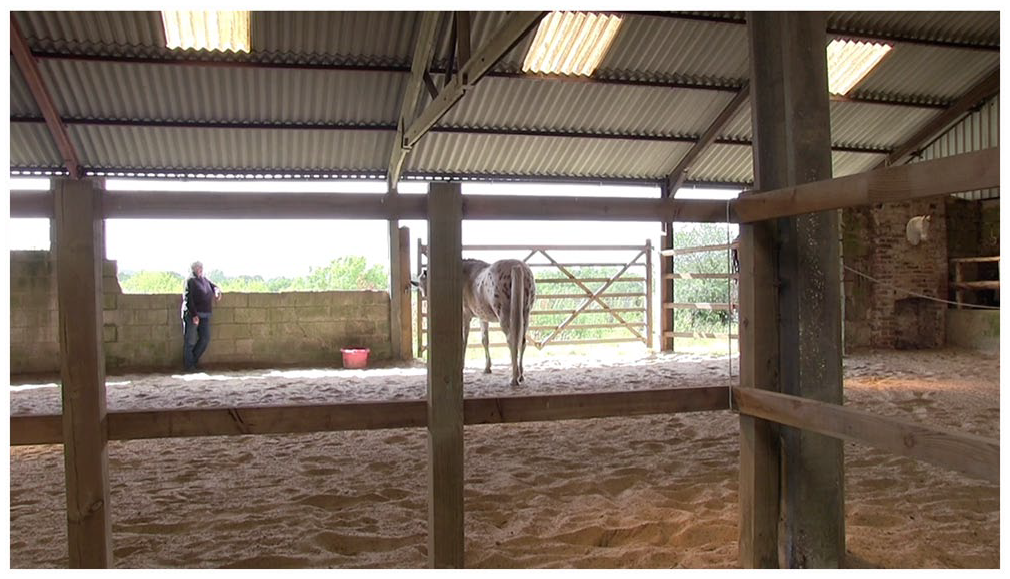
Jemma and Patch (see video at: https://www.youtube.com/watch?v=pO07p1E12AQ&ab_channel=MaisieTomlinson).
In common with many first encounters, Jemma is focused on being able to touch and stroke the horse for her connection, and is trying to get the horse to come to her. It is evident that her attention is closely attuned to Patch’s embodied signals. However, having learned that the ears are a good indication of where the horse’s attention is, she is using the ears as a somewhat isolated signalling device with a narrow sensory focus on this visible signifier. What matters to Patch seems to be a certain physical distance.
In the second video, Heather is on the final day of the advanced retreat, six days further ahead in her training than Jemma. She has been asked to ‘go into neutral’, where she focuses her attention on a visual spot on the ground for ten minutes to quiet her thoughts, before being allowed to interact with Duncan, whom she has not met before (watch the video in the link in Figure 3).
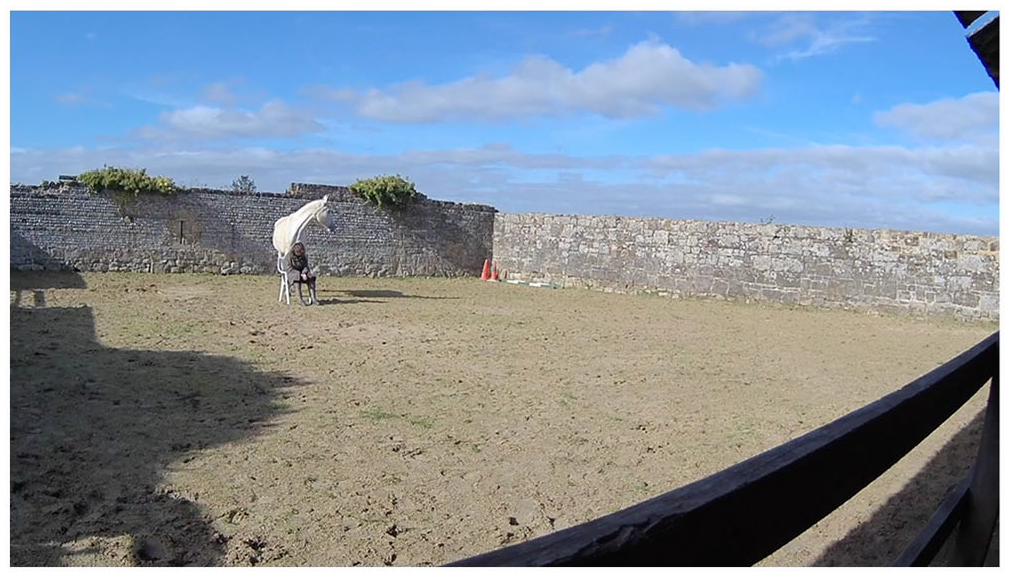
Heather and Duncan (see video at: https://www.youtube.com/watch?v=o6hjfxQK23s&ab_channel=MaisieTomlinson).
In this video, it is evident that Heather has started to conceive of a different kind of ‘connection’: ‘but without words’, one more akin to the kind of intangible communication that a herd leader might give from the centre, she says. Through a reflexive engagement with her felt sense, it seems that she has begun to interpret the horse and their encounter in a different, more subtle way to beginner retreat participants. She has foregone visual contact completely, and does not initiate touch, but yet believes that she senses this connection. Duncan stayed close to her in this position for approximately ten minutes, and whatever his motivation, what becomes intelligible is that he prefers to be close to Heather for that period of time, signifying at the very least trust and confidence in her presence. Heather matters to him, at this point in time.
Whilst as different horse–human pairs these cannot be directly compared, this shift in horse–human interactions was broadly illustrative of others over the six days of the two retreats, as the humans worked with developing understandings of ‘felt-sense’ techniques to become more sensitive and attuned to the horses’ communications, as well as to themselves.
A posthuman, responsive reflexivity
I suggest that Janice’s experiences of ‘experimental partnering’ with Alfie and Evy were attempts to engage with an embodied, craft-like reflexivity, one in which the horses’ preferences, subjectivity and agency could more fully emerge. The process involved a kind of phenomenological ‘bracketing’ (Husserl, 1931/2014, p. 31) in which habitual modes of affective self-presentation (hands on hips, indulging in anger) become the object of self-attention. There is, then, a certain practice of detachment, even purification. Janice treats her ‘self’ with a certain distance, working with herself, on herself, in playing with the effect of her improvised emotions on the horse. To find ‘clean communication’, she then either tries to dissolve those emotions, for example by using hearing to find ‘present moment’, or she takes her emotions into account in her interpretation of the horse’s response, as in her deduction about the reasons for Alfie’s physical distance. So The Forge’s reflexive techniques are relational and posthuman to some degree. Developing the ‘felt sense’ does not imply a split between self/other or human/animal. The effect on the horse tells you something about yourself, and simultaneously, one’s self-understanding produces an interpretation of the horse’s behaviour. But self can be, at least in theory, also distinguished and worked upon, through practices of distance and reflection (cf. Cook, 2015). The co-production of knowledge, therefore, becomes more evident, as horse and human ‘undo and redo’ each other’s bodies in reflexive response.
Conclusion
This article has addressed one of the key ethical and epistemological problems for sociology’s engagement with nonhuman animal subjectivities: the difficulty of making human–animal interactions and experiences intelligible. Whilst qualitative interpretations of animals’ social worlds have been phenomenologically justified through the theoretical mobilisation of ‘embodied empathy’ or ‘attunement’, there is a dearth of empirical practical methods in the human–animal studies literature, especially that which speaks to the subtle emotional-attentional techniques somewhat casually referred to.
This ethnographic exploration of the ‘felt sense’ with horses might be a useful case study for the kind of attentional, empathetic and reflexive practices that are needed in nonhuman animal methodologies. Through Janice, Alfie and Evy’s story I have described how the ‘felt sense’ was cultivated as a craft-like, embodied skill, with one’s body becoming the instrument of knowledge. Practical exercises in ‘getting into the body’ and ‘extending the senses’ were explored. This enabled Janice to play with affective, spatial, sensory and tactile moves in a process of ‘experimental partnering’ with the horse to negotiate her intention with them. Eventually, Janice feels she was able to achieve ‘connection’ with Evy, an intense experience of immediacy. This is understood by Erin as a place of ‘clean communication’, a condition of possibility in which the horse can begin to be ‘heard’. It bears significant similarity to sociological notions of ‘reflexivity’, albeit in a more embodied, intercorporeal sense than is usual.
Embodied reflexivity, here, allows an appreciation of what matters to horses, not as an object of knowledge distinct from oneself, but as a subject, who co-produces knowledge in each moment through ‘teaching’ clients how to behave. The attentional exercises were tools for us to understand how this takes place, as clients focused their attention intently on the moves of the horse for clues as to their progress. Self becomes inseparable from other; and at the same time a source of knowledge about the other. Likewise, the other becomes a source of information about oneself. This partnering allowed both human and horses’ subjectivities to emerge differently, to be witnessed, and incorporated into responses. If ‘connection’ is achieved, there is a feeling of complete attunement.
However, detachment plays a role in finding this attunement too (Candea, 2010). Clean communication aims to ‘get oneself out of the way’, to distinguish one’s own self-interest from the horse’s behaviour, and, if possible, dissolve it. But this is only in the last instance, because the self has to be worked through fully with the help of the horse before it can be released.
This article has argued that if we engage with the work of qualitative animal behaviour experts, we might find methodological tools that do justice to animals’ lively presence. This makes us more capable of interrogating everyday relations of power, collaboration and affection in multiple contexts of human–animal interaction. It does not mean casting aside scientific, ethological expertise; nor does it mean that animal subjectivities will suddenly become transparent. To aim for this is not just naïve, but potentially harmful. It does, however, mean recognising that there are embodied ways of being with others, particularly nonverbal others, that cultivate greater or lesser insight, through reciprocal and responsive engagements that tell us something of what matters to them.
The Forge’s ‘felt-sense’ methodologies have further relevance, perhaps, for more profoundly embodied human research encounters, particularly since the ‘live methods’ agenda called for more imaginative, crafty and multisensorial forms of research (Back & Puwar, 2012). There is a resonance, for example, with Jennifer Mason’s call for more ‘sensory kinaesthetic attunement’ to the constitutive role of ‘affinities’ in social life (2018, p. 8), and how these lively, potent sensations enchant or toxify relational encounters. The lessons that The Forge teaches on cultivating ‘connection’ could sensitise us to how affinities can be stifled, amplified and shaped. Their methodologies could also inform research with nonverbal human adults or with children, since the need for practices that cultivate bodily attunements, affective sensitivities, openness and mindfulness has been affirmed (Fleetwood-Smith et al., 2022; Nolas et al., 2019). Such aspirations align with Erin’s lesson in ‘just being’ with the horses, without agenda, trusting in the relation.
Whether with humans or with nonhuman animals, engaging with these possibilities would mean undisciplining our habitual research practices, submitting research sites to new questions, addressing centuries of neglected ethical enquiry and learning challenging and stimulating new methods.
Footnotes
Acknowledgements
I would like to thank Erin, and all the participants in this research, for sharing their knowledge and experiences. I would also like to thank Dr Mariam Motamedi-Fraser and Professor Lynda Birke, as well as the editors and reviewers of this manuscript, for their very helpful suggestions.
Funding
This research was funded by a PhD studentship at the School of Social Sciences, University of Manchester. Publication was funded by a South-East Network for Social Sciences (SeNSS) Economic and Social Research Council (ESRC) Postdoctoral Fellowship at Goldsmiths, University of London (grant number S/W007061/1).