




Abstract
Although advocacy is central to cultural transformations, claims makers are social actors who struggle for meaning and power. This article focuses on Global Athlete (GA) to analyse the stakes behind advocacy. This sports advocate has engaged a frame keying, even fabrication, to gain recognition in the global sport landscape. GA’s activity is examined on two levels. First, the article analyses how, to become a credible actor, GA framed itself by claiming to be ‘the voice of the athletes’ and appropriating the athletes’ symbolic capital. Second, this appropriation’s economic, political and social resources are identified. This case study highlights the interest of combining Goffman and Bourdieu to understand how GA’s framing captures individuals’ symbolic capital and how keying a frame, as an advocate committed to protecting athletes’ rights, served power struggles within the sports field. The results further show the need for sociologists to question what can be at stake beneath advocacy for ‘noble causes’.
Often identified as an appeal for concessions from dominant groups, advocacy relies on a strong commitment to protecting the most vulnerable (Stake & Rosu, 2016). Advocacy played an essential role in several core transformations of sports culture. The recognition of black athletes’ discrimination in sports owes much to the sociologist Harry Edwards, who inspired the US athletes Tommie Smith and John Carlos’s protest during the 1968 Mexico Olympic Games (OG) (Hartmann, 2003). Others advocated for the social inclusion of people with disabilities and the recognition of disabled athletes. Tom Waddell, a former athlete, organised the first Gay Games in 1982 ‘for the purposes of sexual rights advocacy’ (Stevenson et al., 2005, p. 454). The role of ‘advocacy coalitions’ has also been discussed to understand how people who share fundamental values influence sport policy changes (Green & Houlihan, 2004).
Advocacy organisations tend to be viewed positively in academia (McGillivray et al., 2022) because they support populations facing unequal power relationships. Sport advocacy organisations fit well with sociologists’ cultural inclination to challenge the reproduction of power asymmetries via, for example, supporting activists committed to improving the situation of subordinate groups, exposing the toxic culture of sports, and fighting against individuals and organisations with strong control over relationships and power. Edwards’ advocacy contributed to the broader movement for racial justice (Hartmann, 2003) and critical voices confronting sports organisations are deemed essential. However, the alignment of the researcher’s values with the defended cause can lead to a lack of distancing and magnifying of problems (Gilbert, 1997). Therefore, a critical reading of advocacy in sports, going beyond the ‘noble causes’ trope, is necessary to understand what social dynamics are at work (McCormack, 2020).
Our contribution is neither intended to defend or question the values behind sports advocacy, nor do we seek to assess their influence on the audience. Instead, it is about understanding what is at stake in advocates’ framing, both in the presentation on the ‘frontstage’ and in the power struggles ‘behind the scenes’ (Goffman, 1974). The empirical context for our study is Global Athlete (GA), founded in 2019, which is one of the few organisations that claim recognition as advocates for athletes. Key personnel of GA have been very vocal over its four-year existence, and GA has been described as ‘the most high-profile international sports athlete advocate organisation’ (Ingle, 2022). Our analysis aims to decipher the framing carried out by GA to become ‘the’ voice of the athletes and gain recognition within a short period, and to show that GA’s framing as an advocate committed to protecting athletes’ rights needs to be interpreted in the context of power relations within the sports field.
Sport advocacy and symbolic power
Sports activists, most notably Edwards, use the symbolic power of sport, but they tend to do so with more limited exploration of the underlying social processes (Hartmann, 2009). Research needs, therefore, to grasp the multiple issues that can be entangled in advocacy. This article argues that symbolic power is central to understanding how advocacy relates to other political issues at stake in sports. This symbolic dimension underpins how social actors’ cultural framing turns sport into politics (Seippel et al., 2018). Examples include when advocacy is used to obtain a leadership position in sports fields (Stenling & Sam, 2020) or to deconstruct the hagiographic discourses on college sports (Benford, 2007).
To explore these symbolic dimensions of advocacy, we combine the insights of Pierre Bourdieu with those of Erving Goffman’s frame analysis (Goffman, 1974). We mainly rely on how the latter has been redefined in the social movement analysis (Benford & Snow, 2000; Snow et al., 2013), which is relevant to apprehend the use of the symbolic power of sport in its structural and performative aspects. Like Bourdieu, Goffman emphasised ‘the performative capacity of symbolic forms’ (Bourdieu & Wacquant, 2013, p. 292) in understanding power relations. Symbolic power is an epicentral concept for Bourdieu (Wacquant, 2014). Bourdieu analysed the power given to a spokesperson as mere ‘delegated power’ (Bourdieu, 1991, p. 107). The spokesperson relies on a community to establish themselves as a legitimate actor and obtain power within a field. Symbolic capital is ‘a credit’; it is ‘the power granted to those who have obtained sufficient recognition to be in a position to impose recognition’ (Bourdieu, 1989, p. 23). As suggested by Bourdieu (1989, p. 23), ‘one can create things (i.e., groups), with words’ and a spokesperson can be ‘invested with the full power to act and speak in the name of the group which he or she produces by the magic of the slogan’ (Bourdieu, 1989, p. 23). Building on this approach, we argue that to gain symbolic power as an advocate, it is not necessary to be the spokesperson of a real group; the same can be achieved through recognition as the spokesperson of an imaginary community (Anderson, 1983).
Frames can play a major role in guiding action and rendering situations meaningful. ‘Critical frame analysis’ allows for a ‘discursive approach to politics’ in, for example, identifying ‘who has a voice in defining problems and solutions’ (Lombardo et al., 2009, p. 10). As observed by Fillieule and Neveu (2019, p. 17), ‘many social movement studies are framed in a “heroic vision”’ in which activists as ‘entrepreneurs’ seek to impose a framing other than the existing one or, to clear a discredit, to stage a positive image of themselves as can be observed in the case of animal rights activists (Einwohner, 2002, p. 263). Furthermore, framing can support cultural fabrications such as religious beliefs or racialist movements (Snow et al., 2013).
In sports, such frame-building can be observed in the way the International Olympic Committee (IOC) uses its voice to build an ‘invented’ history of the sport, presenting itself as apolitical, idealising athletes, celebrating mega-events legacy, Olympic values and communities (Defrance, 2000; Horne & Manzenreiter, 2006; Maguire, 2005). The IOC relies on a ‘frame articulation’ combining cultural elements, ideologies, beliefs and experiences to stage sport as an apolitical social space. However, sports’ internal and external politics and mega-events have been highlighted several times in the literature (e.g. Horne, 2017). Yet, politics in sports is sometimes mundane and spread by the ‘invisible ideologies of “apolitical” escapism’ (Serazio, 2020, p. 223) or by ordinary sports practices that normalise the conception of personal responsibility and social policies (Hartmann, 2016). The staged unity of sport also gives an illusion of cooperation and denies political struggles (Butterworth, 2020). This is observable in how the Olympic Charter – which claims that the athletes’ ‘interests constitute a fundamental element of the Olympic Movement’s action’ 1 – idealises sport as a universal culture. These claims overlook, for example, the underrepresentation of global south athlete voices with, in some cases, regulations that can be seen as racialised and imperialist (Henne & Pape, 2018).
Therefore, it is particularly relevant to question the hidden dimensions of sports politics, which can also be played out in advocacy. Advocates can use framing to influence individuals’ cognition to construct another reality. It can serve to protect the most vulnerable but also have less altruistic political ends. Whatever the agenda, symbolic power is gained by making a credible frame that people believe in. Credibility, a central topic of Goffman’s sociology (Manning, 2000), can be seen as a condition for being able to transform a frame (i.e. ‘keying it’, Goffman, 1974) in changing the meaning of a situation. The way this approach has been used by Benford and Snow (2000) in social movement analysis is particularly relevant to understand how GA has achieved, in a short period, a framing that earned at least some support and enabled GA to gain symbolic power by positioning itself as the spokesperson of ‘the athletes’.
We thus hypothesise that framing, as a form of textuality, plays a central role in GA’s dramaturgy and is at the core of the power relations it exercises in the sports field. However, the idea that ‘text . . . shapes the world’ (Alexander, 2003, p. 19) does not seem sufficient to understand how GA gains recognition. Structural aspects also play a role. Feldman et al. (2016) have shown the benefit of adopting Bourdieu’s sociology to understand how advocates try to monopolise symbolic capital and exclude others from converting it into power. The effectiveness of discourse alone must be questioned regarding actors’ social conditions. In a similar manner, attention to GA’s networks, and its economic and political resources, is required to understand its quest to gain recognition as the advocate of athletes’ rights. Consequently, we combine an analysis of the framing that GA builds to gain credibility with an analysis of the power struggles within the sports field.
Methods
Our methods and access to survey sites relate to our positioning as researchers who have extensively studied the anti-doping stakeholders’ culture over the past decades. This gives us privileged access to those who work within this community, while our primary status as observers helps us to avoid identification with the ‘anti-doping doxa’ (Ohl et al., 2021) ensuring that we maintain an ‘audit trail’ of our reasoning and judgements (Berger, 2015). Our long-term engagements with actors and organisations relating to anti-doping have served as a continuous source of research inspiration, driven by the concerns of the actors within the field. Initially, our research did not revolve around advocacy or GA, and our research was not motivated by taking a stance for or against sports organisations or advocates. Indeed, like other academics (McGillivray et al., 2022), we would a priori view advocacy in sport positively. However, our interactions gradually led to adopt a more sceptical stance and to identify GA as a puzzling actor, following an inductive approach equivalent to engaging ‘in imaginative thinking about intriguing findings’ (Charmaz, 2016, p. 138). Although the first steps of this research are clearly inductive, we also bring the micro and the macro levels ‘into dialogue’ (Burawoy, 2009, p. 8) through a reflexive approach that contrasts with grounded theory (Timmermans & Tavory, 2012). Our aim was twofold: to identify both the ‘social processes . . . and the external forces’ (Burawoy, 2009, p. 289). Contrary to starting with ‘our favorite theory’ (Burawoy, 2009, p. 43), we employed an iterative process of moving ‘back and forth between data and theory iteratively’, leveraging ‘observational surprises or puzzles’ to develop an original application of theory (Timmermans & Tavory, 2012, p. 168).
Through this inductive process, our observations led us to use Goffman’s Frame Analysis (1974) to delve into the underlying issues and dynamics at play associated with GA and its advocacy. Specifically, we conceptualise GA’s communication as a ‘self-enhancing social front’ (Goffman, 1974, p. 109). To gain a deeper understanding of what lies beneath GA’s front performance, we analysed two types of data:
A first source of data was GA’s communications, comprising 88 articles – which are mainly media releases, open letters and statements – published on its website (www.globalathlete.org/our-word) from its creation (February 2019) to December 2021, for which we conducted a content and discourse analysis. We also analysed the contents of two sports websites: insidethegames.biz (IG) and Sports Integrity Initiative (SII), from 2019 to December 2021 (a total of 14 and 15 articles, respectively, plus 17 annexes) to find out whether GA’s framing was shared or contested within these specialised media. IG has recognised expertise in international sport and claims to be the No.1 Olympic news website in the world. 2 SII is more limited in reach but is relevant since it was funded by Morgan Sports Law, a firm positioning itself as specialised in defence of athlete rights.
We first read GA, IG and SII articles to gain an understanding of the wider context of these texts. IG and SII articles were coded separately, using inductive coding that helped us to identify the categories of actors mentioned in each article, what the attributes of the GA are and how it is categorised; a memo was written for each article. The analysis showed that the contents of IG and SII very often adopted GA’s contents, with a reminder of the context followed by a series of quotations of GA’s article without any comment or even, as observed for SII, a simple copy-paste of a GA media release (e.g. SII 15.08.2019). The added value of IG and SII discourse is hence limited. Consequently, we mainly base our analysis on GA articles (n = 88). This enabled us to scrutinise the data and compile a first analysis table with the main themes, the most significant text extracts and reading notes.
We did not use a predetermined analytical structure referring to a standard model of framework analysis. Instead, and drawing inspiration from Chesters and Welsh (2004), we developed our analytical framework based on the data themselves. Twelve main categories emerged from this initial phase of open coding. They served as a basis for a more in-depth analysis of these categories, and their links, in axial coding with the support of NVivo. The coding focused on the topics, the targets of the article, the appropriation of athletes’ voices, the moral stance and the type of critic. However, to avoid a rigid set of coding, we adopted, at that point, an ‘abductive logic’ which led us to ‘creatively inferencing and double-checking these inferences with more data inferencing’ (Timmermans & Tavory, 2012, p. 168). In practice, this meant bringing existing theoretical frameworks to bear on the data and identifying where the material pointed to opportunities for new theory building. Therefore, additional coding was adopted while exploring the data with NVivo via keywords or topics. It allowed access to the meaning of the articles and to explore the contents based on themes, organisations or characters mentioned.
2. Second, we engaged in ‘observed conversations’ (Swain & King, 2022), primarily during our active participation in events such as the World Anti-Doping Agency (WADA) symposium and the Institute of National Anti-Doping Organisations (INADO) annual meetings. We gathered data from nine interviewees – five women, four men; from three continents; from anti-doping organisations (6); advocates organisations (2); and sports organisations (1) – between 2019 and 2023. We selected them for their seniority and the diversity of their profile and positions to compare their views. We had a total of 29 informal conversations with these interviewees (duration 10'–90'). These key stakeholders were individuals we encountered on multiple occasions, allowing us to pose various questions about stakeholders, inter-organisational relationships (both public and behind the scenes), and specifically about GA. Additionally, towards the end of the analysis phase, we conducted more formal interviews (5, not recorded, 60'–90') with interviewees working for sport and anti-doping organisations to fill in any missing information.
While interviews, conversations and field notes primarily provided background knowledge for our analysis, these materials were essential to understand what was playing out beneath the surface and to avoid hasty interpretations of the written materials. During our informal conversations and interviews, we diligently took field notes. Our intention was to capture the essence of the discussions and interactions as they unfolded. As a result, we documented conversations in part verbatim, provided descriptions of various interactions and scenes, and noted any emerging questions. We also made attempts to interview individuals from GA, but unfortunately, we were not successful in our efforts. Despite sending direct emails to three out of the six members of the GA Start-Up Group, we did not receive a positive response for an interview.
From an ethical standpoint, we did not engage in ‘procedural ethics’ (Guillemin & Gillam, 2004) prior to this research, as the focus on GA activism emerged inductively. However, once the topic became clear, there was no covert research: we have always shared the purpose of our research with our informants. We did not require a written prior consent form, as it would have been inappropriate given the context described; in the environment of anti-doping stakeholders, this would have discouraged individuals from engaging in conversation. In addition, merely obtaining generalised, prior consent, and then publishing statements from the conversations or interviews would run the risk of an ‘artificial ethical security’ (Dilger et al., 2019, p. 4). Therefore, we prioritised ‘ethics in practice’ (Guillemin & Gillam, 2004) by providing each individual mentioned their respective quotes as they actually appear in the article. This allowed them to grant written consent for their usage and ensure confidentiality.
Results
Our observations show that GA uses ‘discursive and strategic processes’ (Benford & Snow, 2000) to alter the IOC’s idealised and apolitical frame of Olympic sports framing and perform another story of what ‘is really going on’ (Goffman, 1974, pp. 44–45). Thus, GA focuses on athletes as its main ‘frame elaboration’ (Snow et al., 2013, p. 232) and stages them as a marginalised group whose rights are not protected and whose voices are not heard, thereby changing the meanings attached to athletes.
In the first section, we explore GA’s bricolage melding together ‘issues, events, experiences, and cultural items’ to elaborate a convincing ‘frame articulation’ (Snow et al., 2013, p. 229) that produces a symbolic repertoire antagonistic to the IOC’s (see Figure 1). GA’s bricolage relies on a ‘frame bridging’, by which GA stages itself as an important organisation amidst a strong social network, and an imagined community (Anderson, 1983) of athletes to appropriate their voice, which is an essential source of symbolic capital. GA also uses ‘science’, to find external endorsement for its claims and discredit the IOC and WADA, and two components of ‘frame amplification’ (Snow et al., 1986): a ‘value amplification’ through the idealisation of athletes, elevating them to saviours of sports governance, and a ‘belief amplification’ to present athletes and sports organisations as opponents (Snow et al., 1986, p. 469), WADA and the IOC being the ones to blame for this antagonism.
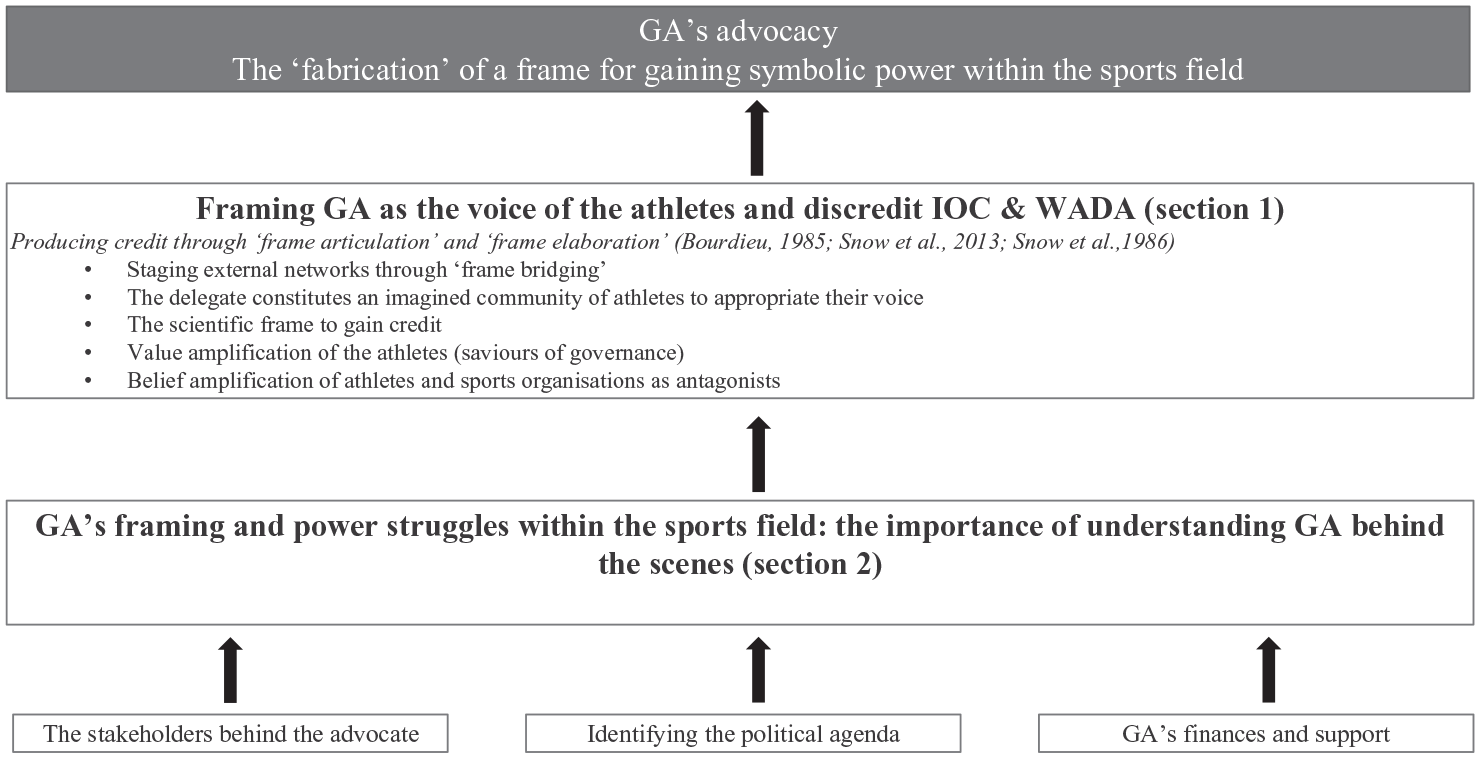
The analytical framework (simplified).
The second section focuses on more structural aspects that enable GA’s framing to support the reinforcement of its role as a stakeholder and serve its political agenda with actors supporting GA. Finally, we argue that GA’s advocacy relies on a frame keying, even ‘fabrication’ (Goffman, 1974), to appropriate the athlete’s voice, accumulate symbolic capital and increase its power within the sports field.
Framing GA as the voice of the athletes
GA’s frame bridging
The frequency of reference to organisations that appear to advocate for athletes (Figure 2) indicates how GA is engaged in a ‘frame bridging’ primarily effected ‘through [an] interpersonal or intergroup network’ (Snow et al., 1986, p. 468).
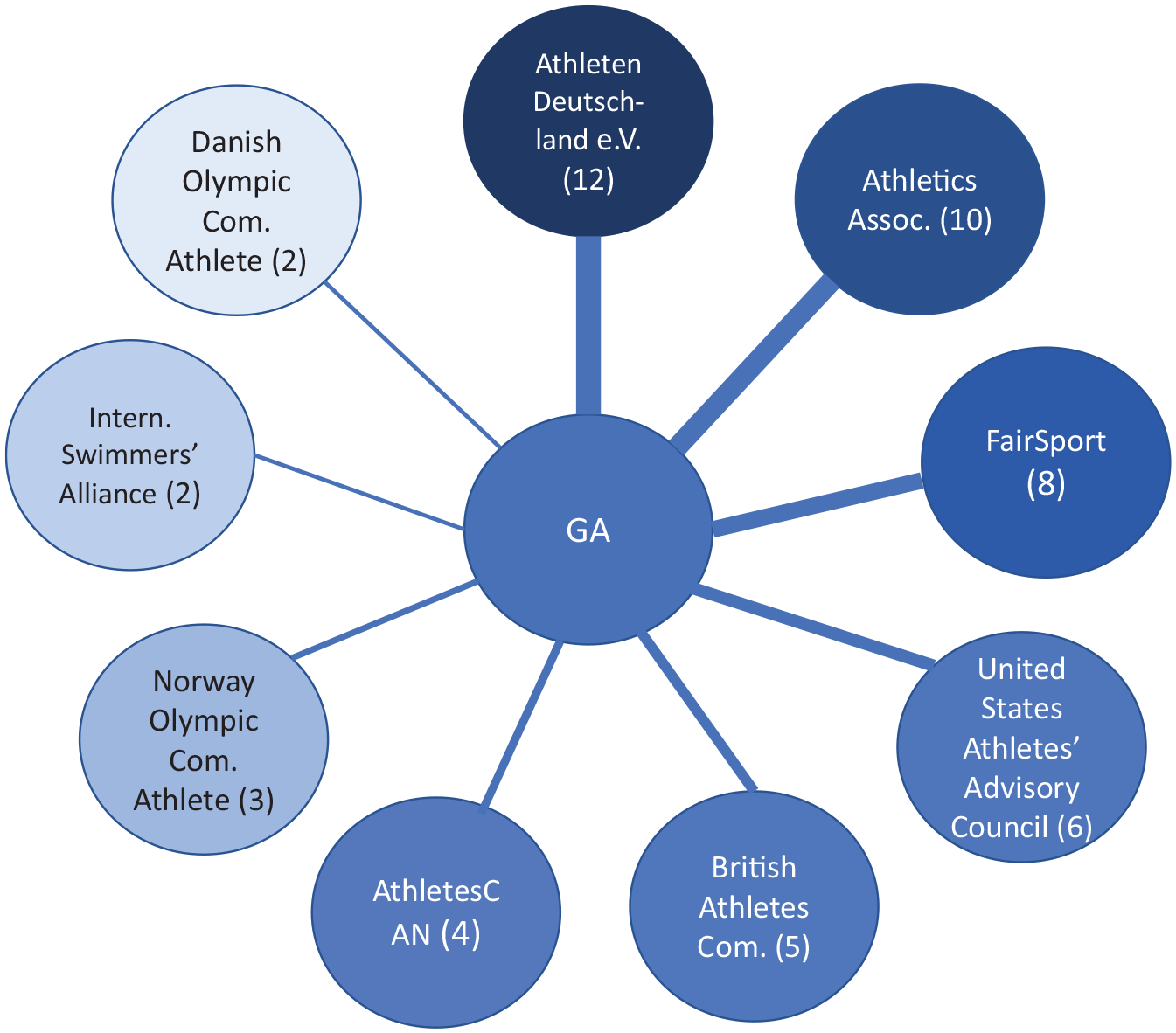
Frequency of mobilisation by GA of networks of organisations composed of athletes (line thickness is proportional to the number of articles which refer to it).
GA anchors its activity in a global movement for the protection of athlete rights and tries to convince its audience that its framing is a reality and is trustworthy: Now we speak collectively to elevate our call for more independence, transparency, and accountability at WADA. And we reaffirm the need to strengthen human rights and eliminate conflicts of interest in the anti-doping system. (11.11.2020)
3
GA also presents itself as leading the development of further organisations formed around athlete advocacy: We remain committed to helping other international athlete groups organise. (08.06.2021)
GA not only claims a seat among the organisations that champion athlete advocacy but also advertises know-how and proficiency in assisting others in becoming champions. Although GA emphasises its ties to the organisations listed in Figure 2, this mise-en-scène says little about the strength of the relationship, their hierarchy, or whether the organisations cited are engaged with GA. For example, the link with Athleten Deutschland e.V. is quoted in 12 articles, whereas the connection with FairSport is quoted in only eight articles. Yet FairSport funds GA. It is a charitable organisation created amid the Russian doping scandal to promote clean sport and support whistleblowers. 4 Thus, ties between GA and FairSport are presumably objectively stronger than those with other organisations.
Capturing the symbolic capital of the athletes
GA communication relies on a ‘frame elaboration’ – in the sense of making some topics ‘more salient’ (Snow et al., 2013, p. 232) – focusing first and foremost on athletes (1811 quotes) as its main concern, and then Olympism/IOC (674), WADA/Doping (549) and Rights (274). GA’s CEO, Rob Koehler, a former WADA deputy director general, leads this framing. He explained that the catalyst for the creation of GA ‘was the controversy around WADA’s September [2018] decision to reinstate the Russian Anti-Doping Agency (RUSADA)’ (Connolly, 2019). RUSADA was suspended in 2015 following allegations of widespread state-sponsored doping.
In this context, GA claimed ‘WE ARE ATHLETE’ [sic] in its initial tweet (see Figure 3) and promised to act as a spokesperson for the athletes in the name of athletes’ rights. GA is an athlete start-up movement aiming to inspire athletes, drive positive change across international sport, change the balance of power between athletes and organisations, and ‘help athletes gain a more represented voice in world sport’. 5
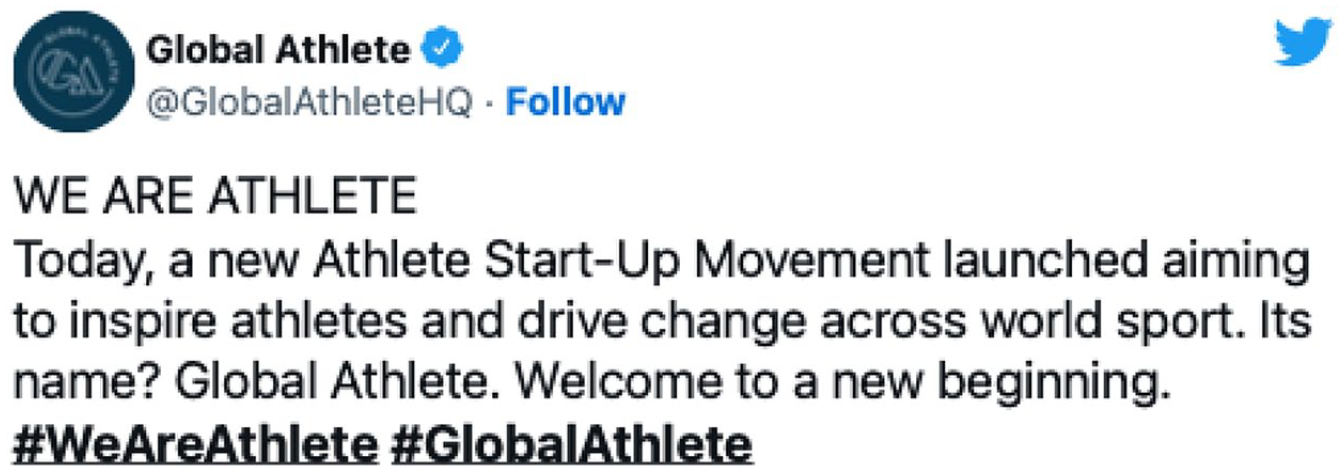
Tweet from Global Athlete (13 February 2019).
Since its foundation, GA has sought to establish itself as the athlete’s voice. Yet, athletes are diverse and often do not have much in common regarding culture, income level, age, social origin or working conditions. Therefore, the ‘voice of the athletes’ does not exist, and GA’s frame elaboration is an artificial construct. ‘Athletes’ is an imagined community (Anderson, 1983) that GA uses to gain symbolic power. The voices of the most valued fraction of the sporting elite are particularly coveted because they constitute a potent symbolic capital (Bourdieu, 1986).
Science as a surveillance device to gain symbolic power
GA assigns itself a ‘surveillance function’ to try to portray the IOC’s and WADA’s activities as ‘a discreditable performance’ (Goffman, 1974, p. 169), relying on the authority of scientific methods. For example, it conducted a survey in 2019 that was designed to showcase a basis of ‘hard data’ for the movement and to consolidate its role as spokesperson. Athletes were invited to answer questions about rights, welfare and representation. The survey was described as ‘part of Global Athlete’s listening exercise’, in contrast to the IOC and WADA, which, according to GA, do not listen to athletes (23.02.2020). GA presents the key outcomes of the survey (491 athletes representing 48 countries, which is a tiny sample size) regarding anti-doping programmes as highlighting athletes’ dissatisfaction with WADA: ‘athletes have lost confidence in WADA’s integrity’ (23.11.2021). However, this claim is not supported by the survey results. The full report shows that 60% of the athletes completely or mostly trust ‘the international anti-doping system’. 6 While giving the appearance of a data-based approach, the survey appears more as a barely concealed score-settling enterprise. This example shows that GA’s quest for recognition relies on a frame where discrediting WADA is central (40 of 88 articles are on anti-doping).
GA uses a similar process to criticise the IOC and particularly condemns Rule 40 of the Olympic Charter (regulating the profits from commercial activities around the OG) for implementing an unfair allocation of profits. Koehler co-produced a ‘study’ that makes a disadvantageous comparison between the Olympic Movement and the US Pro Leagues: ‘The 5 largest professional sports leagues in the world pay between 40-60% of their revenues directly to players. The IOC has spent a mere 4.1% on athletes’ (23.04.2020). The question raised by GA is legitimate; however, the ‘study’ lacks a critical point of analysis of each model’s pros and cons and neglects each model’s cultural embeddedness.
In parallel, GA strongly criticised a survey conducted by the IOC on athletes’ position on Rule 50 of the Olympic Charter which concerns athletes’ freedom of expression. GA reviewed the IOC athlete surveys (3547 Olympians representing 185 countries) conducted in 2020. Before the publication of the results, GA had already sought to discredit the study: ‘we call on the IOC Athletes’ Commission to abandon the Consultation on Athletes’ (28.08.2020). Although the survey was not conducted by the IOC directly but by a private company and checked by the ‘Swiss Centre of Expertise in the Social Sciences’, a foundation specialising in large-scale surveys, GA commissioned its own anonymous ‘reviews’ and asserted that ‘the survey methodologies and subsequent reporting are flawed’ (29.01.2021) (https://forscenter.ch/).
On publication, GA proclaimed that ‘The IOC’s Consultation on Athlete Demon-strations is an inadequate response to the current movement’ (29.01.2021) and sought to tarnish the IOC for, precisely, consulting athletes. Such actions indeed threaten GA’s anchoring as the voice of the athlete and leader in protecting human rights. This manifests particularly when the results contradict GA’s framing strategies: while GA fiercely opposes Rule 50, one of the results of the IOC survey was that athletes support the limitations on the rights to express themselves publicly on political issues on the podium (67%) and at opening ceremonies (70%) (Athlete Expression Consultation, 2021, p. 20). GA’s support of the athlete’s voice thus only seems to extend insofar as those athletes do not jeopardise its frame.
Value amplification: framing athletes as the saviours of governance
Athletes are an ideal resource for ‘value amplification’, which consists of ‘the identification, idealisation, and elevation of one or more values’ (Snow et al., 1986, p. 469). Thus, to gain credit, GA claims to speak on behalf of the athletes, though without demonstrating a delegation of their voices. The ‘Global Athlete Start-Up Group’ of six athletes is used repeatedly and staged as upfront labelling on GA’s website. At the same time, it suggests that (at least these) athletes have agreed to GA speaking on their behalf; however, some of the six seem to receive financial compensation for being in this group (source: member of an anti-doping organisation). GA conveys the impression that the movement grew organically out of the athletes themselves, as in GA’s motto – ‘By the athletes, for the athletes’ – which attempts to merge GA and the athletes. However, in most cases, GA refers to an imagined ‘International Athlete community’ (03.06.2019), a rhetorical figure for a collective category that is both too broad and opaque. The term may include super-rich sports stars as well as anonymous and precarious sportspeople.
With a few exceptions, such as Russian athletes (17.12.2020) or athletes who overlook or ignore misbehaviour (23.02.2020), GA stages the athlete as an idealised figure of change. It relies on a moral discourse saturated with references to human rights: ‘Unanimously, athletes agree that freedom of expression is a right and sports rules cannot supersede basic human rights’ (16.10.2020). Athletes are predominantly presented as ‘victims’ whose – assumed – opinions are overlooked by sports organisations: ‘Once again, the athletes’ voices have been ignored’ (06.12.2020). The idealisation of athletes allows GA to call for increased athlete representation in sports governance – notably in the fight against doping. For example, GA’s claims for ‘An equal say on WADA Foundation Board for independent athletes (1/3, 1/3, 1/3)’ (17.12.2020) are presented as a key element of WADA’s necessity to structurally change.
Belief amplification
‘Sport as a type of dramatic performance’ can serve several political ideologies (Hoberman, 1984, p. 7), and sport can be reframed to make athletes and sports organisations antagonists. Reframing is at the heart of GA’s ‘belief amplification’ (Snow et al., 1986), which is evident in two key respects. First, amplification resides in relying on athletes’ voices to blame WADA and the IOC. GA allows access to its website as a platform for athletes expressing dissatisfaction with sports organisations. For example, GA published an ‘open letter’ from Gwendolyn Berry, an American Olympian hammer thrower. Berry criticises the IOC for prioritising ‘political relationships, profits and their existence over the rights and freedom of athletes’ (08.06.2022). In support of her critique of the drift of the IOC’s proclaimed values (‘Is it Sport or Entertainment?’) and the denial of the athlete’s right to express their political position, she presents two contrasting images: one of a podium with an athlete raising his fist, and a second with the list of the IOC’s sponsors. A GA media article followed up on Berry’s letter a few days later, with a strong critique of Rule 50: Athletes around the globe were awestruck with this statement and demanded change. Once again, athletes have stood together, and their collective voice has pressured the IOC. (14.06.2020)
This example demonstrates how GA selects athlete voices to stage its ‘official’ position as representing the views of all athletes.
Second, the amplification relies on discrediting athlete representatives within the Olympic Movement to gain credit and feed the ‘constructed’ antagonism. Thus, when GA celebrates that ‘athletes stood together’ against Rule 50, this collective voice excludes the many athletes in the IOC survey who expressed themselves in favour of (at least) some limitations enshrined in Rule 50. Individual athletes can thus be part of the imagined community created by GA or be denied entry, depending on whether they fit GA’s narrative.
GA blamed sports organisations for their inability to incorporate the interests of athletes in their policies and observed: World Athletics must not pretend to be an athlete-first organisation while simultaneously cutting events from its flagship series without meaningful athlete engagement. (20.11.2019)
GA also seeks to discredit athlete voices from official athlete commissions of sports organisations, arguing that ‘athlete groups do not have the independence or professional support to rigorously survey their athletes’ (28.08.2020). Ironically, independence no longer seems an issue when athlete groups from Commissions of National Olympic Committees or National Anti-Doping Agencies support GA’s causes, for example, in its ‘call for further reforms for WADA’ (11.11.2020). Further, according to an interviewee from a sport organisation: ‘Rob [GA’s CEO] can take credit for changes when discussions have been going on for a very long time in the athletes’ commissions, and then acts as if these causes were put on the agenda by GA’.
GA’s framing and power struggles within the sports field
GA was unlikely to succeed in producing a discursive and strategic framing that gains power without economic, cultural, political and social resources and support. This second section, therefore, analyses how GA sought to obtain such resources and the actors supporting GA in the ‘fabrication’ of the frame.
The political agenda at the backstage
The analysis of GA's first year of communication shows a mixture of self-congratulation, and prophecy that GA will successfully carry the voice of the athletes to serve them, protect their rights and change sports governance. For example: Dear Athletes, 2019 has been a momentous year for global sports governance and the athlete’s voice, and a time viewed by many as the year when athletes spoke up and were finally heard. It has been a real pleasure for Global Athlete to have listened to you, worked with you, learnt from you and supported your rights. The athletes’ voice is getting stronger; sports leaders are finally starting to pay attention, and change is in the air. (18.12.2019)
Like other ‘fields of symbolic production’ (Bourdieu, 2000, p. 17), sport gained autonomy and value by producing a doxa/ideology of apoliticism (Serazio, 2020) and idealising its intrinsic value. By presenting its commitment as ‘pure’ (Bourdieu, 2000), purportedly non-politicised – unlike the IOC and WADA, which are supposed to be compromised by politics – and anchoring it in the service of the noble cause of athletes’ rights, GA also seeks to increase its power: Athletes want to know why certain human rights are not available on the field of play and are calling out the hypocrisy of being silenced on the grounds of ‘keeping politics out of sport’. (10.06.2020)
GA portrays itself as detached from ‘political politics’ and denounces politics intruding into sport, using various decisions taken by WADA in support. Suggesting that WADA’s independence is compromised, GA stated: These conflicts of interest have undermined WADA’s effectiveness and have been repeatedly exposed over the past several years with these very same conflicted actors rendering anti-doping decisions based on politics, not principle. (23.11.2021)
Like other sports organisations, GA relies on the rhetoric of apoliticism to gain power (Serazio, 2020). An illustration of this strategy can be found in 2019, when Koehler, on behalf of the GA Start-Up Group, called ‘on WADA’s President, Sir Craig Reedie, WADA’s Director General, Olivier Niggli and WADA’s Compliance Committee Chair, Jonathan Taylor, to immediately resign from their positions’ (24.09.2019). Since Koehler himself resigned in August 2018 as a member of WADA’s staff, asking one’s former colleagues to resign could be viewed as carrying a conflict of interest or/and a political agenda.
The pivotal role of FairSport
Jim Swartz and Johann Koss, the co-founders of FairSport, are the most visible people in the organisation that provides full funding for GA. According to an interviewee, Swartz is a wealthy industry leader who finances and offers his networks to GA. He also produced the award-winning documentary film ICARUS investigating doping issues. Koss, a former Olympic speed skating champion, seems to play on his symbolic capital in sport. In 2017 the relationship between FairSport and WADA was still good, and, according to an interviewee, the only political dimension was a crusade against doping in Russia. Koss was invited to the WADA Foundation Board Meeting, described as an ‘old friend of . . . the Olympic Movement’, and he praised WADA’s President and General Secretary. 7 However, FairSport’s position in the anti-doping political arena changed, as can be observed first in the elections for the presidency of WADA and, second, in its support to the Rodchenkov Anti-Doping Act (RADA), two aspects of which are developed below.
Elections for the presidency of WADA
In March 2018, during the WADA symposium, after an intervention by Koehler, Linda Helleland, WADA’s vice-president at that time, used her role to attack WADA head-on: People tell me, and you [the WADA symposium attendance], to sort this mess out, friends of the antidoping community, let there be no doubt, a strong and independent WADA is the key [applause] we should put pressure on sports organisations to make them understand that process like this [lack of transparency in anti-doping decisions] diminishes the credibility of the entire anti-doping . . . it is time for a new road-map, a roadmap of trust . . . A roadmap of trust must be based on our common values and athletes voices as ours. (Field notes)
When Helleland formally announced her candidacy for WADA presidency, FairSport’s founders endorsed her as: ‘the one and only candidate that is in-tune with athlete and public opinion on anti-doping’ (IG 03.01.2019). Significantly, Helleland’s official bid (January 2019), the creation of GA (GA’s first article was published in February 2019) and the strong support of FairSport all occurred in the same period. There was also a convergence of discourses. Helleland ran her campaign criticising WADA and the IOC for their ‘gross mishandling of the Russian doping crisis’ and for ‘the increased suppression of athletes’ rights’ (IG 03.01.2019), which echoes the main arguments of GA. Since FairSport is a major founder of GA, its endorsement of Helleland is key to understanding the power stakes surrounding GA’s framing. The coincidence between the election, the creation of GA and a similar rhetoric 8 are all signs of a shared political agenda.
Robust backing to the Rodchenkov Anti-Doping Act
FairSport and GA gave strong support to RADA, signed into US law in 2020, which gives US authorities the power to prosecute individuals (other than athletes) for doping schemes designed to influence international sports competitions. While RADA was criticised by WADA and the Olympic Movement, GA ‘supported and advocated the RADA’ (18.12.2019) and ‘championed’ its successful passing (16.12.2021). Similarly, Swartz, like Helleland, ‘praised the introduction of the Rodchenkov Act’ (IG 22.12.2018). FairSport shares the ‘clean sport’ doxa and displays WADA as among the four organisations it works with ‘in the pursuit of clean sport’. 9
The US Office of National Drug Control Policy (ONDCP) also strongly supported the RADA. ONDCP officials threatened to withdraw funding to WADA by the US, its largest governmental funder, if it did not engage in meaningful reforms, particularly with ‘US Government and athlete representation within WADA’. 10 Travis Tygart, the head of the US Anti-Doping Agency (USADA), shared that position and called the RADA ‘game-changing’ (IG 22.12.2018) and supported ONDCP’s demand ‘for athletes to be given a voice’. 11 It thus came as no surprise that GA congratulated the US Senate for implementing the Act (04.12.2020).
GA claimed that the RADA was adopted with ‘the support and backing of athletes’ (16.12.2020). There were political issues behind this law that gives the US unilateral extraterritorial leverage in a global anti-doping system which had precisely been built to limit power inequalities between countries. It hypocritically spares the US Pro Leagues that have not signed on to the World Anti-Doping Code (Abrahamson, 2020) because, according to a member of an anti-doping organisation (2022): ‘the initial draft of the law was applying to the Pro Leagues and this was taken out to secure support at the congress level’. While GA uses US Professional Leagues as role models (e.g. 23.04.2020), GA’s ‘frame consistency’ (Benford & Snow, 2000, p. 619) could be questioned here: GA’s criticism of the IOC’s and WADA’s lack of anti-doping orthodoxy is at odds with its support of a US Pro League model that can be described as heterodox due to its greater tolerance on the use of substances. In addition, for an interviewee working for an anti-doping organisation, ‘choosing to name this law Rodchenkov, the individual who organised the biggest fraud ever in doping, is an insult to the people in anti-doping’.
The ‘fabrication’ of a frame within a political agenda
There are converging indications suggesting that GA’s advocacy relies on an exploitative type of ‘fabrication’ organised for the benefit of the fabricator (Goffman, 1974). In this interpretation, GA produces ‘a false belief about what it is that is going on’ (Goffman, 1974, p. 83), and what is being fabricated is ‘the possibility of that activity itself’ (Goffman, 1974, p. 197), which aims to serve a political agenda. The idiosyncrasy of GA, however, lies in its lack of transparency and questionable consistency, which preclude any verification by an external observer as to the trustworthiness of the frame.
An opaque non-global organisation
GA proclaims itself the unquestionable spokesperson for athletes, but releases no data about its membership nor the number and profiles of athletes who have taken the step to ‘Join the Movement’ on its website. The only indication of the number of athletes ‘represented’ by GA came incidentally when Koehler was invited as a witness before a Committee of the Canadian House of Commons (16.02.2023), 12 stating that ‘we don’t represent, we advocate for . . . more than 600 athletes’, which is comparable to a medium-sized local club. GA proclaims to represent all the athletes but is not inclusive and, in fact, is exclusively led by individuals from Australia (1), Canada (1), the UK (3) and US (1), 13 with no representative athletes from the ‘global south’.
Furthermore, despite claiming to prioritise athlete voices, GA’s frontstage is predominantly occupied by Koehler, who does not have a background as a former athlete according to an interviewee. This undermines GA’s frame consistency, as it fails to adhere to the principles it advocates in terms of giving athletes a central role. Koehler has run GA since its creation and is presented by GA as ‘a trusted leader and an experienced advocate’. 14 However, there is no supporting evidence of advocacy experience, which is at odds with the long social process that typically underpins becoming an activist in politics (Fillieule & Neveu, 2019) and sports (Lee & Cunningham, 2019).
Finally, the conditions for joining ‘the movement’ are opaque. When clicking on the ‘Join the Movement’ icon on GA’s website, a contact form appears with further rhetorical jargon but no terms of use or specification of who is meant to join as an ‘athlete’ versus a ‘non-athlete’. ‘Joining the Movement’ looks more like a subscription to a newsletter than an actual participation in an organisation.
We sent five messages to GA (see Figure 4 for the first message) to gather information about the athletes on behalf of whom GA speaks and to get information about GA’s terms of reference (how to become a member, statutes, budget, etc.). These messages went unanswered, which seems paradoxical for an organisation that professes to lead a listening exercise and calls out sports organisations for their lack of transparency (21 of 88 items).
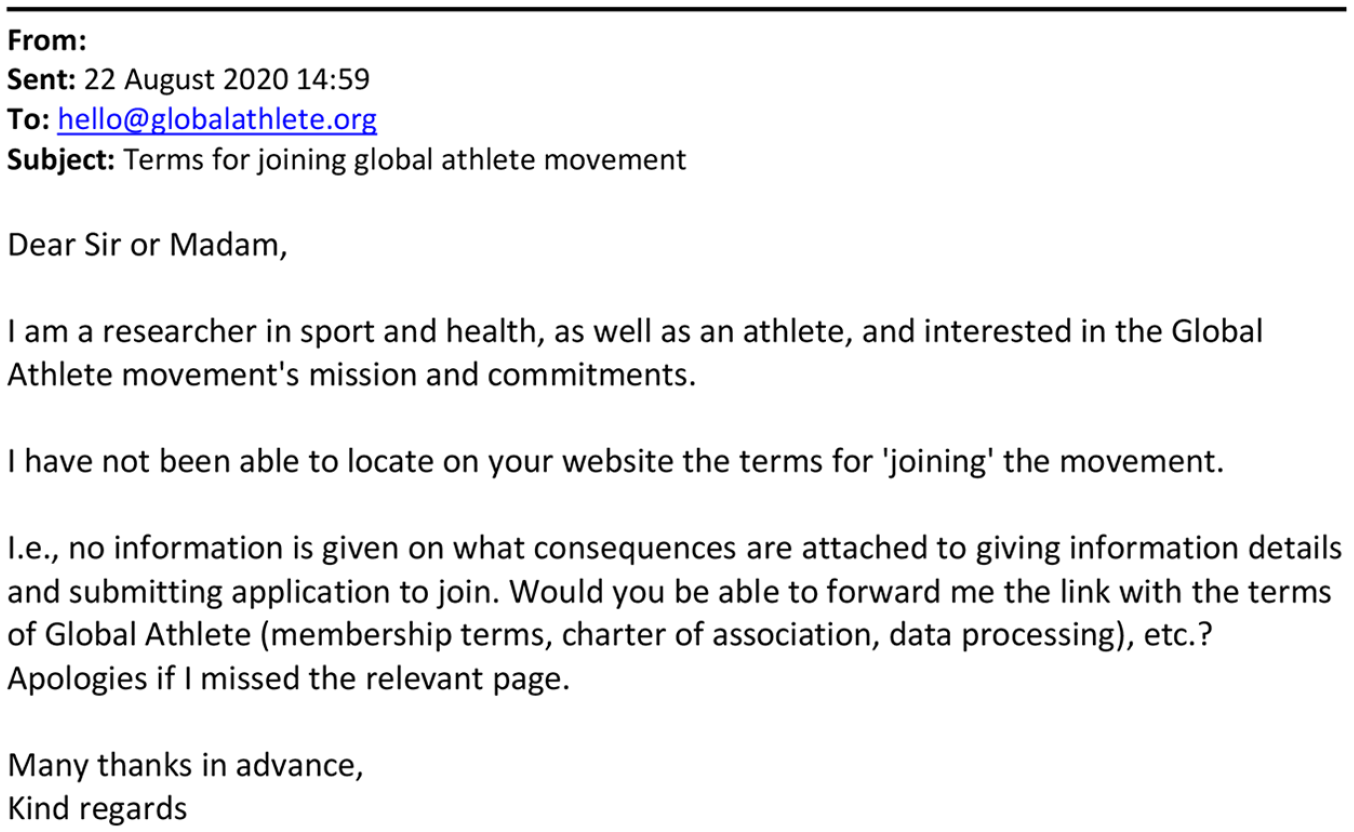
Our first request for information to GA.
We can thus only assess the true representativeness of GA or verify adherence to its commitments through its own public relations messages. This lack of transparency cannot be interpreted (only) as mistrust in the face of our enquiries: unlike some GA partners, like Athleten Deutschland e.V., 15 GA provides minimal information on its website. It publishes neither its form of organisation nor its governance structure nor its statutes and by-laws. Athletes are asked to join a movement on entirely unknown terms and conditions, in total contradiction to the ‘good governance standards’ GA advocates for.
GA’s weak consistency
GA frames itself as an organisation that speaks out for noble causes on behalf of athletes. This ‘fabricated framework’ is used to give legitimacy to the criticism of the IOC and WADA because they are deviating from orthodoxy on ‘clean sport’ ethics or athlete rights (GA refers to clean athlete/sport in 17 articles of 88). This can mainly be seen in its protest on economic aspects, and particularly on US funding of the Olympic movement: Who pays the bill for the world Olympic movement? . . . ‘Make no mistake about it. Starting in 1988, U.S. corporations have paid 60 percent of all the money, period’ (U.S. Olympic Committee chairman Ueberroth, quoted). (08.06.2020)
This critique of the economics of the Olympic Movement has concomitant cultural and geopolitical dimensions. References to the culture of US Pro Leagues are recurrent and go hand-in-hand with US Government criticism about a perceived under-representation of US actors, especially in WADA, 16 from a country whose TV channels and sponsors are very active in funding the IOC.
The balance of ‘power between sports leaders/administrators and athletes’ is mentioned almost systematically in the presentation of GA’s mission. Fourteen articles are devoted to this subject; here is an excerpt as an example: New Athlete-led Movement (GA) . . . to balance the power between athletes and sports administrators. (13.02.2021)
GA’s appropriation of the voice of athletes serves as part of the power struggle within the sports field and was felt to threaten the position of the IOC as the legitimate representative of the athletes (see Figure 5 for a tweet by the Athletes’ Commission trying to discredit this new emerging actor).
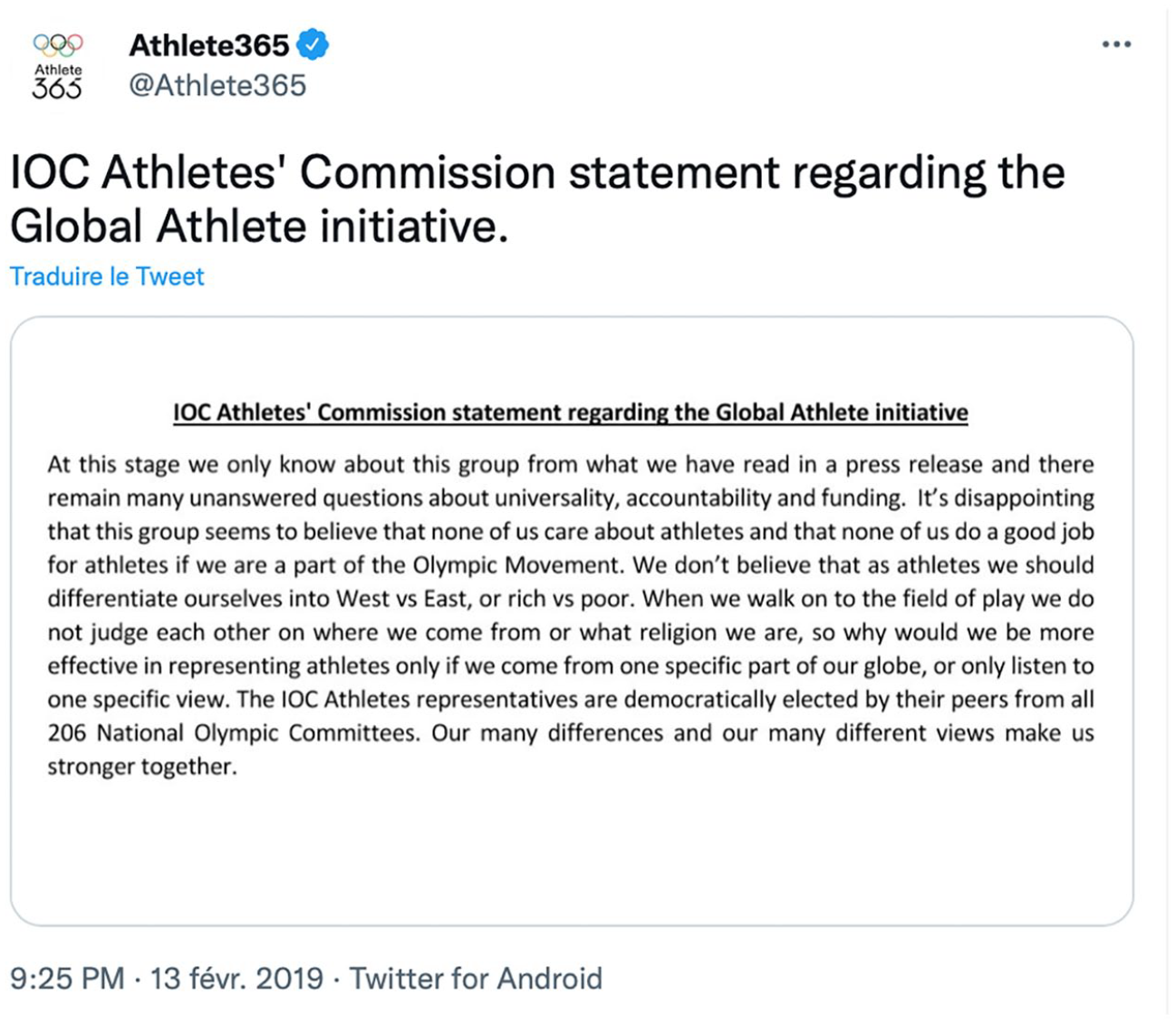
Athletes’ Commission’s tweet on the launch of GA.
In sum, how GA frames itself as the champion of human rights, displays its networks, criticises some organisations while praising others, and appropriates athletes’ symbolic capital, reveals GA’s strategy intended to challenge the power of ‘traditional’ sports organisations. GA aims to disrupt the ‘hierarchy of credibility’ (Becker, 1967) and become the legitimate voice in defining problems. However, due to an absence of significant mobilisation of athletes in favour of GA, a lack of transparency and a weak consistency – which requires congruence between ‘beliefs, claims, and actions’ (Benford & Snow, 2000, p. 620) – GA risks undermining its credibility as ‘the frame articulators’ (Benford & Snow, 2000, p. 619). Consequently, we argue that a ‘fabrication’ of a frame best captures GA’s position. By framing its engagement as an advocate and concealing its relations of power, GA ennobles its own commitment through one of those political manoeuvres common in sport. It is an example of the ‘politics of group-making’ grounded in a ‘socio-symbolic alchemy whereby a mental construct . . . is turned into a concrete social reality acquiring existential veracity’ (Wacquant, 2013, p. 275).
Conclusion
Three key points emerge from our study of GA’s athlete advocacy campaigns: the importance of analysing how framing allows the meaning(s) of a situation to be anchored in values to conceal power relations; the relevance of articulating frame analysis with Bourdieu’s field analysis; and the need for sociologists to reflect on their involvement in supporting such causes and for greater detachment in analysing the social impact of such advocacy groups.
It would be naïve to believe that GA’s critique of sports organisations serves the sole objective of protecting athlete rights. While GA frames itself as a social athlete movement, it resembles more a mobilisation of an imagined athlete community to enhance its frame consistency. The ‘strategic dramaturgy’ (McAdam, 1996, p. 385), frequently observed in social movements, is a key resource GA uses to position itself as a vocal organisation in the sports field. GA considers, without argumentation, that reinforcing the presence of athletes would improve governance in sports organisations. Despite the lack of argument behind this ‘frame amplification’, the protection of athlete rights underpinning the claims resonates with ‘universal’ values. It gives GA ‘empirical credibility’ (Benford & Snow, 2000, p. 619). GA still retains some external credibility among journalists and activists. The international activists’ community does not view GA’s action as a fabrication of a frame; its reputation was good until doubts arose, which seem to be in relation to the increasing importance given by GA to the issue of protecting athletes from abuse (activist interview). Koehler’s testimony at the Canadian House of Commons on issues related to sports integrity (21.11.2022 & 16.02.2023) 17 also shows that GA has gained symbolic power within the political field. However, GA’s inconsistencies have impaired its ‘empirical credibility’ over time: ‘its credibility has weakened in the international sports community’ and GA is considered ‘a deception’ (international sports actor).
Nevertheless, it is necessary to broaden the focus to understand this strategic framing. The appropriation of athletes’ voices in a political representation is not specific to this case because ‘appropriation is inscribed in this act of delegation’ and in ‘most acts of delegation, the constituents present a blank cheque to their delegate’ (Bourdieu, 1985, p. 58). The amplification here is compounded by the fact that the ‘constituents’ – being an imagined community – do not really exist, except in GA’s framing. GA uses its framing to take advantage of the symbolic value of athletes. There is no doubt that strategic framing plays a central role, but the battle being waged is also a power struggle within the sports field, with geopolitical stakes in the background. GA has rapidly ascended to its current position as an advocate because it can count on funding from FairSport, and the political convergence with organisations like USADA.
As academics, we may benefit symbolically from positioning ourselves as advocates for noble causes such as protecting athletes. In addition, our values may lead us to look positively at any organisation committed to defending human rights and balancing power between athletes and sports organisations. Despite – or, one could say, because of – these affinities, we took a critical stance to avoid complacency based on the values displayed. Although there is a risk of choosing sides (Hammersley, 2001), this article is not about ‘ranking’ organisations or tarnishing advocacy in sport. Instead, our position seeks to debunk simplistic views of actors in the sporting field as ‘good’ versus ‘bad’. The role of athlete and human rights advocacy is too important to be an empty shell, diverted to serve other personal or political interests. The analysis of sports culture deserves nuanced approaches that avoid the caricature of blameless athletes as victims of greedy organisations.
Footnotes
Acknowledgements
We would like to thank the reviewers and the editor, Amy Chandler, for the relevance of their critiques, to J. Maguire for his contribution to the English editing, and our colleague O. Fillieule for his valuable comments on an earlier version of this article.
Funding
The authors received no financial support for the research, authorship, and/or publication of this article.