




Abstract
This article reports on a study investigating the struggle for influence in an Indigenous community. With an eye on the potential further subordination on certain subgroups, we studied how Sámi sports club officials outside Sámi core areas perceive their relationship with clubs in core Sámi areas and the federative Sámi sports organization. Methodologically, we performed interviews with representatives of Indigenous sports clubs and employed Bourdieu's concept of symbolic power as a theoretical framework. The results show how Sámi sports club officials outside core areas consider their peers within core Sámi areas as superior and that this relationship is engrained and taken for granted. The perceived superiority is based on the judgment of sports club officials outside the core Sámi areas, showing how the elite is defined as much by its subordinates as by the elite itself, to use Bourdieu's conceptualization of symbolic power. In conclusion, these results show how the struggle for influence in an Indigenous community can create further subordination of subgroups in a group that is already subordinated in society.
Introduction
In all societies, groups struggle for influence. As essential assets in most power dynamics, individuals and groups act in manners conducive to accessing more influence, and since influence is a relative phenomenon, such actions decrease the influence of other individuals or groups (Peters, 2019; Shively and Schultz, 2022). As a result, some groups gain superiority while others become subordinate. In such cases, internal group power struggles are bound to arise in which these processes tend to exacerbate further subordination. From sports sociological research, we are familiar with how homosexual, bisexual, and transgender women become subordinated relative to their heterosexual counterparts (Giulianotti, 2011; Schubert, 2008) and how Aboriginal women become “double marginalized” as both female and Indigenous. From the broader social science literature (Bourdieu, 1991; Peters, 2019; Shively and Schultz, 2022), we know that as the influence of a larger social group is divided among several subgroups, it tends to be hollowed out as the capacity to speak with one voice decreases.
While ethnicity and sports studies used to be dominated by Afro-hyphenated perspectives due to an American focus on “race” (Carrington, 2012; Hylton and Lawrence, 2016; Yep, 2012), Indigenous sports research indicates an ambiguous understanding of sport's constraining and liberating functions. Sport can work in suppressing ways for Indigenous people, for example, as an integrated part of boarding schools that aim at assimilating Indigenous youth into the colonizer's culture. However, sport can also be emancipating and be conceived of as the only arena where Indigenous athletes can beat a majority (Forsyth et al., 2023; Hokowhitu, 2023; Rice, 2023). Moreover, Hapeta et al. (2019) propose that Indigenous research paradigms should be axiologically directed toward working with and for the scrutinized group. While the cited works apparently relate to Indigenous people as one entity and the dominant colonizer as another, the concepts of subjugation versus emancipation consequently relate to the (one) minority relationship to the majority.
However, Gaudet (2014) underscores that there is “no single Indigenous epistemology, as each person and/or community expresses knowledge uniquely based on stories, personal experiences, and ways of knowing and being” (p. 74). As there are differences between Sámi communities across state borders (Berg-Nordlie, 2015), there are variations across Sámi areas within Norway (Anderson et al., 2014). In this article, we are interested in how the struggle for influence among the Sámi people creates the further subordination of subgroups in a group that is already subordinated in broader redistributive politics. By exemplifying the Sámi, an Indigenous people of the North Calotte—northern regions of Norway, Sweden, Finland, and the Kola Peninsula in Northwest Russia (Young and Bjerregaard, 2019)—we show how different groups of the same Indigenous peoples are colonized and assimilated in different ways. 1
Access to and influence over voluntary organized and membership-based club sports is conditioned by socioeconomic circumstances, age, gender, physical and intellectual capacities, sexual orientation, and religious beliefs, and more specifically, by aspects such as ethnicity, nationality, and cultural origin (Coakley and Dunning, 2000; Wenner, 2022). In the case of Indigenous groups’ access to and influence over so-called mainstream sports have been and continue to be restricted by redistributive politics, funding criteria, and political coalitions (Fahlen and Skille, 2017). Empirically, this article is drawn from a larger study on Sámi sport (Skille, 2022). Specifically, this article builds on data from Sámi sports clubs in previously assimilated—now revitalized—Sámi areas. Focusing on their relationship with other parts of Sámi sports, we pose the following research question: How do Sámi sports club officials in revitalized areas perceive their relationship with clubs in core Sámi areas and toward the Sámi sports organization (SVL 2 )?
When seeking answers to this relatively simple question about current sports, we explore overarching historical, societal, ethical, and cultural issues. Consequently, we also touch upon the politics of the pressing issue of “Who are Sámi?” The empirical investigations reveal how the assimilation policy of a nation-state reinforces a hierarchy across groups among one Indigenous people. Thus, while this cultural colonization of the Sámi people led to an intra-Indigenous stratification, we theoretically draw on Bourdieu's (1991) concept of symbolic power (see also Sullivan et al., 2019) to highlight how the subordinated contribute to reproduce their (lower) position (Bourdieu, 1991). While Indigenous groups’ access to and influence over Indigenous sports have been restricted by broader assimilative politics and the suppression of ethno-cultural expressions (Forsyth et al., 2023; see also Gilroy, 2008; Go, 2013; Young, 2003), the contribution of this article lies in its ambition to illustrate how some innate properties of sports (e.g., being selected for a national team) have the capacity to exacerbate broader patterns of subordination, suppression, colonization, and subjugation of Indigenous people.
The article further shows how the politics surrounding the public's recognition of and support for Indigenous groups contribute to the fractionation of an already subordinate group, resulting in both internal animosity and weakening of Indigenous self-determination. In so doing, we empirically demonstrate the arguments put forward by Schubert (2008), that symbolic domination “is everywhere in that we all live in symbolic systems that, in the process of classifying and categorizing, impose hierarchies” (192), and Giulianotti (2011), that “sport has served to intensify and dramatize some ethno-political enmities” (207). Considering real experiences, we investigate how historical Norwegianization impacts on Sámi sports clubs today, including the relations among clubs across Sámi areas, toward SVL and the nation of Sápmi (the land of the Sámi).
Thereby, we challenge the understanding of ethnicity as “a sense of group belonging, based on ideas of common origins, history, culture, language, experience and values” (Brown and Langer, 2010: 412) by pinpointing that a Sámi individual both is a Sámi and belongs to a specific Sámi subgroup. Since the state of Norway aimed to incorporate the Sámi people and other minorities into a culturally united Norwegian nation, the Norwegianization policy served to define and delimit social groups in Norwegian society and into “in- and out-groups” of the Indigenous people themselves. We continue by providing some more context about the Sámi people and (Sámi) sports in Norway. We then present the theoretical lenses through which we analyze and discuss the results, namely, Bourdieu's theory on symbolic power.
Context
Predecessors of Sámis, Norwegians (and others) cohabited in northern parts of Scandinavia from the last ice age, some 10,000 years ago. Sámi ethnicity is estimated to date back about 2000–3000 years (Hansen and Olsen, 2004). Thus, the Sámi people were never colonized in the same vein as many other Indigenous peoples, whose lands were expropriated by nation states, such as the Māori people of Aotearoa/New Zealand (Anderson et al., 2014) and the First Nations in North America (Paul, 2022). Nevertheless, there was cultural colonization—in the form of a harsh assimilation policy—implemented by new nation-states because the Sámi had lived on the land long before state borders were drawn (Broderstad, 2011; Nordø et al., 2015). Focusing on the Norwegian side of Sápmi (the land of the Sámi), in 1814, Norway promulgated its own constitution, and in 1905, it detached from Sweden. During the 19th and 20th centuries, the Norwegian nation aimed to create a united identity (Olstad, 2017).
It should be emphasized that the North Calotte was, and is, diverse regarding ethnicity and culture. The Sámi population—across the four countries—has participated in sports alongside other peoples and ethnic groups, since the organizing of sport in the late 1800s (Pedersen, 2011; 2013; Pedersen and Rafoss, 1989). The communities where the first sports clubs were established in the 1880s, were—and are—ethnically and culturally diverse; populations are made up of Sámis, Norwegians, and Kvens (immigrants from today's Finland mainly during the 19th and early 20th centuries; Anderson et al., 2014; Pedersen, 2013). Also, many self-identify with several ethnicities. This complex ethnic composition of Sápmi characterizes peoples’ everyday lives today. Against this backdrop, emphasizing ethnic diversity, we further focus on the Sámi community—or rather Sámi communities—in Norway.
From the 1960s, growing concerns over Sámi heritage led to a series of revitalizing processes (Hovland, 1996; Stordahl, 1996), which have resulted in different types of Sámi self-identification within different areas (Nystad et al., 2017). Especially along the North Norwegian coastline, where the assimilation process was strongest, the revitalization process has been particularly manifest. In inland Sápmi and the northernmost county, Finnmark, cultural features, especially the Sámi language, were more immune to Norwegian influence and have had more direct continuation (Larsen et al., 2016; Semb, 2012). 3 Today, Sámi individuals are integrated into Norwegian society (Hämäläinen et al., 2018), and sports play an overwhelming part for both Sámi and Norwegian youth (Rafoss and Hines, 2016). Both Norwegians and Sámis participate in sports clubs of the Norwegian Confederation of Sports (NIF), which federates 55 national sports associations (football, skiing, etc.) and counts almost two million individual memberships. Hence, the NIF enjoys virtually a monopoly over subsidies from the state (Ministry of Culture, 2019; NIF, 2019; Skille and Säfvenbom, 2011).
In comparison, SVL organizes sports disciplines that are both universal (skiing, football) and Sámi-specific (reindeer racing, lassoing). 4 In 2018, 23 clubs were members of SVL, with a total of 3785 individual members (SVL, 2018). 5 Close to all Sámi sports clubs are members of both SVL and NIF (Skille, 2012), just like Sámi individuals in Norway have “dual political membership” of both the Norwegian electoral system and the Sámi system (Semb, 2012; see also Bjørklund, 2016; Nystad et al., 2017). SVL receives state sports subsidies (Ministry of Culture, 2018), distributed via the Sámi Parliament (Sametinget, 2015). Although small in scale, Sámi sports exist across Sápmi, and they provide an opportunity to shed light on symbolic power between groups. While we acknowledge the importance of discussing sports and ethnicity within big politics and global trends (Coalter, 2007; Giulianotti, 2011; Hartmann, 2012; Spaaij, 2012), it is important to study local everyday life.
Hence, we study Sámi issues by investigating voluntary grassroots sports clubs in local communities (Skille, 2022) and follow Hartmann's (2012) observation that “sport scholars have assumed the broad racial significance of sport and that sophisticated, systematic analyses of this form will speak for themselves” (1009, original italics). Consequently, we must go beyond the sporting boundary “to establish the particular roles of sport as a racial force in the contemporary world” (Carrington, 2012: 968; cf. Hartmann, 2012: 1009). The “self-reported Sámi ethnicity,” that is, “the respondent's self-identification as Sámi,” seems “to have remained generally stable” (Pettersen and Brustad, 2015: 2071), which might reinforce a dichotomized relationship between Sámi and Norwegians “expressing the Sámi as different from Norwegian culture” (Larsen et al., 2016: 832). In that respect, it should again be underscored that the understanding—including self-understanding—of ethnicity is complex and diverse.
Semb (2012) referred to “the Sámi population” (1655) as if it were a single entity (see also 1655, 1658, 1661, 1663). At the same time, she criticized “that cultural variation is discontinuous, and that Sámi-ness is a matter of either/or,” while the real empirical world is much more complex (Semb, 2012: 1633). Hämäläinen et al. (2018) nuanced the perspective of Sámi as one (uniform) people and questioned the phrase “the Sámi living in Norway.” They underscored that the Sámi people have been built up by individuals and “consist of different groups like the South Sámi, Lule Sámi, North Sámi and Skolt Sámi. The division is based on linguistic and geographical differences” (2; see also Junka-Aikio, 2019; Sarivaara, 2012). Nystad et al. (2017) differentiated between assimilated and majority Sámi places, which is a distinction we follow and that prepares the ground for our theoretical choice.
Theory
Bourdieu's theory of symbolic power holds that social reality must be analyzed and understood through “a relational mode of thinking” (Bourdieu, 1991: 126). Bourdieu (1991) combined Durkheim's idea of social facts as objective facts with the phenomenological idea of Schütz that the perceptions and experiences of focal actors must be considered in empirical research. Symbolic power refers to socially real relationships and “the power to make groups” (Bourdieu, 1991: 138). Symbolic power “is the power to make things with words” and “has to be based on the possession of symbolic capital” (Bourdieu, 1991: 139). To operationalize symbolic power, Bourdieu often applied symbolic capital, that is, “the form that the various species of capital assume when they are perceived and recognized as legitimate” (Bourdieu, 1991: 127). Consequently, there are corresponding patterns between positions in social space and (sports) participation, which must be treated with caution because relational positions are negotiated, and sports provide one symbolic tool for doing so (Forsyth et al., 2023).
Taken together, the familiar world seems to be “taken for granted” and perceived as natural. This is because the dispositions of agents, namely their habitus (i.e., the mental structures through which they apprehend the social world), are essentially the product of that world of the internationalization of the structures of the world (Bourdieu, 1991: 130). Bourdieu's theory assists in examining the complex dynamics of power and the interplay between the various historical actors between the state and the Sámi and, later, between different groups among the Sámi. Bourdieu's notion of power is to merge a physical element of violence that is exercised through the state apparatus of political society and symbolic violence realized through the ideological apparatus of civil society (Sullivan et al., 2019). Symbolic power is a concept that can play a role in legitimizing hierarchies; it does so by establishing standards to measure identity and position, hereunder a position based on ethnicity (Swartz, 2013).
In other words, the essence of symbolic power is the concept's capacity to devote or disclose particular social groups. The possibility to demarcate groups constitutes an exhibition of symbolic power, creating a hierarchy and hereunder the superiority to one group via the widespread recognition and consequent acceptance of the ruling elite—also among the subordinated (Bourdieu, 1991). We are still in the aftermath of an “intense period of acculturation was from 1851 to 1959,” when “Norwegianization’ was a leading ideology based on social Darwinist ideas of Norwegian superiority and the importance of nation-building with monocultural norms” (Hämäläinen et al., 2018: 2). Bourdieu (1991) supports us in the analyses of how processes used, and current statuses differ across groups of Sámi people (Nystad et al., 2017). Especially outside core Sámi, empirically focused on in this article, the point is that “the revitalizing process is by no means concluded” (Hämäläinen et al., 2018: 2). 6
Materials and methods
The data reported here are drawn from a larger study of Sámi sports (Skille, 2022). For this article, we combined interviews and document analysis to study Sámi sports clubs. The sampling of sports clubs was purposive, with the aim to generate as much relevant information as possible from key organizations and individuals (Bryman, 2001: 458; Miles and Huberman, 1994: 27). Interviewees were chairpersons, deputies, and members of sport club boards. From a total of 10 interviews across five sports clubs, we focused on four interviews from one Sámi club in a revitalized Sámi area, referred to as the “focal club” (and member of both SVL and NIF). The sports club is located along the coast, outside Finnmark. Like many other Sámi sports clubs, it provides “global” activities such as cross-country skiing and lassoing as a specific Sámi sports discipline. Former research had identified this particular sports club to be apt for the purpose, due to its active involvement in SVL events and having many contact points with other Sámi sport clubs and the Sámi sport organization (Skille, 2019; Skille & Fahlén, 2020). 7
The interviews were part of an overarching project, based on a relatively comprehensive interview guide that consisted of four main topics: (i) interviewee's background and position in the club, (ii) sport club's activities, organization, and affiliation, and policy (influence from SVL, NIF, the Sámi parliament, the Norwegian state), (iii) Sámi as Indigenous people, (iv) sport as identity and Sápmi as a sport nation. This article draws particularly on findings from sections (ii) and (iv) and questions as per example: “to which organizations are your sport club affiliated?”; “do we need a Sámi sport organization?”; and “which roles does sport play in society?” including probes specifying “the local community,” “the Sámi society” 8 and “the Sámi nation.” The interviews were conducted in Norwegian language 9 and lasted 50–75 min. They were recorded and transcribed verbatim before subjected to a five-step phenomenological analysis (Giorgi, 2012; Giorgi and Giorgi, 2008).
In Step 1, the first author familiarized himself with the data through readings of each interview, taking notes on immediate reflections. In Step 2, he identified meaning units based on the texts of all 10 interviews. In the transition from the first to the second step, the first author separated data from revitalized Sámi areas by focusing on a few cases, and in Step 3, he transformed the words of the sports club officials into applicable expressions to create a draft text (for the overall project). At this point, a narrative for this article emerged from the data (the local and regional levels; see the Results and Discussion section), and the decision was made to both supplement the narrative with other data and bring in co-authors. In Step 4, the authors discussed the analysis and identified the main message expressed by the sports club's representatives, and selected quotations to be included in this text.
As an additional part of Step 4, we conducted a media analysis (Hawzen and Newman, 2017) by applying the media search engine Retriever and collected coverage from all Norwegian newspapers containing the phrase “Sámi and sport.” This resulted in a 143-page document containing 81 unique newspaper articles, of which 67 were considered relevant. The reading resulted in a coding that overlapped with topics from the interview material (Miles and Huberman, 1994) and followed a structural hermeneutic methodology, where text was organized to shape a narrative (Alexander and Smith, 2001). With the narrative structure mapped, we added media data to supplement the interview data; especially regarding the national level of analysis where the interviewees were more limited in their expressions. At this point of the analysis, the structure of the results section was in place. However, “terms not found in the transformed meaning-units are required to describe” the phenomenon (Giorgi and Giorgi, 2003: 253).
Therefore, we needed theoretical concepts that could aid analytically in the empirical observations of the narrative. Thus, Step 5 included the introduction of symbolic power theory (Bourdieu, 1991). The choice of symbolic power rests mainly on our empirical observations of how interviewees from revitalized areas subordinated themselves in the intra-Indigenous sport organizational hierarchy of Sámi sport in Norway. The use of theory was thus for interpretive and expressive purposes—resulting in a merged Results and Discussion section. It should be pointed out that this article only presents empirical evidence touching upon the Norwegian side of Sápmi (which crosses four countries), and we make a few remarks on that point in the conclusion.
Results and discussion
The experience of the focal sports club officials’ regarding other Sámi sports clubs and with the SVL is played out through multiple relationships. Acknowledging that a written text never fully reflects a complex reality, we structure the presentation through three layers: local, regional, and national. It should be noted though, that these distinctions are made mainly for purposes of structure and readability. In reality, experiences are more intertwined and less structured. The local layer refers to the village community in which the focal sports club is located, while the regional refers to Sápmi within Norway.
During the establishment process, the founding leaders of the sports club experienced local resistance due to an ethno-political element in the club. It was deliberately exposed as a Sámi sports club, operationalized by its membership in the SVL. Local skepticism has since declined, and today, the sports club is relatively well accepted, and even appreciated by some. On the regional level, the narrative revealed how the club officials experience relationships with peers in core Sámi areas and with the umbrella organization, SVL. Although the local and regional relationships have improved, the sports club officials still experience subordination, compared to the Sámi sports clubs in core areas. This point is most evident when the discussion of Indigeneity kicks in; thus, we present a separate section on the national level before we discuss the levels together.
Local
The focal sports club was established during the peak period of new Sámi organizations. Although we want to be cautious regarding ethnic diversity in the local community and individuals’ multi-ethnic self-understanding; the focal sports club is located in a village that used to be Sámi and was then assimilated (e.g., losing the Sámi language) before a revitalization process came to dominate policy and local initiatives. Today, the sports club is located in “a place with a strong Sámi identity” (Interviewee # 2), and since its establishment, the municipality has taken on a formal Sámi identity. 10 The policy of the sports club is “to promote the Sámi, this is deliberate because we participate at SVL events. … We organize lasso competitions and other competitions to be a part of the SVL” (Interviewee # 2). Before the sports club was formed, Sámi sports had been organized by another Sámi association (not primarily sports) with outspoken Sámi political objectives; hence, the relationship between Sámi sports and Sámi politics was conceived of as strong by many local inhabitants.
Thus, the affiliation with the SVL, combined with the ethno-political formulations in the bylaws, created tensions. Local inhabitants had different opinions on the promotion of the Sámi identity through sports, and some considered it to be unwanted ethnic activism. A sports club leader referred to a nearby village, saying: “nobody liked to be identified as Sámi, but they were Sámi!” (Interviewee # 1). 11 The most resistant individuals were “parents who never really wanted to have anything to do with Sámi” (Interviewee # 1) or wanted to stay assimilated (as Norwegians). These are well-known and long-established strategies for coping with assimilation (Eidheim, 1971). 12 The situation of the focal sports club parallels larger societal and ethno-political developments and reflects Bourdieu's (1991) understanding of symbolic power as “the power to make groups” (137) and “the power to make things with words” (138). The sports club officials used words to establish themselves as Sámi, with a Sámi identity, and at a Sámi place.
With the intentional use of “Sámi” as a reference to the sports club, the result is more local acceptance of Sámi culture and Sámi organizations. “There are many Sámi people at the training sessions; you do not go around thinking about it all the time, it is just a part of [everyday life]” (Interviewee # 2). Eventually, the focal sports club functioned as would any other local sports club. According to a club official, it has been a “Sámi success,” exemplified by youth choosing participation in Sámi sports over mainstream options (“athletes skipping training sessions and gatherings in [the Norwegian organization] in order to be part of the Sámi [sessions]”), “because the atmosphere is much better” (Interviewee # 1). In recent years, it has been easier, more acceptable, and somewhat popular to participate in Sámi sports, including representing the Sápmi national team.
However, the latter is a contested terrain. For one thing, athletes wearing Sápmi national team gear at club training and local competitions symbolize pride. “That is because they have participated in the Arctic Winter Games [AWG] in Sápmi gear” (Interviewee # 4). The AWG is an international sports event for circumpolar Indigenous peoples, and it is considered an honor to be selected for participation in it. On the contrary, wearing national team costumes and participating in international competitions on behalf of the national team inherits discursive elements of both organization and Indigeneity. To participate at the AWG “is a huge carrot for many [youth participants] in the sports club. … To be selected, you need to participate in the Sámi championship during the previous season. That is one criterion, to participate in SVL gatherings” (Interviewee # 4). However, debates over AWG participation in terms of more organizational affiliations will touch upon the question of “Who are Sámi?” We discuss this in the Regional section and return to it in the National section.
Regional
In general, the relationship between sports clubs in revitalized and core Sámi areas is good, and it has been improving. Nevertheless, that improvement is an ongoing process implies that there remains a gap. It is a hierarchical relationship within Sámi sports where the sports clubs in core Sámi areas are on top. The focal sports club's officials perceive a top–down attitude among some participants and leaders of Sámi sports clubs in core Sámi areas. For example, when athletes and leaders from core areas use the Sámi language at SVL events, “I actually believe that they want to make a point” (Interviewee # 2) and deliberately exhibit Indigenous superiority. However, the sports club official moderated themself later in the interview and suggested that it also could be “that for some of the [SVL] members from Finnmark, it is just natural to speak Sámi. It is what they do daily” (Interviewee # 2). In this respect, the use of language is a double-edged sword regarding deliberate versus taken-for-granted practice (cf. Bourdieu, 1991).
Another sports club official stated: “Many of them [from core areas] speak Sámi. Some of our [athletes] speak Sámi, but not many” (Interviewee # 4). The relationship is not black and white; there are always nuances when it comes to various member groups of Sámi sports in Norway. Nevertheless, the difference in language skills implies a feeling of subordination among Sámi sports club officials in revitalized areas. Due to language, some interviewees from revitalized areas referred to their peers from Finnmark as “Real Sámi” or “Sámi Sámi.” Thus, “categories of perception, the schemata of classification, that is, essentially the words, the names that construct social reality as such as they express it,” as the interviewees’ denomination of their peers reflected “a struggle to impose the legitimate principle of vision and division” (Bourdieu, 1991: 134). Regarding the relationships between sports clubs, it should be noted that Bourdieu (1991: 134) pointed out that the German word “kategorein, from which our word ‘category’ comes, originally means to accuse politically.”
Independent of the degree of intention when it comes to its use, the Sámi language bears a symbolic value. The empirical descriptions of relationships between Sámi sports clubs reflect an interchange between objective reality and symbolic reality, linked by social reality. “Objective relations of power tend to reproduce themselves in relations of symbolic power” (Bourdieu, 1991: 135). The element of categorization is extremely laden when it comes to the discussion of participation rights at Sámi events and teams. The very fact that the statutes allow for non-Sámi athletes to participate in SVL goes beyond a discussion of organization or affiliation; it leads to a discourse about Indigeneity (“Who are Sámi?”) and further on to a third level, namely that of a Sámi nation.
National
The debate about hierarchies within Sámi sports had its counterpart in a discussion about the criteria for becoming a Sámi champion and representing the Sápmi national team. It was questioned if all Sámi champions and all participants in Sápmi national teams have inherited Sámi ethnicity. For example, a newspaper article asked if “the Sámi championship [is] for Sámi?” and determined a “lack of ethnic criteria for participation” (Dalbakk, 2011). The current criteria enable non-Sámi athletes to become Sámi champions and to represent the Sápmi national team, contradicting SVL's statute for organizing “Sámi for Sámi” sport. “SVL currently practices the rule whereby all members of an [affiliated] club, independent of ethnicity, can participate in Sámi championships. In practical terms, non-Sámi can participate in Sámi championships” (Dalbakk, 2011). It has been criticized that sports clubs can enable participation in international sports competitions for Indigenous peoples (AWG) by recruiting athletes outside the target group. The Sámi championship is thus dependent on individual athletes’ personal judgment of their own ethnicity (Skille, 2019, 2022).
It should be noted that Norwegian championships, in cross-country skiing, for example, accept competitors from other countries. However, these competitors cannot become Norwegian champions; the best result is for someone with a Norwegian passport to become the Norwegian champion. As there is no Sámi passport or any other registration or measurement of ethnicity in Sámi championships, the only criterion is affiliation with a Sámi sports club. Sámi sports clubs are open to everyone, and some even promote themselves as exceptional and exotic, apparently to attract and recruit members. With recruitment also comes the possibility to participate at international events. Regarding some sports clubs’ active use of AWG as a motivation for recruitment, it was written that “This is legal and in line with the preconditions for participation in AWG. … This carrot has encouraged non-Sámi participants to show interest in AWG, and they have been welcomed with open arms as fully worthy members by SVL clubs” (Dalbakk, 2011).
The newspaper extracts raise some important questions since the bylaws allow non-Sámi to represent SVL. When “we experience that non-Sámi have suppressed athletes with Sámi identity and cultural background from AWG,” it is “timely to question the ethics, morals and justice regarding the Sámi sport organization's objectives and intention” (Dalbakk, 2011). From these extracts, some questions emerge: Should Sámi sports be exclusively for Sámi? If so, who has the right to define who is Sámi? Moreover, if there are eligible criteria for Indigenous sports participation, how can they be regulated, controlled, and sanctioned? Although we provide no clear answers, the multicultural origins of most local communities in Sápmi, combined with the various impacts of the assimilation policy on communities, have enabled (to paraphrase Bourdieu, 1991) numerous categories. There is a spectrum between “real Sámi” and “non-Sámi” with individuals with Sámi language as their mother tongue who are registered on the electoral roll of the Sámi Parliament, and individuals who want to be Sámi without having known or visible Sámi heritage (see Skille, 2022).
Most individuals are between these dichotomies, hereunder youth from families who were assimilated and are now revitalized—some of whom have learnt (“taken back”) the Sámi language and some who have not. In Bourdieu's terms, there are individuals with different habitus, which “is both a system of schemata of production of practices, and a system of perception and appreciation of practices. In both dimensions, its operation expresses the social position in which it was elaborated” (Bourdieu, 1991: 131). What is discussed here is—with the concept of habitus—not only “a sense of one's place” but also “a sense of the place of others” (Bourdieu, 1991: 131), which is complex and crosses all the above levels of analysis. Let us therefore merge them.
The complexity of local, regional, and national
The only criterion for participation in Sámi championships and representation of Sápmi is the membership of an SVL sports club. The focal sports club has “been very clear that it is the club as such that is a member in SVL; there is no personal membership” (Interviewee # 4). Thus, there is no evaluation of individual members’ ethnicity, which is a rather pragmatic and inclusive approach to local sports policy. “We have many members in the sports club who are not Sámi”; thus, there have been questions and discussions of this. “Some believe that one should be on the electoral roll [of the Sámi parliament] or have Sámi legacy to be a member of the SVL and participate in their competitions” (Interviewee # 4). If the right to represent Sápmi in sports depended on organizational membership and affiliation alone, the national level of analysis intertwines with the regional and local levels. Let us therefore discuss the levels together, since the local sports club is affiliated with a regional sports organization, in which participation rights relate to national debates on Indigeneity.
The empirically observed relationship between the revitalized and the “real Sámi” (as per the words of some sports club officials in revitalized areas) intersects with the theoretical idea—despite there being a “potential plurality of possible structurings” (Bourdieu, 1991: 132)—“that the social world presents itself as a highly structured reality” (Bourdieu, 1991: 132). In this respect, the intersection of the three levels and the current context of the Sámi nation has historical explanations that involve Norwegian state power. In other words, the symbolic power in the relationship between Sámi sports clubs and communities depends on the different degrees of “completion” of assimilation policies. The empirical results show how representatives of a Sámi sports club in a revitalized Sámi area perceive their sports club regarding the local community, the region (Sápmi in Norway, including other Sámi sports clubs and the SVL), and regarding the Sámi nation (specified through representation in Sámi national teams).
Paradoxically, the same individuals who are pro Sámi at the local level conceive of themselves as “less Sámi” at the regional level and when compared with the “real Sámi” in core areas. At the national level, there is a discussion—indicated in the media and experienced by sports club officials—regarding Sámi versus non-Sámi participants. In this respect, the complexity goes full circle because the participant criterion intersects with the membership statute of the sports organization at the regional level and with the recruitment process of the focal sports club at the local level. Figure 1 sketches these relationships, which we discuss more analytically below. Picking up on the empirical observation that sports club officials in revitalized areas find themselves in a submissive position relative to the sports clubs and the SVL located in core Sámi areas, the subordinated Sámi group has apparently taken on a perspective taken for granted by many others in Norway, which is that closeness to reindeer and language skills equates with Sámi Indigeneity (Skille & Sam, forthcoming).
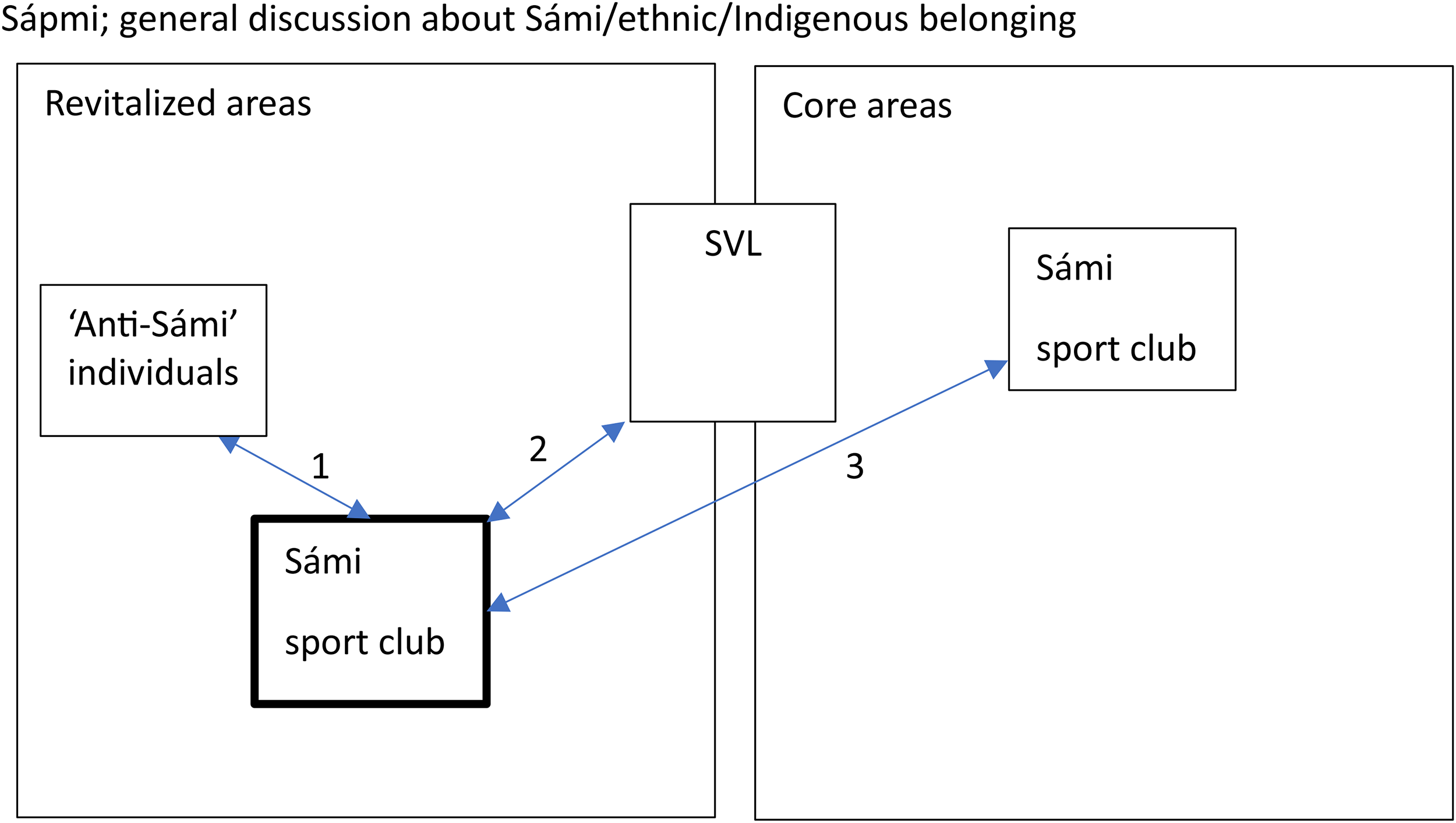
Relationships between the focal sports club (box with bold lines) at the local (arrow no. 1), regional (nos. 2 and 3), and national levels.
Leaning on Bourdieu's definition of doxa as “the unquestionable, taken-for-granted aspects of culture,” Eriksen (2010) held: “Doxic stereotyping … is very powerful in many polyethnic societies and can often function as self-fulfilling prophecies: the negative stereotype created by a dominant group may become part of a group's view of itself” (59). Alternatively, in the words of Brubaker (2004): “the extent to which the population categories constituted by states or political entrepreneurs approximate real ‘groups’, are open questions that can only be addressed empirically” (54). Without limiting the dominant group to being the colonizer, or the negative stereotype to refer to the colonized, our findings align with Eriksen (2010): “In a complex multi-ethnic environment, people will thus develop different standardized forms of behavior vis-à-vis different categories of others” (79). Moreover, the current intra-Indigenous relationship stems from historical assimilation—the Norwegianization policy of the Norwegian state and the subsequent Norwegianization practices of Norwegian society—that is still impacting Sámi milieus.
As per the introduction and context sections, assimilation policies have impacted differently across the various Sámi areas, which in turn have strongly impacted the relationship between Norwegians and the Sámi and the relationships between different Sámi areas, communities, sports clubs, and individuals. This struck hardest in the revitalized areas and less so in the core Sámi area of Finnmark, an observation that intertwines various imprints of colonialism in different groups of Indigenous people (Gilroy, 2008; Go, 2013; Young, 2003). Despite the assimilation policy having formally ended in the middle of the 20th century, it has historical imprints that continue to impact Sámi people, their subgroups, and others. The difference can at least partly be traced back to how assimilation was implemented across Sápmi, based on varied access to and the severity of the influence of the Norwegian state (Broderstad, 2011; Hansen and Olsen, 2004; Nordø et al., 2015; see Figure 2).
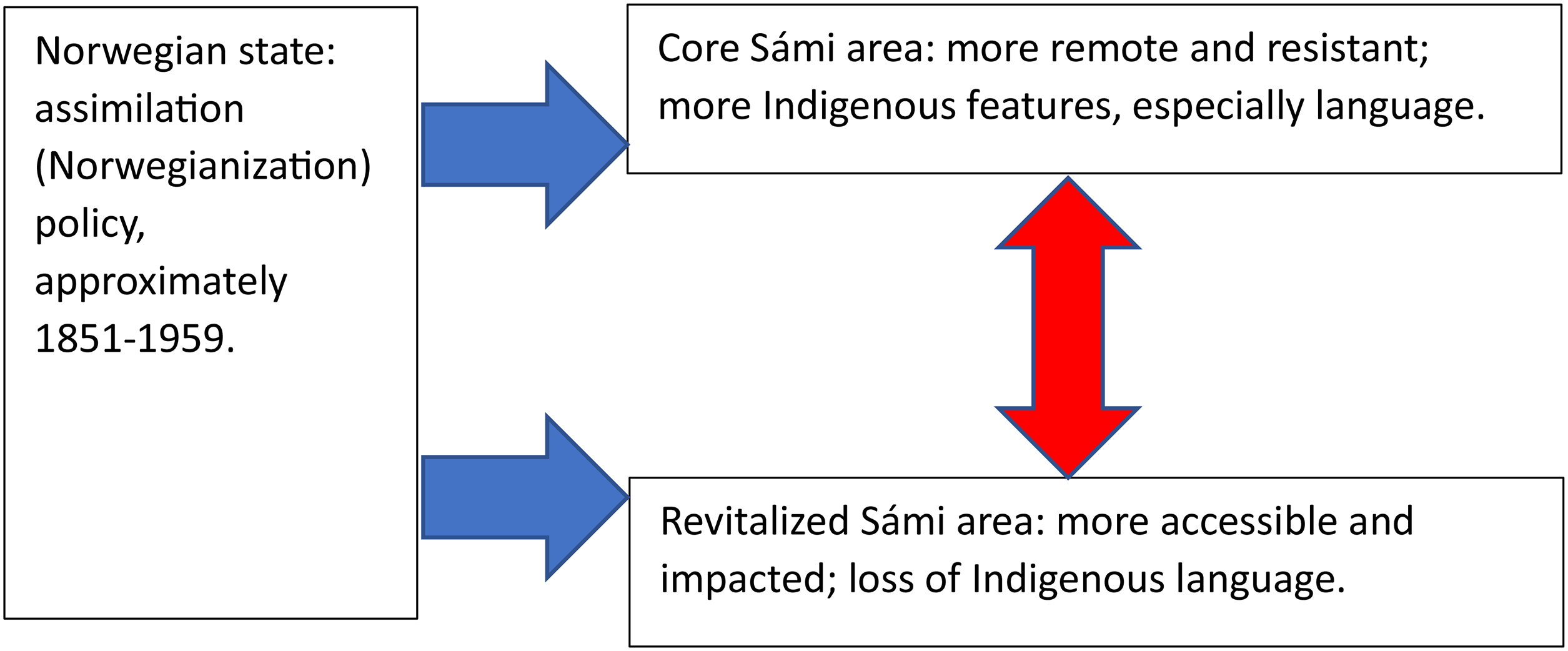
Assimilation policy's impact on Indigenous sports (horizontal arrows) and its internal relations today (vertical arrow).
Concluding remarks
Sámi sports club officials outside core areas consider their peers within core areas as superior, an interpretation that was based on the words of sports club officials outside the core areas; thus, this article shows that the elite is defined as much by its subordinates as by the superiors. The strongest empirical example of this general statement is that Sámi sports club officials in revitalized areas refer to their peers in core areas as “real Sámi” or “Sámi Sámi,” as if they themselves are “less Sámi” or “Norwegian Sámi.” However, there should be taken several precautions: denominations such as “less Sámi” were never used during the selected interviews; according to earlier research, Sámi sports club officials in core areas never used formulations that indicated any “top-down perspectives” between themselves and peers in revitalized areas (Skille, 2022); and, this dichotomization of Sámi communities does not credit the complexity of the ethnic compositions and self-identifications in the scrutinized contexts. Nevertheless, the core area superiority can be interpreted as taken for granted, and therefore non-communicated (Bourdieu, 1991).
This “Indigenous elitism” differs from a “sports performance elite.” Research indicates that Indigenous axions put the group over winning (sport performance as individual success, Rice, 2023); thus, the intersection of sports and politics is fascinating because the very explanation of who is Sámi follows sports organizational affiliations and not any other criteria of ethnic definition. In an article examining Sámi sports across Finland, Sweden, and Norway, a Finnish Sámi sports club representative reflects upon “so-called Sámi” who apparently participate for competitive reasons alone: The most troublesome people are “so-called Sámi people” [without official Sámi status]. They want to maximize sport performance. They forget community, networks, and cultural aspects. Geographical aspects are missing as well as the Sámi Homeland. Everybody is speaking Norwegian; we do not hear Sámi anymore. This is one thing. They want only success, even when we are talking about young people. (Skille et al., 2023: 537)
The dichotomy between competitive sports orientation versus identity development through sports, indicates how sports relate to other societal elements. According to Bourdieu (1991), the “space of sports is not a universe closed in on itself. It is inserted into a universe of practices and consumptions, themselves structured and constituted as a system” (159). In other words, Sámi sports are conceived of as a symbolic field that relates to other fields, hereunder Indigenous identity. The utility of Bourdieu's conceptual lens lies in elucidating how specific skills symbolizing Indigenous culture—especially the knowledge and use of an Indigenous language—facilitate the creation of a stratification of the intra-Indigenous society. This intra-Indigenous stratification is impacted by a historical assimilation process enacted on the whole Sámi society by the Norwegian state. Thus, the state, to a large degree, has determined the forms of symbolic capital that can be bestowed on (or withdrawn from) agents across Sámi society. However, Indigenous sport is relatively absent in larger policies in Norway, in contrast to elsewhere.
In Canada, sport was an instrument for colonization of Indigenous people; simultaneously, sport can be part of reconciliation policies and occupies exclusive points in the Canadian Truth and Reconciliation Commission's call for actions (TRCC, 2015). On the contrary, the 700-page report from the Norwegian Truth and Reconsolidation Commission mentions sport only once, when listing other social contexts than the school in which negative incidents have been experienced: “Persons … describe other social settings than school more generically: the church/congregation, Laestadian gatherings, the military, health services, sport milieus, and workplaces” (SFK, 2023). Overall, participation in SVL led to both unity and division. Hokowhitu (2023) refers to Indigenous sport as a “double-edged sword,” where topics, arguments, and “premises are at odds with each other” (225). Moreover, “…the idea of Indigenous self-determination and other notions … can operate at multiple levels, and sport can be simultaneously both subjugating and liberating” (228).
While we have demonstrated how this is true—not only in inter-ethnic but also in intra-Indigenous relations, new studies of sports should take individual athletes as the point of departure to gather more in-depth knowledge of how athletes’ strategies of self-identification in Sámi sports clubs can occur.
Footnotes
Declaration of conflicting interests
The authors declared no potential conflicts of interest with respect to the research, authorship, and/or publication of this article.
Funding
The authors received no financial support for the research, authorship, and/or publication of this article.
