



Abstract
Incarceration has become naturalized as a primary mode of punishment within the penal systems of modern states across the globe. This study examines how states develop the capacity to execute incarceration as a routine state function. I argue that rationalization and bureaucratization are key for transforming carceral enclosures into a naturalized feature of states’ routine exercise of coercion. I develop this argument through analysis of a dynamic case of carceral modernization in the Brazilian state of Espírito Santo (2003 to 2014). I analyze the significance of coordinated violence and performative strategies for rulers to extend administrative capacity to incarceration and transform confinement into a legitimate and legitimizing instrument of state power. Findings demonstrate how coercive practices and other modes of violence that state authorities come to narrate as illegitimate are not antithetical to modernization. Rather, they become constitutive of the very process of consolidating and legitimizing rational-legal modes of administration that routinely exercise violence while more effectively being misrecognized as such. By extending inquiry to how states develop the administrative capacity to exercise penal power, this analysis makes several contributions to the political sociology of punishment and theories of state-building.
How do authorities develop the administrative capacity to execute incarceration as a routine state function? The penitentiary has become a taken-for-granted feature of modern states’ arsenal of coercive force. Scholarship has theorized the economic, cultural, and biopolitical factors that influence incarceration as a mode of punishment in modern societies (Dikötter and Brown 2007; Durkheim [1901] 1983; Foucault [1975] 1977, 2007; Garland 2002; Rusche and Kirchheimer [1939] 2003). However, the capacity to construct and operate carceral enclosures as an instrument of state coercion, and how authorities manage incarcerated people, vary widely.
Social science spotlights the modes and extent to which rulers exercise coercion as central to state legitimacy (Spierenburg 1984; Wacquant 2009). This article argues that modernizing incarceration through rationalization and bureaucratization of the capacity to displace, confine, and control criminalized people is a key process for transforming carceral enclosures into a legitimate and legitimizing feature of modern state power. To demonstrate this requirement, I examine a dynamic case of carceral modernization in the Brazilian state of Espírito Santo between 2003 and 2014. Conceptualizing the state as a bureaucratic field (Bourdieu 1994; Wacquant 2010), I elaborate on the practical (Tilly 1990; Weber [1946] 1958) and symbolic dimensions (Norton 2014; Reed 2019) of state-building that transform incarceration into a routine state function. I demonstrate how a combination of coercion and performativity are central strategies in the initial phase of extending administrative capacity (drawing from Loveman 2005) to incarcerate criminalized groups. In so doing, I illustrate how modes of violence that authorities come to narrate as “illegitimate”—be it torture, militarized extraction, or maintaining people under conditions in which they fear for their lives—are not antithetical to bureaucratizing and rationalizing state power. Rather, they become constitutive of the very process of consolidating and legitimizing rational-legal modes of administration that routinely exercise violence while more effectively being misrecognized as such. I conclude by discussing the implications of my analysis for the political sociology of punishment and theories of state-building.
The Penitentiary as Beacon of the Modern State
The birth of the penitentiary marks consolidation of incarceration as a state-sanctioned punishment. Scholars connect its emergence in the eighteenth and early-nineteenth centuries across Western Europe and the United States to the development of industrial capitalism, European Enlightenment, and the consolidation of modern states (Ignatieff 1978; Melossi and Pavarini [1981] 2019; Rusche and Kirchheimer [1939] 2003; Spierenburg 1984). Debates over the function and limits of state power and the nature of its “social contract” with citizens rendered punishment and its acceptable modes integral to defining and legitimizing modern state authority (Garland 1991). The penitentiary emerged as a symbol of a “civilized” and transformative mode of punishment, contrasted with the gruesome and spectacular violence associated with absolutist powers (Spierenburg 1984). With Enlightenment ideas influencing conceptions of behavior that emphasized individuals’ “rational” calculations, imprisonment’s perceived deterrent capacity legitimized it as penal innovation (Garland 1990). Merging with progressive ideals shaped by religious reform and medicalized discourses, the prison was projected as a site for redemption and rehabilitation (Foucault [1975] 1977; Platt 1969; Showalter 2019). The penitentiary became an important feature of European imperialism across Africa, Asia, and Latin America over the nineteenth and twentieth centuries (Aguirre 2005; Botsman 2007; Dikötter and Brown 2007). Prisons became a beacon of modernity and civilization, forming part of a larger wave of liberal reform in many countries that linked “overhaul of the justice system” to state-building (Gibson 2011:1058). 1
Although the prison has failed to realize the reformative ideal that legitimized its birth and diffusion (Feeley and Simon 1992; Gibson 2011), incarceration is a primary mode of punishment within the penal systems of modern nation-states. In the late twentieth century, incarcerated populations boomed across several continents, especially in contemporary democracies (Hathazy and Müller 2016; Wacquant 2009). Scholarship attributes persistence of the prison to its material, cultural, and symbolic functions—from sustaining capitalist modes of production through disciplinary practices (Foucault [1975] 1977) and managing social “disorder” (Melossi and Pavarini [1981] 2019), to biopolitical logics of “security” (Foucault 2007) and “biosovereignty” (Bargu 2016), expressing or defending cultural values and sensibilities (Garland 2002; Pratt 2002), and reinforcing unequal orders along gendered and ethno-racial lines as well as other axes of marginalization (Alexander [2010] 2020; Beattie 2015; Castillo 2016; Hinton and Cook 2021; Simes 2021; Wacquant 2009). However, existing theories fall short of resolving the distinction between imprisonment’s formal adoption and states developing the administrative capacity to impose incarceration at scale. For example, nineteenth-century prison-building in nearly every post-colonial state across Latin America was publicized as a “beacon of the modern state” and a “major turning point” in efforts to control crime. Yet in practice, incarceration had little effect on that century’s dominant modes of punishment (Salvatore and Aguirre 1996).
Developing administrative capacity and its subsequent rationalization can take generations or centuries (Mann 2012; Poggi 1990; Weber [1978] 2013). Far from inevitable, administrative development, or lack thereof, is “the cumulative product of concrete historical struggles, of varying types and intensity, over the boundaries of legitimate state practice—and thus, over the practical definition of the state itself” (Loveman 2005:1661). Carceral state-building demands significant economic resources (Gilmore 2007). It also requires political will, expertise, and personnel. Various administrative models circulate globally, with geopolitical dynamics, institutional pressures, social anxieties, and the struggles and interests of diverse actors influencing adoption and adaptations (Gottschalk 2006; Hathazy and Müller 2016; Macaulay 2013; Page 2012; Rubin 2015; Salvatore 1996).
Incarcerated people themselves influence administration and the extent to which state authorities are able to routinely displace, confine, and control them. Bargu’s (2016) work on the mass death fast of incarcerated people in Turkey shows captives may resist rationalization of control to the point of self-destruction to deny state sovereignty. Other works show how, in extreme cases, the absence of rationalized incarceration can strengthen “carceral communities” that undermine state actors’ attempts to monopolize legitimate violence (Darke et al. 2021; Dias and Salla 2013). However, research has overlooked how incarcerated people influence cases when state actors do develop the capacity to routinely incarcerate criminalized groups. I address this gap by examining how rulers rationalize and bureaucratize carceral administration when incarcerated people forcefully organize to resist it. The following section develops a framework to examine how rulers extend coercive capacity to this domain.
Extending Coercive State Capacity to the Carceral Domain
Bellicist state-building theories argue that administrative expansion depends on authorities’ material capacity to overcome resistance through coercion “in the final instance” (Tilly 1990; Weber [1946] 1958). However, rulers must also make their coercive actions seem legitimate. Just as is the case with carrying out any function (Loveman 2005:1652), the state’s coercive capacity and functions hinge on accumulation and exercise of symbolic power (Bourdieu 1991, 2014). I bring together the material and symbolic dimensions of state-building to conceptualize how rulers extend their capacity to routinely impose incarceration. Building on Bourdieu’s (1994) theory of the state as a bureaucratic field, I examine the relationship between penal development and legitimacy. First, I define the bureaucratic field and explain how “primitive accumulation of symbolic power” not only extends the domain of legitimate state practice (Loveman 2005), but also influences state legitimacy overall. Second, I link this process to expanding penal capacity, showing the significance of coercion and performance to naturalizing the routine exercise of violence.
The State as Bureaucratic Field and the Primitive Accumulation of Symbolic Power
Bourdieu (1994:5) conceptualizes the state as the “culmination of a process of concentration of different species of capital” (e.g., coercive instruments, economic capital, cultural capital, symbolic capital). This concentration of various types of power goes hand in hand with consolidation of corresponding fields, or structured spaces of forces where agents vie over accumulation and distribution of power particular to that field (Bourdieu 1993, 1994). State-building involves accumulation of various material resources (Centeno 1997; Tilly 1990; Weber [1946] 1958). But it also requires recognition through symbolic power that the ‘State’ is the legitimate executor and arbiter of these resources (Bourdieu 2014; Loveman 2005). Indeed, “creation of ‘durable state structure’” is both a “logistical and a cultural feat” (Loveman 2005:1675). Symbolic power is a form of “meta-capital” that consists of the power to “constitute the given” (Bourdieu 1991:170); it is the “ability to make appear as natural, inevitable, and thus apolitical, that which is a product of historical struggle and human invention” (Loveman 2005:1655). Whereas symbolic power is derived from recognition of legitimate authority, its effects are produced through misrecognition, “through the appearance that no power is being wielded at all” (Loveman 2005:1655)—be it constitution of identities through censuses (Loveman 2014a) or codifying meanings of criminality (Norton 2014; Wacquant 2009) and citizenship (Brubaker 1996) that naturalize boundaries of territorial, social, and cultural exclusion.
Loveman (2005) distinguishes between two phases in state-building: (1) the primitive accumulation of symbolic power and (2) routine exercise of symbolic power. In the latter, the “institutional reality of the state becomes naturalized” and focus turns to the mechanisms and techniques the state uses to regulate social life (Loveman 2005:1657–58). The former focuses on extension of the state’s administrative reach to new domains. This initial stage is crucial to understanding state-building because it presents multiple and intertwining agency problems (Kiser and Cai 2003; Reed 2019), where success depends on (1) achieving recognition by influential segments of the populace, while also (2) attracting personnel to carry out administration (Reed 2019).
Examining modes of administrative extension creates analytic leverage to explore how states establish “new administrative activities as legitimate state practices” (be it through innovation, emulation, co-optation, usurpation, or some combination of such methods) (Loveman 2005:1664). Importantly, symbolic power crosscuts fields and their distinct sources of power. Rulers may engage in primitive accumulation of symbolic power in one domain while routinely exercising it in another (Loveman 2005). In turn, success or failure of administrative expansion influences broader state legitimacy by reshaping the combination and “transmutation” (Bourdieu 2014:191) of resources concentrated in the bureaucratic field.
Recent works elaborate the performative dimension of accumulating symbolic power, capturing the significance of publicity and interpretation (Norton 2014; Reed 2013, 2019). Especially when rulers possess scarce resources and weak legitimacy, “well-timed acts, ‘in tune’ with the situation,” can provide “another route to a ‘quantum of social force’” to advance state-building (Reed 2013:203)—be they speech acts (Butler 1997), displays of force against classified adversaries (Reed 2019), or enactment of implicitly racialized scripts (Smith 2016). Actions are successful insofar as they are interpreted as an “act of state” that assigns the state a reality that “orients future action” (Reed 2019:341).
Spectacular executions used by state and proto-state actors to accumulate legitimacy (see Dias and Salla 2013; Spierenburg 1984) are a quintessential example of performative power. The act’s public nature consolidates into an “event” to be witnessed and interpreted; this requires a relatively constrained and finite exertion of force, which is also what makes the demonstration possible for would-be rulers with otherwise scarce resources. The prison was contrasted with public execution as “civilized” punishment; however, routine incarceration requires a much greater, more reliable capacity to exercise coercion over time. I highlight the significance of coercion and performativity to the initial phases of extending state administration to routinely incarcerate criminalized people.
Modernizing Carceral Administration in the Penal Field
Accumulation and concentration of coercive capacity in the bureaucratic field involves consolidating “institutions mandated to guarantee order” (Bourdieu 1994:5). Physical violence is applied by specialized groups, centralized, disciplined, mandated, and clearly identified for such end. Over time, armed forces progressively differentiate themselves, for example, with military forces for “inter-state competition” (e.g., war over land) (Bourdieu 1994), and penal regimes, which consolidate the penal field (Page 2012), for imposing intra-state order.
Building on Bourdieu’s conception of the state, Wacquant (2010:201) brings penal policies, institutions and practices “from the periphery to the center” of analyses of the state. For example, Wacquant’s (2009:283) investigation of the resurgence of incarceration and selective targeting of poor, marginalized, and racialized populations in the United States and France since the late twentieth century argues that penal expansion served to (1) manage poverty and social “disorder” and (2) symbolically re-establish public officials’ legitimacy (i.e., accumulate symbolic power) through a spectacle of “law-and-order pornography.” 2 Wacquant’s deployment of the bureaucratic field brings attention to the distinct, although interrelated, material and symbolic dimensions to explaining why, how much, and toward whom, rulers exercise penal capacity. 3 I extend this analytic approach to the administrative features of penal power and examine how rulers extend coercive capacity through rationalization. 4
Administrative expansion takes place within various political, bureaucratic, economic, and cultural conditions that shape the timing, orientation, and modes of extending coercive power. Key to analysis is the penal field—the social space where coercive resources are concentrated and agents struggle to accumulate and exercise the “legitimate authority to determine penal policies and priorities” (Page 2012:159; Sozzo 2018). This structured space includes people, groups, and organizations who “participate in and affect these struggles and the rhetoric, signs and symbols that are both weapons in and products” of such struggles (Page 2012:159). 5 Through rationalization, the penal field becomes composed of “subfields” (e.g., policing, carceral, parole), each possessing their own logic, rules, regularities, and stakes that influence and are influenced by practical and expressive dimensions of state authority (Hathazy 2018).
To bolster legitimacy, the penal arm of the state must project a monopoly on legitimate violence, which requires sufficient administrative capacity to routinely execute coercion, typically achieved through bureaucratization. Practically, bureaucracy enables rationalization of administrative techniques to establish the most durable, reliable, and efficient means of achieving a given end (Hintze 1989; Poggi 1990; Skocpol 1979; Weber [1946] 1958). Bureaucratic administration is also an indicator that rulers have achieved sufficient symbolic power to routinely exercise coercion. Violence becomes “sanitized or disguised” through its monopolization by specialist groups. The impersonal and professional manner of their conduct, articulated and justified through expert discourses and rational-legal codes, produces an “administrative veil” (Pratt 2002:7) that neutralizes the “emotional intensity that such repressive behavior threatens to arouse” (Garland 1991:146). In so doing, penal mechanisms are transformed into instruments of “rule through law”: the seemingly impartial character of law is converted into political practices to accumulate legitimacy that criminalize socially marginalized groups (Hathazy and Müller 2016). 6 For example, Murakawa (2014:15) demonstrates how the perceived neutrality of rational-legal penal policies can garner support from diverse actors with “distinct and even oppositional goals,” while profoundly influencing disparate and racialized outcomes.
Developing the administrative capacity to incarcerate people presents especially difficult agency problems that highlight the dynamic relationship between physical violence and performance in extending and modernizing coercive power. First, whereas control of incarcerated populations can be maintained through disciplinary practices, rationalized architectures, and other management tactics (Foucault [1975] 1977, 2007), monopolizing violence involves overcoming the authority of rivals to a state’s administrative power (Elias [1939] 2000; Mann 2012; Weber [1946] 1958). Because rationalization takes place over time, effectively confining and controlling resistant groups can hinge on wrestling away the authority that incarcerated people may have achieved in the absence of routine state control.
Second, “cultural infrastructure,” or “a system of meanings” (Norton 2014), that aligns with rulers’ goals is essential to extending coercive power. This involves successful coordinated “construction of the objects of violence” (e.g., as a dehumanized enemy or criminalized other) (Norton 2014:1541), as well as codifying the mode of exercised coercion as legitimate state practice. Rulers need influential segments of the populace to interpret their extending coercive capacity as an “act of state.” Moreover, the state must attract personnel, whose practices, expertise, and participation in administration not only influence capacity and modes of control (Foucault [1975] 1977), but also the basis on which authorities can codify incarceration as legitimate (Showalter 2019).
I examine a dynamic case in which incarcerated people forcefully resisted carceral modernization, and the existing cultural infrastructure was out of alignment with the authority that state rulers sought to project. I spotlight the coercive and performative strategies through which rulers transformed incarceration into an instrument of rule through law.
Methodology
Case Selection
Carceral state-building in the Brazilian state of Espírito Santo between 2003 and 2014 is a generative case for theory-building. State rulers went from possessing a complete lack of administrative capacity to receiving national attention as a model for carceral modernization. Reform was part of a broader political project to expand the administrative capacity of state institutions and legitimize state power under conditions in which authorities possessed a deficit of symbolic power in the bureaucratic field. The coincidence of economic capital, human resources, political will, and population size facilitated modernization in the penal field over a relatively short period, rendering it an “extreme case” and a “critical case” (Flyvbjerg 2006) that clarifies the relationship between state legitimacy, incarceration, and the means of developing the capacity to routinely exercise this function.
Data
Primary data collection took place during three site visits to Espírito Santo between 2011 and 2014, lasting four to six weeks each. Since absence of systematically recorded data is characteristic of non-bureaucratized administration, interviews were a critical starting point to develop an account of how administrative practices changed over time, and the conditions, actors, and struggles that shaped them. I conducted 55 semi-structured interviews with penal field protagonists, using snowball and purposive sampling. Interviewees included bureaucrats such as prison directors and administrators of the prison medical, education, work, finance, and security departments; the active Secretary of Justice (SEJUS) chiefs in 2011 and 2014; the state civil police chief, deputies, and officers; military police colonels, judges, public defenders, and public prosecutors; managers of three private prison management companies; representatives of the local Black Movement; and leaders of local and national human rights organizations, the Brazilian Bar Association and the Catholic Prison Ministry.
I triangulated interview data with administrative documents and audit reports from (1) Espírito Santo’s Secretary of Justice, the Public Prosecutor Office, the Public Defender Office, and the Legislative Assembly’s historical archive; (2) online government archives (Instituto Jones dos Santos Neves, National Penitentiary Department, National Justice Council, and National Council of Criminal and Penitentiary Policy); and (3) the Bar Association, the Catholic Prison Ministry, and Espírito Santo’s Human Rights Commission. I collected newspaper articles to examine public representations of incarceration and how such dynamics influenced state strategies to modernize incarceration.
I supplemented the data with tours of 17 penitentiaries and three civil police stations (ranging two to four hours each), with the latter having been a key site of confinement prior to reform. Penitentiaries varied according to geographic location, pre- and post-trial detention, regime and security level, gender of incarcerated people, inauguration year, and public, private, or nonprofit management. In 15 penitentiary visits I was accompanied by the facility prison director, private firm manager, or SEJUS security director, who permitted me to determine the spaces observed, including the central intelligence and surveillance hubs, weaponry rooms, medical clinics, classrooms, work rooms, kitchens, cells, galleries, and yards. In the remaining two penitentiary visits, I accompanied surprise audits by the Bar Association’s National Penitentiary Policy Commission and Catholic Prison Ministry. I toured the police stations accompanied by a civil police commissioner and investigator. These visits allowed me to gain glimpses of confinement conditions and administrative infrastructures, as well as the narratives penal actors attributed to observed conditions. I also draw from secondary literature to situate Espírito Santo’s carceral reform in broader social, political, and economic context.
From Dungeons to Modernizing Carceral Administration
Genesis and evolution of the penal arm of the Brazilian state is connected to the maintenance of highly unequal social relations along ethno-racial lines, shaped by Portuguese colonization between the early sixteenth and nineteenth centuries and an economy dependent on enslavement of Black African and Indigenous peoples. Unlike most Latin American countries, slavery persisted following formal independence from colonial rule in the early nineteenth century. The state’s first police organization emerged with the mandate to repress escapes, organized revolts, and the resistance of enslaved people, who composed more than half of the population, the majority being of Afro-descent (Dos Santos, Nascimento-Mandingo, and Chazkel 2020; Holloway 1993). The dawn of the Brazilian Republic by the late nineteenth century and formal abolition of slavery ushered in a state project of ethno-racial “whitening” associated with ideals of progress, civilization, and modernity (Dos Santos 2002; Loveman 2014a). Alongside financing of Western European migration to occupy positions of paid labor and advance miscegenation, penal codes criminalizing vagrancy and practices such as capoeira (an Afro-Brazilian martial art) legitimized aggressive policing of newly freed enslaved people, complementing a broader explicit state project to erase the “black stain” (Beattie 2015; Dos Santos 2002:75).
Since their inception, penitentiaries were reserved for the poor, Black and Brown people, and political dissidents (Maia et al. 2009); however, until the late twentieth century, incarceration played a minor role in punishment. In the early nineteenth century, Brazil was the first Latin American country to construct a penitentiary. Yet in addition to fiscal constraints, elites considered other penal modes “more fitting” for the “uncivilized and barbarous masses” (e.g., public executions, branding, whipping, banishment, military conscription) (Aguirre 2007:18–19; Beattie 2001; Salvatore 1996).
Like most countries in Latin America, Brazil experienced a “rebirth” of the penitentiary in the late twentieth century (Hathazy and Müller 2016). With abandonment of dictatorship (1964 to 1985) and a return to electoral democracy in the 1980s, policing and incarceration of the poor along ethno-racial divisions became a political strategy across party lines to shore up legitimacy. This occurred amid pervasive violence, public demands for tougher crime policies, and intensifying “rule of law” and “human rights” discourses in a globalizing field of power projecting western ideals of acceptable modes of punishment (Nunes 2015; Paschel 2018; Skidmore 1990; Wacquant 2008). Since then, state authorities have incarcerated an unprecedented number of people. Reaching a rate of 320 per 100,000 inhabitants, the number of people behind bars has increased ninefold, from 88,000 in 1988 to 812,000 in 2021—the largest incarcerated population in Latin America and the third largest worldwide (surpassed only by the United States and China) (DEPEN 1988a, 1988b; World Prison Brief 2021). The people incarcerated are overwhelmingly economically disadvantaged and disproportionately identify as preto (“black”) or pardo (“brown,” or “mixed race”). This disparity is most striking in the Southeast, the country’s most industrialized region and prime destination for European immigration. Among the region’s population overall, 9 percent identify as preto, 37.6 percent as pardo, 52.2 percent as white, and 1.2 percent as Asian or Indigenous (IBGE 2020). By contrast, among those incarcerated, 24.8 percent identify as preto, 49.06 as pardo, 24.56 percent as white, and 1.61 percent as “other” (DEPEN 2020).
Brazil’s 1984 Law of Penal Execution (LEP) was the first national legislation to elaborate a rationalized system of punishment, defining sanctions and rules of sentencing progression. It mandated specialized bureaucratic offices to administer incarceration, detailing rights and obligations for managing pre-trial and convicted incarcerated people. Nearly two decades after the LEP’s passing, however, the southeastern state of Espírito Santo was exemplary of authorities’ failure to systematically operate carceral enclosures as a mode of punishment. Managing incarcerated people was assigned to the state Secretary of Justice and Citizenship (SEJUC), which was responsible for a wide range of functions, including administration of children’s, consumers’, workers’, and retirees’ rights (Assembleia Legislativa 1991). With scarce economic and human resources, no incarceration-specific expertise, and insufficient space in the state’s 12 dilapidated carceral buildings, many incarcerated people—both pre-trial and convicted—were held in civil police stations, sometimes for years (Congresso Nacional 2007). Neither policing organizations, the judiciary, nor the SEJUC systematically recorded information, including incarcerated people’s names, alleged offense, or sentence term. Lacking training and resources, civil police and prison guards were highly dependent on the arms and officers of the military police as means of control.
Just over a decade later, between 2003 and 2014, Espírito Santo went from operating arbitrary dungeons to a rationalizing and bureaucratizing system of carceral administration. The state achieved recognition from the National Justice Council as an “ideal model” for modernizing Brazil’s penitentiary system, on the basis of its capacity to provide “security” and conditions conducive to “resocialization,” as mandated in the 1984 LEP (Figueiredo and Brêda 2016). Such recognition was achieved as the number of people incarcerated in Espírito Santo nearly tripled, increasing faster than nearly every state in the country (DEPEN 2014)—a clear example of incarceration transformed into an instrument of rule through law.
Carceral administration no longer relied on human, infrastructural, or coercive resources of policing organizations. All pre-trial and convicted people were managed by a new state office, the Secretary of Justice (SEJUS), the first in Espírito Santo with a specialized mandate and budget for incarceration. The SEJUS comprised a hierarchical administrative structure with departments to manage nearly every aspect of people’s lives, from their movement, to meals, hygiene, medical and psychological attention, education, and work. People were confined within a system of 34 carceral facilities; they passed through a triage center and were then distributed among 13 pre-trial detention centers and 21 penitentiaries according to social profile and legal status. The SEJUS established professional degree requirements for prison directors (Martinuzzo 2010b), and the first custody training coordinator not affiliated with the military assumed the position in 2014. For the first time, custodians wore uniforms, and with logos distinct from those of policing organizations. Guards were trained through a SEJUS penitentiary school; specialized teams were designated to “escort” incarcerated people, and tactical operations groups were created to quell heightened resistance to control. (See Tables 1 and 2 for key indicators of the expansion and rationalization of carceral state capacity in Espírito Santo over this period.)
Incarcerated Population and Establishments Used for Confinement, Espírito Santo
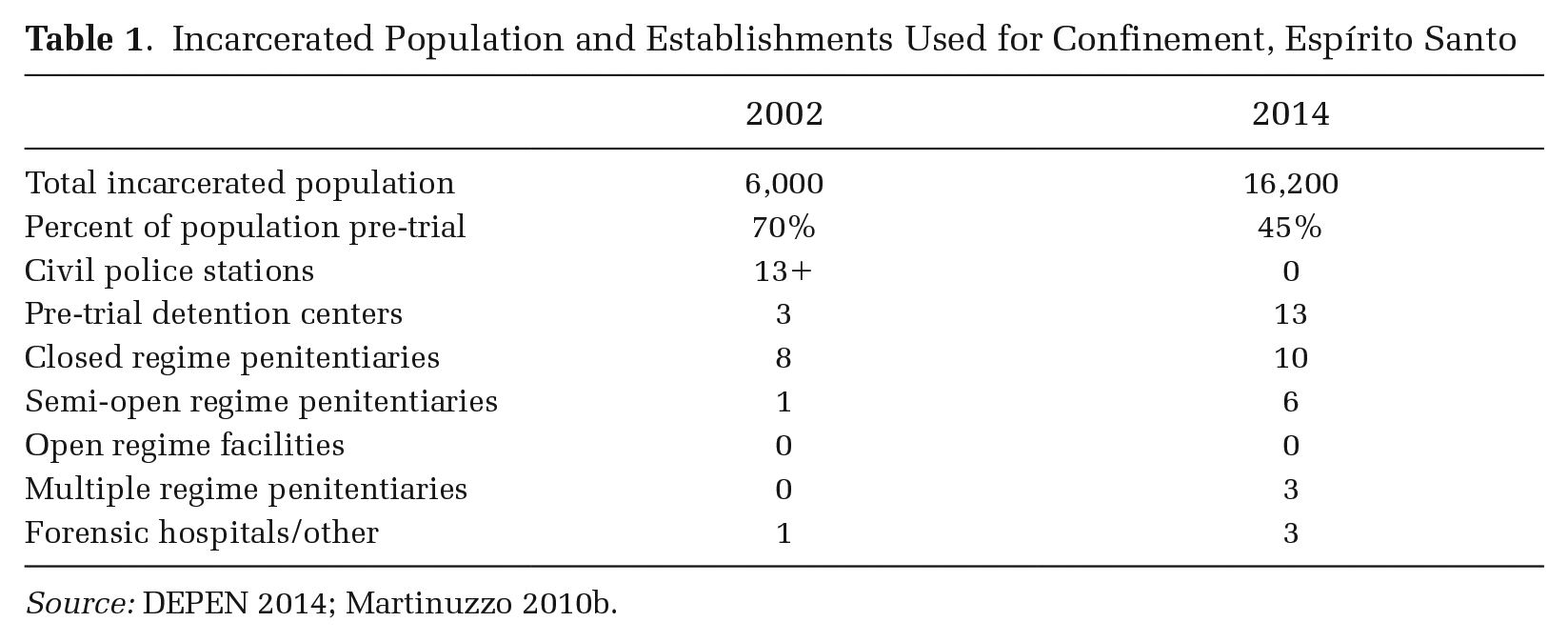
Source: DEPEN 2014; Martinuzzo 2010b.
Bureaucratization and Rationalization of Carceral Administration Indicators, Espírito Santo
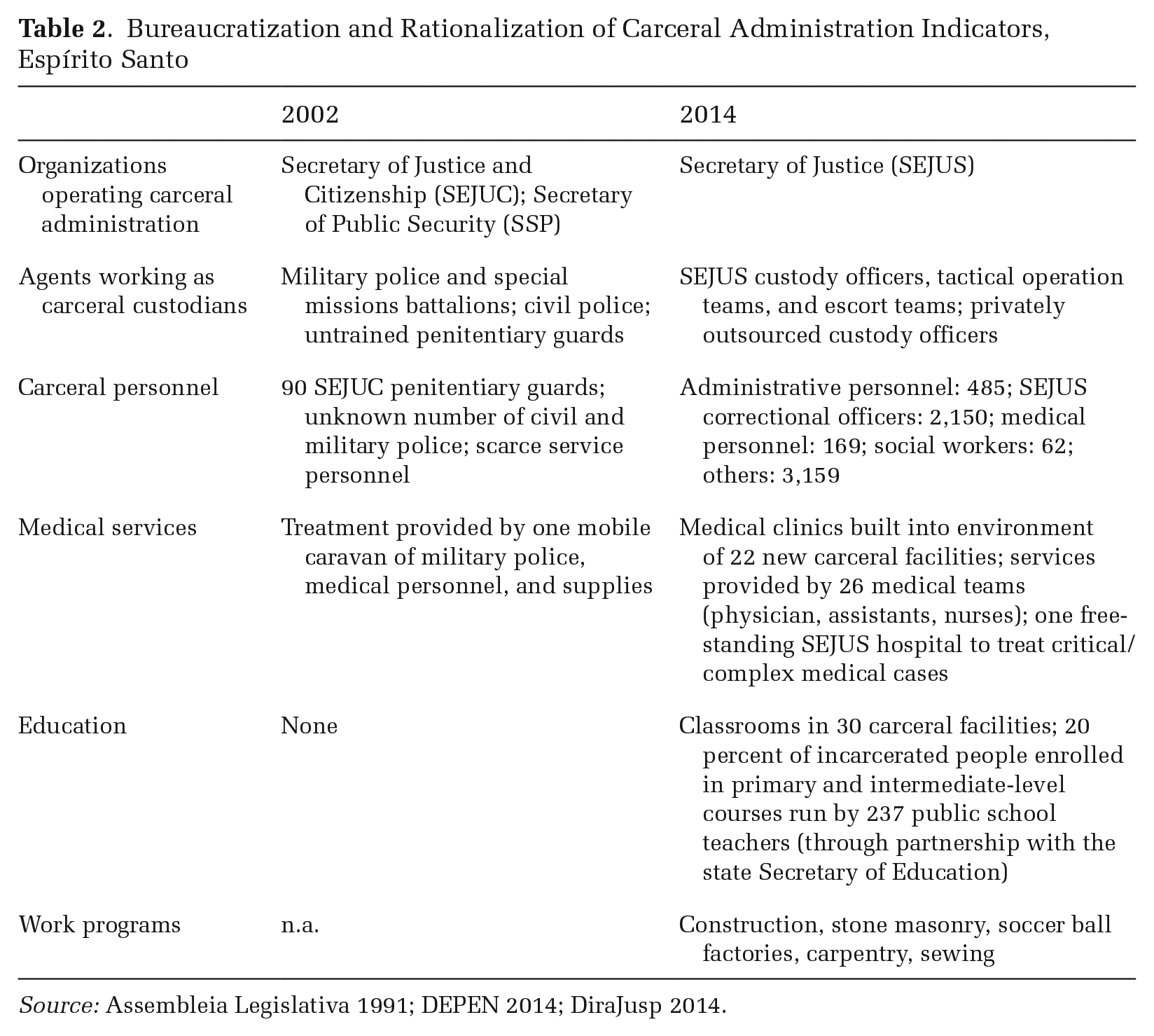
Source: Assembleia Legislativa 1991; DEPEN 2014; DiraJusp 2014.
First, in the following section, I elaborate the coinciding forces that facilitated carceral reform and its significance to a broader project of legitimizing state authority. Second, I highlight the coercive strategies employed by new technocratic authorities to wrestle away the administrative power of incarcerated people who resisted imposition of this new penal regime. Third, I elaborate on performative strategies rulers employed to (1) legitimize state authority in the bureaucratic field and (2) attract actors to the penal field to transform incarceration into a routine and legitimizing state function.
From Patrimonial Rule to Modernizing State Power
The “binding normal regulations of bureaucratic administration” stand in distinction from patrimonial power (Weber [1978] 2013:1030). In the latter, offices are distributed based on personal allegiances rather than expertise. Office holders lack technical orientation toward administration; instead, they divert resources to private endeavors that can lead to relinquishing means of state administration. Immediately prior to Espírito Santo’s carceral reform (1984 to 2002), patrimonial rule led to a bureaucratic field drained of material resources and recognition of rulers’ legitimate authority to rule (symbolic power). These conditions influenced the basis on which new technocratic leaders sought to build and legitimize state power between 2003 and 2014, including by rationalizing and bureaucratizing the penal field.
Patrimonial State Authority, Capture by a Criminal Organization and Administrative Failure in Espírito Santo (1984 to 2002)
Brazil’s return to electoral democracy ushered in formal reorganization of state power. Penal authority went from being concentrated in federal executive positions occupied or controlled by the military, to a federalist structure transferring management of most functions to local institutions executed by or subordinate to civil authorities. National legislation and the new 1988 Constitution mandated state military police organizations (subordinate to elected governors) for preventative policing, civil police for investigatory functions, public prosecutor offices, public defender offices, the judiciary, and an office for carceral administration. However, international debt, weak currency, political instability, entrenched personalistic rule, and organized crime presented obstacles to developing local institutional capacity in most states (Congresso Nacional 2000; World Bank 2006). These conditions strengthened the authority of militia groups, who operated illicit economies while exercising mass executions of poor preto and pardo Brazilians to proclaim legitimacy as organizations of “order and security,” distinct from “organized crime” (Manso 2020). Circumstances in Espírito Santo between 1984 and 2002 exemplify these dynamics.
Espírito Santo is the fifth smallest of Brazil’s 26 states geographically. Withcoffee-growing among the region’s primary economies for much of the twentieth century, a system of agrarian oligarchs (coronelismo) was pervasive (Ribeiro Júnior 2012). After the formal return to democracy in the 1980s, such entrenched personalistic rule and Espírito Santo’s prime geographic location along the southeastern coast rendered administratively weak state institutions vulnerable to capture by one of Brazil’s then most powerful militias: Scuderie Detetive Le Cocq (SDLC). Originating at the beginning of dictatorship in 1965 as a “death squad” of civil and military police, members increasingly concentrated in Espírito Santo by the 1980s, with over 1,000 registered affiliates in the capital city of Vitória by 1984. In addition to former or active police, the SDLC consisted of entrepreneurs, politicians, attorneys, judicial authorities, public prosecutors, and legislative assembly leaders (Bittencourt and Dadalto 2017).
Running one of the most expansive operations of organized crime at the time through the jogo de bicho gambling scheme, the SDLC possessed a near full monopoly on local commerce and exploited ideally positioned ports to circulate illicit goods (drugs and arms) transnationally (Congresso Nacional 2000; Rohter 2002). With positions in the bureaucratic field conferred as personal favors tied to SDLC loyalties, and resources systematically diverted to private pockets, state administration was paralyzed. Payment of military and civil police salaries was delayed for months, rendering the penal field dependent on the SDLC’s whims in exchange for favor (Congresso Nacional 2000; Martinuzzo 2010a).
As people increasingly migrated to urban areas, they faced growing unemployment and violence (Secretaria de Economia e Planejamento 2013). In 2002, Espírito Santo was ranked the second most violent state in the country, with an average homicide rate of 50 per 100,000 inhabitants. Vitória reached over 100 homicides per 100,000 inhabitants for more than three consecutive years, reaching rates of civil war according to UNESCO and ranked as the most dangerous city in Latin America (Rohter 2002; Waiselfisz 2010).
Rulers not only lacked expertise and interest to address heightened social tensions, but the state itself was recognized as one of the primary perpetrators of violence, terror, and impunity. The SDLC obstructed attempts to denounce or investigate affiliates’ activities, from burning criminal registries of corruption, extortion, illicit commerce, and homicides; to threatening or killing witnesses, investigators, lawyers, community leaders, journalists, and police officers who attempted to speak out against mass executions of poor preto or pardo youth and other SDLC crimes (Bittencourt and Dadalto 2017; Ministério Público Federal 1996).
People targeted by coercive state resources frequently never made it behind prison bars. Between 1988 and 2002, the recorded number of people incarcerated increased from 1,500 to 6,000 (DEPEN 1988a, 1988b; Martinuzzo 2010b), but largely due to judicial and penal institutions’ administrative failures. Those detained faced an indefinite term behind bars without trial, with no access to legal defense and their release dependent on processing by poorly resourced civil police and courts (Martinuzzo 2010b; Veiga and Merlo 2014). Amid festering refuse and disease, incarcerated people depended on their families—and sometimes private provisions from custodians—as their nearly sole resource for food, medicine, clothing, and soap.
On one hand, incarcerated people were subject to multiple forms of violence through extra-legal torture and neglect (CNPCP 2006; Conectas 2011); on the other, authorities’ dependence on nonstate actors to respond to rebellions against such conditions demonstrated state authorities’ incapacity to manage and control those they were mandated to incarcerate. This dynamic is reflected in the following excerpt from my interview with a member of the Catholic Prison Ministry, who became an influential mediator during this period: During one of the rebellions in the city of Linhares, the judge phoned me to go there. Imprisoned men were holding hostages and said they would only speak to me. The warden begged me to come. When I got there, the judge hugged me and said he wanted to come to terms with the inmates. I was really used by judges and public prosecutors during that time because they didn’t want to enter prisons themselves. They were afraid. But they knew with me nothing would happen to them. I was their guarantee. I walked on the yard and prisoners went to hand me the weapons. I didn’t let them and said they had to hand them to the public prosecutor. Because they [state authorities] already resented me. The prisoners finally surrendered the hostages.
By the early 2000s, gruesome overcrowding, growing frequency of rebellions, and mass escapes of incarcerated people countrywide became of increasing concern for political legitimacy, commerce, and securing investments in a reorganizing economic field (Nunes 2015; World Bank 2006). Amid stabilizing currency, the discovery of oil reserves promised to bolster the country’s global market position. By 2011, Brazil was the fifth largest economy worldwide (Financial Times 2011). With the election of President Luiz Inácio Lula da Silva (Workers’ Party) in 2003, politicians, bureaucrats, and entrepreneurs at the national level became increasingly invested in developing and expanding state administrative capacity to produce social and infrastructural conditions for exploiting economic opportunities and attracting international investment.
In the penal domain, technocratic administrators were nominated to Brazil’s National Ministry of Justice, transforming it into an “island of bureaucratic excellence” (Nunes 2015:139). The ministry’s National Penitentiary Department (DEPEN) enhanced data collection on incarcerated populations and administrative conditions and provided prescriptions for carceral modernization. However, the timing and extent to which local authorities invested in carceral administration varied widely. Espírito Santo was among the first states to rationalize capacity to incarcerate criminalized people, which became crucial for new local technocratic state leaders to accumulate legitimacy in a bureaucratic field severely lacking symbolic power.
The Political Project to Modernize Espírito Santo (2003 to 2014): Rationalizing the Penal Field to Legitimize State Authority
In the early 2000s, offshore oil discoveries along Espírito Santo’s coast positioned it as Brazil’s second largest oil contributor (IPEA 2015). During this period, key members of the SDLC were removed from political office by federal court mandate (Ribeti 2004; Silveira 2004). This facilitated the entry of new technocratic political leaders oriented toward reorganizing, expanding, and modernizing state institutions in the local bureaucratic field to bolster the promise of Espírito Santo’s industrializing market economy. In 2003, Paulo Hartung was elected governor, and his political trajectory, technocratic expertise, networks, and support of entrepreneurial interests were a catalyst for modernizing state institutions. Hartung put forth a reform plan to “purge the state machine” and “reconstruct the State of Espírito Santo” as one of “democratic right,” where it is “illegitimate to use State force against the rights of citizens” and “immoral to use State power to obtain privileges and appropriate from the public good.” Backed by rhetoric distinguishing state power from its “patrimonial past” (Governo do Espírito Santo 2003), Hartung brought together bureaucrats and strategic management experts to rationalize and expand the state’s institutional reach. From public health to education and transportation, Hartung made sweeping investments in various domains to expand administrative power (Secretaria de Economia e Planejamento 2013).
Expanding and rationalizing coercive capacity in the penal field were among Hartung’s development priorities. Military police organizations acquired personnel, vehicles, weapons, and surveillance technologies. Civil police received technical-scientific investigatory training, vehicles, computers, and new police stations (Martinuzzo 2010a; Secretaria de Economia e Planejamento 2013). Developing the administrative capacity to incarcerate criminalized people was also integral to the broader project to rationalize, expand, and legitimize state authority. Existing modes of incarceration were a practical obstacle to rationalizing policing organizations, as well as a symbolic obstacle for political strategies oriented toward “re-defining the relationship between citizens and state authority” (Governo do Espírito Santo 2005; see also Martinuzzo 2010a). The following interview excerpt from the chief of Espírito Santo’s civil police reflects the significance of removing civil police from work as carceral custodians: Before, you [civil police] couldn’t go out to actually investigate because you had to take care of who was there [in the station]. Otherwise, the inmates would escape. So, you lost the capacity to do your job. And then, what did that generate? Impunity. The civil police didn’t investigate, couldn’t conclude procedures because we had to take care of inmates. So, if there were 10 police stations and you had to spend your shift assuming command of the inmates, then there was no one to go out and investigate. . . . Police stations were originally constructed in each district to attend to citizens wanting to register an occurrence [a crime], not to detain prisoners. But a lot of times people wouldn’t visit police stations because they were too afraid. We had a case, for example, where there were almost 200 inmates held in the police station. One station. 200 prisoners. . . . Today, with prisoners no longer kept in police stations and managed now by the SEJUS, we have returned 26 new stations to society.
The capacity to routinely displace and control incarcerated people became crucial to accumulating the legitimacy authorities sought to shore up through selective deployment of Espírito Santo’s growing policing capacity. Since the early 2000s, soaring violence in the country has been shaped by complex dynamics between social inequality, political instability, reconfigurations in organized crime, and clientelistic relationships between state authorities and organizations operating booming illicit commerce (Arias and Goldstein 2010; Manso and Dias 2018; Willis 2015). Amid widespread anxieties about violence, distrust of state authority, and a pervasive sense of impunity, incarcerating poor, preto, and pardo Brazilians, backed by rhetoric of “law and order” and Brazil’s “drug war,” became a key political strategy for leaders to consolidate a “dehumanized criminalized other” (pace Norton 2014) against which to legitimize authority. The country’s incarcerated population more than doubled, from 240,000 in 2003 to 670,000 in 2014 (DEPEN 2014). The portion of people behind bars for drug trafficking law violations tripled, reaching 35 percent and surpassed only by that of property crimes (DEPEN 2014; Nunes 2015). This strategy became useful for Espírito Santo’s political leaders, who sought to expand coercive capacity while distinguishing its use from association of the state itself with organized crime (Ribeiro Júnior 2012). 7 During this period, Espírito Santo’s incarcerated population grew from 6,000 to 16,200, reaching a rate of 420 per 100,000 inhabitants (compared to the national rate of 315), with drug law violations comprising 44 percent of incarcerated people (compared to the national average of 35 percent) (DEPEN 2014). However, lack of administrative capacity to control the growing number of people detained by police presented obstacles to a political project dependent on staging the monopolizing of legitimate violence.
Numerous penal field actors (e.g., judges, prosecutors, public defenders, military and civil police, human rights activists) documented concerns related to weak administration (Conectas 2011; Congresso Nacional 2007, 2009). Civil police unions complained of “precarious work conditions,” including “overcrowding,” “lack of administrative equipment and no policy for HUMAN RESOURCES,” and being “terrified of being used in possible inmate rebellion as ‘bargaining chip’” (CNPCP 2006:1). DEPEN facility inspections highlighted “various escapes, through the wall, the entrance door and who knows where else. We have received various and constant complaints about tunnels, weapons, cell phones, coordinating of crimes,” most notably within the state’s maximum-security facility, which “does not in any moment present security for the population, where at any moment could occur mass escape” (CNPCP 2006:6–8).
Such administrative failure was not unique to Espírito Santo (Congresso Nacional 2009). However, several conditions facilitated reformers’ ability to subsequently build administrative capacity. Economic capital, along with sustained political interest—locally and nationally—were crucial to development. Governor Hartung’s orientation toward technocratic management led him to nominate as Chief Secretary of Justice the career bureaucrat Ângelo Roncalli, who was previously director of the National Penitentiary Department. Roncalli had administrative expertise and was orientated toward rational-legal carceral management. The relatively smaller number of incarcerated people in Espírito Santo (e.g., compared to São Paulo’s 220,000) also facilitated change (DEPEN 2014). Indeed, these conditions rendered Espírito Santo a “laboratory” for the DEPEN and authorities in other states who were seeking strategies to modernize administration. However, these essential preconditions do not sufficiently explain carceral reform.
State authorities faced tremendous practical and symbolic obstacles to overcoming various agency problems. First, modernizing carceral administration resulted in better sanitization and some systematic access to food and medical attention, yet it imposed more totalizing state control. Previously, weak state administration had strengthened groups that resisted more invasive management of incarcerated people’s movements, activities, and circulation of (licit and illicit) goods. Second, development depended on recruiting personnel to the penal field amid widespread publicity of prisons as spaces of gruesome violence and disorder. Coercive and performative strategies became key to advancing carceral state-building and accumulating state legitimacy.
Coordinated Violence to Displace, Confine, and Control Populations
Everyday carceral life comprises a complex social system of interdependencies and exchanges between incarcerated people, their captives, and the outside world (Akoensi 2014; Applebaum 2003; Clemmer 1958; Comfort 2007; Darke et al. 2021; Sykes [1958] 2007; Williams and Wu 2004). Brazil’s comandos are an extreme example of how administratively weak penal bureaucracies may strengthen groups that rival state authority and legitimacy, which in turn present obstacles to state actors’ attempts to extend administration. Comandos originated in the 1980s as organizations of incarcerated people who resisted systematic torture by custodians and denounced the lack of basic living needs (Dias and Salla 2013; Grillo 2016). They have since come to function as proto-state actors that link carceral society and poor urban favela communities (Darke 2018; Dias and Darke 2016)—largely composed of preto and pardo residents—that have scarce access to state resources, except for violent and often deadly police interventions (Alves 2018; Franco 2018). Comandos operate as parallel political structures—even imposing their own juridical orders—and have become primary operators of Brazil’s illicit drug trade (Arias 2006; Lessing 2017; Silvestre 2018). Weak state administration has rendered prisons central nodes for comandos to bolster authority, territory, and markets behind carceral walls and beyond, as prisoners and the urban poor rely on them for everyday resources and have become subject to their authority (Dias and Darke 2016). In Espírito Santo, reformers used several coercive strategies to overtake factions’ pervasive authority in the prison domain and impose state administration.
State authorities classified, transferred, and isolated segments of the incarcerated population to weaken comandos’ administrative power. This process included classifying and isolating leaders in out-of-state facilities, newly constructed federal penitentiaries, and SEJUS facilities inspired by maximum-security and supermax technologies pervasive in the United States. The function, structure, and organization of the Penitenciária de Segurança Máxima II (PSMA II) exemplifies these strategies. Among the first facilities built in the initial stages of Espírito Santo’s carceral reform, the SEJUS security director explained to me that the PSMA II functioned to reduce the influence of those classified as the “most dangerous” among incarcerated people. The following excerpt from the beginning of my three-hour tour of the facility in 2014 captures the logic of classification and isolation to weaken resistance to state authority: At the entrance, I passed SEJUS custodians wearing black uniforms, thick vests, and military-like boots. The security director, together with facility warden, initiated the tour showing me the “control center” where a panoptic computerized monitoring system with screens suspended on the wall showed surveillance of happenings throughout the entire facility. A metallic device electronically controlled opening and closing each door leading into each space, gallery and cell. The warden explained this “helps reduce need for custodians’ physical contact with inmates to maintain control.” Then we walked through a hallway with large one-way glass windows looking into a two-floor gallery of cells. We could see in, but those inside could not see us. Thick metal cell doors lined two sides of the gallery, each possessing a small window and another rectangular door-like slit at waist height. We walked into the gallery, and as the warden led me to one of the cells to show me inside, he explained, “There are two inmates to each cell except in one gallery, where right now three men are confined in each. But we are in the middle of reducing this through several upcoming transfers.” The security director explained that their strategy was to maintain the PSMA II as a space to isolate “intelligence” threats—influential “shotcallers”—from people the SEJUS classified as more “physically aggressive threats.” “Keeping them in the same facility made things harder for us before,” he explained, “with faction leaders incentivizing other inmates to act out against custodians in exchange for payment of their legal defense fees. Keeping the PSMA II only for inmate leaders and transferring other inmates to separate facilities has been much more effective so far.”
Strategies to reduce comandos’ influence also involved segregating influential members of the same faction from one another. When I asked the security director during the tour how the SEJUS approached potential tensions between the intermixing of people from rival comandos, he nodded in the direction of 12 men sitting at two cemented tables in the middle of the gallery: You see those men? They are leaders of several different factions. Some get along, some don’t, but they all have to figure it out between them. We haven’t conceded like some states that sometimes segregate each group by gallery. We can’t let them win by separating them into their groups. That would make it so that it’s “their” prison. One example of how we deal with these tensions is a few months ago when we put two men from different comandos in the same cell. For several days, neither one slept, each clearly thinking about how or whether to kill the other before he himself would get killed. Eventually they had to come to some sort of truce or it wouldn’t end well for either. This is how we have to impose the authority of the state, let them know we are the ones who have control. We have to show them the state is stronger.
Moving the broader incarcerated population to a new carceral infrastructure involved waiting for inauguration of new SEJUS facilities and subsequently transferring incarcerated people in incremental stages to reduce the strength of resistance to the new regime. Until transfer, people were kept in dilapidated buildings so overcrowded that state authorities supplemented them with metal shipping containers. The following audit report excerpt from the National Council of Criminal and Penitentiary Policy illustrates how neglect of old facilities was actively part of the broader modernizing logic: The prison, with a capacity of 370 inmates had on the day of the visit 1,177 inmates throughout three galleries. None of them had bars closing the cells. . . . Since there is no control of prisoners, parts of the galleries in successive periods were destroyed. There is no electricity or light. No showers. Water is provided only at the end of the day. At night, galleries are lit up with searchlights directed at the walls. . . . Security does not exist for inmates or visitors. In the last few years, there have been denunciations of various quartered bodies of prisoners. When bodies are found—or at least parts of them—the administration acknowledges the deaths. When they are not, the administration affirms possibility of an escape. . . . We collected capsules from revolvers, rifles and rubber bullets. . . . At the building entrance there are three neighboring cells designated for “transfer” and “safety.” Prisoners isolated for safety concerns plead for their lives, saying they were at risk kept next to prisoners held for transfer. The prison administration said there is nothing they can do. Early afternoon we arrived in the city of Serra, where there are [shipping] containers the State calls “penitentiaries.” The location has capacity for 144 prisoners but had almost 400. . . . Each container had about 40 prisoners. The location is absolutely insalubrious. Temperature in the summer exceeds 45 degrees [Celsius]. Weekly visitation is done through barbed wire. It is common occurrence for visiting children to cut themselves reaching for prisoners’ hands between wires. . . . Under the cells was a river of sewage. . . . The depth of that river of feces and waste reached approximately 40 centimeters. . . . The Secretary of Justice, Ângelo Roncalli, explained all the difficulties he had since assuming the position. In summary, he said the problems would only be resolved through constructing new penitentiaries, which were planned to be complete for 2010 onward. . . . He was not willing to invest one cent on old penitentiaries. He denied the existence of torture cells. He said he had nothing to do with the quarterings that periodically occur in the carceral system. . . . He was not willing to construct bars on gallery cells. He was not willing to separate inmates in transit from those in isolation for security, since this would obviously require expenses and physical construction in old prisons already designated for demolition. (CNPCP 2009)
Amid a relentless number of people put behind bars, state attempts to curtail comandos’ influence and the state’s neglect of worsening conditions in old facilities generated strong resistance from incarcerated people—from destroying infrastructure in the first maximum-security establishment, to organizing simultaneous rebellions in multiple facilities and instigating acts of spectacular violence in urban spaces. To re-assume command, extract people from old carceral buildings, and transfer them to new ones, Governor Hartung harnessed people and resources from various local and national agencies—from military police and their “special missions” groups, to the army and National Force of Public Security—especially initially when the SEJUS was building up its own coercive capacity. The following excerpt from my interview with a member of the commission that coordinated such actions captures how state authorities sought to take over command: Prisoners in the Maximum Security I Penitentiary in Viana destroyed all the prison bars—from those of individual cells to the bars that separated prison wings. The only ones maintained were those on what we call the chapão. In many prisons it was the only thing we were able to maintain. It is the last barrier that separates the man who is free from the man who is imprisoned. It was the only door stopping all prisoners from getting out. And in this case, the prisoners put between themselves and the police a mountain of rubble that left only about forty or fifty centimeters open from the ceiling. This opening allowed just enough contact for us to hear their voices and what they asked for. . . . So, what did we do? Over about two weeks, dogs were trained by the Special Missions Battalion, which, in the United States would be similar to a SWAT team. They already had a dog company, about eighty of them. Some were trained to endure tear gas and were sent inside—since a dog could easily pass through the opening. The prison was completely filled with tear gas, the dogs went in, and forced prisoners back. They were trained to make prisoners retreat. Prisoners were bundled together and pushed to the back of the prison where they stayed because of the gas and the dogs. This allowed for the battalion to enter and mobilize them, remove dead bodies and control the prison. That was total chaos. The prison was completely demolished. Like I said, that prison fell, but following that others fell too. . . . When I say “fell,” I mean the state lost management. So the state now had to impose by force its administrative power again.
As state authorities coordinated coercive strategies to extend carceral administration in Espírito Santo during this period, conditions of confinement and struggles with incarcerated people were placed on center stage amid widespread media attention to the country’s “prison crisis.” Various penal field actors (including human rights organizations, the legal bar association, public defenders, the Catholic prison ministry, civil police) publicly criticized the state’s inability to control incarcerated people or protect them. Media publicized denunciations on diverse grounds—from extra-legal violence and negligence in protecting incarcerated people as evidence of a state seized by organized crime, to “inhumane” conditions and coercive tactics against incarcerated citizens representing continuation of authoritarian rule (CNPCP 2006, 2009; Conectas 2011; Gaspari 2010). Within this cultural infrastructure in which the line between legitimate and illegitimate state violence was blurred, well-timed performative strategies became important for state authorities to accumulate overall legitimacy in the bureaucratic field and advance carceral modernization in the penal field.
Performance, Acts of State, and Rule Through Law
Performative power contributes to state-building by transforming expectations, emotions, and interpretations that secure the state as legitimate and “real in its consequences” (Reed 2019:340). Performance is almost always magnified by “becoming a public spectacle,” bringing to the fore temporal and spatial dimensions of action, in contrast to discursive power, where actions are embedded in existing cultural infrastructures (Reed 2013:203–204). In Espírito Santo, state authorities used distinct performances to (1) shore up legitimacy in the eyes of influential segments of the populace, and (2) co-opt personnel to the penal field to advance carceral modernization.
Performance and Accumulating Symbolic Power in the Bureaucratic Field
Local and national conditions in which state actors sought to modernize incarceration in Espírito Santo were widely publicized—locally, nationally, and internationally—as a “prison crisis.” Brazilian prisons became a symbol of state failure to monopolize legitimate violence behind carceral walls and in society more broadly—from rebellions organized by incarcerated people demanding authorities address food scarcity and quality, medical assistance, basic needs, and systematic torture; to resistance to state attempts to impose robust regimes of control; and gruesomely violent and spectacular disputes among rival comandos vying for territories and spoils of booming illicit drug markets (Manso and Dias 2018; Nunes 2015).
Most notable were the “mega-rebellions” organized by the São Paulo-originated Primeiro Comando da Capital (PCC) (“First Command of the Capital”) to assert its sovereignty over rival factions and resist state attempts to curtail the influence of incarcerated PCC leaders. In February 2001, the PCC organized simultaneous rebellions in 30 facilities across São Paulo state, involving 28,000 incarcerated people. In 2006, the PCC incited rebellions in more than 70 prisons, while instigating attacks against ordinary people and state agents. São Paulo became “the stage for one of the largest crises ever experienced in the country in the area of public security.” Bank buildings, supermarkets, buses, and police stations were targets of assault or set on fire, resulting in over 172 deaths (Dias and Salla 2013:397).
Rebellions and mass escapes of incarcerated people in other states were also publicized nearly weekly during this period, including in Espírito Santo. Such events compounded public anxieties about violence, organized crime, and contestations over state legitimacy. Indeed, the modes of coercion state authorities did exercise, as well as the overall lack of coercive capacity, became objects of wide public scrutiny. However, publicity also provided a platform for state authorities in Espírito Santo to shore up legitimacy amid a deficit of symbolic power in the bureaucratic field. In particular, spectacular violence instigated in the streets of Vitória by incarcerated groups garnered widespread attention and anxiety, rendering them opportune events for performative demonstrations of state capacity and the state’s commitment to exercising coercion in the name of “security.”
In 2004, following transfer of faction leaders to out-of-state facilities, incarcerated people provoked a series of bus burnings in Vitória. Fifty prisoners escaped from the Casa de Custodia in the city of Vila Velha, inciting public panic (Folha de S. Paulo 2004). In response, Governor Hartung deployed the army and then called on the National Force of Public Security, making Espírito Santo the first state to harness this new militarized agency (Estadão 2004; Folha de S. Paulo 2004). The event gained national attention, providing an opportune platform for narrating and garnering interpretations of coordinated militarized violence as an act of state: Vitória – Espírito Santo will be the first state in the country to receive the federal government’s National Force of Public Security. Next week, 150 men will arrive in the state. This confirmation was made yesterday morning by Governor Paulo Hartung. According to him, the agents possess the capacity to investigate actions against private property and acts that put society at risk. “We act correctly, in the correct moment, with the correct intensity, to demonstrate that the state has public authority. It is in moments like this that the state is living that the National Force should be used, to de-articulate this criminal web that is present from the north to south of Brazil and poisons Brazilians’ lives.” (Tribuna, November 26, 2004)
During the same period as the 2006 mega-rebellions, the national Ministry of Justice inaugurated the first of five federal supermax penitentiaries to isolate individuals classified as influential comando leaders. Espírito Santo was among the first states to transfer people to these facilities (DEPEN 2014). Incarcerated people organized spectacular acts of force, including 20 bus burnings in Vitória and simultaneous rebellions in three carceral establishments, with media publicizing their demands to return faction leaders (Gazeta do Povo 2006; Globo 2006). Governor Hartung called on the National Force of Public Security again, who remained for four months, placing Espírito Santo’s “prison crisis” on center stage. The following news excerpt demonstrates how displays of force and speech acts sought to legitimize state authority: The National Force of Public Security is in Espírito Santo to try to contain the wave of prisoner rebellions. Eighty men arrived in the state yesterday (Sunday) in the morning and they are already prepared to occupy the capixaba penitentiaries, by request of Governor Paulo Hartung, of the PMDB. 250 more agents will arrive by next week. According to the Secretary of Justice of Espírito Santo, the agents of this Force should substitute the military police who were operating the security of the penitentiaries, so that these police can return to the streets. . . . The national Minister of Justice said that the National Force of Public Security will stay in the state until order in the capixaba penitentiary system is completely re-established. . . . Commander of the Military Police of Espírito Santo, Colonel Antônio Carlos Coutinho, met with representatives of the National Force of Public Security and gave an interview to UOL News immediately after: “We do not underestimate criminal organizations and we want to maintain the authority of the state in a very clear manner.” . . . Colonel Coutinho affirmed that these elite agents did not come to “resolve” the problems in prison establishments, but he did not want to say if there was a scarcity of policing in the capixaba state [i.e., Espírito Santo]. He only said that presence of the National Force gives value to their work, since this way it would be possible to realize diverse operations in an integrated way simultaneously and in less time. . . . According to the colonel, Espírito Santo’s Military Police are experiencing one of their best moments, with more policing in the streets and commitment, but even so, they do not want to risk and do as other states have done, that have also recently experienced a wave of violence both inside and outside of their penitentiaries. (UOL News, June 19, 2006)
Repressing or negotiating with organizations that rival state administrative power depends on many factors (Lessing and Willis 2019; Tilly 1990). Indeed, my separate interviews with a member of Espírito Santo’s organized crime investigation unit and the director of the SEJUS security department highlighted the “fractured neighborhood-based nature” of comandos in Espírito Santo—in comparison to the PCC’s near administrative monopoly in São Paulo—as significant for explaining their ability to suppress factions’ administrative hold behind carceral walls. The timing of publicity nonetheless provided an opportune moment for Espírito Santo’s authorities to accumulate symbolic power by articulating their response in distinction from other states. Following the 2006 mega-rebellions, the “relative peace” in São Paulo’s prisons was not established by overcoming PCC hegemony, but through officials’ agreements to no longer transfer key leaders to supermax prisons, and by strengthening a regime of “co-management” between the comando and custodians (Dias and Darke 2016). Countrywide familiarity with the PCC’s successful challenge to state authority provided propitious reference for authorities in Espírito Santo to bolster state authority. However, it also aggravated obstacles to attracting the personnel necessary to rationalize incarceration of criminalized people and codify such coercion as legitimate state practice.
Carceral Modernization and Performance in the Penal Field
Bureaucratized administration facilitates the ability to adjust conditions and the orientation of state power over time as rulers see fit, while decreasing public knowledge—and the effectiveness of scrutiny—about prison life (Pratt 2002:127). By contrast, in the early stages of state-building, especially amid vigorous contestations over the “truth” about rulers’ practices (Pratt 2002), aligning conditions with culturally encoded legitimate aims facilitates accumulating the creditability (symbolic power) needed to develop, coordinate, and naturalize administration (Norton 2014; Reed 2019). Among a broader set of mechanisms that shape and compose cultural infrastructure (e.g., codes, institutions), performance can be pivotal to making coordinated and routine actions possible (Norton 2014).
For reformers in Espírito Santo, developing a mode of carceral administration more closely aligned with the 1984 Law of Penal Execution became important to codify incarceration as a legitimate practice amid fervent public scrutiny. Indeed, the law was already the basis for national carceral reform prescriptions by influential institutions in the penal field, including the National Penitentiary Department, the National Justice Council, and the National Council of Criminal and Penitentiary Policy.
The LEP mandates carceral administration’s objectives as “preventing crime and orienting return [of incarcerated people] to cohabitation in society,” stipulating diverse materials and experts to serve these aims—from medical to juridical, educational, social, and religious assistance (Lei N. 7.210, de 11 de julho de 1984, arts. 10 and 11). Systematically developing these conditions required attracting diverse actors to the penal field.
Regularizing public servants’ salaries and training, as well as implementing new control technologies, facilitated SEJUS’ ability to attract people to work as custodians (Martinuzzo 2010a, 2010b). Economic profit attracted private companies for facility construction, food provision, and partial outsourcing of management functions (Ribeiro Júnior 2012). However, widespread perceptions of prisons as “schools of crime” and publicized images of “quartered” and “decapitated bodies” of incarcerated people (Gaspari 2010) presented challenges to co-opting other actors and experts (e.g., medical personnel, educators) important to advancing administrative control and codifying incarceration as legitimate.
Reformers used performances to challenge interpretations that undermined their ability to attract personnel to advance the modernizing project, including commemorative ceremonies, PowerPoint presentations, and inviting teachers and private companies to tour newly inaugurated facilities. Such inherently constrained actions—visually, temporally, and spatially—sought to project new meaning onto the carceral environment as conducive to actors’ diverse interests, expertise, and professional missions. As the director of the SEJUS department of prisoner education and work services explained in our interview: “they [potential staff and stakeholders] need to believe things are different now, that things are not the same as before.”
The first SEJUS-organized solenidade, or commemorative ceremony, captures several logics of such performativity. Held in June 2011 in the capitol’s Palácio Anchietta, approximately 200 people were in attendance: SEJUS administrators, directors of private companies to which SEJUS had outsourced administration of certain prisons, social workers, teachers, and representatives of private companies providing—or considering providing—work positions for incarcerated people on conditional release. My first day of field research in June 2011 began with attendance at this event. Extensive media coverage in years prior of rebellions organized by incarcerated people and militarized state interventions had led me to expect a reality far different from representations at the ceremony. My conversation later with a SEJUS administrator confirmed that the ceremony sought to have precisely that effect, with one of the goals being to incentivize private businesses to hire current and previously incarcerated people to realize the “LEP-guided” reform project underway: The ceremony began with five women singing, who I had seen escorted out of a trailer-like vehicle handcuffed in single file just a few minutes earlier. As they sang, slides projected fortress-like carceral facilities on a large screen, rotating with images of people in prison uniforms playing music, smiling together, and attending church. One man with ironed khaki pants and a tucked short-sleeve yellow collared shirt stepped up to the podium to give his testimony. He introduced his wife and child, spoke of the importance of support, getting a hug, having people to go to when you get out of prison. He had been incarcerated for six years, sharing that in those first few years he spent his time “doing nothing, getting into fights and being depressed.” But then he joined the new SEJUS programs and started taking classes. He also started working in construction through a SEJUS partnership once he was on conditional release; he shared the challenges of working there, of not always being well-received by co-workers, but also of the importance of that opportunity for his “resocialization.” Then, a SEJUS administrator stepped up to the podium and presented a PowerPoint on Espírito Santo’s modernizing prison system. The presentation started with slides on Brazil’s prison boom and the many challenges it has presented for administrators across the country. There were photos of old dilapidated facilities in Espírito Santo, described as a “state failure” the current administration “inherited from past leaders.” The presenter declared the SEJUS’s commitment to the 1984 Law of Penal Execution, with a slide projecting LEP excerpts on the state’s obligation to provide opportunities for “resocialization.” Subsequent slides showed photos of incarcerated people in uniforms, sitting in sanitized dentist chairs treated by medical professionals in white coats, reading hunched over in classroom seats, and participating in work activities. The official concluded by thanking the efforts of public servants and private actors. . . . “We must celebrate our advances, though there are many challenges still ahead,” he said, inviting them to be part of this “visionary process.”
Such performances projected state capacity to control incarcerated people and impose order within carceral spaces. At the time of the 2011 ceremony, demolition of old facilities, construction of new ones, and mass transfer of incarcerated people was still underway. Projecting images that spotlighted already-inaugurated facilities as technologically rationalized fortresses and “safe” work environments celebrated substantive changes while eclipsing ongoing tensions and struggles that could otherwise complicate interpretations of state power in this domain. With images of incarcerated people in classrooms and receiving dental treatment unimaginable just a few years earlier, photos where seemingly no force was being used implicitly projected administrative capacity.
Reformers also sought to transform perceptions of incarcerated people as dangerous and “barbarous” by displaying them engaged in “civilized” activities, for example, singing, praying, and sitting in classrooms. Performances such as those during the solenidade sought to attract new actors and stakeholders. In other instances, administrators sought to transform interpretations and actions of already contracted personnel. For example, then Secretary of Justice Ângelo Roncalli said in our interview, We have inmate medical treatment provided by a nonprofit organization. This partnership started in 2006 and we initially had problems with quality of care because medical technicians had a certain fear of inmates, a certain prejudice. We created a protocol and standards in order to have more quality control. Because of the protocol we can conduct evaluations, which has a strong influence, but we also had to have courses and lectures to work on the fear.
In addition to challenging perceptions about incarcerated people, select testimonials, such as that of the man in the solenidade, were also spectacles of a state capable of intervening and transforming emotions, minds, or behaviors of people perceived as “dangerous” or “deviant.”
Finally, reformers enacted performances to garner recognition of the features and orientation of administrative extension as an act of state codified by the seemingly neutral force of law. “Rule of law” speech acts and PowerPoint slides with quotations from the 1984 LEP, together with images of physical infrastructures to support activities associated with “resocialization,” were used to counteract interpretations of illegitimate state authority. They were also important to garner interpretation of reformers’ actions as a coordinated project and give seemingly “objective” (i.e., rational-legal) meaning to the entry of new actors into the penal field, who could understand their work as participation in a legitimate state function—indeed, one that would become more effectively codified as such through their entry and routine practices.
Discussion and Conclusions
The state’s monopoly over legitimate violence is never absolute (Kestnbaum 2009). Instead, selective domains become stages for bolstering perceptions of such power. I spotlight how the administrative capacity to routinely incarcerate criminalized groups can become a key site for projecting such a monopoly. This article argues that rationalization and bureaucratization are essential to transforming carceral enclosures into a naturalized feature of modern states’ routine exercise of coercion. Such processes provide authorities robust infrastructural power to systematically displace, confine, and control the bodies of criminalized people, as well as the symbolic power crucial for recognition of such routine violence as legitimate state practice. Through such processes, the prison is transformed into a legitimizing state function. Carceral reform in Espírito Santo serves as a critical case for developing this argument.
Facing a deficit of symbolic power in the bureaucratic field, administrative development through rationalization and bureaucratization of carceral administration in the penal field became a logistical and symbolic component of transforming coercion into an instrument of rule through law, distinguishing it from practices culturally perceived as antithetical to legitimate state power. Crucially, the poor and disproportionately preto and pardo people against which technocratic leaders deployed penal resources were not new criminalized objects of violence. Indeed, the SDLC had (unsuccessfully) attempted to narrate violence against the poor along racialized lines as enforcing “law and order” to symbolically distinguish their authority from organized crime. However, through rationalization and bureaucratization of the penal field, technocratic leaders who subsequently assumed power were able to more effectively accumulate symbolic power in the bureaucratic field, while exercising much greater and more systematic coercion along these lines of social exclusion.
By examining the significance of coordinated violence and performative strategies to extending state power to carceral administration, this analysis also demonstrates how forms of violence that agents of rational-legal bureaucracies come to narrate as antithetical to their authority are in fact integral to the process of constructing rational-legal modes of administration. The growing number of people put behind bars through more aggressive policing, coupled with the state’s efforts to incapacitate them, aggravated struggles between incarcerated people and state authorities. Publicity of such conditions strengthened widespread interpretations of a “prison crisis,” presenting opportunities for well-timed acts of state to shore up legitimacy in the bureaucratic field and garner (mis)interpretation of carceral state-building as a logistical—thus apolitical—feat.
Reformers sought to attract diverse personnel to the penal field, whose participation and expertise were important to advance carceral modernization aligned with administrative features codified as legitimate within the existing cultural infrastructure. Successfully doing so entailed performative strategies to project state capacity and commitment to “humane,” “civilized,” and legally sanctioned administration. In practice, however, carceral modernization entailed the very types of violence against which reformers came to legitimize their authority—incapacitating people in shipping containers amid festering disease, militarized extraction, and forcing people to live under conditions in which they feared for their lives.
Political Sociology of Punishment
By extending inquiry to how states develop the administrative capacity to exercise penal power, this analysis makes several contributions to the political sociology of punishment. First, scholarship on initiatives to reform and modernize incarceration in Brazil, advanced by Macaulay (2013), provides evidence of significant carceral state-building, adoption of rationalized technologies, and participation of diverse state and nonstate actors in carceral administration in recent decades. Macaulay (2013:362) identifies the geopolitical dynamics of reform and how the Brazilian state has “adopted, adapted and resisted” administrative models available globally. Macaulay also highlights the influence of comandos in curtailing attempts to impose more totalizing regimes of control (see also Darke 2018). By moving from the global/national level to analyzing administrative development at the subnational level, I demonstrate how comandos also influence the practical and symbolic means by which state authorities do modernize incarceration. I provide evidence that suggests a need for greater analytic scrutiny of variation in the features of comandos and their dynamics with state authorities in local penal fields to explain the extent, timing, and modes of modernization at the subnational level.
Second, this case suggests the need for greater attention to when and how state actors develop rule through law instruments within the Global South. Hathazy and Müller (2016) highlight institutional change, penal state-building, and political efforts to consolidate rule through law as key to explaining how Latin American democracies since the late twentieth century have come to incarcerate more than the dictatorships that preceded them. I contribute a “thick” case analysis (the kind called for by Sozzo 2018) of how state actors consolidated incarceration into an instrument of rule through law. Throughout much of the Global South, the effects of colonization have shaped patterns of armed conflict, organized crime, and violence against ordinary citizens, while state actors lack the capacity to act, are unwilling to counteract pervasive violence, or are directly complicit in personalistic violence that undermines state legitimacy (Carrington et al. 2018:8; Willis 2015). The relatively “porous” (Darke et al. 2021) boundaries of many penitentiaries render them ripe and integrated terrains on which these struggles take place. I demonstrate the analytic importance of accounting for such dynamics to identify the practical and symbolic means by which state actors seek to legitimately extend (successfully or not) coercive capacity in the penal field.
More generally, taking inspiration from Loveman (2005), I argue for a broadened conceptualization of what the political sociology of punishment needs to explain by expanding the analytic agenda to how authorities build the capacity to exercise incarceration as routine state function. Disproportionate research on penal policies in the Global North, especially in the United States—one of the world’s most robust administrative bureaucracies—has obscured the significance of administrative capacity in understanding the relationship between penal power and legitimacy. My analysis presents an extreme case in which a complete lack of administrative capacity initially undermined the very legitimacy authorities sought to shore up through hyperincarceration. This study opens up new directions for future scholarship on the tremendous variation in administrative capacity to incarcerate criminalized people, how such features influence accumulation of symbolic power in the bureaucratic field within existing cultural infrastructures, and the organization of society more broadly.
Moreover, I suggest the need for closer scrutiny to the causal sequence in explanations of carceral state-building. The case of Espírito Santo calls into question the nature of the relationship between carceral communities and state authorities in administrative development. Building on existing work that highlights prisons as “vectors of and for” social organization (Garces and Darke 2021:6), the present case serves as a starting point for comparative analyses of how distinct interconnections between carceral communities and state authorities influence the material and symbolic means—and effects—of administrative extension in the penal field. By analyzing a case in which dynamics between carceral communities and state actors were not yet obscured by a veil of bureaucratized administration, I bring to the fore how carceral state-building involves not only economic capital, informational capital, and political will (Gilmore 2007; Gottschalk 2006; Macaulay 2013), but also struggles that involve varied degrees of coercion and performance to impose more totalizing regimes of control. This opens inquiry for future research into state actors’ strategies to overcome incarcerated people’s resistance to physical incapacitation; and also how these authorities try to attract personnel to work within spaces legitimized as sites that contain “criminality.”
Even states with the most bureaucratized of capacities encounter and are shaped by resistance from carceral communities. Much work documents the significance and connections between the 1960s and 1970s prisoners’ movements and the U.S. Civil Rights Movement (e.g., Berger 2014). Gottschalk’s (2006) analysis highlights how this “exceptionally organized” and visible movement influenced authorities’ orientation toward increased carceral state-building and the discourses that undergirded them. The present analysis does not eclipse this argument. Rather, I reframe the question to probe the struggles and negotiations between carceral communities and state actors that preceded this moment, and how they influenced features of the carceral state against which the 1960s and 1970s movements more publicly sought to resist.
Theories of State-Building
My analysis also advances scholarship on state-building in several ways. First, by further extending the bureaucratic field (Bourdieu 1994; Hathazy 2018; Wacquant 2010) to examine penal administration, I bring together and advance literatures on the material and symbolic elements of bureaucratized coercion and their relationship to state power. On one hand, scholars of state-building and warfare focus on the practical effectiveness of bureaucratic administration to regime survival (Skocpol 1979; Tilly 1990). On the other, scholars of punishment highlight bureaucracies’ greater ability to impose violence while being misrecognized as such (Murakawa 2014; Pratt 1999, 2002). The present case supports the idea that it is both dimensions together that render bureaucratization such an effective means of exercising legitimate and legitimizing coercive power—be it through penal management of criminalized populations, warfare, or regulating maritime jurisdictions.
Second, I advance inquiry opened by Loveman (2005) into how states extend their administrative reach to new domains by bringing attention not only to modes of administrative extension, but the strategies state actors pursue to overcome related agency problems. Loveman (2005) illustrates the value of attention to the former through analysis of a negative case, where popular revolt in nineteenth-century northeastern Brazil impeded a state attempt to implement civil registration. Loveman shows how rulers’ decision to pursue modes of imitation and innovation, rather than co-optation of nonstate resources, was decisive for explaining their failure. By analyzing a case of successful administrative extension, I bring attention to the practical and symbolic strategies state actors use to overcome the intertwining agency challenges presented by the different extension modes they pursue. Development of the capacity to routinely incarcerate criminalized people in Espírito Santo entailed various coercive strategies to overcome comandos’ administrative influence, at least within carceral walls (a sort of usurpation). Indeed, Loveman (2005) also highlights how coercion can be decisive for extending administrative power. By contrast, performative strategies were central to overcoming reticence of personnel whom reformers co-opted to advance carceral modernization. This analysis suggests that conceptualizing administrative extension within a particular field of specialized power can be useful for analytically clarifying the modes and strategies state actors pursue within the constraints and struggles that constitute that field.
Third, I contribute to a recent line of inquiry into the significance of performative acts of state in securing relationships important to state-building (Norton 2014; Reed 2019). Reed’s (2019:357) analysis of early initiatives to build the United States’ federal government, while facing “widespread distrust of general government,” shows how well-timed publicity of exemplary violence amid a widely perceived “emergency” garnered popular legitimacy and attracted personnel for administrative development. In my case, the performances state authorities enacted to garner popular legitimacy in the bureaucratic field were distinct from those deployed to attract personnel and stakeholders to the penal field for carceral modernization. Not all carceral state-building is driven by moments of crisis. However, by analyzing a case that garnered widespread interpretation as a “prison crisis,” I show the importance of asking questions about the potentiallyvaried—sometimes even contradictory—narratives rulers perform for different groups to accumulate symbolic power.
Finally, in addition to capturing the material and symbolic dimensions of power, I demonstrate how the bureaucratic field is a useful analytic device for clarifying the relationship between accumulating symbolic power through administrative development in one field and the accumulation of state legitimacy overall. In a moment of broader attention to the systematic and generational harms incarceration has done to economically disadvantaged and socially marginalized communities, especially along ethno-racial lines, this work calls our analytic attention to the potential implications of reforms to incarceration, or the administrative innovations in other fields that may be conjured to replace it.
Footnotes
Acknowledgements
I thank the public servants, professionals, activists, social movement leaders, and contractors who allowed me to interview or accompany them in their work environments, and who provided access to reports and other data important to this study. I thank the archivists of the Legislative Assembly of the State of Espírito Santo for their guidance and support in accessing historical data and resources. I am grateful to Loïc Wacquant, Mara Loveman, Laura Enríquez, David Showalter, Martin Eiermann, Alexander Roehrkasse, Jason Ferguson, and William Welsh for their comments and suggestions on earlier drafts of this work. I thank the ASR reviewers and editors for their engagement, insightful comments, and feedback. This article also benefited from comments on previous drafts by members of the State Workshop and Global South Workshop in the Sociology Department, and also the Critical Theory Workshop, at the University of California-Berkeley.
Funding
Funding for this research includes grants from U.S. Fulbright, the Mellon Foundation, and the University of California-Berkeley’s Institute of International Studies and Center for Latin American Studies.
