




Abstract
Based upon a multi-species ethnography of companion dog training in the UK, this paper examines the training class as a site of inter-species communication through which dogs and their humans are mutually affected and transformed. We argue that dog training represents an important form of multi-species learning in which participants (human trainer, trainee and canine) shape one another, jointly if asymmetrically, through the performance of particular tasks and challenges. Successful training requires ‘attunement’ to the haptic and sensory experiences of another species and the creation of shared embodied languages through which relationships of trust and reciprocity are formed. Responding to calls for less human-centred methods we examine the possibilities of visual and ethnographic methods for capturing the ‘animal’s point of view’ and explore how deep ethnographic involvement of the researcher’s own body can draw attention to the everyday complexities of embodied inter-species communication. We consider the importance of our own embodied learning in decentring the human in the research process, engendering a corporeal understanding of the multi-sensory nature of inter-species interaction and transforming ourselves in the process. Through the use of ethnographic vignettes, photos and video stills we highlight the importance of body language, sound, touch, smell and training atmospheres in the creation of shared knowledges. In doing so we explore the possibilities of such methods for evoking the affective dimensions of human-canine interactions and attending to the complex and multiple actors and sensibilities which comprise multi-species training relationships.
Keywords
Imagine you are a Dog
It is a cold evening in November, round the back of a dilapidated church hall in South-East London. Five of us stand at the entrance to a narrow alleyway bordered by rusting fences and dark rustling trees – Frankie (All human and animal names are pseudonyms), a five-month-old Cavapoo (A cross between a Cavalier King Charles Spaniel and a miniature poodle), his human companion Leanne, dog trainer Janet, her assistant Amy and myself. Icy drizzle stings our faces, gusts of wind blow litter and dried leaves in swirling piles around us and the air is filled with the roar of bus engines and the distant sound of police sirens. Frankie is nearing the end of his twelve-week training course and the aim of the exercise is for him to practice what he has learnt in the church hall in the ‘real’ world – walking on a loose lead and ignoring the temptations of abandoned takeaway wrappers and traces of dog urine. He shivers a little as we set off down the alley in an unwieldy procession, Frankie in the lead followed closely by Leanne and Janet, with Amy and I trailing behind. After a few seconds we come to an abrupt halt as Frankie lunges and grabs a chicken bone in his mouth. ‘Leave’ shouts Leanne, but she is a split second too late and struggles to remove it from his jaws. When he finally gives it up he is rewarded with a piece of chicken and we continue only to come to another halt as he stops to investigate the smells of a lamppost. ‘You need to anticipate more’ says Janet ‘imagine you are a dog and spot the distractions before he does’. Leanne gives a small tug of the lead and we move on, reaching the end of the alley without incident, however as we round the corner Frankie suddenly flies into a frenzy, barking and pulling taut on his lead. We look around to see what has caused this disturbance and catch sight of the shadowy silhouette of a fox frozen in the lamplight – she stares briefly at us then quickly disappears behind a car. Frankie gives a final bark then returns his attention to Leanne as we complete the circuit back along the main road. She talks encouragingly to maintain his attention and utters several sharper ‘leaves’ as he passes tempting pieces of litter on the floor. Finally, we reach the church door and she bends to his level rubbing his ears and rewarding him with more chicken and lavish praise. The warm air hits us as we re-enter the hall and we are struck by the stale atmosphere, bright lights and slight odour of meaty dog treats, a seemingly different world from the city streets outside.
This extract, taken from an ethnographic diary of dog training classes, reveals something of the importance of bodily communication in more-than human relationships, from the shared corporeal experiences of training atmospheres
1
to the recognition of bodily difference and possibilities of sensory ‘attunement’
2
to non-human worlds.
3
According to Geiger and Hovorka,
4
Bodies are at the core of our experience, we live our lives as embodied creatures—feeling, sensing, thinking, and acting through the body—and our relationship to space, place, landscape and others is inescapably shaped by the kinds of bodies we have.
The vignette demonstrates the ways in which human and animal bodies experience ‘partial affinities’ 5 through the process of walking the dark London streets, and draws attention to the canine ‘umwelt’ or ‘lifeworld’ 6 through which Frankie differentially experiences the sounds, smells and movements of the training situation. Here it is apparent that Leanne is not yet attuned to Frankie’s way of being in the world, failing to anticipate that he may grab a chicken bone or examine the tree for traces of other canines. The dog’s different sensory apparatus means that he is aware of the fox long before any of the humans, most likely through his perception of scent or movement. Whilst we can never experience exactly what another being experiences, through paying attention to the ‘fleshy bodily and emotional susceptibilities, potentialities and vulnerabilities of non-human others’ 7 we can learn from one another through multi-sensual encounters, creating possibilities of embodied understanding and communication.
Dog training can be understood as a site of inter-species learning in which participants learn to respond to one another through the repetition of specific tasks. As with any acquired skill, early attempts are often unsuccessful and communication develops through a process of trial and error, aided by the advice of the trainers. In the exercise described above Leanne must learn to anticipate potential distractions, whilst Frankie is encouraged to resist temptations in order to gain alternative rewards. Janet’s experiential knowledge allows her to pre-empt difficulties and intervene where she sees a lack of communication between the trainees (the chicken bone). However other elements of the training environment (the fox) are surprising and here Frankie takes the lead in alerting the others to her presence. Such processes draw attention to the shared learning through which relationships of trust and reciprocity are formed.
This vignette is drawn from a multi-species ethnography 8 of companion dog training classes. In this article, we argue that embodied communication is key to the success (or otherwise) of training relationships and that through ‘somatic modes of attention’ 9 we engage in practices of ‘embodied’ 10 or ‘kinaesthetic’ 11 empathy through which participants are mutually affected and transformed. Taking this as our starting point we discuss the possibilities of ethnographic and visual methods for attending to the complex and multiple actors comprising multi-species training relationships. In doing so we attempt to move away from the privileging of the written and spoken word and explore the ways in which multiple methods (embodied understandings, moving and still images and verbal accounts of participants) support one another in revealing the shared practices and knowledges of training cultures. In doing so we consider the importance of our own embodied learning in decentring the human in the research process, engendering a corporeal understanding of the multi-sensory nature of inter-species interaction and transforming ourselves in the process
In order to develop these arguments the paper is structured into five key sections. Firstly, we provide a brief discussion of the role of embodiment in human-animal relations and the ways in which animal geographies have engaged with the material and sensory geographies of non-human others. Secondly, we describe the study which comprised a mixed-methods, multidisciplinary approach involving participant observation, in-depth interviews and photo and video diaries. Thirdly we discuss the ways in which training practices mutually transform human and canine bodies to enable them to live successfully together in modern urban society. Fourthly, we discuss images, video stills and ethnographic vignettes taken from the training classes, which illustrate elements of the embodied and material practices of training. We conclude by discussing the training class as an important site of multi-species interaction and the possibilities of ethnographic and visual methods for responding to calls for less human-centred research methods which can make these practices knowable.
Embodiment and inter-species communication
There is now a wide body of work within animal geographies and related disciplines on human-animal relationships including companion animals, 12 farm animals, 13 laboratory animals 14 and wildlife. 15 As Buller 16 notes there has been a tendency to focus on human accounts or interpretations of animal practices, with less focus upon the ‘lived, sensed and felt geographies of animals themselves’. 17 Various scholars have sought to address these imbalances for example through the use of ANT approaches, 18 which ‘emphasize relational practices and non-human agency’ 19 or through the emergence of ‘multi-species’ 20 or ‘lively’ ethnographies 21 which aim to decentre the human subject and attend to the lived realities of non-human lifeworlds. Such ethnographies use innovative methods such as photography and video 22 and collaboration with artists and activists 23 and have increasingly involved multi-disciplinary working between natural and social scientists, 24 including techniques such as ‘ethno-ethology’ 25 which attempt to account for the ways in which humans and animals live together in ‘hybrid communities’. 26
Buller suggests that one particularly important way in which we can begin to understand the interconnection of human and animal lives is through the body – ‘we do not share language with non-humans, but we do share embodied life and movement and in doing so, different – yet both biologically and socially related – ways of inhabiting the world’. 27 Bodies provide not just a means of jointly experiencing the world but also important forms of interspecies communication. ‘Through body movement, animals not only express, enact and develop their agency but they communicate that agency to others (to us) just as we do to them, creating new co-assemblages of movement’. 28 According to Haraway dog training is a process of ‘becoming with’ in which two bodies meet in the ‘contact zone’ and ‘engage in a joint dance of being that breeds response and respect in the flesh’. 29 Following Despret, 30 she sees training as an ‘anthropo-zoo-genetic’ process in which animals and people learn to become available to one another ‘in such a way that both parties become more interesting to one another, more open to surprises, smarter, more ‘polite’, more inventive’. 31
Those who live and work with animals experience connectedness and cross-species communication daily and are highly attuned to each other’s emotional states. According to Game ‘the human body is not simply human. Through interconnectedness, through our participation in the life of the world, humans are always forever mixed and thus too have what could be described as a capacity for horseness’ 32 or, we would add, dogness. In her study of horse-riding practices Game describes the ‘entraining’ of horse-human rhythms, in which riders must learn to move with the horse, forgetting their separate bodies if they are to ride well. Whilst human-dog relations do not involve the bodily connectedness of riding, Haraway discusses a similar moment of recognition when she performs a successful agility run with her dog Cayenne. She describes how she learnt to ‘trust’ and ‘respond’ to her dog and talks of ‘the sheer joy of that coming together of different bodies in co-shaping motion, that ‘getting it’, which makes each partner more than one, but less than two’. 33
Embodied communication is not only about joy and attunement, but also frustration and misunderstanding. 34 Haraway’s descriptions of her numerous miscommunications with Cayenne during the training process testify to the difficulties of taking the animal’s perspective. Communication is not always easy and requires both parties to ‘make themselves available’ to one another through a process of what could be described as ‘attunement’, 35 ‘embodied empathy’, 36 ‘response-ability’ 37 or ‘attentiveness’. 38 Despret 39 discusses the ways in which scientists’ bodies are actively involved in engaging with animals in the field and have to learn to interact and respond appropriately, creating ‘partial affinities’ and being ‘touched/affected by what matters to the animal he/she observes’. 40 She uses a particularly evocative example of Canadian scientist Farley Mowat, who attempts to create bodily connections with wolves through eating a diet of mice (which he believed wolves survived on for much of the year) and communicating via urine marking of his territory, a language the wolves could understand and respond to.
Recognition of animal ‘lifeworlds’ means paying attention to the differential ways in which the multisensory animal body ‘affects and is affected by the world’. 41 Through a shared history of co-evolution ‘dogs are adept at reading human emotional cues, affective intensities and shared atmospheres’, 42 however humans are generally less able to read dogs’ emotional cues and rarely attend to the effects of the heightened senses of smell and hearing that shape canine sensory worlds. 43 In their discussion of ‘response-able’ dog walking practices in the Scottish countryside, Brown and Dilley argue that ‘human failure to appreciate how a dog makes sense of the world and what the dog attends to on a walk’ could lead to moments of ‘rupture’ where humans lost control of their canine companions and the lack of ‘a pre-emptive sensitivity to how different social, ecological and topographical entanglements on-the-move could threaten human–animal coherence’. 44 Similarly, Borthwick 45 discusses the ways in which her dogs differentially experience walking practices through sniffing or playing with other dogs, rolling in (what humans define as) unpleasant odours and eating found objects, emphasising the importance of olfaction and taste in multi-species research. The importance of smell is reinforced through Hodgetts 46 study of more-than-human participatory research in pine-marten conservation. Hodgetts describes how the ‘human-dog collective’ searches the woodland for traces of these elusive animals, his ‘eyes becoming nosy’ as his dog Hester alerts him to interesting smells, animal tracks and droppings that are not immediately obvious to the human observer.
Other forms of non-verbal communication also play an important role in inter-species communication. As revealed in Mondeme’s study of guide dog training, touch is often used as a form of reward in training situations, with increased tempo and extension of petting to sensitive areas such as the ears, chest or belly associated with increased praise. 47 Non-functional touch is also a key feature of affective inter-species relationships, often initiated by the non-human partner through gestures such as rubbing or head-butting. In a video ethnography of human-animal interactions, Konecki 48 looks at the importance of touch and gesture exchange in the formation of emotional and social bonds, arguing that the repeated exchange of gestures over time builds common understanding and identities.
Such arguments emphasise the importance of embodied knowledge in communicating with animals. ‘Much like any relationship effective inter-species communication often relies upon ‘years of hard work – and love. Empathy may be innate – or not – but it ought nevertheless to be cultivated, nurtured, educated’. 49 Within training practices this ‘active, practical and perceptual engagement’ 50 with non-human others is often combined with more academic or instrumental understandings of animals as a representative of a species/breed, moving between quasi-scientific understandings of ‘instinctive’ behaviours and recognition of individual agency. 51
The discussion above highlights the potential of embodied methods for multi-species research. In the sections that follow we move on to describe the ways in which our combination of ethnographic and visual methods work together to reveal novel insights into co-produced worlds and enable us to become attuned to the cultural geographies of the training class.
Researching companion dog training
The research is based on 6 months of multi-species ethnographic fieldwork in two companion dog training classes in South London, as part of a wider project on dog-training cultures. One class was a private business that ran a 12-week foundation course teaching basic ‘life skills’ to human and canine companions, including behaviours such as sit, stay, leave, recall, loose lead walking and not jumping up. The other was a Kennel Club approved class, which ran two 7-week Foundation courses per week (one specifically for puppies and the other for older dogs) plus weekly intermediate and advanced courses for club members, where they practiced more advanced skills and engaged in ‘fun’ activities such as agility and scent work. Initially we acted as passive observers, taking ethnographic notes and photo and video diaries. However, as the research progressed we found ourselves increasingly drawn into participation in the classes, setting up equipment, holding dogs or providing distractions during training exercises and eventually being asked to act as an assistant trainer at one of the classes when the head trainer went on long term sick leave. This required a more direct and embodied engagement with the research, opening our eyes to the subtle forms of bodily communication through which dogs and humans ‘affect and are affected’ 52 in the process of training.
Our methods aimed to engage with the issue of embodiment in two specific ways. Firstly, through in-depth participation and involvement of the researcher’s own body in the training classes we were able to attend to the small everyday details and processes of ‘becoming with’ through which humans and canines navigate the training relationship. Discussions of methods within animal geographies have called for greater engagement with ‘what humans and animals actually do, rather than what they say they do’ 53 and methods which are less focussed on human experiences, such as written material or interviews. In-depth participant observation allowed us to pay attention to the fleshy embodied gestures, touches, sounds, smells and atmospheres of the training classes and engage in ‘thick ethnographic description’ 54 that attempted to capture the minute details of interspecies communication that are ‘difficult to see, understand and articulate’. 55 Whilst it could be argued that such methods return to words and privilege the somatic experience of the researcher over the experiences of the participants, 56 they provide a means through which to engage with the senses and pay attention to non-verbal cues through which humans and non-humans demonstrate their intention or agency. Our interpretations of situations were often guided by the trainers, who offered their own readings of canine or human behaviours, however as we became more attuned to canine ‘lifeworlds’ we found ourselves developing our own responses and noticing subtle interactions that may not be apparent to the untrained eye, for example minor tail or ear movements, licking or scratching that signalled a dog was nervous or unsure, unexplained barking caused by the actions of another dog or unknown objects in the room. As active participants in the training environment, we did not adopt the position of detached scientific observers and were forced to pay attention to the ways in which our own presence affected training outcomes, creating an enhanced awareness of our own bodily comportment and interspecies communication skills.
The second way in which we attempted to capture something of the embodied nature of interspecies communication was through the use of photo and video diaries. Visual methodologies have a long tradition in ethnography, dating back to the early days of anthropology and human geography, with drawings, photographs and maps often used to describe what is difficult to ‘see’ in words. 57 Rose argues that images are not simply an ‘accurate representation of reality’ but reveal multiple ‘realities’ which can be understood within the context of their production, circulation and audiencing and evoke the ‘affective materiality of social life’. 58
There has been a small body of work within animal geographies that has argued for the use of visual methods as a means of capturing more visceral forms of bodily communication and moving beyond the limits of text in representations of interspecies relationships. 59 They argue that visual methods offer the potential to overcome the privileging of verbal accounts, providing a ‘levelling gaze’ 60 that does not foreground human agency and captures something of the interactions with the material world. Ernwein 61 discusses how the embodied practice of filming itself allows the researcher to become attuned to the rhythms and pace of participants and attend to them with the whole body, revealing new ways of looking. Visual material also provides the opportunity for haptic recall and what Hayward 62 terms ‘fingery eyes’ or ‘embodied visuality’ 63 through which images can invoke sensory recall of specific situations or similar experiences. The capacity of images to evoke bodily sensations and convey movement underlines the possibilities for researchers to engage with research material in a manner more attuned to embodiment. 64 Video material also provides the opportunity to re-watch training exercises, slowing down or repeating footage, thus drawing attention to the intricate details of embodied communications that are often missed.
During the research, we took over 4,000 photos and 300 videos, usually in short clips of approximately 1 minute which aligned with the rhythm of training exercises, where trainees took turns to complete a particular task. Video footage was gathered using a tripod, set at a dog’s level to get closer to their view of the world and capture the movements of both human and canine participants (who often moved rapidly around the room). In doing so we engaged with the filmmaking practices discussed by Turnbull and Searle 65 in their analysis of the film Space Dogs, which follows the movements of two Moscow street dogs. They argue it is not possible for film to offer a dog’s perspective, or see the world through their eyes, but rather they attempt to bring humans down to a dog’s level to see the city from a new angle, foregrounding the dog’s territories and agencies. In doing so the filmmakers engage in a form of ‘responsible anthropomorphism’, acknowledging the limits of human sensorial capacities to attune to dogs’ worlds, but offering a situated and affective view of urban space. Through the use of visual techniques combined with deep ethnographic involvement in the training classes, we attempted to engage in an affective understanding of inter-species learning, evoking the embodied details of training scenarios discussed in the following sections.
Becoming more dog-human? (or human-dog?)
Dog training involves a process of joint learning where human and non-human participants learn together through the completion of particular tasks, often framed as ‘games’ or ‘challenges’. Historically dog training has focussed upon the disciplining of canine bodies, training them to perform specific tasks for humans or civilising them as suitable inhabitants of anthropocentric worlds. 66 Much basic training revolves around bodily control – learning to sit, wait, leave, ignore distractions, not jump up or recall on command. Such behaviours arguably re-model canine bodies as ‘more human’, disciplining them to meet human expectations of ‘acceptable’ behaviours and imparting ‘life skills’ to prepare them for participation in modern urban society. In recent years there has been a movement to reframe training around ‘doggish worlds’, with an emphasis on fun and activities such as agility and scent work that engage canine sensibilities and encourage humans to literally become ‘more dog’. 67
Novice dogs entering the training classes learn through a gradual process of trial, error, reward (and sometimes displeasure) to resist some of their ‘doggish’ impulses to sniff, bark, chase, play or interact with other dogs/people and instead focus on their human companions. Certain ‘basic’ behaviours were commonly seen as ‘essential’ across all training classes we observed, such as the ability to obey simple verbal commands like ‘sit’ or ‘stay’, ignore food or other distractions and to return to their companion when called. Such skills were developed gradually through reinforcement of ‘desirable’ behaviours, with the majority of learning taking place outside the formal training situation as humans and canines learned to communicate their intentions and preferences to one another.
Trainers stressed the importance of effective bodily communication in successful training partnerships, encouraging human companions to pay attention to canine body language, individual preferences, likes and dislikes. They often acted as ‘translators’ for inexperienced handlers, perceiving when the dogs were nervous, impatient, frustrated or relaxed and interpreting subtle clues in their body language such as ear movement, lip-licking or salivation. As demonstrated in the opening vignette, human companions were encouraged to ‘see the world from a dog’s point of view’, paying attention to the sights, sounds and smells that mattered to their canine companions.
Trainers also focus on the importance of human body language and ways in which participants can become more ‘human-dog’ in order to facilitate interspecies communication. One trainer spoke of the need to make yourself ‘the most exciting thing in the world’ to the dog, in order that they would always prefer your company to that of other canines, humans or other distractions. Tone of voice was seen as an important element of this, with Paul often encouraging handlers to increase both their volume and vocal range (particularly the use of high-pitched tones) to call or praise their dogs. According to Paul ‘dogs are not listening to the words you are saying, but the emotion you are conveying with your voice’. On one occasion he crossed the boundaries of polite human interaction by telling one particularly non-expressive companion that she needed to ‘smile more’ as her dog ‘just wanted to have some fun’.
Corporeal communication was also seen as a key element of building training relationships, with Sally encouraging owners to be ‘more Judi Dench and less amateur dramatics’ when gesturing to their dogs to perform a particular behaviour, overemphasising the bodily movement until the dog had incorporated its meaning and developed an ‘invisible thread of inter-corporeal communication’ 68 along which human and canine could communicate with the slightest hand gestures or tilt of the head. Touch and play were also seen as important tools for communication, conveying pleasure and reward, with a focus upon appropriate ways in which to engage with your dog. Trainers believed that many humans did not know how to play appropriately and encouraged experimentation with different toys and games to discover the dogs’ individual preferences. They stressed the importance of human body language and turn taking in expressing genuine pleasure in the interactions, as they believed dogs were able to distinguish between ‘real’ and ‘forced’ fun.
As a former professional ballet dancer Sally was keen to emphasise the importance of body posture and movement, interacting gracefully with the dogs. She seemed to possess a connection that was difficult to quantify but could perhaps best be described a ‘sensitive feel’ 69 through which two bodies unconsciously respond to one another. Through moving in more ‘doggishly appropriate’ ways she encouraged even inexperienced or nervous dogs to participate in exercises that were met with confusion when performed by inexperienced handlers. Such skill is not ready-made but develops through the course of embodied interaction 70 and is felt and expressed in and through the body. In her study of Argentine Tango dancing, 71 Manning discusses the ways in which part of the performance is learnt through the bodily discipline of posture, breathing, musculature and choreographed movements. However such understandings miss the more sensual components of becoming a dancer. This involves developing a ‘bodily sensitivity or openness to connection’ 72 and a relational ‘touch’ or ‘sensing body’. 73 Thus, bodies are not seen as static pre-formed entities, but always in-becoming through their relations with the world. Such unconscious movements and connections play a key role in interspecies communication, with training providing basic guidance on strategies for interaction, but true responsiveness emerging in the course of everyday embodied relationships.
In the following sections we discuss two vignettes, which illustrate different elements of embodied communication in human-canine worlds. The first vignette, ‘A tail of tripe’, examines the importance of attunement to canine sensory experiences, focussing on the importance of smell in inter-species communication. The second vignette ‘Jumping for joy’ examines the intricate bodily (mis)communications between Anna and her dog Bella as they (attempt to) perform an agility exercise, demonstrating the interactions of complex and contested agencies that make up interspecies relationships. We conclude by discussing the use of ethnographic and visual methods as a means of accessing embodied communications and the ways in which such perspectives can better help us attend to more-than-human worlds.
A tail of tripe
As demonstrated in the opening vignette of this paper, dogs experience their sensory worlds in an entirely different manner to humans. Dogs’ sense of smell is between 10,000 and 100,000 times more powerful than ours, containing around 300 million olfactory receptors compared to 6 million and the part of their brains that analyses and processes scents is proportionally 40 times greater. 74 Audition and touch also play an important role in ‘doggish’ worlds, 75 however human research methods struggle to accurately reflect the kinaesthetic and olfactory experiences that are so central to animal lifeworlds. 76 Such considerations highlight the importance of embodied ethnographic research methods, which reveal sensual dimensions which cannot be captured through visual or written material.
The importance of smell is not lost upon the trainers, who emphasise the need for ‘high value’ treats in training exercises:
Simon, a softly spoken middle aged man is practicing the recall exercise with his puppy Jojo. The hall is laid out as a ‘temptation alley’ with toys and treats scattered on the floor. Alice (the trainer) holds Jojo’s collar, whilst Simon runs to the other end of the hall and calls him. The idea is that he runs straight back to Simon without a sideways glance. However on the first attempt he zigzags between the distractions as Simon shakes his treats and waves his arms wildly. Eventually he returns to Simon and Paul, the head trainer, shakes his head and whispers to me ‘I’m always telling them to bring better treats, they don’t listen’. ‘What have you got there?’ he asks. Simon holds up a pack of supermarket treats. ‘Look why don’t you try one of these?’ says Paul reaching for a pile of Tupperware boxes. He opens the first labelled ‘Tripe’ and a pungent smell fills the air. Paul mimes a vomiting action and laughs ‘imagine how these smell to a dog?’ He shows me the other boxes labelled ‘dried fish’ and ‘garlic chicken’, opening the lids slightly so I can get a whiff of the putrid aromas. Simon tries again and this time Jojo makes a beeline for the tripe, ignoring lower value items on the floor. ‘See the difference’ exclaims Paul. The next week Simon arrives at class proudly carrying a Tupperware full of freshly prepared garlic chicken. ‘I’ve made sure he is really hungry too’ he says, ‘so hopefully he will do better today’.
Jojo heads straight for the treats and toys
The key principle behind reward-based training is to heavily reward the dog for making the ‘correct’ choice 77 until the dog embodies this behaviour (in this case returning to their human companion) of his/her own choice, over alternative self-rewarding behaviours (sniffing other dogs, playing with toys, eating food from the floor). Therefore, the reward needs to be of sufficiently ‘high value’ to ‘make it worth it’ for the dog, especially in the early stages of training. The above vignette demonstrates the trainer’s awareness of ‘what matters’ to the animal in question, 78 in this case dogs’ preferences for particularly pungent and tasty treats. The ‘temptation alley’ itself is laid out so as to challenge the dog’s sensory perception, providing maximum olfactory and visual distraction (Figures 1–6). As such it presents a particular challenge or game for the participants through which they can assess how they are progressing as a pair. On this occasion Simon is the one learning a valuable lesson, appreciating the qualities of pungent food in a new way and recognising that Jojo’s hunger levels will have an effect on his willingness to work for food. However, trainers were also keen to stress individuality in dogs, with some dogs preferring dried fish or cheese over tripe and others preferring a special toy or ball. Therefore, effective reward is often a matter of trial and error, with trainers combining their practical knowledge of dogs with notions of ‘species’ or ‘breed’ 79 (e.g. Labradors are food motivated, Akitas are aloof) and embodied knowledge of individual likes and dislikes. For example, Billy, a Collie cross in the same training class would not respond to any form of food reward, but was motivated by a tennis ball, to the extent that his companion had taken to carrying two with her at all times so that she felt she ‘always had some kind of incentive for him to return’.
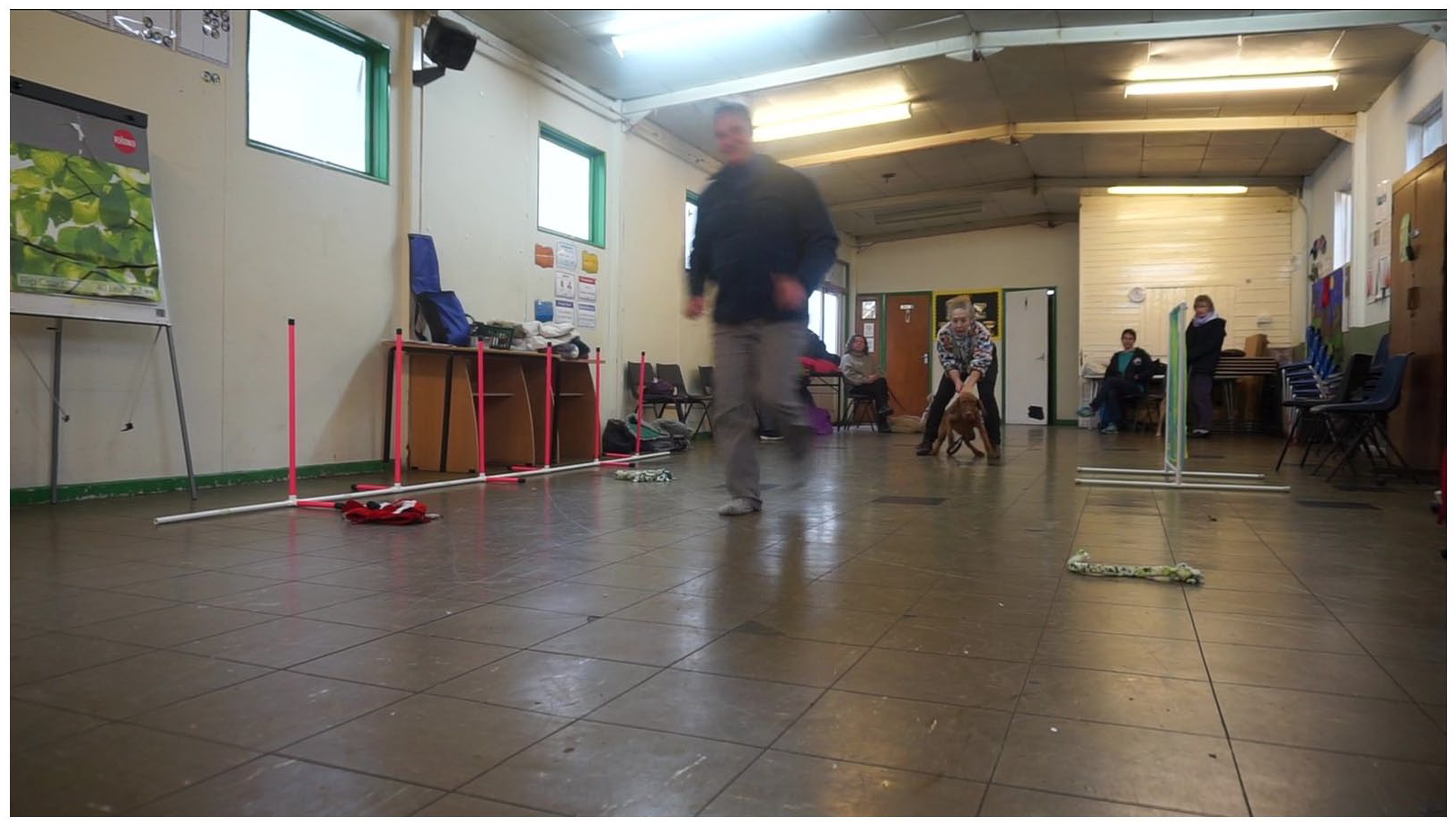
Simon runs to the other end of the room as Jojo strains at the leash; Alice: ‘Run’. (Authors’ photograph).
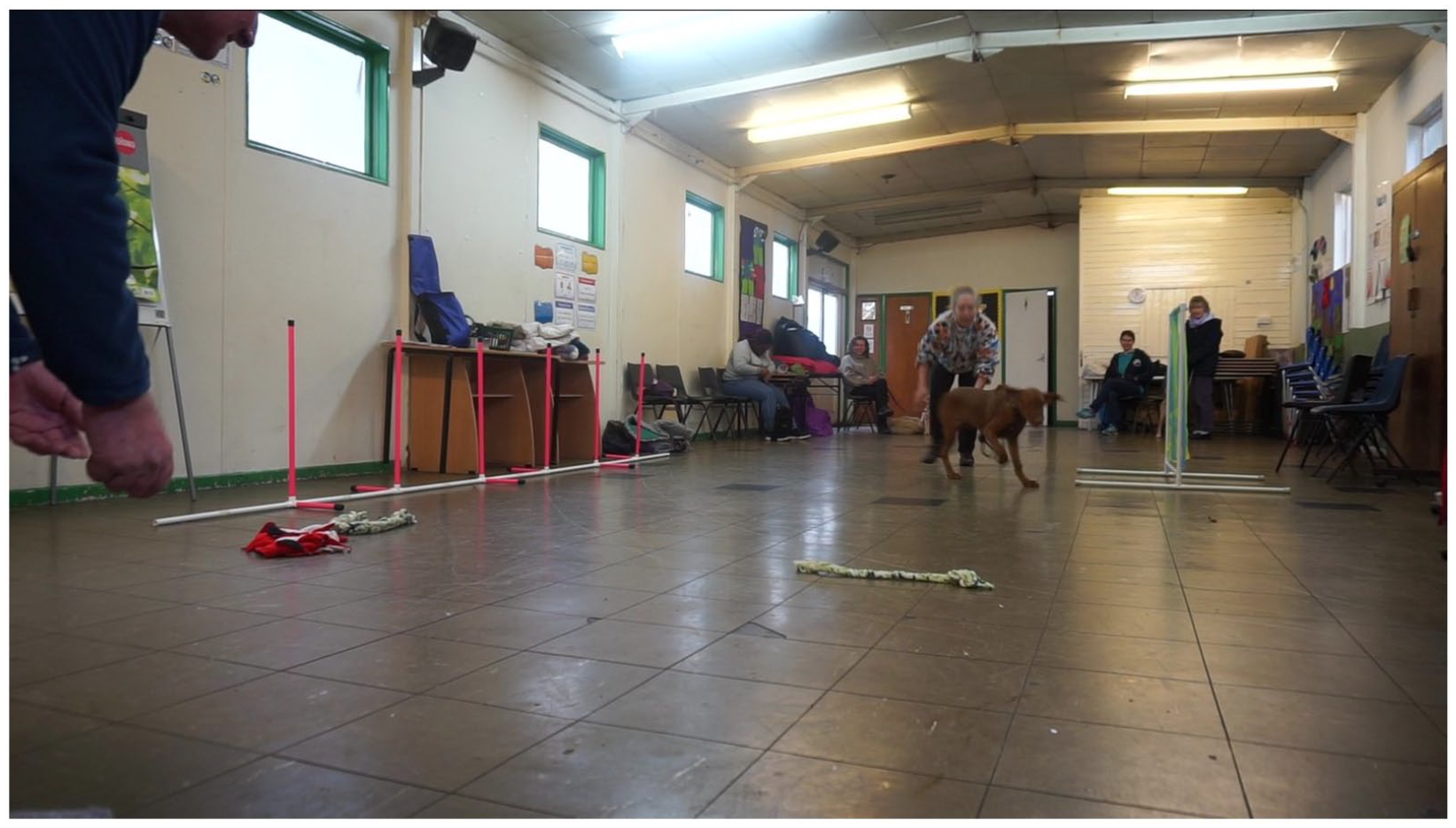
Jojo spies a tasty treat; Simon: ‘Jojo, Jojo, Jojo’. (Authors’ photograph).
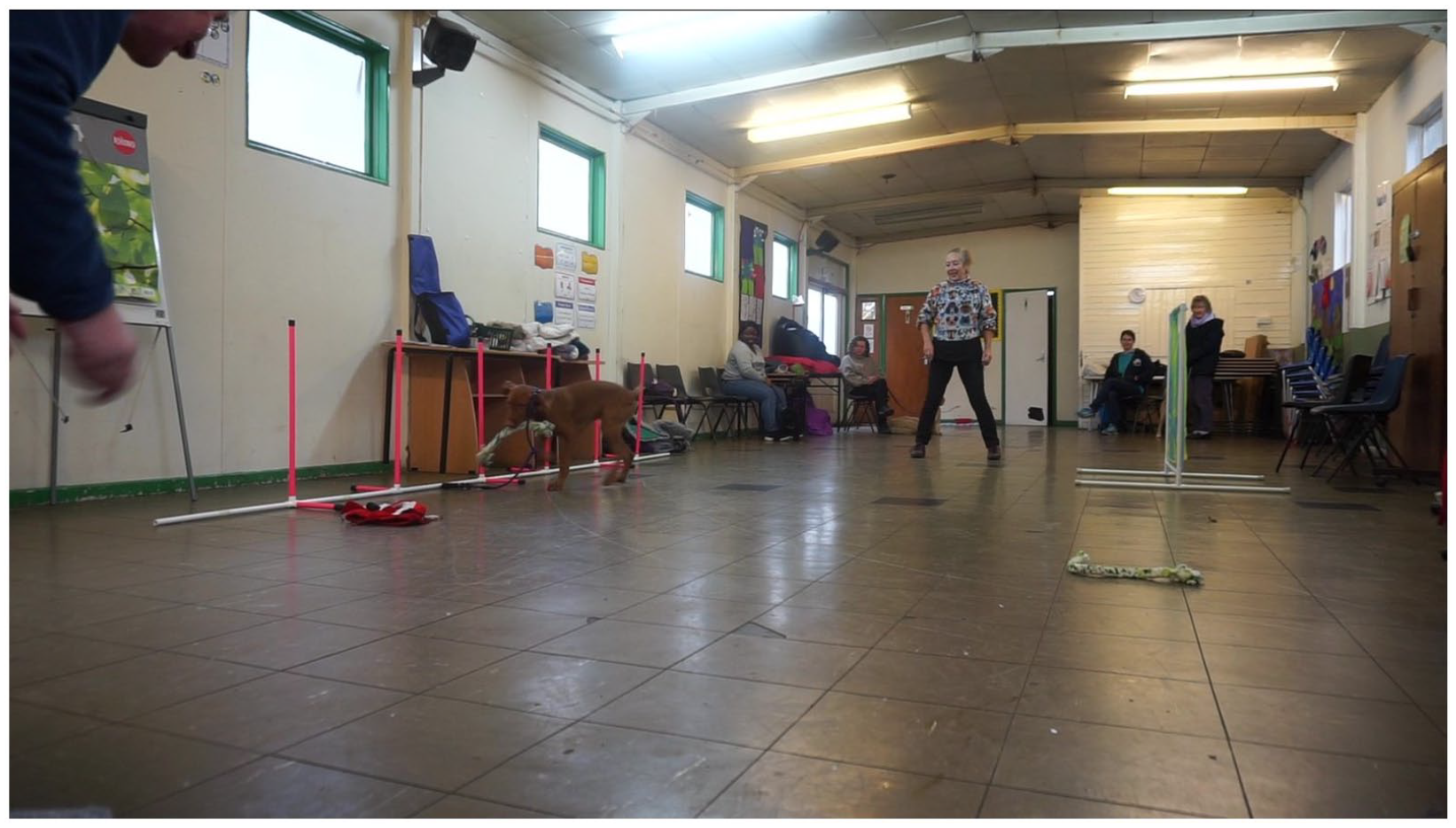
Jojo finds a toy; Simon: ‘Ahhh, Jojo’. (Authors’ photograph).
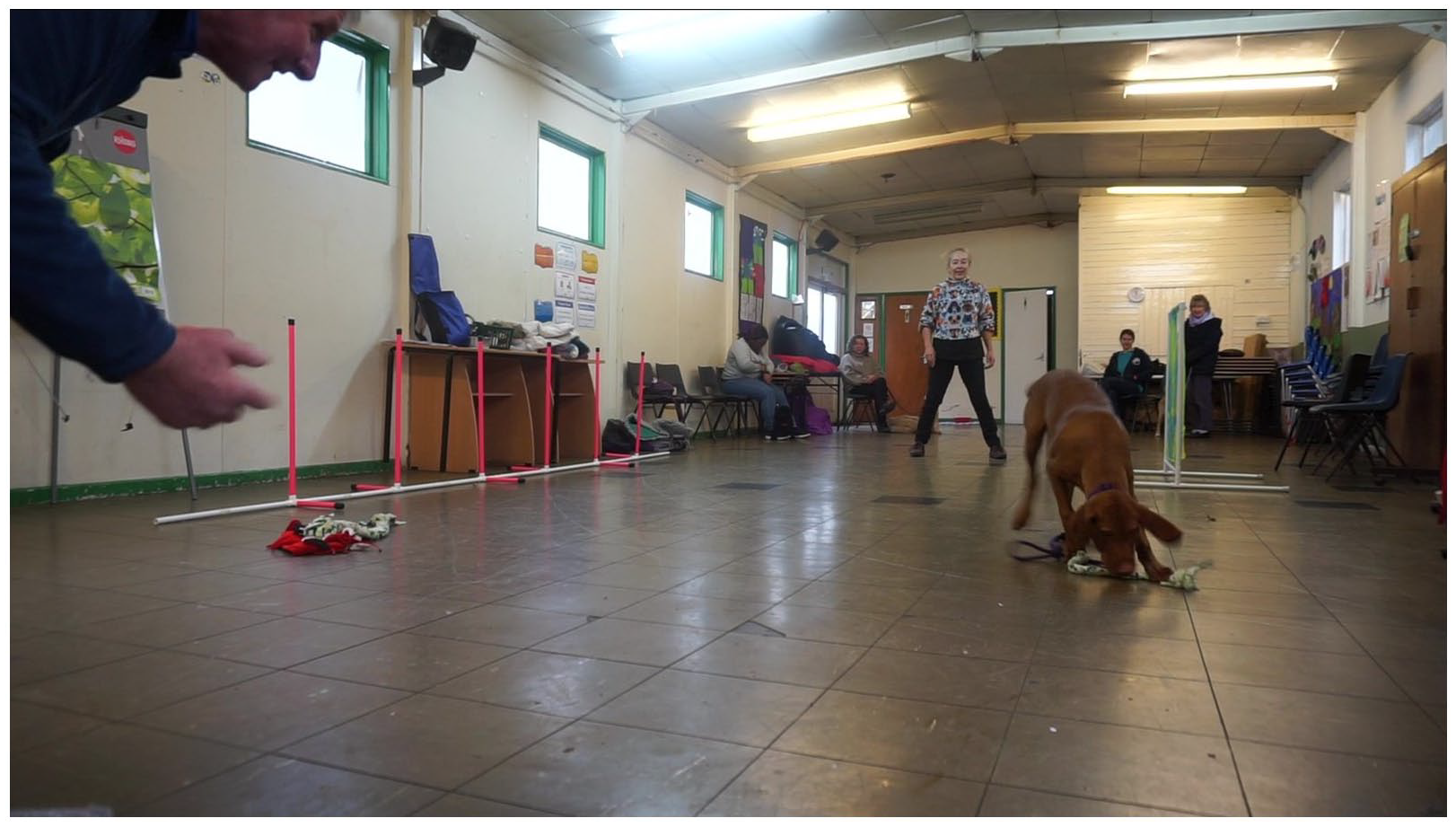
And another; Simon: ‘Jojo, Jojo’; Laughter from room. (Authors’ photograph).
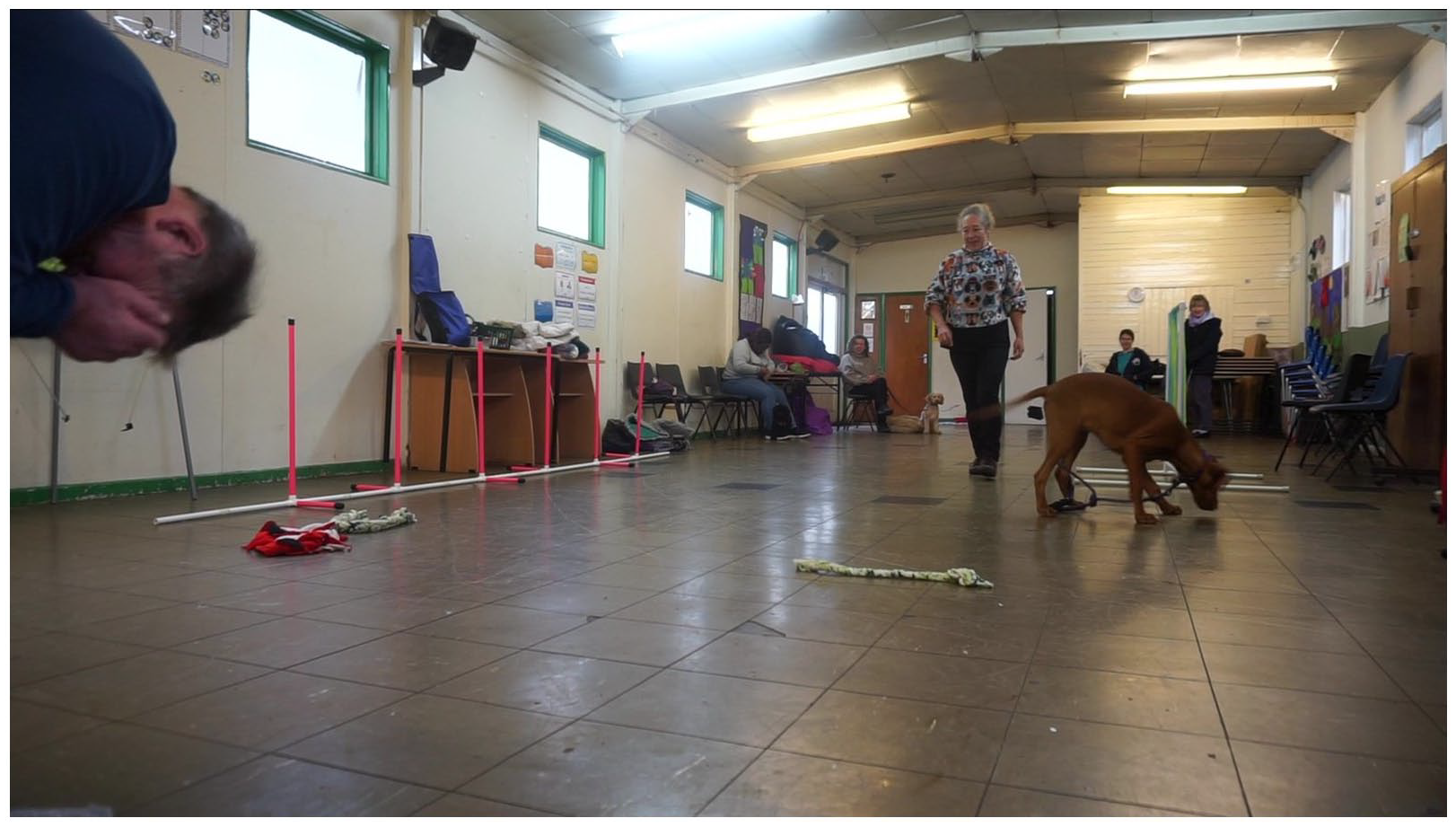
Jojo finds a treat and eats it; Simon: ‘Oh no!’ (Authors’ photograph).
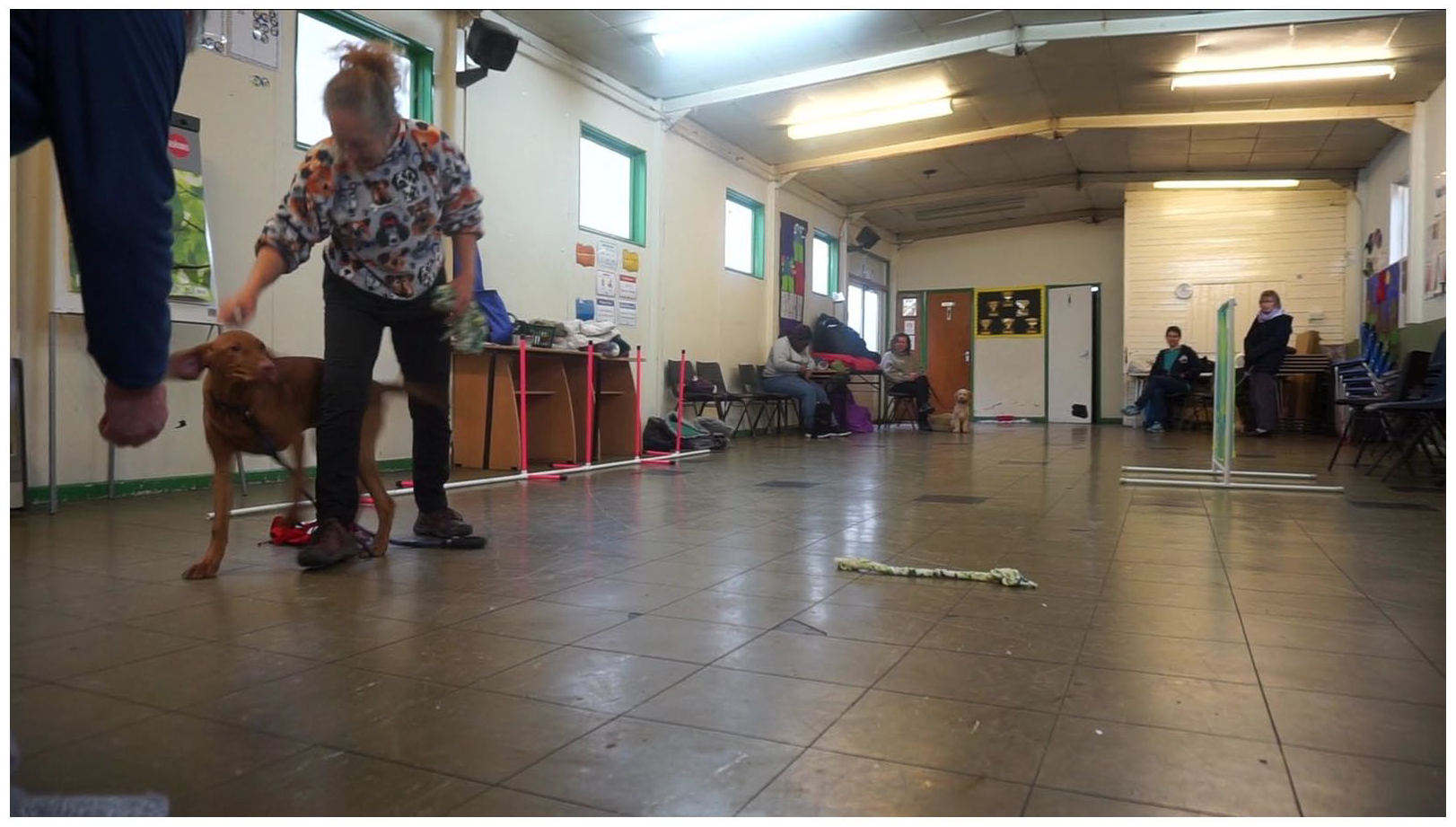
Alice retrieves Jojo; Alice: ‘Come on now’. (Authors’ photograph).
Jumping for joy
An embodied communication is more like a dance than a word. The flow of entangled meaningful bodies in time – whether jerky and nervous or flaming and flowing, whether both partners move in harmony or painfully out of synch or something else all-together – is communication about relationship, the relationship itself and the means of reshaping relationship and so its enactors.
80
Embodied multi-species communication is a skill that is learnt over time and constantly negotiated and re-negotiated within complex individual relationships, dependent on the moods and wills of the participants involved. As Haraway demonstrates in the quote above, such communication is not easy and relies on a combination of embodied gestures, learnt commands and temporal and environmental circumstances in which both partners may perform in unexpected ways. In the vignette and images below we use the example of embodied exchanges between Anna and her lively 2-year old Cockapoo Bella to illustrate the complexities of such exchanges.
That evening Sally and I had arrived early to set up an agility course, usually a favourite of both humans and canines. Bella was asked to perform a circuit of the agility equipment, including a variety of jumps, tunnels and platforms. Anna brings Bella to the starting point and attempts to get her into the sit position to begin. However, Bella has other ideas and jumps playfully at Anna to try and gain her attention. Anna’s body language shows exasperation with a hint of amusement as she attempts to ignore Bella’s advances, folding her arms and staring at the ceiling. Eventually tiring of the lack of attention, Bella retreats to the back of the room where she rolls on her back and solicits the attention of her canine friend Rio. Anna keeps her back turned and continues the cold shoulder treatment, glancing back a couple of times to check on Bella’s movements. Eventually she retrieves her with the use of a treat and manages to tempt her into the sit position. However, Bella does not remain seated for long and flies headlong into the course without waiting for instructions. Instead of clearing the first jump she runs alongside it, continuing to jump at Anna’s legs. Anna brings her back and tries a second time with the same result, struggling to contain Bella’s exuberant energy. Finally, she concedes defeat and lifting Bella into her arms returns to her seat.
Bella refuses to engage with the agility course
Here we see a clash of canine and human agencies, with Bella refusing to engage in the human defined ‘fun’ of the agility course, preferring to jump playfully at Anna rather than over the agility jumps. Her body language exudes enthusiasm and playful disobedience, her gaze firmly upon Anna, seeking her attention, whilst Anna demonstrates over-exaggerated disapproval, embodied in her attempts to ignore the behaviour rather than merit it with a response. The task here is very different to the temptation alley, requiring participants to work together to navigate a series of obstacles in the correct order and shortest possible time. The human partner must work as a guide for their dog, interpreting the verbal instructions of the trainer through the use of embodied gestures and commands. Here Anna fails, literally, at the first hurdle, with Bella finding her own pleasure in the game of disobedience – she understands the task but chooses not to participate in it. Meanwhile Anna’s amusement is barely concealed by her apparent frustration, she too appears to secretly welcome a distraction from the routine of the training class (Figures 7–12).
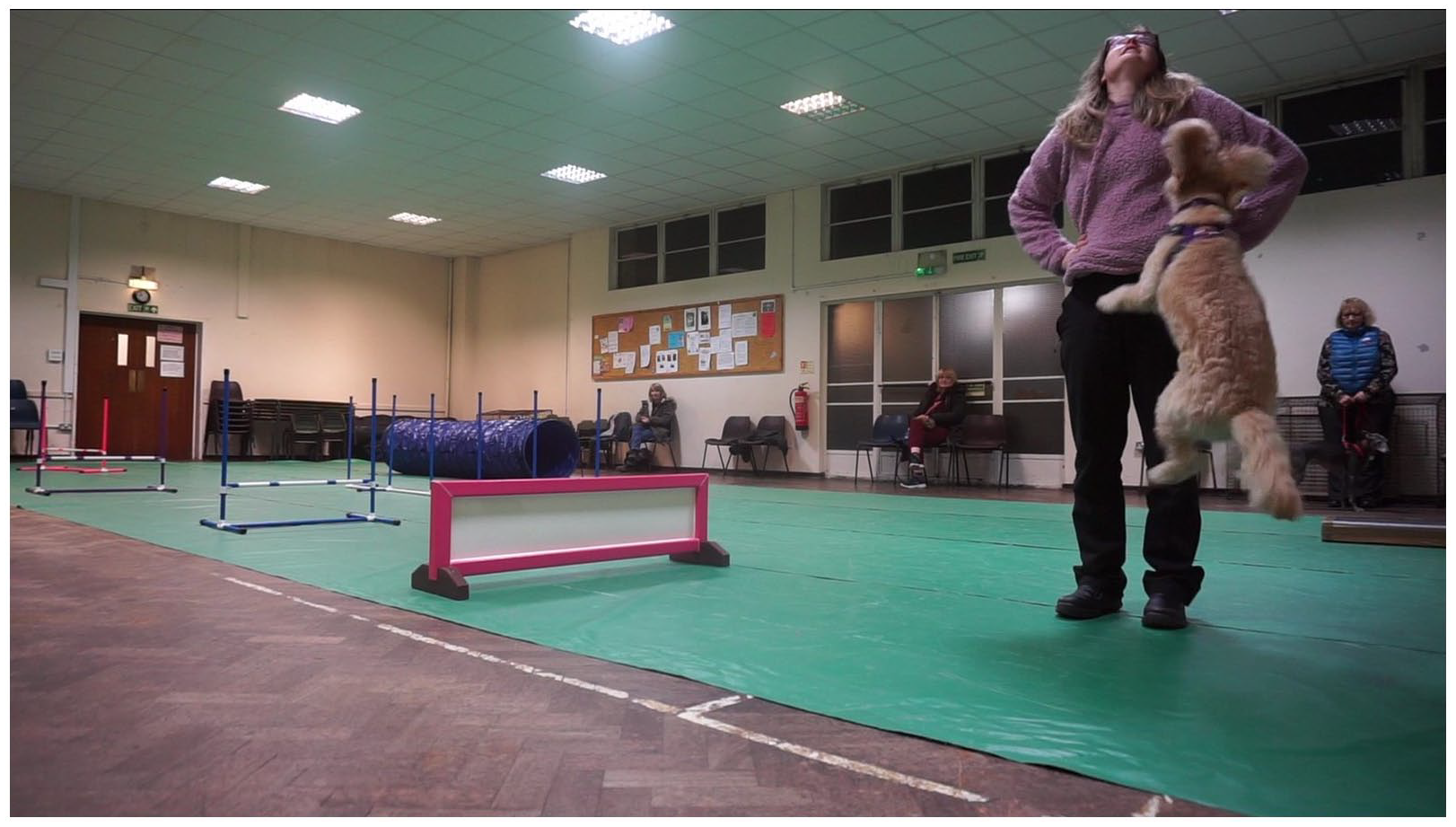
Bella jumps enthusiastically at Anna; Anna: ‘I know, I know’. (Authors’ photograph).
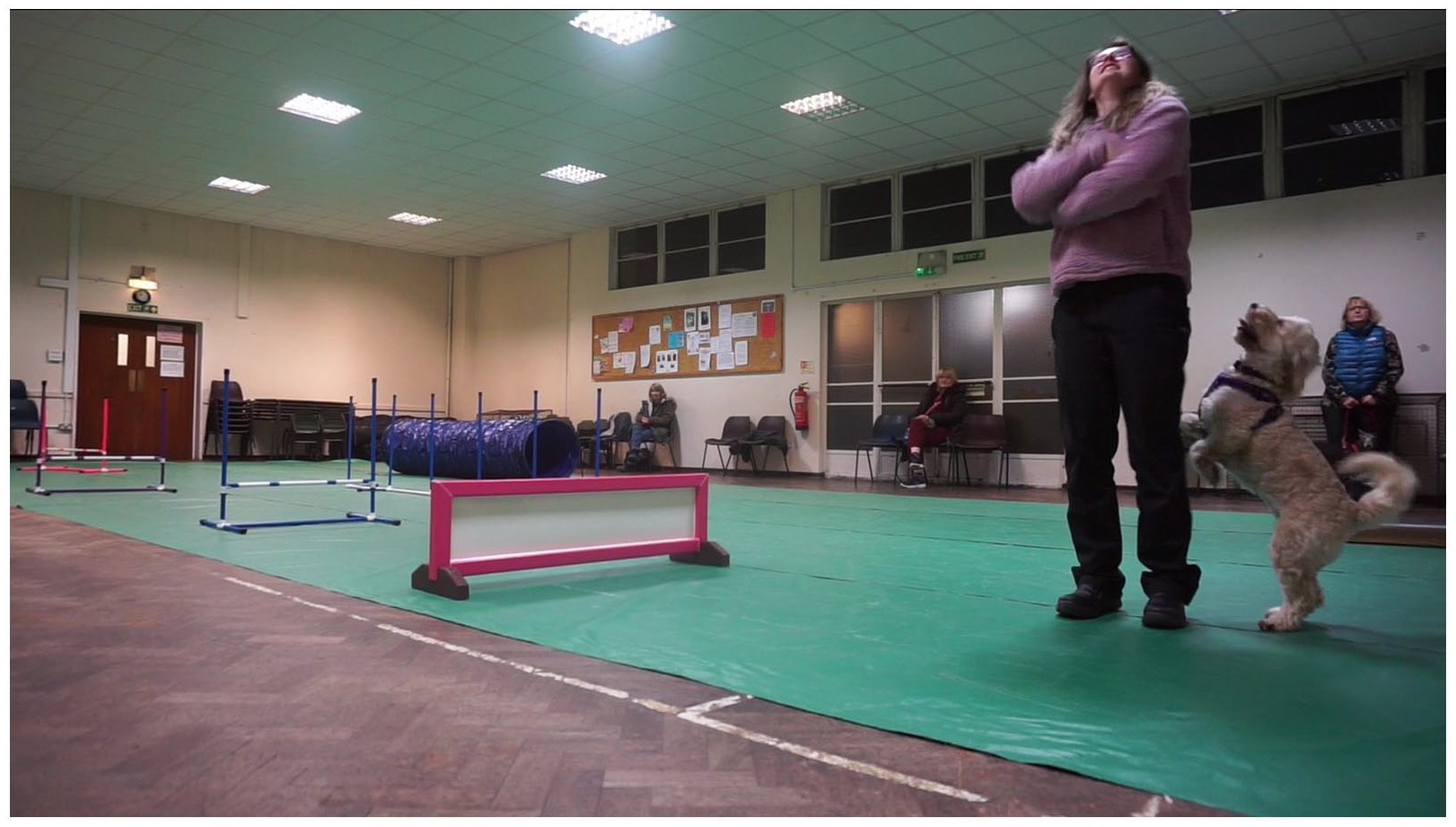
Anna ignore Bella; Silence apart from the jingling of Bella’s collar. (Authors’ photograph).
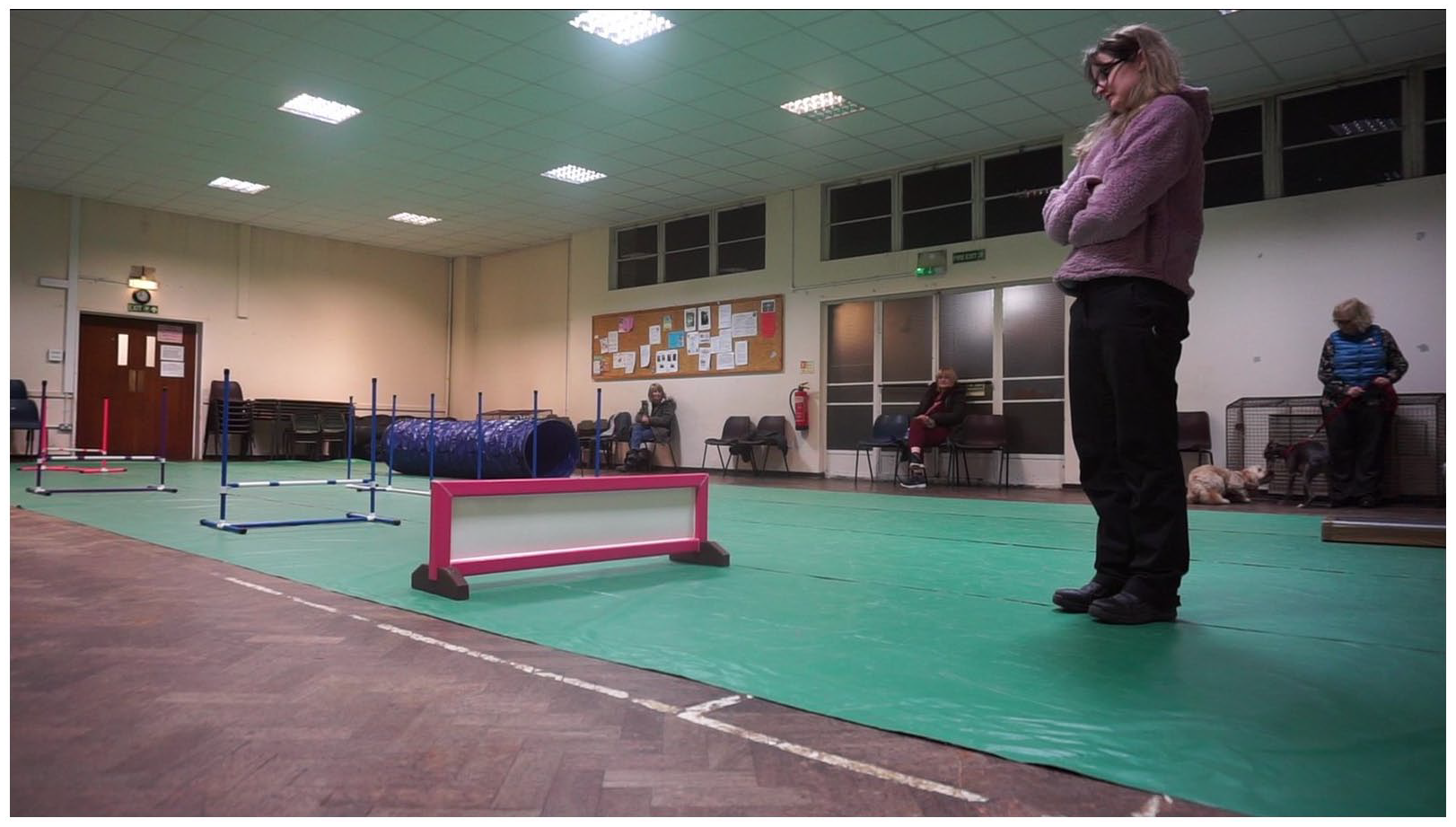
Bella visits a friend. (Authors’ photograph).
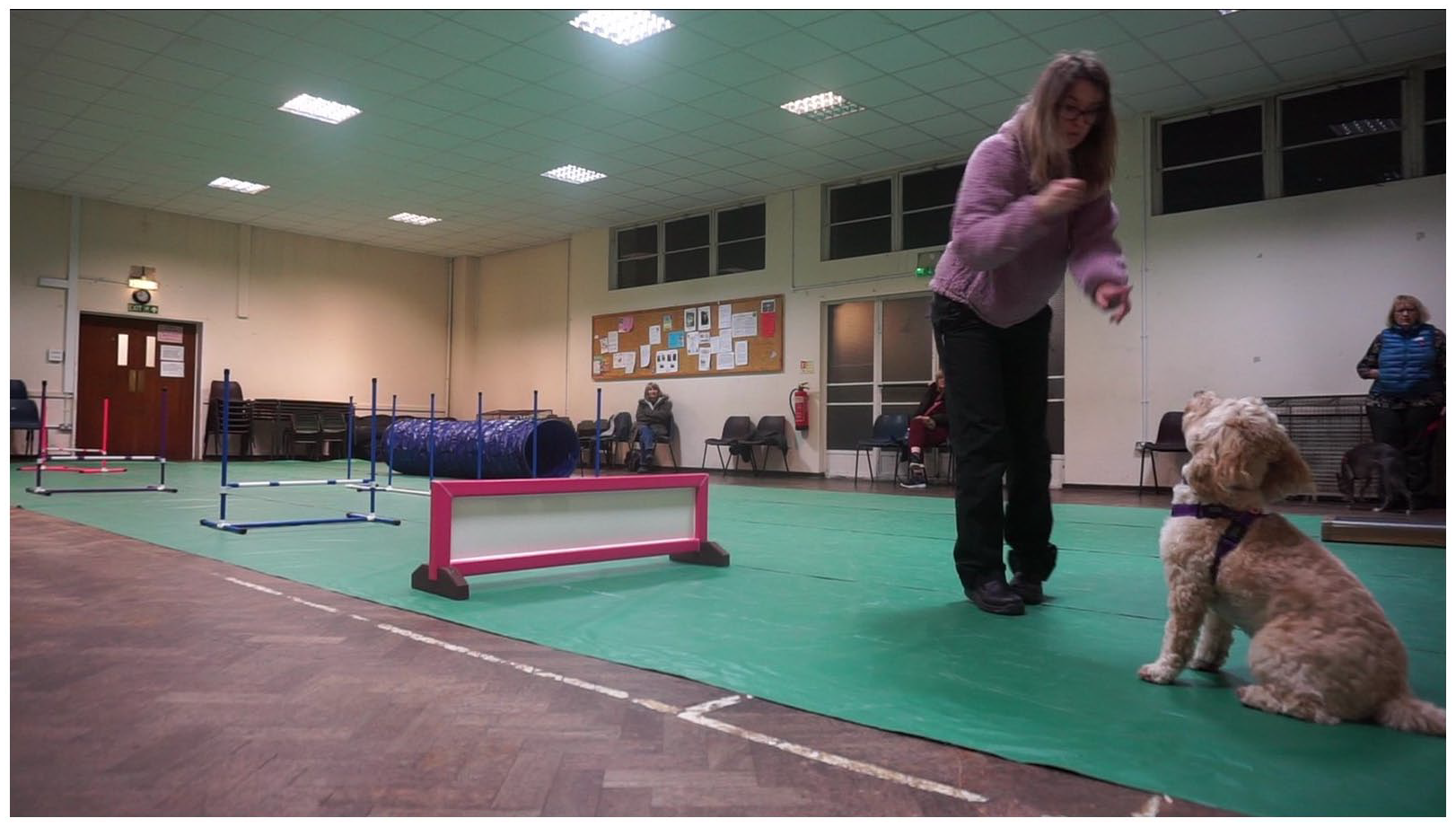
Anna gets Bella in a sit; Anna: ‘Bella, sit’. (Authors’ photograph).
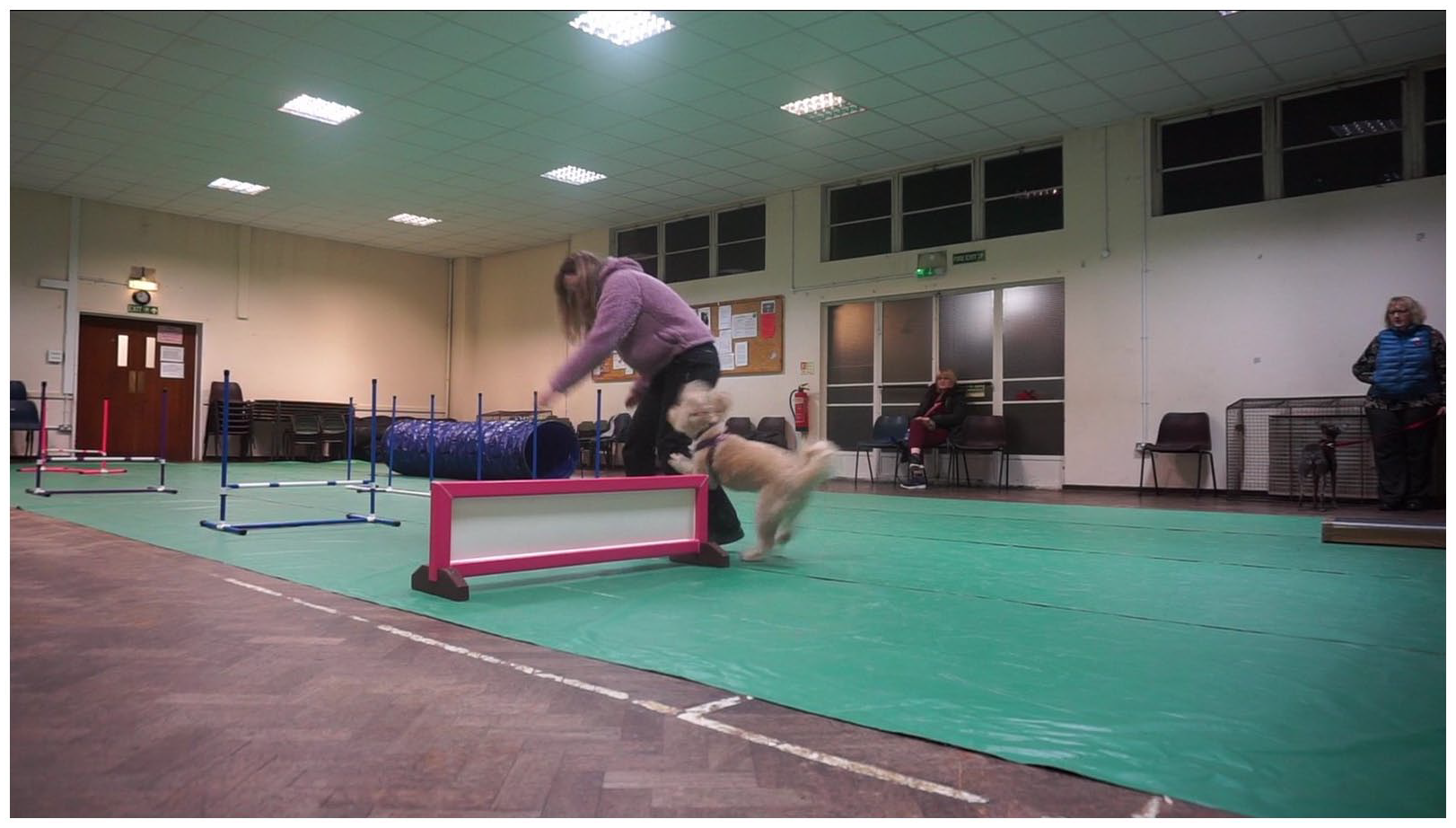
Bella avoids the jump; Anna ‘Bella, over’. (Authors’ photograph).
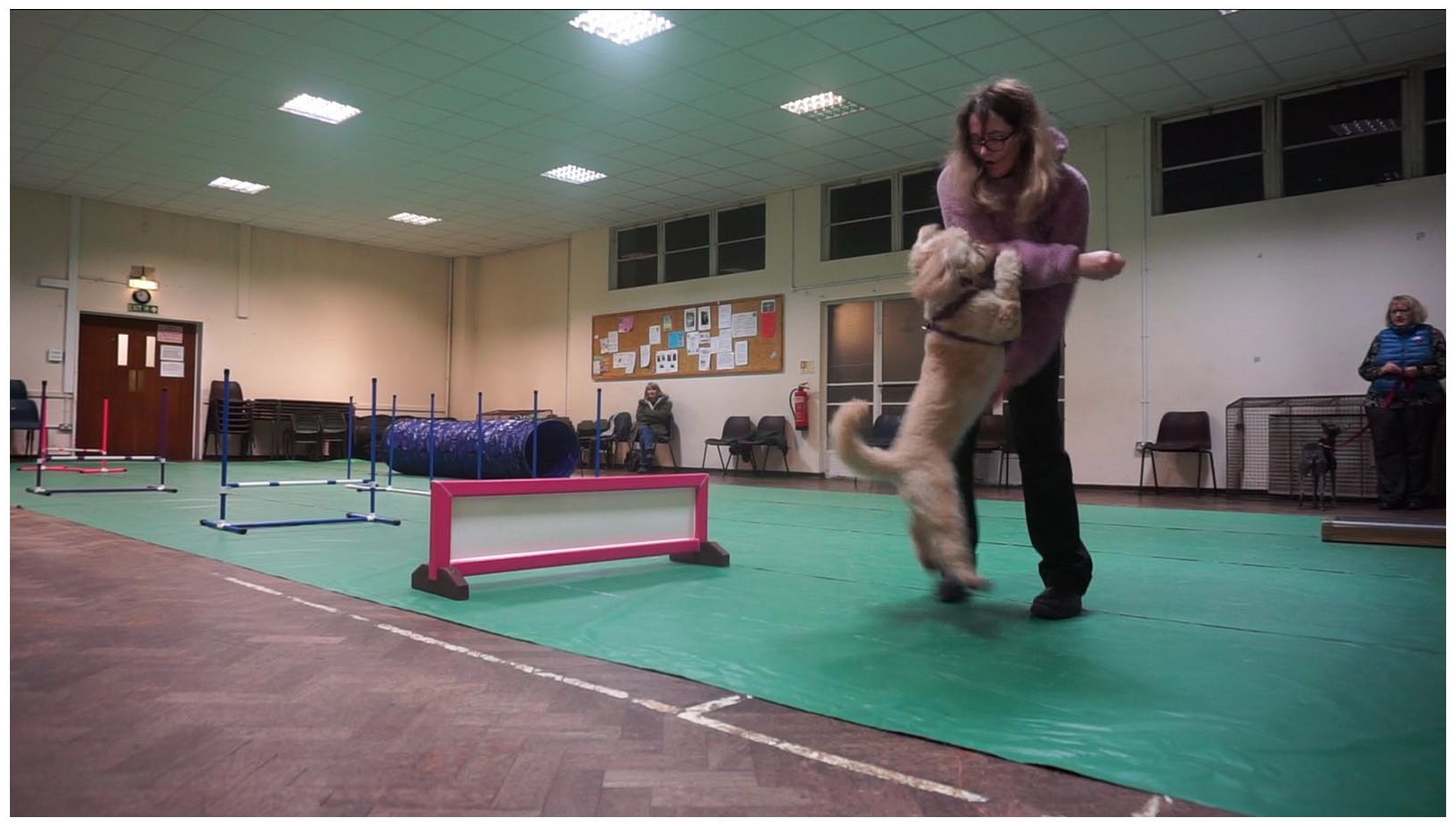
Bella continues to ignore the course; Sally ‘OK, lets have Bella last’. (Authors’ photograph).
The images ‘bring to life’ something of the playful energy as Bella jumps and rebounds off Anna, tail and ears flying, highlighting the ‘haptic visuality’ 81 of human-animal embodiment, perhaps serving as a bodily reminder of our own encounters with jumping dogs. We capture moments and gestures of inter-species (mis)communication as Anna attempts to establish a connection with Bella, bending her body slightly and pointing to hold her in the sit position before gesturing her over the jump, Bella leaping around her ankles. The images also reflect something of the wider training atmospheres, the shabby walls and stale atmosphere of the hall, the artificial glare of the strip lighting and the watchful gaze of the other participants as Anna and Bella perform on the green matting in the centre. What they do not convey are the sounds and smells of the training environment, the damp cold of the hall on this winter’s evening, the barking and whining of canine observers and lingering odours of treats and wet dogs.
Bella performs successful agility jumps
On the second attempt at the agility course we see an entirely different situation with Bella clearly focussed on the task in hand. We see moments of connection and engagement as Bella follows the movements of Anna’s body and gestures of her hand, concentration on her face as she flies over the jumps with ease. Her gaze is fixed upon Anna, but she is also looking ahead to the coming obstacles, continuing the jumps beyond Anna’s guidance, both taking the task seriously. As Goode 82 notes play is both fun, but also a serious matter for dogs, and they learn the rules governing different types of play situation. The differential camera angle adds to this feeling of togetherness, focussing upon the connection between the two bodies rather than the distractions of the wider training environment; this demonstrates the capacity of images to provide different ‘versions’, rather than ‘more truthful’ representations, of reality (Figures 13–15). 83
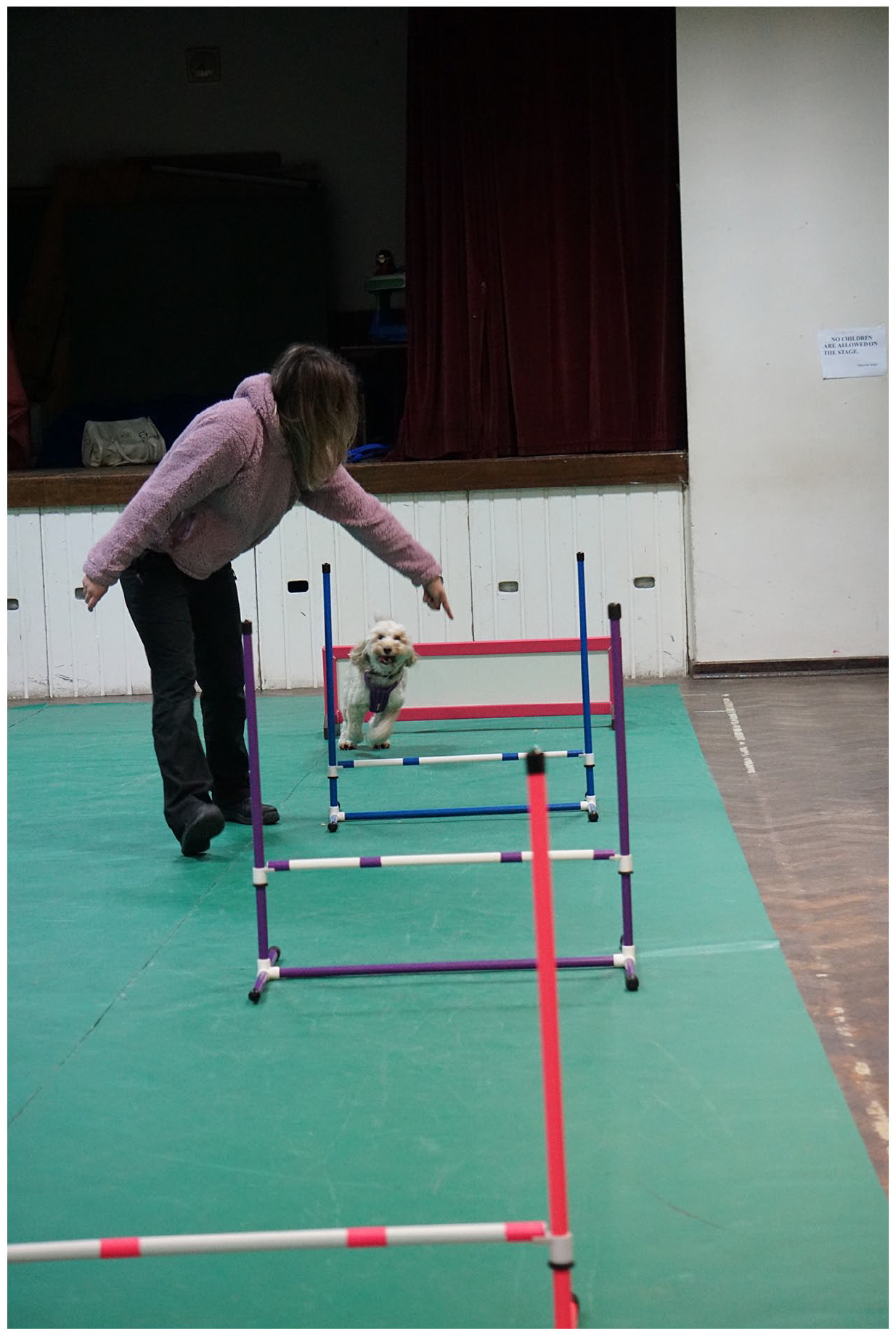
Bella follows Anna’s directions. (Authors’ photograph).
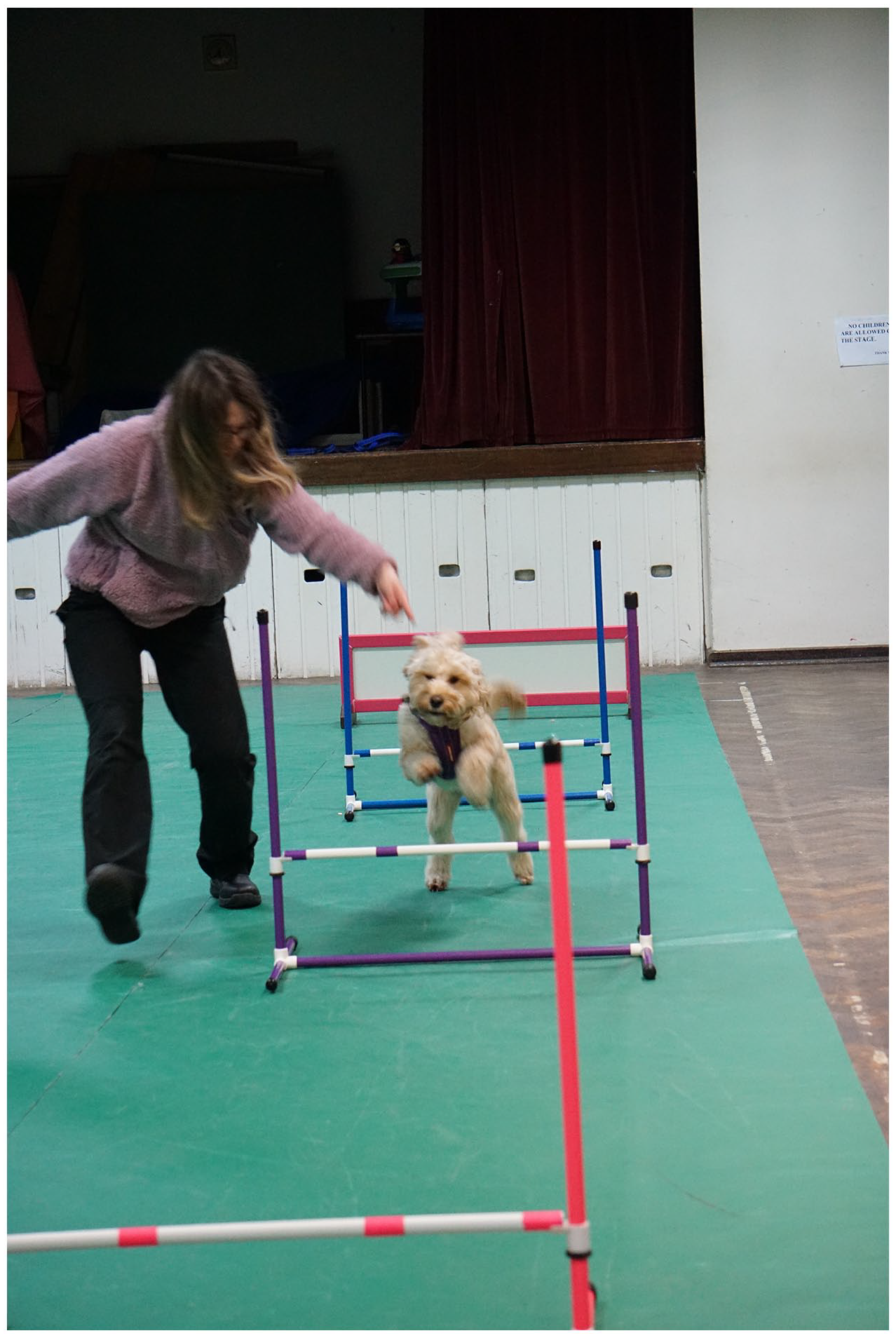
Bella flies over the jumps with ease. (Authors’ photograph).
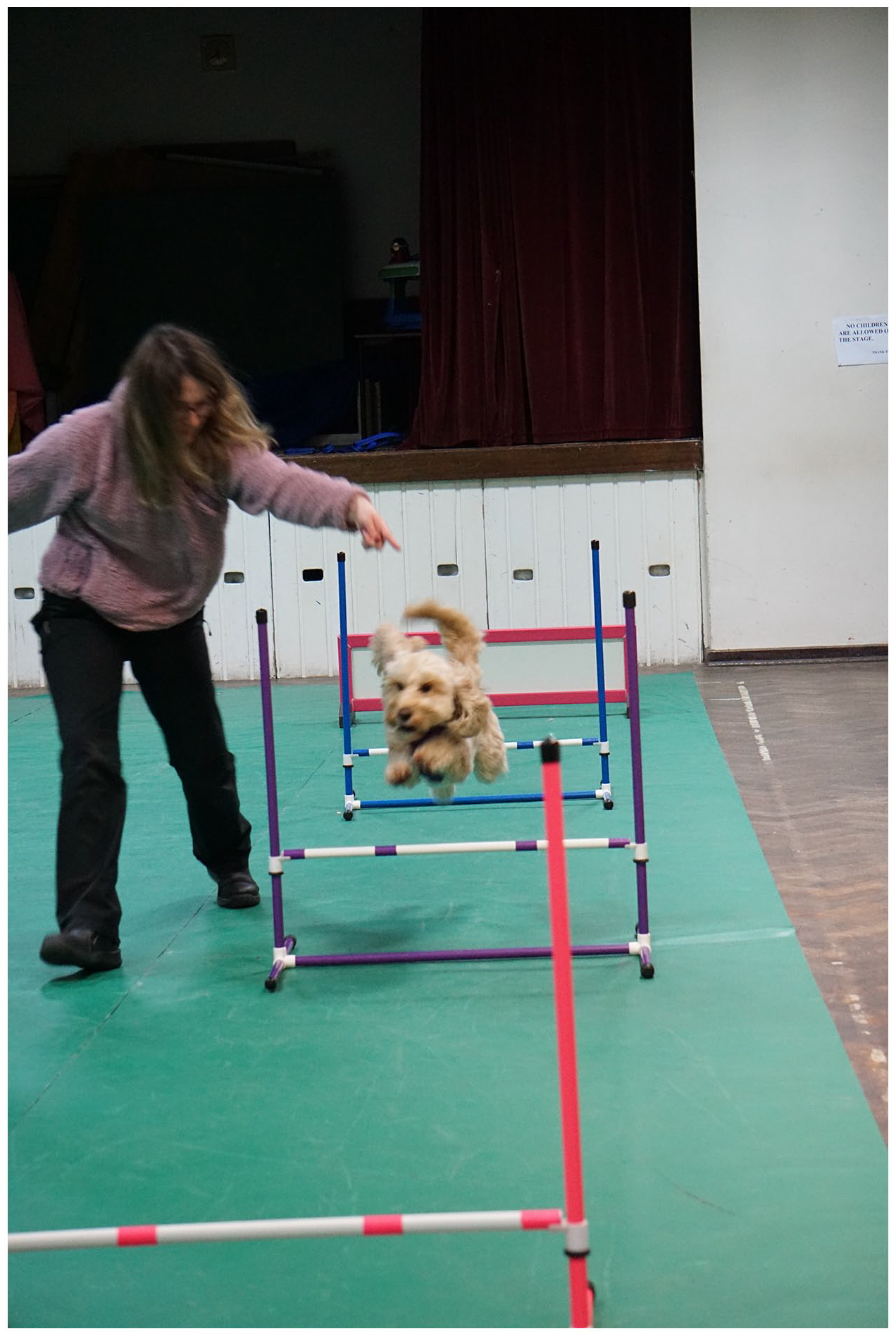
Bella continues to focus on the course ahead. (Authors’ photograph).
Here two bodies move in harmony rather than out of sync, embodying one another’s capacity for dogness/humanness 84 and transforming each other in the process.
Meaning is mutually constituted, literally embodied as two individuals’ behaviours (“the parts”) combine to create something new (“the whole”). I use the term embodied communication to refer to interactions whose meaning lies more in such emergent properties than in the lower-level, individual actions of the participants.
85
This second vignette demonstrates the possibilities inherent in the study of intricate bodily interactions, highlighting the relational agency through which bodies make and re-make one another through the training process. In the final section we move on to discuss the overall contributions of the paper and the ways in which detailed ethnographic accounts of training relationships can add to geographical literature on inter-species communication.
Conclusions
This paper draws upon previous work in multi-species ethnography to examine the possibilities of embodied ethnographic and visual research methods for understanding the complex cultures of dog training. We explore the training class as a multi-species event in which communicating creatures learn together, appreciating one another’s perspective and becoming literally more ‘dog-human’ or ‘human-dog’ in the process. Through ‘attunement’ 86 of our own bodies (and camera) to the training process, we reveal the intricacies of embodied communication through which participants shape one another and attend to the sensory and affective dimensions of the training environment. In doing so we make several contributions to the literature on multi-species relationships.
Firstly, drawing upon calls for methods that are more attuned to the ‘beastly places’ of animals themselves 87 we have explored the importance of attention to bodies (human and canine) in both the training and research process. We have shown how deep ethnographic involvement of the researcher’s own body can draw attention to the everyday forms of embodied communication that are so important to interspecies relationships and have discussed how visual methods contribute to understanding the ‘performative, haptic and affective dimensions’ 88 of human-animal interaction. Through the use of thick description and visual representation we have attempted to move beyond traditional written or verbal sources such as interviews to capture something of the ‘animal’s point of view’, creating possibilities for less human-centred research methods.
Secondly, we have argued that practical experience of living and working with animals is key to understanding their ‘characteristic behaviours, temperaments and sensibilities’ 89 and that trainers often act as mediators between humans and animals, interpreting canine body language and advising human companions on corporeal communication. Similarly, trainers work with dogs, communicating human intentions through practical demonstration and split-second timing of rewards, adapting their techniques to the requirements of particular individuals. This three-way communication is key to the success of training relationships, as participants engage in a variety of tasks through which they learn to work together and appreciate one another’s unique skills and qualities.
As researchers we can learn from the trainers’ tacit and experiential knowledge 90 paying attention to the involvement of our own bodies in the research process.
Attending with one’s body goes far beyond just looking toward or gazing at; it means turning a full bodily engagement toward others, it means that our very own bodies can actually tell us something about others and about the world if we are attentive to it and them.
91
In a similar manner to Moore and Kosut’s study of bee-keeping practices, 92 we attempt to become ‘dog-centred’, learning from both our human and non-human teachers 93 to attune ourselves to canine emotions, preferences and bodily communications, developing appropriate corporeal and ethical responses. Such practical embodied engagement provides a valuable opportunity for creating ‘lively ethnographies’ 94 of human-animal relations that go beyond verbal interpretations of animal behaviour.
Thirdly, we have explored the various modes of embodied communication that operate within training relationships, using a combination of visual and ethnographic methods to reveal the details of these which are often hard to articulate or reproduce. Training relies on both verbal and non-verbal communication, including body language, tone of voice, posture, gesture, touch, smell, play, various training tools (including treats, toys, balls) and the immediate training environment. Successful training requires ‘attunement’ to the bodily experiences of other species on the part of both dogs and humans and the creation of shared embodied ‘languages’ 95 through which relationships of trust and reciprocity are formed. This involves awareness of the differential ways in which humans and canines experience the training situation and the potential for frustration and disconnection if we fail to appreciate one another’s ‘point of view’. 96
In discussing training practices we are aware of the unevenness of the processes of becoming ‘more human-dog’ or ‘more dog-human’, which pose a greater demand on canine than human participants. The training techniques discussed above, even if non-coercive and playful, are never entirely innocent and often work with canine sensibilities to shape their behaviour to human desires. However, they are productive in reminding us of the need to become (at least a little bit) dog and see the world from a less anthropocentric perspective.
In paying attention to the intricate details of corporeal communication within the specific site of the dog training class we have demonstrated the possibilities of embodied learning for decentring the human in inter-species research. Through active engagement of our own bodies in the research environment we have not only gained a deeper understanding of human-animal communication, but embodied a new way of being, appreciating the multi-sensorial dimensions of training relationships and transforming ourselves in the process. Drawing upon ethnographic vignettes, photos and video stills we have provided fleshy empirical examples of interspecies (mis)communication and highlighted the importance of body language, sound, touch, smell and atmospheres in the creation of shared knowledges. Such understandings reveal the practices through which ‘feeling/thinking/seeing bodies undo and redo each other, reciprocally though not symmetrically’ 97 in a way that changes who and what they become together. We hope that these findings can contribute to a rich and ever-expanding literature on embodiment and multi-species ethnography, highlighting the possibilities of combining visual, spoken, sensual and ethnographic material for revealing a less anthropocentric understanding of inter-species relationships.
Footnotes
Acknowledgements
The authors would like to thank all the human and canine participants for allowing us to take part in the training classes and learn about inter-species communication together. We would also like to thank the three anonymous reviewers and editor Dydia DeLyser for your thoughtful and generous feedback on the paper. Finally we would like to thank the Leverhulme Trust for the funding that made this project possible and our families and friends (human and non-human) for supporting us throughout the research and writing process.
Funding
The author(s) disclosed receipt of the following financial support for the research, authorship, and/or publication of this article: This research was funded by the Leverhulme Trust award number RPG-2017-219.
