




Abstract
Throughout the COVID-19 pandemic, celebrities occupied a highly contested space within the popular and political imaginary. Whilst the mass suffering unleashed by the pandemic led some to herald the death of celebrity culture, many celebrities also took part in fundraising initiatives, public health campaigns and philanthropic ventures, with some taking on the status of ‘national treasure’. This article examines two such figures who gained particular luminosity as ‘Covid Heroes’ for their charitable and campaigning work during the pandemic: war veteran Sir Captain Tom Moore and footballer Marcus Rashford. Through a discourse analysis of UK national newspaper articles and television documentaries, we consider what ideological work these celebrities perform within times of heightened crisis. The article expands upon Chris Greer and Eugene McLaughlin’s theorisation of the ‘national treasure’ in a number of ways, considering how, in ushering forth particular ideas about the nation, these figures secure or contest contemporary welfare imaginaries. Identifying how Rashford and Moore play a crucial role in what Stuart Hall called ‘scripting a national story’ within the pandemic, the article highlights the significance of ‘crisis celebrity’ as a site of hegemonic struggle over national identity, welfare, deservingness and belonging.
Introduction
Throughout the COVID-19 pandemic, celebrities occupied a highly contested space within the popular and political imaginary. On the one hand, the global suffering unleashed by the pandemic saw celebrities vilified as ‘out of touch’ and sheltered from the worst effects of national lockdowns, economic downturns and buckling healthcare institutions. Concurrently, celebrities took part in fundraising initiatives, public health campaigns and philanthropic ventures, with some taking on the venerated status of ‘national treasure’, applauded by media institutions, politicians and the general public alike. This article examines two such figures who gained particular visibility and admiration in the UK for their charitable and campaigning efforts during the pandemic.
Tom Moore, popularly known as ‘Captain Tom’ or latterly ‘Sir Tom’, was a British war veteran who came to global fame when, approaching his 100th birthday, he raised close to £39 million for the NHS by walking 100 lengths of his garden. Moore also released a charity single and a foundation was set up by his family in his name. 1 In January 2021 Moore tested positive for COVID-19, and died in February 2021. Marcus Rashford’s celebrity was initially secured pre-pandemic through his career as a professional footballer. However, during the pandemic Rashford achieved a new level of visibility and status elevation as a poverty campaigner and vocal critic of the Conservative government, who initiated a policy U-turn over the provision of free school meals.
Whilst occupying distinct relationships to celebrity, Moore and Rashford were commonly labelled ‘Covid Heroes’ (Petter, 2020). They regularly featured together in media articles celebrating extraordinary and inspirational individuals who symbolised the best of the nation, such as The Daily Telegraph’s ‘feel-good power list [of] people making a real difference during the corona crisis’ (Dunn, 2020). Their hypervisibility and elevation to the status of ‘national treasure’ during the pandemic warrants critical attention. Indeed, what does it mean to make someone exemplary of the nation? Through a discourse analysis of national newspaper coverage and television documentaries about Moore and Rashford, we consider how their celebrity secures and contests hegemonic ideas of the nation and welfare within times of heightened crisis. To do so, we expand upon Greer and McLaughlin’s (2020) theorisation of the ‘national treasure’ as an ‘ideological assemblage’ by bringing this into conversation with scholarship on the hegemonic function of celebrity, including ‘celeb-philanthropy’, within contexts of welfare reform (Allen et al., 2014, 2015; Jensen & Tyler, 2015; Littler, 2015; Martin, 2022). Sociologies of race, ethnicity and nationalism (Bhambra, 2022; Gilroy, 2004a, 2004b; Hall, 1993; Valluvan, 2019a; Virdee & McGeever, 2018) are also drawn upon as theoretical resources to help illuminate the ideological work these figures perform.
Our analysis demonstrates how Moore and Rashford played crucial roles in ‘scripting a national story’ (Hall, 1993) within the pandemic, and we argue that their mediation as ‘crisis celebrities’ reveals multiple contestations and struggles over national identity, welfare, deservingness and belonging. We first show how Moore became a vehicle for the veneration of public giving and resurgence of ‘Big Society’ rhetoric, rooted in a romanticisation of the NHS as a source of national pride. We also demonstrate how Moore’s celebrity upheld ideas of nationhood rooted in war-time nostalgia and imagined ethnic commonality. By contrast, Rashford’s pro-welfare demands and critiques of the UK government, although fragile, challenged the anti-welfare orthodoxy of neoliberal austerity. We argue that Rashford’s celebrity contests hegemonic visions of nationhood, dominant welfare imaginaries and the classed and racialised exclusions underpinning them, in favour of cultivating a working-class multiculture built on notions of care and collectivism.
Theorising the national treasure
Focusing on the British film and theatre actor Dame Judy Dench, Chris Greer and Eugene McLaughlin (2020) offer the first critical analysis of ‘national treasures’: a status of celebrity they designate as an ‘elite within an elite’. They contend that the national treasure is more than just a ‘trite term of endearment’, but ‘an ideological assemblage in contemporary Britain, invested with significance’ (2020, p. 71). They state: . . . national treasures . . . are powerful signifiers of all that is claimed to be exceptional in the British national character. Validated by the interlocking centres of power and authority that constitute the fabric of British public life, national treasures become national institutions in themselves. Like all national institutions, they undertake important ideological work. (2020, p. 83)
Their work trains our eye to consider what ideological work this category of celebrity performs. In particular, in arguing that national treasures play a role in the ‘scripting of a national story’ (Hall, 1993), Greer and McLaughlin prompt us to ask: What does the designation of particular public figures as national treasures tell us about how the nation imagines itself ?
Greer and McLaughlin identify three mechanisms of validation that work together to produce consensus around the designation of individuals as national treasure: peer (awards and praise from fellow celebrities); state (namely through the British honours system); and the media (not just media exposure but universal media admiration and affection). This model is highly instructive to how we make sense of both Moore and Rashford, who were frequently heralded as national treasures by the media, state and peers. However, as we demonstrate, the level of consensus around their status designation was not equal, and the contestations and conditionality around their designation as a national treasure is crucial to understanding their ideological function.
We expand upon Greer and McLaughlin’s theorisation in several ways. First, we identify the general public as playing an important role in designating celebrities as national treasures, alongside – and sometimes against – the media, state and peers. Second, we expand their schema to include other categories of celebrity. Rather than focus on members of the elite ‘celebritocracy’ associated with ‘high culture’, we examine individuals with a different relation to celebrity, including so-called ‘ordinary’ people who become unexpectedly celebritised (i.e. Moore) and those famous for work in one field but who become endowed with national treasure status through work in another (i.e. Rashford). As their heightened visibility and status were tied directly to a moment of national crisis (i.e. the pandemic), we locate these as ‘crisis celebrities’. In shifting the focus to different categories of celebrity, we aim to expand understandings of the ideological work undertaken by national treasures, including those with more fleeting and perhaps unexpected national treasure status.
Third, our analysis considers the particular role played by national treasures within the context of the COVID-19 pandemic when ‘the nation’ was deemed under threat, both literally (as the virus impacted populations and economies) and symbolically (with national governments scrutinised on the global stage for their handling of the pandemic). Moreover, the pandemic emerged into a post-Brexit referendum landscape of already-revitalised assertions and struggles over national identity, heightened anti-migrant sentiment (Elias et al., 2021; Virdee & McGeever, 2018), and what Sivamohan Valluvan calls a ‘nationalist resurgence’ (2019a, p. 4). Locating our analysis squarely within a context of competing and contested nationalisms, we illustrate how these celebrities’ mediation reanimates, reconsolidates and in some instances undoes hegemonic notions of national identity. Here, we use Stuart Hall’s conceptualisation of the nation state as not simply a political entity but ‘always also a symbolic formation – a system of representation which produced an “idea” of the nation as an imagined community’ (1993, p. 355). We are led by questions of who forms the imagined community enacted through each celebrity’s status as national treasure and what affective registers they operate through.
Finally, we consider the relationship between national identity and welfare. Here we draw on feminist scholarship which highlights how celebrity – and popular culture more widely – operates ideologically within conjunctures of welfare retrenchment to solidify ‘anti-welfare commonsense’ (Jensen & Tyler, 2015; see also: Allen et al., 2014, 2015; Littler, 2015; Martin, 2022). We thus consider the ideological significance of Moore and Rashford in the context of complex and shifting welfare imaginaries throughout the pandemic. Indeed, some scholars have suggested that the pandemic has unsettled the anti-welfare orthodoxy that characterised the austerity years (Orton & Sarkar, 2023), and saw a (partial) reinvigoration of a public appetite for, and pride in, the welfare state. However, others have cautioned against such claims, pointing to the fleeting and surface level nature of such gestures of public support (Wood & Skeggs, 2020) and the endurance of logics of conditionality and ‘covid exceptionalism’ (de Vries et al., 2021) throughout the pandemic. Contributing to these debates, we ask therefore, how do these figures, in ushering forth particular ideas about the nation and belonging, also secure – or contest – contemporary welfare imaginaries?
Methods
Our analysis focuses on news coverage of Moore and Rashford in UK national newspapers during the first 12 months of the pandemic, beginning in March 2020. This was supplemented by selected prime-time television programming about Moore and Rashford: Captain Tom: We Salute You (2020, BBC); The Life and Times of Captain Sir Tom (2020, ITV); and Marcus Rashford: Feeding Britain’s Children (2021, BBC). Our analysis focused predominantly on traditional media rather than social media. This enabled us to generate a manageable data set, whilst also recognising that these platforms remained particularly significant sources of information during the pandemic and lockdown. However, the interactive, hybrid nature of the contemporary media landscape meant that social media (including tweets from or about these celebrities) were incorporated into the texts we analysed. Nevertheless, recognising that social media are an increasingly important site for the circulation – and contestation – of dominant discourses of celebrity, welfare and nationhood, we see value in future research which attends specifically to the mediation of national treasures across digital culture.
We used the online media database LexisNexis, designing a sampling frame that allowed us to generate a manageable corpus of data whilst identifying key patterns in how these celebrities were constituted in UK media over the course of the pandemic. We limited our sample to the four most read national newspapers: (1) The Daily Mail/Mail Online/Mail on Sunday; (2) The Guardian/The Observer/Guardian online; (3) The Sun; and (4) The Telegraph/Sunday Telegraph/Telegraph online. These publications represent diversity in terms of political orientation and placement across the tabloid–broadsheet spectrum. For Rashford, we searched his name plus ‘food’ to attempt to eliminate articles focusing solely on football, resulting in 517 articles for analysis. For Moore, we used his name plus ‘NHS’, resulting in 280 articles for analysis. To ensure relevance, we removed duplicates and articles where the celebrities were mentioned only in passing.
We coded each article thematically, saving relevant quotes and tracking key discursive themes and repertoires (e.g. optimism, resilience, charity, national pride). Our analysis draws on a poststructuralist framework concerned with the constitutive nature of language as a social practice – that is, how language gives structure to the manner by which an object, topic or social group can be talked about and understood (Gill, 2018). Our analysis also attended to documentary footage and newspaper images, with a particular focus on ideas of welfare and nationhood which were being expressed in these celebrity representations.
Captain Fantastic: Tom Moore
Although distinct from elite figures traditionally designated as national treasures, Moore’s status was affirmed across the same interlocking mechanisms of validation identified by Greer and McLaughlin (2020). Moore received unwavering state validation, most notably receiving a knighthood for public services in July 2020. State validation also came through praise from other members of the Royal Family and official representatives of the state, including Prime Minister Boris Johnson and senior cabinet ministers. Peer validation came from celebrities across a range of fields, with such praise and admiration frequently reported across our data. The media unanimously validated Moore as a national treasure who had ‘captured the hearts of the nation’ (Levy, 2020). Emphasising his exceptionalism, superhero tropes featured across our data, with Moore regularly referred to as ‘Captain Fantastic’ (Fryer, 2020) and ‘Captain Marvel’ (Parker, 2021). As previously noted, while the general public are missing from Greer and McLaughlin’s (2020) model, they also helped build consensus around Moore’s status as national treasure. For instance, Moore received a ‘Pride of Britain’ award (voted for by the public), and an online petition calling for his knighthood received over 800,000 signatures.
The return of the ‘Big Society’ and NHS pride
As noted above, Moore came to public attention through his fundraising for the NHS. His celebrity thus embodied a championing of charitable public giving, and he was regularly praised for ‘symbolis[ing] the spirit of the entire nation doing its bit in the battle to beat coronavirus’ (Daily Mail, 2020). The pandemic saw many communities, celebrities and businesses engage in fundraising or philanthropic acts, particularly for the NHS, whose staff were deemed to be at the ‘frontline’ of the crisis. Though undoubtedly well-intentioned, we are interested in how the veneration of Moore’s fundraising for the NHS – and the discourse of a ‘civic duty’ of public giving more broadly – expresses particular ideas about the welfare state.
Scholarship on celanthropy (celebrity-led philanthropic activity) points to some of the ideological effects of such practices. Littler (2015) for example argues that celebrity-giving has increasingly come to perform functions that were ‘might have formerly been the job of the state’ (2015, p. 472), and are therefore ‘often involved in the gradual privatisation and dismantling of the forms of collective provision fundamental to the welfare state’ (2015, p. 479). In Moore’s celebrity we find similar ideological effects, whereby the NHS is constructed as a charity and public giving is located as a civic duty of individual citizens. In these ways, Moore embodies a revitalisation of the ‘Big Society’ agenda that characterised David Cameron’s Conservative government and early austerity project. As Emma Dowling and David Harvie (2014, p. 872) argue, this agenda saw the state ‘retreat from its involvement in the management, funding and delivery of public services, relying instead on voluntary organisations and local communities to do the work’.
Through the spectacular veneration of Moore’s fundraising, we see a reconsolidation of public giving as a replacement for welfare, contributing to longer term processes of welfare retrenchment. Moore’s function as a pandemic celebrity helps to shift the responsibility for funding the NHS from the state to celebrities and then to individual members of the public. The embrace of the charity fundraising model through Moore’s celebrity thus casts further doubt on claims that the pandemic increased public support for welfare state provision.
Furthermore, we argue that Moore’s status as national treasure works to obscure the failures of government to adequately support the NHS through years of chronic underfunding and privatisation that preceded the pandemic, including cuts enacted under the austerity project. Indeed, it is notable that in the ITV documentary, austerity is mentioned but only in relation to Moore’s post-war life in 1940s Britain, where the country is described as a ‘very grey and gloomy place’ struggling with unemployment and rationing. Austerity thus figures as something of a bygone era rather than a contemporary mode of economic constraint, insecurity and inequality.
Moore’s mediation is characterised by a spectacular lionising of individuals as ‘extraordinary heroes’ (Littler, 2015) that further displaces him from the broader socio-economic and political context with distinctly depoliticising effects. Indeed, there is no discussion within Moore’s mediation as to why the NHS requires funding, other than that its staff are ‘on the frontline’ – as if the pressures faced by the NHS were created solely and uniquely by the pandemic. Furthermore, Moore’s virtues of self-reliance, public duty and self-sacrifice – evidenced by the physical toll of his walk, his fundraising and his services to World War II – sit in sharp contrast to the perceived irresponsibility, laziness and selfishness associated with the abject figure of the ‘welfare scrounger’ of austerity (Jensen & Tyler, 2015).
Moore’s celebrity also helped shore up broader constructions of the NHS as a ‘British institution’ and source of national pride. Through its symbolic tethering to Moore, the NHS is itself constituted as a ‘national treasure’, symbolising all that is great and good about the nation. Consequently, both must be guarded against criticism (Greer & McLaughlin, 2020). We can draw similarities here with the national ‘Clap for Carers’, which set forth a deeply sentimental affective mood (Wood & Skeggs, 2020) around key workers who were also heroised during the pandemic (McCormick, 2020). Whilst this saw the public express appreciation for NHS workers, in Moore’s celebrity we saw both the public and NHS staff themselves express gratitude to Moore. For instance, the BBC programme includes montages of masked NHS nurses (notably, mainly white) holding cards thanking Moore (Figure 1).
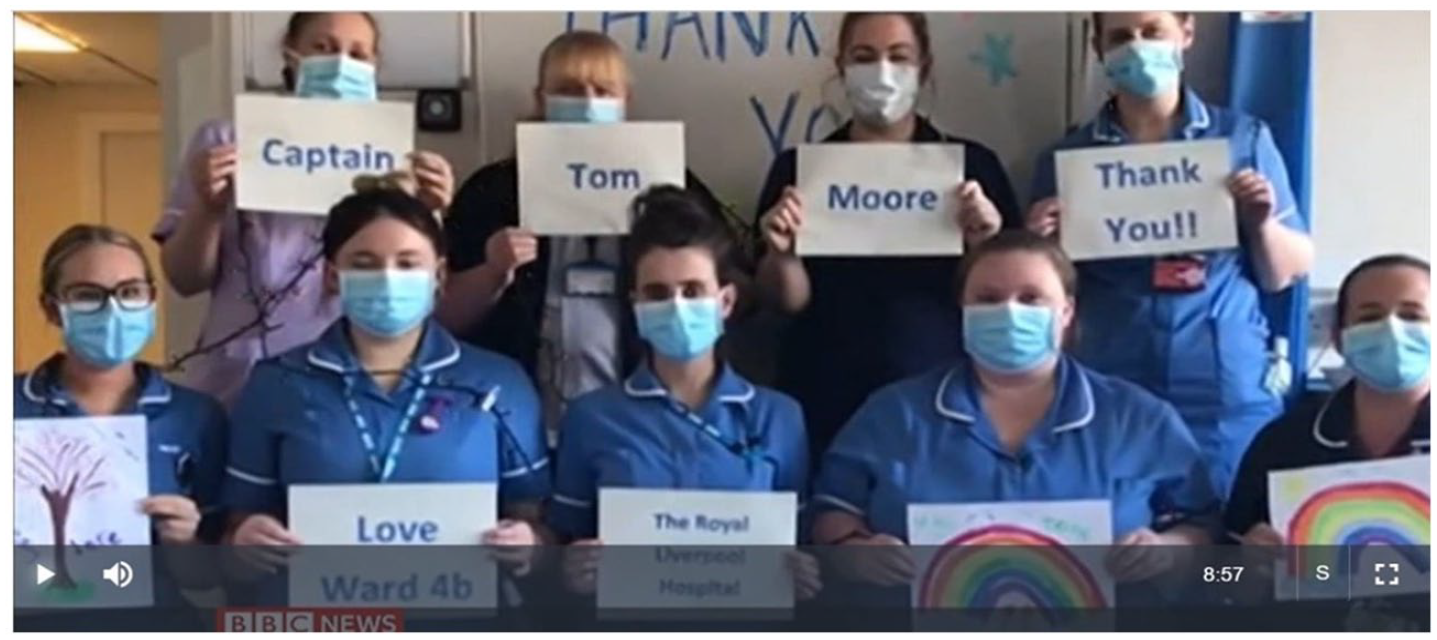
‘Captain Tom: We salute you’.
Locating the ‘Clap for Carers’ as a mode of ‘caring nationalism’, Wood and Skeggs (2020) not only point out the insufficiency of such gestures, but argue that these may block other affects (anger, shame, fear) which can be vital to addressing contemporary inequalities. More specifically, they claim that such gestures constitute a form of ‘care gratitude’ which needs to be replaced by a framework of ‘care justice’ in order to ‘re-right . . . long established forms of injustice’ (2020, p. 642) that have been wrought by neoliberal government welfare policies. We argue that the highly sentimental image of both Moore and the NHS as ‘national treasures’ was produced by and productive of forms of affect policing which inhibit a move from ‘care gratitude’ to ‘care justice’, including a quelling of criticism around the problems of charitable giving as a substitute for state-funding of the NHS, the government’s inadequate resourcing of personal protective equipment (PPE) for key workers, and the disproportionate deaths among ethnic minority NHS staff – inconvenient truths which undermine the celebratory framing of the NHS as a source of national pride.
‘A secular Queen’: Patriotism, optimism and ‘British virtues’
Throughout Moore’s mediation we find the repetition of both spectacular and everyday rituals, symbols and events through which national unity is asserted. The regular appearance of the British flag in images of Moore is the most obvious example of this. In photos appearing in men’s magazine GQ (Figure 2), when Moore was named a ‘Man of the Year’, he appears suited, his war medals displayed across his chest, triumphantly holding aloft the British flag.
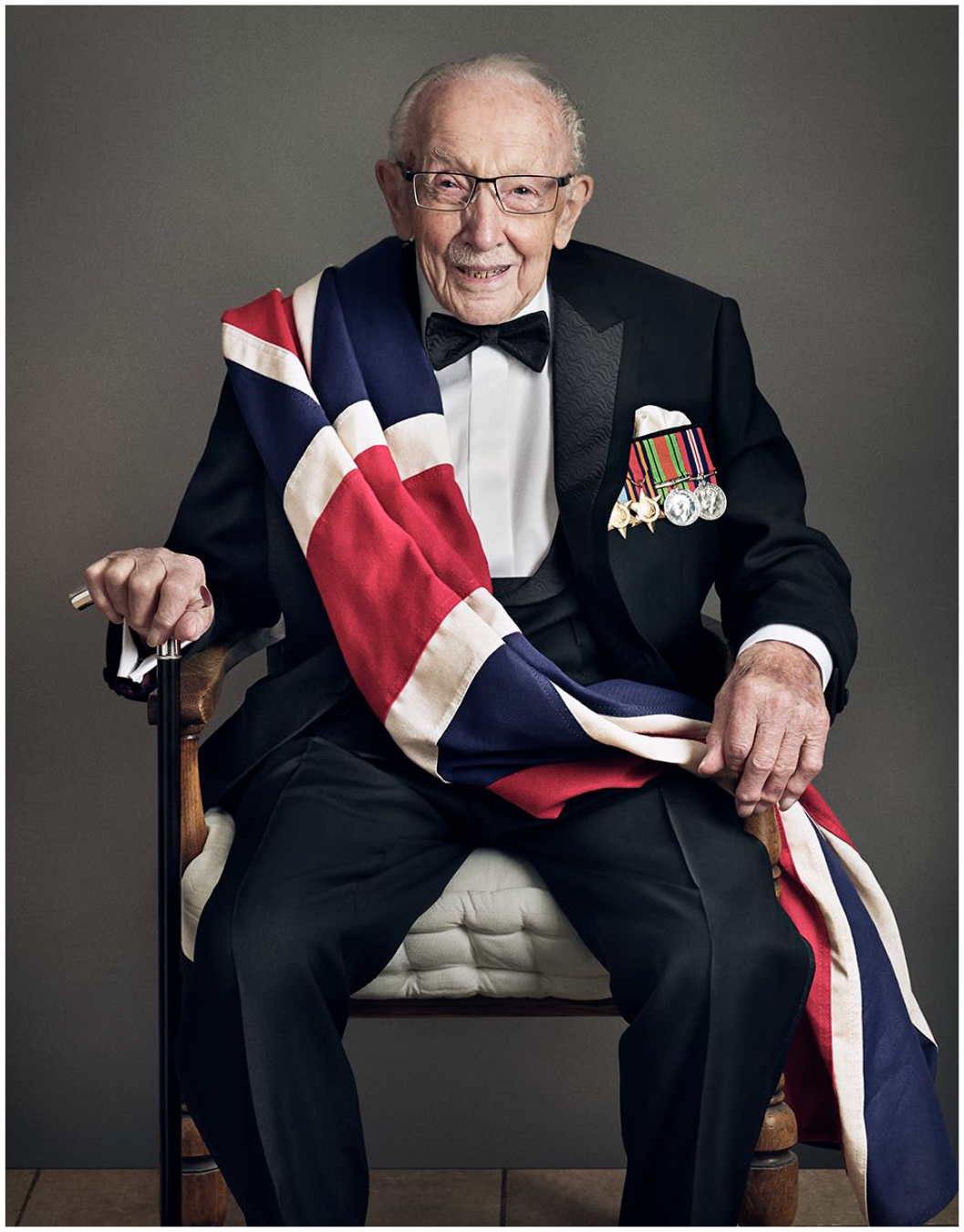
Captain Sir Tom Moore as GQ Magazine’s “Man of The Year”. Photo Credit: Gavin Bond for GQ magazine / August.
Moore’s mediation is characterised by other practices that resemble what Michael Billig (1995) calls ‘flagging’ of the nation’, whereby ‘daily, the nation is indicated, or “flagged” in the lives of its citizenry’ (1995, p. 6). Themes of patriotism and loyalty – specifically an allegiance to Queen and Country – are repeated motifs in Moore’s representation, symbolised through the repeated imagery of the Union Jack, his association with the NHS and World War II (to which we return shortly), and Moore’s alignment with the British monarchy. As well as receiving a knighthood, Moore was regularly positioned as a pseudo-member of the monarchy and ‘secular Queen’ (The Life and Times. . ., ITV, 2020). As work by Laura Clancy (2021) and Natalie Weidhase (2022) demonstrates, the monarchy play a crucial symbolic role in asserting national unity, particularly in moments when hegemonic notions of Britishness are being fractured, including the 2014 Scottish independence referendum and the 2016 Brexit referendum. This symbolic role of the monarchy was evident during the pandemic. In April 2020 the Queen gave a broadcast speech to the nation, which praised British citizens’ self-discipline and ‘good humoured resolve’ (Dymond, 2020). It is no surprise therefore that both the ‘real’ and ‘secular’ Queen became symbolic resources in a post-referendum, pandemic landscape where national unity and identity were destabilised. Moore is commonly depicted as not only adoring the Queen but sharing the same ‘British’ virtues: Captain Tom loves the Queen. ‘She is fantastic and so strong and sensible . . . We’re very lucky’. . . . There is something very special about Captain Tom. Not just his modesty, stoicism and dry humour, but also his optimism – even in the current crisis. . . . ‘Of course some people are apprehensive about what might happen to them, but you have to look on the bright side and think, “It won’t be me”’. (Moore in Fryer, 2020)
Optimism was a particularly potent motif in Moore’s mediation, symbolised by his morale-boosting ‘mantra’ and title of his autobiography Tomorrow Will be a Better Day. This optimism was unanimously praised by national media outlets across the political spectrum including The Guardian: Moore represented hope. More than that, he represented the best of what we like to think of as British: a can-do attitude, an indefatigable spirit, a determination to always look on the bright side of life. He was Britain's grandpa, ‘mustn't grumble’ personified. (Pidd, 2021)
Investments in Moore’s optimism – and the feelings he is seen to generate in others (pride, hope, inspiration) – must be understood not simply as sentimental gestures of endearment. Rather, they operate as mechanisms for the policing of feelings about the nation and its institutions. Specifically, we argue that Moore was strategically leveraged by government not only to appeal to unity and self-responsibility among the British public but to propagate a narrative of successful governance, despite the UK having among the highest number of recorded deaths from COVID-19 in the global north. References to Moore regularly littered the then-Prime Minister Boris Johnson’s speeches, as he praised Moore’s ‘superhuman energy’ (Johnson quoted in Rayner, 2020) and called on the country to ‘show the same spirit of optimism and energy shown by Captain Tom Moore’ (Johnson quoted in Nsubuga, 2020). Even after Moore’s death from the virus, Johnson referenced him as a symbol of the government’s successful vaccine roll-out, quoting Moore’s catchphrase ‘Tomorrow will be a good day’ (Cole, 2021). National treasures like Moore therefore not only enhance nationalism in the UK, but do so in relation to other countries, as nations compete to demonstrate successful governance.
Whilst Moore’s perceived virtues are largely mobilised as a source of national pride, they also emerge as being under threat, as captured in the following quote from historian and right-wing media pundit Dominic Sandbrook in the ITV documentary about Moore’s life: He seems to personify virtues that we think we’ve lost. With his wartime background, and with his longevity and as a family man . . . he became the kind of perfect avatar of what we would like to think that Britain could be. . . . He’s like a sort of secular version of the Queen. We were in this time of great crisis . . . and people looked to him and they said . . . there’s the kind of Britishness that reminds us that we will prevail and will come through this. (Sandbrook in The Life and Times. . ., ITV, 2020)
The emphasis on loss and a nostalgic longing for a past Britain is resonant of the emotional register of conservative nationalism centred around the mourning of a nation. Whilst race and ethnicity is not explicitly named by Sandbrook here, as Valluvan (2019a, p. 100) notes, the ‘conservative urge to look backwards in order to mourn the present’ is often underpinned by an attachment to ‘injured whiteness’ which must be reasserted to solve contemporary crises (Gilroy, 2004a): a sentiment we see elsewhere in Moore’s mediation.
‘Tom the Soldier’: Whiteness and war-time nostalgia
World War II featured prominently in Moore’s mediation, with the repeated use of symbols of war-time nostalgia and imperial mythology, including various forms of militaristic commemoration: flags, war medals, VE Day celebrations and RAF fighter jets. Moore himself drew parallels between the war and the pandemic, stating ‘we were comrades throughout the war . . . wherever you came from. And I think that is really needed now. We’re all comrades in the battle against the virus’ (Moore in Captain Tom: We Salute You, BBC, 2020).
Moore’s status as a war veteran was also frequently emphasised by Boris Johnson, and the media more generally, to project an image of national togetherness rooted in war-time heroism, victory and ‘blitz spirit’. Speaking of Moore, Johnson said: ‘In the dark days of the Second World War he fought for freedom and in the face of the country’s deepest post-war crisis he cheered us all up and embodied the triumph of the human spirit’ (Johnson in Shute, 2020). Johnson’s appropriation of Moore’s role in World War II can not only be explained by the wider appeal to war-time nostalgia in Britain’s framing of the pandemic (McCormick, 2020) and austerity before it (Bramall, 2013). It also speaks to an underpinning ‘Churchillism’ associated with the project of conservative nationalism (Valluvan, 2019a). This particular veneration of Churchill’s legacy became especially evident during Johnson’s pandemic premiership when he was regularly praised by Brexiteers and conservative media pundits for ‘channelling Churchill’s spirit’ in leading the nation in a fight against the virus (McGleenon, 2020).
Moore’s association with the war thus performs a vital symbolic function in asserting a specific image of national identity and history. As Valluvan (2019a) argues, ‘the British soldier’s heightened symbolic role reveals a . . . tenable conservative modelling of where the nation might best be located – the soldier represents namely a body, purpose and mentality in which the idea of the nation can be proudly invested’ (2019a, p. 119). Indeed, Paul Gilroy (2004b) reflects on Britain’s ‘neurotic’ obsession with World War II ‘victory’ as a key ‘entry point’ into national identity (2004b, p. 97). He argues that this attachment to the image of a country at war ‘against foes who are . . . Uncomplicatedly evil’ expresses a melancholic longing for a return to a mythical ‘place or moment before the country lost its moral and cultural bearings’ (2004b, p. 97). This ‘reorientation’ or ‘recovery’ of an imagined past, symbolised by World War II, is rooted in an idea of the nation as an ‘imagined community’ (Hall, 1993) ‘united in their commonality’ (Valluvan, 2019a, p. 30), namely whiteness. Such imagined ethnic homogeneity was asserted not only through the repetition of war-time imagery, but also a distinct emphasis on Moore’s ‘ordinariness’, humility and no-nonsense attitude as ‘Britain’s grandpa’ (Pidd, 2020), which we argue was coded through whiteness. We see, for example, an emphasis on his enjoyment of the small comforts of cups of tea and his daily bowl of porridge – quotidian and banal markers of national identity: Moore celebrated news of his knighthood yesterday by putting on his veteran’s suit and medals – then having a cup of tea. His daughter Hannah and her family toasted Tom with champagne – but she knew he would prefer a cuppa so made him his favourite Yorkshire brew. (Pattinson & Newton Dunn, 2020)
We glimpse how Moore’s ordinariness was also shored up by reference to his Yorkshire roots. Alongside frequent praise for his ‘Yorkshire grit’ (BBC, 2021), in the ITV documentary, Moore states ‘things happening around me are different, but inside here, nothing’s changed. I’m still the same Tom Moore.’ The voiceover tells us ‘that Sir Tom Moore was born and bred in the Yorkshire Dales’ as the camera cuts to images of a rural park, lined with terraced houses and decorated with a sign celebrating ‘Capt. Tom the Keighley Lad’ (Figure 3).
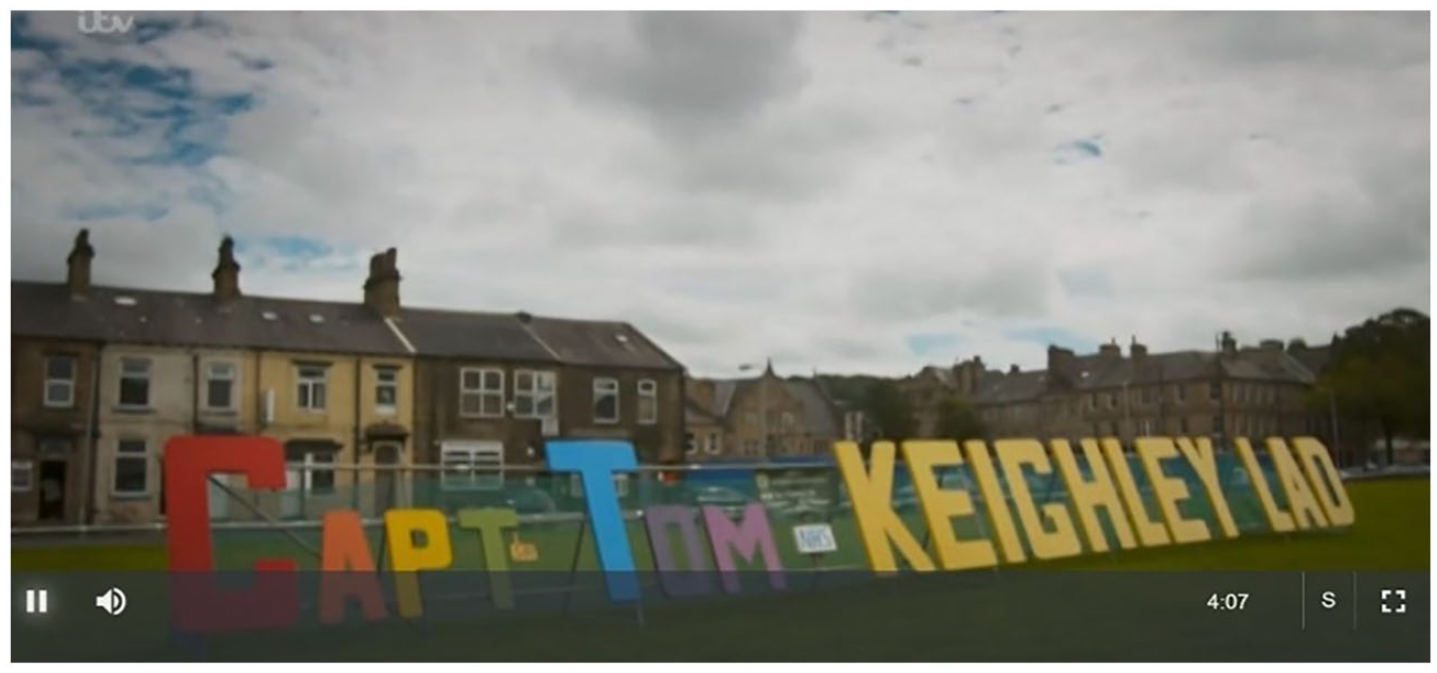
Celebrating Captain Tom in his hometown of Keighley.
Such imagery echoes a ‘nostalgically recalled veneration of provincial Englishness’ (Valluvan, 2019a, p. 90) which not only has a long history within the conservative nationalist project (Tyler, 2020) but is undergirded by a nostalgic attachment to whiteness which erases histories of colonialism (Clancy, 2021). These discourses followed a decade of austerity in which nationalism and nostalgia were mobilised in order to detract from deepening inequalities, and the Brexit referendum entrenched populist discourses of racial nativism focused on the ‘white working-class’ (Valluvan, 2019b; Virdee & McGeever, 2018). By equating the working-class with whiteness, these discourses have served to scapegoat perceived ‘others’ such as immigrants and ethnic minorities who are discursively produced as ‘undermining the position of a previously incorporated (white) working class now “left behind”’ (Bhambra & Holmwood, 2018, p. 574). We contend that Moore’s ‘ordinariness’ – coded through whiteness – operates as a key resource for conservative nationalism, ‘symbolically sustaining the nationalist wave’ (Valluvan, 2019a, p. 18) that intensified through the Brexit referendum and global pandemic. This specific articulation of the nation is distinct from Rashford’s scripting of the nation, as we now show.
Rashford’s celebrity activism
In order to understand Rashford’s status as national treasure, it is crucial to consider the wider cultural context within which he achieves fame, where he is often framed as ‘part of a new wave of philanthropic black athletes giving their voice, their privilege and their wealth to social good’ (Bardowell, 2020). Rashford’s activism can be best understood as emerging against the backdrop of over a decade of ‘austerity, the hostile environment, the leave campaign in the Brexit referendum, Grenfell, Covid-19 and continued police brutality’ (Bardowell, 2020). It is within this context that Rashford emerges as a celebrity activist, and his racial and class identity is a key component of his campaigning. Rashford draws on his experiences as a young, Black, British child who grew up in poverty, despite his mum working several jobs. He utilises powerful, affective personal testimonies to detail his experiences of poverty.
In this way, Rashford’s status as a ‘crisis celebrity’ occupies a similar space to that of ‘austerity celebrity’ (Martin, 2022), whereby his visibility is heightened through direct articulations with austerity culture, and in this case, crisis culture exacerbated by the pandemic. These articulations allow Rashford to emerge as a national treasure who is often framed as having successfully read and understood the mood of the pandemic in a way that politicians were incapable of doing. His hypervisibility scripts a particular form of contemporary nationhood and welfare justice which contests the nostalgic, white, militaristic notions of Britain and care gratitude inherent in Moore’s celebrity. Through repeatedly attributing his success to his mum, a working-class, Black single mother, Rashford invokes a sense of maternal sacrifice, struggle and aspiration which reframes the dominant discourse of the white working-class as the face of contemporary poverty and inequality in the UK.
‘Rashford is at the vanguard’: The complexification of a national treasure
There are numerous references to Rashford emerging as a national treasure throughout our data (Hinsliff, 2020b; Parker & Kerr, 2020). Despite his class and race identity making him distinct from the British ‘celebitocracy’, Rashford receives peer validation both for his athletic prowess and campaigning skills, and almost unanimous media validation. It is in the third form of validation which Greer and McLaughin (2020) identify as integral to the formation of a national treasure – state validation – that we see a complexification of this conceptualisation, and we argue Rashford’s celebrity therefore provides a distinct ideological assemblage to Moore.
Rashford’s active critique of the state during the pandemic is central to his heightened visibility, and his highlighting of the government’s inadequate provisions for those living in poverty contests the more sentimental affective discourses which emerged through the pandemic – embodied in Moore – which suggested we are ‘all in this together’ (Sobande, 2020). Instead, Rashford uses his visibility to expose the failures of the welfare state during the pandemic, with a specific focus on food poverty. In June 2020, Rashford’s campaigning initiated a policy U-turn from the Conservative government, who, after increasing public and media pressure led by Rashford, eventually agreed to extend emergency free school meal vouchers for vulnerable families over the summer. Here, we see a discursive shift for Rashford, who has previously been framed as a philanthropic celebrity – whose philanthropic gestures might even play a role in the dismantling of the welfare state (Littler, 2015) – to a campaigner who begins to exert political pressure, advocating for the welfare state and entering a more antagonistic dynamic with the government. This sits in sharp contrast to Moore’s distinctly depoliticised status. This is evident in the open letter Rashford sends to the government in June 2020, which was widely reported in the media, stating ‘The Government has taken a “whatever it takes” approach to the economy – I’m asking you today to extend that same thinking to protecting all vulnerable children across England . . . I encourage you to hear their pleas and find your humanity’ (Rashford in Ducker, 2020). This affective tone allows Rashford to not only advocate for ‘vulnerable children’ but also to provide a broader ideological critique of the government’s approach to the pandemic, where economic recovery is seen to take precedence over an ever-shrinking welfare state.
Despite eventually receiving state honours in the form of an MBE, state validation toward Rashford is fragile, and like his national treasure status, often conditional. Footballers in general were often singled out in the early stages of the pandemic as celebrities who could ‘do more’, reproducing wider classed and racialised discourses of celebrity footballers as materialistic and selfish (Mendick et al., 2018). For instance, former Health Secretary Matt Hancock stated in May 2020, ‘the first thing that Premier League footballers can do is make a contribution, take a pay cut and play their part’ (Hancock in Holt, 2020). Later in the year, when Rashford begins to reapply pressure for the government to continue to provide free school meal support during half-term and Christmas holidays, Conservative MP Brendan Clarke-Smith accuses him of ‘celebrity virtue-signalling’ (Clarke-Smith in Hull, 2020). Despite this, Rashford is consistently portrayed as a compassionate spokesperson for vulnerable people, and is often discursively produced as more ‘in touch’ with the British public than the government, who are seen to have underestimated the appetite for robust welfare in times of crisis. For example, when reporting on the above incident, The Guardian states ‘This flint-hearted politics fundamentally misreads the pandemic mood . . . the Tories don’t realise that, in a pandemic, kindness is a strength not a weakness’ (Hinsliff, 2020a). Perhaps more surprisingly, this framing was also apparent in publications with histories of anti-welfare rhetoric including The Daily Telegraph, which stated: Rashford is at the vanguard. It is puzzling how Dominic Cummings
2
and his crack team of superforecasters failed to foresee how voting against food aid to vulnerable families would go down . . . the United striker, who was on free school meals as a child, has skin in the game. You might not recognise this, given the absence of it in British politics in recent years, but this is genuine leadership. (Hymas & Jones, 2020)
Here, Rashford is discursively produced not only as a more competent leader, but also as a more authentic voice of the pandemic mood, as opposed to the government, who are framed as a homogeneous elite. The reference to Rashford’s ‘skin in the game’ demonstrates the importance of his perceived authenticity and ordinariness.
Rashford’s ordinariness elevates his visibility in the position as a celebrity activist, and we suggest that his status as a national treasure is amplified by his antagonistic relationship with the government (Figure 4). In this sense, Rashford complicates the state verification associated with more traditional national treasures, and instead relies on a more informal public verification which can be seen to fracture the consensus over who is deemed to represent the ‘best of the nation’. This public verification is reinforced in the documentary on Rashford, where he is described as having ‘won the hearts of the nation’, and having ‘the Great British public rally around’ (Marcus Rashford: Feeding Britain’s Children, BBC, 2021) following the MPs’ vote to end free school meal support. Moreover, as we explore below, Rashford’s status provides a distinct ideological assemblage which can be said to contest the white exceptionalist notions of British identity embodied by Moore.
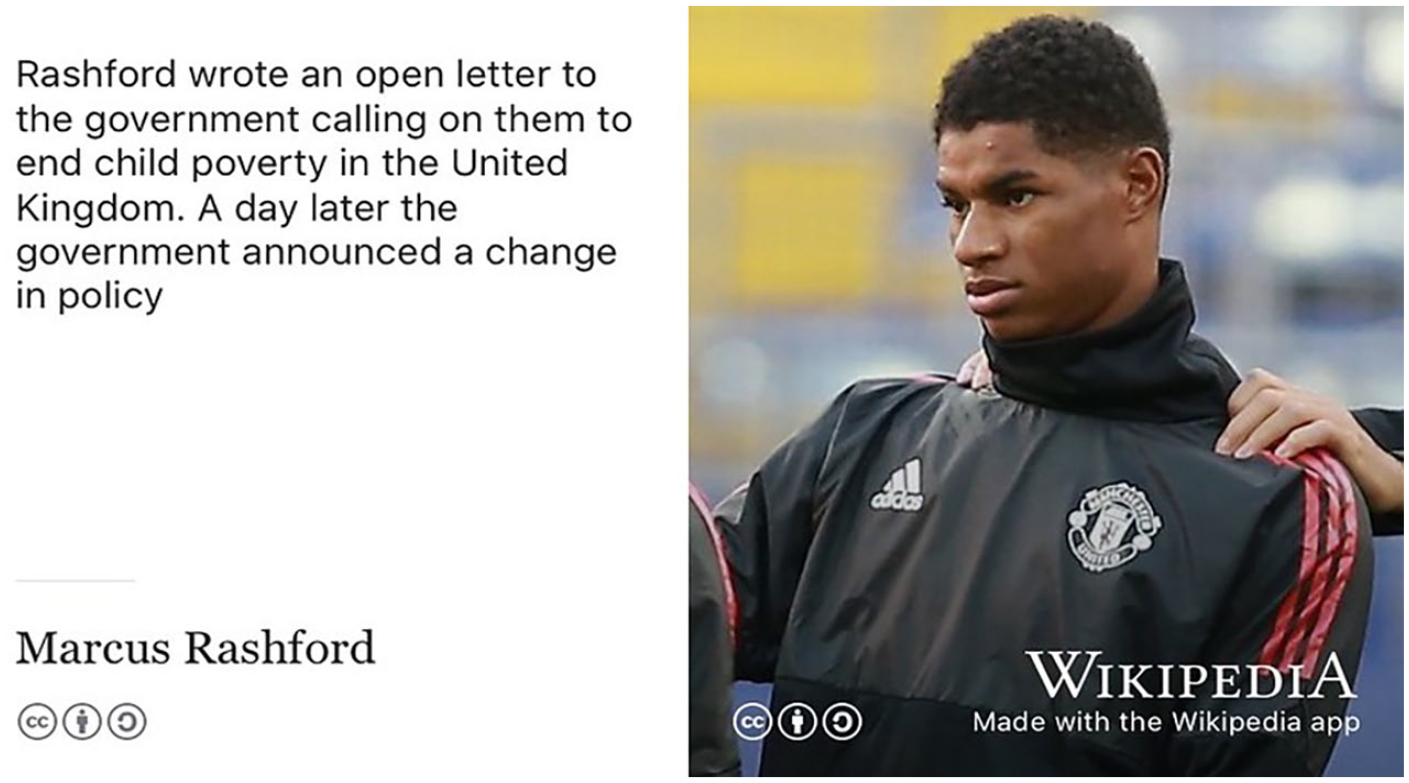
Marcus Rashford pitted against the government (Openverse).
‘This is England’: Shame, care justice and Rashford’s scripting of the nation
Articulations of the nation state circulated in sometimes new and specific ways during the pandemic, as indicated earlier. It is against this backdrop of racially-exclusive nationalistic sentiment that we can begin to understand the distinctly different discourses of nationhood within Rashford’s celebrity to those found in Moore. Specifically, in Rashford we see challenges to the care gratitude sentiment embodied in Moore and instead discourses of care justice (Wood & Skeggs, 2020) emerge, representing a move away from neoliberal philanthrocapitalism and Big Society rhetoric towards advocating for wealth redistribution.
Affective registers of both national pride and shame circulate in Rashford’s celebrity in ways that shore up calls for a more robust welfare state. Shame is mobilised by Rashford in the BBC documentary when we see him tweet ‘This is England in 2020 and families need help’” (Marcus Rashford. . ., BBC, 2021), and in his open letter to MPs asking them to extend free school meal support over summer holidays, he states: This summer should have been filled with pride once more, parents and children waving their flags, but in reality, Wembley could be filled more than twice with children who have had to skip meals during lockdown due to families not being able to access food. As their stomachs grumble, I wonder if those 200,000 children will ever be proud enough of their country to pull on the England shirt and sing the national anthem. (Rashford in Ducker, 2020)
Here, we can understand Rashford’s celebrity as mobilising traditional nationalistic sentiments, invoking pride in the nation as designated through flag waving, singing the national anthem and supporting the England football team. This reminds us that nationalism is not necessarily or exclusively a right-wing position. Rather it ‘is capable of being inflected to very different political positions, at different historical moments and its character depends very much on the other traditions, discourses and forces with which it is articulated’ (Hall, 1993, p. 355). Here, nationalism is mobilised within Rashford’s celebrity activism to both invoke shame and inspire action, to script a particular version of Britishness that is associated with welfarism, where children do not go hungry and families are able to access food. This seemingly conflicting invocation of nationalism (which is often predicated on exclusion) and the calls for a welfare state predicated on inclusion could be understood to be made possible through a pre-pandemic shift in British Conservatism inspired by the Brexit referendum. During this period, a form of affective nationalism ‘distracted the Right from its post-war commitment to the moral project of market-value’ (James & Valluvan, 2020, p. 1242). This decoupling of nationalism and neoliberal market logics creates space for nationalist discourses to be utilised in calls to revitalise and extend the welfare state, as in Rashford’s plea. But there are further complications to dominant discourses of nationalism and welfare imaginaries within Rashford’s celebrity.
Rashford’s identity as Black and British is central to his own testimonies of living in poverty, and across the data there are frequent invocations of discourses of maternal sacrifice as Rashford frames his single mum as responsible for his success: As a black man from a low income family, I could have been just another statistic. Instead, due to the selfless actions of my mum, family, neighbours and coaches, the only stats I’m associated with are goals, appearances and caps. (Rashford in Ducker, 2020)
Here, Rashford directly contests dominant discourses on welfare dependency which have demonised working-class, migrant and ethnically minoritised single mothers (Allen et al., 2015). By invoking his mum’s hard work and sacrifice, we see a reframing of the national script around ‘shirkers and strivers’. Moreover, his visibility as a national treasure and a successful Black man who was subjected to extreme poverty despite the best efforts of his mum can also be said to contest the imagined homogeneity of the discourses of the white working-class. Instead, Rashford’s affective personal testimonies make clear the ‘shared if not worse working-class penalties endured by many racialized minorities’ (Valluvan, 2019a, p. 177), further fracturing the idea of an ethnically homogeneous nation.
Nationhood, community and fragile welfare imaginaries
As the pandemic continued throughout 2020 and 2021, there is a shift in media coverage as Rashford moves beyond single-issue campaigns such as extending free school meals and begins to speak about tackling poverty and redistributive politics more broadly in structural terms. He cites the need ‘to identify a long-term sustainable framework to stabilise the households of our most vulnerable children’ (Rashford in Reilly, 2020) and enters talks with government ministers to encourage a boost to Universal Credit payments. This is positioned within the media as a reflection of Rashford’s ‘increasing interest in the underlying drivers of food poverty and his appreciation of the role of adequate welfare benefits in protecting and feeding struggling families over the longer term’ (Butler, 2020). It inspires a wealth of media coverage and social media activity in which the gaps in the welfare state are discussed, and demand for welfare provision is explicitly stated.
As noted, Rashford’s upbringing and his mum’s struggle to feed her children despite multiple jobs feature as key tropes in his mediation. Whilst this is often used effectively as a device to underline the need for extending welfare provision and find long-term solutions for tackling poverty, we also find stubborn myths around welfare dependency and deservingness emerging. For example, he is positioned by right-wing commentators such as Daily Mail journalist Sarah Vine as a credible source in welfare debates. Vine credits his mother for this, describing her as: . . . by all accounts a formidable woman with a solid moral compass that her boy has inherited, held down three jobs so that he could fulfil his dream of becoming a professional footballer. Neither could be further from the cliche of the grabby benefit scrounger. (Vine, 2020)
Here, exceptionalism is used to reinforce a binary between Rashford’s mum’s ‘strong moral compass’ and the ‘grabby benefit scrounger’. Rather than contesting welfare myths then, Rashford’s celebrity is instead mobilised by right-wing publications to reinforce discourses of conditionality and deservingness. Thus, we see the limitations of his ability to contest national myths around poverty and to mobilise new welfare imaginaries. Rashford’s race and class therefore make his status as a national treasure fragile, limiting and sanitising the more explicitly political critiques his celebrity is able to articulate in a community built on racialised divisions.
In many ways, Rashford represents a challenge to dominant discourses of inequality that are rooted in ‘injured whiteness’, particularly through the use of personal testimony. But perhaps more significantly, his celebrity mobilises discourses of national pride and shame to call for extending welfare provision in ways that incorporate a more heterogeneous and inclusive idea of the nation. Rashford frequently cites not only his mother but his ‘community’ as integral to his success, stating that ‘without the kindness and generosity from the community there wouldn’t be the Marcus Rashford you see today’ (Rashford, 2020). This emphasis on community could be understood to offer a glimpse into what Valluvan (2019b) terms a ‘working-class multiculture’ which can be ‘minimally defined as the cultural and political textures that often emerge in those generally impoverished, working class pockets of our cities and towns that are characterized by meaningful ethnic and racial diversity’ (2019b, p. 40). Rashford’s testimonies of relying on a network of family, neighbours, coaches and friends, as well as the documentary footage of him meeting community organisers and foodbank workers reflect this everyday multiculture and are central to his demands for robust welfare provision, ushering in an idea of community which moves beyond the ethnically homogeneous idea of ‘nation’ at the heart of the welfare state. This working-class multiculture which Rashford embodies is distinctly political, representing the ability of conviviality and ordinary multiculture to move from the arts and into policy (Gilroy, 2005). It articulates a conception of community that is focused on the local, countering the postcolonial melancholia in Moore’s scripting of the homogeneous nation. Here, Rashford’s celebrity functions by both reconfiguring the community of the nation, and reconfiguring both who and what it should treasure.
Conclusion
Within this article, we have analysed two celebrities who achieved national treasure status in a moment of social, economic and political instability, whereby fundamental ideas around nationhood, identity and welfare were being re-made and contested. Despite both being discursively positioned as the ‘voice of the nation’, and with ‘ordinariness’ and national pride being central to their mediation, our analysis demonstrated how Moore and Rashford produced distinct and, to some extent, contrasting ideas around community, nationhood, welfare and belonging. In Moore’s case, patriotism, optimism and nostalgia were mobilised to signify a left-behind nation which is implicitly white and working-class. In these ways, Moore operated as a key resource for conservative nationalism, ‘symbolically sustaining the nationalist wave’ (Valluvan, 2019a, p. 18) that well-preceded COVID-19 – especially within and following the Brexit referendum – but intensified during the pandemic. In contrast, Rashford’s use of affective testimonies that centred his classed and racialised identity, and his invocation of maternal sacrifice, punctured the myth of the homogeneously white working-class, undercovering racial exclusions in the discourse of the ‘left-behind’. The stark contrast in imagined communities invoked by each celebrity represents how nationhood is a site of ongoing struggle; one which can be said to have been exacerbated by the pandemic.
Through their mediation, these celebrities also became the site for competing ideas about the welfare state. In Moore’s case we saw a veneration of public giving and a resurgence of Big Society rhetoric, facilitated through affective registers of optimism, pride, care gratitude, and a romanticisation of the NHS. We argued that this not only blocked critique of the government’s (mis)handling of the pandemic, but served to frame the NHS as a charity rather than a key feature of a robust welfare state. In contrast, Rashford’s status as national treasure articulated an alternative set of discourses and affective registers oriented around shame, care justice and redistribution. However, we also pointed to stubborn welfare myths and discourses of deservingness within his mediation that, at times, served to undermine these alternative welfare imaginaries.
Both Moore and Rashford were framed as national heroes, though this heroisation was doing distinct ideological work. For Moore, his hero status was framed in terms of his age and military history which were invoked to produce him as a symbol of the nation’s past, in need of protection. In contrast, Rashford’s heroisation worked to present him as an exception despite his race and class. In this sense, Rashford’s status as a national treasure is always conditional and fragile, so too is his capacity to effect substantial welfare reform. Despite this, Rashford did generate meaningful political change and, in mobilising an everyday multiculture and cultivating ideas of collectivism and care, Rashford’s status fractures dominant ideas of the nation and welfare. What is clear is that both Rashford and Moore’s designation as national treasures reveal the intrinsic relationship between welfare and nationhood, and illuminate ongoing contestations and struggles that fall across race, class and gender lines.
We hope to have illustrated further the value of analysing the cultural and ideological work of individuals who – sometimes unexpectedly – come to represent the nation, particularly in times of heightened crisis. As nations continue to grapple with ongoing crises it is vital to attend to their accompanying cultural politics as they play out in the seemingly trivial realm of celebrity. As we have demonstrated, these figures do significant work in moments when dominant ideas about ‘the nation’ are in flux. We must also consider the mechanisms of validation that confer such status on individuals. We have identified an additional mechanism of validation in the general public, who contributed to each figure’s visibility and political agency, working alongside – and in some cases against – state, peer and media validation. As we saw in the case of Rashford, the public can play a role in fracturing the consensus around who comes to represent both who the nation is and what it deserves.
Footnotes
Acknowledgements
We are grateful to the three reviewers for their generous and thoughtful engagements with our work. We are also grateful to Kirsty Morrin for discussions which really helped inform our thinking.
Funding
The authors received no financial support for the research, authorship, and/or publication of this article.