




Abstract
This article engages critically with the idea of state-centred nationhood, including its promises and limitations, as a foundation for state strategies of forging unity in (migration-related) diversity within nations. As states across Europe grapple with the management of migration-related diversity, in contexts of increasing polarization of public debate on nationhood, which conceptions of nationhood do they draw on? We build on data from Norway, including policy documents and parliamentary debates, and draw on ten interviews with eleven bureaucrats in senior positions. Our interviewees were tasked with different aspects of the state’s nation building work, such as immigration control, national minorities (including Sami populations), religious and life-stance communities, and the 200-year anniversary of the Constitution. When asking which conceptions of nationhood bureaucrats draw on, we acknowledge that someone is doing the state’s nation building work. We find that the bureaucrats draw on a range of conceptions of nationhood, where ethnic and civic, more open and more closed dimensions, are mobilized. However, we did not find a cohesive conception of a state-centred nationhood being promulgated. Instead, our interviewees expressed uncertainty about how and to what extent nationhood could or should be mobilized to forge unity among Norwegian citizens. We argue that future research should move beyond dichotomies such as ethnic/civic or elite/everyday nationhood to theorize the composite articulations of nationhood which emerge empirically. Who bureaucrats effectively see as the imagined community, we argue, remains central to understanding states nation-building efforts.
Introduction
Conceptions of nationhood and experiences of nationness are much debated in contemporary contexts of migration-related diversity (Brubaker, 1994; Fox and Miller-Idriss, 2008; Goode and Stroup, 2015). This article explores how the people charged with key aspects of the state’s nation-building work – bureaucrats in Norwegian ministries in our case – reflect on nationhood, competing conceptions of nationhood and state-centred conceptions specifically. We approach the notion of a state-centred conception of nationhood, first as multivocal (Kaufmann, 2017), and second, as one which transcends the pervasive idea of a civic/ethnic divide (Brubaker, 1999). Through this we contribute to scholarship that seeks to connect macro and micro level perspectives on the study of the nation (Fox, 2017; Malešević, 2019).
The picture of elites ‘propounding their nationalist messages’ and ‘people who receive or ignore the message’ (Smith, 2008: 565) has long been challenged (Skey and Antonsich, 2017). Both elites and states might adhere to different conceptions of nationhood, civic and ethnic, closed and open; and people – the masses – can subscribe to different conceptions of the nation, varying similarly between ethnic and civic, closed or open (Brubaker, 1999; Millard, 2014). This article contributes to the body of work shedding light on multivocality within conceptions of nationhood (Kaufmann, 2017), in our case specifically when considering a state-centred conception of nationhood.
As states across Europe grapple with the management of migration-related diversity, in contexts of increasing polarization of public debate on nationhood (Antonsich and Matejskova, 2015), which conceptions of nationhood are at play? How can responsible states – here represented by the backbone of the state, the bureaucrats – meaningfully engage in nation-building practices today, and which conceptions of nationhood do they draw on in doing so? In fact, research shows that ordinary people in their everyday lives are likely to draw on changing constellations of differing dimensions of nationhood, depending on circumstance and in ways malleable to change over time (Strømsø, 2019). To what extent is this also applicable to bureaucrats, and with which implications for a state-centred conception of nationhood?
We interviewed bureaucrats about their professional as well as personal reflections on nationhood in Norway, and ask: Which conceptions of nationhood emerge in bureaucrats’ reflections? The main argument we put forward in this article is that conceptions of nationhood, largely reflect the ministry (and thematic field) a bureaucrat works for. Why is this important? First, it casts new light on the very idea of ‘state-centred nationhood’ as one monolithic and coherent set of ideas. Second, it also questions conceptual dichotomies, such as elite vs everyday nationhood and civic vs ethnic nationhood. Such dichotomies have, of course, been critiqued for a long time (since Brubaker’s thorough critique in ‘the Manichean myth’, 1999), yet continue to underpin analyses on matters of nationhood to a surprising extent. By viewing nationhood through the lens of state bureaucracy, what emerges is the negotiation of the nation. More specifically, this negotiation is over dilemmas and conflicts about the nation, as these are brought to light through the reflections of those who are tasked with putting policy into practice, the bureaucrats. Remarkably few studies exist which scrutinize bureaucrats’ conceptions of nationhood, and our study therefore contributes to filling this gap (exceptions include Brochmann and Midtbøen, 2021).
We seek to contribute to addressing the call for research which better integrates macro-level and micro-level dimensions of nationhood (Fox, 2017; Hearn, 2007; Malešević, 2019). In this article we propose to do this by situating people’s understanding of nationhood in their broader life contexts. Specifically, we situate people’s understanding of nationhood in the context of their professional, work-related position. We seek to understand how reflections on nationhood among individuals who work in government ministries with different responsibilities, all with direct relevance for questions of nationhood and diversity, are (or are not) shaped by the context in which they work, and the issues they discuss with their colleagues. Through this contribution this study engages critically with the idea of state-centred nationhood, including its promises and its limitations, as a foundation for state strategies of forging unity in (migration-related) diversity within the nation.
We draw on a larger data set of policy documents, White papers, Green papers, legislation, as well as parliamentary debates from Norway but, in this article, focus our analysis on 10 in-depth interviews with a total of 11 bureaucrats across government ministries in Norway. Our analysis is set within the context of sustained interaction and exchange with bureaucrats working across Ministries on themes of nation- and migration-related diversity over time. The data were collected as part of a larger research project on nation and diversity. 1
We now proceed to present the theoretical and conceptual landscape we engage with, before introducing the context of nationhood in Norway, and our methodology. We analyse our interview material, both through in-depth scrutiny of two cases, and across our material, in order to shed light on bureaucrats’ reflections on nationhood, spanning how, when, to what extent and which conceptions of nationhood are drawn on. In the conclusion, we return to the question posed in the title: ‘A state-centred conception of nationhood?’ and offer some reflections on empirical and theoretical implications – for the study of state-centred conceptions of nationhood – beyond the case of Norway.
Bridging state-centred vs personal conceptions of nationhood
Early research on nationalism was criticized for having a too state-centred approach, but following Anderson’s (1983) urge to study nationalism as ‘imagined communities’ and Billig’s (1995) call for the study of banal nationalism, studies on nationalism ‘from below’ have emerged (e.g. Brubaker et al., 2018; Fox and Miller-Idriss, 2008). Our study takes a next step in studying state-centred conceptions of the nation – but doing so: ‘from below’. That is, by gauging bureaucrats’ own reflections on, and conceptions of, nationhood. Therefore, we analyse bureaucrats’ conceptions of nationhood as both situated in their professional position, the specific ministry they work for, and simultaneously as situated within their own personal reflections.
As Hearn (2007: 659) argues, personal conceptions of the nation are a product of social organisation. The construction of an opposition between personal and social identities, or personal and professional conceptions of nationhood, and the lack of attention to the contexts in which these interact, is a challenge. Hearn’s (2007) study of the merger of a Scottish and an English bank is one of few studies which analyses how personal and professional nationalisms interact. In fact, it is found that the social organisational setting is crucial for understanding the interplay of the personal dimensions of nationhood and the professional ones. Similarly, Herzfeld (2016: 6) argues that ‘state ideologies and the rhetorics of everyday social life are revealingly similar’, and he argues for an approach that links the view from the bottom with the view from the top, thereby rejecting the simplistic idea of ‘elites’ vs ‘ordinary people’, which conceals their common ground.
Another contribution to this otherwise nascent focus on unpacking the interaction between micro and macro levels in conceptualization of nationhood, is Malešević’s Grounded nationalisms. Malešević (2019: 4–5) argues that nation-centric understandings of social reality are unavoidable since we ‘live in a world where the nation state is the only legitimate form of territorial rule’. Further, he argues that: In a world of nation states the rulers can successfully justify their right to rule only by invoking nationalist principles – the view that the nation is the fundamental unit of human solidarity and political legitimacy. ( … ) The rulers and the wider public can be more or less nationalist; their nationalist ideology can be more or less inclusive; they can utilize more civic or ethnic idioms of nationhood; ( … ) but there is simply no way to avoid nationalism.
While civic nationhood is often defined as national loyalties in relation to the state’s territory and institutions, rendering national identity a matter of choice, most examples of civic nationhood also involve cultural components and a sense of separate peoplehood (Brubaker, 1999: 61). Civic and ethnic nationhood should not be seen as distinctly different from each other; the differences are not absolute, nor are these two mutually exclusive conceptions of nationhood (Goode and Stroup, 2015; Millard, 2014). Despite the deep-seated conviction that ethnic nationhood is the idea that ‘nations are defined by a shared heritage which usually includes a common language, a common faith, and a common ethnic ancestry’ (Muller, 2008: 20), and therefore more ‘closed’ than civic nationhood, any meaningful conceptualisation of ‘civic nationhood’ in fact also draws on some aspects of shared language and respect for basic democratic values, which are never context, nor culture, free (Brubaker, 1999).
Thus, it is by now well established that a separation of these two conceptions of the nation is simplistic and too dichotomous (e.g. Millard, 2014; Zimmer, 2003). This draws not least on empirical investigations which demonstrate that the nation to most people is strongly connected to a sense of community, but not in ways which necessitate blood ties and shared ancestry, rather there is a mix of a sense of shared past, present and future which needs to be in place (Brubaker et al., 2018; Strømsø, 2019).
In our analysis of bureaucrats’ reflections on nationhood, we find plenty of examples of these complexities, to which we return in the analysis sections. We acknowledge the inherent complexity of what nation and nationhood might mean (Kaufmann, 2017), and seek to highlight the different conceptions of nationhood, both as seen by the actors themselves, and as this emerges from our analysis across our data set. Recent contributions in the field of everyday nationalism emphasize the need to consider people’s agency more clearly (Skey and Antonsich, 2017), and to recognize how individual human beings are inconsistent in their own conceptions of nationhood, often mixing conceptions of nation which, in the literature, are assumed to be in opposition (Strømsø, 2019). We propose that this is no less true for bureaucrats who are performing the state’s nation-building work through their professional practice.
By bridging the divide between studies focusing on nation-building on the part of the state, and those focusing on personal nationhood emphasizing the everyday and ‘ordinary people’, we agree with Hearn and Antonsich (2018: 595) that everyday nationalism’s focus on the individual should ‘not be detached from the social organisational contexts’ (e.g. workplaces) ‘which mediate more structural (macro) dimensions of the nation’. To this end we study individuals whose workplace is the state itself, acknowledging that ‘the state’ and its ‘nation-building’ is conducted by someone – and that these individuals are both nation-state actors and individuals within the nation.
Nationhood in Norway
Construction of nationhood in Norway has taken an anti-imperialist rhetoric similar to other ‘small nations’ such as Ireland or those in the Balkans (Malešević, 2019). Comparatively, Norway has a relatively short history as an independent nation-state, and therefore, independence and freedom have become an integral part of the national narrative (Buxrud and Fangen, 2017; Demiri and Fangen, 2019). Norway was under Danish rule for 277 years (from 1537–1814). This period was followed by a period under Swedish rule, and Norway got its own constitution in 1814, and was partly independent from then on. In 1905, Norway achieved full independence. The relatively short history of independence, combined with the fact that Norway was not a colonial power in its own right (although it was as part of Denmark-Norway), has often been understood as the reason why nationalism in Norway is commonly associated with positive values such as freedom, democracy, and independence (Gullestad, 1997: 23–24). Yet, the dark side of national history includes the bad treatment of national minorities such as the Sámi people, Roma and later, with forced sterilisation and forced Christianisation (Engebrigtsen, 1999), and also a clause in the constitution up until 1851, which denied Jews access to Norway.
During World War Two, Norway was occupied by the Nazis, and the Norwegian king and government went into exile. Many Norwegians were killed and arrested during the war; however, no group was as hard hit as the Jewish community, which in 1940 counted 2100 Jews. Of these, 772 were deported during the war (only 34 of these survived), 23 were directly killed or took suicide as a consequence of the threatening circumstances, whereas 1100 managed to flee to Sweden. Some of those who fled managed to do so with assistance from the Norwegian resistance movement, whereas others fled by themselves (Bruland and Tangestuen, 2011). There is currently a debate in Norway regarding the extent to which the resistance movement understood the situation, and whether they could have done more to help or not.
After the war, those Norwegians who had supported the Nazi regime were sentenced for treason, whereas the narrative on the Second World War has emphasized freedom and independence. Other aspects of recent Norwegian history have also contributed to this narrative, such as the two referendums regarding inclusion in the EU, which both resulted in Norway staying out of the EU. Meanwhile, due to being part of the EEA and Schengen, Norway is in fact relatively integrated within present-day Europe.
Norway is often described as having been quite homogenous until the 1970s, becoming a net immigration country in the late 1960s (Brochmann and Kjelstadli, 2008). A few decades later, immigration entered the political debate with full force, when the right-wing populist Progress Party made immigration the main topic before the national elections in 1989 (Fangen and Vaage, 2018). Norwegian policy on diversity has, until recently, been framed mostly from a migrant integration perspective. In more recent years, diversity management has increasingly also been included in the portfolio of the Directorate for Children, Youth and Family Affairs, who are charged with issues of equality, anti-racism and anti-discrimination policies. White paper after white paper, from especially the former Labour-party-led coalition Government (2005–2009 and 2009–2013), developed an inclusive understanding of Norwegianness, as the former Foreign Minister put it in 2007: ‘a new Norwegian we’ (Horst, 2019). These policy documents underscore that: Having affiliation, family and friends in other countries than Norway does not conflict with being Norwegian. There is room for composite identities; one can be both Norwegian and participate in the Norwegian community, and at the same time feel a sense of belonging to one’s own or the family’s country of origin, and culture and traditions there. (The Norwegian Parliament, 2012–2013)
Methods and data
We draw on interviews with bureaucrats in Norway, analysed top-down (policy makers as professionals) and bottom-up (focusing on personal reflections). Importantly, in their self-perceptions, bureaucrats do not unequivocally see themselves as part of the elite. In a comparative study of British, French and Norwegian bureaucrats, it was found that Norwegian bureaucrats saw themselves as a professional elite, but not as elites in a broader societal sense (Mangset, 2015). In other words, they were also part of ‘the people’ in their everyday lives. This is interesting, seen in light of the fact that Norwegian bureaucrats generally have high education and top grades when being recruited for these positions, and bureaucrats in leading positions are among the top 3% with highest salaries in the country (Mangset, 2015). As such, they are a powerful group. Meanwhile, the Norwegian context is one of short social distance, and, with many places in rural areas quite sparsely populated, the chance of knowing someone’s cousin remains large, even when the total population has reached 5 million. It is also worth pointing out that, despite increases in recent years, inequality levels in Norway remain small, and there is therefore no ‘bureaucrat class’. These aspects support the bureaucrats’ self-understanding as not distant and separate from – but rather as part of – ‘the people’.
Our interviews were conducted in 2014 and 2015, under a Conservative Party/Progress Party coalition government (2013–2017). The bureaucrats were recruited on the basis of their main responsibilities, as our aim was to have a sample reflecting different topics relevant to conceptualization of nationhood within the state. Therefore, we recruited senior advisors or directors of ministries responsible for policies of immigration control, minority issues, integration of immigrants, national minorities, extremism and radicalisation. The bureaucrats we interviewed were from the Ministry of Justice and Police, where issues regarding immigration policy are housed, the Ministry of Children, Equality and Inclusion, who at the time housed the integration section, the Directorate of Diversity and Inclusion, the Secretariat of the 200 year Constitution anniversary (which was in 2014), the Ministry of Church and Education, Community and Volunteer Section, and Sámi and Minority Affairs, Ministry of Renewal and Transport, as displayed in Table 1.
Ministry sources.
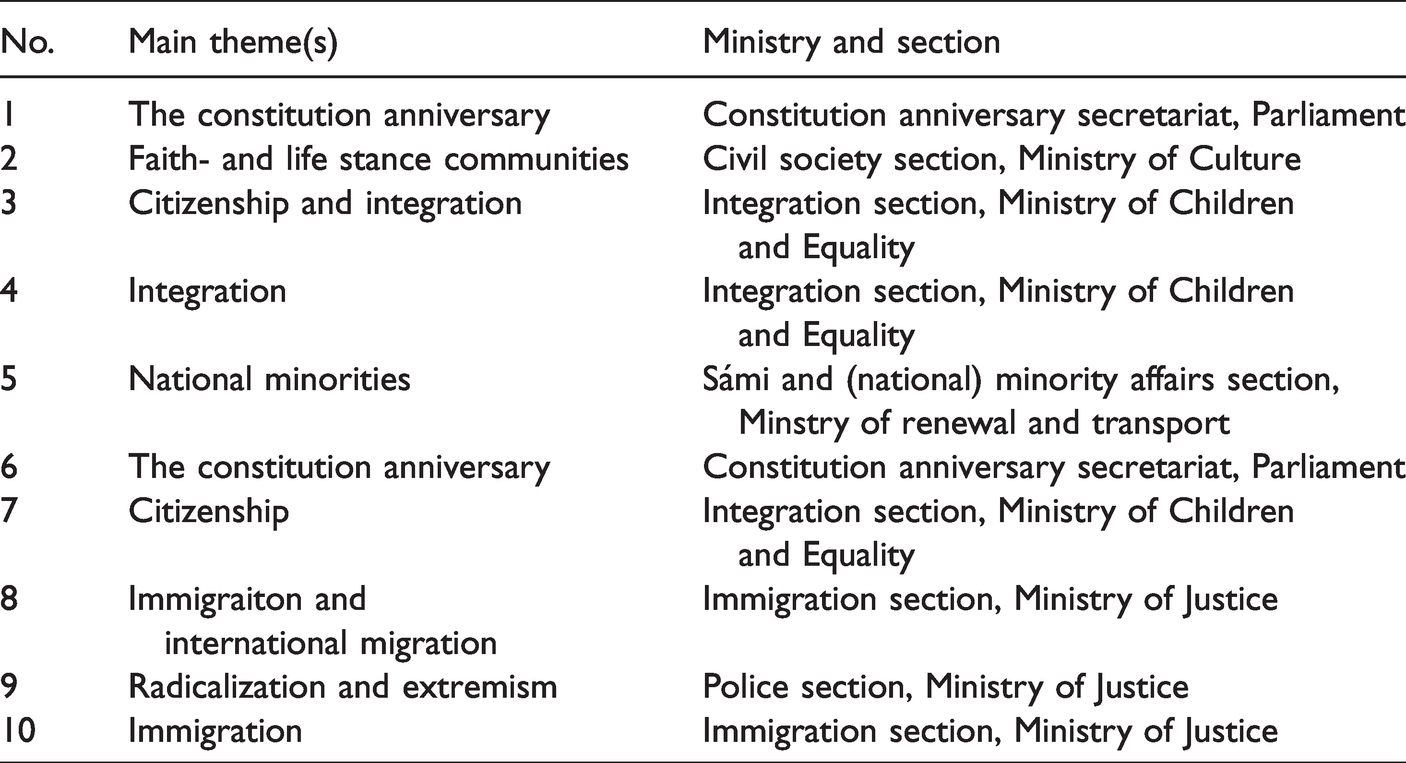
Interviews were conducted face-to-face and were recorded and transcribed in full. A research assistant conducted the interviews (in Norwegian), reaching out to bureaucrats directly, by email or phone. The interviews opened with general questions related to the specific position of the interviewee. Some of the interviewees quite soon touched on questions of nationhood and national identity or citizenship. If not, the interviewer asked more direct questions concerning national identity and citizenship (e.g. what does it mean to be Norwegian today, are there any conflicts around definitions of national identity, community, ethnicity or shared values?). The interviews also allowed for bureaucrats’ personal reflections.
In this way, we grasped how the bureaucrats were ‘talking the nation’: ‘the discursive construction of the nation through routine talk in interaction’ (Fox and Miller-Idriss, 2008: 537). Yet, in contrast to Fox and Miller-Idriss’ (2008) approach, we did not use the strategy of ‘wait and see’ for themes related to nationhood to reveal themselves. The reason was first, that the interviews were conducted as part of a research project (‘Negotiating the Nation: Implications of ethnic and religious diversity for national identity’), with the aim to see how nationhood is negotiated, so the participants knew what we were interested in because of reading the information sheet prior to giving their informed, voluntary consent to participate. Therefore, we found it appropriate to ask directly about their views on nationhood, related to the specific jobs the bureaucrats had.
This article also draws on a larger data set consisting of official documents (including political speeches, white papers, action plans, official Norwegian reports, etc. available at the website regjeringen.no), parliamentary debates (available at stortinget.no), as well as informal conversations and interaction with bureaucrats from different ministries who were part of the advisory group of this project, and with whom we engaged on 6–10 different occasions over a four-year-period, 2013–2017), and following the media debates throughout the data-collection period in 2012–2014. Other project publications use the above-mentioned material as their main data material, whereas for this article it mainly serves to contribute to our background understanding.
The main material for this article comprises the 10 semi-structured interviews with 11 bureaucrats: four women and seven men. Two of our interviewees had ethnic minority backgrounds. The interview material was coded, reflecting different sub-themes. The average transcript length was approximately 6000–7000 words long, thus in total offering a substantive qualitative textual data set. For this article, the material was re-coded based on how the bureaucrats answered questions regarding Norwegianness, ethnicity, national values, citizenship, and the constitution. We then drew both on the interview transcripts in full, putting statements into a particular bureaucrat’s context in full, and on the coded material, with extracts coded around the same themes appearing together across interviewees.
Bureaucrats and state-centred conceptions of nationhood
The analysis section addresses the question: Which conceptions of nationhood emerge in bureaucrats’ reflections? Furthermore, we explore how these are related to the specific office the bureaucrat is working in, and how the bureaucrats relate to state-centred conceptions of the nation (if and when they do). We start with two sections containing in-depth analysis of two of our interviews, while the third section builds on all our interviews – thus enabling us to present and discuss both the depth and breadth of bureaucrats’ conceptions of nationhood, as these emerge in our data.
Including national minorities, avoiding conceptions of state-centred nationhood
One of the bureaucrats we interviewed was working with national minorities (for example, the Sámi people and the Jewish minority), underlines that he wants a broad definition of the Norwegian nation based on values like individuality, non-violence, self-determination, and freedom of speech. He downplays the term ‘national identity’, and instead emphasizes shared universal values, thus leaning to what has been called constitutional patriotism (Lacroix, 2002: 946).
In his professional role – he works for and acknowledges minorities’ quest for recognition on the basis of shared minority identities, and references the Sámi president as saying: … identity is like a fish that needs water to swim. You don’t realize it’s there until you’re on dry land”. [ … ] That imagery, that sense of not being able to breathe when you have to be someone you’re not … as an ethnic … [ … ] To use the Sámi president’s metaphor, it makes you able to breathe again. It’s very important for their sense of belonging.
Simultaneously, he has a concern for the future of the Norwegian welfare state – ‘if it is to function, we all have to work jointly’ – he says, underscoring the need for both principled demands to new Norwegian citizens – in terms of democracy, values, and normative aspects – but also in practical terms, about language and participating in the labour force. These are examples of what Brubaker (1999) describes as part of the exclusionary dimension of civic nationhood, in the form of the demands that immigrants must satisfy in order to qualify for access to the nation.
This bureaucrat’s most central conception of nationhood, or rather rejection of nationhood (in the sense that the attachment to a political community is not based on national identity but on universal rights), is reluctantly drawn from this: ‘We don’t have a national identity – we have shared values’. In other words, he rejects the significance of national belonging when it comes to Norway, but seems able to acknowledge its significance when discussing internal ‘others’, e.g. Sámi. In other words, ‘they’ have ‘identity’, ‘we’ do not.
He says he prefers to say the ‘Constitution day’, rather than the National day: ‘It’s a little hang-up I have, maybe an occupational injury’. In his department, they are all very concerned about using inclusive language, and they sometimes give advice regarding language use to the rest of the Ministry, for example, in talking about ‘in Norway’ rather than saying ‘Norwegian’. Also, he narrates that, in his department, they do not speak of ‘ethnic Norwegians’, but rather ‘the majority population’. He thinks, in general, that there is greater generosity and acceptance regarding such more inclusive terms today than there was 20 years ago.
This bureaucrat assumes that ordinary people are likely to disagree with his approach, perhaps assuming that ethno-cultural conceptions of the nation are predominant among most people in Norway, as opposed to his more cosmopolitan ideas. Nevertheless, he recognizes that he is involved in nation-building through his speech writing, being aware of the need for inclusive identity formation at the collective level.
His hesitancy in using the notion of national identity is clearly anchored in an assumption that ‘national identity’ risks discriminating because of being exclusionary, as he assumes national identity to be inherently linked with a static conception of ethno-cultural nationhood. He links this less to everyday realities, and instead foregrounds one conception of ethno-cultural nationhood which he sees as threatening to minorities, primarily. Even so, he still personally sees the need to address skin colour: If you talk about ethnic and non-Norwegian [ … ] this is just my private opinion, but I think if [someone] had dark skin colour then it is reasonable to spell that out, instead of saying that he or she had a foreign origin. Yet, it is quite clear that if you are part of official Norway [the state apparatus] you are very afraid of saying something wrong, but still you also need to say things the way they are, so it becomes a little bit like you try to bundle it together.
Meanwhile, rather than defining national identity based on a shared past history and some interpretation of a national culture (Vertovec, 2011), he introduces the idea of being in the same boat with regard to the future of Norwegian society, as a welfare state, and emphasizes a willingness to pull together, thus pointing to a civic conception of nationhood (see also Buxrud and Fangen, 2017; Demiri and Fangen, 2019). He foregrounded the salience of a conception of everyday nationhood in practice, but not developing this as an idea of nationhood in full. Instead of a conception of nationhood that could encompass the everyday co-existence, with a shared future, tied to the same territory and same welfare state, which he describes, this is conceived of not as a state-centred form of nationhood, but rather as a state-centred form of togetherness somehow ‘beyond’ the national, yet still trapped by it.
The ‘Constitutional nation’ and limits to state-centred conceptions of nationhood
The previous example was not the only one among our interviewees who considered the concept of a Norwegian national identity problematic, as a point of departure. This was also the case with our next example, a senior advisor in the parliament working on the Constitution 200-year anniversary: 1814–2014 2 (Gammelgaard and Holmøyvik, 2015). Although not afraid to express his personal opinions – he said that he had communicated and published many bold, powerful and strong statements during his career – he had objections to the concept of national identity, and would rather not discuss it as he thought it was not relevant. He says that, ‘I understand myself more as European or [ … ] as world citizen. [ … ] So, a form of European constitutionalism, with a European citizenship. I am not very concerned about national citizenship, even not universal, but only European’. He did also not see ethnicity as important, but rather that it underscored the salience of feelings of belonging.
He related his constitutional patriotic view to the fact that he was a political scientist, but also to the committee he worked for, and underlined that the other committee members shared his lack of interest for national identity: ‘We have not been concerned with that topic. We have noticed that some others have been concerned about it. We, however, have been more interested in highlighting the more universal, political perspective’. The committee members agreed on the importance of having in mind that society is multicultural and that there are national minorities.
Simultaneously, when asked directly in the interview about the Christian value basis in the Norwegian constitution, he answered that the Norwegian culture indeed has evolved within a Lutheran Christian tradition, and this has contributed to a sense of national identity, whereas today, religion has less importance: ‘We now understand that we live in a multicultural society. It is even more important than before. And thus dialogue between different religions becomes more important’. In the longer perspective, he therefore thinks it will be natural to remove the sentence on Christianity from the constitution, which is in line with a recommendation from a White paper from 2013 (NOU, 2013). He pointed out that: ‘I think life stance and religious affiliation are personal choices that for me is not national in any way’.
He acknowledged the purpose of nation building yet underlined that nations cannot be negotiated exclusively top-down (formally), but through interaction and through exchange: ‘For a national identity to exist, the nation must be formally defined in a way people can relate to.’ His position supports a view of how the state-centred conception of nationhood must be linked with people’s conceptions in order to be effective. This is a good example of how the macro and the micro are linked. Representing the nation as inclusive to increase national feelings and participation in democracy among all Norwegian citizens also becomes central: If you have a notion of the national being somewhat static and locked, and [ … ] in the extreme sense almost genetic, then you will also be exclusionary. Then you won’t let anyone in. But if you have a view of nation that recognizes people’s peculiarity, and which is open enough to see that it is in cultural exchange – it is in meetings – that [ … ] national identity, national culture is constantly evolving, and national culture is then understood as the national community. After all, I belong to those who have such [ … ] an opinion of the national that in some way rests on support of the community, that is, in a way a relatively open approach to it.
This bureaucrat describes Norway as a ‘liberal, open, including society’, and when the interviewer asks him about racism, he says that he is more worried about this problem in other European countries. He underlined the need for ‘anchoring’ and shared values: The national community is constituted by something and the constitution is in a way the basis. That is what forms the framework for our democracy and the interaction between the Norwegian authorities and the population. [ … ] There are some such minimum joint values, and then there is a whole lot around that is exchanged and exchanged and you interpret it in different ways, and the world is completely dependent of migration; the world looks completely different in Norway now than in 1814. The 200th anniversary of the Constitution is a political anniversary, which is based on the Constitution and universal human rights. So, there is no celebration of the nation or nationalism, which some people are concerned with. And the concept nation-building, for example, you can hardly find any reference to that in the document, and this has also not been an important message for us.
Contradictory conceptions of state-centred nationhood?
When scrutinising our overall interview material, we find that working within different Ministries with their respective mandates and responsibilities triggers contrasting – if not conflicting – views of nationhood, and of what state-centred nationhood is, or ought to be, in Norway. Also, working on alternative themes, perhaps not surprisingly, triggers contrasting responses to what the nation is, or how borders around nationhood ought to be defined. These different themes (integration, diversity, minorities, radicalisation, as reflected in Table 1) trigger different conceptions of nationhood, where ethnic and civic components play different roles, and with a variety of ideas about inclusionary and exclusionary mechanisms, and the degrees to which these may, or may not, be seen as state-centred in meaningful ways.
One of our interlocutors who worked in the immigration section of the Ministry of Justice, referred to the issue of foreign fighters (going to join ISIS), something several of the bureaucrats discussed, to define the limits of nationhood: When you participate in a war supporting another state than the Norwegian, and you defend values that are partly contrary to our legislation, and you conduct actions that are illegal, then that is something that we do not define as Norwegian identity, because we do not want those things to happen in our society.
Another one of our interviewees, a senior member of the integration section in the Ministry of Children and Families, was concerned about the importance of describing foreign fighters as ‘our young Norwegians’, ‘our extremists’. Reflecting on which concepts were being used, and the need for inclusive concepts when speaking about immigrants – points to the idea of a broad Norwegian ‘we’ stated in earlier White papers (Buxrud and Fangen, 2017; Demiri and Fangen, 2019; Horst, 2019). We see here that the same topic, foreign fighters, is considered very differently when seen from an immigration control and crime prevention perspective in the Ministry of Justice, or from an integration policy perspective. The difference in conceptions of nationhood – and the roles of a state-centred nationhood – which emerge are potentially divergent.
Another senior advisor from the integration section in the Ministry of Children and Families also argued that the main conflicts around national identity was related to values: I think it is first and foremost about secular Norway versus the religiously conservative and traditional society. I think a lot of the conflict is related to that. Again, you try to define yourself through faith or through culture, or other things. But I think one is more uncertain if everyone isn’t involved in the social project that very many in Norway believe in, related to being a secular democratic society, to a certain extent a progressive Norway, where gender roles are, where there is … equality at all levels of society. And there is … maybe a little fear that these ideals … Ehm … are not shared by everyone. That not everyone agrees with this.
Shared values as key to conceptions of nationhood are central in immigration and integration debates (Ezzati, 2021). Yet, it is unclear how loyalty to values should be interpreted in relation to conceptions of nationhood (Brubaker, 1999), given that this may work in either inclusionary or exclusionary ways. This approach to nationhood reflects a voluntaristic dimension often associated with civic nationhood (Zimmer, 2011), akin to constitutional patriotism, where citizens opt in – or opt out – on a voluntary basis. However, this approach, as evidenced since the 1990s, places insufficient weight on cultural as well as everyday dimensions of the nation which are experienced as real (Skey, 2013; Vertovec, 2011), and which are inherently multivocal and complex (Kaufmann, 2017). In sum, what emerges are contradictory conceptions of nationhood, wherein a key line of contention is about the very issue of state-centred nationhood, its very existence, or potential, which the bureaucrats overall have relatively less to say about, as compared to specific issues falling specifically within their particular mandate.
Discussion
The bureaucrats we interviewed all work in Ministries and sections somehow charged with the state’s nation-building work. When analysing which conceptions of nationhood emerge in these bureaucrats’ reflections, and how these are related to state-centred conceptions of the nation in Norway, it is striking that there is no coherent state-centred conception of nationhood which comes across, instead there is significant variation in views on whether state-centred conceptions of nationhood ought to be promoted at all. This includes bureaucrats who are, in fact, quite ambivalent about the state drawing on nationalism at all, but not necessarily due to views which would align with common criticism of ‘elites’ favouring cosmopolitan, post-national worldviews.
As our first case illustrates, some bureaucrats opt for a state-centred form of togetherness which foregrounds shared fate among people inhabiting the same territory, as members of a political community. This form of state-centred – and citizenship-based – community, seeks to avoid having anything to do with nationhood, in good part for fear of its exclusionary mechanisms. Interestingly, this also means nationhood’s inclusionary mechanisms are forfeited, and a shared story about ‘who we are’ fails to emerge with any significant force, while a grounded sense of togetherness is recognized as both real and salient.
Across our data set bureaucrats appear to share the assumption that a base-line majority exists. These are an assumed point of reference, seen as the majority, who are white, and native in the sense of being implicitly ‘not diverse’, and they are assumed to hold a conception of nationhood which is slow to change. The bureaucrats’ reflections on nationhood, rely in a not insignificant way on this assumed idea of ‘who the nation (really) is’. This base-line majority nation does not appear in bureaucrats’ reflections to hold a closed conception of nationhood, yet perhaps a less open conception of nationhood than what the ‘liberal elite’ is described as promoting. Here bureaucrats place themselves, to an extent, as a neutral third party – mediating between this base-line majority and the ‘liberal elites’, navigating the space for forging togetherness in Norway, but clearly ambivalent about the role which nationhood and nationalism should explicitly take here.
The bureaucrats are sensitive to the need to recognize different minorities as part of the nation, although there is variation regarding which minorities appear to matter more. Some bureaucrats emphasize adherence to ‘Norwegian values’, reflective of current policy debates, in particular targeting immigrants (Ezzati, 2021). Whilst open to the dynamism of changing conceptions of nationhood and cognizant of differences in anxieties in relation to such changes, the bureaucrats in our sample balance between reproducing a familiar conception of nationhood, and one which actually includes all the people who are Norwegian citizens today.
The bureaucrats also have different views of the exact conception of nationhood underlying state policies: our analysis shows that state-centred nationhood is defined very differently, based on the perspective of different ministries. State-centred nationhood does not, based on our analysis, emerge as a coherent conception in Norway. We find that citizenship, the constitution, and democratic participation are shared features across different conceptions of nationhood (and among those promoting a state-centred approach to togetherness which does not mobilize nationalism). As such, the shared core appears to align with a more civic conception of nationhood. Yet, the bureaucrats’ reflections do not really support this interpretation, as there is both a mixing of civic and ethnic elements, with cultural aspects cutting across, while a distinct distancing from conceptions of nationhood of any kind is also present. We find that the bureaucrats’ reflections on nationhood underscore how nationalism endures, both due to being grounded in the nation-state structure itself, as well as through micro-interactional realities in our societies (Malešević, 2019). The conceptions of nationhood which emerge both top-down and bottom-up here, are intertwined, or to be more precise, mutually constitutive.
Despite diverging views, the bureaucrats recognize the importance of a conception of nationhood which takes on board subjective aspects, not least of belonging, and that there is need for a story about what Norway is and about Norwegian nationhood, in order for people to develop a foundational bond, a sense of belonging, a willingness to participate and to contribute in society. Whether with reference to ‘the fish that needs to be in the water’ or to a sense of a ‘shared fate’, our interviewees acknowledge both the fact of being in the same boat, and of the long-term implications thereof for nation-building, and hence also for the need for an evolving conception of nationhood. Their role and responsibilities as the state’s nation builders in terms of shaping this development at an overarching level, however, remains elusive.
Conclusion
In the title we ask: ‘A state-centred conception of nationhood?’ Multivocality was a given, entering analysis of bureaucrats’ conceptions of nationhood (Kaufmann, 2017), and the relationship between such conceptions of nationhood, different policy fields and overarching ideas about the state’s nation-building work. We found few clear voices supporting post-national views (Habermas, 2001), rather bureaucrats in different ways combined their understanding of shared national values and a sense of togetherness with their own – and others’ – personal experiences of the nation (Cohen, 1996; Hearn, 2007; Mann and Fenton, 2009). We found that approaches to nationhood ranged on a scale of importance – very important to not important – and on a scale of how the state should mobilize ‘nationalism’ – from explicit to implicit – but also contrasting in views on the type of approach the state should take: completely embracing ‘nationalism’ – to great reluctance about how the state should mobilize ‘nationalism’ today, with some bureaucrats suggesting it might be better ignored.
The reluctance to engage with conceptions of nationhood to a greater extent might be interpreted in three ways. In part it might be explained by the politicized nature of public debate on migration-related diversity, where bureaucrats’ natural instincts might be to say less. Second, it might, in part, be explained by the variety of opinions on conceptions of nationhood within the ruling government coalition at the time of the interviews, again prompting bureaucrats toward non-involvement. Finally, we might see this as an example of the tendency among those highly educated and subscribing to ‘cosmopolitan outlooks’, to disavow nationalism, foregrounding the exclusionary risks especially of its extreme ethnocultural iterations, even at the cost of losing out on the inclusionary potential (e.g. Billig et al., 1988; Fenton, 2007; Skey, 2013).
Rather than finding a multivocal conception of a state-centred nationhood, consisting of an amalgamation of more or less coherent elements, we find a non-articulated and inconsistent array of thoughts on state-centred nationhood in the Norwegian context. There is reluctance and uncertainty about the role of nationhood, due to fear of its exclusionary power. There is also uncertainty about how an inclusive and plural national ‘we’ could be facilitated with top-down policies, without seeming too aloof, too distanced from everyday experiences, and cultural forms of belonging and togetherness. While there is openness to the natural, unquestioned and legitimate place of migration-related diversity – and that of national minorities – within conceptions of Norwegian nationhood (see also Buxrud and Fangen, 2017; Erdal and Strømsø, 2021), there is no coherent state-centred conception of nationhood promulgated to achieving this as a goal. The struggles around how to speak of the nation with sufficient inclusivity, yet simultaneously with necessary attention to history and slow-changing cultural expectations, is seen in the king’s annual speeches on New Year’s Eve (Demiri and Fangen, 2019).
As Malešević (2019: 15) suggests, ‘even when rulers and state administrators express genuine sensitivity towards cultural diversity, the organizational structure of the nation state often makes it impossible to overcome the centrifugal forces of cultural homogenization’. The lack of clear confrontation of this challenge in bureaucrats’ own reflections about the nation, diversity, and the state’s nation-building work, is puzzling if not confounding, given the salience which togetherness and sustained trust is given in public debate on diversity in Norway.
While our findings from the Norwegian context are shaped by this national story, and the specificities of the Norwegian nation-state’s approach to inclusion over time, we offer three contributions of broader relevance. First, our study provides an example of the ‘value-added’ of scrutinizing what happens within the state, among those individuals who are tasked with the state’s nation-building work. Unpacking macro- and micro-level negotiations over nation in this way may yield further gains if applied to other contexts.
Second, state-centred conceptions of nationhood merit unpacking, not just empirically, but also theoretically. As we have shown, a series of dichotomies which have long been critiqued continue to hold pervasive sway in the literature in general terms. Detailed analysis reveals how the personal and professional, the everyday and elite, the ethnic and civic, are composite within different iterations of nationhood, rather than representative of alternative conceptions of nationhood.
Finally, the usually implicit referent – the nation – merits further scrutiny. When bureaucrats refer to the nation, who is it they are speaking to, and about? Does the ‘imagined community’ align with the demographic composition of the population and citizenry of the nation-state? Arguably, this is a question which is equally pertinent across nation-state contexts. For liberal democratic welfare states such as the Norwegian, it presents a paradox: a ‘shared fate’ conception of nationhood is de facto integral to the state’s vision of the future, but how can this be squared with either conceptions of nationhood which struggle with their own degree of inclusivity, or with a reluctance to mobilize nationhood as a frame for a shared future at all.
Footnotes
Acknowledgements
We would like to thank Mari Nielsen Vaage for her research assistance, Marte Mangset and Laura Führer for comments on a previous version of the article, and the project team of the NATION project for valuable insights, discussion and feedback, which have informed this work: Michael Collyer, Rojan Tordhol Ezzati, Åshild Kolås, Thomas Lacroix and Mette Strømsø. Thanks also to Marco Antonsich for enlightening discussions on the micro and macro-dimensions of the nation.
Declaration of conflicting interests
The author(s) declared no potential conflicts of interest with respect to the research, authorship, and/or publication of this article.
Funding
The author(s) disclosed receipt of the following financial support for the research, authorship, and/or publication of this article: This article is an output of the completed research project 'Negotiating the nation: Implications of ethnic and religious diversity for national identity' ( ), funded by the Research Council of Norway (grant number 222757).