




Abstract
Building on a field perspective, this article adopts a relational approach that lets us make sense of food charities’ interconnections, relationships and social positioning. I analyse how food charities working with different models of provision do boundary work and resolve the cognitive dissonance arising from simultaneously competing and collaborating. Making use of several semi-structured interviews, I illustrate how Trussell Trust food banks, independent food banks and pantries’ directors mark symbolic boundaries when illustrating their models of provision vis-a-vis other models (e.g. pantries vs food banks) but build symbolic bridges when discussing the ultimate ends of charitable food provision. This strategy lets them resolve the tension arising from two contradictory stances and is representative of what I call ‘hunger bonds’: relationships of cooperation and mutual help that also permit positional returns to be obtained and strategically advance a specific vision of the field order.
Keywords
Introduction
In the aftermath of the Great Recession, food charities became a pillar of the survival strategies of the urban poor in higher-income countries all over the world (Garthwaite, 2016a; Lambie-Mumford and Silvasti, 2020; Riches and Silvasti, 2014). In the UK, the impressive rise of food banks after the financial crisis has been investigated in depth, and studies document the role played by cuts in welfare services, reforms of social security payments and benefits sanctioning in driving the growth in demand for food support (Loopstra et al., 2015, 2018; Reeves and Loopstra, 2020). The COVID-19 crisis further confirmed the role of UK food charities as a shadow welfare state, as increases in the number of food parcels distributed were reported by several charitable organisations (Oncini, 2021a; Power et al., 2020). At the same time, pressure to reduce food waste and thereby transition to sustainability has further cemented the institutionalisation of food charities, as food surplus distribution to people in need is often seen as a win–win position (Arcuri, 2019; Caplan, 2017; Lohnes and Wilson, 2018).
Possibly owing to the advocacy of the Trussell Trust – the largest and most powerful UK food bank network – discourses about food insecurity and parcel distribution flooded the media (Knight et al., 2018), and the role of other food support initiatives has been partially neglected (but see Hirth et al., 2022; Moraes et al., 2021; Oncini, 2022a). In fact, next to Trussell Trust food banks, several thousand independent food banks, pantries and warm meal providers work in the food assistance sector (Lambie-Mumford and Loopstra, 2020), albeit in different guises and with different views about the best ways to provide food support to families in need.
In sociological terms, it is useful to think that UK charitable food providers operate in a field, and particularly in a strategic action field (SAF) (Fligstein and McAdam, 2012; Oncini, 2022a). In fact, while all food charities agree which courses of action to ‘feed the poor’ are acceptable and share a general understanding of ‘what is going on’ in the sector, they also compete for the same resources and to define legitimate ways to operate in the charitable food provision (CFP) field. At the same time, like many other non-profits working to relieve poverty, they often collaborate and work together to achieve common goals and to advocate on how to reduce food insecurity and improve the food system.
Building on a field perspective, this article advances the literature on food poverty and food support by adopting a relational approach that lets us make sense of food charities’ interconnections, relationships and social positioning. In line with previous scholarship (Helfen, 2015), it illustrates the benefits of cross-fertilising the analysis of boundary work with the concept of inter- and intra-field relationships to advance our sociological understanding of meso-level social orders. To do this, the article analyses how food charities working with different models of provision do boundary work and resolve the cognitive dissonance arising from simultaneously competing and collaborating both within and between fields (Curley et al., 2021; Sharp, 2018). Making use of several semi-structured interviews, I illustrate how food charity directors mark symbolic boundaries and distinguish their models of provision from the other models (e.g. pantry vs food bank), but build symbolic bridges when referring to the ultimate ends of CFP. This strategy lets them resolve the tension arising from two contradictory stances and represents what I call ‘hunger bonds’, relationships of cooperation and mutual help that also permit positional returns to be obtained and strategically advance a specific vision of the field order.
Boundary Work in a Strategic Action Field
Field theory has become a common sociological approach when investigating meso-level social orders. While all field theorists share basic tenets regarding the unit of analysis and actors’ relationality, the term now encompasses three conceptual frameworks – the Bourdieusian, New Institutionalism and SAF theory – that emphasise different aspects of how fields work (Barman, 2016). For instance, scholars inspired by Bourdieu tend to put stress on the struggle over material and symbolic resources, with dominant actors imposing their power on dominated groups through ability to control ‘the rules of the game’ that govern field relations (Bourdieu and Wacquant, 1992); conversely, New Institutionalism focuses more on the processes that bring organisations within a field to homogenise under the influence of technical and institutional pressure (Di Maggio and Powell, 1983).
Like the other two approaches, SAF theory calls attention to the ways actors:
are attuned to and interact with one another on the basis of shared (which is not to say consensual) understandings about the purposes of the field, relationships to others in the field (including who has power and why), and the rules governing legitimate action in the field. (Fligstein and McAdam, 2012: 9)
In line with Bourdieu’s field theory, for instance (Bourdieu and Wacquant, 1992), actors in a SAF vie for advantage and struggle to gain legitimacy in order to substantiate, challenge or subvert the field order. This means that in any field there are always incumbents – ‘actors who wield disproportionate influence within a field and whose interests and views tend to be heavily reflected in the dominant organizations’, and challengers ‘who wield little influence over its operation’ and ‘while they recognise the dominant logic of incumbent actors . . . can usually articulate an alternative vision of the field and their position in it’ (Fligstein and McAdam, 2012: 13).
At the same time, SAF theory has two additional features that are particularly important when analysing the non-profit sector (e.g. Lang and Mullins, 2020; Spicer et al., 2019) and especially relations between food charities. First, SAF theory argues that cooperation is a fundamental force at play in any field, alongside competition. In fact, the two are barely distinguishable, for collaboration to make meaning is what allows individuals to feel ‘that they are part of something real, important and tied to their “interests”’ – namely, a field (Fligstein and McAdam, 2012: 49). The simultaneous tangle of competitive and collaborative forces is particularly relevant to understand the dynamics of non-profit fields, as those forces can lead to cognitive dissonance in organisations torn between an ethics of care and mutual help and a quasi-market potentially producing winners and losers (Curley et al., 2021; Sharp, 2018).
Second, SAF theory invites researchers to pay particular attention to the broader field environment, to understand processes of emergence, destabilisation and change in the field. In the CFP field, a crucial external context is distribution of food surplus. As awareness of the environmental impact of food waste has grown, recent years have seen a significant rise in the number of companies recovering surplus food and distributing it to food charities – and hence to people living in poverty. Although conceptually reductionist, the appeal to frame these two separate issues as a double win clearly responds to moral obligations to ‘feed the hungry’ and avoid food waste (Arcuri, 2019). In the UK, FareShare is the largest food surplus distributor and the incumbent in its field. Although food surplus partly covers charities’ food needs, FareShare can obviously exert pressure on CFP field dynamics – for instance by establishing alliances with some providers and not others (Oncini, 2022a).
Against this background, understanding how repertoires of evaluations are enacted in the CFP field and at its border helps us better grasp the coexistence of potentially ambiguous field dynamics. Boundary work refers to the process through which symbolic boundaries – conceptual distinctions made to categorise people, groups, practices, attitudes and things – are constructed, reinforced, blurred or shifted (Lamont and Molnár, 2002; Oncini, 2019, 2020, 2021b; Zietsma and Lawrence, 2010). These demarcation processes are crucial to how organisational fields are structured, reproduced or changed, for the capacity to impose systems and principles of classification is an essential means to acquire status and monopolise resources (Lamont and Molnár, 2002). As Helfen (2015: 1390) explains:
[b]oundary work within fields, then, is concerned with maintaining or changing a field by manipulating its boundaries from the inside. Boundary work across fields aims to shield or lever a given field settlement by relating the focal field to neighboring or higher-order fields.
Nonetheless, while most attention is usually devoted to how boundaries act as barriers marking differences (Jarness, 2017), it should be stressed that they can also enable connections and act as bridges or junctures (Comeau-Vallée and Langley, 2020; Pugh, 2011; Quick and Feldman, 2014), especially in contexts characterised by a strong ethics of care such as the non-profit sector. Symbolic junctures let us create shared domains of understanding that translate, align or decentre differences in order to respond effectively to public problems requiring both coordination and efficiency (Quick and Feldman, 2014) – as is the case with the provision of food support to people in need.
The Study
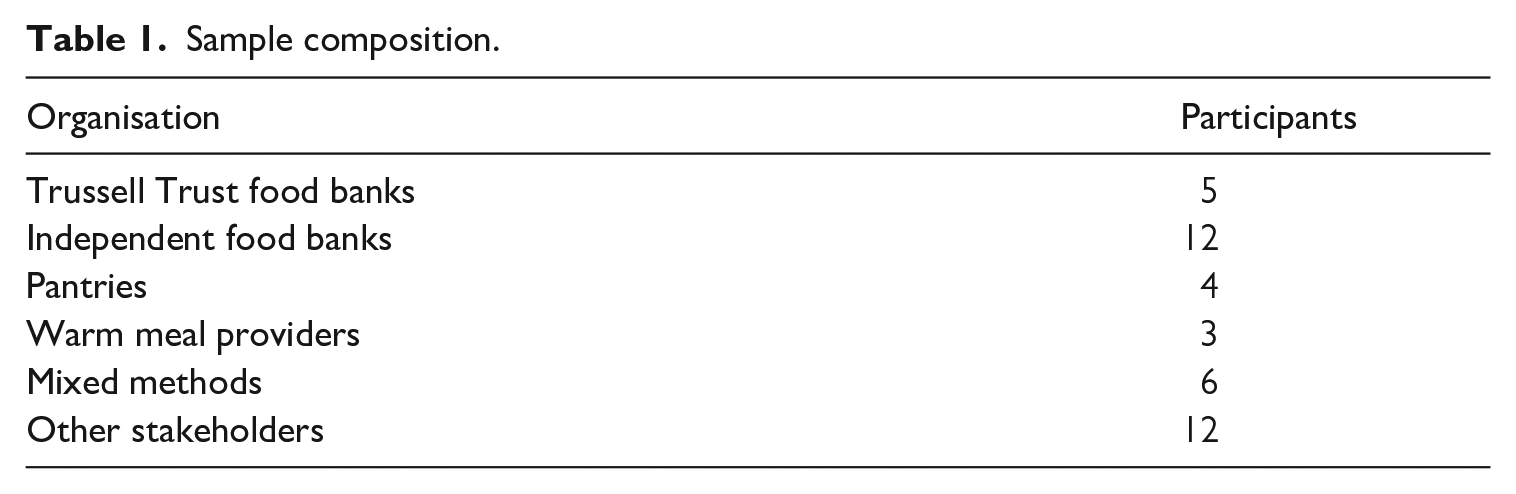
This article is based on the data gathered for a larger project of research into the relationships between food charities based in Greater Manchester during the initial months of the COVID-19 pandemic (Hirth et al., 2022; Oncini, 2021a). 1 The core of the data used in this article comes from 42 semi-structured interviews conducted via Zoom with food charity directors, spokespeople and stakeholders between June and August 2020. Using an online tool allowed me to respect safety measures while guaranteeing rapid collection of data – an advantage in a period of sudden changes, as these months were. Interviews followed up a small quantitative survey on the characteristics of different food support providers and on the impact of COVID-19 on their operations (Oncini, 2022b). The survey was carried out by a research agency that was able to contact 110 food charity directors or spokespeople and secured a response from 55 of them. More than half of the survey participants (30) agreed to participate in a one-hour-long follow-up interview, while 12 additional stakeholders were recruited using personal contacts and snowball sampling. The interview sample includes both Trussell Trust (the largest UK food bank network) and independent food banks (often members of the Independent Food Aid Network, IFAN), pantries, warm meal providers and a few other groups operating with a mixture of methods. Concurrently, stakeholders working at the ‘edge’ of the field (e.g. directors of charities that distribute funding, three area managers or coordinators from Trussell Trust, IFAN and FareShare, experts in food surplus redistribution and members of advocacy groups) were recruited to discuss patterns emerging from the ongoing analysis of the data, and particularly the dynamics taking place within and at the edge of the CFP field (Table 1). All the interviews were recorded, anonymised, then transcribed verbatim, and participants were thanked via a charity donation. Before conducting the interviews, I telephoned each participant to set a date and explain the aim of the research.
Sample composition.
The interviews lasted between 45 and 90 minutes. They all focused on the history, aims and networking of the organisation, the way personnel and volunteers were coping with the pandemic, expectations for the future and, most importantly, on the reasons why the organisation chose one particular model over another. The interview guide was built with two purposes in mind: on one hand, following SAF theory, to obtain information on the rules and understandings of the field, its power structure, embeddedness and broader interlinkages, and on the effect of COVID-19 as an exogenous shock. On the other hand, drawing from recent research into how to elicit class-based symbolic boundaries and deal with their contradictions (Jarness and Friedman, 2017; Pugh, 2013; Sølvberg and Jarness, 2019), in the interviews I focused both on general, highly abstract questions (e.g. what relations do you have with other food support providers? What do you think is going to happen in the next few months?) and more specific questions probing the models of provision (e.g. why did you decide to become an independent food bank and not a Trussell Trust one? Why a pantry and not a food bank?). Following recent scholarship (Jarness and Friedman, 2017; Pugh, 2013; Sølvberg and Jarness, 2019), this strategy allowed me to elicit ‘honourable’ and ‘visceral’ accounts that referred to the field positions and position-takings, so as to understand how both narratives coexist within the same discourse. The interview style was conversational and relaxed, while conveying empathy and understanding. Interview transcripts were analysed using thematic coding in NVivo 12 (Gibbs, 2018) to identify relevant passages as boundaries and bridges. ‘Boundaries’ contained evaluative judgements of other models of provision, reflections on the competitive environment and claims of distinction; ‘bridges’ focused on the reasons why the field exists, positive appraisals of other food charities’ operations and actual or potential collaboration with other organisations. The analysis proceeded iteratively while the interviews were taking place, and data were further enriched by collecting public information available on food charity websites (e.g. yearly reports, blogposts) and fieldnotes gathered at meetings of an umbrella organisation focusing on food support, active throughout the COVID-19 crisis.
Making Boundaries within and between Fields
Although food charities can organise their model of support in different guises, by and large the CFP field is structured around the following models: Trussell Trust food banks, independent food banks, pantries, warm meal providers and a minority with mixed methods. Generally, food banks donate a parcel containing food to take home, prepare and eat. Pantries permit access to a sort of grocery store, usually every week, for payment of a small subscription. Warm meal providers distribute cooked meals or operate free-access canteens.
Considering its longevity, capillarity, sponsorships and media presence the Trussell Trust network clearly acts as the incumbent in the field. Over time, its model has been criticised on several grounds, and two main challengers have emerged more clearly. First, some food banks simply want to maintain autonomy and independence, often from the corporate partners backing the Trussell Trust. This hidden world was eventually brought to light by IFAN, a UK-wide charity that in 2017 surveyed and then started to speak on behalf of the many food banks without national representation – though not all of them eventually became members. Second, pantries oppose the food bank model altogether, claiming to offer a more dignified experience based on choice and community building, since members usually pay a subscription and can freely pick food from the shelves. Third, despite being the longest-running form of food support, warm meal providers tend to be bystanders in the field and to not participate in the legitimacy struggle that characterises CFP field dynamics (Oncini, 2022a).
‘There Is a Stigma Attached to Food Banks’: Boundary Making within the CFP Field
During the course of the interviews, these field positions mirrored three main different position-takings characterised by the delimitation of boundaries marking the distance between models, signals about their scope and mission, and claims of distinction and competitive advantage. First, Trussell Trust directors draw boundaries based on formality and competence. Being part of the establishment means being the benchmark against which other providers must measure themselves. In the words of Mary, director of a Trussell Trust food bank:
Having that network of support, but also having the awareness that you’re there and the resources of having a good website . . . that’s pre-made for you. I think we’re a lot more . . . in the public eye as part of the network than you maybe would be otherwise, and I think as a result of that probably we get more donations, both monetary and in terms of food. We probably get more volunteers. Yeah, again it’s just that kind of awareness, the Trussell Trust is so much more in the public consciousness than I think independent food banks or kind of pantries or food clubs would be. (Mary – Trussell Trust food bank)
As Mary explains, being part of the incumbent network comes with clear material and symbolic advantages over other providers. Beside the wider access to donations and volunteers, the Trussell Trust can take advantage of its cultural hegemony (being more ‘in the public consciousness’) and turn this into a positional advantage. Andrew makes a similar point in two passages where he calls into question both pantries and non-affiliated food banks:
I think, as with anything, you’re in a much better position if you’re part of a much bigger organisation. I think the expectations of Trussell in terms of its management are going to be far more polished than if you’re running a cupboard. Well . . . ‘cupboard’ is patronising; but if you’re running a pantry. Because I think, if you were going to run a food bank properly . . . you’re better off setting up the food bank under the banner of the Trussell Trust. And again, I think food banks have become a bit trendy. And so people are attracted to them because being part of a food bank looks good on your CV, but is worthless if you don’t actually know how a food bank works. (Andrew – Trussell Trust food bank)
In line with Mary, Andrew underlines the benefits coming from being in a better field position than either pantries or non-affiliated food banks, and engages in explicit boundary drawing. The first, interesting, example is where he corrects his first (visceral) use of the word ‘cupboard’, derogatory and ‘patronising’, as he himself admits. The second example is, when referring to independent food banks, he points to the ‘proper’ way of setting up a food bank vis-a-vis the improvised, possibly self-interested, way of people attracted to the model that ‘do not know how food banks work’.
As both excerpts clearly show, independent food banks and pantries operate from subalternate positions in the field. Challenging the symbolic ascendancy of the Trussell Trust thus requires other strategies to legitimise their distinct and antagonistic position in the field. On one side, directors of non-Trussell Trust food banks develop their critique ‘from within’: they turn to their advantage the greater freedom that being independent grants them. Although some were also critical of pantries, they most often aligned when emphasising autonomy from the Trussell Trust. For instance, when I asked Rami and Clare why they had not joined the network, they replied in a similar manner:
Red tape. Red tape is the main thing. Because we’re independent we don’t have anybody above us, you know. I’m chief officer, so ultimately the buck stops with me. The only organisation responsible above us is the Charity Commission . . . I think we decided not to engage with Trussell Trust because of, if you like, all of the constraints that are around about that. And you know, the need for people to have vouchers, the need for people to be registered elsewhere. And the limit it puts on what you could hand out. (Rami – independent food bank) I think the reason why not to go in with the Trussell Trust was because it was so rigid an organisation, and that you have to do a lot of things that they want you to do . . . And we still don’t really want to be because we feel that we provide a much more bespoke service to our clients. We don’t turn them away if they’ve been three times. If they come to us for food, then they need food. And as long as we’ve got food, we will provide them with food. (Clare – independent food bank)
Like Rami and Clare, many other interviewees mentioned the limit on the number of times users could be served as a patent example of the types of constraints that they could avoid. 2 One African food bank director mentioned the capacity to provide ‘African foods’ that would not typically be available in a Trussell Trust food bank. 3 Although many non-affiliated food banks implement restrictions as well, they highly value their capacity to decide case by case, since they tend to know most of their users well. Such practicality is then taken as a sign that a more impersonal approach stems from being part of a more formal and larger network. Instead, the independent label permits directors to portray their service as closer, potentially more considerate of users’ needs (‘bespoke’), and ultimately more in line with the true end of the field. As another director passionately exclaimed, after explaining why they did not place a limit on the number of times people could ask for parcels, ‘They’re hungry! If they’re hungry, they’re hungry.’
The challenge advanced by pantries’ directors is instead more radical, as it concerns the way food support should be organised and delivered. Although they still desire independence (from the incumbent), symbolic boundaries are erected against the food bank as an institution. Its very modus operandi lays the foundation for a shameful experience for the food-poor, depriving them of the possibility of choice. When describing the history of one organisation, Matt expressed this concept decisively:
We’ve never liked the food bank. And we have always railed against it. Hence the reason why we’ve moved towards ‘pantry’. And I think, additionally to that, we’ve never really been very comfortable with the idea that you pack food for somebody and that you remove choice . . . So yeah, I’m quite passionate about getting rid of ‘food bank’ as a concept forever. (Matt – pantry director)
Matt’s charity moved from being a food bank to becoming a pantry because they felt unsatisfied with the lack of choice that the food bank model implied. This transformation eventually led them to antagonise food banks, and ultimately to desire their demise. Conversely, pantries are seen as ‘giving dignity’ and ‘bringing everyone together’, as another interviewee explained. In addition, since many pantries redistribute surplus food (and often fresh), the model is seen as contributing more to the transition to sustainability than ‘classic’ food banks based on ambient food donated by individuals. In the following excerpt, two pantry directors express these concepts in a very similar fashion:
People often mistake pantries for food banks, and I’ve had this conversation a number of times. Whilst food banks are very important and they certainly fill a need, there’s a stigma attached to food banks, and I think that people feel like they’ve failed, or they feel ashamed of accessing it . . . And for me, food banks aren’t a sustainable model. I mean, lots of them have a restriction on how many times a year you can use them anyway . . . So we see the pantry as a sustainable model. And it’s a more inclusive model. (Martin – pantry director) The reason we went for the pantry model versus a food bank was because we are, we are independent, we are not . . . not governed by anybody or anyone else, so we didn’t have to follow a Trussell Trust kind of food banky model or anything else, that was one . . . And then the final reason that we chose that model was because, talking to various potential beneficiaries, there is stigma attached to charitable giving and to food banks, because people see it as them being supported by charity, whereas with the pantry model, because people contribute by paying their small membership fee every week, it is not charity. They are actually making a contribution towards the food that they are having. Okay, it’s vastly subsidised, but they are making a contribution, so it takes that whole stigma of charity away from the whole process. (Gale – pantry director)
Like Matt, Martin and Gale express dissatisfaction at and open antagonism towards the unidirectional relationships that they see at the basis of food banks’ operations. In their view, their model is capable to de-stigmatise food support thanks to the (small) subscription paid by users. This creates a sense of community and reciprocity between users, and potentially a form of food support that does not feel like charitable giving – though as Gale himself admits, it needs to be vastly subsidised.
‘Do You Want That Food to Go in the Bin?’: Boundary Making between Two Fields
In any SAF, incumbents are expected to shield a field’s settlement from external influence by exerting control over the social and symbolic boundaries that circumscribe the realm of possible courses of action (Fligstein and McAdam, 2012; Helfen, 2015). In this light, food surplus plays a crucial role in in the struggle for legitimacy that characterises the CFP field, because it is redistributed from a proximate field of interest (the surplus food distribution field) and primarily used by one of the challengers: pantries (which uphold). Since 2014, the largest UK food surplus distributor, FareShare, has increasingly supported this model of provision, and with it pantries’ worldview about sustainability, dignity and choice, against the more stigmatising operation of food banks. In the words of one interviewee:
I felt that it was important to support the emergence of the pantry model . . . And I felt that was where we should go, because that fitted with what food was coming in. So chilled, frozen, and you know, variety. And when it’s done well, a food club or a pantry is hopefully a more dignified, choice-based model. So, we went in the direction of pantries, [from] 2014 onwards. (Jane, FareShare)
Conversely, the Trussell Trust has aligned, and since allied, with IFAN, thus changing their vision of the ultimate mission of the network. In fact, from inception, IFAN has increasingly criticised the lack of attention that the Trussell Trust paid to the political and structural conditions forcing people to rely on food support, and argued for ending the need for food banks and expanding forms of support based on monetary transfers. This alliance had two consequences for the incumbent: first, it meant moving from the motto ‘every town should have a food bank’ to the ‘end the need for food banks’ (Lambie-Mumford, 2013; Oncini, 2022a); second, it implied framing pantries as part of the same ‘shadow welfare’, despite their different modus operandi. At the edge of the field, this motivates the construction of two different symbolic boundaries based on whether people living in poverty or the environment are prioritised. On one side, Trussell Trust and IFAN defend their field positions against pantries and FareShare, prioritising surplus food distribution in the fight against hunger:
Part of our strategy is that we believe that people need more . . . money in their pockets to be able to [be] self-sufficient and to be able to shop for themselves and have choice . . . Rather than masking the need with another food solution, we should be finding money as a solution . . . And I think that’s the difference [FareShare has] with Trussell Trust, . . . we’re not reliant on food surplus, so we’re about communities helping communities, so people within their communities donating food that they have purchased from supermarkets to those that can’t help it, so our food banks don’t rely upon surplus and one is because we want the people who come to us to have good-quality food just like anyone else would if they went to the shop. (Jerry, Trussell Trust) I wouldn’t say food pantries are a helpful addition to the mix at this point, if you want my opinion. Then there’s this dangerous thing where they’re kind of saying . . . well, we’re better than a food bank. Well, there may be elements [of pantries] that are better than a food bank in terms of dignity, of access, et cetera, but they don’t address the root causes of the problem and they . . . are possibly . . . confusing the issue by not saying actually we want to see an end for the need for food pantries . . . FareShare’s objective is environmental. Yeah. And what they do . . . by saying that they’re fighting hunger and tackling food waste is, is mislead the public. They’re not fighting hunger. They never ever message on poverty. If they’re fighting hunger, they need to message on poverty . . . and if they’re not going to message on poverty, then they need to change their ‘fighting hunger’, um, mantra. And they . . . haven’t so far because it suits the marketing department. So that’s why they’re a huge problem in this arena. (Sabine, IFAN)
On the other side, FareShare’s manager defends their main aim, recovering and redistributing food waste, as motivating their ‘fight against hunger’ as a consequence of an existing situation that requires some fix, even temporary:
I suspect there are people that are thinking, if FareShare didn’t . . . distribute that food, the system, it would contribute to positive system change. I’ve been in conversations where people are saying ‘do not expand your operating, you know, this is not a sustainable way to go’. But nobody ever answers the question that we ask: do you want that food to go in the bin? Right? Nobody ever answers that question. [. . .]. But looking at their stats this week, 14.4 million people in poverty, 7-point-something million in persistent poverty and all the rest of it. If somebody could fix poverty for us, we would then just stick with the environmental agenda. Given that there is so much human need, it would be irresponsible of us to not try and prioritise where that food goes, in my view. (Jane, FareShare)
These three excerpts clearly show how the dynamics of contention at the edge of the field play on the tension between different frames concerning social/environmental sustainability and present/future perspectives, in both of which boundaries are erected to create a framing reflecting the relative position of the actors: the within-field alliance (Trussell Trust and IFAN) decouples the between-field alliance (FareShare and pantries) in two ways. First, it others FareShare’s operation as something pertaining to another ‘arena’, potentially undermining the long-term objective of the CFP field (‘it suits the marketing department’); 4 and second, it includes pantries within the CFP field and normalises their modus operandi as a different way to respond to a similar need. Conversely, FareShare leverages short-term outcomes and normalises such ‘encroachment’ on the field (Spicer et al., 2019), arguing that surplus food distribution ‘belongs’ to the CFP field since poverty is currently so pervasive; hence, the choice to sustain the pantry model as the most dignified way to respond to pressing humanitarian need while waiting for somebody to ‘fix’ food poverty ‘for them’ in the meantime.
‘Everybody’s Part of This’: Symbolic Bridges in the CFP Field
Symbolic competition over legitimate ways to operate in the CFP field does not prevent food charities from collaborating with one another. Cooperation can take many shapes: from formal partnerships applying for project funding to informal donation of food stock to nearby providers in shortage. Although, as many interviewees plainly admitted, the liberal UK arrangement of the non-profit sector (Anheier et al., 2020) stimulates competition for food, funding and donations, everyday field relationships are often based on exchange of resources and knowledge. Providers often participate in or organise meetings to share organisational innovations, developments, achievements and hurdles with other food charities; but also, many join the same campaigns to advocate for ending food poverty – both within and between fields. 5 Considering the boundaries discussed in the previous section, this may seem puzzling: how can field actors show such cohesion and willingness to help each other while trying to present their positions as more legitimate and effective? During the interviews, boundary making often coincided with building two symbolic bridges to let directors partly overcome their different and conflicting worldviews about the best way to operate in (and between) the field(s). Unity of intentions and symbolic complementarity resolve the potential cognitive dissonance arising from simultaneous struggle and cooperation with ‘rival’ food charities in a field.
Focusing on unity of intentions lets us decentre differences (Quick and Feldman, 2014) in food charities’ modus operandi, and concentrate on the things that hold the field together. Regardless of relative field positions, interviewees generally agreed on what is driving the rise in food support (especially on the roll-out of universal credit), as well as on the field’s overall aim – to alleviate social suffering by providing food support. Critical judgements thus cross with positive appraisals of other organisations; discourses are sprinkled with ‘honourable’ admissions. For instance, before starting to criticise food banks, Martin admitted that ‘food banks are very important’ and that they ‘fill a need’ (see above). After listing the advantages of being part of the Trussell Trust, another director explained ‘I’m sure [there are] equally good, small-run food banks who are doing a great job of getting food to people, which is ultimately what we’re all trying to do, isn’t it?’; and similarly, after praising the work of her pantry, Lara explained that ‘obviously food banks are amazing but we just are different, so we want that to be recognised’. A few sentences after discussing non-Trussell Trust food banks and criticising a nearby CFP serving only a particular minority, Andrew admitted ‘I think it has a role, don’t misunderstand, I think it’s got a role.’ More explicitly, when prompted with a question about competition, an independent food bank director responded:
There’s definitely a sense of protecting your own, in a way. Or . . . yeah, I feel that. I try, myself, not to be . . . we’re just part . . . people get their food from lots of places, we’re just a small part . . . Personally, I’m thankful wherever people can have food. And you know, if in the past we’ve been a small part of that, that’s fine. This is, for us, just a part of what we do. No, I’m just thankful that it is . . . and I think being a big city, really, you’ve got to have that attitude, that everybody’s part of this. (Sarah, independent food bank)
Sarah is aware of the boundaries erected by each charity to defend its own work, but at the same time she emphasises that regardless of the differences ‘everybody’s part of this’ and is ‘thankful wherever people can have food’: ultimately, this is what really matters if you are part of a field based on care and help.
Though closely related to unity of intentions, symbolic complementarity invokes the widespread idea that the CFP field eventually finds an equilibrium between the different forms of food support. Such stasis (supposedly) results from the efforts made by actors both within the field and proximate (i.e. surplus providers and local governments) to avoid ‘the risk of duplication’ as Jane (FareShare manager) and Jerry (Trussell Trust manager) put it. In practice, avoiding duplication has two implications: first, that food charities with the same model try not to operate next to each other, stepping on each other’s toes; second and most importantly, that different organisations respond to different types of poverty need: as Marta, director of a warm meal provider, concisely told me, ‘we are all very different; we all have very different niches’. Likewise, after describing a minor quarrel he had with a pantry director who wanted to prove the superiority of pantries over food banks, a Trussell Trust director explained how he was able to avoid conflict:
And I’ve tried to explain my reasoning for why they were different and why they both were needed, and he drew his end of the conversation [to an] end and he says ‘but don’t you think ours is better?’ And I said ‘I’m not going to be drawn on it, I’ve just told you my answer, we need both.’ We, ideally we don’t need either, but whilst we’re in the current context, we need both. (Jim, Trussell Trust food bank)
Reconciliation of the field contrapositions is made possible by proposing a functional reading of the different models: food banks act as emergency providers, pantries as longer-term food support and warm meal providers have a stronger focus on empathic listening and potentially alleviating deeper conditions of misery (e.g. homelessness, drug addiction). Admittedly, such complementarity mainly serves the symbolic purpose of blurring contrapositions and keeping more visceral narratives under control, for directors – and researchers, for that matter (but see Moraes et al., 2021) – do not yet know how the urban poor strategically navigate the CFP field and its diverse models to make ends meet.
Discussion
The growth and consolidation of food charities as a shadow welfare state has been a feature of the UK assistance landscape since the 2008/2009 Great Recession. Each year, and increasingly, millions of parcels and meals are donated from many organisations throughout the country. The COVID-19 emergency and the current cost of living crisis further demonstrate the crucial role of food support for providing temporary relief from even greater suffering. Previous studies of food poverty have investigated both organisational aspects and users’ experiences (Garthwaite, 2016b; May et al., 2019; Purdam et al., 2016) but neglected how food charities with different approaches relate to one another while operating in the same arena. Building and expanding on recent literature cross-fertilising boundary work and SAF theory (Helfen, 2015), this article examines how directors and managers set boundaries and build bridges when talking about other models of provision. How incumbents and challengers do boundary work is fundamental to understanding how a field’s settlement is maintained or overturned, and how alliances within and between fields shape the battle for legitimation that characterises any arena. At the same time, symbolic boundaries do not suffice by themselves to describe how actors operate in fields characterised by a strong ethics of care. Symbolic bridges function as the meaning-making glue that allows organisations to ‘put on one side’ their field positions to collaborate with their competitors, thus resolving the cognitive dissonance that inevitably arises when care and competition imbricate.
In the case analysed here, position-takings within the field reflect the conflict for legitimacy between the incumbent and the two main challengers. Trussell Trust food banks distinguish themselves by praising the formality and competence of a more established network; independent food banks emphasise informality and the closeness to users that autonomy grants them; pantries major instead on dignity and sustainability as the assets that their model can boast compared with the food bank one. While empathy and support are at the core of any food charity initiative, these symbolic boundaries suggest the concept of care can be operationalised very differently and arguably become the source of rivalry.
Higher-order relationships between fields are instead characterised by a symbolic clash between social and environmental sustainability, and by looking at the measures needed to counter poverty and food waste over different timeframes. IFAN and the Trussell Trust, speaking on behalf of food banks, have the long-term goal to end the need for all types of food aid, and frame surplus food distribution as a potential hindrance to that goal. FareShare, on the other hand, exists because food excess and food poverty coexist in the hic et nunc, and sees the latter as unavoidably tied to the former given current levels of deprivation. Taking these positions resonates with scholarly work criticising aspects of the CFP sector: how food banks can give rise to stigma and feelings of shame and embarrassment among users (Garthwaite, 2016b; Purdam et al., 2016); how increasing bureaucracy in the Trussell Trust (e.g. the use of referrals) can distance claimants from operators (May et al., 2019); how pantries, while proposing a less stigmatising model of support, are de facto part of the same shadow welfare state based on food transfers (Moraes et al., 2021); and the moral tension arising between the food waste and food poverty agendas when framed as two sides of the same coin (Arcuri, 2019; Caplan, 2017). Adopting a field perspective helps us understand how these stands relate to each other as part of the same, meso-level, sociological order. Boundaries permit CFP actors to define and reproduce their own legitimate space of operation while expounding a strategic vision of the field that mirrors actual power relationships and proposes alternative orders. However, reliance solely on competitive forces would not let us understand why, in spite of such fractures, food charities continuously help and work with one another, more or less formally. Hence, in the second part of the article I show how two symbolic bridges – unity of intentions and symbolic complementarity – create ground for cooperation that lets operators overlook divisions and refocus on the ultimate goal of the CFP field. This tangle of boundaries and bridges, reflecting interviewees’ visceral and honourable narratives, may seem contradictory, but in fact lets practitioners resolve the tension between working in the third sector and pursuing social goals while vying for advantage. The goal of providing food to people in need is far too important and morally charged to prohibit collaboration despite taking contrasting positions; at the same time, boundaries let each organisation carve a legitimate space of difference that produces positional returns and reproduces (or challenges) the current order. In the CFP field, these evaluative judgements illustrate what could be called ‘hunger bonds’, simultaneously the emotional ties that make charities work together to counter extreme deprivation, and the revenue (both financial and symbolic) that each charity obtains by occupying a particular position in the field. From a public policy perspective, such tension may also suggest why, despite having become a central backbone of the UK welfare system, food charities are still unable to coordinate effectively in order to exert enough political influence to improve social security measures.
Since food charities and surplus food distribution are now part of the non-profit sector in many higher-income countries (Lambie-Mumford and Silvasti, 2020) future research could further investigate boundary work comparatively, perhaps considering the institutional embeddedness in liberal, corporativist, statist and social-democratic regimes (Anheier et al., 2020), or the alliances and frictions between the most important incumbents across countries and regimes. A second line of enquiry might concentrate on CFP social boundaries, namely the ‘objectified forms of social differences manifested in unequal access to and unequal distribution of resources (material and nonmaterial) and social opportunities’ (Lamont and Molnár, 2002: 168; see also Jarness, 2017). Data on food charities such as income, grants, number of employees and location, especially over time, could shed further light on the emergence and differentiation of the CFP field, as well as refine our understanding of the relationships between social and symbolic boundaries.
Footnotes
Acknowledgements
The author is much obliged to the Great Manchester Poverty Action and the Food Operations Group for their help throughout the fieldwork.
Funding
The author disclosed receipt of the following financial support for the research, authorship and/or publication of this article: this research was supported by the H2020 Marie Skłodowska-Curie Fellowship (Grant Number 838965).
